Gatwick Airport South Terminal Bus Station
These pictures show the bus station at Gatwick Airport’s South Terminal
















Note.
- It is in two separate sections (Northbound and Southbound) on either side of a fairly busy dual carriageway.
- This is the bus station in the South Terminal for Metrobus local services.
- Most of these pictures were taken on the Southbound side, with the last four looking down from the terminal.
- The information displays were clear and easy to understand.
- Access to the terminal and the train station was via lifts and a pair of travelators.
- About 80 % of the buses I saw were hydrogen-powered.
It did look as if it had been designed by an architect, who was more used to designing rudimentory rural tram stops or train stations.
This page on the London Gatwick web site gives more details of Coaches and Buses at Gatwick Airport.
CoacH2 – The Next Generation Coach
This page on the Advanced Propulsion Centre UK web site is entitled CoacH2 – Next Generation Hydrogen Fuel-Cell Coach Powertrain Demonstrator.
This is the sub-heading.
Accelerating the development of zero-emission hydrogen fuel-cell electric coaches, with a full on-vehicle technology demonstrator.
These are the first two paragraphs.
Coaches are an integral part of the public transport network, with over 30,000 diesel coaches operating across the UK and Ireland. Due to the specific demands of coach operation (motorway driving, long-range, high passenger and luggage loading capacity) decarbonisation options for this sector are extremely limited with hydrogen fuel-cell technology considered the most viable choice. This project will tackle this difficult to decarbonise sector by developing, testing and validating an innovative hydrogen fuel-cell powertrain suitable for coach applications.
Delivered by a Northern Irish consortium spanning OEM, coach operator and academia, CoacH2 will accelerate the development of zero-emission, fuel-cell electric coaches, with a full on-vehicle technology demonstrator to be manufactured and showcased at Cenex Expo 2024.
As I indicated in British Buses For British Bottoms, Wrightbus build a good well-built, smooth-riding and comfortable bus, so now they can add hydrogen-powered coaches to the product range.
This press release on the Wrightbus web site is entitled Wrightbus Coach Demonstrator Unveiled At Cenex Expo, gives more information on CoacH2.
- The demonstrator has a power of 300 Kw.
- It has a range of 1,000 km. on one refueling.
- An internet search reveals a launch date of 2026 for the hydrogen-powered coach.
I wonder, if this will be the killer application for hydrogen-powered road transport.
Thoughts On The Airbus A 390
Ask Google what she knows about the Airbus A 390 and you get this AI Summary.
The Airbus A390 is a three-deck, six-engine aircraft that can carry around 1,000 passengers. It’s based on the A380, but with a third deck and extra engines. The A390 was custom-built for Qantas to fly between Melbourne and New York.
Google got their summary from this page on steemit.
Search for images of the Airbus A 390 and you get several images of this unusual three-deck aircraft, that looks like a widened Airbus A 380 with six engines.
These are some of my thoughts.
Wikipedia Entries
There is no Wikipedia entry for the Airbus A 390.
But.
- There is a Wikipedia entry for the Airbus A 380.
- There is also a Wikipedia entry for the six unusual Airbus Beluga XLs, which are used to transport two pairs of Airbus A 350 wings between factories.
The A 390 is supposedly based on the A 380 and the Beluga XL appears to have a fuselage that is a bit like the Airbus A 390.
Will The Airbus A 390 Fly?
After reading the two Wikipedia entries, I am fairly sure that an Airbus A 390 airliner, as shown in the pictures would be able to fly.
Although, I must say, that I was surprised, at seeing an Airbus Beluga XL on video. This is a Beluga XL landing at Heathrow.
So I think we can say, that Airbus know more than a bit about the aerodynamics of three-deck fuselages.
The Antonov An-225 Mriya
This aircraft designed and built in the Soviet Union , does have a Wikipedia entry.
These three paragraphs from the start of the entry, give some details of this unusual and very large aircraft.
The Antonov An-225 Mriya (Ukrainian: Антонов Ан-225 Мрія, lit. ’dream’ or ‘inspiration’) was a strategic airlift cargo aircraft designed and produced by the Antonov Design Bureau in the Soviet Union.
It was originally developed during the 1980s as an enlarged derivative of the Antonov An-124 airlifter for transporting Buran spacecraft. On 21 December 1988, the An-225 performed its maiden flight; only one aircraft was ever completed, although a second airframe with a slightly different configuration was partially built. After a brief period of use in the Soviet space programme, the aircraft was mothballed during the early 1990s. Towards the turn of the century, it was decided to refurbish the An-225 and reintroduce it for commercial operations, carrying oversized payloads for the operator Antonov Airlines. Multiple announcements were made regarding the potential completion of the second airframe, though its construction largely remained on hold due to a lack of funding. By 2009, it had reportedly been brought up to 60–70% completion.
With a maximum takeoff weight of 640 tonnes (705 short tons), the An-225 held several records, including heaviest aircraft ever built and largest wingspan of any operational aircraft. It was commonly used to transport objects once thought impossible to move by air, such as 130-ton generators, wind turbine blades, and diesel locomotives.
This further paragraph described the destruction of the aircraft.
The only completed An-225 was destroyed in the Battle of Antonov Airport in 2022 during the Russian invasion of Ukraine. Ukrainian president Volodymyr Zelenskyy announced plans to complete the second An-225 to replace the destroyed aircraft.
I feel that the Mriya is significant for the Airbus A 390 for three reasons.
- Mriya was a six-engine heavy-lift cargo aircraft developed from a certified four-engine transport.
- Mriya was starting to make a name for being able to move over-sized cargo around the world.
- Given the parlous state of parts of the world and the ambitions of some of its so-called leaders, I believe, as I suspect others do, that a heavy-lift cargo aircraft is needed for disaster relief.
So are Airbus looking at the possibilities of converting some unwanted A 380 airliners into the heavy-lift aircraft, that they believe the world needs?
- They may even want some for their own purposes.
- Jeff Bezos or Elon Musk may need a heavy-lift aircraft for their space programs.
Converting some unwanted Airbus A 380s into heavy-lift cargo aircraft could be a more affordable route, than designing and building new aircraft from scratch.
Ricardo’s Hydrogen Fuel Cell Module Successfully Reaches Full Power
The title of this post is the same as that of this press release from Ricardo.
This is the sub-heading.
Ricardo, a global strategic, environmental, and engineering consulting company, today announces a significant milestone in clean energy innovation with its new high-powered, multi-stack hydrogen fuel cell module technology successfully reaching 393kW of net electrical power, achieved within three months development from initial start-up.
These are the first two paragraphs.
This achievement was made possible due to Ricardo’s virtual engineering toolchain, which reduces physical prototyping costs and risks, accelerates development timelines, and provides a deeper understanding of system behaviours under diverse conditions.
Initially developed as part of the Sustainable Hydrogen Powered Shipping (sHYpS) Horizon Europe project for the maritime sector, Ricardo’s multi-stack hydrogen fuel cell module is designed to deliver high energy output with zero emissions. Its modular architecture integrates multiple fuel cell stacks to provide unmatched power density, and scalability while meeting the evolving energy demands of diverse applications, such as maritime, stationary power generation, rail and off-highway.
It certainly looks like Ricardo have developed a heavy end hydrogen fuel cell, that can be applied to a range of applications, in a very short time. Now that’s what I call world class engineering.
The last paragraph of the press release indicates what is possible.
To support the adoption of hydrogen technology, Ricardo has also developed a containerised solution, able to combine multiple fuel cell modules, enabling power output to be scaled up to 3MW per container, with the DC-DC power conversion on board, all without sacrificing efficiency or durability. When scaled up to incorporate multiple fuel cell modules housed within two bespoke containers, a total net electrical plant output of 6MW can be delivered. This is sufficient to power a 50,000 tonne 1,000 passenger cruise ship through important zero-emission mission cycles.
Although, this family of fuel cells, was originally developed for maritime applications, as an example of the flexibility of the system, it would surely be applicable for replacing any diesel engine from 2 MW upwards in a large number of rail, stationary and on and off-road applications.
This picture shows one of several hundred Class 66 locomotives on UK railways.
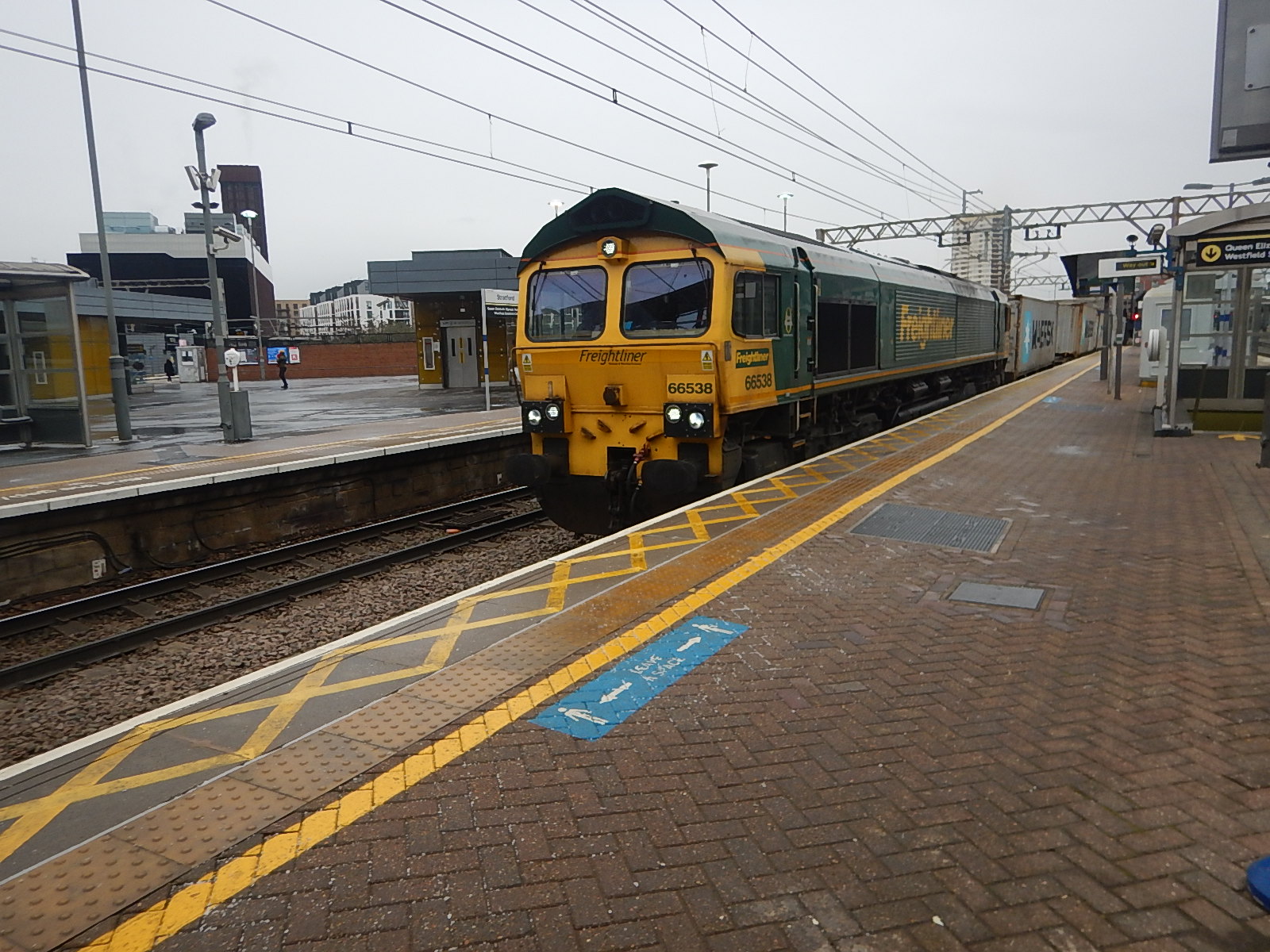
As they have an electric transmission, the 2 MW diesel engine could be fairly easily changed for a hydrogen fuel-cell of an appropriate size.
Sail Into The Future In Style With Super-Realistic Virtual Tour Of The New Mersey Ferry
The title of this post is the same as this page on the Liverpool Region web site.
These five bullet points act as sub-headings.
- Immersive, interactive VR tour offers stunning detail of new Mersey Ferry
- Vessel designed to reflect Mersey Ferries’ world-famous new vessel will feature event spaces, bars, bike storage and improved accessibility
- Offers world-class experience to passengers and unique, stylish venue for conferences and private events
- Built by Cammell Laird and part of £26m investment in modernising ferries
- Due to set sail in summer 2026
Good to see, that it will be a locally-built ferry.
The current ferries were there, when I first went to the city in the 1960s.
Click here to take a tour on the new vessel.
Will 2025 Be A Bumper Year For Solar?
The title of this post, is the same as that of a sub title of this this article on Solar Power Portal, which is entitled Two Solar NSIPs Granted Development Consent.
This is the sub heading of the main article.
The Department for Energy Security and Net Zero (DESNZ) has granted development consent orders (DCOs) to the Heckington Fen Solar and West Burton Solar solar PV power plants.
This paragraph, gives a brief description of the two projects.
The two developments, both located in Lincolnshire, England, are classified as Nationally Significant Infrastructure Developments (NSIPs) as their proposed generation capacity is over 50MW. Combined, the Heckington Fen Solar and West Burton Solar projects will have a generation capacity of almost 1GW.
But it was the prominent sub-title in the article, that prompted me to write this post.
These were the three paragraphs, the author used to answer their question.
This year so far has already seen significant movement on several large-scale solar projects, with more to come throughout 2025.
Last week, international renewable energy developer Ørsted announced proposals for a 320MW solar PV power plant in East Yorkshire, the Kingfisher Solar Farm, for which public consultations are set to begin on 3 February. Meanwhile, Elements Green has opened the second phase of statutory consultations for its 800MW Great North Road Solar and Biodiversity Park, which will run until 20 February.
Plans for another proposed 800MW development, EDF Renewables UK’s Springwell Solar Farm, will be examined by the planning inspectorate following the successful submission of a DCO application for the project.
I also wrote UK Solar Deployment Poised To Increase 50% YoY, Following Rapid Growth In The Second Half Of 2024, just over a week ago, where I predicted a large growth in steel aolar panels on industrial and architect-designed buildings.
Conclusion
There may be a lot of new solar power generated in the UK in 2025, but because some of it will be roof-mounted and structural, we won’t see as much as we have in the past.
How To Keep The Lights On When The Wind Doesn’t Blow
The title of this post, is the same as that of this article in The Times.
This is the sub-heading.
Britain came close to a blackout this month. Gas is being phased out and renewables are intermittent, so can energy storage stop us going dark?
These are the first two paragraphs.
It was 8.29pm on the first Tuesday in January when the alert was issued by the electricity control room. Freezing temperatures had coincided with unusually low wind speeds, and it was making the National Energy System Operator (Neso) jittery.
Engineers forecast a 1.6GW shortfall — the requirement for about 1.5 million homes — for a three-hour period from 4pm the following afternoon. “System operators are requested to notify Neso of any additional megawatt capacity,” the message said.
Luckily, the plea worked.
The article then goes on to describe the various technologies that are being deployed.
The article starts by talking about pumped storage hydroelectricity.
This paragraph gives a superb illustration about how things have changed in energy and energy storage in the UK in the last few decades.
In the past, when coal provided the bulk of British power, this system was used to meet fluctuating demand levels. But now it is also required to meet fluctuating supply levels from renewable sources. Martin Pibworth, chief commercial officer at SSE, started with the company as a trainee in 1998. “Back then, at our Foyers pumped storage plant [at Loch Ness] we would switch modes, from pumping to not pumping and back again, maybe 600 to 700 times a year. Last year we switched modes there 6,500 times. It’s an insight into how the market has changed and how much more flexibility is needed, and how responsive that has to be.”
We have to be more agile, with our handling of storage to back up the various methods of generation.
UK Solar Deployment Poised To Increase 50% YoY, Following Rapid Growth In The Second Half Of 2024
The title of this post, is the same as that of this article from Solar Power Portal.
This is the sub-heading.
Josh Cornes, analyst at Solar Media Market Research, looks at what 2025 might hold for the solar industry.
The first four paragraphs give some interesting statistics.
The UK is forecast to add between 3-3.5GWp-dc of capacity in 2025, just shy of the huge numbers seen in 2015 and huge growth on 2024.
The UK added around 2.3GWp-dc in 2024, exceeding original expectations with the help of a push in ground mounted projects toward the back end of the year. This equates to around 20% growth on the 1.9GW that was added in 2023.
Approximately 20% of the 2.3GW deployed in 2024 came from residential rooftop installations, continuing the boost in this sector, first highlighted by the near 200% year-on-year (YoY) increase from 2022 to 2023. Commercial rooftops also contributed 20% of installations in 2024 with a slight increase of 10% YoY.
Large-scale ground-mount installations in 2024 saw the largest growth, making up 60% of the annual capacity. This uptick has continued to be driven by projects with Contracts for Difference (CfD), with rounds AR4 and AR5, and even AR6, accounting for nearly 850MW of the 1.3GW added.
It is a well-written article, that should be read in full.
Summarising 2024
In 2024 solar installations broke down as follows.
- Ground-mounted -1.38 GW
- Residential rooftops – 0.46 GW
- Commercial rooftops – 0.46 GW
Which adds up to the total installed solar capacity of 2.3 GW.
3.5 GW of total solar is scheduled to be installed in 2025, which at that rate until the end of 2030 would add 21 GW of total solar power.
But the UK will get help from what I think is one of the best solar ideas, which surprisingly comes from The University of Swansea in Wales.
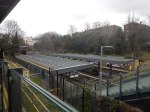
This Google Map shows the three large solar roof panels on Denmark Hill station in London.
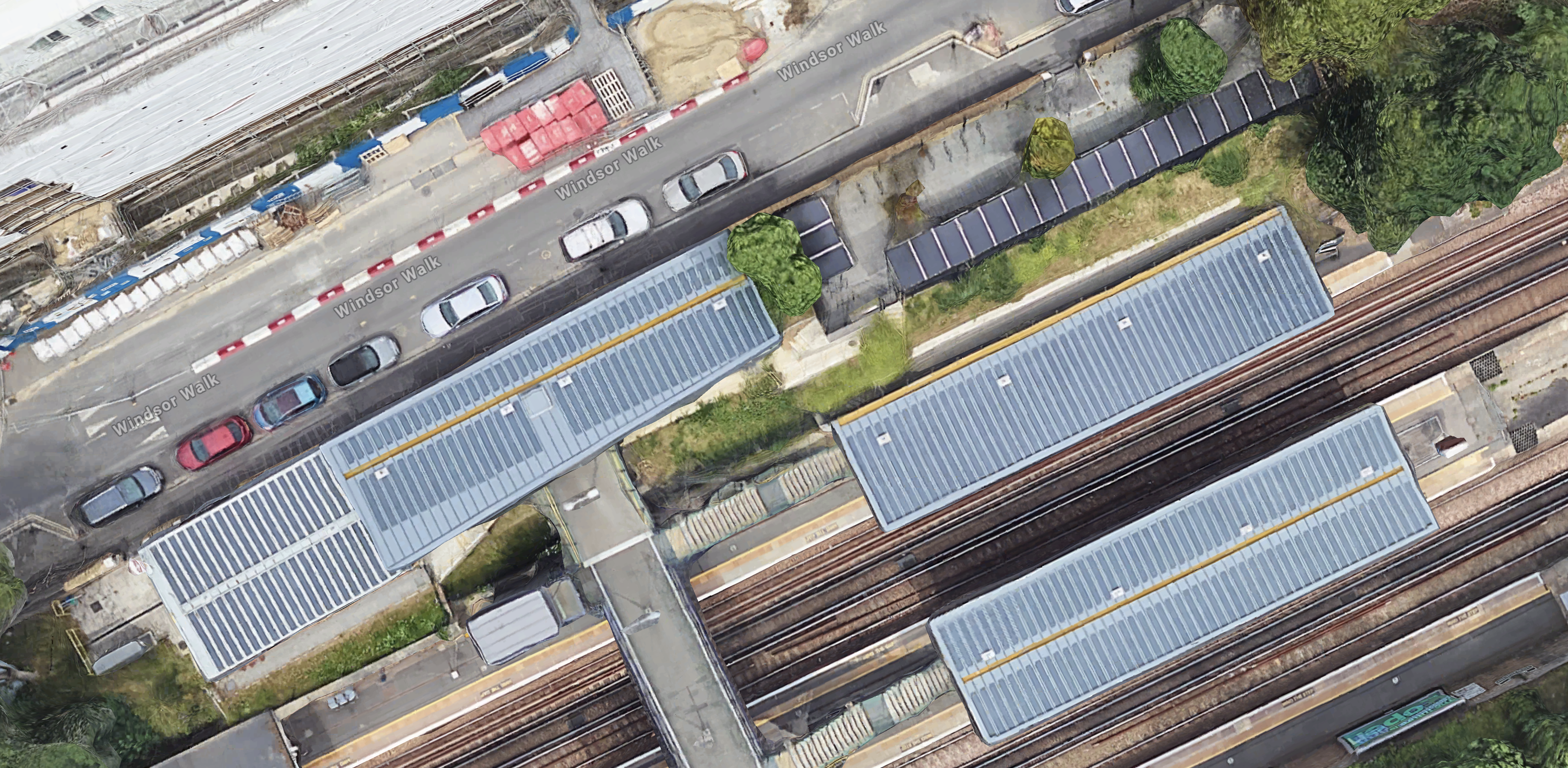
Note.
- The three large panels are flat.
- The panels are built on a steel substrate.
- Two provide shelter for three platforms.
- The third panel provides shelter for entering passengers.
These pictures show the panels from various angles.
















So often, a small improvement opens up a large opportunity.
This page on the Kalzip web site which is entitled Modernisation of Denmark Hill Station, gives more details of the station project.
Over the years, I put up a few steel-roofed buildings in my time and I helped design a few with a client in the 1970s, that could have benefited from solar panels like these.
Is FirstGroup’s Order For Fourteen Trains For Lumo And Hull Trains More Identical Than Is Generally Assumed?
Currently, Hull Trains operate Class 802 trains and Lumo operate Class 803 trains.
Both trains are five-car Hitachi A-Trains and appear to be similar in size, although there are other differences.
- Hull Trains have a two-class layout, whereas on Lumo everybody sits in the same class.
- Hull Trains are a true bi-mode with the 700 kW Rolls-Royce mtu diesel generators.
- Lumo only have a battery for emergency hotel power.
- Hull Trains currently operate a route, where up to a hundred miles in each round trip can be on diesel.
- Lumo’s current route is all electric.
However, the differences in train specification doesn’t stop the two operators using each other’s trains.
This is from an article in the November 2023 Edition of Modern Railways, that is entitled Extra Luggage Racks For Lumo.
The co-operation between sister East Coast mail line open access operators Lumo and Hull Trains continues, with one recent move, being the use of a Hull Trains ‘802’ on Lumo services to cover for a shortage of the dedicated ‘803s’ while one unit was out of action for repairs following a fatality. Although the two types are similar, there are notable differences, most obviously that the Hull Trains units are bi-modes while the Lumo sets are straight EMUs and a training conversion course is required for Lumo drivers on the ‘802s’. There are also challenges from a passenger-facing perspective – The Hull Trains units have around 20 % fewer seats and a First Class area.
A future Chief Executive of FirstGroup might at some future date decide to convert all trains to the same specification.
Drive Systems Of The Five-Car Class 80x Trains
I’m writing them down for all the five-car Class 80x trains to make it easier to understand.
- Class 800 train – DPTS–MS-MS-MC–DPTF – (LNER) 3 x 560 kW or (GWR) 3 x 700 kW diesel generators.
- Class 801 train – DPTS–MS-MS-MC–DPTF – 1 x 560 kW diesel generators
- Class 802 train – DPTS–MS-MS-MC–DPTF – (LNER) 3 x 700 kW diesel generators.
- Class 803 train – DPTS–MS-MS-MS–DPTF
- Class 805 train – DPTS–MS-MS-MC–DPTF – 3 x 700 kW diesel generators.
- Class 810 train – DPTS–MS-MS-MC–DPTF – 4 x 735 kW diesel generators.
Note.
- All these five-car trains have the same drive configuration.
- Traction motors are on cars 2 and 4.
- Trains with one diesel generators have them under car 3.
- Trains with three diesel generators have them under cars 2/3/4.
- Trains with four diesel generators have them under cars 1/2/4/5.
- The traction battery in the Class 802 battery-electric test train was 750 kW, according to The Data Sheet For Hitachi Battery Electric Trains.
It is all a very balanced design.
A Standard Basic Train For Hull Trains And Lumo
This may be possible and could be the following.
- A Class 802 or Class 803 train to the latest specification.
- Five cars.
- Interior to the customers specification.
- Ability to work in pairs.
- A standard size traction battery in car 3.
The battery could be changed according to route.
- Carmarthen – 75.3 miles – See Thoughts On Lumo’s Proposed Paddington And Carmarthen Service.
- Edinburgh – 100 miles – To cover the Lincolnshire Diversion.
- Hull – 100 miles – To cover the Lincolnshire Diversion.
- Paignton – 128.2 miles – See Thoughts On Lumo’s Proposed Paddington And Paignton Service.
- Rochdale – 100 miles to cover reverse at Rochdale.
- Sheffield – 100 miles – To cover Retford and Sheffield both ways.
- Stirling – Possibly no batteries required.
I can see a battery range of 100 miles covering most routes.
There could be two or three batteries close together in cars 2, 3 and 4, driving the traction motors in cars 2 and 4 and being charged by them.
These are my thoughts on individual Hull Trains and Lumo routes.
Beverley And Hull
In Could Hull Station Be Electrified?, I put forward my view that if Hull station were to be electrified, it opens up various possibilities of running battery-electric trains to Hull and Beverley.
Hull Trains services would charge the battery, every time they went through Hull station.
Distances needed on battery power to electrification would be.
- Beverley – 16.7 miles for return trip.
- Bridlington – 31.1 miles
- Doncaster – 40.8 miles
- Scarborough – 53.8 miles
- Temple Hirst – 36.1 miles
Except for Scarborough, a single battery would probably suffice.
Beverley and Hull are handled without a battery at present, but Hull Trains might like to carry sufficient power in batteries to be able to handle the Lincoln Diversion.
Carmarthen
Cardiff and Carmarthen via Gowerton is 75.3 miles, which probably means two batteries would be needed.
See Thoughts On Lumo’s Proposed Paddington And Carmarthen Service, for more details.
Edinburgh
Edinburgh is handled without a battery at present, but Lumo might like to carry sufficient power in batteries to be able to handle the Lincoln Diversion.
Paignton
Paignton is the longest route at 128.2 miles and I doubt, it would be talked about if it wasn’t technically possibly.
See Thoughts On Lumo’s Proposed Paddington And Paignton Service, for more details.
Rochdale
Sheffield
Stirling
Stirling could be handled without a battery, but Lumo might like to carry sufficient power in batteries to be able to handle a small diversion.
Petition Calls Made To Scrap Blackwall And Silvertown Tolls
The title of this post, is the same as that of this article on the BBC.
This is the sub-heading.
A petition containing more than 37,000 signatures calling for proposed tolls on the Blackwall and Silvertown tunnels to be scrapped has been presented at City Hall.
These four paragraphs give more details.
Toll charges of up to £4 per journey through the soon-to-open Silvertown Tunnel and the neighbouring Blackwall Tunnel were announced by Transport for London (TfL) on 26 November.
The Silvertown Tunnel will open next spring and will provide a new road crossing under the Thames between Silvertown and the Greenwich Peninsula.
The charges are “designed to manage levels of traffic using the tunnels”, TfL has said.
A TfL spokesperson added that without the tolls, “traffic would increase in both tunnels causing delays and congestion, which contribute to poorer air quality”.
Note.
- 37,000 is a large petition.
- If Transport for London wanted to reduce pollution, they could encourage greater use of hydrogen.
I have done some simple modeling using Excel.
- There are six vehicle crossings; Dartford Bridge, Dartford Crossing, Woolwich Ferry, Silvertown Tunnel, Blackwall Tunnel and Rotherhithe Tunnel.
- Matters are complicated by each crossing being a different size.
- There are several reliable rail crossings and a number of foot crossings, which offer alternatives, for those travellers on foot.
- Currently the worst disruption occurs, when more than one route is out of action at the same time.
It is a very complex river crossing,
I feel strongly that we aren’t going to get a true picture of traffic flow through the two new tunnels, until we see serious disruption on the Dartford Crossing.
But what worries me most, is that in the last few years, TfL have made decisions, where they must have done extensive mathematical modelling and they seem to have come up with answers, that are wide of the mark.
Congestion Prediction
I believe that we now have enough data, that by the use of modern computing, advanced vehicle detection techniques and a liberal dollop of artificial intelligence we should be able to accurately predict the traffic flow over the Thames between Dartford and Silvertown, better than we have done in the past.
But will this just mean, that everybody just takes the least-congested route?
 The Anonymous Widower