Angus Peter Campbell: I’m In Two Minds About The Renewable Energy Revolution
The title of the post, is the same as that of this article in the Aberdeen Press and Journal.
This is the sub-heading.
The debate (argument) between development and environmentalism is as old as the hills.
In the article, Campbell puts all sides of the arguments over the Coire Glas pumped storage hydro-electric scheme, and the article is very much a must read.
I feel that this 1500 MW/30 GWh scheme should be built, as like Hinckley Point C and Sizewell C, it takes a large bite out of the new energy storage capacity that is needed.
But if we do build this large project, we should think very hard about how we do it.
These are a few thoughts.
Low Carbon, Disturbance And Noise During Construction
High Speed Two are doing this and I wrote about it in HS2 Smashes Carbon Target.
I do subject though, that increasingly large construction projects can go this way.
Electric Trucks, Cranes And Other Equipment
High Speed Two and big mining companies are increasingly using electric mining trucks, cranes and other equipment.
As this sort of equipment, also provides a better environment for workers, I suspect we’ll see more electric equipment.
Hydrogen Trucks And Construction Equipment
Hydrogen could play a big part and rightly so.
It is ideal for heavier equipment and one of its biggest advocates and developers is JCB.
I wouldn’t be surprised to see a decision about an onsite electrolyser being made soon.
Low Carbon Concrete
There are various methods of making low- and zero-carbon concrete, some of which incorporate carbon dioxide into the material.
Use Of Loch Lochy And The Caledonian Canal
I wouldn’t be surprised if just as the Thames in London was used in the construction of Crossrail and the Northern Line extension, Loch Lochy and The Caledonian Canal will be used to take out construction spoil.
There’s certainly a lot of ways to be innovative in the movement of men and materials.
Conclusion
The construction of Coire Glas will make an epic documentary.
Highview Power And Ørsted Collaborate To Unlock Greater Value From The Next Generation Of Wind Farms
The title of this post, is the same as that of this press release from Ørsted.
This is the sub-heading.
Highview Power and Ørsted have signed a Memorandum of Understanding aiming to prove the feasibility and economic value of co-locating long duration energy storage with offshore wind.
This first paragraph indicates how the two companies will work together.
The two companies will carry out detailed technical analysis and an economic assessment during 2023 that will investigate how combining Ørsted’s wind technology with Highview Power’s liquid air energy storage can deliver a stronger investment case for future offshore wind projects by reducing wind curtailment, increasing productivity, and helping the move to a more flexible, resilient zero carbon grid.
This all good stuff and as a Control Engineer, I know, there is a very good chance, it will bring forward worthwhile benefits.
Centrica And UK Infrastructure Bank Announce Significant Investment Into Sustainable Electricity Funds
The title of this post is the same as that of this press release from Centrica.
This is the sub-heading.
Funds set to help supercharge UK’s transition to cleaner, greener energy
These four paragraphs outline the investment.
Centrica and UK Infrastructure Bank have today announced they are investing up to £265 million in sustainable energy storage to help drive the country’s transition to a cleaner, greener and more resilient electricity network.
The proposed investment will support the development of new energy storage, following the Bank’s expression of interest to find innovative ways to fund and increase the nation’s storage capacity.
The Bank will invest £75 million on a match funding basis into the Gresham House Secure Income Renewable Energy & Storage LP (SIRES) alongside a £65 million investment from Centrica.
UK infrastructure Bank has committed to invest £125 million on a match-funding basis into Equitix UK Electricity Storage Fund.
Note.
- Centrica describes itself on its web site, as an energy services and solutions company.
- The Wikipedia entry for the UK Infrastructure Bank, says it is a British state-owned development bank.
- The Equitix web site has a mission statement sating it is a responsible investor, investing in, developing and managing global infrastructure assets, which materially contribute to the lives of the communities they serve.
By supporting two energy storage funds, it is to be hoped that more electricity storage is added to the UK electricity network.
This is a paragraph in the press release.
Currently National Grid forecasts show that up to 29 GW of total storage could be needed by 2030 and up to 51 GW by 2050. This is a huge increase on the 5 GW currently available and means there is a clear need to accelerate deployment of capital and investment in new storage projects.
I doubt there will be any problems deploying new energy storage.
The press release then has a paragraph on what each fund will do with the money.
Gresham House Secure Income Renewable Energy & Storage LP (SIRES)
I will pick these important points from the paragraph.
- Centrica and the UK Investment Bank will invest on a matched funding basis.
- Centrica will be a cornerstone investor, and this marks the first time the business has invested in such a fund.
- Collocation of renewable generation and short duration electricity storage facilities to help maximise grid connections.
- The seed asset will be a collocated solar and battery energy storage project in Hartlepool, County Durham, with 50 MWp solar capacity and 75 MWh of battery energy storage.
- Centrica will seek to provide a route-to-market for the assets in the fund once they become operational.
You could almost consider this a When the wind doesn’t blow and the sun doesn’t shine fund.
Equitix UK Electricity Storage Fund
I will pick these important points from the paragraph.
- The Bank will support the launch of the fund by committing to invest up to £125million on a match-funding basis.
- The fund will focus on a combination of innovative business models across both short and long duration storage. Short duration strategies may include installation in households and at underutilised commercial premises, as well as co-location.
- The fund will also aim to deploy a range of long duration storage technologies, such as pumped-hydro.
Does a range of technologies mean that they will support new storage technologies?
Hulam Farm, Hartlepool
This page on the Lightsource-BP web site is entitled Proposed Solar Installation At Hulam Farm.
This is the first paragraph.
The proposal involves Lightsource bp funding the development of a solar installation that will connect into the local electricity network, with an output power capacity of 49.9MW (Megawatts).
Could this be the solar part of the Hartlepool project mentioned in the press release?
- Lightsource BP are experienced funders of solar farms.
- Gresham House have built many batteries of the size needed.
- I don’t think technically, there will be too many problems.
I shall watch this development with interest.
What’s In It For Centrica?
I have to ask this question.
Consider.
- Centrica is part-owner of the 270 MW Lincs offshore wind farm, which was commissioned in September 2013.
- Centrica is half-owner of the 194 MW Lynn and Inner Dowsing wind farm, which was commissioned in March 2009.
- Both these wind farms have separate substations in Lincolnshire.
- Centrica also have interests in two onshore wind farms in Scotland, that have a combined capacity of 98 MW.
I wonder how many times these wind farms have been shut down because of too much electricity?
Will Gresham House pit batteries on these sites?
Gravity Energy Storage For Cleaner Power Grids!
The title of this post, is the same as that of this article on Energy Live News.
This is the sub-heading.
Scotland’s Gravitricity has teamed up with a Czech electricity flexibility company to bring their gravity storage technology to market
These two paragraphs introduce the article.
Scottish firm Gravitricity has partnered with Czech energy flexibility aggregator Nano Energies to commercialize their gravity storage technology.
The partnership plans to convert an old mine shaft in the Czech Republic into a gravity energy store, which can rapidly respond to grid fluctuations and could be a pioneer for European projects.
Gravitricity seems to be on its way.
£100m Boost For Biggest UK Hydro Scheme In Decades
The title of this post, is the same as that of this article on the BBC.
This is the sub-heading.
A giant hydro scheme which would double the UK’s ability to store energy for long periods is taking a leap forward with a £100m investment by SSE.
These are the first three paragraphs.
The proposed 92m-high dam and two reservoirs at Coire Glas in the Highlands would be Britain’s biggest hydroelectric project for 40 years.
Scottish ministers approved the 1.5 GW pumped storage facility in 2020.
But power giant SSE wants assurances from the UK government before finally signing it off.
There are two major problems with this scheme.
Why The Forty Year Wait?
I am an Electrical and Control Engineer and it is a scandal that we are waiting forty years for another pumped storage scheme like the successful Electric Mountain or Cruachan power stations to arrive.
Petrol or diesel vehicles have batteries for these three main purposes.
- To start the engine.
- To stabilise the output of the generator or alternator.
- To provide emergency power.
As to the latter, I can’t be the only person, who has dragged a car out of a ford on the starter motor. But think of the times, you’ve used the hazard warning lights, after an accident or an engine failure.
The nightmare of any operator of a complicated electricity network like the UK’s is a black start, which is defined by Wikipedia like this.
A black start is the process of restoring an electric power station or a part of an electric grid to operation without relying on the external electric power transmission network to recover from a total or partial shutdown.
Hydro electric power stations and especially those that are part of pumped storage schemes are ideal for providing the initial power, as they are often easy to start and have water available. Cruachan power station has a black start capability, but at 440 MW is it big enough?
Over the last few years, many lithium-ion batteries have been added to the UK power network, which are used to stabilise the grid, when the sun isn’t shining and the wind isn’t blowing.
There are four pumped storage hydro-electric schemes in the UK.
- Cruachan – 440 MW/7 GWh – 1965
- Dinorwig (Electric Mountain) – 1800 MW/9.1 GWh -1984
- Ffestiniog – 360MW/1.44 GWh – 1963
- Foyers – 300 MW/6.3 GWh – 1974
Note.
- I always give the power output and the storage capacity for a battery, if it is known.
- According to Wikipedia, Scotland has a potential for around 500 GWh of pumped storage.
- The largest lithium-ion battery that I know, that is being planned in the UK, is Intergen’s 320 MW/640 MWh battery at Thames Gateway, that I wrote about in Giant Batteries Will Provide Surge Of Electricity Storage. It’s smaller than any of the four current pumped storage schemes.
- The Wikipedia entry for Coire Glas says that it is a 1.5 GW/30 GWh pumped storage hydro-electric power station.
I very much feel that even one 1.5 GW/30 GWh pumped storage hydro-electric power station must make a big difference mathematically.
Why have we had to wait so long? It’s not as though a pumped storage hydro-electric power station of this size has suffered a serious disaster.
Drax Needs Assurances Too?
The BBC article says this.
Scotland’s only other pumped storage scheme, operated by Drax Group, is housed within a giant artificial cavern inside Ben Cruachan on the shores of Loch Awe in Argyll.
The North Yorkshire-based company plans to more than double the generating capacity of its facility, nicknamed Hollow Mountain, to more than 1GW, with the construction of a new underground power station.
But both Drax and SSE have been reluctant to press ahead without assurances from Whitehall.
It looks like the right assurances would open up at least two pumped storage hydro-electric power station projects.
But it could be better than that, as there are other projects under development.
- Balliemeanoch – 1.5GW/45 GWh
- Corrievarkie – 600 MW/14.5 GWh
- Loch Earba – 900 MW/33 GWh
- Loch Kemp – 300 MW/9 GWh
- Red John – 450 MW/2.8 GWh
This totals to 3750 MW/104.3 GWh or 5850 MW/134.3 GWh with the addition of Coire Glas and the extension to Cruachan.
Getting the assurances right could result in large amounts of construction in Scotland!
What Assurances Do Power Giants SSE And Drax Want Before Signing Off?
This news item on SSE Renewables, which is dated 18th March 2022, is entitled Ministerial Roundtable Seeks To Unlock Investment In UK Energy Storage.
These three paragraphs gives details of the meeting.
Business leaders have met with UK Energy Minister the Rt Hon Greg Hands MP to discuss how the government could unlock significant investment in vital energy storage technologies needed to decarbonise the power sector and help ensure greater energy independence.
The meeting was organised by the Long-Duration Electricity Storage Alliance, a new association of companies, progressing plans across a range of technologies to be first of their kind to be developed in the UK for decades.
Representatives from Drax, SSE Renewables, Highview Power and Invinity Energy Systems met with The Rt Hon Greg Hands MP, Minister of State for Business, Energy and Clean Growth [yesterday].
But they still don’t seem to have come up with a funding mechanism.
- In this case, it seems that multiple politicians may not be to blame, as Greg Hands was the Minister of State for Business, Energy and Clean Growth until the 6th of September 2022, when he handed over to Graham Stuart, who is still the incumbent.
- Could it be that civil servants for this problem need to be augmented by a Control Engineer with mathematical modelling skills from a practical university?
It is the sort of problem, I would love to get my teeth into, but unfortunately my three mentors in accountancy and banking; Bob, Brian and David, who could have helped me, have all passed on to another place to help someone else with their problems.
I’ve just had a virtual meeting with all three and they told me to look at it like a warehousing system.
Consider.
- It would be very easy to measure the amount of water stored in the upper reservoir of a pumped storage hydro-electric power station.
- It would also be easy to measure the electricity flows to and from the pumped storage hydro-electric power station.
- A monetary value could be placed on the water in the upper reservoir and the flows, depending on the current price for electricity.
So it should be possible to know that a pumped storage hydro-electric power station, was perhaps storing energy as follows.
- 10 GWh for SSE
- 8 GWh for RWE
- 6 GWh for Scottish Power
- 6 GWh is not being used
And just as in a warehouse, they would pay a fee of so much for storing each GWh for an hour.
- The system would work with any type of storage.
- Would competition between the various storage sites bring down prices for storing electricity?
- Pumped storage operators would get a bonus when it rained heavily.
- Just as they do now, electricity generators would store it when prices are low and retrieve it when prices are high.
A lot of the rules used to decide where electricity goes would still work.
Hydro-Storage Options To Be Studied For Grängesberg
The title of this post, is the same as that of this news item from Anglesey Mining.
These are the highlights of the news item.
- Anglesey Mining plc, together with its 49.75% owned subsidiary Grängesberg Iron AB (“GIAB”) have entered into an MoU with Mine Storage to investigate the potential for the Grängesberg Mine to be converted into a Pumped Hydro-Storage project at the end of the mine’s producing life.
- Pumped-Hydro Storage is a green-energy storage solution that utilises water and gravity to store electrical energy. An underground mine can provide a closed-loop solution using proven, pumped hydro-power technology. Essentially, the system involves water being gravity fed through pipes down a shaft into the turbines, which produce electricity for supply to the grid and also pump the water back to surface. The mine storage system has a high round-trip efficiency of 75-85% and proven durability.
- The MoU with Mine Storage could lead to numerous future benefits.
I like this project.
Too often, when mines, quarries or other large operations come to the end of their economic lives, they are just abandoned in the hope that something worthwhile will happen.
But here we have a company planning the end of an iron ore mine in a way that will turn it into a source of future revenue.
I have a few thoughts.
Mine Storage
Mine Storage are a Swedish company with an informative web site.
The web site answered most of my questions.
Mines Are Moving From a Liability To A Resource
Consider.
- Gravitricity are using mines to store energy using cables and weights.
- Charlotte Adams and her team at Durham University are developing the use of the heat in abandoned coal mines.
- The Global Centre of Rail Excellence is being developed in a disused opencast mine in Wales.
- RheEnergise are developing their first High Density Hydro system in the Hemerdon Tungsten Mine in Devon.
And now we have this co-operation between Anglesey Mining and Mine Storage working together on pumped storage hydroelectricity.
Where is Grängesberg
This Google Map shows the location of Grängesberg.
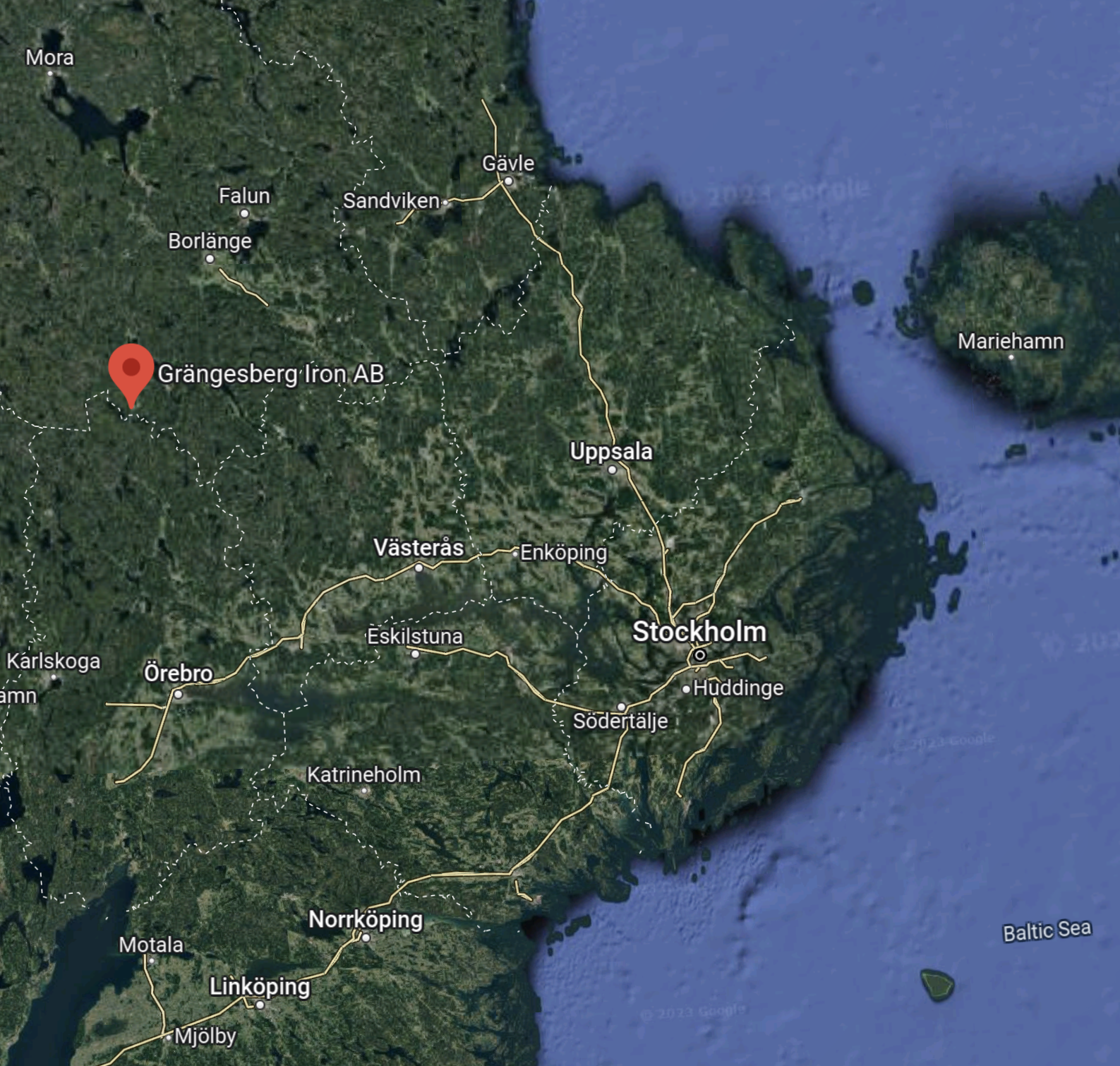
It is convenient for storing energy for Stockholm.
Scottish Hydrogen Fuel Tank – SHyFT
The title of this post, is the same as that of this page on the Innovatus Technologies web site.
This is the sub-heading.
Advanced Flexible Form Factor and Lightweight Multi-Chamber Type IV & V Hydrogen Storage Vessel
These paragraphs outline the product.
SHyFT is a unique Type IV or V composite high-pressure vessel unlike conventional large, heavyweight cylindrical vessels. The unique multi-chamber composite design, aided by patented composite technology and recyclable materials, allows for SHyFT to conform to any form factor specific to our customers needs.
SHyFT’s largest model boasts the worlds highest Gravimetric Storage Density of 10%, allowing 5.4 KG of hydrogen storage. This is a significant 10% increase on current market leaders in composite storage of gaseous substances.
The core composite technology drives a 25%+ weight and 20%+ cost reduction, whilst providing superior quality and technical performance for a more efficient and economical product. With SHyFT, various market applications such as commercial, personal and industrial transport, Marine and UAV, can be easily dominated creating a higher value proposition for our customers.
As with other companies in the past, like Pilkingtons, Rolls-Royce and Skeleton Technologies, who have developed a unique product, I suspect that the key is a special purpose machine that makes the tanks. I have two friends in Cambridge, who specialise in making unusual manufacturing machines and they are very busy.
I first came across this company as they are named in the Wikipedia entry for Project Fresson, which is a part-Scottish project to create a hydrogen-powered Islander aircraft.

Innovatus Technologies are building the composite hydrogen fuel tanks. Two, which are coloured green, appear to be mounted below the wings and there could be others inside the fuselage.
This company could solve one the major problems with hydrogen applications – How to cram in enough of the gas to make the application possible!
Conclusion
I predict a big future for this company, unless the Chinese or other idea-stealers ruin the market.
Drax Moves Forward With 600MW Scottish Hydro Scheme
The title of this post, is the same as that of this article on reNEWS.BIZ.
This is the sub-heading.
Studio Pietrangeli has been appointed as owner’s engineer for the project
It looks like this 600 MW project, which will turn Drax’s 440 MW pumped storage hydroelectric power station into 1 GW power station, is finally on its way.
Reading about this project on the Internet, there are still some hurdles to be overcome before the power station is upgraded.
- Planning permission is needed.
- Both the UK and Scottish Governments need to give permission.
- Argyle and Bute Council are not totally behind the project.
My view as a Control Engineer, is that we need it to help balance the grid and allow wind power to play its full part.
SSE Thermal Outlines Its Vision For The UK’s Net Zero Transition
The title of this post is the same as that of this news item from SSE Thermal.
This is the opening statement.
SSE Thermal, part of SSE plc, is calling on government to turbocharge the delivery of low-carbon technologies to help deliver a net zero power system by 2035.
Two paragraphs then outline what the company is doing.
The low-carbon developer is bringing forward multiple low-carbon projects across the UK. This includes Keadby 3 Carbon Capture Power Station in the Humber – which is being developed in collaboration with Equinor and recently became the first power CCS project in the country to receive planning permission – and Aldbrough Hydrogen Pathfinder, which would unite hydrogen production, storage and power generation in one location by the middle of this decade.
These projects would form part of SSE’s £24bn investment programme in the UK, and in addition to supporting the decarbonisation of industrial heartlands and powering a low-carbon future, they would also help to secure a just transition for workers and communities.
The news item then talks about the future.
Now, SSE Thermal has published ‘A vision for the UK’s net zero transition’ which outlines the need for these low-carbon technologies and the potential of carbon capture and hydrogen in providing flexible back-up to renewables.
It also outlines the steps Government should take to facilitate this:
- Progress the deployment of carbon capture and storage (CCS) and hydrogen infrastructure in a minimum of four industrial areas by 2030.
- Support first-of-a-kind carbon capture and storage and hydrogen projects to investment decisions before the end of next year.
- Increase its ambition for power CCS to 7-9GW by 2030, with regular auctions for Dispatchable Power Agreements.
- Set out a policy ambition for hydrogen in the power sector and a strategy for delivering at least 8GW of hydrogen-capable power stations by 2030.
- Accelerate the delivery of business models for hydrogen transport and storage infrastructure, to kickstart the hydrogen economy.
These are my thoughts.
Carbon Capture And Use
There is no mention of Carbon Capture And Use, which in my view, should go hand in hand with Carbon Capture And Storage.
- Sensible uses for carbon dioxide include.
- Feeding it to plants like tomatoes, flowers, salad vegetables, soft fruit and herbs in greenhouses.
- Mineral Carbonation International can convert a dirty carbon dioxide stream into building products like blocks and plasterboard.
- Deep Branch, which is a spin-out from Nottingham University, can use the carbon dioxide to make animal feed.
- Companies like CarbonCure add controlled amounts of carbon dioxide to ready-mixed concrete to make better concrete and bury carbon dioxide for ever.
Surely, the more carbon dioxide that can be used, the less that needs to be moved to expensive storage.
Note.
- There is a lot of carbon dioxide produced in Lincolnshire, where there are a lot of greenhouses.
- At least three of these ideas have been developed by quality research in Universities, in the UK, Australia and Canada.
- I believe that in the future more uses for carbon dioxide will be developed.
The Government should do the following.
- Support research on carbon capture.
- Support Research on finding more uses for carbon dioxide.
Should there be a disposal premium or tax credit paid to companies, for every tonne of carbon dioxide used in their processes? It might accelerate some innovative ideas!
Can We Increase Power CCS to 7-9GW by 2030?
That figure of 7-9 GW, means that around a GW of CCS must be added to power stations every year.
Consider.
- It is probably easier to add CCS to a new-build power station, than one that is a couple of decades old.
- Better and more affordable methods of CCS would probably help.
- In Drax To Pilot More Pioneering New Carbon Capture Technology, I wrote about a promising spin-out from Nottingham University
- In Drax Secures £500,000 For Innovative Fuel Cell Carbon Capture Study, I wrote about another system at Drax, that captures carbon dioxide from the flue gases at Drax.
If we develop more ways of using the carbon dioxide, this will at least cut the cost of storage.
Can We Deliver At Least 8GW Of Hydrogen-Capable Power Stations By 2030?
Do SSE Thermal mean that these power stations will always run on hydrogen, or that they are gas-fired power stations, that can run on either natural gas of hydrogen?
In ‘A vision for the UK’s net zero transition’, this is said about the hydrogen power stations.
Using low-carbon hydrogen with zero carbon emissions at point of combustion, or blending hydrogen into existing stations.
So if these power stations were fitted with carbon capture and could run on any blend of fuel composed of hydrogen and/or natural gas, they would satisfy our needs for baseload gas-fired power generation.
Hydrogen Production And Storage
SSE’s vision document says this about Hydrogen Production.
Using excess renewables to create carbon-free hydrogen, alongside other forms of low-carbon hydrogen, which can then be stored and used to provide energy when needed.
SSE’s vision document also says this about Hydrogen Storage.
Converting existing underground salt caverns or creating new purpose-built caverns to store hydrogen and underpin the hydrogen economy.
This page on the SSE Thermal web site is entitled Aldbrough Has Storage, where this is said about storing hydrogen at Aldbrough.
In July 2021, SSE Thermal and Equinor announced plans to develop one of the world’s largest hydrogen storage facilities at the Aldbrough site. The facility could be storing low-carbon hydrogen as early as 2028.
With an initial expected capacity of at least 320GWh, Aldbrough Hydrogen Storage would be significantly larger than any hydrogen storage facility in operation in the world today. The Aldbrough site is ideally located to store the low-carbon hydrogen set to be produced and used in the Humber region.
From my own experience, I know there is a similar salt structure in Cheshire, which has also been used to store gas.
Earlier, I said, that one of the things, that SSE would like the Government to do is.
Progress the deployment of carbon capture and storage (CCS) and hydrogen infrastructure in a minimum of four industrial areas by 2030.
If Cheshire and Humberside are two sites, where are the other two?
Deciding What Fuel To Use
If you take the Humberside site, it can provide electricity to the grid in three ways.
- Direct from the offshore and onshore wind farms.
- Using natural gas in the gas-fired power stations.
- Using hydrogen in the gas-fired power stations.
SSE might even add a battery to give them a fourth source of power.
In the 1970s, I used dynamic programming with Allied Mills to get the flour mix right in their bread, with respect to quality, cost and what flour was available.
Finance For SSE Thermal Plans
The news item says this.
These projects would form part of SSE’s £24bn investment programme in the UK.
£24bn is not the sort of money you can realise solely from profits or in sock drawers or down sofas, but provided the numbers add up, these sorts of sums can be raised from City institutions.
Conclusion
I like SSE Thermal’s plans.
Plans To Turn Czech Coal Mine Into Storage, Hydrogen And Solar Hub
The title of this post, is the same as that of this article on Power Engineering International.
This is the sub-heading.
Mine is also going to be the site of an experimental greenhouse project called Eden Silesia
This paragraph outlines Eden Silesia.
The site will also be home to an experimental greenhouse project called EDEN Silesia, managed by the Silesian University of Technology and based on the concept of the Eden Project in Cornwall, England.
It does seem that the Czechs are creating a comprehensive facility around a Gravitricity energy store.
This Gravitricity system is only a 4MW/2 MWh system, but there is also this quote from the company.
Future multi-weight systems could have a capacity of 25MWh or more.
If the concept works, this could be imitated in several countries around the world?

