Alternative Energy Storage Technologies To Challenge Electrochemistry
The title of this post, is the same as that of this article on Battery and Energy Storage Magazine.
It gives a good summary of two energy storage system; Highview Power and Gravitricity, that I rate highly promising.
It also gives details of a Danish system called Stiesdal Storage Technologies, which is developing a hot rocks energy storage system.
The article says this about the system.
The pumped-heat ESS uses pea-sized crushed basalt, rock in insulated steel tanks with the stored energy released by turbine.
SST CEO Peder Riis Nickelsen said: “The cost of crushed stone is at a totally different level per unit of energy than practically any other material for energy storage. Our charging and discharging system can utilise well-known technologies that have been applied for a century within other industries and are well-suited for mass production.”
The cost of materials is estimated to be €10 ($12) per kWh.
The first demonstration project, a 1-2MW, 24h capacity unit, will be installed at a power plant in Denmark next year, and will operate commercially.
This page on the Striesdal web site, explains the technology.
It sounds like the system uses very similar principles to Siemens Gamesa ETES, with a different heat storage medium.
Conclusion
At my last count, there now appears to be upwards of half-a-dozen viable alternatives to chemical batteries and traditional pumped storage. Some of the technologies are also backed, by large companies, organisations and countries, who can afford to take a long-term view.
I hope those, who claim that renewables will never power the world, have at least got the recipe for the cooking of humble pie ready.
Gigawatt-Scale Compressed Air: World’s Largest Non-Hydro Energy-Storage Projects Announced
The title of this post, is the same as that of this article on Recharge.
This is the opening paragraph.
The two 500MW/5GWh ‘advanced’ compressed-air projects in California would each be bigger than the current record holder.
They are certainly not small. On the Electric Mountain scale of energy storage, they are both 55 %.
Both appear to be from Canadian company; Hydrostor and will be built in California.
This explanatory video is from the company.
It appears to be a rather elegant solution.
Like Highview Power, the system appears to be based on proven process technology, is zero-carbon, can be built almost anywhere and doesn’t require large amounts of land.
Hydrostor is definitely one to watch.
My only worry about both Hydrostor and Highview systems, is that countries, who don’t recognise patents and design copyrights could develop other systems based on similar physical principles.
Form Energy Discloses A Small Amount
Form Energy has been a bit mysterious, but this article on Energy Storage News, which is entitled Renewables As Baseload Energy: Form Energy’s Multi-Day |Storage Seeks To Replace Gas And Coal.
Form Energy certainly have large ambitions, backing from organisations like Bill Gates’ Breakthrough Energy Ventures and an order for a 1 MW/150 MWh pilot for Great River Energy in Minnesota, and I suspect this is probably enough to ensure success in the mid-size market sector, which they share with the UK’s Highview Power, who are building their first grid-scale 50 MW/ 250 MWh at Carrington to the South of Manchester.
The article is certainly an interesting insight into one of the new energy storage ventures.
Gravitricity Celebrates Success Of 250kW Energy Storage Demonstrator
The title of this post, is the same as that of this article on the Solar Power Portal.
I have already posted about this success in Gravitricity Battery Generates First Power At Edinburgh Site.
But the news story has now been mentioned in several respected publications and web sites.
So this idea, based on traditional Scottish products of heavy weights and girders seems to be getting valuable publicity.
The demonstrator is only small and uses two 25 tonne weights and a fifteen metre tower.
This is only a storage capacity of only 2.04 kWh, but the company is talking of weights totalling up to a massive 12,000 tonnes.
With a fifteen metre tower, that would be 490 kWh.
Note.
- The shafts at Kellingley Colliery in Yorkshire are 800 metres deep.
- The TauTona mine in South Africa is 3.9 kilometres deep
- In this article in The Engineer, Gravitricity talk about weights of up to 12,000 tonnes.
These are typical storage capacities.
- Kellingley – 50 tonnes – 109 kWh
- Kellingley – 12,000 tonnes – 26.15 MWh
- TauTona – 50 tonnes – 531 kWh
- TuaqTona = 12,000 – 127.5 MWh
Accountants before they invest in a company look at the financial figures. As an engineer, I look at the numbers in the science behind their claims.
If the engineering can be made to work, these figures are to say the least; very promising.
They are also beautifully scalable.
If say your application needed a 2 MWh battery and you had a 400 metre shaft available, you can calculate the weight needed. It’s around 1836 tonnes.
The Solar Power Portal article finishes with these two paragraphs.
The company will now look to rollout the technology in a series of full-scale 4-8MW projects, with conversations already underway with mine owners in the UK, Scandinavia, Poland and the Czech Republic, it said. Additionally, in South Africa Gravitricity is working closely with mine operator United Mining Services as part of a programme funded by an Innovate UK Energy Catalyst programme to identify potential schemes.
“A key feature of our full-scale projects will be their long life” added Blair. “Once built, our system can last for over 25 years, with no loss in output or degradation over time. This makes gravity storage cost-effective. And unlike batteries, we have no reliance on rare metals such as cobalt and nickel which are becoming increasingly scarce in the global drive to electrification.”
Note.
- I assume that they are 4-8 MWh projects.
- Charlie Blair is the Managing Director of Gravitricity.
- A weight of 1836 tonnes would give 4 MWh in the 800 metre shaft at Kellingley.
I wouldn’t be surprised that those owning a deep empty hole in the ground will be starting conversations with Gravitricity!
Conclusion
I am not worried, that I bought a few shares in Gravitricity in the crowd-funding last year!
All this good publicity from the BBC, Good News Network, Science, The Engineer, The Times and other media sites won’t harm my investment.
H2 And NH3 – The Perfect Marriage In A Carbon-Free Society
The title of this post, is the same as that of this article on The Chemical Engineer.
It is an article, which explains in detail, how we can use hydrogen and ammonia in the future.
MAN Energy Partners With Highview Power On Liquid-Air Energy-Storage Project
The title of this post, is the same as that of this article on Renewable Energy Magazine.
This is the introductory paragraph.
Highview Power, a leader in long duration energy storage solutions, has selected MAN Energy Solutions to provide its LAES turbomachinery solution to Highview Power for its CRYOBattery™ facility, a 50 MW liquid-air, energy-storage facility – with a minimum of 250MWh – located in Carrington Village, Greater Manchester , U.K.
The article is almost a word-for-word copy of this press release from MAN Energy Solutions, which has a similar title to this post and the Renewable Energy Magazine article.
As an Electrical Engineer who has done a lot of work in Project Management, I find these two paragraphs significant.
Construction will proceed in two phases. Phase 1 will involve the installation of a ‘stability island’, to provide near-instantaneous energy grid stabilisation. This will be achieved using a generator and flywheel, among other components. Enabling short-term stabilisation will provide the basis for Phase 2 and the completion of the more complex liquid air energy storage system that includes various compressors, air expanders and cryogenic equipment.
Phase 2 will represent the integration of stability services with a full-scale long-duration energy storage system, and in doing so promote the full integration of renewable energy. The Carrington project will offer a blueprint for future projects and cement the partnership between MAN Energy Solutions and Highview Power.
I first became acquainted with the use of flywheels to stabilise energy, when I was working in Enfield Rolling Mills as a vacation job at sixteen.
The centerpiece of their factory was a rolling mill, which took heated copper wirebars about two metres long amd ten centimetres square and rolled them into thick copper wire just a few millimetres in diameter. The mill was driven by a powerful electric motor, to which it was connected with a 97 tonne flywheel perhaps four metres in diameter in between. The flywheel spun at probably 3000 revolutions per minute.
The wirebar used to meander through the rolling mill several times and at each turn, the head would be caught by a man with a pair of tongs and turned back through the mill.
Each time the wire-bar went through a new pair of rolls the energy needed increased, as there was more rolling to do. So this extra energy was taken from the flywheel!
The rolling mill incidentally had been built by Krupp before the First World War. It still had the Krupp trademark of three interlocked railway tyres all over it. It had ended up in Enfield as reparations after the First World War. Enfield Rolling Mills added a fourth ring to create their own trademark.
It would appear that the kinetic energy of that flywheel could be as high as 1.6 MWh. Flywheels also react very fast.
Flywheel energy storage would appear to be a feasible intermediate energy store for this type of application.
I always remember Shimatovitch, who was the Chief Engineer of the company had jokingly once said that if the flywheel came off its bearings, it would have ended up a couple of miles away and would have demolished all the houses in its path. But he was a man with a dark sense of humour, who had spent most of the Second World War in a Nazi concentration camp.
Could it be that Phase 1 is the installation of a similar system to that I saw working in the 1960s, but upgraded with modern electronics, which exchanges power with the grid to create the stability island referred to in the press release.
In Phase 2 electricity can be passed to and from the CRYOBattery.
Looking at the MAN Energy Solutions web site, I suspect that they don’t care what sort of energy store they connect to the grid.
They would appear to be an excellent choice of engineering partner for Highview Power.
I also wonder how many other applications and customers, they will bring into the partnership.
Conclusion
This looks like a very sensible and low-risk strategy to connect the CRYOBattery to the grid.
Gravitricity Battery Generates First Power At Edinburgh Site
The title of this post, is the same as that of this article on the BBC.
This is the first paragraph.
A project to create electricity from gravity has generated its first power at a demonstrator site in Edinburgh.
This is only a demo to prove the technology, but all great oaks start as acorns.
I have great hopes for Gravitricity and I should declare an interest, as I bought a few shares in a crowdfunding.
Australian Coal Mine To Transform Into Pumped Hydro Facility
The title of this post, is the same as that of this article on PV Magazine.
This is the introductory paragraph.
Australian utility AGL is transforming its operations in a number of ways, from restructuring the company itself, to building energy storage facilities for flexible distribution of renewable energy into the future. The company is also planning to build a pumped-hydro facility at a disused open-cut coal mining site in eastern Australia.
It is an interesting proposition to say the least to reuse an opencast coal mine for something useful.
It would appear to be able to supple 250 MW for eight hours, which would make it a 2 GWh facility.
But then Australia is a country, that needs a lot of energy storage as they transform their economy to zero carbon.
Massless Energy Storage: The Next Step In Battery Technology
The title of this post, is the same as that of this article on AZOCleanTech.
This is the introductory paragraph.
In this environmentally conscious world, fossil fuels are being shunned in favor of renewables for electricity generation and transportation. Due to their periodic nature, excess energy generated by renewables is frequently stored in batteries. However, these often add extra weight to the cars and consumer electronics they power.
To solve the problem, researchers in Sweden have developed a structural battery.
Sounds like a good idea to me!
Tesla And PG&E Are Working On A Massive ‘Up To 1.1 GWh’ Powerpack Battery System
The title of this post, is the same as that of this article on electrek.
This is the first two paragraphs.
For the past few months, Tesla and CEO Elon Musk have been teasing a giant battery project that would dwarf even the company’s 129 MWh Powerpack project in Australia.
Today, we learn that Tesla is working with PG&E on a massive battery system with a capacity of “up to 1.1 GWh” in California.
It certainly, is a big lithium-ion battery.
- It will be able to provide 182.5 MW for four hours.
- It looks like it could be the largest lithium-ion battery in the world.
It is worth comparing with the Castaic Power Plant, which is also in California.
- This is a pumped storage plant.
- It can produce 1566 MW and has a capacity of 12470 MWh.
This Google Map shows the plant.
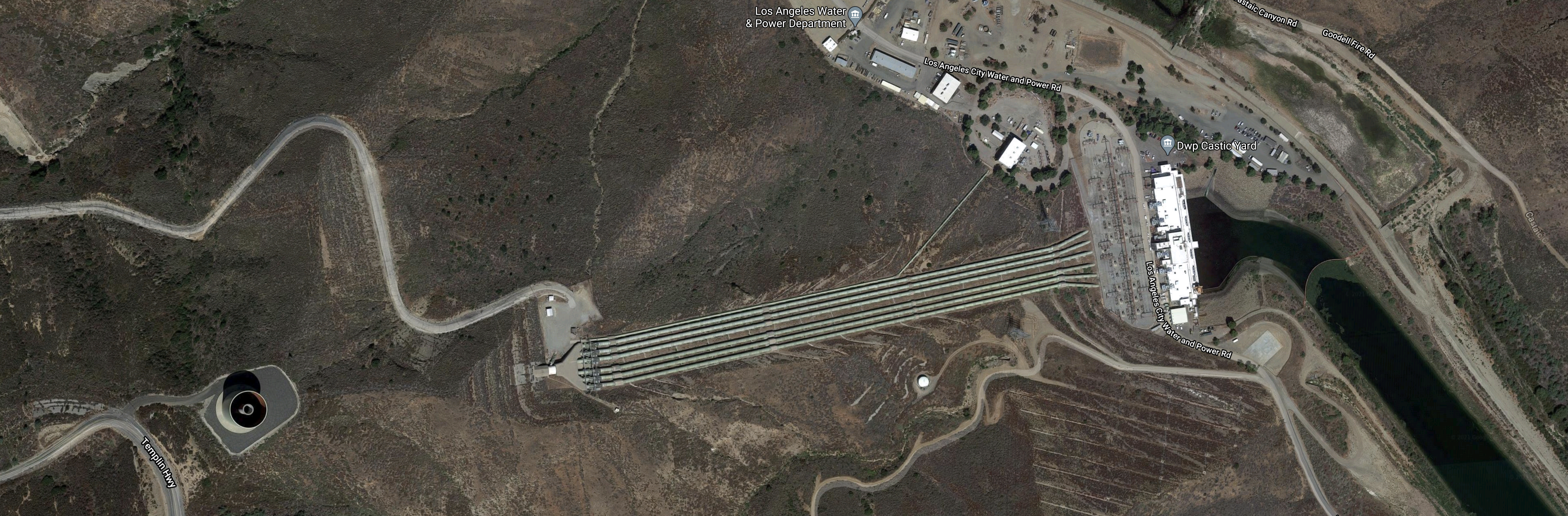
Note.
- The power plant is also part of the California State Water Project, which transfer water from North to South.
- The low-lake is Elderberry Forebay to the East.
- The high-lake is Pyramid Lake to the North.
It is a complicated system that includes the Angeles Tunnel, which takes water between Pyramid Lake and the Castaic power plant.
It cost a lot more than the 1.1 GWh battery, but it can generate a lot more power.
 The Anonymous Widower