Regenerative Braking On A Dual-Voltage Train
Yesterday, I found this document on the Railway People website, which is entitled Regenerative Braking On The Third Rail DC Network.
Although, the document dates from 2008, it is very informative.
Regenerative Braking On 25 KVAC Trains
The document says this.
For AC stock, incoming power from the National Grid at high voltage is stepped down by a transformer. The AC power is transmitted via OHL to the trains. When the train uses regenerative braking, the motor is used as a generator, so braking the axle and producing electrical energy. The generated power is then smoothed and conditioned by the train control system, stepped up by a transformer and returned to the outside world. Just about 100% of regenerated power is put back into the UK power system.
But I have read somewhere, that you need a 25 KVAC overhead electrification system with more expensive transformers to handle the returned electricity.
Regenerative Braking On 750 VDC Trains
The document says this.
After being imported from the National Grid, the power is stepped down and then AC power is rectified to DC before being transmitted via the 3rd rail. Regenerated Power can not be inverted, so a local load is required. The power has to be used within the railway network. It cannot be exported.
So the electricity, is usually turned into heat, if there is no train nearby.
The Solution That Was Applied
The document then explains what happened.
So, until such time as ATOC started to lobby for a change, regenerative DC braking was going nowhere. But when they did start, they soon got the backing of the DfT and Network Rail. It takes a real combined effort of all organisations to challenge the limiting assumptions.
In parallel, there were rolling stock developments. The point at which all the issues started to drop away was when the Infrastructure Engineers and Bombardier, helped out by some translating consultants (Booz & Company), started to understand that new trains are really quite clever beasts. These trains do understand what voltage the 3rd rail is at, and are able, without the need to use any complicated switch gear – just using software, to decide when to regenerate into the 3rd rail or alternatively, use the rheostatic resistors that are on the train.
Effectively, the trains can sense from the voltage if the extensive third-rail network can accept any more electricity and the train behaves accordingly.
As most of the electric units with regenerative braking at the time were Bombardier Electrostars, it probably wasn’t the most difficult of tasks to update most of the trains.
Some of the Class 455 trains have recently been updated. So these are now probably compatible with the power network. Do the new traction motors and associated systems use regenerative braking?
This document on the Vossloh-Kiepe web site is entitled Vossloh Kiepe enters Production Phase for SWTs Class 455 EMU Re-Tractioning at Eastleigh Depot and describes the updating of the trains. This is said.
The new IGBT Traction System provides a regenerative braking facility that uses the traction motors as generators when the train is braking. The electrical energy generated is fed back into the 750 V third rail DC supply and offsets the electrical demands of other trains on the same network. Tests have shown that the energy consumption can be reduced by between 10 per cent and 30 per cent, depending on conditions. With the increasing cost of energy, regenerative braking will have a massive positive cost impact on the long-term viability of these trains. If the supply is non-receptive to the regenerated power, the generated power is dissipated by the rheostatic brake.
So thirty-five year old British Rail trains now have a modern energy-saving traction system.
Has The Solution Worked On The Third-Rail Network?
The Railway People document goes on to outline how they solved various issues and judging by how little there is about regenerative braking on the third-rail network, I think we can assume it works well.
One Train, Two Systems
If you have a train that has to work on both the 25 KVAC and 750 VDC networks, as Thameslink and Southeastern Highspeed trains do, the trains must be able to handle regenerative braking on both networks.
So is there a better way, than having a separate system for each voltage?
In Do Class 800/801/802 Trains Use Batteries For Regenerative Braking?, I investigated how Hitachi’s new Class 800 trains handle regenerative braking.
A document on Hitachi’s web site provides this schematic of the traction system.

Note BC which is described as battery charger.
The regenerative braking energy from the traction motors could be distributed as follows.
- To provide power for the train’s services through the auxiliary power supply.
- To charge a battery.
- It could be returned to the overhead wires.
Hitachi’s system illustrates how using a battery to handle regenerative braking could be a very efficient way of running a train.
Hitachi’s diagram also includes a generator unit or diesel power-pack, so it could obviously fit a 750 VDC supply in addition to the 25 KVAC system on the Class 800 train.
So we have now have one train, with three power sources all handled by one system.
What Has Happened Since?
As the Hitachi document dates from 2014, I suspect Hitachi have moved on.
Siemens have produced the Class 700 train for Thameslink, which is described in this Siemens data sheet.
Regenerative braking is only mentioned in this sentence.
These new trains raise energy efficiency to new levels. But energy efficiency does not stop at regenerative braking.
This is just a bland marketing statement.
Bombardier are building the first batches of their new Aventra train, with some Class 345 trains in service and Class 710 trains about to enter testing.
Nothing has been said about how the trains handle regenerative braking.
But given that Bombardier have been experimenting with battery power for some time, I wouldn’t be surprised to see batteries involved.
They call their battery technology Primove and it has its own web site.
There is also this data sheet on the Bombardier web site.
Class 387 Trains
There is another train built by Bombardier, that is worth investigating.
The Class 387 train was the last and probably most advanced Electrostar.
- The trains have been built as dual-voltage trains.
- The trains have regenerative braking that works on both electrification types.
- They were built at around the time Bombardier were creating the Class 379 BEMU demonstrator.
- The trains use a sophisticated propulsion converter system called MITRAC, which is also used in their battery trams.
On my visit to Abbey Wood station, that I wrote about in Abbey Wood Station Opens, I got talking to a Gatwick Express driver about trains, planes and stations, as one does.
From what he said, I got the impression that the Class 387/2 trains, as used on Gatwick Express, have batteries and use them to keep the train and passengers comfortable, in case of an electrification failure.
So do these trains use a battery to handle the regenerative braking?
How Big Would Batteries Need To Be On A Train For Regenerative Braking?
I asked this question in a post with the same name in November 2016 and came to this conclusion.
I have a feeling that using batteries to handle regenerative braking on a train could be a very affordable proposition.
As time goes on, with the development of energy storage technology, the concept can only get more affordable.
Bombardier make a Primove battery with a capacity of 50 kWh, which is 180 mega-Joules.
So the braking energy of what mass of train could be stored in one of these batteries?
I got these figures.
- 100 mph – 180.14 tonnes.
- 110 mph – 148.88 tonnes.
What is the mass of a Class 387 train?
This is not available on the Internet but the mass of each car of a similar Class 378 train averages out at 32 tonnes.
Consider these points.
- A Class 387/2 train, has 219 seats, so if we assume each passenger and baggage weighs eighty kilograms, that adds up to 17.5 tonnes.
- As the Class 387 trains have a maximum speed of 100 mph on third-rail electrification, it would appear that a Primove 50 kWh battery could handle the braking energy.
- A Primove 50 battery with its controller weighs 827 Kg. according to the data sheet.
It all looks like using one of Bombardier’s Primove 50 batteries on a Class 387 train to handle the regenerative braking should be possible.
But would Bombardier’s MITRAC be able to use that battery power to drive the train in the most efficient manner? I suspect so!
If the traction layout is as I have outlined, it is not very different to the one published by Hitachi in 2014 on their web site for the Class 800 train.
Conclusion
Hitachi have got their traction layout right, as it can handle any number of power sources.
The Intelligent Multi-Mode Train And Affordable Electrification
Some would say we are at a crisis point in electrification, but I would prefer to call it a crossroads, where new techniques and clever automation will bring the benefits of electric traction to many more rail lines in the UK.
Lines That Need Electric Passenger Services
I could have said lines that need to be electrified, but that is probably a different question, as some lines like the Felixstowe Branch Line need to be electrified for freight purposes, but electric passenger services can be provided without full electrification.
Lines include.
- Ashford to Hastings.
- Borderlands Line.
- Caldervale Line from Preston to Leeds
- Camp Hill Line across Birmingham.
- Huddersfield Line from Manchester to Leeds via Huddersfield.
- Midland Main Line from Kettering to Derby, Nottingham and Sheffield.
- Uckfield Branch Line
There are many others, too numerous to mention.
What Is A Multi-Mode Train?
If a bi-mode train is both electric and diesel-powered, a multi-mode train will have at least three ways of moving.
The Intelligent Multi-Mode Train
The intelligent multi-mode train in its simplest form would be an electric train with these characteristics.
- Electric drive with regenerative braking.
- Diesel or hydrogen power-pack.
- Onboard energy storage to handle the energy generated by braking.
- 25 KVAC and/or 750 VDC operation.
- Automatic pantograph and third-rail shoe deployment.
- Automatic power source selection.
- The train would be designed for low energy use.
- Driver assistance system, so the train was driven safely, economically and to the timetable.
Note the amount of automation to ease the workload for the driver and run the train efficiently.
Onboard Energy Storage
I am sure that both the current Hitachi and Bombardier trains have been designed around energy storage. Certainly, there are several quotes from Bombardier executives that say so.
The first application will be to handle regenerative braking, so that energy can be stored on the train, rather than returned to the electrification.
Onboard energy storage is also important in modern electric trains for other reasons.
- Features like remote train wake-up can be enabled.
- Moving the train short distances in case of power failure.
- When Bombardier started developing the use of onboard energy storage, they stated that one reason was to reduce electrification in depots for reasons of safety.
Onboard energy storage will improve in several ways.
- The energy density will get higher, meaning lighter and smaller storage.
- The energy storage capacity will get higher, meaning greater range.
- The cost of energy storage will become more affordable.
- Energy storage will last longer before needing replacement.
- CAF use a supercapacitor to get fast response and a lithium-ion battery for good capacity.
We underestimate how energy storage will improve over the next few years at our peril.
Automatic Onboard Storage Management
The use of the energy storage will also be optimised for route, passenger load, performance and battery life by the trains automatic power source selection system.
Diesel Power Pack
A conventional diesel power pack to drive the train on lines without electrification.
As the train is electrically-driven, when running under diesel, regenerative braking can still be used, with the generated energy being stored onboard the train.
Hydrogen Power Pack
I believe that hydrogen could be used to generate the electricity required, as it is in some buses.
Operation Of The Multi-Mode Train
I’ve read somewhere that Greater Anglia intend to run their Class 755 trains using electricity, where electrification is available, even if it only for a short distance. This is enabled, by the ability of the train to be able to raise and lower the pantograph quickly and at line speed.
The train’s automatic power source selection will choose the most appropriate power source, from perhaps electrification, stored energy and diesel, based on route, load and the timetable.
Do Any Multi-Mode Trains Exist?
The nearest is probably the Class 800 train, which I believe uses onboard energy storage to handle regenerative braking, as I outlined in Do Class 800/801/802 Trains Use Batteries For Regenerative Braking?.
This article in RailNews is entitled Greater Anglia unveils the future with Stadler mock-up and says this.
The bi-mode Class 755s will offer three or four passenger vehicles, but will also include a short ‘power pack’ car to generate electricity when the trains are not under the wires. This vehicle will include a central aisle so that the cars on either side are not isolated. Greater Anglia said there are no plans to include batteries as a secondary back-up.
So does that mean that Class 755 trains don’t use onboard energy storage to handle regenerative braking?
At the present time, there is no bi-mode Bombardier Aventra.
But in Is A Bi-Mode Aventra A Silly Idea?, I link to an article on Christian Wolmar’s web site, which says that Bombardier are looking into a 125 mph bi-mode Aventra.
My technical brochure for the new Class 769 train, states that onboard energy storage is a possibility for that rebuild of a Class 319 train.
I don’t think it is a wild claim to say that within the next few years, a train will be launched that can run on electric, diesel and onboard stored power.
The Pause Of Electrification
Obviously, for many reasons, electrification of all railway lines is an ideal.
But there are problems.
- Some object to electrification gantries marching across the countryside and through historic stations.
- Network Rail seem to have a knack of delivering electrification late and over budget.
- The cost of raising bridges and other structures can make electrification very bad value for money.
It is for these and other reasons, that the Government is having second thoughts about the direction of electrification.
Is There A Plan?
I ask this question deliberately, as nothing has been disclosed.
But I suspect that not for the first time, the rolling stock engineers and designers seem to be getting the permanent way and electrification engineers out of trouble.
As far as anybody knows, the plan seems to be to do no more electrification and use bi-mode trains that can run under both electrification and diesel-power to provide new and improved services.
Use Of Bi-Mode Trains
Taking a Liverpool to Newcastle service, this would use the electrification to Manchester, around Leeds and on the East Coast Main Line, with diesel power on the unelectrified sections.
If we take a modern bi-mode train like a Class 800 train, some features of the train will help on this route.
- The pantograph can raise or lower as required at line speed.
- It is probably efficient to use the pantograph for short sections of electrification.
- Whether to use the pantograph is probably or certainly should be controlled automatically.
On this route the bi-mode will also be a great help on the fragile East Coast Main Line electrification.
Improving Bi-Mode Train Efficiency
Bi-mode trains may seem to be a solution.
However, as an electrical engineer, I believe that what we have at the moment is rather primitive compared to how the current crop of trains will develop.
Onboard Energy Storage
I said this earlier.
- I am sure that both the current Hitachi and Bombardier trains have been designed to use energy storage.
- CAF use a supercapacitor to get fast response and a lithium-ion battery for good capacity.
This is an extract from the the Wikipedia entry for supercapacitor.
They typically store 10 to 100 times more energy per unit volume or mass than electrolytic capacitors, can accept and deliver charge much faster than batteries, and tolerate many more charge and discharge cycles than rechargeable batteries.
Supercapacitors are used in applications requiring many rapid charge/discharge cycles rather than long term compact energy storage: within cars, buses, trains, cranes and elevators, where they are used for regenerative braking.
Pairing them with a traditional lithium-ion battery seems to be good engineering.
The most common large lithium-ion batteries in public transport use are those in hybrid buses. In London, there are a thousand New Routemaster buses each with a 75 kWh battery.
In the past, there has have been problems with the batteries on New Routemasters and other hybrid buses, but things have improved and I suspect there is a mountain of knowledge both in the UK and worldwide on how to build a reliable, affordable and safe lithium-ion battery in the 75-100 kWh range.
As on the New Routemaster the battery is squeezed under the stairs, these batteries are not massive and I suspect one or more could easily be fitted underneath the average passenger train.
Look at this picture of a Class 321 train.
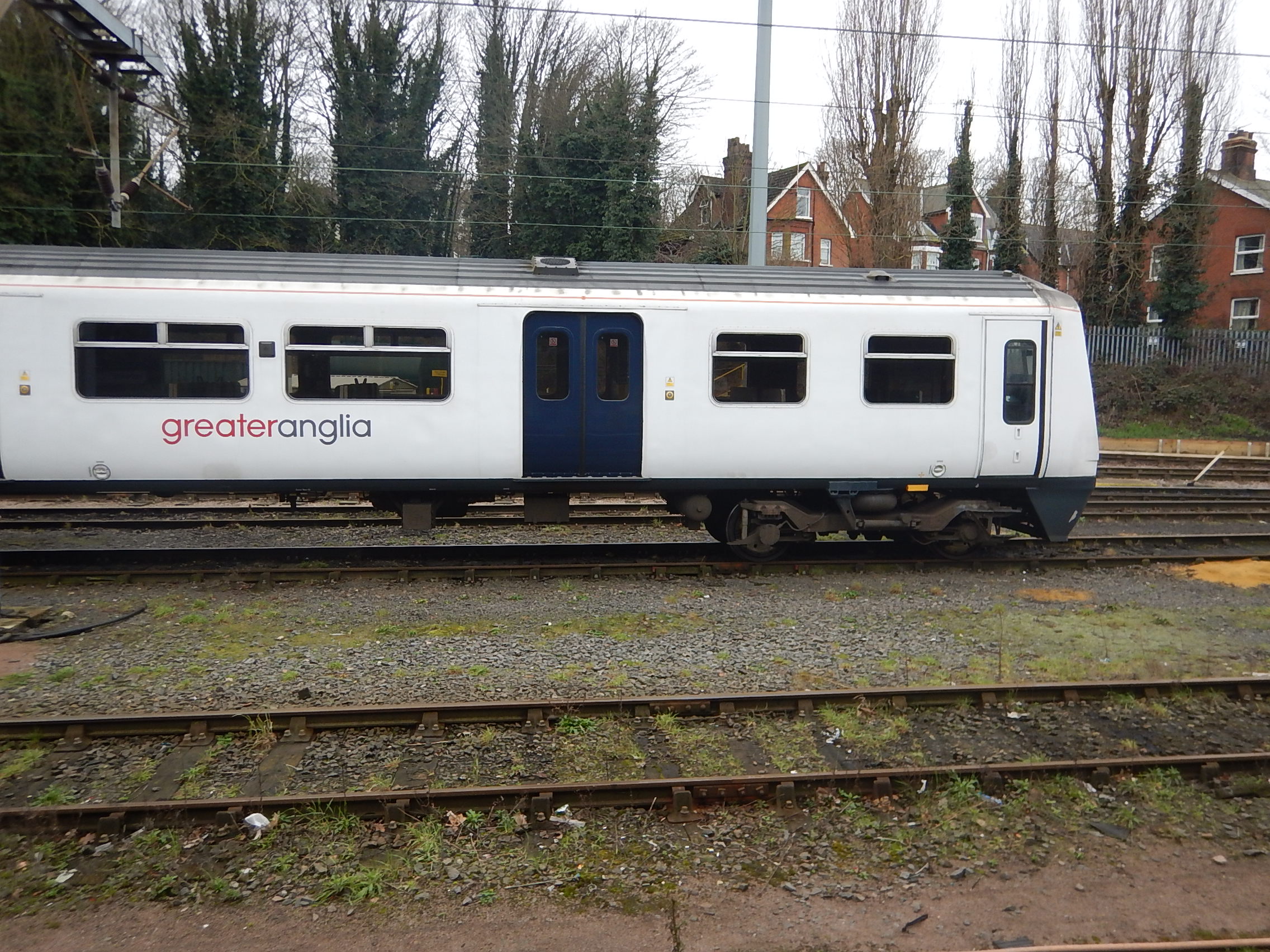
The space underneath is typical of many electrical multiple units.
How Far Could A Train Travel On Stored Energy?
In an article in the October 2017 Edition of Modern Railways, which is entitled Celling England By The Pound, Ian Walmsley says this in relation to trains running on the Uckfield Branch.
A modern EMU needs between 3 and 5 kWh per vehicle mile for this sort of service.
So if we take a battery from a New Routemaster bus, which is rated at 75 kWh, this would propel a five-car electric multiple unit between three and five miles.
Suppose though you put a battery of this size in every car of the train. This may seem expensive, but a typical car in a multiple unit and a double-deck bus carry about the same number of passengers.
A battery in each car would give advantages, especially in a Bombardier Aventra.
- Most cars in an appear to be powered, so each traction motor would be close to a battery, which must reduce electrical transmission losses and ease regenerative braking.
- Each car would have its own power supply, in case the main supply failed.
- The weight of the batteries is spread along the train.
If you take any Aventra, with a 75 kWh battery in each car, using Ian’s figures, they would be able to run between fifteen and twenty-five miles on battery power alone.
Quotes by Bombardier executives of a fifty mile range don’t look so fanciful.
What Onboard Energy Storage Capacity Would Be Needed For Fifty Miles?
This article in Rail Engineer, which is entitled An Exciting New Aventra, quotes Jon Shaw of Bombardier on onboard energy storage.
As part of these discussions, another need was identified. Aventra will be an electric train, but how would it serve stations set off the electrified network? Would a diesel version be needed as well?
So plans were made for an Aventra that could run away from the wires, using batteries or other forms of energy storage. “We call it an independently powered EMU, but it’s effectively an EMU that you could put the pantograph down and it will run on the energy storage to a point say 50 miles away. There it can recharge by putting the pantograph back up briefly in a terminus before it comes back.
What onboard energy storage capacity would be needed for the quoted fifty miles?
I will use these parameters.
- Ian Walmsley said a modern EMU consumes between 3 and 5 kWh for each vehicle mile.
- All vehicles are powered and there is one battery per vehicle.
This will result in the following battery sizes for different EMU consumption rates.
- 3 kWh/vehicle-mile – 150 kWh
- 4 kWh/vehicle-mile – 200 kWh
- 5 kWh/vehicle-mile – 250 kWh
These figures show that to get a smaller size of battery, you need a very energy-efficient train. At least lighting, air-conditioning and other electrical equipment is getting more efficient.
The 379 IPEMU Experiment On The Mayflower Line
In 2015, I rode the battery-powered Class 379 train on the 11.2 mile long Mayflower Line.
I was told by the engineer monitoring the train on a laptop, that they generally went to Harwich using the overhead electrification, charging the battery and then returned on battery power.
Ian Walmsley in his Modern Railways article says that the batteries on that train had a capacity of 500 kWh.
This works out at just over 11 kWh per vehicle per mile.
Considering this was an experiment conducted on a scheduled passenger service, it fits well with the conssumption quoted in Ian Walmsley’s article.
Crossrail’s Emergency Power
If you look at Crossrail’s Class 345 trains, they are nine cars, with a formation of
DMSO+PMSO+MSO+MSO+TSO+MSO+MSO+PMSO+DMSO
All the Ms mean that eight cars are motored.
Suppose each of the motored cars have a battery of 75 kWh.
- This means a total installed battery size of 600 kWh.
- Suppose the nine-car train needs Ian’s Walmsley’s high value of 5 kWh per vehicle mile to proceed through Crossrail.
- Thus 45 kWh will be needed to move the train for a mile.
- Dividing this into the battery capacity gives the range of 13.3 miles.
If this were Crossrail’s emergency range on stored energy, it would be more than enough to move the train to the next station or place of safety in case of a complete power failure.
Trains Suitable For Onboard Energy Storage
I have a feeling that for any train to run efficiently with batteries, there needs to be a lot of powered axles and batteries distributed along the train.
Aventras certainly have a lot of powered axles and I think Hitachi trains are similar.
Perhaps this explains, why after the successful trial of battery technology on a Class 379 train, it has not been retrofitted to any other Electrostars.
There might not be enough powered axles!
Topping Up The Onboard Energy Storage
There are three main ways to top up the onboard energy storage.
- From regenerative braking.
- From the diesel or hydrogen powerpack.
- From the electrification, where it is available.
The latter is probably the most efficient and is ideal, where a route is partly electrified.
Affordable Electrification
Although the Government has said that there will be no more electrification, I think there will be selective affordable electrification to improve the efficiency of multi-mode trains.
Why Is Electrification Often Late And Over Budget?
The reasons I have found or been told are varied.
- Electrification seems regularly to hit unexpected infrastructure like sewers and cables on older routes.
- There have been examples of poor engineering.
- There is a large amount of Victorian infrastructure like bridges and stations that need to be rebuilt.
- There is a certain amount of opposition from the Heritage lobby.
- Connecting the electrification to the National Grid can be a large cost.
My experience in Project Management, also leads me to believe that although Network Rail seems to plan large station and track projects well, they tend to get in rather a mess with large electrification projects.
Electrification Of New Track
It may only be a personal feeling, but where new track has been laid and it is electrified Network Rail don’t seem to have the same level of problems.
These projects are generally smaller, but also I suspect the track-bed has been well-surveyed and well-built, to give a good foundation for the electrification.
It was interesting to note a few weeks ago at Blackpool, where they are electrifying the line, that Network Rail appeared to be relaying all of the track as well.
I know they were also re-signalling the area, but have Network Rail decided that the best way to electrify the line was a complete rebuild?
Short Lengths Of New Electrification
Short lengths of new electrification could make all the difference on routes using multi-mode trains with onboard energy storage.
As a simple example, I’ll take the Felixstowe Branch Line, that I know well. Ipswwich to Felixstowe is about sixteen miles, which is probably too far for a train running on onboard energy storage. But there are places, where short lengths of electrification would be beneficial to both the Class 755 trains and trains with onboard energy storage.
- Ipswich to Westerfield
- On the section of double-track to be built in 2019.
- Felixstowe station
There is also the large number of diesel-hauled freight trains passing through the area, quite a few of which change to and from electric haulage at Ipswich.
So would some selective short lengths of electrification enable the route to be run by trains using onboard energy storage?
Electrification Of Tunnels
Over the last few years, there has been some very successful electrification of tunnels like the seven kilometre long Severn Tunnel. This is said about the problems of electrification in Wikipedia.
As part of the 21st-century modernisation of the Great Western Main Line, the tunnel was prepared for electrification. It has good clearances and was relatively easy to electrify, although due to its age, the seepage of water from above in some areas provided an engineering challenge. The options of using either normal tunnel electrification equipment or a covered solid beam technology were considered and the decision was made to use a solid beam. Over the length of the tunnel, an aluminium conductor rail holds the copper cable, which is not under tension. A six-week closure of the tunnel started on 12 September 2016. During that time, alternative means of travel were either a longer train journey via Gloucester, or a bus service between Severn Tunnel Junction and Bristol Parkway stations. Also during that time, and possibly later, there were direct flights between Cardiff and London City Airport. The tunnel was reopened on 22 October 2016.
It appears to have been a challenging but successful project.
This type of solid beam electrification has been used successfully by Crossrail and Chris Gibb has suggested using overhead beam to electrify the three tunnels on the Uckfield Branch Line.
In the North of England, there are quite a few long tunnels.
Could these become islands of electrification to both speed the trains and charge the onbosrd energy storage?
Third-Rail Electrification Of Stations
Ian Walmsley in his Modern Railways article proposes using third rail electrification at Uckfield station to charge the onboard energy storage of the trains. He also says this.
This would need only one substation and the third rail could energise only when there is a train on it, like a Bordeaux tram, hence minimal safety risk.
There needs to be some serious thought about how you create a safe, affordable installation for a station.
I also feel there is no need to limit the use of short lengths of third-rail electrification to terminal stations. On the Uckfield Branch, some stations are very rural, but others are in centres of population and/or industry, where electricity to power a short length of third-rail might be available.
Overhead Beams In Stations
This picture shows the Seville trams, which use an overhead beam at stops to charge their onboard energy storage.
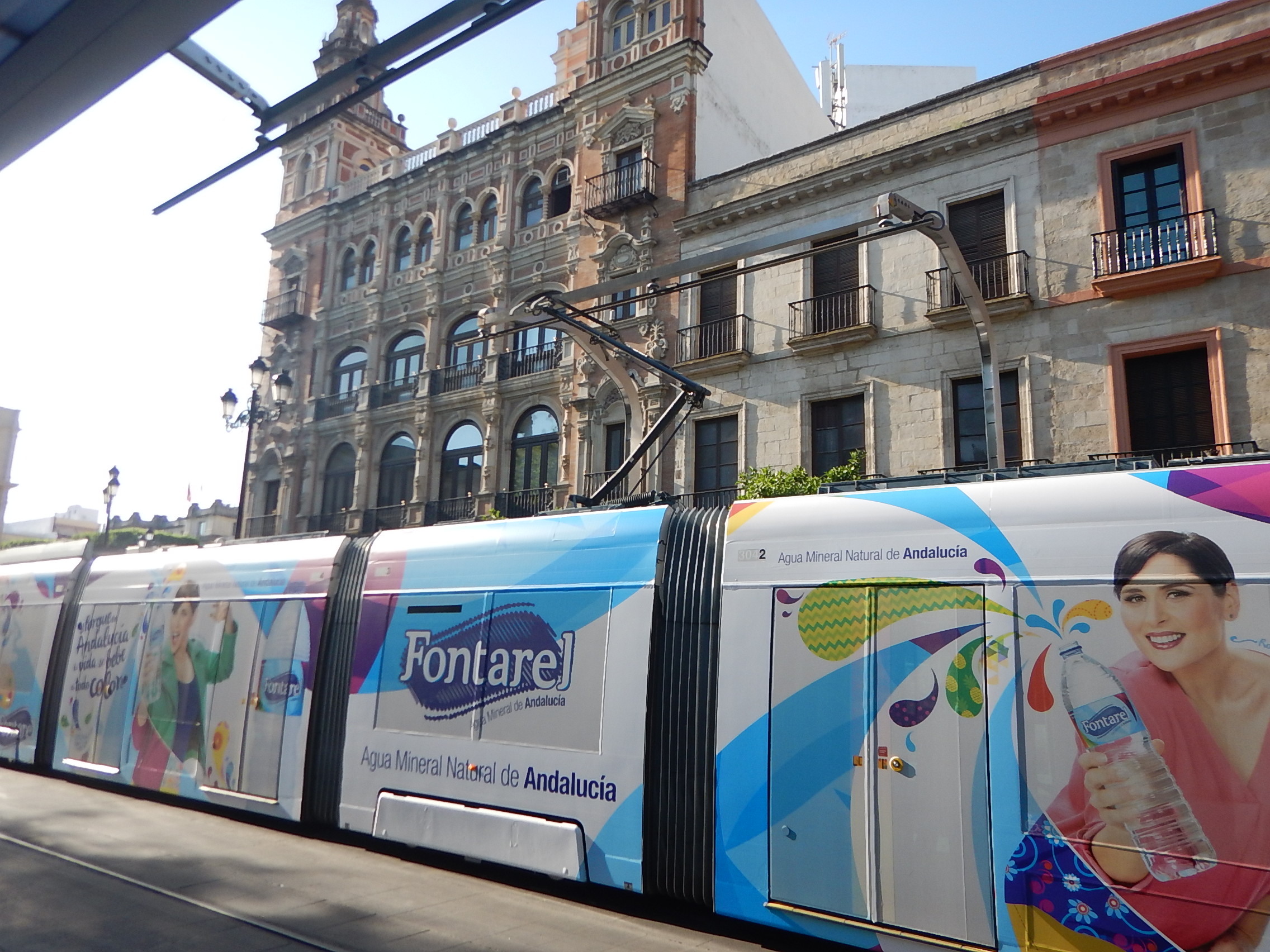
Surely devices like these can be used in selective stations, like Hull, Scarborough and Uckfield.
Third-Rail Electrification On Bridges And Viaducts
Some bridges and high rail viaducts like the Chappel Viaduct on the Gainsborough Line, present unique electrification problems.
- It is Grade II Listed.
- Would overhead electrification gantries be welcomed by the heritage lobby?
- It is 23 metres high.
- Would this height present severe Health and Safety problems for work on the line?
- The viaduct is 320 metres long.
Could structures like this be electrified using third-rail methods?
- The technology is proven.
- As in stations, it could only be switched on when needed.
- The electrification would not be generally visible.
The only minor disadvantage is that dual-voltage trains would be needed. But most trains destined for the UK market are designed to work on both systems.
Getting Power To Short Lengths Of Electrification
One thing that is probably needed is innovation in powering these short sections of electrification.
Conclusion
There are a very large number of techniques that can enable a multi-mode train to roam freely over large parts of the UK.
It is also a team effort, with every design element of the train, track, signalling and stations contributing to an efficient low-energy train, that is not too heavy.
?
OVO Offers Solar Panels And A Battery
There are a couple of reports on the Internet, that the smaller energy supplier; Ovo Energy, is now offering deals on solar panels and a battery.
I have been thinking of adding a battery for some time, but I don’t think the time is quite right yet, as the price of batteries is becoming more affordable.
However, I do think that Ovo’s move is the first of many we will see in the next few months and years.
This march towards solar and batteries could have various consequences for the UK.
- Many house builders will add solar panels and a battery to new houses.
- Domestic electricity needs will reduce.
- Solar panels and batteries may have some interesting effects on the property market.
Battery owners could also charge up overnight on low-price electricity, so the daily operation could be something like.
- Overnight the battery is charged on low-price electricity.
- Morning ablutions and breakfast, thus uses low-price electricity.
- Hopefully, the sun charges the battery during the day.
- Evening electricity would in part be what has been stored during the day.
One overall effect of the battery is to smooth the energy needs of a property.
So as the proportion of houses with batteries increases, the National Grid will see a reduction in the spikes of electricity demand, as evetybody makes a cup of tea in the advert breaks.
But the biggest effect will be on how the UK would generate its electricity.
I am not against nuclear power for any technical or environmental reasons, but I do think that the cost of new nuclear power stations like Hinckley Point C are not good value for money compared with other methods of generation. On the other hand, if we are going to have much smoother electricity needs, then we do need the nuclear power station’s ability to produce a steady baseload of power.
I am against inappropriate on-shore wind in many locations, but I am not against off-shore wind or perhaps a few large turbines in an industrial estate.
I feel that solar, batteries and off-shore wind could give the UK very affordable electricity, but they need to be backed by some form of baseload power stations, which at the moment can only be nuclear.
Conclusion
Following my logic, I believe, that as more batteries are installed in the UK, the following will happen.
- Those who install a battery will save money whether they have solar panels or not!
- Batteries will be allowed to be charged on low-cost overnight electricity.
- As more batteries are installed in the UK, the UK power needs will be smoother.
- Overnight off-shore wind could be used to charge all these batteries.
This leads me to the conclusion, that the Government should create incentives for homes to install batteries, which would be charged with low-cost overnight electricity or solar panels.
CAF Secures Tram Contracts In The United States
The title of this post is the same as this article in Global Rail News.
The sale of two batches of trams is not that remarkable, but this is an extract from the article, about the vorder for Seattle.
The trams will have a 100 per cent low floor and come with onboard energy storage to run on catenary-free sections of the network.
Trams with these characteristics are becoming increasingly common.
BBC Click On Batteries
This weekend’s Click on the BBC is a cracker and it’s all about batteries.
Electric Mountain
It starts with pictures of the UK’s largest battery at Dinorwig Power Station or Electric Mountain, as it is colloquially known.
The pumped storage power station was completed in 1984 and with a peak generating capacity of 1.6 GW, it was built to satisfy short term demand, such as when people make a cup of tea in advert breaks in television programs. Under Purpose of the Wikipedia entry for Dinorwig Power Station, there is a very good summary of what the station does.
To build Dinorwig was a wonderful piece of foresight by the CEGB, over forty years ago.
Would environmentalists allow Dinorwig Power Station to be built these days?
That is a difficult question to answer!
On the one hand it is a massive development in an outstanding area of natural beauty and on the other Dinorwig and intermittent power sources like solar and wind power, is a marriage made in heaven by quality engineering.
As solar and wind power increase we will need more electric mountains and other ways of storing considerable amounts of electricity.
Close to Electric Mountain, another much smaller pumped storage power station of 100 MW capacity is being proposed in disued slate quarries at Glyn Rhonwy. This article on UK Hillwalking, is entitled Opinion: Glyn Rhonwy Hydro is Causing a Stir.
The article was written in 2015 and it looks like Planning Permission for the new pumped storage power station at Glyn Rhonwy has now been given.
The UK’s particular problem with pumped storage power stations, is mainly one of geography, in that we lack mountains.
However Electric Mountain is in the top ten pumped storage power stations on this list in Wikipedia.
I doubt in today’s economy, Electric Mountain would be built, despite the fact that it is probably needed more than ever with all those intermittent forms of electricity generation.
The Future Of Pumped Storage Technology
But if you read Wikipedia on pumped-storage technology, there are some interesting and downright wacky technologies proposed.
I particular like the idea of underwater storage, which if paired with offshore wind farms could be the power of the future. That idea is a German project called StEnSea.
Better Batteries
Click also talks about work at the Warwick Manufacturing Group about increasing the capacity of existing lithium-ion batteries for transport use by improved design of the battery package. Seventy to eighty percent increases in capacity were mentioned, by a guy who looked serious.
I would reckon that within five years, that electric vehicle range will have doubled, just by increments in chemistry, design and manufacture.
Batteries will also be a lot more affordable.
Intelligent Charging
Warwick Manufacturing Group are also working on research to create an intelligent charging algorithm, as a bad charging regime can reduce battery life and performance.
I rate this as significant, as anything that can improve performance and reduce cost is certainly needed in battery-powered transport.
The program reclons it would improve battery performance by ten percent in cars.
Surely, this would be most applicable to buses or trains, running on a regular route, as predicting energy use would be much easier, especially if the number of passengers were known.
In Technology Doesn’t Have To Be Complex, I discussed how Bombardier were using the suspension to give a good estimate of the weight of passengers on a Class 378 train. I suspect that bus and train manufacturers can use similar techniques to give an estimate.
So a bus or train on a particular route could build a loading profile, which would be able to calculate, when was the optimum time for the battery to be charged.
As an example, the 21 bus, that can be used from Bank station to my house, is serviced by hybrid new Routemasters. It has a very variable passenger load and sometimes after Old Street, it can be surprisingly empty.
Intelligent charging must surely offer advantages on a bus route like this, in terms of battery life and the use of the onboard diesel engine.
But is on trains, where intelligent charging can be of most use.
I believe that modern trains like Aventras and Hitachi’s Class 800 trains are designed to use batteries to handle regenerative braking.
If you take a Class 345 train running on Crossrail, the battery philosophy might be something like this.
- Enough energy is stored in the battery at all times, so that the train can be moved to a safe place for passenger evacuation in case of a complete power failure.
- Enough spare capacity is left in the battery, so that at the next stop, the regnerative braking energy can be stored on the train.
- Battery power would be used where appropriate to reduce energy consumption.
- The control algorithm would take inputs from route profile and passenger loading.
It may sound complicated, but philosophies like this have been used on aircraft for around forty years.
Reusing Vehicle Batteries In Homes
Click also had detailed coverage about how vehicles batteries could be remanufactured and used in homes. Especially, when solar panels are fitted.
Other Batteries
On the on-line version, the program goes on to look at alternative new ideas for batteries.
Inside Electric Mountain
The on-line version, also gives a tour of Electric Mountain.
Conclusion
The future’s electric, with batteries.
The Pressure For More Rail Electrification
Over the last few days, there have been several articles on the media pushing for more electrification.
This article in Rail Technology Magazine, which is entitled TfGM To Fight Corner For Full TransPennine Electrification.
This article in the Carlisle Times and Star, which is entitled Campaigners Urge Backtrack On Axed Electric Rail Projects.
This article in the Times, which is entitled New Oxford-Cambridge Rail Route Must Rely On Diesel Trains.
This article in the Nottingham Post, which is entitled Strong Condemnation Of Government Plan To Abandon Rail Electrification.
I feel that electric trains are the future, but like members of the current Government, I feel that we need an alternative approach to creating a modern railway network in the UK.
What Do Passengers Want?
Passengers in general want a comprehensive rail service, that is affordable, reliable, fast and frequent and gives them good comfort and service on trains and at their terminal stations.
What Do Train Operating Companies Want?
Train companies need and want to make profits.
Judging by the latest franchise awards to Northern, TransPennine Express, Greater Anglia, South Western Railway and West Midlands Trains, part of their philosophy to achieve this is to buy fleets of new trains to replace old ones, with the following characteristics.
- More carriages and increased capacity.
- Higher speed and performance.
- Power and USB points, wi-fi and 4G connectivity.
- Easier entrance and exit.
- Better facilities for persons of reduced mobility.
- Shorter dwell times at stations.
- Better driver assistance systems.
The best way to pay for these trains and make a profit is to fill them with happy passengers.
So Where Does Electrification Give Advantages?
In summarising what passengers and train companies want, I didn’t mention electrification, although electric trains do give advantages to both groups.
- It must be easy to fit electrical equipment into an electric train.
- Electric trains accelerate faster.
- Electric trains can be fitted with regenerative braking to save energy
Electrification is not needed in all cases as electricity for the train can be provided by diesel or hydrogen-powered generators or some form of onboard energy storage can be used.
Why Are So Many Elecification Schemes In The UK Over Budget And Late?
With my experience of writing Project Management software and talking about it with numerous Project Managers all over the world, I suspect the following about electrifying an existing railway in the UK.
- The drawings and documentation for some of the existing lines which go back well over a hundred years is questionable.
- Politicians put undue pressure to keep costs down and corners are cut.
- The scope of the project changes as it progresses.
- Those against the electrification have lots of routes to delay the project.
- We don’t have enough engineers or qualified personnel to do the work.
- Often work is on constricted sites and the locals get annoyed.
I’m coming to the conclusion, that electrification is one of the most difficult of projects.
I do feel though there is hope for the future judged on what happened at Waterloo during August.
The Future Of Road Transport
We are seeing more and more electric and hybrid vehicles on the roads and this article in the Guardian, says that Britain will ban the sale of all diesel and petrol cars by 2040.
For this to happen, there needs to be a vast improvement in the efficiency and size of energy storage systems.
A few years ago, if you’d fitted solar panels to your house, your neighbours would have laughed at you. Now they don’t as technology has improved the performance of solar panels, just like it will improve energy storage in the next few years.
What Will Improved Energy Storage Mean For Trains?
The first trains with onboard energy storage are starting to appear on the UK’s railways.
Class 800 trains – Intercity Express Programme
This document on the Hitachi Rail web site, which is entitled Development of Class 800/801 High-speed Rolling Stock for UK Intercity Express Programme.
The document provides this schematic of the traction system of a Class 800 train.
Note BC which is described as battery charger.
This is said in the text.
The system can select the appropriate power source from either the main transformer or the GUs. Also, the size and weight of the system were minimized by designing the power supply converter to be able to work with both power sources. To ensure that the Class 800 and 801 are able to adapt to future changes in operating practices, they both have the same traction system and the rolling stock can be operated as either class by simply adding or removing GUs. On the Class 800, which is intended to run on both electrified and non-electrified track, each traction system has its own GU. On the other hand, the Class 801 is designed only for electrified lines and has one or two GUs depending on the length of the trainset (one GU for trainsets of five to nine cars, two GUs for trainsets of 10 to 12 cars). These GUs supply emergency traction power and auxiliary power in the event of a power outage on the catenary, and as an auxiliary power supply on non-electrified lines where the Class 801 is in service and pulled by a locomotive. This allows the Class 801 to operate on lines it would otherwise not be able to use and provides a backup in the event of a catenary power outage or other problem on the ground systems as well as non-electrified routes in loco-hauled mode.
Note that GU refers to Generator Unit, which in these trains are diesel-powered.
This is all very comprehensive, but if you look at how the braking system of the trains work and if it uses regenerative braking, you won’t find anything on the web.
But note how the four traction motors in the diagram are connected to the system. When they are in braking mode, what happens to the electricity?
- It is returned to the overhead wires. Difficult when using GUs on lines without electrification.
- It is passed to resistors on the roof of the train and burnt off as heat.
- It is stored in some form of onboard energy storage, so it can be reused later.
I feel that Hitachi are using Option 3, as it would work in both modes of the train and would save a lot of energy.
Note that in the above extract from the Hitachi document, the company states that the electric Class 801 trains have at least one GU to provide auxiliary and traction power in the event of catenary failure.
It looks like the only difference between the Class 800 and Class 801 trains, is that the Class 800 trains have more GUs.
Could this explain why Hitachi seem to be doing all their testing with Class 800 trains, as the differences between the two trains are minimal?
If the Class 800 works, then the Class 801 will!
Hitachi are also testing the Class 802 trains, but then these are built in Italy, have more powerful engines and bigger fuel tanks.
Bombardier Aventras
Bombardier have been developing battery technology for some years and as I described in Is The Battery Electric Multiple Unit (BEMU) A Big Innovation In Train Design?, I rode in the prototype converted from a Class 379 train in February 2015.
I believe that the Class 345 trains are fitted with onboard energy storage for the following reasons.
- Onboard energy storage is the logical way to handle regenerative braking in tunnels.
- Onboard energy storage means that each train reuses its own braking energy and draws less current from the electrification.
- Onboard energy storage is the only way to move a train to a safe place, when the Russians or North Koreans hack the power suppky.
- Some of the features announced for Aventras, like remote wakeup as I discussed in Do Bombardier Aventras Have Remote Wake-Up?, need onboard energy storage.
- Bombardier have won awards for the technology.
Until Bombardier say otherwise, I’ll assume that Aventras like the Class 345 trains have onboard energy storage.
Overhead Power In Long Tunnels
It should also be noted that the overhead power supply in the Crossrail tunnels is a rail fed with power at both ends, as incidentally is the Severn Tunnel.
Could it be that money could have been saved on the electrification of these tunnels as all electric trains using them; IEPs and Aventras, can handle their own regenerative braking energy?
The Effect Of Large Onboard Energy Storage On Trains and Trams
There is a big difference between adding weight to a pneumatic-tyred vehicle like a car or truck, and adding weight to that of a steel-wheel-on-steel-rail vehicle like a train or tram.
With the former, the rolling resistance is increased, which means more power is needed to move the vehicle, but with the latter, surprisingly, the reverse is true.
This allows locomotives to pull iron ore, coal and stone trains carrying hundreds of tonnes.
So adding a heavy energy storage device under a train may not be as detrimental to performance as you may think.
I suspect Bombardier, Hitachi and others have determined the optimal size of storage device for their trains.
I believe the following, if an appropriately-sized online storage device is fitted to a train.
- It will be able to handle all the regenerative braking energy.
- It will give the train a range of up to fifty kilometres on stored energy.
Without doubt, all trains driven by electricity and having regenerative braking will use onboard energy storage.
This applies even if their main power source is not electricity, but perhaps diesel, hydrogen or extra-strong knicker elastic!
Discontinuous Electrification
Modern trains like Aventras and Hitachi Class 80x trains have another ability.
They can raise and lower their pantographs under GPS control, so that they only connect with the electrification, when it is there.
They can also do it at line speed.
This raises the possibility of discontinuous electrification, where the easy-to-electrify sections have wires and the difficult bits are run using either diesel, hydrogen or onboard storage power.
An example would be between Batley and Morley stations on the Huddersfield Line, between which is the Morley Tunnel.
- The tunnel is four kilometres long and hopefully could be electrified using a conductor rail in the tunnel roof.
- Morley station is hard by the Northern portal of the tunnel.
- The line from Morley to the electrification at Leeds doesn’t appear to have any serious bridges to replace and the double-track line has wide margins.
- Batley, Morley and Cottingley stations are all stations with platforms either side of the track and could probably have the gantries on the platform.
Would it be possible to electrify short sections of line like this and let the trains and the driver decide to use onboard or overhead power?
The TransPennine Route
I will look at the TransPennine route in detail.
Mainly Electrically-Driven Trains
Looking at the various trains on TransPennine routes, we see the following ways of driving the trains and locomotives.
- Class 156 trains – hydraulic
- Class 158 trains – hydraulic
- Class 170 trains – hydraulic
- Class 185 trains – hydraulic
- Class 195 trains – mechanical – six-speed epicyclic
- Class 220 trains – electric
- Class 221 trains – electric
- Class 802 trains – electric – bi-mode
- Class 66 locomotives – electric
- Class 68 locomotives – electric
- Class 88 locomotives – electric – bi-mode version of a Class 68 locomotive.
The last three trains and all the locomotives in this list are electrically driven, where on-board diesel engines generate electricity to power the train.
In addition the Class 802 trains and the Class 88 locomotives are bi-mode and can use electrification to power the trains directly, if it is available.
So a Liverpool to Newcastle service using Class 802 trains or Class 88 locomotives and Mark 5 carriages could use the overhead electrification on the following sections of track.
- From Liverpool to Stalybridge via Manchester Victoria
- Through Leeds
- On the East Coast Main Line
Electrifying between Leeds and the East Coast Main Line would seem to be a lot easier than that between Leeds and Manchester, so I suspect that there is some seriously difficulty that has prevented it being done already, as it would allow Kings Cross to Edinburgh services to stop at Leeds, if that was desired.
Improving The Current Service
Currently Liverpool Lime Street to Newcastle takes three hours and three minutes, with the following sectional times.
- Liverpool to Manchester Victoria – 39 minutes
- Manchester Victoria to Huddersfield – 30 minutes
- Huddersfield to Leeds – 22 minutes
- Leeds to York – 25 minutes
- York to Newcastle – 67 minutes
Some places to save times are apparent.
- Liverpool to Manchester Victoria could be speeded up by a couple of minutes, after the addition of the fourth track at Huyton.
- According to the time table, most dwell times are reasonable, but nine minutes is allowed at Manchester Victoria.
- Manchester Victoria to Stalybridge is being electrified.
- Virgin’s fastest trains take 56 minutes between York and Newcastle, so I would assume that a TransPennine Class 802 train could match this.
- If Leeds to York were to be electrified, I would think that the same percentage decrease in journey time could be expected, which would give a Leeds to York time of 21 minutes.
Could we see the following times on the route?
- Liverpool to Manchester Victoria – 30 minutes
- Manchester Victoria to Huddersfield – 28 minutes
- Huddersfield to Leeds – 22 minutes
- Leeds to York – 21 minutes
- York to Newcastle – 56 minutes
This gives a timing of 157 minutes, which is a saving of twenty-three minutes.
Is The Track Up To It?
Under Timings And Line Speeds in the Wikipedia entry for Liverpool and Manchester Lines, this is said.
As of 2016, the fastest journey times are around half an hour, which is little better than over a century earlier. The fastest recorded run was from Manchester Exchange to Liverpool Lime St in 30 minutes 46 seconds by a 1936 built Jubilee 5707 with 7 coaches. An 1882-built compound steam locomotive was timed on the same route in 38 minutes 18 seconds. Until 1968 trains from Liverpool to Manchester by all 3 routes were scheduled to take 40 minutes and often took less. The southern route via Warrington is now restricted to 85 mph and the northern route via Earlestown to 90 mph, with 75 mph over Chat Moss.
Work is under way to four-track the line between Huyton and Roby which is scheduled for completion in December 2017.
Surely, Twenty-First Century engineering can sort out Stephenson‘s problems of nearly two centuries ago!
If it’s like this between Liverpool and Manchester on a fully-electrified line, what’s it like between Manchester and Leeds?
I believe that modern engineering should be able to create a 100 mph route between Liverpool and Leeds.
Are The Other Trains Slowing The Expresses?
Northern run an assortment of trains between Liverpool and Leeds via Manchester Victoria.
Between Liverpool and Manchester Victoria are all the services timed for and run by 100 mph Class 319 trains, or do some of the assortment of 75 mph trains share the route? If it’s the latter then they will delay the expresses.
Between Manchester Victoria and Hudderfield, I’m sure that slower trains are on the route.
Help is at hand as Northern have ordered fifty-five Class 195 trains, which have a 100 mph capability.
Should Stalybridge To Leeds Be Electrified?
Only when slow trains have been eliminated and the track has been improved to allow 100 mph running between Liverpool and Leeds should we answer this question!
Using rough estimates, I feel we might see the following timings with a Class 802 train.
- Liverpool to Manchester Victoria – 26 minutes
- Manchester Victoria to Huddersfield – 21 minutes
- Huddersfield to Leeds – 16 minutes
- Leeds to York – 21 minutes
- York to Newcastle – 56 minutes
This gives a timing of 140 minutes, which is a saving of forty-three minutes on the current times.
Improving Leeds To Newcastle
The Class 802 trains are stated in Wikipedia as being capable of running at 140 mph with minor modifications.
How many minutes would this take off the journey, if this were to be possible?
Conclusion
There are a lot of things to do before the decision to electrify Stalybridge to Leeds is taken.
- Sort the track for at least 100 mph running.
- Remove all passenger trains not capable of 100 mph from the line.
- Perhaps add some passing loops.
- Electrify Leeds to Colton Junction.
- Remove all level crossings.
- Raise all bridges and other structures, so that electrification is possible.
- Get the planning permission for electrifying the sensitive areas.
Hopefully these actions in themselves would deliver a time of under forty minutes between Manchester and Leeds.
That would be a spoonful of sugar for the passengers and the train operating companies.
Any attempt to electrify without doing all of these actions before the decision to electrify is taken, will result in the sort of mess seen in some of the electrification schemes of the last few years.
The East West Rail Link
I will look at the East West Rail Link in detail.
Linking To Electrified Lines
The East West Rail Link joins or crosses the following electrified lines.
- The Great Western Main Line at Didcot
- The West Coast Main Line at Bletchley
- The Midland Main Line at Bedford
- The East Coast Main Line at Sandy
- The West Anglia Main Line at Cambridge
As connecting the National Grid to electrification is a major cost, if the line were to be electrified, then there are several places to connect at a cheaper cost.
Building For Electrification
The instructions from the Department for Transport seem to have stated the following.
- The line will be double track.
- The line will have an operating speed of at least 100 mph or possibly 125 mph.
- All bridges and structures, will be built to accommodate overhead electrification.
I wonder if the specification suggests preparing the margins of the route, so putting up overhead gantries wouldn’t be a case of digging and hitting important cables or pipes.
Electrification of new lines like the East London Line, Crossrail and the Hitchin Flyover seem to have proceeded much smoother than schemes like the Gospel Oak to Barking Line.
Trains For The East-West Rail Link
The proposed services include.
- Oxford to Bedford
- Bletchley to Bedford
- Oxford to Milton Keynes Central
- Aylesbury to Milton Keynes Central.
I have also seen suggestions that the trains terminate at Reading.
The trains will need the following.
- A 100 mph capability to make good use of the route.
- Ability to use overhead electrification to get to Bedford, Milton Keynes Central and Reading.
- Ability to use diesel to use the Chiltern routes to Aylesbury and Marylebone.
To meet all these requirements, it would appear bi-mode trains like a Class 800 train are needed.
Should The East-West Rail Link Be Electrified?
Consider.
- The trains chosen for the route will be bi-mode and so the line doesn’t need to be electrified.
- Freight trains using the route would be hauled by a diesel locomotive or possibly a bi-mode locomotive like a Class 88 locomotive.
However, if at a future date, all or part of the electrification were to be deemed needed, if the line had been built with electrification in mind, putting up the wires would be a lot easier than on the TransPennine route.
Conclusions
I have come to these conclusions from these two examples.
- The bi-mode route allows a lot of flexibility and means that electrification with all its problems can be done when it is really necessary.
- The bi-mode route, also means that passengers get the benefits of modern, faster and more frequent trains at an earlier date.
- Electrification of a new line is easier than electrifying an old Victorian one.
- All new or reopened lines should be built to allow electrification at a future date.
Don’t underestimate the ingenuity of railway engineers to make a more comprehensive railway powered by electricity possible.
Thoughts On Highspeed to Hastings
Since I wrote Kent On The Cusp Of Change – Highspeed To Hastings, a couple of months ago, several things have happened.
And Now There Are Three!
Trenitalia has pulled out of bidding for the new Southeastern franchise as reported in this article in the International Rail Journal.
This leaves just three bidders.
- A joint venture of Abellio, East Japan Railway Company and Mitsui
- Govia
- Stagecoach
The same joint venture were recently awarded the West Midlands franchise.
The new franchise will be awarded in August 2018, with services starting in December 2018.
Electrification Has Been Abandoned
Major electrification schemes have been abandoned, so I suspect it will be even more unlikely that Ashford to Hastings will be electrified.
The Aventras Are Coming
Class 345 trains have started to appear on Crossrail and it is my opinion that they are a fine train.
In An Exciting New Aventra, I laid out the philosophy of the new trains and in How Long Will It Take Bombardier To Fulfil Their Aventra Orders?, I discussed how Bombardier will build the trains, at a rate of twenty-five carriages a month.
The rate comes from this article in The Guardian, which is entitled Full speed ahead for train builders as minister pulls plug on electrification, where I found this useful nugget of information, from the General Manager of Bombardier’s Derby plant.
Building trains in an “ergonomically correct” fashion, he says, means completing and testing the carriage’s constituent parts, then assembling them, rather than wiring them up afterwards – and also takes the risk away from a production line which boasts a rate of 25 carriages per week.
It sounds like Bombardier’s engineers have been drinking and swapping ideas, with Toyota’s production engineers a few miles down the road at Burnaston.
The New South Eastern Franchise
So do we have any clues as to what the new South Eastern franchise will be doing?
South Western Railway
South Western Railway‘s routes have a similar pattern to those of the South Eastern franchise, with an intense suburban network and longer distance services.
You could also argue that Greater Anglia isn’t much different.
Both these other franchises have are replacing their suburban trains with new 100 mph trains with all the trimming like wi-fi and toilets.
Both have chosen a mix of five and ten-car Aventras.
This would appear to give the following advantages.
- The 100 mph trains with excellent acceleration and smooth regenerative braking help to make services faster and more frequent.
- A near identical fleet will help maintenance and crew training.
- It is easier to get the train-platform interface better, if only one class of train calls at a station.
- Platform compatibility with Crossrail and Crossrail 2.
I suspect that the new South Eastern franchise will think on similar lines.
The Networkers Must Be Going
Southeastern currently has a total of 674 Networker carriages, most of which will surely be moved on by the new franchise holder.
I believe that these trains with their 75 mph speed and average performance, is not high enough for efficient timetabling of services and that consequently the new franchise holder will probably replace these trains with 100 mph units.
One choice would be to use a mix of new five and ten-car Aventras as chosen by Greater Anglia and South Western Railway. Replacing Networker carriages with the same number of Aventra carriages would take around six months of production at Bombardier.
The Aventras must be high on the list of new trains, as some of the new trains, may have to use the same platforms as Crossrail, if the line is extended from Abbey Wood station.
The Extra High Speed Trains
To serve Hastings and increase the number of Highspeed services, the new franchise holder, will have to obtain some more trains that can use High Speed 1.
Some of these trains will need the ability to travel on the Marshlink Line between Ashford and Hastings.
Consider.
- It probably wouldn’t be a good idea to have two different types of trains working to Ashford on High Speed 1.
- Class 800 trains, which are closely related to the Class 395 trains have onboard diesel power and might have energy storage to handle regenerative braking.
- Class 395 trains are getting towards ten years old and are approaching the need for a refresh.
- Hitachi have built trains with onboard energy storage in Japan.
- Diesel fuel might not be allowed in the tunnels of High Speed 1.
- Hitachi would probably be very disappointed to not get this order.
More Class 395 trains fitted with either onboard energy storage must be the favourite.
Conclusion
Kent will get Aventras to improve suburban services and more Class 395 trains with batteries for Highspeed services.
Midland Metro’s £149m Extension To Open In 2021
The title of this post is the same as an article on Global Rail News.
This is the first two paragraphs.
A 2km extension of Transport for West Midlands’ Midland Metro has been given the go ahead in the UK.
The £149 million extension will link Grand Central, in Birmingham’s city centre, with the southern suburb of Edgbaston with five new stops served by up to 10 trams an hour at peak times.
This article in the Birmingham Mail, gives more details.
The locations of five new stops to be built in the next phase of the Midland Metro extension have been confirmed.
The line is being taken an additional 1.2 miles from outside New Street station to Hagley Road.
As previously mooted, there will be stops outside Town Hall Birmingham and at Centenary Square, in Broad Street, where passengers can access the ICC, Library of Birmingham and new HSBC UK head office.
The other stops will be opposite Brindleyplace at the corner of Granville Street, outside the Cineworld cinema in Broad Street and in front of office block 54 Hagley Road, close to the Morrisons supermarket.
I think that the design of the route has been kept fairly simple and also involves some pedestrianisation.
From New Street To Broad Street
This Google Map shows the first section of the route from the current terminus of the Midland Metro at Grand Central outside New Street station to the start of Broad Street.
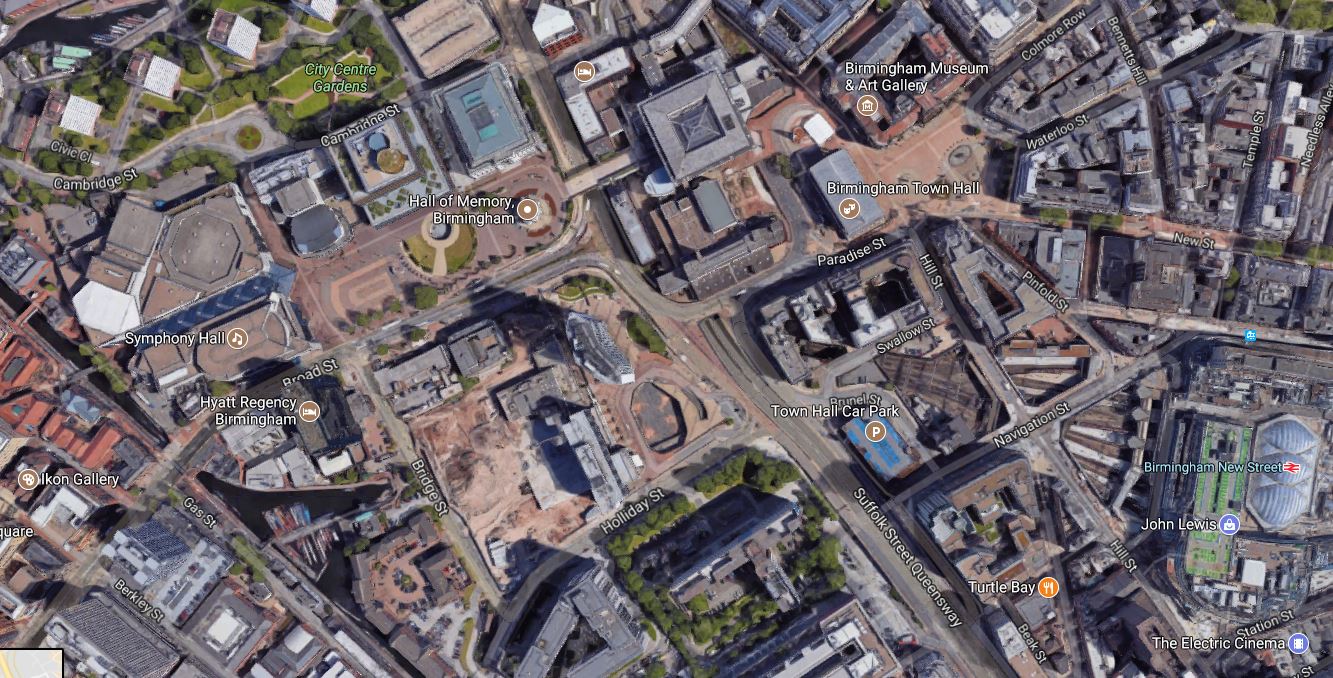
The blue dot outside New Street station shows the Grand Central tram stop.
The route goes up the hill, to the stop at Birmingham Town Hall before twisting to go down Broad Street to stop in Centenary Square.
Along Broad Street
This Google Map shows Broad Street from the Symphony Hall to the Cineworld Cinema.

Three stops are on this section.
- Brindleyplace
- Granville Street
- Cineworld Cinema
This visualisation shows the route at the cinema.

Note.
- The view is looking towards Five Ways.
- Overhead electrification is used on this section.
Will the route be pedestrian only?
Through Five Ways Roundabout And On To 54 Hagley Road
This Google Map shows the last section of the route.
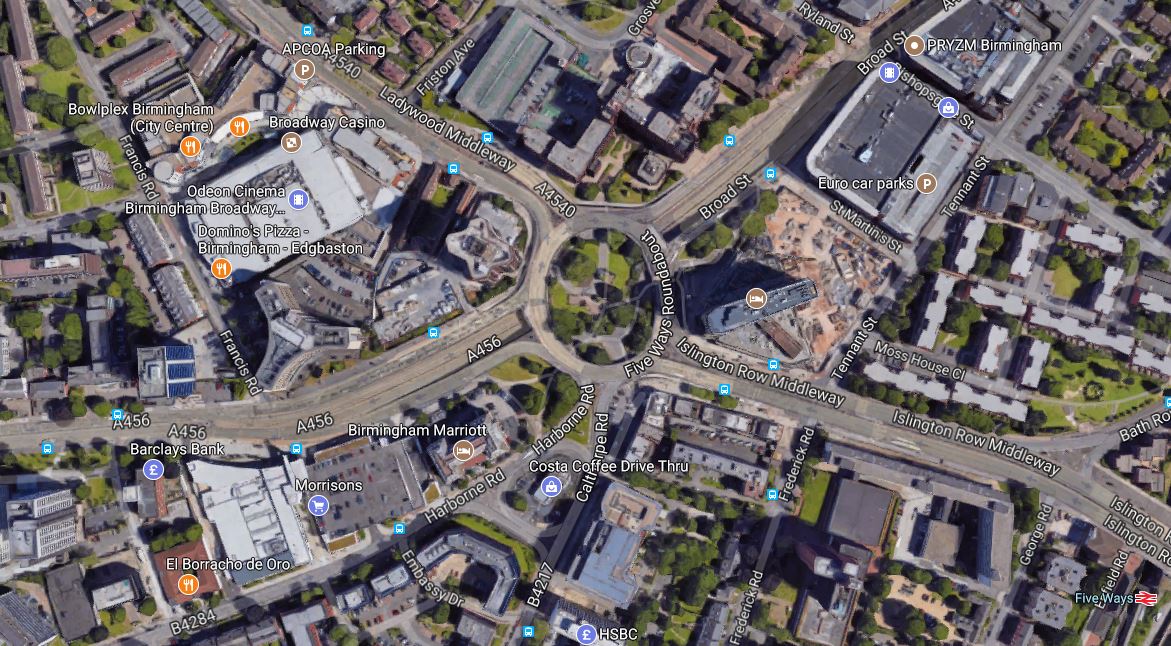
The roundabout looks to have plenty of space to thread the tram lines through.
54 Hagley Road is the office tower in the South West corner of the map, on the South side of Hagley Road. Again there seems plenty of space.
Sections Without Wires
The route bwtween Grand Central and Hagley Road will use a mixture of overhead wiring and onboard energy storage to power the trams.
It has been stated that in the historic centre, the trams will not use wires, as in this visualisation.
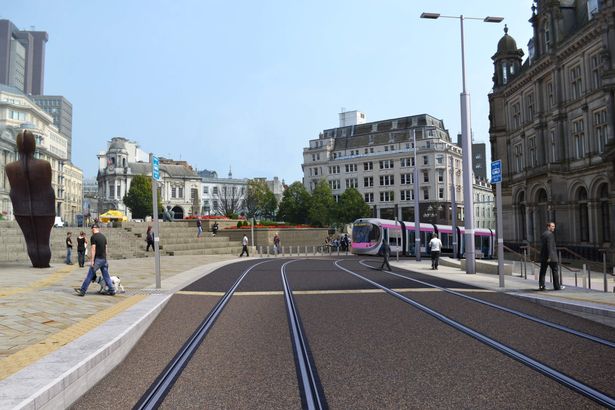
It appears that there will be wired sections either side of this section without wires in the centre.
This will ensure, that the onboard energy storage is well-charged before entering the section.
Cost And Timescale
Comments on the Birmingham Mail article, think the line is expensive and it will take a long time to build.
Looking at the route the two tricky sections are around Paradise Street and Five Ways, as there will need to be a lot of reconstruction of the road network.
But the sections running on onboard energy storage should be a lot easier to build.
At £149 million for 3.38 kilometres, the extension will cost £44 million a kilometre.
Manchester Metrolink’s Trafford Park Line will cost £350 million for 5.5 kilometres or £64 million a kilometre.
Is the lower cost/km. of the Birmingham Extension due to the sections without wires?
I suspect, it’s probably more complicated than that!
Conclusion
It looks a good scheme.
My only reservation is what will drivers think about a pedestrianised Broad Street, if that is part of the design.
Electrification ‘Very Unlikely’ To Come Back Into EWR Scheme
The title of this post is the same as this article on Rail Technology Magazine.
This is a quote from Andy Free, who is head of engineering of the alliance that is building the East West Rail Link.
The steer from the DfT is that wherever the Alliance is building a new structure it needs to be clear and suitable for electrification, “and we must do nothing that hinders future electrification, but it is not on the short- or medium-term horizon.
Given the developments in bi-mode trains in recent years, I suspect this is a sensible policy.
Electrification is probably cheaper to fit to a train in a nice warm factory in Derby or Newton Aycliffe, than at a remote location in the pouring rain and the howling wind.
In the case of the East West Rail Link, where sections of the route are well defined, as they are existing rail alignments, building the route would involve.
- Raising any over-bridges to be clear of future electrification.
- Building any bridges or flyovers, where the new railway crosses over roads and other railways.
- Preparing the track bed.
- Laying the track.
- Building or rebuilding the stations.
Note I have ignored signalling, as ideally that will be in-cab by radio.
Building the line without electrification must give advantages.
- Network Rail seem to find it impossible to do electrification projects to time and budget.
- Stations without electrification are safer places and easier to design and build.
- There is less visual intrusion for Nimbys to complain about.
- The cost of connecting the electrification to the National Grid is zero.
- There is less copper cable to steal.
In Is A Bi-Mode Aventra A Silly Idea?, I outlined what I believe the ultimate bi-mode train will be like.
A bi-mode Aventra would be a sophisticated train with the following characteristics.
- Electric drive
- Regenerative braking.
- 25 KVAC overhead and 750 VDC third rail capability.
- Automatic pantograph deployment.
- Onboard energy storage.
- Automatic power source selection.
- Diesel or hydrogen power-pack
The first four are probably already in service in the Class 345 train.
A train going from between Reading and Bedford on the East West Rail Link, would charge its energy storage at the terminals and then use this power along the route. If the train detected that the stored energy was running low, the diesel or hydrogen power-pack would cut in and charge the energy storage.
Conclusion
It is my view, that if you are building a new rail line that is not high speed or high frequency, that there is no need to electrify the line, as intelligent bi-mode trains will be able to work the route economically and without the noise, pollution and vibration problems of their diesel engines working all the time.
 The Anonymous Widower