Upcycling A Truck
Whilst walking through the City of London this morning, I came across this truck.




It’s even got its own web page on the Refuse Vehicle Solutions web site.
This is the first paragraph.
Paper Round, part of BPR Group, has received its very own fully electric-conversion vehicle from Refuse Vehicle Solution (RVS) this week. The company is committed to transforming the future of resource management and the switch to electric is a major step in achieving this goal.
And this paragraph describes the conversion.
We have converted a Mercedes Econic 2630, 6×2 RS with a MOL VDK body and bin lift into a fully electric truck. It was being used by Paper Round as part of their commercial waste and recycling collection services in London. The RCV was converted from a diesel euro 5 engine to electric at RVS’s headquarters in Berkeley using the innovative EMOSS technology. With zero emissions, this new addition will contribute towards reducing Paper Round’s carbon footprint.
The performance seems impressive with a top speed of 56 mph and a range of around 250 km.
The economics of the truck indicate, that it is cheaper to go electric by converting an existing vehicle, rather than buying a new one.
Hence the title of this post.
Freightliner Continue Trials On New Low Carbon Fuel
The title of this post, is the same as that of this article on Rail Technology Magazine.
This is the first paragraph.
As part of their commitment to carbon reduction Freightliner will conduct operational trials of a new low carbon fuel supplied by Green Biofuels Ltd (GBF).
And this paragraph described the fuel.
GBF are the UK’s leading provider of Hydrogenated Vegetable Oil (HVO) and the new fuel consists of 55% Shell GTL (gas to liquids) Fuel and 45% Gd+ HVO.
It does appear that hydrotreated vegetable oil or HVO, could be becoming an intermediate step on the route to decarbonisation, as I’ve posted about the fuel before in Powered By HVO.
The other promising route to decarbonisation must surely be that of producing fuel from waste, as pioneered by Velocys and others.
But they are only intermediate steps before hydrogen becomes the preferred zero-carbon fuel for rail freight services.
Chile Wants To Export Solar Energy To Asia Via 15,000km Submarine Cable
The title of this post, is the same as that of this article on pv magazine.
You can’t fault the Chileans for ambition, especially as the Atacama Desert is the sunniest area in the world.
But I do think, that it might be cheaper to build a giant electrolyser in Chile and export the hydrogen by ship to Japan and South Korea.
I do wonder, if Chile is a country, that needs to talk to Andrew Forrest of Fortescue Future Industries.
Velocys Announces Long-Term Clean Avgas Deals With Airline Behemoths
The title of this post, is the same as that of this article on the Energyst.
This is the first paragraph.
Fuel-from-waste pioneer Velocys has made the world’s biggest sustainable aviation fuel (SAF) plant more investible, as it detailed massive likely long-term supply deals to two big airline groups.
The share price seemed to benefit from the announcement.
I’m not bothered, as I have a small investment.
Fortescue Unveils Green Investment Framework
The title of this post, is the same as that of this article on Mining Weekly.
This is the first paragraph.
Iron-ore major Fortescue Metals this week launched its Sustainability Financing Framework, enabling the future issuance of green and social debt instruments that will support investments in eligible green and social projects.
I have to admit, that I thought something like this might happen, after seeing all the Fortescue Future Industries publicity on a bus, which I wrote about in Green Hydrogen Can Save Us. But Waiting For It Won’t.
I did say this in that post.
Andrew Forrest is intending to get his message across to the City.
But I didn’t take any action.
I can see other companies and investment trusts following Andrew Forrest’s lead.
Is Thermify The Ultimate Zero-Carbon Boiler?
In The Sunday Times today, there is an article, which is entitled Tech Is Putting Net Zero Within Reach, which lists several ideas to help us achieve net zero.
The first is the best idea, that I’ve seen this year.
When you talk using a phone, tablet or computer to your family, preferred social network, bank or company, you are probably talking to or through a server somewhere on the Internet.
These servers are often a bank of computers and they use a lot of electricity and give out a lot of heat. So they are often located in unusual places like Iceland. Someone has even suggested putting them deep under the sea.
Under a section entitled Computer Power, the article in The Times introduces Thermify.
The Welsh company has combined a computer server with a heat exchanger to replace your gas-fired boiler.
I suspect all of these servers fit together just like data centres do all over the world.
It would be ideal for my house, as I only use gas for heating and hot water and I have solar panels on the roof and under-floor heating using hot water.
I shall be contacting the company next week.
Fortescue Future Industries As A First Mover In Global Green Hydrogen And Next Generation Mining Equipment
The title of this post, is the same as that of this article on International Mining.
This is the most significant sentence in the article.
Fortescue has set an industry leading target to be carbon neutral by 2030.
The article details how Andrew Forrest’s company intends to do it.
I found the article a fascinating read.
Port Of Açu And Fortescue To Explore 300MW Hydrogen Plant In Brazil
The title of this post, is the same as that of this article on H2Bulletin.
This is the first paragraph.
Brazilian ports have been attracting foreign investors to benefit from its abundant renewable resources. Porto do Açu Operações SA has recently started exploring opportunities to become a hydrogen production hub in Brazil, which H2Bulletin exclusively covered in its recent article.
The location of the Superport of Açu is shown on this Google Map.
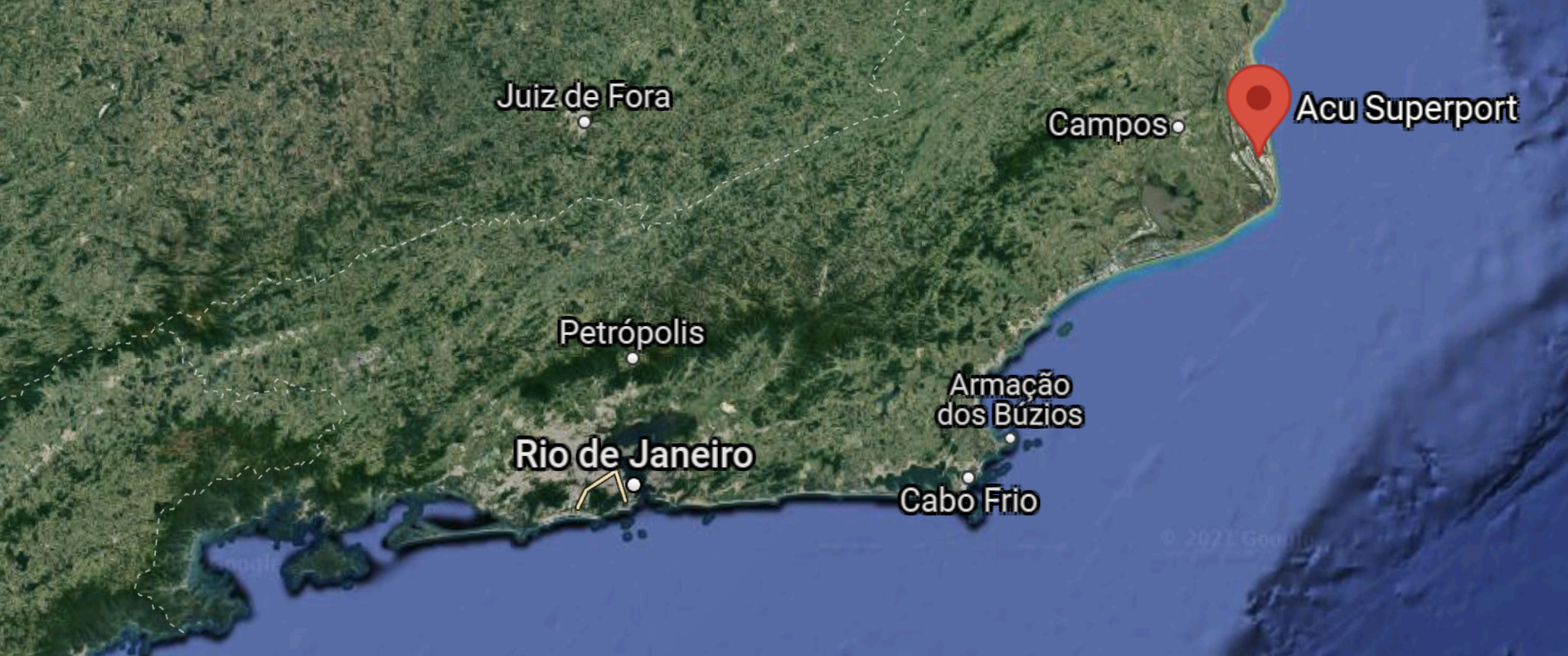
Açu is marked by the red arrow and is about 300 km. from Rio de Janeiro.
Over the last year or so, I’ve noticed several ports declare the intention of becoming hydrogen hubs.
- Hydrogen can be used to power dock vehicles, tugs, work-boats and ships.
- Hydrogen can be used to support local businesses with high energy needs.
- In the future hydrogen may power freight trains to and from the port.
Do ports feel hydrogen is a good way to decarbonise?
Do Ports Make Good Hydrogen Hubs?
Consider.
- Ports and their staff are used to handling cargoes of all types including gases, chemicals, liquids and liquified gases.
- They generally have space for the tanks to store hydrogen.
- They have a good electrical connection for an electrolyser to create green hydrogen.
- They have lots of uses for hydrogen.
Any excess hydrogen can be exported to someone who needs it.
It seems to me, that a port is a good place for a hydrogen hub.
Fortescue Expands Green Energy Into PNG
The title of this post is the same as that of this article on Perth Now.
This is the first paragraph.
Mining magnate Andrew “Twiggy” Forrest’s Fortescue Future Industries plans to develop more than a dozen hydropower and geothermal energy projects in Papua New Guinea.
Other points from the article include.
- Green hydrogen and ammonia will be created.
- This will create a domestic and export industry for a country that relies heavily on imported oil.
- Papua New Guinea will become a leader in the world’s renewable energy transition.
- The target is 2.3 million tonnes of green hydrogen a year.
There is also a commitment to the various communities of Papua New Guinea of training, employment and business development opportunities.
I estimate that to produce 2.3 million tonnes of green hydrogen a year, would need around 600 MW of electricity twenty-four hours a day on every day of the year.
Eden Project: Geothermal Heat Project ‘Promising’
The title of this post, is the same as that of this article on the BBC.
This is the first paragraph.
A three mile-deep (4.8km) borehole has shown “promising” prospects for a geothermal heat plant in Cornwall.
Eden estimates the borehole can produce enough heat for 35,000 homes.
Geothermal energy is only at the beginning in the UK, but just because we don’t have any active volcanoes, we shouldn’t discount it.
On the other hand, we do have a lot of water-filled abandoned coal mines, which in former mining areas of the UK can and will provide a substantial amount of district heating, as I wrote in Exciting Renewable Energy Project for Spennymoor.
And then there’s one-off project’s like Bunhill 2 in Islington, which I wrote about in ‘World-First’ As Bunhill 2 Launches Using Tube Heat To Warm 1,350 Homes.
Conclusion
The UK may not be an Iceland, Indonesia, Italy, New Zealand, Philippines or the USA, but according to Wikipedia we have a good potential.
- Deep geothermal resources could provide 9.5GW of baseload renewable electricity.
- Deep geothermal resources could provide over 100GW of heat.
I think my most significant post on geothermal energy is Schlumberger New Energy And Thermal Energy Partners Form Geothermal Development Company STEP Energy.
Schlumberger and the other oilfield services companies have a very serious problem.
With countries abandoning oil and gas, they have lots of engineers, geologists and other staff, who will not be needed by the oil and gas industry.
But their expertise and skills can be transferred to the geothermal heat and power industry. This will benefit the staff, the companies and the world!
The other place there expertise can be used is in the storage of captured carbon dioxide.
 The Anonymous Widower