Seaway7 Installs Final Foundation At Seagreen Offshore Wind Farm
The title of this post, is the same as that of this article on offshoreWIND.biz.
This is the sub-heading.
Seaway7 has installed the final wind turbine foundation on Seagreen Offshore Wind Farm, off the coast of Angus, Scotland, concluding the 18-month installation campaign.
Note.
- As 114 foundations have been installed in eighteen months or just over six installations in a month.
- According to Deepest Ever Fixed-Bottom Wind Turbine Foundation Stands Offshore Scotland, each foundation weighs two thousand tonnes.
- Some are also the deepest ever turbine foundations with a depth or is that height of nearly sixty metres.
- The Seagreen web site, says that phase 1 will be complete in the second quarter of this year.
- The first phase will generate 1075 MW.
We should raise a few cheers for the companies involved.
Mingyang Building Fish Farm-Equipped Offshore Wind Jacket Foundation
The title of this post, is the same as that of this article on offshoreWIND.biz.
This is the sub-heading.
Chinese wind turbine manufacturer Mingyang Smart Energy revealed on 17 April that it started the construction of a jacket foundation that also features a net cage system for fish farming, which will be installed at the Mingyang Qingzhou 4 offshore wind farm in the South China Sea later this year.
The picture in the article, looks like something out of Baldrick’s book of cunning plans.
This paragraph gives more details.
The jacket is typhoon-resistant and the aquaculture system, which will raise up to 150,000 fish in 5,000 cubic metres of water, will have remote functions such as automated feeding, monitoring, detection, and collection, according to Mingyang.
Mingyang also state that the Qingzhou 4 offshore wind farm will also produce hydrogen.
Does that mean that in the next phase of the development, they’ll be putting a fish and chip shop on top?
Australia Climate Protest: Rising Tide Activists Shovel Coal Off Train
The title of this post, is the same as that of this article on the BBC.
This is the sub-heading.
About 50 climate activists have been arrested in the Australian state of New South Wales after protesters climbed on a train carrying coal and began shovelling its cargo out of the wagons.
At least with coal, the mess won’t do too much damage.
UK Government Grants £30 Million For Long Duration Energy Storage Projects
The title of this post, is the same as that of this article on Solar Power Portal.
These two paragraphs outline the grants and their recipients.
The UK Department for Energy Security and Net Zero (DESNZ) is providing £30 million in grants for three long-duration energy storage (LDES) projects using novel energy storage technologies.
The three projects awarded funding are from Synchrostor, Invinity Energy Systems and Cheesecake Energy. Synchrostor and Cheesecake Energy are to receive £9.4 million each to fund thermal energy storage systems and Invinity Energy Systems receiving £11 million to develop a vanadium flow battery.
The UK Government seems to give out a lot of these grants for research and development purposes and from feedback I have received from recipients and also by applying my own experience, I am of the opinion, that they are spending tax-payers money more in a wise, rather than a foolish direction.
Cheesecake Energy
I wrote about Cheesecake Energy’s grant in Cheesecake Energy Collects £9.4m Government Funding.
The Government’s press release says this about Cheesecake’s grant.
Cheesecake Energy Ltd, Nottingham, which will receive £9.4 million to test their FlexiTanker technology which stores electricity using a combination of thermal and compressed air energy storage and uses a reversible air compression / expansion train to charge and discharge. They will then install pilot units at 2 sites within a microgrid development in Colchester.
If this project proves successful, it surely is one that can be duplicated in many places.
I have had my eye on Cheesecake Energy for some time and this could be their breakthrough.
Invinity Energy Systems
I first wrote about Invinity Energy Systems in UK’s Pivot Power Sees First Battery On Line By 2021.
The Government’s press release says this about Invinity’s grant.
Invinity Energy (UK) Limited, Scotland, which will receive £11 million to develop and manufacture their 7MW, 30MWh 4-hour Vanadium Flow Battery (VFB), the largest in the UK. Invinity will manufacture the 30 MWh VFB at the Company’s factory in West Lothian, Scotland. The location of the plant will be confirmed in due course.
In this article on renews.biz, which is entitled Invinity Wins Funds For 30MWh UK Battery, these two paragraphs introduce the project.
Invinity Energy Systems plc has today been awarded £11m in funding by the Department for Energy Security and Net Zero to build what it says is the largest grid-scale battery ever manufactured in the UK.
The £11m in funding will come from the Longer Duration Energy Storage Demonstration (LODES) Competition, with funding matched by Invinity’s, as yet unnamed, project partner.
These are other points from the article.
- It will be a fast-response 30MWh battery.
- The battery will be assembled at Bathgate in Scotland.
- It will operate as a stand-alone energy storage asset.
- It will be connected to the National Grid.
- Invinity’s vanadium flow batteries are an alternative to lithium-ion.
The aim is to go live by 2025.
This paragraph indicates the differences between a vanadium flow battery and a traditional lithium ion one.
Invinity said this battery is safer as they cannot catch fire, more durable as they do not degrade with use and are almost completely recyclable at the end of their 25+ year life, reducing environmental impacts and disposal costs for project owners.
I believe that there will come a point, when fully-developed vanadium flow batteries, will become very attractive for financial reasons to the successful energy storage funds like Gresham House and Gore Street.
If the UK government’s funding hastens the day, when energy storage funds feel that these new-fangled vanadium flow batteries are a safe investment, then it is money well spent.
It is not as though the money is going to an early start-up, as this page on the Invinity Energy Systems web site indicates at least a dozen installations.
This project for an as yet unnamed customer, which has a capacity of 30 MWh, is probably much bigger and the Government help is probably very much welcomed.
SynchroStor
SynchroStor was new to me, today.
The Government’s press release says this about SynchroStor’s grant.
Synchrostor, Edinburgh, Scotland, which will receive £9.4 million to build a Pumped Thermal Energy Storage (PTES) grid-connected demonstration plant operating at 1MW, with the ability to charge and discharge for a period of 10 hours, longer than current battery technology.
This page named Technology on their web site, explains their technology, both with words and diagrams.
It is probably the most complex technologies of the three batteries, but I don’t think that will be a problem.
Conclusion
The Government has given grants to three different storage technologies.
If all goes well three good sizable pilot plants will be created and those companies like Centrica, Gore Street, Gresham House, National Grid, Ørsted, SSE and others, will be able to judge, which system is best for their needs.
Cheesecake Energy Collects £9.4m Government Funding
The title of this post, is the same as that of this article on UKTN.
These two paragraphs outline how they will use the grant.
Cheesecake Energy will use the government funding to install its energy storage solution as a microgrid in Colchester to help with local grid limitations.
University of Nottingham spinout Cheesecake Energy’s installation will collect energy made by a solar farm with a capacity of 8MW and a central heat pump that supplies a district heat pump network.
Cheesecake Energy have been on my list of possible successful energy storage systems for some time and this sounds like a very neat application for energy storage.
Cheesecake Energy bill themselves on their web site as The World’s Greenest Battery, which is a big claim to make.
This outline of their technology is given on their Our Technology page.
Cheesecake Energy’s eTanker energy storage system is a stationary, medium to long-duration energy storage solution which delivers cheap, reliable, efficient energy storage in a modular, containerised package.
The technology stores energy in the form of heat and pressurised air, re-tasking ex-service truck engines to become zero-emission electrical power-conversion machines for putting energy into storage and recovering it from storage. The resulting system does not use diesel or any fuel. It is safe, straightforward to operate, has a lifetime of up to 25 years and can deliver turnaround efficiencies of around 70%.
I like the idea of using recycled truck engines at the heart of the system.
Conclusion
The World’s Greenest Battery could be right!
N-Sea To Connect German Offshore Wind Farm To Dutch Gas Platform
The title of this post, is the same as that of this article on offshoreWIND.biz.
This is the sub-heading.
Dutch upstream oil and gas company, ONE-Dyas, has awarded N-Sea with a contract to install a subsea power cable between the Riffgat offshore wind farm in the German North Sea and the new, to-be-built N05-A gas production platform.
At a first look it appears that wind power is being used to power the gas production platform.
Other points from the article include.
- The distance of the connecting cable is ten kilometres.
- The Dutch government approved the scheme in June 2022.
- A final investment decision was made in September 2022.
I have some thoughts and further information.
Borkum, Rottumerplaat and Schiermonnikoog
The article says this about the position of the gas platform.
The N05-A platform will be installed some 20 kilometres north of the islands of Borkum, Rottumerplaat and Schiermonnikoog, and approximately one and a half kilometres from German waters.
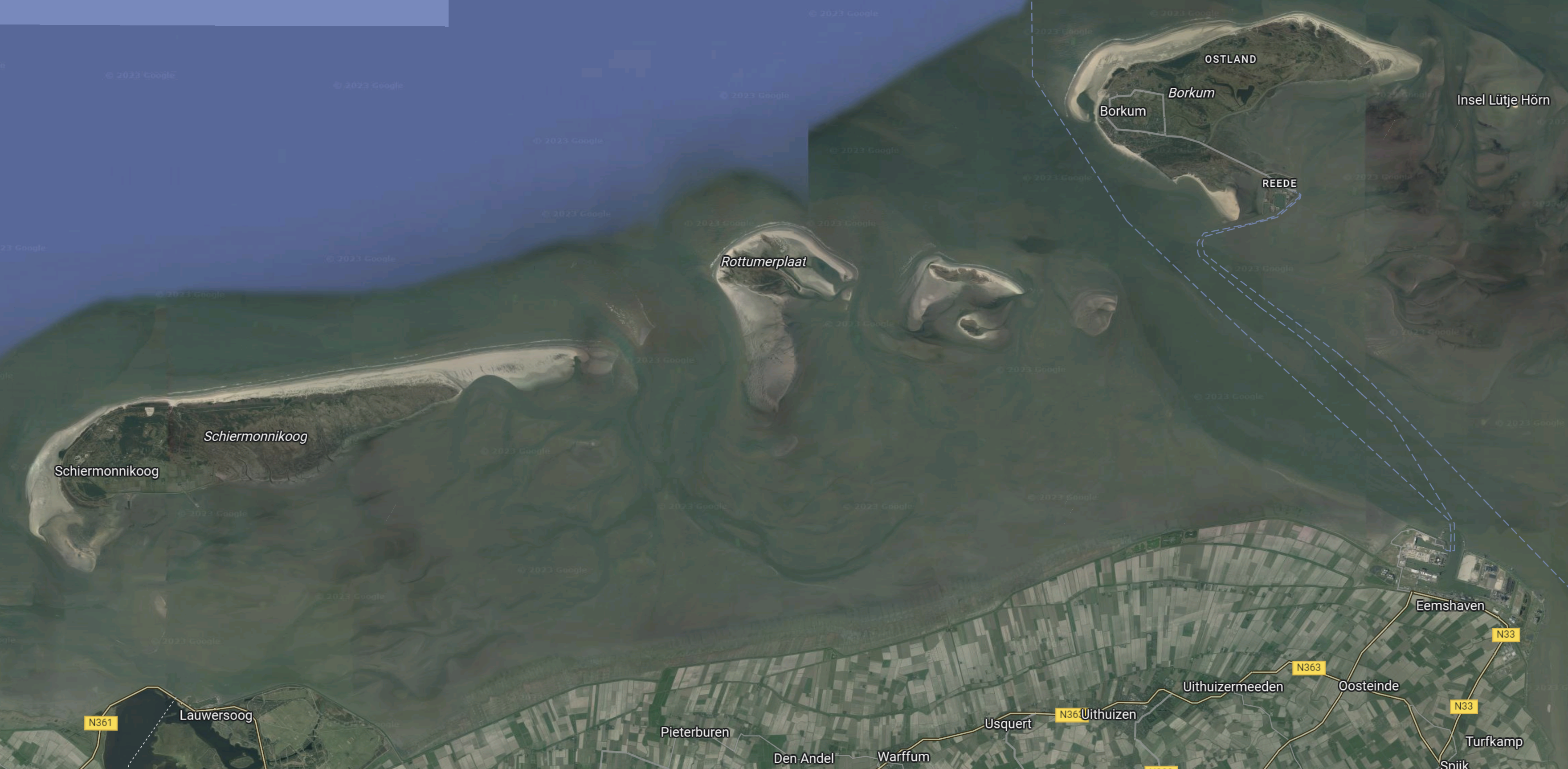
This Google Map shows the three islands.
Note.
- Borkum is the horseshoe-shaped German island in the North-East corner of the map.
- Schiermonnikoog is the long and thin island in the West.
- Rottumerplaat is the larger of the two Dutch islands in middle map.
- Eemhaven, which I wrote about in The Train Station At The Northern End Of The Netherlands, is in the South-East corner of the map.
Shipping routes run up the River Ems and German-Dutch border in the East of the map
Riffgat Wind Farm
This web page on the EWE web site, gives this description of the wind farm.
EWE has built the first commercial wind farm in the German North Sea in summer 2013 with Riffgat. The modern wind farm has a total capacity of 108 megawatts of power and can supply around 120,000 households with environmentally friendly electricity. In just 14 months of construction, the 30 wind turbines of the 3.6 megawatt class have been installed 15 kilometers off the north seas of Borkum. The rotor diameter of the units is 120 meters, while the hub height is 90 meters, which corresponds to the height of the Bremen dome. Overall, the plants are 150 meters high from the water surface to the top rotor blade tip. They are founded on 70 meter long steel foundations (monopiles), 40 meters deep in the sea bottom. The water depth in the wind farm is between 18 and 23 meters. In addition to the wind power plants, Riffgat also consists of a substation which transports the generated electricity to a better transportable voltage level.
It looks a pretty standard 100 MW wind farm with fixed foundations.
The N05-A Platform
The article says this about the N05-A project.
The N05-A project is part of the so-called GEMS area, an area approximately 20 to 80 kilometres north of the Ems estuary. ONE-Dyas, together with partners Hansa Hydrocarbons and EBN, aims to extract natural gas from the N05-A field as well as surrounding fields in the German and Dutch North Sea.
The GEMS area has a web site with a URL with a .co.uk extension.
It has an informative video, which I don’t think would go down with Dutch chapter of Just Stop Oil.
The North Sea’s First Gas Platform To Run Entirely On Wind Power
The article says this about the N05-A project.
While the N05-A platform will not be the first in the North Sea to run on wind energy, it will be the first to do so entirely.
Hywind Tampen floating wind farm will be the first.
Conclusion
This looks like a good pragmatic solution to me.
I can see more connections between offshore wind farms and oil and gas facilities all over the world.
BP And EnBW Hire Kent For 2.9 GW Scottish Offshore Wind Project
The title of this post, is the same as that of this article on offshoreWIND.biz.
This is the sub-heading.
Engineering and design service provider Kent has been awarded a contract by EnBW and BP to carry out pre-Front End Engineering Design (FEED) studies for the 2.9 GW Morven offshore wind project in Scotland.
Morven offshore wind farm would appear to be on its way.
According to Wikipedia’s list of UK offshore wind farms, the water depth in the Morven wind farm is between 65-75 metres.
- Total power is given as 2907 MW, which indicates that 14 MW turbines could be used.
- Siemens Gamesa 14 MW turbines have a blade length of 108 metres and their 10 MW have a blade length of 94 metres.
- This would seem to indicate that the wind turbine will be as much as 160 to 185 metres above the sea-bed.
A radical design of fixed foundation will be needed.
In Entrion Wind Wins ScotWind Feasibility Deal For Its 100-Metre Depth Foundation Tech, I look at technology that might work.
I also say this about work I did in Cambridge in the early 1970s.
The structures, I mathematically-modelled were for a company called Balaena Structures, that had been started by two Cambridge University engineering professors. The structures were about a hundred metres high and perhaps thirty metres in diameter.
They would have been built horizontally in the sort of dock, where you would build a supertanker and would have been floated into position horizontally. Water would then be let in to the cylinder and they would turn to the vertical. From that position, they would be lowered to the sea-bed by adjusting the water in the cylinder. They had a method of holding the Balaena to the seabed, which relied mainly on the weight of the structure and what they called the gum-boot principle.
Sadly, they never sold any platforms and the company folded.
Until recently, you could find the expired patents on the Internet.
I believe that a development of the Balaena design could be the solution to deep water fixed foundations.
Deepest Ever Fixed-Bottom Wind Turbine Foundation Stands Offshore Scotland
The title of this post, is the same as that of this article on offshoreWIND.biz.
This is the sub-heading.
The world’s deepest fixed-bottom wind turbine foundation has been installed at what will be Scotland’s largest offshore wind farm – Seagreen – off the coast of Angus.
This is the first paragraph.
On Friday, 7 April, the jacket foundation was transported to the project site on a barge operated by the main contractor, Seaway 7, where it was met by the Saipem 7000 – the semisubmersible crane vessel which is used to lift each of the 2,000-tonne turbine foundations into place.
It is obviously, a very worthwhile engineering achievement.
But two thousand tonnes of steel and a giant crane to lift it into place seems a bit of an overkill to me.
I believe that there must be a better method.
I feel that Entrion Wind’s idea of a FRP monopole, which I talked about in Entrion Wind Wins ScotWind Feasibility Deal For Its 100-Metre Depth Foundation Tech, could be a better bet.
ESB Invests In Floating Offshore Wind Mooring Tech
The title of this post, is the same as that of this article on offshoreWIND.biz.
This is the sub-heading.
Ireland’s Electricity Supply Board (ESB) has announced that it will invest in Dublin Offshore Technology (DOT), a company specialising in floating offshore wind mooring technology
These three paragraphs, outline the new relationship.
DOT has developed a technology solution for floating offshore wind mooring systems which provides significant design improvements for the wind farm, the company said.
The optimised mooring system delivers these benefits using locally-sourced materials tried and tested in the offshore environment with no degradation over the full lifetime of the wind farm, according to the Irish energy company.
By partnering with DOT, ESB will be able to leverage its expertise and resources to accelerate the development and delivery of its floating wind project portfolio.
In 13 Offshore Wind Projects Selected In World’s First Innovation And Targeted Oil & Gas Leasing Round, I wrote about how ESB and DOT were working together on Malin Sea Wind.
This update on the Dublin Offshore web site describes the Malin Sea Wind project.
In the early days of North Sea oil and gas, I saw relationships like these form and blossom. You could argue that the success of the project management system; Artemis, that I wrote, benefitted from close relationships with major oil companies and large international engineering companies.
History is just repeating itself.
H&M Move Partners With Lanzatech To Launch Capsule Collection Using Captured Carbon Emissions
The title of this post, is the same as that of this press release from H & M.
This is the sub-heading.
This is the stuff of science fiction: LanzaTech diverts carbon emissions heading for the atmosphere, traps them, and turns them into thread. In a leap towards innovating sportswear, H&M Move partners with the breakthrough material science company for a drop arriving at hm.com/move on April 6.
And this is an H & M image of some of the clothes on a young lady.
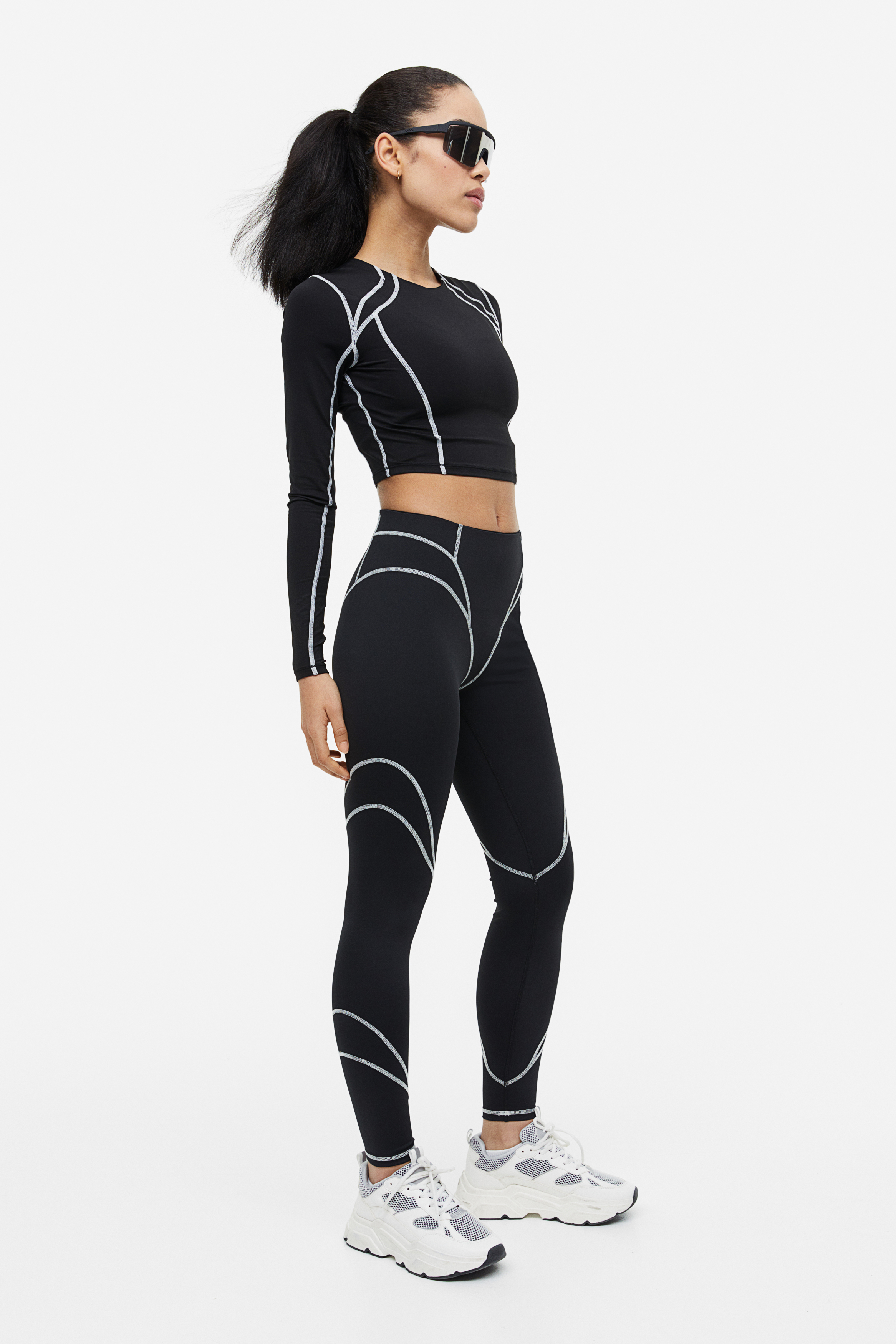
Not bad considering that the polyester thread was made using carbon emissions from a steelworks.
Lanzatech’s Process
This paragraph from the H & M press release outlines the process.
Using three simple steps, LanzaTech captures carbon emissions from steel mills, traps them in bioreactors and converts them into the same building blocks that conventional polyester is made of. This revolutionary solution helps reduce pollution and limits the use of virgin fossil resources needed to make new products.
So does this mean that lots of products made from polyester can use the polyester made by Lanzatech?
As I worked for ICI Plastics Division, who had a polyester plant, that was used to make Melinex film, I suspect the answer is yes from the knowledge I picked up at the time.
Out of curiosity, I typed “polyester underwear men’s” into Google and there’s quite a lot of it about. Including some from Marks and Spencer that I own. Marks and Spencer also do a similar product for the ladies. Both products have a high proportion of polyester and could best be described as everyday.
I must find mine comfortable, as I have been buying them for some years now!
So it looks like it might be possible to replace a proportion of the fossil fuel-based polyester with one made from captured carbon dioxide.
And this can this be used in the same way as the fossil fuel-based polyester.
The Wikipedia entry for polyester is full of useful information and is very much a must-read.
This table gives world PET (polyethylene terephthalate) production for 2008 in millions tonnes/year
- Textile – 39
- Resin, bottle – 16
- Film – 1.5
- Special – 2.5
Note.
- Bottle includes, the bottles used for soft drinks, washing up liquid etc.
- Film is high quality and was used as recording tape, but now it’s mainly for packaging.
- Special includes engineering plastics.
Wikipedia has this section on recycling, where this is said.
Recycling of polymers has become very important as the production and use of plastic is continuously rising. Global plastic waste may almost triple by 2060 if this continues. Plastics can be recycled by various means like mechanical recycling, chemical recycling, etc. Among the recyclable polymers, polyester PET is one of the most recycled plastic. The ester bond present in polyesters is susceptible to hydrolysis (acidic or basic conditions), methanolysis and glycolysis which makes this class of polymers suitable for chemical recycling. Enzymatic/biological recycling of PET can be carried out using different enzymes like PETase, cutinase, esterase, lipase, etc. PETase has been also reported for enzymatic degradation of other synthetic polyesters (PBT, PHT, Akestra™, etc) which contains similar aromatic ester bond as that of PET.
Note that PET is one of the most recycled plastics.
So it looks like the LanzaTech process can not only use carbon dioxide, it can also create a product that can be recycled.

