Decarbonising The Mid-Cornwall Metro
Although the Mid-Cornwall Metro will probably run initially using what diesel multiple units, after a year or so, the route will be converted to zero-carbon operation.
Newquay To Falmouth Docks
This map shows the Mid-Cornwall Metro.

These are current timings.
- By train can take almost three hours with changes at Par and Truro.
- By car should take 45 minutes to drive the 24.4 miles according to Google.
Note.
- The train timings are for a typical British Rail-era Diesel Multiple Unit on the branches and something smarter between Truro and Par.
- A Day Return ticket would cost £8.90 without a Railcard.
- If there was a through train, that meant you didn’t have to change trains, I estimate that the time could be as low as one hour and 35 minutes.
I feel that most travellers, who had access to a car, would use that to travel between Newquay and Truro.
Newquay To Falmouth Docks By Electric Train
I have ridden in three battery-electric trains.
- Class 379 train – Manningtree and Harwich in passenger service.
- Class 230 train – Vivarail demonstration
- Class 777 train- Liverpool Central and Headbolt Lane in passenger service.
Note.
- All were mouse-quiet.
- There was no detectable difference, when running on battery power in the trains.
It is my view that battery-electric trains are no second-class solution.
Consider.
- Newquay and Par is 20.8 miles.
- Falmouth Docks and Par is 30.8 miles.
- Newquay and Falmouth Docks is 51.6 miles.
- The maximum speed between Par and Newquay is around 30 mph
- The maximum speed between Par and Falmouth Docks is around 50-70 mph
- There are twelve intermediate stations.
- There is a reverse at Par station.
- Charging would be easy to install at Falmouth Docks, Newquay and Par.
- In Par Station – 10th February 2024, I suggested that Par station could be fully-electrified, so that expresses could have a Splash-and-Dash on their way to London and Penzance. If all platforms at Par were electrified the Mid-Cornwall Metro trains could charge from the electrification, as they reversed.
There are two main ways that the Mid-Cornwall Metro might operate.
- There would be chargers at Newquay and Falmouth Docks and trains would shuttle the 51.6 miles between the two stations.
- There would only be charging at Par and trains would after charging at Par go alternatively to Newquay and Falmouth Docks.
The first might need smaller batteries and the second would only need one charger.
Newquay To Falmouth Docks By Hydrogen-Powered Train
There is only one hydrogen-powered train in service and that is the Alstom Coradia iLint, which is running in Germany.

I feel it is very much an interim design, as Alstom has taken a diesel-mechanical Lint train and swapped the diesel for a hydrogen-powered electricity generator and an electric motor.
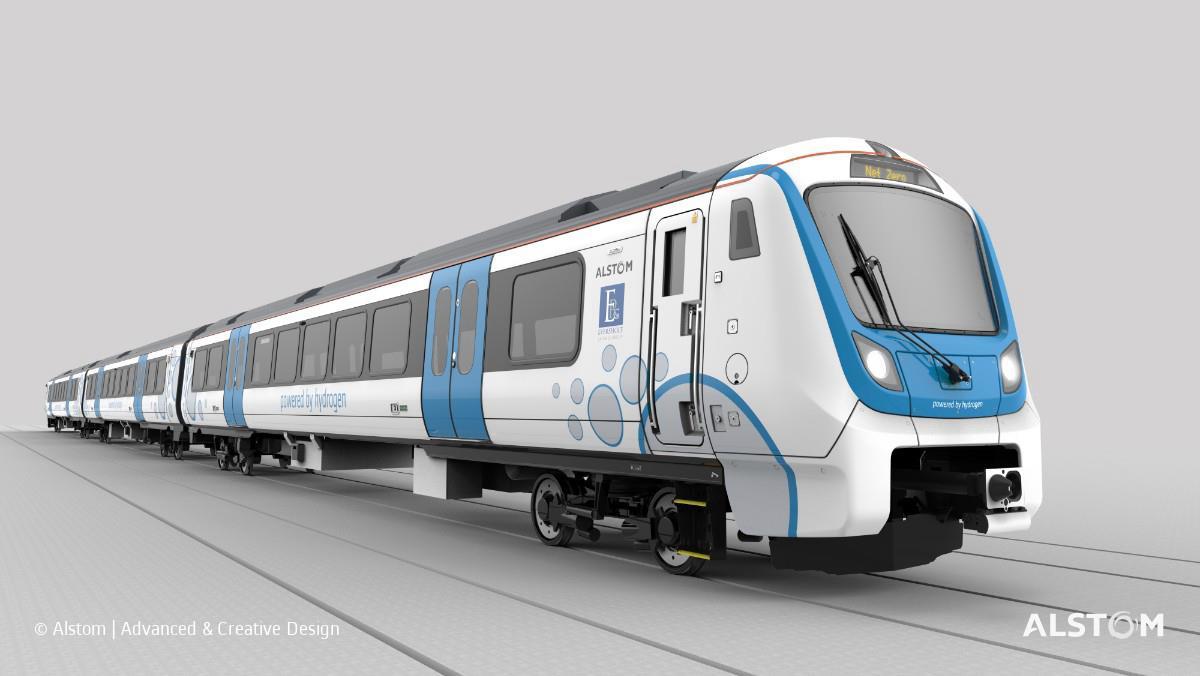
But Alstom are putting together a hydrogen-powered train based on an Aventra.
Note.
- The train is three cars.
- I would envisage performance of the hydrogen train would be very similar to that of a similar battery-electric train.
- I wouldn’t be surprised that refuelling of the train would not be a problem, as with all the china clay working nearby, there may well be developments to use hydrogen in the industry to decarbonise the mining.
The Mid-Cornwall Metro and Alstom’s Hydrogen Aventra could be ideal for each other.
Conclusion
I believe, that although the Mid-Cornwall Metro will start operation with diesel multiple units, it will be running in a zero-carbon mode within a few years.
Hydrogen Refuelling Site Could Attract Businesses To City – Meeting Told
The title of this post, is the same as that of this article on Yahoo News.
These are the first three paragraphs.
A hydrogen fuelling station planned for Bradford could play a key part in attracting new businesses to the city – councillors have been told.
The HyBradford facility is due to open on a former gas storage site off Bowling Back Lane in 2025, and late last year the scheme received millions worth of Government funding.
It is hoped the scheme will make Bradford a leader in the new, greener energy at a time when many companies are looking to wean themselves off fossil fuels.
What sort of businesses will the City attract?
- In Cadent’s Hydrogen-Hybrid Solar Toilet, I talked about how the sun and hydrogen backup are used to provide quiet, zero-carbon facilities for a building site.
- In Cummins Agrees To Integrate Its Hydrogen ICE Technology Into Terex® Advance Trucks, I talked about hydrogen-powered ready-mixed concrete trucks. These will help to reduce pollution levels on building sites and city streets and a local electrolyser would allow ready-mixed concrete suppliers to be located conveniently, where major contracts are in city centres.
- In £77 Million Investment For UK Heavy Duty And Commercial Vehicle Projects, I talked about a series of hydrogen transport projects being developed with Government and industry money. One project was one by Ford to develop a hydrogen-powered Transit van, which will be trialled by Ocado. If these catch on, then we will need more convenient electrolysers.
Bradford could be the first city, where companies try out ideas, that need a reliable supply of hydrogen.
It should also be noted that Bradford and Leeds are about fifteen miles apart, so Bradford’s electrolyser will probably be an ideal location for any business based in the Leeds/Bradford area.
Energy / Sullom Voe Terminal To Be Connected To The Grid By The End Of Next Year
The title of this post, is the same as that of this article on Shetland News.
This is the sub-heading.
POWER supply to the Sullom Voe Terminal is set to be provided by two 43-kilometre underground power lines from the Gremista substation by the end of next year.
These four paragraphs outline some of EnQuest’s plans.
The on-site gas-fired power station, operated by Equans, is due to be switched off in the fourth quarter of 2025 as it no longer meets stringent carbon emission standards.
EnQuest, the operator of the terminal, gave an update on its plans for the 1,000-acre site during a Shetland suppliers forum held at Mareel on Wednesday morning.
The company was keen to present itself as one that is seeking collaborative working with the local businesses and the community as Sullom Voe transitions from an oil terminal to a green energy hub.
The company is in the middle of a “right-sizing” project that involves some significant decommissioning of equipment no longer needed to make space for long-term aspiration such as carbon capture and storage, green hydrogen production and offshore electrification.
Note.
- Two underground cables will be coming from Gremista to Sullom Voe.
- Up to seven wind turbines could fit on the site to produce power needed for green hydrogen production.
- Shetland is set to be connected to the UK national grid later this year thanks to a new 600MW HVDC subsea transmission link which will run to Caithness.
- The Sullom Voe power station, once switched off, could be “repurposed” to continue producing energy using clean fuels.
- EnQuest are certainly doing a comprehensive job on the transition.
- It looks to be a well-thought out plan to convert existing oil and gas infrastructure to a modern green asset.
This Google map shows Gremista to Sullom Voe.

Note.
- Sullum Voe is at the top of the map.
- Gremista is marked by the red arrow.
- It looks like the cable could take mainly a straight North-South route.
This second Google map shows Sullum Voe

Note.
- The Sullum Voe terminal is at the top of the map.
- Sullum Voe is a 1,000-acre site.
- In the South-West corner is the closed Scatsta airport.
This third Google map shows Lerwick.
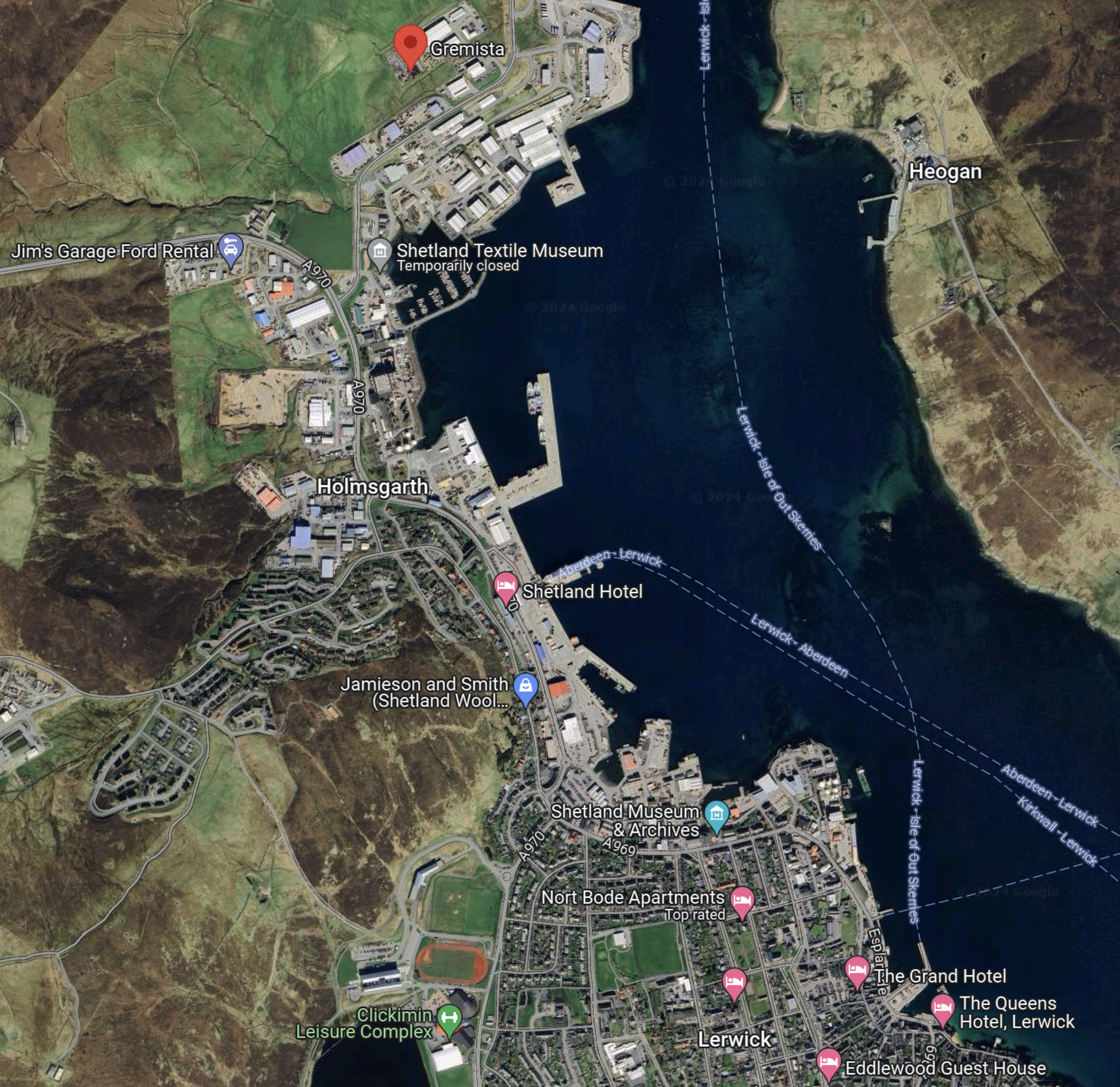
Gremista is marked by the red arrow.
I do have some thoughts.
Scatsta Airport
Consider.
- It takes takes over three hours on a bus between Lerwick and Sullum Voe
- Scatsta Airport only closed in 2020.
Is there an opportunity for an air taxi between Lerwick and Scatsta?
The Economic Case For Hydrogen In Domestic Heating
The title of this post, is the same as that of this article on The Chemical Engineer.
The Wikipedia entry for The Chemical Engineer has this introductory paragraph.
The Chemical Engineer is a monthly chemical engineering technical and news magazine published by the Institution of Chemical Engineers (IChemE). It has technical articles of interest to practitioners and educators, and also addresses current events in world of chemical engineering including research, international business news and government policy as it affects the chemical engineering community. The magazine is sent to all members of the IChemE and is included in the cost of membership. Some parts of the magazine are available free online, including recent news and a series of biographies “Chemical Engineers who Changed the World”, although the core and the archive magazine is available only with a subscription. The online magazine also has freely available podcasts.
It is a source on the Internet, where anything non-scientifically correct will be unlikely to appear.
The article has two introductory sub-headings.
Despite its thermodynamic disadvantages, global energy technology specialist Thomas Brewer believes hydrogen has an economic and efficient role in domestic heating. It forced him to deviate from his usual mantra of ‘efficiency above all else’ to get there, though
The work of decarbonisation by chemical engineers is about how we can cost effectively enable our organisations’ transition away from fossil fuels. This requires foresight. A decision chemical engineers make on a project with a 20-year lifespan will still be operational in 2045, when in most global locations, internal combustion engine (ICE) vehicles will probably be in the minority and grid electricity will be mostly renewable.
This is the first actual paragraph.
It is unsurprising, therefore, that chemical engineers are researching and debating the prospects of the future of energy availability from renewables, and the likely role and cost of hydrogen. There is much public noise surrounding the conversation about heat pumps vs hydrogen for domestic heating. I have noticed how few articles are written from an unbiased perspective, how very few reports talk about the whole solution, and authors avoid quantifying the financial impact of their proposed solution. I couldn’t find an unbiased study with any financial logic, so, I built a model to assess the options, for my own interests. I found the results so intriguing that I wanted to share them.
In other words, let the data do the talking and accept what it tells you.
These are some extracts from the article.
On Curtailment
The article says this on curtailment of wind energy, because you are generating too much.
Efficient electrical energy storage is expensive, which has traditionally led renewable system designers to include curtailment as a part of their design. Curtailment involves oversizing the wind supply to be higher than the grid connection to reduce the need for as much energy storage, and deliberately wasting the occasional electrical excess. The system design becomes an economical balance between oversizing the renewable generation and paying for additional electrical storage. Within the UK grid in 2023, curtailment is a small factor. As electrification and wind power become more mainstream, the financial decision between investing in excess wind vs electrical storage will lead curtailment to become a more significant factor.
Curtailment is to me a practice, that should be consigned to the dustbin of history.
To eliminate it, as much storage as is needed storage must be provided.
Eliminate Naked Flames In The Kitchen
The article says this about eliminating naked gas flames (natural gas or hydrogen) in the kitchen.
Figure 1 shows that the recommended standard of hydrogen gas installation if removing kitchen gas cooking would result in less injuries than the existing natural gas installation if cooking were converted to induction heating. Kitchen leaks are more likely than boiler leaks due to the number of valves and connections, regardless of the gas type. NOx emissions in the home because of naked flames in the kitchen are also of concern to the health of the occupants and hydrogen naked flames have a higher NOx emission than natural gas; another reason to eliminate naked flame cooking.
When I was financing the development of what became the Respimat inhaler, I did my due scientific diligence and found research from a Russell Group University, that naked flames (including smoking) were a cause of asthma, especially in children.
My recommendation is that, at an appropriate time in the near future, you replace your gas cooker with an electric one. My ginger-haired Glaswegian friend, who is a chef, who’s had Michelin stars would recommend an electric induction cooker.
Pumped Storage
The article says this about building more pumped storage.
The pumped storage assumption is based on the SSE proposal for Coire Glas, a 30 GWh £1.5bn storage system in Scotland which will more than double the UK’s current pumped storage capacity. The capital cost of this pumped storage system is about £50/kWh which will be delivered at about 80% efficiency. Pumped storage is a good balance between low cost and high efficiency. However, it requires natural resources. The Mott MacDonald report, Storage cost and technical assumptions for BEIS (Department for Business, Energy and Industrial Strategy) suggests the equivalent of four Coire Glas-scale installations in the UK by 2050. The model optimistically assumes that ten more similar additional Coire Glas-size pumped storage schemes could be installed.
This page on the Strathclyde University web site, gives these GWh figures for the possible amounts of pumped-storage that can be added to existing hydroelectric schemes.
Strathclyde’s total for extra storage is over 500 GWh.
Distributed Batteries
The article says this about distributed batteries.
A distributed battery assumption could be configured with multiple 10 kWh batteries which typically cost about £3,000 installed, near or in homes with a heat pump. This could be coupled with larger battery storage systems like the £30m Chapel Farm 99 MWh battery installation near Luton, commissioned in 2023. The small battery systems at each home are similar to the proposed virtual power plants using electric vehicle battery capacity to help balance the grid. Placing these batteries at locations with grid limitations could reduce the costs of upgrading the grid system. This is a more expensive energy storage scheme than pump storage and for the purposes of the model it is assumed that battery storage schemes are limitless. In both cases cited, the cost is £300/kWh. Battery efficiency varies significantly with temperature, and typically ranges from about 90% to 97%. As the system design needs to be focused on the coldest periods, the model is optimistically assuming 93% efficiency, which would require many of the batteries to be in a heated environment.
New lower-cost alternative batteries are also being developed.
Hydrogen Generation
The article says this about hydrogen generation.
Alternatively, the electricity generated from wind energy could be used in the electrolysis of water to produce hydrogen. While the fully installed electrolysis equipment costs about £2,100/kW, hydrogen storage in specially built cylinders is relatively cheap at about £23/kWh. The model, however, assumes salt mine storage which the US DoE in their report, Grid Energy Storage Technology Cost, calculate at a total system cost for hydrogen of $2/kWh. Electrolysis is the least efficient energy storage option, with a conversion efficiency of 75%, including compression. The waste heat from this conversion loss is useful for industrial heating, or in a district heating system. This has been ignored for simplicity.
Pumped storage, distributed batteries and hydrogen electrolysers distributed all over the UK, will mop up all the spare electricity and release it to heat pumps and for charging cars as necessary.
The hydrogen will be used for heating, to decarbonise difficult-to-decarbonise industries and provide fuel for hydrogen-powered vehicles, railways and shipping.
Curtailment will be a thing of the past.
The UK Offshore Wind Potential
The article says this about the UK offshore wind potential.
The UK government target for wind generation by 2030 is 50 GW. The UK offshore wind potential is reliable and available and has been estimated to be as high as 2,200 GW. There are, however, a few low wind periods that can last for several days.
I am not going to argue with 2,200 GW, but I will say that a lot of that will be used to generate hydrogen offshore.
Conclusions
This is the article’s main conclusion.
A wind-based supply for heating will mean that large quantities of potentially unused electricity will be available for more than 90% of the year, for potentially very low cost. While this could appear wasteful, it provides further synergistical opportunities for the decarbonisation of other interruptible energy duties, such as production of hydrogen for road transport or supplying heat via heat pumps for interruptible industries.
The sensitivity analysis shows that these conclusions are robust even with significant variation in the assumptions on equipment cost, efficiency, and other electricity source options.
This is also said about the most cost-effective solution.
A cost-effective national heat pump-only solution is about £500bn (50%) more expensive than a hydrogen-only boiler solution. The most cost-effective system is a combination of the two, £100bn cheaper than the hydrogen-only solution, and £600bn cheaper than the heat pump-only solution.
A cost-effective national heat pump-only solution has a system efficiency 40% lower than the hydrogen-only solution, requiring more than 750 GW of installed wind capacity. A hydrogen boiler solution requires less than 500 GW but the most efficient system, however, is a combination of the two.
The conclusions mean that everybody will be able to use the most appropriate solution for their circumstances for both heating their housing or powering their vehicles, as there will be massive supplies of affordable electricity and hydrogen.
How Will Everything Be Paid For?
Just as Germany and others built its industry on cheap Russian gas, it will now choose to use the plentiful and reliable UK electricity and hydrogen to rebuild its industry.
ScottishPower Makes Hydrogen Aviation Pact
The title of this post, is the same as that of this article on reNEWS.biz.
These two paragraphs outline the project.
ScottishPower has partnered with ZeroAvia to explore the development of green hydrogen supply solutions for key airports, with the aim of seeing the decarbonisation of air travel take off.
The collaboration will allow the companies to explore the hydrogen infrastructure for airports to support hydrogen-electric flight and other potential uses.
There is no point of having zero-carbon hydrogen-electric aircraft without the ability to refuel them.
This picture comes from ScottishPower’s original press release.
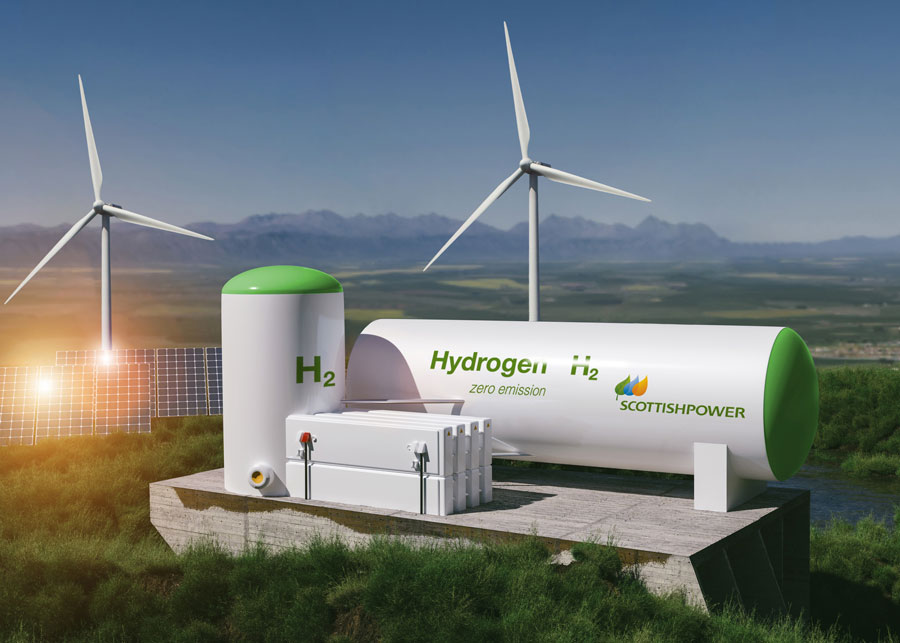
I can see a system like this having applications in industries like buses, farming, heavy transport and mining.
The Best Plane That Looks Like An Egg
The title of this post is the same as that of this article on interesting Engineering.
This is the sub-heading.
Celera 500L: Redefining aviation with its unique egg-shaped design, unparalleled fuel efficiency, and affordability.
These are the first two paragraphs.
In the world of aviation, where innovation meets the boundless sky, a groundbreaking aircraft is poised to redefine the future of air travel. Meet the Celera 500L, the brainchild of the Otto Aviation Group, an aircraft that not only boasts a distinctive egg-shaped design but also promises to transform the way we think about flying. Set to enter production in 2025, the Celera 500L is a testament to cutting-edge technology and forward-thinking design, promising to make air travel more cost-effective and eco-friendly than ever before.
One cannot help but be captivated by the Celera 500L’s futuristic aesthetics. Its unmistakable egg-shaped design is a departure from the traditional aircraft we’ve grown accustomed to seeing in the skies. However, this unique shape is not just for show; it’s the result of meticulous engineering aimed at reducing drag and maximizing efficiency.
I suggest you read the article and look at Interesting Engineering’s video.
After that have a good look at Otto Aviation’s web site.
Brief details of the business aircraft version are scattered through the pages.
- Passengers – 6
- Range – 5,000 miles
- Fuel-consumption – 33 miles per gallon.
- Power – Single pusher diesel engine.
The Otto Aviation web site, explains how it is done using laminar flow and advanced aerodynamics.
There is also this page on the ZeroAvia web site, which is entitled ZeroAvia & Otto Aviation Partner to Deliver First New Airframe Design with Hydrogen-Electric Engine Option.
Is a new world of aviation emerging?
Ten Spanish Companies Join Forces To Apply Hydrogen Propulsion To A High-Speed Train For The First Time
The title of this post, is the same as that of this press release from Talgo.
These are the three bullet points.
- The Hympulso project is part of the Strategic Projects for Economic Recovery and Transformation (PERTES)
- A new technical car with hydrogen and batteries to be developed for a Talgo 250 train, allowing it to run on clean energy on non-electrified lines.
- The main partners are Talgo, Golendus, Ingeteam, Repsol, Sener and Optimus3D.
These are the first four paragraphs.
Ten Spanish companies have joined forces to design, build and install, for the first time in the world, a propulsion system based on renewable hydrogen fuel cells on a high-speed train. Under the Hympulso project, the companies will develop a set of technologies that can be applied to the Talgo 250 ‘all-terrain’ train, making it possible to electrify the rail network with energy generated entirely from renewable sources, even on lines without overhead power lines.
Led by Talgo, Hympulso also includes Golendus, Ingeteam, Optimus3D, Repsol and Sener as partners. Universidad Pontificia Comillas and Tecnalia are collaborators, while Adif is an observer. The initiative has received a grant of €6.5 million and is part of the Incentive Programme for the Innovative Value Chain and Knowledge of Renewable Hydrogen, as part of the Recovery, Transformation and Resilience Plan.
Hympulso will be comprehensive in nature: it will activate the entire renewable hydrogen value chain in the railway system, from production to consumption. The project will also make it possible to analyse the impact of the future transition on the various railway infrastructure assets managed by Adif, such as maintenance facilities or the track.
Thus, the project will result in a joint output of hydrogen supply installations adapted to railways -both mobile and static- and a pioneering prototype of a hybrid bimodal train for passengers with automatic track-gauge change, which will be able to run both on conventional and high-speed networks, using catenary supply when available, or hydrogen and batteries in those corridors that are not electrified.
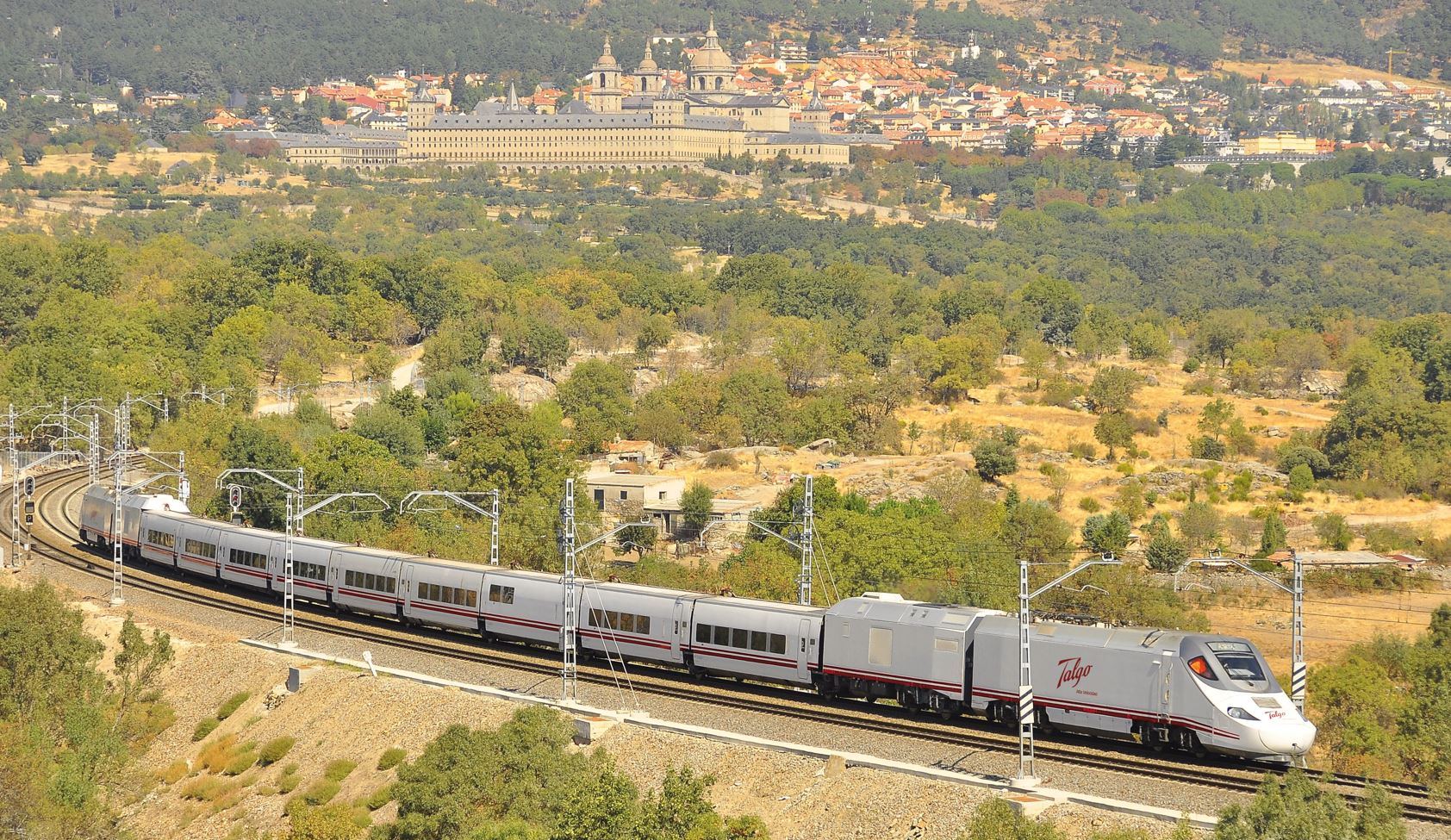
This picture shows a visualisation of the train.
Note.
- There is a power car containing the hydrogen fuel cells and other gubbins behind the one or both locomotives.
- Hydrogen power is used, where there is no electrification.
- Talgo already make a high speed train with a diesel power pack, so engineering would only involve developing a new hydrogen power pack.
My only questions are.
- Do the trains come without gauge-changing?
- Could they be run on a typical UK rail line?
- Do they speak, Cornish, Gaelic and Welsh?
If the answer to all questions is yes, then this must be the ideal train for these routes.
- London Euston and Aberystwyth
- London Euston and Holyhead
- London King’s Cross and Aberdeen.
- London King’s Cross and Cleethorpes/Grimsby
- London King’s Cross and Inverness.
- London King’s Cross and Thurso/Wick.
- London Paddington and Carmarthen
- London Paddington and Penzance
Note.
- No more electrification on these routes would be needed.
- The trains could use High Speed Two to wherever it goes.
- The trains could do 140 mph on the Great Western Main Line, East Coast Main Line and West Coast Main Line.
Hympulso looks a very comprehensive, professional and practical plan, that could easily be adapted to the UK mainland.
H2 Green Steel Raises More Than €4 billion In Debt Financing For The World’s First Large-Scale Green Steel Plant
The title of this post, is the same as that of this press release from H2 Green Steel.
This is the sub-heading.
H2 Green Steel signs definitive debt financing agreements for €4.2 billion in project financing and increases the previously announced equity raised by €300 million. Total equity funding to date amounts to €2.1 billion. The company has also been awarded a €250 million grant from the EU Innovation Fund. H2 Green Steel has now secured funding of close to €6.5 billion for the world’s first large-scale green steel plant in Northern Sweden.
These three paragraphs describe the company and outlines the financing.
H2 Green Steel is driving one of the largest climate impact initiatives globally. The company was founded in 2020 with the purpose to decarbonize hard-to-abate industries, starting by producing steel with up to 95% lower CO2 emissions than steel made with coke-fired blast furnaces. The construction of the flagship green steel plant in Boden, with integrated green hydrogen and green iron production, is well under way. The supply contracts for the hydrogen-, iron- and steel equipment are in place. A large portion of the electricity needed has been secured in long-term power purchase agreements, and half of the initial yearly volumes of 2.5 million tonnes of near zero steel have been sold in binding five- to seven-year customer agreements.
Today H2 Green Steel announces a massive milestone on its journey to accelerate the decarbonization of the steel industry, which is still one of the world’s dirtiest. The company has signed debt financing of €4.2 billion, added equity of close to €300 million and been awarded a €250 million grant from the Innovation Fund. Funding amounts to €6.5 billion in total.
H2 Green Steel has signed definitive financing documentation for €3.5 billion in senior debt and an up-to-€600 million junior debt facility:
Note.
- I first wrote about H2 Green Steel about three years ago in Green Hydrogen To Power First Zero Carbon Steel Plant.
- The Wikipedia entry for Boden in Northern Sweden, indicates it’s a coldish place to live.
- In that original post, H2 Green Steel said they needed €2.5 billion of investment, but now they’ve raised €4 billion, which is a 60 % increase in financing costs in just three years.
Is this Sweden’s HS2?
The Future Of Green Steelmaking
The finances of H2 Green Steel look distinctly marginal.
I have a feeling that green steel, as the technology now stands is an impossible dream.
But I do believe that perhaps in five or ten years, that an affordable zero carbon method of steel production will be developed.
You have to remember, Pilkington developed float glass in the 1950s and completely changed an industry. Today, we’d call that a classic example of disruptive innovation.
The same opportunity exists in steelmaking. And the rewards would be counted in billions.
Centrica Business Solutions Delivers Significant Energy Savings For The Pirbright Institute
The title of this post, is the same as that of this press release from Centrica.
These three paragraphs outline the project.
Centrica Business Solutions has partnered with The Pirbright Institute to deliver sustainable on-site technology that will help reduce its net energy use by more than 10 per cent by 2026.
Centrica installed a new Combined Heat and Power Plant (CHP), which will provide around 75 per cent of Pirbright’s future power needs. The CHP uses natural gas to generate electricity and hot water at the site, with its exhaust gases also used to feed into a heat recovery generator to provide steam. It means CHP technology is over twice as efficient as conventional power sources and can lower organisational reliance on the Grid.
The Institute, which is dedicated to the study of infectious diseases of farm animals, has already devised an energy plan which has introduced energy-saving upgrades across the Surrey campus, including the closure of energy-inefficient buildings, the introduction of efficient lighting and a programme to raise staff awareness of energy consumption.
The system is still powered by natural gas.
Liverpool University
I was an undergraduate at Liverpool University and according to this page on their web site, which is entitled Sustainability, they seem to be following a similar route to the Pirbright Institute.
With a heading of Energy And Carbon, this is the mission statement.
The University’s ambition is to be a climate-resilient campus, that has minimal negative and maximum positive environmental impact, achieving net zero carbon by 2035. We monitor energy and carbon across the entire University as part of the Climate plan and in support of the Sustainability Strategy and Strategy2026 net zero carbon targets.
One section of the page has a title of The Green Recovery with Clarke Energy at the University’s Energy Centre, where this is said.
The University of Liverpool generates up to 90% of its campuses electricity needs on site in the Energy Centre, through CHP. Clarke Energy help the University operate CHP in the most efficient way, keeping us on track with technological developments, such as how the CHP can be adapted to take different fuel blends.
Although there is a nod to different fuel blends, I suspect that the system, like that at Pirbright, is currently powered by natural gas.
Clarke Energy, is headquartered in Liverpool and is a division of Kohler.
Centrica And HiiROC
CHP systems are becoming more common and like these two systems, they are generally powered by natural gas.
In Plans Submitted For Hydrogen Pilot Plant At Humber Power Station, I describe how Hull-based start-up; HiiROC are going to help fuel a gas-fired power station with a hydrogen blend.
This is a paragraph from this article on Business Live, which describes Centrica’s relationship with HiiROC.
It comes as the owner of British Gas has also increased its shareholding in the three-year-old business to five per cent. Last November it was one of several investors to pump £28 million into HiiRoc alongside Melrose Industries, HydrogenOne, Cemex, Hyundai and Kia, who joined existing strategic investors Wintershall Dea and VNG.
HiiROC’s system can take any hydrocarbon gas from biomethane, through chemical plant waste gas to natural gas and convert it to hydrogen and carbon black.
Carbon black has a large number of manufacturing uses and can also be used in agriculture to improve soil.
It looks to me, that HiiROC’s systems will be a simple way to convert natural gas-powered CHPs to zero carbon.
EDF Receives Green Light For Solar Farm At The Macallan Estate
The title of this post, is the same as that of this article on Solar Power Portal.
These three paragraphs outline the story.
Energy company EDF Renewables UK has been granted the green light to develop a 4MW solar farm to decarbonise the production of The Macallan’s single malt Scotch whisky in Craigellachie.
Located at The Macallan Estate in north-east Scotland, the distillery company alongside EDF Renewables will integrate ground-mounted solar panels to deliver up to 50% of the daytime electricity needs at peak output. In doing so, this could provide 30% of the site’s yearly electricity demand.
A key aspect of the project is biodiversity and local community engagement – aspects of solar projects which regular readers of Solar Power Portal will be aware of across a number of different schemes.
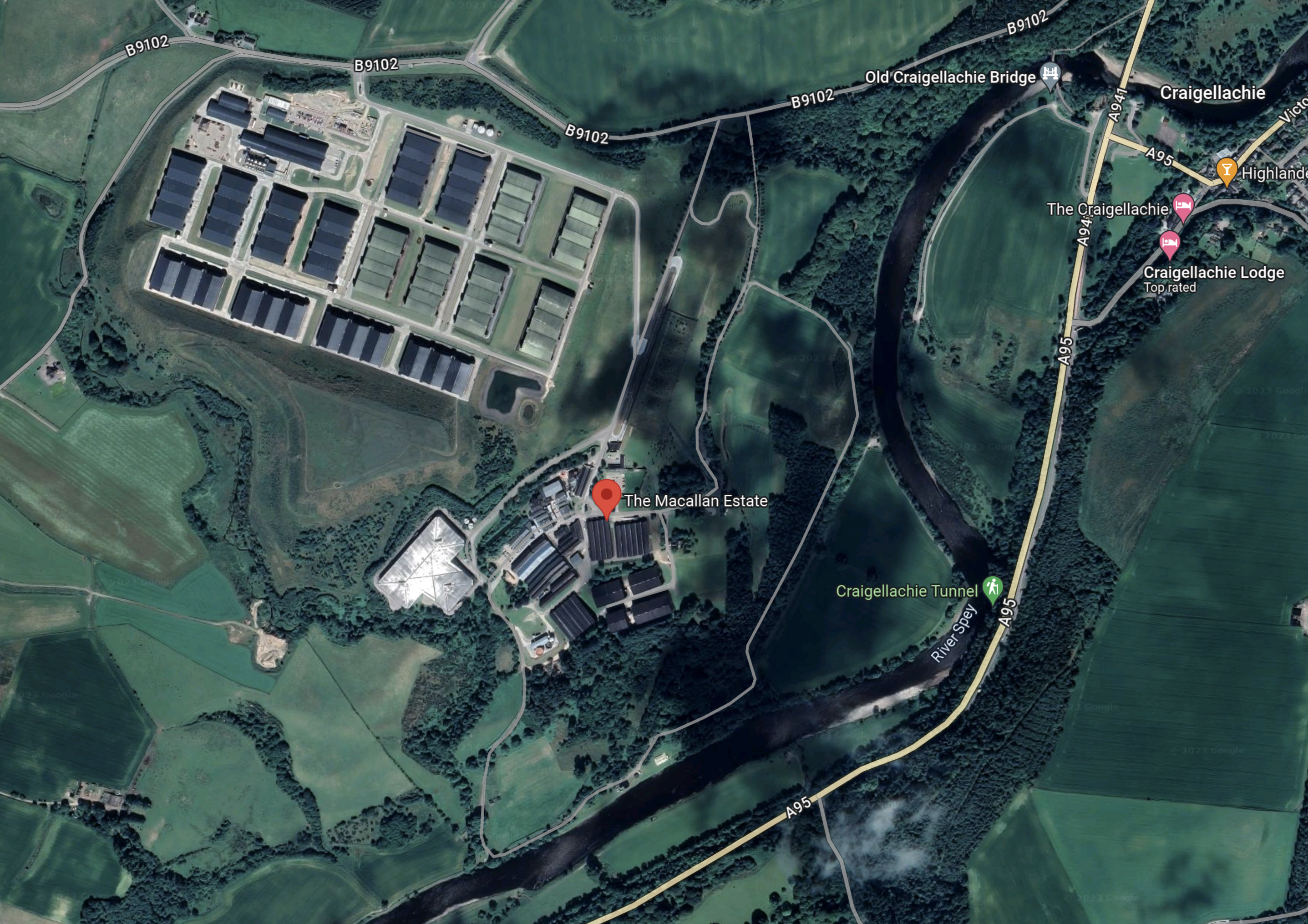
This Google Map shows the Macallan Estate about sixty miles to the North-West of Aberdeen.
This page on the Macallan Estate web site gives details about the company, its whisky and principles.
As the estate is 485 acres, they’ve certainly got enough space for 4 MW of solar panels.
I do wonder though if low- or zero-carbon whisky and other spirits is the way the industry is going.
Searching the Internet for “Zero-Carbon Whisky” gives some worthwhile results.
- NC’NEAN is organic Scotch Whisky distilled in a net-zero distillery in the Western Highlands of Scotland.
- Cooper King is the is the very first whisky in England to be distilled using net zero energy.
- Diageo opens its first carbon neutral whiskey distillery in North America
- The Scotch Whisky Association will achieve Net Zero emissions by 2040 in our own operations.
- Scotch Whisky Heads To Zero Emissions With Wind & …
Scotland seems to be moving to make whisky at least carbon neutral.
There are also two hydrogen projects aimed at distilleries under development.
This is a paragraph from the home page of the Cromarty Hydrogen Project.
The Cromarty Hydrogen Project is the first project in the Scotland Hydrogen Programme. It originated from a collaboration between the Port of Cromarty Firth, ScottishPower, Glenmorangie, Whyte & Mackay and Diageo and the project originator, Storegga during the feasibility stage. This project is looking to develop a green hydrogen production hub in the Cromarty Firth region and revolves around the local distilleries forming the baseload demand for early phases of the project, which would enable them to decarbonise in line with their own ambitions and sector targets.
This project appears to be backed by three companies, who produce Scotch whisky.
In Major Boost For Hydrogen As UK Unlocks New Investment And Jobs, I said this.
I have just looked at the InchDairnie Distillery web site.
- It looks a high class product.
- The company is best described as Scotch Whisky Reimagined.
- The company is based in Fife near Glenrothes.
- They appear to have just launched a rye whisky, which they are aiming to export to Canada, Japan and Taiwan.
The press release says this about InchDairnie.
InchDairnie Distillery in Scotland, who plan to run a boiler on 100% hydrogen for use in their distilling process.
That would fit nicely with the image of the distillery.
I suspect the hydrogen will be brought in by truck.
Would a zero-carbon whisky be a hit at Extinction Rebellion and Just Stop Oil parties?
Diageo
This page on the Diageo web site is entitled Accelerating To A Low Carbon World.
It would probably help if more companies thought like Diageo.
Conclusion
Macallan are certainly going in the right direction.

