Plans for Hydrogen Development At Dogger Bank D Gain Ground
The title of this post, is the same as that of this article on offshoreWIND.biz.
This is the sub-heading.
Dogger Bank D, the potential fourth phase of the world’s largest offshore wind farm under construction, Dogger Bank Wind Farm, has awarded contracts to engineering consultants to support the feasibility and optimization of a large-scale green hydrogen development option on the project
These three paragraphs outline the project.
SSE Renewables and Equinor, the developers of the Dogger Bank wind farm in the UK, awarded contracts for green hydrogen concept and engineering and optimization studies to Genesis, H2GO Power, and Fichtner.
If progressed for delivery, Dogger Bank D would be located in the North Sea around 210 kilometers off the northeast coast of England. Subject to the successful outcome of further technical studies, the project could be capable of generating up to around 2 GW of renewable power.
The 2 GW offshore wind farm is currently planned to comprise 128 wind turbines and up to six offshore platforms.
Note.
According to the article, this would be one of the UK’s largest green hydrogen production facilities.
The partners said, that the project could contribute to the UK Government’s electrolytic hydrogen ambitions for 5 GW by 2030.
This is said about the studies.
Using AI machine learning and robust modeling, these studies will investigate the multitude of interdependent variables required to optimize a potential green hydrogen production facility, such as offshore wind farm sizing, electrolysis capacity, transport and storage capacity, water availability, and offtake optionality.
I was using robust modelling on projects such as these fifty years ago, both with Artemis and bespoke software.
To my mind, SSE Renewables and Equinor are doing the right thing. If anybody has a similar project with lots of variables, I’d love to give my opinion.
I have some thoughts.
How Much Hydrogen Will Be Produced?
Ryze Hydrogen are building the Herne Bay electrolyser.
- It will consume 23 MW of solar and wind power.
- It will produce ten tonnes of hydrogen per day.
The electrolyser will consume 552 MWh to produce ten tonnes of hydrogen, so creating one tonne of hydrogen needs 55.2 MWh of electricity.
This would mean that if the Japanese built one Herne Bay-size electrolyser, then it would produce around three hundred tonnes of hydrogen in an average month.
Consider.
- Dogger Bank D is likely to be a 2 GW wind farm.
- This document on the OFGEM web site, says that the Dogger Bank wind farms will have a capacity factor of 45 %.
- This means that Dogger Bank D wind farm will produce an average of 900 MW over a year.
- This works out at 7,884 GWh of electricity in a year.
As each tonne of hydrogen needs 55.2 MWh to be produced, this means if all the electricity produced by Dogger Bank D, is used to create green hydrogen, then 142,826.1 tonnes will be produced.
How Will The Hydrogen Be Brought Ashore?
142,826.1 tonnes is a lot of green hydrogen and the easiest ways to transfer it to the shore would be by a pipeline or a tanker.
I wouldn’t be surprised to see the use of tankers, as this would give more flexibility and allow the export of hydrogen to countries in need of hydrogen.
Will There Be Hydrogen Storage In The Dogger Bank D Wind Farm?
This would surely be a possibility, but there are security considerations.
Cost would also be a factor!
The Location Of The Dogger Bank D Wind Farm
I clipped this map of Dogger Bank A, B, C and D wind farms from this page of the Dogger Bank D web site.
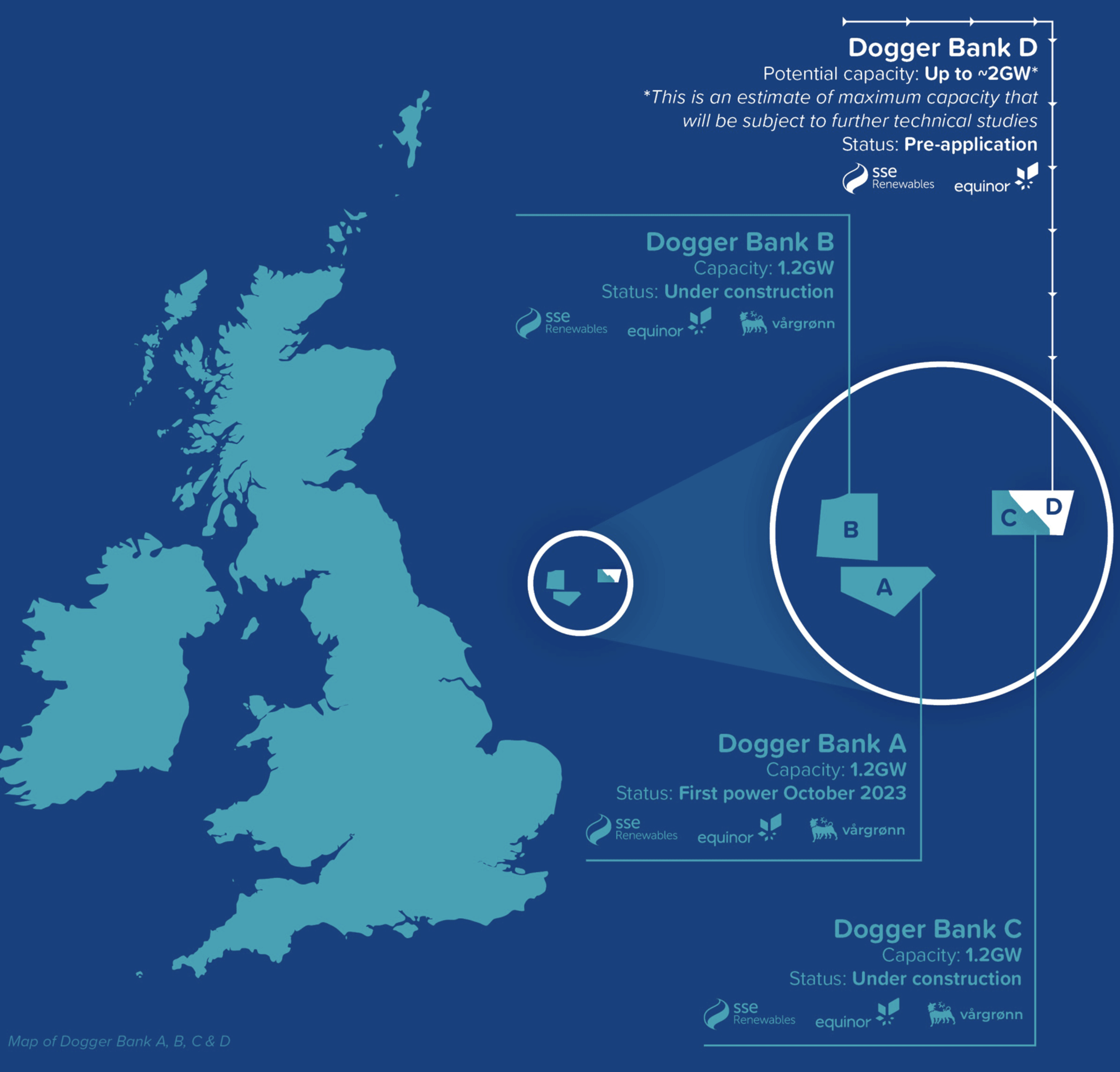
Note.
- RWE’s Dogger Bank South wind farm is not shown on the map.
- Dogger Bank D wind farm is the most Easterly of the four wind farms being developed by SSE Renewables and Equinor.
- Dogger Bank D wind farm must be the closest of the Dogger Bank wind farms to the Eastern border of the UK’s Exclusive Economic Zone or EEZ.
Dogger Bank D wind farm would appear to be ideally placed to supply hydrogen to a number of places, by either pipeline or tanker.
Could Dogger Bank South Wind Farm Also Produce Hydrogen?
In RWE Partners With Masdar For 3 GW Dogger Bank South Offshore Wind Projects, I talked about the change of ownership of the Dogger Bank South wind farm.
I would assume that the Dogger Bank South wind farm will be located to the South of the Dogger Bank A,B, C and D wind farms.
Whether it will produce hydrogen will be a matter for the owners and market conditions.
I do believe though, that it could share some facilities with the those that might be built for Dogger Bank D wind farm.
Conclusion
After this brief look, Dogger Bank D could be an ideal place to build a large hydrogen production facility.
Centrica’s Rough Storage Facility Pumps Gas Into Grid To Meet Increased Demand
The title of this post, is the same as that of this press release from Centrica.
This is the sub-heading.
The UK’s largest gas storage facility, Rough, has released stored gas into the grid to help the UK both manage higher heating demand during the current cold weather and keep prices down. This is the first time Rough has released gas this winter.
These three paragraphs describe how Centrica are using Rough and how they will use it in the future.
This year, Centrica has filled Rough with the equivalent of 18 LNG tankers. Rough provides enough energy to heat over 3 million homes, every day, all winter, keeping families warm and bills down.
Rough is the UK’s largest gas storage facility. It stopped storing gas in 2017 but was re-opened for gas storage in October 2022, and its capacity was doubled in the summer of 2023. The facility, which is 18 miles off the coast of East Yorkshire, now provides half of the UK’s total gas storage.
Centrica’s long-term ambition is to turn the Rough gas field into the largest long duration low carbon energy storage facility in the world, capable of storing both natural gas and hydrogen.
It does seem that Centrica have handled the Rough facility well.
But I do feel that Centrica are playing a bigger game.
- In Lhyfe And Centrica To Develop Offshore Renewable Green Hydrogen In The UK, I talk about how Centrica will produce hydrogen offshore.
- Would this hydrogen be conveniently produced near to Rough?
- Rough allow Centrica to buy gas at a low price and sell high. Rough could be a neat little profit centre?
- I suspect lessons learned at Rough, could be applied to other gas storage facilities?
- Centrica have taken a substantial stke in HiiROC, who are developing a new way of producing green hydrogen.
- In Centrica Partners With Hull-Based HiiRoc For Hydrogen Fuel Switch Trial At Humber Power Plant, I talk about how Centrica are helping HiiROC with full scale trials.
I certainly like what they’re doing.
Do Rolls-Royce mtu Have A Plan To Decarbonise Their Diesel Engines For Rail Applications?
Data Sheets For Rolls-Royce mtu Diesel Engines For Trains
These are data sheets for various Rolls-Royce mtu diesel engines that can be used in rail applications.
Rolls-Royce Releases mtu Rail Engines For Sustainable Fuels
The title of this section, is the same as that of this press release from Rolls-Royce.
These four bullet points, act as sub-headings.
- mtu Series 1300, 1500 and 1800 engines already released; Series 1600 and 4000 to follow shortly
- Up to 90% CO2 savings by operating existing engines with Hydrotreated Vegetable Oil (HVO/renewable diesel)
- Locally emission-free operation possible in combination with mtu Hybrid PowerPack
- Field tests with DB Cargo and RDC Autozug Sylt
This is the first paragraph.
Rolls-Royce is taking a significant step towards even more climate-friendly rail transport with the release of mtu rail engines for use with sustainable fuels. With synthetic diesel fuels of the EN15940 standard, CO2 emissions can be reduced by up to 100 percent compared to fossil diesel. Hydrotreated Vegetable Oil (HVO or renewable diesel), which is already commercially available today, reduces CO2 emissions by up to 90 percent. If the fuels are produced with the help of renewable energy and green hydrogen – through what is termed a Power-to-X process – existing rail vehicles can be operated in a completely CO2-neutral manner. The mtu Series 1800 engines which are used in mtu PowerPacks, as well as Series 1300 and 1500 for locomotives and multi-purpose vehicles, are already approved for use with synthetic fuels such as HVO. Series 1600 and versions of Series 4000 engines will follow in the near future. The release of engines for climate-friendly fuels requires a series of tests and trials and Rolls-Royce has found strong partners for this activity. DB Cargo and RDC Autozug Sylt have already tested or are currently testing mtu Series 4000 engines with HVO in their locomotives.
How Does That Fit With The UK’s Population Of Rolls-Royce mtu Diesel Engines?
These classes of train have Rolls-Royce mtu engines.
- Class 43 power cars – 6V 4000 R41R
- Class 168 train – 6R 183 TD 13H
- Class 170 train – 6R 183 TD 13H
- Class 172 train – 12V 1800 R83
- Class 195 train – 12V 1800 R85L
- Class 196 train – 12V 1600 R85L
- Class 197 train – 12V 1600 R85L
- Class 800 train – 12V 1600 R80L
- Class 801 train – 12V 1600 R80L
- Class 802 train – 12V 1600 R80L
- Class 805 train – 12V 1600 R80L
- Class 810 train – 12V 1600 R80L
Note.
- Class 168 and 170 trains seem to be powered by older model Rolls Royce mtu engines.
- Class 180, 220,221 and 222 trains are powered by Cummins engines.
- I can’t find what engines power Class 805 and 810 trains, but it is reasonable to assume they have the same engines as the other Hitachi trains.
- As CAF are building LNER’s new tri-mode trains, I suspect these trains will also have Rolls Royce mtu engines.
It would appear that all the Rolls-Royce mtu rolling stock in the UK, with the possible exception of the Class 168 and 170 trains will be able to run on sustainable fuels.
Rolls Royce mtu And Hydrogen
This press release from Rolls-Royce is entitled Rolls-Royce Successfully Tests mtu Engines With Pure Hydrogen.
This is the first paragraph.
Rolls-Royce today announces that it has conducted successful tests of a 12-cylinder gas variant of the mtu Series 4000 L64 engine running on 100% hydrogen fuel. The tests, carried out by the Power Systems business unit, showed very good characteristics in terms of efficiency, performance, emissions and combustion. These tests mark another important step towards the commercial introduction of hydrogen solutions to meet the demand of customers for more sustainable energy.
Engines of mtu’s 4000 family are used in Class 43 power cars, so surely these developments could lead to hydrogen-powered freight locomotives.
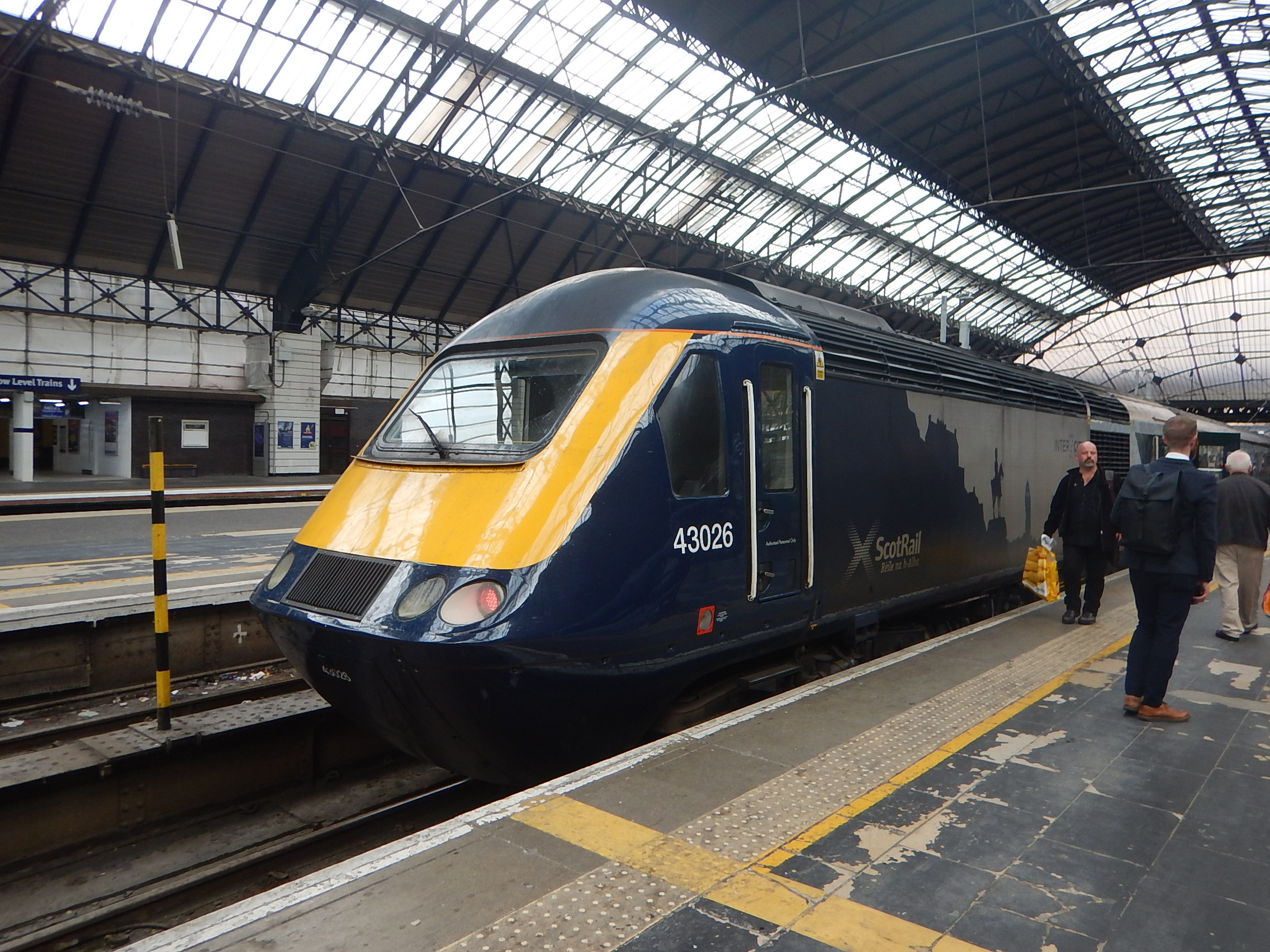
The picture shows a Class 43 power car at Glasgow Queen Street station.
Could Rolls-Royce mtu hydrogen power keep these iconic trains running for a few more years?
In ‘Spirit of Innovation’ Stakes Claim To Be The World’s Fastest All-Electric Vehicle, I look at Rolls-Royce’s Spirit of Innovation, which set the record for an electric vehicle at 555.9 km/hour.
As the InterCity125 already holds the record for the fastest diesel train, perhaps Rolls-Royce will attempt to set a record for the fastest hydrogen-powered train?
Decarbarbonising The CAF Class 195, 196 And 197 Trains
If Rolls-Royce mtu develop a hydrogen version of the 1800 diesel engine, then this could be used to fully decarbonise the CAF trains.
The operators may consider it’s not worth it and continue with using sustainable fuels.
But the possibility is surely there.
There must also be the possibility of developing a fuel cell replacement for the 1800 diesel, that can be slotted into the train.
Decarbarbonising The Hitachi Class 80x Trains
Hitachi are developing battery packs and the data sheet can be downloaded from this page on the Hitachi web site.
Decarbarbonising The CAF Tri-Mode Trains
I feel that as CAF usually use Rolls-Royce mtu engines, I suspect these trains will be designed, so they can be converted to hydrogen.
Conclusion
Rolls-Royce mtu appear to be on a path to decarbonise all their diesel engines.
Rolls-Royce Announces Successful Run Of UltraFan Technology Demonstrator To Maximum Power
The title of this post, is the same as that of this press release from Rolls-Royce.
This is the sub-heading.
Rolls-Royce today announces it has successfully run its UltraFan® technology demonstrator to maximum power at its facility in Derby, UK. The initial stage of the test was conducted using 100% Sustainable Aviation Fuel (SAF).
These are the first four paragraphs.
This is an important milestone for the UltraFan demonstrator, which was successfully tested for the first time earlier this year. Since then, the UltraFan team has been gradually increasing the power as part of the rigorous testing regime and the demonstrator has performed in line with our expectations. The results of the test will provide us with valuable learning and data, which our teams will now take away and continue to analyse.
This achievement reinforces our confidence in the suite of technologies that has been developed as part of the UltraFan programme. Confirming this capability is a big step towards improving the efficiency of current and future aero-engines as UltraFan delivers a 10% efficiency improvement over our Trent XWB, which is already the world’s most efficient large aero-engine in service. In total that’s a 25% efficiency gain since the launch of the first Trent engine.
UltraFan’s scalable technology from ~25,000-110,000lb thrust also offers the potential to power the new narrowbody and widebody aircraft anticipated in the 2030s.
As part of the UltraFan development programme we have identified a number of technologies that are potentially transferable to our current Trent engines, which will provide our customers with even greater availability, reliability and efficiency.
These are my thoughts.
What Is UltraFan?
UltraFan has a section in the Wikipedia entry for the Rolls-Royce Trent engine, where these are the two opening paragraphs.
After the Advance comes the UltraFan, initially aimed to be ready for service from 2025. A geared turbofan with a variable pitch fan system that promises at least 25% improvement in fuel burn, the UltraFan aims for a 15:1 bypass ratio and 70:1 overall pressure ratio.
The Ultrafan keeps the Advance core, but also contains a geared turbofan architecture with variable-pitch fan blades. As the fan will vary pitch to be optimised for each flight phase, it won’t need a thrust reverser. Rolls-Royce will use carbon composite fan blades instead of its usual hollow titanium blades, and along with new material adoption will save 340 kg (750 lb) per engine.
This is a bit different from previous engines.
Variable-Pitch Fan Blades
Variable Pitch Fan has its own Wikipedia entry, where these are the two opening paragraphs.
A variable pitch fan is similar in concept to that of a variable-pitch propeller and involves progressively reducing the pitch (or blade angle) of the fan on a turbofan as the engine is throttled. Although variable pitch fans are used in some industrial applications, the focus of this article is on their use in turbofan engines. No production engine uses such a feature; however, it will likely be required on at least some of the next generation of high bypass ratio turbofans.
One of the methods used to reduce Thrust-specific fuel consumption is to improve Propulsive Efficiency. This involves reducing the effective jet velocity of the engine by reducing specific thrust. This, in turn, reduces the optimum fan pressure ratio required and consequently the cold nozzle pressure ratio. At cruise flight speeds the nozzle is choked and the fan working line is fairly steep and linear. However, at low flight speeds the ram pressure rise in the air intake is so low the nozzle is well un-choked. Consequently, the fan working line is highly curved and well to the left of the cruise flight speed working line, potentially reducing the fan surge margin to a dangerous level, particularly at lower throttle settings. Readers unfamiliar with surge lines, working lines, etc. should read the Wikipedia article on Compressor map.
The extract says that no production engine uses this feature. So will UltraFan be the first?
Variable pitch fan blades seem to offer two advantages; better efficiency and lower weight. If the reliability is acceptable, then that must be a winner.
No Thrust Reverser
This sentence is also in the Wikipedia entry for Variable Pitch Fan.
One advantage of the variable fan option is that varying the fan pitch offers the possibility of reversing engine thrust without the need for heavy blocker doors, cascades, etc.
It does look like the UltraFan will be a lighter engine, than its predecessor.
Composite Fan Blades
Composite Fan Blades were tried in the 1960s for the Rolls-Royce RB211 engine.
But they failed and were replaced by titanium blades.
At the time, I was at Liverpool University and John Wilkinson was a fellow student.
John’s father was the manager of a Tesco store in Derby.
That Tesco store had a nice line in selling out-of-date chickens and turkeys to Rolls-Royce to test the engines for bird strikes.
Improving The Engine’s Efficiency
This is the second paragraph of the press release.
This achievement reinforces our confidence in the suite of technologies that has been developed as part of the UltraFan programme. Confirming this capability is a big step towards improving the efficiency of current and future aero-engines as UltraFan delivers a 10% efficiency improvement over our Trent XWB, which is already the world’s most efficient large aero-engine in service. In total that’s a 25% efficiency gain since the launch of the first Trent engine.
Note.
- The Trent engine was first run in 1990 and has improved 25 % since.
- The Trent XWB engine was first run in 2010 and has improved 10 % since.
The increase in efficiency appears to be linear.
A Saleable Design
This is the third paragraph of the press release.
UltraFan’s scalable technology from ~25,000-110,000lb thrust also offers the potential to power the new narrowbody and widebody aircraft anticipated in the 2030s.
If that means that an UltraFan can power an aircraft as small as an A320, then that is sensational, as it will give Rolls-Royce access to the A320/Boeing 737 market, where they have virtually no sales.
UltraFan Is About A Suite Of Technologies
This is from the second paragraph of the extract.
This achievement reinforces our confidence in the suite of technologies that has been developed as part of the UltraFan programme.
And this is the fourth paragraph.
As part of the UltraFan development programme we have identified a number of technologies that are potentially transferable to our current Trent engines, which will provide our customers with even greater availability, reliability and efficiency.
As you learn more about your future project, why not apply that knowledge to current projects.
Running On SAF Is Part Of The Testing
I’m reassured that testing of the technology using Sustainable Aviation Fuel has started early in the program.
This is surely going to be the fuel, that aircraft will use until hydrogen becomes available.
Conclusion
It looks like Rolls-Royce are redefining, what a standard aero engine looks like.
- It will give a 10 % fuel saving over their latest engines launched thirteen years ago.
- The UltraFan engines will save weight and hopefully more fuel.
- It will allow Rolls-Royce to compete in the A320/737 market, where they have no engine at present.
I would watch the share price
UK And Germany Boost Offshore Renewables Ties
The title of this post, is the same as that of this article on offshoreWIND.biz.
This is the sub-heading.
A new partnership between the UK and German governments has been agreed on 3 November to help secure safe, affordable, and clean energy for consumers in both nations for the long-term and bolster energy security. Both countries commit to strengthening cooperation in renewables, notably offshore wind and electricity interconnection.
These two paragraphs introduce the deal.
Under the new partnership signed in London by Energy Security Secretary Claire Coutinho and Germany’s Vice Chancellor, Robert Habeck, the UK and Germany have reaffirmed their shared ambition and commitment to net zero and progressing the energy transition.
Europe’s two largest economies have also doubled down on commitments made under the Paris Agreement to limit global warming to 1.5 degrees.
i think this could be a worthwhile follow-up to the relationship, that Boris Johnson and Olaf Scholz seemed to encourage after their high profile meeting in April 2022.
This press release from Downing Street is entitled PM meeting with German Chancellor Olaf Scholz: 8 April 2022 and this is the first two paragraphs.
The Prime Minister welcomed German Chancellor Olaf Scholz to Downing Street this afternoon to discuss the West’s response to Putin’s barbaric invasion of Ukraine.
The two leaders shared their disgust at the Russian regime’s onslaught and condemned Putin’s recent attacks.
I wrote Armoured Vehicles For Ukraine based on some of the things said in the press conference after what seemed to be a very wide discussion.
But it was these paragraphs in the press release that caught my eye.
They also agreed on the need to maximise the potential of renewable energy in the North Sea and collaborate on climate ambitions and green energy.
The Prime Minister said he wanted to further deepen the UK’s relationship with Germany, and intensify its cooperation across defence and security, innovation and science.
After Boris and Olaf’s meeting at Downing Street, I have been able to write these posts about the Anglo-German energy relationship and also make some other observations.
- Mona, Morgan And Morven
- UK-German Energy Link Reaches Financial Close
- RWE, Siemens and other German companies seem to be building a strong presence in the UK.
- Rolls-Royce are doing the same in Germany.
Claire Coutinho and Robert Habeck seem to be wanting to continue the co-operation, judging by this paragraph from the article on offshoreWIND,biz.
The energy and climate partnership sees both countries commit to enhancing cooperation in renewables, particularly in offshore wind and electricity interconnection, including offshore hybrid interconnection.
The most significant part of this paragraph is the mention of offshore hybrid interconnection.
If you want more details on their meeting, this document is the official UK Government declaration.
I have my thoughts.
What Is Meant By Offshore Hybrid Interconnection?
Type “Offshore Hybrid Interconnection” into Google and the first page is this page from National Grid, that is entitled Offshore Hybrid Assets, that has this sub-heading.
How the North Sea has the potential to become Europe’s green energy ‘powerhouse’
This is the introductory paragraph.
Now more than ever we need more renewable energy to make energy cleaner, more affordable, and more secure. The North Sea offers an incredible opportunity for the UK and our European neighbours to deliver huge increases in offshore wind. But delivering new offshore wind will require more infrastructure, which will have an impact on communities.
Hybrid is all-purpose comfort word like cashmere, platinum or puppies.
The page on the National Grid web site describes The Next Generation Interconnector with these paragraphs.
Interconnectors already provide a way to share electricity between countries safely and reliably. But what if they could do much more than that? What if interconnectors could become an offshore connection hub for green energy?
Instead of individual wind farms connecting one by one to the shore, offshore hybrid assets (OHAs) will allow clusters of offshore wind farms to connect all in one go, plugging into the energy systems of neighbouring countries.
And then there is this section entitled Tomorrow’s Solution: Offshore Wind And Interconnectors In Harmony, where this is said.
Today, offshore wind and interconnectors operate alongside each other, connecting to the shore individually. In the future, offshore hybrid assets could enable offshore wind and interconnection to work together as a combined asset.
We now call this type of infrastructure an offshore hybrid asset (OHA), but we used to refer to it as a multi-purpose interconnector (MPI). We changed it because we work so closely together with Europe, it made sense to use the same terminology.
The page on the National Grid web site also has an interactive graphic, which shows the benefit of the approach.
LionLink
National Grid are already developing LionLink, with Dutch grid operator; TenneT, which will be a multi-purpose interconnector linking the UK and the Netherlands.
LionLink is described on this page from National Grid, where this is the sub-heading.
We’re developing a first-of-its-kind electricity link to connect offshore wind between the UK and the Netherlands.
This is the introductory paragraph.
Designed together with our Dutch partners TenneT, LionLink (formerly known as EuroLink) is an electricity link that can supply around 1.8 gigawatts of clean electricity, enough to power approximately 1.8 million British homes. By connecting Dutch offshore wind to Dutch and British markets via subsea electricity cables called interconnectors, LionLink will strengthen our national energy security and support the UK’s climate and energy goals.
Will we be planning a similar electric handshake with the Germans?
How Much Offshore Wind Power Are We Talking About?
This is answered by the last two paragraphs of the article on offshoreWIND.biz.
Around 75 per cent of installed offshore wind capacity in the North Sea is in German and British waters. This is helping to drive the UK’s ambition for up to 50 GW of offshore wind, including up to 5 GW of floating wind, by 2030, the governments said.
Germany is aiming at installing 30 GW by 2030.
That is an Anglo-German starter for eighty GW.
Electrolysers In The Middle If The North Sea
Why Not?
This is a clip from National Grid’s graphic on the page that introduces Offshore Hybrid Assets,
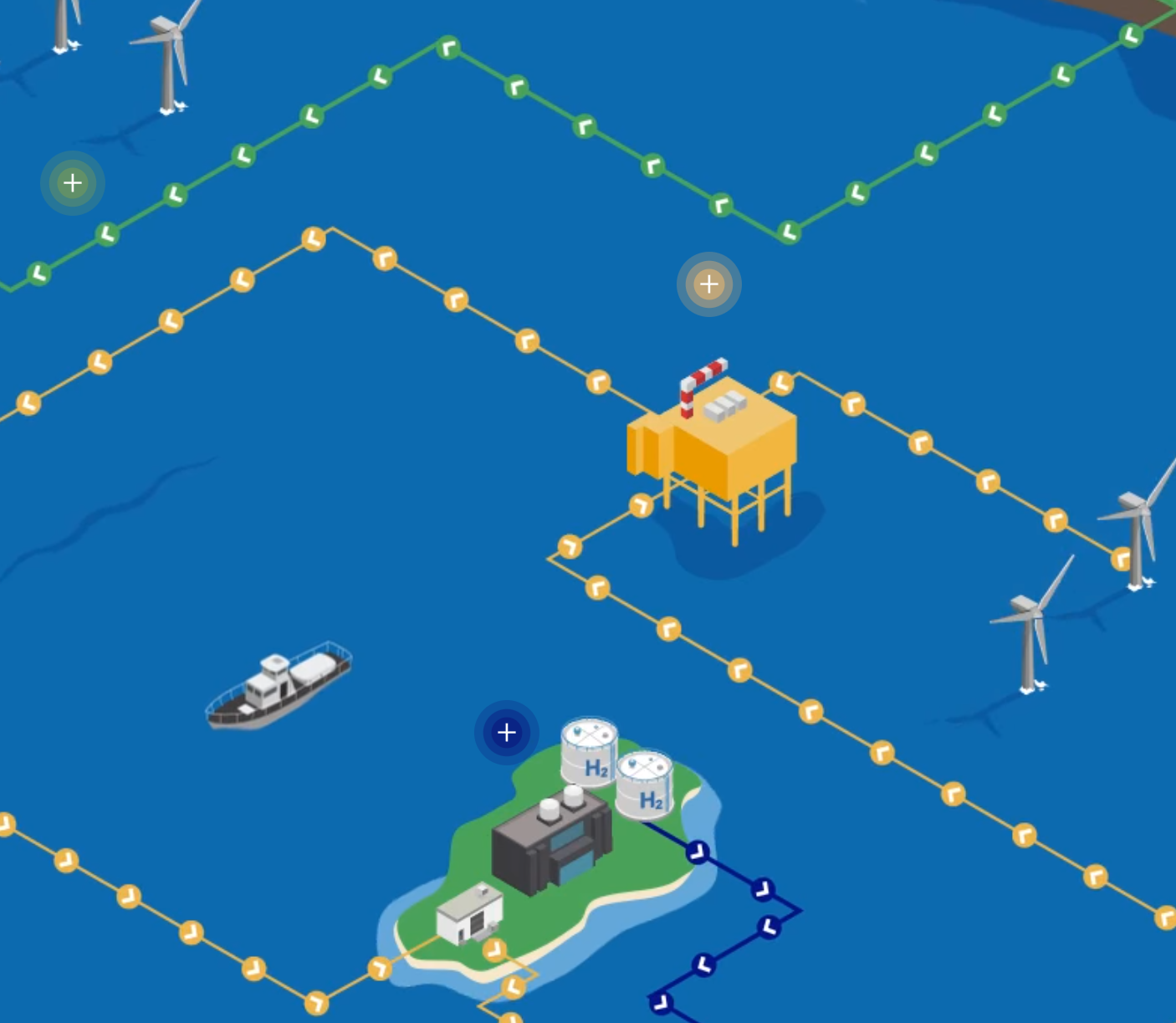
It shows an offshore hydrogen electrolyser.
- You could have an offshore hybrid asset that went between say Bacton in Norfolk and Hamburg via these assets.
- One or more wind farms in UK territorial waters.
- A mammoth offshore electrolyser, with hydrogen storage, possibly in a depleted gas field.
- One or more wind farms in German territorial waters.
Electricity will be able to go three ways; to the UK, to Germany or to the electrolyser.
The Involvement Of German Energy Companies In UK Territorial Waters
Wikipedia lists offshore fifteen wind farms, that have German owners in UK territorial waters, that total 12,960 MW.
This compares with.
- Equinor – 6 wind farms totalling 6466 MW.
- Ørsted – 15 wind farms totalling 9683 MW.
- Scottish Power – 2 wind farms totalling 5,000 MW.
- SSE Renewables – 15 wind farms totalling 15,591 MW.
- Vattenfall – 6 wind farms totalling 4384 MW.
As there is a number of partnerships, these figures only show the relative sizes of the investment by individual companies.
But at nearly 13 GW, the amount of total German investment in UK territorial waters is substantial.
Is This Solely An Anglo-German Club Or Can Others Join?
Consider.
- It seems to me, that because of the LionLink, the Dutch are already involved.
- TenneT is also a large electricity distributor in Germany.
- Countries with substantial shares of the water and winds of the North Sea in addition to Germany, the Netherlands and the UK, include Belgium, Denmark and Norway.
- The UK has interconnectors with Belgium, Denmark, France, Germany, Norway and the Netherlands.
It appears that the world’s largest multi-national power generator is evolving by stealth.
North Sea Wind Power Hub
This concept seems to have developed around 2017, by Danish, Dutch and German interests.
The Wikipedia entry introduces it like this.
North Sea Wind Power Hub is a proposed energy island complex to be built in the middle of the North Sea as part of a European system for sustainable electricity. One or more “Power Link” artificial islands will be created at the northeast end of the Dogger Bank, a relatively shallow area in the North Sea, just outside the continental shelf of the United Kingdom and near the point where the borders between the territorial waters of Netherlands, Germany, and Denmark come together. Dutch, German, and Danish electrical grid operators are cooperating in this project to help develop a cluster of offshore wind parks with a capacity of several gigawatts, with interconnections to the North Sea countries. Undersea cables will make international trade in electricity possible.
Currently, the UK is developing these wind farms on their portion of the Dogger Bank.
- Doggerbank A – 1235 MW – Started producing electricity in 2023.
- Doggerbank B – 1235 MW – Planned commissioning in 2024.
- Doggerbank C – 1218 MW – Planned commissioning in 2025.
- Doggerbank D – 1320 MW – Being planned.
- Doggerbank South – 3000 MW – Being planned.
Note.
- That’s a total of 8 GW.
- A, B, C and D are being developed by a consortium of SSE Renewables and Equinor.
- South is being developed by RWE.
- This web site is for Dogger Bank D.
- This web site is for Dogger Bank South.
This map from the European Atlas of the Seas, shows the various exclusive economic zones (EEZ) in the North Sea.

Note.
- The pinkish zone to the East of the UK, is the UK’s EEZ.
- The light blue zone at the top is Norway’s EEZ.
- The greenish zone in the North-East corner of the map is Denmark’s EEZ.
- The light blue zone below Denmark’s EEZ is Germany’s EEZ.
- Then we have the EEZs for The Netherlands, Belgium and France.
The Dogger Bank is situated where the British, Dutch, German and Norwegian EEZs meet.
All five Dogger Bank wind farms are in British waters.
The Wikipedia entry for the Dogger Bank says this about its size.
The bank extends over about 17,600 square kilometres (6,800 sq mi), and is about 260 by 100 kilometres (160 by 60 mi) in extent. The water depth ranges from 15 to 36 metres (50 to 120 ft), about 20 metres (65 ft) shallower than the surrounding sea.
This probably makes it easy to accommodate a large fixed-foundation wind farm.
Overlaying the map in the Wikipedia entry, with the EEZ map, I’m fairly sure that the northeast end of the Dogger Bank is close to where the EEZs meet.
Progress On The North Sea Wind Power Hub
The North Sea Wind Power Hub has a web site, but it seems to be more about thinking than doing.
It seems to have been hijacked by that august body; The Institute of Meetings Engineers.
This page on the web site, which is entitled Explore The Future Energy Highways, has a simple interactive map.
This shows its vision for 2030.
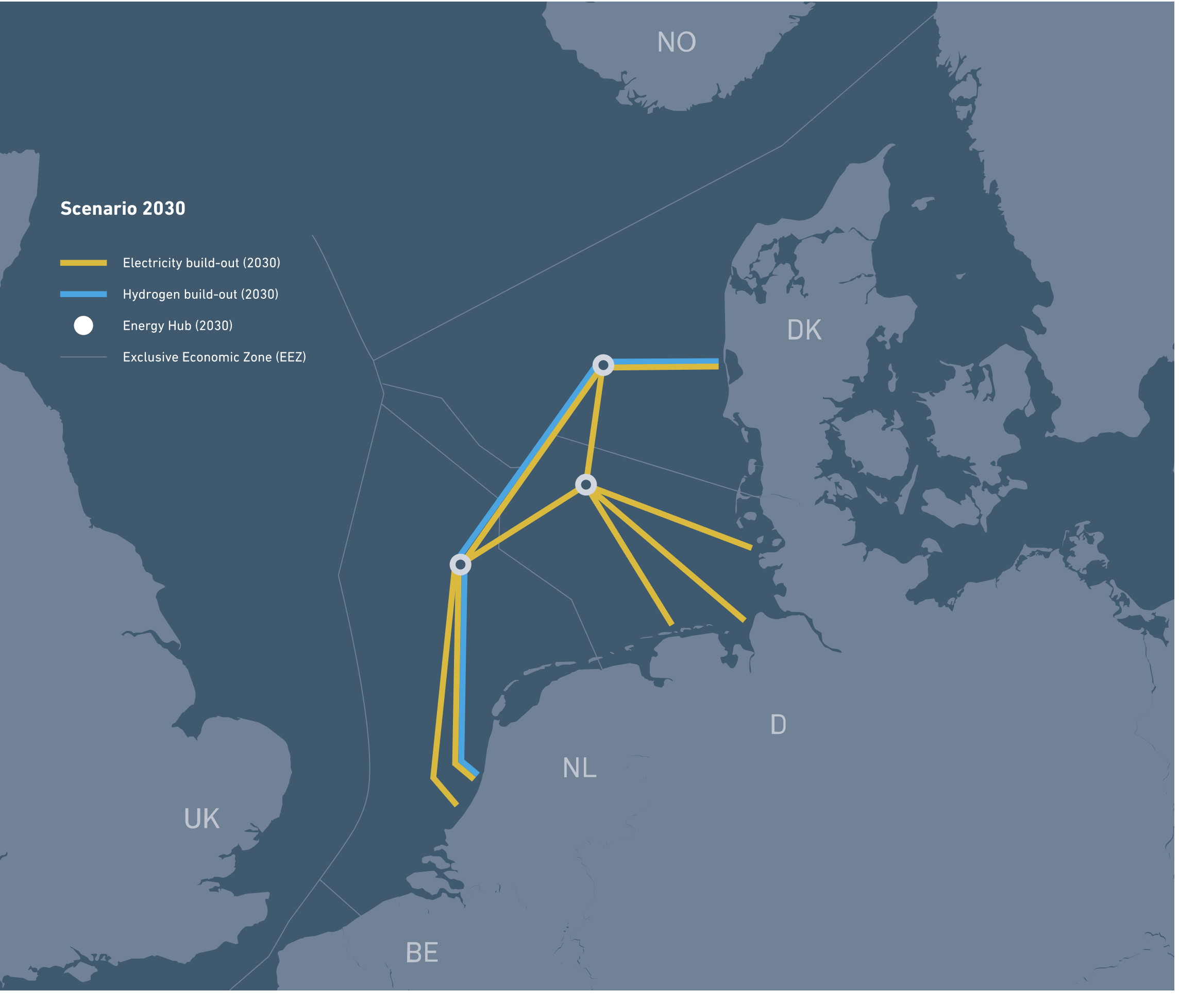
Note.
- Yellow is electricity links to be built before 2030.
- Blue is hydrogen links to be built before 2030.
- Feint lines indicate the EEZ boundaries.
There are two problems with this layout.
- It doesn’t connect to the Dogger Bank area, where the original plan as detailed in Wikipedia talked about “Power Link” artificial islands.
- No hydrogen is delivered direct to Germany.
This shows its vision for 2050.
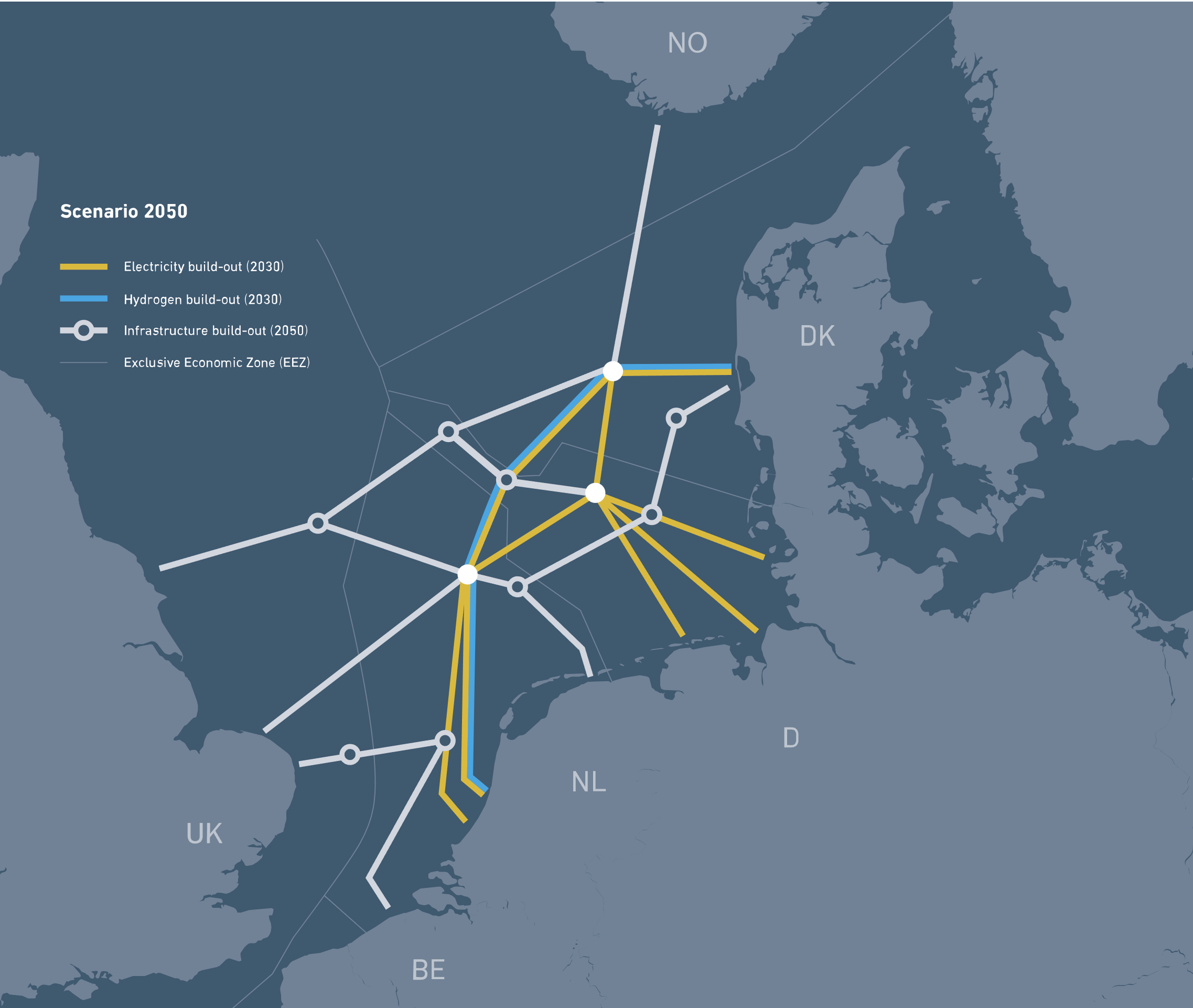
Note.
- Yellow, blue and feint lines are as before.
- White is electricity links to be built before 2050.
- There appears to be a node on the Dogger Bank in the German EEZ. This node could be connected to the “Power Link” artificial islands.
- The Southernmost connection to East Anglia could be Bacton.
- The other Norfolk connection could be where wind farms are already connected.
- The Northern connection could be Teesside, where some of the Dogger Bank wind farms connect.
- If the Northern connection to England is Teesside, then first node, which is in the British EEZ, could be one of the offshore sub-stations in the Dogger Bank wind farm complex.
This all seems a lot more feasible.
A New Offshore Hybrid Asset Between Teesside And Germany
Consider.
- A new offshore sub-station will be needed in the German EEZ to connect the “Power Link” artificial islands to the power network.
- The new offshore sub-station will eventually have three interconnectors to the German coast.
- Only the 1218 MW Dogger Bank C wind farm will be connected to the Teesside onshore substation.
- Germany has a power supply problem, after shutting down nuclear power stations and building more coal-fired power stations.
A new Offshore Hybrid Asset between Teesside and Germany could be created by building the following.
- A the new offshore sub-station in the German EEZ to connect the “Power Link” artificial islands to the power network.
- An interconnector between a sub-station of the Dogger Bank wind farm complex and the new sub-station
- A second interconnector to connect the new sub-station for the “Power Link” artificial islands to the German electricity grid.
All of the work would be done mainly in the German EEZ, with a small amount in the British EEZ.
Where Does Dogger Bank South Fit In?
Consider.
- Dogger Bank South is planned to be a 3 GW wind farm.
- It will need a 3 GW connection to the onshore electricity grid.
- Creyke Beck substation is the proposed location for the onshore connection.
- It is owned by German electricity company; RWE.
Could it be that some of the electricity produced by Dogger Bank South is going to be sent to Germany or to another node to produce hydrogen?
It certainly illustrates the value of an Offshore Hybrid Asset.
Global First For Formula 1: CEVA Logistics Transports Ferrari Equipment By Rail
The title of this post is the same as that of this article on Container News.
This is the sub-heading.
CEVA Logistics, CMA CGM-owned third-party logistics provider, recently designed an innovative rail transport solution for Scuderia Ferrari’s F1 racing team in North America
These paragraphs outline the transport.
In a global first for Formula 1, Ferrari equipment is being transported by rail between three North American F1 grand prix races as part of the two companies’ efforts to cut carbon emissions.
Since the start of their cooperation in 2022, CEVA has been altering the Scuderia Ferrari logistics programme. As CEVA guarantees that the equipment reaches each of the 23 Grand Prix racing venues on schedule, the flow of the six different 45-ton equipment kits that travel the world has shifted away from air freight and toward a primary combination of ocean and road freight.
Carbon savings were 90 % compared to flying and 32 % compared to an all-road route.
But as the containers appeared to have travelled 4,000 miles between Montreal to Las Vegas via Austin, probably hauled by a diesel locomotive, how much extra carbon savings could have been achieved if a hydrogen-powered locomotive had been used?
Hydrogen Bus Fleet Project Gains Momentum
The title of this post, is the same as that of this article from Energy Live News.
This is the sub-heading.
Luxfer Gas Cylinders and Ricardo have formed a partnership to advance a project that aims to deploy 150 hydrogen-powered buses on UK routes by 2024
I first came across this project in June 2022 and wrote Ricardo Repowers Double Decker Diesel Bus With Hydrogen Fuel Cells, where I said this.
The title of this post, is the same as that of this press release from Ricardo.
Ricardo, a global strategic, environmental, and engineering consulting company, in partnership with Stagecoach North East, has repowered a diesel, double decker bus with a hydrogen fuel cell propulsion system. Delivering zero tailpipe emissions, Ricardo is now seeking to secure customers to invest in the production of a fleet of passenger vehicles fit for the future of sustainable shared mobility.
The project, part funded by the Department of Transport, through its Hydrogen Transport Hub Demonstration competition, saw Ricardo, working with Stagecoach North East to retro-fitted hydrogen fuel cell technology into an existing double decker bus. It created a zero emissions demonstrator that is now undergoing a ten-week test and demonstration programme around the Tees Valley and Brighton and Hove. Feedback and data from the trials will support the team to explore future market opportunities and applications with bus operators and other partners across the UK and beyond.
Given that there are around 38,000 existing buses in the UK, many of which still have a few years of life left, this surely must be an affordable way of creating more zero-carbon hydrogen buses.
It appears that Ricardo are aiming to have an initial batch of 150 buses in service from late 2024.
It looks to me, that this project is certainly gaining momentum.
Trucks On Moorgate
I took these pictures of trucks on Moorgate this morning in one twenty minute period.
















Note.
- All of the large trucks were diesel-powered.
- Some smaller vans might have been electric.
- Six of the trucks were concrete mixer trucks.
- One of the concrete mixer trucks was advertising ECOPact The Green Concrete.
Surely, if large heavy good vehicles, like these were hydrogen-powered, it would cut carbon footprints and reduce pollution.
I doubt we’ll see many hydrogen trucks in London, until we have a Mayor, who has a hydrogen policy that isn’t to ignore hydrogen and hope it goes away.
Cummins Enters Collaboration To Demonstrate Hydrogen Ecosystem
The title of this post, is the same as that of this article from Rental Management.
This is the first three paragraphs.
Cummins®, Columbus, Ind., has signed a Memorandum of Understanding (MoU) with Terex® Advance Mixer, Fort Wayne, Ind., a subsidiary of Terex Corp.; Edge Materials, Cloverdale, Ind.; and PCC Hydrogen, Louisville, Ky., to produce, trial and prove concrete mixer trucks powered by Cummins’ zero-carbon, hydrogen-fueled internal combustion engines.
The project aims to develop a full hydrogen ecosystem together with a hydrogen producer, vehicle manufacturer and end user. It is the first MoU of its kind signed by Cummins.
he four companies will unite their efforts, which will see Cummins’ X15H hydrogen internal combustion engines integrated into the Terex Advance Commander Series of front-discharge concrete mixer trucks. Edge Materials, a ready-mix concrete provider and Terex Advance customers will operate the hydrogen-powered trucks in challenging real-world environments including on construction sites and critical infrastructure projects. PCC Hydrogen, an ultra-low carbon intensity hydrogen producer, will supply the hydrogen fuel as well as stationary storage and dispensing services.
Note.
- The X15H engine also comes in diesel and natural gas versions.
- Cummins also make electrolysers, that can produce hydrogen.
- It looks like the collaboration has all bases covered.
- I suspect similar deals could be done all over the world and with other types of trucks.
It all sounds like a sensible way to go to me.
Silvertown Tunnel: Cracks In Mayoral Policies
The title of this post is the same as that of this article on the BBC.
This is the sub-heading.
It is an infrastructure project that is well-underway with the boring almost completed — but it has a very low profile.
These are the first three paragraphs.
Every step of the Crossrail tunnelling, the media were invited along. Not so with this project.
This is Silvertown Tunnel. It is more than 1km long and will be London’s first road tunnel in over 30 years.
Perhaps one of the reasons it isn’t being pushed publicity-wise, is it is very controversial.
Tom Edwards gives a detailed outline of why the tunnel is controversial.
Under a heading of HGVs Using Bus Lanes, this is said.
Instead of using the Dartford Crossing, larger HGVs will be able to use the tunnel — and its bus lane.
Campaigners said that will mean more HGVs going through Newham and Greenwich.
I’ve also never heard this before.
Sheila Keeble, of the Greenwich Society, said the tunnel “will be magnet for bigger traffic than we’ve got at the moment”.
“One of the issues we have is all the developers are now looking at building distribution centres,” she said.
“At the moment the Blackwall Tunnel protects us from bigger traffic… Silvertown won’t.”
That is all very logical and I suspect we’ll see larger trucks in Hackney and Waltham Forest too!
There was also this bit of nonsense from Transport for London.
TfL says the tunnel will lead to an overall improvement in air quality.
How will all those trucks through the two tunnels reduce pollution?
In 2024, London must vote for a Mayor, who understands hydrogen, mathematics and science!

