Plan To Build £150m Green Hydrogen Plant At Felixstowe Port
The title of this post, is the same as that of this article in The Times.
These two paragraphs introduce the project.
A £150 million green hydrogen plant is to be built at the UK’s busiest container port according to proposals by ScottishPower, it emerged yesterday.
The energy company has devised plans for a 100MW plant at the Port of Felixstowe which will provide fuel to power trains, trucks and ships.
There’s a lot more to this project than it would appear at first.
Where Will The Electrolyser Be Sited?
The Times article says this.
The site will be around the size of a football pitch, on brownfield land within the port.
I have flown my virtual helicopter over the port and there could be a couple of suitable football pitch-sized plots.
Where Will The Electricity Come From?
The East Anglia Array is a proposed massive series of offshore wind farms, which will be about thirty miles off the Suffolk coast.
Wikipedia says this about the size.
Up to six individual projects could be set up in the area with a maximum capacity of up to 7.2 GW.
But the main thing about the East Anglian Array is that it is being developed by a partnership of ScottishPower and Vattenfall.
Negotiations shouldn’t be difficult.
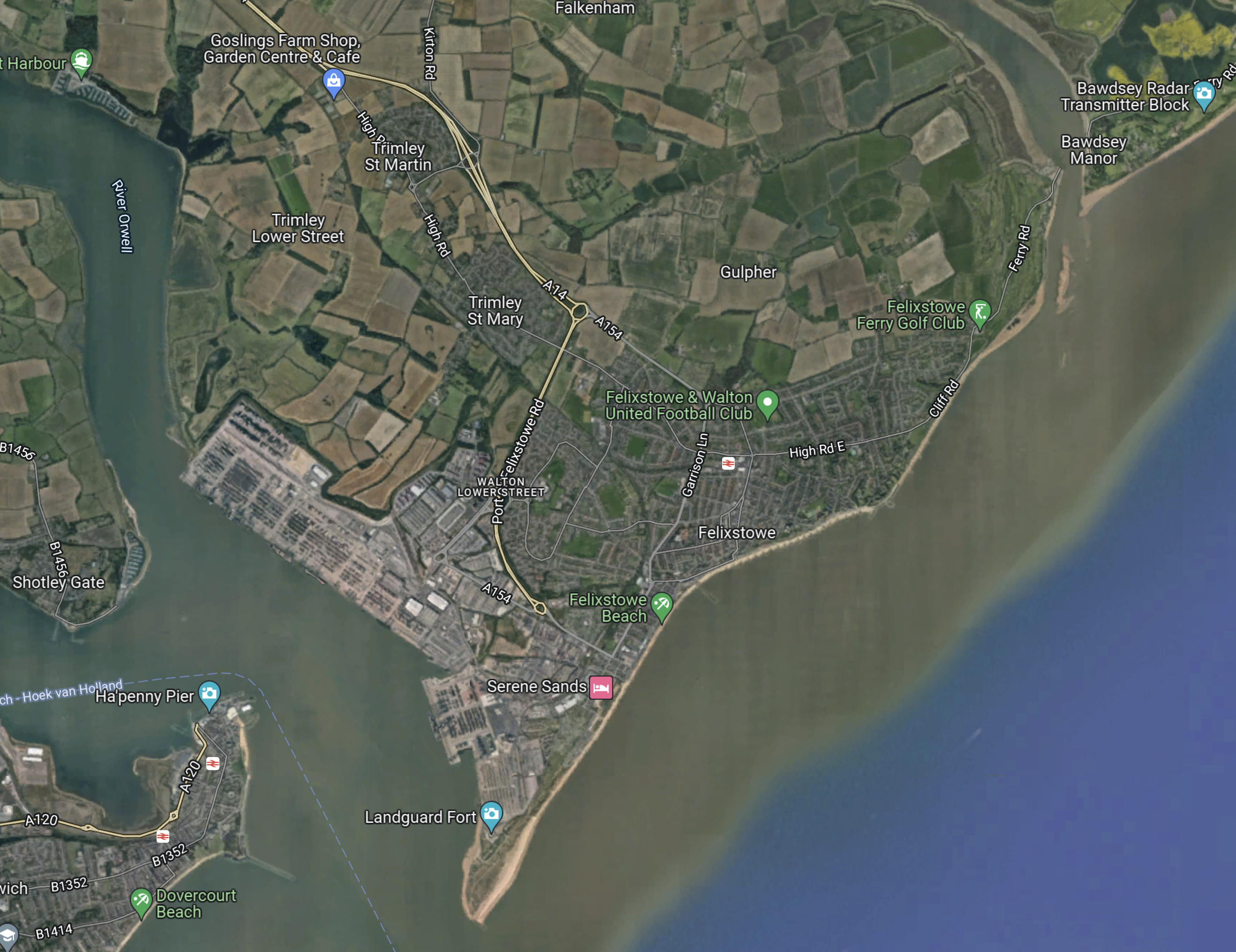
This Google Map shows the town of Felixstowe.
Note.
- The Ports of Felixstowe and Harwich are opposite each other on the two banks of the River Orwell.
- The power cable to the East Anglia Array comes ashore at Bawdsey in the North-East corner of the map.
- The Port of Felixstowe has two rail links, which are not electrified.
I suspect that the electric power to the electrolyser might well be routed underwater to the Port of Felixstowe either from Bawdsey or possibly direct from the wind farm.
A Meeting With A Crane Driver
I used to regularly go to Ipswich Town away matches and at one match, I met a senior crane operator from the Port of Felixstowe. We got talking about electrifying the rail link to the port and decarbonisation of the port in general.
He was adamant that electrification of the rail lines in the port, wouldn’t be a good idea as containers occasionally get dropped or crane drivers aren’t as accurate as they should be.
Hydrogen-Powered Freight Locomotives
When, I told him about the possibilities of hydrogen rail locomotives, he felt this was the way to go, as no rail electrification would be needed in the port.
Hydrogen-electric hybrid locomotives would also be able to take containers cross-country to the main electrified routes to the North and West, where they would raise their pantographs and use electric power.
How many trucks would be removed from the A14, A1 and M6?
Will Greater Anglia Convert Their Class 755 Trains to Hydrogen?
Class 755 trains have a short PowerPack in the middle and are designed for conversion to hydrogen-electric operation.
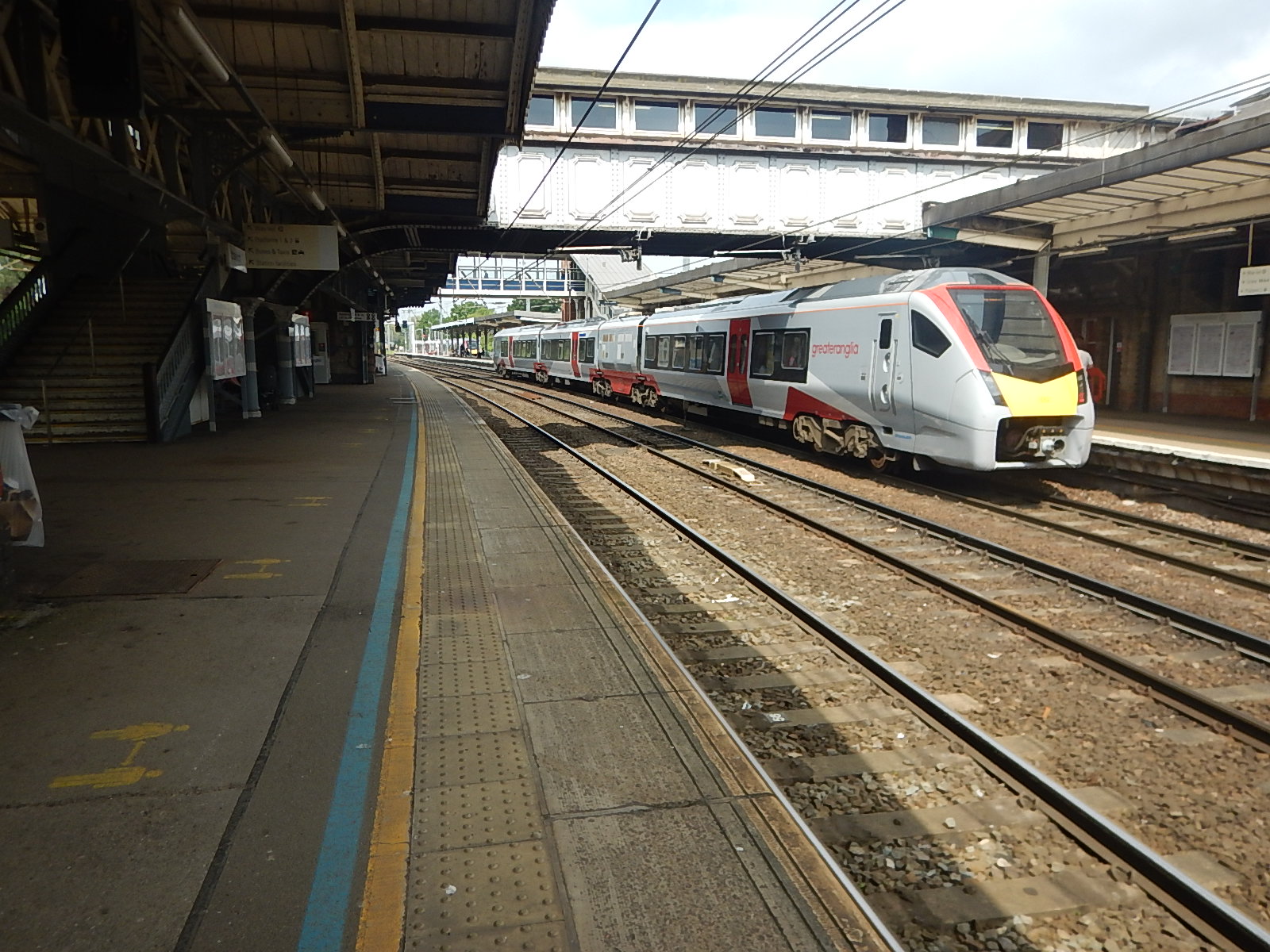
Note the PowerPack has four slots for diesel engines, batteries or hydrogen fuel-cells.
A Better Working Environment
But my fellow supporter felt the biggest gain in the port, would come with replacement or updating of all the vehicles and handling equipment, as if all these machines were hydrogen-powered, this would greatly improve the working conditions for the dock workers.
ScottishPower’s Vision
This press release on ScottishPower’s web site is entitled ScottishPower Vision For Green Hydrogen Fuels Hub At Port Of Felixstowe.
Conclusion
The Port of Felixstowe is doing the planning for this in the right way, as ensuring the hydrogen supply in the port first, is the logical way to transition to hydrogen power.
But then, I’ve watched the Port of Felixstowe grow since the 1960s and they usually get their decisions right.
The press release starts with these bullet points.
- ScottishPower explores green hydrogen at Port of Felixstowe to help decarbonise the UK’s busiest port.
- The project could help kick-start the low carbon transformation of the UK’s heavy transport sector.
- 100MW facility could deliver up to 40 tonnes of green hydrogen per day – enough to power 1300 hydrogen trucks.
- International export also being explored.
And these two paragraphs.
ScottishPower, with Hutchison Ports, is exploring the opportunity to develop, build and operate a multi-hundred MW green hydrogen production facility at the Port of Felixstowe – with the potential to decarbonise industry and transportation in the region.
Both companies have set out their vision to help create a greener port, which could provide clean fuel for customers at Britain’s busiest container port.Plans are being developed to use green hydrogen for onshore purposes, such as road, rail and industrial use, with the potential to create liquid forms, such as green ammonia or e-methanol. This could, in turn, provide clean fuels for shipping and aviation, and create opportunities for cost-effective export to international markets. The project aims to continue engineering and site development works to align with customer demand from 2025 onwards.
It is certainly a very extremely ambitious vision!
But then the county of my conception, has a tremendous determination to succeed. And often against all conventional logic!
Barking Riverside To Barking – 8th August 2022
This post and Woodgrange Park To Barking Riverside – 8th August 2022 are a pair and show the area on the date given. This is so I can show it as it develops in the next few years.
I took these pictures returning from Barking Riverside station.





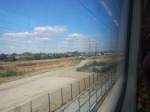




Note, that this side of the line, is dominated by Barking substation, lots of overhead cables and views of the viaduct.
This 3D Google Map shows the viaduct from the West.
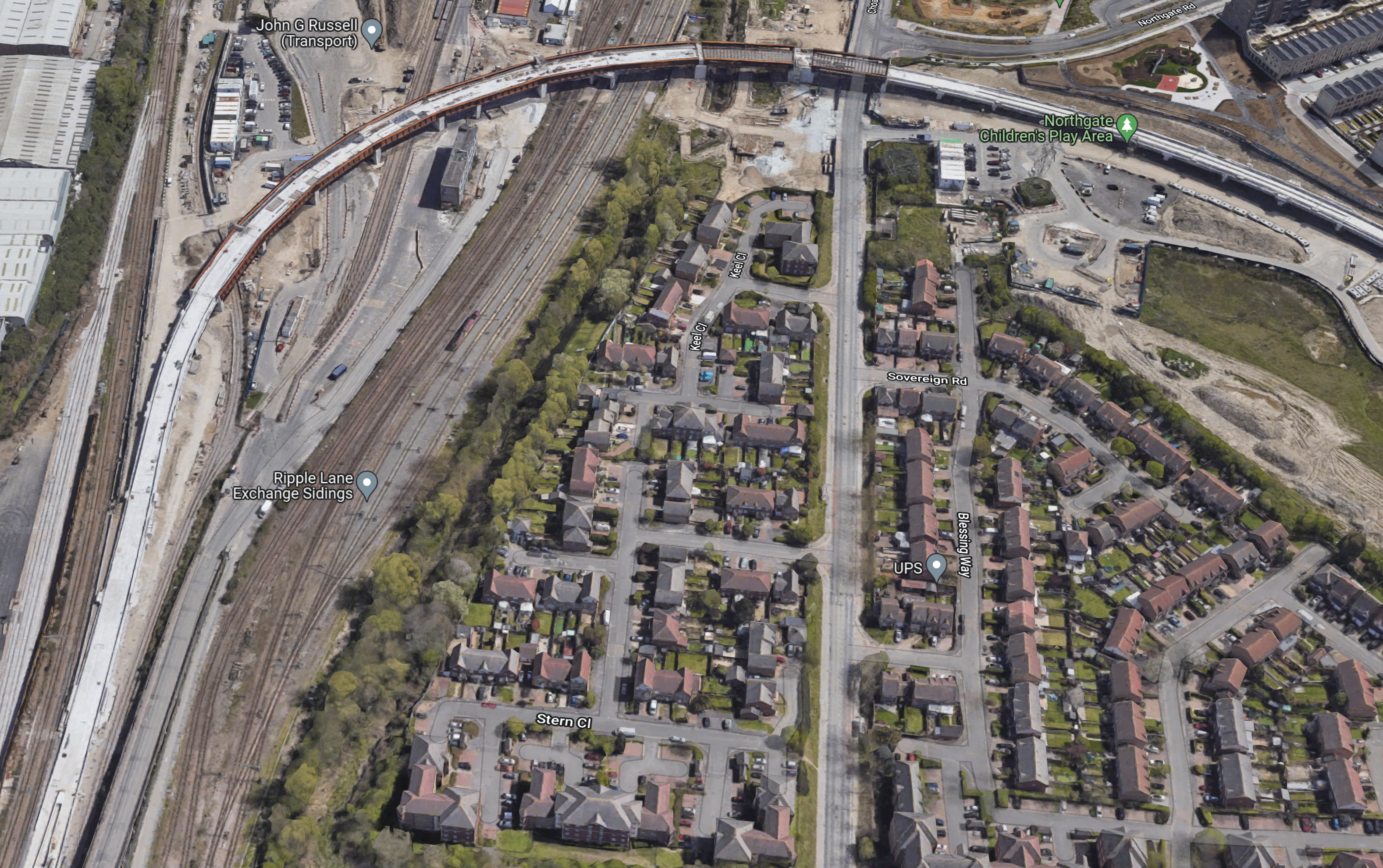
Are there any other viaducts, which comprise a whole branch line?
Woodgrange Park To Barking Riverside – 8th August 2022
This post and Barking Riverside To Barking – 8th August 2022 are a pair and show the area on the date given. This is so I can show it as it develops in the next few years.
I took these pictures going to Barking Riverside station.










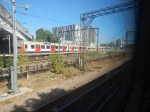

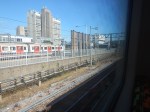















Note.
- The route passes the ventilation shaft for High Speed One.
- It goes through and over the concrete viaducts and bridges of Barking station.
- Renwick Road station could be built in the area to serve five thousand proposed houses.
- It then crosses over the Barking Freight Terminal, which is sure to be developed either as a larger freight terminal or housing.
- The houses of Barking Riverside have sheds in their gardens.
What are the circular structures in the penultimate picture for?
What A Stupid Place To Park A Bike!
These days my eyesight, has almost returned to normal after my stroke in 2011 and I rarely bump into things, that I did in the first couple of years after suffering from the stroke.
Today, though I came across this hire bicycle, that some twit had left where a light-controlled crossing meets the pavement.
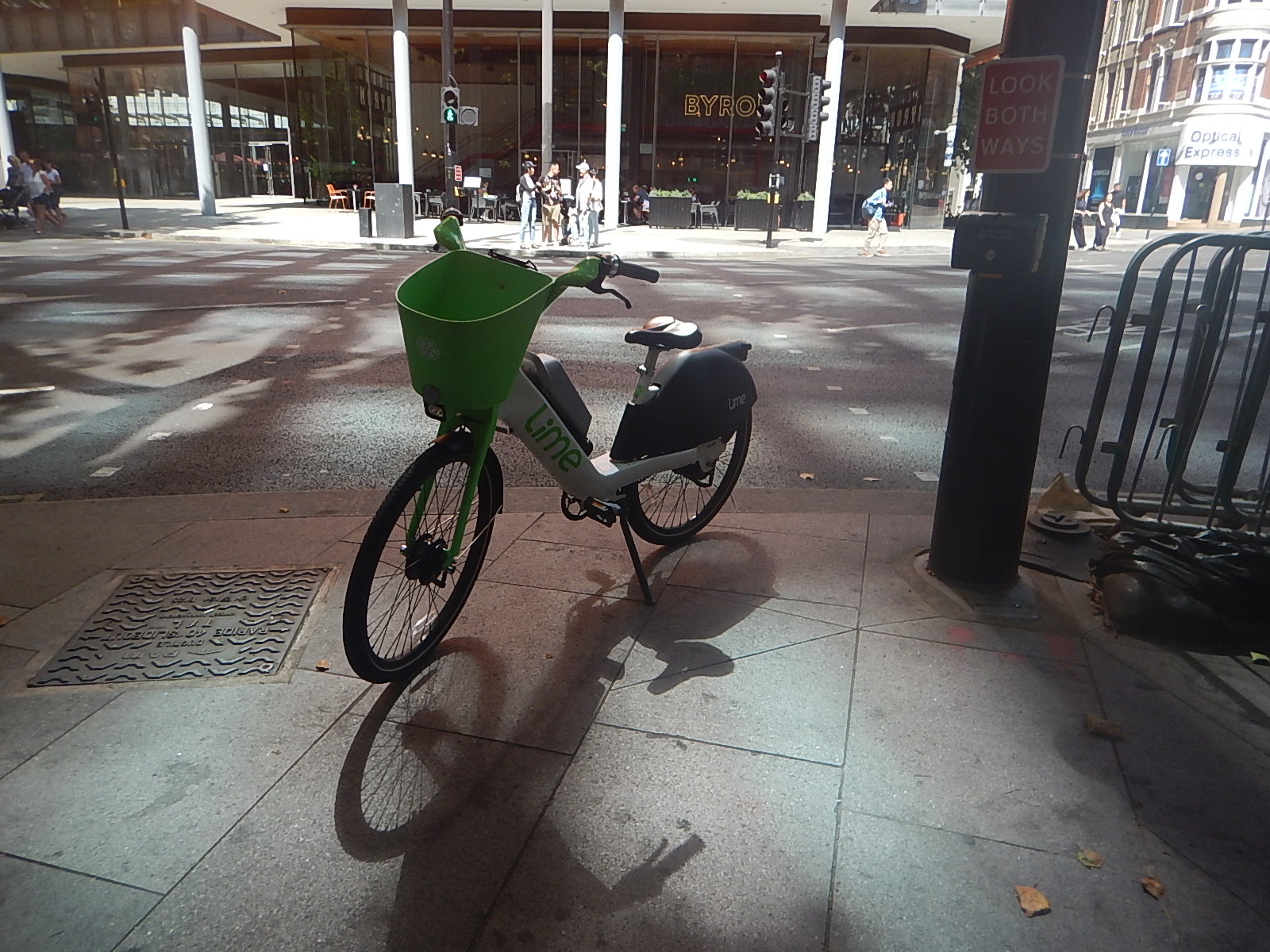
The idiot deserves at least points on their driving licence or a suspended sentence for their stupid behaviour. Or perhaps, the bike hire company need a hundred pound fine?
It has been stated on The Times, ITV and other web sites, that the next Transport Bill will include a review of cycling law.
That should also include rules about how to park a bicycle.
ZeroAvia Hydrogen Powered Jets For American Airlines?
The title of this post, is the same as that of this article on Aviation Source.
The article states that American Airlines will be investing an undisclosed amount into ZeroAvia and that it might use their regional hydrogen-powered aircraft in the United States.
High Speed Two Works Between Denham And West Ruislip Stations – 5th August 2022
I took these pictures as my Chiltern Train returned from Birmingham Moor Street station tonight.










Note that the pictures were taken looking to the North of the Chiltern Main Line.
The Birmingham Bull – 5th August 2022
The non-human star of the Opening Ceremony of the 2022 Commonwealth Games in Birmingham was a mechanical bull.
This article on the BBC is entitled Commonwealth Games: Scots Creator Reveals Secrets Of Metal Bull.
These three introductory paragraphs give an overview of the design.
The secrets of the mechanical bull that wowed audiences during the opening ceremony of the Commonwealth Games have been revealed by its Scottish creator.
The 10m high scrap metal sculpture was one of the stars of the celebration in Birmingham’s Alexander Stadium.
Michael Dollar, of creative model makers Artem, said it took six people to operate the giant structure.
The BBC also revealed today, that the bull would be parked for a few days in Centenary Square outside the Library of Birmingham.
So as my day had fallen apart, I got on a Chiltern train to Birmingham and took these pictures.




























Note.
- The first picture has the The Library Of Birmingham in the background, with its lattice frontage and gold dome.
- The Bull seems to have been built on a loader chassis.
- There were a large crowd in Centenary Square looking at the Bull.
I have never seen a public work of art surrounded by such a crowd, most of whom were taking selfies or traditional pictures.
This article on the BBC is entitled Birmingham Commonwealth Games: Ceremony Bull To Stay.
The BBC article says this about the future of the bull.
A giant mechanical bull that became the star of the Birmingham Commonwealth Games opening ceremony it set to stay in the city.
The 10m sculpture is on display in Centenary Square after its debut last week, although its future has been less clear.
Largely made of foam, it was due to be dismantled at the end of the Games, sparking public outcry.
But Birmingham City Council has confirmed the bull has won a reprieve.
It will stay in the square until the end of September before being moved indoors.
This wonderful work of engineering art, is far too good and is now too well-loved to be scrapped.
As it needs to go inside, why not bring it inside High Speed Two’s new Curzon Street station, to greet passengers visiting Birmingham?
Barry Station – 3rd August 2022
It was announced last week, that Barry station, now had a step-free bridge, so on my trip to Wales on Wednesday, I had to go and take a look.
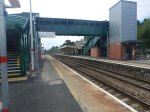
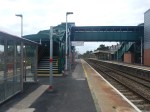
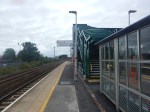
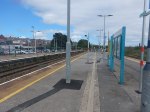

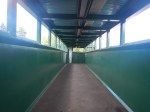
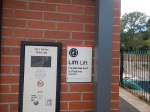
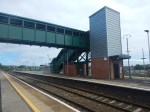
It looks like the builders are still working on the site. However, the bridge was delivered early.
Cardiff Central Station’s New Entrance
As I passed through Cardiff Central station, I took these pictures of their new Southern entrance.




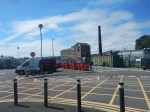
Although, it’s mainly for the car park, it may have its uses for me, as there is a ticket office to buy the Day Ranger ticket, I generally use to explore the valleys.
Extending The Elizabeth Line – High Speed Trains On The Elizabeth Line
This may seem rather fanciful, but could it be the way to maximise the use of the Elizabeth Line?
- I feel that the Elizabeth Line will eventually serve other destinations like Basingstoke, Beaulieu, Oxford, Southend and Swindon.
- The capacity of the Elizabeth Line will grow to over thirty trains per hour (tph) under control of digital signalling.
These are a few thoughts.
The Design Of The Trains
As any train would have to be compatible with the platform-edge doors in the central tunnel of the Elizabeth Line, the trains would have to be dimensionally identical to the current Class 345 trains.
- Nine cars
- Possibility of lengthening to ten cars.
- 204.73 metres long.
- 6 sets of doors per carriage
- Ability to run under full digital signalling.
They would be designed for a higher speed of at least 110 or 125 mph, to enable running on the fast lines of these routes.
- East Coast Main Line
- Great Western Main Line
- Midland Main Line
- West Coast Main Line
They would also be able to run at 100 mph on the Chiltern Main Line, the Great Eastern Main Line and the North Kent Line.
The faster running would ease scheduling of the trains.
Extra facilities could include.
- Toilets
- Tables
- A third-rail capability for running in Kent.
Effectively, it would be a Class 345 train with more features and considerably more grunt.
Note that in A High Speed Train With An IPEMU-Capability, I started the post with the following.
Bombardier were reported by Ian Walmsley in the April 2016 Edition of Modern Railways, to be developing Aventra, with a 125 mph capability.
Bombardier have also told me, that all Aventras will be wired so they could be fitted with on-board energy storage.
Could it be that the design of a Class 345 train could be modified to run at higher speeds? I wouldn’t be surprised.
Oxford To Southend Victoria
This could be a typical route.
- Between Oxford and Paddington, it would follow a route similar to the GWR’s Oxford service with stops at just Reading and Slough.
- At Paddington the train would take the Central Tunnel of the Elizabeth Line and travel under London, at the same speed as the other trains.
- It would emerge at Stratford and move to the Great Eastern Main Line.
- It would probably stop at Stratford, Romford, Shenfield and all stations to Southend Victoria.
Note.
- Digital signalling would enforce the precise timekeeping needed.
- Much of the Oxford and Paddington section would be up to speeds of at least 125 mph.
- Times in the Central Tunnel of the Elizabeth Line would be identical to the current Class 345 trains.
- Much of the Stratford and Southend section would be up to speeds of at least 100 mph.
I estimate that total time would be a few minutes under two hours.
Connecting To The Central Tunnel Of The Elizabeth Line At Royal Oak
I discuss this in Extending The Elizabeth Line – Connecting Great Western Main Line Services To The Central Tunnel.
Connecting To The Central Tunnel Of The Elizabeth Line At Stratford
I discuss this in Extending The Elizabeth Line – Connecting Great Eastern Main Line Services To The Central Tunnel.
Connecting To The Central Tunnel Of The Elizabeth Line At Abbey Wood
This map from cartometro.com shows the track layout at Abbey Wood.
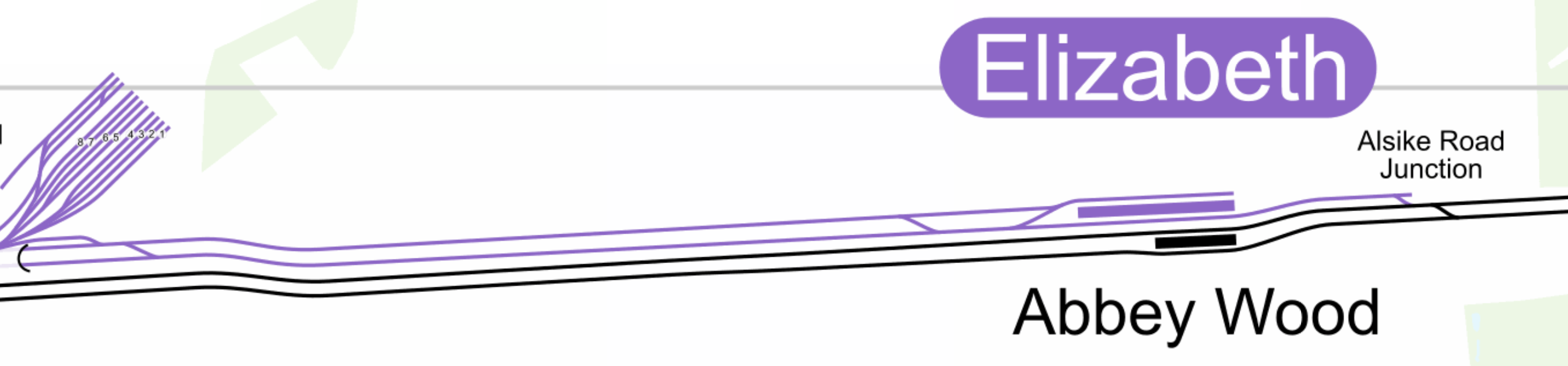
Note.
- The Elizabeth Line is shown in purple.
- The North Kent Line is shown in black.
- The North Kent Line platform to London is the Southernmost platform and is numbered 1.
- The North Kent Line platform from London is the other Southern platform and is numbered 2.
- The Elizabeth Line platforms are numbered 3 and 4.
- Platform 4 is the Northernmost platform.
At present the Elizabeth Line service to Abbey Wood station is twelve tph, with each platform handling six tph.
This picture shows trains in both Platform 3 and 4 looking towards the station buildings.

Note.
- Platform 3 is on the right.
- Platform 4 is on the left.
In Elizabeth Line To Ebbsfleet Extension Could Cost £3.2 Billion, I talk about this proposal as described in this article on Ian Visits.
One of the key features of Crossrail To Ebbsfleet (C2E) project is that instead of all trains terminating at Abbey Wood, trains will terminate as follows.
- Abbey Wood – 4 tph
- Northfleet – 4 tph
- Gravesend – 4 tph
This will mean that 8 tph would pass through Abbey Wood station.
- Platform 4 could certainly handle the four that terminated on the Elizabeth Line.
- Platform 3 would need to handle eight tph in both directions or sixteen tph to fulfil the proposed C2E service.
- This would be one train every 225 seconds.
I believe that digital signalling could handle this easily and safely.
I am fairly sure that the track layout at Abbey Wood allows eight tph to go both ways between the North Kent Line and the Elizabeth Line Central Tunnel.
The Maximum Capacity At Abbey Wood Station
Because of the current track layout at Abbey Wood, I believe that without track modifications, Abbey Wood station will not be able to handle more than 12 tph.
Thameslink
These proposed trains would also be compatible with Thameslink, as this route has no platform edge doors.
No platform extensions would be needed, as the Class 345 trains are shorter than the 12-car Class 700 trains.
If they were 125 mph trains, then this would ease timetabling on the East Coast Main Line, as the trains could mix it with the expresses on the fast lines.
Could These High Speed Trains For The Elizabeth Line Have A Cruising Speed Of 140 mph?
It is likely, when full authority digital ERTMS signalling is installed on main lines out of London, that 140 mph will be possible on some at least these routes.
- East Coast Main Line
- Great Western Main Line
- Midland Main Line
- West Coast Main Line
The extra speed would maximise capacity.
 The Anonymous Widower