Possible Destinations For An Intercity Tri-Mode Battery Train
Currently, the following routes are run or are planned to be run by Hitachi’s Class 800, 802, 805 and 810 trains, where most of the route is electrified and sections do not have any electrification.
- Avanti West Coast – Euston and Chester – 21 miles
- Avanti West Coast – Euston and Shewsbury – 29.6 miles
- Avanti West Coast – Euston and Wrexham General – 33 miles
- Grand Central – Kings Cross and Sunderland – 47 miles
- GWR – Paddington and Bedwyn – 13.3 miles
- GWR – Paddington and Bristol Temple Meads- 24.5 miles
- GWR – Paddington and Cheltenham – 43.3 miles
- GWR – Paddington and Great Malvern – 76 miles
- GWR – Paddington and Oxford – 10.4 miles
- GWR – Paddington and Penzance – 252 miles
- GWR – Paddington and Swansea – 45.7 miles
- Hull Trains – Kings Cross and Hull – 36 miles
- LNER – Kings Cross and Harrogate – 18.5 miles
- LNER – Kings Cross and Huddersfield – 17 miles
- LNER – Kings Cross and Hull – 36 miles
- LNER – Kings Cross and Lincoln – 16.5 miles
- LNER – Kings Cross and Middlesbrough – 21 miles
- LNER – Kings Cross and Sunderland – 47 miles
Note.
- The distance is the length of line on the route without electrification.
- Five of these routes are under twenty miles
- Many of these routes have very few stops on the section without electrification.
I suspect that Avanti West Coast, Grand Central, GWR and LNER have plans for other destinations.
A Battery Electric Train With A Range of 56 Miles
Hitachi’s Regional Battery Train is deescribed in this infographic.

The battery range is given as 90 kilometres or 56 miles.
This battery range would mean that of the fifteen destinations I proposed, the following could could be achieved on a full battery.
- Chester
- Shewsbury
- Wrexham General
- Bedwyn
- Bristol Temple Meads
- Cheltenham
- Oxford
- Swansea
- Hull
- Harrogate
- Huddersfield
- Lincoln
- Middlesbrough
Of these a return trip could probably be achieved without charging to Chester, Shrewsbury, Bedwyn, Bristol Temple Meads, Oxford, Harrogate, Huddersfield, Lincoln and Middlesbrough.
- 86.7 % of destinations could be reached, if the train started with a full battery
- 60 % of destinations could be reached on an out and back basis, without charging at the destination.
Only just over a quarter of the routes would need, the trains to be charged at the destination.
Conclusion
It looks to me, that Hitachi have done some analysis to determine the best battery size. But that is obviously to be expected.
Charging The Batteries On An Intercity Tri-Mode Battery Train
There are several ways the batteries on an Intercity Tri-Mode Battery Train could be charged.
- On an electrified main line like the Great Western or East Coast Main Lines, the electrification can be used in normal electrified running.
- A short length of electrification at the terminal or through stations can be used.
- The diesel engines could be used, at stations, where this is acceptable.
Alternatively, a custom design of charger can be used like Vivarail’s Fast Charge system.
In Vivarail’s Plans For Zero-Emission Trains, I said this.
Vivarail Now Has Permission To Charge Any Train
Mr. Shooter said this about Vivarail’s Fast Charge system.
The system has now been given preliminary approval to be installed as the UK’s standard charging system for any make of train.
I may have got the word’s slightly wrong, but I believe the overall message is correct.
In the November 2020 Edition of Modern Railways, there is a transcript of what Mr. Shooter said.
‘Network Rail has granted interim approval for the fast charge system and wants it to be the UK’s standard battery charging system’ says Mr. Shooter. ‘We believe it could have worldwide implications.’
I hope Mr. Shooter knows some affordable lawyers, as in my experience, those working in IPR are not cheap.
I think it’s very likely, that Vivarail’s Fast Charge system could be installed at terminals to charge Hitachi’s Intercity Tri-Mode Battery Trains.
-
- The Fast Charge systems can be powered by renewable energy.
- The trains would need to be fitted with third rail shoes modified to accept the high currents involved.
- They can also be installed at intermediate stations on unelectrified lines.
Vivarail is likely to install a Fast Charge system at a UK station in the next few months.
These are my thoughts about charging trains at various stations.
Penzance station
This Google Map shows Penzance station.
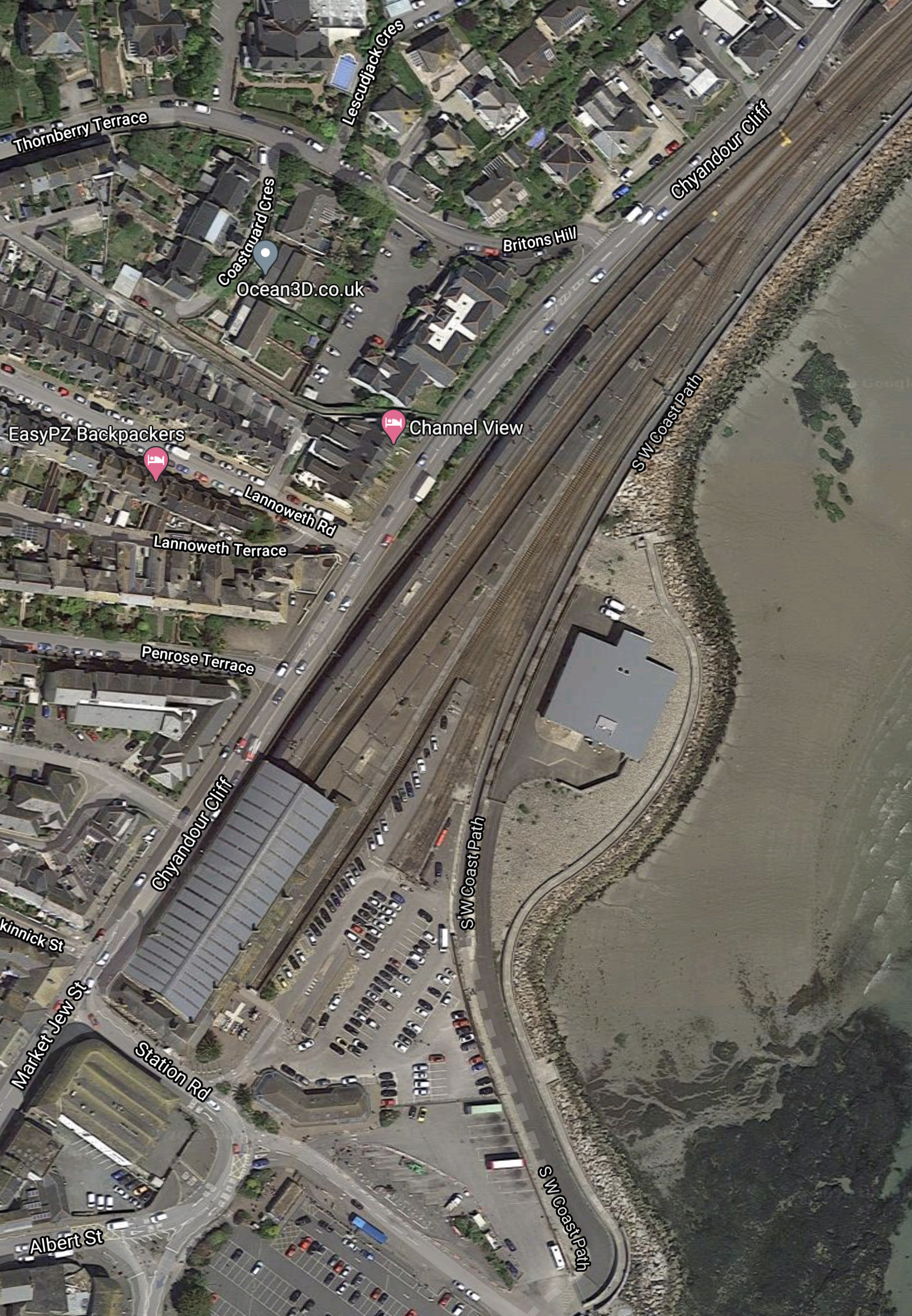
Penzance would be an ideal station to fully charge the trains, before they ran East.
- The station has four long platforms.
- There appears to be plenty of space just to the East of the station.
- Penzance TMD is nearby.
This picture shows Platform 4, which is on the seaward side of the station. The train in the platform is one of GWR’s Castles.
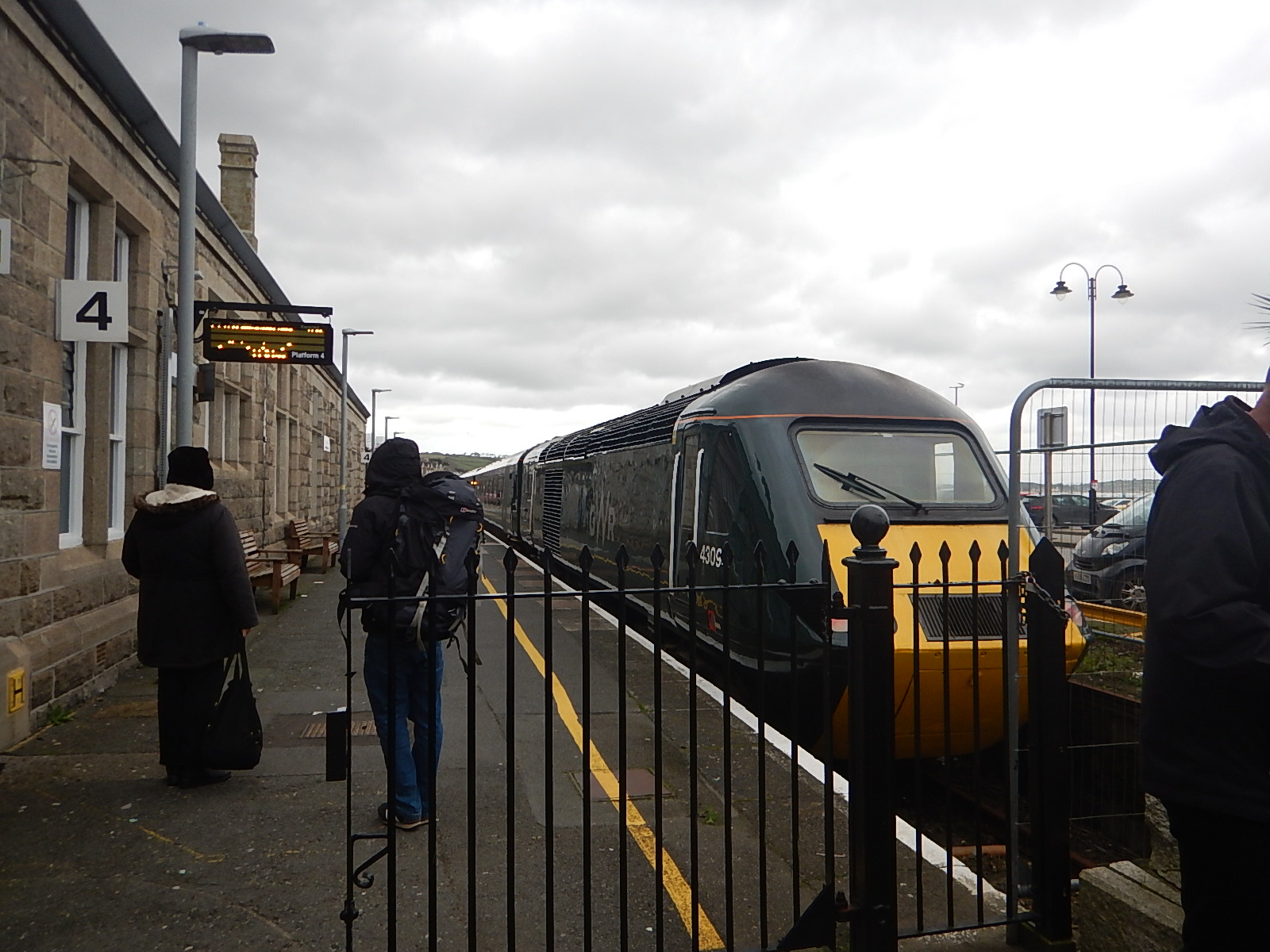
It is partly outside the main station, so might be very suitable to charge a train.
If trials were being performed to Penzance, it appears that the station would be a superb choice to charge trains.
My only worry, is would the location have enough power to charge the trains?
Plymouth Station
This Google Map shows Plymouth station.
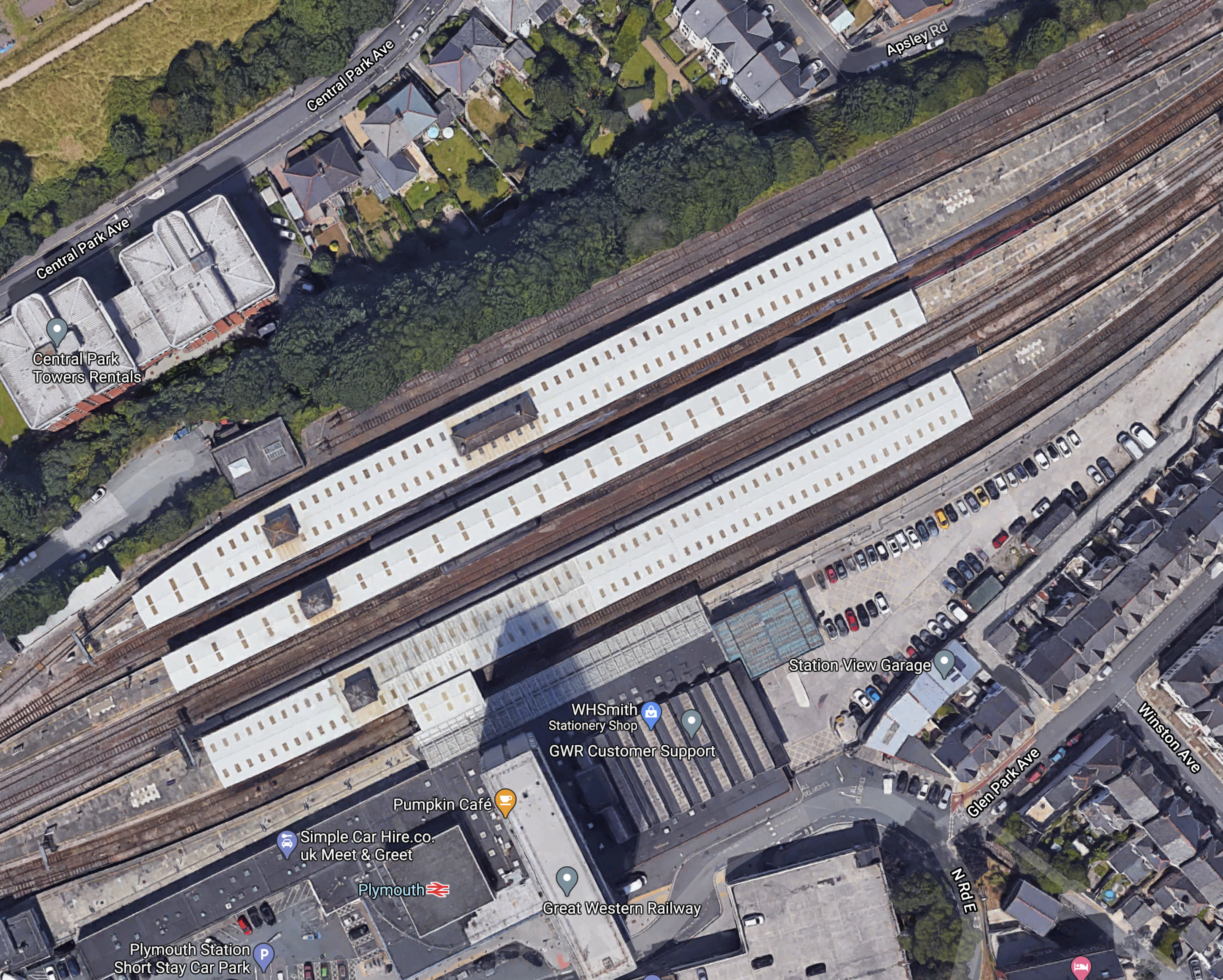
It is another spacious station with six platforms.
Chargers could be installed as needed for both expresses and local trains.
A Zero-Carbon Devon and Cornwall
If the battery trains perform as expected, I can see the Devon and Cornwall area becoming a low if not zero carbon railway by the end of this decade.
- The Castles would be retired.
- They would be replaced by battery electric trains.
- Charging would be available on all platforms at Penzance, Plymouth and possible some other intermediate stations and those on some branch lines.
It certainly wouldn’t hurt tourism.
Thoughts On Batteries In East Midland Railway’s Class 810 Trains
Since Hitachi announced the Regional Battery Train in July 2020, which I wrote about in Hyperdrive Innovation And Hitachi Rail To Develop Battery Tech For Trains, I suspect things have moved on.
This is Hitachi’s infographic for the Regional Battery Train.
Note.
- The train has a range of 90 km/56 miles on battery power.
- Speed is given at between 144 kph/90 mph and 162 kph/100 mph
- The performance using electrification is not given, but it is probably the same as similar trains, such as Class 801 or Class 385 trains.
- Hitachi has identified its fleets of 275 trains as potential early recipients.
It is also not stated how many of the three diesel engines in a Class 800 or Class 802 trains will be replaced by batteries.
I suspect if the batteries can be easily changed for diesel engines, operators will be able to swap diesel engines and battery packs according to the routes.
Batteries In Class 803 Trains
I first wrote about the Class 803 trains for East Coast Trains in Trains Ordered For 2021 Launch Of ‘High-Quality, Low Fare’ London – Edinburgh Service, which I posted in March 2019.
This sentence from Wikipedia, describes a big difference between Class 803 and Class 801 trains.
Unlike the Class 801, another non-bi-mode AT300 variant which despite being designed only for electrified routes carries a diesel engine per unit for emergency use, the new units will not be fitted with any, and so would not be able to propel themselves in the event of a power failure. They will however be fitted with batteries to enable the train’s on-board services to be maintained, in case the primary electrical supplies would face a failure.
Nothing is said about how the battery is charged. It will probably be charged from the overhead power, when it is working.
The Intercity Tri-Mode Battery Train
Hitachi announced the Intercity Tri-Mode Battery Train in this press release in December 2020.
This is Hitachi’s infographic for the Intercity Tri-Mode Battery Train.

Note.
- The train is battery-powered in stations and whilst accelerating away.
- It says that only one engine will be replaced by batteries.
- Fuel and carbon savings of 20 % are claimed.
Nothing has been said in anything, I’ve read about these trains, as to whether there is regenerative braking to batteries. I would be very surprised if fuel and carbon savings of 20 % could be attained without regenerative braking to batteries.
In Do Class 800/801/802 Trains Use Batteries For Regenerative Braking?, I discussed the question in the title.
This is a shortened version of what I said in that post.
If you type “Class 800 regenerative braking” into Google, you will find this document on the Hitachi Rail web site, which is entitled Development of Class 800/801 High-speed Rolling Stock for UK Intercity Express Programme.
If you search for brake in the document, you find this paragraph.
In addition to the GU, other components installed under the floor of drive cars include the traction converter, fuel tank, fire protection system, and brake system.
Note that GU stands for generator unit.
The document provides this schematic of the traction system.

Note that BC which is described as battery charger.
Is that for a future traction battery or a smaller one used for hotel power as in the Class 803 train?
As a Control and Electrical Engineer, it strikes me that it wouldn’t be the most difficult problem to add a traction battery to the system.
From what Hitachi have indicated in videos, it appears that they are aiming for the battery packs to be a direct replacement for the generator unit.
Generator Unit Arrangement In Class 810 Trains
When I wrote Rock Rail Wins Again!, which was about the ordering of these trains, the reason for four engines wasn’t known.
It now appears, that the extra power is needed to get the same 125 mph performance on diesel.
The formation of a five-car Class 802 train is as follows.
DPTS-MS-MS-MC-DPTF
Note.
- The three generator units are in the three middle cars.
- The three middle cars are motored.
- The two driver cars are trailer cars.
How are Hitachi going to put four generator units into the three middle cars?
- I wonder if, the engines can be paired, with some auxiliaries like fuel-tanks and radiators shared between the generators.
- A well-designed pair might take up less space than two singles.
- A pair could go in the centre car and singles either side.
It will be interesting to see what the arrangement is, when it is disclosed.
Is there the possibility, that some of the mathematics for the Intercity Tri-Mode Battery Train has indicated that a combination of generator units and battery packs can give the required 125 mph performance?
- Battery packs could need less space than diesel generators.
- Regenerative braking could be used to charge the batteries.
- How far would the train be able to travel without electrification?
- Trains would not run the diesel engines in the station.
- Could the fuel and carbon savings of 20 %, that are promised for the Intercity Tri-Mode Battery Train, be realised?
There may be a train buried in the mathematics, that with some discontinuous electrification could handle the East Midlands Railway Intercity services, that generates only a small amount of carbon!
Would A Mix Of Diesel Generators And Battery Packs Enable 125 mph Running?
Consider.
- The trial Intercity Tri-Mode Battery Train intended for the London Paddington and Penzance route, will probably have two diesel generators and a battery pack according to what Hitachi have said in their infographic for the Intercity Tri-Mode Battery Train.
- East of Plymouth some of the stretches of the route are challenging, which resulted in the development and ordering of Class 802 trains, that are more powerful, than the Class 800 trains used on easier routes.
- An Intercity Tri-Mode Battery Train with two diesel generators and a battery pack, needs to be as powerful as a Class 802 train with three diesel generators.
- So effectively does that mean that in the right installation with top class controlling software, that in fast running, a battery pack can be considered equivalent to a diesel generator?
I don’t know, but if it’s possible, it does bring other advantages.
- Fuel and carbon savings of 20 %
- No diesel running in stations or whilst accelerating away.
- Better passenger environment.
Configurations of 3-plus-1 and 2-plus 2 might be possible.
Dangerous Innovation
I had to put a link to this article on the Romford Recorder, which is entitled Heritage: Sootigine, Dagfert and Baxtrol.
It is a tale of dangerous products mainly developed in East London.
It has to be read, as no precis of mine can do it justice.
I will add a story, that was told by the guy whose bottom fell out in this post.
The guy in the story had at one time been the Complaints Manger for Ford in Dagenham.
This was one of his tales.
Ford received a complaint via the main dealer in East London.
- The engine had failed in a car about six months old.
- So he arranged a time to meet the owner at the garage.
- When they arrived, he asked, the garage manager to start the car.
- He said that he’d never heard such a noise. All big-ends and the small-ends were making a lot of noise and it was the worst engine he’d ever heard.
- So he asked the manager to put the car on a lift and drop the sump to have a look.
- When the sump was dropped, the manager showed him the sump, which looked like it was full with a waxy solid.
So they asked the owner, who was of Mediterranean origin, what oil he was using in his car.
They got the immortal reply!
“Good enough for my fried fish! Good enough for my car!”
DLR Extension To Thamesmead Gets Preliminary Funding
The title of this post, is the same as that of this article on IanVisits.
This is the opening paragraphs.
TfL has secured funding to carry out more work on plans to extend the DLR from Beckton to Thamesmead.
The current proposals are for a new station be built in Beckton, with a bridge over (or tunnel under) the Thames to a new station in Thamesmead. Both sites are subject to lots of new housing being built, or planned, and the DLR extension was included in TfL’s latest financial plans.
Ian also gives this map.
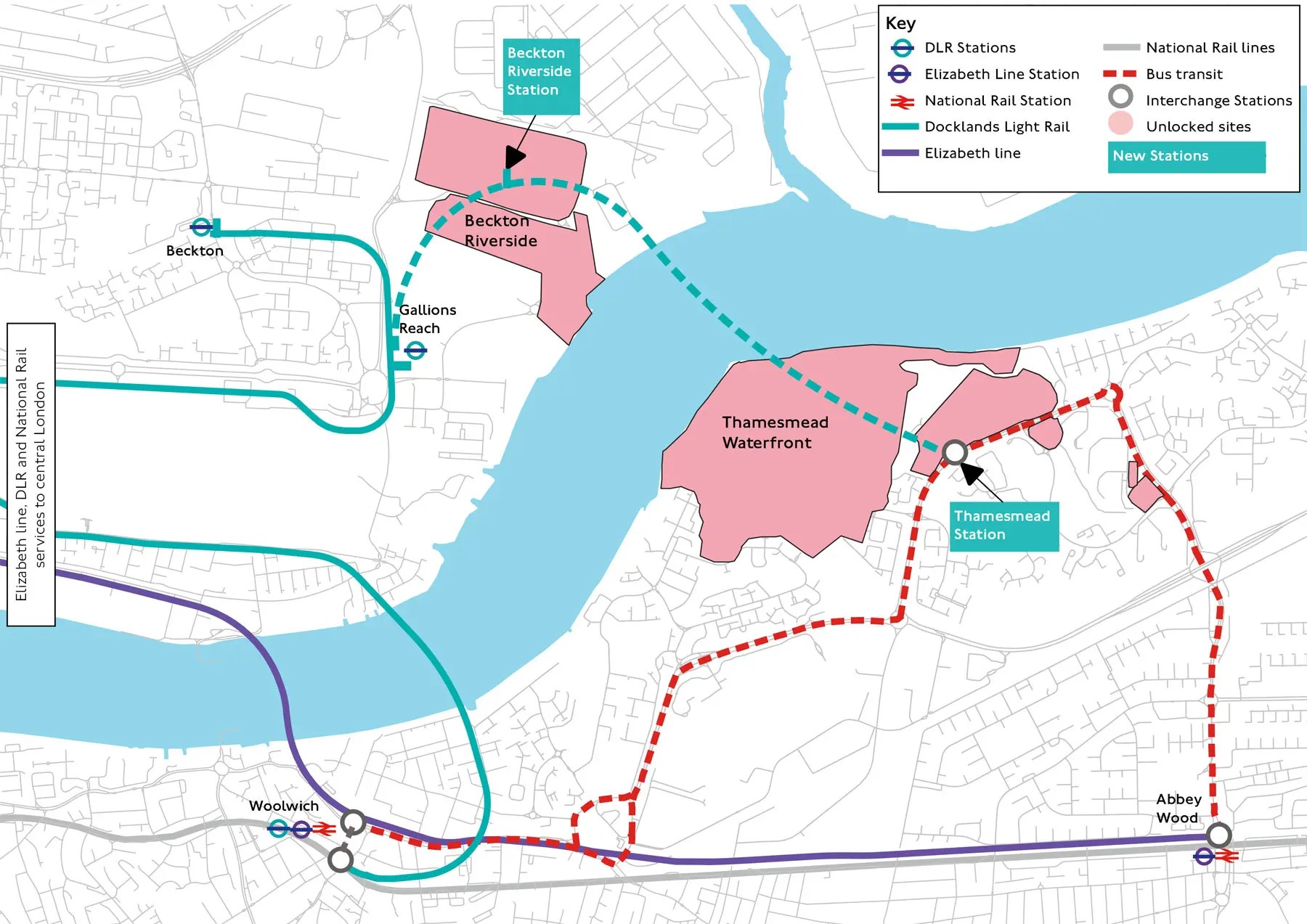
This Google Map shows the area, where the extension will be built.
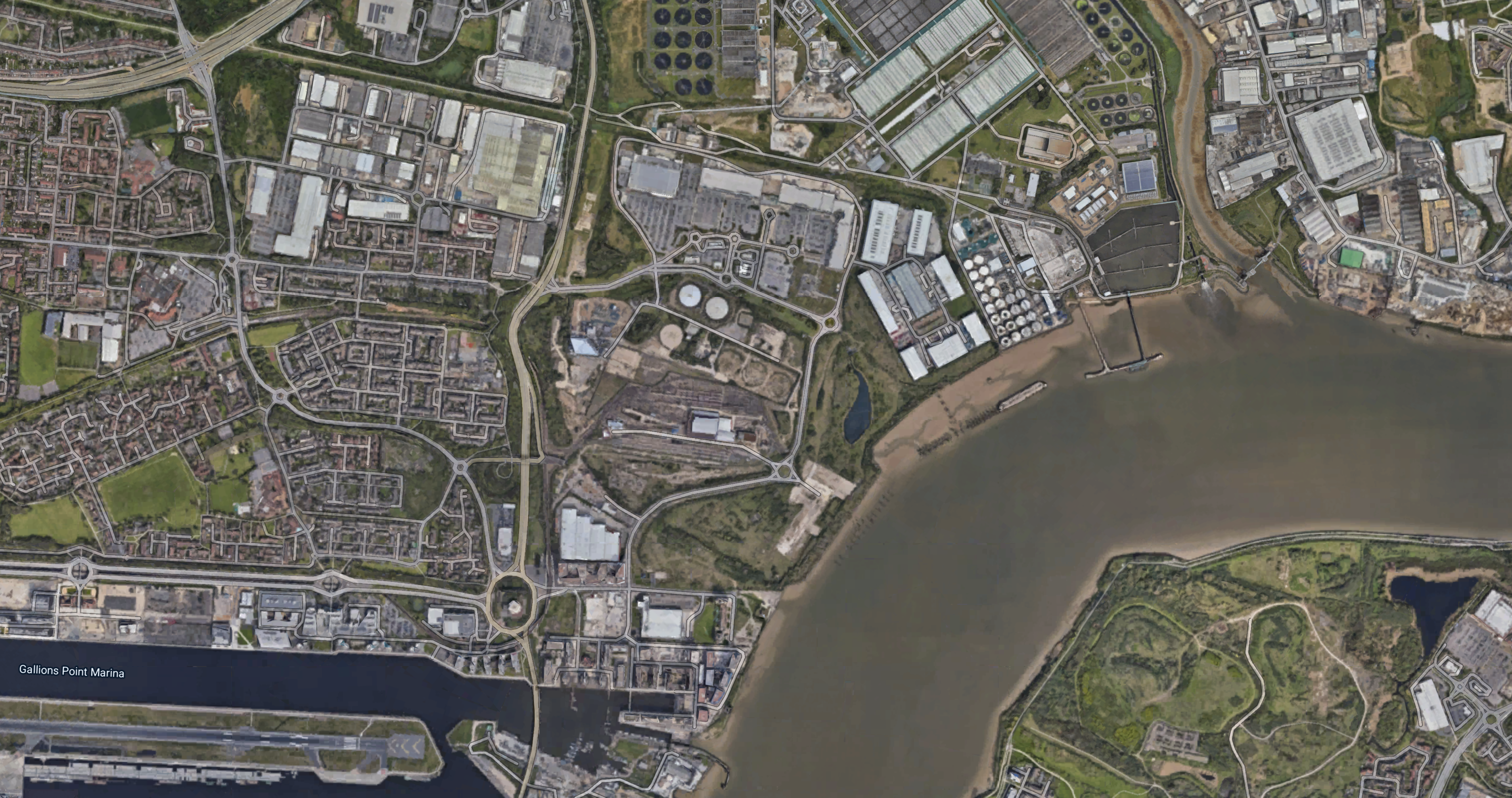 Note.
Note.
- The Eastern end of the runway at London City Airport in the South-Western corner of the map.
- The proposed location of Thamesmead station is by the roundabout in the South-Eastern corner of the map.
I estimate that the River Thames is around 500-600 metres wide at this point.
North Of The Thames
This Google Map shows more detail around the ring road of Armada Way on the North side of the Thames.
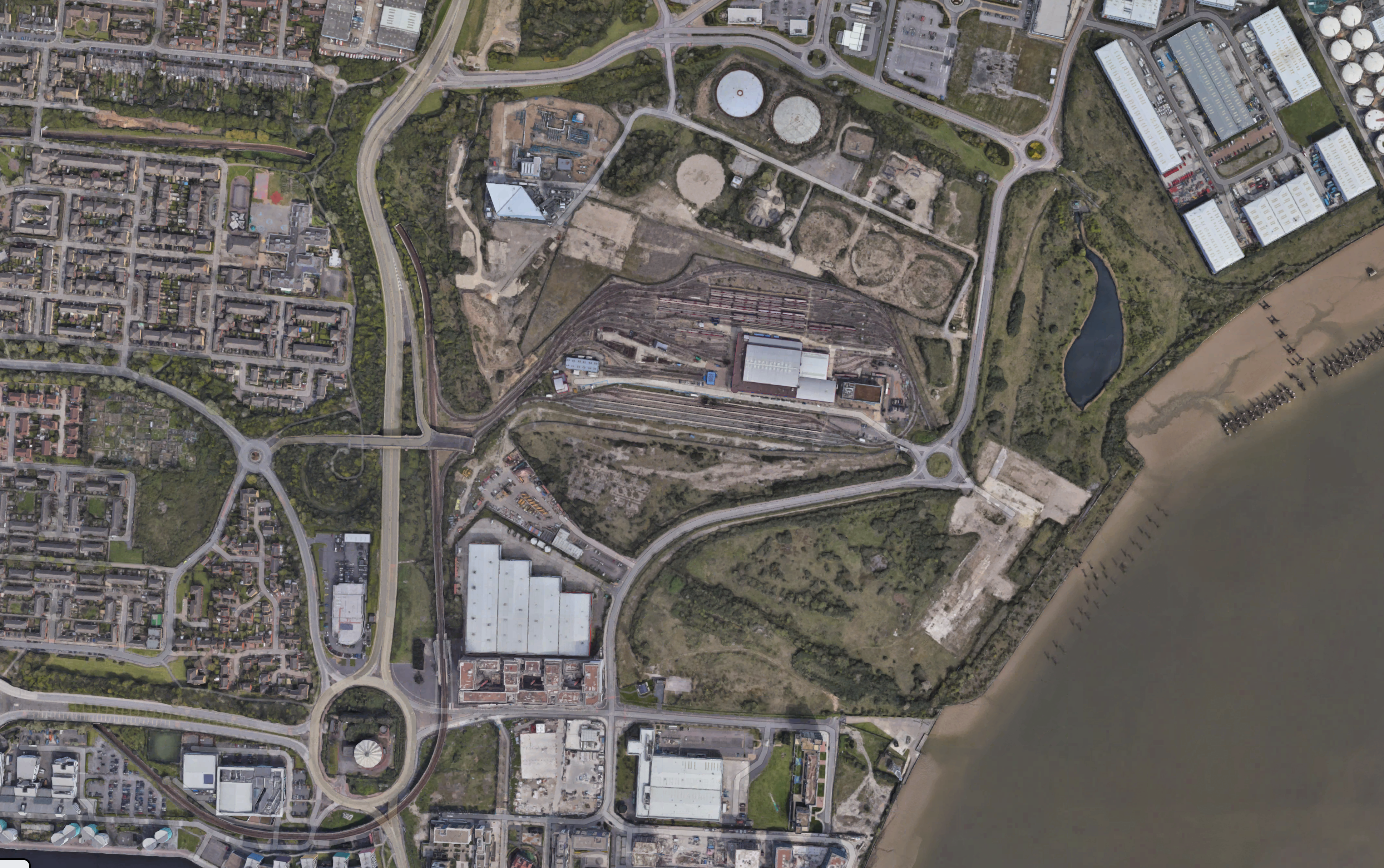
Note.
- The ring road of Armada Way in the centre of the map.
- Beckton Depot of the DLR takes up the Southern part of the land enclosed by Armada Way.
- The Northern part of the enclosed land is what is left of Beckton Gas Works.
- Gallions Reach station by Gallions roundabout, aligned North-South along the road.
- Note how the DLR goes under the road to read Beckton station in the North West corner of the map.
- To the North of the Armada Way ring, there is Gallions Reach Retail Park.
- Surrounding everything to North and East is the massive Becton Sewage Treatment Works.
I am not sure how the extension will connect to the existing Beckton branch of the DLR, but it does look that it could sneak around the inside of Armada Way and strike out directly across the Thames, from a junction to the North of Gallions Reach station.
This Google Map shows Gallions Roundabout and Gallions Reach station.
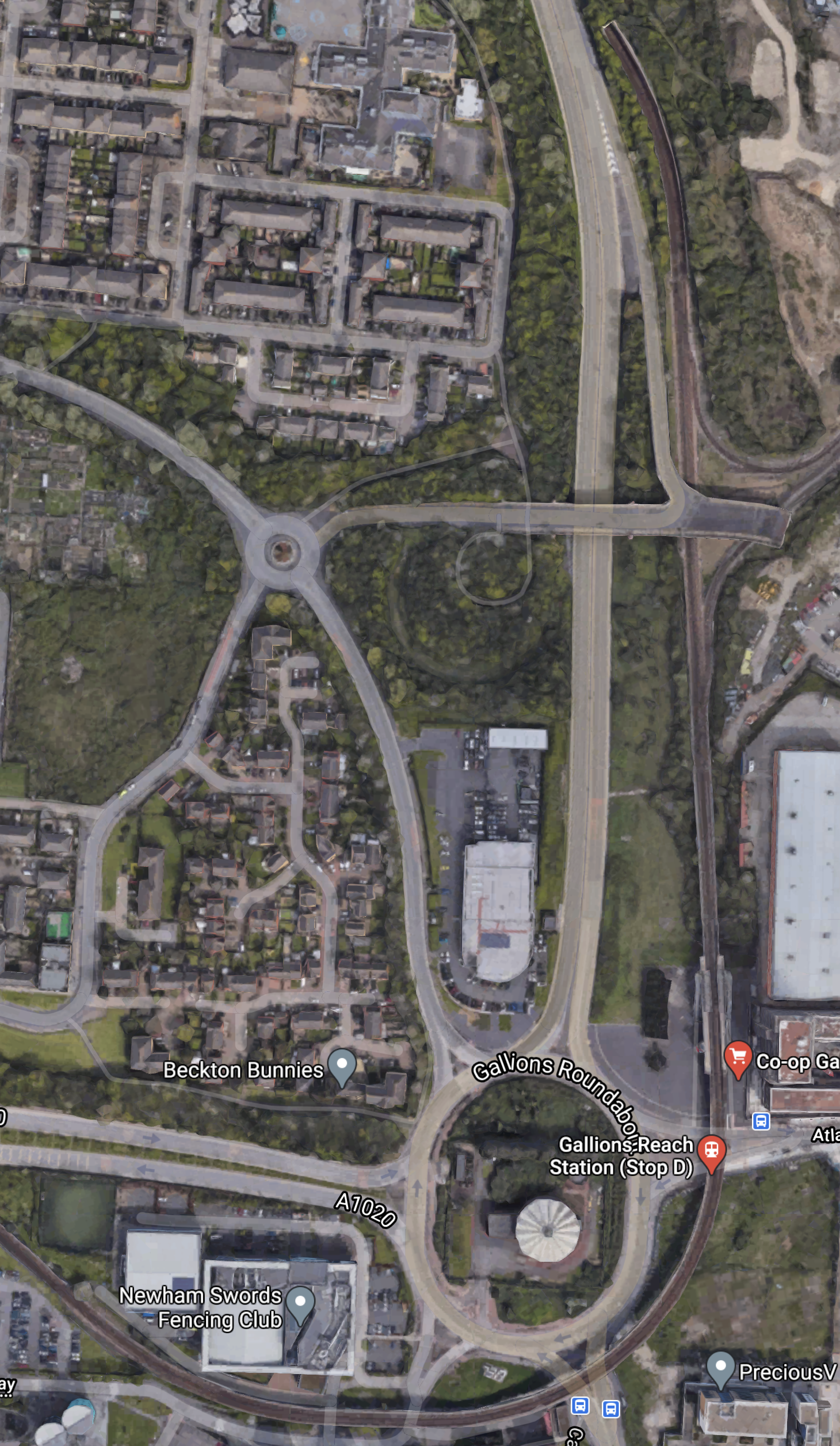
The connection to Beckton Depot to the North of the station can be picked out. It appears trains can enter and leave the depot in both directions.
This further Google Map shows Armada Way as it goes across the Northern side of the Beckton Gas Works site and along the Southern side of Gallions Reach Retain Park.
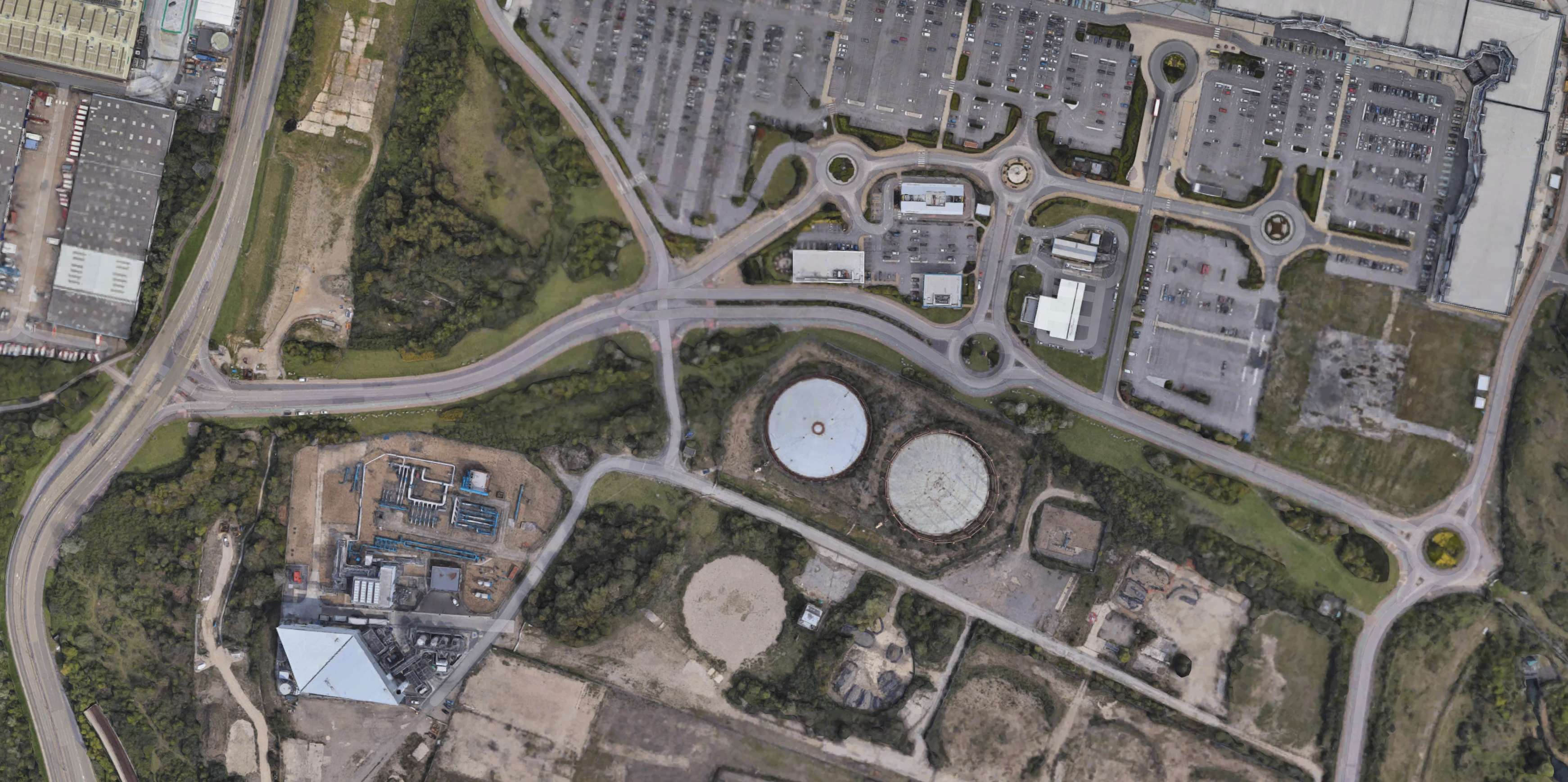
Note.
- The current route to Beckton station can be seen entering a short tunnel to go under the road.
- Could the route go inside Armada Way?
A station appears to be planned in this area called Beckton Riverside.
South Of The Thames
This Google Map shows the area which will be served by the extension South of the river.
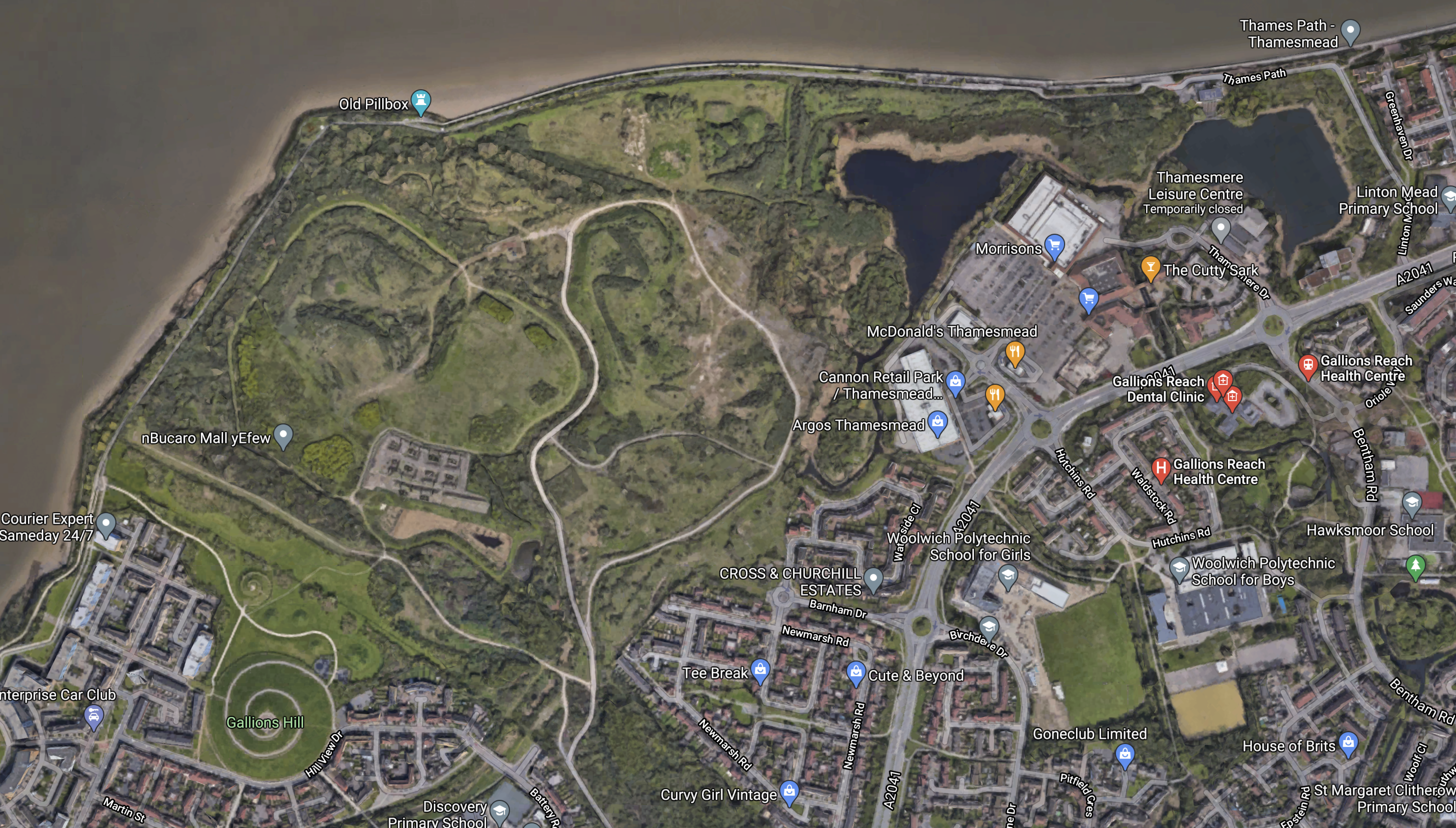
Note.
- From the first map in this post it would appear that the route from the North makes landfall just to the East of the blue dot on South bank of the River.
- Thamesmead station would appear to be by the middle of the three roundabouts shown on the road crossing the map.
Much of the land between, the current buildings and the river could be developed.
Bridge Or Tunnel?
The major piece of construction will be the bridge or tunnel to connect the two halves of the extension.
Consider.
- The frequency of the extension could be fifteen trains per hour (tph)
- A bridge may stop large ships like HMS Ocean and MS Deutschland coming upriver to Greenwich or the Pool of London.
- London has tried to develop a cruise ship terminal at Enderby’s Wharf near Greenwich.
- Bringing cruise ships into London creates employment.
- The Docklands Light Railway already has two tunnels under the river.
- A tunnel would probably be less than a kilometre.
For these reasons, I think, a tunnel will be the more likely option.
Although, I always like railway bridges across a river, as they can become tourist attractions.
A Few Thoughts
These are a few thoughts.
A Frequency Of 15 tph
In his article, Ian says this about the frequency.
If the DLR extension is built, then it’s provisionally expected to be able to offer 15 trains per hour – roughly one every four minutes.
Currently, the frequency between Tower Gateway and Beckton is only 7.5 tph in the Peak and six tph in the Off-Peak.
- If the Beckton service were to be extended to Thamesmead, to run a frequency of 15 tph, would still need more trains for the service.
- But where would the extra trains terminate in the West?
- Could this be handled with the new trains and better signalling?
I’m not sure, but it seems that the Docklands Light Railway is being setup with another 15 tph capacity in the East.
Could it be that the Thamesmead extension will be run back-to back with another extension in the West.
In A Connection Between City Thameslink Station And The Docklands Light Railway, I described a possible Westward extension of the Docklands Light Railway to Euston, St. Pancras and Victoria stations.
This map shows the route.
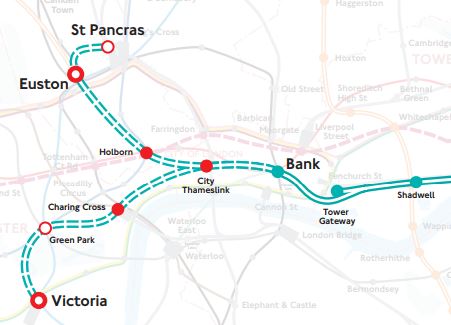
Note.
- Could St. Pancras and Victoria both take half of the 15 tph from Thamesmead?
- Bank currently , turns 22.5 tph in the Peak and 18 in the Off Peak.
- The new trains may be able to work with shorter headways.
- Currently, Euston, St. Pancras and Victoria have no direct connection to Canary Wharf.
I think the DLR could end up with a Peak service something like this service.
- 7.5 tph – St. Pancras and Lewisham via Canary Wharf
- 7.5 tph – St. Pancras and Woolwich Arsenal
- 7.5 tph – Victoria and Lewisham via Canary Wharf
- 7.5 tph – Victoria and Thamesmead
Except at Custom House and with a walk at Canary Walk, the connection to Crossrail is poor.
Conclusion
The extension of the Docklands Light Railway to Thamesmead, looks to be a sensible project to serve much-needed housing at Beckton and Thamesmead.
But I feel it needs to be built alongside a Western Extension of the Docklands Light Railway to Charing Cross, Euston, St. Pancras and Victoria.
- This would enable a train frequency of at least 7.5 tph to Thamesmead.
- Or 15 tph if the existing Tower Gateway service were to be extended from Becton to Thamesmead.
- This extension would also provide a direct link between Euston, Kings Cross and St. Pancras stations and Canary Wharf and perhaps take some pressure from the Bank branch of the Northern Line.
But the extension’s primary function would be to balance the Docklands Light Railway and allow capacity through Bank to the East to be increased.
It could be an affordable fill-in, while we wait for better times, in which to build Crossrail 2.
OptiFuel Systems Announces Natural Gas Freight Locomotive
The title of this post is the same as that as this article on Railway Gazette International.
This is the introductory paragraph.
Rail, marine and generator product supplier OptiFuel Systems has announced that it is ready to manufacture freight locomotives of 1 200 to 2 400 hp fuelled by biomethane and natural gas.
Other points from the article.
- They are modifying a rail-certified Cummins engine, which has already been used in 12,000 trucks.
- They are using a modular design, so different power outputs can be provided.
- It appears they will provide kits to convert existing locomotives.
- They have a US government grant to build a 4,400 hp or 3.3 MW main line locomotive that can run on renewable natural gas.
This is a quote from OptiFuel President; Scott Myers.
We think that in the next two years there will be a 50-state Low Carbon Fuel Standard programme that includes rail and an extension of the existing federal Alternative Fuel Credit program to include rail. These programmes, just as in trucking and aviation, will provide renewable natural gas to the railroads at a near zero cost and providing them the financial incentive to decarbonise their fleets over the next 15 years.
President Trump was not available for comment.
Renewable Natural Gas
This sounded to me, like the ultimate in greenwashing, when I saw it in this article. The Wikipedia entry for renewable natural gas defines it like this.
Renewable Natural Gas (RNG), also known as Sustainable Natural Gas (SNG) or Biomethane, is a biogas which has been upgraded to a quality similar to fossil natural gas and having a methane concentration of 90% or greater.
Wikipedia also says this about the creation of renewable natural gas.
The UK National Grid believes that at least 15% of all gas consumed could be made from matter such as sewage, food waste such as food thrown away by supermarkets and restaurants and organic waste created by businesses such as breweries. In the United States, analysis conducted in 2011 by the Gas Technology Institute determined that renewable gas from waste biomass including agricultural waste has the potential to add up to 2.5 quadrillion Btu annually, being enough to meet the natural gas needs of 50% of American homes.
In combination with power-to-gas, whereby the carbon dioxide and carbon monoxide fraction of biogas are converted to methane using electrolyzed hydrogen, the renewable gas potential of raw biogas is approximately doubled.
Because of the carbon in the gas and its source, it would appear that it is net zero carbon, rather than the zero carbon of hydrogen. But it does appear, that it would be cheaper to produce than hydrogen.
Conclusion
The United States seems to be researching a route, that will allow them to decarbonise their rail-freight industry.
Application To The United Kingdom
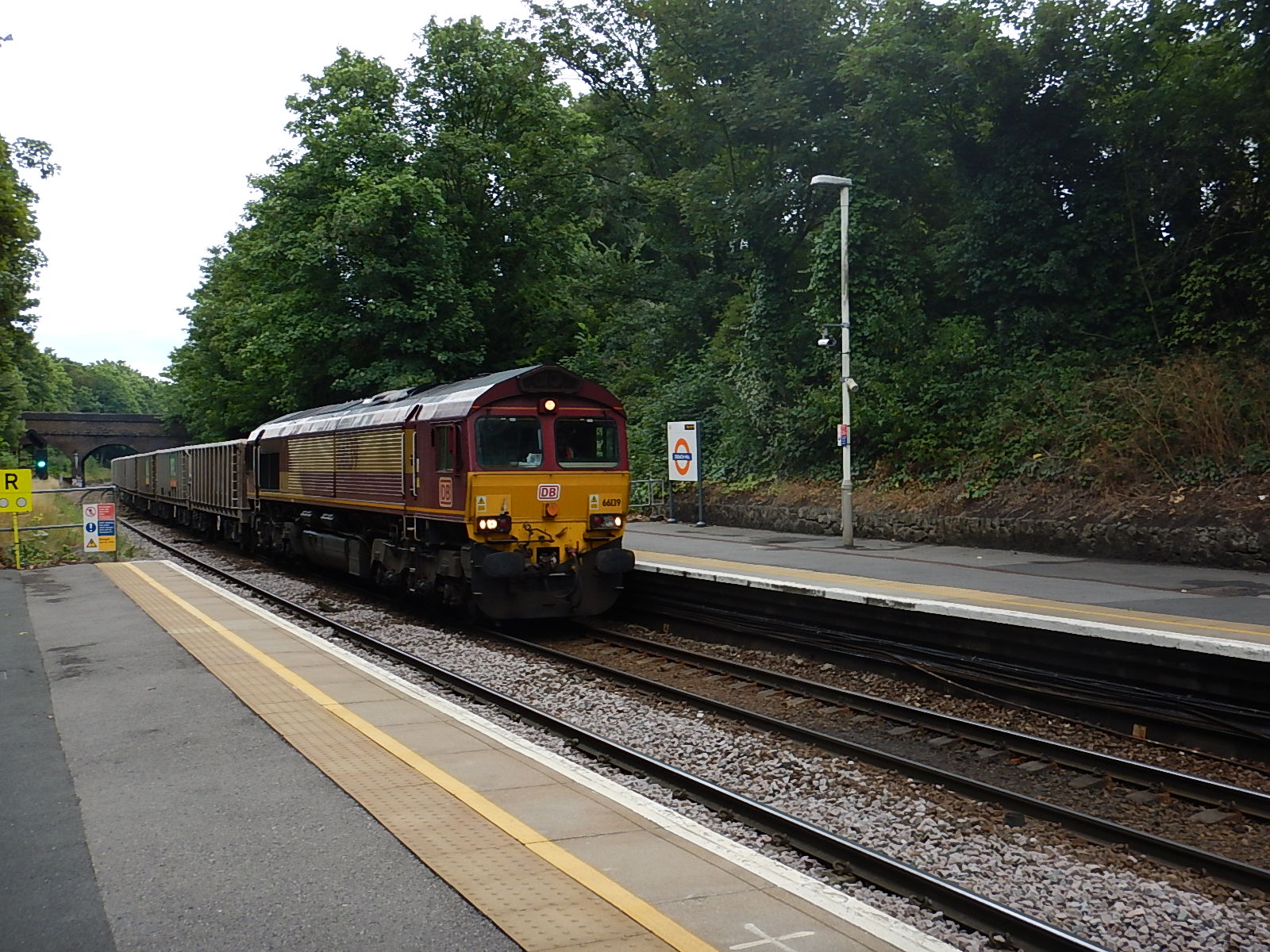
Shown is a Class 66 locomotive.
They are a mainstay of freight in the UK, that are powered by a 3,300 hp diesel engine.
Unfortunately, they are not the most neighbourly of locomotives, which throw out quantities of various pollutants.
Could OptiFuel Systems supply a solution for these locomotives?
Did I Have A Close Brush With Covid-19?
In January, this year, I wrote a post called Mule Trains Between Liverpool And Norwich, where I went between Liverpool and Sheffield on a train formed of of several Class 153 trains.
I didn’t think of it, at the time, I wrote the post, but at Manchester Piccadilly station, the train filled up with a large number of Chinese students returning to University.
The students were happy and laughing, but you wouldn’t have complained about them, but there must have been twenty taking most of the available seats in my carriage. I shared a table with three!
At the time, Covid-19 had hardly started to invade the UK, with most cases starting in March.
But, after hearing someone’s story on the radio yesterday, I wonder about the health of those students.
I certainly, didn’t catch the covids seriously after that train journey and haven’t had the virus since, to my knowledge. But thinking back I may have felt unwell the next day.
But after reading the scientific paper from the University of Padua, that I wrote about in Risk of COVID-19 In Celiac Disease Patients, perhaps I was protected by a natural immunity provided by being a coeliac on a long-term gluten-free diet.
As my father said, I was born lucky!
The Hitachi Intercity Tri-Mode Battery Train Between Paddington And Bedwyn
This is probably one of the easiest services for GWR to run using a Hitachi Intercity Tri-Mode Battery Train.
This Hitachi infographic shows the specification.
Consider.
- The route is fully electrified between London Paddington and Newbury.
- It is 13.3 miles between Bedwyn and Newbury, with two intermediate stations.
- There is under thirty miles without electrification in a round trip between Paddington and Bedwyn.
- There is a turnback siding at Bedwyn, that could be fitted with a charger if required.
- Current trains take 17 minutes for between Bedwyn and Newbury, which is an average speed of 47 mph.
- The trains would run at up to 125 mph between Paddington and Reading.
- If the Great Western Main Line gets full in-cab digital ERTMS digital signalling, they will be able to take advantage and run at up to 140 mph between Reading and Paddington.
If it could be shown to be able to run the route reliably, I feel that a Hitachi Intercity Tri-Mode Battery Train with a mix of diesel engines and battery packs might be the ideal train.
- Large amounts of power would not be needed to maintain an average speed of 47 mph between Newbury and Bedwyn, which from my helicopter appears to be a fairly level railway by the side of the Kennett and Avon Canal.
- Except in emergencies, I doubt that diesel running would be needed.
On my list of possible services for these trains, they would also be able to work GWR services between Paddington and Oxford or any other station with a less than thirty mile round trip away from the electrification
Station Stop Performance Of The Intercity Tri-Mode Battery Train
Hitachi have stated that the their Intercity Tri-Mode Battery Trains will not use their diesel engines in stations and to leave the station.
The first Intercity Tri-Mode Battery Trains will be conversions of Class 802 trains.
This page on the Eversholt Rail web site, has a data sheet for a Class 802 train.
The data sheet shows the following for a five-car Class 802 train.
- It can accelerate to 120 kph/75 mph in 100 seconds in electric mode.
- It can accelerate to 160 kph/100 mph in 160 seconds in electric mode.
- It can accelerate to 120 kph/75 mph in 140 seconds in diesel mode.
- It can decelerate from 120 kph/75 mph in 50 seconds in electric mode.
Note.
- 75 mph is the operating speed of the Cornish Main Line and possibly the Highland Main Line.
- 100 mph is the operating speed for a lot of routes in the UK.
- It would appear that trains accelerate to 75 mph forty second faster in electric mode, compared to diesel mode.
- In diesel mode acceleration slows markedly once 100 kph is attained.
Can we assume that performance in battery mode, will be the same as in electric mode?
I am always being told by drivers of electric cars, trains and buses, that they have sparkling performance and my experience of riding in battery electric trains, indicates to me, that if the battery packs are well-engineered, then it is likely that performance in battery mode could be similar to electric mode, although acceleration and operating speed my be reduced to enable a longer range.
If this is the case, then the following times for a station call with a 75 mph operating speed are possible.
- Electric mode – 50 + 60 + 100 = 210 seconds
- Diesel mode – 50 + 60 + 140 = 250 seconds
- Battery mode – 50 + 60 + 100 = 210 seconds
Note.
- The three figures for each mode are deceleration time, station dwell time and acceleration time.
- Times are measured from the start of deceleration from 75 mph, until the train accelerates back to 75 mph.
- I have assumed the train is in the station for one minute.
I suspect with a stop from 100 mph, that there are greater savings to be made than the forty seconds at 75 mph, due to the reduced acceleration in diesel mode past 100 kph.
Savings Between London Paddington And Penzance
There are fifteen stops between London Paddington and Penzance, which could mean over ten minutes could be saved on the journey.
This may not seem that significant, but it should be born in mind, that the fastest journey times between London and Penzance are between five hours and eight minutes and five hours and fourteen minutes.
So these small savings could bring a London Paddington and Penzance journey much closer to five hours.
Savings Between London Kings Cross And Inverness
There are probably not as great savings to be made on this route.
- The electrification runs as far as Stirling.
- There are only five intermediate stops between Stirling and Inverness
- Stirling and Inverness are 151 miles apart.
On the other hand, the route has a lot of gradients, which may give opportunities to use the batteries to boost power on climbs and save fuel and emissions.
Conclusion
Replacing one or more of the diesel engines on a Class 800, 802, 805 or 810 train, on a route, where the full complement of diesel engines is not required, may well result in time savings on the journey, simply by reducing the time taken to accelerate back to operating speed.
I have indicated two routes, where savings can be made, but there may be other routes, where savings are possible.
Report Reveals The Environmental Benefits HS2 Will Deliver
The title of this post, is the same as that of this article on Rail Technology Magazine.
This is the introductory paragraph.
A significant report from the High-Speed Rail Group has been published today and details how the environmental team working on HS2 are delivering connected, climate-resilient habitats at a new scale, raising ambition for future infrastructure projects.
The report also suggests that High Speed Two will bring forward other projects.
The Borders Railway
The article says this about the Borders Railway.
Besides providing capacity, an extended high-speed rail network could catalyse wider public transport upgrades, such as improving the case for reopening the Borders Railway to Carlisle.
It appears to me, that to go South, from towns like Galashiels, Hawick, Peebles and Selkirk will be quicker if you change at Carlisle to High Speed Two.
Battery Electric Trains On The Borders Railway
The Borders Railway could also be one, that is ideal for battery electric operation.
- It is already electrified at the Edinburgh end of the route.
- Newcraighall station, where the current wires end, is only thirty miles or so from the current end of the line at Tweedbank.
- Tweedbank and Hawick are about 15 miles.
- At the Southern end of the route it joins the West Coast Main Line to the North of Carlisle.
- Hawick and the West Coast Main are about 35 miles.
- The West Coast Main Line is fully electrified.
This Hitachi infographic gives the specification of their Regional Battery Train
As Hitachi and others are talking of trains with a range of over fifty miles on batteries, I can see a sensible plan evolving to run battery electric trains between Edinburgh and Carlisle.
- At both ends trains would join the Borders Railway with full batteries.
- It might be sensible to extend the electrification at both ends for perhaps five to ten miles.
- From the South trains could certainly reach Hawick and might possibly be able to reach Tweedbank.
- From the North trains could certainly reach Tweedbank and might possibly be able to reach Hawick.
I feel that by using the best of modern battery technology and with charging during extended stops at Hawick and Tweedbank, battery electric trains could work between Carlisle and Edinburgh.
 The Anonymous Widower