Hyundai Delivers World’s First Hydrogen-Powered Trucks
The title of this post, is the same as this article on Car Advice.
The trucks llok impressive and they are going to Switzerland.
Could ERTMS And ETCS Solve The Newark Crossing Problem?
This is an updated version of what, I originally published the following in Will The East Coast Main Line Give High Speed Two A Run For Its Money To The North East Of England?
The Newark Crossing is the railway equivalent of a light-controlled pedestrian crossing in the middle of a motorway.
This Google Map shows the crossing.
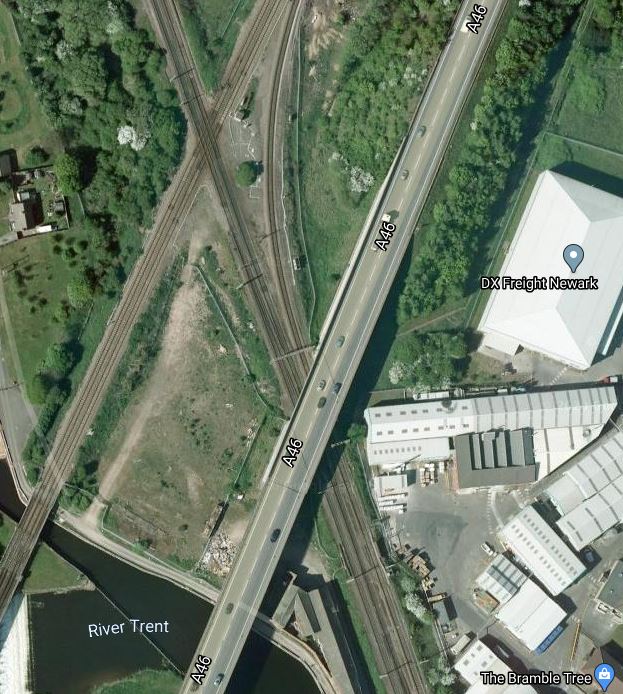
Note.
- The East Coast Main Line (ECML) running roughly North-South
- The A 46 road crossing the line.
- The Nottingham-Lincoln Line running parallel to the road.
- A chord allowing trains to go between the Nottingham-Lincoln Line and Newark North Gate station, which is to the South.
- The River Trent.
Complicated it certainly is!
I wrote about the problems in The Newark Crossing and felt something radical needed to be done.
Looking at the numbers of trains at the Newark Crossing.
- The number of trains crossing the ECML is typically about three trains per hour (tph) and they block the ECML for about two minutes.
- But then there could be a fast train around every four minutes on the ECML, with eight tph in both directions.
Would a Control Engineer’s solution, where all trains are computer controlled through the junction, be possible?
ERTMS, which is digital in-cab signalling is being installed on the ECML and will allow the following.
- Trains to be able to run at up to 140 mph.
- Trains to be precisely controlled from a central signalling system called ETCS.
ERTMS and ETCS are already working successfully on Thameslink.
Suppose all trains going through the Junction on both the ECML or the Nottingham-Lincoln Line, were running using ERTMS and ETCS.
- Currently, there are three tph crossing from East to West and three tph crossing from West to East. Which means that the junction is blocked six times per hour for say two minutes.
- Suppose the signalling could control the crossing trains, so that an East to West and a West to East train crossed at the same time.
- To cater for contingencies like late and diverted trains, you might allow the trains to cross at up to four tph.
Instead of six tph, the frequency across the junction would be no more than four tph.
A similar paired crossing procedure can be applied to trains on the ECML.
The outcome is that you are scheduling a smaller number of double events, which must be easier.
I suspect there are other tricks they can do to increase capacity.
There’s also the problem of what happens if a crossing train fails, as it goes over the East Coast Main Line. But that must be a problem now!
Whatever happens here will be a well-thought through solution and it will add to the capacity of the East Coast Main Line and increase the line-speed from the current 100 mph.
BNSF And Wabtec Prepare To Test Battery-Electric Locomotive
The title of this post, is the same as that of this article on Railway Gazette.
Some points from the article.
- It is a 4,400 hp or 3.3 MW locomotive.
- The battery is formed from 20,000 cells.
- The locomotive uses regenerative braking.
- Testing will be on a 560 km route in California.
But what I find interesting, is that the locomotive is designed to work commonly with a diesel locomotive and this is discussed in detail.
I have this feeling, that running two different locomotives as a pair might be more efficient and I wrote Could A Battery- Or Hydrogen-Powered Freight Locomotive Borrow A Feature Of A Steam Locomotive?, where I examined the concept.
In the article, they say that when a train hauled by a diesel and a battery locomotive, slows, the batteries are recharged. This would seem to make the combination more efficient.
I’ll be interested to see the results of the tests performed by BNSF and Wabtec.
Vivarail And Hitachi Seem To Be Following Similar Philosophies
This press release on the Vivarail web site, is entitled Battery Trains And Decarbonisation Of The National Network.
This is the two paragraphs.
Vivarail welcomes the recent announcements regarding new technologies for rail, and the growing understanding that battery trains will be a key part of the decarbonisation agenda.
Battery trains have been much misunderstood until now – the assumption has been that they can’t run very far and take ages to recharge. Neither of these are true! Vivarail’s trains:
To disprove the assumptions, they then make these points.
- Have a range of up to 100 miles between charges
- Recharge in only 10 minutes
They also make this mission statement.
Vivarail’s battery train, Fast Charge and power storage system is a complete package that can drop into place with minimal cost and effort to deliver a totally emission-free independently powered train, ideally designed for metro shuttles, branch lines and discrete routes across the country.
They add these points.
- Batteries can be charged from 750 VDC third-rail or 25 KVAC overhead electrification or hydrogen fuel cells.
- A daily range of 650 miles can be achieved on hydrogen.
- Vivarail seem very positive about hydrogen.
- The company uses modern high-performance lithium Ion pouch batteries from Intilion.
- It also appears that Vivarail are happy to install their traction package on other trains.
The press release finishes with this paragraph.
The rail industry needs to move now to hit its own decarbonisation targets and assist with the national effort. Battery trains are the quick win to achieve that.
Following on from Hitachi’s announcement on Monday, that I wrote about in Hyperdrive Innovation And Hitachi Rail To Develop Battery Tech For Trains, it does appear that battery trains will be arriving soon in a station near you!
Eurostar Amsterdam To London Treaty Formally Signed
The title of this post, is the same as that of this article on Railnews.
The first paragraph says it all.
The treaty allowing full customs and security procedures for Eurostar passengers at Amsterdam and Rotterdam has been formally signed, said the Department for Transport.
Perhaps, next time I go to Amsterdam, I’ll come back by train.
Proposal To Reopen Camberwell Railway Station
The title of this post, is the same as that of this article on Ian Visits.
It is an excellent article on the pros and cons of the station, with a good picture and a map from TfL.
Ian says, that there are worries, that the station would slow trains for commuters further out.
HS2 Trials UK’s First Electric Forklift
The title of this post, is the same as that of this article on Rail Technology Magazine.
This is the introductory paragraph.
In their efforts to lessen their carbon footprint and support the country’s green economic recovery, HS2 are trailing the UK’s first electric forklift on one of its major construction sites in London.
The construction industry is certainly thinking about cutting its emissions.
Hyperdrive Innovation And Hitachi Rail To Develop Battery Tech For Trains
The title of this post, is the same as that of this article on The Engineer.
This is the introductory sub-title.
Hyperdrive Innovation and Hitachi Rail are to develop battery packs to power trains and create a battery hub in the North East of England.
The article gives this information.
- Trains can have a range of ninety kilometres, which fits well with Hitachi’s quoted battery range of 55-65 miles.
- Hitachi has identified its fleets of 275 trains as potential early recipients.
Hitachi have also provided an informative video.
At one point, the video shows a visualisation of swapping a diesel-engine for a battery pack.
As a world-class computer programmer in a previous life, I believe that it is possible to create a battery pack, that to the train’s extremely comprehensive computer, looks like a diesel-engine.
So by modifying the train’s software accordingly, the various power sources of electrification, diesel power-packs and battery packs can be used in an optimum manner.
This would enable one of East Midlands Railway’s Class 810 trains, to be fitted with a mix of diesel and battery packs in their four positions under the train.
Imagine going between London and Sheffield, after the High Speed Two electrification between Clay Cross North Junction and Sheffield has been erected.
- Between St. Pancras and Market Harborough power would come from the electrification.
- The train would leave the electrified section with full batteries
- At all stations on the route, hotel power would come from the batteries.
- Diesel power and some battery power would be used between stations. Using them together may give better performance.
- At Clay Cross North Junction, the electrification would be used to Sheffield.
For efficient operation, there would need to be electrification or some form of charging at the Sheffield end of the route. This is why, I am keen that when High Speed Two is built in the North, that the shsared section with the Midland Main Line between Clay Cross North Junction and Sheffield station, should be built early.
Hitachi have said that these trains will have four diesel engines. I think it will more likely be two diesel engines and two batteries.
The World’s First Battery-Electric Main Line
I suspect with electrification between Sheffield and Clay Cross North Junction, that a train fitted with four batteries, might even be able to run on electric power only on the whole route.
In addition, if electrification were to be erected between Leicester and East Midlands Parkway stations, all three Northern destinations would become electric power only.
The Midland Main Line would be the first battery electric high speed line in the world!
Hitachi On Hydrogen Trains
The press release about the partnership between Hitachi and Hyperdrive Innovation is on this page on the Hitachi web site.
This is a paragraph.
Regional battery trains produce zero tailpipe emission and compatible with existing rail infrastructure so they can complement future electrification. At the moment, battery trains have approximately 50% lower lifecycle costs than hydrogen trains, making battery the cheapest and cleanest alternative zero-emission traction solution for trains.
I have ridden in two battery-electric trains and one hydrogen-powered train.
I would rate them out of ten as follows.
- Class 230 train – 6 – Battery
- Class 379 train – 8 – Battery
- Coradia iLint – 4 – Hydrogen
It’s not that the iLint is a bad train, as the power system seems to work well, but the passenger experience is nowhere near the quality of the two battery trains.
In my view, battery vehicles are exceedingly quiet, so is this the reason?
On the other hand, it could just be poor engineering on the iLint.
Conclusion
This is as very big day in the development of zero- and low-carbon trains in the UK.
Beeching Reversal – South Yorkshire Joint Railway
This is one of the Beeching Reversal projects that the Government and Network Rail are proposing to reverse some of the Beeching cuts.
This railway seems to have been forgotten, as even Wikipedia only has a rather thin entry for the South Yorkshire Joint Railway.
The best description of the railway, that I’ve found is from this article in the Doncaster Free Press, which is entitled South Yorkshire Railway Line, Which Last Carried Passengers 100 Years Ago Could Be Reopened.
This is said.
The line remains intact, and recently maintained, runs from Worksop through to Doncaster, via North and South Anston, Laughton Common/Dinnington and Maltby.
I jave got my helicopter out and navigating with the help of Wikipedia, I have traced the route of the South Yorkshire Joint Railway (SYJR) between Worksop and Doncaster.
Shireoaks Station
This Google Map shows the Southern end of the SYJR on the Sheffield and Gainsborough Central Line between Shireoaks and Kiveton Park stations.
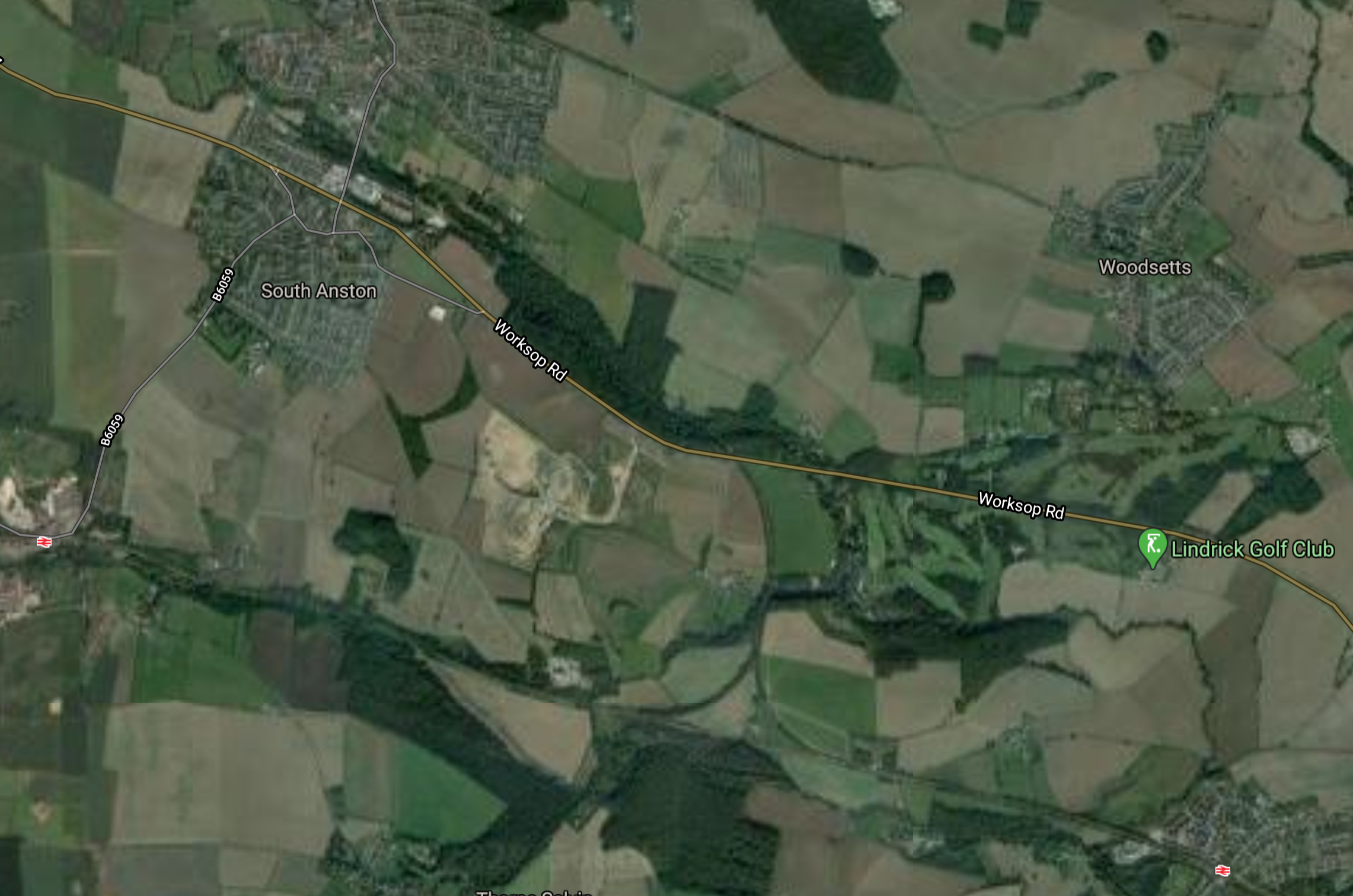
Note.
- Shireoaks station is in the East.
- Kiveton Park station is in the West.
- The SYJR starts at the triangular junction in the middle of the map.
- Lindrick Golf Club, where GB & NI, won the Ryder Cup in 1957 is shown by a green arrow to the North of Shireoaks station.
- The original passenger service on the SYJR, which closed in the 1920s, appears to have terminated at Shireoaks station.
The line immediately turns West and then appears to run between the villages of North and South Anston.
Anston Station
This Google Map shows the location of Anston station.
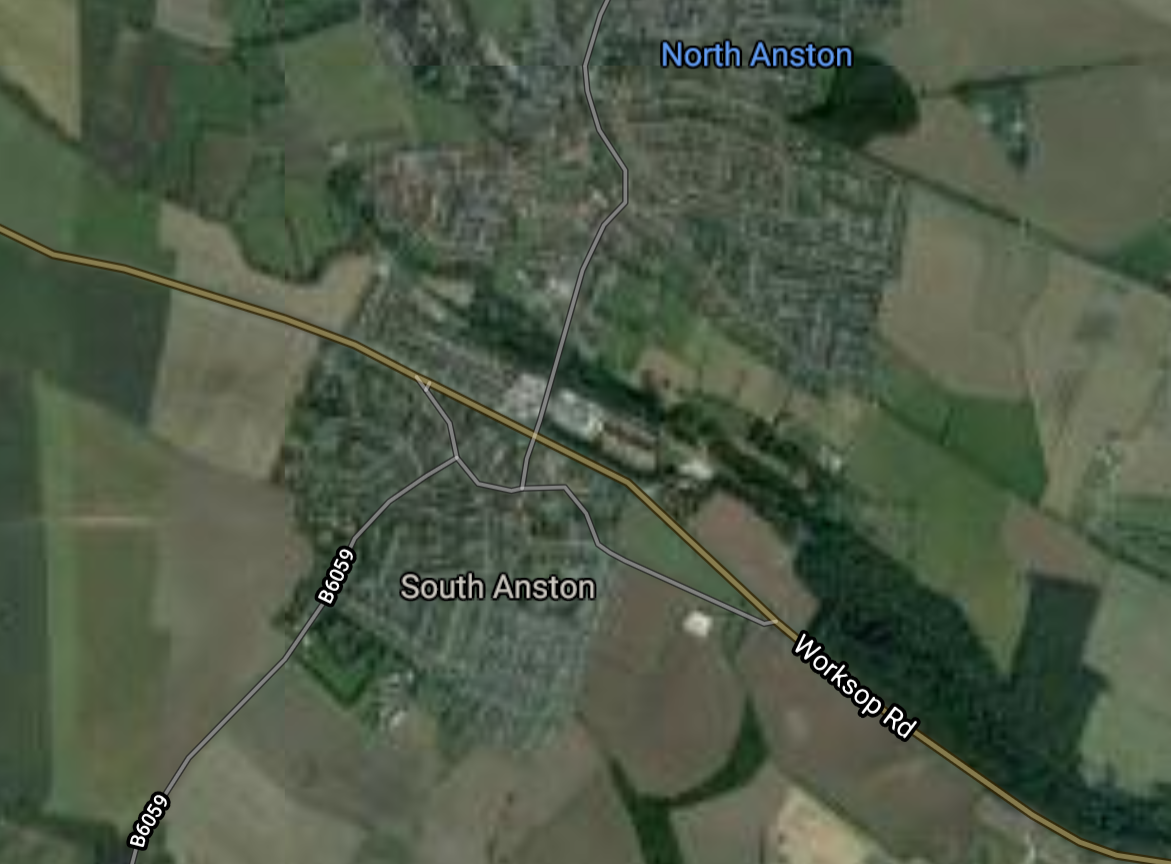
Note that the SYJR goes between the two villages and runs along the North side of the wood, that is to the North of Worksop Road.
Dinnington & Laughton Station
This Google Map shows the location of the former Dinnington & Laughton station.
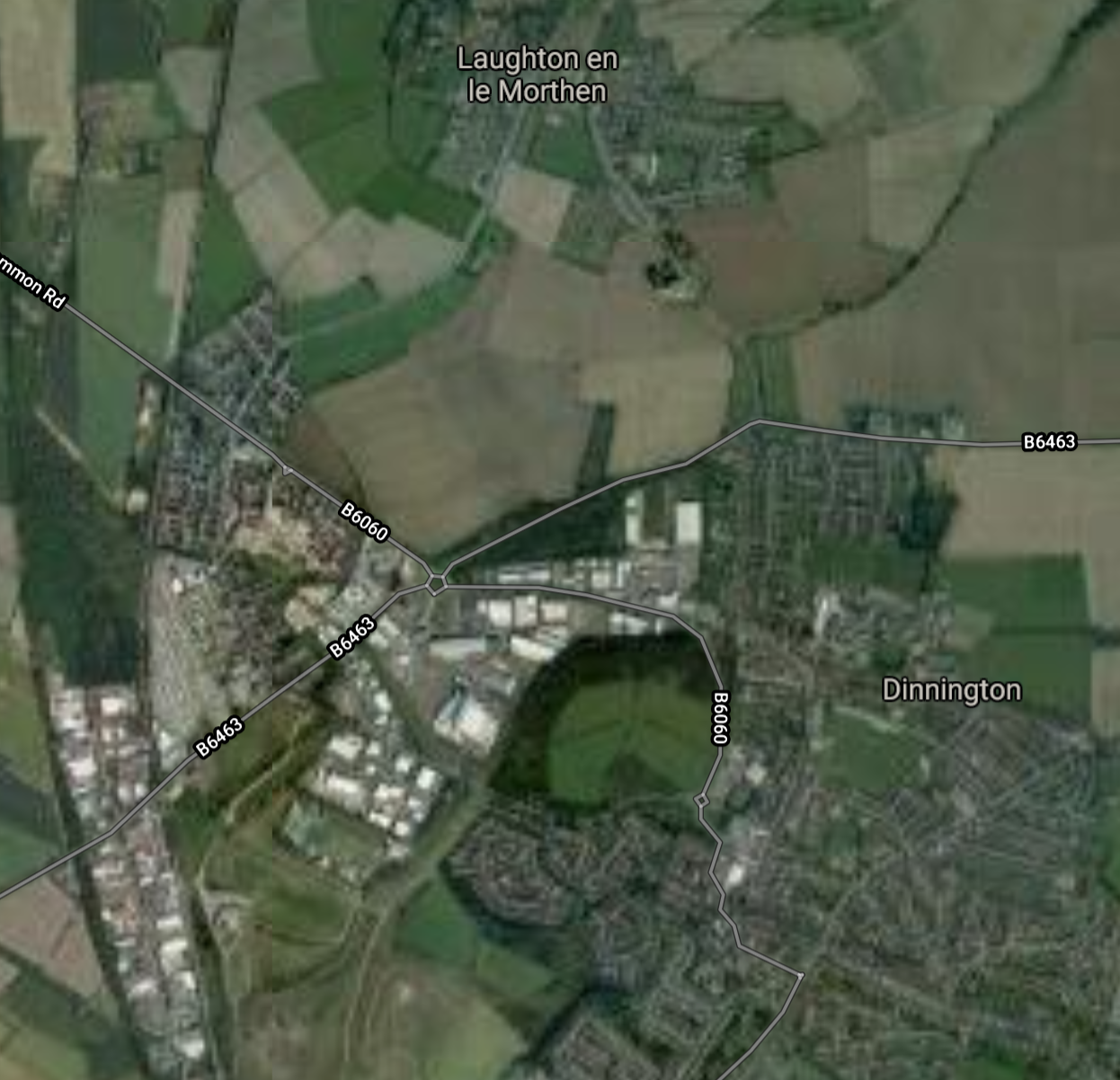
Note that the SYJR goes to the west side of both villages, so it would have been quite a walk to the train.
Maltby Station
This Google Map shows the location of the former Maltby station.
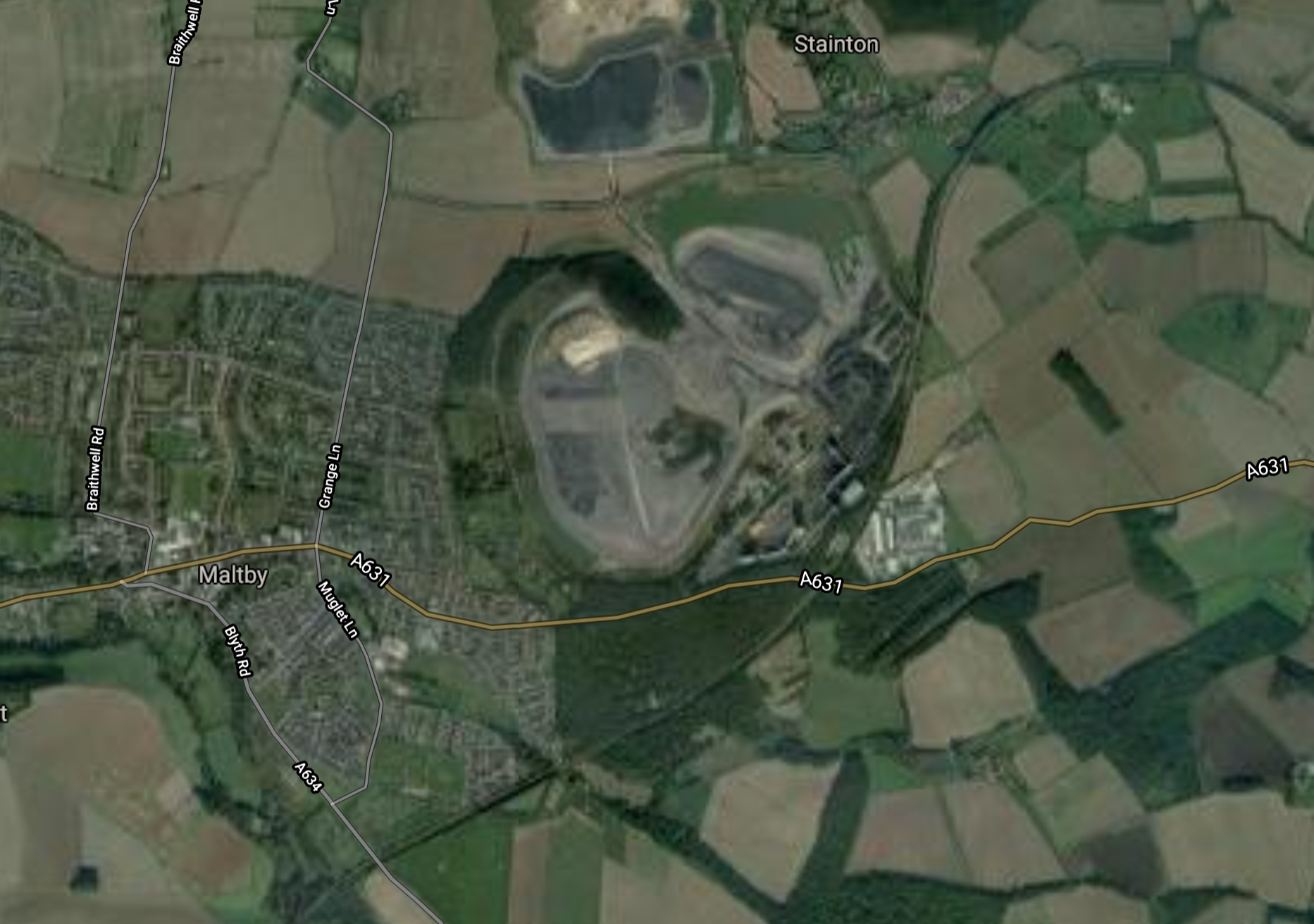
Note.
- The SYJR goes around the South side of the village.
- The remains of the massive Maltby Main Colliery, which closed several years ago.
I wonder if they fill the shafts of old mines like this. if they don’t and just cap them, they could be used by Gravitricity to store energy. In Explaining Gravitricity, I do a rough calculation of the energy storage with a practical thousand tonne weight. Maltby Main’s two shafts were 984 and 991 metres deep. They would store 2.68 and 2.70 MWh respectively.
It should be noted that Gravitricity are serious about 5.000 tonnes weights.
Tickhill & Wadworth Station
This Google Map shows the location of the former Tickhill & Wadworth station.
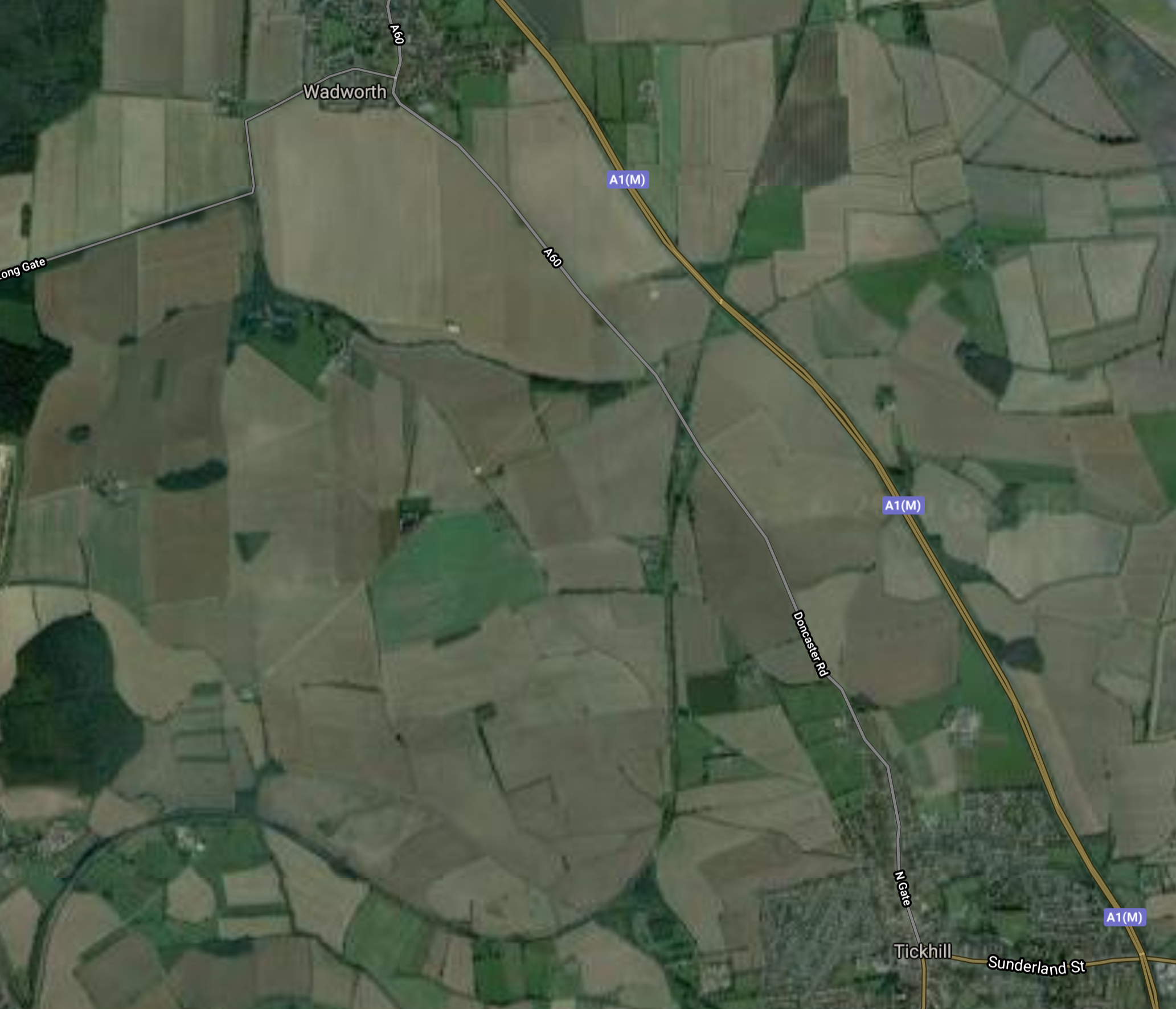
Note.
- Tickhill is in the South and Wadworth is in the North.
- Both villages are to the West of the A1 (M)
- The SYJR runs in a North-Easterly direction between the villages.
The station appears to have been, where the minor road and the railway cross.
Doncaster iPort
The SYJR then passes through Doncaster iPort.

Note.
- The iPort seems to be doing a lot of work for Amazon.
- The motorway junction is Junction 3 on the M18.
- The SYJR runs North-South on the Western side of the centre block of warehouses.
This is Wikipedia’s introductory description of the iPort.
Doncaster iPort or Doncaster Inland Port is an intermodal rail terminal; a Strategic Rail Freight Interchange, under construction in Rossington, Doncaster at junction 3 of the M18 motorway in England. It is to be connected to the rail network via the line of the former South Yorkshire Joint Railway, and from an extension of the former Rossington Colliery branch from the East Coast Main Line.
The development includes a 171-hectare (420-acre) intermodal rail terminal to be built on green belt land, of which over 50 hectares (120 acres) was to be developed into warehousing, making it the largest rail terminal in Yorkshire; the development also included over 150 hectares (370 acres) of countryside, the majority of which was to remain in agricultural use, with other parts used for landscaping, and habitat creation as part of environment mitigation measures.
It ;looks like the SYJR will be integrated with the warehouses, so goods can be handled by rail.
Onward To Doncaster
After the iPort, the trains can take a variety of routes, some of which go through Doncaster station.
I have some thoughts on the South Yorkshire Joint Railway (SYJR).
Should The Line Be Electrified?
This is always a tricky one, but as there could be a string of freight trains running between Doncaster iPort and Felixstowe, something should be done to cut the carbon emissions and pollution of large diesel locomotives.
Obviously, one way to sort out Felixstowe’s problem, would be to fill in the gaps of East Anglian electrification and to electrify the Great Northern and Great Eastern Joint Line between Peterborough and Doncaster via Lincoln. But I suspect Lincolnshire might object to up to fifteen freight trains per hour rushing through. Even, if they were electric!
I am coming round to the believe that Steamology Motion may have a technology, that could haul a freight train for a couple of hours.
These proposed locomotives, which are fuelled by hydrogen and oxygen, will have an electric transmission and could benefit from sections of electrification, which could power the locomotives directly.
So sections of electrification along the route, might enable the freight trains to go between Felixstowe and Doncaster iPort without using diesel.
It should be said, that Steamology Motion is the only technology, that I’ve seen, that has a chance of converting a 3-4 MW diesel locomotive to zero carbon emissions.
Many think it is so far-fetched, that they’ll never make it work!
Electrification of the line would also enable the service between Doncaster and Worksop to be run by Class 399 tram-trains, which are pencilled in to be used to the nearby Doncaster Sheffield Airport.
What Rolling Stock Should Be Used?
As I said in the previous section, I feel that Class 399 tram-trains would be ideal, if the line were to be electrified.
Also, if the line between Shireoaks and Kiveton Park stations were to be electrified to Sheffield, this would connect the South Yorkshire Joint Line to Sheffield’s Supertram network.
Surely, one compatible tram-train type across South Yorkshire, would speed up development of a quality public transport system.
A service could also be run using Vivarail’s Pop-up Metro concept, with fast charging at one or two, of any number of the stations.
Conclusion
This seems to be a worthwhile scheme, but I would like to see more thought on electrification of the important routes from Felixstowe and a unified and very extensive tram-train network around Sheffield.
 The Anonymous Widower