Blackpool Tramway Is Reaching Towards The Station
On Saturday, I went to Blackpool and rode the Blackpool Tramway to Fleetwood to see Ipswich play.
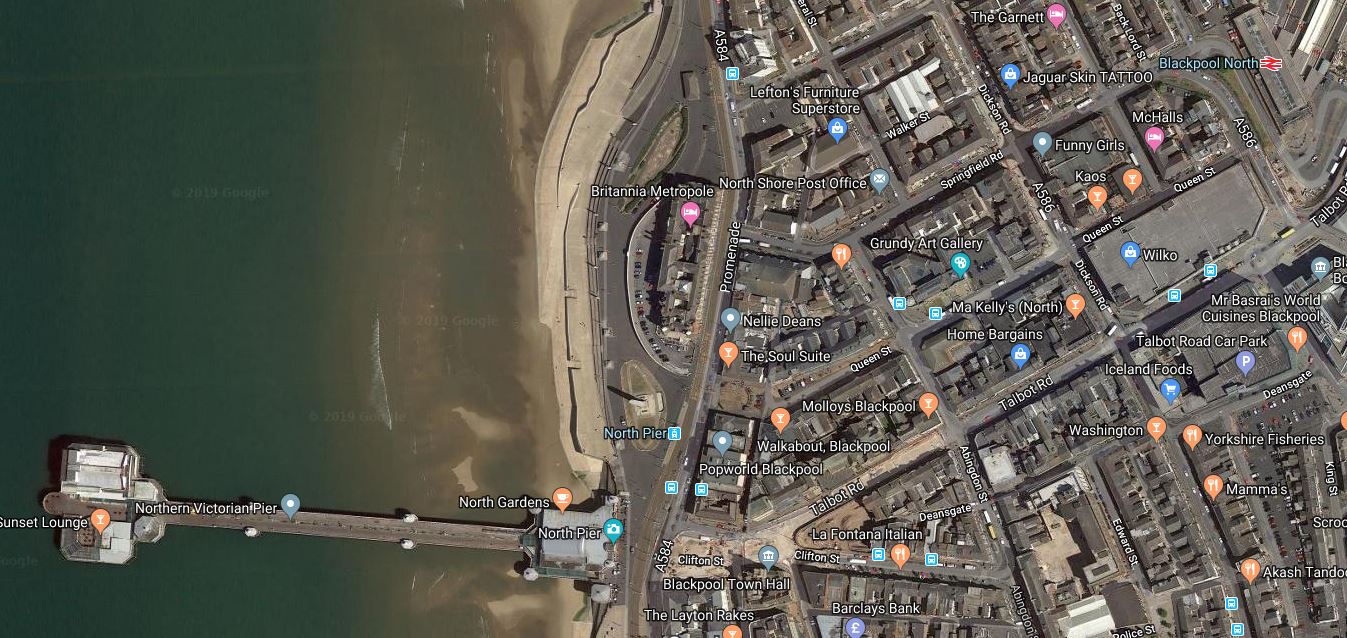
This Google Map shows the current walking route between Blackpool North station and the North Pier tram stop.
Note.
- The station is in the North East corner of the map.
- The North Pier tram stop is by the North Pier!
- The main tram route passes North-South across the map, close to the shore end of the pier.
- The walk is along Talbot Road.
- Close to the station is a branch of Wilko.
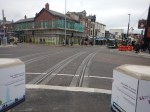
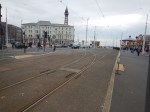
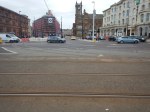
The new tram tracks will be laid along Talbot Road and these pictures show the current progress of the new tracks.


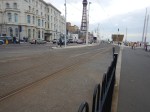

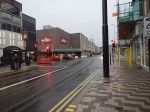
Note.
- The spur is twin-track.
- The first two and the last pictures appear to show the tram tracks going into Wilko.
- The tram tracks appear to share the road with other traffic.
- There is a full triangular junction where the spur meets the main North-South tramway.
A few extra facts and thoughts.
What About Wilko?
The Wilko store will either be demolished or modified and the space will be used by a tram stop.
- It will be reached by an underpass from the station.
- I suspect it will have two platforms.
- One platform might be for trams to the North and the others for trams to the South.
- There will probably be a few kiosks and small shops.
Done well and it would give passengers a good welcome.
The Track Layout
The track layout with the full triangular junction and a double-track to the station gives a lot of flexibility.
- Trams can go between the the tram station and the North.
- Trams can go between the the tram station and the South.
- Trams could even come from the North, reverse in the station and go out to the South! Or vice-versa!
I also think it has been designed to be ready for expansion of the Blackpool Tramway.
A Tram Stop At Talbot Square
I have found a document on the Blackpool Council web site, that says this.
A tram stop on Talbot Square would be developed while road layouts are being examined so the new scheme would interfere as little as possible with drivers.
There is certainly enough space.
Could Tram-Trains Connect At Blackpool North Station To The Blackpool Tramway?
This Google Map shows Blackpool North station and the nearby Wilko.
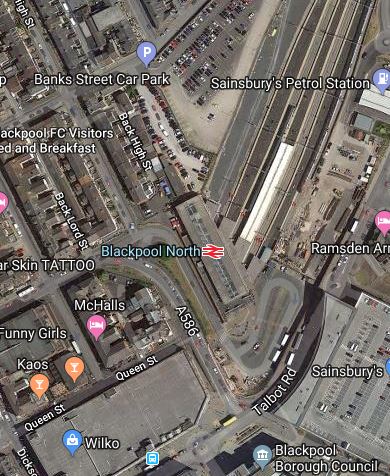
I think it would be possible for tram-trains to come straight through the railway station and connect to the Blackpool Tramway.
- I would suspect that a frequency of between four and six trains per hour (tph) would be possible.
- The Tram-trains would have a battery capability with a range of perhaps twenty or thirty miles.
- The tram-trains would obviously come from Preston.
- But would they go on to Blackburn, Burnley, Clitheroe, Colne, Ormskirk, Southport and/or Todmorden.
The designs of the tracks, Blackpool North station and the proposed Blackpool North tram stop, would not seem to rule out the creation of a tram-train network with the Blackpool Tramway as the Western terminus.
Tram-Trains To The South
The new tram link at Blackpool North station will link the station to Blackpool Pleasure Beach and other attractions South of the North Pier.
To not annoy and discourage visitors, the frequency should be at least six tph or one tram every ten minutes. as little Harry and little Summer won’t late any longer!
Tram-trains to and from Preston and beyond, would have the following effects.
- A lot of visitors wouldn’t have to change between train and tram.
- They would reinforce the service between Blackpool North station and the Southern terminus at Starr Gate.
- They might cut the number of cars needing to park in Blackpool.
- Blackpool would become the only place in the world where you could see heritage trams, modern trams and tram-trains using the same system.
This tram-train link would surely improve the economy of Blackpool and the \Fylde Coast.
But the tram-trains don’t need to terminate at Starr Gate.
This Google Map shows the Blackpool Tramway’s Southern terminus and depot at Starr Gate and the nearby Squires Gate station.
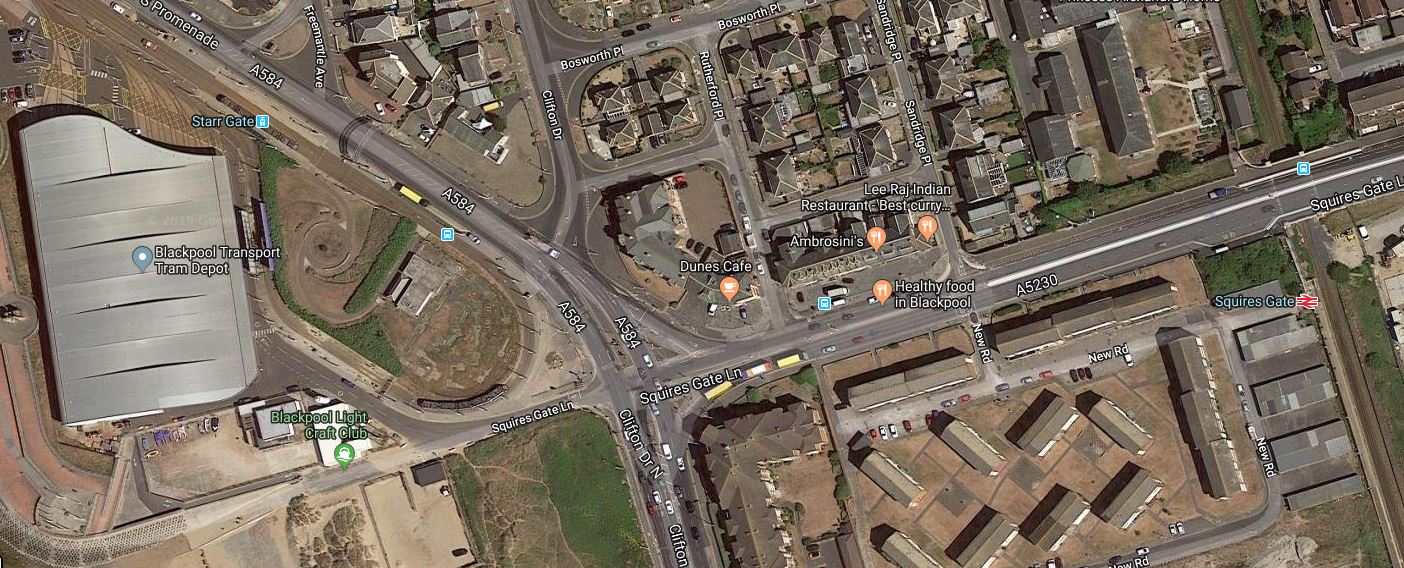
Note.
- Starr Gate Depot on the West side of the map.
- The turning loop for the trams outside.
- Squires Gate station four hundred metres to the East.
I don’t think it would be difficult to connect the two rail systems.
- Tram-trains would be able to more freely between the Blackpool Tramway and the South Fylde Line to Kirkham & Wesham and Preston stations.
- The route between Kirkham & Wesham and Preston stations is electrified.
- The length of the section without electrification between Kirkham & Wesham and Blackpool South stations is just over twelve miles.
- The route West of Kirkham & Wesham station is single-track, but could probably be capable of handling more trains per hour, with some improvements like sections of double track.
I can’t see why tram-trains with a battery capability, which could be similar to those destined for the South Wales Metro, couldn’t run an extended service between Preston and the Blackpool Tramway.
- Tram-trains would change systems at Blackpool North station and Squires Gate/Starr Gate.
- Tram-trains would call at all stations and tramway stops in both directions.
- A frequency of at least two tph in both directions would be my preference.
- Tram-trains could easily handle the section without electrification on batteries charged on the existing electrification.
- It would provide improved public transport links to the important golf course at Royal Lytham.
I also feel that running battery tram-trains on the South Fylde Line could be an affordable solution to improving public transport in the area.
Tram-Trains To The North
The same arguments that can be used to allow tram-trains to go South along the Blackpool Tramway, will also work, for allowing tram-trains to go to the North.
But there is no railway in good condition to create a loop, as can be done to the South.
Perhaps, two tram-trains per hour could go to Fleetwood Ferry tram stop and use the loop to return to Blackpool North station.
Fleetwood would regain a rail service to Preston, that appears to have been discontinued in the 1960s.
Reinstatement Of The Fleetwood Branch Line
The Association of Train Operating Companies has proposed the reopening of the Fleetwood Branch Line, which would connect Fleetwood with Poulton-le-Fylde on the electrified line to Blackpool North station.
The branch is also being developed for heritage purposes.
I do wonder though, that a tram-train solution, where tram-trains run between Preston and Fleetwood via Kirkham & Wesham, Blackpool North and the Blsckpool Tramway, may give a higher return.
Obviously, a full study needs to be done.
Other Issues
On my trip to Fleetwood, two other issues were obvious.
A Distinct Lack Of Shelters
I took this picture, as I returned to the trams after the match.
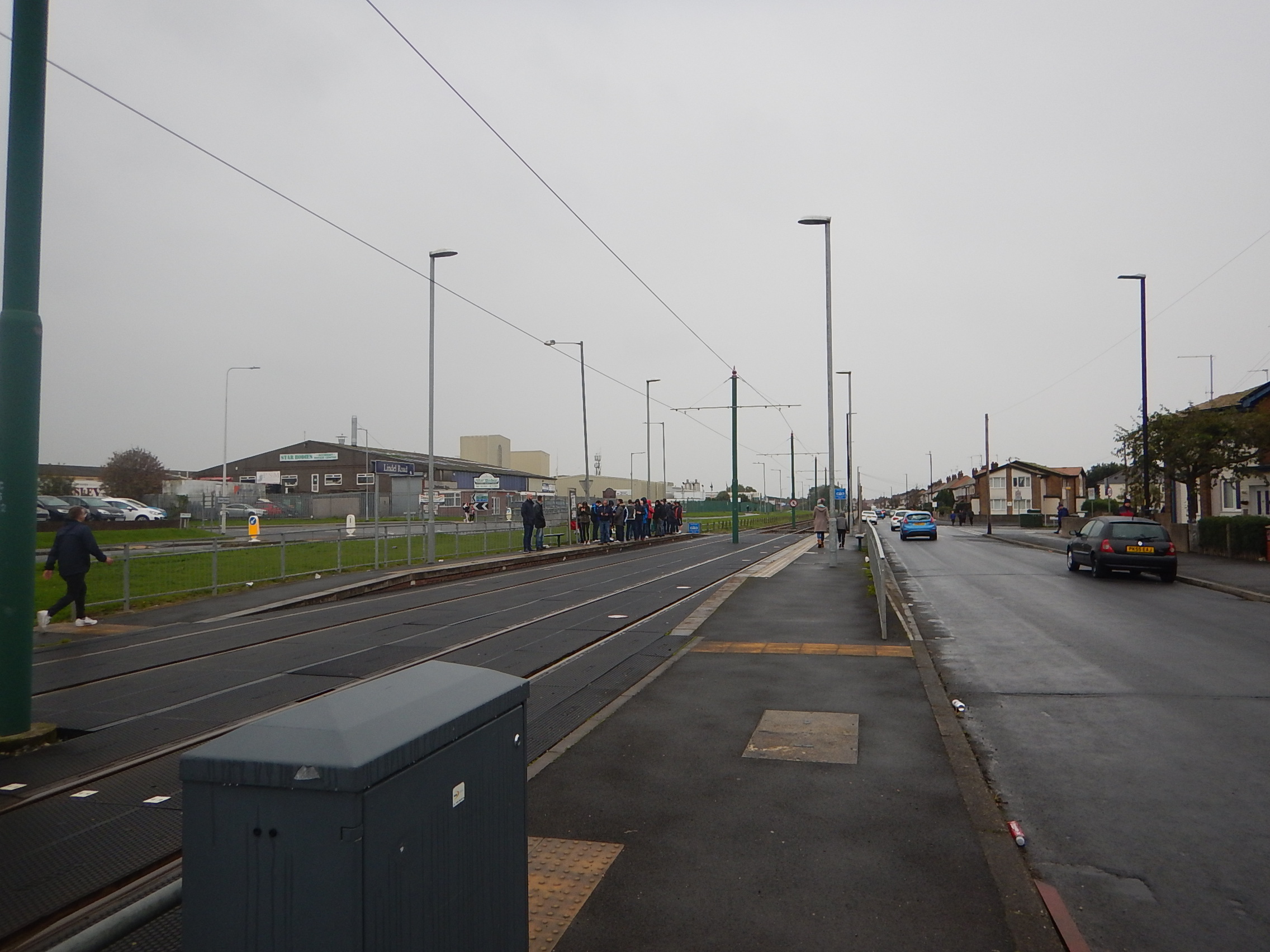
At the time it was chucking it down!
Perhaps, they’d increase ridership, if passengers had some more shelter.
Bank Card Ticketing
I rarely carry cash these days, as I generally use contactless payments, for all payments under thirty pounds.
But on the Blackpool Tramway, you have to use cash!
That is so Nineteenth Century!
Conclusion
Blackpool Tramway can be built into a much more comprehensive and more customer-friendly tram and tram-train network.
Europhoenix Earmarks ‘91s’ For European Freight Use
The title of this post is the same as that of this article on Rail Magazine.
Class 91 locomotives are the locomotives at one end of an InterCity 225 train.
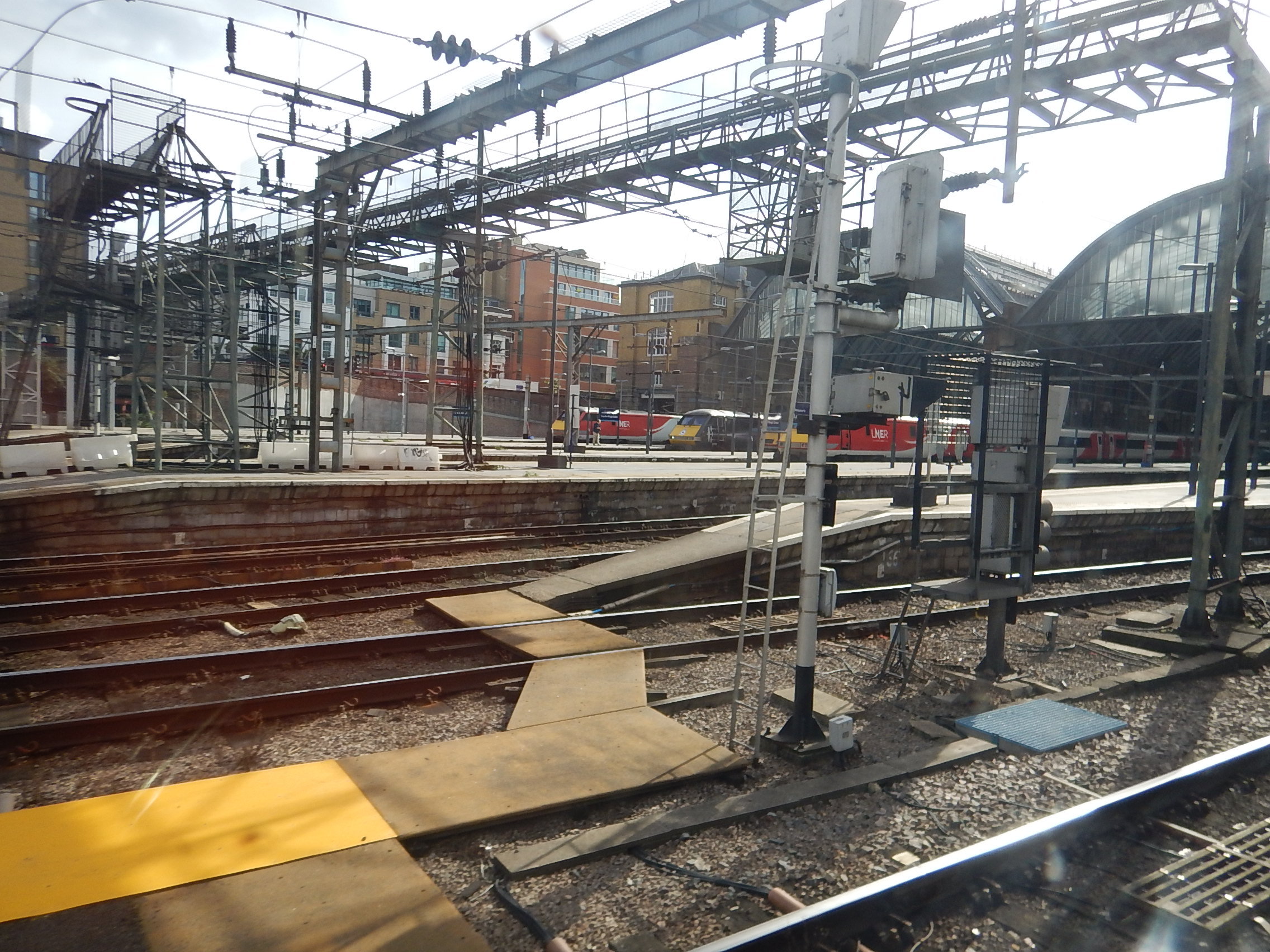
The picture shows three Class 91 locomotives lined up at Kings Cross station. Locomotives are normally at the Northern end of the train, with driving van trailers, which are dummy locomotives with a cab, at the other end of the train. The locomotives have a pantograph.
They are electric locomotives, with an unusual transmission, described like this in Wikipedia.
The locomotive body shells are of all-steel construction. Unusually, the motors are body mounted and drive bogie-mounted gearboxes via cardan shafts. This reduces the unsprung mass and hence track wear at high speeds. The locomotive also features an underslung transformer so that the body is relatively empty compared to contemporary electric locomotives. Much of the engineering specification for the locomotive was derived from the research and operational experience of the APT-P.
Wikipedia also says this about the locomotives.
- Have a power of 4.83 MW.
- Have a weight of 81.5 tonnes.
- Can work on 25 KVAC overhead electrification.
- Have a service speed of 125 mph
- Have a service speed of 110 mph going blunt end first.
- Can operate as a normal locomotive.
According to Wikipedia, there are a total of 31 locomotives.
They are powerful locomotives, that were designed to haul nine heavily-loaded coasches at 140 mph.
Europheonix’s Plan
Europhoenix, which is described as a railway locomotive hire company by Wikipedia, intend to do the following, according to the Rail Magazine article.
Up to twenty Class 91 locomotives will be acquired and they will be used for freight in Eastern Europe.
Two have already been purchased and these are being readied for tests.
This paragraph gives more details on the modifications and how they will be used.
EP owner Glenn Edwards told RAIL on October 4 that the locomotives would work in permanent pairs, with the blunt ends coupled together. Currently, ‘91s’ are not suitable for heavy freight haulage duty, so in partnership with Voith they will be re-geared to a lower rating to enable them to operate in this manner.
A few of my thoughts!
The Double Locomotive
British Rail gets a lot of criticism.
Some of this is justified, but on the other hand, some of their track,locomotive and carriage design has admirably stood the test of time.
In his quote, Glenn Edwards seems very confident that the engines can work in permanent pairs.
As the Class 91 locomotives were designed to work as normal locomotives, perhaps the ability to work as a pair, was part of the original specification.
But as no-one ever used them to haul heavy freight trains, the feature was never needed.
British Rail has form in using pairs of electric engines to haul freight.
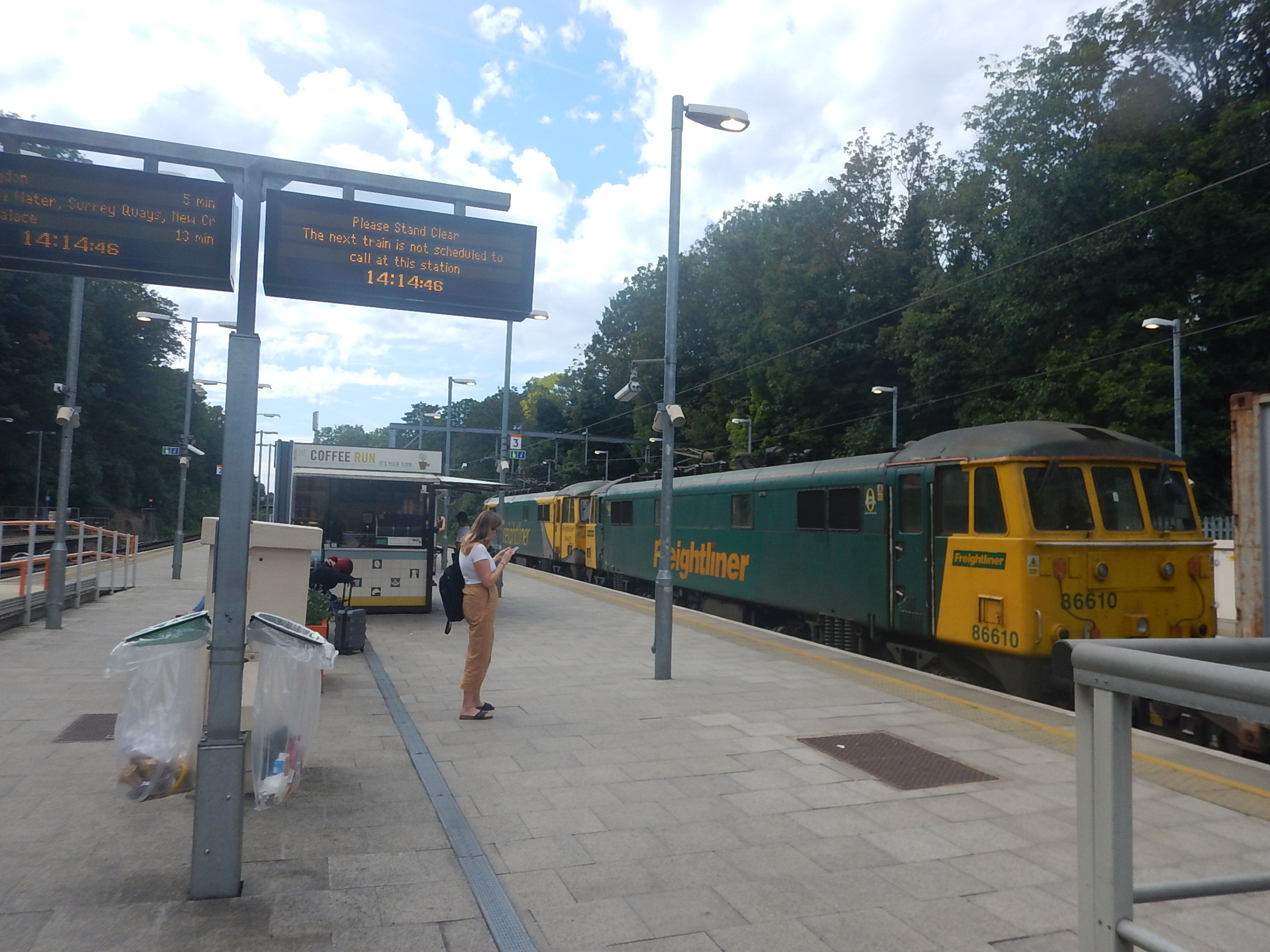
The picture shows a pair of Class 86 locomotives, which were built in 1965-66, pulling a heavy freight train through Canonbury in 2019.
I also must show this picture of a British Rail-era Class 90 locomotive double-heading a heavy freight train with a Class 66 diesel locomotive.
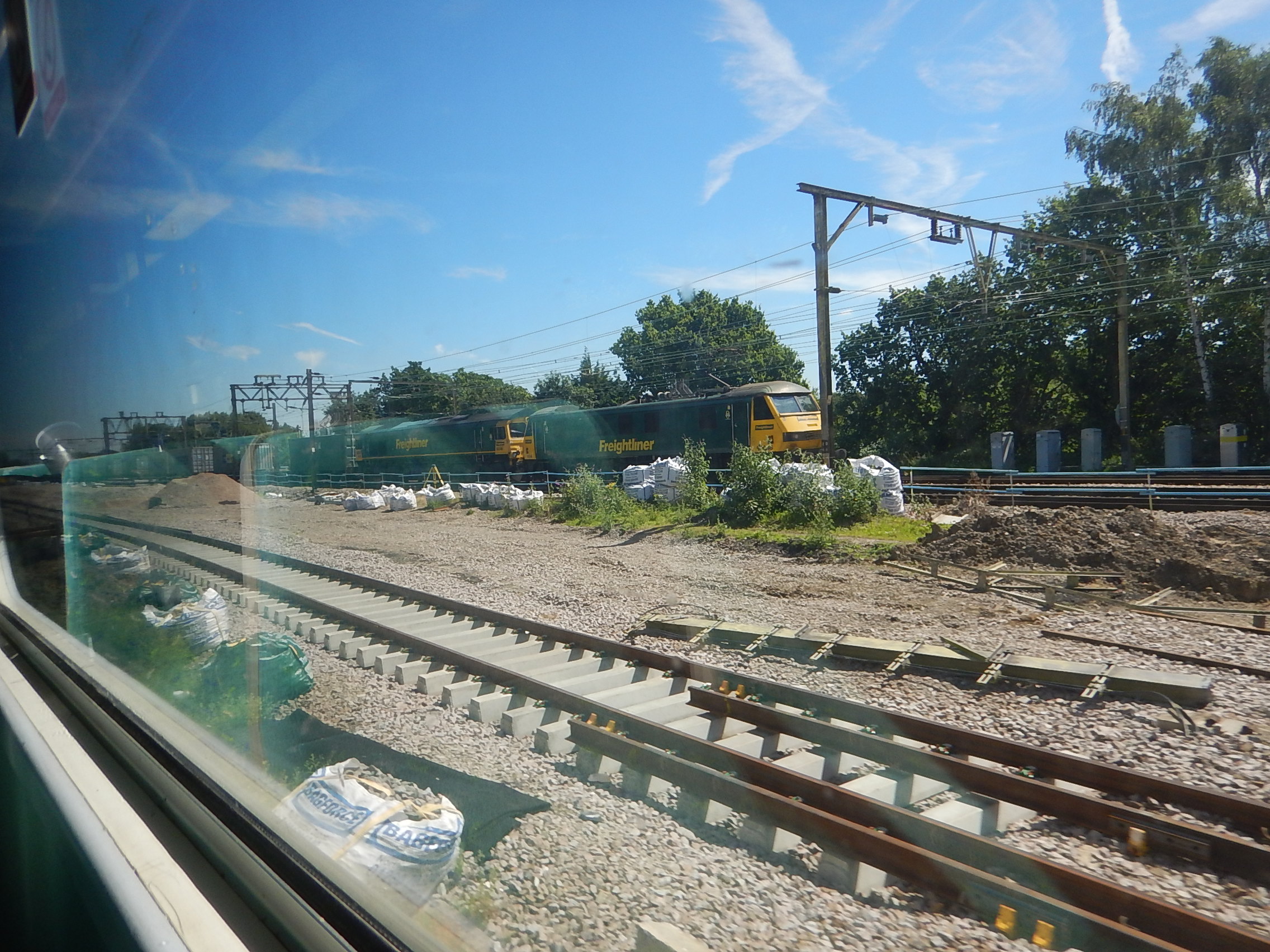
Is this the ultimate bi-mode locomotive for the UK?
I’ve never seen the formation again or found any reference on the Internet.
I wouldn’t be surprised to be told, that running two Class 91 locomotives, blunt end together, was part of the original design.
The pair would be a powerful beast.
- Almost ten MW of power.
- Eight driven axles.
But the pair would have a lowish axle loading of around twenty tonnes.
Modifications Planned
The only modification noted in the Rail Magazine article is to change the gearing from that needed for a 140 mph passenger train to that needed for a slower freight train.
Hopefully the manufacturer of the original gear-boxes are still in existence.
Other Information
There is a discussion about these locomotives on this topic on RailUK Forums.
One post says this.
I spoke to a colleague the other day who said ROG were getting 2X91’s for testing the new wires on the MML.
ROG is Rail Operations Group and they are should be well-qualified to do the testing.
According to Wikipedia, there is a lot of space inside the locomotive, so could this space be used to house instrumentation used to test the overhead wires?
Could Pairs Of Class 91 Locomotives Be Used For Freight In The UK?
I think it all depends on the routes, the amount of electrification and the economics.
On the other hand new Stadler Class 93 locomotives might be a better alternative.
Conclusion
It does look like Eirophoenix have organised an export deal, that is to the benefit of several parties.
Battery Units Planned For Chemnitz – Leipzig Route
The title of this post is the same as that of this article on Railway Gazette.
I have visited Chemnitz and after a visit to the area I wrote Would I Go Back To Dresden, Chemnitz And Leipzig, where I said this.
I enjoyed my two days spent exploring these three cities in the former East Germany. On a properly planned trip, there is a lot to see to satisfy any particular taste.
This picture sums up Chemnitz, which used to be called Karl-Marx-Stadt.

Although, I did get a reasonable gluten-free lunch in a restaurant under the Rathaus, called the Ratskeller.
Summarising the new battery trains, I can say the following.
- The trains will be eleven three-car battery-powered versions of Alstom’s Coradia Continental multiple-units.
- They will replace diesel-electric locomotives and coaches.
- Trains will generally run in pairs.
- The maximum speed would be increased by 20 kph to 160 kph.
- The current service takes sixty-five minutes and the new trains will knock six minutes off the time.
- Batteries will take thirty minutes to charge at Chemnitz and Leipzig.
Note that the route would appear to be just over seventy kilometres and there are stops at .. Bad Lausick, Geithain and Burgstädt.
A few of my thoughts.
Chemnitz And Leipzig
Consider.
Chemnitz and Leipzig are two of the three largest cities in the German state of Saxony.
- Chemnitz has a population of around 220,000
- Leipzig has a population of nearly 600,000
- The train journey between the two cities takes an hour.
But they only have an hourly train service between them.
Many services of a similar duration in the UK have only hourly services, but there are several that have or aspire to have half-hourly services.
Liverpool and Preston could be an equivalent city-pair in the UK and they currently have a single stopping service every hour.
In the next few years, the following will happen.
- An express Liverpool and Glasgow service will stop at Preston.
- A second stopping service will run via Ormskirk.
I wouldn’t be surprised to see the Germans doubling the frequency between Chemnitz and Leipzig.
Number Of Trains Needed
Consider.
- The service will take an hour.
- Thirty minutes will be needed to charge the batteries at either end of the route.
This means that a round trip will take three hours, so this will mean.
- Three trains will be needed for the hourly service.
- Six trains will be needed for a half-hourly service.
If all services are run by pairs of three-car trains, there would be a need for twelve new trains to run the half-hourly service.
So perhaps, the service will be half-hourly, with some trains six-cars and others only three-cars.
Charging Time
The charging time seems a bit long to me, but it is using conventional pantographs, rather than a specialist charging station.
Suppose, by using one of these stations like a Railbaar, that the charging time could be reduced to fifteen minutes, this would reduce the round trip to two and a half hours.
This would mean that five trains would be needed for a half-hourly service.
If all services are run by pairs of three-car trains, there would be a need for ten new trains.
This would leave a spare or allow for one being maintained.
Conclusion
Around the world we will be seeing a lot of current diesel services converted into battery-electric services.
How many services are there like Chemnitz and Leipzig?
- Around 50-60 miles.
- Only a few stops.
- Run by noisy and polluting diesel trains.
- Operators need more trains to increase the frequency.
- Operators need new trains to increase the level of customer service.
- Operators need to run faster services.
- There are good electricity supplies to charge the trains at both ends.
Here are a few simple examples from the UK.
- Ashford and Hastings
- Bidston and Wrexham
- Cambridge and Ipswich
- Carlisle and Newcastle
- Didcot and Oxford
- Ely and Norwich
- Ely and Peterborough
- Fife Circle Line
- Ormskirk and Preston
Battery-electric trains will be invading the diesel world.
Caledonian Sleeper Considers Seven-Day Running
The title of this post, is the same as that of this article on Rail Magazine.
This is the introductory paragraph.
More routes and seven-day-a-week running could feature for Caledonian Sleeper in the future.
To my mind, it should always be a service that runs seven days a week, as the make-up of passengers seems to contain, a lot of those who want to travel on the day they want.
As to more routes, I wrote about possible services between the Far North and Edinburgh in Rail Sleeper Plan Between Caithness And Edinburgh
This was my conclusion.
I feel that not next year, but once Scotland’s rail system is fully developed, with the shortened Inter-City 125s serving the longer routes and electric trains all over the Central Belt, that a Sleeper Train between Edinburgh and Thurso will be viable.
I’d certainly give it a go!
Conclusion
I can’t see any reasons for investigating the roll out of extra Caledonian Sleeper services, once the company sorts out their current operational problems.
Hopefully, the Scottish Government and tourism industry will give the services their backing.
Ovo’s Kaluza Partners With Powervault To Offer Smart Storage Service
The title of this post, is the same as that of this article on Business Green.
Read the article, as it shows the way domestic energy will be going in the next few years.
- Every house or collection of houses will have a battery.
- If there is a parking space there will be a charging point for an electric car.
- Like my house, many will have solar panels.
- An intelligent control system will tie it all togerther to minimise electricity bills.
- I suspect in the next couple of years, I will fit an energy store and a car charging point in my garage.
I may not have a car, but if I sell the house, it would make it easier to sell.
This article on Podpoint is entitled Adding Value To Your Property With EV Charging.
It makes some interesting points.
The Missing Link At St. Pancras Station
This picture was taken inside St. Pancras station.
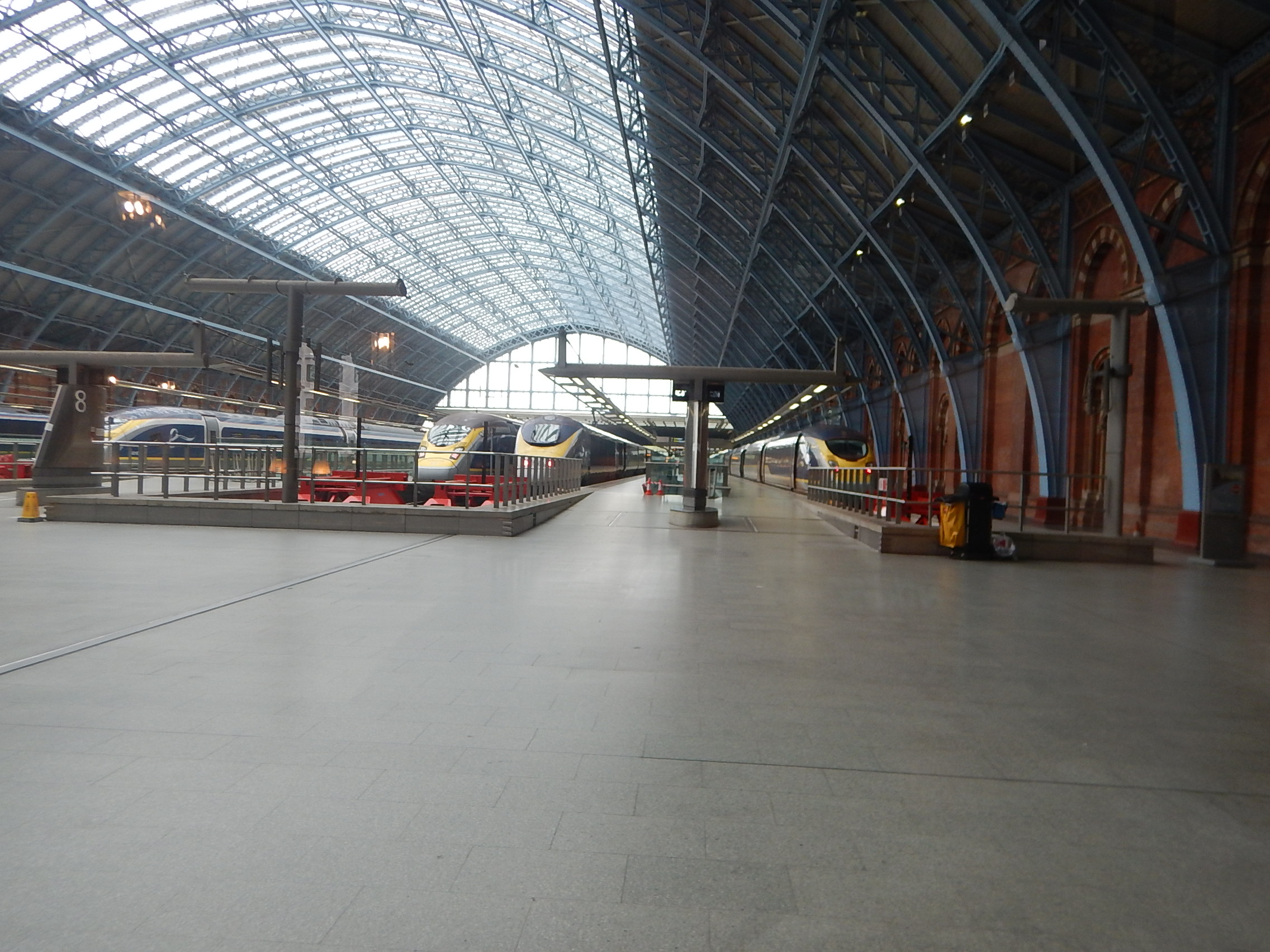
I was standing in front of the glass security wall, towards the East (Kings Cross) side of the station.
On the British Library side of the station it is possible to walk along to the four platforms for East Midlands Railway trains.
I wonder why, there isn’t a link down the Kings Cross side of the station, so that it would be possible to walk from the front of the station to the Souyjeastern HighSpeed commuter routes.
A Freight Shuttle For Liverpool Street Station Planned
Edition 889 of Rail Magazine has an article which is entitled London Gateway-Liverpool Street Freight Trial Planned.
Rail Operations Group are planning to run a freight shuttle between London Gateway and Liverpool Street station.
Trains will be Class 769 bi-mode trains.
- The trains will be fitted with roller doors, roller cages and strengthened floors.
- Three aervices will leave Thames Gateway at 0029, 1208 and 1856.
- They will return from Liverpool Street at 0242, 1421 and 2100.
- Services will use Platforms 9 and 10 in Liverpool Street station.
It seems a very detailed plan.
A few of my thoughts.
Journey Time
I would estimate that a time of about 45 minutes to an hour would be possible.
Use Of Platforms 9 and 10
These two platforms are generally used for the London and Norwich expresses via Colchester and Ipswich, but it appears that only one service is timed to arrive in times when the station is really busy.
Platform 10 is near to the old Cab Road and so there is good vehicle access from the back of the station.
Final Delivery
The article says that trucks would be used for the final deliveries, with battery vehicles planned for the future.
Would There Be Sufficient Capacity For Trucks In The Cab Road?
A Class 769 train has four twenty metre long cars, so capacity will be equivalent of four small-to-medium supermarket delivery articulated trucks.
You wouldn’t get artics into the Cab Road, but would you get enough small trucks in to pick up a complete train-load?
- At night or in the evening, this would surely be possible!
- However, in the afternoon, it would surely be too busy, for more than a couple of delivery vans.
I’m sure Karl Watts has a well-laid plan.
What Is The Role Of UPS In This Freight Service?
In the Wikipedia entry for London Gateway, this is said.
Development of the Logistics Park has followed the initial stages of development of the port. UPS is developing a 32,000 square metre package sorting facility on the site – one of the American firm’s largest ever infrastructure investments outside of the USA. Since March 2017,
UPS wouldn’t build a facility the size of thirty two football pitches and then send out a series of trucks to their biggest market in the City of London , only for the packets to get stuck in the traffic.
I suspect that packets will be sorted into small easily-managed loads for delivery by electric vans, cargo bicycles or Shank’s Pony, from Liverpool Street station.
And Could Lidl Be In On The Act?
The Wikipedia entry for London Gateway also says this.
German grocery retailer Lidl has been operating out of the DP World London Gateway Logistics Centre, the first warehouse to be developed on the site.
This article in the Guardian is entitled Lidl In The Middle: Chain To Open First Store In Central London. This is said.
Lidl is to launch its first store in central London as it opens 40 new shops across the capital in the next five years.
Could Lidl be thinking of using such the proposed service to supply Central London stores?
- Last mile delivery could be by electric vehicles.
- Catching the 0029 train from London Gateway could be ideal.
- Goods could be on the shelves by early in the morning.
I think that this could offer interesting possibilities.
Supermarket deliveries were also one of the cargoes proposed in the LaMiLo project that I talked about in The LaMiLo Project.
Why Use Bi-Mode Trains?
Consider.
- Virtually all of the route is electrified, except for the last mile or so into the London Gateway.
- It would be possible to electrify those last few miles and use electric trains.
- Electric trains like unmodified Class 319 trains could be used for the service.
But cranes, containers and 25 KVAC overhead wires are a possible disaster waiting to happen, as a crane driver once told me!
When Will The Service Start?
The article says that the service could start in April or May.
Could There Be Other Services?
This is the last paragraph of the article.
Watts mentioned that other routes were a possibility for the business, suggesting that routes from the West Midlands to the Scottish Central Belt and the West Midlands to the West Country have been investigated. No dates have yet been given for any such trials.
I would also think, that there could be opportunities for moving high-value or perishable cargoes into major city centre stations in the middle of the night.
Suitable stations could be.
- Birmingham New Street
- Bristol
- Edinburgh
- Glasgow
- Leeds
- Liverpool Lime Street
- Manchester Piccadilly
I am not being anti-Geordie, but Newcsastle might be a difficult station to unload cargoes from trains onto trucks!
Conclusion
If seems to me that Rail Operations Group are being innovative with trains.
Expansion At Southall Station (?)
This Google Map shows Southall station.
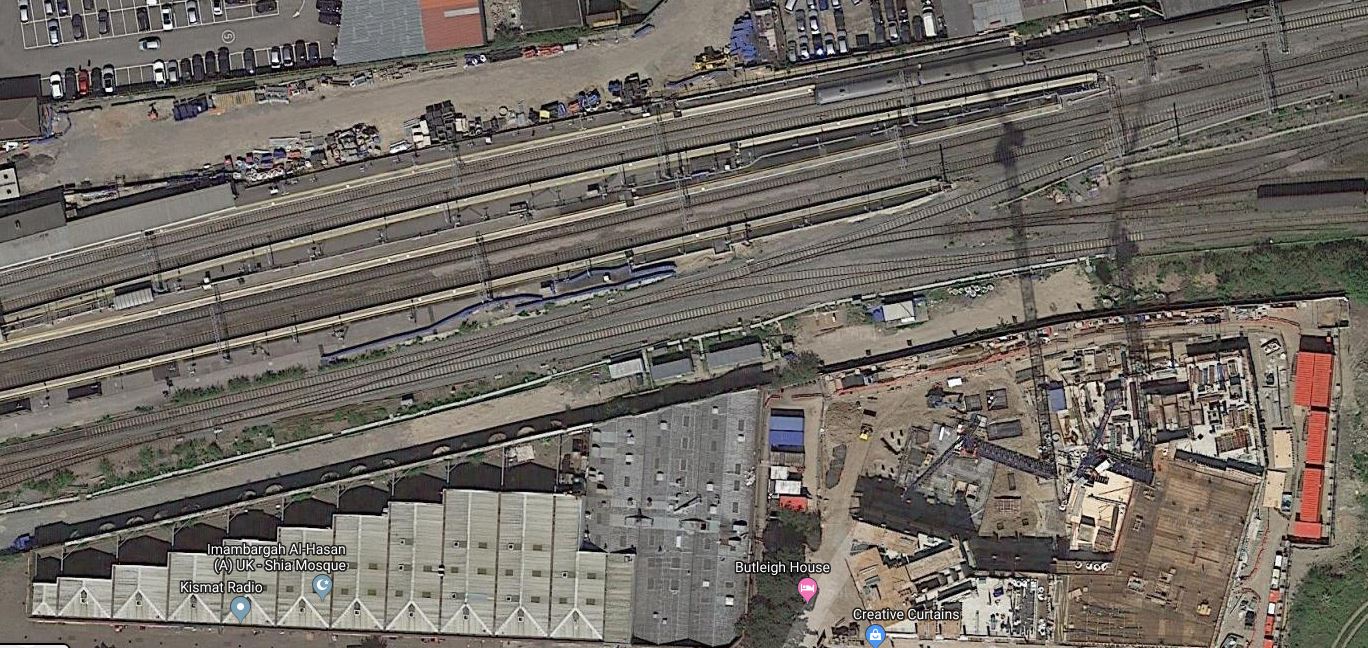
Note
- Southall station with one side and two island platforms towards the top of the map.
- Two fast and two slow railway lines going East towards Paddington station.
- A large commercial and residential development called The West Works to the South of the map.
And this map from varto.metro.free.fr shows a map of the railway lines in the area.
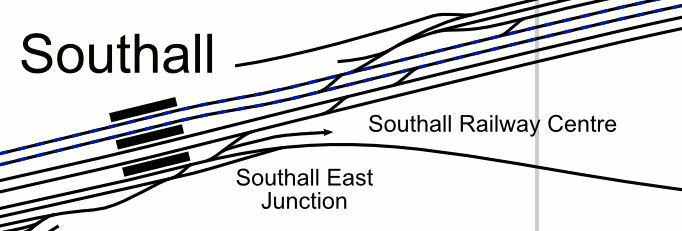
Note.
- The two East-West fast lines, that are shown in black are used for Great Western Railway expresses and Heathrow Express services.
- The two East-West railway lines, that are shown in blue, will be used for Crossrail and other slow services into Paddington.
- Platforms and numbers South to North, with 1 and 2 serving the fast lines and 3 and 4 serving the slower services.
- The line going off to the South-East is the Brentford Branch Line.
These are pictures I took of a new step-free bridge that will link the platforms at Southall station.


Note.
- The bridge will definitely have access to platforms 1 and 2 and 3, and I would assume it will also serve platform 4.
- The bridge will have lifts.
- The West Works can be seen in the last picture.
Even now it looks to be a comprehensive scheme.
Access Between Southall Station And The West Works
Thjs picture was taken from the islans platform 2 and 3 in July 2015 and clearly shows a rusty footbridge, that has since been demolished.

I would assume the bridge used to provide access across the railway.
Has the new bridge been designed so that, it can be extended at both ends to give full step-free access across the railway and provide a step-free route between The West Works and Southall station?
Serving A Future Brentford Branch
Hounslow Council is keen to reopen the Brentford Branch Line, to link Btrntfprd to Southall station for Crossrail.
I wrote about it in Plans To Reopen The Brentford To Southall Railway.
This recent Google Map shows the Southernmost of the two island plsatforms at Southall station.
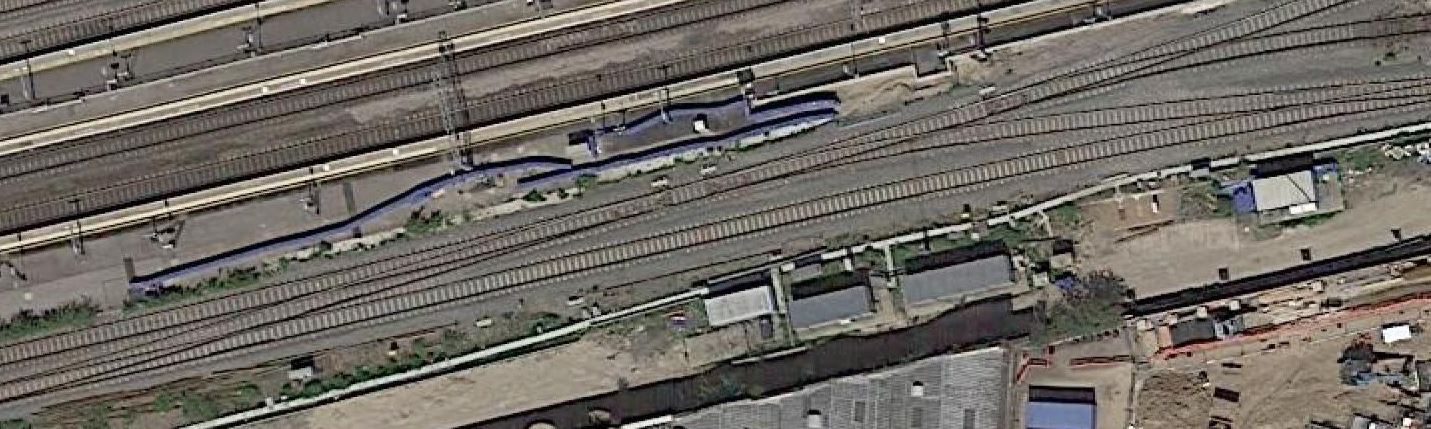
The island platform seems to have a few blue safety hoardings.
- The Down Fast line from Paddington is on the North side.
- It is likely, that the platform for the Brentford Branch Line will be on the South side.
For safety reasons, there will probably be a safety fence down the middle of the platform.
Passengers needing to change between Crossrail and the Brentford Branch Line will have to use the bridge.
I would assume that the step-free bridge will only need minor improvements to accommodate the Brentford Branch Line.
Southall’s Suicide Problem
I suspect that safety fences will be put on platforms 1 and 2, which will be only used occasionally and under strict supervision, to minimise the suicide problem at the station.
Southall Gasworks Site
Whilst at Southall, I’ll take a look at the massive Southall Gas Works site.
It is shown on this Google Wap to the West of Southall station.
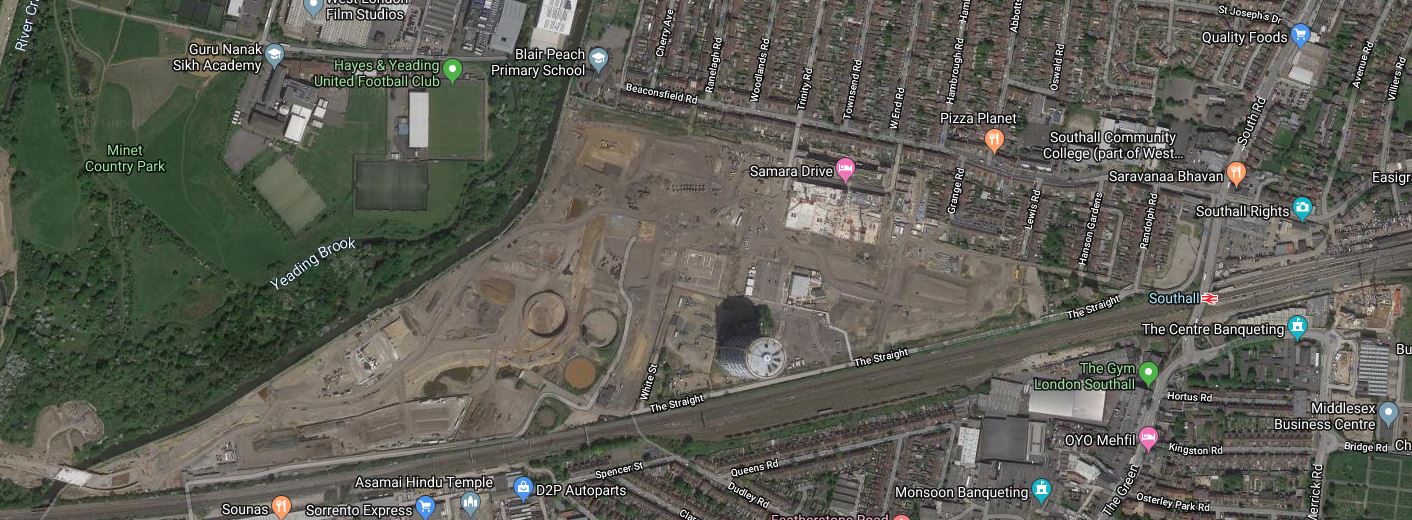
It is likely to be over three thousand houses and flats.
- So that will surely mean a similar number of cars.
- Can the roads in the area cope?
- What about the air quality?
Are there any plans for an innovative rail connection to the station? And cycleways through the site?
Conclusion
It does seem that the bridge will allow limited expansion of the station.
I feel very strongly, that the type of housing developments being built around Southall station, must be built with step-free access to a rail station or tram stop.
HS2 Way Out In Front In Tunnel Design For High-Speed Rail
The title of this post is the same as that of this article on Rail Engineer.
The article describes how Arup and Birmingham University are using physical and computer modelling to obtain the ultimate profiles of both tunnel portal and train nose to both increase train performance and reduce train noise as the trains enter tunnels.
They are even using a huge shed at the former British Rail Research Centre in Derby!
The biggest problem, is that there are aerodynamic effects, as the trains enter the tunnels at very high speeds, which result in what are inevitably called sonic booms, that disturb the local residents.
Because the new trains and tunnel portals are being developed together, there must be a greater chance, they will meet the objectives.
Collateral Benefits
Get the design right and there will be other benefits.
Lower Power In The Cruise
In How Much Power Is Needed To Run A Train At 125 mph?, I said this.
I have found this on this page on the RailUKForums web site.
A 130m Electric IEP Unit on a journey from Kings Cross to Newcastle under the conditions defined in Annex B shall consume no more than 4600kWh.
This is a Class 801 train.
- It has five cars.
- Kings Cross to Newcastle is 268.6 miles.
- Most of this journey will be at 125 mph.
- The trains have regenerative braking.
- I don’t know how many stops are included
This gives a usage figure of 3.42 kWh per vehicle mile.
This figure is not exceptional and I suspect that good design of the train’s nose will reduce it, especially as the design speed of High Speed Two will be 360 kph or 224 mph.
Reduced Noise
Stand on a Crossrail platform at say Southall or West Drayton stations and listen to the Class 801 trains passing.
They are only doing about 100 mph and they are certainly not quiet! Noise comes from a variety of sources including aerodynamics, overhead wires and running gear.
Could the nose and profile of high speed trains also be designed to minimise noise, when cruising at high speeds?
Reduced Pantograph Noise
Travelling at up to 360 kph, pantograph noise could be a serious problem.
The only way to cut it down, would be to lower the pantograph in sensitive areas and run the train on battery power.
But if the trains energy consumption could be cut to a much lower level, it might be possible for the cruise to be maintained on battery power alone.
Consider a journey between Euston and Birmingham.
- The train would accelerate away from Euston and go in a tunnel to Old Oak Common.
- Batteries could be charged whilst waiting at Euston and in the run to Old Oak Common.
- Accelerating away from Old Oak Common would bring the train to 360 kph as fast as possible.
- It would now cruise virtually all the way to Birmingham Interchange at 360 kph.
- At the appropriate moment the pantograph would be lowered and the train would use the kinetic energy to coast into Birmingham Interchange.
- There would probably be enough energy in the batteries to take the train into Birmingham Curzon Street station after the stop at Birmingham Interchange.
One technology that will massively improve is the raising and lowering of the pantograph at speed.
So could we see much of the long non-stop intermediate section being run on batteries with the pantograph down. If power is needed, it would raise to power the train directly. If the raising and lowering was efficient, then it might be able to use the pantograph only in tunnels.
Could It Be Possible To Dispence With Wires Outside Of Tunnels?
Probably not on the first phase of High Speed Two, but consider.
- High Speed Two is designed to have a lot of tunnels.
- Arup and Birmingham may come up with even better aerodynamic designs.
- Pantograph raising and lowering will get faster and extremely reliable.
- Battery technology will hold more electricity for a given weight and volume.
- Dispensing with visible wires could reduce the problems of getting planning permissions.
- Noise and visible intrision will be reduced.
I believe there will come a time, when high speed railways could be built without visible overhead electrification.
The only places, where electrification would be used would be in tunnels and stations.
Are There Any Other Applications Of This Research?
These are a few thoughts.
Hitachi Trains For The Midland Main Line
I’m suspicious, that the research or similar research elsewhere, might have already produced a very handy result!
In an article in the October 2019 Edition of Modern Railways, which is entitled EMR Kicks Off New Era, more details of the new Hitachi bi-mode trains for East Midlands Railway (EMR) are given.
This is said.
The first train is required to be available for testing in December 2021 with service entry between April and December 2022.
The EMR bi-modes will be able to run at 125 mph in diesel mode, matching Meridian performance in a step-up from the capabilities of the existing Class 80x units in service with other franchises. They will have 24 metre vehicles (rather than 26 metres), a slightly different nose to the ‘800s’ and ‘802s’, and will have four diesel engines rather than three.
Could the new nose have been designed partly in Birmingham?
Consider.
- Hitachi’s bi-modes for EMR InterCity could be running at up to 225 kph in a few years.
- The Midland Main Line between Derby and Chesterfield goes through a number of tunnels in a World Heritage Site.
- Hitachi have collaborated with UK research teams before, including on the Hyabusa.
- Hitachi and Bombardier are submitting a joint bid for High Speed Two trains, which is based in Birmingham.
It should be noted that when the Tōkaidō Shinkansen opened in 1964 between Tokyo and Osaka average speed was 210 kph.
So are Hitachi aiming to provide EMR InterCity with almost Shinkansen speeds on a typical UK main line?
Arup and Birmingham University, certainly have the capability to design the perfect nose for such a project.
Aventras
Did the research team also help Bombardier with the aerodynamics of the Aventra?
I’m pretty certain, that somebody did, as these trains seem to have a very low noise signature, as they go past.
Talgo
Tsalgo are building a research centre at Chesterfield.
Will they be tapping in to all the rail research in the Midlands?
Conclusion
It looks to me, that there is some world-class research going on in Birmingham and we’ll all benefit!
Transport for London’s New Train Information Displays
I came across this train information display for the first time in Paddington station.
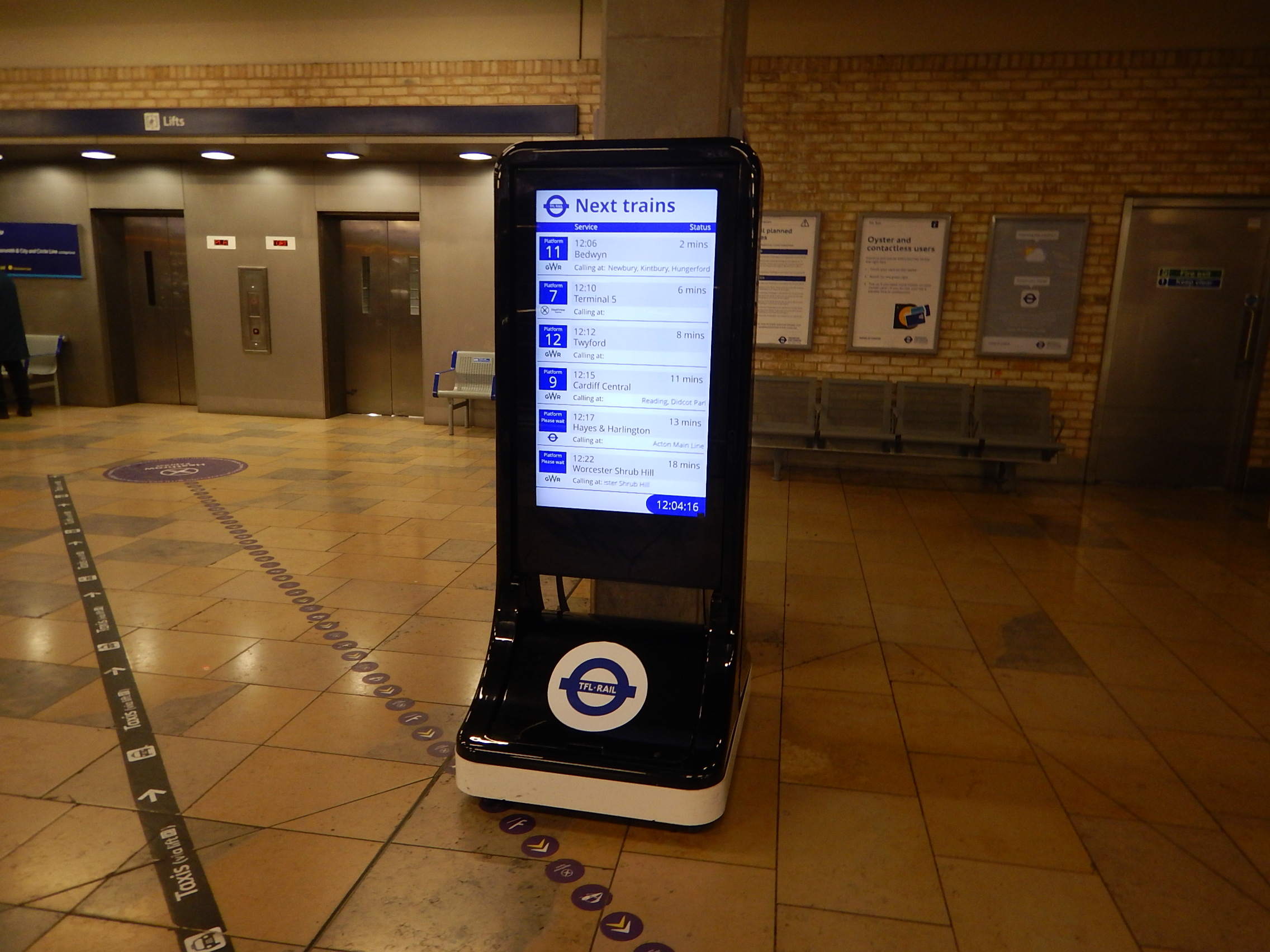
It appears to be wireless and battery-powered, which means they can be placed anywhere that an Internet signal can be obtained.
Surely, this must be the quickest way to improve the dreadful information provision at some places on the UK rail and bus network.
The display shown was placed in an area, where there is little information and I suspect that no-one thought torun any cables for a traditional display.
 The Anonymous Widower