Government Response To Crossing Petition ‘Shameful’
The title of this post, is the same as that of this article on the BBC.
This is the sub-heading.
The government has “moved the goalposts” in its response to calls for an underpass to be installed at a busy level crossing, an MP has said.
These three opening paragraphs add more detail.
More than 4,500 people signed a petition calling for any replacement of the level crossing at London Road in Bicester to include access for cars, as well as for cyclists and pedestrians.
In its response, the Department for Transport said vehicular access to any crossing replacement would be “subject to both affordability and feasibility”.
Callum Miller, the MP for the north Oxfordshire market town, said the response – and in particular the suggestion of a footbridge – was “shameful”.
A few weeks ago, I went to see this important level crossing and wrote Bicester Village Station – 28th May 2025.
Severe Delays At Blackwall Tunnel, Woolwich Ferry And Dartford
The title of this post is the same as that of this article on Murky Depths.
These three paragraphs give more details.
There are severe delays at all crossings of the Thames between east and south east London and beyond this afternoon after a collision on the Dartford crossing.
Miles of queues are in place at the approach to the Blackwall crossing with traffic backed up for the entire length of the A2 and A102 between the M25 and Greenwich then back into east London.
Extremely long waits for the Woolwich ferry are also seen, with numerous bus routes delayed.
It appears to have been caused by a crash on the Dartford Crossing, that required extensive repairs to the road and barriers.
In 2015, I published No To Silvertown Tunnel.
Since the tunnel opened, I have written Is The Silvertown Tunnel A Silver Elephant?
I am certainly keeping an open mind, after yesterday’s article in Murky Depths.
Batteries Ordered For Grand Central Inter-City Trains
The title of this post, is the same as that of this article on Railway Gazette.
These three paragraphs add detail to the article.
Hitachi Rail has selected Turntide Technologies to supply lithium iron phosphate batteries for use on electric-diesel-battery hybrid inter-city trainsets it is to build for Arriva’s open access operator Grand Central.
Nine five-car trainsets are to be manufactured at Hitachi Rail’s Newton Aycliffe factory for delivery in 2028 under a order placed by leasing company Angel Trains in March.
Under the latest agreement announced on July 2 Hitachi Rail will place orders worth nearly £10m for Turntide to continue with R&D and supply next-generation LFP batteries, which are designed to be smaller and more powerful than previous lithium-ion batteries. The Safety Integrity Level 2 and IEC 61508 compliant battery management system will detect and mitigate hazards and meet the IEC 62243 cybersecurity standard.
There is also this paragraph, which describes the benefits of the trains.
The battery technology is expected to cut the Grand Central trains’ emissions and fuel consumption by around 30%, with the trains entering and exiting stations in zero-emission mode to improve air quality and reduce noise in urban centres.
Angel Trains, Grand Central, Hitachi Rail and Turntide Technologies seem to be playing this all carefully, as I suppose that they don’t want to be left with a large problem, if the current government decides to take over open access services.
GWR Battery-Powered Trains Could Be Used In Future
The title of this post, is the same as that of this article on the BBC.
This is the sub-heading.
Battery-powered trains could be used more frequently after a successful trial by Great Western Railway (GWR).
These three paragraphs give more details.
The rail company says using former underground trains and a rapid-charging system has shown the technology could replace its existing diesel fleet.
The year-long trial was held in west London but the trains will eventually be rolled out in the Thames Valley.
GWR says it can now prove the concept works and hopes to take the initiative to government.
A couple of weeks ago, I used similar trains between Wrexham Central and Shotton stations, which I wrote about in Vivarail Trains And Wrexham Central Station – 6th June 2025.
Darlington Station – 26th June 2025
I visited Darlington station, three times on my trip.
These pictures are in chronological order.
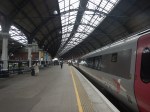
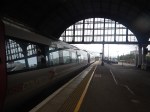
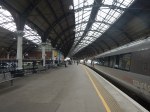
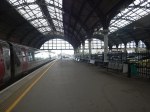
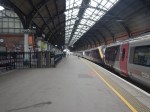
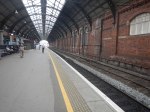
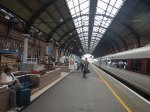
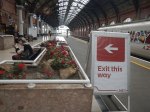
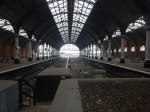
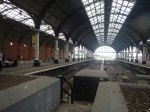
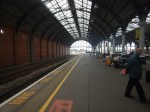
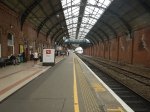
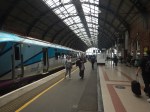
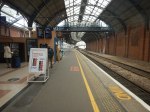
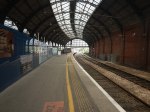
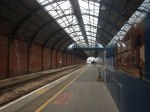
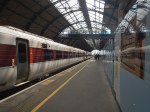
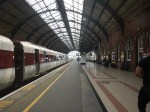
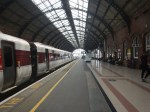
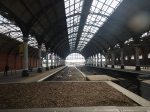
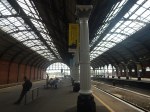
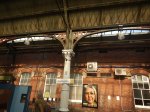
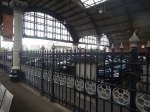
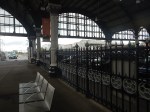
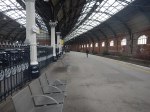
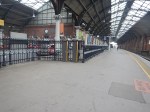
Note.
- The station is being given a major upgrade, so it can handle more trains.
- The station has a large number of top-quality Victorian features.
- The station is Grade II* Listed.
- Inside the enormous train-shed are two long platforms, that handle most of the trains and two South-facing bay platforms.
- Two new platforms, which are numbered 5 & 6, and possibly a double-track avoiding line are being added outside the train-shed on the East side.
- In images with a comment saying Note Platform 5, the new long electrified Platform 5 can be seen.
- Platform 5 appears to be already electrified at its Southern end.
These three OpenRailwayMaps shows the future layout.
The first OpenRailwayMap shows the junction, where the branch to Newton Aycliffe, Shildon and Bishop Auckland connects.
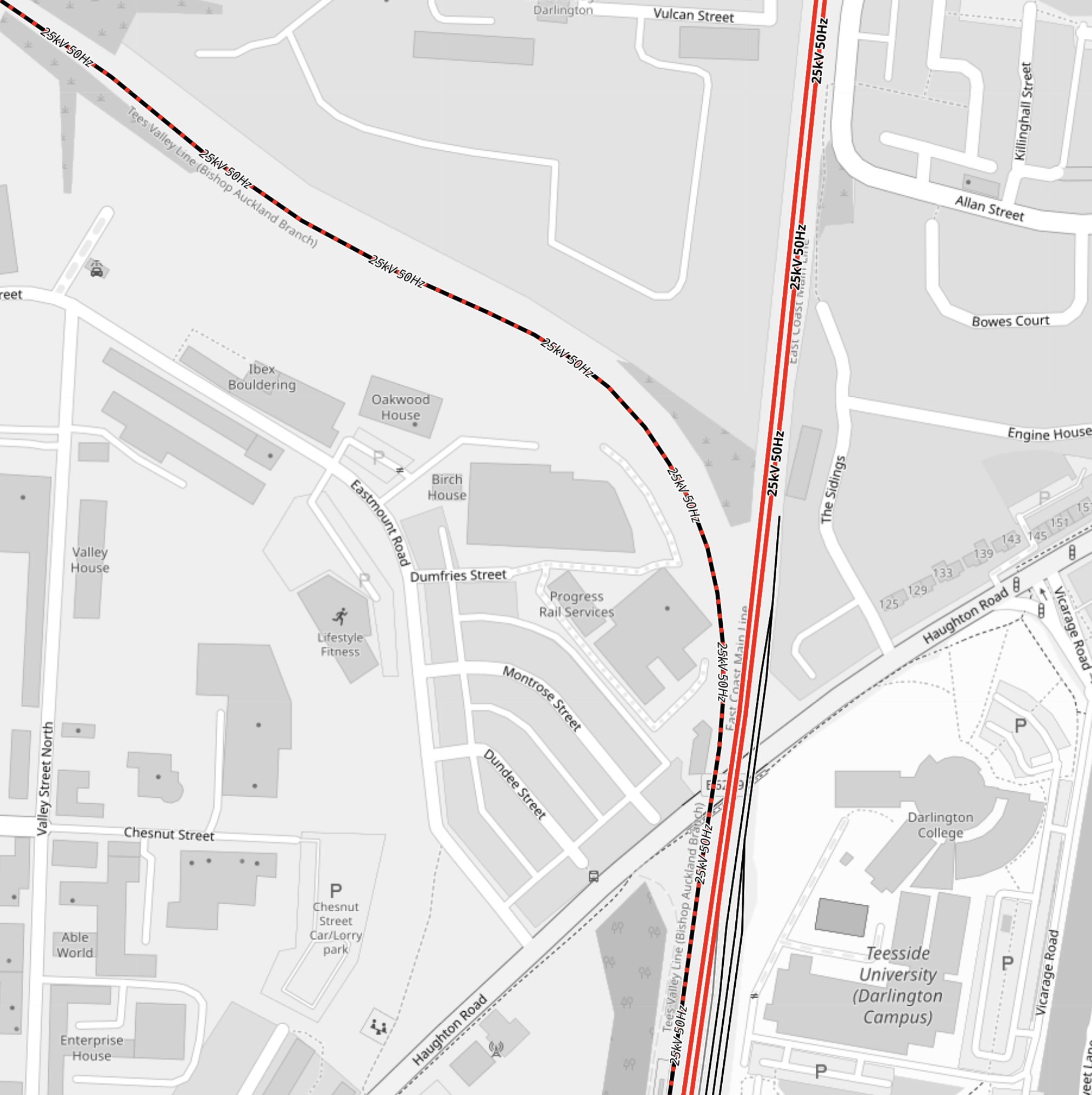
Note.
- The red tracks are electrified and indicate the East Coast Main Line.
- The track curving off to the North-West is the Bishop Auckland Branch.
- The black tracks are not-electrified.
- The Bishop Auckland Branch is shown dotted black and red, as it will be electrified, so that Hitachi can get their new trains to the East Coast Main Line.
- The two tracks of the East Coast Main Line are very straight and the map shows them to have a 125 mph operating speed.
The second OpenRailwayMap, shows the lines immediately to the South of Darlington station.
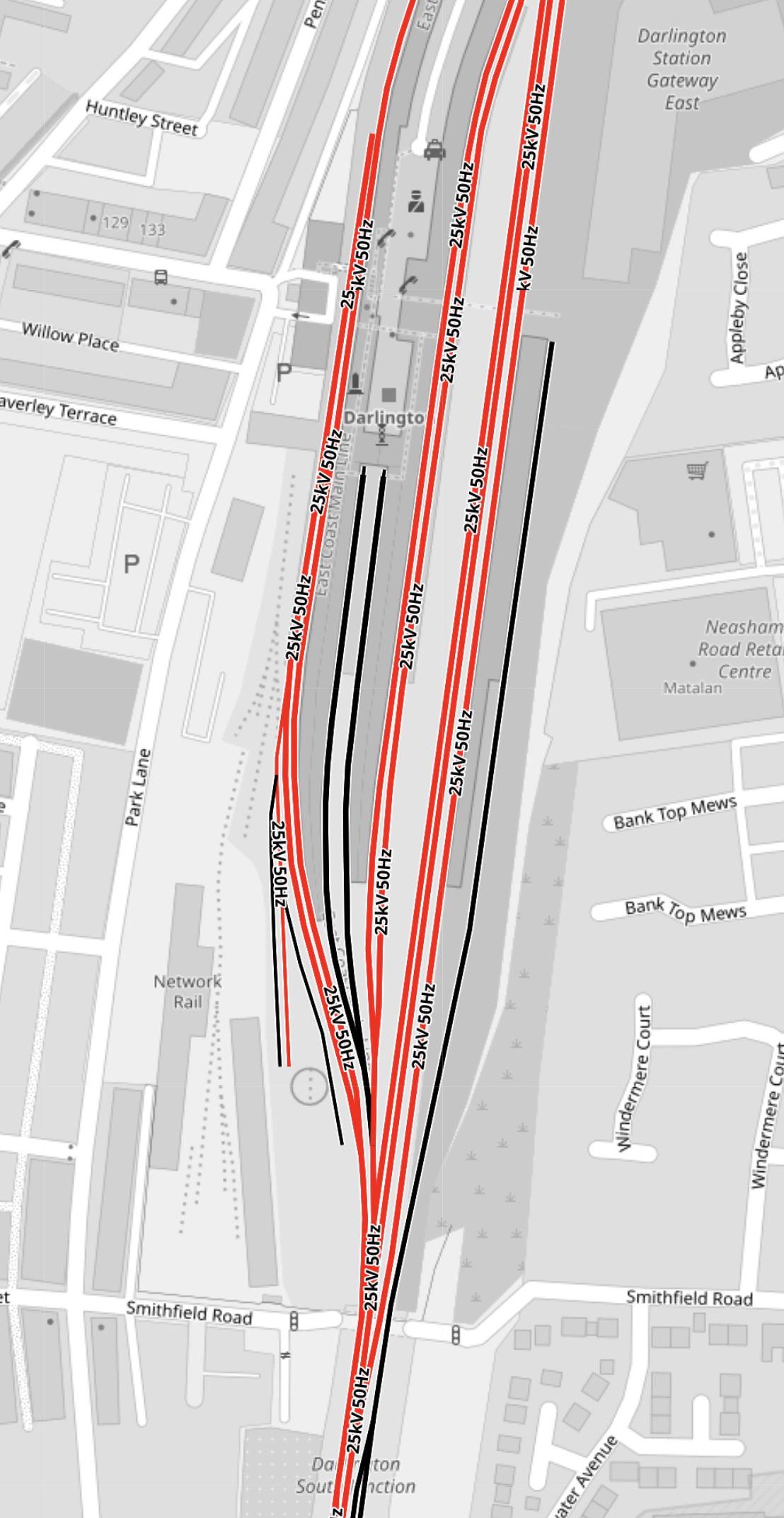
Note.
- The red tracks are electrified.
- The black tracks are not electrified.
- Tracks are number 4, 3, 2 and 1 from the West.
- The Southern ends of Platforms 1 and 4, and Platforms 2 and 3, which are inside the current train-shed appear to be virtually unchanged.
- Platform 1 is electrified and will probably still cater for Southbound trains.
- Platforms 2 and 3 are bay platforms without electrification for trains terminating at Darlington.
- Platform 4 is electrified and will probably still cater for Northbound trains.
- There is an electrified avoiding line to the East of Platform 1.
- The brick wall of the current train shed is in the white space to the East of Platform 1.
- Outside the current train shed are two electrified 125 mph lines, an electrified through platform and a South-facing bay platform without electrification.
- The new electrified platform looks very long. Could it be long enough to handle a pair of High Speed Two Classic-Compatible trains? I suspect though it is long enough to handle the splitting and joining of a pair of five-car Hitachi Class 80x trains.
- The new bay platform looks longer that the current bay platforms 2 & 3. Is it long enough to handle a five-car Hitachi Class 80x train?
- It does appear from the track layout, that the new electrified platform is connected to the East Coast Main Line, the Saltburn branch and stabling sidings to the North of the station.
- The new bay platform appears to be connected to the Saltburn branch.
The two new platforms also appear to be adjacent to an area of the station, which is labelled Darlington Station Gateway East. I would assume, that this proximity will be used to make the station easy for changing trains.
The third OpenRailwayMap shows the section of the station between the two previous maps.
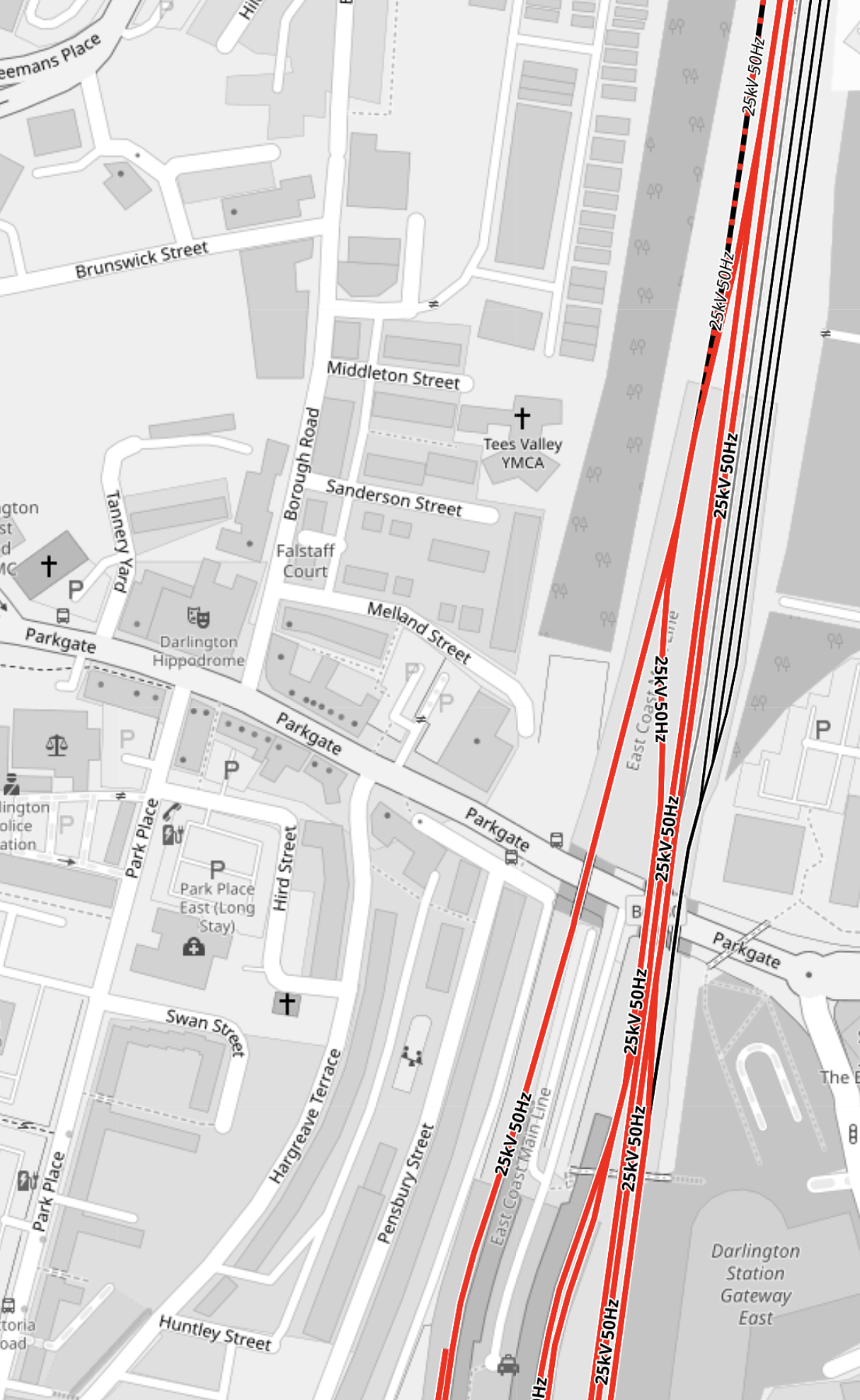
Note.
- The red tracks are electrified.
- The black tracks are not-electrified.
- The Darlington end of the Bishop Auckland Branch is shown dotted black and red, as it will be electrified, so that Hitachi can get their trains to and from the East Coast Main Line.
- Both Platforms 1 and 4 appear to connect to the East Coast Main Line, so high speed services can operate as they do now, by taking a diversion through the current Darlington station.
- To the East of the East Coast Main Line, there appear to be some very useful stabling sidings.
I have some general thoughts about Darlington station.
Will Trains Not Stopping At Darlington Station Use The New 125 mph Lines Through the Station?
It does appear that the two 125 mph lines through the new part of the station are very straight.
- They are shown as 125 mph, but could be faster.
- It should be remembered that according to Wikipedia, British Rail built the Selby Diversion for 160 mph in 1983.
- Between Durham and York stations is 66.2 miles of mainly 125 mph railway.
I believe that cutting out the need for trains to slow to go through Darlington station could save several minutes.
Will Trains Stopping At Darlington Station Use The Current Platforms 1 And 4 As They Do Now?
The track layout would seem to allow this and those changing to another train, would not have to walk a long way.
Can Trains Stopping At Darlington Station Use The New Eastern Platforms?
I have examined the second and third maps in detail and it looks as if the track layout will allow trains on the East Coast Main Line in both directions to stop at the long electrified platform.
The shorter bay platform appears to be only connected to the Tees Valley Line to Middlesbrough and Saltburn.
How Long Are The New Eastern Platforms?
Estimating against the scale on the map, I reckon these are the likely lengths.
- Long electrified platform – 400 metres – Appears to be numbered 5
- Bay platform – 200 metres – Appears to be numbered 6.
These are very useful lengths.
An Aerial View Of The New Platforms
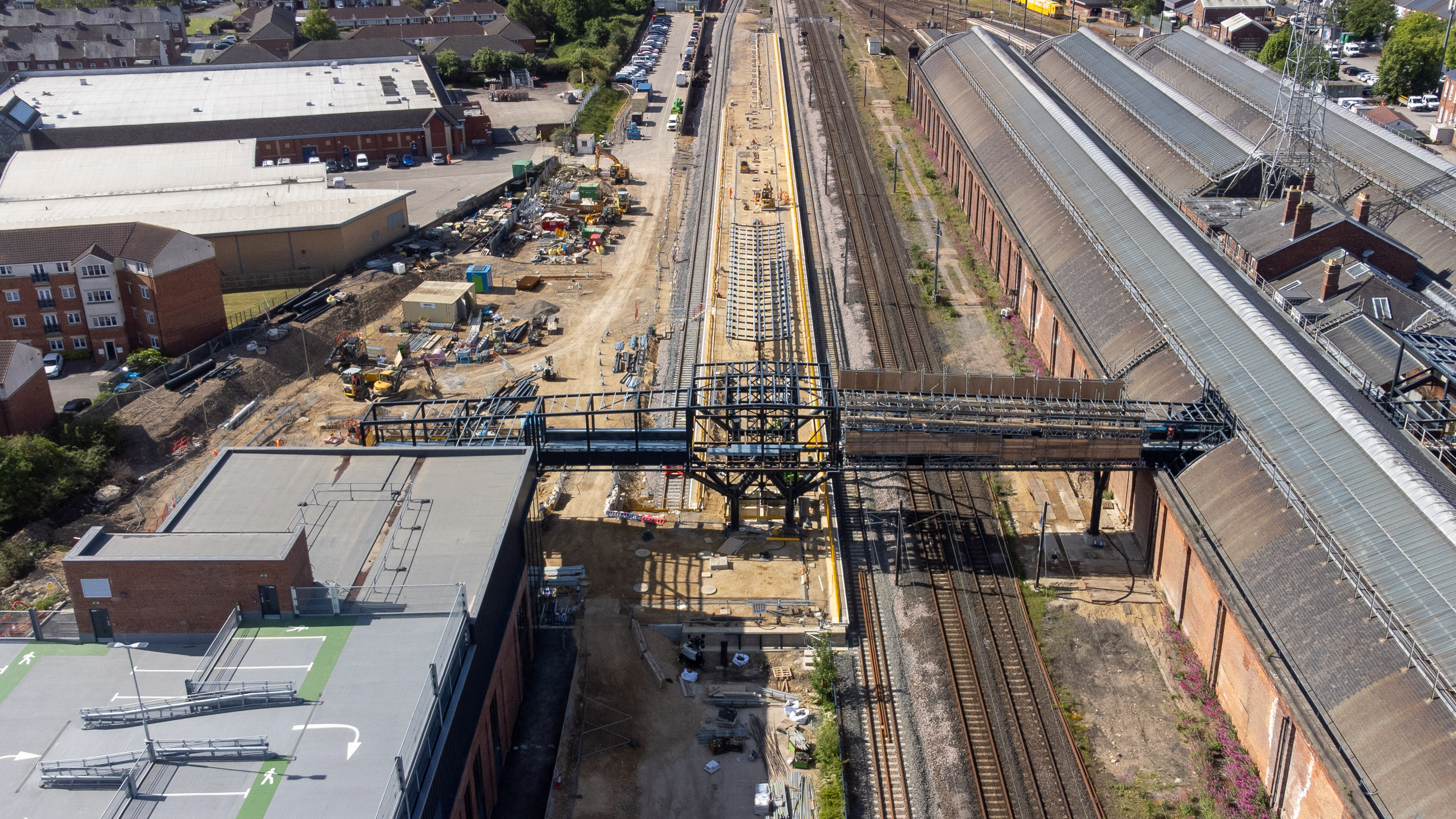
This image from Tees Valley Combined Authority shows the Northern ends of the new platforms and the new footbridge.
Note.
- The original four-platform Victorian station is on the right, which is the Western side.
- The East wall of the Victorian train shed can be clearly seen.
- The two absolutely straight 125 mph lines, that allow trains to bypass the original station are closest to the wall.
- The long electrified platform, which appears to be numbered 5, also appears to be absolutely straight.
- The unelectrified bay platform, which appears to be numbered 6, is to the left.
- Platforms 5 and 6 would seem to be separated by a wide island platform, which would make interchange easy.
This page on the Network Rail web site, gives more information.
Car Parking At Darlington Station
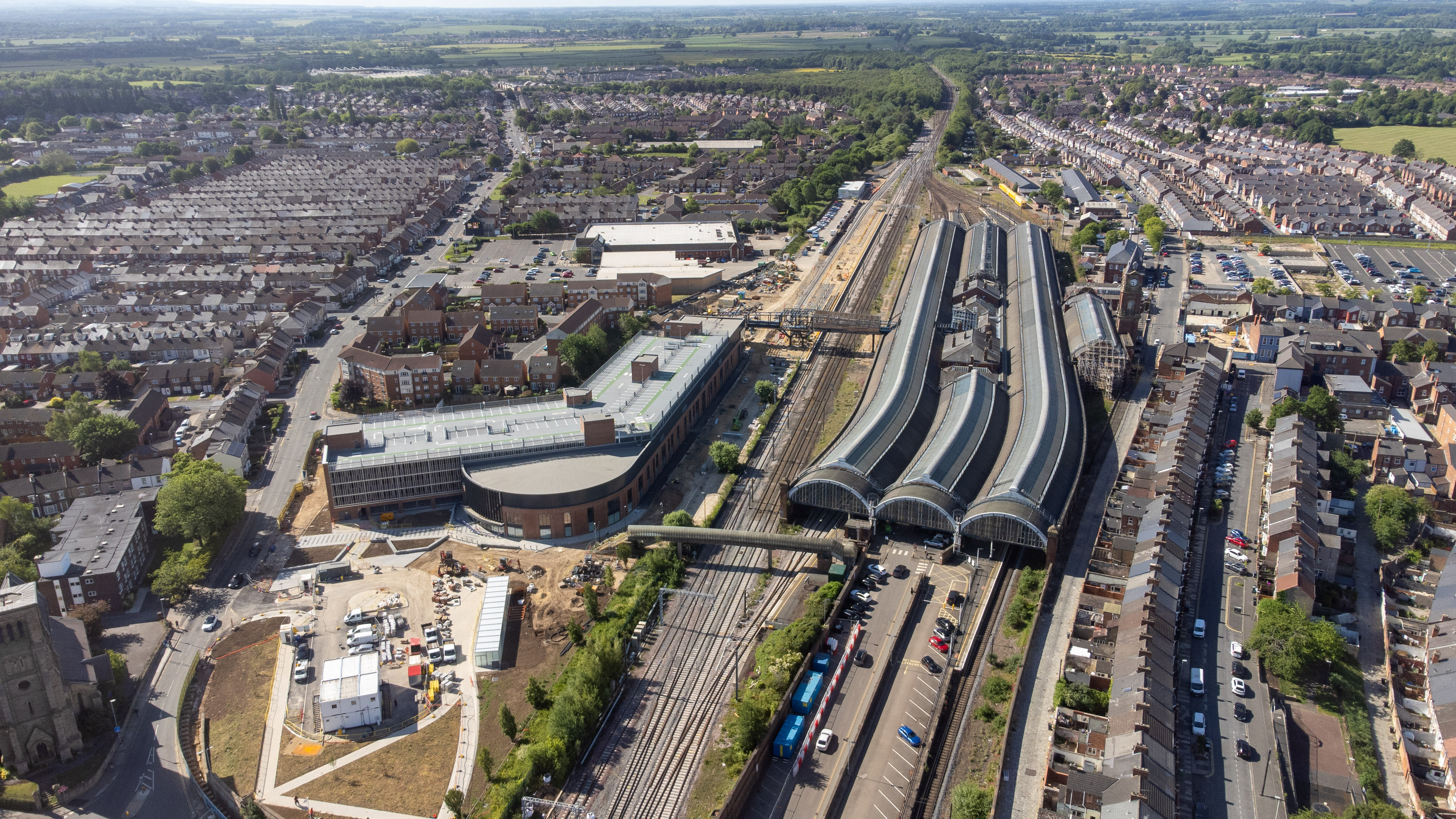
This image from Tees Valley Combined Authority shows the Northern end of the station.
Note.
- The three sections of the Victorian station.
- The two new platforms ; 5 and 6 at the top of the image.
- The two 125 mph lines bypassing the Victorian station.
- There are two new footbridges connecting the Victorian station to the land on the other side of the 125 mph lines.
To the left of the station, there appears to be a massive multi-story car-park.
I asked Google about the new car park at Darlington station and got this reply.
The new multi-story car park at Darlington Station will have a capacity of more than 650 vehicles. This is part of a larger £140 million redevelopment of the station, which also includes new platforms and an eastern concourse. The car park will include accessible parking bays and electric car charging points.
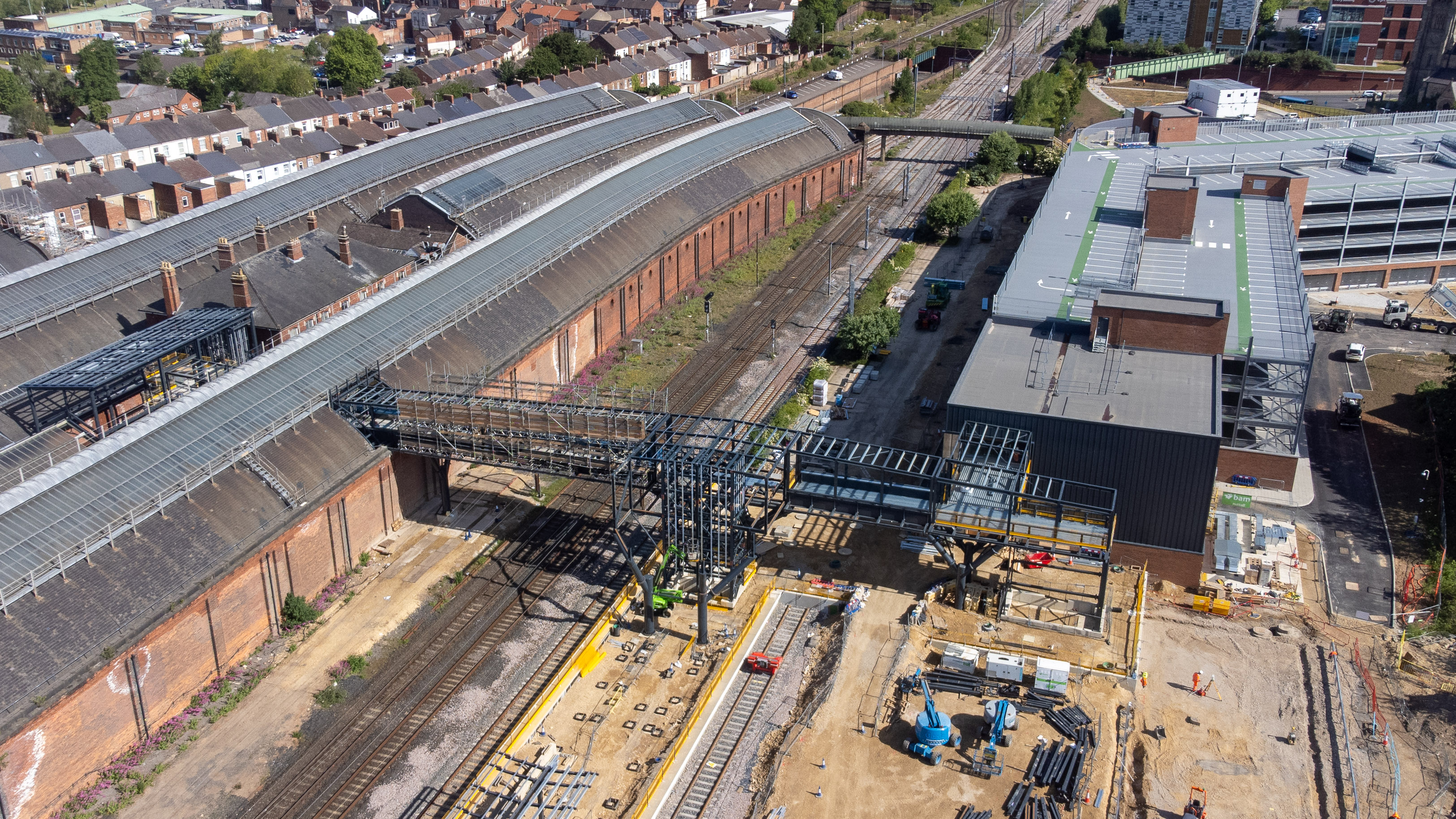
This image from Tees Valley Combined Authority shows the car parking from the South.
Note.
- The building appears to be a five-story car park.
- There appears to be a very easy connection between the car park and the bridge to the station.
- From the roof layout, there appears to be several lifts.
- It looks like there will be a large area between the platforms and the car park, where travellers can meet and socialise.
- The bay platform 6 already has a pair of red buffer stops.
Railways may have come to Darlington two hundred years ago and it looks like they are getting the car parking at the station ready for at least the next two hundred.
Further Electrification
If as I expect, the UK embraces battery electric technology for local and regional trains, I can see the three South-facing bay-platforms being electrified, so they could charge he battery-electric trains.
This picture shows that bars have been placed across Platforms 2 and 3, that could be used to support the electrification.
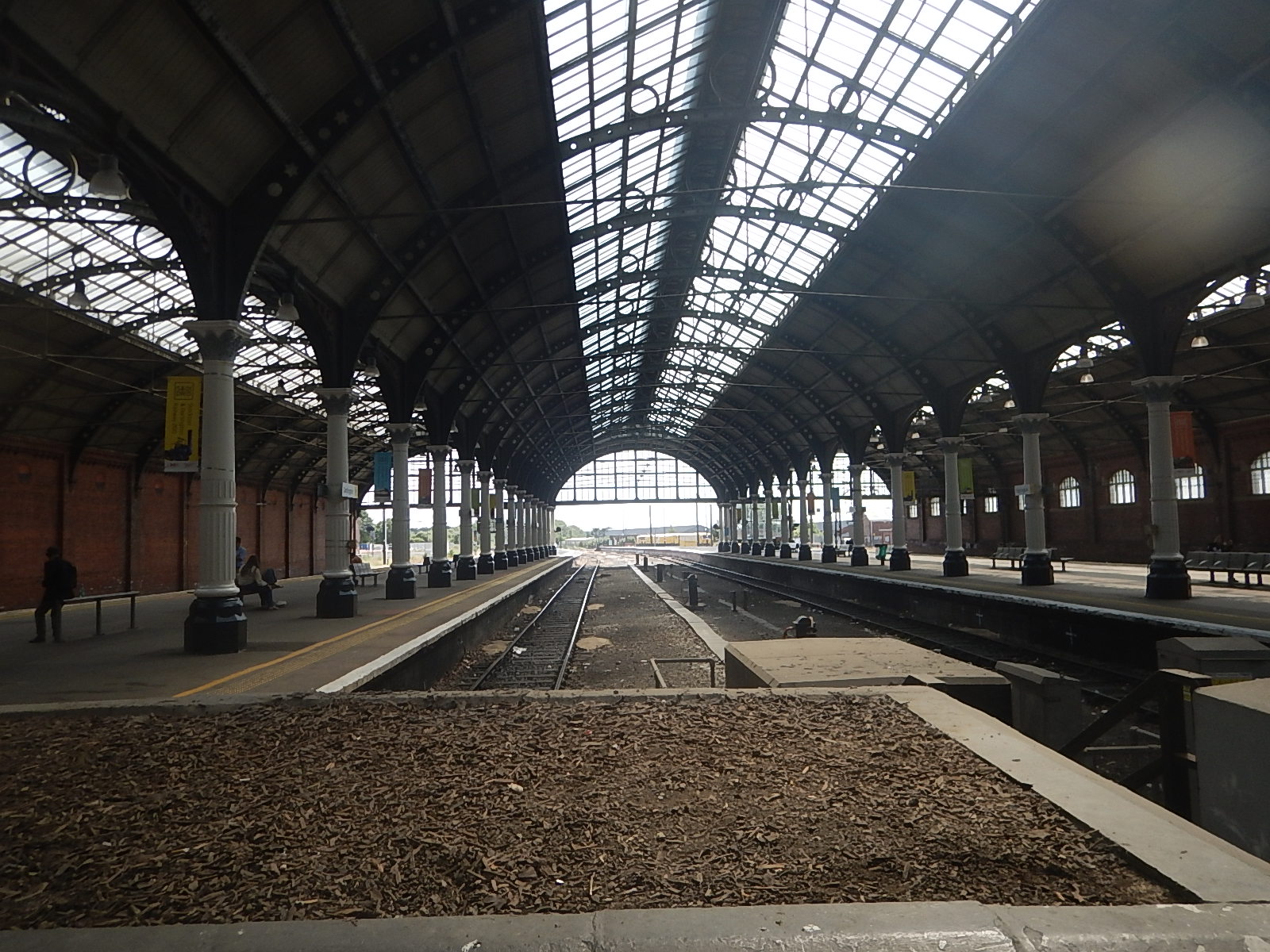
This method has been used in Victorian stations in the UK before. I show some installations and discuss electrifying Victorian stations in Could Hull Station Be Electrified?.
Darlington Station And High Speed Two
This graphic shows the original service pattern for High Speed Two.
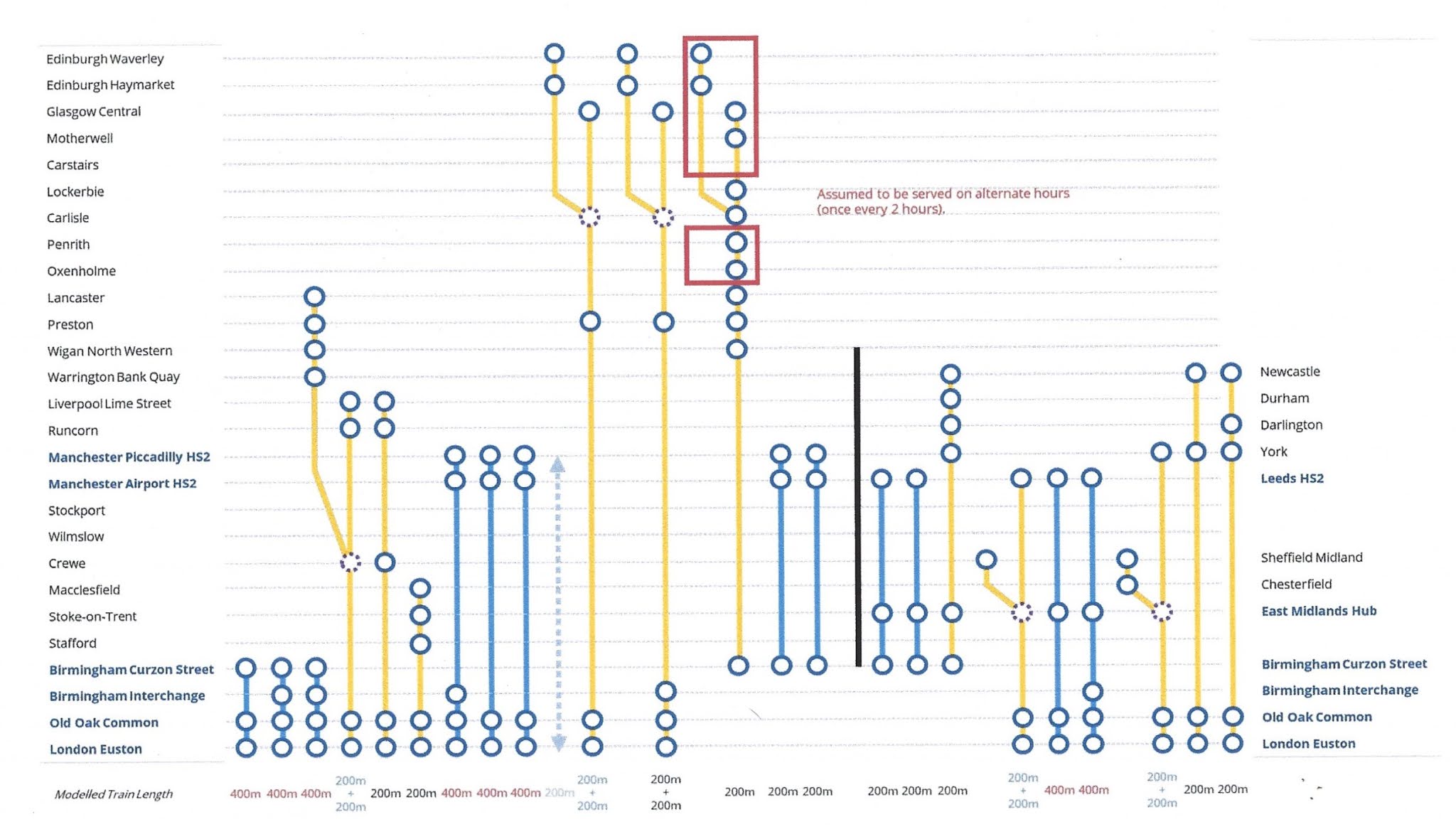
Note.
- There are seventeen paths terminating in the South at Euston station.
- Six of these paths go to Leeds, Newcastle or York.
- As the Eastern leg has been abandoned, that means there will be no High Speed Two trains to Leeds HS2, York, Darlington, Durham and Newcastle via the East Coast Main Line.
Darlington was to be served by these hourly services.
- Train 17 – Birmingham Curzon Street and Newcastle via East Midlands Hub, York, Darlington and Durham.
- Train 23 – London and Newcastle via York and Darlington.
Both trains would have been a single 200 metre long High Speed Two Classic-Compatible train.
Joining And Splitting Trains At Darlington
As Platform 5 looks like it would be a 400 metre long platform, it would look like it would be possible to handle a pair of High Speed Two Classic-Compatible trains.
But these trains will not now be serving Darlington in the near future, as the Eastern leg of High Speed Two has been cancelled.
A pair of nine-car Class 801 trains would be 467.4 metres long and might be able to fit into Platform 5.
But a pair of seven-car trains would certainly fit into a 400 metre Platform 5.
In Do Class 800/801/802 Trains Use Batteries For Regenerative Braking?, I found this snippet in an Hitachi document.
To simplify the rearrangement and management of train configurations, functions are provided for identifying the train (Class 800/801), for automatically determining the cars in the trainset and its total length, and for coupling and uncoupling up to 12 cars in
normal and 24 cars in rescue or emergency mode.
So I suspect with software updates two nine-car trains could run together.
Suppose LNER wanted to attack the airlines on the London and Scottish route.
- Two seven- or nine-car Class 800 or 801 trains would leave Edinburgh working as a pair.
- First stop would be Platform 5 in Darlington.
- The trains would split in Darlington.
- One train would go to King’s Cross stopping at perhaps Doncaster and Peterborough.
- The other train would go to St. Pancras stopping at perhaps Leeds, Sheffield, Nottingham and Bedford.
Note.
- A seven-car Azuma would be under 200 metres long.
- Seven-car trains would fit in St. Pancras.
- LNER have run an Azuma train into St. Pancras.
- The train would interchange with East-West Rail at Bedford.
- Travellers to and from East Anglia would change at Peterborough.
Large areas of England would have a fast route to and from Scotland.
Agreement To Eliminate Mobile Blackspots On Britain’s Lines
The title of this post, is the same as that of this article on Railway/PRO.
This is the sub-heading.
Network Rail and telecoms companies, Neos Networks and Freshwave signed an agreement named Project Reach to boost connectivity and remove mobile signal blackspots on the Britain’s rail network.
These first three paragraphs add more detail.
The ground-breaking public-private partnership delivers on the government’s Plan for Change mission to kickstart economic growth with ultra fast fibre optic cable across country’s busiest rail lines.
This is a multi-year project with the first installation of mobile infrastructure expected to begin in 2026 and fully rolled out by 2028.
The new deal will eliminate mobile signal blackspots in tunnels on key rail routes up and down the country, transforming daily journeys for millions of passengers who currently face the frustration of dropped calls and interrupted streaming on key routes between London, Manchester, Newcastle and Cardiff.
Note.
- Finance appears to be coming from both the public and private sector. Is this setting a dangerous precedent for Starmer and Rachel from Accounts.
- It is a £300 million project.
- In addition, a second project will tackle black-spots in 57 tunnels.
- Would the technology allow or improve other services on trains, where they could use mobile phone technology?
It is an ambitious and much-needed project, that could encourage many people to increase their use of rail transport.
Years ago, I built a new office on the farm, where I lived. The mobile coverage was bad in the new office, which was annoying. Someone suggested a piece of kit, that pointed at the nearest mobile phone mast and rebroadcast mobile signals, which solved the problem.
I suspect that Neos Networks and Freshwave can do the connection at 125 mph, that the solution, that I used, did without moving.
Conclusion
Sounds to me, that every train and rail line should have this technology installed.
Darlington And Bishop Auckland – 26th June 2025
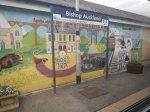
My second trip out from Darlington was to Bishop Auckland station and I took these pictures on the way up and down.

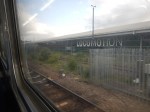

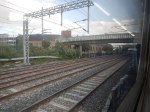
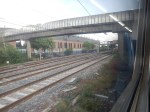
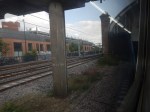
Note.
- Bishop Auckland station is a one-platform station, but all the other stations seem to be two-platform stations.
- The railway museum; Locomotion seems to be within walking distance of Shildon station.
- There is a short section of electrified track, that Hitachi use to test trains and get them to the East Coast Main Line.
The stations seemed tidy and clean, but more step-free access is needed.
I have some further thoughts.
The Location Of Hitachi Rail
This Google Map shows the location of Hitachi Rail.
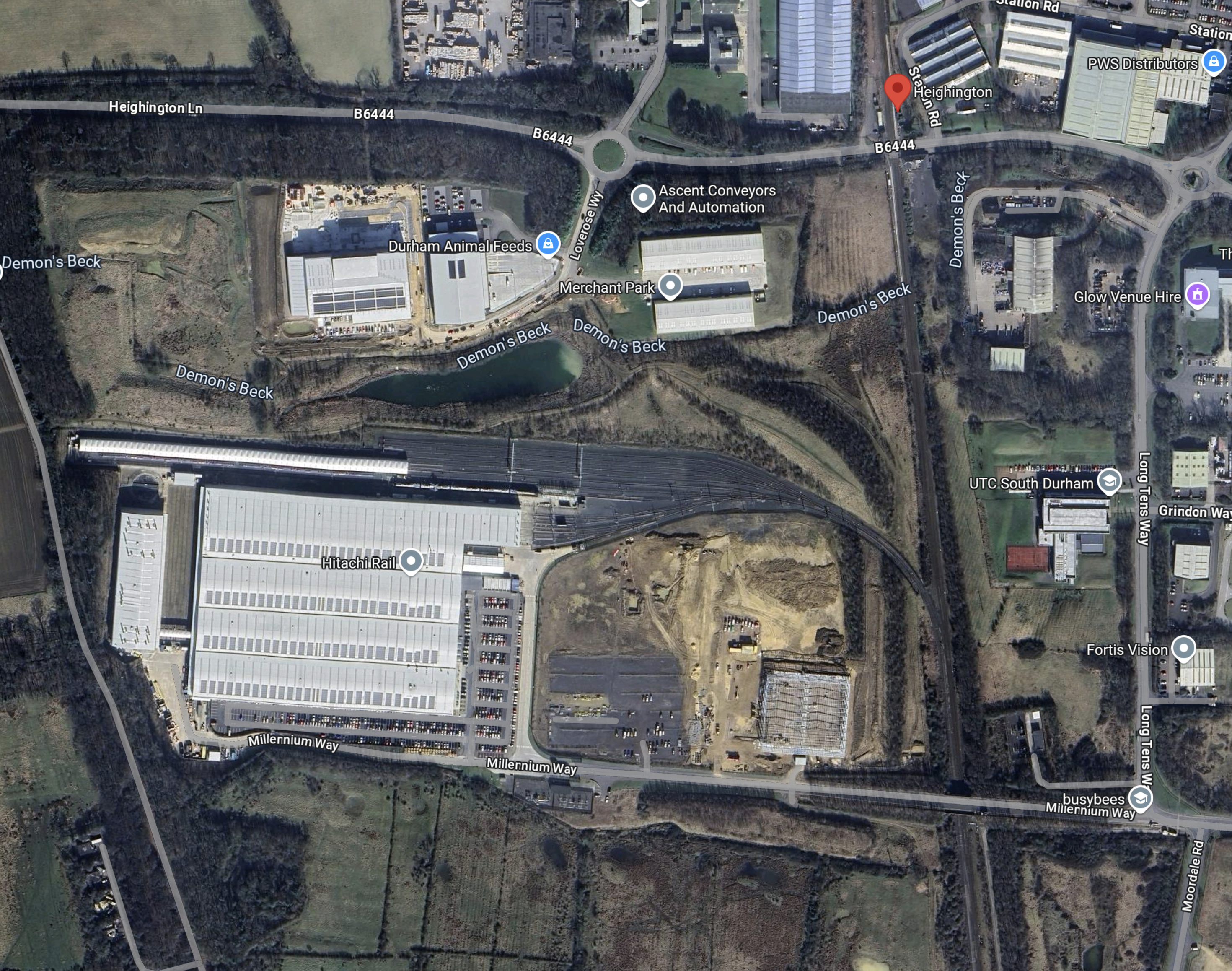
Note.
- Heighington station on the Tees Valley Line is marked by the red arrow.
- Hitachi Rail is the large building in the South-West corner of the map.
- There appear to be electrified sidings to the North of the factory, which have a connection to the Tees Valley Line.
From the map it looks efficient and well-designed.
Could The Services On The Branch Be Run By Battery-Electric Trains?
I don’t think there would be too many problems.
- Bishop Auckland and Darlington is only twelve miles.
- Both platforms at Darlington used by Tees Valley Line services are electrified.
- The single platform at Bishop Auckland station could be fitted with one of Siemens’s Rail Charging Convertors.
- Hitachi at Newton Aycliffe might like some more formal electrification between Newton Aycliffe and Darlington stations.
- An electrified Tees Valley Line would surely be useful to Hitachi for showing the capabilities of battery-electric trains.
This would be a very easy line to run using battery-electric trains.
Are Zero- And Low-Alcohol Beers Cutting Road Accidents?
In The Times today, there is an article, which is entitled Drink-Driving ‘Effectively Legalised’ As Number Of Breath Tests Falls, where these are the first three paragraphs.
Drink-driving has effectively been legalised due to plummeting rates of breathalyser tests and light punishments for offenders, campaigners have warned.
The number of breath tests conducted by police has fallen by more than 62 per cent over the past decade as dangerously inebriated drivers receive short bans.
In 2009, police carried out 647,380 breath tests, but by 2023, that figure had fallen to just 240,322.
This later paragraph, adds a few more statistics.
In 2002, 18 per cent of breath tests were positive, compared to 16 per cent in 2023, while the number of drivers prosecuted for drink-driving offences has significantly decreased. Convictions for drink-driving fell from 55,300 in 2012 to 40,292 in 2023, coinciding with the sharp decline in breath testing.
Note, that in both extracts the latest comparison date is 2023, whereas the earliest date is 2009 and 2002.
This analysis is not the full picture, as there are two big differences between drinking in 2002 or 2009 and 2023.
The first difference is that 2002 and 2009 are pre-Covid, but 2023 is post-Covid.
So did Covid alter our drinking habits, which could have perhaps meant more people drank at home?
The second difference is that in 2023, zero and low alcohol beer was readily available.
I don’t drive, after a stroke ruined my eyesight, but I do drink up to four bottles a day of 0.5 % real ale. The beer I drink has been regularly available since 2017.
I wonder how many nominated drivers are now drinking these beers?
A serious survey and analysis needs to be done.
London Underground’s New Piccadilly Line Trains Delayed Until 2026
The title of this post, is the same as that of this article on Railway Gazette.
These are the first two paragraphs.
The new air-conditioned trains which Siemens Mobility is supplying for London Underground’s Piccadilly Line are now expected to enter service from the second half of 2026, Transport for London has confirmed.
When the order was signed in November 2018 it was envisaged that the trains would enter service from 2024.
The article also says this about the new CAF trains for the Docklands Light Railway.
The Docklands Light Railway is to implement ‘short-term timetable changes’ on less busy routes from July 21. The reduction in services aims to ensure that reliability can be maintained pending the delayed introduction of new CAF trainsets, which was originally planned for 2023 but is now expected later this year. TfL said the age of the existing trains meant some needed to be retired this summer.
It looks like has two sets of new trains, both being delivered two years late; one being German and the other Spanish.
The only factors I can think both trains being late would be.
- Bad management of the contracts by Transport for London.
- Bad documentation of the Piccadilly Line and the Docklands Light Railway, when they were built.
- Bad project management generally throughout Europe.
- All politicians will be blaming someone else.
Take your pick!
Farage Wants HS2 Scrapped
The title of this post, is the same as a sub-title in this article on The Times. which is entitled HS2: Labour confirms delay until 2033.
This is the sub-heading.
Nigel Farage has called for the whole HS2 project to be scrapped.
These two paragraphs give NF’s view.
The Reform UK leader told the Commons: “Has the moment not come, rather than having another reset, to recognise this is a failure?
“Let’s scrap HS2, let’s use the tens of billions of pounds we can save in the next decade to upgrade railway lines across the entirety of the United Kingdom to the benefit of many millions and spend the rest on other national priorities in these financially straitened times.”
Farage’s simplistic plan will appeal to his disciples, but the major thing that is needed, is more capacity between South and North. Or North and South depending on where you live!
HS2 will provide an extra seventeen paths between London and a large triangular junction in the West Midlands.
If HS2 Is Not Built There Will Be More Cars And Trucks On The Roads
In Footage Released Of East West Rail’s First Commercial Freight Train, I wrote about the SEGRO Logistics Park Northampton (SLPN), which would generate lots of road and rail traffic. Without developments like HS2, the roads will just get clogged up.
High Speed Two’s Originally Proposed Service Pattern
This graphic shows the original service pattern for High Speed Two.
Note.
- There are seventeen paths terminating in the South at Euston station.
- Six of these paths go to Leeds, Newcastle or York.
- As the Eastern leg has been abandoned, that means six extra trains can run between London and the large triangular junction in the West Midlands.
Six extra trains running to the West side of England and Scotland could give a substantial improvement of services.
High Speed Yorkshire
HS2 needs to be paired with High Speed Yorkshire, which would mainly be an upgrading of the East Coast Main Line running at up to 160 mph to serve Lincolnshire, Yorkshire, the North-East and East Scotland.
Note.
- British Rail built the Selby Diversion in the 1980s to run at 160 mph.
- Digital signalling is currently being installed on this route and this will allow trains to speed through the two bottlenecks of the Digswell Viaduct and the Newark Crossing.
- Times of three-and-a-half hours between King’s Cross and Edinburgh, should be possible.
These times should give the airlines a good kicking on London-Newcastle and London-Scotland routes.
Fast services would run on High Speed Yorkshire to Alnwick, Barnetby, Barnsley, Beverley, Berwick, Bradford, Brough, Cleethorpes, Darlington, Doncaster, Durham, Edinburgh, Goole, Grantham, Grimsby, Harrogate, Huddersfield, Hull, Leeds, Lincoln, Middlesbrough, Newcastle, Peterborough, Pontefract, Retford, Rotherham, Scarborough, Scunthorpe, Sheffield, Skipton, Stevenage, Sunderland, Wakefield, Worksop and York.
Most of these towns and cities are already served by Hitachi or other high speed trains from King’s Cross.
A high proportion of the services to Yorkshire destinations will be under two hours from London.
When the current trains need replacing, they could be replaced by High Speed Two Classic-Compatible trains.
Onward From Handsacre Junction
Services to the North-West and Scotland will join the Trent Valley Line at Handsacre junction.
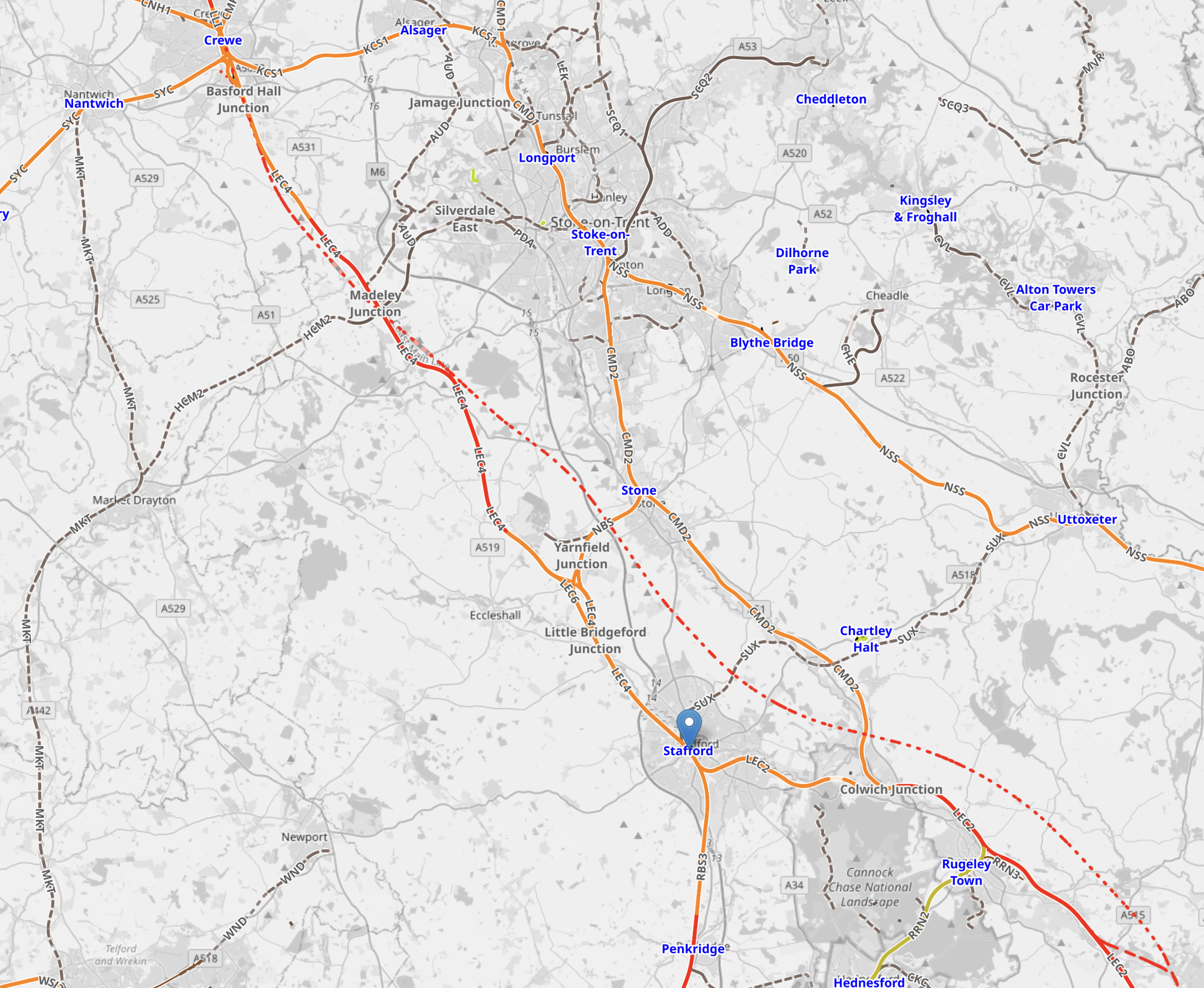
This OpenRailwayMap shows the Trent Valley Line between Crewe station and Handacre junction.
Note.
- The proposed route of High Speed Two is shown as a dotted line, running diagonally across the map.
- The red track to its West is the Trent Valley Line, which is a section of the West Coast Main Line.
- Handsacre junction is in the South-East corner of the map.
- The blue arrow indicates Stafford station on the West Coast Main Line.
- The main High Speed Two tracks will not connect to Stafford or Stoke-on-Trent stations.
- Crewe station is in the North-West corner of the map.
- Crewe station and Handsacre junction are 37.6 miles apart.
With the exception of the 6 mile twin-track section between Stafford Trent Valley and Colwich junctions, it appears that Crewe station and Handsacre junction is all quadruple track.
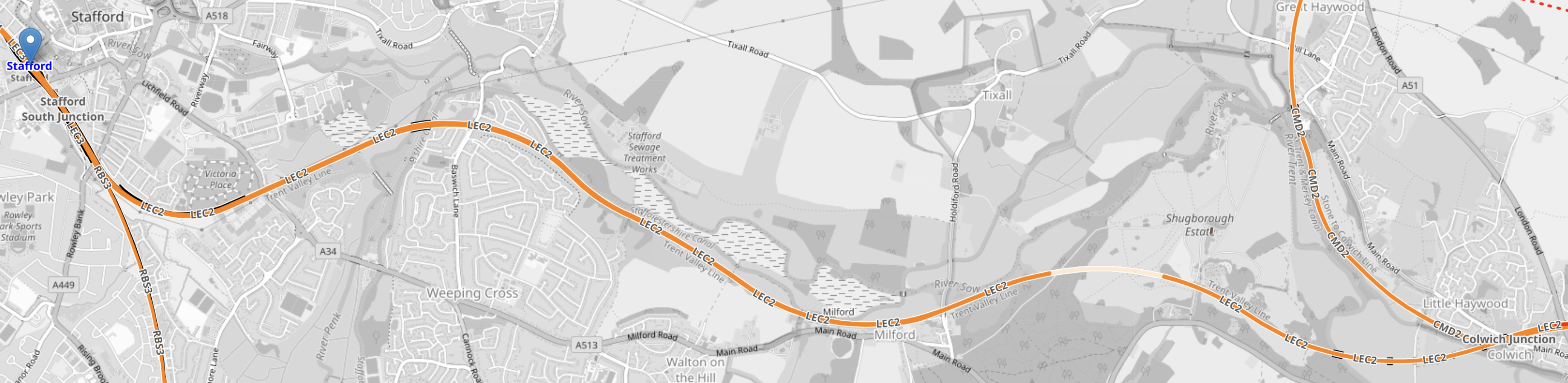
This OpenRailwayMap shows the Trent Valley Line between Stafford stationand Colwich junction.
Note.
- The Trent Valley Line, which is a section of the West Coast Main Line, runs across the map.
- The arrow in the North-West corner of the map indicates Stafford station.
- Colwich junction is in the South-East corner of the map.
- About three-quarters of the way across, the track is shown in cream. This is the twin-track Shugborough Tunnel, which is around a half-mile long.
- The Shugborough Tunnel has a 100 mph maximum speed.
- The portals of Shugborough Tunnel are Grade II Listed and the Wikipedia entry for the tunnel is certainly worth a read.
How Many High Speed Two trains per hour (tph) will use the Trent Valley Line route?
The original proposal in the graphic earlier shows these trains.
- 4 – London to Lancaster/Liverpool Lime Street – Splits at Crewe
- 5 – London to Liverpool Lime Street
- 6 – London to Stafford, Stoke -on-Trent and Macclesfield
- 7 – London and Birmingham Interchange to Manchester Airport and Manchester Piccadilly
- 8 – London to Manchester Airport and Manchester Piccadilly
- 9 – London to Manchester Airport and Manchester Piccadilly
- 10 – London and Birmingham Interchange to Preston, Carlisle, Edinburgh Haymarket and Edinburgh Waverley/Glasgow Central – Splits at Carlisle
- 11 – London Euston to Preston, Carlisle, Edinburgh Haymarket and Edinburgh Waverley/Glasgow Central – Splits at Carlisle
- 12 – Birmingham Curzon Street to Wigan North Western, Preston, Lancaster, Oxenholme, Penrith, Carlisle, Edinburgh Haymarket and Edinburgh Waverley Or Wigan North Western, Preston, Lancaster, Carlisle, Lockerbie, Motherwell and Glasgow Central- Services alternate.
- 13 – Birmingham Curzon Street to East Midlands Hub, Manchester Airport and Manchester Piccadilly
- 14 – Birmingham Curzon Street to East Midlands Hub, Manchester Airport and Manchester Piccadilly
Note.
- It looks like there will be eleven High Speed Two tph on the Trent Valley Line.
- As East Midlands Hub will not be built, I will assume trains 13 and 14 will be Birmingham Curzon Street to Manchester Airport and Manchester Piccadilly.
- Other trains will need to use the route.
- I suspect that freight trains, that couldn’t maintain 100 mph would not be allowed.
I believe that digital signalling can handle all the trains between Handsacre Junction and Crewe.
- Trains 10 and 11 would run every thirty minutes to give two tph between London and Glasgow Central and two tph between London and the two Edinburgh stations.
- Each of these trains would lead a flight of trains behind them through the Trent Valley Line.
- The last trains going North in the flights, would be trains 4 and 6, as they stop on the Trent Valley Line section.
I have written a lot of scheduling algorithms in the last fifty years and I wouldn’t be surprised if flights could be up to 7 or 8 trains, running 3 or 4 minutes apart.
It would be an impressive sight.
What Timings Would Be Possible On High Speed Two Using Handsacre Junction And The Trent Valley Line?
In Where Is Handsacre Junction? I calculated some times on High Speed Two to various destinations, using Handsacre junction and the Trent Valley Line. This is a more comprehensive table.
- London and Blackpool North – 205 mph – 1:55
- London and Blackpool North – 140 mph – 2:12
- London and Carlisle – 205 mph – 2:45
- London and Carlisle – 140 mph – 3:01
- London and Crewe – 205 mph – 1:03
- London and Crewe – 140 mph – 1:19
- London and Edinburgh Waverley – 205 mph – 4:14
- London and Edinburgh Waverley – 140 mph – 4:30
- London and Glasgow Central – 205 mph – 4:22
- London and Glasgow Central – 140 mph – 4:38
- London and Handsacre junction – 205 mph – 0:35
- London and Handsacre junction – 140 mph – 0:51
- London and Lancaster – 205 mph – 1:50
- London and Lancaster – 140 mph – 2:06
- London and Liverpool Lime Street – 205 mph – 1:46
- London and Liverpool Lime Street – 140 mph – 2:02
- London and Manchester Piccadilly – 205 mph – 1:41
- London and Manchester Piccadilly – 140 mph – 1:57
- London and Preston – 205 mph – 1:31
- London and Preston – 140 mph – 1:47
- London and Stafford – 205 mph – 0:45
- London and Stafford – 140 mph – 1:01
- London and Stoke-on-Trent – 205 mph – 0:55
- London and Stoke-on-Trent – 140 mph – 1:11
- London and Wigan North Western – 205 mph – 1:17
- London and Wigan North Western – 140 mph – 1:33
Note.
- 205 mph could be the average speed between London Euston and Handsacre junction for High Speed Two Classic-Compatible trains.
- 140 mph could be the average speed between London Euston and Handsacre junction for Class 390 trains.
- Times are in hh:nn.
- For times North of Handsacre junction are typical Class 390 times.
A typical timing between London Euston and Handsacre junction for Class 390 trains is 71 minutes, so if High Speed Two services were run using Class 390 trains, twenty minutes would be saved on all services via Handsacre junction compared to current Avanti West Coast services.
I have some other thoughts.
Using Class 390 Trains Is Not My Idea
This article on Rail nBusiness UK is entitled Viewpoint: Buy tilting trains and finish Delta Junction to salvage HS2, says Gibb.
This is the sub-heading.
UK: Procurement of a fleet of tilting trains and a focus on Birmingham – Manchester services are key to making the most the descoped High Speed 2 scheme, former Virgin Trains executive Chris Gibb tells Rail Business UK.
Chris Gibb has the right experience. and has been used as a go-to man, when projects are in trouble.
The major points of his plan are as follows.
- Connect High Speed Two to the Trent Valley Line to go North from the Midlands.
- Initially, use Class 390 trains or Pendelinos on Liverpool, Manchester and Scottish services.
- Run Class 390 trains at 140 mph between Euston and Handsacre junction.
- When the Pendelinos need to be retired, buy a new set of tilting trains.
- Complete the North-to-West leg of High Speed Two’s triangular junction, so that trains can run between Birmingham Curzon Street and Manchester.
- Gibb proposes a Blackpool service, that splits and joins with a Liverpool service. I assume he means train 5.
Gibb feels a fundamental review of the operating principles and fleet requirements is now needed.
It is a well-thought out viewpoint and very much a must-read.

