Crossrail Service To Reading On Track For December Opening
The title of this post is the same as this article on New Civil Engineer.
In Will Crossrail Open To Reading in 2019?, I analysed this possibility, after it was raised in the January 2019 Edition of Modern Railways.
I decided it would be a good idea, with the major benefit of making Paddington a station without any trains running on diesel.
Startup Nikola Bets Hydrogen Will Finally Break Through With Big Rigs
The title of this post is the same as that of this article on Forbes.
Read the article, as it is an interesting concept.
- Nikola Motor will not only build the trucks, but the hydrogen filling station network across North America.
- They believe big trucks are ideal for hydrogen power.
- They will also make their hydrogen filling station network available to car makes.
- The founder of the company; Trevor Milton, claims it’s easier to package hydrogen tanks in big vehicles than small ones.
- He also claims that hydrogen-powered trucks are much lighter than battery ones.
- Hydrogen will be produced from renewable sources, where it is needed.
- They are raising $1.2billion dollars to fund it.
First trucks will be delivered in 2022,, if all goes well with the funding.
I have no idea, whether it will work successfully, but surely a network of hydrogen filling stations, generating their own hydrogen across a Continent could be the kick, that hydrogen power for vehicles needs.
The UK is a small island and comparing it to North America, probably means the concept wouldn’t work in the UK, but if it works in North America, it will work in Europe.
But, if Trevor Milton’s mathematics work for big trucks in North America, they may well work with trains in the UK. A few hydrogen filling stations for trains and locomotives at strategic depots might power a whole new generation of rail vehicles. The rail filling stations could be co-located with filling stations for hydrogen road vehicles.
Trucks In Cities And Large Urban Areas
As I walk around London I see lots of large trucks, that can be put into a few categories.
- Articulated delivery trucks, often for the big supermarkets.
- Eight-wheel rigid trucks moving loads of building materials or soil and rubble dug out of construction sites.
- Refuse trucks.
- Skip trucks
- Cement mixer trucks
With the exception of the first, many of these vehicles don’t do a large number of miles in a working day.
Will we see companies like Nikola Motor and others developing hydrogen or battery-powered trucks for these niches?
If they do, I can see some interesting working and fuelling strategies developing.
Would Hydrogen Trucks Be Ideal For Cross-Channel Traffic?
Imagine a journey between Stuttgart and the Toyota plant in Derby.
- Using the European hydrogen network, the truck arrives at Calais with a low hydrogen level.
- On arrival in Dover it goes to a convenient hydrogen station and fills up with enough hydrogen to make the five hundred mile return journey to Derby.
- The return journey to Stuttgart, would use a hydrogen filling station at Calais to speed the truck on it’s way.
Because of the distances involved, I’m sure hydrogen would work for regular high-value truck journeys across the Channel, even if different tractors were used on either side of the Channel, as they often are now!
You could also argue, that this journey would be better done by rail. But if that is the case, why is it so much cross-Channel freight moved by trucks?
Conclusion
Hydrogen will continue to attract innovation and it is not time to write it off yet.
An Inter7City Class 43 Locomotive At Dundee Station
This Inter7City Class 43 locomotive was waiting at Dundee station, when I protographed it.

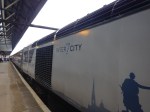
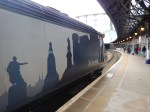
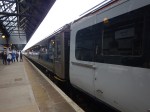

I suspect it was a training run.
Can You Fit These Cases In A Class 800 Train?
I took this picture at Edinburgh station, after arriving there on an Aberdeen to London train.
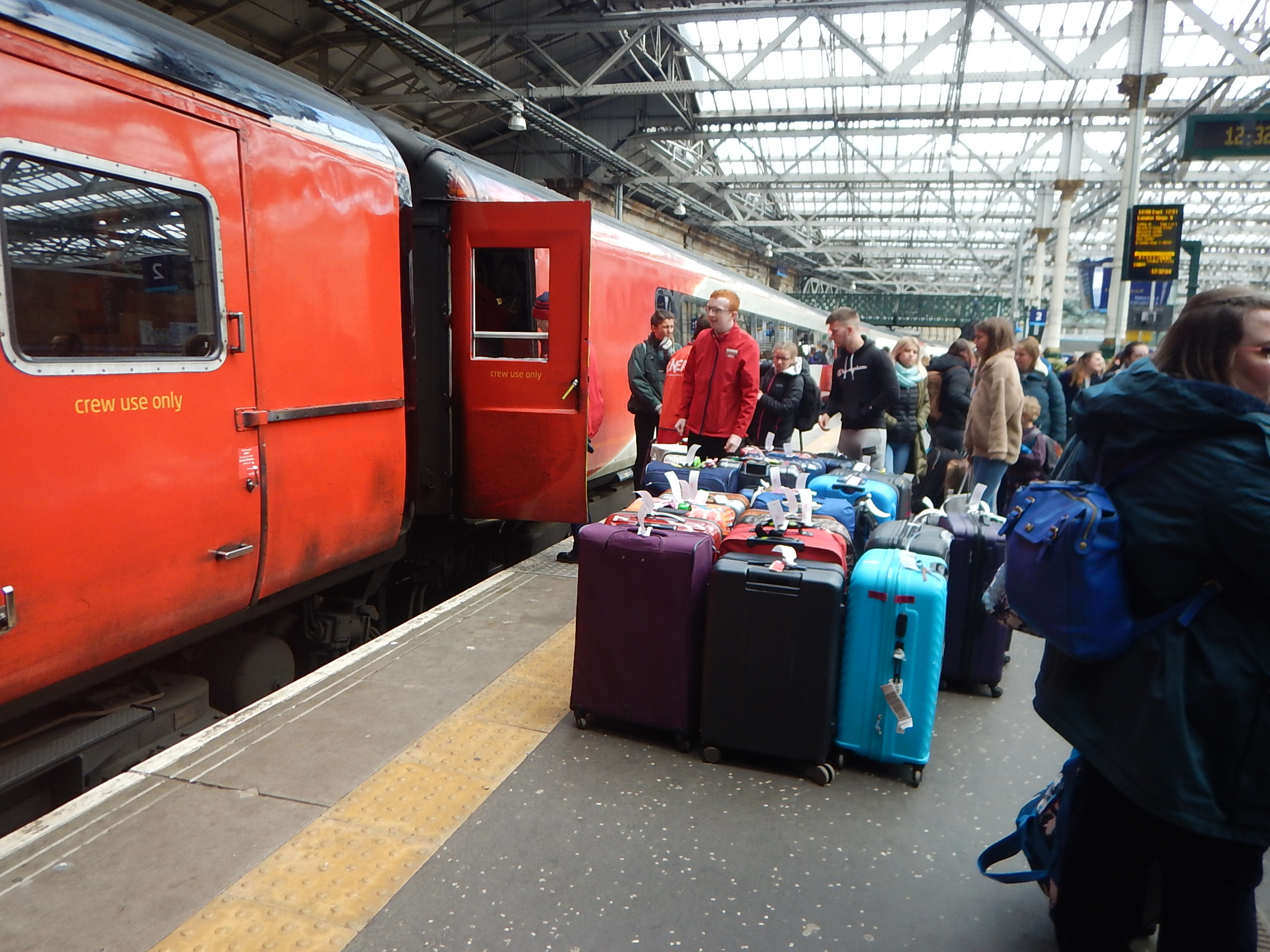
Could these cases be fitted into a new Class 800 train?
I’ve seen surfboards and heavily-loaded bikes being swallowed by a Class 43 locomotive in an InterCity 125.
Perhaps, passengers with loads like this, will fly to Edinburgh and then use ScotRail’s Inter7City trains around Scotland.
Brand-New Bi-Mode Trains For Long Term Use By Abellio East Midlands Railway
This page on the Department for Transport web site is an interactive map of the Abellio’s promises for East Midlands Railway.
These trains are proposed for working on several routes and some of their features are given.
In this section, I will try to ascertain, what they will be like.
These trains will replace the interim Mark 4 Coach/Class 43 locomotive sets on the Midland Main Line from April 2022.
They will also be used on the following services.
- London – Lincoln.
- London – Oakham – Melton Mowbray
- London – Leeds – York
Features include.
- More reliable service
- Improved comfort
- Passenger information system
- Free on-board Wi-Fi
- At-seat power sockets
- USB points
- Air conditioning
- Tables at all seats
- increased luggage space
- On-board cycle storage
I think it wouldn’t be speculating too much, to expect that shorter versions of these trains would also be used on other routes of the franchise.
I also think, that these trains will have other properties.
Ability To Run At 125 mph On Both Electric And Diesel Power
Bombardier, Hitachi and Stadler are proposing or have built fast bi-mode trains, which run at the same speed on both diesel and electric power.
- Bombardier are proposing a 125 mph Aventra with batteries.
- Hitachi’s 125 mph Class 800 trains are running at 125 mph on electric power, but can they achieve the 125 mph on diesel needed for the Midland Main Line?
- Stadler’s 100 mph Class 755 trains, will be running between London and Norwich at this speed from next month.
As parts of the Midland Main Line, that will not be electrified by 2022, to have a 125 mph operating speed, it is essential that the trains can do this speed on either power source.
Ability To Switch Power Source At Line Speed
Some trains do this, but others don’t!
To run as fast a timetable as possible, it is essential. Hitachi’s Class 800 trains can do it!
240 Metre Long Trains
Consider.
- The notes on the interactive map, says that Corby services will be this length in the Peak.
- 240 metre long platforms will be needed at St. Pancras for Corby services.
- Thameslink services are already this length.
These points lead me to the conclusion, that the new bi-mode trains can be up to 240 metres long.
Passenger Capacity
A seven-car Class 222 train has the following properties.
- 236 Standard Class seats.
- 106 First Class seats.
- 161.8 metres long
As the interiors of the existing and proposed trains seem similar with lots of tables and comfort, adjusting for the longer bi-mode train gives the following numbers of seats.
- 349 Standard Class seats.
- 157 First Class seats
There will be a large increase in the number of seats.
Step-Free Access Between Train And Platform
Stadler are the masters of this and are providing it on Merseyrail and on the Great Eastern Main Line.
Other companies will have to follow suit!
Hitachi in particular and surprisingly seem to design their trains with a big step.
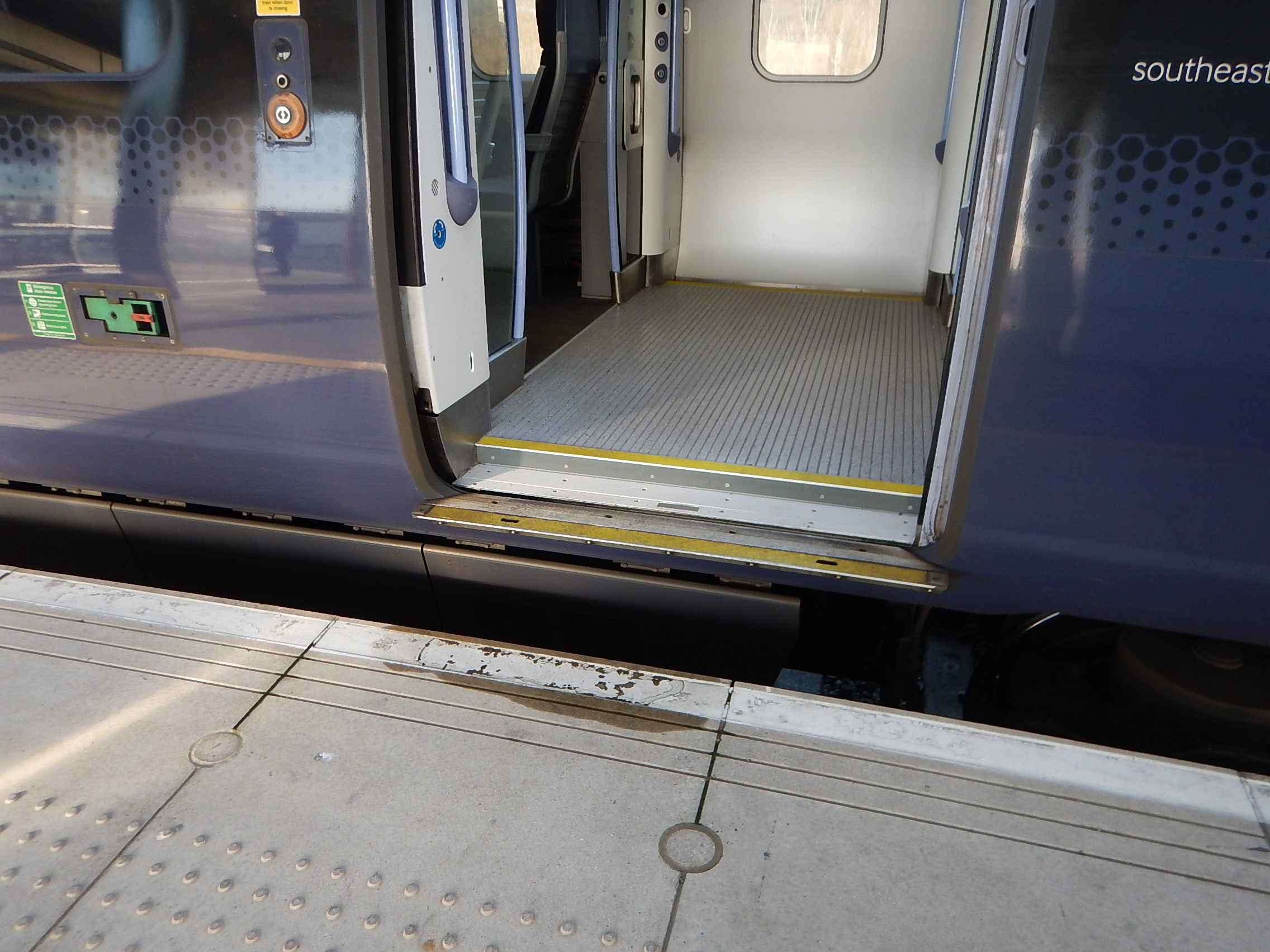
This picture shows the step up into a Class 395 train at St. Pancras station. It is unacceptable!
Step-free access improves the dwell time of trains at stations and is essential on any high-frequency service.
Digital Signalling
This will be essential to run the trains faster and closer together, so that more services can be run between London and the Midlands,
140 mph Running
IDigital signalling could even enable 140 mph running on sections of the route.
Improved Dwell Times
The performance of these trains and easy access, will mean that every station stop will be faster and will enable two pssenger benefits.
- Journeys will be faster by a few minutes.
- It will be possible to add extra station stops, with only a small penalty of overall journey times.
I doubt passengers will be unhappy.
High Speed Two Compatibility
High Speed Two should reach the East Midlands Hub station in 2032 and Sheffield station in 2034.
Between Clay Cross North Junction and Sheffield, High Speed Two and Midland Main Line services will use the same sixteen mile electrified railway.
Good project management probably says that this joint electrified line is created early, by say 2025. This would obtain maximum benefit to the City of Sheffield and the surrounding area.
As it is likely, that the new bi-mode trains will still be in service to past 2034, whatever is decided, these bi-modes must be able to run on High Speed Two infrastructure.
Conclusion
Even if, the current service pattern of two trains per hour to Derby, Chesterfield, Nottingham and Sheffield is maintained, there will be a large increase in capacity.
But if a fully-digital railway is created with 125 mph trains, I can see the Midland Main Line becoming one of the finest high speed railways in the world, that has been created by updating a classic rail line built in the Nineteenth Century.
Operating speed and capacity will be up there with the East Coast and West Coast Main Lines.
I can see Derby, Nottingham and Sheffield having a four trains per hour service from London in times of 75, 90 and 120 minutes respectively.
By comparison, High Speed Two is looking at a sub-ninrty ,minute time between London and Sheffield.
East Midlands Class 222 Trains
The Class 222 train is the workhorse of the Midland Main Line.
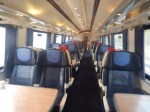
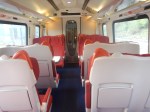
Where will they go, when they are replaced by new bi-mode trains in 20222?
They have some good properties.
- Built in 2003-2005 and refurbished in 2011-2012.
- 125 mph capability
- Lots of tables.
- Meet all the access reguilations.
- Good ride on FLEX-Eco bogies.
But there is the annoying noise of the under-floor diesel engines.
In Have Bombardier Got A Cunning Plan For Voyagers?, I commented on a statement by Bombardier to upgrade these trains with batteries, to give full regenerative braking, improve their efficiency and require less running of the engines in stations.
Luton Station To Go Step-Free
This document on the Government web site is entitled Access for All: 73 Stations Set To Benefit From Additional Funding.
Luton station is on the list.
These pictures show the station.

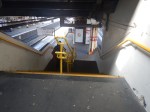


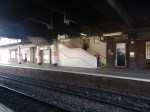



Without doubt, this is the worst station, I’ve found so far in an important town, that is to be made step-free.
There is nothing of any architectural merit at all in this station.
Will Abellio East Midlands Railway Improve Their Service To Luton?
Currently, Luton station has the following.
- Full electrification, which is being upgraded to a high standard for 125 mph running.
- Platforms long enough to accommodate Thameslink’s 242 metre long twelve-car Class 700 trains.
- The Class 700 trains are already fitted for working with digital signalling and this will be added to all trains.
It certainly treats trains better than it does passengers.
From December 2020, the following trains will run through Luton station.
- Two trains per hour (tph) to/from Corby, which will be 240 metre long twelve-car electric trains in the Peak. Why not in the Off Peak?
- Two tph to/from Leicester and Nottingham
- Two tph to/from Leicester, Derby, Chesterfield and Sheffield
At the present time, only the single Corby service stops at Luton.
From 2022, East Midlands Railway will be running new bi-mode trains through the station.
- For compatibility with the electric trains to Corby and to make full use of long platforms, I suspect that these trains could be up to 240 metres long.
- They will have a larger capacity, than the current Class 222 trains.
- They will effectively be electric trains between London and Market Harborough, where the electrification ends.
- They will have fast acceleration and smooth regenerative braking, because of the electric power.
- They could have step-across access between train and platform.
As Luton station is electrified and has long platforms, these trains will be able to stop at Luton (and Luton Airport Parkway) in minutes.
Network Rail intend to make Luton station step-free by 2024.
The improved access will give easier connections between the expresses and Thameslink, and entry/exit to the station.
I can see several trains per hour stopping at Luton.
Conclusion
If money was no object, this station should be totally rebuilt.
But money is an object, so the architects will be struggling.
But by 2024 at the latest and possibly a couple of years earlier Luton station could be sorted for passengers and handling well upwards of a dozen 240 metre long high capacity trains in every hour.
A High Visibility Truck
I saw this concrete truck outside Kings Cross station.
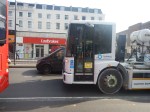
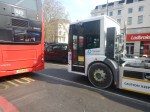
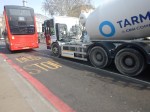
I hope the concept works!
It’s a Mercedes-Benz Econic.
There is a review on this page.
Abellio’s Plans For Nottingham And Crewe Via Derby
This page on the Department for Transport web site is an interactive map of the Abellio’s promises for East Midlands Railway.
These are mentioned for services between Nottingham and Crewe via Derby.. This is an extension of the current service which is two separate services, that need a change at Derby.
Crewe-Derby Services Will Operate With Increased Capacity Compared To Today
Consider.
- Currently, the service between Derby and Crewe takes 43 minutes with another 30 minutes for Derby And Nottingham.
- It is run by a Sprinter with one or two cars.
- The service is hourly.
- I suspect that a well-driven train will be able to do a round trip from Nottingham to Crewe and back in under three hours.
This would mean that three trains are needed to provide the hourly service.
But put four- or five-car Class 222 trains on the route and this would mean.
- Much greater capacity.
- Faster journeys.
- More comfort and facilities.
If a train could do the round trip in under two hours, then just two trains would be needed for the hourly service.
Most Services Will Be Extended To And From Nottingham
I assumed this in the previous section and it appears sensible.
, Later Evening Service Is To Be Provided In Both Directions
Trains can never be too late.
Enhanced Sunday Service With A Regular Hourly service Starting Early In The Morning
You can’t fault that!
Increased Community Rail Partnership Funding
Or that one!
Refurbished Modern Trains
As with their plans for Nottingham to Norwich, they use the same words about the trains.
Read Abellio’s Plans For Norwich And Liverpool, to see what I said.
Wikipedia’s View
The Wikipedia entry for the Crewe-Derby Line says this about services on the route.
The line sees a basic hourly service in each direction with trains calling at all stations on the route however Peartree which is served by 2 Derby bound trains and 3 Crewe bound trains per weekday.
The majority of services on the route since December 2008 have been provided by Class 153 “Super Sprinter” Diesel Multiple Units however Class 158 “Express Sprinter” and Class 156 “Super Sprinter” units are occasionally used. Overcrowding remains a major issue on the route, particularly in the morning and evening peak and a weekends. Passengers are occasionally left behind.
A Class 222 train on this line with a 70 mph operating speed, must provide a better service.
Collateral Benefits
I see these as collateral benefits.
Extra Services Between Derby and Nottingham
If you take this plan with Abellio’s Plans For Norwich And Liverpool, they both have added an hourly service between Derby and Nottingham.
Better Connections To High Speed Two
\Will these extra services connect to High Speed Two at the East Midlands Hub station?
Remember that Abellio’s is an eight year franchise and High Speed Two will arrive in the area, at the time of the end of the franchise.
Abellio’s Plans For Norwich And Liverpool
This page on the Department for Transport web site is an interactive map of the Abellio’s promises for East Midlands Railway.
These are mentioned for services between Norwich and Liverpool.
Splitting Of The Service
Early in the new franchise the Liverpool – Nottingham section will transfer to another operator, which will enable the two halves of the service to better meet the needs of customers.
The section remaining with East Midlands Railway will become a Norwich and Derby service via Nottingham.
This has been said for some time by the Department of Transport.
It is also said that limited services will continue to operate via Stamford and Loughborough.
Looking at trains between Nottingham and Norwich., they take these routes.
- Grantham, Peterborough, Ely, Thetford
- East Midlands Parkway, Loughborough, Melton Mowbray, Oakham, Peterborough, Ely, Thetford
The service will be extended from Nottingham to Long Eaton, the future East Midlands Hub and Derby.
Refurbished Modern Trains
It is proposed that the service will be run by refurbished modern trains.
Features include.
- More reliable service
- Improved comfort
- Passenger information system displays
- free on-board Wi-Fi
- at-seat power sockets
- USB points
- Air conditioning
- Tables at all seats
- Increased luggage space.
- No date for introduction is given.
This all sounds fine to me.
The Current Trains On The Route
Before discussing the possible new trains, I will look at the current service, that I have used many times.
Class 158 trains are used,
Normally, a pair of two-car trains run together to make a four-car formation.
- At times, these trains are very overcrowded.
- I don’t think, the trains have a universal access toilet.
- The trains are thirty years old and some detailing is not very good or very last century.
- The air-conditioning may be a bit dodgy.
- Nottingham and Norwich is probably about the maximum comfortable range for passenger on these trainss.
I suspect too, that they have operational problems.
- They are only 90 mph trains and they will share tracks with faster trains.
- As part of this route could be on the East Coast Main Line, scheduling trains would be easier, if the trains were capable of 125 mph.
- On board catering is provided by a trolley. Can it be pushed between the two trains?
Abellio are obviously quite right to promise a better train for both passengers, staff and their bottom line.
An Ideal Train For The Route
An ideal train would have a specification something like this.
- Modern train, built since 2000.
- Five or six cars
- 125 mph operating speed.
- An onboard cafe-bar.
- Universal-access toilet.
It sounds to me, like a Class 222 train with a high-class refurbishment.
Currently, there are these Class 222 trains available to the franchise.
- Four by four-car
- Seventeen by five-cars
- Six by seven-cars.
Many of the Class 222 trains, will be replaced in 2022, when the new bi-mode trains are delivered.
The New Trains For The Route
It does look to me, that East Midlands Trains could do a lot worse, than use refurbished Class 222 trains between Norwich and Derby.
- Their engineers and drivers know the trains well.
- They could be arranged as four or five coaches for the route.
- Tory are 125 mph trains, which must bring journey time savings, especially on the East Coast Main Line.
- Bombardier have proposed, that they could be fitted with batteries to reduce the need to run the engines in stations.
Refurbishing something you know, is probably one of the cheaper options.
How Many Trains Are Needed For An Hourly Service Between Nowich And Derby?
I suspect that running to a well defined timetable that times of around three hours could be achieved between Norwich and Derby.
This would probably mean that a train could go from Norwich to Derby and back in under seven hours.
This would mean that seven trains would be needed for an hourly service running all day.
If the 125 mph trains could use their speed on the East Coast Main Line and perhaps on the Breckland Line, it might be possible to do the round trip in six hours and therefor need a train less.
Would Finding Seven Class 222 Trains Be Possible?
Obviously, once the Midland Main Line routes have been replaced by new bi-mode trains in 2022, there will be a lot of Class 222 trains available and seven trains to run the Norwich and Derby service will not be a problem.
Some other factors will help.
Trains Will Be Released By The London And Corby Electric Service
In December 2020, when the London and Corby service receives electric trains, the current Class 222 trains on this route will become available.
I think that this service currently needs three trains.
More Mark 4 Coach/Class 43 locomotive Sets Could Be Created
In Abellio’s Plans For The Midland Main Line, I described how interim sets could be built by replacing the non-compliant Mark 3 coaches in an InterCity 125, with the compliant Mark 4 coaches from an InterCity 225.
These trains would be used to release some of the Class 222 trains on the Midland Main Line.
Another five Mark 4 Coach/Class 43 Locomotive sets would probably release the same number of Class 222 trains.
Trains Could Be Reorganised With A Better Plan
I have a feeling that by reorganising the Class 222 trains and bringing in more more Mark 4 Coach/Class 43 Locomotive sets, could mean that a better plan on the Midland Main Line could be developed.
As an example, when boarding a train at St. Pancrass, I often notice two trains are in the platform and you have to walk to the far train. This is not efficient and surely slows down the turnround of trains.
Platforms 1 to 4 are reserved for East Midlands services at St. Pancras station.
- Two trains per hour to Derby, Chesterfield and Sheffield
- Two trains per hour to Nottingham
- One train per hour to Corby, which goes to two trains per hour in December 2020.
Surely, it would be easier, if the station was organised as follows.
- Sheffield, Nottingham and Corby trains all have their own platform, with one spare for luck!
- All trains are full length, with First Class at the London end
- One train per platform.
This would make things easier for passengers and reduce turnround times.
No More Two Trains Running Together
I think that the practice of train companies running two or more trains together to increase capacity is a bad idea, unless you have no other way.
Consider two four-car trains running together as an eight-car train.
- You have two driving cabs in the middle, which serve no purpose and just take up space. and add useless weight.
- A buffet car in the train can be available to all passengers.
- The First Class seats could be in two separate places on the train.
- With trains like the Hitachi Class 800 trains, onboard staff can only move between trains in a station.
- Walk-through trains allow passengers to position themselves for a convenient and quick exit.
Anybody who procures trains to run in multiple formations all the time, instead of buying longer trains, is generally incompetent.
A Rough Estimate
I have done a very rough estimate and feel that the Midland Main Line services can be run with the following numbers of trains.
- Sheffield services – Ten trains
- Nottingham services – Eight trains
- Corby services – Six trains
As the Corby services will be run by refurbished twelve-car trains, it looks to me that there is a need for eighteen diesel trains for Sheffield and Nottingham services.
I would go for eighteen Mark 4 Coach/Class 43 locomotive sets, with perhaps a couple of spare sets..
Conclusion
The following services should be run with Mark 4 Coach/Class 43 locomotive sets of an appropriate length.
- London and Nottingham
- London and Sheffield
This would release the Class 222 trains for other services like those between Norwich and Derby.
 The Anonymous Widower