Northern Cities And COVID-19
If you look at the official Government statistics for the total number of cases of COVID-19, as of May 3rd, the number of cases in the two major cities in the North West as follows.
- Leeds – 1463 out of a city population of 789,194 (0.18%) and a metro population of 2,638,127 (0.05%)
- Liverpool – 1454 out of a city population of 494,814 (0.29%) and a metro population of 2,241,000 (0.06%)
- Manchester – 1154 out of a city population of 547,627 (0.21%) and a metro population of 3,748,274 (0.03%)
- Newcastle – 939 out of a city population of 300,196 (0.31%) and a metro population of 1,650,000 (0.06%)
- Nottingham – 537 out of a city population of 321,500 (0.17%) and a metro population of 1,610,000 (0.03%)
- Sheffield – 2191 out of a city population of 582,506 (0.38%) and a metro population of 1,569,000 (0.14%)
Note.
- All populations come from Wikipedia.
- Why is Liverpool 40% worse than Manchester?
- Why is Sheffield the worst?
I will add a few smaller towns andcities.
- Blackpool – 465 out of an urban population of 139,720 (0.33%)
- Caldervale – 252 out of an urban population of 200,100 (0.13%)
- Hull – 469 out of a city population of 260,645 (0.18%)
- Middlesbrough – 566 out of an urban population of 174,700 (0.32%)
- Stoke-on-Trent – 509 out of a city population of 255,833 (0.20%)
- York – 315 out of a city population of 209,893 (0.15%)
I’d like to see full statistics plotted on a map or a scatter diagram.
The latter is a very powerful way to plot data and often they highlight data points that lie outside the underlying pattern of the data.
Hydrogen House Is ‘Greenest In Europe’
The title of this post is the same as that of this article in The Times.
This is the introductory paragraph.
A hydrogen-powered house that is off-grid and said to be the first of its kind in Europe is being built by a family in Devon.
These are some features.
- Solar panels
- Hydrogen from electrolysis.
- Hydrogen storage
- Hydrogen boiler
- Water from a borehole
- Own sewage plant
- Air source heat pump.
The article says that “Any spare hydrogen can power the hydrogen cars they plan to buy”
This sounds like my ideal house!
Israel Should Be Funding Alternative Energy, Not Another Gas Pipeline
The title of the post, is the same as that of this article from The Jerusalem Post.
This is the introductory sub-title.
A pipeline only serves interests of the gas tycoons and not the taxpayers or the environmentally minded residents of the region.
The pipeline is proposed to run to Eilat in the South of Israel, which is an area, that gets enough sun for most of its electricity needs.
Some points from the article.
- Jordan will be 100 % daytime solar by 2030.
- Israel could be 100 % daytime solar by 2030.
- The Arava region of Israil will achieve this aim, by the end of this year.
The article gives an interesting insight into how you get electricity, when you have plenty of sun.
Funding Award to Supply An 8MW Electrolyser
The title of this post, is the same as that of this Press Release from ITM Power.
This is the main body of the Press Release.
ITM Power, the energy storage and clean fuel company, is pleased to announce it has signed an agreement to supply an 8MW electrolyser in the UK. The agreement, including associated project costs, has a total value of £10m and funding will fall across FY2021 and FY2022. Further details will be announced in due course.
I bet they’re pleased!
To get a hold on what 8 MW looks like, these Class 90 locomotive each have a power output of just under 4 MW and are capable of hauling an eight-coach express train at 110 mph.

Working at full rate, the electrolyser will be able in a year to convert 70 GWh of electricity into hydrogen.
Why Would You Want An 8MW Electrolyser?
These are a few ideas.
Green Hydrogen For Humberside
This is a project described in this ITM Power Press Release.
This is the first three paragraphs.
ITM Power, the energy storage and clean fuel company, is pleased to announce that it has won, with partner Element Energy, a first stage deployment project in the UK Government’s Industrial Strategy Challenge Fund competition “Decarbonisation of Industrial Clusters” to assess the feasibility and scope of deploying green hydrogen with some major industrial partners in Humberside.
“Green Hydrogen for Humberside” will lead to the production of renewable hydrogen at the Gigawatt (GW) scale distributed to a mix of industrial energy users in Immingham, Humberside. Decarbonisation of this cluster is critical in reaching the UK’s legally binding 2050 net zero emission targets. Humberside, the UK’s largest cluster by industrial emissions, (12.4Mt of CO2 per year), contributes £18bn to the national economy each year and has access to a large renewable resource from offshore wind in the North Sea.
The project will work with customers in the region to establish the feasibility of switching to renewable hydrogen and justify a number of 100MW deployments of electrolysers. The project will cost the supply of hydrogen to these end users. This includes the electricity supply to the electrolyser, the hydrogen production facility, hydrogen distribution across the Humber and conversion of existing processes to use renewable hydrogen.
The study talks about a number of 100 MW deployments of electrolysers.
Will the 8MW electrolyser be a demonstrator for this project?
To Convert Surplus Renewable Energy Into Hydrogen Which Is Injected Into The Gas Grid
The Wikipedia entry for ITM Power has a section entitled Energy Storage Power To Gas. This is the first paragraph.
Power-to-Gas is a methodology of introducing such hydrogen to the natural gas network, essentially converting renewable electrical power to a clean gas that can be more conveniently stored using existing assets. There are two main Power-to-Gas mechanisms. The first involves metering pressurised hydrogen into the gas network directly. The second involves combining hydrogen with carbon dioxide via a methanation process to produce synthetic natural gas prior to introduction to the grid.
The electrolyser could be used to convert a lot of electricity into zero-carbon hydrogen for use in the UK gas network.
Improving The Resilience Of The UK Gas Network
This article on the BBC is entitled Major Power Failure Affects Homes And Transport and it describes a major power failure, when two generators failed in August 2019.
Could the 8MW electrolyser be part of the solution to make the UK power network more robust, if parts of the network fail?
To Create Feedstock For An Oil Refinery Or Petro-Chemical Plant
Hydrogen can be used as a feedstock for an oil refinery or petro-chemical plant.
This ITM Power Press Release, describes such a project, where wind power from the North Sea is used to create hydrogen for Phillips 66 Limited’s Humber Refinery.
As Part Of An Experimental Steel-Making Plant
This is pure speculation on my part, but steel-making creates lot of carbon-dioxide.
I do believe that using hydrogen to make steel is possible and ITM Power are based in the steel-city of Sheffield.
On the other hand look at the HYBRIT web site.
This is the introductory paragraph.
In 2016, SSAB, LKAB and Vattenfall joined forces to create HYBRIT – an initiative that endeavors to revolutionize steel-making. HYBRIT aims to replace coking coal, traditionally needed for ore-based steel making, with hydrogen. The result will be the world’s first fossil-free steel-making technology, with virtually no carbon footprint.
During 2018, work started on the construction of a pilot plant for fossil-free steel production in Luleå, Sweden. The goal is to have a solution for fossil-free steel by 2035. If successful, HYBRIT means that together we can reduce Sweden’s CO2 emissions by 10% and Finland’s by 7%.
This page on their web site is entitled Steel Making Today And Tomorrow. This image compares traditional blast furnace steelmaking with HYBRIT.
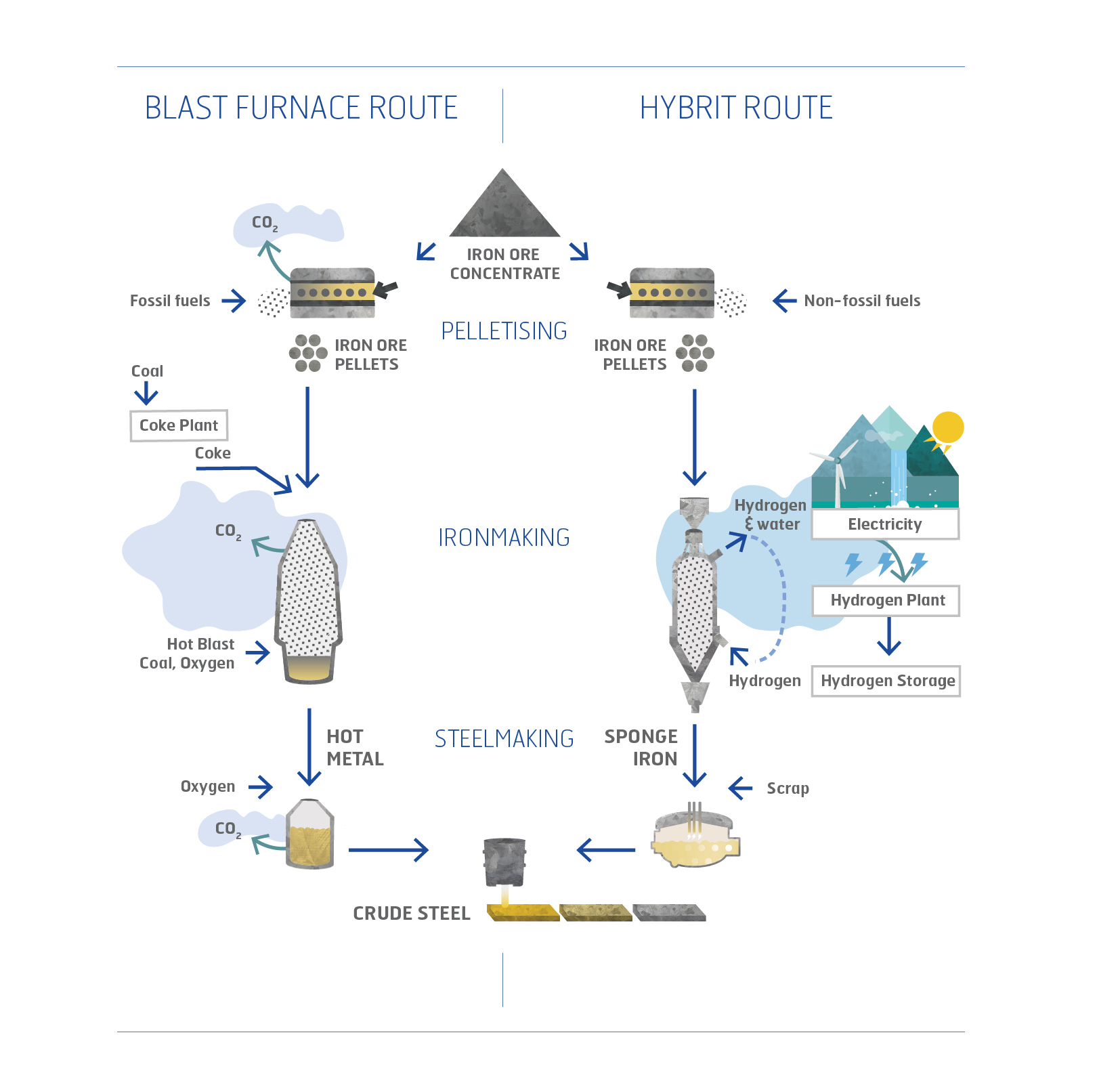
Note that at the heart of the process is the production of hydrogen from renewable electricity. This process will need a large electrolyser.
Could someone be doing something similar in Sheffield or more likely, Scunthorpe?
- British Steel may be owned by the Chinese, but it has a record of innovation.
- We will need a lot of long steel products, like railway rails and girders, in which British Steel specialise.
- In a few years, Humberside will have enough renewable electricity from North Sea wind to create an electro-magnetic gun to fire space capsules at Mars.
I will be watching out for hydrogen steelmaking.
Is Jim Ratcliffe Up To Something?
Jim Ratcliffe is a very rich man and the chairman and CEO of INEOS, which has a turnover of $83billion.
Consider.
- INEOS must know about hydrogen.
- I read some years ago, how they were using waste hydrogen to generate electricity on Teesside.
- I have a feeling that they have backed a hydrogen fuel-cell company.
- They own the hydrogen factory in Runcorn, where I worked in 1970.
- They have extensive interests in the North West, North East and Scotland.
- The company probably has an enormous carbon-footprint, that they’d probably like to reduce, by perhaps using hydrogen instead of natural gas as a feedstock for some processes, like production of ammonia.
But above all the cost of an 8MW electrolyser would be small change and probably cost a lot less, than running the cycling team.
The Fallback
It could of course be used to produce a large amount of hydrogen to power buses, cars and trains.
To Revive Economy, Think Infrastructure
The title of this post is the same as that of this article on CommonWealth.
This is the sub-title.
It worked in the Great Recession and it can work now.
The author is talking about Massachusetts in 2008, but I’m sure it would work in the UK and other countries in 2020.
Projects I would bring forward in the UK.
- Build lots of wind farms, both onshore and offshore.
- Build energy storage. I would go for Highview Power.
- Use wind energy to generate hydrogen for industrial processes. ITM Power in Rotherham, have the technology.
- Build a refuelling network for hydrogen-powered cars, buses, trucks and other vehicles.
- Add new rail stations to the network, where needed.
- Update all possible rail, tram, light rail and Underground stations so they are step-free.
- Build the electrified Huddersfield and Leeds upgrade to the TransPennine Route.
- Expand the Blackpool Tram, the Edinburgh Tram, the Manchester Metrolink, Merseyrail, the Nottingham Express Transit, the Sheffield Supertram, the Tyne and Wear Metro and the West Midlands Metro.
- Extend the Docklands Light Railway West to Charing Cross, Euston, St. Pancras and Victoria.
I would setup a construction pipeline, so all areas of the country got a share of the new infrastructure.
We must be bold.
InPipe Energy: Power Through Pressure
The title of this post is the same as that of this story on CleantechConcepts.
This is the introductory paragraph.
It’s the new hydropower. Not dams, no reservoirs, just pipes. With help from Oregon State engineering researchers, an Oregon startup company is developing a system to generate carbon-free electricity from a previously untapped water source: the pipes under our streets.
I think this could be an interesting idea. But could it be applied in the UK and Europe?
London Church Investigated Over ‘Protection’ Oil
The title of this post, is the same as that as this story on the BBC.
This is the first two paragraphs.
A faith healer who sold £91 “plague protection kits” claiming they could shield people from Covid-19 is being investigated by the charity watchdog.
Bishop Climate Wiseman of the Kingdom Church in Camberwell, London, claimed a bottle of oil and some red yarn would protect his followers from the virus.
Surely, he should be being investigated by the Metropolitan Police!
As far as I can see, the purpose of some religion is to let a few men, live a good life, at the expense of others.
A Minister For Hydrogen – Yes Please, Prime Minister
The title of this post is the same as that of this article on H2 View.
Sounds like a good idea to me!
Trump’s Fake News
This article on the BBC is entitled Coronavirus: Trump’s Disinfectant And Sunlight Claims Fact-Checked.
This is the introductory paragraph.
President Donald Trump has questioned whether injecting people with disinfectants and exposing patients’ bodies to UV light could help treat the coronavirus.
The article then goes on to demolish Trump’s claims with the full force of scientifically-correct evidence.
Do they have whelk stalls in the United States? Trummkopf certainly doesn’t have the intelligence to run one!
Ricky Gervais And David Bowie
Ricky Gervais just told this tale on Radio 5.
He was playing a gig with David Bowie, so he asked, why he still did gigs like this.
I thought Bowie’s reply was classic.
To stave off the boredom before death!
I suspect that applies to lots of people.
 The Anonymous Widower