Ørsted to File for Another Preliminary Injunction Against Stop-Work Order In US
The title of this post, is the same as that of this article on offshoreWIND.biz.
This is the sub-heading.
Ørsted will submit a motion for a preliminary injunction against the recently imposed construction halt for its Sunrise Wind project in the US, the company said on 7 January, several days after announcing the same legal action in relation to Revolution Wind, which the developer is building through a joint venture with Skyborn Renewables.
These two paragraphs add more details.
For Sunrise Wind, Ørsted is set to file a complaint in the US District Court for the District of Columbia challenging the lease suspension order issued by the US Bureau of Ocean Energy Management (BOEM) on 22 December 2025, which will be followed by a motion for a preliminary injunction.
The company says that Sunrise Wind, being built off New York, is now nearly 45 per cent complete, with 44 of 84 monopile foundations, the offshore converter station, and nearshore export cables installed. The construction of the onshore electric infrastructure is also substantially complete, according to the developer.
It appears now that Ørsted is now involved in two injunctions, as another one that I outlined in Ørsted-Skyborn JV Takes Legal Action Against US Gov’t Over Stop-Work Order; Seven Turbines Left To Install On Revolution Wind.
It would appear that Trump is throwing good money down the drain in pursuit of his stupid vendetta against wind farms.
Ørsted-Skyborn JV Takes Legal Action Against US Gov’t Over Stop-Work Order; Seven Turbines Left To Install On Revolution Wind
The title of this post, is the same as that of this article on offshoreWIND.biz.
This is the sub-heading.
On New Year’s Day, Revolution Wind LLC, the 50/50 joint venture between Ørsted and Skyborn Renewables, filed a supplemental complaint in the US District Court for the District of Columbia and plans to move for a preliminary injunction to block the lease suspension order recently imposed by the US government that stopped construction on its 704 MW project, which is now approximately 87 per cent complete and was expected to start generating power in January 2026.
These five paragraphs give more details of the story.
The lease suspension order, issued by the US Department of the Interior’s Bureau of Ocean Energy Management (BOEM) on 22 December 2025, directed all major offshore wind projects under construction to pause pending a review of alleged national security risks.
The developer asserts the suspension is unlawful and would cause substantial harm to the project, similar to the August 2025 stop-work order.
The project partners say Revolution Wind secured all required federal and state permits in 2023 after extensive reviews and engaged in multi-year consultations with defence authorities, resulting in formal mitigation agreements.
The project is approximately 87 per cent complete, with all foundations, offshore substations and export cables – and 58 of the total 65 wind turbines – installed, and was expected to begin generating power this month.
The developer also noted that the project will supply affordable power to over 350,000 homes under long-term power purchase agreements and support grid reliability in the Northeast.
A Verdict From Google AI
Pending any final result from my learned friends, I asked Google AI, if Revolution Wind will win their case and received this answer.
The question of whether Revolution Wind will ultimately win its case against the federal government’s Bureau of Ocean Energy Management (BOEM) has no final answer yet, as the litigation is ongoing. However, a federal judge has so far ruled in favor of Revolution Wind in a key preliminary step.
Key Developments in the Case
Initial Ruling: In September 2025, a U.S. District Court judge in D.C., Royce Lamberth, granted a preliminary injunction that allowed construction on the nearly-complete project to resume. The judge stated that Revolution Wind was likely to succeed on the merits of its claims and that the project would face “substantial harm” otherwise. The judge called the government’s initial “stop-work order” the “height of arbitrary and capricious action” because it failed to provide a factual basis for the cited national security concerns.
Outcome Uncertainty: The preliminary injunction allows work to continue while the full case proceeds, which could take years. The final outcome of the case depends on the court’s ultimate decision on the merits of the lawsuit
There is going to be some interesting reporting of this case, when the judges give their verdict.
The most interesting case, will probably be the one surrounding Coastal Virginia Offshore Wind as that is a 2.6 GW wind farm, which will generate a lot of fees for lawyers.
An Airbus A 380 On Finals At Heathrow
I realised this morning, that I needed an image of an Airbus A 380 and as I’d never flown in one, I didn’t have one.
So I went to Heathrow and took a few pictures as one does.





The aircraft was approaching on Runway 27 L.
i
Britain’s Biggest Clean Power Projects Among 2.4GW Of Transmission Connections National Grid Delivers In 2025
The title of this post, is the same as that of this press release from National Grid.
This is the sub-heading.
Record-breaking renewable power projects are among the 2.4GW of new generation connections we plugged into our transmission network during 2025, in another key step in the UK’s clean energy transition.
This first paragraph adds some detail to the headlines.
This year’s works build on the 3GW of connections we delivered in 2024 – which included a new interconnector between Wales and Ireland – and is part of 12.6GW of generation capacity we’ve connected in England and Wales over the past five years.
The rate of connections appear to have been fairly steady over the last five years, at about 2.5 GW/year.
Three projects are highlighted.
- In April the 373MW Cleve Hill Solar Park, Britain’s largest solar array, began exporting power across the network following work to connect it at our Cleve Hill substation in Kent.
- Over summer Statera Energy’s Thurrock Storage project, the country’s biggest battery energy storage system (BESS), connected at our Tilbury substation in Essex to add 300MW of flexible capacity across London and the south east.
- And in September we completed upgrades and commissioning activity at our Lackenby substation in North Yorkshire in readiness for RWE’s Sofia offshore wind farm – one of the world’s biggest – to complete construction.
They also completed works for more than 400MW of additional BESS connections during the year, including a 150MW scheme connecting at Ferrybridge substation in West Yorkshire, a 100MW facility plugging in at Thornton substation in North Yorkshire, and further projects at our substations in Enderby (Leicestershire), Rainhill (Merseyside) and Bredbury (Greater Manchester).
I think that adds up to ten projects in total.
It looks like National Grid had a good year.
Direct London Trains ‘Could Start In 2026’
The title of this post, is the same as that of this article on the BBC.
This is the sub-heading.
A new train company is hoping its proposals for new daily services from Shropshire to London Euston could begin towards the end of 2026.
Wrexham, Shropshire and Midlands Railway (WSMR), which is led by international rail firm Alstom, submitted a new bid at the end of last year to provide four daily trains.
These two paragraphs add detail to the story.
The county has not had a direct train link to the capital since Avanti West Coast stopped its single daily service in 2024 because of low passenger numbers.
The move has been welcomed by regular commuter Charlotte Foster, who lives on the Welsh border. She said a direct service would save her the stress of missing a connection or catching a train elsewhere.
These are my thoughts on this proposal.
I wonder If Alstom Will Be Using This route To Trial Hydrogen-Powered Trains?
Consider.
- The route was a failure for Virgin Trains.
- Perhaps the curiosity value of hydrogen-trains will generate sufficient traffic.
- Hydrogen-electric trains will be very quiet. Those in Germany are hydrogen-electro-mechanical and very noisy.
- The trains will be based on the proven Aventra platform.
- I reported on Alstom’s hydrogen trains for the UK in Alstom Plans To Operate Its Own Passenger Train Service In The UK For The First Time.
- Perhaps Alstom feel that an extended test will convince passengers that the trains are a good idea.
- An extended test would give proper costings for Great British Railways and prospective open access operators.
The map downloaded from the BBC article shows the route.
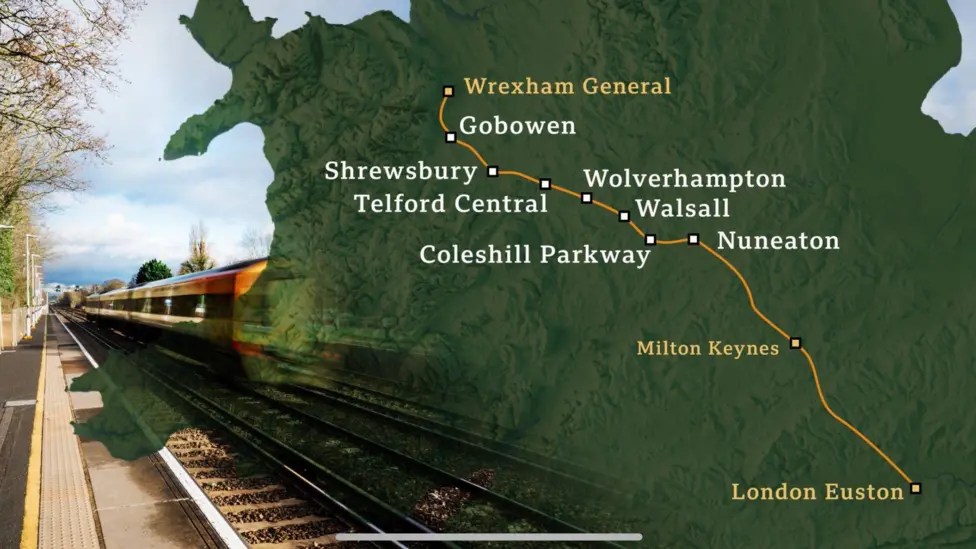
Note.
- There are eight intermediate stops.
- Euston and Wolverhampton is 124.9 miles and fully electrified.
- Wolverhampton and Wrexham General is 59.9 miles and is not electrified.
- The section of the route without electrification at 120 miles return might need some new electrification for battery-electric trains, but from their experience in Germany, I suspect that Alstom, will know how to cover the route using hydrogen-hybrid trains, which would use the existing electrification between Euston and Wolverhampton.
This picture shows a visualisation of a possible Alston hydrogen train, which would probably be built in Derby on an Aventra platform.
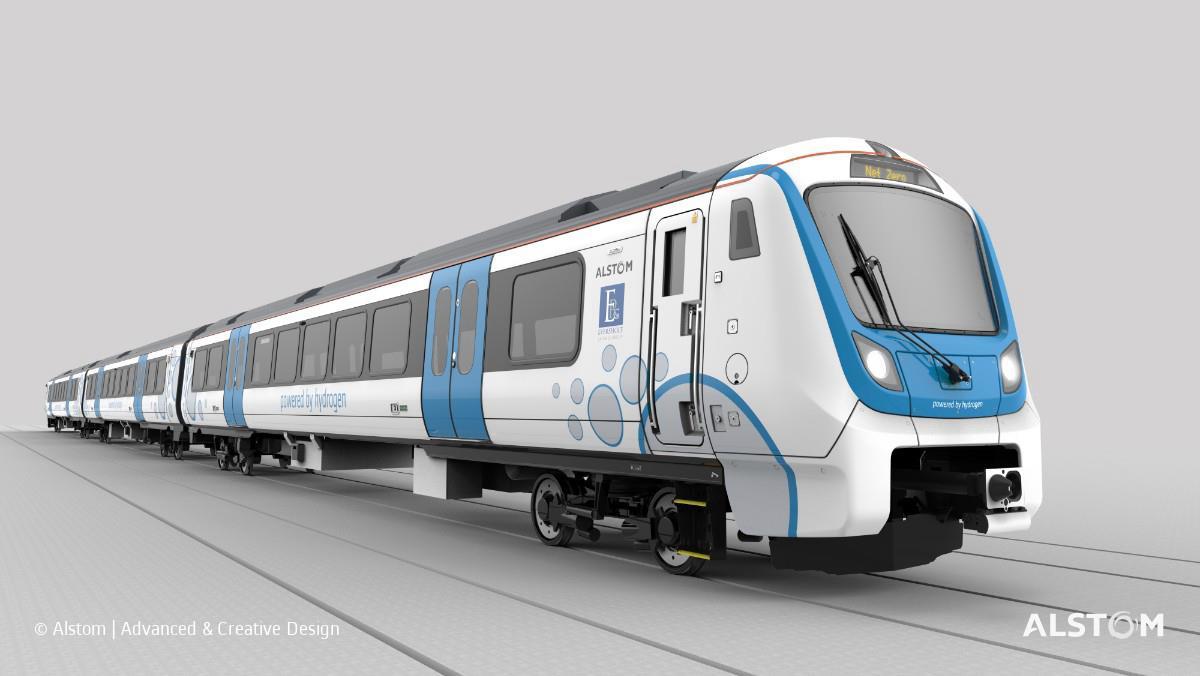
Note.
- It could be up to five-cars long.
- I suspect Alstom could give the train a 125 mph cruising speed, so it could mix it with all the express trains between Euston and Wolverhampton.
- The trains would have a very long range on hydrogen.
- Hydrogen trains could certainly handle a round trip between Wolverhampton and Holyhead on a single fuelling.
- Hydrogen fuelling is likely to be setup at Cemex at Wrexham and the Port of Holyhead.
I think it could be an ideal trial route for hydrogen trains.
But also it could bring growth to the towns and cities between Wolverhampton and Holyhead.
Would Alstom’s Hydrogen-Hybrid Trains Be Suitable For Other Routes?
Most Certainly!
In the first place, the route could be extended to Holyhead, which would surely bring growth to the towns and cities between Wolverhampton and Holyhead.
This would create a zero-carbon route between London and the Island of Ireland.
But around the UK, there would be other routes.
I can envisage these routes being run by hydrogen-hybrid trains.
- London Waterloo and Exeter – Third-rail operation
- London Bridge and Uckfield – Third-rail operation
- London Bridge and Hoo – Third-rail operation
- East Coastway and Marshlink Lines – Third-rail operation
- Scotland – Replacement of Inter7City trains and filling in the gaps in electrification.
Note.
- Some areas already have or have plans for hydrogen supply networks.
- With the exception of supplying hydrogen, very little infrastructure would be needed.
- Hydrogen trains should be fairly quiet.
- Hydrogen trains don’t create much disruption, when they are installed.
Aventras have been fairly well received and can be between three and nine cars.
Consultation On Offshore Wind Reform: Hydrogen Sector Calls For Hybrid Connection Concepts And Warns Of Compensation Risks
The title of this post, is the same as that of this article on the AquaVentus web site.
There is this statement on the home page.
Berlin, January 02 2026. In the context of the consultation launched by the Federal Ministry for Economic Affairs and Energy (BMWE) on the reform of the Wind Energy at Sea Act (WindSeeG), the hydrogen initiative AquaVentus is calling for clear legislative action to enable a cost-efficient and system-friendly development of offshore wind energy. At the heart of its position is the timely legal establishment of hybrid connection concepts, allowing offshore wind farms to be connected via both electricity cables and hydrogen pipelines.
Note.
- I’ve always felt that copying proven technologies from the offshore oil and gas industry is good practice.
- It may be easier to recycle infrastructure like pipelines, platforms and storage by creating the hydrogen offshore.
- In the UK, Centrica and SSE are already re-purposing natural gas storage for hydrogen.
It may feel safer to some for the hydrogen to be produced a distance offshore.
If President Maduro Is Found Guilty Of The United States Charges Will He Face The Death Penalty?
I asked Google AI the question in the title of this post and received this answer.
Nicolás Maduro has been indicted on several charges in a U.S. federal court, primarily in the Southern District of New York. The potential penalties for these charges are:
- Narco-terrorism conspiracy: This charge has a mandatory minimum prison sentence of 20 years and a maximum of life in prison.
- Cocaine importation conspiracy: This charge carries a mandatory minimum sentence of 10 years and a maximum of life in prison.
- Weapons charges (using and possessing machine guns and destructive devices in furtherance of the conspiracies): These charges carry a mandatory minimum sentence of 30 years and a maximum of life in prison.
The maximum penalty for all charges combined is life imprisonment in a U.S. federal prison, a sentence that has been described as a “de facto life sentence” in the media. The U.S. Attorney General has stated that the goal is for him to face justice in a U.S. court and, if convicted, he could spend the rest of his life behind bars.
Will this be enough for Trump?
Who knows?
But The Lady On The Train may have a say.
Could Artificial Intelligent Judge Cases Without A Jury?
I just had to ask Google AI this question and received this answer.
Artificial intelligence is not currently used to judge cases or issue final verdicts without human oversight in any major legal system, and legal experts believe a full replacement is unlikely in the foreseeable future. The complex nature of law requires human qualities like empathy, moral judgment, and the ability to assess nuance and credibility, which AI currently lacks.
The current role of AI in the judiciary is primarily used as a tool to assist human judges and lawyers, not replace them.
Could Artificial Intelligent Perform Sentencing In Cases?
I just had to ask Google AI this second question and received this answer.
While artificial intelligence (AI) is already used in various legal processes, it cannot perform actual sentencing in legal cases in a legally binding capacity. Legal systems currently maintain that judicial discretion and the final decision-making authority must rest with a human judge to ensure accountability, due process, and fairness.
Does Artificial Intelligence Support A Reduced Role For Juries In Legal Cases?
I just had to ask Google AI this third question and received this answer.
Artificial intelligence is currently being used to support, not replace, human decision-makers in the legal system, with experts highlighting the need for human judgment, empathy, and accountability in jury trials. The debate over AI’s potential to reduce the role of juries is ongoing, with arguments both for and against.
Conclusion
In all these questions, artificial intelligent didn’t appear to act above its station.
Could Doncaster Sheffield Airport Become A Hydrogen Airport?
I asked Google AI, what is the current status of Doncaster Sheffield Airport and received this reply.
Doncaster Sheffield Airport (DSA) is currently in a state of active, public-funded redevelopment after closing in late 2022 due to financial issues, with plans to reopen for passenger flights by late 2027 or 2028, following significant funding (around £160m) secured by the South Yorkshire Mayoral Combined Authority (SYMCA) for the City of Doncaster Council to take over operations and rebuild commercial viability, with freight and general aviation potentially returning sooner.
This Google Map shows the location of the airport.
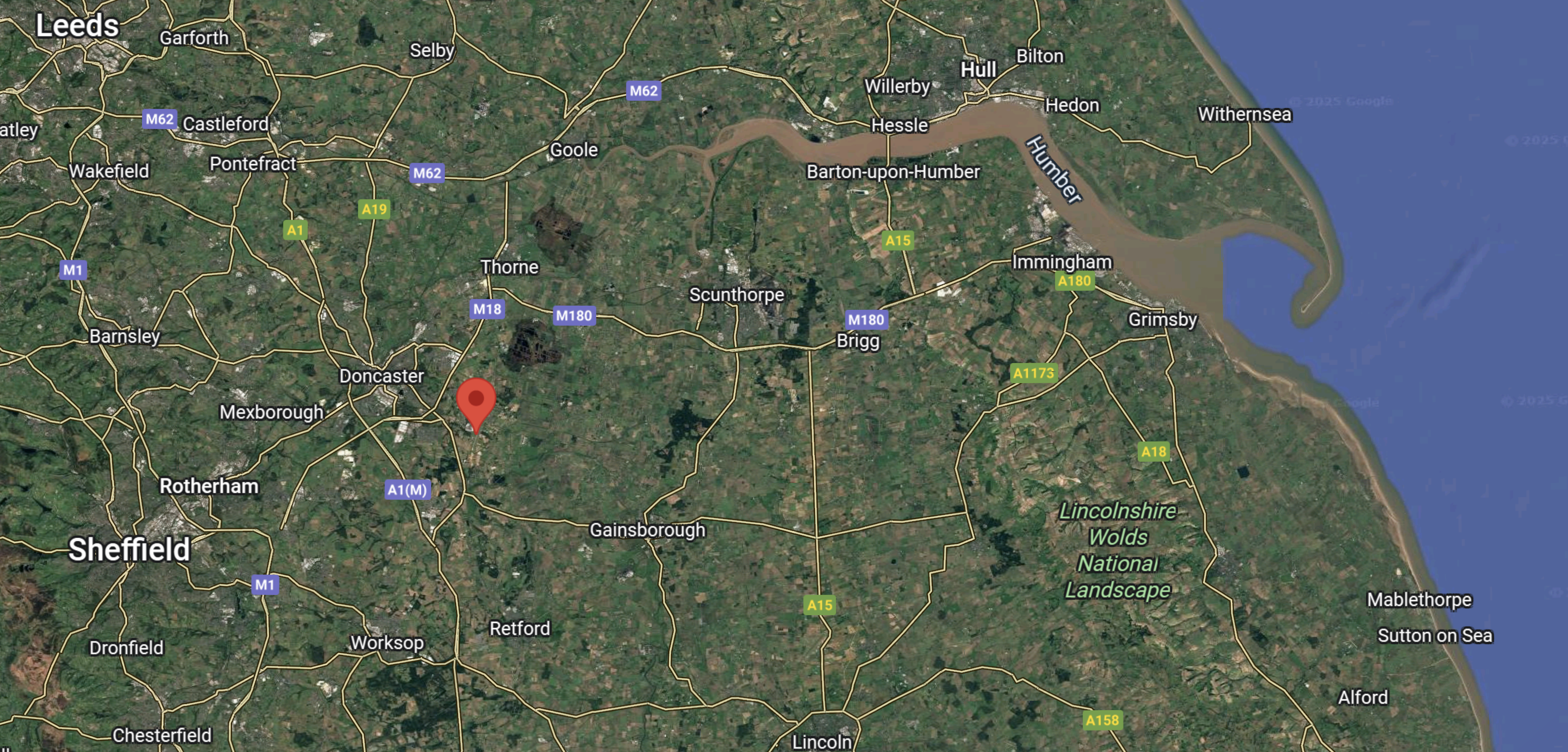
Note.
- The distinctive mouth of the River Humber can be picked out towards the North-East corner of the map.
- Hull and Grimsby sit in the mouth of the Humber.
- The red arrow indicates Doncaster Sheffield Airport.
- Leeds is in the North-West corner of the map.
- The towns and city of Doncaster, Rotherham and Sheffield can be picked out to the West of the airport.
This second Google Map shows a close-up of the airport.

On my visit to NASA in the 1980s, where an Artemis system was used to project manage the turnround of the Space Shuttle, I was asked questions by one of NASA’s support people about RAF Finningley. Nothing too technical, but things like what is Doncaster like.
When I asked why, they said there’s a high chance that a Space Shuttle could land at RAF Finningley, as it has one of the best runways for a very heavy aircraft in Europe.
Looking at the runway, it is a long and wide runway that was built for heavy RAF nuclear bombers like Valiants, Victors and Vulcans.
I believe that we will eventually see hydrogen- and/or nuclear-powered airliners flying very long routes across the globe, just as a nuclear-powered example, attempted to do in the first episode of the TV series Thunderbirds, which was called Trapped in the Sky and has this Wikipedia entry.
Just as the Space Shuttle did, these airliners and their air-cargo siblings will need a large runway.
Doncaster Sheffield Airport already has such a runway.
These hydrogen- and nuclear-powered aircraft will make Airbus A 380s look small and will need runways like the one at Finningley.
But I don’t think we’ll ever see nuclear-powered aircraft in the near future, so the aircraft will likely be hydrogen.
Other things in favour of making Doncaster Sheffield Airport, an airport for long range hydrogen aircraft include.
- The airport is close to the massive hydrogen production and storage facilities being developed on Humberside at Aldbrough and Rough.
- The airport could be connected to the Sheffield Supertram.
- The airport could be connected to the trains at Doncaster station, which has 173 express trains per day to all over the country.
- The airport would fit well with my thoughts on hydrogen-powered coaches, that I wrote about inFirstGroup Adds Leeds-based J&B Travel To Growing Coach Portfolio
- The airport might even be able to accept the next generation of supersonic aircraft.
- The airport could certainly accept the largest hydrogen-powered cargo aircraft.
- The Airport isn’t far from Doncaster iPort railfreight terminal.
Did I read too much science fiction?
I have some further thoughts.
Do Electric Aircraft Have A Future?
I asked Google AI this question and received this answer.
Yes, electric aircraft absolutely have a future, especially for short-haul, regional, and urban air mobility (UAM), promising quieter, zero-emission flights, but battery limitations mean long-haul flights will rely more on hydrogen-electric or Sustainable Aviation Fuels (SAF) for the foreseeable future. Expect to see battery-electric planes for shorter trips by the late 2020s, while hybrid or hydrogen solutions tackle longer distances, with a significant shift towards alternative propulsion by 2050.
That doesn’t seem very promising, so I asked Google AI what range can be elected from electric aircraft by 2035 and received this answer.
By 2035, fully electric aircraft ranges are expected to be around 200-400 km (125-250 miles) for small commuter planes, while hybrid-electric models could reach 800-1,000 km (500-620 miles), focusing on short-haul routes due to battery limitations; larger, long-range electric flight remains decades away, with hydrogen propulsion targeting 1,000-2,000 km ranges for that timeframe.
Note.
- I doubt that many prospective passengers would want to use small commuter planes for up to 250 miles from Doncaster Sheffield airport with hundreds of express trains per day going all over the UK mainland from Doncaster station.
- But Belfast City (212 miles), Dublin (215 miles) and Ostend (227 miles), Ronaldsway on the Isle of Man (154 miles) and Rotterdam(251 miles) and Schipol 340 miles) may be another matter, as there is water to cross.
It looks like it will be after 2035 before zero-carbon aircraft will be travelling further than 620 miles.
My bets would be on these aircraft being hydrogen hybrid aircraft.
What Will The Range Of Hydrogen-Powered Aircraft In 2040?
I asked Google AI this question and received this answer.
By 2040, hydrogen-powered commercial aircraft are projected to have a range that covers short- to medium-haul flights, likely up to 7,000 kilometers (approximately 3,780 nautical miles), with some models potentially achieving longer ranges as technology and infrastructure mature.
The range of these aircraft will vary depending on the specific technology used (hydrogen fuel cells versus hydrogen combustion in modified gas turbines) and aircraft size.
It looks like we’ll be getting there.
This Wikipedia entry is a list of large aircraft and there are some very large aircraft, like the Antonov An-225, which was destroyed in the Ukraine War.
A future long-range hydrogen-powered airline must be able to match the range of current aircraft that will need to be replaced.
I asked Google AI what airliner has the longest range and received this reply.
The longest-range airliner in service is the Airbus A350-900ULR (Ultra Long Range), specifically configured for airlines like Singapore Airlines to fly extremely long distances, reaching around 9,700 nautical miles (18,000 km) for routes like Singapore to New York. While the A350-900ULR holds records for current operations, the upcoming Boeing 777-8X aims to compete, and the Boeing 777-200LR was previously known for its exceptional range.
I believe that based on the technology of current successful aircraft, that an aircraft could be built, that would be able to have the required range and payload to be economic, with the first version probably being a high-capacity cargo version.
What Would An Ultra Long Range Hydrogen-Powered Airliner Look Like?
Whatever the aircraft looks like it will need to be powered. Rolls-Royce, appear to be destining a future turbofan for aircraft called the Ultrafan, which has this Wikipedia entry.
I asked Google AI, if Rolls-Royce will produce an Ultrafan for hydrogen and received this answer.
Rolls-Royce is actively developing the UltraFan architecture to be compatible with hydrogen fuel in the future, but the current UltraFan demonstrator runs on Sustainable Aviation Fuel (SAF). The company has a research program dedicated to developing hydrogen-powered engines for future aircraft, aiming for entry into service in the mid-2030s.
I asked Google AI, if Rolls-Royce have had major difficulties converting engines to hydrogen and received this answer.
Rolls-Royce has not encountered insurmountable difficulties but faces significant engineering and logistical challenges in converting engines to run on hydrogen. The company has made substantial progress in testing both stationary and aero engines using pure hydrogen, confirming its technical feasibility.
Given the company’s success in developing engines in the past, like the R Type, Merlin, RB 211, Pegasus, Trent, mtu 4000 and others, I suspect there’s a high chance of a successful hydrogen-powered Ultrafan.
If you look at a history of large passenger and cargo aircraft over the last sixty years, there has been a lot of the following.
- Conversion of one type of aircraft to a totally different type.
- Fitting new engines to a particular type.
- Fitting new avionics to a particular type.
Examples include.
- Fitting new CFM-56 engines to DC-8s.
- The first two Nimrods were converted from unsold Comet 4Cs.
- Converting Victor bombers to RAF tanker aircraft.
- Converting BA Tristars to RAF tanker aircraft.
- Converting DC-8s to cargo aircraft.
- Airbus converted five Airbus A 300-600 into Belugas, which have this Wikipedia entry.
- Airbus converted six Airbus A 330-200F into BelugaXLs, which have this Wikipedia entry.
- Converting two Boeing-747s to carry Space Shuttles ; one from American Airlines and one from Japan Airlines, which have this Wikipedia entry.
Note.
- Most of these examples have been successful.
- The last three examples have been very successful.
- Most of these applications do not have a human cargo.
This picture shows an Emirates Air Lines’s Airbus A 380 on finals at Heathrow.

Note.
- The aircraft was landing on Runway 27 L.
- The four engines and the vertical oval cross-section of the fuselage are clearly visible.
- The Wikipedia entry for the Airbus A 380 shows two floors across the fuselage; the upper floor with eight seats in 2-4-2 and the lower floor with ten seats in 3-4-3, and a pair of LD3 cargo containers in the basement.
I’d be interested to know, how much hydrogen could be put in the basement and how far it could take the plane with a full load of passengers!
This link to the Wikipedia entry, shows the cross section in detail.
Note
I wouldn’t be surprised that the first application of large hydrogen aircraft will be for cargo and it could be an Airbus Beluga or perhaps an Airbus A 380 freighter?
Rail Operator Crosses Line For First Time In Years
The title of this post, is the same as that of this article on the BBC.
This is the sub-heading.
An operator’s first passenger train has crossed a historical and scenic route for the first time in more than a decade.
These three paragraphs give more details about the reason for the trip.
Avanti West Coast’s 07:54 GMT from Wigan was the first to run on the Settle to Carlisle route earlier.
The 73-mile line is renowned for its picturesque views across the Yorkshire Dales and the North Pennines via the Ribblehead viaduct.
The route is usually only used by Northern trains operating between Leeds and Carlisle, but Avanti is using it as a diversion while work to replace the Clifton Bridge take place over the M6 near Penrith.
I’ve only ridden the Route once and that was on a day in 2014, when the weather wasn’t at its best.
Afterwards I wrote Long Live The Settle And Carlisle, so the trip couldn’t have been that bad!
These paragraphs give the reason for and details of the diversion.
The Settle to Carlisle line does not have overhead power lines, meaning Avanti is using bi-mode Class 805 Evero trains which operate on diesel.
Several timetable changes have been made during the engineering works, with disruption expected until 15 January.
Until 5 January, the railway will also be blocked south of Preston, meaning on these days the diverted services are running between Wigan North Western and Carlisle.
But if Great British Railways could get their act together and convert a sufficient number of their Hitachi diesel bi-modes to battery-electric bi-modes and do some testing and a few calculations, the problem would be solved.
In 2021, I wrote Through Settle And Carlisle Service Under Consideration, after Modern Railways wrote an article of the same name.
Could Lumo Run A Lincoln And Glasgow Service Via Doncaster, Leeds And Settle?
In South Yorkshire Now Has Better North-South Connections, I calculated that Doncaster station now has 173 express trains per day, that stop at the station.
So why not add five or six express trains per day to Doncaster, Lincoln, Leeds, Settle, Carlisle and Glasgow?
And why not ask Lumo to run it, as they’d know how to run such a service?
 The Anonymous Widower
