The Cure For White Coat Hypertension
At one of my previous GP practices the two excellent nurses had banned my GP from taking blood pressure as she always raised the patient’s blood pressure, by the way she took the pressure.
This page on a blog at the London Cadiovascular Clinic is entitled White Coat Hypertension, gives this definition.
White coat syndrome, also known as white coat hypertension is a phenomenon in which your blood pressure is artificially raised due to the stress of being in a clinic, hospital, or even just taking your own blood pressure. This usually happens due to the stress and anxiety associated with having medical investigations done. Your reading will be higher than it would be if you measured it at home.
A week ago, I had a message from my GP practice to come in and measure my blood pressure in their machine in the waiting room.
So I went in and took my blood pressure about an hour ago.





I just put my hand in the hole at the front, shook hands with the machine, pressed the green button on top and it inflated a glove around my hand and lower arm to take the pressure.
Ears Are A Black Body
When I worked for ICI in Runcorn in 1968, one of my colleagues; John Baxendale developed or acquired one of the first remote infra-red thermometers.
ICI needed one for taking the temperature of hot vessels , pipes and reactors on chemical plants and in laboratories. John’s thermometer solved the problem, by measuring the black body radiation of the object.
John found that to calibrate his instrument he could point it at a colleague’s ear. As the ears emit black body radiation, the device should have read 36.9°C, as it generally did.
These so-called tympanic thermometers are now in regular use and cost about twenty pounds.
John is one of those people that has stuck in my mind from all those years in the past. He was a surfer and probably the only one, I’ve ever met in my life. I remember some weekends, he used to take his Morris Minor Traveller all the way to the North of Scotland to go surfing. Visiting that area has been on my bucket list for years. The closest I got, was to fly in my Cessna 340A to the Orkneys.
Poo power To Heat Homes In West London As Thames Water Continues To Reduce Its Carbon Footprint
The title of this post, is the same as that of this press release from Thames Water.
These are the three bullet points.
- Thames Water unveils its second successful gas-to-grid project.
- Around 4000 homes in West London will be heated using converted sewage sludge from Mogden sewage treatment works starting early this year.
- This initiative is part of Thames Water’s commitment to reduce its carbon emissions across its operations thereby reducing its contribution to the causes of climate change.
These three paragraphs outline the project.
Thames Water has announced sewage sludge will be used to heat homes in West London early this year, after successfully delivering its second gas-to-grid (G2G) project, at its Mogden Sewage Treatment Works (STW).
The success of the gas-to-grid model established at Deephams STW in North London in 2021, where biogas is converted into biomethane to heat homes in Enfield, served as the blueprint for the project at Mogden.
Currently serving over 2 million customers, Mogden is the third largest STW in the UK, and has the potential to reach and supply gas to 4000 homes in West London. This comes as part of the company’s commitment on energy transition, by transforming the way it creates and uses power to reach net zero carbon emissions.
The press release then gives a paragraph of explanation as to how the system works.
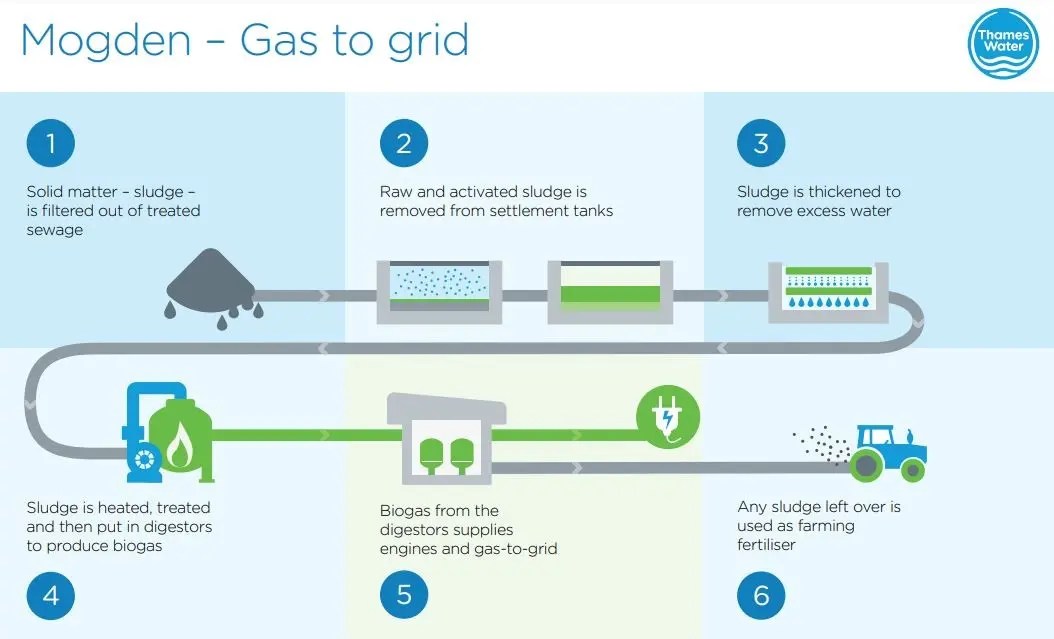
A byproduct of the sewage treatment process is sewage sludge, which is then digested to produce BioGas. Mogden STW then generates electricity with this BioGas via Combined Heat and Power (CHP) engines. The Gas-to-Grid plant, which will be managed by gas supplier SGN, intends to take a proportion of this BioGas and to ‘uprate’ it to export quality which is achieved by filtering, scrubbing and then compressing gas so it can be used as fuel for cooking and heating.
This Thames Water graphic illustrates the process.
This press release is not Thames Water’s image from many of its customers.
RWE And National Grid Answer New York Offshore Wind Call
The title of this post, is the same as that of this article on offshoreWIND.biz.
This is the sub-heading.
Community Offshore Wind, a joint venture of RWE and National Grid Ventures, has submitted a proposal to the New York State Energy Research and Development Authority (NYSERDA) to develop 1.3 GW of new offshore wind capacity in response to New York’s expedited fourth competitive offshore wind solicitation.
These four paragraphs add more details.
This next phase of the project builds upon Community Offshore Wind’s provisional offtake award to deliver 1.3 GW of wind capacity as part of New York’s third solicitation for offshore wind. In total, the projects are expected to generate USD 4.4 billion in economic benefits to New York.
Combined with its provisionally awarded New York project, Community Offshore Wind is on track to deliver nearly USD 100 million in workforce and economic development investments, the developer said.
The new proposal includes nearly USD 50 million in funding for workforce and community initiatives, with a focus on creating opportunities for diverse New Yorkers and supporting local non-profit organizations.
The proposal also includes an investment of up to USD 10 million in the offshore wind supply chain, to help New York businesses prepare for the economic opportunities the growing industry will create. All of these commitments are contingent on NYSERDA’s final selections.
is this partly a result of the meeting between Energy Security Secretary Claire Coutinho and Germany’s Vice Chancellor, Robert Habeck, that I wrote abut in UK And Germany Boost Offshore Renewables Ties?
We certainly seem to be getting some good deals on renewable energy these days with the Germans and the Koreans.
Perhaps someone in the government is doing something right?
New British Steel Rail Stocking Facility Will Boost Network Rail Supply Chain
The title of this post, is the same as that of this article on RailUK.
These four paragraphs outline the new facility and how it will work.
British Steel is building a new £10 million rail stocking facility, the biggest of its kind in the country.
The facility, at the company’s Scunthorpe site, is scheduled to be completed this summer and will stock around 25,000 tonnes of 108-metre finished rail.
The investment is part of our British Steel’s strategy to support the supply of 56E1 and 60E2 section rails for Network Rail, ensuring there is rail stock readily available for its supply chain.
Rails stocked in the new facility will all have undergone the stringent testing and quality assurance checks required to meet the specification to allow immediate dispatch or welding into 216-metre lengths to the customer.
With all the gloom in the steel industry, It’s good to see someone investing in new facilities.
Ten Spanish Companies Join Forces To Apply Hydrogen Propulsion To A High-Speed Train For The First Time
The title of this post, is the same as that of this press release from Talgo.
These are the three bullet points.
- The Hympulso project is part of the Strategic Projects for Economic Recovery and Transformation (PERTES)
- A new technical car with hydrogen and batteries to be developed for a Talgo 250 train, allowing it to run on clean energy on non-electrified lines.
- The main partners are Talgo, Golendus, Ingeteam, Repsol, Sener and Optimus3D.
These are the first four paragraphs.
Ten Spanish companies have joined forces to design, build and install, for the first time in the world, a propulsion system based on renewable hydrogen fuel cells on a high-speed train. Under the Hympulso project, the companies will develop a set of technologies that can be applied to the Talgo 250 ‘all-terrain’ train, making it possible to electrify the rail network with energy generated entirely from renewable sources, even on lines without overhead power lines.
Led by Talgo, Hympulso also includes Golendus, Ingeteam, Optimus3D, Repsol and Sener as partners. Universidad Pontificia Comillas and Tecnalia are collaborators, while Adif is an observer. The initiative has received a grant of €6.5 million and is part of the Incentive Programme for the Innovative Value Chain and Knowledge of Renewable Hydrogen, as part of the Recovery, Transformation and Resilience Plan.
Hympulso will be comprehensive in nature: it will activate the entire renewable hydrogen value chain in the railway system, from production to consumption. The project will also make it possible to analyse the impact of the future transition on the various railway infrastructure assets managed by Adif, such as maintenance facilities or the track.
Thus, the project will result in a joint output of hydrogen supply installations adapted to railways -both mobile and static- and a pioneering prototype of a hybrid bimodal train for passengers with automatic track-gauge change, which will be able to run both on conventional and high-speed networks, using catenary supply when available, or hydrogen and batteries in those corridors that are not electrified.
This picture shows a visualisation of the train.

Note.
- There is a power car containing the hydrogen fuel cells and other gubbins behind the one or both locomotives.
- Hydrogen power is used, where there is no electrification.
- Talgo already make a high speed train with a diesel power pack, so engineering would only involve developing a new hydrogen power pack.
My only questions are.
- Do the trains come without gauge-changing?
- Could they be run on a typical UK rail line?
- Do they speak, Cornish, Gaelic and Welsh?
If the answer to all questions is yes, then this must be the ideal train for these routes.
- London Euston and Aberystwyth
- London Euston and Holyhead
- London King’s Cross and Aberdeen.
- London King’s Cross and Cleethorpes/Grimsby
- London King’s Cross and Inverness.
- London King’s Cross and Thurso/Wick.
- London Paddington and Carmarthen
- London Paddington and Penzance
Note.
- No more electrification on these routes would be needed.
- The trains could use High Speed Two to wherever it goes.
- The trains could do 140 mph on the Great Western Main Line, East Coast Main Line and West Coast Main Line.
Hympulso looks a very comprehensive, professional and practical plan, that could easily be adapted to the UK mainland.
British Gas Joins Forces With Samsung To Help Customers Power Smarter Energy Use
The title of this post, is the same as that of this press release from Centrica.
This is the sub-heading.
British Gas and Samsung have today announced the exciting first step in a long-term venture – aimed at helping customers better manage their energy use and increase the adoption of low carbon heating technologies in homes across Britain.
These are the first two paragraphs.
The collaboration will see British Gas integrate with Samsung’s SmartThings app to help customers optimise their home appliances to use energy when the cost and demand are lower. This is now possible through the integration of SmartThings Energy and British Gas’ PeakSave demand flexibility scheme informing customers (by sending notifications via their smartphone, TV or other compatible devices) of the best times to use household appliances to save money.
The PeakSave scheme includes PeakSave Sundays, running every Sunday until the end of February with half-price electricity from 11am to 4pm for British Gas customers and PeakSave Winter events which encourages customers to move their electricity use out of peak times when there is high demand on Britain’s energy grid.
As a Graduate Control Engineer, I believe that this could make optimising your energy use much easier.
- It would surely be a lot easier to check usage on your phone rather than a smart meter, when you perhaps cook a ready meal, so that you can see if your microwave or traditional cooker is cheapest.
- Suppose you and everybody, who lives with you are out for supper and British Gas want to cut off your gas for a reward, you can make an appropriate decision.
- Hopefully, if you have the right controls, you’ll be able to switch lights and appliances off and on.
The possibilities are endless.
I shall certainly be looking at the reviews of this app.
There is a section in the press release called Scaling Up Low Carbon Heating Opportunities, where this is said.
The collaboration will also help support customers in their journey to decarbonising their homes by introducing smart technologies in a way that is simple and empowering. From early 2024, British Gas will include Samsung heat pumps in its offering to British households to support the UK’s commitment to reach net zero by 2050.
The venture will see specially trained British Gas surveyors and engineers working with consumers to explain the benefits of heat pumps and then conducting the installations on-site. Samsung will be supporting workforce training as part of their efforts to upskill the heating industry to ensure there are enough installers to service the expected growing demand.
British Gas also offers customers the chance to purchase heat pumps through flexible financing methods. This, combined with the recently increased UK Government Boiler Upgrade Scheme grant of £7,500, creates an attractive package of financing options to help people make the transition more affordable.
Various plumbers, who I would trust, have given me different views about heat pumps.
I suspect the Samsung’s SmartThings app might be able to simulate your energy usage with or without the heat pump, as it would know your energy use with your current boiler.
I was doing similar calculations for chemical plants in the early 1970s at ICI, using a PACE 231-R computer.

Consider.
- It may look rather old fashioned, but it could solve a hundred simultaneous differential equations in one go.
- Two similar computers linked together were the analogue half of NASA’s moon mission simulator.
- Without these wonderful machines, NASA would not have been able to re-calculate the dynamics of Apollo 13 and the mission would be remembered as a disaster, rather than the first space rescue.
The average current smart phone has more computing power than a PACE 231-R.
What’s In It For Samsung?
I have a Samsung television, but unfortunately it has a screen fault because of age. So if I had the Samsung app and liked it, I might buy another Samsung TV.
Similarly, the app might give me a financial reason to buy a Samsung heat pump.
Samsung will sell more equipment.
What’s In It For Centrica?
Centrica would appear to be a loser, as bills will fall and they could be paying customers to not use energy.
But they are surely hoping that their market share will increase and I’m sure Samsung will give them a commission.
What’s In It For The Consumer?
Hopefully, they’ll get lower energy bills.
But also they might get a lot of convenience controlling their appliances and heating.
Conclusion
Using energy is becoming a computer game with monetary rewards.
Is the deal between Centrica/British Gas and Samsung another deal that has been brought to fruition by the Korean President’s visit to the UK?
It looks like this is the third recent deal signed between UK and Korean companies, after these two.
- South Korea, UK Strenghten Offshore Wind Ties
- UK And South Korea Help Secure Millions For World’s Largest Monopile Factory
I suspect, there might be a few more deals, if Charles and Camilla really turned on the charm.
In Mersey Tidal Project And Where It Is Up To Now, I wrote about talks between Liverpool City Council and Korea Water about a tidal barrage of the Mersey. This project must surely be a possibility!
This is said in the Wikipedia entry for Korean Air under Fleet Plans.
At the Association of Asia Pacific Airlines Assembly in 2018, Korean Air announced that it was considering a new large widebody aircraft order to replace older Airbus A330, Boeing 747-400, Boeing 777-200ER and Boeing 777-300. Types under consideration for replacement of older widebody aircraft in the fleet include the Boeing 777X and Airbus A350 XWB. At the International Air Transport Association Annual General Meeting (IATA AGM) in Seoul, Chairman Walter Cho said Korean Air’s widebody order is imminent and it is considering an extra order of Airbus A220 Family including developing version, Airbus A220-500.
Note.
- Airbus A350 XWB have Welsh wings and Rolls-Royce engines.
- Airbus A220-500 are made in Canada with wings and composite parts from Belfast. Rolls-Royce may have a suitable engine.
Could a deal have something in it for the UK?
Although Korea has its own SMR program, I wonder, if there could be a link-up between Korean industry and Rolls-Royce over SMRs?
BESS Projects Represent ‘Encouraging Progress’ in New York Efforts To Replace Dirty And Polluting Peakers
The title of this post, is the same as that of this article on Energy Storage News.
These are the first three paragraphs.
Battery storage is playing an active role in helping New York City retire its fleet of peaker power plants, with around 700MW of its most polluting power generation assets already fully retired.
According to a new report, 4,019MW – about two-thirds of a 6,093MW fleet – has either retired or put in place plans to replace turbines with cleaner technologies since New York adopted its climate goals and environment protection policies in 2019.
In addition to 700MW already retired, around the same amount again is actively being moved towards end of life.
Note.
- Just over 6,000 MW seems a lot of extra peaker power, even for a city as large as New York.
- But at least over 4 GW has been retired or the plans to replace it with cleaner technologies are in place.
- The New Yorkers certainly seem to be getting on with the conversion, with about a GW/per year either retired or planned to do so.
The article says this about batteries.
Battery storage is one of a number of different technologies that can be used to replace peaking capacity. While lithium-ion batteries with 4-hour duration might be the most directly analogous in terms of technical capability to peakers, effectively retiring the power plants could be facilitated with a combination of other resources including rooftop solar, offshore wind and energy efficiency measures.
I find the 4-hour duration interesting, but I suspect the Yanks know what they’re doing.
So if you were going to replace the 240 MW Glanford Brigg power station, which Centrica describe as a peaker station, with energy storage, you’d use a 240 MW/960 MWh battery, if you were working to New York rules.
Batteries in the UK, that I’ve talked about lately include.
Amp Hunterston – 400 MW/800 MWh – 2 hours
Amp Kincardine – 400 MW/800 MWh – 2 hours
- Carlton Energy Park – 1040 MW/2080 MWh – 2 hours – Close to an 884 MW gas-fired power station.
- Coalburn – 500 MW/1000 MWh – 2 hours- Close to a 946 MW collection of wind farms.
- Gateway Energy Centre – 450 MW/900 MWh – 2 hours – Close to an 732 MW gas-fired power station.
- Normanton Energy Reserve – 500 MW/1000 MWh – 2 hours
- Richborough Energy Park – 100 MW/100 MWh – 1 hour
- Spalding Energy Centre – 550 MW/1100 MWh – 2 hours – Close to an 860 MW gas-fired power station.
Note.
- The first field is Output/Storage Capacity.
- The second field is the duration.
- I have assumed Spalding Energy Centre is another two hour duration system, like Gateway Energy Centre, which is also being developed by Intergen.
- Two hours seems to be the most common duration for a UK battery.
Adding the batteries up gives a virtual 3940MW/7780MWh battery.
It amazing how they add up to quite large values. But then every little helps!
And these are only the ones I’ve talked about.
HyperTunnel Wins Government Backing For Revolutionary Underpass Tech
The title of this post, is the same as that of this article on Rail Technology Magazine.
This is the sub-heading.
Pioneering tunnel builders hyperTunnel have scored a major coup, securing UK government funding to showcase their revolutionary swarm construction technique at the Global Centre of Rail Excellence (GCRE) in South Wales.
These four paragraphs outline hyperTunnel and its demonstration project at the GCRE.
Their underpass project is one of just 16 cutting-edge schemes set to be unveiled at the GCRE’s Dulais Valley site this year. hyperTunnel’s brainchild, the swarm construction technique, harnesses the power of AI, digital surveying, and robot swarms to essentially 3D print tunnels directly in the ground, eliminating the need for messy excavation.
This futuristic approach it hopes will transform underground construction, whilst slashing costs and timeframes. It can also help contribute to waste reduction, risk prevention and help reduce a projects carbon footprint compared to the traditional cut-and-cover methods which are frequently used.
Their GCRE project will see them build a 20-metre pedestrian underpass beneath a test track, cleverly designed to keep the track operational throughout construction.
hyperTunnel’s overarching vision is to offer a financially viable alternative to perilous level crossings which it anticipates will boost safety, and increase rail capacity.
Note.
- To learn more visit hyperTunnel’s web site.
- The mission statement on the home page is Transforming Underground Construction Through AI, Machine Learning And Swarm Robotics.
I like this technology and think it will go a long way. Hopefully, in the right direction.
The Biggest Strawberry In The World
I eat a lot of strawberries, either as fruit or as jam on a scone or bread.
- I always have done since I left home to go to Liverpool University.
- I do wonder, if it was a subconscious decision on my part, as my body reacted to all the alternatives like puddings with all their gluten.
- Certainly, by the time, I was married, I know that I always annoyed my mother-in-law by never eating her gluten-rich puddings.
- Strawberries were also my wife’s passion, when she was pregnant.
Have other coeliacs avoided gluten before diagnosis. I certainly did.
Today, I bought a punnet of strawberries in Marks & Spencer.

Note.
- They were Spanish strawberries.
- To say they were large would be an understatement.
- One weighed in at a massive 64 grammes.
But they all tasted fine with a good texture!
 The Anonymous Widower