SSE Thermal Outlines Its Vision For The UK’s Net Zero Transition
The title of this post is the same as that of this news item from SSE Thermal.
This is the opening statement.
SSE Thermal, part of SSE plc, is calling on government to turbocharge the delivery of low-carbon technologies to help deliver a net zero power system by 2035.
Two paragraphs then outline what the company is doing.
The low-carbon developer is bringing forward multiple low-carbon projects across the UK. This includes Keadby 3 Carbon Capture Power Station in the Humber – which is being developed in collaboration with Equinor and recently became the first power CCS project in the country to receive planning permission – and Aldbrough Hydrogen Pathfinder, which would unite hydrogen production, storage and power generation in one location by the middle of this decade.
These projects would form part of SSE’s £24bn investment programme in the UK, and in addition to supporting the decarbonisation of industrial heartlands and powering a low-carbon future, they would also help to secure a just transition for workers and communities.
The news item then talks about the future.
Now, SSE Thermal has published ‘A vision for the UK’s net zero transition’ which outlines the need for these low-carbon technologies and the potential of carbon capture and hydrogen in providing flexible back-up to renewables.
It also outlines the steps Government should take to facilitate this:
- Progress the deployment of carbon capture and storage (CCS) and hydrogen infrastructure in a minimum of four industrial areas by 2030.
- Support first-of-a-kind carbon capture and storage and hydrogen projects to investment decisions before the end of next year.
- Increase its ambition for power CCS to 7-9GW by 2030, with regular auctions for Dispatchable Power Agreements.
- Set out a policy ambition for hydrogen in the power sector and a strategy for delivering at least 8GW of hydrogen-capable power stations by 2030.
- Accelerate the delivery of business models for hydrogen transport and storage infrastructure, to kickstart the hydrogen economy.
These are my thoughts.
Carbon Capture And Use
There is no mention of Carbon Capture And Use, which in my view, should go hand in hand with Carbon Capture And Storage.
- Sensible uses for carbon dioxide include.
- Feeding it to plants like tomatoes, flowers, salad vegetables, soft fruit and herbs in greenhouses.
- Mineral Carbonation International can convert a dirty carbon dioxide stream into building products like blocks and plasterboard.
- Deep Branch, which is a spin-out from Nottingham University, can use the carbon dioxide to make animal feed.
- Companies like CarbonCure add controlled amounts of carbon dioxide to ready-mixed concrete to make better concrete and bury carbon dioxide for ever.
Surely, the more carbon dioxide that can be used, the less that needs to be moved to expensive storage.
Note.
- There is a lot of carbon dioxide produced in Lincolnshire, where there are a lot of greenhouses.
- At least three of these ideas have been developed by quality research in Universities, in the UK, Australia and Canada.
- I believe that in the future more uses for carbon dioxide will be developed.
The Government should do the following.
- Support research on carbon capture.
- Support Research on finding more uses for carbon dioxide.
Should there be a disposal premium or tax credit paid to companies, for every tonne of carbon dioxide used in their processes? It might accelerate some innovative ideas!
Can We Increase Power CCS to 7-9GW by 2030?
That figure of 7-9 GW, means that around a GW of CCS must be added to power stations every year.
Consider.
- It is probably easier to add CCS to a new-build power station, than one that is a couple of decades old.
- Better and more affordable methods of CCS would probably help.
- In Drax To Pilot More Pioneering New Carbon Capture Technology, I wrote about a promising spin-out from Nottingham University
- In Drax Secures £500,000 For Innovative Fuel Cell Carbon Capture Study, I wrote about another system at Drax, that captures carbon dioxide from the flue gases at Drax.
If we develop more ways of using the carbon dioxide, this will at least cut the cost of storage.
Can We Deliver At Least 8GW Of Hydrogen-Capable Power Stations By 2030?
Do SSE Thermal mean that these power stations will always run on hydrogen, or that they are gas-fired power stations, that can run on either natural gas of hydrogen?
In ‘A vision for the UK’s net zero transition’, this is said about the hydrogen power stations.
Using low-carbon hydrogen with zero carbon emissions at point of combustion, or blending hydrogen into existing stations.
So if these power stations were fitted with carbon capture and could run on any blend of fuel composed of hydrogen and/or natural gas, they would satisfy our needs for baseload gas-fired power generation.
Hydrogen Production And Storage
SSE’s vision document says this about Hydrogen Production.
Using excess renewables to create carbon-free hydrogen, alongside other forms of low-carbon hydrogen, which can then be stored and used to provide energy when needed.
SSE’s vision document also says this about Hydrogen Storage.
Converting existing underground salt caverns or creating new purpose-built caverns to store hydrogen and underpin the hydrogen economy.
This page on the SSE Thermal web site is entitled Aldbrough Has Storage, where this is said about storing hydrogen at Aldbrough.
In July 2021, SSE Thermal and Equinor announced plans to develop one of the world’s largest hydrogen storage facilities at the Aldbrough site. The facility could be storing low-carbon hydrogen as early as 2028.
With an initial expected capacity of at least 320GWh, Aldbrough Hydrogen Storage would be significantly larger than any hydrogen storage facility in operation in the world today. The Aldbrough site is ideally located to store the low-carbon hydrogen set to be produced and used in the Humber region.
From my own experience, I know there is a similar salt structure in Cheshire, which has also been used to store gas.
Earlier, I said, that one of the things, that SSE would like the Government to do is.
Progress the deployment of carbon capture and storage (CCS) and hydrogen infrastructure in a minimum of four industrial areas by 2030.
If Cheshire and Humberside are two sites, where are the other two?
Deciding What Fuel To Use
If you take the Humberside site, it can provide electricity to the grid in three ways.
- Direct from the offshore and onshore wind farms.
- Using natural gas in the gas-fired power stations.
- Using hydrogen in the gas-fired power stations.
SSE might even add a battery to give them a fourth source of power.
In the 1970s, I used dynamic programming with Allied Mills to get the flour mix right in their bread, with respect to quality, cost and what flour was available.
Finance For SSE Thermal Plans
The news item says this.
These projects would form part of SSE’s £24bn investment programme in the UK.
£24bn is not the sort of money you can realise solely from profits or in sock drawers or down sofas, but provided the numbers add up, these sorts of sums can be raised from City institutions.
Conclusion
I like SSE Thermal’s plans.
Cummins Fuel-Agnostic X Series Platform
This post shows a Cummins video on YouTube about their fuel-agnostic X Series engine.
Irish Green Hydrogen Could Be Europe’s Cheapest In 2030, Aurora Finds
The title of this post, is the same as that of this article on Renewables Now.
These two paragraphs outline the story.
Ireland could produce the cheapest green hydrogen in Europe by 2030, achieving a levelised cost of EUR 3.50 (USD 3.73) per kg under optimal conditions, Aurora Energy Research said on Tuesday.
This would be 8% below optimal production costs in Spain and 35% below those in Germany, with Ireland’s cost advantage driven by the country’s high wind speeds and rising grid congestion.
Aurora also sees the possibility of exports to Germany before 2030.
Hydrogen Engines To Be Mass Produced By Hyundai By 2025
The title of this post, is the same as that, of this article on Hydrogen Fuel News.
This is the sub-heading.
Hyundai Doosan Infracore is accelerating engine development
These are the first two paragraphs.
After the completion of its H2 internal combustion engines (ICE) design and rolling out the prototype, Hyundai Doosan Infracore (HDI) is revving up the development of its hydrogen engines, with the aim to mass produce these engines by 2025.
The hydrogen-powered internal combustion engine can produce a power output of 300 kW (402 HP) and a torque of 1700 NM at 2000 RPM. Fulfilling Tier 5/Stage 5/Euro7 regulation, the engine satisfies the emission requirements to be 90% decreased to the current level to meet Zero CO2 (below 1g/kwh) and Zero Impact Emission.
Note.
- The engine is described as an 11 litre class engine.
- The new hydrogen engines that will be produced will be installed on commercial vehicles, including large buses, trucks and construction equipment.
It should also be noted that Hyundai are investors in Hull-based hydrogen production company; HiiROC, as I wrote about in Centrica Partners With Hull-Based HiiRoc For Hydrogen Fuel Switch Trial At Humber Power Plant.
Hyundai now have the hydrogen internal combustion engine to go with HiiROC, who are developing the means to produce hydrogen at a filling station or depot.
A Problem With The Hydrogen Fuel News Article
This article on Diesel Progress, which is entitled Hyundai Doosan Infracore To Launch Hydrogen Engine covers the same story.
But it shows a different picture of the hydrogen internal combustion engine, which as it looks like one, I assume it is the correct image.
X1 Wind’s Floating Prototype Delivers First Power Offshore Canary Islands
The title of this post, is the same as that of this article on offshoreWIND.biz.
This is the sub-heading.
X1 Wind has announced that its floating offshore wind turbine prototype delivered first power to PLOCAN’s smart grid in the Canary Islands, Spain.
The article is based on this news item from X1 Wind, which is entitled X1 Wind’s X30 Floating Wind Prototype Delivers First kWh, which starts with these two paragraphs.
X1 Wind has announced today (MARCH 07) that its X30 floating wind prototype, installed in the Canary Islands, successfully produced its first kWh.
The milestone marks the world’s only floating wind platform currently installed with a TLP mooring system, which dramatically reduces the environmental footprint and improves compatibility with other sea uses. It further heralds Spain’s first floating wind prototype to export electricity via a subsea cable.
Note.
- TLP is short for tension leg platform, which is described in this Wikipedia entry.
- The TLP Wikipedia entry contains a section, which describes their use with wind turbines.
- TLPs have been in use for over forty years, with the first use in the Hutton field in the North Sea.
- TLPs work well for water depths of between 300 and 1,500 metres.
I also suspect there’s a lot of experience from the oil and gas industry around the world about how to deploy TLPs.
The X1 Wind news item also has this paragraph.
The novel X30 platform is equipped with a specially adapted V29 Vestas turbine and ABB power converter. Another key design feature, developed through the EU-backed PivotBuoy Project, combines advantages of SPM and TLP mooring systems. The proprietary SPM design enables the floater to ‘weathervane’ passively and maximise energy yields, with an electrical swivel ensuring electricity transfer without cable twisting. The TLP mooring system also dramatically reduces the seabed footprint, compared to traditional designs proposing catenary mooring lines, minimizing environmental impact while maximizing compatibility with other sea uses, in addition to its suitability to move into deeper waters.
SPM is short for single point mooring, which is described in this Wikipedia entry, where this is the first sentence.
A Single buoy mooring (SrM) (also known as single-point mooring or SPM) is a loading buoy anchored offshore, that serves as a mooring point and interconnect for tankers loading or offloading gas or liquid products. SPMs are the link between geostatic subsea manifold connections and weathervaning tankers. They are capable of handling any tonnage ship, even very large crude carriers (VLCC) where no alternative facility is available.
Note.
- The use of the weathervane in both paragraphs.
- If an SPM can handle a VLCC, it surely can handle a well-designed floating structure with a wind turbine mounted on top.
- I suspect that an SPM used for a wind turbine will be much simpler than one used to load or unload a gas or oil tanker.
As with TLPs, I also suspect there’s a lot of experience from the oil and gas industry, from around the world about how to deploy SPMs.
It looks to me, that X1 Wind have used the proven attributes of SPMs and TLPs to create a simple mooring for a wind turbine, that is designed to align itself with the wind.
X1 Wind Are Open With Their Technology
Today’s news item from X1 Wind also links to two other useful documents.
- X1 Wind Adaptation Of A Vestas V29 Turbine To Downwind Configuration
- X1 Wind Successfully Installs Floating Wind Platform In Spain
They are certainly open with their information.
The news item, also includes this video.
Thoughts
These are some thoughts.
Capacity Factor
The capacity factor of this wind turbine could be an interesting figure.
As the turbine constantly will turn to be downwind, this should maximise the amount of electricity produced over a period of time.
Tetrahedrons
The design is effectively a tetrahedron.
Alexander Graham Bell knew a lot about the properties of tetrahedrons and invented the tetrahedral kite.
This document details Bell’s involvement with tetrahedrons and says this.
Bell found the tetrahedron to have a very good strength to weight ratio.
Put more simply this means that an object is structurally very strong but at the same time very lightweight.
So X1 Wind’s design is probably extremely strong for its weight.
Large Turbines
X1 Wind’s prototype uses a wind turbine of only 225 KW.
Manufacturers are building 15 or 16 MW turbines now and talking of 20 MW in the next few years.
Given the strength of the tetrahedron, I wonder, if it will be possible to build a PivotBuoy, that is capable of hosting a 20 MW wind turbine?
Conclusion
Although it appears radical, it uses proven technology to generate power in an innovative way.
In some ways the thinking behind the design of this floating technology, is a bit like that of Issigonis in his design for the first Mini, where he took proven technology and arranged it differently to perform better.
Historic Northumberland Line To Reopen Next Summer
The title of this post, is the same as that, of this news story from the UK Government.
This is the sub-heading.
Fully accessible stations are being built to give 6 Northumberland communities regular train services.
And these are the main bullet points.
- Transport Secretary announces regular train services will return to Northumberland Line in 2024
- Journey times will be slashed in half and communities reconnected to jobs and opportunities helping to level up and grow the region’s economy
- Investment forms part of government’s Restoring Your Railway programme, which reopens old stations and lines across the country
Let’s hope this line follows the Dartmoor Line in being a success.
I wrote about this success in Dartmoor Line Passes 250,000 Journeys On Its First Anniversary, As Rail Minister Visits To Mark Official Opening Of The Station Building.
Ørsted Joins Global Offshore Wind Alliance
The title of this post, is the same as that of this article on offshoreWIND.biz.
This is the sub-heading.
Ørsted has become the first energy company to join the Global Offshore Wind Alliance (GOWA) to support a faster deployment of offshore wind and create a global community of action.
These two paragraphs outline GOWA.
GOWA is a new global organisation that brings together governments, the private sector, international organisations, and other stakeholders to accelerate the deployment of offshore wind power.
The alliance was launched last year at COP27 by the International Renewable Energy Agency (IRENA), the Global Wind Energy Council (GWEC), and the Danish government.
For more information look at the GOWA web-site.
Would It Be Possible For The Bakerloo And Watford DC Lines To Use The Same Trains? – 6th March 2023 Update
These two lines are very different.
- The Bakerloo Line is a classic London Underground Line with 25 stations and services run by 1972 Stock trains.
- The Watford DC Line is part of the London Overground with 19 stations and services run by Class 710 trains.
Ten stations are shared between the lines, of which only one; Queen’s Park offers level boarding.
The Shared Stations
The nine shared stations often have considerable steps up and down, as at Willesden Junction station, which is shown in Train-Platform Interface On Platform 1 At Willesden Junction.
I am rather pleased and pleasantly surprised, that there are not more accidents at the shared stations, but using the line must be a nightmare for wheelchair users, buggy pushes and large case draggers.
If Transport for London proposed building a line like this, they would have to launch it at the Hammersmith Apollo, where comedians perform.
The One Train Type Solution
To my mind, there is only one solution. The two services must use the same type of trains.
These are a few thoughts on the trains.
Trains Would Be Underground-Sized
As the trains will have to work through the existing tunnels to Elephant & Castle station, the trains would have to be compatible with the tunnels and therefore sized for the Underground.
I suspect they would be a version of the New Tube for London, that are currently being built by Siemens for the Piccadilly Line.
New Tube For London And Class 710 Train Compared
This Siemens infographic summarises the New Tube For London.
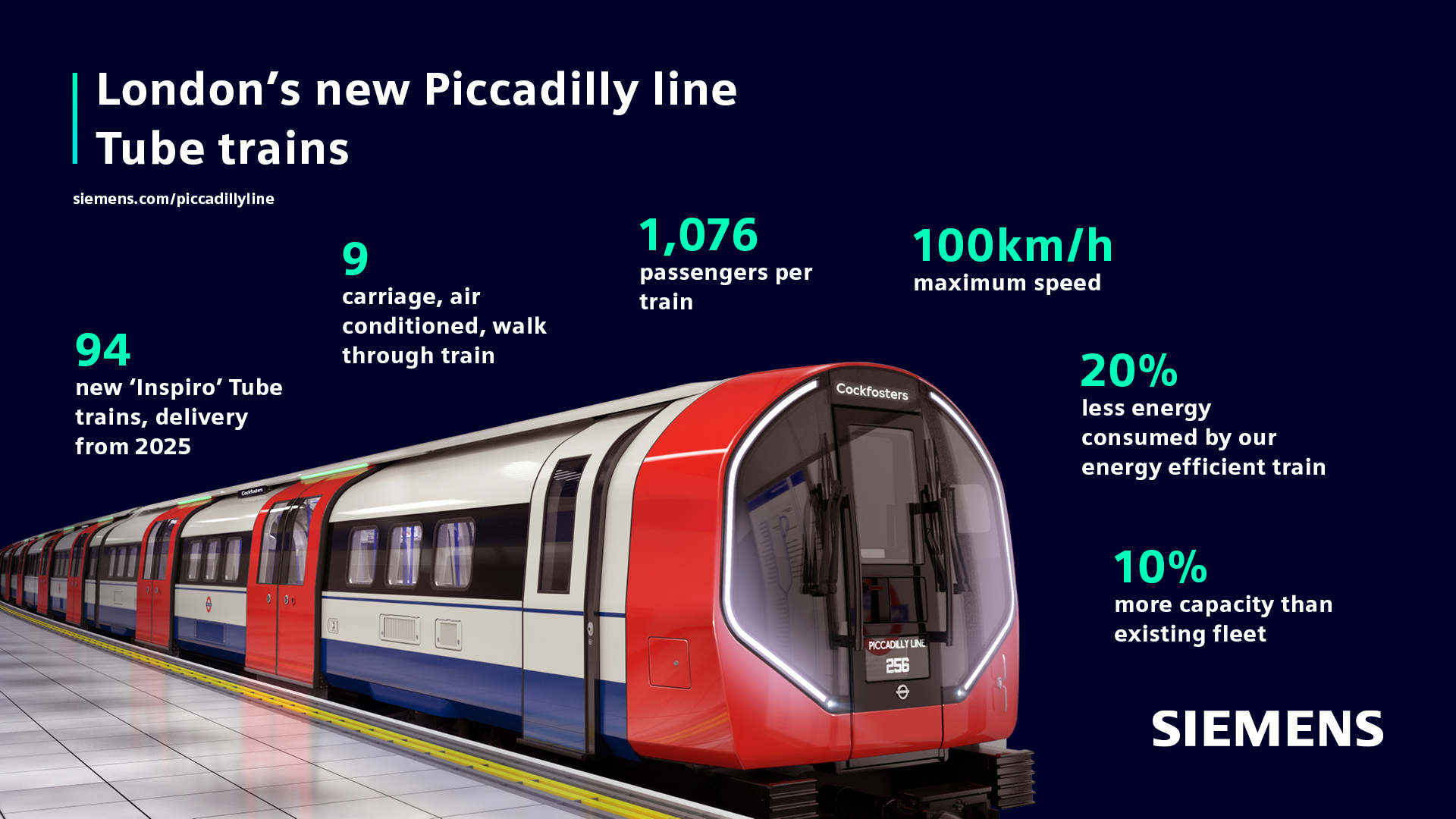
These figures are from Wikipedia.
- Cars – NTFL – 9 – 710 – 4
- Car Length – NTFL – 12.6 metres – 710 – 20 metres
- Train Length – NTFL – 113.4 metres – 710 – 80 metres
- Seated Passengers – NTFL – 268 – 710 – 189
- Total Passengers – NTFL – 1076 – 710 – 678
- Passenger Density – NTFL – 9.5 per metre – 710 – 8.2 per metre
- Speed – NTFL – 62 mph – 710 – 75 mph
Note.
- The figures for the Class 710 train are for a four-car train.
- The passenger density and speed are closer than I thought they’d be.
- I’m sure Siemens can design a longer and/or faster train if required for the Euston service.
I feel that the New Tube for London design could be adjusted , so that it could work the Watford DC service.
Platform Modifications
I suspect that the New Tube for London will be lower than the Class 710 train and all platforms would need to be lowered to fit the new trains.
I would also suspect that it would be easier to lower platforms, than modify them, so that they had dual-height sections to satisfy two classes of train.
It should be noted that the New Tube for London has shorter cars than the sixteen metre 1972 Stock trains currently used on the line, so there will be smaller gaps at stations with curved platforms like Waterloo.
I believe that with one class of train, all of the stations on the Bakerloo and Watford DC Lines could be made step-free between train and platform.
Platform Height On Platform 9 At Euston
I took these pictures on Platform 9 at Euston station.




Note that it is rather a high step into the train and there is a large gap.
But if say, a modern London Underground train from say the Victoria Line pulled into the platform would it be a better fit?
Platform Height At Kilburn High Road Station
These pictures show Kilburn High Road station.





I should have taken more pictures, but the step between the platform and train is similar to Platform 9 at Euston.
Platform Height At South Hampstead Station
These pictures show South Hampstead station.










I should have taken more pictures, but again the step between the platform and train is similar to Platform 9 at Euston.
Were The Platforms At Euston, South Hampstead And Kilburn High Road Built For Another Class Of Train?
This Wikipedia entry is for the London Underground Watford Joint Stock train, where this is said.
The Watford Joint Tube Stock was built for the service to Watford along both the Bakerloo tube and the London North Western Railway. As a result, the cars were owned by both the Underground and the London North Western Railway. To be able to operate on both lines, the car floors were 4+1⁄2 inches (110 mm) higher than other tube cars. This was a compromise height between the platform heights on the two lines.
The cars were ordered in 1914, but construction was delayed by The First World War. As a result, the first cars were not delivered until early 1920.
Note.
- The Wikipedia entry has links to some images of which this is one.
- They must have been rather cramped trains if they were built for deep tunnels and had a floor that was 110 mm higher, than other tube trains.
It certainly appears to be possible to design a train, that would fit both lines.
But would it fit modern regulations and give full step-free access?
Queen’s Park And Euston
This map from cartometro.com, shows the route between Queen’s Park and Euston stations.
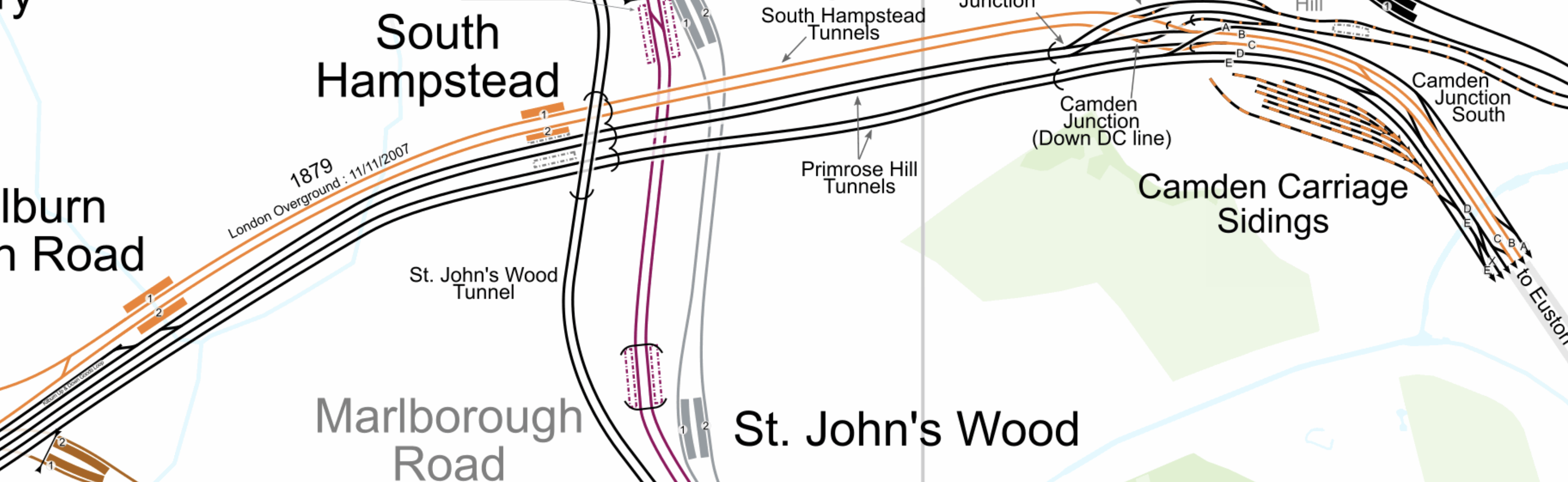
Note.
- The Watford DC Line is shown in orange.
- Queen’s Park station is to the West of Kilburn High Road station.
- It appears that Watford DC Line trains always use Platform 9 at Euston station.
The route seems to be a self-contained third-rail electrified line into Euston station.
On the subject of electrification between Queen’s Park and Euston stations, there would appear to be a choice between the third-rail system and London Underground’s four-rail system.
But it is rumoured that the New Tube for London will have a battery capability.
As Euston and Queen’s Park stations are only 3.7 miles apart, perhaps the choice would be to use battery power into Euston station, which would remove electrified rails from Euston?
How Many Trains Could Run Into Euston?
Currently, four trains per hour (tph) run into Euston.
It is generally accepted that six tph can use a single platform. But would this be enough?
I suppose there is the possibility of tunnelling under Euston station to a pair of terminal platforms.
In that case the current platform could be used by other services.
Southern’s Milton Keynes And Clapham Junction Service
This service wouldn’t be affected as it uses the fast lines between Willesden and Watford Junction.
Advantages Of One Train Type On The Bakerloo And Watford DC Lines
I can think of these advantages.
- Step-free access between train and platform, should be achieved.
- A unified fleet.
- A higher frequency between Euston and Willesden Junction stations.
- Higher frequency where needed.
- If trains had a battery capability, Euston could be free of third-rail electrification.
As only one type of train will be using the Watford DC line between Euston and Watford Junction, this could result in operational efficiencies.
Linking Of The Bakerloo And Abbey Lines
This could be the biggest advantage of all.
This map from cartometro shows the lines at Watford Junction station.
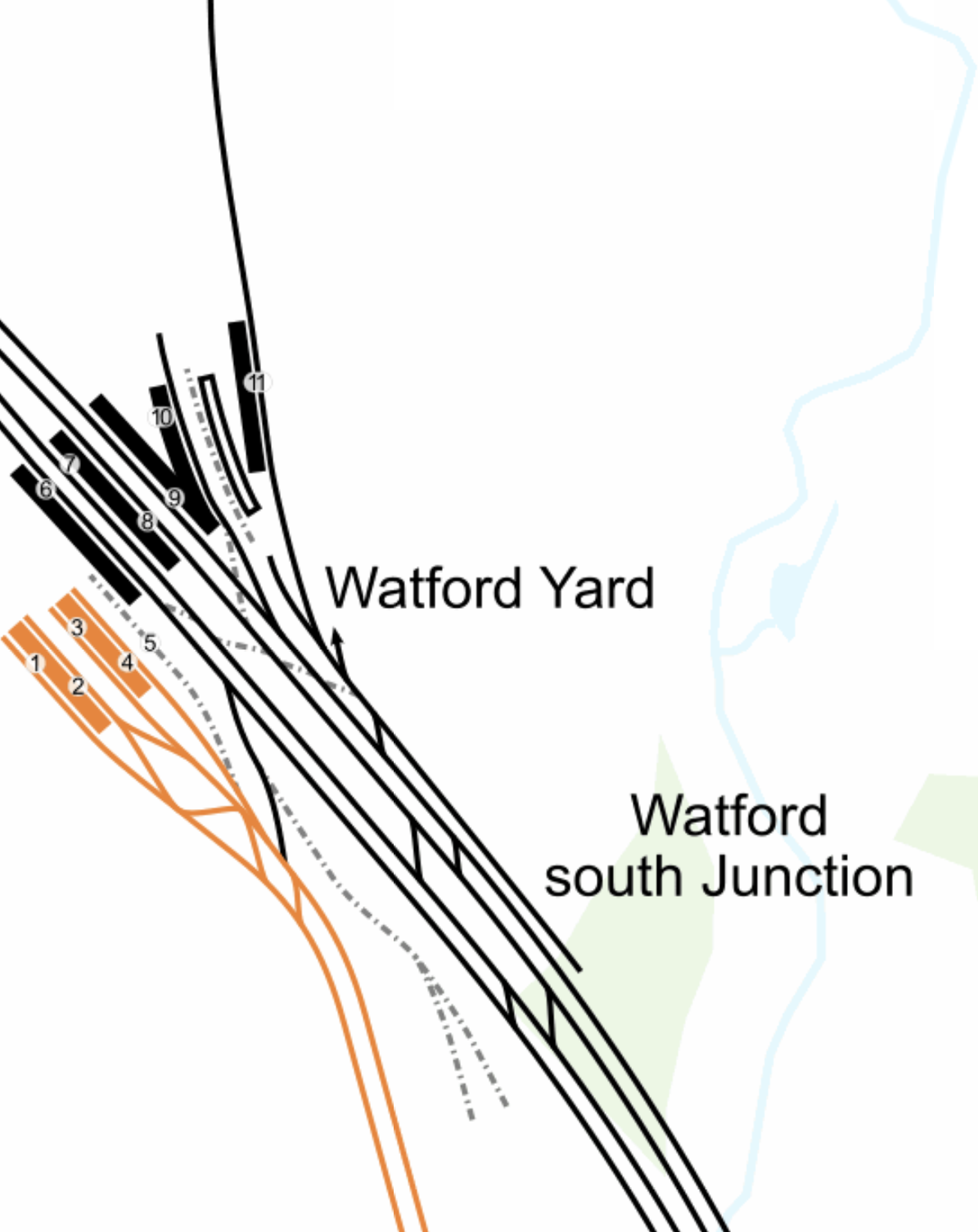
Note.
- The orange lines are the current Watford DC Line services of the London Overground, terminating in platforms 1 to 4 of Watford Junction station.
- These lines would be taken over by the unified Bakerloo/Watford DC Line services, running nine-car New Tubes For London.
- The next station to the South is Watford High Street.
- The West Coast Main Line goes through the station and uses platforms 5 to 10.
- At the North of the station is Platform 11 on the Abbey Line which leads roughly North East to St. Albans.
Look at how the Abbey Line is more or less in line with the twin-tracks of the Watford DC Line.
Recently, during the Bank Station Upgrade, a 488 metre long single track tunnel was built to divert the Southbound Northern Line.
This tunnel was not dug with a tunnel boring machine, but traditionally by hand, using men, picks, shovels and I suspect a few small machines.
I believe, that a similar technique could be used to dig a tunnel, to connect the Abbey Line and the Watford DC Line.
- It would only be single-track
- It would probably be less than 500 metres long.
- It would connect to the Abbey Line to the South of Platform 11.
- It would be deep-level tube-sized.
- It might be dug by hyperTunnel.
- Geography wouldn’t allow the tunnel to terminate in the Watford DC Line platforms at Watford Junction station.
But where would the terminal be on the Southern side of the West Coast Main Line?
This map from OpenRailwayMap, shows the two routes between Watford Junction and Bushey stations.

Note.
- Watford Junction station is at the top of the map.
- The orange line is the West Coast Main Line.
- The yellow line looping to the West of the West Coast Main Line is the double-track Watford DC Line.
- Bushey station is at the bottom of the map, where the two rail lines meet.
- Watford High Street station is in the middle of the map on the Watford DC Line.
The new service could certainly take the Watford DC Line as far as Watford High Street station.
- The station is close to the centre of Watford, the hospital and Vicarage Road stadium.
- But there is no space for a terminal platform.
This second OpenRailwayMap shows the disused railways to the West of Watford High Street station.
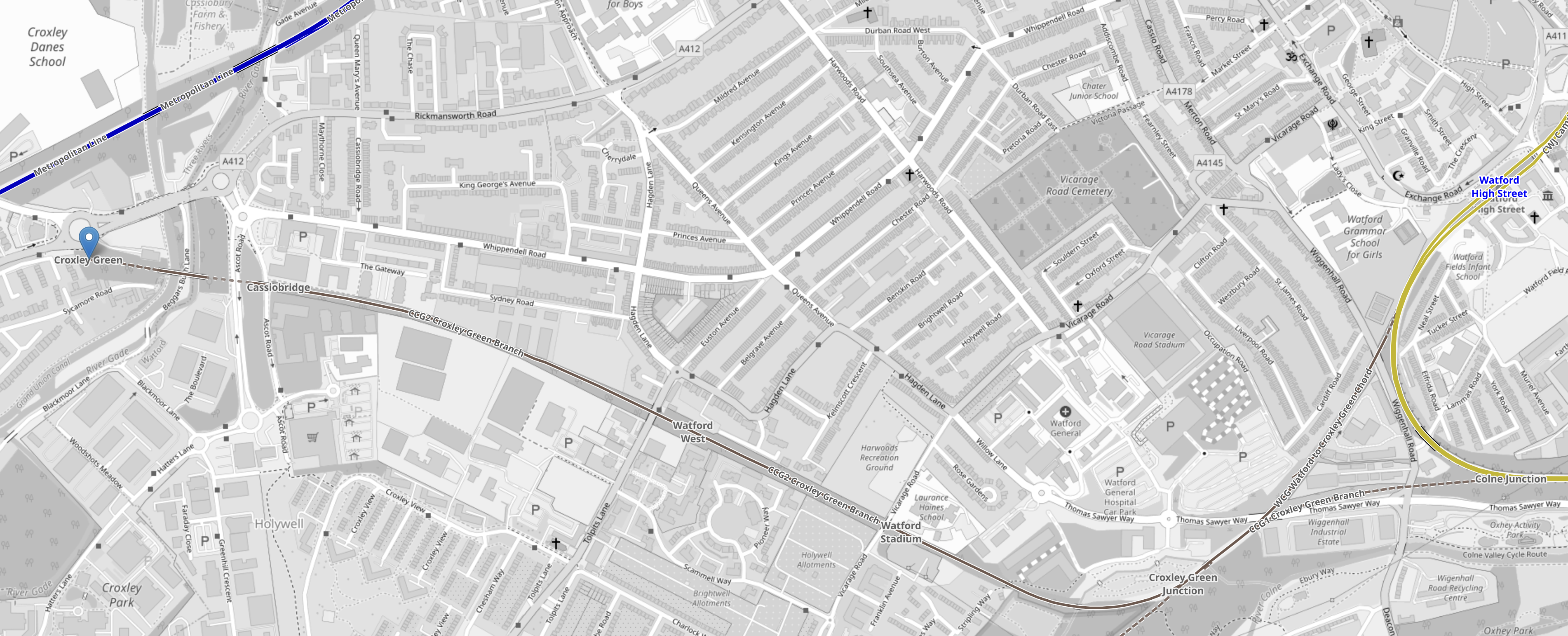
Note.
- The yellow loop at the East of the map is the Watford DC Line.
- Watford High Street station is on this loop.
- There is a triangular junction, that connects the former Croxley Green branch to the Watford DC Line.
- The terminus at Croxley Green station is marked by a blue arrow.
- There used to be intermediate stations at Cassiobridge, Watford West and Watford Stadium.
- This route was used for the failed attempt to build the Croxley Rail Link.
But could a Western extension of the Abbey Line be built?
- It would terminate at either Croxley Green or Cassiobridge.
- There would be intermediate stations at Watford West, Watford Stadium and Watford High Street.
- There would be two tph.
- Trains would be nine-car New Tubes For London.
- The current Abbey Line is 6.4 miles and would be run using battery power, with possible charging at St. Albans Abbey station.
- The tunnel under the West Coast Main Line would be run on battery power.
- The Western extension from Watford High Street station would be run using battery power, with possible charging at the Western end.
I believe, an extended Abbey Line could be a viable alternative to the ill-fated Croxley Rail Link.
- I have used battery power, as I doubt Health and Safety would allow any new third-rail electrification.
- I have used nine-car New Tubes For London for the extended Abbey Line, as their small cross-section would allow a smaller tunnel and they would be certified for running in tunnels.
- Some platforms on the Abbey Line would need to be lengthened, but these would be the only modifications, other than the possible installation of the charging system.
- The extended Abbey Line would serve Watford Hospital and Vicarage Road.
The capacity of the extended Abbey Line would be substantially more than the current line.
Conclusion
A common fleet used by the Bakerloo and Watford DC Line would appear to give advantages and it has been done successfully before.
But what the Bakerloo Line, the Watford DC Line, the Abbey Line and the Bakerloo Line Extension need is a good dose of holistic design.
Green Light For Orkney Transmission Link
The title of this post, is the same as that of this news item from SSE.
These three paragraphs outline the project.
SSE’s Transmission business, SSEN Transmission, has welcomed today’s publication by Ofgem in which the energy regulator has provisionally approved long awaited and much needed plans to provide a subsea electricity transmission link to Orkney.
The Orkney Islands are home to some of the world’s greatest resources of renewable electricity, from established onshore wind, to emerging marine technologies, where Orkney is at the forefront of global developments in marine energy generation.
Following significant growth in small-scale renewable electricity generation in Orkney, the local electricity network has long been at full capacity and no new electricity generation can connect without significant reinforcements.
This paragraph describes the scope of the project.
SSEN Transmission’s proposed solution would enable the connection of up to 220MW of new renewable electricity and consists of a new substation at Finstown in Orkney, and around 57km of subsea cable, connecting to a new substation at Dounreay in Caithness.
200 MW seems a good return for a substation and forty miles of cable.
 The Anonymous Widower
