A Diversion To Severn Beach
After my trip to Cardiff yesterday was curtailed by a signalling problem, I ended up at Bristol Temple Meads station.
After checking the timetable, it occurred to me, that it would be easy to take a diversion to Severn Beach station before I took a train back to London.
I took these pictures on the journey.




























































Note.
- Stapleton Road station has massive ramps.
- Stations like Redland and Avonmouth have interesting art works.
- The Avon, several wind turbines and the Secon Severn Crossing can all be seen.
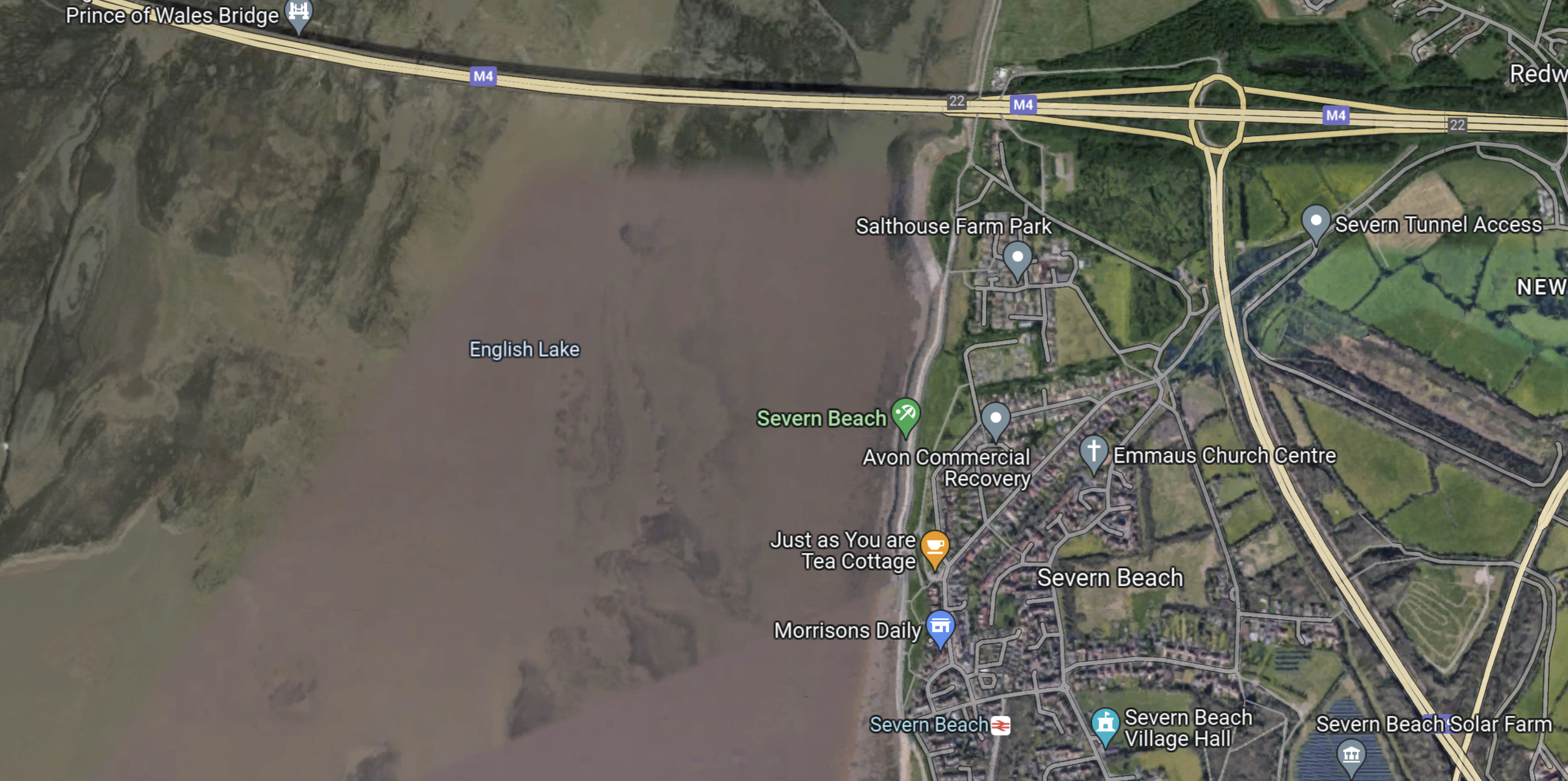
This Google Map shows the location of Severn Beach station.
Note.
- The M4 and the Second Severn Crossing are at the top of the map.
- The rail station icon marking Severn Beach station at the bottom of the map.
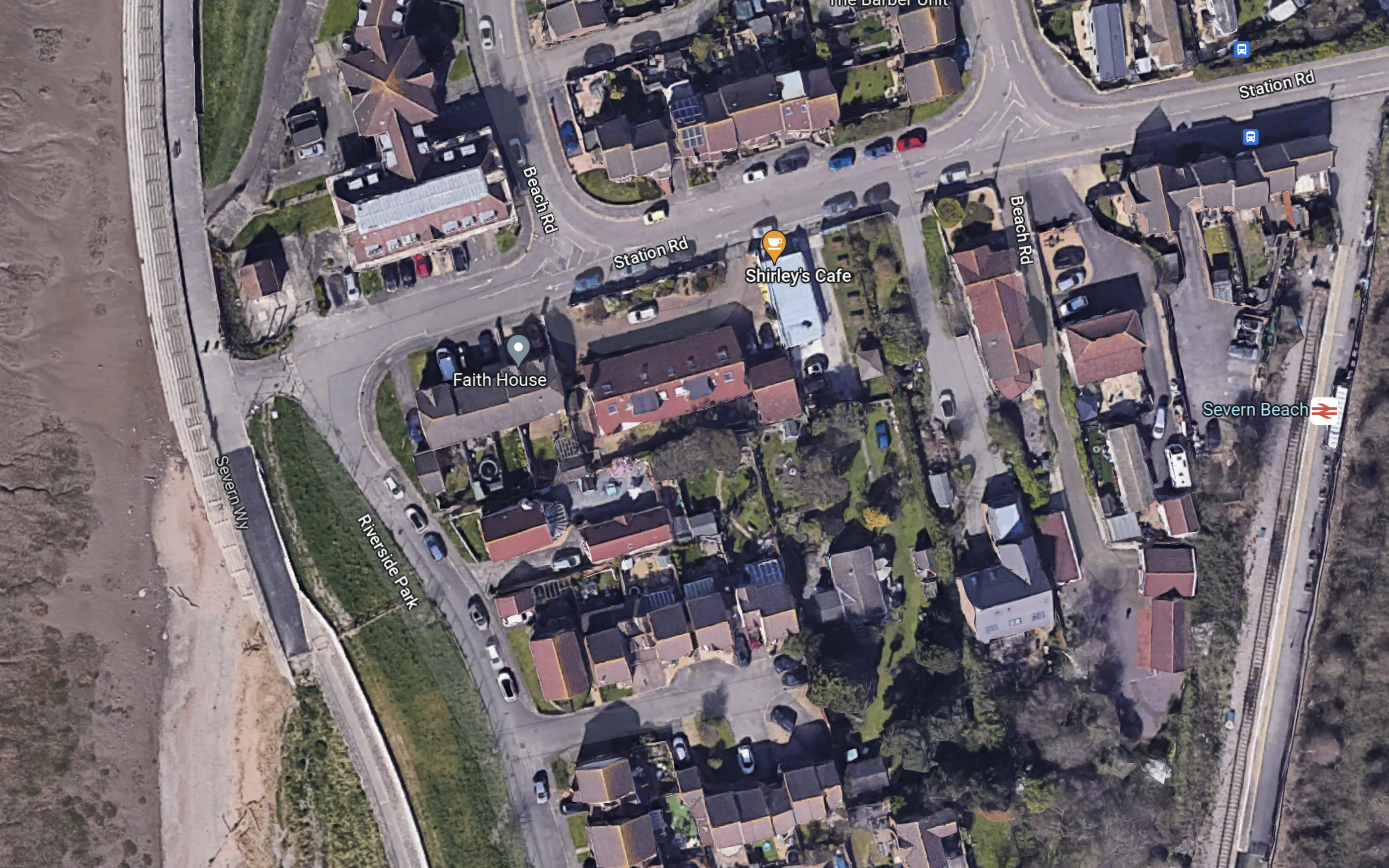
This second Google Map shows the area of the station.
Note.
- Shirley’s Cafe, where I bought my ice cream.
- The cafe does gluten-free breakfasts.
- The promenade, where I took the pictures of the Second Severn Crossing.
- The long platform in the station.
- The fare from Bristol Temple Meads was only £1.95 for a return with my Senior Railcard.
Severn Beach looks to be a good place to go for a walk.
These are pictures I took at and around the station.




















We need more ice cream sellers in or near stations.
Portway Park & Ride Station
Portway Park & Ride station is a new station currently under construction.
I took these pictures as the train passed.






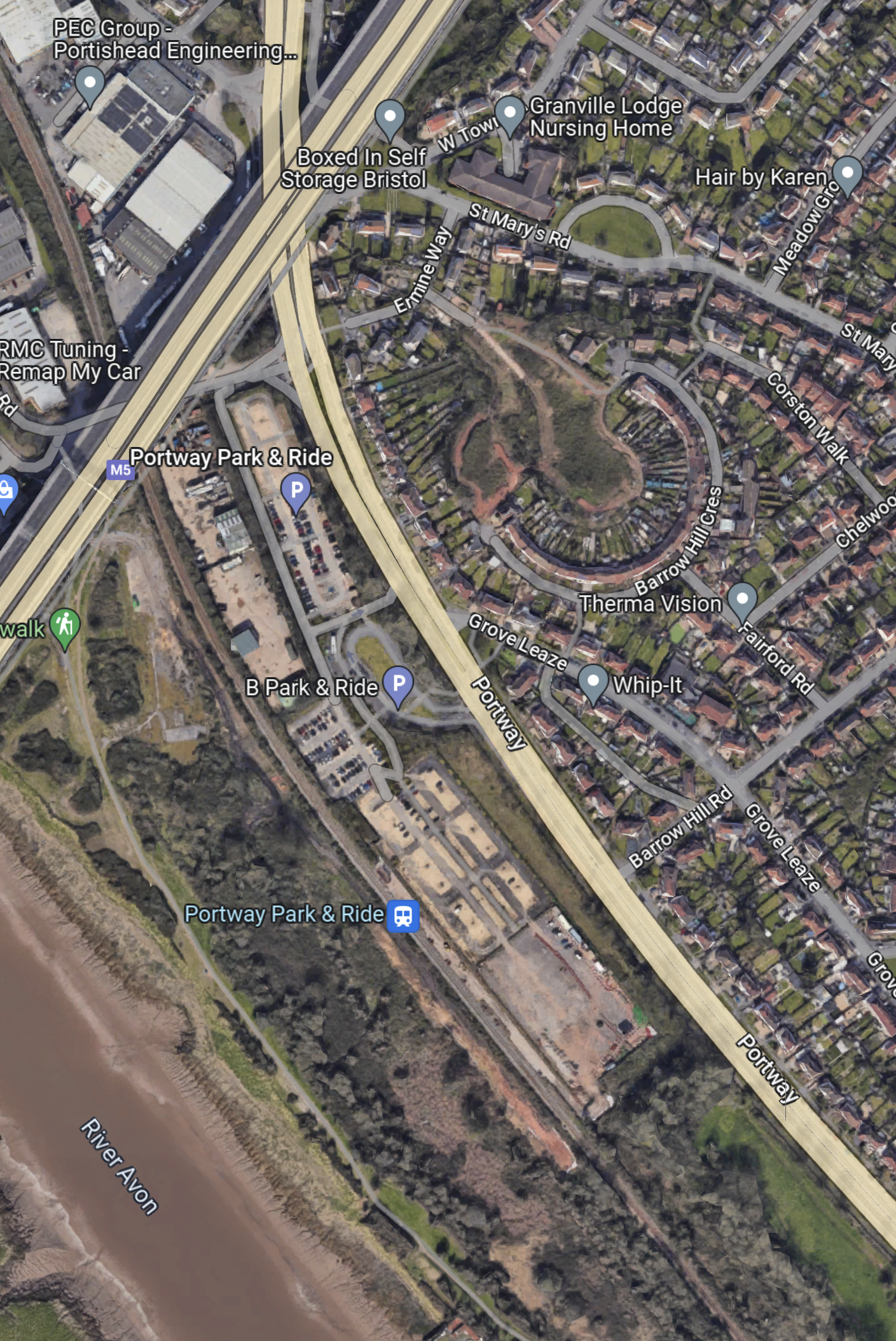
This Google Map shows the location of the station.
Note.
- The parking is to the South of where the M5 and A4 cross.
- The blue dot at the South of the site marks the single-platform station.
- The buses from the Park & Ride run every twelve minutes.
- The trains are only an hourly service.
From the pictures, it looks like the station will be opening soon.
I would hope that the access to the parking from the major roads is good.
Improving The Line
I was a bit worried that I’d miss the train back, so I only had an ice cream, but if the trains were more frequent, I might have had a drink in the cafe as well.
Under Future in the Wikipedia entry for the Severn Beach Line, the following is said about train frequency.
Improved services along the line are called for as part of the Greater Bristol Metro scheme, a rail transport plan which aims to enhance transport capacity in the Bristol area. There is an aspiration for half-hourly services, however due to the large sections of single-track and the congested main line from Temple Meads, such frequency is not currently feasible. However, it is expected that with the four-tracking of Filton Bank, including the Severn Beach line between Temple Meads and Narroways Hill Junction, that there will be sufficient capacity to allow half-hourly services.
Two trains per hour (tph) would be a good improvement.
This is also said.
Plans also call for the reopening of the Henbury Loop Line, which could allow a service from Temple Meads to Bristol Parkway via the Severn Beach line.
After my experiences yesterday, a more frequent route between the two major Bristol stations must be a good idea.
Zero-Carbon Trains
Given the route and its length and location, the Severn Beach Line must be a candidate for battery or hydrogen power.
Vineyard Wind To Deploy US-Based Supplier’s Bubble Curtain During Foundation Installation
The title of this post, is the same as that of this article on offshoreWIND.biz.
This is the sub-heading.
Vineyard Wind, a joint venture between Copenhagen Infrastructure Partners (CIP) and Avangrid building the first large-scale offshore wind farm in the US, has signed an agreement with the US company ThayerMahan for a pilot programme to deploy and test a secondary bubble curtain during the installation of foundations
This is the first paragraph.
A bubble curtain mitigates noise created during foundation installation by absorbing and dampening sound. First, the curtain’s large, perforated hoses are placed on the seafloor around the monopile. Then, the hoses are filled with compressed air which, once the hoses are inflated, escapes through the perforations and creates a barrier of bubbles that reduce noise.
Nothing is said, as to how the bubbles cut the noise.
I’m fairly certain that I know why.
- The speed of sound in air on a standard day at sea level static conditions, is about 340 metres/second.
- In water it’s about 1500 metres/second.
So what would the speed of sound in a bubbly mixture of air and water be?
I asked this question of Google and got this answer.
Surprisingly, in a two- fluid mixture, the measured speed of sound can be one order of magnitude smaller than that of its constituents. For example for water and air in normal conditions the speed of sound in the mixture can be about 23m/s while it is 1500m/s in water and 330m/s in air.
I even made money out of this phenomena, by backing two guys, who used it to develop an aerosol valve that used nitrogen as a propellant.
This research indirectly led to the development of the Respimat inhaler for asthma drugs.
So how does it cut the noise?
I’m not sure of this, but we do know the noise of the piling will have to go through areas of water with different speeds of sound. So is the sound attenuated as it passes through the bubble curtain by the slow speed?
I have other ideas for this interesting phenomenon and if anybody is interested please contact me. One use may have applications in mixing dissimilar fluids.
Spirit Energy Welcomes Licence Award For World-Leading Carbon Storage Facility
The title of this post, is the same as that of this news item from Centrica.
This is the sub-heading.
Spirit Energy and its shareholders, Centrica Plc and Stadtwerke München GmbH (SWM), welcome licence award for world-leading carbon storage facility
These are the first two paragraphs.
Spirit Energy – with the support of majority shareholder Centrica Plc, and Stadtwerke München GmbH (SWM) – has today (18 May) been granted a carbon storage licence by the North Sea Transition Authority (NSTA). This represents a further step towards their net zero vision of repurposing the North and South Morecambe gas fields for carbon capture and storage.
Today’s announcement places the companies at the forefront of the decarbonisation efforts in the UK, with the MNZ (Morecambe Net Zero) Cluster having the potential to be one of the UK’s biggest carbon storage hubs. It will be able to store up to a gigaton of carbon dioxide – the equivalent of three years’ worth of current UK CO₂ emissions. It could initially store above 5MTPA of CO₂, scaling in time to 25MTPA. The MNZ Cluster will be able to accept CO₂ transported by pipeline, ship and rail.
Note.
- I would assume MTPA is megaton per annum.
- In the long-term, I believe we’ll find productive uses for a substantial amount of the CO₂ we create, in agriculture, manufacturing construction materials, animal foods and textiles and in other uses.
- The MNZ Cluster is very large and will be a superb partner for Carbon Capture and Use.
- The partners will invest over £1 billion in this project pending the outcome of the Track 2 process.
Neil McCulloch, CEO of Spirit Energy, finished the news item like this.
Spirit Energy has ambitions for the two gas fields to form the core of a green super-hub. This would explore opportunities like direct air capture, the manufacture of blue hydrogen, the production of green hydrogen, the integration of other renewable power generation facilities, and energy storage – all of which would put Barrow and the North West on the map as a centre for low-carbon innovation.
It is a good vision.
BlueFloat, Renantis Ink Exclusivity Agreements For Scottish Floaters
The title of this post, is the same as that of this article on offshoreWIND.biz.
This is the sub-heading.
The BlueFloat Energy and Renantis partnership has signed exclusivity agreements with Crown Estate Scotland to develop its Sinclair and Scaraben innovation projects which will now be part of a phased delivery of the partnership’s Broadshore project
This is the first two paragraphs.
The two 99.5 MW floating offshore wind farms will now be developed as part of a phased delivery of the partnership’s Broadshore project, located 47 kilometres north of Fraserburgh.
Sinclair and Scaraben will explore innovative foundation technologies, associated fabrication works, and mooring systems with a view to maximise opportunities for the Scottish supply chain, driving local investment and job creation, said the partners.
This would seem to be very sensible for manufacturing and project management reasons.
One Of The Worst Train Journeys I’ve Had In The UK Since The 1960s
I started out with a simple objective, in that I intended to go to Cardiff Central station and then explore the Cardiff Valley Lines to look at the progress of the electrification. I had also arranged to possibly have a drink, with an old acquaintance at Rhymney station.
For the first time, I took the Elizabeth Line from Moorgate to Paddington to catch a long distance train. It is so much easier than taking the Underground.
I bought a Super Off Peak Return ticket to Cardiff Central station for £62.15 with my Senior Railcard.
This was the journey I took today.
- I left Paddington on the 10:18 train for Cardiff Central.
- The train arrived at Bristol Parkway at 11:34½.
- Real Time Trains says this about the rest of the journey. “This service was cancelled between Bristol Parkway and Cardiff Central due to a problem with signalling equipment (J3)”
- I was advised by a member of staff, that I wouldn’t be going to Cardiff in the near future and he advised taking a CrossCountry train to Bristol Temple Meads and then going back to London using my Return ticket.
- I left Bristol Parkway at 12:12¼ and arrived in Bristol Temple Meads at 12:20½, after taking the CrossCountry train.
- At Bristol Temple Meads to salvage something of a wasted day, I took a diversion to Severn Beach for the princely sum of £1.95 with my Senior Railcard, arriving back at Bristol Temple Meads at 14:48½.
- I then caught the next train to London, which turned out to be the 16:00, as both the 15:00 and 15:30 were cancelled due to an incident at Didcot.
- The train left Bristol Temple Meads at 16:03 and arrived at London Paddington at 18:00, which was twenty minutes late.
Note.
- I never got to Cardiff.
- If I’d waited at Bristol Parkway and caught the next train, I’d have got to Cardiff at 16:15¼, which would have been four hours later, than if the first train hadn’t been cancelled and had been on time.
I’ve just tried to phone Great Western Railway, but their Contact Us page only gives details of Facebook, Twitter and What’s App. I don’t use any of those!
Conclusion – Added On 5th June 2023
I just received an e-mail saying the cheque will be the post!
Japanese Companies To Invest GBP 14.2 Billion In UK’s Offshore Wind, Green Hydrogen
The title of this post, is the same as that of this article on offshoreWIND.biz.
This is the sub-heading.
Japanese giants Marubeni Corporation, Sumitomo Corporation, and Sumitomo Electric Industries have committed to investing a total of GBP 14.2 billion (approximately EUR 16.3 billion) in offshore wind and green hydrogen projects, and the offshore wind supply chain in the UK
These two paragraphs add a bit of context and flesh to the deal.
Ahead of the UK Prime Minister’s business reception in Tokyo on 18 May, the UK government announced that leading Japanese businesses have committed to invest GBP 17.7 billion (approx. EUR 20.3 billion) in businesses and projects across the UK.
Of this, GBP 14.2 billion has been committed by Marubeni, Sumitomo and Sumitomo Electric for projects in offshore wind, green hydrogen and offshore wind supply chain.
SSE’s Berwick Bank Wind Farm will have a capacity of 4.1 GW and is budgeted to cost just short of £18 billion. Doing a quick calculation, indicates that £14.2 billion would only finance £3.23 GW of offshore wind.
But the Japanese say they will invest in offshore wind, green hydrogen and offshore wind supply chain. Investing in the offshore wind supply chain, would surely attract more money as the developers placed orders for foundations, floaters, electrical gubbins and support vessels.
Note.
- In Japanese Giant Sumitomo Heavy Invests In Liquid-Air Energy Storage Pioneer, I wrote about Sumitomo’s investment in English energy storage. company; Highview Power.
- Electrolyser company; iTM Power has also sold a 1.4 MW electrolyser to Sumitomo and signed an agreement over American sales with another Japanese company.
I can see other similar co-operative deals being developed. Possible areas could be cables, transformers and support vessels.
Spain Launches App To Show If Men Shirk Housework
The title of this post is the same as that of this article in The Times.
This is the first paragraph.
Spain has announced plans to introduce an app that promises to address the gender imbalance of housework by getting users to log the hours they spend on chores.
At least it’s a free app!
ULEZ: Impact Of Mayor’s Expansion Questioned
The title of this post, is the same as that of this article on the BBC.
This is the sub-heading.
One in six cars registered in outer London did not meet Ultra Low Emission Zone (ULEZ) standards last year, according to figures from the Society of Motor Manufacturers and Traders
These paragraphs outline the analysis.
The data was released following a Freedom of Information request by the BBC to Transport for London (TfL).
It comes amid a dispute over whether existing data used by City Hall and TfL is accurate.
However, London Mayor Sadiq Khan said the newly released data was unreliable.
From the end of August, all those driving vehicles within Greater London that do not meet ULEZ pollutant limits will face a £12.50 daily charge or a £180 fine.
I’m sure that any Professor of Statistics from London’s universities or an expert from the Royal Statistical Society, could give a definitive answer on the statistics.
But then Khan is a lawyer and will hide behind the law in this case, by claiming he is both judge and jury.
If Khan really cared about London’s air, he would have a hydrogen policy, which would enable London’s local cement, construction and refuse trucks to be replaced or converted to hydrogen, so that the city’s air improved.
It would also make it easier to introduce more hydrogen-powered buses.
Companies like Tesco and Marks & Spencer, who regularly run trucks into London, should be encouraged to convert their delivery trucks to zero-carbon, by adjustment of the ULEZ charges.
The ULEZ has been badly thought out and needs to be realigned with what is practical and reduces the pollution.
Gresham House Energy Storage Sets GBP80 Million Fundraise
Gresham House Energy Storage Fund must be doing something right, as similar headlines are used in half-a-dozen places on the Internet and they regularly seem to be raising more money.
But then, as a Graduate Control Engineer and a previous owner of half a finance company, I’ve always thought raising money to build batteries was a good idea.
My only niggle with Gresham House, is that I would have thought by now, they would have put some money into building one of the excellent new technology batteries that are coming through.
The storage fund or some of its employees, may of course have contributed to some of the crowdfunding for these new technologies, all of which I feel have a good chance of being a success.
Note.
- Energy Dome is Italian and all the others are at least fifty percent British.
- Most of the British batteries have had backing from the UK government.
- All these batteries are environmentally-friendly.
- None of these batteries use large quantities of rare and expensive materials.
- Energy Dome even uses carbon dioxide as the energy storage medium.
In addition, in Scotland, there is traditional pumped storage hydro-electricity.
Project Iliad
This article on renews.biz has a slightly different headline of Gresham House To Raise £80m For US Battery Buildout.
This is the first two paragraphs.
Gresham House Energy Storage Fund is seeking to raise £80m through a share placing.
The new equity raised will primarily be used to finance 160MW of solar with co-located four-hour battery projects in California, US, known as Project Iliad.
The article then gives a lot of financial details of Project Iliad and Gresham House.
Will Gresham House be backing co-located solar/battery projects in the UK?
- In Cleve Hill Solar Park, I write about a co-located solar/battery project in Kent.
- This press release from National Grid is entitled UK’s First Transmission-Connected Solar Farm Goes Live, which also describes a co-located solar/battery project, being built near Bristol.
These two projects are certainly serious and could be pathfinders for a whole host of co-located solar/battery projects.
WillGresham House back some of this new generation?
Articles From The Engineer
I generally read articles from The Engineer once a week.
Here’s a few that are worth reading.
12th Feburuary 2023 – Hydrogen Ambulance Set For London
A project led by hydrogen fuel specialists ULEMCo is aiming to deliver the UK’s first zero emission hydrogen ambulance later this year
There is an interesting discussion, as to whether hydrogen or battery ambulances are better. Range and hotel power issues seem to favour hydrogen.
11th May 2023 – Bramble Energy Secures £12m For Hydrogen Bus
Bramble Energy has joined forces with Equipmake, Aeristech and Bath University to develop a new hydrogen double-deck bus integrating its printed circuit board fuel cell (PCBFC) technology
Bramble Energy can create bespoke fuel cell stacks in a ‘matter of days at scale and low-cost’.
12th May 2023 – Cornish Geothermal Project Leads Government Heat Scheme
The UK’s first deep geothermal heat network is one of seven new projects to receive funding as part of a new government programme to decarbonise buildings across England.
The full list of projects to receive support today via the Green Heat Networks Fund is detailed.
17th May 2023 – Ricardo Joins Pan-European Hydrogen Shipping Consortium
UK engineering firm Ricardo is set to play a key role in the sustainable HYdrogen powered Shipping (sHYpS) project being funded by the EU’s Horizon Europe programme.
One thing that is disclosed in the article, is that Ricardo have a new 400kW hydrogen fuel cell test chamber at the company’s UK headquarters.

