It’s Hugo Lloris vs Jordan Pickford And There’s Only One Winner
The title of this post, is the same as that of this article on The Telegraph.
This is the introductory paragraph.
By most measures, Jordan Pickford has been the better keeper than Hugo Lloris this season — especially when it comes to penalties
The Telegraph uses statistics from a specialist goalkeeping statistics site, which is called Goalkeeper-XG.
So I would tend to put a high level of trust in their deductions.
I found the Telegraph article, when I was looking for any article about the two team captains, Harry Kane and Hugo Lloris, who both play for Tottenham Hotspur, where Lloris is captain.
I also suspect that in training.
- Harry Kane has probably scored more penalties than any other player has against Hugo Lloris.
- Hugo Lloris has probably saved more penalties than any other keeper from Harry Kane.
The two players probably know each other’s strengths and weaknesses well and in addition.
- Eric Dier of Tottenham has played many games in front of Lloris, is also in the England team.
- I suspect several of the England team have taken penalties or been in one-on-one situations with the French goalkeeper in Premier League games.
- Some England players may feel they have scores to settle, after Lloris denied them of a goal, because of a superb save.
All of this information, will be powerful in the hands and minds of England’s coaches and psychologists.
On the other hand, with the notable exception of Olivier Giroud, I suspect that only a handful of the French players have faced Jordan Pickford in a goal-scoring opportunity.
I feel that the battle of the goalkeepers will be key tonight.
Soham Station’s Inaugural Year A Soaring Success
The title of this post, is the same as that of this article on Rail Technology Magazine.
This is the first paragraph.
Soham station has seen healthy and consistent passenger usage over its first year since opening to the public, seeing almost 50,000 journeys starting or finishing there, according to Greater Anglia’s figures.
I took these pictures, when the station opened.
















I think Soham station is a good design of a single-platform station.
- It’s a short walk from car park or drop-off point to the platform.
- There is adequate car parking.
- There is a shelter.
The station has also been built, so that it can be expanded.
These are my thoughts.
A Service To Cambridge
Soham station probably needs a train service to Newmarket and Cambridge, as it already has a two-hourly service to Bury St. Edmund’s, Ely and Ipswich and Peterborough.
Wikipedia says this.
There are no current plans for direct services to Cambridge, but the CPCA has expressed support for the idea in a future phase of the project. Mayor James Palmer said “the delivery of Soham station gives us a much stronger case to go to Government and Network Rail and lobby for the reinstating of the Snailwell loop which will provide a direct service between Ely, Soham, Newmarket and Cambridge”
This map from OpenRailwayMap shows the Snailwell Loop.
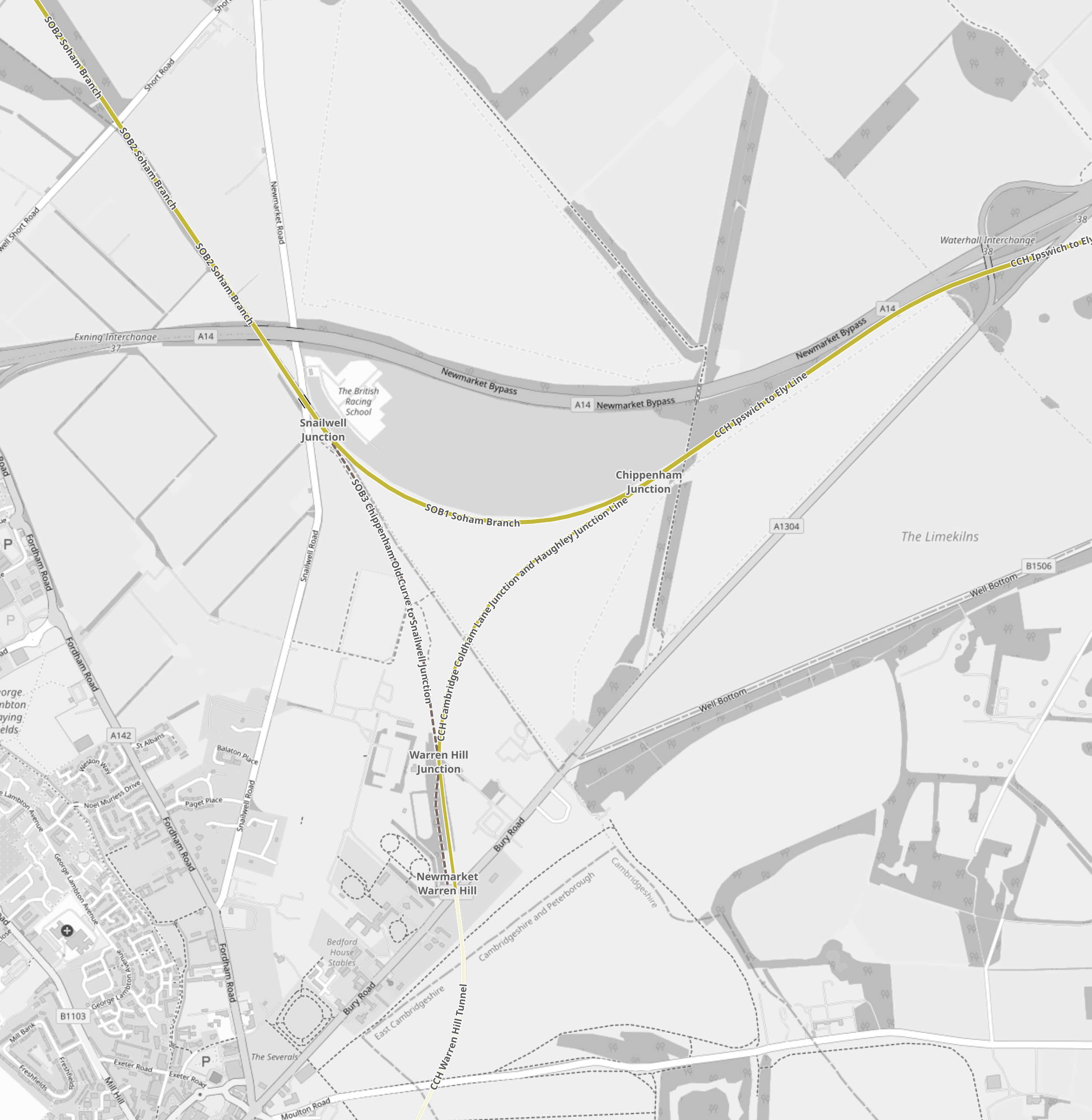
Note.
- The triangular junction in the middle of the map,
- The line from the junction leading East goes to Bury St. Edmunds and Ipswich.
- The line from the junction leading North goes to Soham, Ely and Peterborough.
- The line from the junction leading South goes to Newmarket and Cambridge.
- The Western side of the junction was removed by British Rail.
It would appear that by reinstating the Western side of the junction, a service between Ely and Cambridge via Soham and Newmarket could be run.
There are proposals for new stations in this area and given the need for comprehensive commuter services into Cambridge this Ely and Cambridge service could develop considerably.
The simplest service pattern would be
- Peterborough via Ely, Manea, March and Whittlesea.
- Ely non-stop.
- Ipswich via Bury St. Edmunds and Stowmarket.
- Cambridge via Newmarket and Dullingham.
All trains would be one train per two hours (tp2h).
Snailwell Junction And Cambridge
There could be problems between Snailwell junction and Cambridge, as the line is mainly single-track and it would need to handle the following trains.
Ipswich and Cambridge – 1 train per hour (tph)
Ely and Cambridge – 1 tp2h
Sundry freight trains.
In Roaming Around East Anglia – Newmarket Station, I wrote this about the plans of the East West Rail Consortium in the area.
In this document on the East-West Rail Consortium web site, this is said.
Note that doubling of Warren Hill Tunnel at Newmarket and
redoubling between Coldham Lane Junction and Chippenham Junction is included
in the infrastructure requirements. It is assumed that most freight would operate
via Newmarket, with a new north chord at Coldham Lane Junction, rather than
pursuing further doubling of the route via Soham.
So would it be possible to create a double-track railway through Newmarket station?
In the related post, I came to this conclusion.
Newmarket can benefit from East West Rail, but the two parties must agree objectives that don’t cause problems for the other.
But I do think, that Newmarket will not welcome the building of a double-track railway through the town.
The Proposed A14 Parkway Station
Landmark CCS Project In Humber Becomes UK’s First To Gain Planning Consent
The title of this post, is the same as that of this news item on the SSE web site.
This is the first paragraph.
SSE Thermal and Equinor’s Keadby 3 Carbon Capture Power Station in the Humber has become the first power CCS project in the UK to receive planning permission.
Note.
- This will be one of four power stations at Keadby with Keadby 1, Keadby 2 and Keadby Hydrogen Power Station.
- Keadby 3 will have a capacity of 910 MW.
- It will capture up to 1,500,000 tonnes of carbon per year.
- It could be operational as early as 2027.
The news item, also says this about SSE’s other power stations and hydrogen storage.
SSE Thermal and Equinor are also collaborating on Peterhead Carbon Capture Power Station in the north-east of Scotland. In addition, they are developing Keadby Hydrogen Power Station, which could be the world’s first large-scale 100% hydrogen-fuelled power stations, and Aldbrough Hydrogen Storage, which could provide vital storage to balance intermittent supply and demand.
This all fits nicely with the proposed strategy I wrote about in Increased CCS Can Decarbonise GB Electricity Faster On Route To Net Zero.
I think we can expect more new gas-fired power stations with carbon capture to be built by SSE.
Metocean, Wind Measurement Campaigns Starting At Two More ScotWind Sites
The title of this post, is the same as that of this article on offshoreWIND.biz.
Never On Sunday
I am 75 and I can’t ever remember being called in for a hospital appointment on a Sunday.
But all will change next Sunday, as I have been called in to the Royal London Hospital for a US Doppler Liver/Portal System scan.
The doctors will see what they will see.
UK Space Agency And NNL Work On World’s First Space Battery Powered By British Fuel
The title of this post, is the same as that of this press release from the UK Government.
This is the sub-title.
The UK Space Agency and the National Nuclear Laboratory (NNL) are to collaborate on the world’s first space battery powered by Americium-241.
And these three paragraphs outline the project.
This work, commissioned and funded by the UK Space Agency from NNL, will be delivered in a new £19 million laboratory in Cumbria equipped with next-generation equipment and technology. It will deliver a sovereign supply of fuel for space batteries in the context of a global shortage, enabling the UK and its partners to pursue new space science and exploration missions.
Creating new highly-skilled jobs in the North West of England, it will drive innovation in radiochemistry and separations science and open a new market for the UK space sector.
Atomic space batteries, also known as Radioisotope Power Systems (RPSs), release heat as the radioactivity within them decays. The heat can be used directly to prevent spacecraft from freezing and it can be converted into electricity to power onboard systems. The batteries go on working for decades, without need for maintenance over the many years in which a spacecraft could be travelling.
These two paragraphs explain, why there is a need for a new type of atomic space batteries.
Considered ‘mission critical technologies’ by space agencies in the UK and around the world, all the Apollo missions had an atomic battery in tow, as has every rover that has gone to Mars. Until now, these have been powered by Plutonium-238, a radioisotope produced only in the US, where supply is limited, and Russia, so an alternative is urgently needed.
NNL, the UK’s national laboratory for nuclear fission, has been working on this endeavor since 2009, when its researchers first discovered that Americium-241, an alternative to Plutonium-238, is produced during the radioactive decay of used fuel from nuclear reactors and that it emits power for over 400 years.
With the supply plentiful – the new laboratory is being opened at NNL’s flagship Central Laboratory on the Sellafield site, home to the largest resource of Americium-241 available for extraction in the world – the new collaboration will turn a proven scientific concept into a fully-realised technology. It will be operational within the next four years and is expected to be first used on the European Space Agency’s Argonaut mission to the Moon and for future missions into deep space.
It would appear that Americium-241 has several advantages over Plutonium-238.
- Plutonium-238 has supply problems
- Who in their right mind, would buy a product like this from Russia or China?
- The batteries have a life of 400 years.
- There is plenty of suitable nuclear waste at Sellafield, from which Americium-241 can be extracted.
It looks like the first batteries could also be available in four years.
Aunt Margery
My late wife; C’s Aunt Margery was a lady, who needed a pacemaker. I seem to remember that after several of her pacemakers had run out of power and were replaced, and eventually she was fitted with a nuclear-powered pacemaker in the 1970s or 1980s.
This page on the Stanford University web site is entitled The History Of Nuclear Powered Pacemakers. It was written by Matthew DeGraw.
Many of these pacemakers in the 1960s and 1970s, were powered by Plutonium-238.
The last paragraph is entitled The Rise Of Lithium Battery Pacemakers And Fall Of Nuclear Pacemakers, where this is said.
Despite the often longer life-expectancies, nuclear pacemakers quickly became a part of the past when lithium batteries were developed. Not only did the technology improve, allowing for lighter, smaller, and programmable pacemakers, but doctors began to realize that this excessive longevity of nuclear pacemakers was excessive. Lithium pacemakers often last 10-15 years allowing for doctors to check in on their patients and replace either the batteries or the pacemakers themselves with new and improved technology as it is develops in those 10-15 year spans. While there are still several remaining patients with nuclear-powered pacemakers functioning in their bodies, it is likely that in the next few decades as these patients pass away, so will the once promising nuclear pacemakers.
Would the use of Americium-241 to power a nuclear pacemaker transform the economics of these devices?
I wonder, if there’s a cardiologist out there, who by chance reads this blog, who could answer my question!
Global Port Services Wins Pre-Assembly Contract For Scottish Offshore Wind Farm
The title of this post, is the same as that of this article on offshoreWIND.biz.
These are the first two paragraphs.
Global Port Services, owned by Global Energy Group alongside the Port of Nigg, has secured multiple contracts to support Seagreen Wind Energy Limited (SWEL) with site-enabling works for the pre-assembly construction of wind turbine components at its Port of Nigg facility.
The news comes as the final turbine foundations for the Seagreen offshore wind project arrive at Nigg to be prepared for installation 27 kilometres off the coast of Angus.
Note.
- Nigg is a village in the Highlands to the North of Inverness.
- The Port of Nigg has a busy Marine Fabrication Yard.
- There is a very interesting BBC documentary called Rigs of Nigg, which tells some of the stories of the port from the 1970s.
- As the article indicates, the yard is now very much involved in the wind power industry.
- SSE have invested in the yard.
This Google Map shows the port.
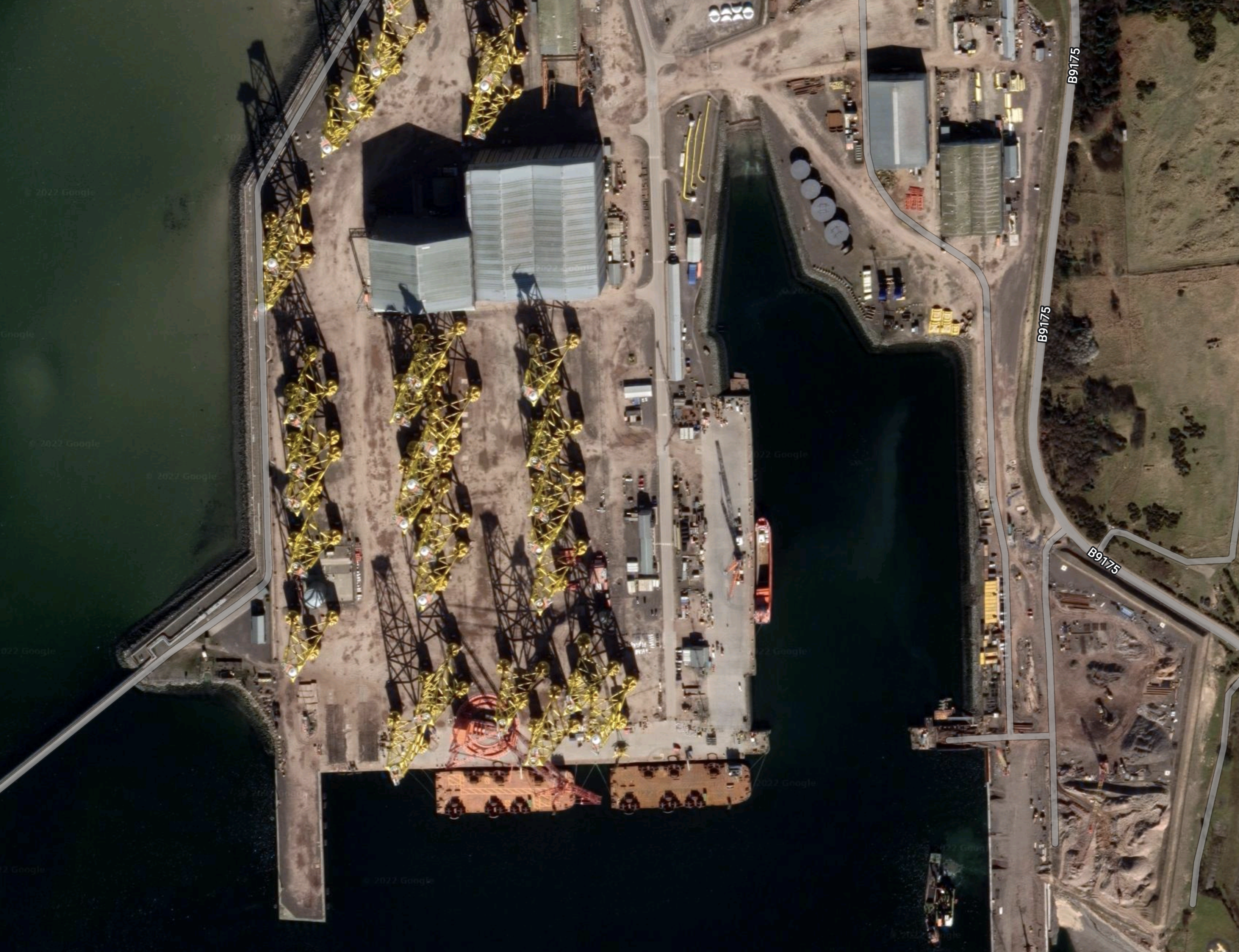
Note. all the yellow steel structures, which look like the fixed foundations for the Seagreen Wind Farm.
I am a bit surprised that foundations for Seagreen are being assembled a fair distance from Angus.
Is there not a fabrication yard on the Firth of Forth?
71 Offshore Wind Applications Now Filed In Brazil, Proposals Total 176.6 GW
The title of this post, is the same as that of this article on offshoreWIND.biz.
Funding Available For Rail Construction Innovation Projects
The title of this post, is the same as that of this article on Railway Gazette.
These are the two introductory paragraphs.
Innovators from across the UK are being invited to submit proposals for the Innovation in Railway Construction Competition, which is making £7·44m available for ideas which could be tested at the Global Centre of Rail Excellence in South Wales.
The competition is being run by Innovate UK with GCRE and the Department for Business, Energy & Industrial Strategy.
£7.44m doesn’t seem much, but it is only for feasibility studies, as the article explains.
Entries for the first phase close at 12.00 on December 14, with funding available for feasibility studies of up to £25 000. This would be followed by an invite-only phase two, with successful first phase projects able to develop and demonstrate their innovations.
As Innovate UK keeps coming up with these competitions, they must be judged to be worthwhile.
Do they use the same technique in areas like Health and the NHS? If not, why not!
MOB To Launch Gauge-Changing Montreux – Interlaken GoldenPass Express
The title of this post, is the same as that of this article on Railway Gazette.
 The Anonymous Widower