The Celtic Cluster Launches New Regional Strategy To Maximise Offshore Wind Benefits
The title of this post, is the same as that of this article on offshoreWIND.biz.
This is the sub-heading.
The Celtic Sea Cluster has released a new Regional Strategy that outlines how Wales and South West England can maximise floating offshore wind technology benefits, in line with the forthcoming Celtic Sea leasing process being delivered by the Crown Estate.
Who comprise the Celtic Cluster? This paragraph gives the answer.
According to the Cluster, which is led by its founding partners, the Welsh Government, Cornwall, Isles of Scilly Local Enterprise Partnership, Celtic Sea Power, Marine Energy Wales, and the Offshore Renewable Energy Catapult, the strategy will allow the region’s stakeholders to ensure their activities are aligned and can achieve their common objectives.
I am surprised the Irish aren’t involved politically.
- The Irish Republic has a coastline on the Celtic Sea.
- There are a lot of Irish companies, finance and engineers involved in wind farm development.
But the cluster does have a firm ambition, according to the article.
The Cluster’s ambition is to establish the Celtic Sea region as a world leader in floating offshore wind by 2030 and to deliver 4 GW of floating wind in the Celtic Sea by 2035, with the potential to grow to 20 GW by 2045.
Note.
- The Wikipedia entry for the Celtic Sea, gives the sea an area of 300,000 km2.
- 20 GW or 20,000 MW is to be installed by 2045.
That is an energy density of just 0.067 MW/km2.
In ScotWind Offshore Wind Leasing Delivers Major Boost To Scotland’s Net Zero Aspirations, I calculated that ten floating wind farms had an average energy density of about 3.5 MW per km².
I wouldn’t bet against a few more floating wind turbines being squeezed into the Celtic Sea.
Grand Union Sets Out Stirling Ambitions
The title of this post, is the same as that of an article in the December 2022 Edition of Modern Railways.
This is the first paragraph.
Grand Union Trains has updated its plans to operate services between Stirling and London Euston. It is targeting a 10-year track access agreement with services starting in May 2025.
I have a few thoughts.
The Route
The route between Stirling and Euston is as follows.
- Trains will call at Larbert, Greenfauds, Whifflet, Motherwell, Lockerbie, Carlisle, Preston, Nuneaton and Milton Keynes.
- Station upgrades are proposed for Larbert, Greenfauds, Whifflet and Lockerbie.
- The route is fully-electrified.
- There will be four trains per day in both directions, with a slightly reduced service on Saturday evenings and Sunday mornings.
This sentence from the article sums up the philosophy of Grand Union Trains.
The company says the aim is to link towns which have no or limited long-distance services and to improve connectivity for some station pairs on the West Coast Main Line.
Note.
Currently Larbert, Greenfauds and Whifflet don’t have services running past Stirling or Motherwell.
- Currently, Nuneaton and Milton Keynes have no Scottish services.
- Nuneaton is well connected to Peterborough and the East.
- Milton Keynes will be on the East-West Railway to Oxford and Cambridge.
It looks to be a service that has been well-planned and offers good possibilities for travel.
The Trains
The article says this about the trains.
New bi-mode rolling stock would be used and GUT says discussions with potential suppliers and manufacturers are ongoing.
Why Are Bi-Mode Trains Needed?
I can think of these reasons.
- Grand Union Trains want to run their South Wales services with the same trains.
- They might want to extend Scottish services from Stirling to perhaps Perth or Dundee.
- They want to offer a reliable service, when the electrification is damaged.
Bi-mode trains will certainly offer flexibility and reliability.
How Long Will The Trains Be?
Consider.
- An eleven-car Class 390/1 train is 265.3 metres long.
- A pair if five-car Class 802 trains is 260 metres long.
I suspect a train has a maximum length of 260 metres and these can be run between London Euston and Stirling.
Could it be that station upgrades are needed for Larbert, Greenfauds, Whifflet and Lockerbie, is that these stations have short platforms?
Could the trains and platforms start short and grow with the business?
The Trains Will Have Three Classes
These classes will be offered.
- First Class in compartments
- Standard in a 2+1 arrangement
- Standard Economy in a 2+2 arrangement
You pays your money and you make your choice.
Vanload Freight May Be Carried
Consider.
- There has been a lot of speculation and some serious train conversions, looking at the possibilities of high speed freight.
- Imagine a train of perhaps five passenger cars and one freight car for containerised freight.
- I suggested earlier, that the trains might grow with the business.
- As business develops, extra cars can be added as appropriate.
- If business booms, then it might be best to run separate passenger and freight services.
Modern trains and refurbished older ones, offer a multitude of solutions.
The Finance
The article says this about finance.
Grand Union Trains has linked with European independent investment firm Serena Industrial Partners to support its ambitions for its new Great Western service, and the project is supported by Spanish operator RENFE.
Serena Industrial Partners are Spanish, so does that mean, that the trains could be Spanish too?
World’s First 16 MW Offshore Wind Turbine Rolls Off Production Line
The title of this post, is the same as that of this article on offshoreWIND.biz.
This is the subtitle and the first paragraph, that add some detail.
The first nacelle for a 16 MW offshore wind turbine jointly developed by China Three Gorges Corporation and Goldwind Technology has rolled off the production line at Fujian Three Gorges Offshore Wind Power International Industrial Park in China.
According to China Three Gorges, the unit has the largest single capacity, the largest rotor diameter, and the lightest weight per megawatt in the world.
The West, is going to push hard to make sure, we don’t give away another industry to the Chinese.
Google Buys Scottish Offshore Wind Power
The title of this post, is the same as that of this article on offshoreWIND.biz.
This is the sub-heading and the first paragraph.
ENGIE and Google have entered into a 12-year, 100 MW corporate power purchase agreement (CPPA) supporting the Moray West offshore wind development in Scotland.
ENGIE will provide Google with more than 5 TWh of green power from the Moray West project, a nearly 900 MW offshore wind farm set to begin generating power from 2025.
Increasingly, it seems that large energy users are committing themselves to long-term energy deals.
One of Google’s senior people is quoted as saying.
People across the UK and Europe are increasingly worried about climate change and energy security. We share that concern and believe technology is an important part of the solution – both by reducing our own emissions, and by helping others to reduce their own.
I have a few thoughts.
How Much Of Moray West’s Output Is 5 TWh?
Consider.
- Moray West has an maximum output of 882 MW.
- This converts to 7.73 TWh.
If Google are buying all the electricity produced by the wind farm, that would mean that the capacity factor is around 64.7 %, which is quite reasonable, if a bit high for a fixed foundation wind farm.
If we are, it does surely reflect a desire for stability and security in a fast-changing world.
Are We Seeing More Corporate Power Purchase Agreements (CPPAs)?
France’s First Offshore Wind Farm Fully Up And Running
The title of this post, is the same as that of this article on offshoreWIND.biz.
This is the sub-title.
France’s first commercial-scale offshore wind farm, the 480 MW Saint-Nazaire, has been fully commissioned.
Does this mean, that this is France’s only operational offshore wind farm?
It does appear so, whereas the UK has 13,628 MW of offshore wind.
With onshore wind, the French have 15,000 MW and England has 14,000 MW.So we’re ahead in offshore and total, but behind in onshore.
From 2025, Nestlé Waters France Will Use The First Hydrogen-Powered Freight Train Through An Innovative Solution Developed by Alstom and ENGIE
The title of this post, is the same as that of this press release from Alstom.
These are the main points of the press release.
-
Nestlé Waters will be the first company in Europe to benefit from the hydrogen fuel cell solution developed by Alstom and ENGIE, for rail freight.
-
The purpose is to operate the first hydrogen-powered freight train from the Vosges plant, thanks to a hydrogen generator wagon system developed by Alstom and supplied with renewable hydrogen by ENGIE, from 2025.
-
Ultimately, this project should enable Nestlé Waters to reduce emissions by 10,000 tons of CO2 equivalent per year.
-
This new collaboration is in line with the actions Nestlé Waters has been carried out for several years to decarbonize its supply chain.
In this Alstom visualisation that accompanies the press release, an Alstom Prima locomotive can be seen pulling a tender full of hydrogen, that generates electricity.
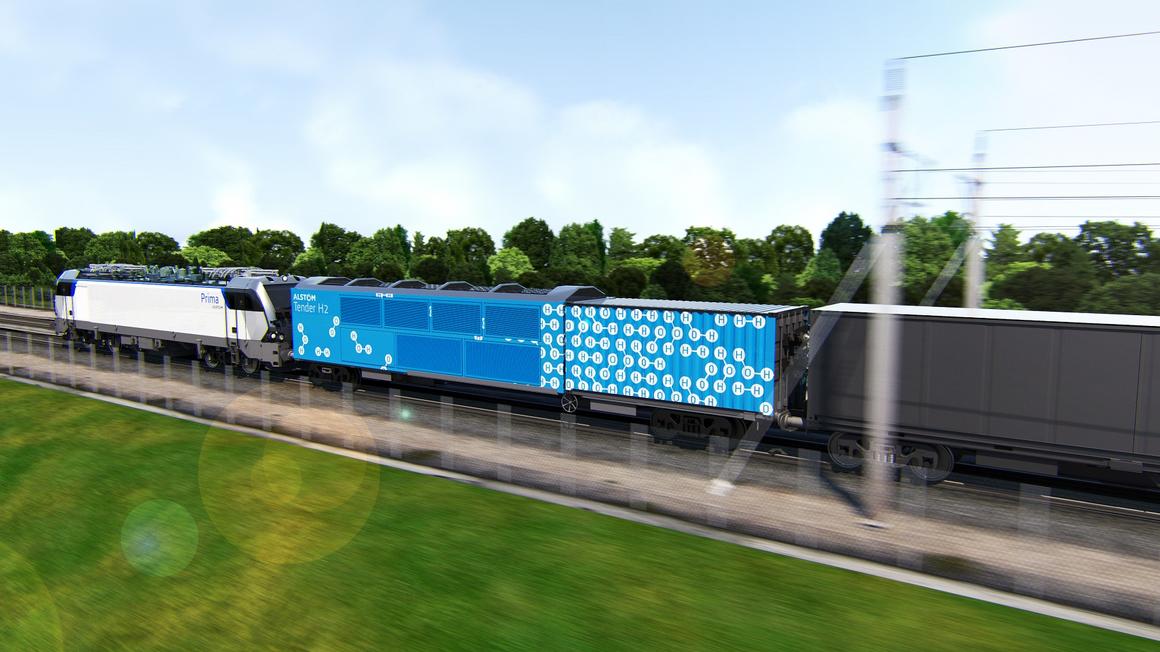
It would appear to be a very simple concept.
- The electric locomotive uses electrification where it is available.
- On lines without electrification, hydrogen is used to generate electricity.
- The locomotive and the tender are connected by a cable.
- I suspect for longer distances, larger generators with a larger hydrogen capacity can be developed.
- It would appear that typical SNCF Prima locomotives have at least 4 MW of power, so the generator must be at least this size.
I could see this concept being used with a 4 MW Class 90 electric locomotive.
Norwegian Company To Power Data Centres With Offshore Wind
The title of this post, is the same as that of this article on offshoreWIND.biz.
This is the sub-title.
Norwegian energy company Earth Wind & Power (EWP) is set to offtake up to 400MW of excess and pre-grid offshore wind power to supply electricity to data centre infrastructure in Northern Europe.
This sounds like a good idea.
Over the next few years, the UK will be ramping up our production of renewable energy.
Data centres could be an ideal way to make money from our excess energy.
Do Cummins And Stadler Have a Cunning Plan?
Roger Ford in the December 2022 Edition of Modern Railways has written an article called Traction à la mode.
The article is a series of small sections, with the last section but one, labelled Monster.
Roger says this.
Finally, we come to the mighty Class 99, which is not at all flakey. In the past I have often commented on the UK railways’ prejudice against Co-Co bogies.
But with the ’99’ six axles will give 6MW (8,000 hp) at the rail, with contact patches to use all its 113 tonnes. Plus the extra axles mean it can accommodate the weight of a 2,400 hp Cummins diesel.
At the recent Rail Freight Group conference, Ross Shepherd, Chief Technical Officer of Beacon Rail, which has 30 locomotives on order for GB Railfreight, revealed a computer simulation which showed a Class 99 would save 36 minutes on a run timed for 1 hr 40 minutes for diesel traction. To quote Mr Shepherd:’It’s a monster and it’s coming.’
I have been doing some digging around the Internet and have found this bulletin from Cummins, which is entitled QSK60 For Rail.
The Class 99 locomotive appears to have a QSK50, which appears to be a less powerful version.
The bulletin describes a Stadler locomotive with a Cummins QSK60 engine, which Stadler are delivering to Bolivia.
This paragraph introduces the locomotives.
Stadler and the Bolivian Ferroviaria Andina (Andean
Railway) FCA have signed a contract for the supply of the first three state-of-the art South American Light
Loco (SALi) locomotives, which will feature the
Cummins QSK60 engine.
The bulletin gives these details.
- Locomotive type – diesel-electric
- Track gauge – one metre
- Axle load – 18 ton/axle
- Power – 1865 kW – 2500 hp
- Diesel engine – QSK60
- Maximum Speed – 100 km/h
- Starting Tractive Effort – 415 kN
- Coupling – AAR
- Fuel Tank – Up to 6000 litres
The bulletin is marked as Printed in UK, so does that mean that the engines will come from Darlington.
The weight of this locomotive is 98 tonnes and Roger says that the Class 99 locomotive is 113 tonnes. But the Class 99 locomotive is an electro-diesel locomotive with 6 MW available when running on 25 KVAC overhead electrification.
It looks to me that Stadler have arranged the substantial electrical gubbins around the Cummins QSK50 diesel engine to create Beacon Rail’s monster.
Cummins And Hydrogen
Cummins is a company, that is big in hydrogen.
- They own hydrogen fuel cell and electrolysis company; Hydrogenics.
- They supply the fuel cells for Alstom’s hydrogen-powered Coradia iLint.
In Werner Enterprises Signs Letter Of Intent Planning To Secure 500 X15H Engines From Cummins, I said this.
More details of the X15H engine are given in this earlier press release, which is entitled Cummins Inc. Debuts 15-Litre Hydrogen Engine At ACT Expo, which has this first paragraph.
Today, Cummins Inc. debuted its 15-liter hydrogen engine at ACT Expo in Long Beach, California. This engine is built on Cummins’ new fuel-agnostic platform, where below the head gasket each fuel type’s engine has largely similar components, and above the head gasket, each has different components for different fuel types. This version, with expected full production in 2027, pairs with clean, zero-carbon hydrogen fuel, a key enabler of Cummins’ strategy to go further faster to help customers reduce greenhouse gas (GHG) emissions.
I certainly like the concept of a fuel-agnostic platform, where below the head gasket, everything is similar, and above the head gasket, there are appropriate components.
Could This Philosophy Be Used To Create An Electro-Hydrogen Locomotive?
It looks to me that if Stadler use the Cummins QSK diesel engine in their locomotives, then if Cummins develop a hydrogen version of the QSK, Stadler can convert the locomotives to hydrogen, if Cummins follow their philosophy of a fuel-agnostic platform, with everything identical below the cylinder head gasket.
Over twenty years ago, I did a small data analysis task for Cummins in Darlington. One of their engineers explained to me how they would rearrange the components of diesel engines, so they fitted with the customer’s application. It looks to me that they have taken this philosophy a step further, so that the customer can have diesel or hydrogen engines in the same application, depending on what the end user wants.
In the case of the order from Beacon Rail for thirty Class 99 locomotives, they will be delivered as electro-diesel locomotives, but at some point in the future, when Cummins has developed the hydrogen engine, they will be able to be converted to electro-hydrogen locomotives.
These locomotives could be in front-line service for over forty years!
The Very Long Range Electro-Hydrogen Locomotive
Hydrogen surely has the power and range to move freight trains across continents.
But can everything be fitted in a standard locomotive body?
Alstom have come up with an innovative solution, which I described in From 2025, Nestlé Waters France Will Use The First Hydrogen-Powered Freight Train Through An Innovative Solution Developed by Alstom and ENGIE
I would also suspect a simple tender containing a tank full of hydrogen will also work.
Collateral Benefits Of A Electro-Hydrogen Locomotive
These are possible benefits of electro-hydrogen locomotives.
- Staff in ports and freight depots get all the clean-air benefits of working with zero-carbon and low-pollution locomotives.
- Ports are becoming hydrogen hubs to fuel ships and ground-handling equipment, so electro-hydrogen locomotives could be easily-fueled.
- Ports and freight depots don’t like electrification, as containers occasionally get dropped.
- Electro-hydrogen locomotives will be able to do their own shunting.
- Electro-hydrogen locomotives will not need all tracks to ports and freight depots to be electrified, but won’t mind if they are.
These benefits would allow Network Rail and the operators of ports and freight depots to develop the best solutions for their operations.
London Bus Cuts: Sadiq Khan Pulls Handbrake On Planned Changes
The title of this post, is the same as that of this article on the BBC.
In The Mayor Of London Is Pruning The North London Bus Network Again, I pointed out Sadiq Khan’s lopsided pruning of the London bus network.
Sadiq Khan has now changed his mind, as this paragraph indicates.
Transport for London (TfL) has announced it will only get rid of three bus routes following a consultation which saw more than 20,000 replies.
These paragraphs explain the changes in detail.
As a result of the consultation, 17 routes which had been proposed to be cut will be saved and kept as they currently operate. Another 40 services will also no longer be changed as initially planned.
Only three routes will be removed entirely – the 521 between Waterloo and London Bridge, the 507 between Victoria and Waterloo, and the 332 between Brent Park and Paddington – while alterations will be made to another 11 services.
Of the plans consulted on:
Routes 4, 12, 14, 24, 31, 45, 72, 74, 78, 242, 349, C3, D7, N31, N72, N74 and N242 will be saved and kept as they are
Planned tweaks to routes 15, 19, 27, 43, 47, 49, 53, 56, 88, 98, 100, 113, 135, 148, 171, 189, 205, 214, 236, 254, 259, 277, 279, 283, 328, 343, 388, 414, 430, 476, D3, D8, N15, N19, N27, N98, N133, N205, N414 and N430 will no longer happen
Proposed changes to routes 3, 6, 11, 23, 26, 59, 77, 133, 211, C10 and N26 will still go ahead
TfL said the consultation had raised issues with the plans and as a result the mayor of London had been able to find extra funding to ensure the cuts did not happen on such a large scale.
That is certainly a substantial U-turn!

