Spanish Consortium Forms For $4.4 Billion Green Hydrogen Investment
The title of this post, is the same as that of this article on Hydrogen Fuel News.
This paragraph outlines the project.
A thirty-three company consortium, called the Spanish Hydrogen Network (Shyne) will be investing into a spectrum of green hydrogen technologies, including the installation of 500 megawatts of renewable H2 capacity by 2025. From there, the capacity will increase to 2 gigawatts by 2030. This represents half of the Spanish government’s goal for the entire country by that year, which is 4 gigawatts of capacity.
The article says this about the creation of hydrogen hubs.
The green hydrogen project’s goal is to “generate an ecosystem that connects” three H2 hubs.
The goal of the project is to develop an ecosystem in which three planned industrial H2 hubs in the Murcia, Catalonia and Basque regions will be connected. The project is also meant to support the development of two new innovation hubs in Castile-La Mancha and Madrid and will target the development of solid-oxide electrolyzers and photoelectrocatalysis.
Note that photoelectrocatalysis is the direct production of hydrogen from solar energy.
London Bus Crash: Children Injured As Double-Decker Hits Shop
The title of this post, is the same as that of this article on the BBC.
These are the first three paragraphs.
Three children and two adults have been taken to hospital after a double-decker bus hit a shop in north-east London.
The crash happened on Selwyn Avenue, Highams Park, at about 08:20 GMT, the Metropolitan Police said.
London Ambulance Service (LAS) said 14 other people were treated at the scene, near Highams Park Overground station, but did not need hospital treatment.
The driver is quoted as saying, that his brakes failed.
This Google Map shows the route of the 212 bus route through Highams Park.
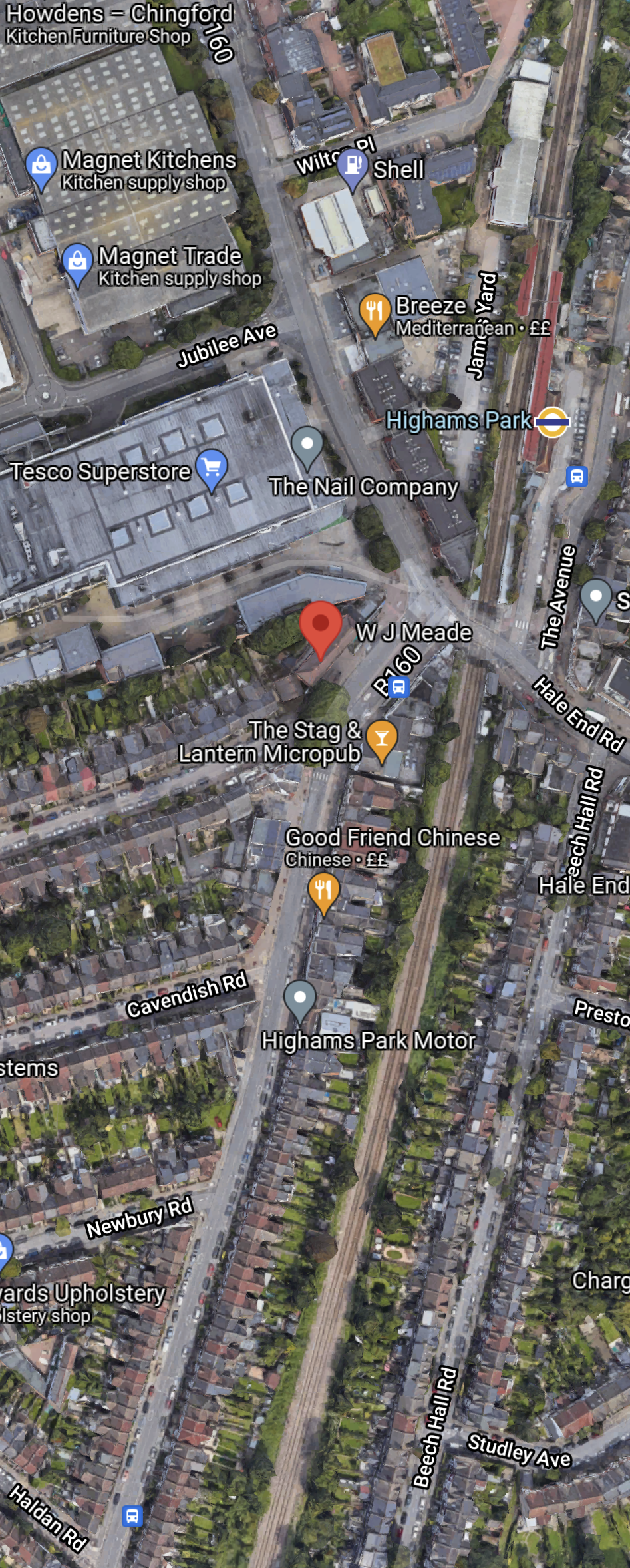
Note.
- The red arrow in the middle of the map shows the location of the crash.
- The bus route runs North-South on the map to the West of the railway line.
The pictures in the article show that the bus was going to Chingford, which is in the North.
In May las year, I took a ride on a 212 bus,which I described in A Trip On An Electric Double Deck Bus On Route 212 Between Chingford And St. James Street Stations.
This is an extract from that post.
I know someone, who used to manage this route and they called it a basket case.
I can certainly understand that.
- The route is narrow in places with cars parked on both sides of the road. This must delay services.
- I was lucky with the level crossing at Highams Park station, but at busy times it could be a nightmare.
Will the new Class 710 trains on the parallel Chingford Branch Line improve matters, by attracting passengers away from their cars in the area and the buses?
There has also been talk of a new station at Chingford Hatch, which could also be served by the 212 bus.
I can’t help feeling that the level crossing was something to do with the crash. Especially as a train went through just before the crash.
Interestingly, a few months ago, I used a black cab driven by a guy, who lives near Highams Park station. He felt the level crossing could be closed and drivers could use other routes. He also said, that since the new trains had started running, more were using the trains.
Perhaps improving the railway, with a couple of new stations, would also take the pressure of the buses.
Exploring Germany Under The Latest Travel Rules
Because of the lack of travel brought about by the Covids, I’ve built up a list of places that I want to visit in Germany.
- Hamburg to see the Siemens Gamesa ETES energy storage and see how the Alstom Coradia iLint hydrogen train is getting on.
- Karlsruhe to see the newly-opened tram-tunnel in the city.
- Stuttgart to see how the construction work for Stuttgart 21 is faring and Alstom’s new battery trains.
- The Lake Constance Belt Railway.
The latest rules mean that travelling back to the UK is easy, so if I chose a route that allowed me to visit all the places I want from say a hotel in somewhere worth visiting like Stuttgart, would it be possible to book an appropriate stay there as a package?
Would this mean all the paperwork going to Germany would be handled by someone else, so if a mistake was made, it’s not my fault?
Fortescue Buys Williams Engineering In Major Push Into High Performance Batteries
The title of this post, is the same as that of this article on Renew Economy.
This is the opening paragraph.
Fortescue Future Industries has made its first major push into battery storage and high performance batteries with the $A310 million purchase of Williams Advanced Engineering (WAE), the offshoot of the Formula 1 specialists Williams Grand Prix Engineering.
Andrew Forrest certainly has a wide-ranging plan.
This article on Railway Gazette is entitled Formula 1 Technology Company To Support Development Of Battery Train, was published later and gives more details.
This is the first paragraph.
Fortescue Metals Group’s green technology division Fortescue Future Industries is developing what it says is a ‘world leading’ battery electric train concept.
It will be interesting to see what technologies are at the heart of the ‘world leading’ concept.
If you are controlling a complex chemical or nuclear plant, you will often have a model of the plant inside the control system, so that the operating strategy can be consistently optimised.
I wouldn’t be surprised to see techniques like this and other advanced techniques be used to reduce the carbon footprint of rail transportation of iron ore and other minerals.
Perhaps, the ideal power for one of these heavy haul trains would consist of a master battery-electric locomotive up front with the crew, assisted by up to three hydrogen-, diesel- or battery-powered slaves.
- All braking would be regenerative to battery.
- Power would be called for from the slave locomotives as required.
- Modelling would determine, if some sections needed electrification to charge the batteries.
I suspect there are opportunities to optimise round trips, as returning the empties will surely need less power.
My Second Cataract Operation
I had my second cataract operation today and the procedure was little different to my first, that I talked about in My Cataract Operation.
But there is one big difference.
- My tight eye was and may still be my master eye.
- So I decided to have the first operation on my weaker left eye.
- This meant that after the first operation, I was able to use my stronger right eye backed up by my improved left eye. It has been a combination that has served me well for several weeks.
- Now, I’m typing this with my improved left eye, as I have a patch over my improved right eye, which makes it temporarily useless.
At least by using my browser at a higher scale, I can read it back with my improved left eye.
Conclusion
If you’re having two cataract operations, discuss the order properly with your surgeon or several people who’ve had a double-cataract operation.
Should We Be Given More Discretion Over Mask Wearing?
I am a bad breather and have been so for most of my life.
I suspect, it’s because I grew up in London smogs and that ruined my breathing.
But my father and his father were also bad breathers and my grandfather died before he was forty of pneumonia.
So when I go on public transport, I find the following.
- I have difficulty climbing stairs with my mask on.
- I can’t wait to get out of the station or bus to take off my mask and put it in my pocket.
- Often in London during the day, there is only a few people on the bus or train and we are all sitting there quietly at least three or four metres apart.
- If I explain my breathing to staff, they will let me remove my mask. I have done this a coule of times, when I have to climb stairs to get out of a station.
Sometimes too, I’ll be on a crowded Underground train for part of my journey, but at other times, I’ll be one of perhaps three in an air-conditioned bus.
As of Thursday rules will say, that we don’t need masks in England, but the Mayor has said we must wear them on public transport in London.
I would like to see some personal discretion, so that some like me would feel more comfortable on public transport, when it is less busy.
Edinburgh Energy Storage Firm Gravitricity Hooks Up To European Backing
The title of this post, is the same as that of this article on The Scotsman.
This is the first paragraph.
Gravitricity, the Edinburgh-based company looking to build an energy storage project in a disused mineshaft, has secured support from the European Investment Bank (EIB).
It’s all to support a project at the recently mothballed Staric coal mine in the Moravian Silesian region of Czechia.
Deutsche Bahn Puts Passengers On Alstom Battery-Electric Trains
The title of this post, is the same as that of this article on electrive.com.
This is the introductory paragraph.
French manufacturer Alstom and Deutsche Bahn are now taking passengers onboard Alstom’s first fully approved electric train since this weekend in Baden-Württemberg. Further testing will start in Bavaria on 5 February and run throughout early May on all routes.
This paragraph describes where the train will be running.
On weekdays the battery-powered train will run in Baden-Württemberg on the Stuttgart – Horb line and Saturdays and Sundays, on the Pleinfeld – Gunzenhausen line in the Franconian Lake District. Alstom said this arrangement would maximise the train’s mileage while testing a variety of route profiles and battery charging scenarios. For example, while in Baden-Württemberg, charging occurs during the ongoing journey via overhead lines, in Bavaria, charging can only take place at stations, as the route in between is not electrified.
The article gives the impression that Alstom have ambitious plans for battery-electric and hydrogen trains in Germany.
This is confirmed by this press release on the Alstom web site, where this is a paragraph.
While Alstom’s hydrogen trains are optimised for longer routes, Alstom’s BEMUs are suitable for shorter routes or lines with non-electrified sections previously operated with diesel vehicles. Direct connections between electrified and non-electrified network sections are now possible and can be operated emission free, without the need of additional electrification – shortening the travel time between city and country.
It appears Alstom will be developing both types of trains.
How Defunct Coal Mines Could Heat UK Homes
The title of this post, is the same as that of this article on Mining Technology.
This is the introductory paragraph.
In a country with no operational coal mines, the UK Coal Authority has proposed to once again turn these operations to heating homes and businesses. But this time, they will not provide coal for burning. The plan, to take warm water from flooded mines, would turn an environmental problem into a community solution, and the idea is spreading.
The reason, I’m posting this is two-fold.
There was a report on this edition of Countryfile, which should be available until the end of 2022. The relevant section starts at 38.5 minutes into the program.
Charlotte Adams is featured in this report and the Countryfile program. I first came across Charlotte and her fascinating work at a lecture in 2018, which I wrote about in Can Abandoned Mines Heat Our Future?
Are First Group Moving Towards Zero-Carbon?
My post, which was entitled Suppliers Sought For New Bi-Mode Locomotives For TransPennine Express And Great Western Railway, prompted me to ask the question in the title of this post.
This factsheet for First Bus says that all their buses will be zero-carbon by 2035.
This factsheet for First Rail says this about Decarbonising Rail Travel.
FirstGroup’s ambition is to be the partner of choice for low or zero emission transport. We recently became the first UK rail and bus operator to formally commit to setting an ambitious science-based target for reaching net zero emissions by 2050 or earlier.
First Rail leads the sector in decarbonisation, including the introduction of bi-mode diesel and electric powered trains which allow us to make best use of electrified networks. We have signed up to the Government’s challenge to take all diesel-only trains out of service by 2040.
GWR has recently taken delivery of the UK’s first tri-mode train which can use overhead wires, third rail or diesel power. Sustainability is at the heart of the NRCs and both SWR and TPE will develop a decarbonisation policy and roadmap towards net zero emissions in accordance with this goal. New all-electric and bi-mode trains will be introduced by Avanti to replace diesel only trains in the current fleet.
Both these factsheets appear to have been written in 2021.
The zero-carbon status of each of First Group’s rail companies is as follows.
Avanti West Coast
The mainstay of Avanti West Coast are fifty-six Class 390 electric trains.
Twenty Class 221 diesel trains are being replaced by ten new Class 807 electric trains and thirteen new Class 805 bi-mode trains.
Great Western Railway
The mainstay of Great Western Railway are a mixture of ninety-three Class 800 and Class 802 bi-mode trains.
They also have thirty-three Class 387 electric trains working London commuter routes.
There are a large assortment of ninety-four diesel trains of various classes working rural routes and local services in Bristol, Exeter, Oxford and Plymouth. There are a lot of these trains in the UK and I suspect that a nationwide solution will be developed.
There are thirty-five Class 43 diesel locomotives, that power the shortened InterCity 125 trains in the South-West. I wrote about converting these to hydrogen in Will We See Class 43 Power Cars Converted To Hydrogen?
Four Class 57 diesel locomotives that haul the Night Riviera are covered by the request for suppliers, that prompted me to write this post.
South Western Railway
The mainstay of South Western Railway are a mixture of around three hundred electric trains.
There are also ten Class 158 diesel trains and thirty Class 159 diesel trains. There are a lot of these trains in the UK and I suspect that a nationwide solution will be developed.
TransPennine Express
The mainstay of TransPennine Express are nineteen Class 802 bi-mode trains and twelve Class 397 electric trains.
There are also fifty-one Class 185 diesel trains.
Fourteen Class 68 diesel locomotives that haul coaches are covered by the request for suppliers, that prompted me to write this post.
Hull Trains
Hull Trains have a fleet of five Class 802 bi-mode trains.
Lumo
Lumo have a fleet of five Class 803 electric trains.
The service is also sold on the basis of its low-carbon footprint.
Conclusion
First Group would appear top have a fair way to go towards full decarbonisation.
- They have around a hundred-and-thirty Hitachi bi-mode trains. Research is ongoing to replace some diesel engines with batteries.
- They have a lot of diesel trains and locomotives, that are still in front-line service.
- They have the tricky problem of the Class 43 locomotives, which I suspect will result in a nationwide solution.
But at least they have started by requesting proposals to replace the other diesel locomotives.
 The Anonymous Widower