Rolls-Royce And Flanders Electric Plan To Develop Hybrid Retrofit Solution For Mining Trucks
The title of this post, is the same as that of this Press Release from Rolls-Royce.
This is the first paragraph.
Rolls-Royce and Flanders Electric have agreed to develop a retrofit solution for hybridizing mining trucks with mtu engines, batteries and hybrid control systems, and Flanders drive train solutions. The two companies have signed a Memorandum of Understanding enabling them to offer a scalable retrofit kit for hybridizing mining trucks in a wide range of mining applications.
This looks to be a promising application of a version of MTU Mybrid PowerPack technology, that is being trialled on a Class 168 train on Chiltern Railways.
They are claiming a CO2 reduction of twenty percent.
London Underground Trains Are Getting Faster
The title of this post, is the same as that of this article on Ian Visits.
A long-running signalling upgrade on the London Underground is starting to show results as the latest timetables show faster journeys on some trips. The four lines modernisation project is replacing antiquated signals across the entire sub-surface part of the Underground – that’s the District, Circle, Metropolitan, and the Hammersmith & City lines.
Iam then goes on to detail some of the timing improvements.
In Between Liverpool Street And Wimbledon Park Stations, I note that I think station dwell times are getting shorter.
Iron Ore Miner Orders Heavy-Haul Battery Locomotive
The title of this post, is the same as that of this article on Railway Gazette.
This is the first two paragraphs.
Mining company Roy Hill has ordered a Wabtec FLXdrive battery-electric heavy-haul freight locomotive. This will replace one the four ES44ACi diesel-electric locos used to haul its 2 700 m long iron ore trains, and is expected to reduce fuel costs and emissions by ‘double digit’ percentages while also cutting maintenance costs.
The locomotive is scheduled to be delivered in 2023. It will have a capacity of 7 MWh, an upgrade from the 2·4 MWh prototype which Wabtec and BNSF tested in revenue service in California earlier this year.
Note.
- It will have a 7 MWh battery.
- 2700 metres is 1.6 miles.
It looks to me, that the three diesel locomotives and one battery locomotive are arranged as a massive hybrid locomotive and I suspect that with sophisticated control systems, those double digit cuts in fuel costs and emissions would be possible.
A couple of years ago, I took this picture near Shenfield.
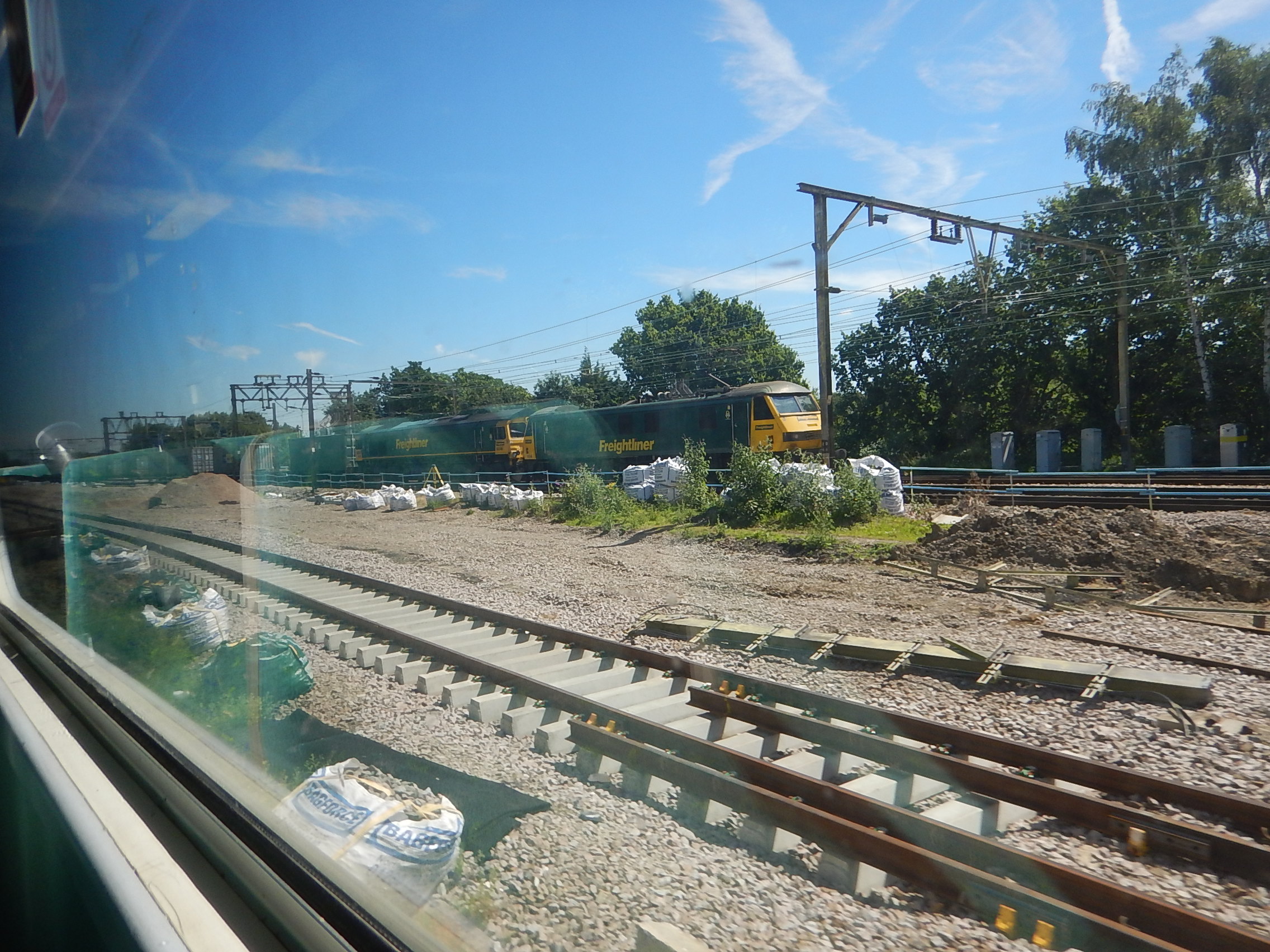
This double-headed train has a Class 90 electric locomotive and a Class 66 diesel locomotive at the front of a long freight train.
- The Class 90 locomotive has an TDM system for multiple working.
- The Class 66 locomotive has an AAR system for multiple working.
So does this mean that the two locomotives can’t work together, which if it does begs the question of what is happening.
- Had the Class 66 locomotive failed and Class 90 was acting as a Thunderbird?
- Was the Class 66 locomotive being moved from one depot to another for maintenance or repair?
- Was it an experiment to see if the two locomotives could work together?
I sometimes think that I didn’t see this unusual formation, but then the camera doesn’t lie.
But could we learn from what Wabtec are doing for Roy Hill in Australia?
The Class 93 Locomotive
Rail Operations Group have already ordered thirty Class 93 tri-mode locomotives from Stadler, which have following power ratings.
- Electric – 4000 kW
- Diesel – 900 kW
- Hybrid – 1300 kW
If this locomotive is capable of hauling the heaviest intermodal freight trains out of Felixstowe, Southampton and other ports and freight terminals, it could contribute to substantial reductions in the diesel fuel used and emissions.
As an example, I will use a freight train between Felixstowe North Terminal and Trafford Park Euro Terminal.
- It is a route of 280 miles.
- I will ignore that it goes along the North London Line through North London and along the Castlefield Corridor through Manchester Piccadilly station.
- There is fifteen miles without electrification at the Felixstowe end.
- There is under three miles without electrification at the Manchester end.
On this service , it could be as much as 94 % of diesel and emissions are saved, if the Class 93 locomotive can haul a heavy freight train out of Felixstowe. A few miles of strategically-placed electrification at the Ipswich end would help, if required.
It must also be born in mind, that the Class 93 locomotive is a 110 mph locomotive on electric power and could probably do the following.
- Run at 100 mph on the busy Great Eastern Main Line.
- Run at faster speeds on the West Coast Main Line.
- Fit in well with the 100 mph passenger trains, that run on both routes.
So not only does it save diesel and carbon emissions, but it will save time and make the freight train easier to timetable on a route with lots of 100 mph passenger trains.
The Class 93 locomotive looks like it could be a game-changer for long-distance intermodal freight, especially, if there were short sections of strategically-placed electrification, added to the electrified network.
Emissions could also be reduced further by using some for of sustainable fuel.

The picture shows a Class 66 locomotive, which is powered by Hydrotreated Vegetable Oil or HVO.
I can see that all diesel-powered trains and locomotives will be powered by sustainable fuels by the end of this decade.
A Wabtec Battery-Electric Locomotive
Wabtec is building a battery-electric locomotive for Roy Hill in Australia.
This article on Railway Age talks about Wabtec’s FLXdrive battery locomotives and describes some features of the locomotive for Roy Hill in Australia.
It mentions pantographs and overhead wires to charge the batteries.
- Wabtec’s prototype battery locomotive has a power output of 3.24 MW and a battery size of 2.4 MWh
- The Roy Hill battery locomotive has a power output of 3.24 MW and a battery size of 7 MWh
I could envisage Wabtec designing a UK-sized battery-electric locomotive with these characteristics.
- 2.5 MW power output, which is similar to a Class 66 locomotive.
- A battery size of perhaps 1.8 MWh based on Wabtec’s FLXdrive technology.
- A pantograph to charge the batteries and also power the locomotive where electrification exists.
- 75 mph operating speed.
- Ability to work in tandem with a Class 66 locomotive.
All technology is under Wabtec’s control.
This locomotive could have a range of at least fifty miles on battery power.
I think this locomotive could handle these routes.
- Peterborough and Doncaster via the Great Northern and Great Eastern Joint Line via Lincoln, with some form of charging at halfway.
- Felixstowe and Nuneaton, with some extra electrification at some point between Peterborough and Leicester.
- Oxford and Birmingham, with possibly some extra electrification in the middle.
One option for charging electrification, would surely be to electrify passing loops.
I think a battery-electric locomtive based on Wabtec’s FLXdrive technology could be a very useful locomotive.
Could Wabtec’s Battery-Electric Locomotive Pair-Up With A Class 66 Locomotive?
Roy Hill will use their locomotive to form a consist of three diesel locomotives and one battery locomotive to obtain double-digit savings of fuel and emissions, when hauling iron-ore trains that are 1.6 miles long on a route of 214 miles.
We don’t have massive iron-ore trains like this, but we do move huge quantities of segregates and stone around the country in trains generally hauled by Class 66 locomotives.
So could a Class 66 or another suitable locomotive be paired-up with a battery-electric locomotive to make savings of fuel and emissions?
I would suggest that if it works in Australia, the technology will probably work in the UK.
The biggest problem for Wabtec is that the heavy end of the market may well be a good one for hydrogen-powered locomotives. But Wabtec are going down that route too!
Conclusion
I am convinced that the two decarbonisation routes I have outlined here are viable for the UK.
But I also feel that locomotive manufacturers will produce hydrogen-powered locomotives.
Other companies like Alstom, Siemens and Talgo will also offer innovative solutions.
How Nicki Minaj And Swollen Testicles Became Part Of a UK Coronavirus Briefing
The title of this post, is the same as that of this article on the BBC.
I do like this comment from Sajid Javid on Sky News, from the BBC report.
People that are in the public eye whether they are a celebrity or a politician or whoever they are should be very careful with their language and certainly shouldn’t be spreading untruths.
I had never heard of Nicki Minaj before and I don’t think I want to hear any of her future pronouncements.
The Side Door At King’s Cross Station
Earlier this week, I noticed this door in the Eastern side of King’s Cross station.




The door appears to lead through to the concourse and in normal operation, probably gets used if a vehicle needs to access the platforms.
These pictures were taken on the other side.



If you walk to the left, you go to Platforms 0 and 1.
But at night could this entrance be used to access Express Parcels and Light Freight Services on these two platforms?
When Will It Ever End?
They’re at it again digging up the pavement on Southgate Road in Hackney


Note.
- This time the bus-stop I regularly use is shut!
- There were no signs up, that this work would be going on.
- At least the guys seem to be doing a good job.
Over the last six months, we’ve had water, telecoms and pavement layers digging everything up. Sometimes, I feel trapped as all the bus stops are closed.
There hasn’t been as much work on the Islington side of the road, but then you can always tell when you cross the border between plebeian Hackney and posh Islington, as the pavements get worse.
I’ve only fallen over twice on the street since my stroke and both times it was in Islington.
Hayes & Harlington Station – 15th September 2021
Hayes & Harlington station is the latest Crossrail station to be more or less completed.





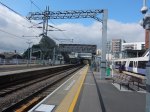




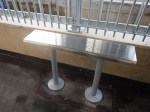


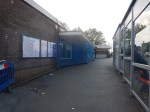








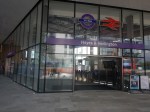


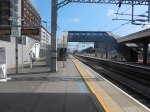

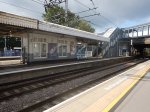
Note.
- The station is a big improvement on what was there previously.
- The building with the green stripes down the front used to be the offices of Metier Management Systems, of which I was a founder.
- A big development is being built to the South of the station, which is shown in the first to pictures.
There are still a few things to do, but it’s almost a complete station.
Services
It looks like Crossrail will run four trains per hour (tph) through the station all day.
Great Western Railway run two tph between Paddington and Didcot Parkway, that stop at the station.
I’m Glad I’m Getting Pfizer As My Booster
In Hay Fever, Coeliac Disease And The AstraZeneca Covid-19 Vaccine, I summarised the battle going on in my body over the last few months, between hay fever and the AstraZeneca vaccine.
I wonder what my strong immune system will make of the Pfizer vaccine. I must admit, I’m tempted to just continue with my gluten-free diet and let my immune system sort out the squabble on its own!
Velocys Welcomes US Government SAF Policy Support
The title of this post, is the same as that of this article on London South East.
This is the first paragraph.
Velocys plc – Oxford, England-based fuels technology company – Welcomes US government announcement last week of a set of comprehensive new policy actions in support for Sustainable Aviation Fuel production in the US. Notes Velocys is cited in a White House briefing paper setting out the Biden administration’s plans to incentivise commercial scale supply of SAF in the US to meet decarbonisation objectives while stimulating economic growth.
I hope that being cited by the White House is a good thing.
I do think though, that Velocys have the technology, that could help us to keep flying until hydrogen-powered aircraft are developed.
Getlink Launches A New Innovative Unaccompanied Rail Freight Cross-Channel Service
The title of this post, is the same as that of this press release from Getlink.
This is the first two paragraphs.
From September 18, 2021, a new cross-Channel freight service will be open to all transporters, using an unaccompanied mode through the Channel Tunnel. The service will benefit of Getlink’s unique customs expertise for the passage through the border
The crossing will be managed by Eurotunnel Le Shuttle Freight and will operate 24 hours a day and six days per week. Departures will be from the Group’s two terminals in Calais or Folkestone. The capacity will be 8,300 trailers per year. The Eurotunnel Border Pass will allows transporters to speed up the border crossing by digitising their administrative exchanges with the border authorities.
The service is designed to compliment the decarbonisation plans of both the French and UK Governments.
It looks like this could be a sensible idea.
But 8,300 trailers per year only equates to around 26-27 trailers per day. So do they just fill up one train per day?
One article on the Getlink service says that DFDS have launched a rival service for unaccompanied trailers between Calais and Sheerness.
 The Anonymous Widower