Could Drax Power Station Solve The Carbon Dioxide Shortage?
Drax Power station is the largest power station in the UK, with a 2.6 GW capacity when burning biomass.
It has also been a regular target of environmental activists complaining of the power station’s carbon dioxide and other emissions.
But could it be an unlikely saviour to replace the carbon dioxide that comes from two fertiliser plants run by the CF Industries, that have been shut down by high gas prices?
I wrote about the shortage in Food Shortages Looming After Factory Closures Hit Production.
Two and a half years ago I wrote Drax Becomes First Wood-Burning Power Plant To Capture Carbon, which was based on an article in the Financial Times.
I said this about the report.
This news has been treated in a more sensationalist way by other news media and sites, but the FT gives it very straight.
Drax power station is running an experiment, that removes a tonne of carbon dioxide a day.
But that is only the start of the process and most of it is released to the atmosphere.
They are currently, looking for profitable and environmentally-friendly ways of disposal, including selling it to beer manufacturers.
Didn’t we have a carbon-dioxide shortage a few months ago?
Now is probably a good time to dig a little deeper into what Drax is doing.
The Wikipedia entry for Drax power station has a section called Carbon Capture And Storage.
This is the last paragraph of the section.
In May 2018, Drax announced a new carbon capture and storage pilot scheme that it would undertake in conjunction with the Leeds-based firm, C-Capture. The focus of this pilot will be on capturing carbon post combustion from the biomass burners as opposed to the coal burners. Drax will invest £400,000 into the project. The company, C-Capture, is a side company of the Department of Chemistry established at the University of Leeds. This would yield about 1-tonne (1.1-ton) of CO2 stored per day from the process, which could be sold on for use in the drinks industry. The pilot scheme was launched in February 2019. The capture of carbon from biomas burners is known as Bio Energy with Carbon Capture and Storage (BECCS).
Who are C-Capture?
Their web site is very informative and this page is called Our Story, which explains the project at Drax.
We designed, built, and installed a pilot plant and have been operating it on site, with real flue gas, since early 2019. The data gathered from this trial is feeding directly into the design process for a full-scale plant, with a target of 10,000 tonnes of CO2 per day captured from one of Drax’s four biomass fired boilers. A recent development has been the installation of equipment to bottle the captured CO2 to allow other organisations to test their own developing technologies with genuine Drax derived CO2.
That looks like a result to me for C-Capture.
This page is called Technology and has a very neat interactive guide to how the technology works.
Conclusion
This company has some very special technology, that has a lot of applications.
It is also significant that Drax and BP have taken a shareholding in C-Capture.
Is Carbon Dioxide Not Totally Bad?
To listen to some environmentalists, there views on carbon dioxide are a bit like a variant of George Orwell’s famous phrase Four legs good, two legs bad from Animal Farm, with carbon dioxide the villain of the piece.
I have just read the Wikipedia entry for carbon dioxide.
For a start, we mustn’t forget how carbon dioxide, water and sunlight is converted by photosynthesis in plants and algae to carbohydrates, with oxygen given off as waste. Animals like us then breathe the oxygen in and breathe carbon dioxide out.
Various web sites give the following information.
- The average human breathes out 2.3 pounds of carbon dioxide per day.
- As of 2020, the world population was 7.8 billion.
This means humans breathe out 17.94 billion pounds of CO2 per day
This equates to 6548.1 billion pounds per year or 2.97 billion tonnes per year.
And I haven’t counted all the other animals like buffalo, cattle, elephants and rhinos, to name just a few large ones.
Wikipedia also lists some of the Applications of carbon dioxide.
- Precursor To Chemicals – Carbon dioxide can be one of the base chemicals used to make other important chemicals like urea and methanol.
- Foods – Carbon dioxide has applications in the food industry.
- Beverages – Carbon dioxide is the fizz in fizzy drinks.
- Winemaking – Carbon dioxide has specialist uses in winemaking.
- Stunning Animals – Carbon dioxide can be used to ‘stun’ animals before slaughter.
- Inert Gas – carbon dioxide has several uses, as it is an inert gas.
- Fire Extinguisher – Carbon dioxide is regularly used in fire extinguishers and fire protection systems.
- Bio Transformation Into Fuel – It has been proposed to convert carbon dioxide from power stations into biodiesel using a route based on algae.
- Refrigerant – Carbon dioxide can be used as a refrigerant. It was used before CFCs were developed and I know of a large Victorian refrigeration system on a farm in Suffolk, used on a store for apples, that still is in regular use that uses carbon dioxide.
- Dry Ice – The solid form of carbon dioxide has lots of applications, where cooling is needed.
Other important applications are under development.
- Agriculture – Carbon dioxide is piped to greenhouses to promote growth of crops. It is also used at higher concentrations to eliminate pests.
- Low Carbon Building Products – Companies like Mineral Carbonation International are developing ways of creating building products from carbon dioxide.
- Synthetic Rubber – Research is ongoing to create replacements for synthetic rubber.
I can only assume, that the demand for gaseous carbon dioxide will increase, as scientists and engineers get more innovative about using the gas.
Solving A Shortage Of Carbon Dioxide
At the present time, there is shortage of carbon dioxide, that I wrote about in Food Shortages Looming After Factory Closures Hit Production.
In the related post, I said this.
Perhaps we should fit carbon capture to a handy gas-fired power station, like SSE are planning to do at Keadby and use this carbon dioxide.
Consider.
- The Keadby complex of gas-fired power stations is close to a lot of depleted gas fields, some of which are in Lincolnshire and some are off-shore.
- Some gas fields are already being used to store natural gas imported from Norway.
- SSE plan to fit the later power stations with carbon capture.
I talk about SSE’s plans in Energy In North-East Lincolnshire.
If SSE were to build four large gas-fired power stations at Keadby, I calculated that they would produce 5.4 million tonnes of carbon dioxide per year.
It could be used or stored in depleted gas fields according to demand.
But the complex at Keadby would not release any carbon emissions.
Could Carbon Capture Be A Nice Little Earner?
If demand for carbon dioxide continues to rise, I could see power companies installing carbon capture on gas-fired power stations to generate an extra income stream.
Incidentally, there are 55 operational gas-fired power stations in the UK, that can generate a total of 30 GW, which are owned by perhaps ten different companies.
Development of carbon capture systems could be helped by Government subsidy.
Conclusion
I have long forgotten all the calculations I did with gases, but I do know that when one molecule of methane combusts it produces two molecules of water and one of carbon dioxide.
So I am fairly convinced that if you took X cubic kilometres of natural gas out of a gas field, after combustion there wouldn’t be anything like as much volume of carbon dioxide to put back, specially if a proportion could be used profitably in other processes.
If we are going to use gas to generate zero-carbon power, we probably need to do it with gas fields under our control either onshore or in the seas around our coasts. This is because the depleted gas fields can be used to store the carbon.
Gas-fired power stations with carbon capture supporting industries that need supplies of carbon dioxide will become a large part of our energy economy.
Rolls-Royce’s All-Electric ‘Spirit of Innovation’ Takes To The Skies For The First Time
The title of this post, is the same as that of this press release from Rolls-Royce.
This is the first paragraph.
We are pleased to announce the completion of the first flight of our all-electric ‘Spirit of Innovation’ aircraft. At 14:56 (BST) the plane took to the skies propelled by its powerful 400kW (500+hp) electric powertrain with the most power-dense battery pack ever assembled for an aircraft. This is another step towards the plane’s world-record attempt and another milestone on the aviation industry’s journey towards decarbonisation.
Rolls-Royce also published an album of photographs, of which this is one.

Note that the motor was designed and made by Yasa.
Stratford Station Secures Funding For Plans Set To Relieve Overcrowding
The title of this post, is the same as that of this article on Rail Technology Magazine.
These are the first two paragraphs.
Reduced congestion at London’s Stratford station is on the table as Network Rail secure a £2m boost from the Department for Transport.
Stratford Station has seen a surge in demand – despite the impact of the pandemic – ever since the 2012 Olympics, and the forecast for this is set to grow even more as the area continues to regenerate.
Something needs to be done as it is he busiest non-terminal station in London, that before the pandemic was handling over 42 million passengers per year.
Nothing specific is said, except that more space will be created for passengers with better wayfinding.
Although the article says that this could be a five year project.
The Current Station
This is an extract from It’s Time To Detopsify Stratford Station, which was a previous look at Stratford station in May this year.
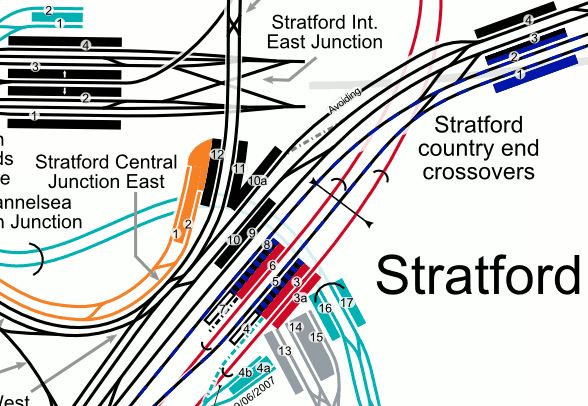
This map from cartometro.com shows the Topsy-like nature of the platforms at Stratford.
Note.
- The Docklands Light Railway is shown in turquoise.
- The DLR platforms in the North-West corner of the map are those of Stratford International station.
- High Speed One and the four platforms of Stratford International station are shown in black.
- The North London Line of the London Overground is shown in orange.
- The North London Line terminates in Platforms 1 and 2, which have a level link to Platform 12.
- Platform 12 is on the anti-clockwise platform for the High Meads Loop and has step-free access to the subway system underneath the station.
- Platform 11 is on the clockwise platform for the High Meads Loop and has level access to Platform 10a and full step-free access,
- Platform 10a is used by some services to East Anglia.
- Crossrail is shown in blue.
- The Central Line is shown in red.
- The Jubilee Line is shown in silver.
It is not the best passenger-friendly station layout.
What Would I Do?
These are what I would like to see.
Better Information on the Overground Platforms
If I am returning from Stratford after doing some shopping at Eastfield, I will often climb up the stairs or rise in the lift to the two Overground platforms 1 and 2. I will often find two trains there, but there is no indication to say which will be the first train to leave.
Use Of The High Meads Loop
The High Meads Loop is a double-track loop at the Southern end of the branch of the West Anglia Main Line that leads to Stratford.
- It is mainly underneath the Eastfield shopping centre.
- It serves Platforms 11 and 12 in Stratford station.
As the single-track loop of the Wirral Line under Liverpool can handle up to sixteen trains per hour (tph), I believe that the High Meads Loop could be used as the Southern terminus for an improved service to Cambridge, Stansted Airport and up the Lea Valley to Cheshunt, Chingford, Harlow and Hertford East.
The signage from when Stratford had a Stansted Express service is still there and shown in this picture.

This is almost symptomatic of the chaotic nature of the station.
I get the impression from this sign, that one of the original design criteria of the High Meads Loop and the Overground platforms at Stratford for the North London Line was to create an easy route for the whole of North London to Stansted Airport and Cambridge.
Or is it just a symptom of Too Many Cooks Syndrome, where everybody had their own ideas and no-one took charge and designed Stratford station properly?
Let’s hope Network Rail are fully in charge, as this is not a project to interest Sadiq Khan, as it’s not in South London and that area of London won’t benefit.
A Better Connection Between Stratford Station And Southeastern HighSpeed Services
I have just looked up how it is recommended you might travel between Richmond and Faversham.
The timetable recommends a double-change at Clapham Junction and Victoria.
I would take the Overground to Stratford and then change to the Southeastern HighSpeed services.
- This route is a single change.
- The change is step-free.
- The change involves passing the best station stop in the UK; Marks and Spencer’s large store in the Eastfield Shopping Centre, where takeaway food is well placed for passing trade.
But the change is badly signposted and could be a long walk with a heavy case.
There is probably a need for some form of people mover that connects all the platforms at Stratford station to the platforms at Stansted International station.
Conclusion
Sort it!
Food Shortages Looming After Factory Closures Hit Production
The title of this post, is the same as that of this article on The Times.
This is the first paragraph.
Acute food shortages were feared last night after high gas prices forced most of Britain’s commercial production of carbon dioxide to shut down.
In some ways, this is rather ironic, when on the one hand we are trying to stop the emission of carbon dioxide and on the other we haven’t got enough for important uses in the food industry.
Perhaps we should fit carbon capture to a handy gas-fired power station, like SSE are planning to do at Keadby and use this carbon dioxide.
If the shortage continues, there’ll be no dry ice for the pantomimes this Christmas.
Vicat And Hynamics Develop Solution For Capturing CO2 And Producing Carbon-Free Methanol
The title of this post, is the same as that of this article on World Cement.
This is the first paragraph.
Under a partnership with Hynamics, a subsidiary of energy-provider Groupe EDF that specialises in production of hydrogen, Vicat is developing an integrated solution for capturing CO2 and producing carbon-free methanol.
As cement manufacture is a large emitter of carbon dioxide, this could lead to a worthwhile solution.
But is it another application of Carbon Capture And Use?
Skelmersdale Railway Station Could Finally Happen – If Government Says Yes
The title of this post, is the same as that of this article on Lancs Live.
The article is a good summary of why Skelmersdale needs a station.
But it doesn’t mention that any service to Skelmersdale will probably go via Merseyrail’s new station at Headbolt Lane.
‘Dramatically More Powerful’: World’s First Battery-Electric Freight Train Unveiled
The title of this post, is the same as that of this article in The Guardian.
It is a good article about Wabtec’s new FLXdrive battery train and is very positive about it coming from a typical Guardian direction.
The article is a must-read.
I am beginning to feel that what Wabtec has done is to create a practical and affordable solution, that will cut carbon emissions in a difficult area, that produces the figures and also is understandable by diverse groups, like journalists, politicians and environmentalists. And they are backing it with academic research from a good university.
I also believe that the technology can be applied to existing locomotives as I outlined in Could Class 66 Locomotives Be Converted Into Battery-Electric Locomotives?.
Could this be another example of positive environmental change brought about by when the big beasts play their cards in the jungle?
Going green is a way of company survival! And Wabtec are going in that direction.
Could Class 66 Locomotives Be Converted Into Battery-Electric Locomotives?
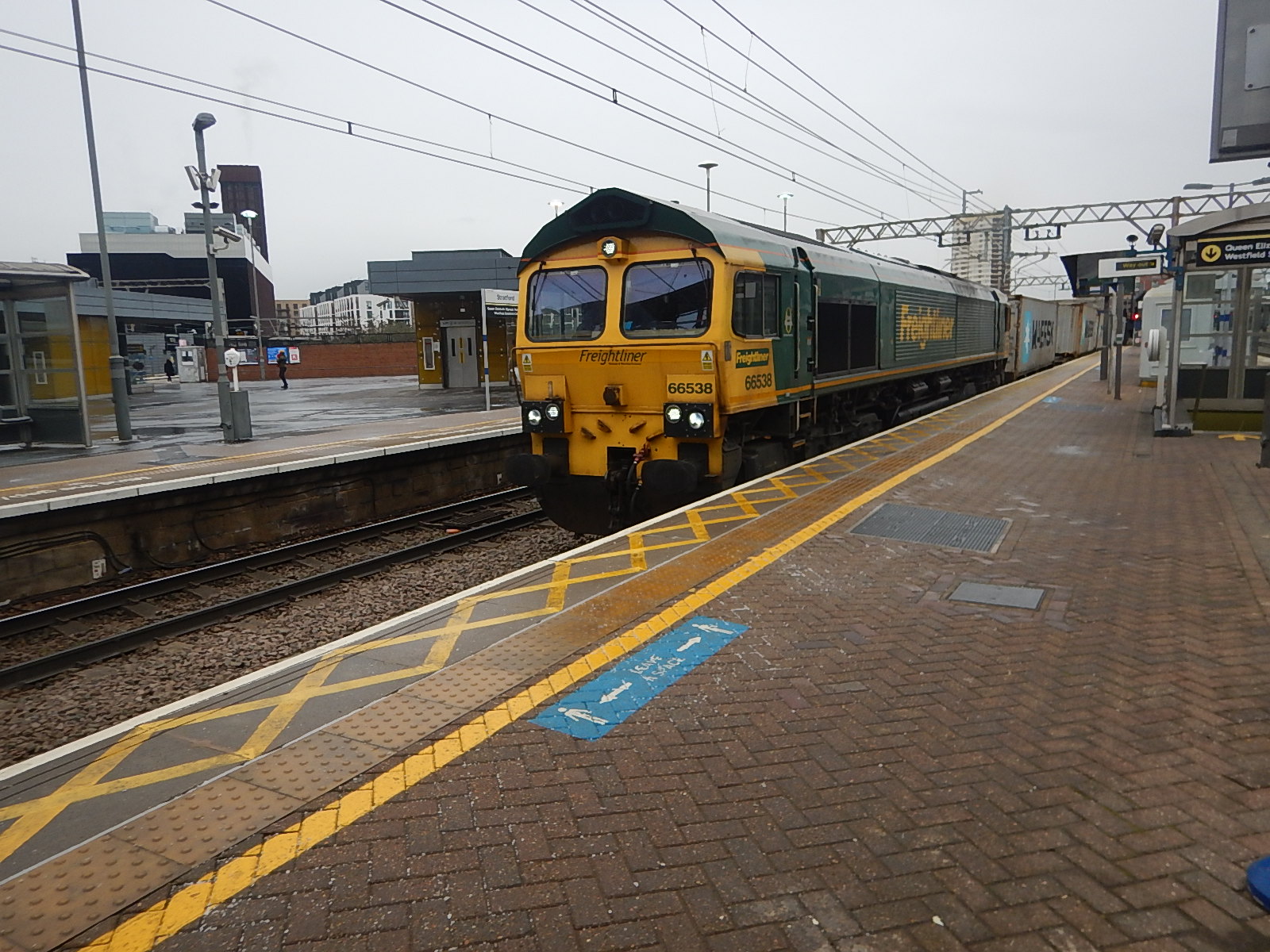
This picture shows a Freightliner Class 66 locomotive passing through Stratford with a multimodal freight train.
These are a few thoughts on converting some of the four hundred and eighty Class 66 locomotives into battery-electric locomotives.
An Estimate Of Performance Of A Battery Electric Class 66 Locomotive
In Iron Ore Miner Orders Heavy-Haul Battery Locomotive, I said this about a UK-sized locomotive based on Wabtec’s FLXdrive battery-electric technology.
I could envisage Wabtec designing a UK-sized battery-electric locomotive with these characteristics.
- 2.5 MW power output, which is similar to a Class 66 locomotive.
- A battery size of perhaps 1.8 MWh based on Wabtec’s FLXdrive technology.
- A pantograph to charge the batteries and also power the locomotive where electrification exists.
- 75 mph operating speed.
- Ability to work in tandem with a Class 66 locomotive.
All technology is under Wabtec’s control.
This locomotive could have a range of at least fifty miles on battery power, doing the sort of duties that Class 66 locomotives do!
So it would be able to take a multimodal container train out of the Port of Felixstowe to the electrification at Ipswich.
The Class 66 Locomotive Is Diesel-Electric
The Class 66 locomotive is a diesel-electric locomotive, where the diesel engine drives an alternator, which generates electricity, which then powers the six traction motors, which are arranged, so that there is one on each of the six axles.
This should make conversion easier, as the heavy lump of the engine and the alternator would be replaced with a large number of lithium-ion batteries.
Wabtec Has A Modular Battery System
This article on Railway Age gives a lot of detail and several pictures of the modular FLXdrive battery system.
- Each module is a 4.9 kWh battery, that weighs 72.6 Kg.
- Batteries are arranged into strings, which feed the traction motors.
- There is a sophisticated control system, which ensures that a module failure doesn’t disable the locomotive.
- The battery system is air-cooled.
I would expect that Wabtec could arrange a number of modules in the stripped out body of a Class 66 locomotive.
The FLXdrive Battery System Handles Regenerative Barking
The Railway Age article says this.
Battery charging while the FLXdrive is operating occurs through regenerative dynamic braking.
This will certainly improve efficiency.
Could A Pantograph Be Fitted To A Class 66 Locomotive?
This picture of a Class 66 locomotive was taken at Peterborough.

Note the 25 KVAC overhead electrification and the gap between the wires and the roof of the locomotive.
I don’t think it would the toughest job to design a pantograph for a Class 66 locomotive.
What Would Be The Use Of A Battery Electric Class 66 Locomotive With A Fifty Mile Range?
I believe that a surprising number of duties currently handled by Class 66 locomotives could be performed by a battery-electric Class 66 locomotive.
- The locomotives would effectively be electric locomotives with a last fifty mile capability.
- The number of possible duties will increase as electrification increases.
- They would be ideal to support track maintenance activities.
- They would be a zero-carbon locomotive with a low noise footprint.
As I said earlier, they should be able to haul a heavy intermodal train out of the Port of Felixstowe.
Would A Battery-Electric And A Diesel-Electric Class 66 Locomotive Working As A Pair Be Able to Handle The Heaviest Trains?
As the Americans and Canadians have shown with more than one locomotive, where one is a battery-electric locomotive can reduce the carbon-emissions, the same rules must apply in the UK.
Conclusion
I am not a lover of the smelly, noisy and polluting diesel Class 66 locomotives, but it does look it could be possible to convert some into battery-electric locomotives.
I wouldn’t be surprised to see Wabtec convert some Class 66 locomotives into battery-electric locomotives.
I also believe, that conversion of Class 66 locomotives to battery-electric operation could be the most affordable way to help decarbonise rail freight.
FLXdrive ‘Electrifies’ Pittsburgh
The title of this post, is the same as that of this article on Railway Age.
The article describes Wabtec’s FLXdrive locomotive, as “the world’s first 100% battery, heavy-haul locomotive”
It is well worth a read, as it describes some of the design philosophy.
In addition, this page on the Wabtec web site gives some details of the locomotive.
It is powered by lithium-ion batteries.
- There are around 20,000 battery cells
- The batteries have their own air-conditioning
- There is a sophisticated battery-management system.
- The total battery size is 2.4 MWh
- Power output is 4400 HP or 3.24 MW
- Locomotive will run for 30-40 minutes at full power.
- The locomotive has regenerative braking.
- Operating speed is 75 mph
Note that running at 75 mph for 40 minutes would cover fifty miles.
The Railway age article has this paragraph, which describes a partnership between Carnegie-Mellon University (CMU), Genesee & Wyoming and Wabtec to create the Freight Rail Innovation Institute.
CMU, Genesee & Wyoming and Wabtec also hope to create the Freight Rail Innovation Institute, described as “the first-of-its-kind effort to create zero-emission locomotives, develop technology that increases freight rail utilization and improve safety by 50%, and create 250,000 jobs by 2030.” G&W’s Buffalo & Pittsburgh Railroad will pilot technologies developed by the Freight Rail Innovation Institute, including a zero-emissions battery and hydrogen-powered train that is planned for revenue operation on 200 miles of track between Pittsburgh and Buffalo, N.Y. within the next three years.
Note.
- The paragraph is very much a mission statement.
- Genesee & Wyoming are the parent of Freightliner in the UK, who are developing a dual-fuel locomotive, that I wrote about in Freightliner Secures Government Funding For Dual-Fuel Project.
It strikes me CMU, Genesee & Wyoming and Wabtec are on the right track.
 The Anonymous Widower