LNER’s Middlesbrough And London Service Starts On December 13th
Tucked at the bottom of the article entitled LNER Tickets For Christmas Getaway in Edition 939 of Rail Magazine, there is this paragraph separated from the article by a sole bullet point.
LNER has confirmed that from December 13 it will run a new weekday service between London King’s Cross and Middlesbrough.
It has already made an appearance on Real Time Trains and I can find the following details.
- There will be one train per day (tpd)
- Intermediate stops will be at Thornaby and York.
- The Middlesbrough and London service will leave Middlesbrough from Platform 1 at 07:08 and arrive in King’s Cross at 10:22.
- The London and Middlesbrough service will leave King’s Cross at 15:25 and arrive in Middlesbrough in Platform 2 at 18:18.
These are my thoughts.
Trains Per Day
One train per day, is obviously an introductory service and like services to Harrogate and Lincoln, the number of services will ramp up to perhaps four or five tpd, if the demand is there and the paths and trains are available.
Journey Times
Consider
- The Southbound journey takes three hours and fourteen minutes with a time of two hours and nine minutes between York and King’s Cross
- The Northbound journey takes two hours and fifty-three minutes with a time of one hour and fifty-six minutes between King’s Cross and York.
- Some services between King’s Cross and York are as fast as one hour and forty-eight minutes.
- Middlesbrough and York seems to take around 52-58 minutes.
- These Middlesbrough and York timings are consistent with TransPennine Express.
- Digital signalling could offer savings in journey time between York and London.
I think it is very likely as the timetable improves, that timings between Middlesbrough and London could be around two hours and forty minutes.
Electrification
The route is fully electrified except for between Middlesbrough and Longlands Junction, where it joins the electrification of the East Coast Main Line, which is a distance of twenty-two miles.
Hitachi are developing a battery-train, which they call the Hitachi Intercity Tri-Mode Battery Train, which is described in this Hitachi infographic.

Note.
- LNER’s current Class 800 trains will probably be able to be converted to this train.
- A range on battery power of upwards of forty miles would be expected.
If the range on battery-power can be stretched to perhaps sixty miles, this train should be capable of serving Middlesbrough without the need for any extra charging at the terminus.
I am sure Hitachi would like to see their battery-electric trains running between King’s Cross and Middlesbrough, as it would be an ideal route on which to show the trains to prospective customers, given that their factory is at Newton Aycliffe.
Conclusion
This could be good demonstration battery-electric service for Hitachi and LNER.
LNER Tickets For Christmas Getaway
The title of this post, is the same as that of an article in Edition 939 of Rail Magazine.
These are the first two paragraphs.
LNER has made available thousands of Advance tickets for the festive period.
It follows research by the operator suggesting that some 48% of people are planning to travel this Christmas to see family and friends, with 30% of them looking to book at least six weeks in advance.
This is surely a good thing and will LNER eventually copy Lumo in allowing ticket purchases longer in advance?
The article says that LNER Internet enquiries and ridership are on the up, with the latter at over 90 % of pre-pandemic levels.
Open Access Operators And The Lumo Model
In the UK, there are only three established Open Access operators, who run UK train services.
- Grand Central
- Heathrow Express
- Hull Trains
From the 25th of October, they will be joined by Lumo.
We probably don’t think of Heathrow Express as an Open Access operator and as it is effectively a short distance special service with new trains between Heathrow and Paddington, it has its own business model, that may or may not survive.
But how will Lumo and their bold new business model affect Grand Central, Hull Trains and any future Open Access operators?
Grand Central Trains
Grand Central is a well-established Open Access operator.
- They run services between London King’s Cross and Bradford Interchange, Sunderland and several other convenient en-route stations.
- They are owned by Deutsche Bahn.
- They also regularly seem to apply for new routes and extra services.
But they have a big problem fast catching up on them; they have a diesel-only fleet and need to decarbonise.
I also think that all express passenger services on the East Coast Main Line will at some date need to be run by 140 mph trains capable of running with full digital signalling and a degree of Automatic Train Operation.
In Lumo: Why Won’t The New Train Service Stop At Yorkshire Stations?, I said that to continue to be successful, they probably need to embrace the Lumo model and acquire new trains.
I will repeat what I said in the related post.
This would entail.
- The ten diesel Class 180 trains would be replaced by new electric trains.
- The trains would need a 140 mph capability under digital signalling to fit in with the plans of Network Rail, LNER and Lumo to create a top-class high-speed high-capacity East Coast Main Line.
- The trains would need a battery capability as Grand Central’s routes are not fully electrified.
- They could copy Lumo’s green marketing philosophy, ticketing and catering offering.
As to the trains, I’m sure that Hitachi could offer a version of their Intercity Tri-Mode Battery Train, the specification of which is shown in this Hitachi infographic.
The trains would need a range of fifty miles on battery-power.
I have some other thoughts.
Financing
If you look at the finances of decarbonising Grand Central, they would need a new fleet of ten trains, which as Lumo’s fleet of five trains are reported to be costing £100 million, so that figure can be at least doubled.
There would also be costs for the two charging systems at Bradford Interchange and Sunderland. But at least there are several possible solutions for charging systems, so the price will probably not be more than a few million, if that.
Will Deutsche Bahn be prepared to stump up the extra finance?
A Service To Cleethorpes
In the Wikipedia entry for Grand Central, there is a section which is entitled London Kings Cross to Cleethorpes, which outlines a proposed service.
- It would split and join with the London King’s Cross and Bradford service at Doncaster.
- It would call at Crowle, Scunthorpe, Barnetby, Habrough and Grimsby.
- Doncaster and Cleethorpes is 52.1 miles and should be in range of a Battery-electric train with a charging system at Cleethorpes.
Using current times from LNER and TransPennine Express, I estimate that Hitachi Intercity Tri-Mode Battery Trains could travel between London and Cleethorpes in around two hours and twenty minutes.
With digital signalling on the East Coast Main Line to the South of Doncaster, the overall time could be much closer to two hours.
This could be a very viable service with battery-electric trains capable of running at 140 mph on the East Coast Main Line and for sixty miles at 100 mph on battery power.
Maximising The Use Use Of Train Paths By The Use Of Splitting And Joining
The proposed service to Cleethorpes is a classic use of splitting and joining, which enables two separate services to run a large part of their routes together.
- On the East Coast Main Line, it means that maximum use can be made of the paths available.
- Splitting and joining is part of the specification for the Hitachi trains and they do it automatically in under two minutes.
- LNER are already talking about using the technique to serve various destinations from Leeds.
I wouldn’t rule out Grand Central’s two services working as a pair between London King’s Cross and Doncaster, where they would split and join.
Conclusion On Grand Central Trains
Decarbonisation with high-speed battery-electric trains could ensure the future of Grand Central Trains.
Hull Trains
Hull Trains is another well-established Open Access operator.
- They run services between London King’s Cross and Hull and Beverley.
- They have a fleet of five bi-mode Class 802 trains.
- The company is part of First Group.
Hull Trains don’t have the decarbonisation problem of Grand Central Trains, as I suspect Hitachi will come up with a solution to turn Class 802 trains into a battery-electric train with a range of perhaps seventy miles on battery power.
- Beverley and Temple Hirst junction is a distance of 44.3 miles and is the only section of the route without electrification.
- Charging of the batteries will be needed at the Eastern end and probably would be best handled by a short length of electrification in Hull station or between Hull and Brough stations.
The Class 802 trains are also ready for updating to run under the new digital signalling of the East Coast Main Line.
First Harrogate Trains
First Harrogate Trains was a subsidiary of Hull Trains, which hoped to run the following services.
- London King’s Cross and Harrogate via York
- London King’s Cross and Cleethorpes via Peterborough, Spalding and Lincoln
Both these services could be run in conjunction with the current service with an appropriate split and join.
Conclusion On Hull Trains
As both Hull Trains and Lumo share London King’s Cross and are both owned by First Group, I would expect that both train operators would share some services, methods and ideas.
There may be advantages if Hull Trains’s Class 802 trains and Lumo’s Class 803 trains could run each other’s services.
Grand Union
Grand Union is a prospective open access operator who are proposing to operate train services from England to Wales and Scotland.
They are proposing two services.
London Paddington and Cardiff Central via Reading, Bristol Parkway, Severn Tunnel Junction, Newport and Cardiff Parkway, with a possible extension later to Swansea andLlanelli or Carmarthen.
London Euston and Stirling via Milton Keynes Central, Nuneaton, Crewe, Preston, Carlisle, Lockerbie, Motherwell, Whifflet, Greenfaulds and Larbert.
Note.
- London Paddington and Cardiff Central is fully electrified, but there is no electrification West of Cardiff Central.
- Cardiff Central and Swansea are 45.7 miles apart.
- London Euston and Stirling is fully electrified.
Currently, the rolling stock for both services is proposed to be a tri-mode Class 93 locomotive hauling a rake of Mark 4 coaches and a driving van trailer.
The locomotive should be capable of handling the routes to Stirling and Cardiff using the electrification alone.
When the Cardiff route is extended, Grand Union would intend to use Class 802 trains, which could be fitted with batteries to serve Swansea, where the batteries would be charged.
There is no sign as yet, that the Office of Rail and Road have approved any of their possible services, but both services might be improved with some Lumo-style thinking.
Alliance Rail Holdings
Alliance Rail Holdings, which is a sister company to Grand Central, is ultimately owned by Deutsche Bahn, seems to have several ideas for new services, but only seems to have got approval to one.
They were given approval some years ago to run a service between London Euston and Blackpool North.
- Calls would be made at Poulton-le-Fylde, Kirkham and Wesham, Preston, Nuneaton and Milton Keynes Central.
- There will be six trains per day.
- Trains would be InterCity 225 trains.
- The approval is for seven years from 2018.
But because of the pandemic it hasn’t run.
Conclusion
The Lumo model will affect all these services.
Fairytales Do Sometimes Come True!
Well Done! Emma!
My Ticket To Ride
I’ve just picked up my ticket to ride to Edinburgh on the 27th of next month from Dalston Junction station.

All very conventional!
Lumo: Why Won’t The New Train Service Stop At Yorkshire Stations?
The title of this post, is the same as that of this article on the Yorkshire Post.
This is the first article, I’ve found about Lumo, that has a negative headline.
The reason is probably very simple, in that most Lumo services are planned to stop at only at Newcastle and Morpeth, with two services having an extra stop Stevenage.
They are intending to run the service in as short a time as possible between London King’s Cross and Edinburgh.
As each stop has a time penalty, not stopping in Yorkshire will give potential to go cut the journey time.
But the positive message that comes from the writer of the Yorkshire Post article is that Yorkshire likes the concept.
This paragraph is their take on the service.
The goal is to encourage a more environmentally friendly mode of transportation and affordable travel. Lumo will provide low-carbon emissions, affordable long-distance travel for more than one million passengers every year.
Perhaps they would like their own Yorkshire flyer.
The obvious way for this to happen would be for the Open Access operator; Grand Central to convert themselves into a train operator like Lumo.
- The ten diesel Class 180 trains would be replaced by new electric trains.
- The trains would need a 140 mph capability under digital signalling to fit in with the plans of Network Rail, LNER and Lumo to create a top-class high-speed high-capacity East Coast Main Line.
- The trains would need a battery capability as Grand Central’s routes are not fully electrified.
- They could copy Lumo’s green marketing philosophy, ticketing and catering offering.
As to the trains, I’m sure that Hitachi could offer a version of their Intercity Tri-Mode Battery Train, the specification of which is shown in this Hitachi infographic.
The trains would need a range of fifty miles on battery-power.
Charging facilities wold be needed at Bradford Interchange and Sunderland stations, as neither has suitable 25 KVAC overhead electrification.
Conclusion
The conversion of Grand Central to work on the Lumo model is possible and as the trains will need to be changed to zero-carbon ones soon to meet decarbonisation objectives, I would suspect that at least that will happen.
Twenty Years On!
On the eleventh of September in 2001, I had three jobs to do in London.
- I had to visit my press cuttings client near Borough tube station to talk about something, which I have long forgotten.
- I had to deliver a thousand Al Stewart CDs to his manager, as the singer was going on tour. The handover was to be performed in Waterloo station.
- I was then going on to Soho to see a Chinese bookmaker, for whom I offered computer advice.
I parked my car on a meter and went to visit the first client at about two.
When I returned to the car, I needed to phone my wife; C about something. My phone was installed in my Discovery and it didn’t have any calling list, as I remembered numbers and just typed them in.
But for some reason I couldn’t remember her mobile phone number or the Office number at home, so I didn’t make the call.
This was very unlike me, as I’ve always had an excellent memory. Especially for numbers.
I did remember to deliver the parcel to Al Stewart’s manager and made my way to Soho, where I parked in an underground car park.
It was only when I got to the bookmakers did I realise what was going on in New York, as they had the televisions on and were watching the drama continuously.
I have a feeling, that I made my excuses and returned quickly to Suffolk.
By this time, my memory had returned and I was able to phone C.
But the worst terrorist attacks of recent memory were probably over.
Did my brain pick up the bad news or was it due to being close to the City of London, where there would have been a large amount of electronic communication to New York?
I have no idea.
But there is another incident, where I may have picked up tragic news through the ether.
On Sunday, the 31st August 1997, I woke up about five as I generally do and remarkably said to C. “Something tragic has happend! I think Tony Blair has been assassinated!”
She told me to stop being silly and I went downstairs to make a cup of tea and do some programming. It was then that I turned on the radio and heard that Princess Diana had died in the traffic accident in Paris.
A Fairytale Of New York
I am 74 and got my interest in sport from my father. He used to take me to football at Spurs and Enfield Town and regularly would get me out of bed to watch quality sport like athletics, when it was shown live on television. I can remember watching Derek Ibbotson breaking the World mile record in black-and-white in 1957.
Over the years, I’ve watched many great sporting achievements. If Emma Raducanu wins in New York tomorrow, it’s up there with England’s two World Cups in football and rugby, Botham’s exploits at Headingley, Moss’s victory at Monaco in 1961 and Wiggins and friends’ victories in the Tour de France.
And if it happens on the twentieth anniversary of one of the worst atrocities in human history, it will be a true fairytale of New York.
New East Linton Station Development Given The Go Ahead
The title of this post, is the same as that of this article on Rail Technology Magazine.
This is the first paragraph.
Proposals to open a station in the village of East Linton, for the first time in over half a century, have just been approved by East Lothian Council’s planning committee.
In The Scottish Borders Have Caught London Overground Syndrome, I said this.
It would also appear that because of the success of the Borders Railway, that there are suggestions to add new stations on the East Coast Main Line at Reston and East Linton. This is said under Future in the Wikipedia entry for East Linton station.
Proposals to reopen the station, along with the former station at Reston, have received the backing of John Lamont MSP, who has taken the case to the Scottish Parliament. A study published in 2013 proposed that East Linton and Reston stations be reopened. Since Abellio ScotRail took over the franchise in April 2015, they have now committed to reopening East Linton and Reston Stations as part of the local Berwick service by December 2016 but due to the shortage of rolling stock this will now commence in December 2018.
So it would appear there is a high chance it will happen.
Reston station is well on the way to completion and the site is shown in this Google map.

Note.
- The East Coast Main Line running between the North-West and South-East corners of the map.
- The brown scars around the railway indicate the site of the station.
- The main A1 road is just off this map to the North.
In New Rail Service From Newcastle To Edinburgh To Stop At These Northumberland Stations, I indicated that a new service from TransPennine Express will start running in December 2021 and will call at Reston station, when it opens.
Now East Linton station is on its way.
This Google Map shows the village of East Linton.
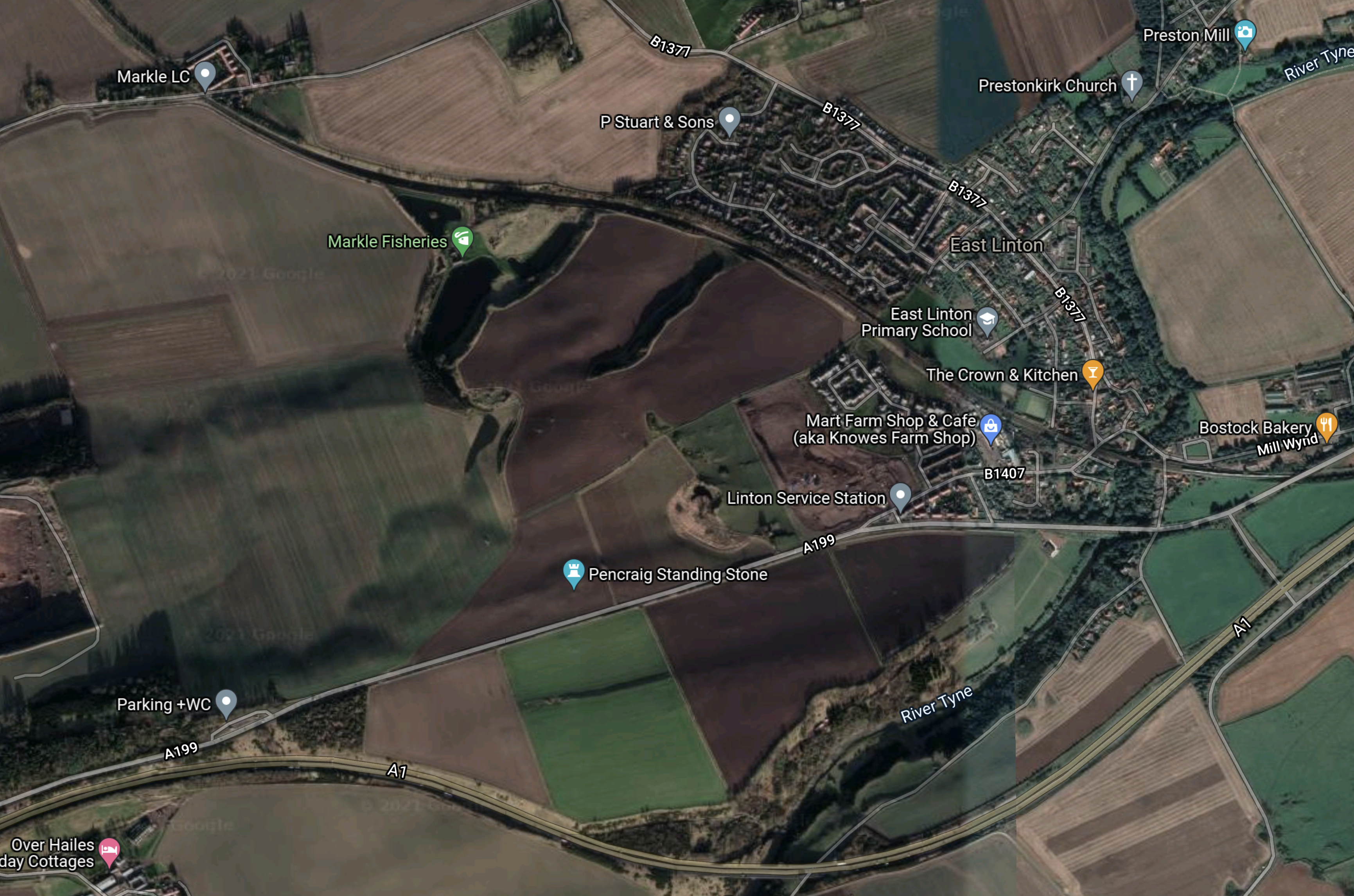
Note.
- The East Coast Main Line going through the middle of the village.
- The A1 curves South of the village.
Will the station be built in the middle of the village?
The page on Scotland’s Railway, indicates it will be.
East Linton and Reston stations seem to be progressing at speed, but then so did Horden and it appears Soham will be open this year.
Network Rail seem to have at last got their project management right.
The London And Edinburgh Travel Market
This paragraph comes from of this article on Railway Gazette.
Lumo is aiming to carry more than 1 million passengers per year. It is particularly targeting people who currently fly between Edinburgh and London; in June it says there were 74 764 air journeys on the route, compared to 82 002 by rail.
Lumo’s million passengers per year, will equate to around 83,300 passengers per month.
What these figures don’t show is the number of rail journeys made to intermediate stations like Newcastle, York, Doncaster and Peterborough.
These are a few thoughts.
Rail Capacity Between London And Edinburgh
Consider.
- LNER is currently the only rail carrier offering a daytime service between London and Edinburgh.
- LNER run approximately 26 trains per day (tpd) in both directions between London and Edinburgh.
- A nine-car Class 801 train can carry 510 Standard Class passengers and 101 First Class passengers.
That means that LNER had a capacity of just over 950,000 seats in June.
It might seem poor to have only sold 82,002 seats in June between London and Edinburgh, which is just 8.6 % of the available seats.
On the other hand, LNER’s two trains per hour (tph) are a lot more than London and Edinburgh trains, as they connect towns and cities all the way up the East Coast Main Line between London and Aberdeen.
Lumo’s capacity of a million seats per year, works out at 83,300 seats per month, which is another 8.7 % of capacity.
- Lumo will sell seats on price initially and I suspect they’ll end up running about 85-95 % full.
- It has been stated that they need to run 80% full to break even.
- I also think, that they would like to have a few seats for late bookers.
But even so, they will surely affect LNER’s bookings.
What Will LNER Do?
Several of the things, that Lumo are doing can be easily copied by LNER.
- Early booking.
- Improve onboard service.
- Better seating.
They could even reduce prices.
I think it is very likely we could end up with a price and service war between LNER and Lumo.
Would The Airlines Be The Losers?
This could be an outcome of competition between LNER and Lumo.
We are now talking about times of around four hours and twenty-five minutes between London and Edinburgh, but there are improvements underway on the East Coast Main Line.
- The remodelling of the approach to Kings Cross station has not been reflected in the timetables.
- The Werrington Dive Under has not been completed yet.
- Digital signalling is being installed South of Doncaster.
- The power supply is being upgraded North of Newcastle.
When these and other improvements are complete, I can see journey times reduced below four hours.
But would that only be for starters?great b
If a 1970s-technology Intercity 225 train, admittedly running as a shortened train formation, could achieve a time of just under three-and-a-half hours for the 393.2 miles between Kings Cross and Edinburgh stations in September 1991, what could a modern Hitachi train do, if all of the improvements had been completed and perhaps half of the route could be run at 140 mph under the watchful eyes of full digital signalling and an experienced driver.
Consider.
- London and York is nearly two hundred miles of fairly straight railway, that is ideal for high speed.
- Current trains run the 393.2 miles in four hours 25 minutes, which is an average speed of 89 mph.
- A train running at 89 mph would take two hours and fifteen minutes to cover 200 miles.
- A train running at 125 mph would take one hour and thirty-six minutes to cover 200 miles.
- A train running at 140 mph would take one hour and twenty-six minutes to cover 200 miles.
When Network Rail, Great British Railways or the Prime Minister renames the East Coast Main Line as High Speed East Coast, I think we can be sure that trains between London and Edinburgh will be able to achieve three-and-a-half hours between the two capitals.
High Speed Two is only promising three hours and forty-eight minutes.
What About LNER’s New Trains?
LNER Seeks 10 More Bi-Modes, was written to explore the possibilities suggested by a short article in the December 2020 Edition of Modern Railways.
There has been no sign of any order being placed, but Hitachi have moved on.
- They are building the prototype of the Hitachi Intercity Tri-Mode Battery for testing on the Great Western Railway.
- They have completed some of the Class 803 trains for East Coast Trains, which has now been renamed Lumo. These trains have a battery for hotel power in case of catenary failure, but no diesel engines.
- They are building the Class 807 trains for Avanti West Coast, which appear to be designed for high speed and have no batteries or diesel engines.
- The latest versions of the trains will have a reshaped nose. Is it more aerodynamic at high speeds?
It does seem that there is an emphasis on speed, better acceleration and efficiency.
- Could the lessons learned be used to improve the performance of the existing trains?
- Could a small high performance sub-fleet be created to run LNER’s Scottish services?
There are certainly possibilities, that would cut journey times between London and Edinburgh.
Conclusion
I can see the airlines flying between London and Edinburgh suffering a lot of collateral damage, as the two train companies slug it out.
 The Anonymous Widower