An Interview With Sir Paul Nurse
The Times Saturday Interview is with Sir Paul Nurse and is entitled ‘Boris knows he’s out of his depth. Suddenly experts are useful again’.
It is a must-read and you may be able to read it on-line by registering with The Times, as that gives you a number of free articles.
It is people like Sir Paul, who will finally defeat COVID-19!
Big London Hospital Was Close To Running Out Of Oxygen
The title of this post is the same as this article on The Times.
With COVID-19 and all those ventilators and CPAP devices, this sounds like a tragedy about to unfold.
I also remembered a story told to me by a friend, who used to be the Chief Pharmacist at a London hospital.
Oxygen was one of their problems, as the tanks were in a small yard with gates opening on to a busy street, about two hundred metres, away from the hospital.
The problem was that illegal parkers would block the gates, so that delivery couldn’t be made.
Knowing my physics and the reliability of deliveries in parts of London, I thought on-site electrolysis might be a better idea. So I consulted my bible.

There on page 760, it is all described how water can be split into two molecules of hydrogen and one of oxygen by electrolysis.
ITM Power are the experts on electrolysis, so I sent them an e-mail and asked if they could make an electrolyser, that produced oxygen instead of hydrogen.
The reply came swiftly and confirmed, that they could make an electrolyser that supplied oxygen. They also said, that the oxygen was of a high purity.
Just Connect Electricity And Tap Water
All these electrolysers would need is supplies of electricity and tap water to create hydrogen and/or oxygen.
No trucks would be needed to deliver tonnes of liquid gases, which can be rather dangerous to move around city streets.
ITM Power’s hydrogen electrolysers are starting to appear in filling stations, so they can refuel hydrogen-powered vehicles.
One could be installed in a hospital to provide a continuous stream of pure oxygen, which could be piped into the current oxygen delivery system.
What To Do With The Hydrogen
The hydrogen electrolysers produce oxygen as a by-product, which I suspect is just vented to the atmosphere!
But you can’t vent large amounts of hydrogen to the atmosphere, as it is an inflammable gas!
However, you could do either of the following options.
- Connect it to a hydrogen fuel pump to refuel hydrogen vehicles.
- Inject the hydrogen into the gas main, as is regularly done with hydrogen produced by surplus renewable electricity.
I prefer the first option, as it could mean that health-care could start to use hydrogen-powered ambulances, that are zero carbon and pollution-free.
Perhaps not an appropriate saying for the industry, but it would genuinely kill two birds with one stone.
The Innovation Must Go On
This is a snippet I found on this news round-up on Rail Business UK.
Network Rail has issued a request for information on innovative techniques for undertaking tunnel renewals and enlargement while minimising blockades. NR said it manages 693 tunnels that are typically 150 years old; these require different and increasing levels of maintenance and renewal, but the growth of traffic means there is less access for maintenance.
Someone in Network Rail has got the engineering envelopes out again and is doing their thinking at home under lockdown, rather than in a real ale hostelry.
Companies and other organisations, should use COVID-19 as an opportunity to innovate.
Imagine the unthinkable and the downright bonkers, so long as it’s legal!
Think loony! You know it makes sense!
Zopa And COVID-19
As regular readers of this blog will know, I invest my spare savings in the peer-to-peer lender Zopa.
I have a feeling, from my experience of reading the statistics of my lending on the site, that money is slow to be lent out!
But there are people out there, even in these insecure times, who have a guaranteed cash-flow and a good credit rating.
And some of these may need a loan to perhaps replace a car, that has expired and they need to get to their essential job or to furnish a spare room as a home office or schoolroom.
If I needed a sensible loan, which I don’t, I’d check out Zopa.
Lockdown And INR Testing
I am on Warfarin and have to be tested regularly for my INR.
I have been doing it for at least seven years now and know that if I test twice a week and take four milligrams of the drug my INR stays well within limits.
This is a testing regime, which fits well with the COVID-19 lockdown, that I’m currently enforcing on myself!
Ipswich And Peterborough In A Battery Train
Greater Anglia have a fleet of bi-mode electro-diesel Class 755 trains, that could be converted into tri-mode electro-diesel-battery trains. I reported on this in Battery Power Lined Up For ‘755s’.
If when fitted with batteries these trains had a range of say 55-65 miles on battery power, these Greater Anglia routes could be handled using battery and electric power.
- Ipswich and Cambridge
- Ipswich and Felixstowe
- Ipswich and Lowestoft
- London and Lowestoft
- Marks Tey and Sudbury
- Norwich and Cambridge
- Norwich and Great Yarmouth
- Norwich and Lowestoft
- Norwich and Sheringham
Note.
- Marks Tey and Sudbury is planned to be extended to Colchester Town. Is this to allow a Class 755 train with a battery capability to charge the batteries on the Great Eastern Main Line? No charging facilities would then be needed on the branch.
- I have left out the current Ipswich and Peterborough service.
- There is speculation that Greater Anglia want to run a Cambridge and Wisbech service via Ely and March.
It is also reported that some or all Peterborough and Ipswich services will continue to Colchester.
- There is a convenient bay platform at Colchester to reverse the trains.
- A Colchester and Peterborough service, would give travellers in North Essex easier access to LNER services at Peterborough.
- Frequencies from Colchester and Ipswich across Suffolk would be improved.
If the trains were to run on battery power between Stowmarket and Ely, the batteries could be charged between Colchester and Stowmarket. Note that Stowmarket and Ely is about forty miles, which should be within battery range.
Ely and Peterborough is thirty miles, which again is within battery range. So would the train top up the batteries at Ely in perhaps a five minute stop?
Extra Electrification At Ely
There could be three battery-electric services needing to charge batteries as they pass through Ely.
- Colchester/Ipswich and Peterborough
- Norwich and Stansted Airport
- Cambridge and Wisbech
So would it be sensible to extend the electrification for a few miles towards Peterborough and Norwich to give the battery a quick top-up? It should be noted that the notorious Ely Junction is to be remodelled.
The New Generation Of Pumped Storage Systems
This excellent article on GreenTechMedia is entitled The 5 Most Promising Long-Duration Storage Technologies Left Standing.
One of the technologies the article discusses is pumped storage, which in the UK is used at the massive Electric Mountain in Snowdonia, which can hold 9.1 GWh of electricity and supply up to 1,800 MW of electricity when needed. That’s not bad for 1970s engineering!
The GreenTechMedia article introduces pumped storage like this.
Midcentury modern design is hot again, so why not midcentury storage technology? This gravity-based concept physically moves water from a low to a high reservoir, from which the water descends, when needed, to generate electricity. This dates from way before lithium-ion’s heyday and still provides some 95 percent of U.S. grid storage, according to the U.S. Department of Energy.
The largest pumped storage system in the US is Bath County Pumped Storage Station, which is described as the biggest battery in the world. With a storage capacity of 24 GWh of electricity and a generating capacity of 3,003 MW, it dwarfs Electric Mountain. But then the Americans have bigger mountains.
Pumped storage is a good partner for intermittent renewables like wind and solar, but in a country like the UK, the US and other countries with strong planning laws getting permission to build a large pumped storage system is not easy. We tried to build one on Exmoor, but that was abandoned.
Note that the country building the most new pumped storage systems is China, where they have mountains and planning laws, that would not be acceptable anywhere else.
But engineers have come up with a new design, described in this paragraph from the GreenTechMedia article.
The new school of pumped hydro focuses on isolated reservoirs that don’t disrupt river ecosystems; this simplifies permitting, but projects still face a decade-long development timeline and billion-dollar price tags.
It then gives two examples of proposed systems.
Gordon Butte Pumped Storage Project
The operation of the Gordon Butte Pumped Storage Project is described like this in Wikipedia.
Gordon Butte will be located on a 177 acres (0.72 km2) site, and will have access to water from Cottonwood Creek, a tributary of the Musselshell River. The facility will operate as a closed system, without actively drawing or discharging water into the watershed. It will have a 4,000 acre-foot capacity reservoir, located 1,000 feet (300 m) above the base, with a power generation capacity of about 400 MW
The smaller size must make it easier to get it built.
How much energy will Gordon Butte hold in GWh?
- A 4,000 acre-foot reservoir has a capacity of 4,933,927.42128 cubic metres.
- As a cubic metre of water weighs a tonne, the reservoir can hold 4,933,927.42128 tonnes of water at an altitude of 300 metres.
- Using Omni’s Potential Energy Calculator, this gives a potential energy of 4,032,108 KWh.
This is just over 4 GWh.
Ths facility could supply 400 MW for ten hours or 4 MW for a thousand hours!
It should be noted that Electric Mountain has an efficiency of 74-76%.
Eagle Mountain Pumped Storage Facility
Eagle Mountain Pumped Storage Facility is introduced like this on its web site.
The pumped storage hydropower project at Eagle Mountain, CA will transform a scarred brownfield site into a 1,300 Megawatt generator of green electricity that can light one million homes. The site is in a remote part of the Mojave Desert, more than 50 miles from the nearest city, Blythe, CA, and more than 60 miles from Palm Springs and the Coachella Valley. The construction of the project will create thousands of jobs and add millions of dollars to the local economy while adhering to the most rigorous environmental standards.
Note that it is turning an eyesore of the worst kind into a pumped storage facility. It’s surely better than using it for landfill!
Conclusion
Systems like these may have applications in the UK!
Could some of those massive quarries in the Peak District be converted into pumped storage systems, using the technology of my two examples?
This Google Map shows the quarries surrounding the town of Buxton.
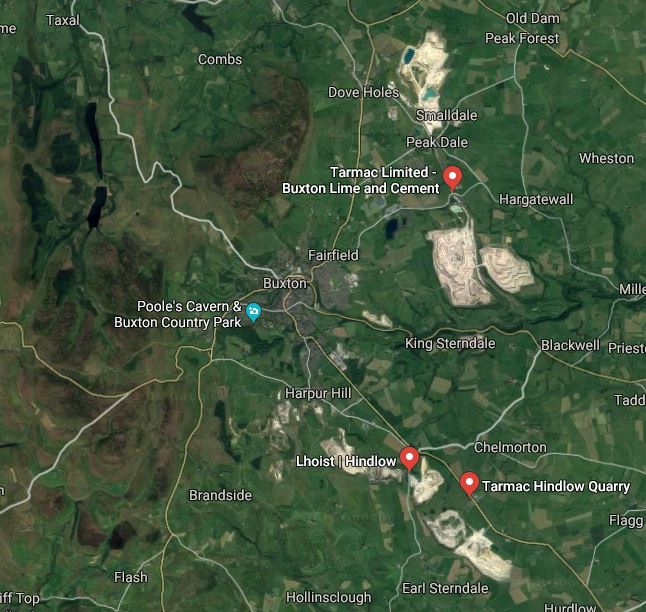
Note.
- The white areas looking almost like clouds are quarries.
- Buxton has an altitude of three hundred metres, which is the altitude of the Gordon Butte Storage Project.
- The vast Tunstead Quarry, which is four kilometres East of Buxton has an area of over one square mile.
- Tunstead Quarry has a red arrow above it marked Buxton Lime and Cement.
Could we not extract as much limestone as is possible from Tunstead and then convert it into a pumped storage system like Gordon Butte? It could have an area of 2.5 square kilometres and an altitude of nearly a thousand feet. A rough estimate, based on Gordon Butte, indicates it could store over 10 GWh.
Hopefully, better hydro-electric power engineers than myself, are looking at the quarries in the Peak District, with eyes flashing like cash registers.
There is one pumped storage project under development in the UK at the present time; Snowdonia Pumped Hydro, which obtained planning permission in 2017.
These are some characteristics.
- Situated in Snowdonia in old slate quarries at Glyn Rhonwy.
- 99.9 MW of power
- 700 MWh of storage capacity.
- 2 reversible turbines
- Start to full power in 12 seconds
- Cycle efficiency of around 81%
- Project lifespan of 125 years
- Estimated carbon saving of 50,000 tonnes per year
It is under a tenth the size to Electric Mountain, but every little helps.
I would also feel that with a 125 year life, it could be the sort of investment, that would appeal to a Pension Fund.
The 5 Most Promising Long-Duration Storage Technologies Left Standing
The title of this post is the same as that of this article on GreenTechMedia.
This is the sub-title of the article.
Low-carbon grids need longer-duration storage, but few technologies have succeeded at scale. Here’s the current roster of best bets.
I won’t steal their thunder, by saying too much more.
- Pumped storage, like Electric Mountain, is making a comeback.
- My favourite; Highview Power is on the list!
- One great thing about their Famous Five, is that perhaps only one uses an exotic material.
- I also think, that all five could be funded by a Pension Fund to give a return to pay pensions.
But you should read the article!
We’re not going to run out of energy!
A Design Crime – The Average Smoke Detector
On Saturday Evening, the smoke detector in my bedroom decided to go off.
I was able to silence it about three times, but it refused to go off permanently.
I then decided to take it down, by standing on the bed.
Unfortunately, I slipped and broke the detector.
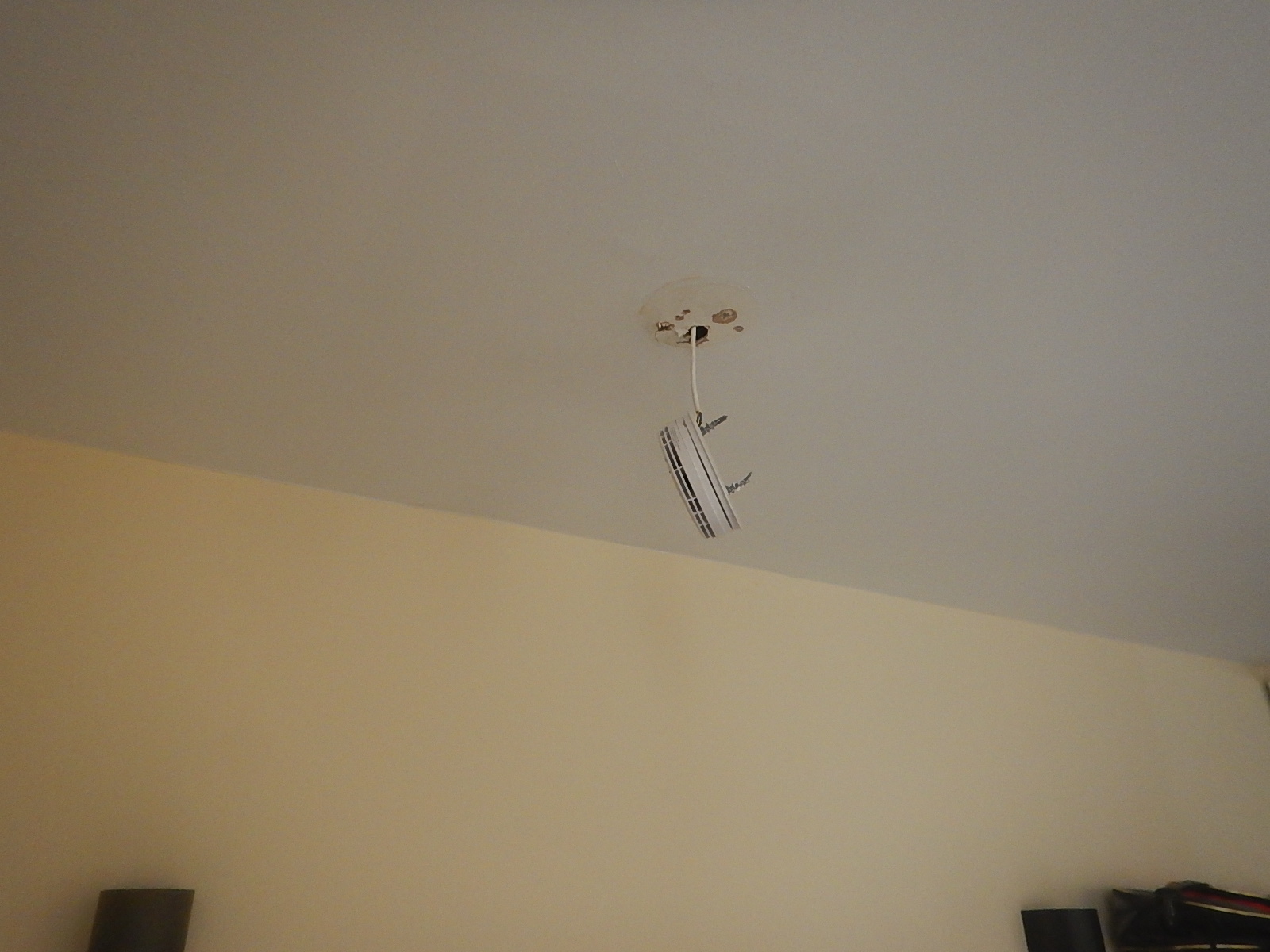
It is not the first altercation, I have had with the cheap and nasty smoke detectors in this house, which were probably bought in Istanbul market for a few pence.
- In my view, there is a need for a superior type of smoke detector wired into a building in a better way.
- It should be possible to replace a failed detector, like I had on Saturday in a simple operation without any tools.
- There should also be a master switch in the house, that switches off all the smoke detectors.
- Instructions on how to deal with the smoke detectors in case of failure should be in an obvious place in the house, like on the door of the meter cupboard.
Smoke detectors are too important, to be designed down to the cheapest possible station and most are a true design crime.
Marks And Spencer In Dalston Was On The Ball
This morning, I walked to Marks and Spencer in the Kingsland Road for essential supplies.

I got more than I needed and now have enough food in the fridge and my cupboards for the next ten days.
The hold-up in the store were the tills, but one of the assistants had taken control of the situation, by marshalling customers to spare self-service tills, scanning goods and helping to get the customers out of the store as fast as possible.
It was real East End spirit in action.
Remember that the BBC soap, was nearly shot in a real square close to Dalston and in some ways the chivvying and banter could have been transposed.
Is EastEnders dealing with COVID-19? I doubt it!
 The Anonymous Widower