SSE Launches £10m Hydro Community Benefit Fund
The title of this post, is the same as that of this article on Project Scotland.
This is the sub-heading.
SSE has launched a new £10 million hydro community benefit fund aimed at supporting projects within areas that host its existing hydro power infrastructure across Scotland.
These paragraphs fill in some detail.
The launch comes following the 80th anniversary of the hydro-electric development (Scotland) act of 1943, which enabled the North of Scotland Hydro-Electric Board (NoSHEB) to transform the way people lived and worked through the build of 54 power stations, 78 dams, and over 300km of underground tunnels.
SSE Renewables recently commissioned a report by Biggar Economics which found that the capital investment in hydro over the 80-year period since 1943 is £7.5 billion, supporting over 10,000 jobs annually in Scotland including 5,519 in the Highlands and Islands.
The new hydro community fund will see investment in local communities continue, with SSE Renewables having consulted with community council areas to establish key priorities.
Priorities include improvements to sustainable community transport, affordable housing, growth of small businesses and social enterprises, improvement of community assets and infrastructure, and a focus on community physical and mental well-being through community arts, culture, sports, and recreation.
If the new fund is as successful as the first, I can’t see thee being many complaints.
Centrica And Coterra Energy Announce Natural Gas Sale And Purchase Agreements
The title of this post, is the same as that of this news item from Centrica.
These three bullet points, act as sub-headings.
- Coterra will supply 100,000 MMbtu/d of natural gas for a period of 10 years, commencing in 2028.
- Volume supplied sufficient to heat 400,000 homes per year.
- Agreement expands Centrica’s growing LNG business.
These three paragraphs say more about the deal and add more on its context.
Centrica LNG and Coterra today announced the execution of two natural gas sale and purchase agreements. Under the contracts, Coterra will supply 100,000 MMbtu/d of natural gas linked to European gas prices such as TTF and NBP, for a period of 10 years, commencing in 2028.
This major gas deal will reduce the market risk in Centrica’s LNG portfolio by purchasing US gas on the same price indices under which the LNG is subsequently sold, and help underpin customer energy supplies for a decade. The volume supplied is sufficient to heat 400,000 homes per year, further cementing Centrica’s global role supporting energy security.
The deal follows similar agreements over recent years, demonstrating Centrica Energy’s innovative partnership approach, one of the key pillars of its successful and growing LNG business.
It certainly looks like Centrica are doing their best for UK energy security.
It also looks to me, that it is a low risk deal.
It should also help to keep us all warm in the UK, until renewable electricity and hydrogen come fully on stream.
Scottish Ministers Approve 200MW Battery Storage Project
The title of this post is the same as that as this article on Solar Power Portal.
These three paragraphs add further meat to the story.
Developer Intelligent Land Investments (ILI) Group has received planning consent for a 200MW battery energy storage system (BESS).
The BESS will be adjacent to the Easterhouse substation near Gartcosh, Glasgow, at Whitehill Farm. ILI Group received Section 36 planning consent, meaning that the BESS is classed as a change to the existing consent granted to the generating substation.
Consent from Ministers follows support for the project from both the Glasgow City Council and North Lanarkshire Council.
ILI seem to be doing well, as they regularly appear in my data searches.
The article sums up ILI Group’s portfolio like this.
ILI Group has a portfolio of over 4.7 GW energy storage projects, including 2.5 GW of utility-scale battery storage and 2.5 GW pumped storage hydro.
They must be doing something right.
ILI Group’s biggest success to date would appear to be developing the Red John pumped hydro power station, which they sold to Statkraft, as I reported in Statkraft To Acquire Major Loch Ness Pumped Storage Hydro Project From Intelligent Land Investments Group.
Conclusion
The batteries and the pumped storage keeps coming in Scotland.
It appears Scotland will not only generate the renewable energy, but store it until it is needed.
As a Control Engineer, my nose is telling me, that Scotland is going to need a few more interconnectors to sell the energy to those, who need it.
Alternatively, it will attract industries, that will need a lot of electricity.
RWE Gets Go-Ahead For 100 MW Electrolyzer For Offshore Wind-to-Hydrogen Project
The title of this post, is the same as that of this article on offshoreWIND.biz.
This is the sub-heading.
German energy company RWE has secured construction and environmental permits to build a 100 MW electrolyzer in Eemshaven, the Netherlands. The electrolyzer is part of system integration solutions associated with OranjeWind, an offshore wind project RWE is jointly developing with TotalEnergies in the Dutch North Sea.
These first threee paragraphs gove more information.
RWE described the permits as an important step in developing 100 MW of green hydrogen production at Eemshaven which, if built, will contribute to the onshore energy system integration plans associated with the 795 MW OranjeWind offshore wind project.
To remind, in July this year, TotalEnergies entered into an agreement with RWE to acquire a 50 per cent stake in the OranjeWind and said it would use its share of the electricity from the offshore wind project to power 350 MW electrolyzer projects that will produce about 40,000 tonnes of green hydrogen annually.
With the necessary permits in place, RWE stated it will be able to develop a 100 MW electrolyzer on a plot adjacent to the Magnum Power Station in Eemshaven.
I went to Eemshaven in The Train Station At The Northern End Of The Netherlands. The area looks like it will be the centre of the Dutch hydrogen industry.
This post is called The Dutch Plan For Hydrogen. The Dutch appear to want to be big in hydrogen.
A 100 MW offshore electrolyser is a good start.
Pumped Storage Hydro In The Highlands – Is Anywhere Still Off Limits?
The title of this post, is the same as that of this article on UK Climbing.
This is the sub-heading.
Are the enormous Earba and Fearna hydro projects merely the thin end of an ever bigger wedge? Thanks to a relaxed developer-friendly planning regime, is anywhere in Highland Scotland now safe from energy projects designed to feed an insatiable demand down south? In pursuit of clean power, do we risk permitting huge and irreparable harm across our remaining wild habitats and scenic land? And if so, what (and who) is it all really in aid of? It’s not too late to shed light on the murky world of Highland mega-energy, says Jane Meek, but time is running out for our mountain heritage.
These are the first three paragraphs.
In case you haven’t heard, Earba is the codename for a massive pumped storage hydro scheme to be hosted by Ardverikie Estate of Monarch of the Glen fame on behalf of Gilkes Energy, a Lakes-based engineering firm hitherto better known as a developer of small-scale run-of-river hydro schemes on Scottish burns and rivers. Some of these may be familiar to you: they include Pattack on Ardverikie Estate, Ben Glas on Glen Falloch Estate near Crianlarich, and Neaty Burn in Glen Strathfarrar, to name just three.
Gilkes Energy has now moved up into the big league of pumped storage hydro (PSH). Visit their homepage to admire a brief slide show of projects past, present and in planning. It’s glossy professional stuff, just what you’d expect from the self-styled “leading independent developer” of conventional hydro and PSH in the UK.
The aerial shots are particularly fine but… hang on a minute… isn’t that Loch a’ Bhealaich Leamhain down there, gleaming like a pearl in the high pass between Munros Beinn a’ Chlachair and Mullach Coire an Iubhair (Geal Charn as was)? And … oh dear, isn’t that Loch Fearna, the glittering shelf lochan below Spidean Mialach, immortalised in countless photographs by walkers crossing the col between Spidean and neighbouring Gleouraich? From the slopes above Fearna, the views across Loch Quoich to Gairich and beyond are simply stunning. After watching the slide show, you may feel simply stunned.
The author of the article makes a statement and asks a question.
It’s industrialisation on a vast scale. Are these truly the right schemes in the right places?
The author may have a point, but environmentalists will argue that saving the planet is more important and that pumped storage hydroelectricity is one of the technologies, that will help us do that!
Plans For Powering Trains And Details Of Our Upcoming Consultation
The title of this post, is the same as that of a news item on the East West Rail web site.
This is the sub heading.
We’re pleased to share plans for how we’ll power trains on East West Rail, as well as information and dates of our public consultation on latest proposals for the project.
These are the first two paragraphs.
As part of our latest proposals, which we’ll be sharing for public consultation from 14 November, we’re providing information on our preference for green traction power in the form of discontinuous electrification with hybrid battery-electric trains, after the Chancellor confirmed government support for the project in yesterday’s budget.
As well as reducing carbon emissions, discontinuous electrification would mean overhead lines would only need to be installed along some sections of the route, which would reduce disruption to existing structures and potentially reduce visual impacts in more sensitive locations on the new railway between Bedford and Cambridge. This option would also cost less than full electrification and would need less land for things such as mast foundations.
There is also a short video, which explains discontinuous electrification.
I feel that to use discontinuous electrification and hybrid battery-electric trains is the way to go on this railway between Oxford and Cambridge.
- It is a zero-carbon solution.
- There is electrification at Reading. Didcot, Bletchley, Milton Keynes, Bedford and Cambridge along the route, so grid connections will be already available.
- Sandy, where East West Rail crosses the East Coast Main Line, is fully electrified and must have a grid connection.
- A small article in the November 2024 Edition of Modern Ralways, says that Hitachi are developing a smaller battery for commuter and suburban trains.
- Didcot to Oxford could be electrified and there is already a grid connection at Didcot.
Discontinuous electrification could be used to extend East West Rail to Norwich, Ipswich and Colchester.
These are my detailed observations and thoughts.
Existing Electrification
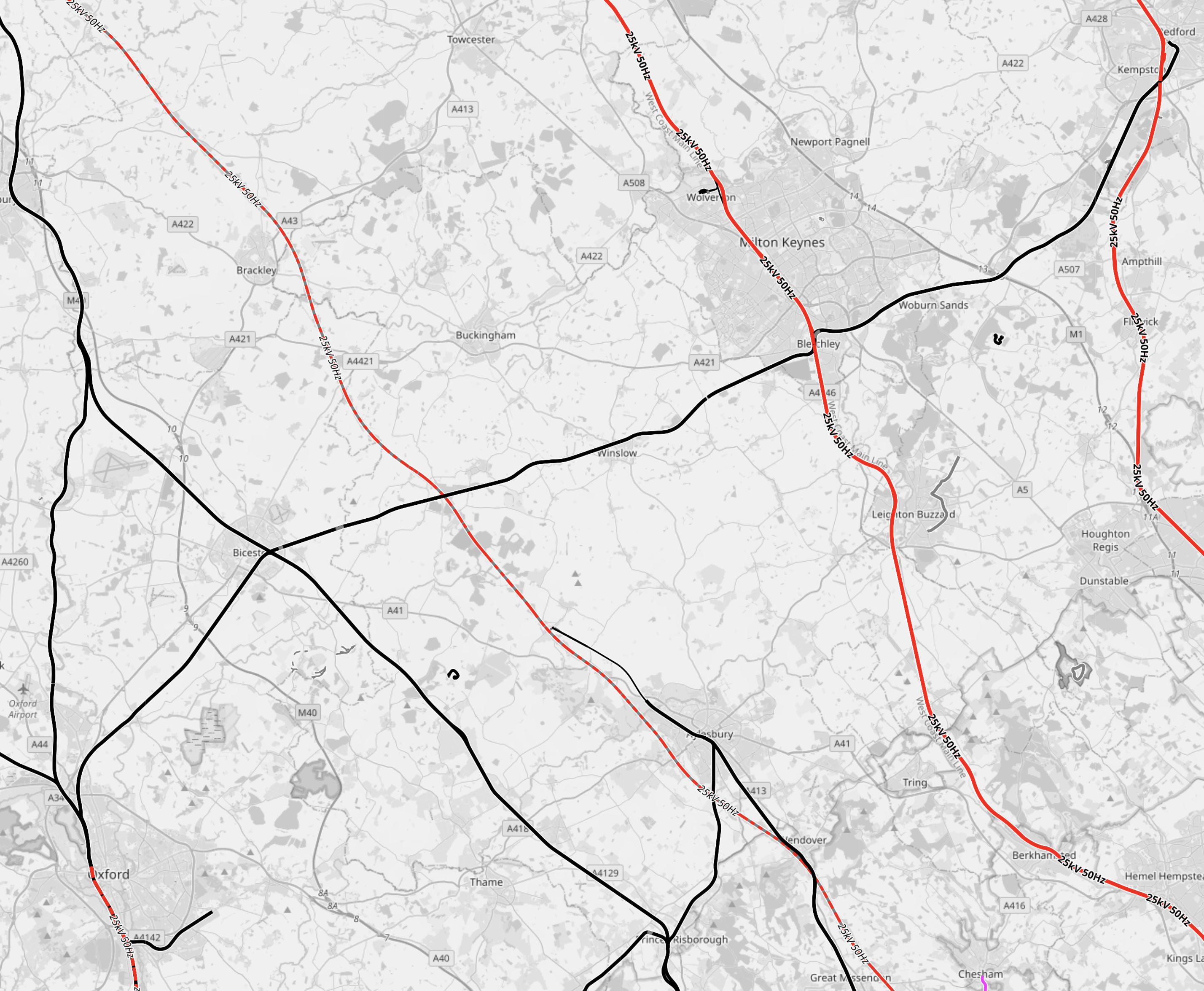
This OpenRailwayMap shows the electrification between Oxford and Bedford.
Note.
- Bold red lines are tracks electrified at 25 KVAC.
- Bold black lines are tracks without electrification.
- Oxford is in the South-West corner of the map.
- Bedford is in the North-East corner of the map.
- The bold black line of the Western section of the East West Rail connects the two cities.
- The lines through Oxford are shown as being electrified. The black stub pointing East to the South of Oxford is the Cowley Branch.
The rail lines crossing East West Rail from West to East are as follows.
- Chiltern Main Line – Not Electrified
- High Speed Two – Will Be Electrified
- West Coast Main Line – Electrified
- Midland Main Line – Electrified
I suspect all lines, except for the Chiltern Main Line, will be able to provide a grid connection for East West Rail.
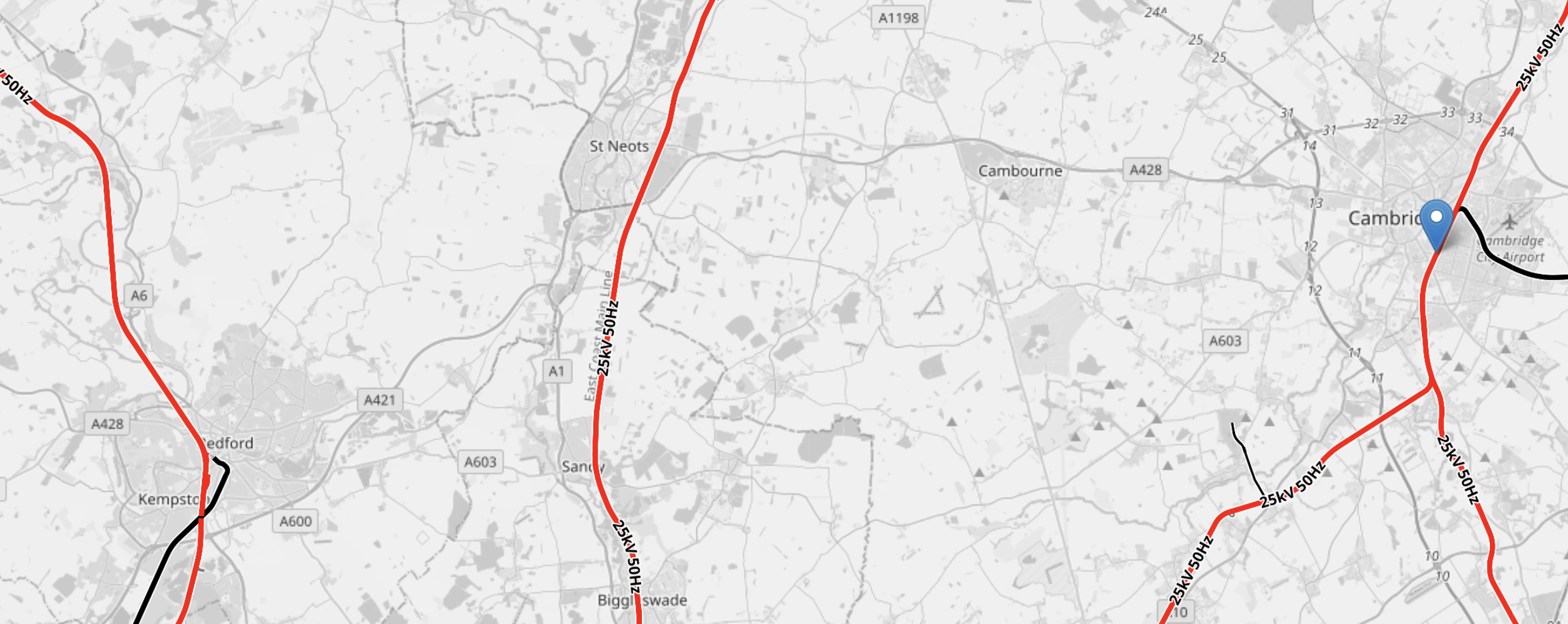
This second OpenRailwayMap shows the electrification between Bedford and Cambridge.
Note.
- Bold red lines are tracks electrified at 25 KVAC.
- Bold black lines are tracks without electrification.
- Bedford is in the South-West corner of the map.
- Cambridge is in the North-East corner of the map.
- The Eastern section of the East West Rail connects the two cities.
- Both maps are to the same scale
The rail lines crossing East West Rail from West to East are as follows.
- Midland Main Line – Electrified
- East Coast Main Line – Electrified
- West Anglia Main Line – Electrified
I suspect all lines will be able to provide a grid connection for East West Rail.
Distances Without Electrification
These sections are not electrified.
- Oxford and Bletchley – 47.2 miles
- Bletchley and Bedford – 16.5 miles
- Bedford and Cambridge – 29.2 miles
- Ely and Norwich – 53.7 miles
- Norwich and Great Yarmouth – 18.4 miles
- Cambridge and Haughley Junction – 41.3 miles
I am assuming that the East West Rail could extend past Cambridge on these two routes.
- Ely, Thetford, Norwich and Great Yarmouth.
- Newmarket, Bury St. Edmunds, Stowmarket, Ipswich, Manningtree and Colchester.
All sections have electrification at both ends, if Didcot Junction and Oxford is electrified, as is expected to happen.
Train Battery Range Needed
The route layout, I have proposed means that if you go for the battery-electric train with the longest battery range you can afford and it can’t handle Ely and Norwich, the existing electrification can be extended to bridge the gap.
Application Of Discontinuous Electrification To Greater Anglia And Chiltern Railways
If discontinuous electrification can be applied to East West Rail, it can surely be applied to Greater Anglia and Chiltern Railways, given the fact that the route networks of all three companies overlap and share tracks.
Greater Anglia already have a fleet of Class 755 trains, which are designed to be converted to battery-electric operation.
With batteries fitted, I believe that these trains could handle most of the current routes they do now.
The other routes would be handled with selective lengths of overhead electrification in terminal stations to charge the trains before return.
Electrification Between Oxford And Bicester Village Stations
Oxford station has two North-facing bay platforms, that are used by Chiltern and other services terminating at the station from the North.






Note.
- Chiltern Railways already run two trains per hour (tph) between these platforms and Marylebone.
- I would assume the platforms will be used by East West Rail services, that terminate at Oxford station.
- If discontinuous electrification is to be used, then these two platforms could be electrified to charge trains before they return.
- East West Rail have not published their proposed services yet, but it could be one tph to both Milton Keynes Central and Bedford stations.
I can see Chiltern buying battery-electric trains to run services between Marylebone and Oxford, and some other routes.
Marylebone and Oxford is 66.7 miles, which is probably two far for even Stadler’s remarkable battery-electric trains, but if say between Oxford and Bicester Village station were to be electrified, would it make it possible to run battery-electric trains between Marylebone and Oxford with charging at both end of the route.
In Chiltern Sets Out New Fleet Ambitions, I talk about Chiltern’s possible new fleet, as proposed by their MD in September 2023.
BOEM Links Up With US Department of Defense On Offshore Wind
The title of this post, is the same as that of this article on offshoreWIND.biz.
This is the sub-heading.
The US Bureau of Ocean Energy Management (BOEM) and the Department of Defense (DOD) have signed a memorandum of understanding (MoU) to support the coordinated development of offshore wind on the US Outer Continental Shelf (OCS).
These three paragraphs give more details of the agreement.
The agreement calls for DOD and BOEM to find mutual solutions that support renewable energy in a manner compatible with essential military operations.
The MoU also requires the organizations to collaborate early in the offshore wind leasing process and maintain regular communication at all levels.
Additionally, the agreement calls for DOD and BOEM to determine what areas should be deferred from leasing to enable the performance of DOD activities on the OCS.
I feel this is a very sensible agreement, as time progress, I’m sure that the co-operation will lead to several joint projects.
- Support boats ensuring safety, like the deal between Ørsted and the RNLI, that I talked about in Ørsted Evolves Long-Standing Partnership With RNLI,
- Offshore structures like electrolysers and substations could have a secondary use as military training facilities.
- Smaller ships, like minehunters, coastguard cutters and fishery protection vessels could go electric and the wind farms could provide charging facilities.
If the United States Navy are hanging around the wind farms, it might discourage Putin’s friends.
Wind farms and the US military could be good neighbours.
Brendan Owens, who is the Assistant Secretary of Defense for Energy, Installations, and Environment, said this.
We will continue to work with BOEM and our other interagency partners, to find solutions that enable offshore wind development while ensuring long-term compatibility with testing, training, and operations critical to our military readiness.
Other nations with large amounts of continental shelf and ambitions to install large amounts of offshore wind like Australia, Belgium, Canada, Denmark, France, Germany, the Netherlands, Portugal, Spain and the UK could do worse that follow the American strategy.
Bicester MP Calls On Chancellor To Fund London Road Crossing
The title of this post, is the same as that of this article on the Oxford Mail.
This is the sub-heading.
An MP has called on the chancellor for funding to keep a town’s level crossing open ahead of the budget this week.
These are the first two paragraphs.
The MP for Bicester and Woodstock, Calum Miller, has written to the chancellor, Rachel Reeves, ahead of Wednesday (October 30), calling on her to fund the London Road Crossing in Bicester.
The East Railway project will result in the London Road Crossing being closed to vehicles, bikes and pedestrians for more than 45 minutes every hour and could, as a result, be closed permanently by Network Rail.
This Google Map shows the level crossing.
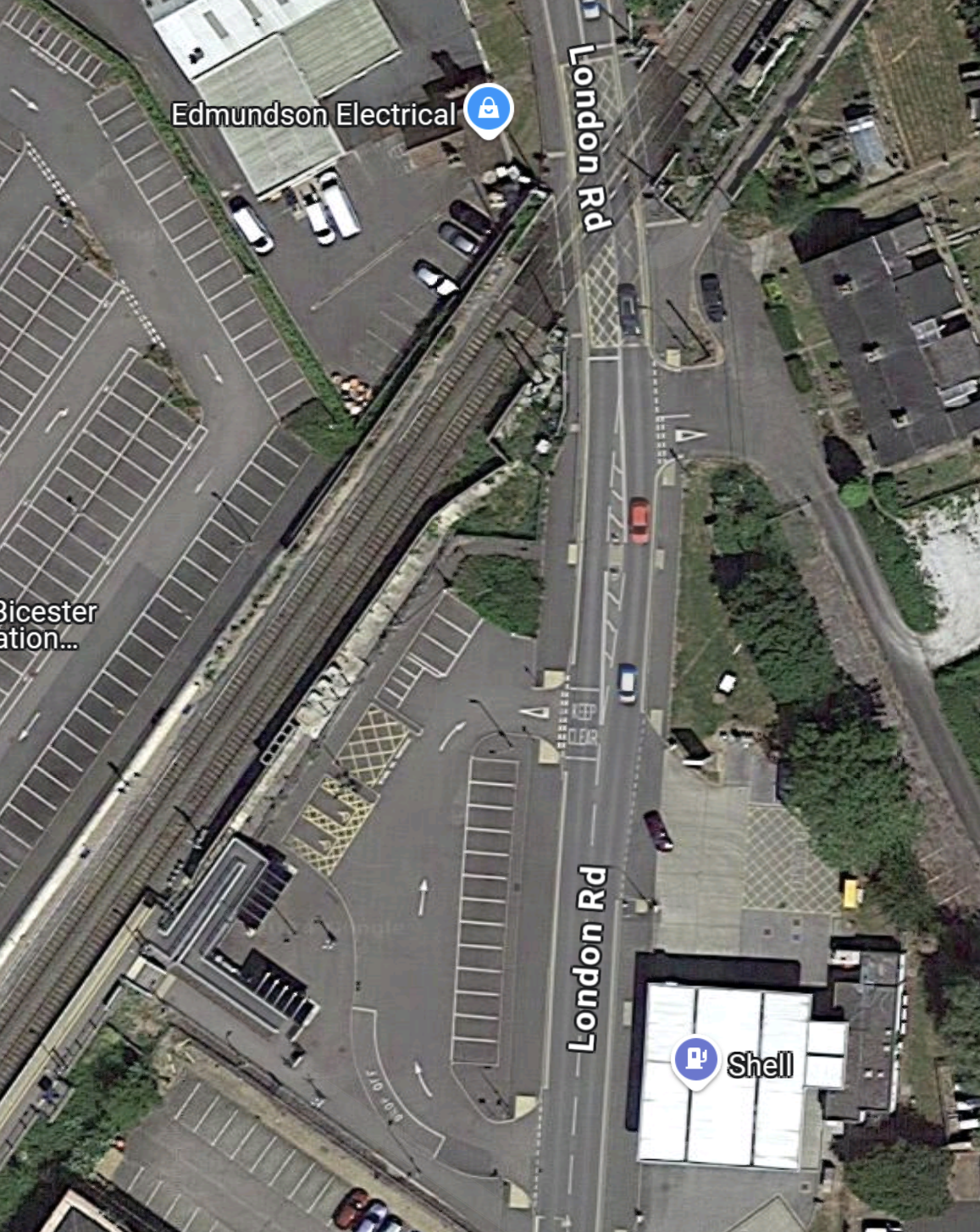
Note.
- London Road runs North-South across the map.
- There is a petrol station on the East side of London Road.
- Bicester Village station is on the West side of London Road.
- Bicester Village station is surrounded with lots of car parking.
- The level crossing is at the top of the map, where level crossings normally are.
This Google Map is a closer view of the level crossing.
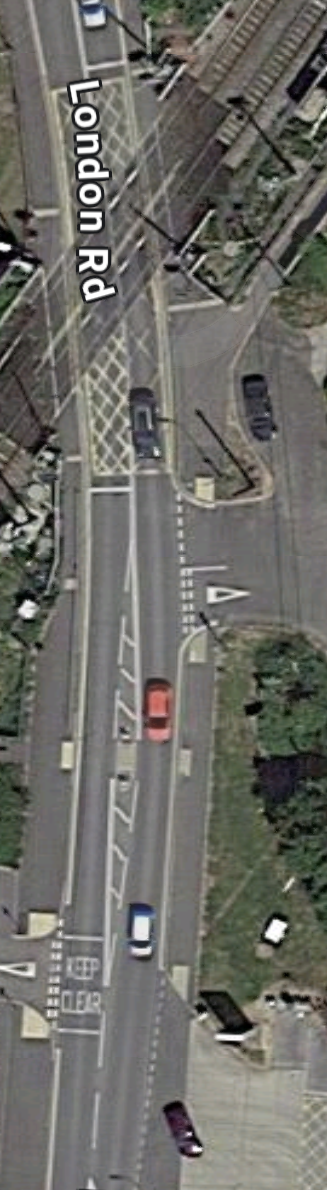
There seems to be several side roads giving access to side-roads and car-parks.
It is a very crowded site with in addition to the level crossing, there is a station, a Shell garage and lots of car parking.
I shall go and have a look next week, but at least the filling station should go. After all, who will want petrol and diesel in a few years?
Iarnród Éireann Looks At Diesel Loco Replacement Options
The title of this post, is the same as that of this article on Railway Gazette.
These three paragraphs introduce the article.
The Stadler Class 99 electro-diesel locomotive for UK operator GB Railfreight was receiving close scrutiny from Iarnród Éireann at InnoTrans in Berlin, with the Irish national operator confirming to Railway Gazette International that it had discussed with the manufacturer how the type might be adapted for operation in Ireland.
Iarnród Éireann Chief Executive Jim Meade told Railway Gazette International ‘we will eventually need to replace our aging diesel fleet with dual-mode locomotives because our freight strategy will take us down that direction after we complete our electrification programme.
‘The replacement for the class 071s and 201s eventually will have to be a bi-mode electric with some form of HVO [renewable diesel fuel] traction in the long term; even the Class 201s are beyond mid-life already.
The Class 99 locomotive is a version of the Stadler Eurodual locomotive, which is described in this Stadler data sheet.
The Wikipedia entry for the Stadler Euro Dual is also informative and lists a dozen different versions of the locomotive, that have been sold to various countries and operators.
This paragraph summarises how the design can handle different gauges and electrical voltages.
The Euro Dual was designed from the onset as a highly modular platform, allowing it to be offered to customers in various different configurations, covering various gauges and voltage systems.
I doubt Stadler would have great difficulty producing an Irish gauge locomotive capable of running on whatever electrification, the Irish erect.
Will The Irish Class 99 Have Enough Power?
The power of the various diesel locomotives are as follows.
- Current Irish Class 071 – 1.68 MW
- Current Irish Class 201 – 2.4 MW
- UK Class 66 – 2.4 MW
- UK Class 99 – 1.79 MW
It would appear that the Class 99 is less powerful than the Irish Class 201 and the UK Class 66, but the Wikipedia entry for the Class 99 says this.
The chief executive of GBRf, John Smith, reports that the Class 99, despite having a less powerful diesel engine than the Class 66, will outperform the Class 66 at low speeds. The greater tractive effort means that the Class 99 on diesel power can deliver more power at the rail than the 66.
But as the Class 99 has 6.17 MW in electric mode, the solution must be to electrify the difficult sections.
I have just looked at the Felixstowe Branch Line, which will be very much Class 99 territory. I am fairly sure, that with some short lengths of electrification on the single-track sections, any performance problems with the Class 99 on the branch could be solved.
Could The Irish Class 99 Use Hydrogen As Secondary Power?
This OpenRailwayMap shows all the railways on the island of Ireland.
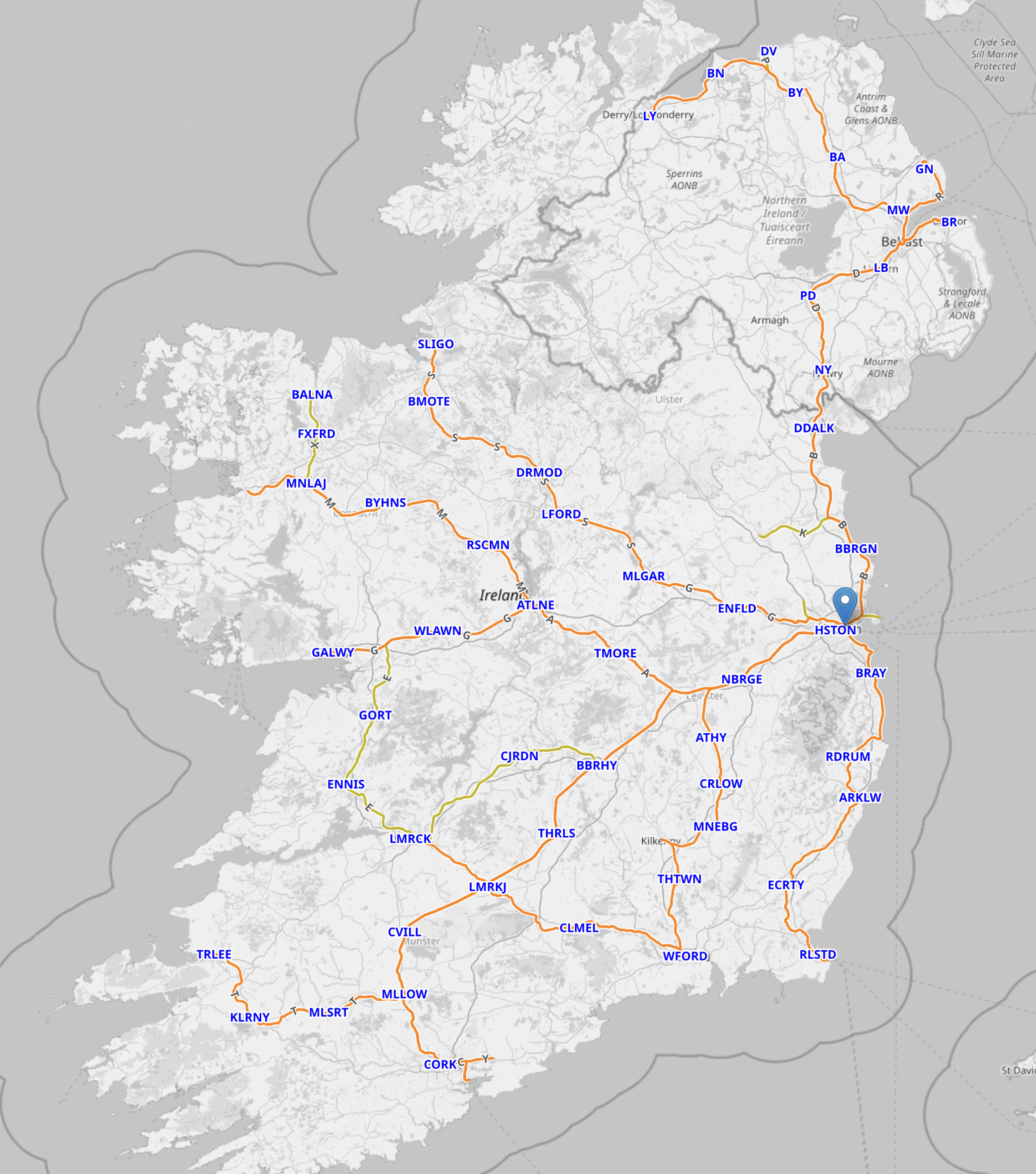
Note.
- All railways on the island of Ireland have an Irish gauge of 1.6 m.
- Only the DART in Dublin is electrified with 1,500 VDC overhead.
- There are 2,733 km. of track.
- New lines are still being added and old ones have been reopened in recent years.
- There will surely be pressure for the Irish to decarbonise their railways, both North and South of the Northern Irish border.
- There are no rail connections to another country, except for the link between Northern Ireland and the Republic of Ireland, which is between two similar systems.
- It is unlikely, that there will ever be a rail link between the Irish gauge railways on the island of Ireland and the standard gauge railways of Europe.
Effectively, the island of Ireland has an isolated network of tracks on which they could build a zero-carbon railway system.
- Signalling could be an off-the-shelf digital system.
- Zero-carbon traction power could be trains powered by either electricity and/or hydrogen.
- Both electricity and hydrogen would need substantial amounts of new rolling stock.
- Electricity would require electrification at €1,000,000 per single track kilometer, which could be around €5.5 billion for the electrification alone.
- Electrification would also need many bridges, stations and tunnels to be modified or rebuilt.
- Hydrogen would need a refuelling infrastructure and could go anywhere that diesel can.
- Hydrogen locomotives and trains, would be one-to-one replacements for diesel locomotives and trains.
It would appear that because of their geographic isolation, hydrogen could be an ideal zero-carbon fuel for the railways of Ireland.
In Do Cummins And Stadler Have a Cunning Plan?, I speculated that the electro-diesel Class 99 locomotive could be converted into an electro-hydrogen Class 99 locomotive, as Cummins are building diesel engines that can be converted into hydrogen ones.
Ireland with its unusual network could change to a zero-carbon railway in the following way.
- Purchase a fleet of diesel locomotives and trains that can run on Hydrotreated Vegetable Oil (HVO) and be convertible to hydrogen.
- A version of the Class 99 with or without the electrical gubbins would satisfy the locomotive replacement.
- A version of the tri-mode Stadler FLIRT like a Class 745 train, would satisfy the train replacement.
- All new trains and locomotives would replace the current stock and run on HVO.
- The hydrogen infrastructure would be built.
- The new trains and locomotives would be gradually converted to run on green hydrogen.
Within a few years, the island of Ireland would have a zero-carbon railway.
Advantages Of A Fully-Hydrogen Railway
These are a few advantages.
- One fuel for all trains.
- All trains and locomotives would be one manufacturer.
- No expensive electrification.
- Hydrogen trains and locomotives have a long range.
- No infrastructure modification for gauge clearance.
- Ireland has plenty of onshore and offshore wind for hydrogen.
- Standard fuelling systems are being developed.
- There would be no disruption as the trains changed to HVO and little disruption as they changed to hydrogen.
I believe that there would be a large increase in train usage both from locals and visitors, which can only be good for the Irish economy.
Managing The Project
This could be one of those rare projects that flows well.
- The changeover to hydrogen could involve very little rail infrastructure work.
- The hydrogen filling stations could be more-or-less independent of the rail infrastructure.
- Trains and locomotives could go into service, when they are accepted and the staff have been trained.
- Trains and locomotives would only be converted to hydrogen, as routes are made hydrogen-capable.
- There should be no gauging problems with the new trains and locomotives.
- There is only one train manufacturer.
Hopefully, it will all be delivered on time and on budget.
Ørsted Evolves Long-Standing Partnership With RNLI
The title of this post, is the same as this news item from Ørsted.
This is the sub-heading.
Ørsted, the global leader in offshore wind power and one of the largest renewable energy companies in the world, has announced the latest phase of its long-standing partnership with the Royal National Lifeboat Institution (RNLI).
These three paragraphs give a few more details of the partnership.
Over the next two years, Ørsted will provide more than £140,000 to help the charity in its mission to save lives at sea.
The RNLI is the charity that saves lives at sea and its volunteers provide a 24-hour search and rescue service across the British Isles.
Established in 2015, the partnership previously focused on supporting seven individual lifeboat stations in areas where Ørsted operates its offshore windfarms and is now evolving to support even more lifeboat stations.
Little is said about what benefits Ørsted get from the partnership.
Although, this is said.
Previously focused on supporting seven individual lifeboat stations in areas where Ørsted operates its offshore windfarms.
Does this mean, that for small incidents, the RNLI can do the rescue or perhaps tow a broken-down workboat to the shore?
In a busy area, the RNLI might even act as backup to Ørsted’s own safety boat, if a second incident occurred.
It might be a more affordable way to ensure safe operation, which is obviously paramount.
Conclusion
As the partnership is being extended, it must surely have been working well.
 The Anonymous Widower