To Norbiton For A Plate Of Lovely Liver
I seem to need a lot of Vitamin B12.
- I am coeliac, which probably means I don’t absorb enough out of my food.
- Although, when my gallstones were removed, the surgeon had a look and said everything was good.
- When Homerton Hospital found my Uncomplicated Pancolonic Diverticular Disease, that I talked about in I’ve Got Uncomplicated Pancolonic Diverticular Disease, they also said everything else was good.
- In the United States, Vitamin B12 is given to stroke patients to help recovery.
- I’ve had Vitamin B12 injections for nearly thirty years, since they were prescribed by Addenbrooke’s hospital.
Certainly, I find that a Vitamin B12 injection doesn’t seem to have the same effect, it had twenty years ago. So, is my brain saying, I’ll have that, when I have an injection?
When I lived in Suffolk and I felt my Vitamin B12 was low, I’d go down the pub or carluccio’s in Cambridge or Bury and have a plate of liver.
But liver is rare in London restaurants and Carluccio’s don’t serve it any more.
A guy in the reader’s comments in The Times told me of a restaurant called the Trattoria Calabrese, that sold liver in sage butter yesterday. So today, I took a train to Norbiton to get myself some extra Vitamin B12.
These pictures describe my first visit to Norbiton.
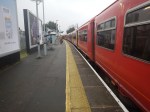




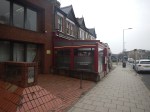




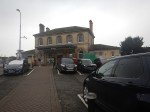

The short walk to the restaurant from Norbiton station was very much worth it. I shall go back!
A Funny Sunday Morning
I didn’t sleep that well and I got up about 05:45.
But by 06:30, I’d completed and entered the Sunday Times Prize Sudoku, as I always do.
The odds of winning must be exceedingly long, as I complete it every week and have not won anything yet.
I had my bath and flushed the sleep from my eyes in the hot water as I always do and by 10:15, I was sitting in Leon at the Angel having my usual gluten free Full-English breakfast.
I also went round the corner to the Marks and Spencer to buy a few items I needed.
- Bananas – I can never have too many
- British Strawberries – Strawberries are rich in magnesium and coeliacs can be low, so when I see quality strawberries I usually buy.
- Liver and Bacon Ready Meal for One – I have one a week to keep up my B12 levels and Ocado didn’t have any yesterday.
- Packet of Chocolate Cakes – I am slightly addicted.
The strawberries were from Dyson Farming, which I would have thought was the wrong side of the political spectrum for Islington.
My left knee also had a funny turn, which I was looking for the liver. Was it just reminding me that, if it didn’t get its B12, it would play up something rotten or was my brain using my knee to signal that it was low in B12 after the superb work on the sudoku?
Thirteen years ago I had a serious stroke and two or three serious doctors have said I’ve made a remarkable recovery.
From what I can gather on the Internet in the United States, I would have been given B12 injections for my stroke.
But then I am, as I am coeliac and Addenbrooke’s prescribed the injections, when I was diagnosed as coeliac in the 1990s. So is that behind my excellent recovery from stroke or did the Chinese doctors in Hong Kong diagnose my stroke as worse than it was?
Since I swapped to Ocado for my food purchases about two months ago, I have found it easier to buy the Marks and Spencer’s Liver and Bacon. I now eat one every week to top up my B12 and the arthitis, I occasionally get in my joints has reduced.
So I asked Dr. Google if arthritis gets worse after a stroke.
They pointed me to this paper on the National Library of Medicine. They also helpfully gave me this AI-derived answer to my question.
Yes, arthritis can worsen after a stroke:
Osteoarthritis
A common type of arthritis that can worsen after a stroke. This can be due to spasticity that develops after a stroke. Osteoarthritis can also make it harder for stroke patients to recover during rehabilitation.
Rheumatoid arthritis
Patients with RA may experience worse functional outcomes after a stroke due to pain and swelling in their extremities. RA patients may also have an increased risk of ischemic stroke.
Other types of pain that can occur after a stroke include: Headaches, Tingling sensations, Shoulder pain, and Central post-stroke pain.
Pain after a stroke can range from headaches that resolve on their own to chronic, severe joint pain.
Ic like the answer, as it fits my symptoms. Is artificial intelligence going to do some doctors out of a job?
I certainly get the tingling sensations.
I’ve just prescribed myself Liver and Bacon for a late lunch.
I’ll report back later!
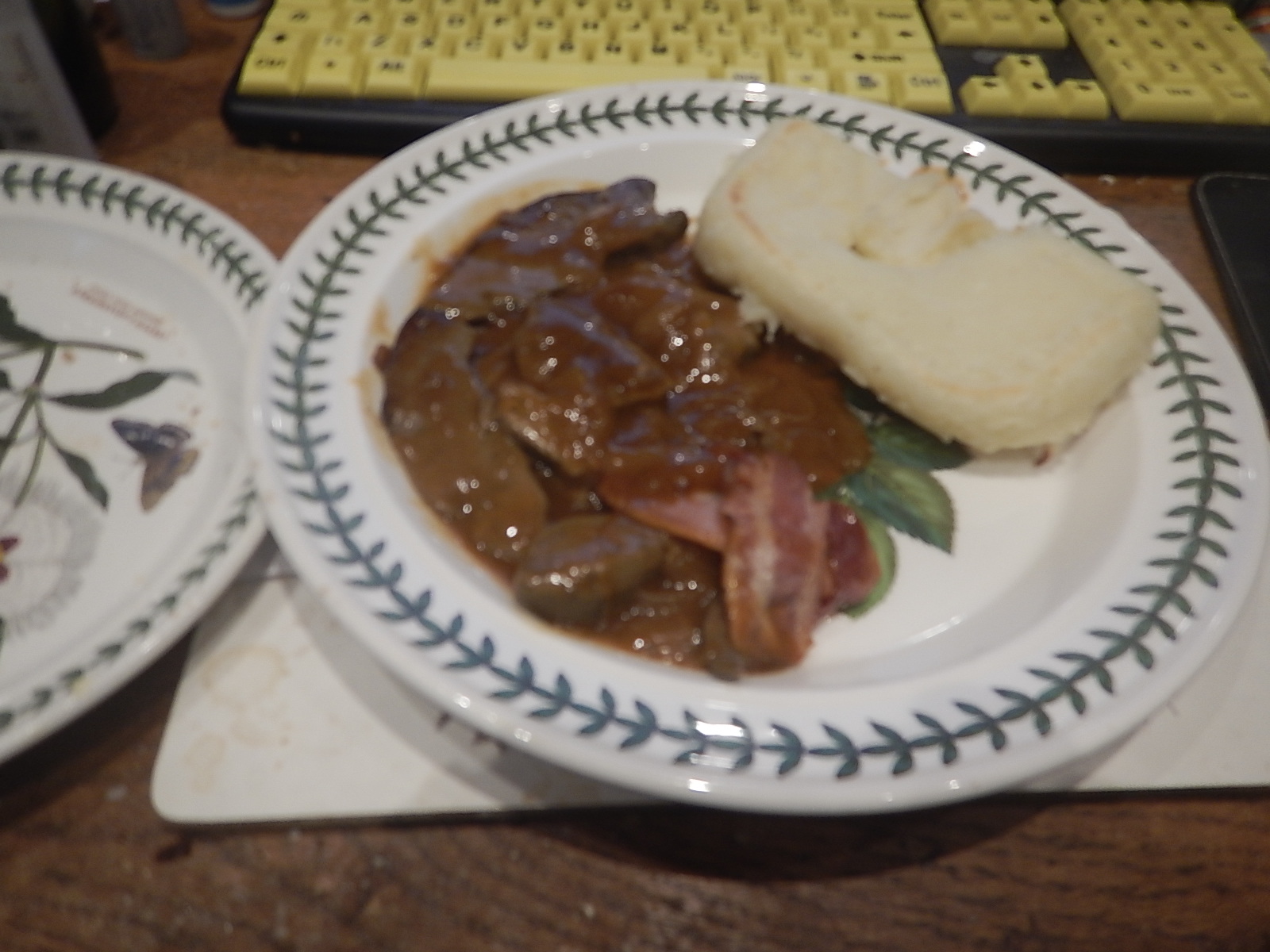
Note, that I’m eating in front of the computer with the new keyboard.
I Had My Fifth Endoscopy Yesterday And The Fourth Without A Sedative!
After two at Addenbrooke’s in Cambridge, this was my third endoscopy at Homerton in East London.
The most difficult part was not eating for eight hours before and only drinking water for four hours before.
I have mild anaemia and they were looking for cancer.
Luckily for me, they didn’t find any.
I did however lose nearly a kilo in weight.
Was that the diet or the long walk to the bus, which took me home?
Endoscopies At Homerton
On their information, they sent me, Homerton said they prefer to do endoscopies without a sedative.
I suppose it is more efficient, as Addenbrooke’s told me nearly thirty years ago.
Conclusion
I am certainly not worried about endoscopies and if your doctor says you have should one, make sure they talk you through it sensibly.
Years ago, I was on holiday in Capri and met a party of about six American gastroenterologists, who were horrified, that I had had two endoscopies without anaesthetic.
But then, I think they were more worried about the fees, that the anaesthetist didn’t get.
When Homerton investigated my gallstones, I said I’d be happy to undergo the procedure without a sedative, although, the specialist private surgeon, doing the procedure for the NHS, was accompanied by an anaesthetist. In the end the anaesthetist just stood by, in case he was needed and the surgeon did his first endoscopy without a sedative. He was very pleased with everyone’s performance including mine.
How To Protect The UK Population From Future Pandemics
The Times today has an article, which is entitled Flu Jab: Single-Shot Vaccine ‘Within Five Years’ Could Stop Future Pandemic.
This is the introductory paragraph of The Times article.
A single-shot vaccine against flu that would provide a lifetime of protection even against future mutations could be available in “five years or less”, scientists have said after making a breakthrough.
The article is very much a must-read, but I believe if used alongside a simple proven medical test, it could be even more effective.
Since 1997, when I was diagnosed as coeliac and started eating gluten-free food exclusively, I have never had a dose of flu.
I may have had one very mild dose of Covid-19, but I have never had a serious dose.
Research At The University Of Padua
This partial immunity to Covid-19 has been shown in a peer-reviewed scientific paper, by the University of Padua in Italy.
I discuss the Padua research in Risk Of COVID-19 In Celiac Disease Patients.
Mathematical Modelling Of Pandemics
As a control engineer, mathematical modeller and statistician, I believe that our herd immunity to future pandemics could be increased, if all new entries to the UK population, like babies and migrants, were tested for coeliac disease.
These days the coeliac test is just a blood test, that costs just a few pounds and I believe that a high percentage of gluten-free coeliacs in the UK population, because of their low susceptibility to flu pandemics, would slow the spread of the pandemic.
In a nuclear reactor non-radioactive carbon rods are often used to control the speed of the reaction.
I believe that non-susceptible coeliacs on gluten-free diets would perform the same function in the UK population.
Should Diagnosed Coeliacs Be Forced To Be Gluten-Free?
I would not force coeliacs to go gluten-free.
They would have to face up to the consequences, if they didn’t.
My son was an undiagnosed coeliac, who refused to get tested.
He died at 37 of pancreatic cancer, as his immune system was useless.
Coeliac disease and a gluten-free diet is a good wingman, but undiagnosed it can kill you!
Why Should Migrants Be Tested?
I hope they are, as some might have something nasty.
But if everyone was tested for a wide range of health and genetic conditions, could it act as a deterrent to come to the UK?
Oxford And Cambridge Compared On COVID-19
In Oxford And Cambridge Compared On COVID-19, I compared the COVID-19 rates of the two University cities.
- Oxford and Cambridge are very similar-sized cities and both ae surrounded by similar counties and countryside.
- During the pandemic, Oxford had a much higher COVID-19 rate than Cambridge.
From my experiences and observations in Cambridge, I believe that the city has a high level of coeliacs.
Why Does Cambridge Have A High Level Of Coeliacs?
I doubt, it is due to the genetics of the local population, as if it was, my coeliac disease would have been picked up earlier.
The two most likely causes are.
- Someone in the Health Authority decided to have a Whack-a-Coeliac policy.
- Addenbrooke’s Hospital, in conjunction with Cambridge University and the Sanger Centre were testing the accuracy of the newly-develop genetic test for coeliac disease.
Note.
- Both routes would have needed a streamlined endoscopy unit to test all those thought to be coeliac.
- I was tested twice in such a unit to prove that I was coeliac, after the genetic test showed, I probably was.
- Fit, younger patients were pushed to have the endoscopy without a sedative, which cut the number and cost of recovery beds and staff.
- My endoscopies were performed without a sedative, by a doctor working alone.
- I was able to drive home, a few minutes after the procedure.
It was a classic case of applying good old-fashioned time-and-motion to a test that would have to be applied to a large number of patients.
If Cambridge’s army of coeliacs helped the city take the edge of the pandemic, what would a Whack-a-Coeliac policy, do for other cities?
Hospital Pioneers Cancer Service For Over 70s That Saves Lives And Money
The title of this post, is the same as that of this article in The Times.
This is the sub-heading.
Treatment is adapted to take into account age-related illnesses, such as heart disease, diabetes and dementia.
These three paragraphs outline, what the Christie Hospital is doing.
The Christie Hospital in Manchester is pioneering a specialist cancer service for elderly patients under plans to tackle a “silver tsunami” of cases.
More than 200 patients have been treated by the new team, which was set up to meet the more complex care needs of an ageing population.
The service has nearly halved the number of unplanned hospital admissions among older cancer patients, improving survival and quality of life.
But it’s the graph that follows that I find interesting.
It shows the cancer incidence rate (per 100,000 population) in 2020 by gender and age at diagnosis.
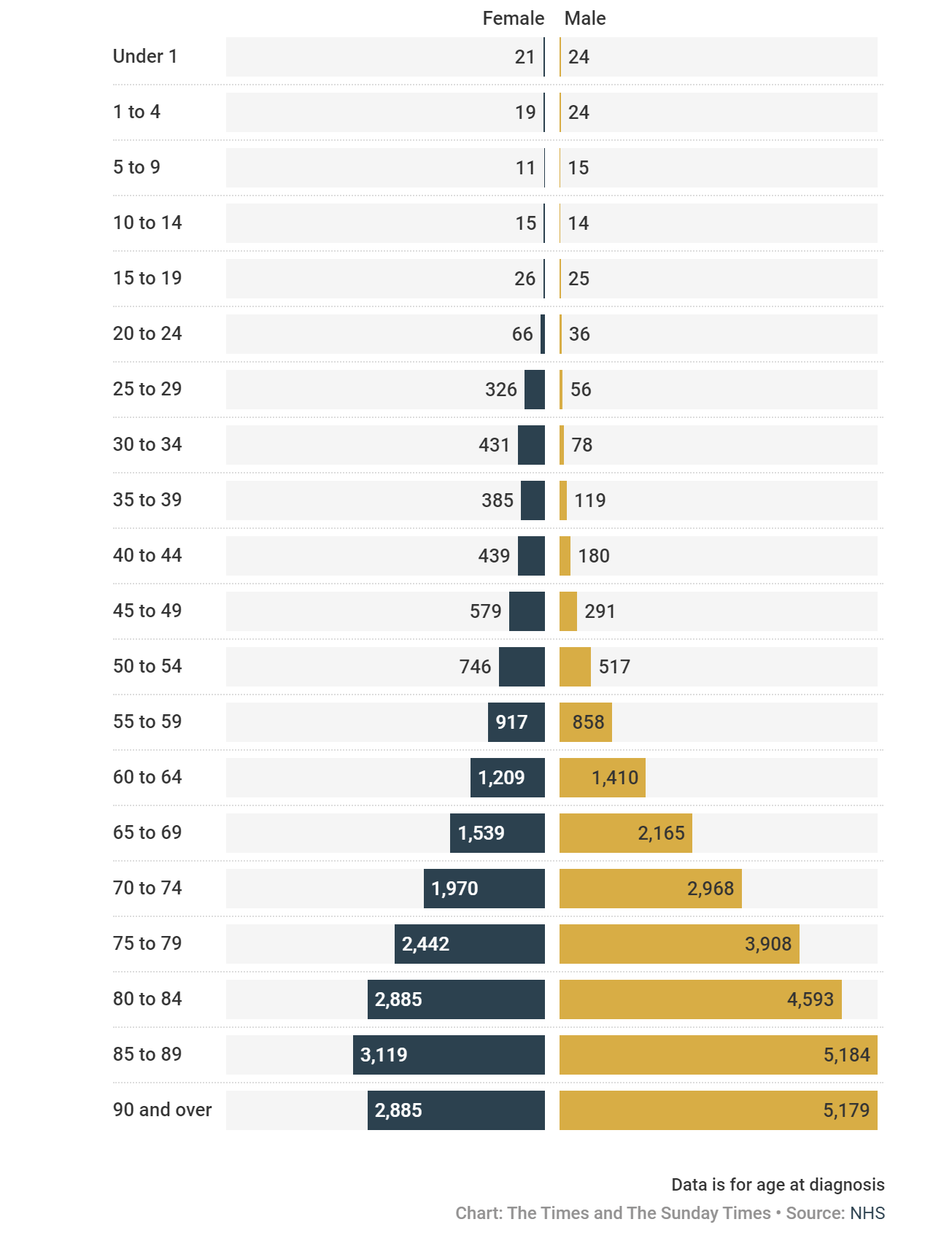
I am a control engineer and statistician and one of the most interesting things in a graph like this is the rate of increase or in this graph’s case the rate of decrease, as the graph effectively has the present at the top.
I have used an old trick and looked at the difference between the groups and the difference between the difference.
Note.
- It seems that the rate of increase of cancer diagnosis with age seems to increase with ages of 60-64 and 25-29.
- This would seem to correspond to those born before 1960 and those born before 1995.
- As a coeliac, I know that the first test for coeliac disease, which used endoscopy was introduced around 1960.
- The modern genetic test for coeliac disease was developed in the 1990s.
Is it coincidence, that the rate of increase of cancer diagnosis with age seems to increase, when a better diagnosis for coeliac disease was introduced?
These are my thoughts!
Coeliac Disease And Me
I am coeliac and I was born in 1947. I wasn’t diagnosed as coeliac until 1997.
I was an unhealthy child, with all sorts of avenues being chased, so in the end they just took my tonsils out.
- It should be remembered, that there was no test for coeliac disease in children until 1960.
- I’ve also only met one coeliac older than me and both her parents were GPs and she was diagnosed by food elimination.
- In fact, I never met a coeliac until I was about 25. He was the two-year-old son of one of C’s friends.
At fifty, an elderly locum gave me a present of a blood test to clear up my long-term health problems. The results showed that my body had very little Vitamin B12. Injections didn’t improve the level, so my GP sent me to Addenbrooke’s.
It was a Monday and all the consultant did was ask a nurse to take several vials of blood. He didn’t ask me any relevant questions or even touch me.
On the Wednesday morning, I got a letter from the hospital saying I was probably coeliac and it would be confirmed by endoscopy.
I must have been one of the first to have been diagnosed by a genetic test on a sample of blood.
Coeliac Disease And My Youngest Son
My youngest son was born in 1972 and after my diagnosis, my late wife felt he was coeliac, as physically he was so like me. But neither him nor our other two sons would get themselves tested.
I am now sure he was coeliac, as his daughter was born with a congenital hernia of the diaphragm and Swedish research says can happen with coeliac fathers. Luckily, she was born in the Royal London Hospital and thanks to heroic surgery at a few days old, she survived and is now in her first year at Southampton University.
Sadly my youngest son died of pancreatic cancer in 2011.
Coeliac Disease And Cancer
Nottingham University have shown that if you are coeliac and stick to a gluten-free diet, you are twenty-five percent less likely to suffer from cancer.
Cancer in the Over Sixties
The following is an extract from A Thought On Deaths Of The Elderly From Covid-19, which I wrote in April 2020.
How many undiagnosed coeliacs are there in those over seventy, who because they are coeliacs, have a compromised immune system?
I would be undiagnosed but for that elderly locum!
How many other coeliacs are there in the UK population?
- Age UK has a figure of twelve million who are over 65 in the UK.
- If 1-in-100, as stated by Coeliac UK, in the UK are coeliac, that is 120,000 coeliacs over 65, who are too old to have been diagnosed as a child, because no test existed.
Note that as of today 177,388 have been diagnosed with Covid-19.
Could the drop in the cancer rate of those born before 1960 be because of the availability of a test for coeliac disease, so that if they were a sickly child like me, they would be diagnosed? As I said earlier diagnosed coeliacs have a lower cancer rate than the general population.
Cancer in the Under Thirties
I was diagnosed in 1997 by a genetic blood test and there is no doubt that I have coeliac disease.
As the test is so simple, I wonder what proportion of coeliacs born since the Millennium have been diagnosed.
And how does this contribute to the drop in cancer cases?
More Research Needs To Be Done
It is obvious to me, that research needs to be done into the link between undiagnosed coeliacs and cancer.
It might be prudent to test every cancer patient for coeliac disease. My GP told me, that the test is not expensive and generally gives the right result.
Biarritz And My Family
I am coeliac and I am fairly sure, my father was too, as he had all the wind, I had at fifty, which was something that led to my being diagnosed as coeliac.
But as my father was born in 1904, there was not really any tests for the disease.
I was one of many, who were diagnosed at Addenbrooke’s Hospital in the 1990s, where I am certain, they were testing out, the genetic test for the disease.
How else could I go in on a Monday and have a very short chat and give some blood for testing and then get a letter on the Wednesday saying I was probably coeliac and it would be confirmed by endoscopy.
I never met my paternal grandfather, as he died in 1929 at around fifty.
My father told me a lot about his father. He had been very affected by his father’s heavy drinking and alcoholism. I suspect, it was part of his plan to make sure, that I didn’t go the way of his father.
In fact now at 76, I am virtually teetotal, although I do drink a lot of bottles of 0.5 % alcohol real ale. But this doesn’t affect my gut or my INR.
I know little about my grandfather’s health, but he did suffer from asthma and that was what killed him.
Was he coeliac? From my father’s descriptions of his father, it was highly likely.
My grandfather had a profitable printing business, which even in the 1920s had around a hundred employees according to what my father told me.
My father also remembered going to see Spurs at White Hart Lane in a pony and trap. That at least showed a certain status.
My paternal grandparents also used to go to Biarritz for at least part of the winter.
My father did say a couple of times, that it did improve my grandfather’s health.
But when I went to Biarritz ten years ago, it certainly made me feel better.
I wrote Would I Go Back To Biarritz Again?.
Government Agrees To Fund £200m Cambridge South Station
The title of this post, is the same as that of this article on the BBC.
This is the sub-heading.
The government has agreed to fully fund a new £200m railway station.
These are a few points.
- Work has already started.
- The station is next to the city’s Biomedical Campus and Addenbrooke’s Hospital.
- Cambridge South station will be on the East West Railway.
It is expected to be open within two years.
I have a few thoughts.
Services At Cambridge South Station
In a typical hour, it seems the following trains go through the proposed site of Cambridge South station.
- 2 tph – Greater Anglia – Liverpool Street and Cambridge North via Tottenham Hale, Cheshunt, Broxbourne, Roydon (1tph), Harlow Town, Harlow Mill (1tph), Sawbridgeworth (1tph), Bishop’s Stortford, Stansted Mountfitchet (1tph), Elsenham (1tph), Newport (1tph), Audley End, Great Chesterford (1tph), Whittlesford Parkway, Shelford (1tph) and Cambridge.
- 1 tph – Greater Anglia -Norwich and Stansted Airport via Wymondham, Spooner Row (1tpd), Attleborough, Eccles Road (1tpd), Harling Road (1tpd), Thetford, Brandon, Shippea Hill (1tpd), Ely, Cambridge North, Cambridge, Whittlesford Parkway and Audley End
- 1 tph – Great Northern – King’s Cross and Ely via Cambridge, Cambridge North and Waterbeach.
- 1 tph – Great Northern – King’s Cross and King’s Lynn via Cambridge, Cambridge North, Waterbeach, Ely, Littleport, Downham Market and Watlington.
- 1 tph – Great Northern – King’s Cross and Cambridge via Finsbury Park, Alexandra Palace, Potters Bar, Hatfield, Welwyn Garden City, Welwyn North, Knebworth, Stevenage, Hitchin, Letchworth Garden City, Baldock, Royston, Meldreth, Shepreth and Foxton.
- 2 tph – Thameslink – Cambridge and Brighton via Royston, Ashwell & Morden, Baldock, Letchworth Garden City, Hitchin, Stevenage, Finsbury Park, St Pancras International, Farringdon, City Thameslink, London Blackfriars, London Bridge, East Croydon, Gatwick Airport, Three Bridges, Haywards Heath and Burgess Hill
- 1 tp2h – CrossCountry – Birmingham New Street and Stansted Airport via Coleshill Parkway, Nuneaton, Leicester, Melton Mowbray, Oakham, Stamford, Peterborough, March, Ely and Cambridge.
Note.
- tph is trains per hour.
- tp2h is trains per two hours.
This gives a base frequency through Cambridge South, Cambridge and Cambridge North of 8.5 tph.
Could some services be extended to Cambridge South or Stansted Airport?
- 1 tph – Greater Anglia – Ipswich and Cambridge via Needham Market, Stowmarket, Elmswell, Thurston, Bury St Edmunds, Kennett (1tp2h), Newmarket and Dullingham (1tp2h).
- 1 tp2h – CrossCountry – Birmingham New Street and Cambridge via Coleshill Parkway, Nuneaton, Leicester, Melton Mowbray, Oakham, Stamford, Peterborough, March and Ely.
These two trains would gives frequencies of.
- Cambridge South – 10 tph
- Cambridge – 10 tph
- Cambridge North – 9 tph
I have assumed these services would terminate at Cambridge South.
There could also be some new services.
1 tph – Greater Anglia – Wisbech and Cambridge via March, Ely and Waterbeach, Cambridge North and Cambridge.
1 tph – East West Railway – Oxford and Great Yarmouth via Oxford Parkway, Bicester Village, Winsford, Bletchley, Bedford, Tempsford, Cambourne, Cambridge, Cambridge North, Ely, Brandon, Thetford, Attleborough, Wymondham and Norwich.
1 tph – East West Railway – Oxford and Manningtree via Oxford Parkway, Bicester Village, Winsford, Bletchley, Bedford, Tempsford, Cambourne, Cambridge, Newmarket, Bury St. Edmunds, Stowmarket, Needham Market and Ipswich.
These three trains would gives frequencies of.
- Cambridge South – 13 tph
- Cambridge – 13 tph
- Cambridge North – 11 tph
I have assumed these services would terminate at Cambridge South.
The A14 Parkway Station
The A14 Parkway station is a proposal from the East West Railway.
- It would be just to the East of Chippenham junction and would be served by both Greater Anglia’s services between Ipswich and Cambridge and Ipswich and Peterborough.
- It would also be close to the major road junction, where the A11 and the A14 meet.
- It would be a Park-and-Ride station.
I believe it could be a major factor in cutting road mileage in East Anglia, as drivers going to Cambridge from Ipswich, Norwich, a large area of North-East East Anglia and North Essex could find that using the A14 Parkway station an easier and faster route. But the A14 Parkway would need a frequent service to the soon-to-be-three main Cambridge stations.
A Soham and Cambridge service could reverse at the A14 Parkway station or by careful timetabling, passengers would be able to change trains in a minute or two.
A Soham and Cambridge service, that terminated at Cambridge South, would give an extra train between Cambridge South and Newmarket and these frequencies at the three Cambridge stations.
- Cambridge South – 13 tph
- Cambridge – 14 tph
- Cambridge North – 12 tph
There would be a minimum interval of no more than five minutes between trains, if you wanted to hop between any of the three Cambridge stations.
Frequencies between Cambridge station and other main stations in the area would be as follows.
- A14 Parkway – 2 tph
- Attleborough – 2 tph
- Bishop’s Stortford – 2 tph
- Bletchley – 2 tph
- Bury St. Edmunds – 2 tph
- Ely – 6 tph
- Great Yarmouth – 1 tph
- Harlow Town – 2 tph
- Hitchin – 3 tph
- Ipswich – 2 tph
- King’s Lynn – 1 tph
- Letchworth Garden City – 3 tph
- Manningtree – 1 tph
- March – 1 tph
- Needham Market – 2 tph
- Newmarket – 2 tph
- Norwich – 2 tph
- Peterborough – 1 tph
- Royston – 3 tph
- Soham – 1 tph
- Stansted Airport – 2 tph
- Stevenage – 3 tph
- Stowmarket – 2 tph
- Thetford – 2 tph
- Wisbech – 1 tph
- Wymondham – 2 tph
Looking at this list, I think that the timetable needs reinforcing, to perhaps Colchester, Haverhill, March, Peterborough, Soham and Sudbury.
But these services will help.
- 1 tph – Greater Anglia – Ipswich and Peterborough via Stowmarket, Bury St Edmunds, Soham, Ely, Manea, March and Whittlesea.
- 1 tph – East Midlands Railway – Liverpool and Norwich via Liverpool South Parkway, Widnes, Warrington Central, Manchester Oxford Road, Manchester Piccadilly, Stockport, Sheffield, Chesterfield, Alfreton, Nottingham, Grantham, Peterborough, Ely and Thetford
But I can’t help feeling that the Stour Valley Railway needs to be reopened.
Coeliac Journey Through Covid-19 – Medical Research
Medical Research
I first got involved as a lab-rat in medical research, when I had my second endoscopy to check for coeliac disease at Addenbrooke’s Hospital in 1997. Rebecca Fitzgerald took a sample of fluid from my gut for her Barrett’s oesophagus research.
After my wife died, I asked my contact in Alumni Relations at Liverpool University, if they did widowhood research.
They are one of the few universities that do and I did several interviews for PhD students in the unit, which is in the Psychology Department. It was very much a positive experience and certainly helped with my grieving.
In some ways the most enjoyable piece of research I have been involved in, was at the University of East London, where they were using computers to measure the balance of those recovering from strokes.
My GP also suggested that I get involved in drug tests at Queen Mary University. The tests were abandoned as the drug didn’t have any good or bad effects, but now I’m one of the William Harvey Centre’s lab-rats.
I also help to sponsor pancreatic cancer research at Liverpool University in memory of my son.
In There’s More To Liverpool Than Football And The Beatles!, I detail some research, that I sponsored in a small way.
I may be tempted to do the fund-raising trip again.
I always advise people to get involved in medical or psychological research, as I have found it such a beneficial experience.
One thing that is needed, is an on-line database of all research projects that are looking for volunteers.
Remember, that much medical and psychological research is about as dangerous as meeting someone in a GP’s surgery for a chat or perhaps in a cafe and having a coffee.
Coeliac Journey Through Covid-19 – Coeliac Diagnosis
Coeliac Diagnosis
My health was very variable as a child.
I would often have months off school and my health only really improved, when my parents bought a second home in Felixstowe, where we spent most of our holidays.
Perhaps it was the sea air, as going to Liverpool University didn’t seem to adversely affect my health.
I had been having gut problems for years and then in Autumn 1997, I didn’t see my GP, but a very elderly locum, who as I had recently had my fiftieth birthday, gave me a present of my first blood test.
It turned out that I was very low on B12 and a course of B12 injections was arranged.
As the injections didn’t raise my levels, an appointment was made to see a consultant at Addenbrooke’s Hospital in Cambridge.
It was a Monday, when I went to the appointment and after a quick chat and no examination, the consultant said that they would take some blood. Which they did!
Within forty-eight hours a letter arrived on my door-mat saying that I was probably coeliac and it would be confirmed by endoscopy.
Two endoscopies without sedative or anaesthetic were performed and I was confirmed as coeliac.
The first was performed by Dr. Richard Hardwick and the second by Dr. Rebecca Fitzgerald.
My gut health has been better since, I’ve been on a gluten-free diet, backed up by three-monthly B12 injections.
A few years later, I was talking to a gastroenterologist in Cambridge and he told me that he thought he had more coeliac patients than any other in England.
The manager of Carluccio’s in the city, also told me that they sold a very high percentage of gluten-free food.
Were Cambridge testing a genetic test for coeliac disease or was it just a Whack-A-Coeliac policy?
They certainly had everything geared up for high-speed diagnosis. They even did the endoscopies without a sedative, so they didn’t need any recovery beds.
High Risk Of Coeliac Disease In Punjabis. Epidemiological Study In The South Asian And European Populations Of Leicestershire
The title of this post, is the same as that of this peer-reviewed paper on PubMed.gov.
This is the abstract of the paper.
The purpose of this study was to measure the incidence of coeliac disease in different ethnic communities and investigate the hypothesis that the incidence is decreasing in most European countries and the role incomplete retrieval of data may play. In a retrospective study of histologically confirmed cases of coeliac disease between 1975 and 1989 in the City of Leicester, 106 patients with coeliac disease were identified. Of these 86 were European and 20 Asian. The overall incidence of coeliac disease in Europeans was 2.5/10(5)/year (95% CI 2-3.2), in Gujaratis 0.9/10(5)/year (95% CI 0.4-1.8), and in Punjabis 6.9 (95% CI 3.2-12.3). These differences were independent of religious belief. The relative risk to Punjabis compared with Europeans is 2.9 (95% CI 1.5-5.3; chi 2 = 12.5, p < 0.01) and to Gujaratis 8.1 (95% CI 3-22.4; chi 2 = 25; p < 0.001). Gujaratis were at 0.4 risk of Europeans (90% CI 0.2-0.8; chi 2 = 6.7; p < 0.01). The incidence in the urban populations of Leicester was 6/10(5)/year (95% CI 1.3-1.9) which was significantly lower than the 3.2/10(5)/year (95% CI 2.7-3.8; chi 2 = 5.6; p < 0.001) in surrounding rural areas. This study shows that the incidence of coeliac disease in Punjabis (Sikhs, Hindus and Muslims) is 8 times higher than in Gujaratis (Hindus and Muslims) and 4 times higher than in Europeans in Leicester.
I find the last sentence in particular very significant.
I’m no medic, but I think it is reasonable to assume, that in a particular community for every diagnosed coeliac, there will be several undiagnosed coeliacs out there.
In this overview of coeliac disease on the NHS web site, this is said about the incidence of coeliac disease.
Coeliac disease is a condition that affects at least 1 in every 100 people in the UK.
But some experts think this may be underestimated because milder cases may go undiagnosed or be misdiagnosed as other digestive conditions, such as irritable bowel syndrome (IBS).
Reported cases of coeliac disease are around 3 times higher in women than men.
The one-in-100 figure is often used in web pages in European countries or Australia, Canada and the United States, so I’ll go along with that.
So does that mean that Punjabis living in Leicester, have a one-in-twenty-five likelihood of being coeliac?
Whether you have been diagnosed though, is a matter of pure luck.
I had been having gut problems for years and then one Autumn, I didn’t see my GP, but a very elderly locum, who as I had recently had my fiftieth birthday, gave me a present of my first blood test.
It turned out my B12 levels were very low and after several months of B12 injections, which made little difference to my B12, my GP decided to send me to a consultant at Addenbrooke’s Hospital in Cambridge.
My appointment was on a Monday morning and consultant took about ten minutes to ask a few questions, after which he said they would take a few bloods.
On the Wednesday morning, I received a letter that said, that I was probably suffering from coeliac disease and this would be confirmed by endoscopy.
Was I diagnosed solely by analysis of my blood? This was in 1997, which is after the date of the Leicester study.
Two endoscopies without sedative or anaesthetic were performed and I was confirmed as coeliac.
The first was performed by Dr. Richard Hardwick and the second by Dr. Rebecca Fitzgerald.
Both doctors feature in this story on the Cambridge University Hospitals web site, which is entitled Familial Gastric Cancer – Case Study.
My problems have been minor compared to the two sisters in the story.
My luck had been good and I recommend that everyone who feels they could be coeliac should get themselves tested.
Cases Of Covid-19 In Leicestershire
This article on the Leicester Mercury is entitled 11 Areas Of Leicestershire Have Among Worst Infection Rates in the UK.
In Coeliac Disease: Can We Avert The Impending Epidemic In India?, I started like this.
The title of this post, is the same as that of this article on the Indian Journal Of Research Medicine.
With the high levels of COVID-19 in Leicester and an Indian population who make up 28.3 % of the population of the city, I was searching the internet to see if there was any connection between those of Indian heritage and coeliac disease.
I know you should not try to prove a theory. But as a coeliac, I’m very interested to see how the millions of diagnosed coeliacs on a gluten-free diet like me, are faring in this pandemic.
I then talk about some extracts from the Indian research.
In a section entitled, which is entitled All Wheats Are Not Equal, I say this.
The other dimension to this problem is that not all wheat is alike when it comes to inducing celiac disease. The ancient or diploid wheats (e.g. Triticum monococcum) are poorly antigenic, while the modern hexaploid wheats e.g. Triticum aestivum) have highly antigenic glutens, more capable of inducing celiac disease in India, for centuries, grew diploid and later tetraploid wheat which is less antigenic, while hexaploid wheat used in making bread is recently introduced. Thus a change back to older varieties of wheat may have public health consequences.
So did all these factors come together to create the high levels of Covid-19 in Leicestershire?
Conclusion
I am getting bored with saying this. More research needs to be done!
 The Anonymous Widower