Hull Trains Open Access Model Drives £185m-380m Economic Boost To Region, New Report Reveals
The title of this post, is the same as that of this article on Rail Technology Magazine.
This is the first paragraph.
Open Access rail operator Hull Trains has announced the launch of a report by Arup, highlighting the significant economic, social, and environmental benefits its services have brought to the Hull and Humberside region.
The key findings of the report are as follows.
- Economic benefits: Since it launched in 2000, Hull Trains estimates that it has delivered between £185m-380m since launch. It also projects those benefits will reach an estimated £325m-700m by 2032.
- Increased connectivity: Frequency between Hull and London has grown to seven trains per day (tpd) from just a single train.
- Enhanced capacity: 10-car trains and additional Sunday services doubled seating capacity compared to 2000.
- Sustainability: Modal shift from road to rail has reduced carbon emissions and air pollution.
- Employment: £35m-£70m (2023 prices) generated in direct employment since launch.
As the report is by respected consultancy Arup, I would put a high level of confidence in the findings.
I have a few thoughts.
Did Hull’s Rail Service Help Hull Become UK City Of Culture In 2017?
In the shortlist, the cities were Dundee, Hull, Leicester and Swansea Bay.
If Hull had had just a single tpd from London, would it have been chosen?
Do Hull Trains Make It More Likely That Companies from Outside Will Develop There?
Hull and Humberside in general has GWs of wind energy, several gas-fired power stations and uniquely plenty of storage for natural gas and/or hydrogen.
So if your company uses a lot of energy, Hull would probably be on your short list.
A good well-respected train service to London could help with your choice.
Hullensians Seem Proud Of Their Train Company
In First Class Gluten-Free Food, I described some good service of a gluten-free meal on Hull Trains.
I praised the steward and her mother-in-law said thanks.
Perhaps Other Independent Cities Need Their Own Open-Access Operator?
Hull Trains seems to have been a success and according to the Arup report, Hull has benefitted.
LNER Are Developing Services To Bradford, Cleethorpes/Grimsby Harrogate, Lincoln And Middlesbrough.
Will LNER run services that are tied to the destination, as if they were an open access operator?
Conclusion
Pairing an independent city with its own train company seems a good business practice.
Perhaps it should be done more often?
Arup and ILF Join Forces To Enhance Pumped Storage Projects In The UK
The title of this post, is the same as that of this of article on Water Power And Dam Construction.
These are the first two paragraphs.
Global sustainable development consultancy Arup and ILF Consulting Engineers have recently signed a Memorandum of Understanding (MOU) aimed at strengthening pumped storage projects in the UK. These projects include Coire Glas, Glenmuckloch, and up to 13 additional schemes in the pipeline.
This partnership marks a significant development in the hydropower sector in the UK, bringing both capacity and valuable experience to support the country’s net-zero energy transition.
Fifteen schemes could be a lot of energy storage.
These are a few useful web sites with information to back up the article.
As most of the work appears to be in Scotland, this would appear to be a second large installment of Power From The Glens. Perhaps it should be named Storage In The Glens.
Green Hydrogen Production Facility
The title of this post is the same as this project on the Arup web site.
This is the introduction.
Green hydrogen – hydrogen produced using 100% renewable energy – holds promise as a future, low emission energy source. Across the world many players are beginning to explore or invest in its production at scale.
Statkraft are Europe’s largest renewable energy producer and are investing heavily in green hydrogen as an energy source for use in transportation and industry. Statkraft have identified a site in Pembrokeshire for a green hydrogen production facility near to the Haven Waterway Enterprise Zone, an area focusing on developing opportunities within the energy and environment sectors.
This green energy hub will be located on the former Royal Navy Armaments Depot in Trecwn, Pembrokeshire. During development, the site employed over 3,000 people, and it is hoped that this new facility can continue to support highly skilled jobs in the area, while contributing to the Welsh Government’s net zero strategy.
Statkraft have a web page for the Trecwn Green Energy Hub, where this is said about the expected production.
It is estimated that the 15MW hydrogen plant will generate up to 4 tonnes of hydrogen a day, the equivalent of powering a single bus for over 40,000 miles. The hydrogen produced could be used locally for a range of purposes including transport, as a feedstock or heat source for industry and manufacturing, as well as for heating buildings.
This Google Map shows the location of Trecwn in Pembrokeshire.

Note.
- The red arrow indicates Trecwn.
- The port of Fishguard is just to the North of Trecwn.
The site appears to be at RNAD Trecwn, which is a decommissioned Royal Navy Armaments Depot.
This second Google Map shows the remains of some of the site.
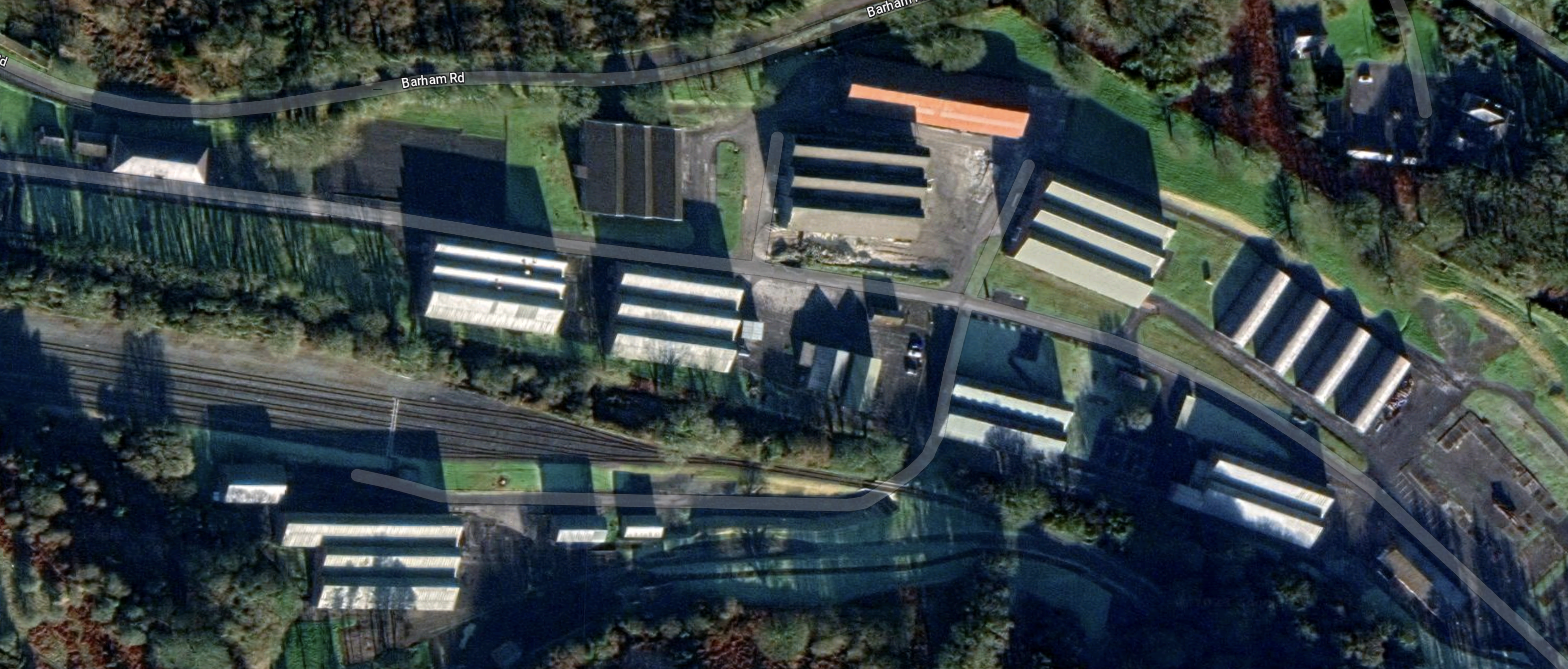
Note the railway line to the site, which is visible in West of the map, which connects to Carmarthen, Fishguard, Milford Haven and Pembroke Dock.
Wikipedia says this about its condition.
Network Rail have not only kept the railway connection operational, but refurbished it to allow the site to develop as an Intermodal freight traffic distribution site from Fishguard.
Note.
This would surely enable local trains, port operations, railway locomotives and ships to be hydrogen-powered.
- Trains and railway locomotives could be filled on the site.
- Buses and trucks could be filled on the site.
- Ports could be supplied by hydrogen trains.
- Strangely, I’ve not seen a design for a short hydrogen delivery train, which would be needed to supply the ports. But I doubt, it would be difficult to design and build.
All the Health and Safety protocols could probably easily be created, given the former use of the site.
Conclusion
Statkraft seem to have chosen an ideal site for the hydrogen electrolyser.
Gravitricity Makes Hydrogen Play With FlexiStore
The title of this post, is the same as that of this article on The Engineer.
This is the sub-heading.
Edinburgh-based energy storage firm Gravitricity is looking to green hydrogen, bringing a new underground storage solution to market.
The system is explained with a large graphic, showing an electrolyser, a FlexiStore and a hydrogen filling station, with this paragraph underneath.
Known as FlexiStore, the concept involves purpose-built, steel-lined shafts capable of holding up to 100 tonnes of compressed hydrogen at 220 bar – around 3.33GWh of energy, or enough to refuel over 1,000 HGVs, according to Gravitricity. Unlike naturally occurring underground storage like salt caverns, FlexiStores could be positioned anywhere, with the current plan to co-locate the storage as close as possible to renewable generation. Gravitricity says a single FlexiStore could serve a 460MW wind farm and that 1,000 units could meet the UK’s predicted hydrogen storage needs in 2050.
Note.
- The concept certainly solves the problem of storing hydrogen on a country-wide basis.
- I suspect, a machine could be designed and built to create the shafts.
- A 3.33 GWh store could supply 460 MW for nearly 33 hours. As a Control Engineer, that sounds a good balance for backing up a wind farm!
As ARUP has been involved in a feasibility study, I suspect there’s a fair chance that FlexiStores can be built.
UK Energy Exports To Europe At Record High
The title of this post, is the same as that of this article on The Times.
This is the first two paragraphs.
Britain has exported record amounts of gas to Europe so far this year as its liquefied natural gas terminals receive shipments destined for the Continent.
Electricity exports also have surged to unprecedented highs in recent weeks after an unexpected glut of gas pushed down short-term gas prices and resulted in gas-fired power plants generating more for export.
Who’d have thought it, that all those gas pipelines and electricity interconnectors between the UK and the Continent of Europe would be part of the replacementliqui for Russian gas.
According to Wikipedia, we have three liquified natural gas terminals; two at Milford Haven; South Hook and Dragon, and Grain on the Isle of Grain.
Note.
- South Hook is Europe’s largest liquified natural gas terminal and is owned by a partnership of the Qataris, ExxonMobil and Elf.
- South Hook and Dragon together can provide 25 % of the UK’s natural gas needs.
- Grain is owned by National Grid and according to Wikipedia, is in terms of storage capacity it is the largest LNG facility in Europe and the eighth largest in the world.
- Grain can supply 20 % of the UK’s natural gas needs.
- Grain has a reloading facility, so that gas can be exported.
- Grain seems to be continually expanding.
- Both Milford Haven and the Isle of Grain have large gas-fired power-stations.
Politicians say we don’t have enough gas storage, but we do seem to have world-class LNG terminals.
I have a couple of extra thoughts.
Blending Natural Gas With Hydrogen
HyDeploy is a project investigated blending hydrogen natural gas to cut carbon emissions. The project is described in this post called HyDeploy.
Surely, these terminals could be places, where hydrogen is blended with our natural gas supply.
- The terminals are connected to the UK gas network.
- Both Milford Haven and the Isle of Grain should have access to large amounts of offshore wind energy in the next few years, which could be used to generate green hydrogen.
- The terminals would need electrolysers to generate the hydrogen.
The Isle of Grain already has a blending capability.
NeuConnect
NeuConnect is an under-development interconnector between the Isle of Grain in Kent and Wilhelmshaven in Germany.
- It will have a capacity 1.4 GW.
- All the planning permissions seem to be in place.
- Prysmian have won a € 1.2 million contract to deliver the interconnector.
- Arup and German engineering firm Fichtner have formed a joint venture to provide project services for the interconnector.
- Construction could start this year.
It looks like the Germans will be replacing some of Putin’s bloodstained gas with clean zero-carbon energy from the UK.
Should We Develop More Gas Fields?
There are some gas fields in the seas around the UK, like Jackdaw, that could be developed.
Suppose, we extracted the gas and sent it to the reloading terminal on the Isle of Grain through the gas transmission network, where it could be exported by ship, to the Continent.
The UK would not be increasing its carbon emissions, as that would surely be the responsibility of the end-user.
Should We Develop More Gas Fired Power-Stations?
I believe it is possible to develop carbon-capture technology for gas-fired power stations.
The carbon dioxide would be either used in a beneficial way or stored in perhaps a worked-out gas field under the North Sea.
So long as no carbon dioxide is released into the atmosphere, I don’t see why more gas-fired power stations shouldn’t be developed.
What is happening at Keadby near Scunthorpe would appear to be one model for zero-carbon power generation.
Keadby Power Station
This is an existing
Conclusion
We will be exporting more energy to the Continent.
Gravitricity And Arup Secure Funding To Develop Below Ground Hydrogen Storage
The title of this post, is the same as that of this article on Offshore Energy.
This is the first paragraph.
Edinburgh-based storage tech firm Gravitricity and British environment consultancy Arup have secured $372,073 (£300,000) from the UK government to study the feasibility of storing hydrogen in purpose-built underground shafts.
The biggest thing about this grant is that it has gone to Scottish start-up; Gravitricity and one of the UK’s most respected engineering consultancy companies; Arup, who have over 16,000 staff in their world-wide operation.
For Gravitricity, it is the sort of deal, that could make this small company.
It follows their link up with world-class Dutch winch specialist Huisman, who provide the winches they need.
If you judge a company, by their friends, Gravitricity now have two of the biggest and best.
This paragraph described the objectives of the study.
The parties will collaborate to deliver a complete system design and commercial feasibility report for the new idea, as well as identify a potential site for their underground hydrogen store. The design will also include integration with gravity energy storage and inter-seasonal heat.
This could turn out to be one of the most significant energy storage announcements of 2022.
Conclusion
I am not disappointed that I invested a small sum in Gravitricity through a crowd funding.
RSSB Appoint Arup To Review Hydrogen Trains
The title of this post is the same as that of this article on Rail Technology Magazine.
This is the first two paragraphs.
The Rail Safety and Standards Board (RSSB) has tasked Arup with developing a case for hydrogen-powered trains on the Great Britain (GB) mainline.
The review will move to establish a high-level operational concept, any relevant operational hazards and obligations of regulation.
This must be good forward thinking.
Arup Called In To Help New Zealand Run Ports And Trains On Hydrogen
The title of this post is the same as that of this article on Global Construction Review.
This is the first paragraph.
UK consulting engineer Arup has been brought in to help design and deliver a hydrogen factory for New Zealand’s second largest port. Ports of Auckland said it plans to build a production facility to make the gas from tap water, which it will use to fuel ships, trucks, buses, cars and trains.
It is all part of the aim of making the port of Auckland, zero-carbon by 2040.
I think we’ll see other large self-contained sites like ports, airports, rail container terminals and large industrial complexes using hydrogen, as it may offer advantages over batteries in terms of range, lifting capacity and vehicle size and weight.
There is also no problem with the regular replacement of batteries in equipment like mobile cranes, which in New Zealand’s case will mean importing new ones.
I suspect, hydrogen may be more affordable to run than batteries for Auckland.
 The Anonymous Widower