Firm Develops Jet Fuel Made Entirely From Human Poo
The title of this post, is the same as that of this article on the BBC.
This is the sub-heading.
A new aviation company has developed a type of jet fuel made entirely from human sewage.
These are the first three paragraphs.
Chemists at a lab in Gloucestershire have turned the waste into kerosene.
James Hygate, Firefly Green Fuels CEO, said: “We wanted to find a really low-value feedstock that was highly abundant. And of course poo is abundant.”
Independent tests by international aviation regulators found it was nearly identical to standard fossil jet fuel.
It certainly seems to have a lot going for it.
I have some other thoughts.
What About Disposable Nappies?
I wrote Are Disposable Nappies A Wasted Resource?, about making hydrocarbon fuels from disposable nappies.
Should Disposable Nappies Be Collected Separately?
My food waste is collected separately in a special bin. Hackney Council say this is what happens to food waste.
Food waste from households in Hackney is sent to an anaerobic digestion facility in south east England, where it’s turned into renewable energy to power homes and biofertiliser to be spread on local farmland to grow crops.
Surely, a similar or appropriate process could be used for disposable nappies.
Biomethane From Sewage Works
In Centrica Signs UK Biomethane Agreement With Yorkshire Water And SGN Commercial Services, I wrote about how Centrica have found a way to distribute biomethane from sewage works using the UK’s gas grid.
Could Firefly take the solids and Centrica the biomethane?
Given that water companies are regularly blamed for spilling sewage could there be an opportunity for a large sewage works to be a major producer of green fuels for agriculture, aviation, industry and road transport.
Airport Of The Future
I am fairly sure, that in ten years, there will be a lot of zero-carbon aircraft flying short haul routes. I have been particularly impressed by some of the ideas from Airbus, although Boeing seem to be very quiet on the subject. Perhaps it’s the difference between visionaries and engineers, and accountants.
But you rarely read anything about how airports are preparing for even a low-carbon future.
- Some long-stay car-parks could be made electric vehicles only, so they would become massive grid batteries, whilst owners are travelling.
- Airside vehicles can all be made zero-carbon.
- Sustainable aviation fuel (SAF) shouldn’t be a problem, as it would be handled like jet fuel.
- Do airports have a large enough grid connection for all the electrification of vehicles and some planes?
- Do airports have a plan for hydrogen?
The last two points, probably mean we should have built Maplin.
- It could have a cable and a hydrogen pipeline from wind farms and co-located hydrogen electrolysers in the Thames Estuary.
- The Elizabeth Line or a new line could easily be extended or built to the airport, to give a 125 mph connection.
But that enemy of the planet; Harold Wilson cancelled it.
Rolls-Royce Announces Successful Run Of UltraFan Technology Demonstrator To Maximum Power
The title of this post, is the same as that of this press release from Rolls-Royce.
This is the sub-heading.
Rolls-Royce today announces it has successfully run its UltraFan® technology demonstrator to maximum power at its facility in Derby, UK. The initial stage of the test was conducted using 100% Sustainable Aviation Fuel (SAF).
These are the first four paragraphs.
This is an important milestone for the UltraFan demonstrator, which was successfully tested for the first time earlier this year. Since then, the UltraFan team has been gradually increasing the power as part of the rigorous testing regime and the demonstrator has performed in line with our expectations. The results of the test will provide us with valuable learning and data, which our teams will now take away and continue to analyse.
This achievement reinforces our confidence in the suite of technologies that has been developed as part of the UltraFan programme. Confirming this capability is a big step towards improving the efficiency of current and future aero-engines as UltraFan delivers a 10% efficiency improvement over our Trent XWB, which is already the world’s most efficient large aero-engine in service. In total that’s a 25% efficiency gain since the launch of the first Trent engine.
UltraFan’s scalable technology from ~25,000-110,000lb thrust also offers the potential to power the new narrowbody and widebody aircraft anticipated in the 2030s.
As part of the UltraFan development programme we have identified a number of technologies that are potentially transferable to our current Trent engines, which will provide our customers with even greater availability, reliability and efficiency.
These are my thoughts.
What Is UltraFan?
UltraFan has a section in the Wikipedia entry for the Rolls-Royce Trent engine, where these are the two opening paragraphs.
After the Advance comes the UltraFan, initially aimed to be ready for service from 2025. A geared turbofan with a variable pitch fan system that promises at least 25% improvement in fuel burn, the UltraFan aims for a 15:1 bypass ratio and 70:1 overall pressure ratio.
The Ultrafan keeps the Advance core, but also contains a geared turbofan architecture with variable-pitch fan blades. As the fan will vary pitch to be optimised for each flight phase, it won’t need a thrust reverser. Rolls-Royce will use carbon composite fan blades instead of its usual hollow titanium blades, and along with new material adoption will save 340 kg (750 lb) per engine.
This is a bit different from previous engines.
Variable-Pitch Fan Blades
Variable Pitch Fan has its own Wikipedia entry, where these are the two opening paragraphs.
A variable pitch fan is similar in concept to that of a variable-pitch propeller and involves progressively reducing the pitch (or blade angle) of the fan on a turbofan as the engine is throttled. Although variable pitch fans are used in some industrial applications, the focus of this article is on their use in turbofan engines. No production engine uses such a feature; however, it will likely be required on at least some of the next generation of high bypass ratio turbofans.
One of the methods used to reduce Thrust-specific fuel consumption is to improve Propulsive Efficiency. This involves reducing the effective jet velocity of the engine by reducing specific thrust. This, in turn, reduces the optimum fan pressure ratio required and consequently the cold nozzle pressure ratio. At cruise flight speeds the nozzle is choked and the fan working line is fairly steep and linear. However, at low flight speeds the ram pressure rise in the air intake is so low the nozzle is well un-choked. Consequently, the fan working line is highly curved and well to the left of the cruise flight speed working line, potentially reducing the fan surge margin to a dangerous level, particularly at lower throttle settings. Readers unfamiliar with surge lines, working lines, etc. should read the Wikipedia article on Compressor map.
The extract says that no production engine uses this feature. So will UltraFan be the first?
Variable pitch fan blades seem to offer two advantages; better efficiency and lower weight. If the reliability is acceptable, then that must be a winner.
No Thrust Reverser
This sentence is also in the Wikipedia entry for Variable Pitch Fan.
One advantage of the variable fan option is that varying the fan pitch offers the possibility of reversing engine thrust without the need for heavy blocker doors, cascades, etc.
It does look like the UltraFan will be a lighter engine, than its predecessor.
Composite Fan Blades
Composite Fan Blades were tried in the 1960s for the Rolls-Royce RB211 engine.
But they failed and were replaced by titanium blades.
At the time, I was at Liverpool University and John Wilkinson was a fellow student.
John’s father was the manager of a Tesco store in Derby.
That Tesco store had a nice line in selling out-of-date chickens and turkeys to Rolls-Royce to test the engines for bird strikes.
Improving The Engine’s Efficiency
This is the second paragraph of the press release.
This achievement reinforces our confidence in the suite of technologies that has been developed as part of the UltraFan programme. Confirming this capability is a big step towards improving the efficiency of current and future aero-engines as UltraFan delivers a 10% efficiency improvement over our Trent XWB, which is already the world’s most efficient large aero-engine in service. In total that’s a 25% efficiency gain since the launch of the first Trent engine.
Note.
- The Trent engine was first run in 1990 and has improved 25 % since.
- The Trent XWB engine was first run in 2010 and has improved 10 % since.
The increase in efficiency appears to be linear.
A Saleable Design
This is the third paragraph of the press release.
UltraFan’s scalable technology from ~25,000-110,000lb thrust also offers the potential to power the new narrowbody and widebody aircraft anticipated in the 2030s.
If that means that an UltraFan can power an aircraft as small as an A320, then that is sensational, as it will give Rolls-Royce access to the A320/Boeing 737 market, where they have virtually no sales.
UltraFan Is About A Suite Of Technologies
This is from the second paragraph of the extract.
This achievement reinforces our confidence in the suite of technologies that has been developed as part of the UltraFan programme.
And this is the fourth paragraph.
As part of the UltraFan development programme we have identified a number of technologies that are potentially transferable to our current Trent engines, which will provide our customers with even greater availability, reliability and efficiency.
As you learn more about your future project, why not apply that knowledge to current projects.
Running On SAF Is Part Of The Testing
I’m reassured that testing of the technology using Sustainable Aviation Fuel has started early in the program.
This is surely going to be the fuel, that aircraft will use until hydrogen becomes available.
Conclusion
It looks like Rolls-Royce are redefining, what a standard aero engine looks like.
- It will give a 10 % fuel saving over their latest engines launched thirteen years ago.
- The UltraFan engines will save weight and hopefully more fuel.
- It will allow Rolls-Royce to compete in the A320/737 market, where they have no engine at present.
I would watch the share price
Rolls-Royce Successfully Completes 100% Sustainable Aviation Fuel Test Programme
The title of this post, is the same as that of this press release from Rolls-Royce.
This is the sub-heading.
Rolls-Royce today announces that it has successfully completed compatibility testing of 100% Sustainable Aviation Fuel (SAF) on all its in-production civil aero engine types.
These are the first three paragraphs.
This fulfils a commitment, made in 2021, to demonstrate there are no engine technology barriers to the use of 100% SAF.
A ground test on a BR710 business jet engine at the company’s facility in Canada, completed the test regime. Other engines tested as part of the programme were: Trent 700, Trent 800, Trent 900, Trent 1000, Trent XWB-84, Trent XWB-97, Trent 7000, BR725, Pearl 700, Pearl 15 and Pearl 10X.
Testing has involved a variety of ground and flight tests to replicate in-service conditions. All the tests confirmed the use of 100% SAF does not affect engine performance.
That would appear to be very comprehensive.
Conclusion
Rolls-Royce look like they are prepared for sustainable aviation fuel!
But are operators, airlines, airports and aircraft manufacturers?
Virgin Atlantic Granted Permit For Historic 100% Sustainable Aviation Fuel Flight
The title of this post, is the same as that of this press release from Virgin Atlantic.
These two paragraphs outline the proposed flight.
Virgin Atlantic’s historic 100% sustainable aviation fuel flight has been granted a permit to fly by the Civil Aviation Authority.
Virgin Atlantic plans to fly across the Atlantic from London Heathrow to New York JFK on 28 November 2023 to test and showcase the feasibility of flying on 100% SAF.
Note.
- Strangely, I’ve never flown Virgin, although I did once book then to go to Kenya, but as the flight was cancelled at the last minute, I swapped to Kenya Airways.
- Virgin have seventeen Rolls-Royce-powered Boeing 787s.
As Branson is involved, I do wonder, if this is more about PR than anything else.
This paragraph talks about sustainable aviation fuel (SAF).
SAF is fuel derived from non-petroleum based renewable sources that is capable of being used as a replacement for, or blended with, kerosene. SAF can currently be used in jet engines to a maximum blend of 50% with traditional kerosene without the need for any modifications. There are several processes to produce SAF, including algae, synthesised fuels from hydrogen waste, or from directly capturing carbon dioxide. When fully replacing kerosene, SAF could reduce lifecycle carbon emissions by over 70% compared to conventional fossil jet fuel.
There is nothing specifically said about the fuel, that Virgin Atlantic will use.
I first mentioned this flight in a post in December 2022, which is entitled World’s First Net Zero Transatlantic Flight To Fly From London in 2023, Powered By The Rolls-Royce Trent 1000.
The press release from Rolls-Royce, said that the flight would be this year. So, that appears to be happening.
In fact, it does appear that Rolls-Royce are being thorough with their testing of sustainable aviation fuel, as these posts include both Rolls-Royce and sustainable aviation fuel.
- Rolls-Royce Completes Next Step On Its Journey To Decarbonising Business Aviation
- New Rolls-Royce Small Engine Set To Begin Tests To Advance Hybrid-Electric Flight
- Rolls-Royce And Gulfstream Give Wings To Sustainable Business Aviation
- News Of The Day From Rolls-Royce
- First In-flight 100% Sustainable-Fuels Emissions Study Of Passenger Jet Shows Early Promise
- Rolls-Royce Joins Boeing And World Energy For Successful 100% Sustainable Aviation Fuel Flight
Several are based on Rolls-Royce press releases.
Rolls-Royce Completes Next Step On Its Journey To Decarbonising Business Aviation
The title of this post, is the same as that of this press release from Rolls-Royce.
This is the sub-heading.
Rolls-Royce today announces the successful completion of a series of tests with 100% Sustainable Aviation Fuel (SAF) on its latest generation of business aviation engines, the Pearl 15 and the Pearl 10X. The Pearl 15, the first member of the Pearl engine family, powers Bombardier’s Global 5500 and 6500 aircraft, while the Pearl 10X will power Dassault’s ultra-long-range flagship aircraft, the Falcon 10X.
These are the websites for the three aircraft, with number of passengers, typical cruise speed and range.
- Bombardier Global 5500 – 16 pax – Mach 0.85 – 5900 nm
- Bombardier Global 6500 – 17 pax – Mach 0.85 – 6600 nm
- Dassault Falcon 10X – 19 pax – Mach 0.925 – 7500 nm
This screenshot from the Dassault Falcon 10X web site shows the range from London.

Note that Buenos Aires, the Falkland Islands, Seattle, Seoul and Tokyo are all within range.
I have a few thoughts and observations.
Jet A-1 And 100% SAF
This paragraph from the press release describes how Rolls-Royce are testing the compatibility of Jet A-1 and 100% SAF.
As well as proving compatibility with 100% SAF another target of the test campaign was to run a back-to-back engine test with both Jet A-1 and SAF on the same Pearl 10X engine. The aim was to confirm further improvements in the environmental footprint when switching to SAF. The results from this first back-to-back engine emission test under standard certification conditions provides important correlations for the evaluation of future SAF within our environmental strategy.
Compatibility and back-to-back running is surely very important, as it could be many years before all airports can supply 100 % SAF for visiting jet aircraft.
The Fuels Used In The Tests And The Benefits
These two paragraphs from the press release describes the fuels used and the benefits..
The HEFA (Hydro-processed Esters and Fatty Acids) SAF was produced from waste-based sustainable feedstocks such as used cooking oils and waste fat. This fuel has the potential to significantly reduce net CO2 lifecycle emissions by about 80% compared to conventional jet fuel.
The back-to-back tests conducted with conventional fossil-based fuel and subsequently SAF also confirmed a cleaner combustion of the sustainable fuel, with significantly lower levels of non-volatile particulate matter (nvPM). In combination with the low NOx combustor technology of the Pearl 10X and its additive manufactured combustor tiles a reduction of all emissions was achieved.
Note.
- An eighty percent reduction in lifecycle emissions is not to be sneezed at.
- Cleaner combustion and low NOx emissions are very much bonuses.
- Additive manufacture is better known as 3D-printing and I’m not surprised that Rolls-Royce have embraced the technology.
As an engineer and retired light aircraft pilot, I suspect the tests have met Rolls-Royce’s objectives.
Moving To 100 % SAF
This is the final paragraph of the press release.
The tests demonstrated once again that Rolls-Royce’s current engine portfolio for large civil and business jet applications can operate with 100% SAF, laying the groundwork for moving this type of fuel towards certification. At present, SAF is only certified for blends of up to 50% with conventional jet fuel. By the end of 2023 Rolls-Royce will have proven that all its in-production Trent and business aviation engines are compatible with 100% SAF.
It must be a good selling point for aircraft equipped with Rolls-Royce engines, that the buyer knows that the aircraft can run on 100% SAF.
100 % SAF As An Airline Marketing Tool
It will be interesting to see how airlines use 100% SAF to sell tickets.
As an example, I can see routes like London and Scotland becoming very competitive.
- Avanti West Coast, LNER and Lumo already run all-electric trains to Edinburgh and Glasgow.
- The technology exists to decarbonise trains to Aberdeen and Inverness..
- Other open access operators could well move in to a lucrative market.
- The only way, that the airlines will be able to compete on emissions, would be to move to 100 % SAF.
There must be hundreds of routes like London and Scotland around the world.
100 % SAF And Business Jets
In A Class 319 Train, But Not As We Know It!, I told this tale.
I am reminded of a tale, that I heard from a former GEC manager.
He was involved in selling one of GEC’s Air Traffic Control radars to a Middle Eastern country.
The only working installation of the radar was at Prestwick in Scotland, so he arranged that the dignitaries and the sales team would be flown to Prestwick in GEC’s HS 125 business jet.
As they disembarked at Prestwick and walked to the terminal, the pilot called the GEC Manager over.
The pilot told him “The Scottish Highlands at this time of the year, are one of the most beautiful places in the world! Would you and your guests like a low-level tour on the way back? I can arrange it, if you say so!”
Despite knowing GEC’s draconian attitude to cost control he said yes.
The sale was clinched!
I also remember an article in Flight International about how JCB sold diggers.
- Dealers in a country like Greece would put together a party of prospective customers.
- The customers would then be flown to East Midlands Airport in JCB’s business jet, which is close to the JCB factory at Rocester.
- After a sales demonstration and a tour of the factory they would be flown home.
I once met a lady who had been one of JCB’s cabin staff and she told me it was a very successful sales technique.
I suspect that a business jet running on 100 % SAF would be an even better sales aid.
There are also increasing protests from the greens about business jets, which are seen as producing pollution and are only the toys of the rich and powerful.
Surely, if they were running on 100 % SAF, this would make business jets more acceptable.
100 % SAF And Niche Airlines
In the web site for the Falcon 10X, there is a section called Mission Flexibility, where this is said.
As large as it is, the Falcon 10X can still access typical airports serving business aviation as well as others with challenging approaches. The Falcon 10X will be London City-capable so that it can fly you straight into the heart of global finance. When you’re ready for rest and relaxation, the 10X can whisk you to out-of-the-way corners of the world.
British Airways used to run a service between London City Airport and New York.
- The route used 32-seat Airbus A-318 airliners.
- The flight stopped at Shannon for refuelling.
- It was business class only.
I suspect someone will think about running a similar London City Airport and New York service using a Falcon 10X.
- It has nineteen seats.
- It could do it in one hop.
- It could run on 100 % SAF.
- British Airways must have all the passenger data from the discontinued service.
- A Falcon 10X flies higher than a Boeing 767, Boeing 787 or an Airbus A350.
I have a feeling that flight time would be comparable or better to a flight between Heathrow and New York.
Conclusion
Rolls-Royce would appear to have the right strategy.
If I was going to New York in business class, I’d use it.
Introducing JetZero
The Times today has an article which is entitled Up, Up And Away On An Eco-Friendly, Blended-Wing Jet.
This is the sub-heading.
The US air force hopes that a $235 million contract for a radical new design will take off
The article goes on to give a good history of blended wing bodies, before describing JetZero’s blended-wing jet and the company’s deal with the US Air Force.
More on the aircraft is available on the company’s web site. Take a look at the WHY JETZERO page.
In ZEROe – Towards The World’s First Zero-Emission Commercial Aircraft, I describe Airbus’s ZEROe BWB, which is another proposed blended wing body.
Ecojet: Dale Vince Launches An Aviation Revolution
The title of this post is the same as that as this news story from Ecotricity.
This is the sub-heading.
The world’s first electric airline powered by renewable energy
These three paragraphs outline the project.
Ecotricity founder, Dale Vince, has announced the launch of Ecojet, the world’s first Electric Airline, powered by renewable energy. The move marks the beginning of an aviation revolution by making net-zero, emission-free air travel possible for the first time.
Ecojet’s fleet will comprise conventional planes retrofitted with hydrogen-electric powertrains. Once converted, the aircraft will operate with the same power output as before, but with a one-hundred percent reduction in CO2 emissions.
The decision to repurpose old planes rather than build new models from scratch will save 90,000 tonnes of carbon per year. The only byproduct will be water, which can be captured and released into the lower atmosphere to avoid the harmful effects of contrails.
These ae my thoughts.
The Aircraft
The news story contains pictures of two aircraft; a de Havilland Canada Twin Otter and a 737 or A320 variant.
- It also says that hydrogen-electric powertrains will be used.
- ZeroAvia in partnership with Cranfield Aerospace are developing such a powertrain and I suspect they could have one certified by 2025.
This would be used in the Twin Otter.
But what about 737 or A320 variant?
Airbus are already proposing the ZEROe Turbofan, which appears to be based on an improved A320 neo.
But the image on the news story looks more like a Boeing 737 from the wing-tips.
This article on the IET web site, which is entitled Airbus And Boeing To Embrace Hydrogen From Mid-2030s, indicates that it will be the mid-2030s before hydrogen twinjets of this size are in service.
This paragraph from the news story indicates his philosophy about the aircraft.
Short-term, to secure routes and a license from the Civil Aviation Authority, Ecojet will initially launch using conventionally fuelled planes. Ecojet will launch with two different sizes of turboprop aircraft (a 19-seat aircraft and a 70-seat aircraft). These aircraft will be retrofitted with the hydrogen-electric powertrains as they become approved for service by the CAA – the first retrofits will take place in 2025, one year after the commencement of flights.
Note.
- The news story clearly states that two types of aircraft will be used; a 19-seat turboprop and 70-seat turboprop.
- So the second picture of a Boeing 737 had nothing to do with the news story.
- They will be retrofitted with hydrogen-electric powertrains, when they have been certified.
- Flights are planned to start next year.
It looks a very canny philosophy, as Ecojet will be able to prove the route with aircraft running on traditional fuels or sustainable aviation fuel (SAF) and only switch to hydrogen, when the hydrogen-electric powertrains are proven, certified and installed, and the hydrogen infrastructure is in place.
The Smaller Aircraft
The first picture in the news story is of a de Havilland Canada Twin Otter.
- This aircraft accommodates 19-20 passengers.
- It has two turboprop engines.
- Production started in 1966 and it is still ongoing.
- Nearly a thousand have been built, so plenty of nearly-new examples will be available for refurbishment and conversion.
- Loganair operate three aircraft in Scotland.
It looks fairly certain, that Ecojet’s 19-seat aircraft will be a Twin Otter.
The Larger Aircraft
Possibilities would include these aircraft.
- ATR-72 – 72 seats
- de Havilland Canada Dash 8 – > 50 seats
Note.
- Both aircraft are still in production.
- In ZeroAvia To Bring Zero-Emissions Flight To Sweden, I talk about how ZeroAvia have sold their hydrogen-electric powertrains to Swedish ATR-72 operator; Braathens and are targeting Dash 8 operators.
- In Universal Hydrogen Successfully Completes First Flight Of Hydrogen Regional Airliner, I talk about Universal Hydrogen’s successful progress in selling hydrogen-electric powertrains for ATR-72s and Dash 8s. The first flight of their system was in an ATR-72.
It looks to me, that Dale Vince has a choice of two 70-seat aircraft and hydrogen-electric powertrains from two manufacturers; ZeroAvia and Universal Hydrogen.
In Monte To Purchase 100 FC Aircraft Drives From ZeroAvia, I talk about how Monte Aircraft Leasing have done a deal with ZeroAvia to lease ZeroAvia’s hydrogen-electric powertrains to regional airlines.
Has Dale Vince done a deal with Monte Aircraft Leasing for his aircraft?
- Monte Aircraft Leasing and ZeroAvia would get an eco-celebrity customer, who could even be the launch customer.
- Ecojet’s aircraft would all have similar ZeroAvia hydrogen-electric powertrains, although the size might be different.
- Dale Vince would only be sharing the risk, if the technology was a dog.
- De Havilland Canada and/or ATR will see how the passengers like zero-carbon flight.
There is also, one of aviation’s most powerful companies close to the deal, as Airbus own half of ATR.
Airbus are developing the hydrogen-powered ZEROe Turboprop, which is shown in this Airbus image.
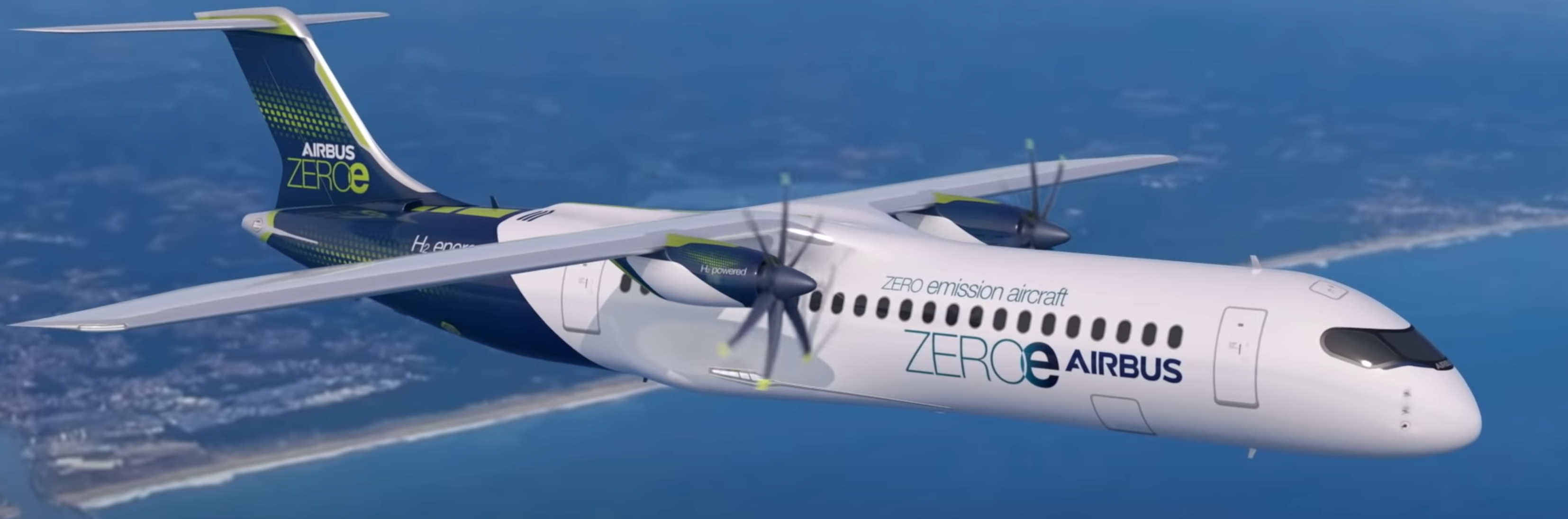
Note.
- It looks very much like an improved ATR-72.
- It has more extreme propellers and probably better aerodynamics.
- Airbus might like to persuade Ecojet to use ATR-72s as their 70-seat airliner.
- Information from an operator of hydrogen-powered airliners would be very valuable to Airbus.
I wouldn’t be surprised to see Ecojet lease some nearly new ATR-72s.
Would Airbus Fit ZeroAvia Hydrogen-Electric Powertrains In The ZEROe Turboprop?
This page on the Airbus website is entitled ZEROe.
In a section, which is entitled Hydrogen Propulsion To Power Future Aircraft, this is said.
All three ZEROe concepts are hybrid-hydrogen aircraft. They are powered by hydrogen combustion through modified gas turbine engines. Liquid hydrogen is used as fuel for combustion with oxygen.
In addition, hydrogen fuel cells create electrical power that complements the gas turbine, resulting in a highly efficient hybrid-electric propulsion system. All of these technologies are complementary, and the benefits are additive.
In 2022, we launched our ZEROe demonstrator with the aim to test hydrogen combustion technology on an A380 multimodal platform. Through future ground and flight testing, we expect to achieve a mature technology readiness level for a hydrogen-combustion propulsion system by 2025.
Note.
- Airbus state they are using modified gas turbine engines.
- Airbus also talk about using fuel cells to create electrical power that complements the gas turbines.
- Could the hydrogen fuel cells be used to power the aircraft’s systems, like avionics, control systems, air-conditioning and the hydrogen system for the main engine?
- This concept of effectively a hydrogen auxiliary power unit, might be a more efficient way of using the hydrogen, which either gives longer range or a smaller fuel tank.
- In The ZEROe Demonstrator Has Arrived, I talk about the ZEROe Demonstrator, which is a modified Airbus A 380.
Did the adding of hydrogen fuel cells to the ZEROe aircraft, lead to the concept of a hydrogen-powered auxiliary power unit, that I talked about in Airbus To Trial In-flight Auxiliary Power Entirely Generated By Hydrogen?
It looks to me, that Airbus have developed their own simple concept of powering the aircraft.
I doubt they will need ZeroAvia’s technology.
But.
- Aircraft manufacturers like Airbus generally fit the best and most suited engines they can find in their aircraft.
- The Wikipedia entry for ZeroAvia says that the prototype hydrogen-electric powertrain is in the cabin, consisting of two fuel cells and a lithium-ion battery for peak power.
- ZeroAvia have powerful shareholders like Amazon, Bill Gates and Royal Dutch Shell.
- ZeroAvia have also received grants from the UK Government.
I wouldn’t be surprised to learn, that Airbus have taken a long hard look at ZeroAvia’s technology.
After all, ZeroAvia could probably build a hydrogen fuel cell power pack, that would meet Airbus’s needs for a hydrogen-powered auxiliary power unit.
Remember too, that many fleets of aircraft have been updated with new engines for decades and I don’t think Airbus would mind ZeroAvia giving a new zero-carbon lease of life to the hundreds of ATR-72s in service around the world.
Surely, a successful hydrogen-powered ATR-72 is only going to create more interest in airlines buying ZEROe Turboprops.
All the converted aircraft will still need support from ATR.
Both the converted and new aircraft will need hydrogen refuelling services, so could the two aircraft use a common standard.
Airbus and ZeroAvia would appear to have several common interests.
Ecojet’s Core Route
This is a paragraph from the news story on the Ecotricity web site.
Dale has partnered with experienced pilot Brent Smith and a team of aviation specialists to set up Ecojet. Flights across the UK will commence in early 2024, starting with the Edinburgh to Southampton route, and expanding to mainland Europe shortly after, with long-haul flights planned for the future.
Note.
- The ATR-72 has a range of 949 miles, which is more than adequate for Southampton and Edinburgh, which is just over 350 miles.
- Diagonal journeys in the UK are often the most passenger-unfriendly by rail and tend to use diesel trains.
- Southampton Airport has good road and rail connections, with the terminal less than a minute from the station.
- Edinburgh Airport has good road and tram connections, with rail connections needing a short journey on the tram.
- Southampton Airport has flights to the Channel Islands, Ireland and Schiphol.
- Edinburgh Airport has a comprehensive service from major airlines and low-cost carriers, and several flights to destinations in the North of Scotland and on the Islands.
I think that it is a well-chosen core route for their 70-seat aircraft.
Which Routes Will Ecojet Fly With The Twin Otters?
Consider.
- My Scottish friends tell me that flying to the Scottish Islands, like the Hebrides, Orkney and Shetland is expensive.
- The growth of the Scottish wind power industry will mean, that more capacity is needed to serve the North of Scotland and the Islands.
- Tourism to the North of Scotland and the Islands is on the up.
- There will not be a shortage of green electricity to produce green hydrogen.
- The North of Scotland isn’t short of airports.
- The Twin Otter has a surprisingly long range on aviation fuel and I suspect, that a hydrogen version would be designed to have a similar range.
- The longest flight needed would probably be Edinburgh and Sumburgh, which is about 280 miles, which should be well within the range of a Twin Otter.
- I suspect that hydrogen refuelling could be easily provided at enough airports, to support hydrogen-powered airliners.
- I am sure, that the Twin Otters could be used on a network of zero-carbon flights from Edinburgh to the North of Scotland and the Islands.
- A zero-carbon airline would help Scotland’s net-zero ambitions.
There is certainly a need for another airline to connect Edinburgh to the North of Scotland and the Islands and the infrastructure could be upgraded to support a hydrogen-based zero-carbon airline.
Could Ecojet build a similar network at Southampton, that served the Channel Islands, Southern Ireland and Northern France?
Conclusion
There’s a lot more to this venture, than there appears at first sight.
O wish Vince and his partners well, but as a coeliac, I’ll skip the food.
Eviation Still Progressing Even As Alice Remains Earthbound
The title of this post, is the same as that of this article on Flight Global.
The article is a full summary of the status of the Eviation Alice project and very much a must-read.
This article on Skies Magazine, which is entitled Eviation Announces New Order For Up To 50 Alice All-Electric Commuter Aircraft, also gives this information about the order status.
In addition to the latest order from Aerolease, Eviation has also received orders from U.K.-based regional aircraft lessor MONTE (30 aircraft), U.S.-based Cape Air (75 aircraft), U.S.-based Global Crossing Airlines (50 aircraft), Germany-based EVIA AERO (25 aircraft), Australia’s Northern Territory Air Services (20 aircraft), Mexico-based Aerus (30 aircraft), Air New Zealand (up to 23 aircraft), and DHL Express for 12 Alice planes in the eCargo configuration.
Whatver, your view on electric aircraft, the total of 315 orders is impressive for a start-up.
 The Anonymous Widower