Aurizon Secures Funding To Develop Next-Generation Freight Trains Using Renewable Energy
The title of this post, is the same as that of this press release from Aurizon.
These five paragraphs outline the project.
Australia’s largest rail freight company Aurizon, today received a major boost to its program to develop the next generation of Australian freight trains, aiming to replace diesel fuel with renewable energy sources on its locomotive fleet.
Aurizon has secured a $9.4 million grant from the Australian Renewable Energy Agency (ARENA) to develop, test and trial a battery electric tender (BET) to be used in conjunction with a modified locomotive. (refer graphic below).
The tender – essentially a big battery-pack on wheels – will couple with the modified locomotive to operate as a hybrid unit using both diesel and battery-electric power sources. The tender’s battery will also harness re-generative energy captured as the train travels down grades and brakes as part of normal operation.
The ARENA grant represents half of the required funding for the ‘Battery Powered Tender for Heavy Haul Fleet Decarbonisation’ project, with the balance of the investment to be funded by Aurizon. The battery-electric tender and modified locomotive project will be built by Aurizon and technology project partner, Alta Battery Technology (Alta) at a facility in Australia, with design and technology inputs from Alta.
Aurizon appreciates the Federal Government making funding available to support the development of a range of new zero emissions technologies in the transport sector, including technologies that can be developed for application in rail-based freight supply chains that are integral to Australia’s export and domestic industries that rely on transport services.
At a first glance it appears to be suited to Aurizon and its long routes with heavy freight trains across Australia.
These are some more specific thoughts.
Alstom Have Built A Train With a Hydrogen Tender
In From 2025, Nestlé Waters France Will Use The First Hydrogen-Powered Freight Train Through An Innovative Solution Developed by Alstom and ENGIE, I describe a train powered by an electric locomotive with an attached hydrogen power unit.
The Future Of The Class 68 Locomotives
Could these be given a reduced-carbon second life, by developing a specialised tender?
I wrote about this in The Future Of The Class 68 Locomotives.
I suspect Stadler, who seem to be excellent innovators will be watching.
There Seems To Be A Lot Going On In Australia
I have written several posts about decarbonisation of freight trains in Australia.
- BHP To Trial Battery Locos On Pilbara Iron Ore Network
- Battery-Electric Power Rides The Rails
- Wabtec And Roy Hill Unveil The First FLXdrive Battery Locomotive
- Fortescue Unveils World-First Electric Train Using Gravity To Recharge
- BHP Joins The Party On Electric Rail
- Rio Tinto Orders Wabtec FLXdrive Battery Locomotives To Reduce Emissions
The big mining companies certainly seem keen to decarbonise.
Battery-Electric Power Rides The Rails
The title of this post, is the same as that of this article on Power Progress.
These two introductory paragraphs, outline the project.
In late October 2023, transportation solution provider Wabtec and its launch customer Roy Hill, an Australia-based iron ore mining company, celebrated the debut of the FLXdrive locomotive – a production model unit that Wabtec described as the “world’s first 100% battery-powered, heavy-haul locomotive for mainline service.”
The debut was the culmination of more than a decade of R&D that started at a time when battery technology and density were far more limited. Rogerio Mendonca, president, Freight Equipment, Wabtec, labeled the company’s earliest project as “more of a science pilot than anything else.”
I feel that this conversion of a diesel locomotive to a 7MWh battery-electric locomotive will be a significant milestone in freight haulage.
In the UK, we have 480 Class 66 locomotives.
Not all are used for heavy freight and you regularly see a single locomotive hauling a load that a lowered-powered battery electric locomotive could handle.
I suspect that if Roy Hill find this a capable locomotive, that we’ll see some Class 66 locomotives converted to battery-electric operation.
The article is well worth a full read.
Wabtec And Roy Hill Unveil The First FLXdrive Battery Locomotive
The title of this post, is the same as that of this press release from Wabtec.
This is the sub-heading.
World’s first 100% battery-powered, heavy-haul freight locomotive for mainline service
This is the first three paragraphs.
Wabtec and its launch customer, Roy Hill, a leading iron ore miner majority owned by Australia’s most successful private company, Hancock Prospecting, have celebrated the debut of the FLXdrive battery locomotive, the world’s first 100% battery-powered, heavy-haul locomotive for mainline service. The ceremony unveiled the unique, striking pink-colored locomotive at Wabtec’s design and development center in Pennsylvania in front of employees, customer executives, and government and community officials.
“This FLXdrive locomotive represents a major step in the journey to a low-to-zero-emission future in the rail industry,” said Rafael Santana, President & CEO of Wabtec. “The FLXdrive is driven from within by our battery technology and the innovative spirit of our employees. Roy Hill is an ideal customer to partner with given their leadership and excellent operational record.”
Roy Hill’s FLXdrive battery-electric locomotive will feature an energy capacity of 7 megawatt hours (MWh). Based on the route and company’s rail operations, the FLXdrive is anticipated to provide a double-digit percentage reduction in fuel costs and emissions per train. Once Wabtec completes the final battery installations and track testing, the locomotive will begin its 17,000-kilometer (10,500-mile) journey in 2024 for delivery to its new home in the Pilbara region of Western Australia, one of the world’s premier mining precincts.
These further two paragraphs outline the operation of the locomotive.
The FLXdrive locomotive represents not only a first for the Pilbara, but a first for the mining industry. The technological smarts that have gone into the development of the loco makes it well suited for our rail network. By using regenerative braking, it will charge its battery on the 344 kilometer (214 mile) downhill run from our mine to port facility and use that stored energy to return to the mine, starting the cycle all over again. This will not only enable us to realise energy efficiencies but also lower operating costs.”
Today, Roy Hill uses four Wabtec ES44ACi “Evolution Series” diesel-electric locomotives in a consist to pull trains that are typically 2,700 meters (1.6 miles) in length carrying more than 33,000 tonnes of iron ore. The addition of the FLXdrive will form a hybrid locomotive consist with Wabtec diesel-electric locomotives, and recharge during the trip through regenerative braking. The FLXdrive manages the overall train energy flow and distribution through its state-of-the-art energy management software. It is also designed with a unique battery thermal management system using liquid cooling to withstand the Pilbara heat, where temperatures can reach 55°C (130°F).
I have some thoughts.
Could Class 66 Locomotives Be Converted Into Battery-Electric Locomotives?
I answered this question fully in Could Class 66 Locomotives Be Converted Into Battery-Electric Locomotives? a couple of years ago and came to this conclusion.
I am not a lover of the smelly, noisy and polluting diesel Class 66 locomotives, but it does look it could be possible to convert some into battery-electric locomotives.
I wouldn’t be surprised to see Wabtec convert some Class 66 locomotives into battery-electric locomotives.
I also believe, that conversion of Class 66 locomotives to battery-electric operation could be the most affordable way to help decarbonise rail freight.
Note.
- Class 68 locomotives could probably also be converted.
- The battery-electric locomotives would either be used singly or in conjunction with diesel-electric locomotives as Roy Hill propose to do.
After the launch of Wabtec’s first production locomotive, I wouldn’t be surprised to find that some of the UK’s freight operators are talking to Wabtec.
Could A Battery-Electric Class 66 locomotive Work With An Electric Locomotive?
This picture shows, what could be an experiment by Freightliner at Shenfield.
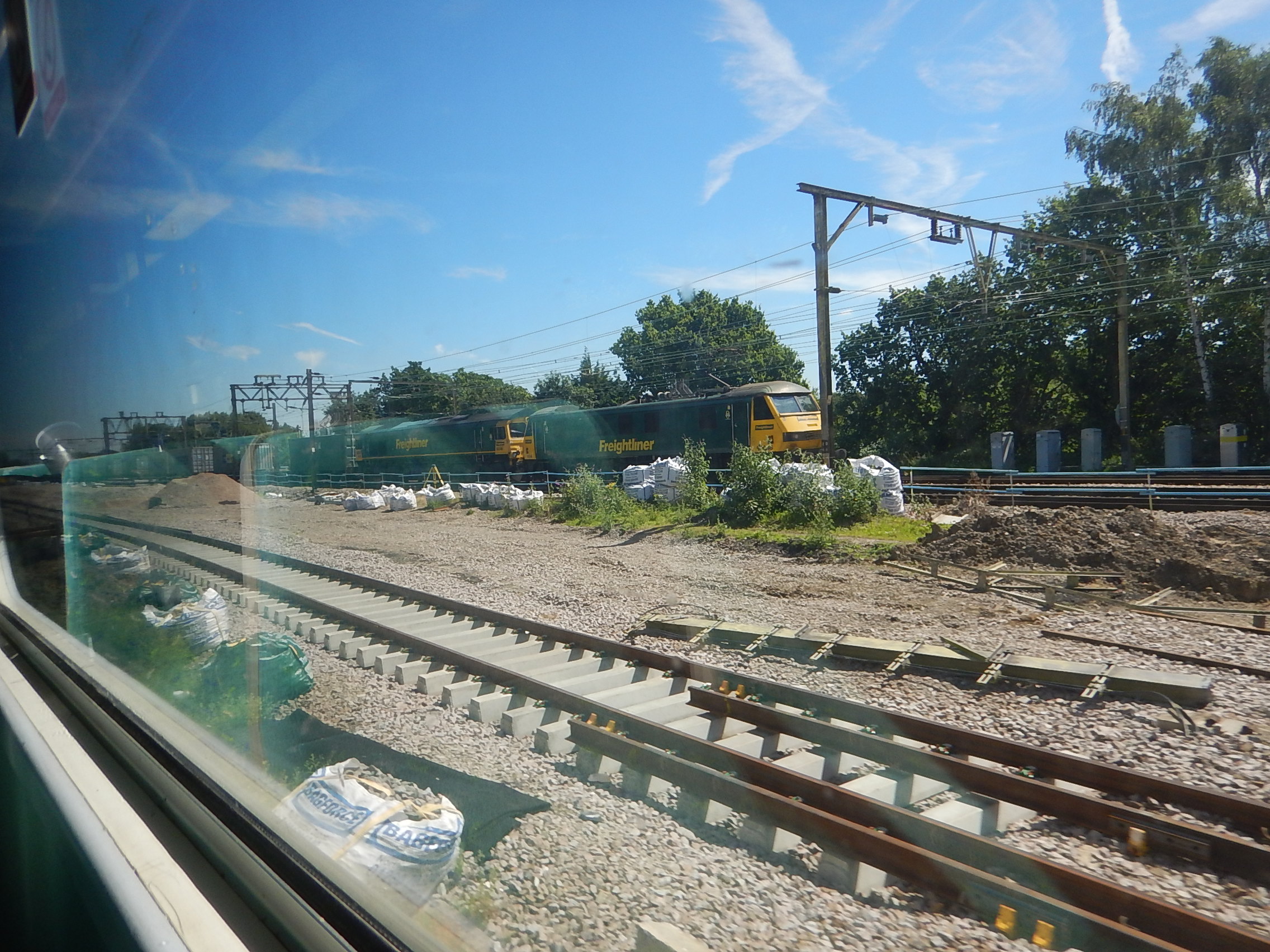
Unfortunately, I didn’t have a chance to ask the driver, if the Class 66 locomotive was running dead-in-train or helping the Class 90 locomotive with a very heavy load.
The picture shows, that the electric and diesel locomotives can work together, at the front of a train.
Consider.
- The battery-electric locomotive would be used, where there is no electrification.
- The battery-electric locomotive could be charged by the electric locomotive or regenerative braking.
It could be an interesting way to handle some freight routes in the UK.
Positive Traction Launches 08e – “The Future Of Sustainable Depot Operations”
The title of this post is the same as this article on Rail UK.
This is the first two paragraphs.
Positive Traction has launched the UK’s first re-engineered battery powered shunting locomotive – the 08e.
Free from carbon, NOx and particulate emissions the 08e can fulfil day-to-day operating needs as well as meet the demanding ESG requirement of shareholders, customers, employees and neighbouring communities.
Note.
- 996 Class 08 locomotives were originally produced between 1952 and 1962.
- Around a hundred are still in use on the UK rail network.
- This page on the Positive Traction web site, gives more details.
This could be a sensible use of technology, that carves itself a profitable niche market.
Electrification Between Newbury And East Somerset Junction
In the August 2023 Edition of Modern Railways, there is an article, which is entitled GWR Seeks Opportunities To Grow.
This is the sub-heading.
Managing Director Mark Hopwood tells Philip Sherratt there is plenty of potential to increase rail’s economic contribution.
This is two paragraphs.
The desire to provide electrification to support aggregates traffic from the Mendip quarries could also benefit GWR , says Mr. Hopwood. ‘Having an electric loco would massively help with pathing heavy freight trains through the Thames Valley. If you could electrify from Newbury to East Somerset Junction, a big chunk of the Berks and Hants route would be wired.
Then you can ask how much further you could get on battery power on an IET without running out of juice.’
I have some thoughts.
Where Is East Somerset Junction?
This OpenRailwayMap shows East Somerset junction.
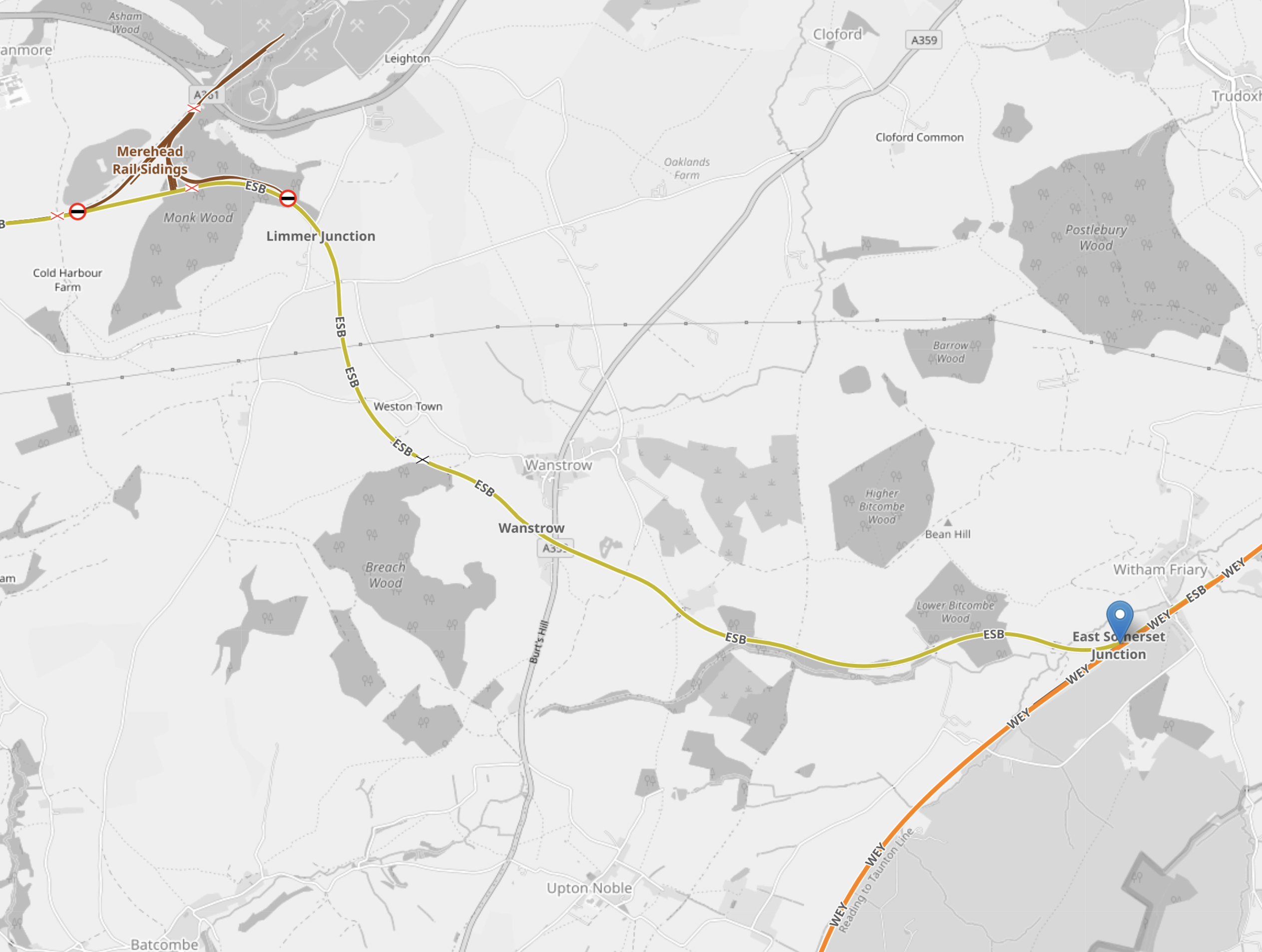
Note.
- The East Somerset junction is marked with the blue arrow.
- East Somerset junction is 5.2 miles North of Bruton station and 5.4 miles South of Frome station on the Reading and Taunton Line.
As the map shows there is a branch to Merehead Rail Sidings, which is shown in yellow.
This Google Map shows Merehead Rail Sidings.
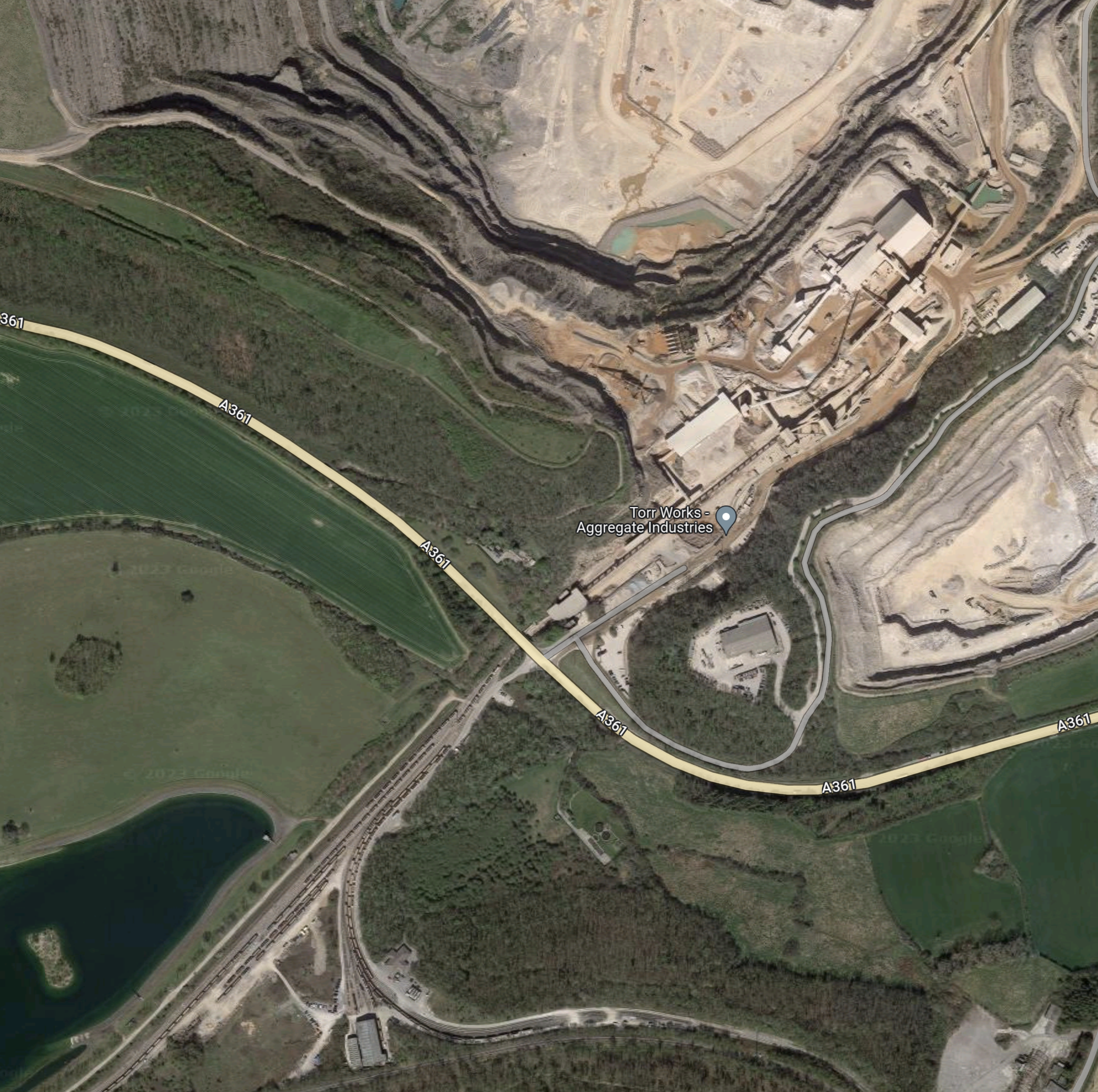
Note.
- It looks like there is a massive quarry to the North of the A361 road, which curves across the map.
- It is labelled Torr Works – Aggregate Industries.
- Torr Works has a Wikipedia entry.
- The rail sidings are South of the A361.
- Zooming in on the map, shows that the railway between East Somerset junction and Merehead is single-track and only a few miles long.
Distances from East Somerset junction are as follows.
- Dorchester junction – 41.2 miles
- Newbury – 53.4 miles
- Taunton – 37.2 miles
- Weymouth – 47.8 miles
Note that it is electrified with 750 VDC third-rail between Weymouth and Dorchester junction.
Range of Battery-Electric Trains
Consider.
- A Bombardier engineer told me eight years ago, that the battery-electric Class 379 train had a range of sixty miles.
- Stadler’s FLIRT Akku has a Guinness world record of 139 miles on one battery charge. See this page on the Stadler web site.
- Even Stadler’s Class 777 trains for Merseyrail have a range of 84 miles on battery power. See New Merseyrail Train Runs 135 km On Battery.
It does appear that five-car battery-electric trains will have ranges in excess of a hundred miles.
I believe that because Hitachi’s battery makers have a good record, they will probably be very ambitious and will want that Guinness record, that Hitachi’s Class 802 trains will have a battery range not far short of the 139 miles of the Stadler FLIRT Akku.
I will be very surprised if Hitachi’s battery-electric version of a Class 802 train, doesn’t have range of at least 125 miles.
But say if they could do say 140 miles, the battery-electric Class 802 train could cover every long-distance route in the UK, which would attract orders for trains to run on the following routes.
- Cardiff and Swansea
- Crewe and Holyhead
- Edinburgh and Aberdeen
- Edinburgh and Inverness
- Crewe and Holyhead
- London Waterloo and Exeter St. Davids
A substantial reward to the battery makers, would probably not be out of order.
Aggregate Trains From The Mendips
Consider.
- Mining and quarrying companies are under pressure from governments, shareholders and environmentalists to reduce their carbon footprints.
- Many are replacing diesel-powered mining excavators and trucks, with electric or hydrogen versions.
- In addition, those companies delivering building products to the construction industry are under pressure to provide low-carbon products.
- Using rail with electric traction to deliver products to market would cut carbon emissions and might even help sales.
These Mendip quarries appear to be connected to the Reading and Taunton Line.
- Torr Works – Connects 5.4 miles to the South of Frome.
- Whatley Quarry – Connects close to Frome.
There may be others.
But these rail-connected quarries, connect at or North of East Somerset junction, to where Mark Hopwood is proposing electrification.
Zero-carbon rail traction could even be possible, by electrifying the short single-track branch lines. or by using hydrogen-electric hybrid locomotives.
GWR’s London And South-West Services
These services use the Reading and Taunton Line to join the Bristol and Exeter Line at Taunton, before going on to Exeter, Plymouth and other destinations in the South-West of England.
These are distances from East Somerset Junction.
- Exeter – 67 miles
- Paignton 95.2 miles
- Penzance – 198.5 miles
- Plymouth – 119.0 miles
- Taunton – 37.2 miles
Note.
- Exeter, Paignton, Penzance and Plymouth stations would need short lengths of electrification to charge terminating trains or top-up passing trains.
- In Thoughts About Electrification Through Devon And Cornwall, I showed that the average stop time at Plymouth station was eight minutes, which could be enough for the rail equivalent of a Formula One splash and dash.
- A 125 mile battery range, not only enables London and Penzance, but also Cardiff and Swansea, and Edinburgh and Aberdeen, when the extra electrification is completed.
Could my estimate of a 125 mile battery range, be Hitachi’s objective for their battery-electric trains?
The Ultimate Battery-Electric Class 802 Train
Hitachi have been totally silent on how the fitting of batteries to Class 802 trains is going.
But Mark Hopwood is more forthcoming in the GWR Seeks Opportunities To Grow article. where this is said.
Meanwhile, GWR had announced plans with Eversholt Rail to trial the replacement of a diesel generator unit with batteries on a Class 802 IET. However, Mr. Hopwood says this would not be useful for GWR and so the trial is not proceeding; instead, a TransPennine Express Class 802 will be the subject of a battery trial.
It sounds to me that another solution is being developed to get trains to run on electric power between London and the South-West.
- I think we can rule out full electrification on the grounds of cost, disruption, time and the Nimbys and objectors will have a field day.
- Newbury and Penzance is a distance of 251.9 miles, which would surely need a lot of batteries.
Mark Hopwood’s idea to electrify the 53.4 miles between Newbury And East Somerset junction, is starting to look like a good compromise.
GWR’s Bristol/Gloucester And Weymouth Services
These stopping trains are run by diesel trains and take the following route between Bristol Temple Meads and Weymouth stations.
- Keynsham
- Oldfield Park
- Bath Spa
- Freshford
- Avoncliff
- Bradford-on-Avon
- Trowbridge
- Westbury
- Frome
- East Somerset junction
- Bruton
- Castle Cary
- Yeovil Pen Mill
- Thornford
- Yetminster
- Chetnole
- Maiden Newton
- Dorchester West
- Dorchester junction
- Upwey
Note.
- I would assume that there is enough electrification at Bristol Temple Meads and towards Gloucester to charge the trains.
- Trains would leave Bristol Temple Meads with a full battery.
- The eighteen stops mean that an electric train with regenerative braking will be more efficient.
- Bristol Temple Meads and Westbury is not electrified.
- Westbury and East Somerset junction will be electrified with 25 KVAC overhead electrification under Mark Hopwood’s proposal.
- Trains take sixteen minutes between Westbury and East Somerset junction.
- East Somerset junction and Dorchester junction is not electrified.
- Dorchester junction and Weymouth is electrified with 750 VDC third-rail electrification.
- Trains take ten minutes between Dorchester junction and Weymouth.
Distances of the various legs are as follows.
- Bristol Temple Meads and Westbury – 28.3 miles – Not Electrified
- Westbury and East Somerset junction – 11.4 miles – Electrified
- East Somerset junction and Dorchester junction – 41.4 miles – Not Electrified
- Dorchester junction and Weymouth – 6.6 miles – Electrified
The two sections without electrification, should be well within range of a dual-voltage battery-electric train, that has been designed for the route.
GWR’s Cardiff Central And Portsmouth Harbour Service
These stopping trains are run by diesel trains and take the following route between Bristol Temple Meads and Portsmouth Harbour stations.
- Keynsham
- Oldfield Park
- Bath Spa
- Freshford
- Avoncliff
- Bradford-on-Avon
- Trowbridge
- Westbury
- Warminster
- Salisbury
- Romsey
- Redbridge
- Southampton Central
- Fareham
- Cosham
- Fratton
- Portsmouth & Southsea
Note.
- I would assume that there is enough electrification at Bristol Temple Meads and towards Cardiff Central to charge the trains.
- Trains would leave Bristol Temple Meads with a full battery.
- The seventeen stops mean that an electric train with regenerative braking will be more efficient.
- Bristol Temple Meads and Westbury is not electrified.
- Westbury station will be electrified with 25 KVAC overhead electrification under Mark Hopwood’s proposal.
- Trains would leave Westbury with a full battery.
- Westbury and Redbridge is not electrified.
- Redbridge and Portsmouth Harbour is electrified with 750 VDC third-rail electrification.
Distances of the various legs are as follows.
- Bristol Temple Meads and Westbury – 28.3 miles – Not Electrified
- Westbury and Redbridge – 46.4 miles – Not Electrified
- Redbridge and Portsmouth Harbour – 28.5 miles – Electrified
The two sections without electrification, should be well within range of a dual-voltage battery-electric train, that has been designed for the route.
GWR’s Bristol Temple Meads And Salisbury Services
These stopping trains are run by diesel trains and take the following route between Bristol Temple Meads And Salisbury stations.
- Keynsham
- Oldfield Park
- Bath Spa
- Freshford
- Avoncliff
- Bradford-on-Avon
- Trowbridge
- Dilton Marsh
- Warminster
Note.
- I would assume that there is enough electrification at Bristol Temple Meads to charge the trains.
- Trains would leave Bristol Temple Meads with a full battery.
- An electric train with regenerative braking will be more efficient.
- Bristol Temple Meads and Westbury is not electrified.
- Westbury station will be electrified with 25 KVAC overhead electrification under Mark Hopwood’s proposal.
- Trains would leave Westbury with a full battery.
- Westbury and Salisbury is not electrified.
Distances of the various legs are as follows.
- Bristol Temple Meads and Westbury – 28.3 miles – Not Electrified
- Westbury and Salisbury – 24.4 miles – Not Electrified
The two sections without electrification, should be well within range of a battery-electric train, that has been designed for the route.
GWR’s Swindon And Westbury Services
These stopping trains are run by diesel trains and take the following route between Swindon and Westbury stations.
- Chippenham
- Melksham
- Trowbridge
Note.
- This is the Transwilts service.
- I would assume that there is enough electrification at Swindon to charge the trains.
- Trains would leave Swindon with a full battery.
- An electric train with regenerative braking will be more efficient.
- Chippenham and Westbury is not electrified.
- Westbury station will be electrified with 25 KVAC overhead electrification under Mark Hopwood’s proposal.
- Trains would leave Westbury with a full battery.
Distances of the various legs are as follows.
- Swindon and Chippenham – 16.9 miles – Electrified
- Chippenham and Westbury – 15.8 miles – Not Electrified
The section without electrification, should be well within range of a battery-electric train, that has been designed for the route.
What Can Be Done If The Electrification Is Not Long Enough?
Some of these routes battery-electric routes may need more electrification to work efficiently.
Despite some routes having both 25 KVAC overhead and 750 VDC third-rail electrification, any extension of the electrification would be overhead, as new third-rail electrification is effectively banned.
Conclusion
It looks like Mark Hopgood proposal is an excellent idea to enable the decarbonisation of GWR services in Wiltshire and Somerset.
- Express services would be run by battery-electric Class 802 trains.
- Local services would be run by battery-electric trains with perhaps three cars.
Some of the local trains would need to be dual-voltage to use both forms of electrification.
Zero/Low-Emission Locomotive Global Roundup
The title of this post, is the same as that of this article on Railway Age.
This is the introduction.
By 2050, in accordance with the Paris Climate Agreement, zero-emission locomotives may have completely replaced conventional diesel-powered equipment on the railways of the world.
Current development of zero-emission switcher locomotives, combined with practical operating experience, increases this likelihood in the foreseeable future.
It will be increasingly possible to determine the optimal type or types of zero- or low- emission locomotives to replace conventional diesel units.
They then give a roundup, which includes American, Canadian Chinese, French, Indian and Polish locomotives.
There was no mention of Clean Air Power‘s conversion of a Class 66 locomotive to dual-fuel operation, that I wrote about in Clean Air Power Adds Hydrogen To Class 66 Fuel Mix.
Joule Battery Loco Unveiled Ahead Of Trial
The title of this post, is the same as that of this article on Railway Gazette.
These three paragraphs outline the trial and the locomotive.
Pacific Harbor Line has unveiled a Progress Rail EMD SD40JR Joule battery electric locomotive ahead of a one-year trial.
Anacostia Rail Holdings subsidiary PHL provides shunting services and dispatches all BNSF and Union Pacific trains within the ports of Los Angeles and Long Beach. It currently operates a fleet of EPA Tier 3 Plus and Tier 4 locomotives using 100% renewable diesel fuel.
The 3·2 MW six-axle SD40JR locomotive was rebuilt from a SD40-2. It has a lithium-ion battery, AC traction motors and individual axle control. It is charged using an EMD Joule Charging Station, and features regenerative braking.
I have some thoughts and more information.
Pacific Harbor Line – PHL
This map from OpenRailwayMap shows the area in the ports of Los Angeles and Long Beach, where it will be working.
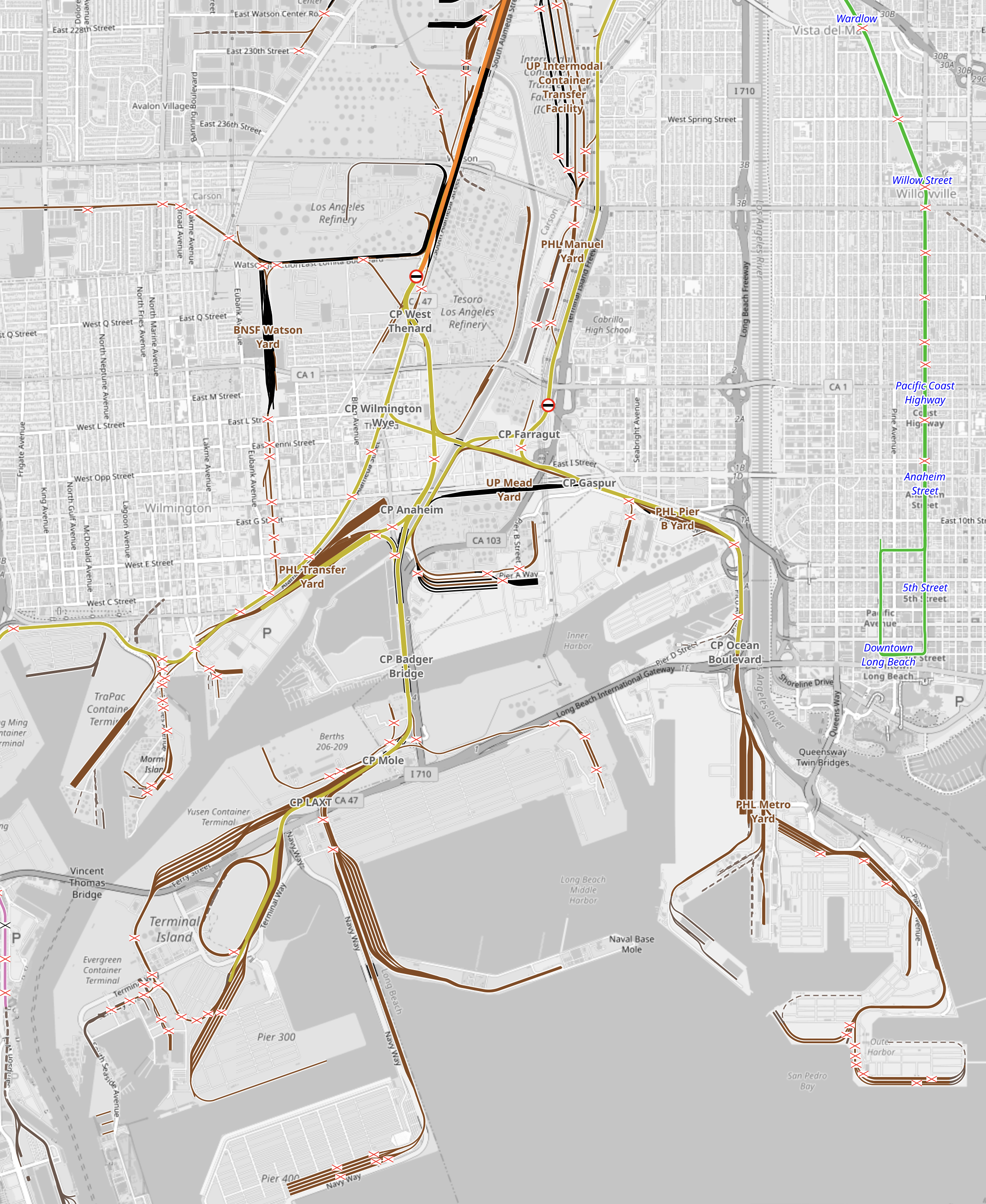
Note.
Los Angeles is to the West and Long Beach is to the East.
Most of the lines in brown are rail tracks, where PHL moves containers between ships and trains that bring them to and from the ports.
The Union Pacific Intermodal Container Transfer Facility is at the North of the map.
It is a very comprehensive system.
The Pacific Harbor Line web site gives more details and starts with this paragraph.
Pacific Harbor Line, Inc. (PHL) provides rail transportation, maintenance and dispatching services to both Ports of Long Beach and Los Angeles, which together form top intermodal gateways in the United States. Through its inception, PHL’s mission has been to offer neutral services to all its business partners: two ports, two Class I railroads, nine intermodal terminals and numerous carload customers. PHL connects with BNSF and UP.
It then gives these details.
- Location: Ports of Long Beach and Los Angeles
- Employees: 189
- Railroad Mileage: 19 route miles, 96 track miles
- Port Facility Served: Port of Los Angeles, Port of Long Beach
- Connecting Railroads: BNSF and UP
- Sustainability: Contact Pacific Harbor Line to discover the low carbon solutions we can provide for your freight needs.
- Number of Customers: 9 on-dock marine terminals, more than 30 carload customers
Later the web site states that PHL is proud of its role as an industry leader for environmental sustainability and as owner of the greenest locomotive fleet in the country.
The new locomotive would appear to fit fit that philosophy.
Progress Rail EMD SD40JR Joule Battery Electric Locomotive
This page on the Progress Rail web site gives more details of their Joule battery electric locomotives.
- The SD40JR locomotive has a power output of 2.1 MW and a 4 MWh battery.
- For comparison, a Class 66 locomotive, of which there are 480 in the UK, has a power output of 1.85 MW at the rail.
- Strangely, the UK locomotive is 1.7 metres longer.
As both locomotive classes were originally built by EMD, I do wonder how similar the components of the two locomotives are.
Would A Battery Electric Class 66 Locomotive Be Any Use?
If we assume that conversion of a Class 66 locomotive to battery power is possible would it find uses in the UK?
I am fairly certain, if you live in any of the villages on the Felixstowe branch line, you will sometimes get annoyed, at the streams of Class 66 locomotives passing with long freight trains between Ipswich and Felixstowe.
I have just looked at the 11:13 freight train from Felixstowe North to Trafford Park.
- It leaves Felixstowe North hauled by a Class 66 locomotive.
- Felixstowe North to Ipswich takes just 35 minutes.
- At Ipswich, the motive power is changed to an electric locomotive, which is probably a Class 90 locomotive.
- The train then uses an all-electric route to Trafford, where it arrives at 23:39.
A rough calculation based on the time running on electric, shows that the current hybrid method of operation, saves 95.3% of the carbon emissions compared to an all-diesel trip.
It would be carbon-free, if a battery-electric Class 66 locomotive could be developed. with sufficient range.
So that’s one application!
There must be other applications, where a battery can supply enough power for the journey.
Conclusion
Given the number of Class 66 locomotives to decarbonise or replace, a fleet of battery electric Class 66 locomotives could be a good start.
Low Carbon Construction Of Sizewell C Nuclear Power Station
Sizewell C Nuclear Power Station is going to be built on the Suffolk Coast.
Wikipedia says this about the power station’s construction.
The project is expected to commence before 2024, with construction taking between nine and twelve years, depending on developments at the Hinkley Point C nuclear power station, which is also being developed by EDF Energy and which shares major similarities with the Sizewell plant.
It is a massive project and I believe the construction program will be designed to be as low-carbon as possible.
High Speed Two is following the low-carbon route and as an example, this news item on their web site, which is entitled HS2 Completes Largest Ever UK Pour Of Carbon-Reducing Concrete On Euston Station Site, makes all the right noises.
These three paragraphs explain in detail what has been done on the Euston station site.
The team constructing HS2’s new Euston station has undertaken the largest ever UK pour of Earth Friendly Concrete (EFC) – a material that reduces the amount of carbon embedded into the concrete, saving over 76 tonnes of CO2 overall. John F Hunt, working for HS2’s station Construction Partner, Mace Dragados joint venture, completed the 232 m3 concrete pour in early September.
The EFC product, supplied by Capital Concrete, has been used as a foundation slab that will support polymer silos used for future piling works at the north of the Euston station site. Whilst the foundation is temporary, it will be in use for two years, and historically would have been constructed with a more traditional cement-based concrete.
The use of the product on this scale is an important step forward in how new, innovative environmentally sustainable products can be used in construction. It also helps support HS2’s objective of net-zero construction by 2035, and achieve its goal of halving the amount of carbon in the construction of Britain’s new high speed rail line.
Note.
- Ten of these slabs would fill an Olympic swimming pool.
- I first wrote about Earth Friendly Concrete (EFC) in this post called Earth Friendly Concrete.
- EFC is an Australian invention and is based on a geopolymer binder that is made from the chemical activation of two recycled industrial wastes; flyash and slag.
- HS2’s objective of net-zero construction by 2035 is laudable.
- It does appear that this is a trial, but as the slab will be removed in two years, they will be able to examine in detail how it performed.
I hope the Sizewell C project team are following High Speed Two’s lead.
Rail Support For Sizewell C
The Sizewell site has a rail connection and it appears that this will be used to bring in construction materials for the project.
In the January 2023 Edition of Modern Railways, there is an article, which is entitled Rail Set To Support Sizewell C Construction.
It details how sidings will be built to support the construction, with up to four trains per day (tpd), but electrification is not mentioned.
This is surprising to me, as increasingly, big construction projects are being managed to emit as small an amount of carbon as possible. Sizewell C may be an isolated site, but in Sizewell B, it’s got one of the UK’s biggest independent carbon-free electricity generators a couple of hundred metres away.
The writer of the Modern Railways article, thinks an opportunity is being missed.
I feel the following should be done.
- Improve and electrify the East Suffolk Line between Ipswich and Saxmundham Junction.
- Electrify the Aldeburgh Branch Line and the sidings to support the construction or agree to use battery-electric or hydrogen zero-carbon locomotives.
Sizewell C could be a superb demonstration project for low-carbon construction!
Sizewell C Deliveries
Sizewell C will be a massive project and and will require a large number of deliveries, many of which will be heavy.
The roads in the area are congested, so I suspect rail is the preferred method for deliveries.
We already know from the Modern Railways article, that four tpd will shuttle material to a number of sidings close to the site. This is a good start.
Since Sizewell A opened, trains have regularly served the Sizewell site to bring in and take out nuclear material. These occasional trains go via Ipswich and in the last couple of years have generally been hauled by Class 88 electro-diesel locomotives.
It would be reasonable to assume that the Sizewell C sidings will be served in the same manner.
But the route between Westerfield Junction and Ipswich station is becoming increasingly busy with the following services.
- Greater Anglia’s London and Norwich services
- Greater Anglia’s Ipswich and Cambridge services
- Greater Anglia’s Ipswich and Felixstowe services
- Greater Anglia’s Ipswich and Lowestoft services
- Greater Anglia’s Ipswich and Peterborough services
- Freight services serving the Port of Felixstowe, which are expected to increase significantly in forthcoming years.
But the Modern Railways article says this about Saxmundham junction.
Saxmundham junction, where the branch meets the main line, will be relaid on a slightly revised alignment, retaining the existing layout but with full signalling giving three routes from the junction protecting signal on the Down East Suffolk line and two in the Down direction on the bidirectional Up East Suffolk line. Trap points will be installed on the branch to protect the main line, with the exit signal having routes to both running lines.
Does the comprehensive signalling mean that a freight train can enter or leave the Sizewell sidings to or from either the busy Ipswich or the quieter Lowestoft direction in a very safe manner?
I’m no expert on signalling, but I think it does.
- A train coming from the Lowestoft direction needing to enter the sidings would go past Saxmundham junction on the Up line. Once clear of the junction, it would stop and reverse into the branch.
- A train coming from the Ipswich direction needing to enter the sidings would approach in the wrong direction on the Up line and go straight into the branch.
- A train leaving the sidings in the Lowestoft direction would exit from the branch and take the Up line until it became single track. The train would then stop and reverse on to the Down line and take this all the way to Lowestoft.
- A train leaving the sidings in the Ipswich direction would exit from the branch and take the Up line all the way to Ipswich.
There would need to be ability to move the locomotive from one end to the other inside the Sizewell site or perhaps these trains could be run with a locomotive on both ends.
The advantage of being able to run freight trains between Sizewell and Lowestoft becomes obvious, when you look at this Google Map, which shows the Port of Lowestoft.
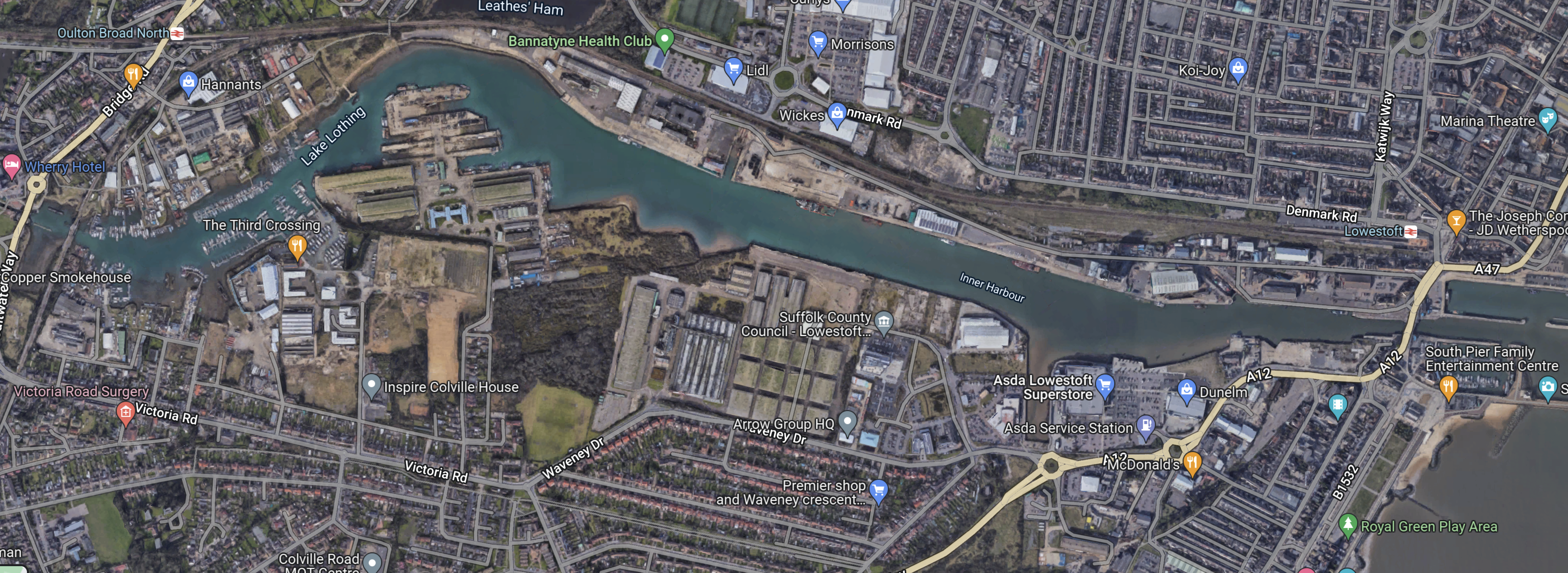
Note.
- The Inner Harbour of the Port of Lowestoft.
- The East Suffolk Line running East-West to the North of the Inner Harbour.
- Lowestoft station at the East side of the map.
I doubt it would be the most difficult or expensive of projects to build a small freight terminal on the North side of the Inner Harbour.
I suspect that the easiest way to bring the material needed to build the power station to Sizewell would be to do the following.
- Deliver it to the Port of Lowestoft by ship.
- Tranship to a suitable shuttle train for the journey to the Sizewell sidings.
- I estimate that the distance is only about 25 miles and a battery or hydrogen locomotive will surely be available in the UK in the next few years, that will be able to provide the motive power for the return journey.
In The TruckTrain, I wrote about a revolutionary freight concept, that could be ideal for the Sizewell freight shuttle.
In addition, there is no reason, why shuttle trains couldn’t come in from anywhere connected to the East Suffolk Line.
Zero-Carbon Construction
Sizewell C could be the first major construction site in the UK to use electricity rather than diesel simply because of its neighbour.
Conclusion
I shall be following the construction methods at Sizewell C, as I’m fairly sure they will break new ground in the decarbonisation of the Construction industry.
Hyperbat In Multimillion-Pound Deal To Supply Battery Packs For Lotus Supercar
The title of this post, is the same as that of this article on The Times.
Lotus or supercars for that matter, will not be a big market for battery packs, but they will be a high-profile one. The article in The Times may well flush out a few good sales leads from companies who want to decarbonise their products.
Many years ago, I did a consultancy job for Cummins, where my software was used to look for faults in their engine testing system. One of their engineers explained to me that they had a sales and production philosophy that could handle all markets from the large down to small niche ones. He said that we can’t tell which niche markets are going to be successful.
In the last couple of years Cummins have embraced hydrogen very strongly and it looks like they are adopting a similar philosophy.
So in the Cummins engine business model, it looks like the niche market is important.
I suspect that what goes for the diesel engine market will also go for the electric transmission market, with niche markets being nicely profitable and an important part of sales.
It looks to me that Hyperbat are going for that market, backed up by the engineering and battery experience of Williams Advanced Engineering and the manufacturing knowledge and logistics of Unipart.
Note that Williams Advanced Engineering is now owned by Australian billionaire; Andrew Forrest, through his company; Fortescue Future Industries. I wrote about this purchase in Fortescue Buys Williams Engineering In Major Push Into High Performance Batteries.
On the Hyperbat web site, this is said about their manufacturing facility.
The facility is about to double in size to meet current needs, with plans to double again in the next 2 years.
The factory is based on the site of a former exhaust plant and reintroduces manufacturing to the area, with an environmentally sustainable future.
Capacity of the factory is approximately 10,000 packs per year.
I;m sure the company, has enough backing for a very successful future.
 The Anonymous Widower