Are Finally Battery-Electric Trains Going To Enter Service?
In the April 2022 Edition of Modern Railways, there are three articles about battery-electric trains on four different routes.
- Effort To Contain Costs For Hoo Reopening talks about the reopening of the Hoo Branch in Kent.
- Uckfield Third Rail Is NR Priority talks about running battery-electric trains on the Uckfield Branch and the Marshlink Line.
- Vivarail’s Battery ‘230’ For Greenford Branch, talks about the Class 230 train, that will be running on the Greenford branch.
The technology has been a long-term arriving, as I had my first ride in a battery-electric train in February 2015, which I wrote about in Is The Battery Electric Multiple Unit (BEMU) A Big Innovation In Train Design?.
What kept it so long?
Is This A Plan For The Marshlink Line?
Uckfield Third Rail Is NR Priority is based on an article in the April 2022 Edition of Modern Railways, with the same name.
The Modern Railways article also has this to say about the Marshlink Line.
By contrast, the shorter trains in use on the Marshlink Line between Ashford and Hastings made bi-modes with batteries a realistic option there.
The Marshlink Line is electrified at both ends at Ashford International and Ore stations.
- In between there are four small stations and one large one Rye in the middle.
- Ashford and Rye are 15.3 miles apart.
- Rye and Ore are 10.1 miles apart.
- As it runs across the Romney Marsh, there probably aren’t too many gradients.
It would appear that with a fast charge system at Rye, battery-electric operation should be possible.
In an article in the October 2017 Edition of Modern Railways, which is entitled Celling England By The Pound, Ian Walmsley says this in relation to trains running on the Uckfield Branch, which is not very challenging.
A modern EMU needs between 3 and 5 kWh per vehicle mile for this sort of service.
For different lengths of trains, battery sizes can be calculated based on a distance of sixteen miles.
- A five-car train would need a battery capacity of between 240 and 400 kWh.
- A four-car train would need a battery capacity of between 192 and 320 kWh.
- A three-car train would need a battery capacity of between 144 and 240 kWh.
In Uckfield Third Rail Is NR Priority, I estimated that the Uckfield branch could be served using five-car trains with batteries between 180 and 300 kWh.
It does look that a five-car battery-electric train could be developed that would handle both the Uckfield Branch and the Marshlink Line.
Uckfield Third Rail Is NR Priority
The title of this post, is the same as that of an article in the April 2022 Edition of Modern Railways.
This is the first two paragraphs.
Electrification of the line between Hurst Green and Uckfield in East Sussex and the remodelling of East Croydon are the top Network Rail investment priorities south of the river, according to Southern Region Managing Director John Halsall. He told Modern Railways that third rail is now the preferred option for the Uckfield Line, as it would allow the route to use the pool of third-rail EMUs in the area. This is in preference to the plan involving overhead electrification and use of dual-voltage units put forward by then-Network Rail director Chris Gibb in his 2017 report (p66, September 2017 issue).
NR has put forward options for mitigating the safety risk involved with the third-rail system, including switching off the power in station areas when no trains are present and section isolation systems to protect track workers.
The Office of Road and Rail hasn’t given Network Rail’s scheme the OK yet, but as an Electrical Engineer, I believe that a safe system is possible.
Making Charging Safe At Greenford
This article on Ian Visits is entitled Ex-London Underground Trains To Be Tested On The Greenford Branch Line.
The article describes how despite using London Underground’s four-rail electrification, it will be possible with the right interlocks and systems to make such a system safe.
As Vivarail’s system is to be installed, it must already agree with all the Health and Safety rules.
A Safe System On The Uckfield Branch
Consider.
- The unelectrified section of the Uckfield Branch is twenty-five miles long.
- There are seven intermediate stations, with the longest section between any two stations under five miles.
- Trains stop in each station on the route.
- Trains appear to have a dwell time of about a minute in each station.
- A ten-car pair of Class 707 trains would be 203.2 metres long.
- All platforms have been lengthened for ten-car trains.
- A battery-electric train running along unelectrified track, is no more dangerous than a diesel train.
This picture shows some typical third-rail electrification at Kidbrooke station in South East London.
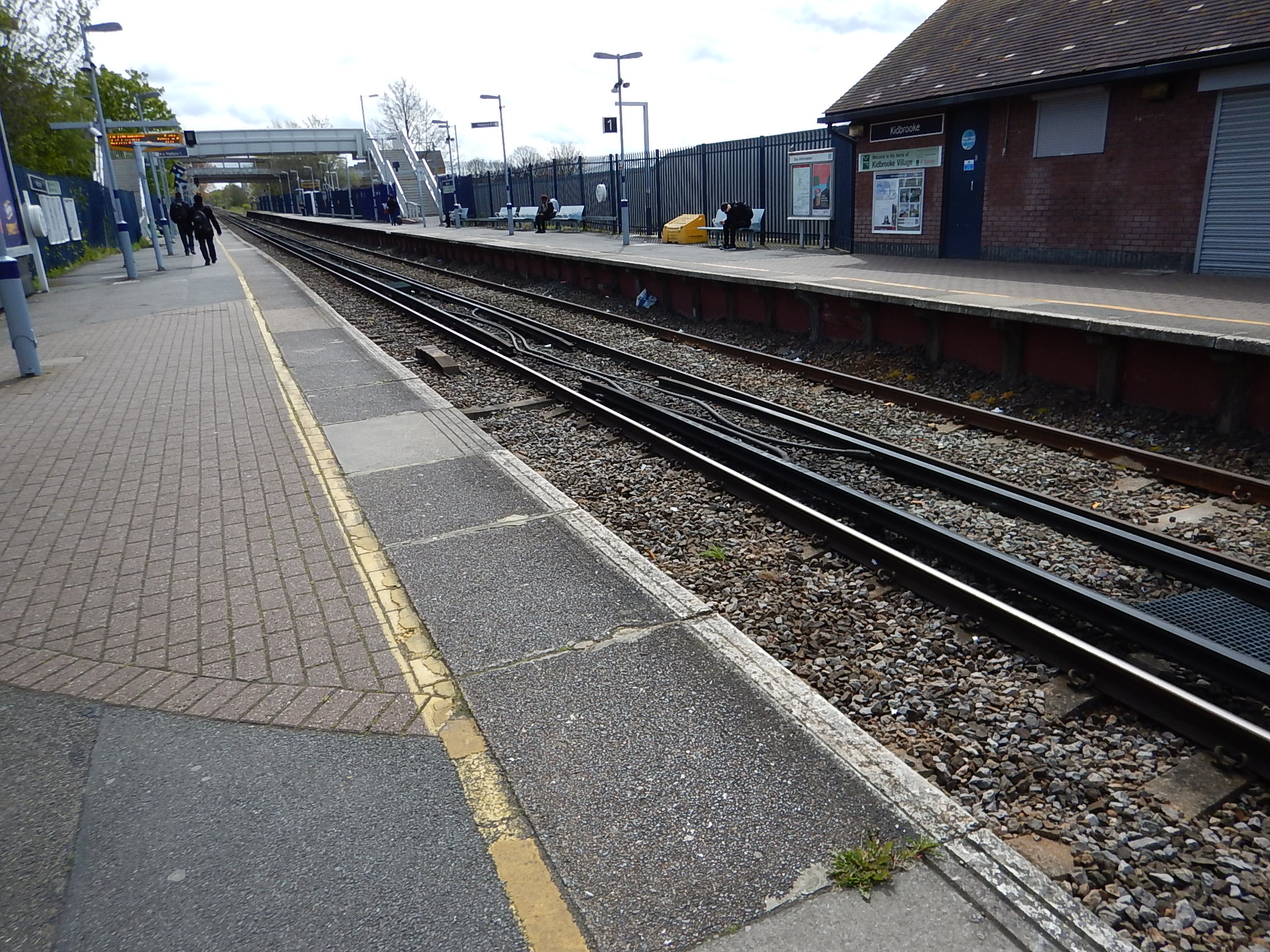
Note.
- The electrified rails are between the tracks.
- Gaps are possible to isolate sections of tracks.
- The third-rail is tapered, so that the third-rail shoes on the train can connect and disconnect easily.
Suppose you have a third-rail electric train with a range of say seven or eight miles on batteries.
Would it be possible to devise a safe electrified railway using this train and standard third-rail electrification with some safety modifications?
- The track in each station would be electrified in the normal way with the third-rail away from the platform.
- The length of electrification in each station would be a few metres shorter than the length of the ten-car pair of Class 707 trains.
- This would mean that the train would completely cover the electrification, when it stopped in the station.
- The third-rail electrification would only be switched on, when a train is stopped in the station and the right interlocks are engaged.
- Even if a passenger fell onto the tracks, they would probably be safe, unless they crawled through the wheels to the centre of the tracks.
- There would be no electrification between the stations, which would protect track workers and trespassers.
I believe that a safe system can be devised.
A train going through a station would do the following.
- Slowing down, the train would use regenerative braking, that helped to charge the batteries
- The train would stop in a station, so that it connected with and covered the third-rail.
- When the charging system recognised that a train was connected, it would start to charge the batteries.
- When all passengers had unloaded and loaded and the train was ready, the driver would stop the charging process.
- The train would move to the next station on battery power.
- Safety interlocks would stop the charging under various unsafe circumstances.
I believe that Siemens could have developed a charging system like this for their Class 707 trains, as some of their other trains of a similar vintage to the Class 707 trains already offer battery options.
A Stepping Stone Approach
On the unelectrified section between Hurst Green Junction and Uckfield, there are the following stations.
- Edenbridge Town – two platforms
- Hever – two platforms
- Cowden – single bi-directional platform – 7.9 miles South of Hurst Green Junction.
- Ashurst – two platforms
- Eridge – single bi-directional platform – 6.3 miles South of Cowden
- Crowborough – two platforms
- Buxted – single bi-directional platform – 4.7 miles South of Eridge
- Uckfield – single platform – 2.3 miles South of Buxted
Suppose the following were to be done.
- Do nothing at the two platform stations.
- Fit an intelligent fast charging system at Cowden, Eridge, Buxted and Uckfield.
- If it was felt to be needed to ensure reliable operation, the power supply to the Southbound platform could be boosted at Hurst Green station.
- Procure some ten-car battery-electric trains, which have regenerative braking and a range of perhaps ten-twelve miles on battery power.
Note.
- A pair of five-car trains could be used instead of ten-car trains.
- Some five-car Class 377 trains fitted with batteries might be ideal.
- This would mean only four platforms would need to be electrified with fast charging systems.
I am sure that Vivarail Fast Charge systems could be used, if they were modified to work with standard third-rail systems and for bi-directional use.
What size of battery would be needed for this approach?
In an article in the October 2017 Edition of Modern Railways, which is entitled Celling England By The Pound, Ian Walmsley says this in relation to trains running on the Uckfield Branch, which is not very challenging.
A modern EMU needs between 3 and 5 kWh per vehicle mile for this sort of service.
So for a ten-car train running for twelve miles, the train would need a battery capacity of between 360 and 600 kWh.
Or if it was two five-car trains between 180 and 300 kWh in each train.
Note that Vivarail find space for 424 kWh in the two-car Class 230 train, I wrote about in Battery Class 230 Train Demonstration At Bo’ness And Kinneil Railway.
I believe that a five-car Class 377 or 707 train could be fitted with a 300 kWh battery and this would give the train a range of 12 miles, which would enable it to provide a battery-electric service on the Uckfield Branch.
Effort To Contain Costs For Hoo Reopening
The title of this post, is the same as that of an article in the April 2022 Edition of Modern Railways.
This is the first paragraph.
Medway Council is working with Network Rail and other industry players in an effort to make restoration of a passenger service to Hoo on the Isle of Grain branch feasible. The Council was awarded £170 million from the Housing Infrastructure Fund in 2020 to support schemes to facilitate building of 12,000 new houses in the area, with £63 million of the HIF money for reinstatement of services on the Hoo Branch.
The article mentions, this new infrastructure.
- A new station South of the former Sharnal Street station.
- Works to level crossings, of which there are six between Gravesend station and proposed site of the new Hoo station.
- A passing place at Hoo Junction, where the branch joins the North Kent Line.
- A passing place at Cooling Street.
Note.
- The single-platform Bow Street station cost £8 million.
- The single-platform Soham station cost nearly £22 million, but it has a bridge.
- Reopening the Okehampton branch and refurbishing Okehampton station cost £40 million.
I think costs will be very tight.
Possible Train Services
This is said in the article about the train service on the branch.
While third rail electrification was originally proposed, this idea has been discarded in favour of self-powered trains on the branch, such as battery-operated trains. Possible destinations include Gravesend, Northfleet or Ebbsfleet for interchange with trains going to London, or extension of London to Dartford or Gravesend services over the branch, using hybrid third-rail/battery trains.
Consider.
- Merseyrail will be using battery-electric trains to provide services to the new Headbolt Lane station, as permission was not available for extending the existing third-rail track.
- Electrification would probably cost more than providing a charging system at Hoo station.
- Turning the trains at Gravesend, Northfleet or Ebbsfleet could be difficult and a new bay platform would probably break the budget.
- Both Dartford and Gravesend have two trains per hour (tph), that could be extended to the new Hoo station.
- Hoo junction to Hoo station is no more than five or six miles.
- There are also half-a-dozen level crossings on the route, which I doubt the anti-thord rail brigade would not want to be electrified.
- The Dartford services have a possible advantage in that they stop at Abbey Wood station for Crossrail.
- It may be easier to run services through Gravesend station, if the terminating service from Charing Cross were to be extended to Hoo station.
- A two tph service between London Charing Cross and Hoo stations, with intermediate stops at at least London Bridge, Lewisham, Abbey Wood and Dartford would probably be desirable.
I feel that the most affordable way to run trains to Hoo station will probably be to use battery-electric trains, which are extended from Gravesend.
It may even be possible to run trains to Hoo station without the need of a charging system at the station, which would further reduce the cost of infrastructure.
Possible Trains
Consider.
- According to Wikipedia, stopping Gravesend services are now run by Class 376, Class 465, Class 466 and Class 707 trains.
- Real Time Trains indicate that Gravesend services are run by pathed for 90 mph trains.
- Class 376, Class 465 and Class 466 trains are only 75 mph trains.
- Class 707 trains are 100 mph trains and only entered service in 2017.
I wonder, if Siemens designed these trains to be able to run on battery power, as several of their other trains can use batteries, as can their New Tube for London.
In Thoughts On The Power System For The New Tube for London, I said this.
This article on Rail Engineer is entitled London Underground Deep Tube Upgrade.
This is an extract.
More speculatively, there might be a means to independently power a train to the next station, possibly using the auxiliary battery, in the event of traction power loss.
Batteries in the New Tube for London would have other applications.
- Handling regenerative braking.
- Moving trains in sidings and depots with no electrification.
It should be born in mind, that battery capacity for a given weight of battery will increase before the first New Tube for London runs on the Piccadilly line around 2023.
A battery-electric train with a range of fifteen miles and regenerative braking to battery would probably be able to handle a return trip to Hoo station.
An Update In The July 2022 Edition Of Modern Railways
This is said on page 75.
More positive is the outlook for restoration of passenger services on the Hoo branch, where 12,000 new houses are proposed and Medway Council is looking to build a new station halfway down the branch to serve them. As the branch is unelectrified, one idea that has been looked at is a shuttle with a Vivarail battery train or similar, turning round at Gravesend or another station on the main line.
Steve White worries that this could mean spending a lot of money on infrastructure work and ending up with what would be a sub-optimal solution. ‘Do people really want to sit on a train for 10 minutes before having to get out and change onto another train? I don’t think so. Ideally what you want is through trains to London, by extending the Gravesend terminators to Hoo.’
That would require a battery/third rail hybrid unit, but Mr. White thinks that is far from an outlandish proposal; with Networker replacement on the horizon, a small bi-mode sub-fleet could dovetail neatly with a stock renewal programme. Medway Council and rail industry representatives are working on coming up with a solution for Hoo that could do what it does best; facilitating economic regeneration in a local area.
Note that Steve White is Managing Director of Southeastern.
I’ll go along with what he says!
Conclusion
I believe that a well-designed simple station and branch line could be possible within the budget.
A battery-electric upgrade to Class 707 trains could be a solution.
But the trains could be very similar to those needed for Uckfield and to extend electric services in Scotland.
Deutsche Bahn Is Building Overhead Line ‘Islands’ For Battery Trains
The title of this post, is the same as that of this article on Railway News.
This paragraph describes the concept.
This means, instead of electrifying a line in full, as is conventional for electric trains to draw traction power, these lines will feature intermittent electrification. The first of these lines to become operational will be in Schleswig-Holstein in December 2023. Deutsche Bahn says it will only electrify short stretches (a few hundred metres up to a few kilometres) or stations – enough to allow battery-powered trains to recharge on these lines. The state rail operator estimates that this move will mean that more than ten million train kilometres can be completed using electric rather than diesel traction in Schleswig-Holstein. The diesel trains currently in use will be decommissioned. DB estimates an annual diesel fuel saving of around ten million litres.
It looks like a simple concept will save a lot of diesel fuel.
I first talked about electrification islands to charge battery-electric trains in The Concept Of Electrification Islands, which I wrote in April 2020.
Battery And Hydrogen Trains For ScotRail ‘Could Make Scotland A Global Leader’ In Zero-Emission Transport
The title of this post is the same as that of this article in the Scotsman.
This is the first paragraph.
New fleets of cutting-edge trains expected to include battery and hydrogen power are to be ordered for ScotRail which the rail industry believes will put Scotland at the forefront of zero-emission transport.
Other points from the article.
- Talgo appear to have passed the story to Scotland on Sunday.
- Three routes are mentioned; Borders Railway, Fife Circle and Glasgow-East Kilbride.
- The new trains could help phase out diesel trains by 2035, which is Scottish Government policy.
- The Inter7City trains might be replaced by 2030.
- Talgo hopes to win an order for its factory in Fife.
Talgo’s Managing Director is quoted as saying, they are starting testing of a hydrogen and electric train with a range of 311 miles.
Consider.
- I wrote about this train in Talgo To Begin Fuel Cell Loco Trials.
- Talgo’s hydrogen and electric train would be ideal for Scotland’s railways of which only forty percent are electrified.
- A four or five-car high specification hydrogen and electric train would be ideal for the Inter7City routes, if it were built specifically for the routes.
- The range would cover all of Scotland.
- Hydrogen hubs are being planned all over Scotland.
- Scotland have 26 Inter7City trainsets.
This could be a rather nice order to fund the factory and test all the trains close to the factory.
Is there a better place to show off your new train to a prospective buyer than the Highlands of Scotland?
In A Class 319 Train, But Not As We Know It!, I told this tale.
I am reminded of a tale, that I heard from a former GEC manager.
He was involved in selling one of GEC’s Air Traffic Control radars to a Middle Eastern country.
The only working installation of the radar was at Prestwick in Scotland, so he arranged that the dignitaries and the sales team would be flown to Prestwick in GEC’s HS 125 business jet.
As they disembarked at Prestwick and walked to the terminal, the pilot called the GEC Manager over.
The pilot told him “The Scottish Highlands at this time of the year, are one of the most beautiful places in the world! Would you and your guests like a low-level tour on the way back? I can arrange it, if you say so!”
Despite knowing GEC’s draconian attitude to cost control he said yes.
The sale was clinched!
I’m sure that Talgo will exploit the scenery and the local produce.
Talgo’s Hydrogen Trains
This page on the Talgo web site, is entitled Talgo’s Hydrogen Train Will Be Ready In 2023.
This paragraph gives an overview of Talgo’s hydrogen power system.
This system is configured as a modular solution that can be installed on all types of trains, as well as in upgrades from diesel to hydrogen. However, it has been specifically designed for the Vittal platform for Commuter and Regional trains, which Talgo has presented in the bidding process for various tenders in Spain and other countries.
And these two paragraphs describe Talgo’s hydrogen trains in more detail.
This innovative system uses hydrogen batteries that provide the energy for the train’s electric motors. It is powered by renewable energy sources, such as solar photovoltaic or wind, which produce hydrogen that is stored and then used to power fuel cell-based propulsion systems, such as the one designed by Talgo. The system is complemented by batteries that increase the speed of the train when it starts, taking advantage of the braking system to recharge it.
Unlike the extended battery systems in the automotive industry, hydrogen (H2) technology is the logical answer to the needs of heavy transport and, in particular, of those railway lines that do not have catenary electrification systems, and which today depend on trains powered by diesel engines. The hydrogen system designed by Talgo enables conventional network lines to be “electrified” without the need for costly and lengthy adaptation operations, and without the use of fossil fuels.
What do they mean by hydrogen batteries? Looking at the German and the Spanish on the page, I think Talgo means hydrogen fuel cells.
The Rebuilding Of Ukraine
It should be noted that Talgo have sold trains in the past to Russia, which has a gauge of 1.520 metres, which lies between Iberian gauge of 1.668 metres and our standard gauge of 1.435 metres.
- Talgo have also sold trains to Germany, who use standard gauge.
- Talgo have built Strizh trains for Russia, that are both standard gauge and Russian gauge for running between Berlin and Moscow.
- According to the BBC and The Times, Ukraine’s railways have been an important lifeline during the Russian invasion, but pictures show they are in need of modernisation and more electrification.
- The Strizh trains or a development would surely be ideal for running between Kviv and Berlin, Budapest, Prague and Warsaw.
- There would also appear to be a need for a hydrogen and electric regional train to reconnect the country back together.
- Other countries using Russian gauge include Mongolia, Kazakhstan, Kyrgyzstan, Tajikistan, Turkmenistan, Uzbekistan, Armenia, Azerbaijan, Georgia, Belarus, Moldova, Estonia, Latvia, Lithuania, and Finland.
So are Talgo positioning themselves to take part in the modernisation of Ukraine’s railways, once the war is over?
- Development and testing is done in Spain and Scotland.
- Manufacturing could be done in Spain and Scotland.
- Delivery from Scotland could either be by ship or if they were dual-gauge trains, they could be hauled through the Channel Tunnel and then through Germany and Poland.
As Talgo has the technology, I can certainly see them exploiting the Russian gauge market once Vlad the Mad has gone.
Deutsche Bahn Puts Passengers On Alstom Battery-Electric Trains
The title of this post, is the same as that of this article on electrive.com.
This is the introductory paragraph.
French manufacturer Alstom and Deutsche Bahn are now taking passengers onboard Alstom’s first fully approved electric train since this weekend in Baden-Württemberg. Further testing will start in Bavaria on 5 February and run throughout early May on all routes.
This paragraph describes where the train will be running.
On weekdays the battery-powered train will run in Baden-Württemberg on the Stuttgart – Horb line and Saturdays and Sundays, on the Pleinfeld – Gunzenhausen line in the Franconian Lake District. Alstom said this arrangement would maximise the train’s mileage while testing a variety of route profiles and battery charging scenarios. For example, while in Baden-Württemberg, charging occurs during the ongoing journey via overhead lines, in Bavaria, charging can only take place at stations, as the route in between is not electrified.
The article gives the impression that Alstom have ambitious plans for battery-electric and hydrogen trains in Germany.
This is confirmed by this press release on the Alstom web site, where this is a paragraph.
While Alstom’s hydrogen trains are optimised for longer routes, Alstom’s BEMUs are suitable for shorter routes or lines with non-electrified sections previously operated with diesel vehicles. Direct connections between electrified and non-electrified network sections are now possible and can be operated emission free, without the need of additional electrification – shortening the travel time between city and country.
It appears Alstom will be developing both types of trains.
Alstom And DB To Kick Off Test Operations With Battery Electric Train
The title of this post, is the same as that of this article on RailTech.com.
This is the introductory paragraph.
Alstom and Deutsche Bahn (DB) are set to enter into service Alstom’s Battery Electric Multiple Unit (BEMU) for trial runs. The test operations will commence on January 24 in the state of Baden-Württemberg, followed by passenger services in neighbouring Bavaria from February 5th onwards. The tests will conclude in May 2022.
It does finally appear that battery electric multiple units (BEMUs) are being seen on the railway.
Northern Seeks Battery-Hybrid Class 195 Variant
The title of this post, is the same as that of this article on Railway Gazette.
This is the introduction to the article.
Northern Trains is seeking to introduce a battery-diesel hybrid version of its CAF Class 195 diesel multiple-units.
The article makes these points.
- The trains will be used on the lines modernised under the TransPennine Upgrade.
- Offers for trains with finance is being requested.
- Technology similar to Chiltern Rail’s Class 165 Hydrive train from Magtec would be ideal.
But I am not sure that this is the right train.
In How Much Electrification Will There Be In The TransPennine Route Upgrade?, I came to this conclusion.
By electrifying all the lines in the TransPennine Upgrade, it would allow all the stopping and slower services to be run by battery-electric trains.
I also said that battery-electric trains from both Hitachi and CAF had enough range to work all the TransPennine routes.
Given that I had my first ride in a battery-electric train in 2015, they have certainly been a long time coming.
It’s almost, as if the Men from the Ministry believe that battery trains will be inferior to diesel.
The Proposed Mid-Cornwall Metro
In the January 2022 Edition of Modern Railways, there is this description of the Mid-Cornwall Metro.
This would see an hourly service shuttling between the north and south coasts of the county and linking the main population centres at Newquay, St Austell, Truro and Falmouth. This would become the main service on the Newquay branch, and it would take over one of the twice-hourly services on the Falmouth branch, with the other service being a Truro to Falmouth shuttle as now.
Facilitating the Metro idea will be the latest phase of the modernisation of signalling in Cornwall, which will see the upgrade of a level crossing near Truro. Other infrastructure work required is a new passing loop on the Newquay branch at Tregoss Moor and restoration of a second platform face at the terminus at Newquay.
A business case was due to be submitted to the Department for Transport before Christmas 2021.
These are a few thoughts.
The Current Timings
If you look at the distances and timings of the various sections they are as follows.
- Newquay and Par – Five stops – 20.8 miles – 49-52 minutes
- Par and Truro – One stop – 19 miles – 22 minutes
- Truro and Falmouth Docks – Four stops – 11.8 miles – 24 minutes
Note.
- It appears that the Newquay to Par service is three minutes quicker than the other way.
- There will be a reverse at Par, which could take three minutes.
- The Par and Truro times were either GWR Castles or Class 802 trains.
The total time is 98-101 minutes and the total distance is 51.6 miles
Possible Timing
Consider.
- For the ease of timetabling and operation, it is probably best that a round trip between the two Newquay and Falmouth Docks takes an exact number of hours.
- The operating speed between Par and Truro is 75 mph and it is only 50 mph elsewhere.
- Turnround time at Newquay is five minutes.
- Turnround time at Falmouth Docks is 4-6 minutes
For these reasons, I doubt that much improvement could be made on the fastest time of 98 minutes. Certainly, a round trip of three hours would appear impossible.
But a round trip time of four hours would be very sensible.
However, there would be a turnround time of between 19-22 minutes at each end of the route.
This time might seem overly long, but it would be ideal for charging a battery-electric train.
How Many Trains Would Be Needed?
As the round trip will be four hours and an hourly service is needed, there will be a need for four trains to run the service, with the addition of probably two extra trains to allow for one in maintenance and one covering for any breakdowns.
Could The Mid-Cornwall Metro Use Battery-Electric Trains?
This Hitachi infographic shows the specification of the Hitachi Regional Battery Train.

Note
- The range of ninety kilometres is fifty-six miles and a longer distance than Newquay and Falmouth Docks.
- The operating speed of 90-100 mph is ideal.
- The time needed for a full charge at either end is within the timetable, I calculated earlier.
Hitachi Regional Battery Trains would be ideal for working the Mid-Cornwall Metro with a full charge at both ends of the route.
I have used my virtual helicopter to explore the Cornish Main Line between Par and Truro.
If it was decided to electrify the Cornish Main Line between Truro and Par, this could be an alternative way to charge the trains.
- The Mid-Cornish Metro trains should be able to do a return trip to Newquay and Falmouth Docks from the main line without charging at the two terminal stations.
- The electrification would be able to charge battery-electric Class 802 trains between Plymouth and Penzance.
But the extra infrastructure works to raise nine road bridges and several footbridges might blow the budget.
Where Would The Trains Be Serviced?
Great Western Railway has depots at both Penzance and Plymouth and with perhaps a charger at Truro and/or Par stations, the trains should be able to get to either depot at the end of the day.
Trains To Newquay
Wikipedia says this about the services to Newquay station.
The service is irregular with typically one train around every two hours.
As well as the local service, the station handles a number of long-distance trains in the summer. These services include Great Western Railway trains from London Paddington and CrossCountry trains from the North of England and the Scottish Lowlands, which do not stop at intermediate stations between Par and Newquay. On Sundays, there are some local trains and a small number of intercity services. As well as the weekend through trains, in peak summer months there is also a Monday-Friday through Great Western Railway intercity service to and from London, but local trains continue on these days too. Traditionally, there was no Sunday service in the winter, even in the ‘golden age’ between both of the 20th century’s world wars, but the line has a service of three trains each way on Sundays from 11 December 2011.
The Mid-Cornwall Metro will at least come with an hourly service.
But this will mean, that to run other services to the station with the hourly Metro will mean that a second platform will be needed.
I discuss the improvements needed in Beeching Reversal – Transforming The Newquay Line.
This is a quirky video, which describes an architect’s plans for the station.
It is the sort of simple solution, that I like.
Conclusion
I believe that a small fleet of Hitachi Regional Battery Trains could create an iconic Metro for Cornwall, that would appeal to both visitors and tourists alike.
 The Anonymous Widower