We Live Three Minutes From The Station — And Can’t Catch A Train
The title of this post is the same as that of this article on The Times.
This is the sub-heading.
A line connecting Oxford to Milton Keynes was finished 16 months ago. So why does it remain useless to families who moved to be next to it?
These four paragraphs add more details.
Nearly two years after moving to Winslow for its rail connections, Rachael Lee is still waiting to catch her first train.
Winslow station, a three-minute walk from Lee’s house, should have opened last year, connecting locals to Oxford, Milton Keynes and beyond. But as the site remains plagued by delays, the only people to pass through its doors are the security guards paid to keep watch.
“All the lights are on and there’s ticket machines that are on,” said Lee, 36, a marketing professional who moved to the Buckinghamshire town with her family in June 2024. “Who’s paying for all of that? It just feels like it takes the mickey when you drive and walk past it.”
Construction issues, union disputes about onboard guards and a lack of ready trains have all delayed the opening of the station, which was built for East West Rail (EWR) in a £6 billion government-funded project to reconnect Oxford and Cambridge by train for the first time since 1967. It is one of the country’s biggest rail projects, begun in 2014, and is expected to bring tens of thousands of jobs and billions of pounds to the regional economy.
Harold Wilson would have solved this problem with beer and sandwiches at No. 10.
East West Rail Unveils Next Phase For Oxford-Cambridge Growth
The title of this post, is the same as that of this press release from the UK Government.
These three bullet points act as sub-headings.
- more frequent trains on the horizon for millions of passengers between Oxford and Cambridge as multibillion pound East West Rail project confirms next steps
- new rail station set to help serve upcoming Universal theme park in Bedford, as well as improvements planned for several existing stations
- new route delivers on the government’s Plan for Change, unlocking £6.7 billion of regional economic growth and delivering up to 100,000 new homes
These two introductory paragraphs make a few general points about the overall project, housing and jobs.
Millions of people across the Oxford to Cambridge corridor are set to benefit from more frequent trains as the East West Railway Company (EWR Co) has revealed the next steps for the second phase of the project today (19 November 2025).
As one of Britain’s largest transport projects, East West Rail forms a cornerstone of the government’s Plan for Change, unlocking £6.7 billion of regional economic growth by 2050, enabling up to 100,000 new homes and supporting tens of thousands of new jobs along the route.
These sections make some more detailed points.
How Many Permanent Staff Will Be Employed At Universal Studios Bedford?
As many will want to live locally, this will surely encourage many to use the trains on the East-West Rail to travel to work, so this will be an important factor.
I asked Google AI, the question in the title of this section and received this answer.
Universal Studios plans to employ 8,000 permanent staff at its new resort in Bedford. This number is part of an overall total of approximately 28,000 jobs, which includes 20,000 jobs during the construction phase.
My project management knowledge is telling me that the station should be built before the theme park.
How Many Daily Visitors Are Expected At Universal Studios Bedford?
I asked Google AI, the question in the title of this section and received this answer.
The Universal Studios theme park in Bedford is expected to have 55,000 visitors on peak days from its launch, based on its plan to handle 8.5 million annual visitors. The project, planned to open in 2031, is expected to attract 8.5 million annual visitors in its first year, with numbers rising to 12 million within 20 years.
I would expect a large number of visitors and staff will probably be encouraged to come by train, just as they are at some Premier League football stadiums.
Will Universal Studios Bedford Be Marketed As A Low Carbon Theme Park?
I’m asking this question, as it seems, the railway is being upgraded make this easier.
I asked Google AI, the question in the title of this section and received this answer.
Yes, it appears Universal Studios Bedford will be marketed as having a low-carbon focus, as evidenced by its planning applications that highlight sustainability efforts. The project outlines include goals for water conservation, energy reduction and clean energy use, waste minimization, and the use of low-carbon materials, all of which will likely be part of the marketing narrative for the theme park, according to LinkedIn.
How Many Car Parking Spaces Will Be Provided At Universal Studios Bedford?
I asked Google AI, the question in the title of this section and received this answer.
The Universal Studios resort planned for Bedford will include a minimum of 7,106 parking spaces and 100 coach bays. The resort is also expected to have 250 cycle spaces and enough room for over 7,100 cars
That is a lot of car parking spaces. Hopefully, there will be a lot of car charging points.
Increased Train Frequency And Capacity
These two paragraphs from the press release, talk about increased train frequency and capacity.
Following extensive consultation with local communities, the multi-billion-pound project has confirmed it is exploring a series of transformative plans including increasing the proposed frequency of trains from 3 or 4 to up to 5 per hour.
These enhancements could provide up to 70% more seating across the route, easing overcrowding and speeding up boarding, as well as cutting average waiting times, improving service resilience and creating a smoother, more reliable passenger experience.
When you consider that London Overground, Merseytravel, the South Wales Metro, West Midlands Trains and other local lines in the UK consider than four trains per hour to be a minimum service, then five trains per hour is to be welcomed.
Station Improvements And New Stations
These two paragraphs from the press release, talk about station improvements and new stations..
Several other improvements across the route have also been confirmed, including new station entrances at Bletchley, Cambridge and Bedford, as well as four brand-new stations along the Marston Vale Line – the first significant investment since the 1960s.
With the current stations on the Marston Vale Line seeing some of the lowest usage in the country, the new stations will better serve local communities by providing faster, more frequent services, as well as helping to serve the upcoming Universal theme park.
I thought Bletchley, Cambridge and Bedford stations had already been substantially improved in recent years.
A New Station At Stewartby
Are the station improvements to upgrade public transport access to the Universal theme park at Stewartby station?
- An East-West Rail service between Oxford and Stansted Airport via Bletchley, Milton Keynes Central, Stewartby, Bedford and Cambridge would give the Universal theme park all-important airport access.
- Would an upgraded Bletchley station improve interchange between the West Coast Main Line and East-West Rail give better access to the theme park from London, the West Midlands and North-West for visitors?
- Would an upgraded Bedford station improve interchange between the Midland Main Line and East-West Rail give better access to the theme park from London, the East Midlands and North-East for visitors?
- An upgraded Bedford station could also be marketed as a zero-carbon route between the theme park and the Continent via St. Pancras International and Eurostar.
- Would an upgraded Cambridge station give better access to the theme park from the East of England?
In addition four new stations on the Marston Vale Line would improve access for visitors and staff, who live locally.
Will Battery-Electric Trains Be Used On The East-West Rail?
As five major East-West Rail stations; Bedford, Bletchley, Cambridge, Milton Keynes and Reading are substantially served by main line electric trains, and it is likely that more stations will be in future, I believe that East-West Rail must either be electrified or services should be run by battery-electric trains, which would enable zero-carbon rail routes to and from London and all the city’s airports, Birmingham, Liverpool, Manchester and an increasing number of cities in the North and Midlands of England, and Scotland and Wales.
I asked Google AI, the question in the title of this section and received this answer.
Yes, the East West Rail (EWR) project plans to use battery-electric trains as part of a discontinuous electrification strategy. This means trains will run on overhead electric power in sections where they are installed, and on onboard batteries in other sections of the route.
It does appear that discontinuous electrification and battery-electric trains will be used.
Electrification At Bedford Station
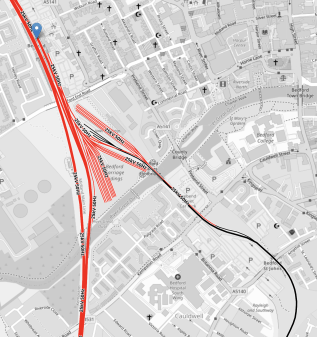
This OpenRailwayMap shows The East side of Bedford station.
Note.
- The red tracks are electrified and black tracks are not.
- The black track looping into the station from the East is the Marston Vale Line, which will connect the East-West Rail to Bedford station.
- At the Easternmost part of the curve is Bedford St. Johns station, which serves Bedford hospital.
- The Marston Vale Line services normally connect to Platform 1A at Bedford station.
- But it also appears trains can also use Platforms 1 and 2 at Bedford station.
- It also appears that that Platforms 1A, 1 and 2 are all electrified.
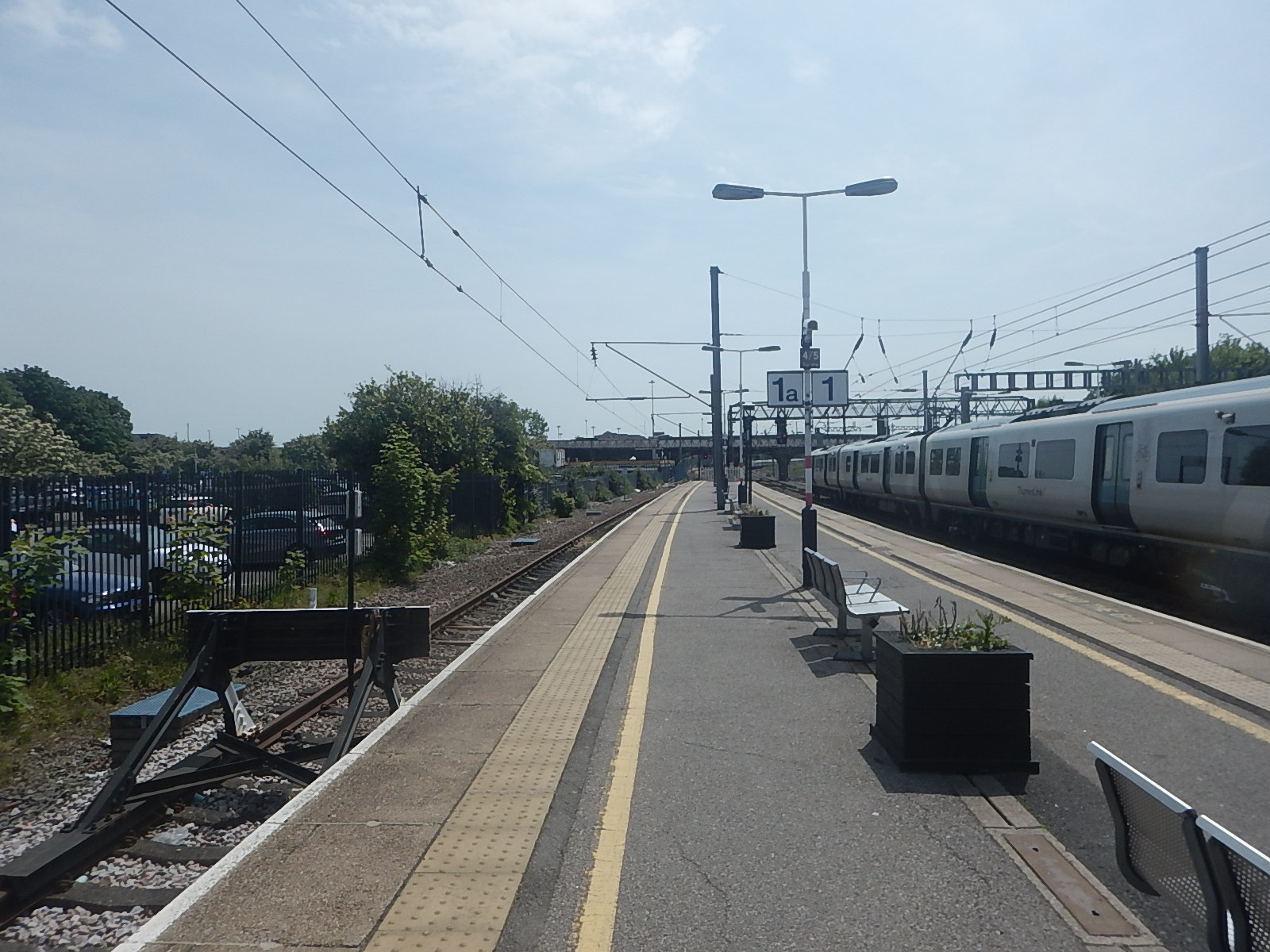
This picture confirms electrification in Platforms 1A and 1.
Note.
- Platform 1A is on the left.
- Platform 1 is on the right.
- The Thameslink train on the right is in Platform 2.
- Platforms 1A, 1 and 2 are all clearly electrified.
- Platform 1A is 81 metres long, so could accept a typical four-coach train.
Battery-electric trains with pantographs could certainly by charged in either of these two platforms at Bedford station.
Electrification At Milton Keynes Central Station
It would appear that East-West Rail services will use Platform 2A at Milton Keynes Central station.
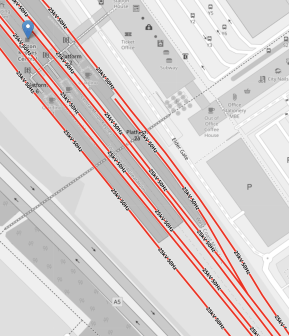
This OpenRailwayMap shows Platform 2A at Milton Keynes Central station.
Note.
- The red tracks are electrified and black tracks are not.
- Platform 1 is the through platform on the North-East side of the station.
- Platform 2A is the bay platform tucked underneath Platform 1.
- Platform 2A is clearly electrified.
- Platform 2A is 124 metres long, so could accept a typical five or six-coach train.
These pictures show Platforms 1 and 2A at Milton Keynes Central station.
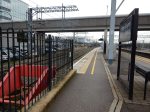
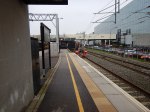
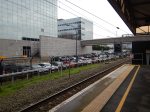
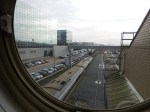
Battery-electric trains with pantographs could certainly by charged in Platform 2A at Milton Keynes Central station.
Electrification At Oxford Station
It would appear that terminating East-West Rail services will use Platform 1 or 2 at Oxford station.
This OpenRailwayMap shows the platforms at Oxford station.
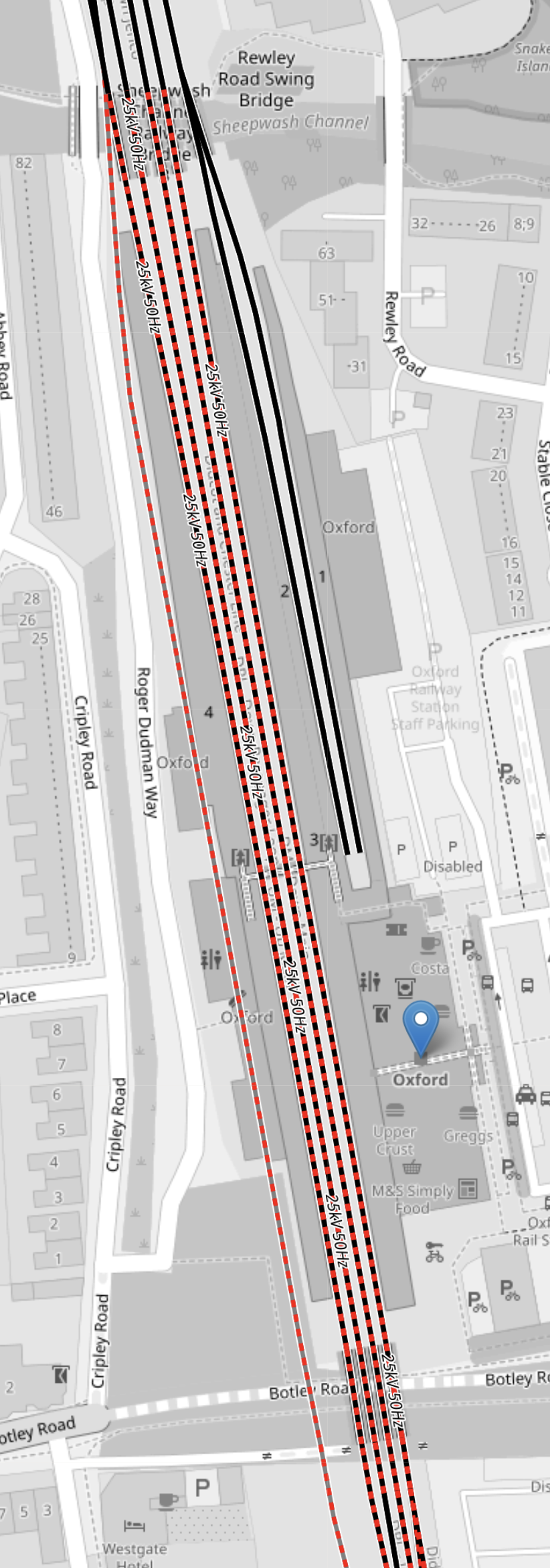
Note.
- The red and black tracks are to be electrified and black tracks are not.
- Platforms 1 and 2 are shown in black and are likely to be used by terminating East-West Rail trains.
- Platforms 1 and 2 would need to be electrified to be able to charge trains.
- Platforms 1 and 2 would also be used by Chiltern’s London services.
- Platform 1 and 2 are respectively 157 and 160 metres long, so could accept a typical five or six-coach train.
- As Oxford and Reading is to be electrified, through East-West Rail trains could use that electrification to travel to and from Reading.
These pictures show Platforms 1 and 2 at Oxford station.
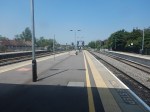
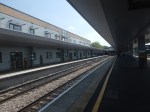
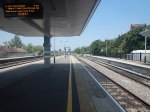
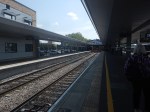
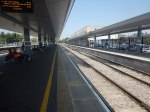
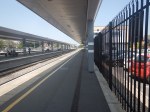
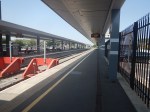
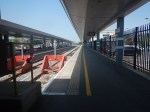
Battery-electric trains with pantographs could certainly by charged in Platform 1 and 2 at Oxford station, if the platforms were electrified.
Electrification At Reading Station
The West-facing platforms at Reading station are all electrified and longer than 120 metres, so could accept a typical four or five-coach train.
What Trains Should Be Used?
Consider.
- There is only one battery-electric train, that has been tested on the UK rail network – The Hitachi Class 802 train or similar.
- There is only one battery-electric train, that has been ordered – The Hitachi Class 802 train or similar.
- The longest distance on battery, between Reading and Bedford, is probably about thirty miles.
The Government could do a lot worse than order some more Class 802 trains, that were tailored for East-West Rail.
The Hitachi Class 802 train has five-cars, which are 26 metres long.
- It has a 125 mph operating speed.
- It has a range of 45 miles on battery power.
- The trains have been proven in service.
- The trains are made in the UK.
- The trains could handle extended routes like Birmingham and Stansted Airport or Cardiff and Cambridge.
A four-car variant of the train with a 100 mph operating speed could be an alternative.
What Will Be The Initial East-West Rail Service?
I asked Google AI, the question in the title of this section and received this answer.
The initial East West Rail service will be between Oxford and Milton Keynes/Bletchley, with passenger services delayed until at least 2026 due to a dispute over train crew roles. Freight services began in June 2025, and temporary diesel services will run until the line is electrified. The full project aims to connect Oxford and Cambridge.
Note.
- Stewartby station for Universal Studios Bedford will not be served by East-West Rail initially.
- But I suspect, that the current Marston Vale Line service will continue, with a change if needed at Bletchley or Bedford to get to Stewartby.
- Earlier I showed that Google AI is predicting 20,000 construction jobs at Universal Studios Bedford, which I am sure will need some form of high-capacity rail transport, if grid-lock is to be avoided in much of Bedfordshire.
Perhaps an initial fleet of four- or five-car Class 802 diesel-electric trains could be ordered and they would run the full route between Oxford and Bedford stations, with a reverse in Platform 2A at Milton Keynes station.
- The trains would run initially on diesel.
- By using stepping-up in Platform 2A at Milton Keynes station, I believe a two trains per hour (tph) service could surely be run.
- Hitachi could probably deliver the trains quickly, as they have not long been out of production.
- Those living locally would get a much improved train service from their local station to and from Bedford, Milton Keynes or Oxford.
- A large portion of the onward connectivity of the East-West Rail would be delivered early to the benefit of locals and visitors.
- If extra services are needed, semi-fast services could be added between Bedford and Reading with stops at Stewartby, Bletchley, Bicester Village, Oxford Parkway and Oxford stations.
When Platforms 1 and 2 at Oxford station are electrified and the trains are converted to battery-electric operation, the route could be converted to zero-carbon operation.
Virtually Nothing Is Said About The Route Of The East-West Rail Between Bedford and Cambridge South Stations Via Tempsford Station
This quote from David Hughes, CEO, East West Railway Company, is the only time, that Tempsford is mentioned in the press release.
“From a new station at Cambridge East to better access in Oxford and clear alignment through Tempsford, East West Rail is shaping the modern, sustainable transport link this region needs to thrive.”
I asked Google AI, if the proposed route of the East-West Rail between Bedford and Cambridge South stations through Tempsford is controversial and I received this reply.
Yes, the proposed route of East West Rail between Bedford and Cambridge is controversial, with opposition from some local residents and political figures who have expressed concerns about the southern alignment through Tempsford and surrounding villages. However, East West Rail Co has selected the route north of the Black Cat roundabout as the preferred alignment, citing reasons like cost-effectiveness and fewer disruptions, while also updating designs to include a southern station entrance to connect with planned growth areas around Tempsford.
Does Government or Artificial Intelligence have precedence?
Cambridge East Station Gets A First Mention
This quote from David Hughes, CEO, East West Railway Company, is the first time, that I’ve seen Cambridge East station mentioned.
“From a new station at Cambridge East to better access in Oxford and clear alignment through Tempsford, East West Rail is shaping the modern, sustainable transport link this region needs to thrive.”
In this document on the East-West Rail Consortium web site, there is extensive talk of an A14 Parkway station.
- The document dates from 2018.
- Google AI can’t find any trace of the A14 Parkway station referred to in the document.
- This article on the BBC, which was written five days ago and is entitled Additional City station Proposed By East West Rail, is the only reference on the Internet, that references Cambridge East station.
- The BBC article also says that other proposals after consultation include a new eastern entrance for Cambridge station, locating Cambourne station closer to the town and a mined tunnel for Bourn Airfield.
- I also have to assume that A14 Parkway has also morphed into Cambridge East station.
- To access all my posts, that relate to A14 Parkway, click this link.
But it does seem that consultation appears to have produced an acceptable compromise.
Between Kempston Hardwick and Tempsford Stations Through Bedford
I’ve now found that OpenRailwayMap has been updated between Bedford and Cambridge.
This first section shows the route between Kempston Hardwick and Tempsford stations through Bedford.
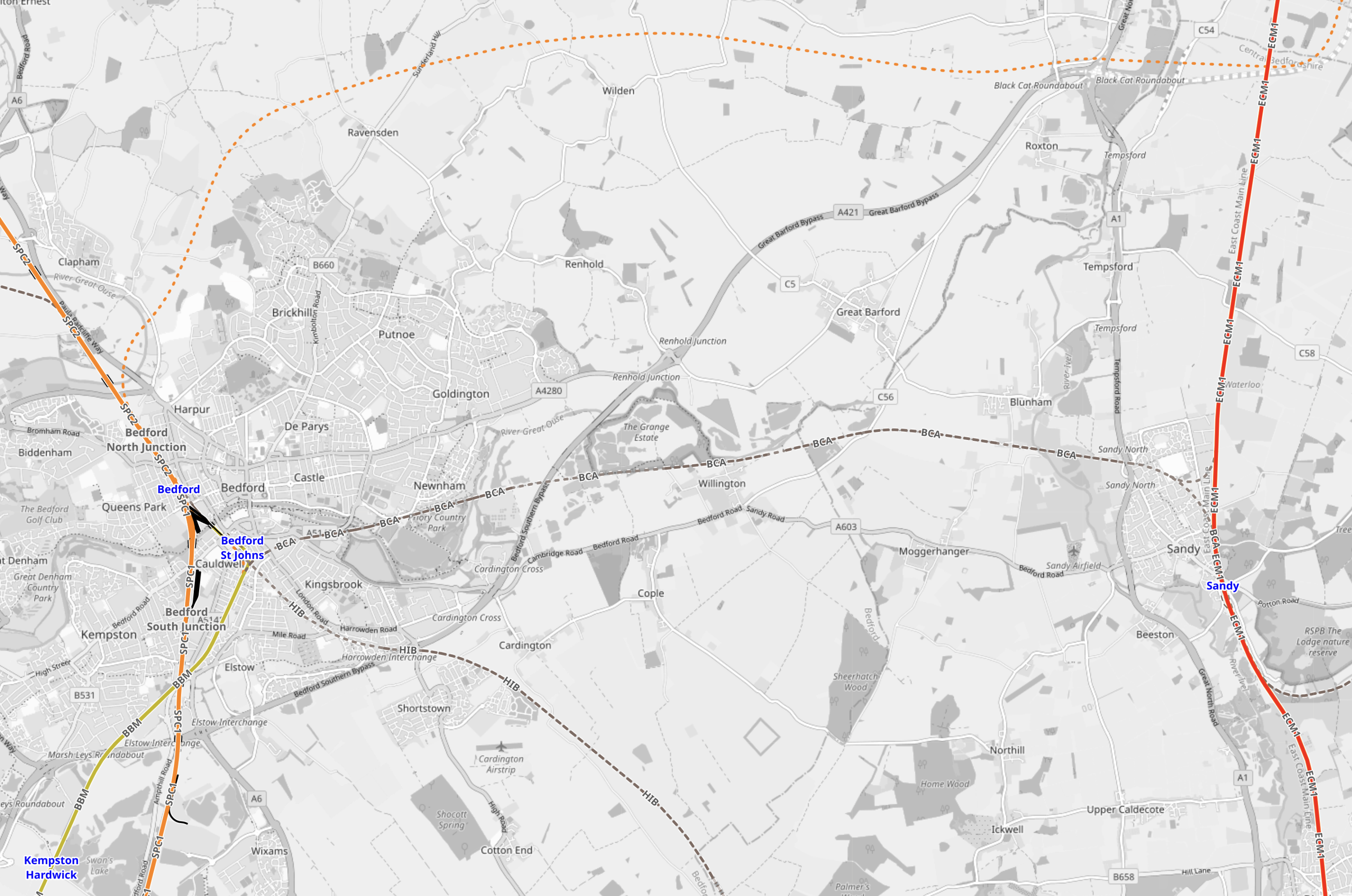
Note.
- Kempston Hardwick station is in the South-West corner of the map.
- The yellow track is the Marston Vale Line, which goes through Bedford St. Johns and Bedford stations.
- The red track on the West side of the map is the Midland Main Line.
- The red track on the East side of the map is the East Coast Main Line.
- The dotted red line across the top of the map will be the route of the East-West Rail.
- Tempsford station will be to the South-West of where the East Coast Main Line and East-West Rail cross in the North-East cornet of the map.
I hope the good people of Bedford are happier now!
Between Tempsford and Cambourne
I’ve now found that OpenRailwayMap has been updated between Bedford and Cambridge.
This second section shows the route between Tempsford and Cambourne stations.
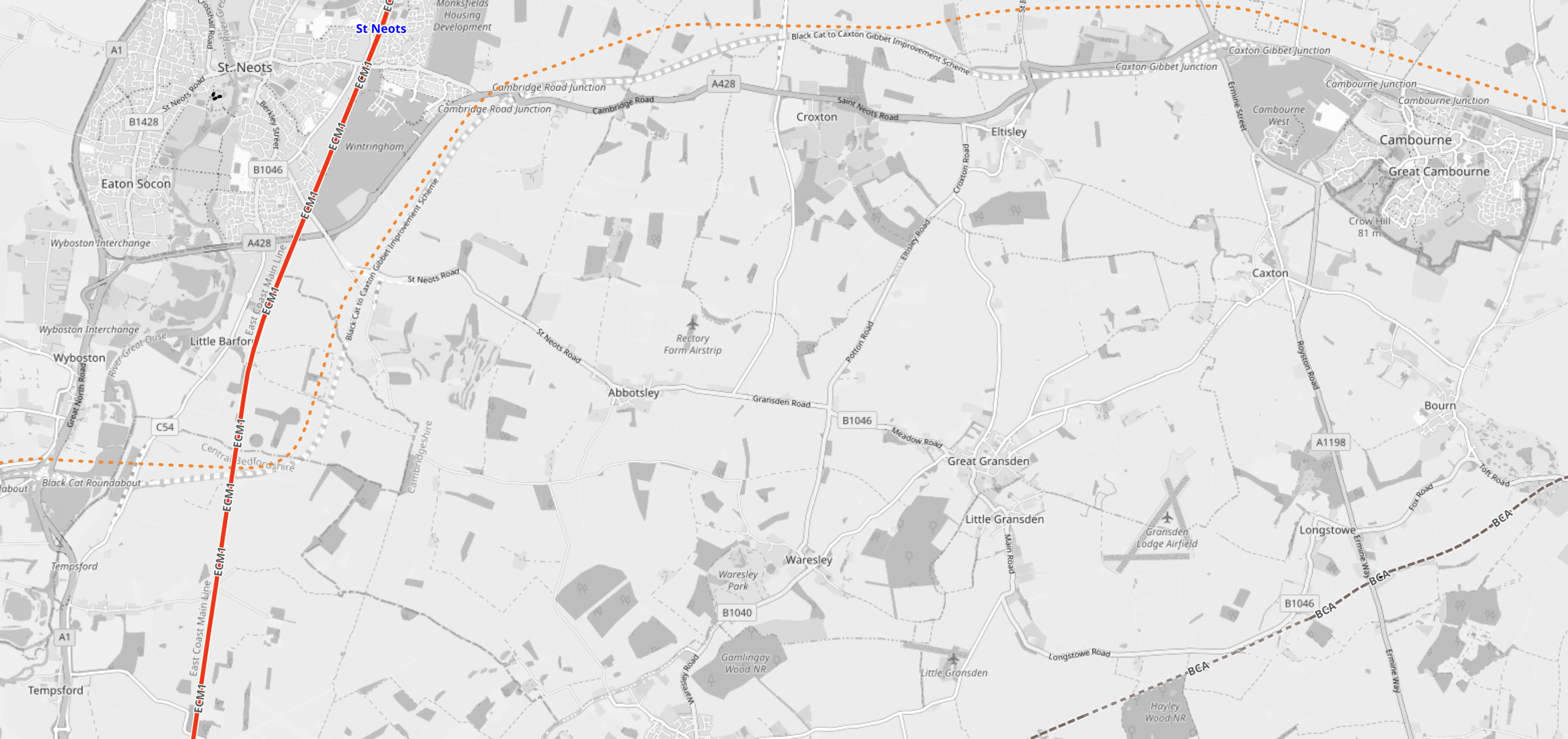
Note.
- The dotted red line across the top of the map will be the route of the East-West Rail.
- Tempsford station is in the South-West corner of the map on the route of the East-West Rail.
- The red track on the West side of the map is the East Coast Main Line.
- Cambourne is the village in the North-East corner of the map.
Plans For Powering Trains And Details Of Our Upcoming Consultation
The title of this post, is the same as that of a news item on the East West Rail web site.
This is the sub heading.
We’re pleased to share plans for how we’ll power trains on East West Rail, as well as information and dates of our public consultation on latest proposals for the project.
These are the first two paragraphs.
As part of our latest proposals, which we’ll be sharing for public consultation from 14 November, we’re providing information on our preference for green traction power in the form of discontinuous electrification with hybrid battery-electric trains, after the Chancellor confirmed government support for the project in yesterday’s budget.
As well as reducing carbon emissions, discontinuous electrification would mean overhead lines would only need to be installed along some sections of the route, which would reduce disruption to existing structures and potentially reduce visual impacts in more sensitive locations on the new railway between Bedford and Cambridge. This option would also cost less than full electrification and would need less land for things such as mast foundations.
There is also a short video, which explains discontinuous electrification.
I feel that to use discontinuous electrification and hybrid battery-electric trains is the way to go on this railway between Oxford and Cambridge.
- It is a zero-carbon solution.
- There is electrification at Reading. Didcot, Bletchley, Milton Keynes, Bedford and Cambridge along the route, so grid connections will be already available.
- Sandy, where East West Rail crosses the East Coast Main Line, is fully electrified and must have a grid connection.
- A small article in the November 2024 Edition of Modern Ralways, says that Hitachi are developing a smaller battery for commuter and suburban trains.
- Didcot to Oxford could be electrified and there is already a grid connection at Didcot.
Discontinuous electrification could be used to extend East West Rail to Norwich, Ipswich and Colchester.
These are my detailed observations and thoughts.
Existing Electrification
This OpenRailwayMap shows the electrification between Oxford and Bedford.
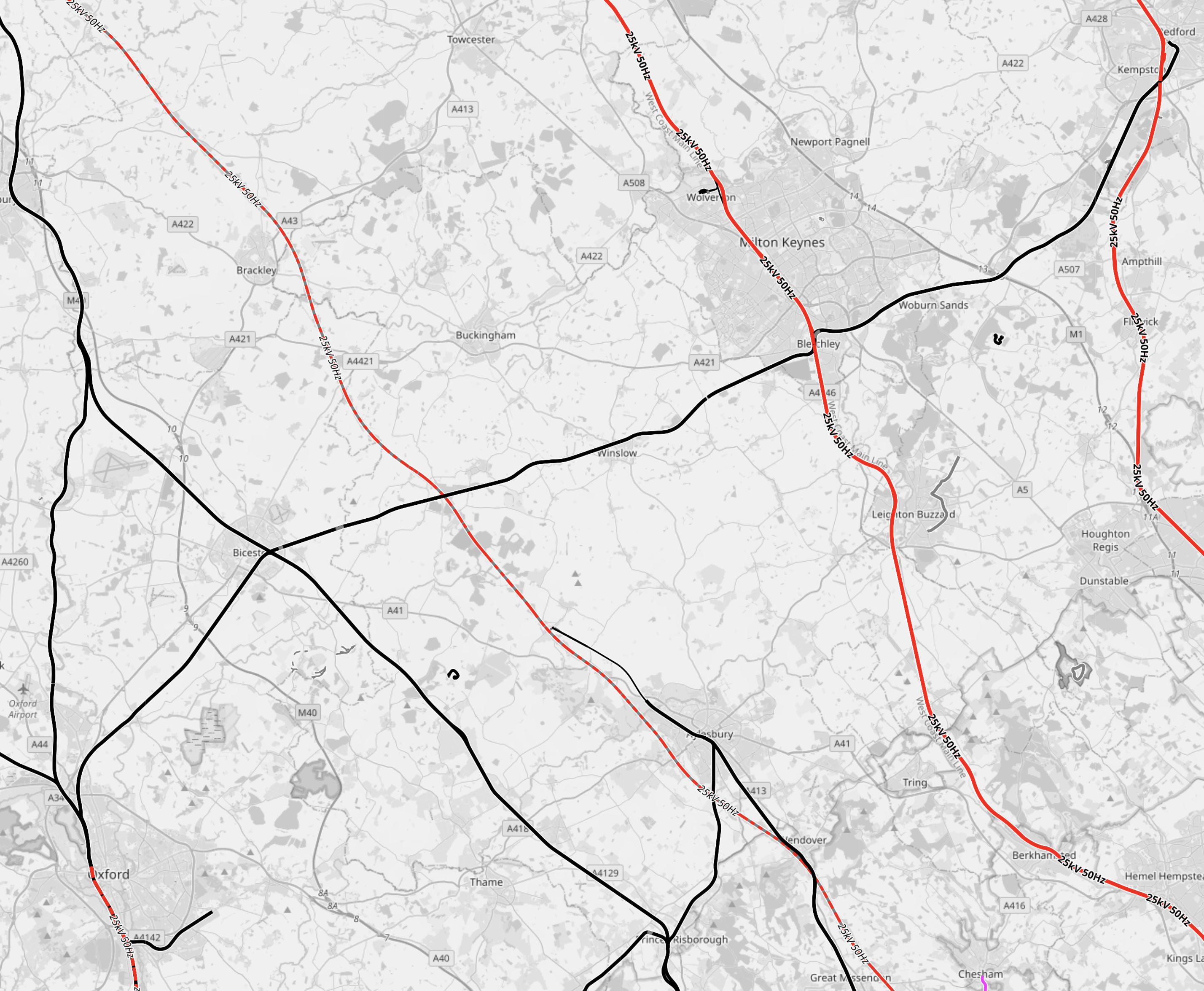
Note.
- Bold red lines are tracks electrified at 25 KVAC.
- Bold black lines are tracks without electrification.
- Oxford is in the South-West corner of the map.
- Bedford is in the North-East corner of the map.
- The bold black line of the Western section of the East West Rail connects the two cities.
- The lines through Oxford are shown as being electrified. The black stub pointing East to the South of Oxford is the Cowley Branch.
The rail lines crossing East West Rail from West to East are as follows.
- Chiltern Main Line – Not Electrified
- High Speed Two – Will Be Electrified
- West Coast Main Line – Electrified
- Midland Main Line – Electrified
I suspect all lines, except for the Chiltern Main Line, will be able to provide a grid connection for East West Rail.
This second OpenRailwayMap shows the electrification between Bedford and Cambridge.
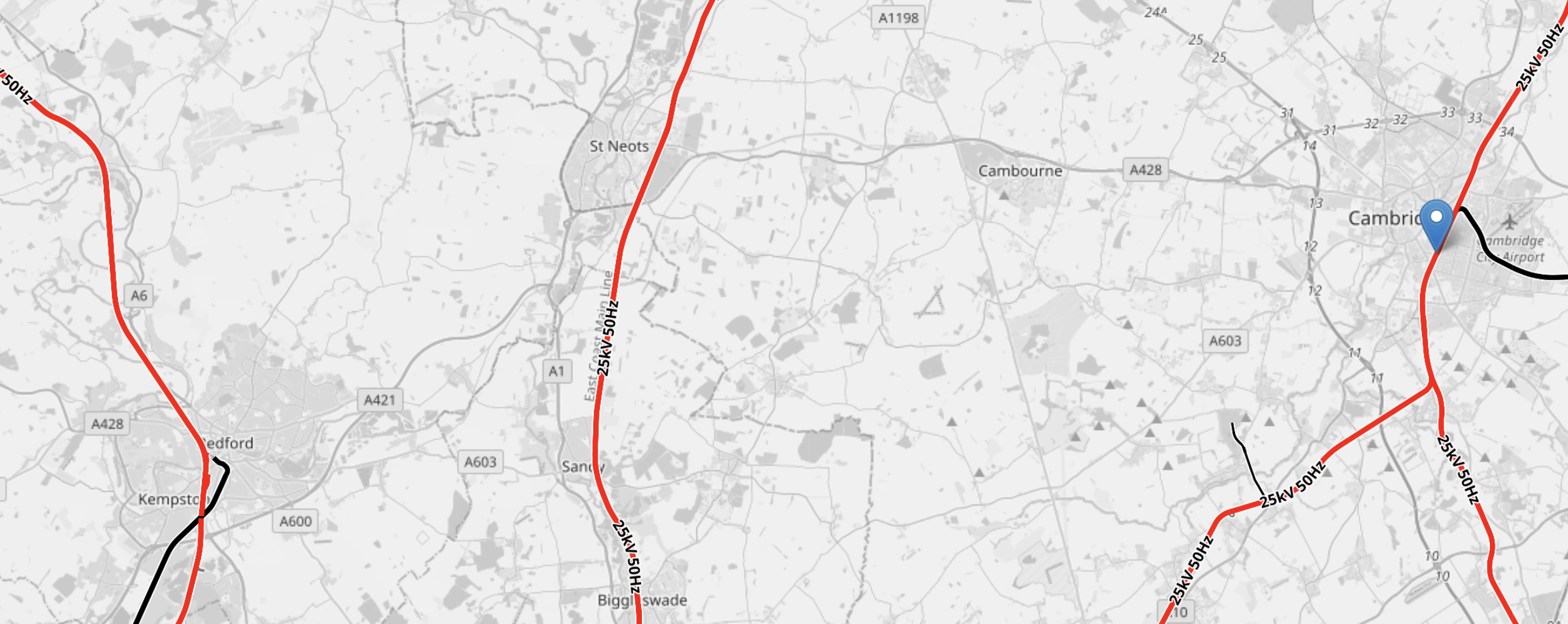
Note.
- Bold red lines are tracks electrified at 25 KVAC.
- Bold black lines are tracks without electrification.
- Bedford is in the South-West corner of the map.
- Cambridge is in the North-East corner of the map.
- The Eastern section of the East West Rail connects the two cities.
- Both maps are to the same scale
The rail lines crossing East West Rail from West to East are as follows.
- Midland Main Line – Electrified
- East Coast Main Line – Electrified
- West Anglia Main Line – Electrified
I suspect all lines will be able to provide a grid connection for East West Rail.
Distances Without Electrification
These sections are not electrified.
- Oxford and Bletchley – 47.2 miles
- Bletchley and Bedford – 16.5 miles
- Bedford and Cambridge – 29.2 miles
- Ely and Norwich – 53.7 miles
- Norwich and Great Yarmouth – 18.4 miles
- Cambridge and Haughley Junction – 41.3 miles
I am assuming that the East West Rail could extend past Cambridge on these two routes.
- Ely, Thetford, Norwich and Great Yarmouth.
- Newmarket, Bury St. Edmunds, Stowmarket, Ipswich, Manningtree and Colchester.
All sections have electrification at both ends, if Didcot Junction and Oxford is electrified, as is expected to happen.
Train Battery Range Needed
The route layout, I have proposed means that if you go for the battery-electric train with the longest battery range you can afford and it can’t handle Ely and Norwich, the existing electrification can be extended to bridge the gap.
Application Of Discontinuous Electrification To Greater Anglia And Chiltern Railways
If discontinuous electrification can be applied to East West Rail, it can surely be applied to Greater Anglia and Chiltern Railways, given the fact that the route networks of all three companies overlap and share tracks.
Greater Anglia already have a fleet of Class 755 trains, which are designed to be converted to battery-electric operation.
With batteries fitted, I believe that these trains could handle most of the current routes they do now.
The other routes would be handled with selective lengths of overhead electrification in terminal stations to charge the trains before return.
Electrification Between Oxford And Bicester Village Stations
Oxford station has two North-facing bay platforms, that are used by Chiltern and other services terminating at the station from the North.
Note.
- Chiltern Railways already run two trains per hour (tph) between these platforms and Marylebone.
- I would assume the platforms will be used by East West Rail services, that terminate at Oxford station.
- If discontinuous electrification is to be used, then these two platforms could be electrified to charge trains before they return.
- East West Rail have not published their proposed services yet, but it could be one tph to both Milton Keynes Central and Bedford stations.
I can see Chiltern buying battery-electric trains to run services between Marylebone and Oxford, and some other routes.
Marylebone and Oxford is 66.7 miles, which is probably two far for even Stadler’s remarkable battery-electric trains, but if say between Oxford and Bicester Village station were to be electrified, would it make it possible to run battery-electric trains between Marylebone and Oxford with charging at both end of the route.
In Chiltern Sets Out New Fleet Ambitions, I talk about Chiltern’s possible new fleet, as proposed by their MD in September 2023.
East West Rail To Hold Drop-In Events Ahead Of Statutory Consultation
The title of this post is the same as that of this article on RailUK.
These three paragraphs introduce the article.
East West Railway Company (EWR Co) has announced a series of information events in May to help people understand how the formal application process to build the railway works.
Nine information events will be held in May across the whole line of route between Oxford, Milton Keynes, Bedford and Cambridge.
These events are aimed at providing information about the statutory consultation process which will start in June. Details of the proposed design about the route will be shared when the statutory consultation begins.
These are the dates for the information events.
- Tuesday 7 May – Bedford Rowing Social Club, The Boathouse, Duck Mill Lane, Bedford, MK42 0AX, from 2pm-7pm.
- Wednesday 8 May – Cutteslowe Pavilion Hall, Cutteslowe Park, Oxford, OX2 8ES, from 2pm-7pm.
- Thursday 9 May – Weyland Hall, 8-10 North Street, Bicester, OX26 6ND, from 2pm-7pm.
- Friday 10 May – South Cambridgeshire Hall, Cambourne Business Park, Cambourne, CB23 6EA, from 2pm-7pm.
- Monday 20 May – Roxton Village Hall, High Street, Roxton, MK44 3EB, from 2pm-7pm.
- Tuesday 21 May – St Philip’s Church Centre, 185 Mill Road, Cambridge, CB1 3AN, from 2pm-7pm.
- Wednesday 22 May – Comberton Village Hall, Green End, Comberton, CB23 7DY, from 2pm-7pm.
- Thursday 23 May – Bletchley Masonic Centre, 263 Queensway, Bletchley, Milton Keynes, MK2 2BZ, from 2pm-7pm.
- Friday 24 May – Marston Moreteyne Community Centre, Great Linns, Marston Moreteyne, MK4 0DD, from 2pm-7pm.
They would appear to have the area covered.
I shall probably go to the Bedford event, as if I didn’t make it, I could go to another.
The Long Platforms At Liverpool Street Station
I was on Liverpool Street station today and I took these pictures.
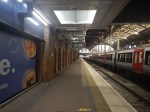

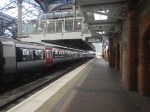
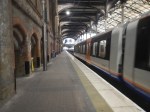

It got me thinking.
- I was standing On Platform 1 and on Platform 2 was a pair of five-car Class 720 trains coupled together.
- The pair of five-car Class 720 trains would be 244 metres long, which mean that the platforms could handle nine-car Class 800 or Class 345 trains.
- There would appear to be plenty of platform space in Liverpool Street station.
- In Azuma Test Train Takes To The Tracks As LNER Trials Possible New Route, I talked about how LNER were checking an Azuma train could use the route to Cleethorpes.
- In London North Eastern Railway Runs Trial Train To Liverpool Street, I talked about how LNER had ran a train into Liverpool Street.
The general consensus seems to be, that points 3 and 4, are about several things.
Adding Grimsby and Cleethorpes to LNER’s list of destinations.
Possibly adding Spalding, Sleaford, Market Rasen and Barnetby to LNER’s list of destinations.
Providing a faster service between London and Grimsby/Cleethorpes.
Providing a diversion route because of engineering or blockades on the East Coast Main Line.
Nearly twenty years ago, I used to play real tennis, with a guy, who was on a committee, that planned the future of the Cambridge region.
- One of the things he said was that Cambridge was full and there is not enough lab space, factories and housing.
- He felt that Peterborough would make an excellent satellite for Cambridge.
- However, transport links and especially the trains are not the best between Cambridge and Peterborough.
- I wonder, if Cambridge’s overcrowding is spreading the Cambridge Effect into Lincolnshire and the number of rail passengers between Lincoln and Cambridge is growing.
So have LNER taken the bull by the horns and are planning to run a London Liverpool Street and Cleethorpes service via Cambridge?
- It might perhaps run at least six trains per day (tpd) in both directions.
- Stops could include Stratford, Cambridge South, Cambridge, Cambridge North, Ely, March, Peterborough, Spalding, Sleaford, Lincoln, Market Rasen, Barnetby and Grimsby Town.
- Trains could be a five-car Class 800 train.
- The route is fully-electrified between London and Ely.
Note.
- The London King’s Cross and Lincoln service could be discontinued.
- Connection between Cambridge and Lincolnshire is much improved.
- The developing energy powerhouse in North-East Lincolnshire gets a connection to Cambridge and London.
- There could be same-platform interchange at Peterborough for passengers between Cambridge and the North.
- By going via Cambridge, one less train needs to use the bottleneck over the Digswell viaduct.
LNER are trying to get the most out of the new December 2024 East Coast Main Line timetable and I do wonder if a London Liverpool Street and Cleethorpes servce is part of that exercise.
Wisbech To March Rail Link Options Being Discussed
The title of this post, is the same as that of this article on the BBC.
This is the sub-heading.
Four options for a “rail” service between the Fenland towns of Wisbech and March are being considered by Network Rail.
These four options appear to be.
- Conventional rail
- Tram-train
- Light rail
- Very light rail
Note.
- I suspect all modes have their supporters.
- But only the first two options would be able to connect to Ely or Cambridge.
- The last two options would probably just be a shuttle to March.
I have looked at the route on OpenRailwayMap and there is no less than a dozen level crossings between March and Wisbech.
Even for very light rail, the engineering costs of these level crossings will be large.
Conclusion
I have a feeling that the costs of the engineering required for this scheme might kill it.
Government Agrees To Fund £200m Cambridge South Station
The title of this post, is the same as that of this article on the BBC.
This is the sub-heading.
The government has agreed to fully fund a new £200m railway station.
These are a few points.
- Work has already started.
- The station is next to the city’s Biomedical Campus and Addenbrooke’s Hospital.
- Cambridge South station will be on the East West Railway.
It is expected to be open within two years.
I have a few thoughts.
Services At Cambridge South Station
In a typical hour, it seems the following trains go through the proposed site of Cambridge South station.
- 2 tph – Greater Anglia – Liverpool Street and Cambridge North via Tottenham Hale, Cheshunt, Broxbourne, Roydon (1tph), Harlow Town, Harlow Mill (1tph), Sawbridgeworth (1tph), Bishop’s Stortford, Stansted Mountfitchet (1tph), Elsenham (1tph), Newport (1tph), Audley End, Great Chesterford (1tph), Whittlesford Parkway, Shelford (1tph) and Cambridge.
- 1 tph – Greater Anglia -Norwich and Stansted Airport via Wymondham, Spooner Row (1tpd), Attleborough, Eccles Road (1tpd), Harling Road (1tpd), Thetford, Brandon, Shippea Hill (1tpd), Ely, Cambridge North, Cambridge, Whittlesford Parkway and Audley End
- 1 tph – Great Northern – King’s Cross and Ely via Cambridge, Cambridge North and Waterbeach.
- 1 tph – Great Northern – King’s Cross and King’s Lynn via Cambridge, Cambridge North, Waterbeach, Ely, Littleport, Downham Market and Watlington.
- 1 tph – Great Northern – King’s Cross and Cambridge via Finsbury Park, Alexandra Palace, Potters Bar, Hatfield, Welwyn Garden City, Welwyn North, Knebworth, Stevenage, Hitchin, Letchworth Garden City, Baldock, Royston, Meldreth, Shepreth and Foxton.
- 2 tph – Thameslink – Cambridge and Brighton via Royston, Ashwell & Morden, Baldock, Letchworth Garden City, Hitchin, Stevenage, Finsbury Park, St Pancras International, Farringdon, City Thameslink, London Blackfriars, London Bridge, East Croydon, Gatwick Airport, Three Bridges, Haywards Heath and Burgess Hill
- 1 tp2h – CrossCountry – Birmingham New Street and Stansted Airport via Coleshill Parkway, Nuneaton, Leicester, Melton Mowbray, Oakham, Stamford, Peterborough, March, Ely and Cambridge.
Note.
- tph is trains per hour.
- tp2h is trains per two hours.
This gives a base frequency through Cambridge South, Cambridge and Cambridge North of 8.5 tph.
Could some services be extended to Cambridge South or Stansted Airport?
- 1 tph – Greater Anglia – Ipswich and Cambridge via Needham Market, Stowmarket, Elmswell, Thurston, Bury St Edmunds, Kennett (1tp2h), Newmarket and Dullingham (1tp2h).
- 1 tp2h – CrossCountry – Birmingham New Street and Cambridge via Coleshill Parkway, Nuneaton, Leicester, Melton Mowbray, Oakham, Stamford, Peterborough, March and Ely.
These two trains would gives frequencies of.
- Cambridge South – 10 tph
- Cambridge – 10 tph
- Cambridge North – 9 tph
I have assumed these services would terminate at Cambridge South.
There could also be some new services.
1 tph – Greater Anglia – Wisbech and Cambridge via March, Ely and Waterbeach, Cambridge North and Cambridge.
1 tph – East West Railway – Oxford and Great Yarmouth via Oxford Parkway, Bicester Village, Winsford, Bletchley, Bedford, Tempsford, Cambourne, Cambridge, Cambridge North, Ely, Brandon, Thetford, Attleborough, Wymondham and Norwich.
1 tph – East West Railway – Oxford and Manningtree via Oxford Parkway, Bicester Village, Winsford, Bletchley, Bedford, Tempsford, Cambourne, Cambridge, Newmarket, Bury St. Edmunds, Stowmarket, Needham Market and Ipswich.
These three trains would gives frequencies of.
- Cambridge South – 13 tph
- Cambridge – 13 tph
- Cambridge North – 11 tph
I have assumed these services would terminate at Cambridge South.
The A14 Parkway Station
The A14 Parkway station is a proposal from the East West Railway.
- It would be just to the East of Chippenham junction and would be served by both Greater Anglia’s services between Ipswich and Cambridge and Ipswich and Peterborough.
- It would also be close to the major road junction, where the A11 and the A14 meet.
- It would be a Park-and-Ride station.
I believe it could be a major factor in cutting road mileage in East Anglia, as drivers going to Cambridge from Ipswich, Norwich, a large area of North-East East Anglia and North Essex could find that using the A14 Parkway station an easier and faster route. But the A14 Parkway would need a frequent service to the soon-to-be-three main Cambridge stations.
A Soham and Cambridge service could reverse at the A14 Parkway station or by careful timetabling, passengers would be able to change trains in a minute or two.
A Soham and Cambridge service, that terminated at Cambridge South, would give an extra train between Cambridge South and Newmarket and these frequencies at the three Cambridge stations.
- Cambridge South – 13 tph
- Cambridge – 14 tph
- Cambridge North – 12 tph
There would be a minimum interval of no more than five minutes between trains, if you wanted to hop between any of the three Cambridge stations.
Frequencies between Cambridge station and other main stations in the area would be as follows.
- A14 Parkway – 2 tph
- Attleborough – 2 tph
- Bishop’s Stortford – 2 tph
- Bletchley – 2 tph
- Bury St. Edmunds – 2 tph
- Ely – 6 tph
- Great Yarmouth – 1 tph
- Harlow Town – 2 tph
- Hitchin – 3 tph
- Ipswich – 2 tph
- King’s Lynn – 1 tph
- Letchworth Garden City – 3 tph
- Manningtree – 1 tph
- March – 1 tph
- Needham Market – 2 tph
- Newmarket – 2 tph
- Norwich – 2 tph
- Peterborough – 1 tph
- Royston – 3 tph
- Soham – 1 tph
- Stansted Airport – 2 tph
- Stevenage – 3 tph
- Stowmarket – 2 tph
- Thetford – 2 tph
- Wisbech – 1 tph
- Wymondham – 2 tph
Looking at this list, I think that the timetable needs reinforcing, to perhaps Colchester, Haverhill, March, Peterborough, Soham and Sudbury.
But these services will help.
- 1 tph – Greater Anglia – Ipswich and Peterborough via Stowmarket, Bury St Edmunds, Soham, Ely, Manea, March and Whittlesea.
- 1 tph – East Midlands Railway – Liverpool and Norwich via Liverpool South Parkway, Widnes, Warrington Central, Manchester Oxford Road, Manchester Piccadilly, Stockport, Sheffield, Chesterfield, Alfreton, Nottingham, Grantham, Peterborough, Ely and Thetford
But I can’t help feeling that the Stour Valley Railway needs to be reopened.
East-West Rail: Electrification
The first paragraph of the Wikipedia entry for the East West Railway, says this about electrification.
As of March 2020, electrification of the line is not planned, but the 2019 decision (to rule it out) is under review.
But I don’t think it’s a simple decision of electrify or not!
These observations are guiding my thoughts.
Milton Keynes Central Station
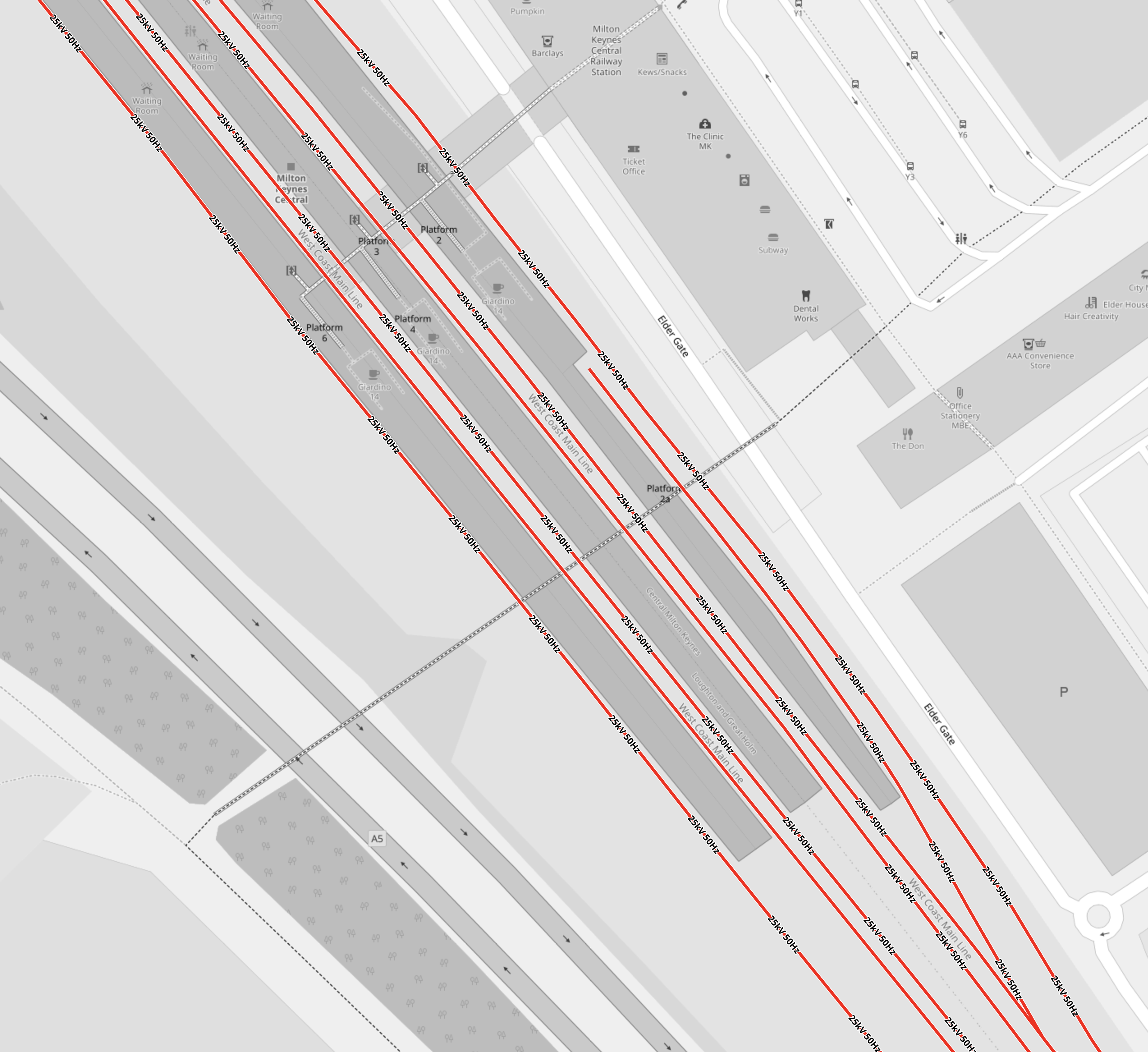
This OpenRailwayMap shows the platforms and whether they are electrified in Milton Keynes Central station.
Note.
- Lines shown in red are electrified with 25 KVAC overhead wires.
- The short platform is Platform 2A, which can take a five-car train and was built recently to terminate the Marston Vale Line service.
- Could Platform 2A be ideal for handling and charging, battery-electric trains, that terminate in Milton Keynes station?
The Wikipedia entry for Milton KeynesCentral station, has a section called Platforms and Layout, which gives full details.
Bletchley Station
This OpenRailwayMap shows the platforms and whether they are electrified in Bletchley station.
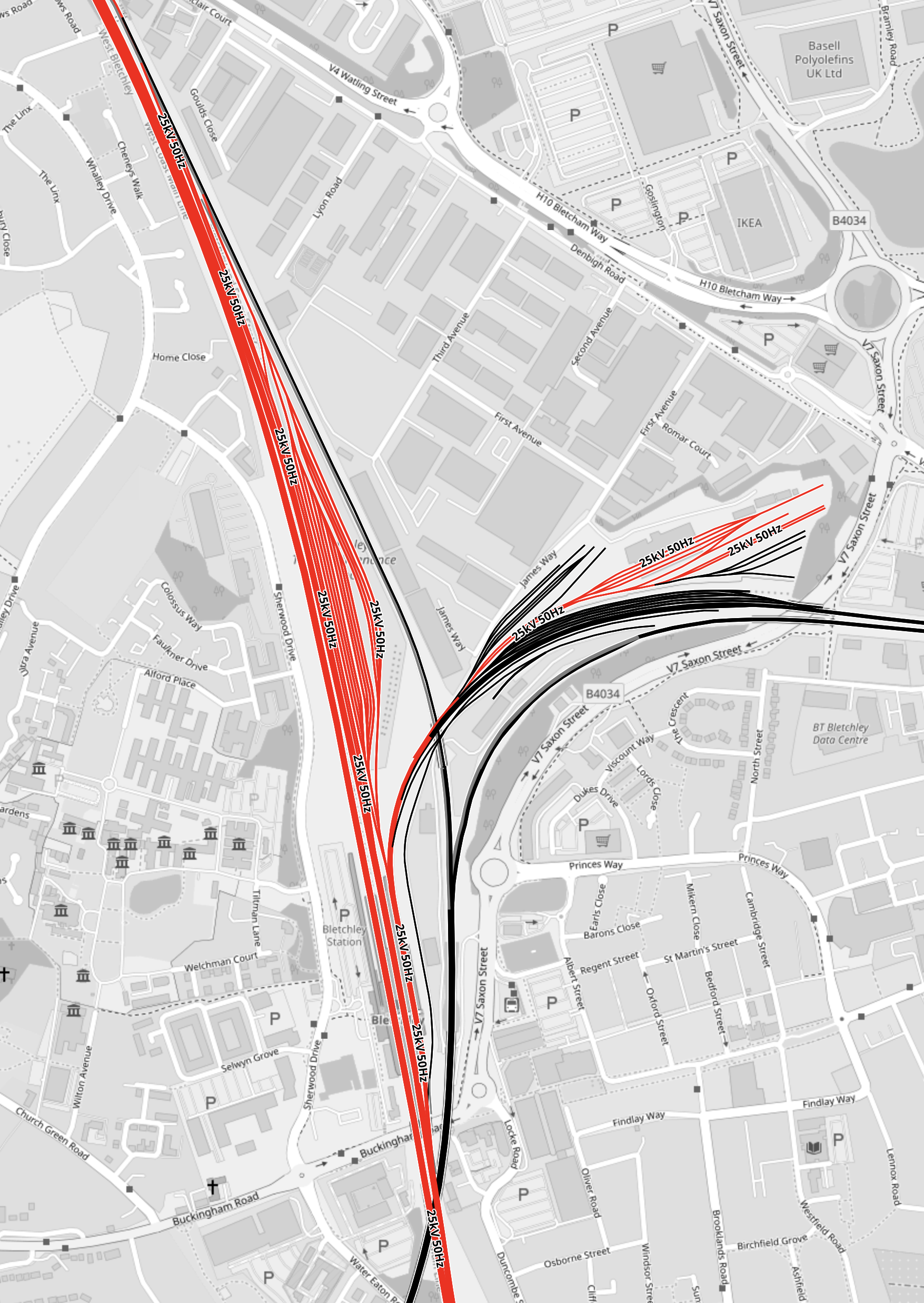
Note.
- Lines shown in red are electrified with 25 KVAC overhead wires.
- The wide swath of red going North is the West Coast Main Line.
- The smaller patch of red to the East of the West Coast Main Line are electrified sidings.
- All low-level platforms at Bletchley station are electrified.
- The viaduct platforms, are shown in black as they are not electrified.
- A non-electrified line leads North-West from the viaduct towards Milton Keynes Central.
- The Milton Keynes end of the line between Milton Keynes Central station and the viaduct is electrified.
- A non-electrified line leads North-East from the viaduct towards Fenny Stratford and Bedford.
The Google Map shows a 3D visualisation of Bletchley station.
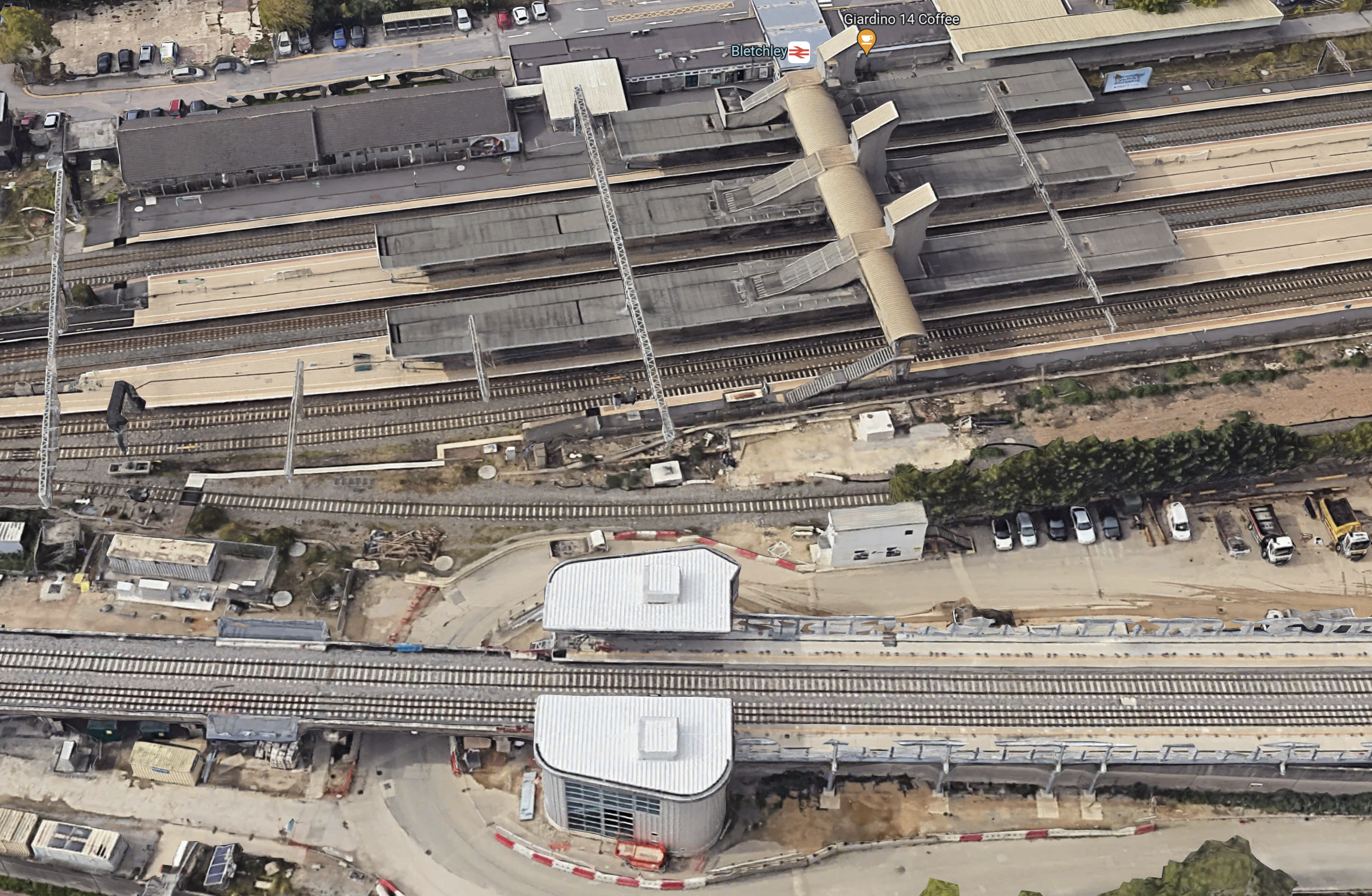
I can’t see much sign of any electrification.
Bedford Station
This OpenRailwayMap shows the platforms and the electrification around Bedford station.
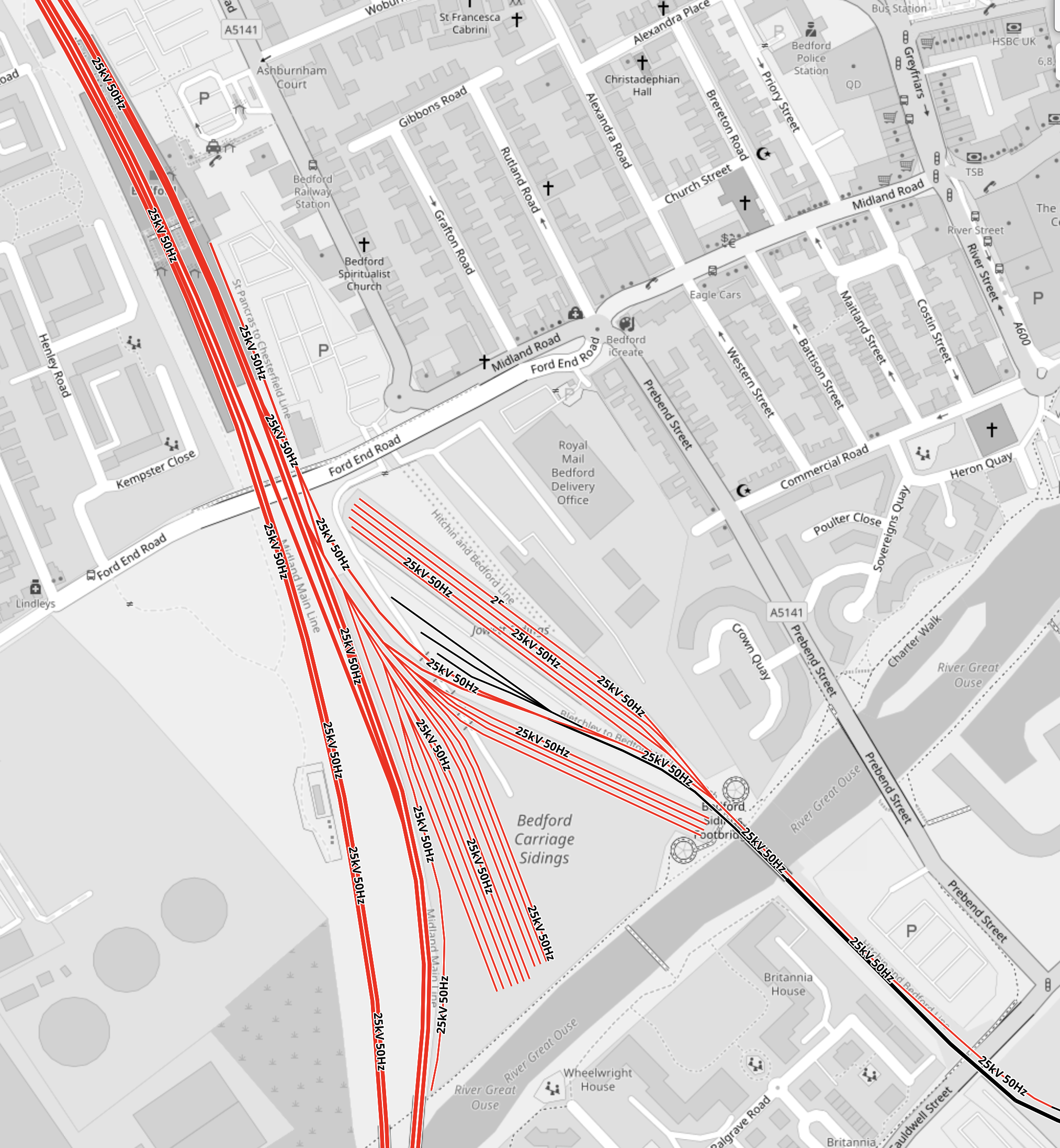
Note.
- All platforms at Bedford station are electrified.
- The lines to the West of the station are the electrified Midland Main Line.
- The Marston Vale Line services terminate in the short Platform 1A, which is the South-East corner of the station.
- The track into Platform 1A is electrified for about two hundred metres, through the sidings South of the station.
This picture shows the electrified track as it crosses over the river.
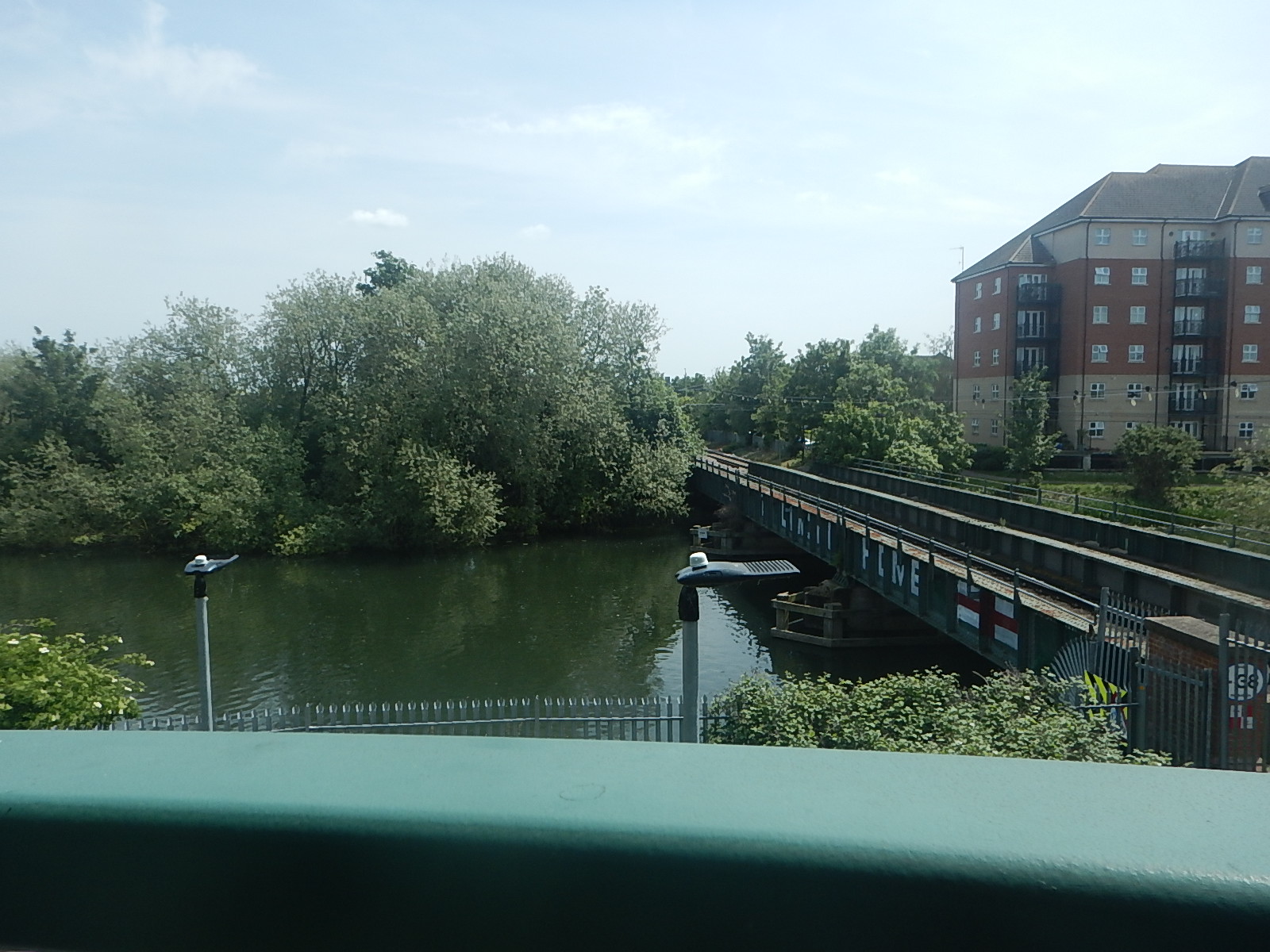
Could Platform 1A be ideal for handling and charging, battery-electric trains, that terminate in Bedford station?
It’s odd that there is the same platform layout at both ends of the Marston Vale Line.
Is it just a coincidence or does Engineer Baldrick have a cunning Plan?
Oxford Station
This OpenRailwayMap shows the platforms and the electrification around Oxford station.
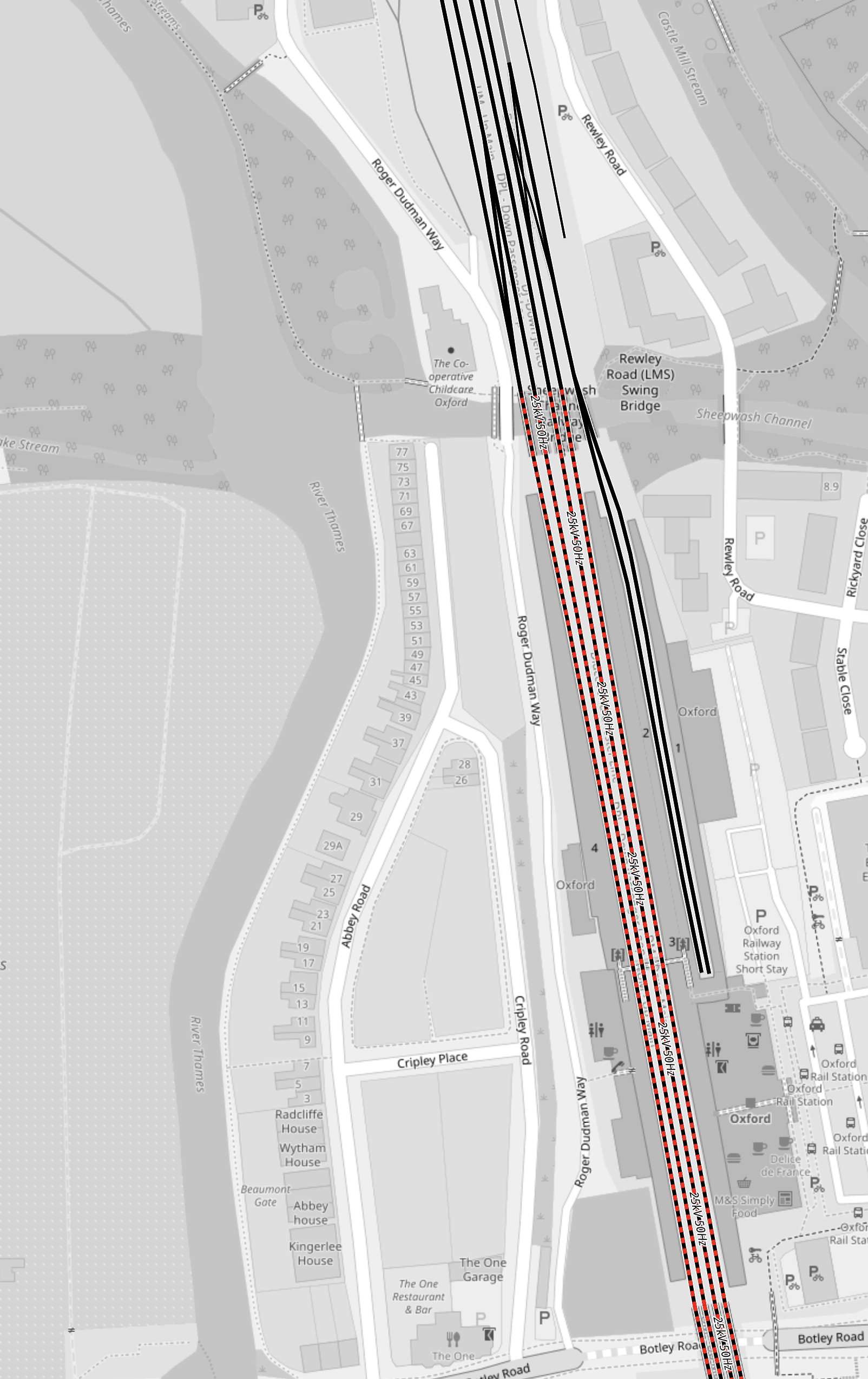
Note.
- The dotted red and black tracks, indicate electrification is planned.
- The planned electrification will connect Oxford station to Didcot Junction station.
- The two bay platforms at the North of the station are not electrified and Platform 2 is now used by Chiltern’s London services.
- Platform 1 could be used by trains on the East West Railway that terminate at Oxford.
When Oxford station is electrified, it wouldn’t be the largest project to add 25 KVAC overhead electrification to the two bay platforms.
Aylesbury Station
This OpenRailwayMap shows the platforms and the lack of electrification around Aylesbury station.
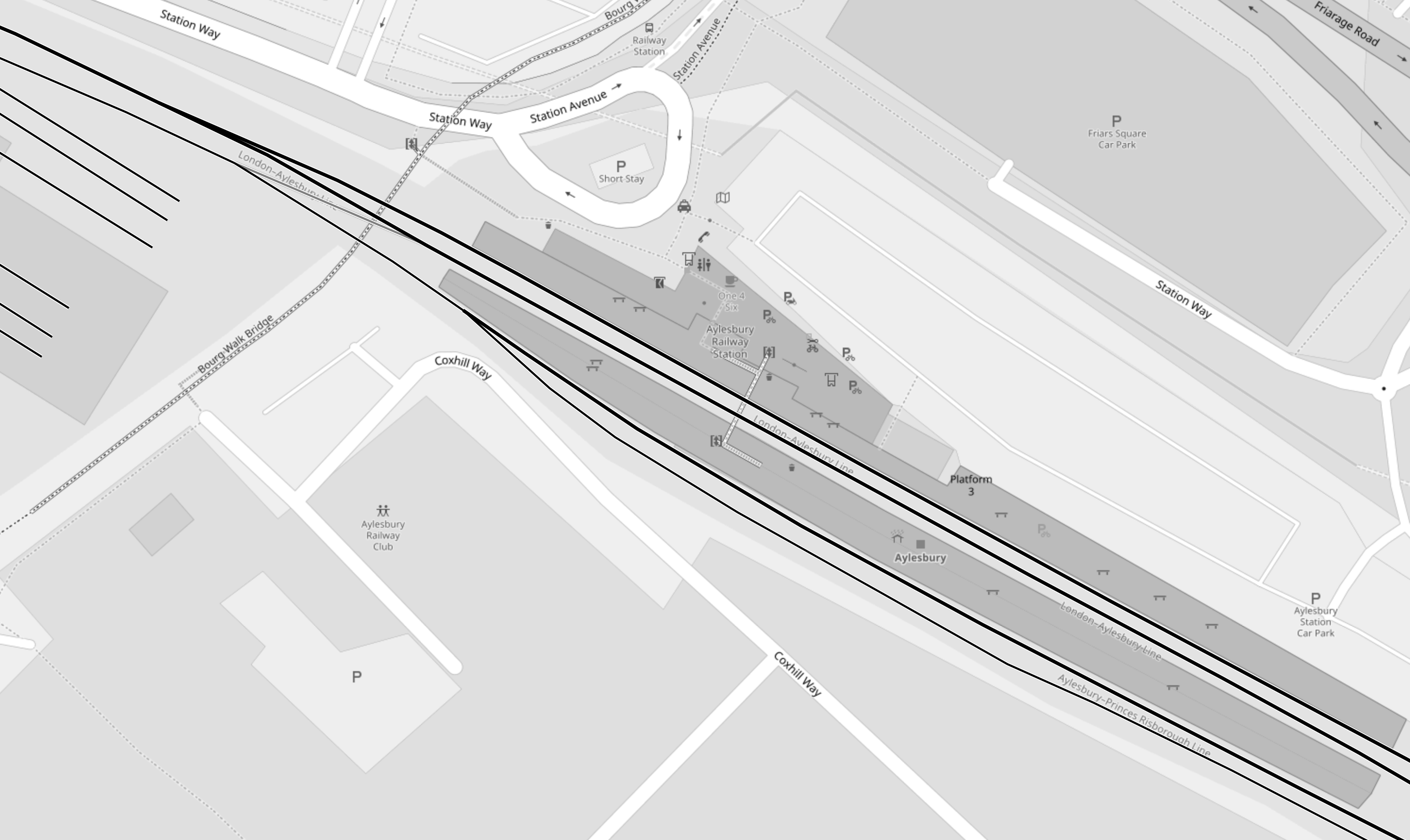
Note.
- No tracks are electrified.
- Platforms are numbered 3, 2, 1 from the top, so 2 and 3 are paired in the middle.
- All freight trains go through Platform 2 and most seem to go via Princes Risborough and High Wycombe.
- Chiltern services use Platforms 1 and 3.
Putting a charging system in Aylesbury station could be tricky.
I wonder if the simplest system for East West Railway would be to electrify between Aylesbury and Aylesbury Vale Parkway stations.
Chiltern Railway’s time between the two stations is as much as seven minutes.
Some trains to Aylesbury take over twenty minutes to do the short journey to Aylesbury Vale Parkway and return, which is more than enough to fully-charge a battery-electric train.
You can even have Chiltern’s hourly Aylesbury Parkway service, sharing the same stretch of electrification with East West Railway’s Aylesbury service, as there is a loop, which creates double-track for some of the way.
It should be noted that between Marylebone and Aylesbury Vale Parkway stations is only 41.1 miles, so some battery-electric trains could do that with a full charge at one end.
East West Railway Distances
In Trains Needed For The East West Railway, I calculated some of these distances.
- Oxford and Bedford – 46.8 miles
- Oxford and Milton Keynes – 33.4 miles
- Aylesbury and Milton Keynes – 25.9 miles
With charging at both ends, all of these routes are possible using modern battery-electric trains, where even a Class 777 IPEMU, designed for extending Merseyrail’s suburban network has done 84 miles on one charge.
On To Cambridge
In this document on the East-West Rail Consortium web site, these services are suggested, for when the East West Railway is complete.
- An hourly train via Norwich terminating at Great Yarmouth.
- An hourly train via Ipswich terminating at Manningtree.
These are distances on these routes that are not electrified, that are to the East of Cambridge.
- Ely and Norwich – 53.7 miles
- Norwich and Great Yarmouth – 18.3 miles
- Cambridge and Haughley Junction – 40.3 miles
Note.
- The Manningtree service would be able to charge its batteries after passing Haughley junction going East and it would be nearly an hour before it needed to use the battery for traction.
- If the Yarmouth service could handle the full route on batteries, then it could return to Cambridge with an efficient charger at Great Yarmouth, which for 25 KVAC overhead electrification trains is an off the shelf item.
- But it does look to me that the trains must leave Cambridge with full batteries, so they can reach electrification at Bedford, Haughley or Norwich.
This map shows the route of the East West Railway between Bedford and Cambridge.
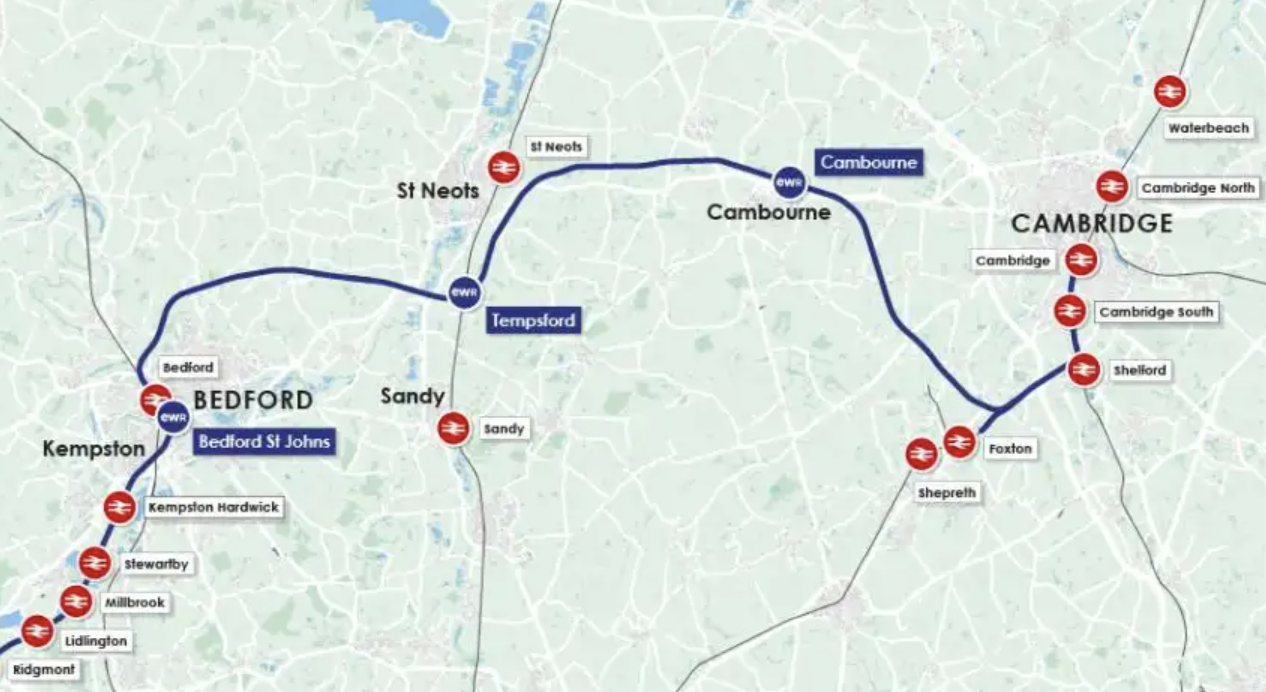
Note.
- Bedford is on the electrified Midland Main Line to London.
- Tempsford is on the electrified East Coast Main Line to London.
- Cambridge has two electrified main lines to London.
- These connections should ensure a good power supply to the East of Bedford for electrification.
I suspect the easiest option will be to add some more electrification at one or more of these places.
- At the Eastern end of the Bedford and Cambridge section.
- To the West of Haughley junction, when it is rebuilt.
- To the North of Ely, when the railways in that area are improved.
Although, as it will be a new route, it might be best to build Bedford and Cambridge as an electrified railway.
East-West Rail: Route For £5bn Bedford To Cambridge Link Announced
The title of this post, is the same as that of this article on the BBC.
This is the sub-heading.
The preferred route of part of £5bn railway line connecting Oxford and Cambridge has been announced.
The first two paragraphs summarise the route.
The East-West Rail (EWR) project confirmed details of the section between Bedford and Cambridge.
It will include new stations at Tempsford and Cambourne, and enter Cambridge via the south of the city.
This map from East West Rail shows the route.

Note.
- The proposed route is shown in blue.
- The possible Southern extension to Aylesbury is shown dotted.
- The Wikipedia entry for East West Rail has conflicting information, as to when trains can run between Bicester and Bedford.
These related posts describe and discuss various parts and issues of the route.
East-West Rail: Along The Marston Vale Line
East-West Rail: Aylesbury Spur
East-West Rail: Electrification
East-West Rail: Oxford And Bedford
East-West Rail: Through Bedford
Govia Thameslink Railway Issues a Prior Information Notice For New Trains
This article on Railway Gazette is entitled UK Railway News Round-Up and contains this section.
Govia Thameslink Railway has issued a prior information notice seeking the provision of between 21 and 30 four-car 25 kV 50 Hz 160 km/h through-gangwayed EMUs with air-conditioning and toilets for use on existing and/or additional Great Northern services from May 2024. Maintenance would be undertaken in-house at Hornsey depot, supported by a Technical Support & Spares Supply Agreement.
I find this all a bit puzzling.
- The trains that need replacing are surely the eighteen Class 313 trains, that run on the West Coastway Line, as they are some of the oldest trains on the UK network.
- If Govia Thameslink Railway were serious about decarbonisation, they would also replace the Class 171 diesel trains, that work the Marshlink Line and the Uckfield branch, with electric trains with a range of thirty miles on batteries.
How many trains would be needed to replace the Class 313 and Class 171 trains?
- The eighteen three-car Class 313 trains could be replaced with an equal number of new four-car trains and this might result in a rise in passenger numbers.
- I would assume the eighteen trains includes allowances for trains in maintenance and spare trains for when a train fails.
- It may be possible to replace the six four-car Class 171 trains used on the Marshfield Line with three new four-car trains, which have a range of thirty miles on batteries.
- The eleven two-car Class 171 trains used on the Uckfield branch could be replaced with three new four-car trains, which have a range of thirty miles on batteries and would run as four-car trains.
- If eight-car trains were needed on the Uckfield branch, there would be a need for six new four-car trains.
- If twelve-car trains were needed on the Uckfield branch, there would be a need for nine new four-car trains.
Note.
- If four-car trains are needed on the Uckfield branch, this means a total of 18+3+3 or 24 trains.
- If eight-car trains are needed on the Uckfield branch, this means a total of 18+3+6 or 27 trains.
- If twelve-car trains are needed on the Uckfield branch, this means a total of 18+3+9 or 30 trains.
Trains on these Southern routes wouldn’t be stabled at Hornsey depot, but could be moved to Hornsey for maintenance using Thameslink.
But the puzzling bit is that the prior information notice says that the trains will be.
Four-car 25 kV 50 Hz 160 km/h through-gangwayed EMUs with air-conditioning and toilets for use on existing and/or additional Great Northern services from May 2024.
Note.
- There is no mention of the trains being able to run on 750 VDC third-rail infrastructure.
- The trains will run on Great Northern services and the Class 313 and Class 171 trains run on Southern routes.
- The only Great Northern services, that have not been moved to Thameslink are Kings Cross and Cambridge, Ely and King’s Lynn and services to Moorgate.
- The Moorgate services have their own dual-voltage Class 717 trains.
- Govia Thameslink Railway have ambitions to double the frequency of trains to King’s Lynn.
- Two eight-car trains per hour (tph) between King’s Cross and King’s Lynn would need sixteen operational four-car trains.
- Two twelve-car trains per hour (tph) between King’s Cross and King’s Lynn would need twenty-four operational four-car trains.
If Govia Thameslink Railway are thinking of thirty new trains, they must have other destinations in mind.
Could we be seeing a double swap?
- An appropriate number of new trains are procured to run Great Northern services between Kings Cross and Cambridge, Ely and King’s Lynn.
- The Class 387 trains released will be moved to the South to replace the Class 313 and Class 171 trains.
- Some or all of the transferred Class 387 trains will be fitted with batteries to give a range of thirty miles without electrification.
Note.
- Could the new trains be Siemens Desiro City trains like the Class 700 and Class 717 trains, which are already maintained at Hornsey depot? It would surely be more efficient and save money.
- Class 387 trains are dual voltage and would need little or no modification to replace the Class 313 trains.
- Uckfield and Hurst Green junction is 24.7 miles.
- Ashford International and Ore is 25.4 miles
- Adding a battery to a Class 387 train has not been done, but Bombardier converted a near-identical Class 379 train to battery-electric operation over eight years ago.
- Converting a Class 387 train gives a dual-voltage battery-electric train.
- I suspect a charger would be needed at Uckfield. Could it be a short length of 25 KVAC overhead electrification?
Could all the Class 387 trains, that will replace the Class 313 and Class 171 trains be identical to ease the problems, when a train develops a fault?
Conclusion
It looks a good plan.
It also opens up the following possibilities.
- Deployment of 750 VDC battery-electric trains on other routes.
- Deployment of 25 KVAC overhead battery-electric trains on other routes.
- Deployment of tri-mode battery-electric trains on other routes.
- Charging of battery-electric trains using a short length of 25 KVAC overhead electrification.
- Fitting of batteries to Class 379 trains to create a 25 KVAC overhead battery-electric train.
It might be possible to convert other Electrostars to battery-electric operation.
Ignoring Class 387 trains on dedicated services like Heathrow and Gatwick Express, these trains are available for conversion.
- Class 379 trains – Stored – 30 trains
- Class 387 trains – Govia Thameslink Railway – 40 trains
- Class 387 trains – Great Western Railway – 33 trains
Note.
- This gives 103 trains.
- They all have good interiors.
- They are all 100/110 mph trains.
- All trains could be updated to 110 mph.
- All trains can use 25 KVAC overhead electrification.
- The Class 387 trains can also use 750 VDC third-rail electrification.
- The Class 379 trains were built in 2010-2011.
- The Class 387 trains were built from 2014.
I believe both classes will make excellent battery-electric trains.
Where will they be deployed?
These are a selection of routes starting in the South-East of England.
- Ashford International and Eastbourne.
- Gravesend and Hoo.
- London Bridge and Uckfield.
- London Paddington and Bedwyn.
- London Paddington and Oxford.
- Reading and Basingstoke.
- Reading and Gatwick.
- Reading and Redhill.
- Slough and Windsor & Eton Central.
- Twyford and Henley-on-Thames
I’ve only added routes which are less than thirty miles.
 The Anonymous Widower