Cummins To Cease New Electrolyser Activity Amid Worsening Market
The title of this post, is the same as that of this article on Renewables Now.
These are the first three paragraphs.
Cummins Inc has decided to stop new commercial activity in the electrolysers space following a strategic review of the segment launched last year, citing deteriorating market conditions and weakening customer demand.
The decision is linked to USD 458 million (EUR 388.4m) of charges for the full-year 2025 related to the electrolyser business within the company’s zero-emission technologies arm, Accelera, of which USD 415 million were non-cash charges.
The company noted that it will continue to fulfil existing customer commitments before winding down new commercial activity in the segment.
Although, I am in favour of using hydrogen as a fuel, I recognise, that traditional electrolysis is not the most efficient process.
These methods are more efficient.
HiiROC
- HiiROC use a process, that they call Thermal Plasma Electrolysis to split any hydrocarbon gas into hydrogen and carbon black.
- HiiROC originated in the University of Hull.
- Typical gases that can be used are chemical plant off-gas, biomethane and methane.
- I like the ability to use chemical plant off-gas, as some of this is particularly nasty and HiiROC may offer safe disposal.
But the big advantage is that the HiiROC process is five times more energy efficient than traditional electrolysis.
The carbon black is no useless by-product, but has several valuable uses in its own right, which are detailed in its Wikipedia entry.
These two paragraphs from Wikipedia, give a summary of the more common uses of carbon black.
The most common use (70%) of carbon black is as a reinforcing phase in automobile tires. Carbon black also helps conduct heat away from the tread and belt area of the tire, reducing thermal damage and increasing tire life. Its low cost makes it a common addition to cathodes and anodes and is considered a safe replacement to lithium metal in lithium-ion batteries. About 20% of world production goes into belts, hoses, and other non-tire rubber goods. The remaining 10% use of carbon black comes from pigment in inks, coatings, and plastics, as well as being used as a conductive additive in lithium-ion batteries.
Carbon black is added to polypropylene because it absorbs ultraviolet radiation, which otherwise causes the material to degrade. Carbon black particles are also employed in some radar absorbent materials, in photocopier and laser printer toner, and in other inks and paints. The high tinting strength and stability of carbon black has also provided use in coloring of resins and films. Carbon black has been used in various applications for electronics. A good conductor of electricity, carbon black is used as a filler mixed in plastics, elastomer, films, adhesives, and paints. It is used as an antistatic additive agent in automobile fuel caps and pipes.
It can also be used as a soil improver in agriculture.
HiiROC would appear to be five times more energy efficient than traditional electrolysis.
I would also rate the range of their investors as a particular strength.
Google AI lists these companies as investors.
HiiROC, a UK-based developer of plasma torch technology for “turquoise” hydrogen production, is backed by a consortium of industrial and strategic investors. Key investors include Centrica, Melrose Industries, Hyundai Motor Company, Kia, HydrogenOne Capital, CEMEX Ventures, Wintershall Dea, and VNG.
Note.
- CEMEX must be going to decarbonise cement making.
- Melrose describe themselves as an industry-leading aerospace technology provider.
- Will we be seeing hydrogen cars from Korean manufacturers?
- Wintershall Dea is Europe’s leading independent gas and oil company.
HiiROC has an impressive list of investors.
Bloom Energy
I wrote about Bloom Energy’s process in Westinghouse And Bloom Energy To Team Up For Pink Hydrogen.
This method also looks promising.
- Westinghouse Electric Company is an American builder of nuclear power stations.
- Bloom Energy Corporation make a solid-oxide electrolyser.
- Pink hydrogen is green hydrogen produced using nuclear power.
It uses electrolysis at a higher temperature, which speeds it up.
Desert Bloom
This is an Australian process, that I wrote about in 10GW Green Hydrogen Project Aims To Electrolyze Water Drawn From Desert Air.
Conclusion
You can understand, why Cummins are getting jumpy!
But you have to remember that when I worked in a hydrogen plant in the 1960s, the hydrogen was an unwanted by-product and it was mixed with coal gas and sent down the power station to raise steam, so that it could be used to do something useful.
Hydrogen Deployment Milestone For Cemex And HiiROC
The title of this post, is the same as that of this article on Agg-Net.
This is the sub-heading.
Cemex kick-start first-of-a-kind low-carbon hydrogen project using thermal plasma electrolysis in cement production
These first two paragraphs add more detail.
CEMEX Ventures, Cemex’s corporate venture capital (CVC) and open innovation unit, announced today an initial hydrogen deployment at industrial scale with HiiROC, the pioneering British hydrogen company that produces affordable, clean hydrogen, at their Rugby cement plant in the UK.
Hydrogen has emerged as a low-carbon energy source within the construction industry’s decarbonization roadmap and offers potential as an energy solution to help reduce the sector’s reliance on fossil fuels and lower CO2 emissions. This venture marks a significant milestone for Cemex, as it represents the beginning of a large-scale strategic project plan with the aim to further lower their carbon emissions in cement production.
These third paragraph is a good outline of HiiROC and how it can be deployed.
HiiROC produce carbon-neutral hydrogen using their proprietary Thermal Plasma Electrolysis (TPE) process, which requires just one-fifth of the electrical energy used in water electrolysis and captures carbon as a solid by-product, avoiding CO2 emissions – a game-changer for the industry. HiiROC’s modular solution can be deployed as single units to full-scale industrial plants, and the hydrogen produced can be used as an alternative energy source to fuel clinker production processes, helping Cemex to achieve their decarbonization goals.
Centrica, Cemex, Hyundai, Kia and others are investors in HiiROC.
I asked Google AI, what percentage of carbon emissions came from cement production and got this answer.
Cement production accounts for roughly 8% of global carbon dioxide (CO2) emissions, according to think tank Chatham House. This makes it a significant contributor to climate change, with the industry’s emissions comparable to the total emissions of some countries.
If HiiROC can take a big bite out of carbon emissions, by reducing cement production’s 8 % share, they would be on a winner.
British Gas Owner Mulls Mini-Nuke Challenge To Rolls-Royce
The title of this post, is the same as that of this article in The Telegraph.
This is the sub-heading.
Centrica is looking to follow Rolls-Royce in developing small modular reactors
These are the first three paragraphs.
The owner of British Gas is considering investing in mini nuclear power plants in the UK as it seeks to cash in on burgeoning demand for the technology.
Centrica is in early talks with the Government about a potential future deal that could see the energy giant participate in the development of so-called small modular reactors (SMRs).
It comes after Ed Miliband, the Energy Secretary, last month announced billions of pounds in funding for SMRs, which will form part of a new “golden age” for atomic energy.
In Centrica Really Can’t Lose At Sizewell, I looked at Centrica’s involvement in Sizewell C and in particular the financing of the nuke and what Centrica would do with their share of the electricity, that the nuke will produce.
I listed these uses for hydrogen in the East of England.
- Transport – Buses, Coaches and Trucks
- Large Construction Projects
- Rail
- Ports
- Airports
- Agriculture And The Rural Economy
- Exports
I do wonder, if Centrica made the investment in Sizewell C, when they realised that there were a lot of uses for hydrogen and producing hydrogen using the electricity from a nuclear power station was a good way to generate hydrogen.
- Sizewell B is a 1.2 GW nuclear powerstation.
- Sizewell C is a 3.2 GW nuclear powerstation.
- Their investment in HiiROC surely gives them access to the technology to generate hydrogen.
- Centrica have a lot of experience of selling natural gas to customers, who need energy.
- There were also substantial government guarantees involved.
- Hydrogen made by a nuclear reaxtor is generally referred to as pink hydrogen.
- In Westinghouse And Bloom Energy To Team Up For Pink Hydrogen, I describe how two American companies have formed a partnership to make pink hydrogen.
Before they invested in Sizewell C, they would have done detailed financial and technical due diligence.
Did Centrica then scale the calculations to see if funding a Small Modular Reactor (SMR) to make hydrogen was a viable deal?
- SMRs are typically around 400-500 MW.
- The article mentions Rolls-Royce, but other companies are developing SMRs.
- Centrica use Rolls-Royce mtu generators for some of their installations.
- Some SMR/HiiROC systems could be built close to steelworks or other high energy users.
This is a very interesting development in taking the UK to net-zero.
What Is The Collective Noun For Cement Mixer Trucks?
I took these pictures on Eldon Street and Moorgate this morning.










Note.
- There was obviously a big pour going on in the rebuilding of Broadgate.
- I suspect those outside the hotel in the street restaurant, we’re too amused by the cabaret.
- Cemex were providing the concrete.
Perhaps in view of the location, the collective noun is a pollution of cement mixer trucks.
In Cummins Agrees To Integrate Its Hydrogen ICE Technology Into Terex® Advance Trucks, I describe the latest design of cement mixer trucks from the United States.
This is the European-sized member of the range.

Note.
- Front is to the right.
- The engine is in the pod at the other end.
- The engine can be one of Cummins’s hydrogen internal combustion engines.
These trucks would be much more city-friendly.
UK Breakthrough Could Slash Emissions From Cement
The title of this post. is the same as that of this article on the BBC.
This is the sub-heading.
Scientists say they’ve found a way to recycle cement from demolished concrete buildings.
These five paragraphs outline, why cement is such an environmental problem.
Cement is the modern world’s most common construction material, but it is also a huge source of planet-warming gas emissions.
That is because of the chemical reactions when you heat limestone to high temperatures by burning fossil fuels.
Recycling cement would massively reduce its carbon footprint. Researchers say that if they switched to electric-powered furnaces, and used renewable energy like wind and solar rather than fossil fuels, that could mean no greenhouse gases would be released at all.
And that would be a big deal. Cement forms the foundation of the modern economy, both literally and metaphorically.
It is what binds the sand and aggregate in concrete together, and concrete is the most widely used material on the planet after water.
If cement was a country, it would be the third biggest source of emissions after China and the US, responsible for 7.5% of human-made CO2.
This article shows how by applying chemical magic to two effectively unrelated processes; the recycling of steel and the recycling of concrete to make new cement, very high rewards are possible.
Cambridge University are calling their new product electric cement.
As large amounts of electricity are used in an arc furnace, to produce the two products
These paragraphs outline the innovative Cambridge process.
Cement is made by heating limestone to up 1600 Celsius in giant kilns powered by fossil fuels.
Those emissions are just the start. The heat is used to drive carbon dioxide from the limestone, leaving a residue of cement.
Add both these sources of pollution together and it is estimated that about a tonne of carbon dioxide is produced for every tonne of cement.
The team of scientists,, has found a neat way to sidestep those emissions.
It exploits the fact that you can reactivate used cement by exposing it to high temperatures again.
The chemistry is well-established, and it has been done at scale in cement kilns.
The breakthrough is to prove it can be done by piggybacking on the heat generated by another heavy industry – steel recycling.
When you recycle steel, you add chemicals that float on the surface of the molten metal to prevent it reacting with the air and creating impurities. This is known as slag.
The Cambridge team spotted the composition of used cement is almost exactly the same as the slag used in electric arc furnaces.
They have been trialling the process at a small-scale electric arc furnace at the Materials Processing Institute in Middlesbrough.
These are my thoughts.
The Only Inputs Are Steel Scrap, Green Electricity And Used Cement
Consider.
- We probably need to increase the percentage of steel scrap we collect.
- Gigawatts of green electricity in a few years, will be available in those places like Port of Ardersier, Port Talbot, Scunthorpe and Teesside, where large amounts of steel will be needed.
- I can envisage large steel users having their own hybrid electric cement/electric arc furnace plants.
- Used cement would be collected and brought to the plants.
- Years ago, I used to live next door to an old World War II airfield. The farmer who owned the airfield, told me, that the concrete was his pension, as when he needed money, he called a company, who crushed it up for aggregate.
I can see a whole new integrated industry being created.
Conclusion
This could be one of the best inventions since sliced bread.
C-Capture Launches Innovative Carbon Capture Trial For Cement Industry
The title of this post, is the same as that of this news item from C-Capture.
This is the sub-heading.
C-Capture, developers of next generation technology for carbon dioxide removal, has launched a new carbon capture trial in the cement manufacturing sector in partnership with Heidelberg Materials.
This is the first paragraph.
The trial, which utilises C-Capture’s innovative solution for industrial decarbonisation, is taking place at Heidelberg Material’s cement manufacturing plant in Ketton. It forms part of C-Capture’s national project, ‘XLR8 CCS – Accelerating the Deployment of a Low-Cost Carbon Capture Solution for Hard-to-Abate Industries’. Working with project partners across the UK, C-Capture’s XLR8 CCS project will demonstrate that a low-cost carbon capture solution is a reality for difficult-to-decarbonise industries in the race to net zero.
I wrote about C-Capture’s technology in Could Drax Power Station Solve The Carbon Dioxide Shortage?
The technology appears to have been spun out of Leeds University.
BP and Drax are investors.
This page on the C-Capture web site is called Technology and has a very neat interactive guide to how the technology works.
Conclusion
I have high hopes for this company and its technology.
Seratech’s Technology Explained
I first wrote about Seratech in Carbon-Neutral Concrete Prototype Wins €100k Architecture Prize For UK Scientists, after reading about this carbon-neutral concrete in the Architect’s Journal.
I have just received Seratech’s October 2023 Newsletter, which contains two must-read articles.
Olivine In The Age Of Climate Crisis
I’d never heard of olivine until I read about the architecture prize, that was won by Seratech.
This is the Wikipedia entry for olivine.
These are the first three paragraphs of Seratech’s article.
On the west coast of Norway, a few kilometres from the village of Åheim, is an open excavation pit – home to the largest commercial olivine deposit in the world.
This seaside quarry, run by Belgian industrial minerals company, Sibelco, works to extract olivine from the earth’s crust by drilling, blasting and crushing. A single blast (used to break up the rocks) removes up to 40,000 tonnes of olivine.
The site is predominantly powered by hydroelectricity and boasts a 4km conveyor system for transport which limits the need for heavy vehicle or double-handling of materials in a bid to reduce emissions.
This is Sibelco’s video of their impressive mining process.
Note.
The mining operation is fully-integrated with its own ort.
- The video does the mining operation justice.
- Sibelco aim to make the mining of olivine carbon-neutral.
Olivine has this Wikipedia entry, which gives more information.
This Google Map shows the port complex at Åheim.
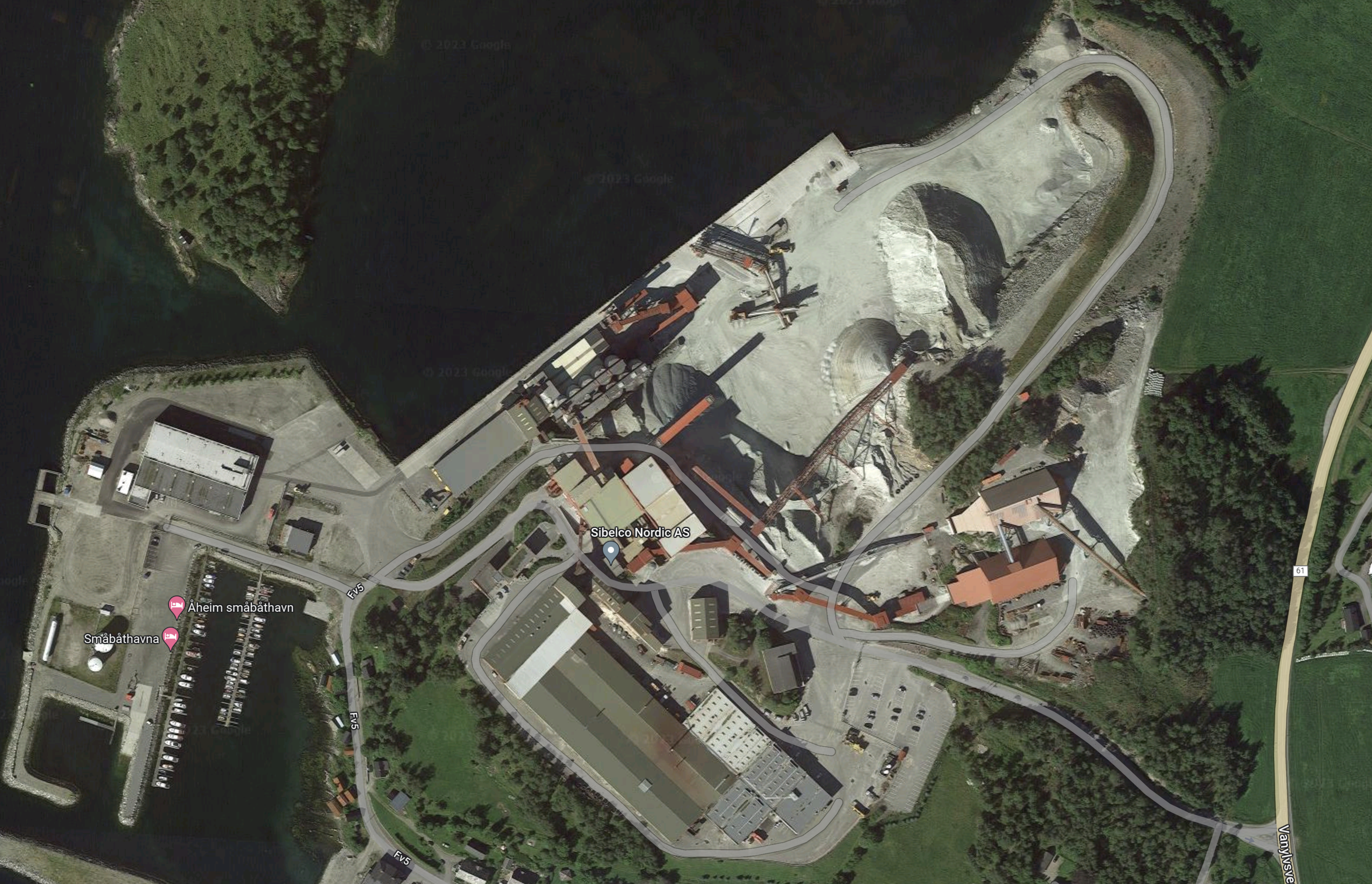
It looks like mine, processing and port all on one site.
The Big Interview With Mike Eberlin
This is the sub-heading.
Former Managing Director of Tarmac Cement & Lime and chair of MPA Cement, Mike Eberlin, became Seratech’s business advisor in June this year. He was intrigued by the novel technology Sam Draper and Barney Shanks had uncovered
These paragraphs are a summary of what Mike Eberlin said.
As we begin to talk, Mike is quick to point out there are two big advantages to Seratech: “They are using magnesium silicate as a starting material which produces silica as a cement replacement and magnesium oxide which can then absorb CO2”.
The CO2 absorption is what fascinates Mike as the type of magnesium carbonate Seratech produces is a “slightly unstable” version which when cured, becomes stable and reverts to the rock-like substance you would find in nature. “This came as a surprise because the chemistry wouldn’t indicate that was possible,” he explains.
Following this discovery, and as Seratech’s research progressed, it soon became apparent that the magnesium carbonate lends itself well as a binder and can be used in applications like building blocks and plasterboard: “It’s effectively carbon capture and use, not carbon capture and storage because you are mineralising the CO2 into a product.
“We end up in this clever situation whereby it’s not that we don’t emit the CO2, it’s better than that, we absorb CO2 and create two binders that replace cement”.
That’s what I call an endorsement.
Conclusion
I have this feeling that Seratech will be a very significant company in a couple of years.
Low-Carbon Concrete: Separating Greenwash From Reality
The title of this post is the same as that of this article from Construction Management.
This is the sub-heading.
Tales of low-carbon concrete abound, but what exactly does that mean? Kristina Smith looks at what’s in the mix.
This is a paragraph, which shows the scale of the problem.
The oft-quoted statistic is that cement contributes to 7% of the world’s carbon emissions. However, MPA says that in the UK concrete and cement account for just 1.5% of emissions. “From 1990 we have reduced our absolute emissions by 53%, which is faster than the overall economy, mainly by improving energy efficiency at the plants,” says Khosravi.
Noushin Khosravi, is sustainable construction manager at the Concrete Centre, which is part of Mineral Products Association (MPA).
Companies mentioned include.
- Capital Concrete with their Earth Friendly Concrete.
- CarbonCure Technologies, which I wrote about in Mote – World’s First Carbon Removal Plant Converting Wood Waste To Hydrogen.
- Seratech, which I wrote about in Carbon-Neutral Concrete Prototype Wins €100k Architecture Prize For UK Scientists.
I find the Seratech process amazing as it takes carbon dioxide straight from flues to make the cement.
Could we fit a Seratech cement process on the back of a gas-fired power station?
The article is a must-read summary of where the technology is with respect to low-carbon concrete.
NI Green Hydrogen Projects Win Government Grants
The title of this post, is the same as that of this article on the BBC.
This is the sub-heading.
Two green hydrogen projects in Northern Ireland have won government grants in the first round of the UK Net Zero Hydrogen Fund.
These three paragraphs outline the projects.
Green hydrogen is made by using renewable electricity to separate water into oxygen and hydrogen – a process called electrolysis.
The grants will be used to help fund the construction of electrolysers.
One will be at the Mannok cement plant in Fermanagh, the other at Wrightbus in Ballymena.
I talked about the Wrightbus project in Ballymena: Wrightbus To Develop Hydrogen Production Facility.
UK Funds Hydrogen-Enabled Decarbonisation Of Steel, Cement, Ceramics Production
The title of this post, is the same as that of this article on Ryse Hydrogen.
This is the first paragraph.
The latest round of grants under the UK government’s Industrial Hydrogen Accelerator Programme shows the breadth of decarbonisation opportunities that hydrogen provides and the depth of innovative talent in our country.
Industries targeted by the projects that received funding include steelmaking, asphalt, cement, waste, paint, and ceramics manufacturing.
The article is good background to how hydrogen will change industry.
 The Anonymous Widower