Japanese Offshore Wind And Battery Storage Project Begins Commercial Operation
The title of this post, is the same as that of this article on offshoreWIND.biz.
This is the sub-heading.
On 1 January 2024, JERA and Green Power Investment Corporation (GPI) began commercial operations at the 112 MW Ishikari Bay New Port Offshore Wind Farm in Japan, which they own through Green Power Ishikari GK, a special-purpose corporation (SPC).
The most significant thing about this wind farm, is that it has been designed from Day One to operate with a battery, which is detailed in the last paragraph.
The project also features a battery storage component with 100 MW x 180 MWh of capacity.
Note that the output of the battery is 89 % of that of the wind farm. Is that the ideal ratio between battery and wind farm capacities?
Conclusion
Because of my training, as an Electronics and Control Engineer, I belief that most renewable energy can be smoothed with the adding of a battery.
Would You Buy A Battery Energy Storage System From Rolls-Royce?
I don’t often click on adverts that appear in web pages.
But I had to click on one from Rolls-Royce mtu, which advertised Battery Energy Storage Systems.
I wonder what the Honourable Charles Rolls would have thought of adverts on the Internet for the company he jointly founded?
I suspect he would have liked the idea, as Rolls was very much a promoter of motoring and aviation and opened one of the first car dealerships in the UK, according to his Wikipedia entry.
The Wikipedia entry for his business partner; Sir Henry Royce starts with this sentence.
Sir Frederick Henry Royce, 1st Baronet, OBE (27 March 1863 – 22 April 1933) was an English engineer famous for his designs of car and aeroplane engines with a reputation for reliability and longevity.
He is also described as a perfectionist.
This sentence from the Wikipedia entry, describes how he started the design of the legendary “R” engine.
In October 1928, he began design of the “R” engine while walking with some of his leading engineers on the beach at West Wittering, sketching ideas in the sand. Less than a year later, the “R” engine, designed in his studio in the village, set a new world air speed record of 357.7 miles per hour and won the Schneider Trophy of 1929.
Later with help from the maddest person my father ever met (his words, not mine!) ; Lady Houston, the Supermarine S.6B won the trophy in 1931 and then broke the world speed record at over 400 mph. Not bad for a seaplane. Take the floats off an S.6B and you almost have a Spitfire.
The Wikipedia entry also describes how the “R” engine was developed into what many engineers believe was the finest internal combustion engine of all time; the Rolls-Royce Merlin.
Following the success of the “R” engine, it was clear that they had an engine that would be of use to the Royal Air Force. As no Government assistance was forthcoming at first, in the national interest they went ahead with development of what was called the “PV-12” engine (standing for Private Venture, 12-cylinder). The idea was to produce an engine of about the same performance as the “R”, albeit with a much longer life. Rolls-Royce launched the PV-12 in October 1933 and the engine completed its first test in 1934, the year after Royce died. The PV-12 became the Rolls-Royce Merlin engine.
Where would we have been in the Battle of Britain without the Merlin engine?
Since 1969, the engineers at Rolls-Royce have followed Sir Henry’s example of perfection and developed the revolutionary RB-211 into the modern day Trent, which is now about to take a big leap into a low-carbon future with the UltraFan.
If the quality of Rolls-Royce mtu’s Battery Energy Storage System matches the levels of perfection Rolls-Royce achieved with the Merlin and the Trent, then I suspect that Sir Henry would have given his approval.
This picture is shown on the web page for the Battery Energy Storage System.

These two paragraphs introduce, what Rolls-Royce mtu are calling the mtuEnergyPack.
In today’s world of economic growth and increasing populations, the demand for electricity is soaring. Governments and industries globally shift to distributed renewable energy, challenging centralized grids. To adapt to this changing energy landscape, the mtuEnergyPack offers an ideal solution.
It integrates renewable sources like solar and wind power, paving the way for future-ready sustainable power systems. The mtu EnergyPack is a scalable, all-in-one solution for autonomous off-grid facilities. It ensures reliable power through peak shaving, load-shifting, and grid stabilization, making it suitable for various applications.
These are my thoughts.
What Is The Output And The Storage Capacity?
This paragraph on this page gives this answer.
It efficiently stores electricity from distributed sources and delivers on demand. The mtu EnergyPack is available in different sizes: The QS and the QL, ranging from 200 kVA to 2,000 kVA, and from 312 kWh to 2,084 kWh, and the QG for grid scale storage needs, ranging from 4,400 kVA and 4,470 kWh to virtually any size.
It seems that you specify your requirements and Rolls-Royce mtu should be able to satisfy it.
What Devices Can Be Connected?
This paragraph on this page gives this answer.
The mtu EnergyPack serves as a key component in enhancing the reliability and profitability of microgrids and energy systems. It stores electricity generated by distributed power sources, including gensets, wind turbines, or solar panels, and delivers it when needed.
In the 1970s, when I was working at ICI, others in the section were working on a system called MEDIA, where every sensor on a chemical plant was connected to the central computer, through its own analog-to-digital computer. It would now be called plug-and-play by some.
I believe that Rolls-Royce mtu are using similar ideas to connect equipment to the control computer.
These are my thoughts about connecting various equipment.
- Hydrogen-powered generators and electrolysers as Rolls-Royce mtu are using at Duisburg, which I wrote about in Rolls-Royce Makes Duisburg Container Terminal Climate Neutral With MTU Hydrogen Technology.
- Could Rolls-Royce’s beer keg-sized 2.5 MW electrical generator based on a Super Hercules engine, be connected?
- Could a Rolls-Royce Trent be connected?
- Could one of Rolls-Royce’s small modular nuclear reactors be connected?
- In Rolls-Royce To Play Key Role In US Department Of Defense Nuclear Microreactor Program, I talk about developing a 1-5 MW nuclear reactor for US Department of Defense. Could these be connected?
I don’t see why every device can’t work to the same protocol.
What Is The Power Density Like?
This paragraph on this page gives this answer.
The mtu EnergyPack’s compact battery system designs suit projects with limited space and logistical restrictions.
In ‘Spirit of Innovation’ Stakes Claim To Be The World’s Fastest All-Electric Vehicle, I talked about Rolls-Royce’s record-breaking electric plane called Spirit of Innovation.
Has what has been learned about energy storage in the confined spaces of an aeroplane been applied to a Battery Energy Storage System?
What Do Rolls-Royce mtu Consider To Be Important Features?
On this page, they list these features.
- Power Density
- Digitally Connected
- Multilevel Safety
- Black Start Capability
- Scalability
- Ultra-Fast Response
- Flexible Use
- Plug-And-Play Installation
The design seems to have everything covered.
Can Similar Systems Be Designed By Others?
I would expect that similar systems can be designed, as technology like batteries is available to all and the operation is only as good as the software controlling the various components of the system.
But similar systems will be without the famous Rolls-Royce logo.
Could One Of These Systems Decarbonise A Village?
I once lived in a village with about fifty houses and perhaps a hundred inhabitants.
- There was an old World War Two airfield, that could probably accommodate a small wind farm of perhaps 20 MW.
- There were a couple of barns and large sheds, that could have solar panels similar to those I described in Bedford Depot’s Massive Solar Roof Helps Thameslink On Way To Net Zero.
I suspect an mtuEnergyPack could control all these inputs and provide the village with the following.
- Enough electricity to power all the needs of the inhabitants, businesses and their vehicles.
- If an electrolyser were to be provided, it could probably produce enough hydrogen to power every boiler and hydrogen-powered vehicle.
Note.
- Farmers would like the local availability of hydrogen, as it will be ideal for tractors and agricultural machinery.
- I actually believe that if a village had a reliable and affordable hydrogen supply, that a large proportion of the inhabitants would switch to hydrogen-powered vehicles.
There would still be the National Grid there for backup.
Conclusion
If I needed an mtuEnergyPack, I’d certainly give one a close look.
Copenhagen Infrastructure Partners Takes FID On 1,000 MWh Battery Energy Storage Project
The title of this post, is the same as that of this press release from Copenhagen Infrastructure Partners.
This is the sub-heading.
The battery energy storage system Coalburn 1 will be one of the largest battery storage projects in Europe. Construction has commenced in November 2023 and the project will be 500 MW / 1,000 MWh once complete.
These two paragraphs outline the project.
Copenhagen Infrastructure Partners (CIP) through its Flagship Funds has taken final investment decision and commenced construction on a 500 MW / 1,000 MWh energy storage system in Coalburn, Scotland, which will be one of the largest of its kind in Europe.
The facility is the first project to be developed from the partnership between CIP and Alcemi to deploy 4 GW of energy storage assets across the UK. CIP aims to take final investment decision on two other projects next year with a combined capacity above 1 GW. The portfolio will provide vital support to the UK’s energy network, accelerating the integration of renewable energy and the transition to net zero by 2050.
Note.
- FID means final investment decision.
- 500 MW / 1,000 MWh could become a common size as it is two hours of power and easy for politicians to add up.
- CIP and Alcemi seem to be planning a total amount of energy storage, eight times bigger than Coalburn 1.
This battery could be the largest in the UK, when it is commissioned.
Who Are Copenhagen Infrastructure Partners (CIP)?
Their About CIP web page gives a lot of details.
Who Are Alcemi?
Their Who We Are web page gives a lot of details.
Environmental Considerations
The press release says this about environmental considerations.
The Coalburn 1 facility has been developed with extensive landscaping and ecological mitigation measures, including the maintenance of peat reserves, tree and wildflower planting, and new habitats, promoting biodiversity across the site.
I’ll agree with that, but add that I hope that they look after the hares. It will be interesting to see how big batteries and big bunnies co-exist. As co-exist they will!
Operation
The press release says this about operation.
The scheme will reduce the need for fossil fuel power generation during periods of peak demand leading to a decrease in CO2 emissions but also provide balancing services to help lower the costs for end consumers to manage the UK Power system.
As a Control Engineer, I suspect, it will act in a little-and-large mode with Scotland’s pumped storage.
Location
This page on the SP Energy Networks web site is entitled Coalburn Connection – South Lanarkshire.
There is this introductory paragraph.
SP Energy Networks own and maintain the electricity network in central and southern Scotland. As part of our infrastructure, Coalburn Grid Substation is a key installation in the transmission network situated to the south of Lesmahagow in South Lanarkshire.
Underneath is this map.
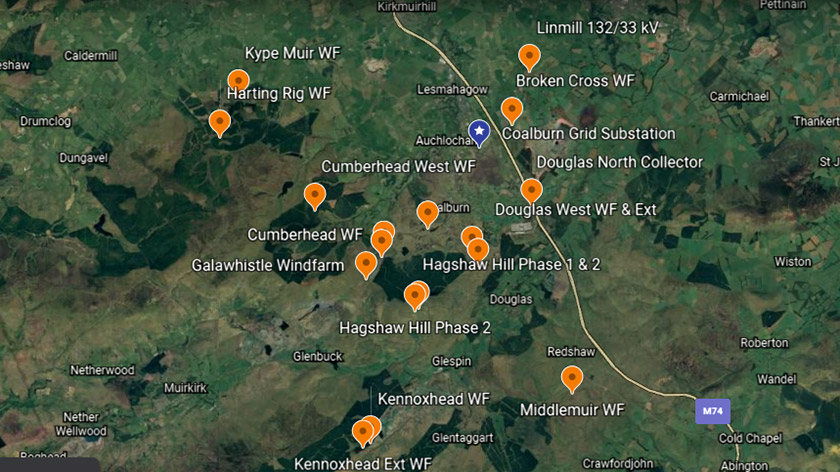
Note.
- The orange arrows are wind farms and there appear to be around a dozen of them.
- The blue arrow is Coalburn Grid Substation.
- Running through the area is the M74 between Glasgow and Carlisle.
- There are some remains of opencast coal-mines in the area, which have been restored and turned into wind farms.
- I have found the capacity of fourteen of the existing wind farms and it totals 946 MW, which is an average capacity for each wind farm of 67 MW.
- During my search for capacity, I found a couple of wind farms that were being upgraded with larger turbines.
- The SP Energy Networks page gives a date of Q3 2025 for connection of the Coalburn battery to the sub-station.
With the 500 MW/1000 MWh Coalburn 1 battery, I wouldn’t be surprised that this massive onshore wind farm complex has been designed to provide a guaranteed 1000 MW to the grid.
Gresham House Energy Storage Sets GBP80 Million Fundraise
Gresham House Energy Storage Fund must be doing something right, as similar headlines are used in half-a-dozen places on the Internet and they regularly seem to be raising more money.
But then, as a Graduate Control Engineer and a previous owner of half a finance company, I’ve always thought raising money to build batteries was a good idea.
My only niggle with Gresham House, is that I would have thought by now, they would have put some money into building one of the excellent new technology batteries that are coming through.
The storage fund or some of its employees, may of course have contributed to some of the crowdfunding for these new technologies, all of which I feel have a good chance of being a success.
Note.
- Energy Dome is Italian and all the others are at least fifty percent British.
- Most of the British batteries have had backing from the UK government.
- All these batteries are environmentally-friendly.
- None of these batteries use large quantities of rare and expensive materials.
- Energy Dome even uses carbon dioxide as the energy storage medium.
In addition, in Scotland, there is traditional pumped storage hydro-electricity.
Project Iliad
This article on renews.biz has a slightly different headline of Gresham House To Raise £80m For US Battery Buildout.
This is the first two paragraphs.
Gresham House Energy Storage Fund is seeking to raise £80m through a share placing.
The new equity raised will primarily be used to finance 160MW of solar with co-located four-hour battery projects in California, US, known as Project Iliad.
The article then gives a lot of financial details of Project Iliad and Gresham House.
Will Gresham House be backing co-located solar/battery projects in the UK?
- In Cleve Hill Solar Park, I write about a co-located solar/battery project in Kent.
- This press release from National Grid is entitled UK’s First Transmission-Connected Solar Farm Goes Live, which also describes a co-located solar/battery project, being built near Bristol.
These two projects are certainly serious and could be pathfinders for a whole host of co-located solar/battery projects.
WillGresham House back some of this new generation?
Boralex Commissions BESS At Wind Farm In France In EU-Supported Demonstration Project
The title of this post, is the same as that of this article on Energy Storage News.
These two paragraphs outline the project.
Canada-based renewable energy firm Boralex has turned on a 3.3MWh battery storage unit attached to a wind farm in France.
The battery storage project has been installed at the site of the Plouguin wind farm, an 8MW generating facility in the Finistere department of Brittany, northwest France.
Note.
- The project was co-financed by the European Union through its European Regional Development Fund (ERDF).
- The project was launched to demonstrate the technical feasibility of a hybrid wind-plus-storage project.
- Boralex added in its announcement that the project will contribute to the stability of the French electricity grid.
There will be a lot of projects like this in the future.
This paragraph makes an interesting point about using batteries with solar and wind power.
Wind farms are less frequently hybridised with energy storage than solar PV because of the larger minimum project size and less predictable variability, with sharper peaks meaning heavier battery cycling and potentially faster degradation.
My control engineering knowledge and experience says that larger power sources and those that are highly variable will need batteries with more capacity for the same stability and quality of power output.
This sounds to me like a very good reason for developing larger and more affordable batteries, like those of Cheesecake Energy, Energy Dome, Gravitricity and Highview Power.
It also probably means that to stabilise several gigawatts of wind power, you need a very large amount of storage, that can only be provided by pumped storage hydroelectricity.
Conclusion
A very large amount energy storage is going to be needed.
Projects like these are essential to make sure we use them to their full possibilities.
Quinbrook Breaks Ground On ‘Largest’ Solar And Storage Project In The UK
The title of this post, is the same as that of this article on Energy Storage News.
These three paragraphs outline the project.
Quinbrook Infrastructure Partners has started construction on Cleve Hill Solar Park, the largest solar and energy storage project in the UK, it claimed.
The specialist global investment manager revealed the Kent-based project, which consists of 373MW of solar and “more than” 150MW of battery energy storage, is expected to be fully completed by the end of 2024.
Once complete, Cleve Hill Solar Park will consist of 880,000 solar panels and battery storage. It was granted development consent by the energy secretary in May 2020.
It is my view, as a Control Engineer, that all solar farms and wind farms should be paired with an appropriately-sized energy storage device.
If this project works out well, we should repeat it on other solar farms of a similar size.
World’s Largest-Of-Its-Kind Power Line To Deliver Clean Power To 1.8m UK Homes And Boost Energy Security
The title of this post, is the same as that as this press release from the UK Government.
These are the three bullet points of the press release.
- LionLink power line between UK and Netherlands will deliver enough electricity to power more homes than Manchester and Birmingham combined.
- Agreement made as Grant Shapps leads delegation of leading businesses to key North Sea Summit.
- Part of renewed Government drive to work with business to help grow the economy.
These three paragraphs outline the project.
The world’s largest multi-use electricity power line will be built under the North Sea, boosting UK energy supplies with enough to power 1.8 million homes – more than Birmingham and Manchester combined.
The new LionLink will connect the UK and the Netherlands with offshore wind farms, providing clean affordable and secure energy to Britain which will help cut household bills and drive Putin’s Russia further out of the energy market.
The cross-border electricity line will be only the second of its kind in the world, with the first having been built by Germany and Denmark. However, it will be able to carry more than four times the amount of electricity as its predecessor – making it the largest of its kind in terms of capacity anywhere in the world.
Note.
- I suspect the LionLink will go via the Dogger Bank, where Danish, Dutch, German and UK territorial waters meet an we are already building 8 GW of fixed foundation offshore wind. The other countries are also active in the area.
- The press release doesn’t mention, where the LionLink will make landfall in the UK.
- Much of the connection will probably use the cables being laid for the Dogger Bank wind farms.
- There is also no mention of the North Sea Wind Power Hub, which could be an artificial island on the Dogger Bank.
There is also a press release on the National Grid web site, which is entitled National Grid And TenneT Collaborate On Proposed First-Of-A-Kind Anglo-Dutch Electricity Link, which gives more details.
- The capacity is stated to be 2 GW.
- Like the current BritNed interconnector, the project will be a cooperation between National Grid And TenneT.
- TenneT is a limited liability company owned by the Dutch government, that is a transmission system operator in the Netherlands and in a large part of Germany.
There is also a diagram, showing how the LionLink will work, which includes these components.
- On the Dutch side, there is an offshore AC>DC Converter Station, which is connected to the Dutch electricity grid and one or more offshore wind farms.
- Across the border between the Dutch and UK Exclusive Economic Zones, there will be a HVDC cable.
- The HVDC cable will terminate in an onshore DC>AC Converter Station in the UK, which will be connected to the UK electricity grid.
No details of the two landfalls have been given.
More information is given in this article on offshoreWIND.biz, which is entitled UK And Netherlands Unveil Multi-Purpose Interconnector Plans.
- This shows a map of the North Sea with an interconnector running in a straight line between possibly Rotterdam and Bacton in Norfolk.
- A wind farm is shown connected to this interconnector.
This paragraph describes the windfarm and the interconnector.
LionLink, a multi-purpose interconnector that was announced today at the North Sea summit, could connect a Dutch offshore wind farm with a capacity of 2 GW to both countries via subsea interconnectors.
If the wind farm has a capacity of 2 GW, I would assume it can supply up to 2 GW to the UK and The Netherlands.
This is a classic system, that can be optimised by the application of sound principles.
All electricity generated by the wind farm must be used, stored or converted into green hydrogen.
Electricity will be distributed as to need.
Energy storage or electrolysers could be sited at either end or even in the wind farm.
I would suspect that more wind farms could be connected to the interconnector.
The team, that write the control system for the grid will have a lot of fun!
BritNed
I have a feeling that National Grid and TenneT have taken a long hard commercial look at the electrical and financial performance of BritNed over the last year and decided, that a second connection would be to the mutual benefit of both companies, their customers and the UK and The Netherlands in general.
It would also be twice as difficult for terrorists sponsored by Putin to cut two cables.
Conclusion
This is a great leap forward for wind power in the North Sea and Europe.
Highview Power And Ørsted Collaborate To Unlock Greater Value From The Next Generation Of Wind Farms
The title of this post, is the same as that of this press release from Ørsted.
This is the sub-heading.
Highview Power and Ørsted have signed a Memorandum of Understanding aiming to prove the feasibility and economic value of co-locating long duration energy storage with offshore wind.
This first paragraph indicates how the two companies will work together.
The two companies will carry out detailed technical analysis and an economic assessment during 2023 that will investigate how combining Ørsted’s wind technology with Highview Power’s liquid air energy storage can deliver a stronger investment case for future offshore wind projects by reducing wind curtailment, increasing productivity, and helping the move to a more flexible, resilient zero carbon grid.
This all good stuff and as a Control Engineer, I know, there is a very good chance, it will bring forward worthwhile benefits.
£100m Boost For Biggest UK Hydro Scheme In Decades
The title of this post, is the same as that of this article on the BBC.
This is the sub-heading.
A giant hydro scheme which would double the UK’s ability to store energy for long periods is taking a leap forward with a £100m investment by SSE.
These are the first three paragraphs.
The proposed 92m-high dam and two reservoirs at Coire Glas in the Highlands would be Britain’s biggest hydroelectric project for 40 years.
Scottish ministers approved the 1.5 GW pumped storage facility in 2020.
But power giant SSE wants assurances from the UK government before finally signing it off.
There are two major problems with this scheme.
Why The Forty Year Wait?
I am an Electrical and Control Engineer and it is a scandal that we are waiting forty years for another pumped storage scheme like the successful Electric Mountain or Cruachan power stations to arrive.
Petrol or diesel vehicles have batteries for these three main purposes.
- To start the engine.
- To stabilise the output of the generator or alternator.
- To provide emergency power.
As to the latter, I can’t be the only person, who has dragged a car out of a ford on the starter motor. But think of the times, you’ve used the hazard warning lights, after an accident or an engine failure.
The nightmare of any operator of a complicated electricity network like the UK’s is a black start, which is defined by Wikipedia like this.
A black start is the process of restoring an electric power station or a part of an electric grid to operation without relying on the external electric power transmission network to recover from a total or partial shutdown.
Hydro electric power stations and especially those that are part of pumped storage schemes are ideal for providing the initial power, as they are often easy to start and have water available. Cruachan power station has a black start capability, but at 440 MW is it big enough?
Over the last few years, many lithium-ion batteries have been added to the UK power network, which are used to stabilise the grid, when the sun isn’t shining and the wind isn’t blowing.
There are four pumped storage hydro-electric schemes in the UK.
- Cruachan – 440 MW/7 GWh – 1965
- Dinorwig (Electric Mountain) – 1800 MW/9.1 GWh -1984
- Ffestiniog – 360MW/1.44 GWh – 1963
- Foyers – 300 MW/6.3 GWh – 1974
Note.
- I always give the power output and the storage capacity for a battery, if it is known.
- According to Wikipedia, Scotland has a potential for around 500 GWh of pumped storage.
- The largest lithium-ion battery that I know, that is being planned in the UK, is Intergen’s 320 MW/640 MWh battery at Thames Gateway, that I wrote about in Giant Batteries Will Provide Surge Of Electricity Storage. It’s smaller than any of the four current pumped storage schemes.
- The Wikipedia entry for Coire Glas says that it is a 1.5 GW/30 GWh pumped storage hydro-electric power station.
I very much feel that even one 1.5 GW/30 GWh pumped storage hydro-electric power station must make a big difference mathematically.
Why have we had to wait so long? It’s not as though a pumped storage hydro-electric power station of this size has suffered a serious disaster.
Drax Needs Assurances Too?
The BBC article says this.
Scotland’s only other pumped storage scheme, operated by Drax Group, is housed within a giant artificial cavern inside Ben Cruachan on the shores of Loch Awe in Argyll.
The North Yorkshire-based company plans to more than double the generating capacity of its facility, nicknamed Hollow Mountain, to more than 1GW, with the construction of a new underground power station.
But both Drax and SSE have been reluctant to press ahead without assurances from Whitehall.
It looks like the right assurances would open up at least two pumped storage hydro-electric power station projects.
But it could be better than that, as there are other projects under development.
- Balliemeanoch – 1.5GW/45 GWh
- Corrievarkie – 600 MW/14.5 GWh
- Loch Earba – 900 MW/33 GWh
- Loch Kemp – 300 MW/9 GWh
- Red John – 450 MW/2.8 GWh
This totals to 3750 MW/104.3 GWh or 5850 MW/134.3 GWh with the addition of Coire Glas and the extension to Cruachan.
Getting the assurances right could result in large amounts of construction in Scotland!
What Assurances Do Power Giants SSE And Drax Want Before Signing Off?
This news item on SSE Renewables, which is dated 18th March 2022, is entitled Ministerial Roundtable Seeks To Unlock Investment In UK Energy Storage.
These three paragraphs gives details of the meeting.
Business leaders have met with UK Energy Minister the Rt Hon Greg Hands MP to discuss how the government could unlock significant investment in vital energy storage technologies needed to decarbonise the power sector and help ensure greater energy independence.
The meeting was organised by the Long-Duration Electricity Storage Alliance, a new association of companies, progressing plans across a range of technologies to be first of their kind to be developed in the UK for decades.
Representatives from Drax, SSE Renewables, Highview Power and Invinity Energy Systems met with The Rt Hon Greg Hands MP, Minister of State for Business, Energy and Clean Growth [yesterday].
But they still don’t seem to have come up with a funding mechanism.
- In this case, it seems that multiple politicians may not be to blame, as Greg Hands was the Minister of State for Business, Energy and Clean Growth until the 6th of September 2022, when he handed over to Graham Stuart, who is still the incumbent.
- Could it be that civil servants for this problem need to be augmented by a Control Engineer with mathematical modelling skills from a practical university?
It is the sort of problem, I would love to get my teeth into, but unfortunately my three mentors in accountancy and banking; Bob, Brian and David, who could have helped me, have all passed on to another place to help someone else with their problems.
I’ve just had a virtual meeting with all three and they told me to look at it like a warehousing system.
Consider.
- It would be very easy to measure the amount of water stored in the upper reservoir of a pumped storage hydro-electric power station.
- It would also be easy to measure the electricity flows to and from the pumped storage hydro-electric power station.
- A monetary value could be placed on the water in the upper reservoir and the flows, depending on the current price for electricity.
So it should be possible to know that a pumped storage hydro-electric power station, was perhaps storing energy as follows.
- 10 GWh for SSE
- 8 GWh for RWE
- 6 GWh for Scottish Power
- 6 GWh is not being used
And just as in a warehouse, they would pay a fee of so much for storing each GWh for an hour.
- The system would work with any type of storage.
- Would competition between the various storage sites bring down prices for storing electricity?
- Pumped storage operators would get a bonus when it rained heavily.
- Just as they do now, electricity generators would store it when prices are low and retrieve it when prices are high.
A lot of the rules used to decide where electricity goes would still work.
UK Confirms £205 Million Budget To Power More Of Britain From Britain
The title of this post, is the same as that of this press release from the Department of Energy Security And NetZero.
This is the sub title.
UK government confirms budget for this year’s Contracts for Difference scheme as it enters its first annual auction, boosting energy security.
These are the three bullet points.
- Government announces significant financial backing for first annual flagship renewables auction, boosting Britain’s energy security
- £170 million pledged for established technologies to ensure Britain remains a front runner in renewables and £10 million ring-fenced budget for tidal
- Scheme will bolster investment into the sector every year, delivering clean, homegrown energy as well as green growth and jobs
These are my thoughts.
First And Annual
The scheme is flagged as both first and annual!
Does this mean, that each Budget will bring forward a pot of money for renewables every year?
My father, who being a letterpress printer and a Cockney poet would say it did and I’ll follow his lead.
Two Pots
In Contracts for Difference Round 4, there were three pots.
- Pot 1 – Onshore Wind and Solar
- Pot 2 – Floating Offshore Wind, Remote Island Wind and Tidal Stream
- Pot 3 – Fixed Foundation Offshore Wind
This document on the government web site lists all the results.
For Contracts for Difference Round 5, there will be two pots, which is described in this paragraph of the press release.
Arranged across 2 ‘pots’, this year’s fifth Allocation Round (AR5) includes an allocation of £170 million to Pot 1 for established technologies, which for the first time includes offshore wind and remote island wind – and confirms an allocation of £35 million for Pot 2 which covers emerging technologies such as geothermal and floating offshore wind, as well as a £10 million ring-fenced budget available for tidal stream technologies.
It could be described as a two-pot structure with a smaller ring-fenced pot for tidal stream technologies.
Contract for Difference
There is a Wikipedia entry for Contract for Difference and I’m putting in an extract, which describes how they work with renewable electricity generation.
To support new low carbon electricity generation in the United Kingdom, both nuclear and renewable, contracts for difference were introduced by the Energy Act 2013, progressively replacing the previous Renewables Obligation scheme. A House of Commons Library report explained the scheme as:
Contracts for Difference (CfD) are a system of reverse auctions intended to give investors the confidence and certainty they need to invest in low carbon electricity generation. CfDs have also been agreed on a bilateral basis, such as the agreement struck for the Hinkley Point C nuclear plant.
CfDs work by fixing the prices received by low carbon generation, reducing the risks they face, and ensuring that eligible technology receives a price for generated power that supports investment. CfDs also reduce costs by fixing the price consumers pay for low carbon electricity. This requires generators to pay money back when wholesale electricity prices are higher than the strike price, and provides financial support when the wholesale electricity prices are lower.
The costs of the CfD scheme are funded by a statutory levy on all UK-based licensed electricity suppliers (known as the ‘Supplier Obligation’), which is passed on to consumers.
In some countries, such as Turkey, the price may be fixed by the government rather than an auction.
Note.
- I would trust the House of Commons Library to write up CfDs properly.
- As a Control Engineer, I find a CfD an interesting idea.
- If a generator has more electricity than expected, they will make more money than they expected. So this should drop the wholesale price, so they would get less. Get the parameters right and the generator and the electricity distributor would probably end up in a stable equilibrium. This should be fairly close to the strike price.
I would expect in Turkey with Erdogan as President, there are also other factors involved.
Renewable Generation With Energy Storage
I do wonder, if wind, solar or tidal energy, is paired with energy storage, this would allow optimisation of the system around the Contract for Difference.
If it did, it would probably mean that the generator settled into a state of equilibrium, where it supplied a constant amount of electricity.
Remote Island Wind
Remote Island Wind was introduced in Round 4 and I wrote about it in The Concept Of Remote Island Wind.
This was my conclusion in that post.
I must admit that I like the concept. Especially, when like some of the schemes, when it is linked to community involvement and improvement.
Only time will tell, if the concept of Remote Island Wind works well.
There are possibilities, although England and Wales compared to Scotland and Ireland, would appear to be short of islands.
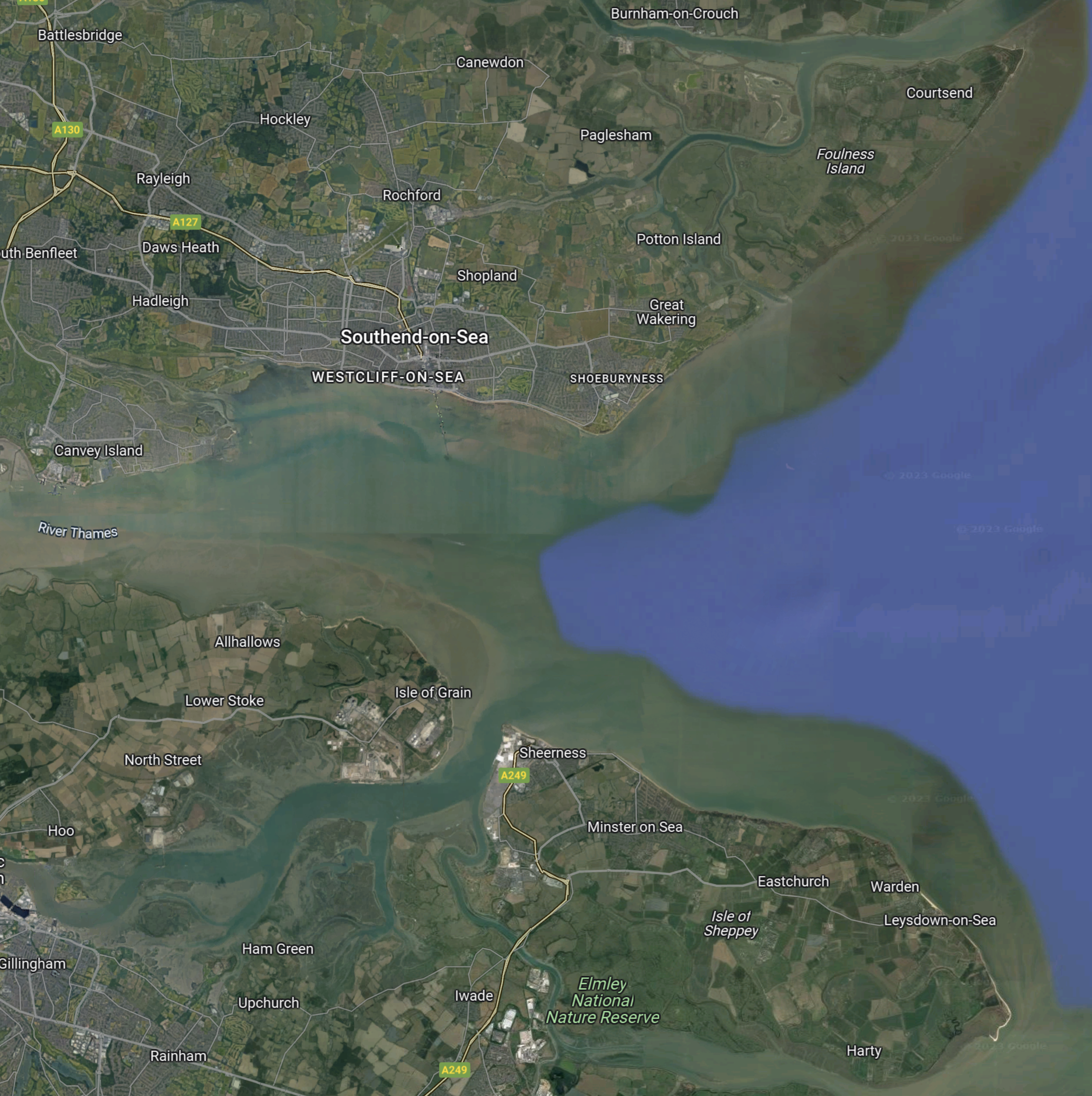
This map shows the islands of the Thames Estuary.
Note.
- In Kent, there is the Isle of Sheppey and the Isle of Grain.
- Between the two islands is a large gas terminal , a gas-fired power station and an electricity sub-station connecting to Germany.
- In Essex, there is Canvey, Foulness and Potton Islands.
- There is also the site at Bradwell, where there used to be a nuclear power station.
If we assume that each island could support 200 MW, there could be a GW of onshore wind for London and perhaps a couple of SMRs to add another GW.
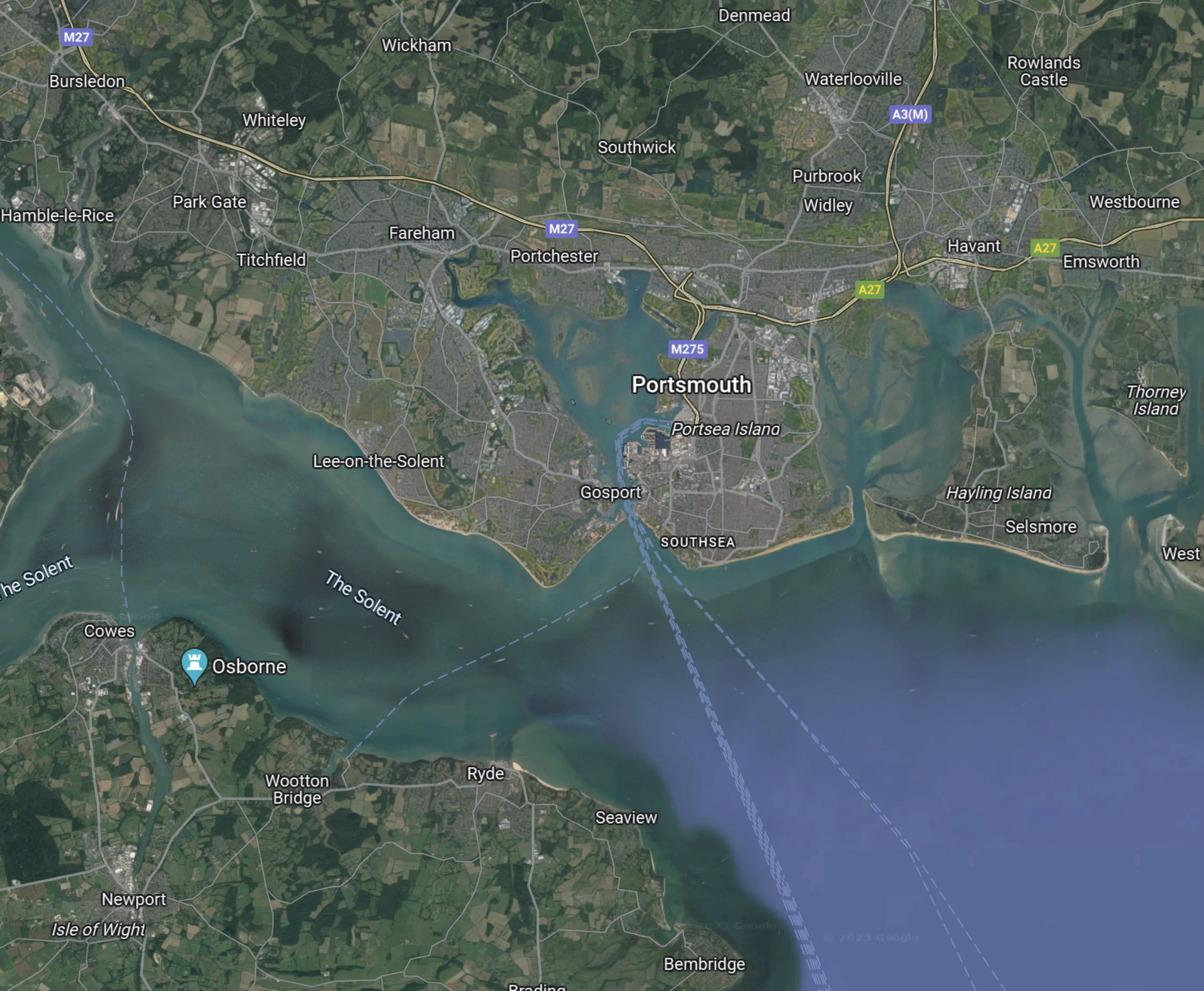
This map shows the islands around Portsmouth.
Note.
- Hayling Island is to the East of Portsmouth.
- Further East is Thorney Island with an airfield.
The Isle of Wight could be the sort of island, that wouldn’t welcome wind farms, although they do make the blades for turbines. Perhaps they should have a wind farm to make the blades even more green.
But going round England and Wales there doesn’t seem to be many suitable places for Remote Island Wind.
I do think though, that Scotland could make up the difference.
Geothermal Energy
This is directly mentioned as going into the emerging technologies pot, which is numbered 2.
I think we could see a surprise here, as how many commentators predicted that geothermal heat from the London Underground could be used to heat buildings in Islington, as I wrote about in ‘World-First’ As Bunhill 2 Launches Using Tube Heat To Warm 1,350 Homes.
Perhaps, Charlotte Adams and her team at Durham University, will capitalise on some of their work with a abandoned coal mine, that I wrote about in Exciting Renewable Energy Project for Spennymoor.
Timescale
This paragraph gives the timescale.
The publication of these notices mean that AR5 is set to open to applications on 30 March with results to be announced in late summer/early autumn 2023, with the goal of building upon the already paramount success of the scheme.
It does look like the Government intends this round to progress at a fast pace.
Conclusion
If this is going to be an annual auction, this could turn out to be a big spur to the development of renewable energy.
Supposing you have a really off-beat idea to generate electricity and the idea place in the world is off the coast of Anglesey.
You will certainly be able to make a bid and know like Eurovision, one auction will come along each year.

