DB And PKP To Expand Cross-Border Rail Services Between Germany And Poland
The title of this post, is the same of that as this article on Railway=News.
These two introductory paragraphs add more detail.
From mid-December 2025, Deutsche Bahn (DB) and PKP Intercity (PKP) are expanding their joint long-distance rail services, increasing the number of direct daily connections between Germany and Poland by more than 50 percent.
Starting on 14 December, 17 daily train pairs will operate across the border, up from the current 11. The additional capacity will provide a two-hourly service on the Berlin–Warsaw route, with seven trains in each direction.
I did a lot of this route, when I did a Home Run From Krakov.
I feel this German-Polish route will attract a lot of passengers, as it serves three excellent Polish cities Gdansk, Krakov and Warsaw, where you can spend a few days and it connects you to Berlin.
German court Rejects Deutsche Bahn’s Appeal To Share Stuttgart 21 Cost Overruns With Partners
The title of this post, is the same as that of this article on Railway Gazette.
These three paragraphs add more details.
A court has rejected Deutsche Bahn’s argument that the financial responsibility for cost overruns on the Stuttgart 21 project should be shared with its partners, which include the Land of Baden-Württemberg, the Stuttgart regional authority, Stuttgart city council and Stuttgart airport.
When launched in 2010, the project to remodel the local rail network, which includes 57 km of new line and a rebuilt Stuttgart Hauptbahnhof with underground platforms, was expected to cost €4·1bn.
It has since undergone steady cost increases, and is now projected to cost more than €11bn. It was originally expected to be completed in 2019, but has been continually delayed and partial opening is now to take place in December 2026 with full completion in 2027.
With a prospective increase in costs of nearly three times and being eight years late, it does seem that we’re not alone in getting large projects spectacularly wrong.
Paris – Berlin Direct High Speed Train Service Launched
The title of this post, is the same as that of this article on the Railway Gazette.
This was the sub-heading.
A daily high speed train service linking Paris Est and Berlin Hbf was launched on December 16.
These four paragraphs outline a few details of the service.
It is operated through the Alleo partnership of SNCF Voyageurs and DB, with both French and German onboard staff and using DB Class 407 Velaro D trainsets built by Siemens Mobility.
The journey time is just over 8 h, using high speed lines from Paris to Strasbourg and from Frankfurt to Berlin, and calling at Strasbourg, Karlsruhe, Frankfurt Süd and Berlin-Spandau.
The service is targeted at both leisure and business travellers, with the operators highlighting the environmental benefits of the rail journey producing 2 kg of CO2, compared to 200 kg when flying.
Fares start at €59·99 in standard class and €69·99 in first.
Those prices seem good value.
I have just looked up going on the direct trains from Paris to Berlin on 19th Feb and coming back on the 21st.
These were the two trains.
- Paris Est – Berlin HBf 19th Feb – 09:55-18:03 – 8:08 – £52:00
- Berlin HBf – Paris Est 21st Feb – 11:54 – 20:00 – 8:06 – £86:50
Note.
- Why is it cheaper to go to the East?
- The Berlin HBf – Paris Est should allow you to catch a late Eurostar to London.
- easyJet could get you fast and affordably between Gatwick and Berlin Brandenburg Airport.
- Lumo can get you between London and Edinburgh for under £25:00.
New train services are opening up interesting trips.
Consider.
- I’ve not been to Berlin by train except from the East.
- I’ve not been to the new Brandenburg Airport.
- I’ve not done an eight-hour East-West daytime train trip across Europe.
- I want to look at Karlruhe and Chemnitz, and their new tram-trains.
I might organise my trip like this.
- Eurostar from London to Brussels
- Train from Brussels to Karlsruhe
- Overnight in Karlsruhe
- Train from Karlsruhe to Chemnitz
- Overnight in Chemnitz
- Train from Chemnitz to Berlin
- Overnight in Berlin
- Train from Berlin to Paris
- Walk between Paris Est and Paris Nord
- Eurostar from Paris to London
Note.
- I’ve done London to Karlsruhe in a day via Brussels.
- There will be three nights in hotels.
- It should be possible to do Berlin and London via Paris in a day.
I think I’ll at least plan it.
Innotrans 2024: Rolls-Royce Shows mtu Solutions For On-Track Energy Transition And Celebrates 100 years Of Rail Engine Business
The title of this post, is the same as that of this press release from Rolls-Royce.
These four bullet points, act as sub-headings.
- All mtu engine series for locomotives and railcars approved for sustainable fuels
- DB, RDC Autozug Sylt, Trenitalia and České dráhy use or test HVO
- Rolls-Royce celebrates 100 years of success with mtu rail drives
- More than 250 rail customers worldwide value the performance, compact design and low exhaust emissions of mtu systems
These are the first two paragraphs.
Rolls-Royce will be presenting its mtu-brand propulsion and service solutions at the international rail exhibition Innotrans in Berlin from September 24 to 27, 2024 in Hall 18, Booth 500. The company will be celebrating an anniversary at the same time: for 100 years, mtu products have been powering trains, including mainline and multi-purpose locomotives, high-speed trains and local transport railcars. On display will be sustainable propulsion solutions such as the mtu Series 4000 and 1600 engines for locomotives and the underfloor drive systems mtu PowerPacks for railcars, all of which are now released for sustainable fuels such as HVO. Rolls-Royce will also be presenting its repower and reman solutions.
100 years ago, Karl Maybach laid the foundation for the rail drive systems of today’s mtu brand with the world’s first high-speed diesel engine for railcars, the Maybach G 4a. Maybach also developed the GO 5 engine for the “Fliegender Hamburger” express train.
These are my thoughts.
Chiltern Railways Could Go Carbon-Neutral By Using HVO
In Vegetable Oil Fuelling Chiltern Railways Trains In UK First, I described how Chiltern Railways are running their Class 68 locomotives on HVO.
This move by Rolls-Royce mtu will allow all Chiltern’s Class 168 trains to be run on sustainable HVO, as they have Rolls-Royce mtu diesel engines.
Chiltern Railways Class 168 train fleet is as follows.
- 10 x 4-car
- 9 x 3-car
- 9 x 2-car
This will still leave Chiltern Railways Class 165 train fleet to be converted to sustainable fuel.
- 28 x 2-car
- 11 x 3-car
Note.
- There are 75 of these trains in service with Chiltern Railways and Great Western Railway.
- They are fitted with Perkins engines.
- Perkins engines are now owned by Caterpillar, who built the engines for the Class 68 locomotives.
As Caterpillar have the sustainable diesel technology, could they convert the Class 165 trains to HVO?
Cummins And HVO
Although this post is mainly about Rolls-Royce mtu, it would be convenient to put in this section about Cummins and how their diesel engines run on HVO.
The UK train fleet contains the following trains with Cummins engines.
- 10 x Class 175 train x 2-car
- 16 x Class 175 trains x 3-car
- 14 x Class 180 trains x 5-car
- 34 x Class 220 trains x 4-car
- 23 x Class 221 trains x 5-car
- 4 x Class 221 trains x 4-car
- 4 x Class 222 trains x 7-car
- 23 x Class 222 trains x 5-car
Cummins says this about their engines and HVO.
Cummins approves use of HVO fuel in all high-horsepower engines
(19L-95L), including the QSK19, K19, QSK23, QST30, QSK38, K38, QSK45,
QSK50, K50, QSK60, QSK78, QSK95, V903 and ACE for all industrial
markets. No engine modifications are required; engines currently in the
field can be used with HVO at any percentage.
It would appear that all trains with Cummins engines can be converted to run on HVO.
CAF And HVO
Class 195, 196 and 197 trains all have Rolls-Royce mtu diesel engines, so they will be able to run on HVO.
Hitachi And HVO
Class 800, 1801, 802, 805 and 810 trains all have Rolls-Royce mtu diesel engines, so they will be able to run on HVO.
Conclusion
If all diesel engines are to be converted to HVO, there is going to be a lot of HVO needed in the UK.
But many train fleets will be carbon-neutral.
Arriva’s Grand Central Applies For Extended Track Access Rights
The title of this post, is the same as that of this news item from Arriva.
These three bullet points, act as sub-headings.
- Grand Central to submit application to the rail regulator for extended track access up to 2038.
- Proposals for a new, greener fleet are outlined as part of the application.
- Application signals Arriva’s long-term commitment to UK rail.
These three paragraphs add more detail to the application.
Arriva Group’s UK open access train operating company, Grand Central, has today announced it is seeking to extend its existing track access rights until 2038, securing its services for the next 15 years and unlocking Arriva’s intentions to invest in new, state-of-the-art trains.
Grand Central has been operating services on the East Coast mainline since 2007 as an open access operator, which means it receives no government funding or subsidy. It directly links 15 destinations, including cities in Yorkshire and the North East with London’s Kings Cross.
The application represents a significant commitment to long-term services and supports its plans to expand services with improved connectivity and increased frequency, as outlined in a previous application, submitted to the Office of Rail and Road in May this year.
These are my observations and thoughts.
Grand Central’s Current Services
Grand Central currently runs two separate services.
- King’s Cross and Sunderland via Peterborough,York, Thirsk, Northallerton, Eaglescliffe and Hartlepool – six tpd
- King’s Cross and Bradford Interchange via Peterborough, Doncaster, Pontefract Monkhill, Wakefield Kirkgate, Mirfield, Brighouse, Halifax and Low Moor – four tpd
Note.
- tpd is trains per day.
- Weekend services are reduced.
- Peterborough is served by one train in each direction.
Grand Central have applied to run more services.
Distances Without Electrification On Current Services
Only the Northern ends of both routes are not electrified.
- King’s Cross and Sunderland – Longlands junction and Sunderland – 48.5 miles
- King’s Cross and Bradford Interchange – Doncaster and Bradford Interchange – 52.1 miles
Note.
- Going North, any train batteries could be charged on the East Coast Main Line.
- Before returning South, train batteries could need to be charged at the two terminals.
- Battery-electric trains would need infrastructure changes at the two terminals.
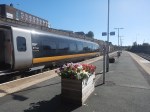
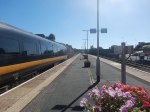
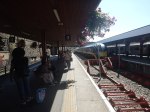
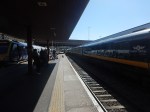
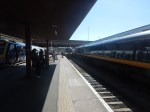
The two terminals; Bradford Interchange and Sunderland are not particular spacious.
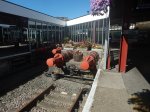
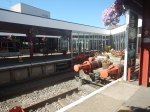
These pictures show Bradford Interchange station.

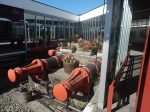
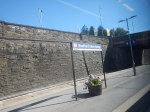

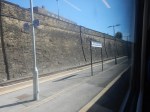
And these pictures show Sunderland station, which is underground.
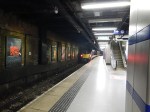
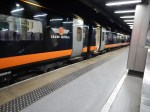

Putting even a short length of catenary to charge battery-electric trains might not be that easy at either station.
Grand Central’s New Trains
Arriva’s news item, gives these details on the new trains.
- Increased capacity: The new trains would feature approximately 20 per cent more seats than the current Class 180 units, providing additional capacity to meet growing passenger demand.
- Modernised fleet: The new Bi-Mode trains would replace the existing 24-year-old Class 180 units bringing new customer focussed features and a more comfortable experience for passengers.
- Greener services: The Bi-mode trains would cut carbon emissions and provide smoother journeys for passengers. They can operate on electric and non-electric tracks, so they can serve long into the future as track electrification gathers pace across the UK.
Note.
- A five-car Class 802 train has approximately twenty percent more seats than a four-car Class 180 train.
- Hull Trains, LNER, Lumo and TransPennine Express all run Hitachi Class 80x trains on the East Coast Main Line, which could ease operations, if all trains were similar.
- Bi-mode trains are specified. Grand Central will change mode once on each trip.
- LNER have specified CAF Tri-mode trains for their new fleet. Will these have an extra level of complication, that Grand Central don’t need?
I suspect that rand Central will opt for the Hitachi trains.
Using The Joint Line Between Peterborough and Doncaster via Lincoln
The diesel Class 180 trains can use this line, in times of incidents or engineering works.
Class 800 and Class 802 trains can also use this diversion, so it might be sensible to be able to use the line in time of trouble.
Chiltern Trains’ London And Birmingham Services
Both Arriva and Chiltern Trains are subsidiaries of Deutsche Bahn.
Currently, Chiltern run six-car rakes of Mark 3 coaches, with a Class 68 locomotive at one end and a driving van trailer at the other, between London and Birmingham.
They are nice trains, but they are not zero-carbon.
Could these be replaced by an eight-car Class 802 train?
- Chiltern have said that they are looking for new trains.
- An eight-car Class 802 train could be a similar length to the current trains.
- London Marylebone and Birmingham Moor Street is only 111.7 miles.
- The Hitachi trains would offer an increase in capacity.
- They might save a few minutes.
But the trains will still be not zero-carbon.
This page on the Hitachi web site is entitled Intercity Battery Trains.
The trains for London Marylebone and Birmingham Moor Street would be built as conventional eight-car Hitachi trains, with perhaps four diesel engines.
- Over the years, the Chiltern Main Line would be partially electrified, starting perhaps in the middle around Banbury.
- One by one, the diesel engines would be replaced by batteries, so that the trains could run on battery power between the electrified sections.
- Eventually, the London Marylebone and Birmingham Moor Street service would be fully battery-electric.
- As Kidderminster is only twenty miles past Birmingham Moor Street, there must surely be possibility for extension of the service.
I believe that Hitachi’s Intercity Battery Train, is going to play a large part in the decarbonisation of UK railways.
Chiltern Trains’ London And Oxford Services
If eight-car Hitachi Intercity Battery Trains can handle London Marylebone and Birmingham Moor Street services, then I am fairly sure that five-car Hitachi Intercity Battery Trains could handle London Marylebone and Oxford services.
They would also have more capacity, than the current trains, that serve Oxford and Bicester Village.
Conclusion
It may be advantageous for Deutsche Bahn to put the two orders together.
Smart Train Lease Aims ‘To Make Renting Trains As Easy And Simple As Renting A Car’
The title of this post, is the same as that of this article on Railway Gazette International.
These four paragraphs outline the scheme.
Siemens Mobility has established a leasing subsidiary that would enable train operators to use its Mireo Smart battery, hydrogen and electric multiple-units without needing to make long-term investment commitments.
Smart Train Lease GmbH would make available at short notice multiple-units already approved for operation. These could be short or medium-term leases, with services such as maintenance available as part of the package. The aim is to provide operators with an economical way to quickly and flexibly expand their fleets and try out more sustainable traction technologies.
‘We want to make renting trains as easy and simple as renting a car, and thus help accelerate the mobility transition’, the leasing company’s CEO Benjamin Dobernecker explained on February 14.
Smart Train Lease will initially operate in Germany, although it plans to expand throughout Europe in the medium term.
I like this idea and I think it will work.
Metier Management Systems And Artemis
When four of us started Metier Management Systems in 1977 to sell our mini-computer-based project management system; Artemis, we generally rented or leased our systems, although we did sell some as the years progressed.
- For a fixed fee per month, a company got a project management computer and all the software.
- The fixed fee included installation, first line support, training and software updates.
- We could also supply extra training and project management consultancy at appropriate rates.
- The only extra costs to the client were the electricity to power the hardware and the paper to put in the printer.
- We also allowed clients to convert leases into outright sales.
This simple sales model appealed to a lot of our clients.
- The cost of the system was easy to budget.
- Many of our clients were happy with leasing or renting computer equipment.
- As the system was desk-sized, it easily fitted the average office.
But the leasing model was very advantageous to us.
- Most of our clients were large high-value quality organisations like big oil companies, nationalised industries and engineering consultancies.
- Our Finance Director and our Bank Manager at Lloyds Bank devised a plan, whereby we bundled a number of high-quality leases together and sold the bundle to Lloyds Bank’s leasing company.
The money we received gave us a healthy cash flow.
- The cash flow was then used to fund Research and Development and to finance more sales.
- If say someone like BP or Shell should phone up or send a fax, wanting a system immediately, we were generally able to fulfil their request.
I am sure that Siemens Mobility will be using a similar model.
They will aim to have trains in stock to fulfil clients needs.
So if Deutsche Bahn phone up saying have you got a three-car battery-electric train that works with 15 KVAC and has a range of 100 kilometres for next Monday, Siemens Mobility can generally say yes.
What helps is that the modular Mireo Smart multiple unit comes in battery, hydrogen and electric versions.
Extras could include full servicing a driver.
So Siemens Mobility will plug the train together and deliver it.
How Would Siemens Use The Leasing Model In Great Britain?
Consider.
- There are a lot of routes that need to be decarbonised in Great Britain.
- Many of these routes have electrification at one or both ends.
- Often these routes terminate in a bay platform.
- On most of these routes a two-, three-, four- or five-car train will be sufficient capacity.
- In the Desiro City, Siemens have a train, that is acceptable to Great Britain.
- If routes in Great Britain are to be electrified, they must be electrified with 25 KVAC overhead wires.
- Trains would be 100 mph, so they wouldn’t be limited as to routes.
- A Mireo-B has a range of between 80-100 kilometres or 49.7-74.6 miles.
I am sure Siemens Desiro City or its European equivalent; Mireo can be developed into a family of trains suitable for GB!
- The basic train would be two driving cars.
- Length would be increased by coupling trailer cars between the two driving cars.
- Hydrogen power would be in one of the trailers.
- Batteries would be under an appropriate number of cars.
Battery trains would be able to use a simple automatic charger, similar to the one, that I described in GWR Trialling Transformative Ultra-Rapid Charging Train Battery.
An Example – Mid-Cornwall Metro
This map shows the Mid-Cornwall Metro.

Consider.
- Newquay and Par is 20.8 miles.
- Falmouth Docks and Par is 30.8 miles.
- Newquay and Falmouth Docks is 51.6 miles.
- The maximum speed between Par and Newquay is around 30 mph
- The maximum speed between Par and Falmouth Docks is around 50-70 mph
- There are twelve intermediate stations.
- There is a reverse at Par station.
- Charging would be easy to install at Falmouth Docks, Newquay and Par.
- In Par Station – 10th February 2024, I suggested that Par station could be fully-electrified, so that expresses could have a Splash-and-Dash on their way to London and Penzance. If all platforms at Par were electrified the Mid-Cornwall Metro trains could charge from the electrification, as they reversed.
There are two main ways that the Mid-Cornwall Metro might operate.
- There would be chargers at Newquay and Falmouth Docks and trains would shuttle the 51.6 miles between the two stations.
- There would only be charging at Par and trains would after charging at Par go alternatively to Newquay and Falmouth Docks.
The first might need smaller batteries and the second would only need one charger.
An Example – Uckfield Branch
The Uckfield branch is in Southern England.
- It is not electrified between Hurst Green Junction and Uckfield, which is 24.7 miles.
- There are eight intermediate stations.
- The line can accommodate ten-car trains.
There is space at Uckfield station for a charger.

Charging would be at Uckfield station and North of Hurst Green Junction, where it will use the existing electrification.
Conclusions
This leasing/rental model will surely encourage train operators to replace diesels with appropriate zero-carbon alternatives on routes that need to be decarbonised.
Set Back As Badgers Undermine 11 km Of Railway
The title of this post, is the same as that of this article on Railway Gazette International.
These four paragraphs outline the problems.
Deutsche Bahn reports that burrowing badgers have undermined about 11 km of embankment on the Fröndenberg – Unna railway, and repairs are likely to be very expensive and take a long time as the damage is more extensive than expected.
In some places the repairs will be equivalent to new construction, and DB says the planning and approval phase alone could take several years as the route passes through protected environments. Local media reports that the financial viability of reopening is being questioned.
DB first discovered the damage in 2022, and initiated repairs using a concrete spraying process. It also began to examine the rest of the route and 140 sett entrances have now been discovered, leading to an extensive tunnel system which is believed to have a total length of around 1 500 m spread over the entire length of the embankment.
The line runs through a nature reserve, so investigations had to be suspended over the summer until a special permit was obtained. Trees and bushes also needed to be cut back. Regional train service RB54 remains suspended between Unna and Fröndenberg and replaced by buses, extending journey times by 7 min.
Note.
- The railway appears to be only single-track from Google Maps.
- Unna station is the Easternmost station of the Rhine-Ruhr S-Bahn.
- The RB 54 – Hönnetal-Bahn runs between Fröndenberg and Unna.
I wouldn’t be surprised that this serious problem will be resolved by either closing the railway permanently or by using an expensive rebuild.
How Network Rail Deal With Badgers
I did find this document on the Network Rail web site, which appears to be part of a Safety Course.
There is this page on the Network Rail web site, which is entitled Badgers Sett To Keep Their Homes As Railway Works Around.
Unfortunately for the Germans, they seem to have whole armies of badgers, whereas we seem to have just a couple of families in the second document.
It does look like in the video in the second example, that a certain amopunt of psychology is used to persuade the badgers to do, what Network Rail wants them to do.
Sheep And The M62
When I was at Liverpool University in the 1960s, the Veterinary Department had a contract to design fencing to keep the hardy Pennine sheep off the motorway.
They found that the sheep had little difficulty climbing over a six foot high wire mesh fence.
Perhaps DB should ask Liverpool, if they have any tips!
German Police Probe ‘Political Motive’ In Railway Fires
The title of this post, is the same as that of this article on DW.com.
This is the sub-heading.
A series of fires hit rail infrastructure on the main line between Hamburg and Berlin overnight, leading to widespread train disruptions. Police say they suspect a politically motivated act of sabotage.
This is the first two paragraphs.
German police are investigating a suspected political motive behind an alleged act of sabotage targeting a major train route connecting the port city of Hamburg to the capital, Berlin.
Fire broke out overnight at three locations in the northern Hamburg region, affecting shafts holding railway cables.
This paragraph describes a claim for responsibility.
An anonymous letter published on the far-left website Indymedia claimed responsibility for the incident, describing it as an act of “sabotage.” The letter said it was a protest against “neo-colonial exploitation and earth destroying extraction of raw materials.”
I don’t think we want anything like this in the UK.
On Track For A Low Carbon Energy Future – Centrica Signs Corporate Power Deal With Deutsche Bahn
The title of this post, is the same as that of this press release from Centrica.
These two paragraphs outline the deal.
Centrica Energy Trading has signed a two-year corporate power purchase agreement (PPA) with Deutsche Bahn, Germany’s national railway company.
Starting January 2024, Centrica will offtake power from three onshore wind farms with an installed capacity of 60.7 MW. The sites, developed by Prokon AG in Germany, have a total of 45 turbines and will provide approximately 70GWh of renewable electricity annually to Deutsche Bahn.
Sounds like good business to me! You buy electricity from three German onshore wind farms and flog it to a large German company and probably get an appropriate commission in Euros.
Are These Two Stories Related?
These are two stories recently published in Railway Gazette.
Deutsche Bahn Sells Arriva Businesses To Private Equity Holding Company, which starts with this paragraph.
Deutsche Bahn has reached agreement to sell its Arriva local transport activities in Denmark, Poland and Serbia to München-based private equity holding company Mutares SE & Co KGaA.
That is fairly clear and is probably related with the German government’s desire for DB to concentrate on its core business.seren
This article on Railway Gazette is entitled RENFE Looks At Entering UK Rail Market Through Open Access Partnership, which starts with this paragraph.
Open access passenger service developer Grand Union Trains is working with Spain’s national operator RENFE and private equity firm Serena Industrial Partners on a proposed service between London and Wales.
That also is fairly clear and would bring competition to services to and from South Wales.
It would also help in the financing of Grand Union Trains.
The article also says the following.
- RENFE seem to be expanding into partnerships to run services outside Spain.
- A parkway station at Felindre will be build to avoid the reverse at Swansea, that would save 20 mins.
- It will be a high quality service with new electro-diesel trains.
- Four trains will be needed.
- A 2025 start is envisaged.
Will this partnership with Grand Union Trains proceed with the development of Grand Union Trains’ London and Stirling service?
I have some thoughts and questions.
Will Deutsche Bahn Sell Other Arriva Businesses?
I think this is a reasonable question to ask, especially, as Deutsche Bahn owns two Open Access Operators in the UK; Chiltern Railways and Grand Central Trains.
- Both operators have a good reputation.
- Both operators need to decarbonise, either by updating their current stock or buying new trains.
- Both operators have solid niche markets, where they are often responsible for the stations.
- Both operators have expansion plans.
Would RENFE and Serena Industrial Partners be interested in taking over Arriva UK and developing the business?
The Talgo Factory At Longannet
I believe that there is reason to believe that one of Talgo’s reasons for a factory in Scotland, is that it could have been used to build Russian and dual-gauge trains for Eastern Europe. The trains would have been delivered by ferry from Rosyth.
There is also the not-small matter of the fleet for Rail Baltica, for which Talgo will surely be a bidder.
But Russia’s attack on Ukraine has scuppered that plan, or at least delayed it for a few years. But now, there could be a much larger market for trains in Eastern Europe and especially Ukraine.
If RENFE Acquire Open Access Operators In The UK, They Will Need New Trains
They will certainly need new trains for the South Wales operations, if they go ahead, but if they were to decarbonise Chiltern and Grand Central, the order could be substantial.
With one Spanish train factory in the UK and another a possibility, I would suspect any train order would go to a Spanish train-builder.
If the orders fell right, could we see Talgo’s factory at Longannet built after all?
 The Anonymous Widower