SSE Thermal Outlines Its Vision For The UK’s Net Zero Transition
The title of this post is the same as that of this news item from SSE Thermal.
This is the opening statement.
SSE Thermal, part of SSE plc, is calling on government to turbocharge the delivery of low-carbon technologies to help deliver a net zero power system by 2035.
Two paragraphs then outline what the company is doing.
The low-carbon developer is bringing forward multiple low-carbon projects across the UK. This includes Keadby 3 Carbon Capture Power Station in the Humber – which is being developed in collaboration with Equinor and recently became the first power CCS project in the country to receive planning permission – and Aldbrough Hydrogen Pathfinder, which would unite hydrogen production, storage and power generation in one location by the middle of this decade.
These projects would form part of SSE’s £24bn investment programme in the UK, and in addition to supporting the decarbonisation of industrial heartlands and powering a low-carbon future, they would also help to secure a just transition for workers and communities.
The news item then talks about the future.
Now, SSE Thermal has published ‘A vision for the UK’s net zero transition’ which outlines the need for these low-carbon technologies and the potential of carbon capture and hydrogen in providing flexible back-up to renewables.
It also outlines the steps Government should take to facilitate this:
- Progress the deployment of carbon capture and storage (CCS) and hydrogen infrastructure in a minimum of four industrial areas by 2030.
- Support first-of-a-kind carbon capture and storage and hydrogen projects to investment decisions before the end of next year.
- Increase its ambition for power CCS to 7-9GW by 2030, with regular auctions for Dispatchable Power Agreements.
- Set out a policy ambition for hydrogen in the power sector and a strategy for delivering at least 8GW of hydrogen-capable power stations by 2030.
- Accelerate the delivery of business models for hydrogen transport and storage infrastructure, to kickstart the hydrogen economy.
These are my thoughts.
Carbon Capture And Use
There is no mention of Carbon Capture And Use, which in my view, should go hand in hand with Carbon Capture And Storage.
- Sensible uses for carbon dioxide include.
- Feeding it to plants like tomatoes, flowers, salad vegetables, soft fruit and herbs in greenhouses.
- Mineral Carbonation International can convert a dirty carbon dioxide stream into building products like blocks and plasterboard.
- Deep Branch, which is a spin-out from Nottingham University, can use the carbon dioxide to make animal feed.
- Companies like CarbonCure add controlled amounts of carbon dioxide to ready-mixed concrete to make better concrete and bury carbon dioxide for ever.
Surely, the more carbon dioxide that can be used, the less that needs to be moved to expensive storage.
Note.
- There is a lot of carbon dioxide produced in Lincolnshire, where there are a lot of greenhouses.
- At least three of these ideas have been developed by quality research in Universities, in the UK, Australia and Canada.
- I believe that in the future more uses for carbon dioxide will be developed.
The Government should do the following.
- Support research on carbon capture.
- Support Research on finding more uses for carbon dioxide.
Should there be a disposal premium or tax credit paid to companies, for every tonne of carbon dioxide used in their processes? It might accelerate some innovative ideas!
Can We Increase Power CCS to 7-9GW by 2030?
That figure of 7-9 GW, means that around a GW of CCS must be added to power stations every year.
Consider.
- It is probably easier to add CCS to a new-build power station, than one that is a couple of decades old.
- Better and more affordable methods of CCS would probably help.
- In Drax To Pilot More Pioneering New Carbon Capture Technology, I wrote about a promising spin-out from Nottingham University
- In Drax Secures £500,000 For Innovative Fuel Cell Carbon Capture Study, I wrote about another system at Drax, that captures carbon dioxide from the flue gases at Drax.
If we develop more ways of using the carbon dioxide, this will at least cut the cost of storage.
Can We Deliver At Least 8GW Of Hydrogen-Capable Power Stations By 2030?
Do SSE Thermal mean that these power stations will always run on hydrogen, or that they are gas-fired power stations, that can run on either natural gas of hydrogen?
In ‘A vision for the UK’s net zero transition’, this is said about the hydrogen power stations.
Using low-carbon hydrogen with zero carbon emissions at point of combustion, or blending hydrogen into existing stations.
So if these power stations were fitted with carbon capture and could run on any blend of fuel composed of hydrogen and/or natural gas, they would satisfy our needs for baseload gas-fired power generation.
Hydrogen Production And Storage
SSE’s vision document says this about Hydrogen Production.
Using excess renewables to create carbon-free hydrogen, alongside other forms of low-carbon hydrogen, which can then be stored and used to provide energy when needed.
SSE’s vision document also says this about Hydrogen Storage.
Converting existing underground salt caverns or creating new purpose-built caverns to store hydrogen and underpin the hydrogen economy.
This page on the SSE Thermal web site is entitled Aldbrough Has Storage, where this is said about storing hydrogen at Aldbrough.
In July 2021, SSE Thermal and Equinor announced plans to develop one of the world’s largest hydrogen storage facilities at the Aldbrough site. The facility could be storing low-carbon hydrogen as early as 2028.
With an initial expected capacity of at least 320GWh, Aldbrough Hydrogen Storage would be significantly larger than any hydrogen storage facility in operation in the world today. The Aldbrough site is ideally located to store the low-carbon hydrogen set to be produced and used in the Humber region.
From my own experience, I know there is a similar salt structure in Cheshire, which has also been used to store gas.
Earlier, I said, that one of the things, that SSE would like the Government to do is.
Progress the deployment of carbon capture and storage (CCS) and hydrogen infrastructure in a minimum of four industrial areas by 2030.
If Cheshire and Humberside are two sites, where are the other two?
Deciding What Fuel To Use
If you take the Humberside site, it can provide electricity to the grid in three ways.
- Direct from the offshore and onshore wind farms.
- Using natural gas in the gas-fired power stations.
- Using hydrogen in the gas-fired power stations.
SSE might even add a battery to give them a fourth source of power.
In the 1970s, I used dynamic programming with Allied Mills to get the flour mix right in their bread, with respect to quality, cost and what flour was available.
Finance For SSE Thermal Plans
The news item says this.
These projects would form part of SSE’s £24bn investment programme in the UK.
£24bn is not the sort of money you can realise solely from profits or in sock drawers or down sofas, but provided the numbers add up, these sorts of sums can be raised from City institutions.
Conclusion
I like SSE Thermal’s plans.
Coal Sales Could Lose Tens Of Millions For Consumers
The title of this post, is the same as that of this article on The Times.
These two paragraphs outline the story.
A huge stockpile of coal bought for emergency use in power stations this winter is due to be resold at a loss of tens of millions of pounds to consumers.
National Grid funded the procurement of hundreds of thousands of tonnes of coal as part of a deal to keep open five coal-fired units this winter. The estimated £368 million cost of the “winter contingency contracts”, which includes an undisclosed sum for the coal purchases, is being recouped via energy bills.
Note.
- None of the coal has been burned, as the weather was warmer than expected,
- It is now sitting in various places around the country.
- It will probably sell at a loss and there will be transport costs.
I will look at the mathematics of disposal.
Burning Fossil Fuels
On the Internet, I have found these figures.
- If you burn a kilogram of natural gas you create 15.5 KWh of electricity and 2.75 kilograms of carbon dioxide.
- If you burn a kilogram of coal you create 2.46 KWh of electricity and 2.38 kilograms of carbon dioxide.
This means that natural gas and coal create 0.18 and 0.97 kilograms of carbon dioxide respectively for every KWh generated.
I believe these figures say, that if we have to use a fossil fuel, gas will be much better than coal for climate change reasons.
The Size Of The Problem
We are talking about 130,000 tonnes of coal for EDF and 400,000 for Drax. Uniper’s figure is not stated. Let’s say they make the coal pile up to 600,000 tonnes.
Burning this pile will generate 1,476,000 KWh or 1.476 GWh of electricity and create 1428,000 tonnes of carbon dioxide.
Effect On Total UK Carbon Dioxide Emissions
According to government figures on the Internet in 2021 we emitted 107.5 million tonnes of carbon dioxide.
Burning all that coal in a year, would add less than 1.5 % to our carbon dioxide emissions. Perhaps we should burn it strategically over a number of years, when there are energy supply problems, as it is after all a crude form of energy storage.
What Would I Do With The Savings?
The money saved on the transport and making loss-making sales could be spent on other ways to save carbon emissions, like converting surplus wind energy into hydrogen and blending it with the gas.
I discussed the mathematics of hydrogen blending in UK – Hydrogen To Be Added To Britain’s Gas Supply By 2025.
If we put 2 % hydrogen in our natural gas, this would save nearly 2.5 million tonnes of carbon dioxide emissions in a year. This figure is much bigger than the 1428,000 tonnes of carbon dioxide, that would be created by burning all the coal.
At a level of 2 %, most appliances, boilers and industrial processes would work without change. But a good service would help.
Small Nuclear Power Plants To Replace Gas In Quest For Net Zero
The title of this post is the same as that of this article on The Times.
I was very much involved in the writing of project management software in the last three decades of the last century and if there’s one thing we’re generally good at in the UK, it’s complex project management.
Usually problems arise because of political or ignorant senior management meddling.
Our Energy Saviours
I believe our two energy saviours will be floating offshore wind and small nuclear reactors (SMRs) and both need good project management to be built successfully on production lines.
So I don’t see any reason, why we can’t build large numbers of floating offshore wind farms to supply our electricity.
They are also complimentary, in that the fleet of SMRs back up the wind.
Floating Wind First
Floating wind is likely to be developed at scale first, as certifying anything involving nuclear will take an inordinate time.
The electricity from floating wind farms will keep us going, but it is also starting to develop a nice line in exports.
This press release from Drax is entitled Britain Sending Europe Power Lifeline – Report, where this is the sub-title.
For the first time in over a decade, Britain became a net exporter of electricity to its European neighbours, making around £1.5bn for the economy in three months.
Note.
- The report was written by Imperial College.
- Two new interconnectors; Viking Link and NeuConnect between the UK and Europe are under construction.
- Several large wind farms are under construction and will be commissioned in 2023/24 and could add over 4 GW to UK electricity production.
Exports will only get better.
A Sprint For Wind
So we must have a sprint for wind, which will then provide the cash flow to allow the SMRs to roll in.
Or will that be too much for the ultra-greens, who would object to cash-flow from GWs of wind being used to fund SMRs?
Making Carbon Dioxide Into Protein For Innovative Animal Feed
The title of this post, is the same as that of this article on Horizon.
These are the first three paragraphs.
It’s common knowledge that proteins, a key component of human nutrition, are also essential for making animal feeds. Less well known is the uncomfortable fact that much of the protein we feed animals in Europe leads to deforestation and overfishing worldwide.
Biotechnology start-up Deep Branch have designed a biochemical transformation process that turns carbon dioxide (CO2) into a protein-rich powder for animals to eat.
The Deep Branch process converts carbon dioxide into a powder, called Proton, which has around 70% protein content. This is much higher than natural soy, which has around 40%.
Note.
- The technology is the brainchild of Peter Rowe, a PhD graduate in molecular biology of Nottingham University in the UK.
- Deep Branch appears to be a well-backed Anglo-Dutch company.
- Their backers are European and British household names and institutions.
- Drax, who have plenty of carbon dioxide, are also backers.
I believe that even if Deep Branch doesn’t succeed, then someone else will, with this technology.
Pumped Storage Development In Scotland
The title of this post, is the same as that of this article on International Water Power & Dam Construction.
It describes and gives the current status of the two large pumped storage hydroelectric schemes under development in Scotland.
The 1.5 GW/30 GWh scheme at Coire Glass, that is promoted by SSE.
The Cruachan 2 scheme, that is promoted by Drax, that will upgrade Cruachan power station to 1.04 GW/7.2 GWh.
Note.
- Construction of both schemes could start in 2024, with completion in 2030.
- Both, SSE and Drax talk of a substantial uplift in employment during the construction.
- Both companies say that updated government legislation is needed for schemes like these.
The article is very much a must-read.
Conclusion
Welcome as these schemes are, given the dates talked about, it looks like we will need some other energy storage to bridge the gap until Coire Glas and Cruachan 2 are built.
Will Highview Power step forward with a fleet of their 2.5 GW/30 GWh CRYOBatteries, as was proposed by Rupert Pearce in Britain Will Soon Have A Glut Of Cheap Power, And World-Leading Batteries To Store It.
- The site needed for each CRYOBattery could be smaller than a football pitch.
- In Could A Highview Power CRYOBattery Use A LNG Tank For Liquid Air Storage?, I came to the conclusion that a single LNG tank could hold a lot of liquid air.
- The storing and recovery of the energy uses standard turbomachinery from MAN.
- Highview Power should unveil their first commercial system at Carrington near Manchester this year.
I am sure, that when they get their system working, they could build one in around a year.
Drax To Pilot More Pioneering New Carbon Capture Technology
The title of this post, is the same as that of this press release from Drax.
This is the first paragraph.
Renewable energy pioneer Drax has partnered with the University of Nottingham and Promethean Particles to trial a pioneering new bioenergy with carbon capture and storage (BECCS) process at its North Yorkshire power station.
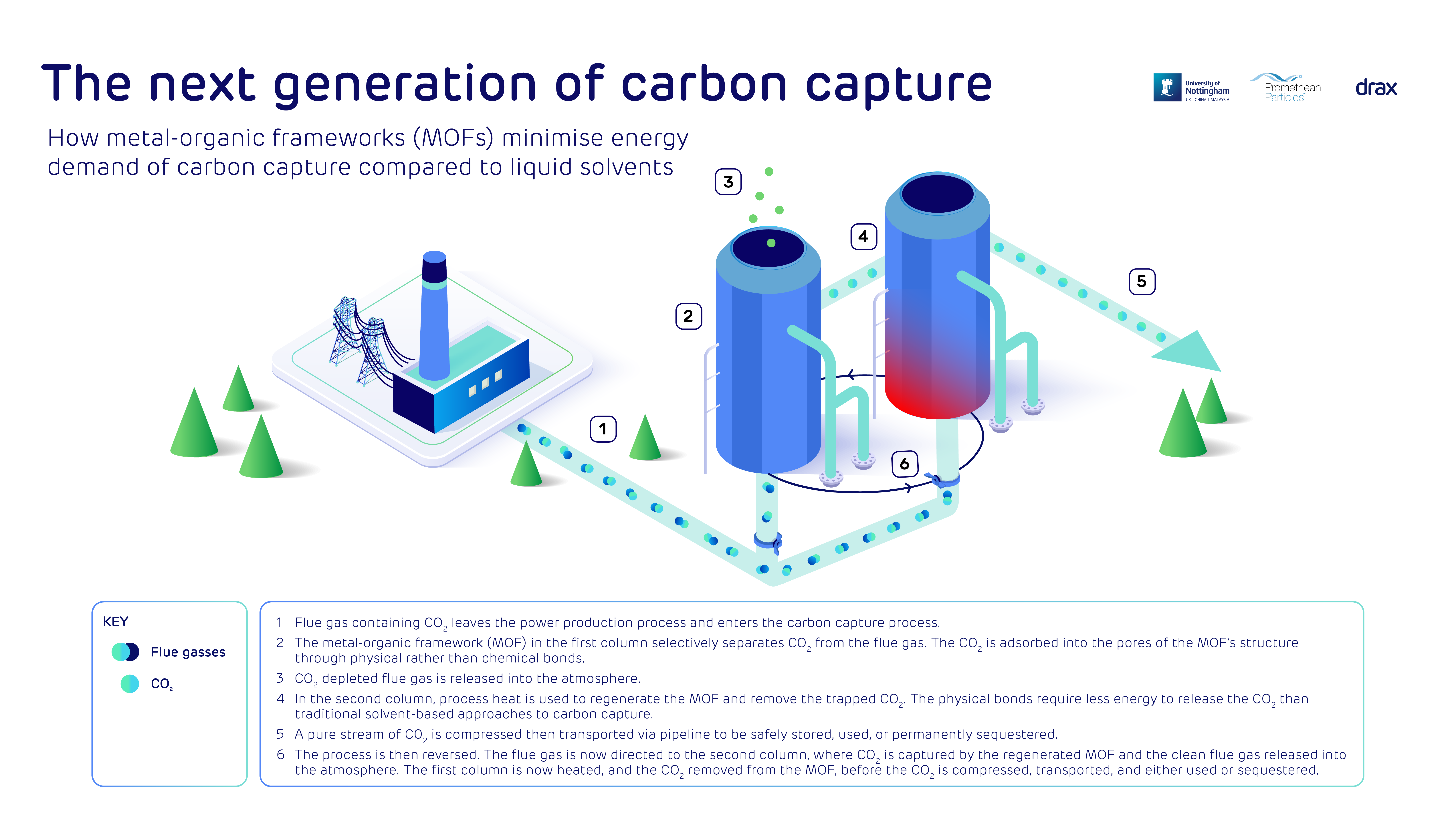
Normally, carbon capture from the flue gas of a power station uses a liquid solvent, which dissolves the carbon dioxide.
However, the process that Drax are trialling, uses porous compounds called metal–organic frameworks (MOFs) to absorb the carbon dioxide.
This page on the Promethean Particles web site described how their carbon-capture works.
Traditional solvent-based carbon capture systems require a significant amount of energy to regenerate the carbon-capturing material. In power generation applications, estimates put this energy penalty at up to 35% of the power station’s output. Metal-organic frameworks (MOFs) capture carbon mainly through physical, not chemical means. This “trapping” process requires lower energy inputs to regenerate the MOFs and can therefore help achieve more energy-efficient carbon capture. By using MOF-based carbon capture, more of the power generated can go where it was intended, lowering the price of energy for consumers and CAPEX for the power generators.
Note.
- It is a physical rather than a chemical process.
- It is more energy efficient than traditional carbon-capture.
This Drax graphic from the press release, shows how this process can be incorporated into a power plant..
Note.
- The trial will last for two months and will be hosted within Drax’s BECCS incubation hub at its North Yorkshire Power Station.
- Metal Organic Frameworks are a unique class of solid sorbents offering lower operational costs and reducing potential environmental impacts.
Work to build BECCS at Drax could get underway as soon as 2024, with the creation of thousands of jobs.
Fifty years ago, I spent several months at ICI looking at the mathematics of different numbers and sizes of vessels of in a proposed chemical plant, to optimise the cost of the plant.
- I suspect a similar analysis could be applied to this process.
- It would surely be very suitable for Drax, whose main power station has four units fuelled by biomass and another fuelled by natural gas.
- Are two columns containing MOF, the optimum number?
- The calculation could involve a lot of permutations and combinations, which I’ve used to advantage for over fifty years.
I will follow this trial with interest.
Conclusion
This is another application of advanced physics and chemistry.
If Promethean Particles ever decide to go the crowdfunding route, I would look seriously at a small investment.
Drax Submits Application To Expand Iconic ‘Hollow Mountain’ Power Station
The title of this post, is the same as that of this press release from Drax.
The project is called Cruachan 2 and is described on this web site.
This is the introduction to the project.
We have kickstarted the planning process to build a new underground pumped hydro storage power station – more than doubling the electricity generating capacity at Cruachan.
The 600 megawatt (MW) power station will be located inside Ben Cruachan – Argyll’s highest mountain – and increase the site’s total capacity to 1 gigawatt (GW).
The new power station would be built within a new, hollowed-out cavern which would be large enough to fit Big Ben on its side, to the east of Drax’s existing 440MW pumped storage hydro station. More than a million tonnes of rock would be excavated to create the cavern and other parts of the power station. The existing upper reservoir, which can hold 2.4 billion gallons of water, has the capacity to serve both power stations.
Note.
- The generation capacity will be increased from 440 MW to 1040 MW, which is an increase of 36 %.
- Cruachan has a storage capacity of 7.1 GWh, which will not be increased.
- Cruachan opened in October 1965, so the generating equipment is nearly sixty years old.
I will assume that Drax and its various previous owners have kept the turbines, generators, dam and associated pipework in good condition, but as an Electrical Engineer, I do believe that the modern equipment, that will be used in Cruachan 2 will offer advantages.
- One of these advantages could be the ability to ramp up power faster, than the original equipment.
- I also suspect, it will have a sophisticated computer control system, that will allow the output of the power station to be precisely controlled.
These two features should mean that when a spike in power demand happens, that the combined Cruachan will step up to the plate.
So all those watching the Celtic and Rangers match on television, will still get their half-time cuppa.
I suspect that the combined Cruachan will be a power regulator of the highest quality.
Will The Storage Capacity Of Drax Be Increased?
Drax don’t appear to have any plans for increasing the size of the upper reservoir and I suspect that geography can’t deliver an affordable solution.
But.
- Loch Awe is an excellent lower reservoir for a pumped storage system.
- The building of Cruachan 2 may create substantial employment and economic benefits in the area.
- Cruachan 2 is not the only pumped storage scheme under development in the area.
- The UK needs as much pumped energy storage as can be created.
I wouldn’t be surprised to see, further development of Cruachan, if Cruachan 2 is an overwhelming success.
It’ll all be down to the geography and the economics.
Ofgem Enables National Grid To Make Early Payment Of Interconnector Revenues, Helping To Reduce Household Bills
The title of this post, is the same as that of this press release from National Grid.
These are the first three paragraphs.
National Grid has offered to pay £200m of interconnector revenues ahead of schedule rather than at the end of the standard five-year review period to play its part in reducing household energy bills.
Interconnectors, which are subsea electricity cables connecting the UK and Europe, enable the import of cheaper, cleaner energy from European neighbours, supporting security of supply and reducing carbon emissions.
It’s estimated that National Grid’s interconnector portfolio will help the UK avoid around 100 million tonnes of carbon emissions by 2030.
Ofgem has approved National Grid’s request to make early payments.
These are my thoughts.
What’s In It For Consumers?
National Grid is making a payment early, so they are not getting anything, they won’t eventually get.
But they are getting it early!
What’s In It For National Grid?
As National Grid is making a payment early, they are forgoing interest on the £200 million.
In New Electricity ‘Superhighways’ Needed To Cope With Surge In Wind Power, I talked about National Grid’s plan to build new North-South interconnectors, that would handle all the extra wind-power.
National Grid currently owns all or part of these operating or planned interconnectors.
- BritNed
- HVDC Cross-Channel
- IceLink
- IFA-2
- Isle of Man to England Interconnector
- NemoLink
- North Sea Link
- Viking Link
- Western HVDC Link
National Grid would appear to have a substantial interest in the UK’s interconnectors and is the £200 million payment to ensure they get the contract to build and operate any new UK interconnectors? I’m not saying it’s a bribe, but it’s just operating the interconnectors in a manner that is an advantage to the UK and its electricity customers.
Surely, if the ultimate customers are happy, there will be less calls for the break-up of National Grid.
What Is A Cap And Floor Regime?
The press release explains a cap and floor regime like this.
Ofgem’s cap and floor regime sets a yearly maximum (cap) and minimum (floor) level for the revenues that the interconnector licensees can earn over a 25-year period. Usually, revenues generated by the interconnector are compared against the cap and floor levels over five-year periods. Top-up payments are made to the interconnector licensee if revenues are lower than the floor; and similarly, the licensee pays revenues in excess of the cap to consumers.
Ofgem’s approval enables National Grid to make payments of above cap revenues significantly earlier than originally planned, which will contribute to reducing consumer energy costs over the next two years. National Grid is now working with Ofgem to explore how to ensure the early payments can have the most impact for consumers.
I wonder if Ofgem and National Grid feel that a cap and floor regime is not only good for them, but for electricity consumers as well.
Cap And Floor Regimes And Energy Storage
There has been talk that cap and floor regimes should be used for energy storage.
This article on Current News is entitled Cap And Floor Mechanism The ‘Standout Solution’ For Long Duration Storage, KPMG Finds.
These are the first two paragraphs.
A cap and floor regime would be the most beneficial solution for supporting long duration energy storage, a KPMG report has found.
Commissioned by Drax, the report detailed how there is currently no appropriate investment mechanism for long duration storage. Examining four investment mechanisms – the Contracts for Difference (CfD) scheme, Regulated Asset Value (RAV) model, cap and floor regime and a reformed Capacity Market – it identified cap and floor as the best solution.
I also suspect that if the operator does a National Grid with the revenues, a cap and floor regime, must be even better.
I would not be surprised to see schemes like Coire Glas pumped hydro operating under a cap and floor regime.
Effect On Other Energy Companies
Wind farms seem to be operated under the Contracts for Difference scheme in many cases, but will we see cap and floor regimes being used in this market?
I can certainly see a new regime emerging, that is better for investors, wind farm builders, consumers and the Treasury.
In some ways keeping a happy relationship between the investors, Government and consumers is most important. So as National Grid, the Government and consumers don’t seem to be jumping up and down about their cap-and-floor regime, it must be working reasonably well!
Conclusion
Get the right regime and quality investors could be flocking to the UK’s energy generation and supply industry.
National Grid by their actions in paying up early, have thoroughly endorsed the system.
Ministerial Roundtable Seeks To Unlock Investment In UK Energy Storage
The title of this post, is the same as that of this press release from Drax.
These are the first two paragraphs.
Business leaders have met with UK Energy Minister the Rt Hon Greg Hands MP to discuss how the government could unlock significant investment in vital energy storage technologies needed to decarbonise the power sector and help ensure greater energy independence.
The meeting was organised by the Long-Duration Electricity Storage Alliance, a new association of companies, progressing plans across a range of technologies to be first of their kind to be developed in the UK for decades.
This press release, which I found on the Drax website, has obviously been produced by the four companies; Drax, Highview Power, Invinity Energy Systems and SSE Renewables.
Greg Hands MP, who is the Minister of State for Business, Energy and Clean Growth said this.
The Long-Duration Electricity Storage Alliance is a key part of our plan to get the full benefit from our world-class renewables sector. Government have already committed £68 million of funding toward the development of these technologies.
“This will support the UK as we shift towards domestically-produced renewable energy that will boost our energy security and create jobs and investment.
The three CEOs and a director from SSE, make statements about what they are doing and what they need from Government, which are all worth reading.
- Drax still needs planning permission for its flagship project at Cruachan, that is called Cruachan 2.
- SSE are saying that the massive 30 GWh Coire Glas pumped hydro scheme has full planning permission and is shovel-ready.
- Drax and SSE appear to be in favour of Cap and Floor regimes to support long term energy storage.
- Highview Power and Invinity Energy Systems appear very optimistic.
- Finance for capital cost is not mentioned. As billions will be needed for some of these schemes and the returns are very predictable, I assume that it has been promised.
After reading this press release fully, I too am optimistic.
Conclusion
I feel sure, that a sensible plan will evolve fairly soon, which will involve these four companies and possibly some others.
Scotland’s Energy Storage
I have been using the web sites of Drax Group, SSE Renewables and ILI Group, and this page from Strathclyde University to look at various hydro-electric schemes to store energy using the tried-and-tested method of pumped hydro.
I have analysed these schemes.
Affric/Beauly
The scheme is now owned by SSE Renewables and has a page on their web site, which introduces the scheme like this.
Situated about 16 kilometres to the west of Inverness, Beauly is the gateway to the Affric/Beauly hydro electric scheme.
Currently, it generates a maximum power of 100.3 MW.
My analysis in Repurposing The Affric/Beauly Hydro-Electric Scheme, showed the following.
- Research from Strathclyde University, says that the Affric/Beauly scheme could support 78 GWh of pumped storage in one scheme at Fasnakyle.
- Adding pumped storage facilities to the Affric/Beauly hydro-electric scheme, with a capacity of upwards of a conservative 50 GWh, should be possible.
Generating capacity and system operation could be improved by replacing some or all of the 1950s and 1960s turbines with modern units and using modern control systems.
The Affric/Beauly hydro-electric scheme could be augmented by upwards of 50 GWh of storage.
Balliemeanoch
This new scheme is being developed by the ILI Group.
From what is published in the press. it appears to be a giant 1.5 GW/45 GWh project.
In Thoughts On The Balliemeanoch Pumped-Hydro Scheme, I analyse the plan.
The Balliemeanoch hydro-electric scheme could add 45 GWh of storage.
Balmacaan
This new scheme is being developed by SSE Renewables.
My searches in A Possible Balmacaan Pumped Storage System, showed the following.
It has a 600 MW generating capacity and I suspect would have about 15-20 GWh of storage.
The Balmacaan hydro-electric scheme could conservatively add upwards of 15 GWh of storage.
Breadalbane
The scheme is now owned by SSE Renewables and has a page on their web site, which introduces the scheme like this.
The Breadalbane scheme is set in the mountainous region around Loch Lyon, Loch Tay and Loch Earn in Perthshire.
Currently, it generates a maximum power of 168.4 MW.
My analysis in Repurposing The Breadalbane Hydro-Electric Scheme, showed the following.
- Research from Strathclyde University, says that the Breadalbane scheme could support 12 GWh of pumped storage in one scheme at Ben Lawers.
- I believe a similar scheme could be built South of Loch Tay to add a similar amount of pumped storage capacity.
As with the Beauly/Affric scheme, generating capacity and system operation could be improved by replacing some or all of the 1950s and 1960s turbines with modern units and using modern control systems.
The Breadalbane hydro-electric scheme could be augmented by upwards of 12 GWh of storage.
Coire Glass
This new scheme is being developed by SSE Renewables and the project has its own web site, which introduces the scheme like this.
Coire Glas is a hydro pumped storage scheme with a potential capacity of up to 1500MW. Coire Glas is an excellent pumped storage site with a large lower reservoir (Loch Lochy) and a significant elevation of more than 500m between the lower and the new upper reservoir site over a relatively short distance.
It is planned to generate a maximum power of up to 1.5 GW for twenty hours, which indicates an energy storage capacity of 30 GWh.
In SSE Renewables Launches 1.5GW Coire Glas Construction Tender, I talk about the current status of the project.
The Coire Glas hydro-electric scheme could add 30 GWh of storage.
Conon
The scheme is now owned by SSE Renewables and has a page on their web site, which introduces the scheme like this.
The Conon scheme lies within the northwest Highlands, broadly between Inverness and Ullapool. Electricity generation started here when the Ross-shire Electricity Supply Company built the small Falls of Conon hydro electric power station in the 1920s.
Currently, it generates a maximum power of 107.2 MW.
My analysis in Repurposing The Conon Hydro-Electric Scheme, showed the following.
- Research from Strathclyde University, says that the Conon scheme could support up to 131 GWh of pumped storage.
- Adding pumped storage facilities to the Conon hydro-electric scheme, with a capacity of upwards of a conservative 30-40 GWh, should be possible.
As with other schemes, generating capacity and system operation could be improved by replacing some or all of the 1950s turbines with modern units and using modern control systems.
The Conon hydro-electric scheme could be augmented by upwards of 30 GWh of storage.
Corrievarkie
This new scheme is being developed by the ILI Group.
From the planning application it appears to be a 600 MW/14.5 GWh project.
In Corrievarkie Pumped Storage Hydro Project, I analyse the plan.
The Corrievarkie hydro-electric scheme could add 14.5 GWh of storage.
Cruachan
Cruachan is a pumped-storage power station, that is owned by Drax, which have a comprehensive web site for the power station.
- It has an output of 440 MW.
- It has an energy storage capacity of 7.1 GWh
- It can can reach full generating capacity in less than 30 seconds.
In Drax’s Plans For Cruachan, I analyse Drax’s plans, which they call Cruachan 2.
- It will be a 600 MW power station.
- It will be to the East of the current power station.
- More than a million tonnes of rock would be excavated to build the power station.
The existing upper reservoir, which can hold 2.4 billion gallons of water, has the capacity to serve both power stations.
These was my conclusions.
It looks like very good engineering to me.
- There is a good chance, that on most nights, the reservoir will be filled using wind energy
- The maximum output of the Cruachan power station has been more than tripled from 323 to 1010 MW.
- There has been no increase in the size of the Cruachan reservoir.
Scotland will now have a GW-sized hydro-electric power station.
It will not be very much smaller than Sizewell B nuclear station.
Foyers
The scheme is now owned by SSE Renewables and has a page on their web site, which introduces the scheme like this.
The current Foyers Power Station operates quite differently to conventional hydro electric power stations. Foyers hydro scheme consists of one pumped hydro power station and one hydro power station and one major dam..
Currently, it generates a maximum power of 305 MW.
My research and analysis in The Development Of The Foyers Pumped Storage Scheme, showed the following.
- Foyers is a modern pumped-hydro scheme with a capacity of 10 GWh.
- The updating of the original 1896 hydro-power station to a modern pumped-storage system in 1974 is a superb example of hydro-power engineering.
The development of Foyers power station is an example, that shows what can be done in other hydro-electric schemes around Scotland and the rest of the world.
Galloway
Galloway is a hydroelectric scheme, that is owned by Drax, which have a comprehensive web site for their two hydroelectric schemes in Scotland; Galloway and Lanark.
- Galloway has a total output of 109 MW.
- It has six power stations at Drumjohn, Kendoon, Carsfad, Earlstoun, Glenlee and Tongland.
- There is no energy storage
- It is what is known as a run-of-the-river scheme.
The scheme opened in the 1930s.
Glendoe
The scheme is now owned by SSE Renewables and has a page on their web site, which introduces the scheme like this.
In 2009, the first major hydro electric power station to be built in Scotland for almost 30 years, Glendoe on the eastern shore of Loch Ness, began generating electricity.
Currently, it generates a maximum power of 106.5 MW.
My analysis in Glendoe Hydro Power Station, led me to conclude, that engineers will look at this scheme built in the early years of this century to convert it to a pumped storage facility. It might even have been designed for conversion to a pumped storage station, as it was built after the successful conversion of Foyers power station. Comparing the size of the upper lake to Foyers and other schemes, I would estimate it could easily provide in excess of 15 GWh of storage.
The Glendoe hydro-electric scheme could be augmented by upwards of 15 GWh of storage.
Glenmuckloch
This is a small scheme promoted by Buccleuch, that generates 4 MW and stores 1.6 GWh in a disused opencast coal mine.
My analysis in The Glenmuckloch Pumped Storage Scheme, led me to this conclusion.
This project appears to have stalled, but I do like the idea of using a disused mine to store energy and the engineering behind the project.
I will ignore it in my conclusions of this post.
Great Glen
The scheme is now owned by SSE Renewables and has a page on their web site, which introduces the scheme like this.
The Great Glen runs for more than 100 kilometres from Inverness in the northeast, to Fort William in the southwest, following a geological fault line that divides north and south Scotland.
Currently, it generates a maximum power of 112.7 MW.
My analysis in Repurposing The Great Glen Hydro-Electric Scheme, showed the following.
- Research from Strathclyde University, says that the Great Glen scheme could support up to 90 GWh of pumped storage.
- Adding pumped storage facilities to the Great Glen hydro-electric scheme, with a capacity of upwards of a conservative 30 GWh, should be possible.
As with other schemes, generating capacity and system operation could be improved by replacing some or all of the 1950s and 1960s turbines with modern units and using modern control systems.
The Great Glen hydro-electric scheme could be augmented by upwards of 30 GWh of storage.
Lanark
Lanark is a hydroelectric scheme, that is owned by Drax, which have a comprehensive web site for their two hydroelectric schemes in Scotland; Galloway and Lanark.
- Lanark has a total output of 17 MW.
- It has two power stations at Bonnington and Stonebyres.
- There is no energy storage
- It is what is known as a run-of-the-river scheme.
The scheme opened in the 1920s.
Red John
This new scheme is being developed by ILI Group and the project has its own web site, which introduces the scheme like this.
Between 2007 and 2015, the total installed capacity of renewables electricity in Scotland has more than doubled. Due to its intermittent nature, the rise in renewable generation has resulted in increased demand for flexible capacity to help meet energy balancing requirements for the national grid system.
Pumped storage hydro is considered by the Directors to be the most developed and largest capacity form of grid energy storage that currently exists. This can help reduce renewable energy curtailment and therefore promote grid stability.
The web site says this about the project.
- The scheme has an output of 450 MW.
- The storage capacity is 2.8 GWh.
- The scheme has planning consent.
- The project is budgeted to cost £550 million.
- The construction program indicates that the scheme will be completed by the end of 2025.
It also has very detailed maps.
I wrote about the project in Red John Pumped Storage Hydro Project, where I came to these conclusions.
- This scheme has the output of a large gas-fired power station for just over six hours.
- The finances must add up, as no-one would back a scheme like this if they didn’t get an adequate return on their money.
It may only be a small scheme, that is a quarter of the size of the existing nearby Foyers pumped-storage scheme, but as it is shovel-ready, we should start digging.
The Red John hydro-electric scheme would add 2.8 GWh of storage.
Shin
The scheme is now owned by SSE Renewables and has a page on their web site, which introduces the scheme like this.
Shin is Scotland’s most northerly hydro electric scheme. It utilises water from a 650 square kilometre catchment area in Sutherland, including Loch Shin, and water from the River Cassley and River Brora.
Currently, it generates a maximum power of 32.1 MW.
My analysis in Shin Hydro Power Scheme, showed the following.
- I would be very surprised if any pumped storage were to be added to this scheme.
- This 1950s scheme has been partially updated.
Perhaps some more updating would be worthwhile.
Sloy/Awe
The scheme is now owned by SSE Renewables and has a page on their web site, which introduces the scheme like this.
With the exception of Cruachan Power Station which was commissioned in 1965, major work on the Sloy/Awe scheme was completed by 1963, the year the Beatles had their first No 1 hit with From Me To You – and a world away from the immediate post-war austerity being experienced when Sloy Power Station was commissioned just 14 years earlier.
Currently, it generates a maximum power of 261.9 MW.
My analysis in Repurposing The Sloy/Awe Hydro-Electric Scheme, showed the following.
- Research from Strathclyde University, says that the Sloy/Awe scheme could support up to 68 GWh of pumped storage.
- Adding pumped storage facilities to the Sloy/Awe hydro-electric scheme, with a capacity of upwards of a conservative 40 GWh, should be possible.
As with other schemes, generating capacity and system operation could be improved by replacing some or all of the 1930s and 1950s turbines with modern units and using modern control systems.
The Sloy/Awe hydro-electric scheme could be augmented by upwards of 40 GWh of storage.
Tummel Valley
The scheme is now owned by SSE Renewables and has a page on their web site, which introduces the scheme like this.
The Tummel scheme stretches from Dalwhinnie, famous for its whisky distillery, in the north, to the remote Rannoch Station in the west, and the highly-popular tourist town of Pitlochry in the east.
Currently, it generates a maximum power of 309.2 MW.
My analysis in Repurposing The Tummel Hydro-Electric Scheme, showed the following.
- Research from Strathclyde University, says that the Tummel Valley scheme could support up to 135 GWh of pumped storage.
- Adding pumped storage facilities to the Tummel Valley hydro-electric scheme, with a capacity of upwards of a conservative 40-60 GWh, should be possible.
As with other schemes, generating capacity and system operation could be improved by replacing some or all of the 1930s and 1950s turbines with modern units and using modern control systems.
The Tummel Valley hydro-electric scheme could be augmented by upwards of 40 GWh of storage.
A Simple Summary
These are deliberately conservative figures from my analysis.
- Affric/Beauly – 50 GWh
- Balliemeanoch – 45 GWh
- Balmacaan – 15 GWh
- Breadalbane – 12 GWh
- Coire Glas – 30 GWh
- Conon – 30 GWh
- Corrievarkie – 14.5 GWh
- Glendoe – 15 GWh
- Great Glen – 30 GWh
- Red John – 2.8 GWh
- Sloy/Awe – 40 GWh
- Tummel Valley – 40 GWh
Note.
- With new storage like Balliemeanoch, Balmacaan, Coire Glas, Corrievarkie and Red John, I am using published figures where they are available.
- With figures from existing schemes,I am being deliberately very conservative.
That is a total of 324.3 GWh with 107.3 GWh down to new storage
Strathclyde University’s Prediction
This page on the Strathclyde University web site, gives these figures for the possible amounts of pumped-storage that can be added to existing schemes.
- Errochty – 16
- Glasgarnock – 23
- Luichart – 38
- Clunie – 40
- Fannich – 70
- Rannoch – 41
- Fasnakyle – 78
- Tummel – 38
- Ben Lawers – 12
- Nant – 48
- Invermoriston – 22
- Invergarry – 41
- Quoich – 27
- Sloy – 20
That is a total of 514 GWh or 621.3 GWh if you include new storage.
Conclusion
Scotland and the UK, has been left a superb legacy for the future by the pioneering work of Scottish engineers and the North of Scotland Hydroelectric Board.
Most of these assets are now in the hands of two groups; Scottish and Southern Energy (SSE) and Drax Group.
Having seen several of the schemes detailed in this post, in the last few weeks, on Michael Portillo’s; Great Coastal Railway Journeys, it does seem that both groups are looking after their assets.
SSE and Drax also seem to be doing their best to publicise the success of one of the UK’s high-value, but low-profile engineering assets.
I believe that we should do a survey that would identify the following.
- What needs to be done to allow each aqueduct, dam, power station and tunnel to continue to function until a given date in the future.
- Which of the individual schemes can be updated to larger schemes or pumped storage systems.
We would then be able to device a long term plan to create a world-class hydro-electric power scheme for Scotland.
Scotland should be able to provide upwards of 400 GWh of pumped-storage.
This article on Current News is entitled Up To 24GW Of Long Duration Storage Needed For 2035 Net Zero Electricity System – Aurora.
These are the first three paragraphs.
Deploying large quantities of long duration electricity storage (LDES) could reduce system costs and reliance on gas, but greater policy support is needed to enable this, Aurora Energy Research has found.
In a new report, Aurora detailed how up to 24GW of LDES – defined as that with a duration of four hours or above – could be needed to effectively manage the intermittency of renewable generation in line with goals of operating a net zero electricity system by 2035. This is equivalent to eight times the current installed capacity.
Additionally, introducing large quantities of LDES in the UK could reduce system costs by £1.13 billion a year in 2035, cutting household bills by £26 – a hot topic with energy bills on the rise as a result of high wholesale power prices.
The report also says that long duration storage could cut carbon emissions by ten million tonnes of carbon dioxide per year.
It appears to me, Scotland can provide more than enough energy storage for the UK and the Island of Ireland, even if the seas around the British Isles were almost completed covered by wind turbines.
In addition, to the works in Scotland to update the various hydroelectric schemes, there would need to be more interconnectors around the UK and probably to close countries like Belgium, Denmark, France, Germany, the Netherlands and Norway.
There could even be an interconnector between Iceland and Scotland, so Iceland’s abundance of zero-carbon electricity could be exported to Europe.

