Plans For Powering Trains And Details Of Our Upcoming Consultation
The title of this post, is the same as that of a news item on the East West Rail web site.
This is the sub heading.
We’re pleased to share plans for how we’ll power trains on East West Rail, as well as information and dates of our public consultation on latest proposals for the project.
These are the first two paragraphs.
As part of our latest proposals, which we’ll be sharing for public consultation from 14 November, we’re providing information on our preference for green traction power in the form of discontinuous electrification with hybrid battery-electric trains, after the Chancellor confirmed government support for the project in yesterday’s budget.
As well as reducing carbon emissions, discontinuous electrification would mean overhead lines would only need to be installed along some sections of the route, which would reduce disruption to existing structures and potentially reduce visual impacts in more sensitive locations on the new railway between Bedford and Cambridge. This option would also cost less than full electrification and would need less land for things such as mast foundations.
There is also a short video, which explains discontinuous electrification.
I feel that to use discontinuous electrification and hybrid battery-electric trains is the way to go on this railway between Oxford and Cambridge.
- It is a zero-carbon solution.
- There is electrification at Reading. Didcot, Bletchley, Milton Keynes, Bedford and Cambridge along the route, so grid connections will be already available.
- Sandy, where East West Rail crosses the East Coast Main Line, is fully electrified and must have a grid connection.
- A small article in the November 2024 Edition of Modern Ralways, says that Hitachi are developing a smaller battery for commuter and suburban trains.
- Didcot to Oxford could be electrified and there is already a grid connection at Didcot.
Discontinuous electrification could be used to extend East West Rail to Norwich, Ipswich and Colchester.
These are my detailed observations and thoughts.
Existing Electrification
This OpenRailwayMap shows the electrification between Oxford and Bedford.
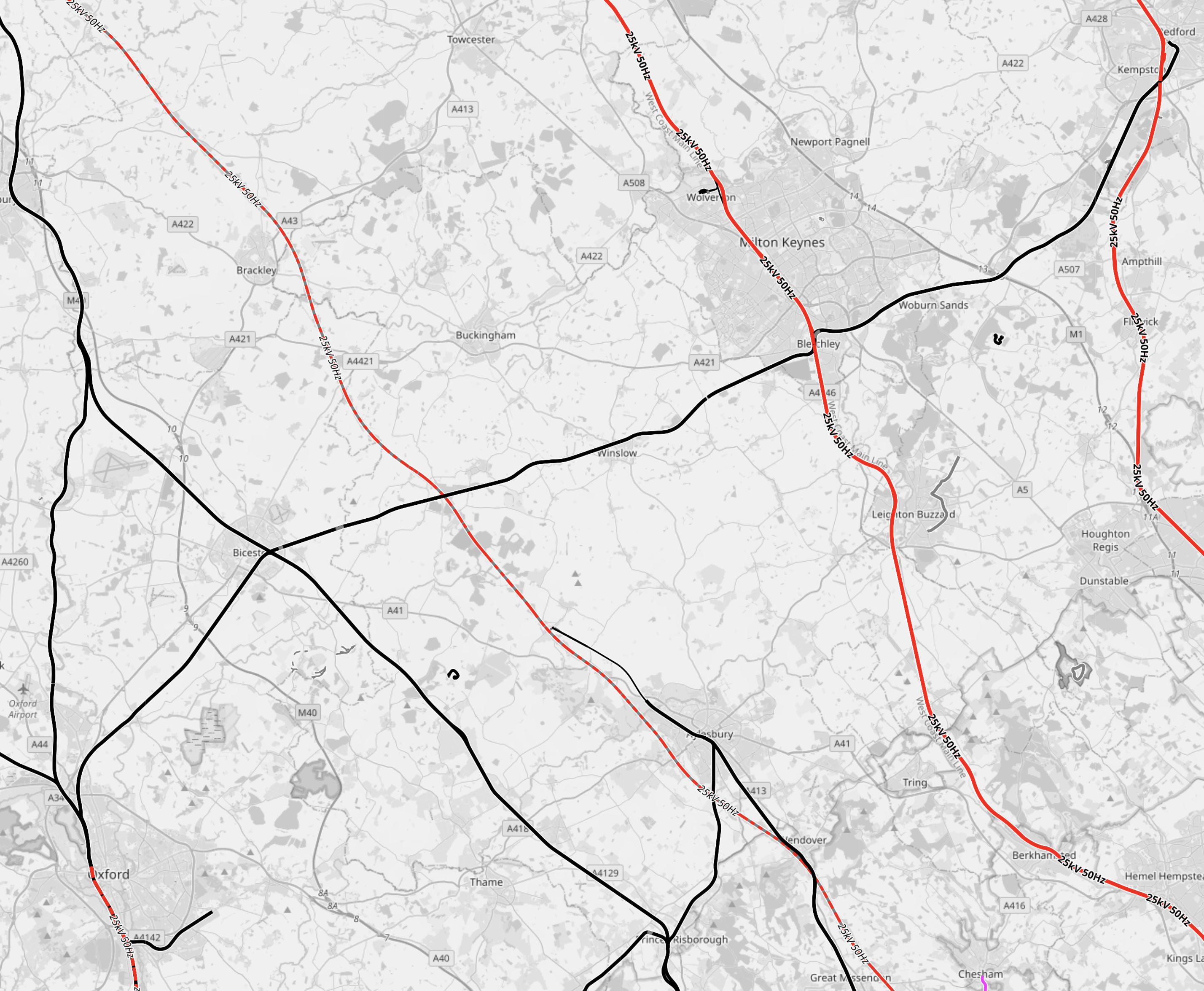
Note.
- Bold red lines are tracks electrified at 25 KVAC.
- Bold black lines are tracks without electrification.
- Oxford is in the South-West corner of the map.
- Bedford is in the North-East corner of the map.
- The bold black line of the Western section of the East West Rail connects the two cities.
- The lines through Oxford are shown as being electrified. The black stub pointing East to the South of Oxford is the Cowley Branch.
The rail lines crossing East West Rail from West to East are as follows.
- Chiltern Main Line – Not Electrified
- High Speed Two – Will Be Electrified
- West Coast Main Line – Electrified
- Midland Main Line – Electrified
I suspect all lines, except for the Chiltern Main Line, will be able to provide a grid connection for East West Rail.
This second OpenRailwayMap shows the electrification between Bedford and Cambridge.
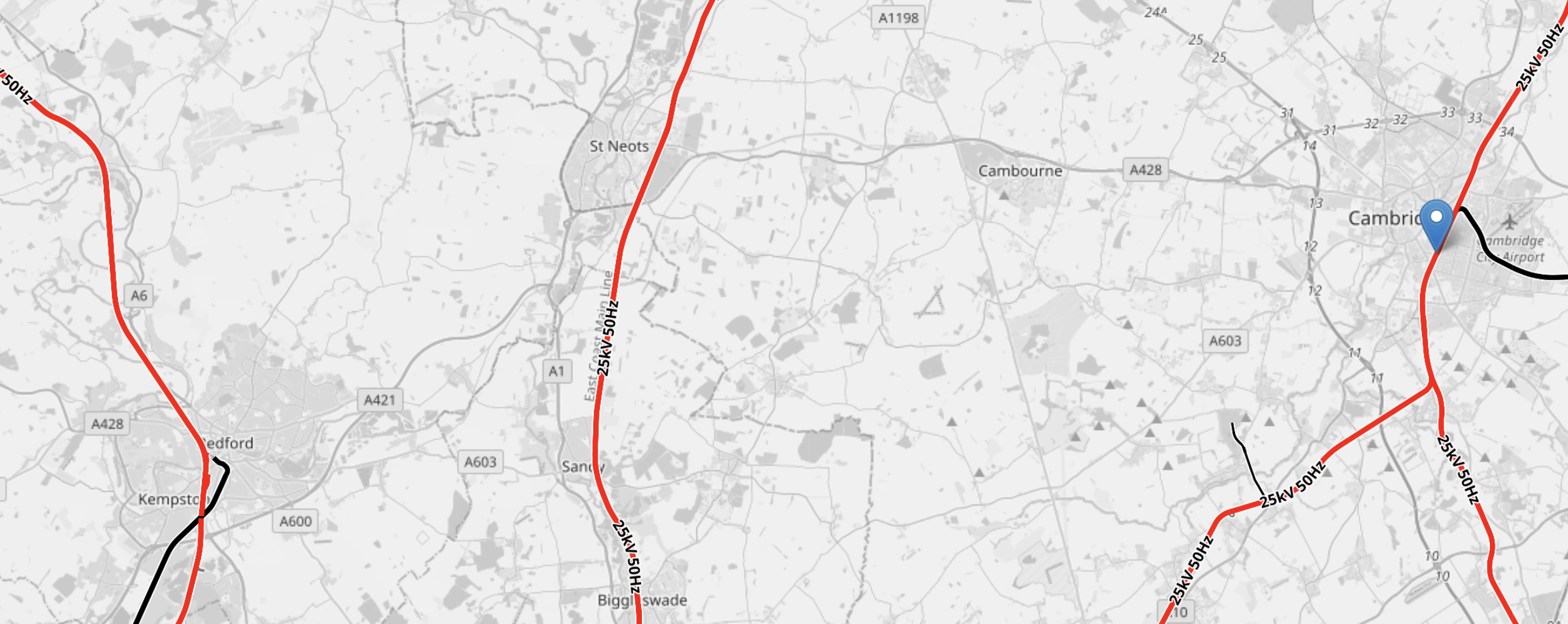
Note.
- Bold red lines are tracks electrified at 25 KVAC.
- Bold black lines are tracks without electrification.
- Bedford is in the South-West corner of the map.
- Cambridge is in the North-East corner of the map.
- The Eastern section of the East West Rail connects the two cities.
- Both maps are to the same scale
The rail lines crossing East West Rail from West to East are as follows.
- Midland Main Line – Electrified
- East Coast Main Line – Electrified
- West Anglia Main Line – Electrified
I suspect all lines will be able to provide a grid connection for East West Rail.
Distances Without Electrification
These sections are not electrified.
- Oxford and Bletchley – 47.2 miles
- Bletchley and Bedford – 16.5 miles
- Bedford and Cambridge – 29.2 miles
- Ely and Norwich – 53.7 miles
- Norwich and Great Yarmouth – 18.4 miles
- Cambridge and Haughley Junction – 41.3 miles
I am assuming that the East West Rail could extend past Cambridge on these two routes.
- Ely, Thetford, Norwich and Great Yarmouth.
- Newmarket, Bury St. Edmunds, Stowmarket, Ipswich, Manningtree and Colchester.
All sections have electrification at both ends, if Didcot Junction and Oxford is electrified, as is expected to happen.
Train Battery Range Needed
The route layout, I have proposed means that if you go for the battery-electric train with the longest battery range you can afford and it can’t handle Ely and Norwich, the existing electrification can be extended to bridge the gap.
Application Of Discontinuous Electrification To Greater Anglia And Chiltern Railways
If discontinuous electrification can be applied to East West Rail, it can surely be applied to Greater Anglia and Chiltern Railways, given the fact that the route networks of all three companies overlap and share tracks.
Greater Anglia already have a fleet of Class 755 trains, which are designed to be converted to battery-electric operation.
With batteries fitted, I believe that these trains could handle most of the current routes they do now.
The other routes would be handled with selective lengths of overhead electrification in terminal stations to charge the trains before return.
Electrification Between Oxford And Bicester Village Stations
Oxford station has two North-facing bay platforms, that are used by Chiltern and other services terminating at the station from the North.
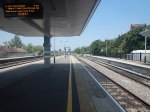
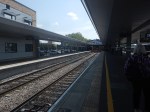
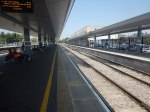
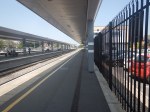
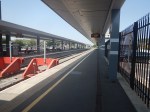
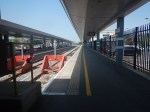
Note.
- Chiltern Railways already run two trains per hour (tph) between these platforms and Marylebone.
- I would assume the platforms will be used by East West Rail services, that terminate at Oxford station.
- If discontinuous electrification is to be used, then these two platforms could be electrified to charge trains before they return.
- East West Rail have not published their proposed services yet, but it could be one tph to both Milton Keynes Central and Bedford stations.
I can see Chiltern buying battery-electric trains to run services between Marylebone and Oxford, and some other routes.
Marylebone and Oxford is 66.7 miles, which is probably two far for even Stadler’s remarkable battery-electric trains, but if say between Oxford and Bicester Village station were to be electrified, would it make it possible to run battery-electric trains between Marylebone and Oxford with charging at both end of the route.
In Chiltern Sets Out New Fleet Ambitions, I talk about Chiltern’s possible new fleet, as proposed by their MD in September 2023.
Arriva’s Grand Central Applies For Extended Track Access Rights
The title of this post, is the same as that of this news item from Arriva.
These three bullet points, act as sub-headings.
- Grand Central to submit application to the rail regulator for extended track access up to 2038.
- Proposals for a new, greener fleet are outlined as part of the application.
- Application signals Arriva’s long-term commitment to UK rail.
These three paragraphs add more detail to the application.
Arriva Group’s UK open access train operating company, Grand Central, has today announced it is seeking to extend its existing track access rights until 2038, securing its services for the next 15 years and unlocking Arriva’s intentions to invest in new, state-of-the-art trains.
Grand Central has been operating services on the East Coast mainline since 2007 as an open access operator, which means it receives no government funding or subsidy. It directly links 15 destinations, including cities in Yorkshire and the North East with London’s Kings Cross.
The application represents a significant commitment to long-term services and supports its plans to expand services with improved connectivity and increased frequency, as outlined in a previous application, submitted to the Office of Rail and Road in May this year.
These are my observations and thoughts.
Grand Central’s Current Services
Grand Central currently runs two separate services.
- King’s Cross and Sunderland via Peterborough,York, Thirsk, Northallerton, Eaglescliffe and Hartlepool – six tpd
- King’s Cross and Bradford Interchange via Peterborough, Doncaster, Pontefract Monkhill, Wakefield Kirkgate, Mirfield, Brighouse, Halifax and Low Moor – four tpd
Note.
- tpd is trains per day.
- Weekend services are reduced.
- Peterborough is served by one train in each direction.
Grand Central have applied to run more services.
Distances Without Electrification On Current Services
Only the Northern ends of both routes are not electrified.
- King’s Cross and Sunderland – Longlands junction and Sunderland – 48.5 miles
- King’s Cross and Bradford Interchange – Doncaster and Bradford Interchange – 52.1 miles
Note.
- Going North, any train batteries could be charged on the East Coast Main Line.
- Before returning South, train batteries could need to be charged at the two terminals.
- Battery-electric trains would need infrastructure changes at the two terminals.
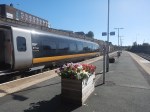
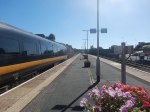
The two terminals; Bradford Interchange and Sunderland are not particular spacious.
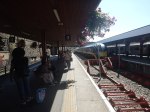
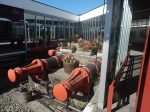
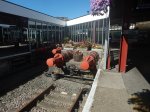
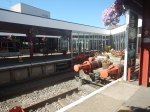
These pictures show Bradford Interchange station.

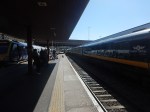
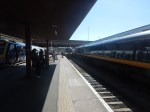
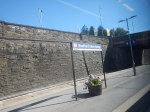

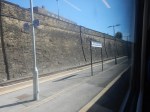
And these pictures show Sunderland station, which is underground.
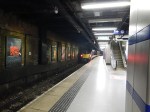
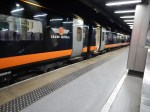
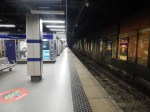
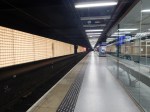
Putting even a short length of catenary to charge battery-electric trains might not be that easy at either station.
Grand Central’s New Trains
Arriva’s news item, gives these details on the new trains.
- Increased capacity: The new trains would feature approximately 20 per cent more seats than the current Class 180 units, providing additional capacity to meet growing passenger demand.
- Modernised fleet: The new Bi-Mode trains would replace the existing 24-year-old Class 180 units bringing new customer focussed features and a more comfortable experience for passengers.
- Greener services: The Bi-mode trains would cut carbon emissions and provide smoother journeys for passengers. They can operate on electric and non-electric tracks, so they can serve long into the future as track electrification gathers pace across the UK.
Note.
- A five-car Class 802 train has approximately twenty percent more seats than a four-car Class 180 train.
- Hull Trains, LNER, Lumo and TransPennine Express all run Hitachi Class 80x trains on the East Coast Main Line, which could ease operations, if all trains were similar.
- Bi-mode trains are specified. Grand Central will change mode once on each trip.
- LNER have specified CAF Tri-mode trains for their new fleet. Will these have an extra level of complication, that Grand Central don’t need?
I suspect that rand Central will opt for the Hitachi trains.
Using The Joint Line Between Peterborough and Doncaster via Lincoln
The diesel Class 180 trains can use this line, in times of incidents or engineering works.
Class 800 and Class 802 trains can also use this diversion, so it might be sensible to be able to use the line in time of trouble.
Chiltern Trains’ London And Birmingham Services
Both Arriva and Chiltern Trains are subsidiaries of Deutsche Bahn.
Currently, Chiltern run six-car rakes of Mark 3 coaches, with a Class 68 locomotive at one end and a driving van trailer at the other, between London and Birmingham.
They are nice trains, but they are not zero-carbon.
Could these be replaced by an eight-car Class 802 train?
- Chiltern have said that they are looking for new trains.
- An eight-car Class 802 train could be a similar length to the current trains.
- London Marylebone and Birmingham Moor Street is only 111.7 miles.
- The Hitachi trains would offer an increase in capacity.
- They might save a few minutes.
But the trains will still be not zero-carbon.
This page on the Hitachi web site is entitled Intercity Battery Trains.
The trains for London Marylebone and Birmingham Moor Street would be built as conventional eight-car Hitachi trains, with perhaps four diesel engines.
- Over the years, the Chiltern Main Line would be partially electrified, starting perhaps in the middle around Banbury.
- One by one, the diesel engines would be replaced by batteries, so that the trains could run on battery power between the electrified sections.
- Eventually, the London Marylebone and Birmingham Moor Street service would be fully battery-electric.
- As Kidderminster is only twenty miles past Birmingham Moor Street, there must surely be possibility for extension of the service.
I believe that Hitachi’s Intercity Battery Train, is going to play a large part in the decarbonisation of UK railways.
Chiltern Trains’ London And Oxford Services
If eight-car Hitachi Intercity Battery Trains can handle London Marylebone and Birmingham Moor Street services, then I am fairly sure that five-car Hitachi Intercity Battery Trains could handle London Marylebone and Oxford services.
They would also have more capacity, than the current trains, that serve Oxford and Bicester Village.
Conclusion
It may be advantageous for Deutsche Bahn to put the two orders together.
LNER Names Train ‘The Flying Swiftie’ Ahead Of Tonight’s Opening Gig
The title of this post, is the same as that of this press release from LNER.
This is the sub-heading,
Forget “The Flying Scotsman”, LNER is today naming the 1000 London-Edinburgh train “The Flying Swiftie” – as thousands of Taylor Swift fans take the train to her first UK gig in the Scottish capital.
These are the first three paragraphs, which give a few more details.
The rail firm famous for having Red seats knows All Too Well that its passengers love a named train – from The Flying Scotsman to the Highland Chieftan and the recently introduced Carolean Express.
As passengers travel in Style and say So Long, London they will be reminded with on-train and station announcements that Everything Has Changed and that they’re on The Flying Swiftie, while screens around the station and along the route will refer to the train’s name too.
Taylor Swift fans will be able to get refreshments onboard cheaper than their Wildest Dreams thanks to a special Flying Swiftie discount.
Recently, Lumo did a similar promotion for Gateshead fans going to Wembley for the FA Trophy final, which I wrote about in Excitement Brewing for Gateshead FC Away At Wembley.
Last Train Home
In the past, I’ve had difficulty with getting a return train after some matches and it is a complaint of the fans of many sides.
- Taylor Swift’s concert seems to finish shortly before midnight.
- I’ve never had trouble from Greater Anglia, as they always run a late train back to London.
- In one case at Ipswich, there were track problems in the Colchester area, so Greater Anglia returned fans to Sudbury by taxi.
- Lumo ran an extra return train to make sure everybody got home after the match.
It certainly looks to me, that if you are going to put on a package for an event, you must make sure, that it is possible for those attending the event to get home.
What Is Possible
Lumo and LNER have shown what is possible on the East Coast Main Line and I would hope that they will develop these two experiences to cover, events like these.
- London football teams playing matches in Newcastle.
- Newcastle United playing matches in London.
- England and Scotland rugby matches.
I hopr to see more services like these in the future.
East West Rail: Bedford Mayor Unveils Eight Alternative Routes
The title of this post, is the same as that of this article on the BBC.
This is the sub-heading.
The Mayor of Bedford has unveiled other potential routes for the East West Rail (EWR) project through the borough.
These four paragraphs outline the current plans and the result of the Mayor’s study.
EWR has already announced its preferred route, linking Oxford and Cambridge via a new track running through Bedford to the north.
Conservative Tom Wootton has defended spending £40,000 to commission consultants to explore alternative routes to the south.
Their report concluded that all options would boost the Bedford economy.
The mayor reflected: “While there is no definitive winner among the proposed routes, the economic potential of the project for Bedford is significant.”
This map from the article shows the current planned route.
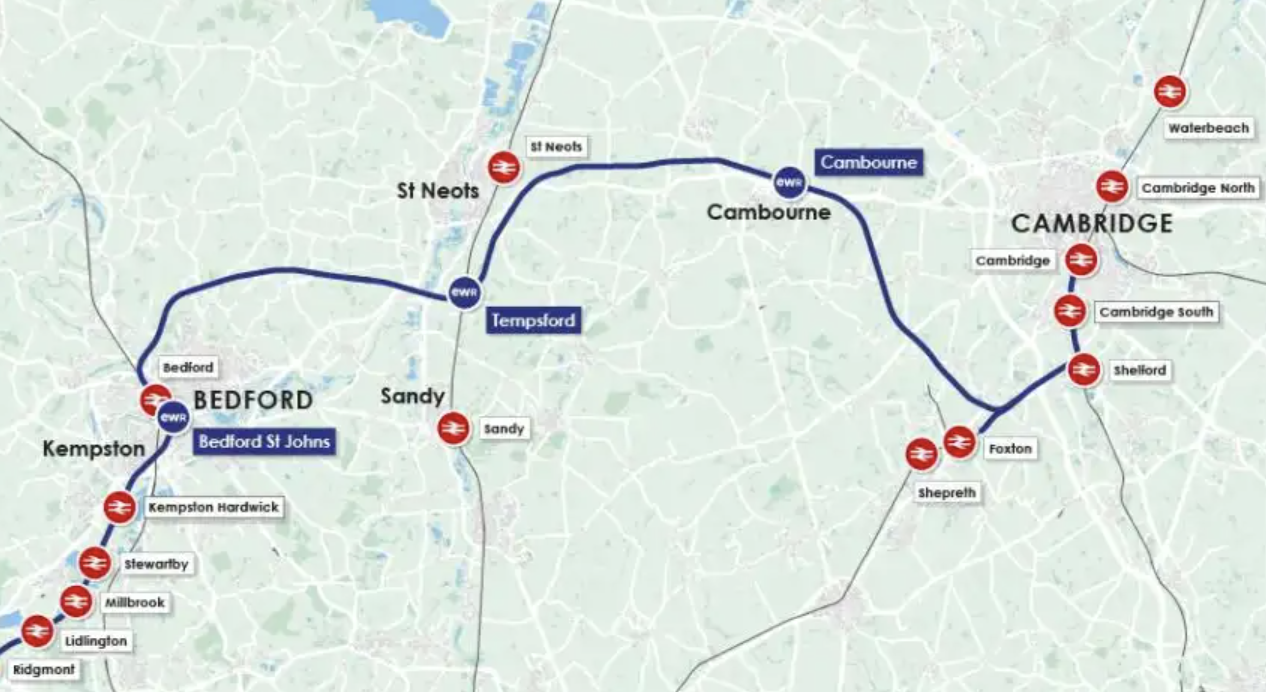
Note.
- Bedford St. Johns station will be rebuilt.
- Trains will go straight through Bedford station.
- Tempsford station will connect the East West Railway to the East Coast Main Line.
- The East West Railway will unlock the building of much-needed housing and commercial developments at Cambourne.
- Trains will go through Cambridge South, Cambridge and Cambridge North stations, and thus serve all important areas of the UK’s Eastern Powerhouse.
As there is no definitive winner among the proposed routes and the economic potential of the project for Bedford is significant, perhaps we should just get on and build the East West Railway’s preferred route.
The Long Platforms At Liverpool Street Station
I was on Liverpool Street station today and I took these pictures.


It got me thinking.
- I was standing On Platform 1 and on Platform 2 was a pair of five-car Class 720 trains coupled together.
- The pair of five-car Class 720 trains would be 244 metres long, which mean that the platforms could handle nine-car Class 800 or Class 345 trains.
- There would appear to be plenty of platform space in Liverpool Street station.
- In Azuma Test Train Takes To The Tracks As LNER Trials Possible New Route, I talked about how LNER were checking an Azuma train could use the route to Cleethorpes.
- In London North Eastern Railway Runs Trial Train To Liverpool Street, I talked about how LNER had ran a train into Liverpool Street.
The general consensus seems to be, that points 3 and 4, are about several things.
Adding Grimsby and Cleethorpes to LNER’s list of destinations.
Possibly adding Spalding, Sleaford, Market Rasen and Barnetby to LNER’s list of destinations.
Providing a faster service between London and Grimsby/Cleethorpes.
Providing a diversion route because of engineering or blockades on the East Coast Main Line.
Nearly twenty years ago, I used to play real tennis, with a guy, who was on a committee, that planned the future of the Cambridge region.
- One of the things he said was that Cambridge was full and there is not enough lab space, factories and housing.
- He felt that Peterborough would make an excellent satellite for Cambridge.
- However, transport links and especially the trains are not the best between Cambridge and Peterborough.
- I wonder, if Cambridge’s overcrowding is spreading the Cambridge Effect into Lincolnshire and the number of rail passengers between Lincoln and Cambridge is growing.
So have LNER taken the bull by the horns and are planning to run a London Liverpool Street and Cleethorpes service via Cambridge?
- It might perhaps run at least six trains per day (tpd) in both directions.
- Stops could include Stratford, Cambridge South, Cambridge, Cambridge North, Ely, March, Peterborough, Spalding, Sleaford, Lincoln, Market Rasen, Barnetby and Grimsby Town.
- Trains could be a five-car Class 800 train.
- The route is fully-electrified between London and Ely.
Note.
- The London King’s Cross and Lincoln service could be discontinued.
- Connection between Cambridge and Lincolnshire is much improved.
- The developing energy powerhouse in North-East Lincolnshire gets a connection to Cambridge and London.
- There could be same-platform interchange at Peterborough for passengers between Cambridge and the North.
- By going via Cambridge, one less train needs to use the bottleneck over the Digswell viaduct.
LNER are trying to get the most out of the new December 2024 East Coast Main Line timetable and I do wonder if a London Liverpool Street and Cleethorpes servce is part of that exercise.
Northumberland Line ‘Phased Reopening’ By Summer
The title of this post, is the same as that as this article on the BBC.
These are the first three paragraphs.
The Northumberland Line will partially reopen this summer days after it was announced it would not be in service until the end of 2024.
Conservative county council leader Glen Sanderson said there had been “challenges” with the project, but when fully reopened the rail line would be a “game changer” for travellers.
The stations due to be open in the summer are Seaton Delaval, Ashington and Newsham.
In my lifetime, the Victoria, Jubilee and Elizabeth Lines in London, have opened on a phased manner.
So why shouldn’t the Northumberland Line?
In fact given the route, it could be opened with a shuttle between Ashington and Newcastle stations, to train drivers and test the concept.
- The intermediate stations could be added over a couple of years.
- I would add a station with lots of parking early.
- If the views live up to the pictures, a lot of passengers will have a day out for the views.
- I’m sure enthusiasts and locals, especially with their kids will be exploring this short railway in droves.
To me, this is definitely a line, that will suffer from London Overground Syndrome.
This OpenRailwayMap shows the railways to the North of Newcastle.
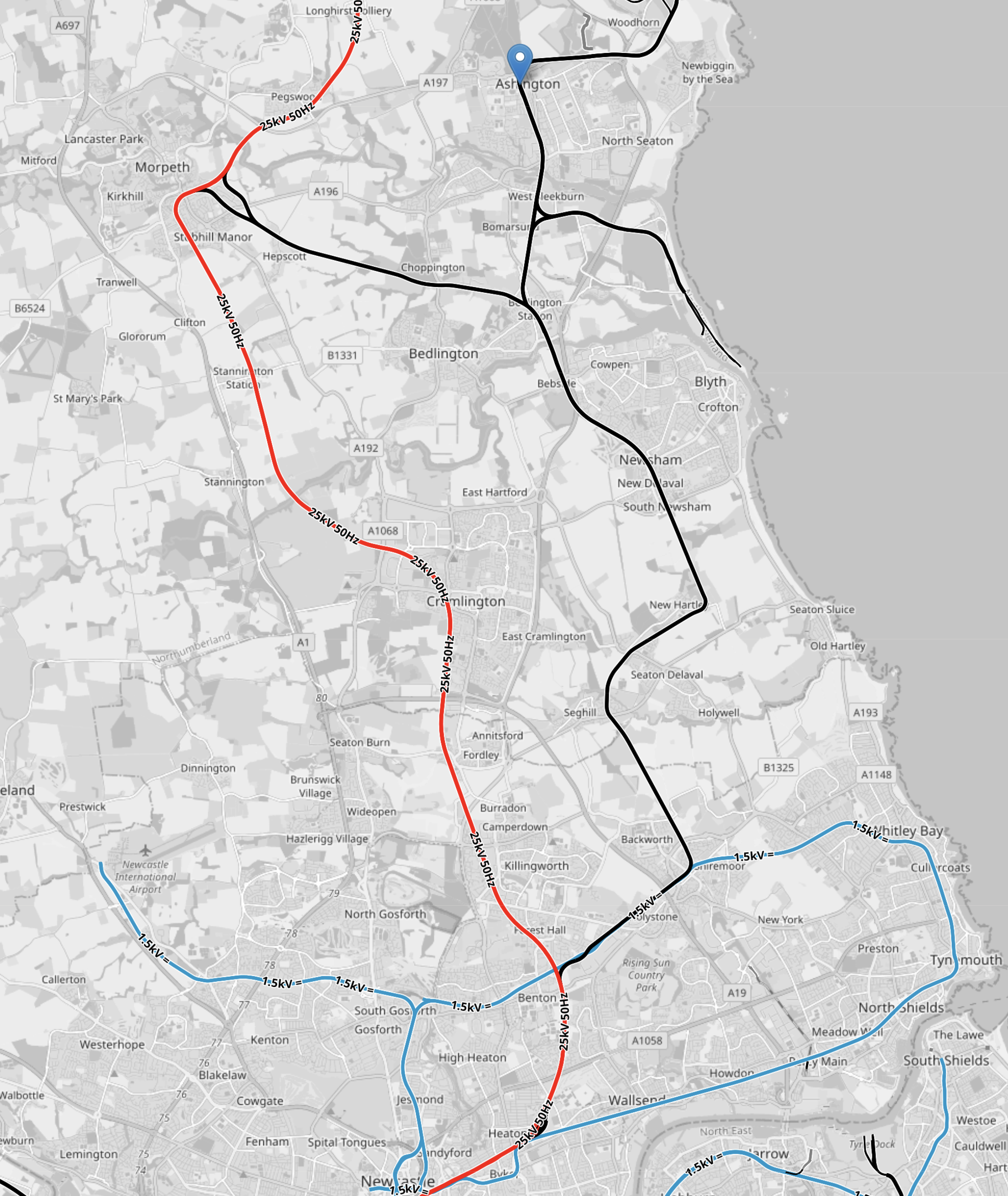
Note.
- The red track is the electrified East Coast Main Line.
- Ashington station is at the top of the map and is marked by a blue arrow.
- The blue track is the Tyne and Wear Metro.
- Newcastle station is where the Metro crosses the East Coast Main Line at the bottom of the map.
- The black trackrunning North-South to the East of the East Coast Main Line is the Northumberland Line.
This OpenRailwayMap shows the railways to the North of Ashington.
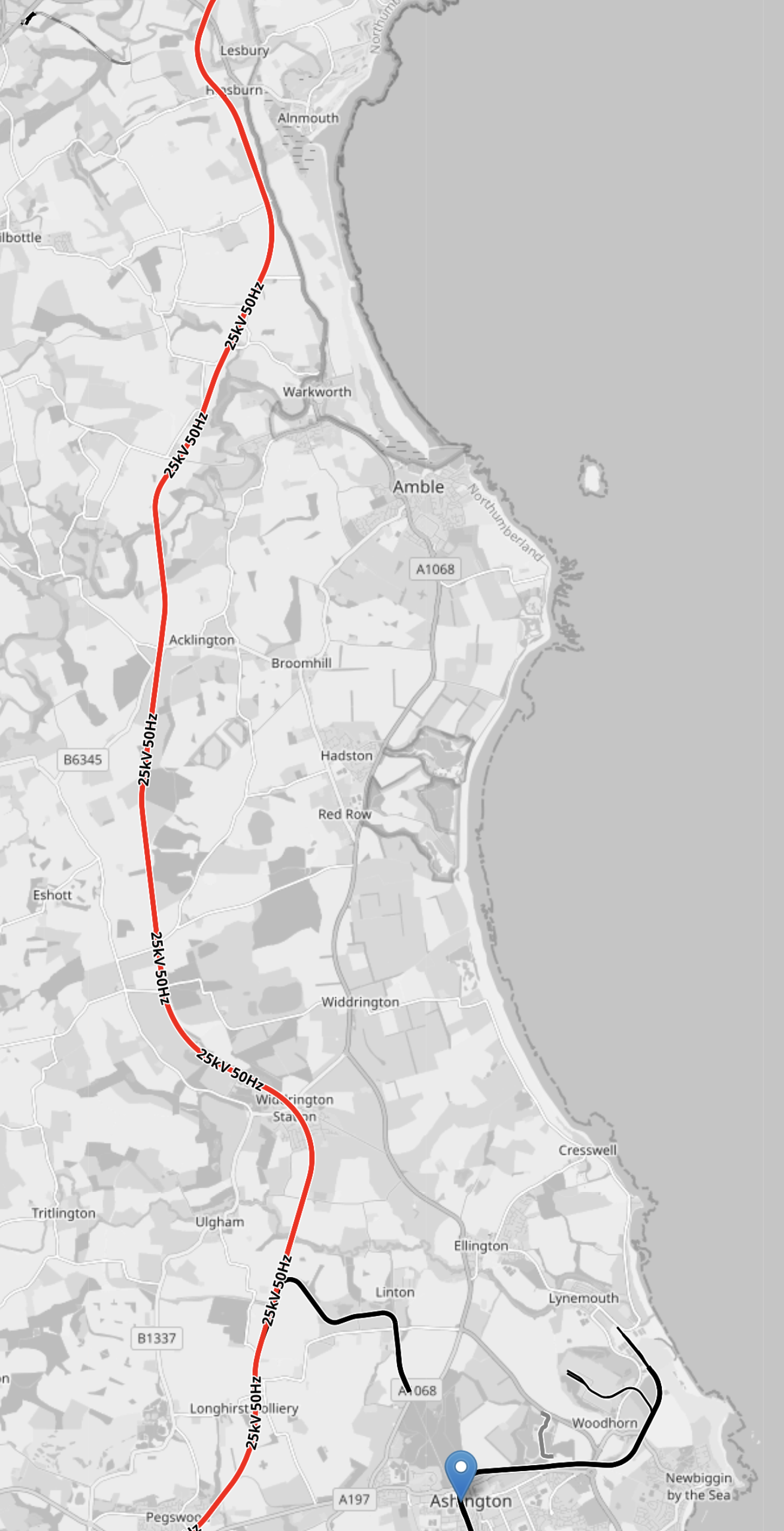
Note.
- The red track is the electrifed East Coast Main Line.
- Ashington station is at the bottom of the map and is marked by a blue arrow.
- There are a few disused colliery lines to the North of Ashington.
I believe that these railways to the North of Newcastle could and should be developed.
The East Coast Main Line Is Congested
Consider.
- The East Coast Main Line has only two tracks.
- It is one of only two rail routes between England and Scotland.
- It carries local services as well as long distance express services.
- In recent years more services have been added by Lumo and TransPennine Express.
It is my belief that applying digital signalling between Newcastle and Edinburgh via Berwick, should be a high priority project to increase the capacity of the East Coast Main Line.
Local Services Can Be Extended
The Northumberland Line opens up possibilities for extension, where track already exists..
- From Ashington to Newbiggin-on-Sea and Lynemouth.
- From Bedlington to Morpeth and the East Coast Main Line.
- From Bedlington to North Blyth.
It would appear that it might be possible to run a new line North from Ashington to connect with the East Coast Main Line.
Distances Are Short
Consider.
- Ashington and Newcastle is 20.6 miles
- Newcastle and Morpeth is 16.6 miles
- Newcastle and Berwick is electrified.
- In The Data Sheet For Hitachi Battery Electric Trains, I stated that Hitachi’s battery-electric express trains have a range of 43.5 miles on one battery. A slower commuter train would certainly achieve this distance.
I have a feeling that a passenger-friendly network of battery-electric trains can be developed along and around the Northumberland Line and the East Coast Main Line.
FirstGroup Applies To Run New London To Sheffield Rail Service
The title of this post, is the same as that of this press release from First Group.
These four paragraphs outline FirstGroup’s initial plans.
FirstGroup plc, the leading private sector transport operator, has today submitted the first phase of an application for a new open access rail service between London and Sheffield to the Office of Rail and Road (ORR).
FirstGroup plans to expand its open access rail operations as part of its award-winning Hull Trains business, building on their successful existing service which has transformed long-distance connectivity between Hull and London.
FirstGroup’s new proposals comprise two return journeys a day from London King’s Cross, calling at Retford, Worksop, Woodhouse and Sheffield, and the company aims to provide a faster link between London and Sheffield than alternative services. Almost three quarters of trips between London and Sheffield are currently made by car, with a further 9% of trips made by coach, and a competitively priced new rail offering will help stimulate a shift in transport mode of choice from road to rail.
The new proposed route will give Sheffield the first regular service from London King’s Cross since 1968 and will also give Worksop in Nottinghamshire the first regular direct London trains in decades. FirstGroup estimates there are 350,000 people in the Worksop and Woodhouse catchment areas who will have direct rail access to London because of these proposals. A sizeable number of rail users in these areas currently drive to Doncaster station to pick up faster services to London rather than travelling via Sheffield, and a convenient rail offering from local stations will also help to reduce the number of these car journeys.
Note.
- The press release says this is only the first phase.
- It appears to be an extension of Hull Trains.
- Comments on a news story based on the press release in The Times, have been generally positive.
These are my thoughts.
The Two Routes Are Similar
Consider.
- Beverley is 44.3 miles from the electrified East Coast Main Line at Temple Hirst Junction.
- Hull is 36.1 miles from the electrified East Coast Main Line at Temple Hirst Junction.
- Sheffield is 23.5 miles from the electrified East Coast Main Line at Retford station.
- There is no electrification at Beverley, Hull or Sheffield.
Note.
- Trains must be capable of having a range sufficient to go from the East Coast Main Line to the destination and back again.
- It is slightly surprising that Sheffield station is closest to the electrification of the East Coast Main Line.
- Hull Train’s electro-diesel Class 802 trains regularly handle the 88.6 miles to Beverley and back.
It does look like an appropriate number of Class 802 trains could handle Hull Trains current and future services to Beverley, Hull and Sheffield.
Hull Trains Need Ten-Car Trains
Consider.
- In Ten-Car Hull Trains, I show some details of Hull Trains using a pair of five-car trains.
- I’ve since seen ten-car Hull Trains regularly.
- There were two ten-car services on the 29th December 2023 between London King’s Cross and Hull.
Hull Trains must procure enough trains for all possible scenarios.
Intermediate Stations Of The Two Routes
Intermediate stations are.
- Going North from London King’s Cross to Hull, trains call at Stevenage (limited), Grantham, Retford, Doncaster, Selby, Howden and Brough.
- Going North from London King’s Cross to Sheffield, trains call at Retford, Worksop and Woodhouse.
There are only a small number of stops on the Sheffield service. Is this to reduce the journey time as much as possible?
What Will Be The Time Of The London King’s Cross And Sheffield Service?
Consider.
- Non-stop trains take 82 minutes between London King’s Cross and Retford, which is 138.6 miles, so it’s an average speed of 101.4 mph.
- Woolmer Green and Retford are 111.7 miles and will in a couple of years, be digitally signalled.
- Non-stop trains take 66 minutes between Woolmer Green and Retford, which is an average speed of 112 mph.
- I have found a direct Retford and Sheffield train, that takes 31 minutes for the 23.5 miles with six stops, which is an average speed of 45 mph.
- The Retford and Sheffield section has a mostly 60 mph maximum speed.
I can now build a table of times between King’s Cross and Retford based on the average speed North of Woolmer Green.
- 125 mph – 72 minutes
- 130 mph – 70 minutes
- 135 mph – 68 minutes
- 140 mph – 66 minutes
Note.
- Getting a high average speed using the power of digital signalling can save several minutes.
- I have measured an InterCity 125 averaging 125 mph on that section.
I can now build a table of times between Retford and Sheffield based on the average speed.
- 45 mph – 31 minutes
- 50 mph – 28 minutes
- 60 mph – 24 minutes
- 70 mph – 20 minutes
- 80 mph – 18 minutes
Note.
- The planned service is expected to stop only twice after Retford, so if we take off two minutes for each of the four stops not taken, this could reduce the time between Retford and Sheffield by 8 minutes.
- There will be a couple of minutes to add for the stop at Retford.
- I feel a typical journey with 125 mph to Retford, 50 mph to Sheffield, could take 94 minutes
- Currently, the fastest London St. Pancras to Sheffield take around 116-118 minutes.
Hull Trains new service could save 22-24 minutes on the current service.
I also feel a fast journey could involve 130 mph to Retford, 60 mph to Sheffield, could take 88 minutes.
Hull Trains new service could save a few minutes over half-an-hour.
Could The Time Of The London King’s Cross And Sheffield Service Be Under 90 Minutes?
I reckon the following is possible.
- After the digital signalling is completed between King’s Cross and Retford, I suspect that a 135 mph average speed can be maintained between Woolmer Green and Retford. This would mean that a King’s Cross and Retford time of 68 minutes would be possible.
- If Network Rail improve the track between Retford and Sheffield, I believe that a 70 mph average could be achieved on the Retford and Sheffield section. This would mean that a Retford and Sheffield time of 20 minutes would be possible.
- I would expect at least six minutes would be saved by missing stops.
This gives a time of 82 minutes between London King’s Cross and Sheffield.
In Anxiety Over HS2 Eastern Leg Future, I said that High Speed Two’s promised London and Sheffield time via a dedicated track would be 87 minutes.
It looks to me that running under full digital signalling on the East Coast Main Line, Hull Trains can beat the HS2 time.
Could Hitachi’s Battery-Electric Trains Handle The Routes?
This page on the Hitachi web site is entitled Intercity Battery Trains.
This is the sub-heading
Accelerate the decarbonisation of intercity rail with batteries.
These paragraphs outline the philosophy of the design of the trains.
A quick and easy application of battery technology is to install it on existing or future Hitachi intercity trains. Hitachi Rail’s modular design means this can be done without the need to re-engineer or rebuild the train and return them to service as quickly as possible for passengers.
Replacing one diesel engine with just one battery reduces emissions by more than 20% and offers cost savings of 20-30%. Our intercity battery powered trains can cover 70km on non-electrified routes, operating at intercity speeds at the same or increased performance.
Wouldn’t it be great, if we could take the diesel engine out of our cars and replace it with an electric power pack?
Paul Daniels would’ve classed it as engineering magic.
But it’s an old engineer’s trick.
As a fifteen year old, I spent time in a rolling mill, building and fitting replacement control systems on large machines. Transistors were used to replace electronic valves and relays.
It’s certainly possible to create a battery pack, that is plug-compatible with an existing diesel generator, that responds to the same control inputs and gives the same outputs.
At the extreme end of this technology, there would be no need to change any of the train’s software.
In The Data Sheet For Hitachi Battery Electric Trains, these were my conclusions for the performance.
- The battery pack has a capacity of 750 kWh.
- A five-car train needs three battery-packs to travel 100 miles.
- A nine-car train needs five battery-packs to travel 100 miles.
- The maximum range of a five-car train with three batteries is 117 miles.
- The maximum range of a nine-car train with five batteries is 121 miles.
As the East Coast Main Line to Beverley is a round trip is 88.6 miles, I suspect that Hull Trains’s five-car Class 802 trains will need to be fitted with a full-complement of three batteries.
Will Hull Trains Have An Identical Fleet Of Trains?
An identical fleet must have advantages for train staff, maintenance staff and above all passengers.
I believe FirstGroup have two choices.
- They buy an appropriately-sized batch of identical Class 802 trains.
- They convert their current fleet to battery-electric operation and buy an appropriately-sized batch of identical new trains.
Note.
- The second option means that they fully-decarbonise Hull Trains.
- Neither option would need any new infrastructure.
- I feel this means that this order is more likely to go to Hitachi.
It’ll probably all come down to the accountants.
Retford Station
This OpenRailwayMap shows the tracks around Retford station.
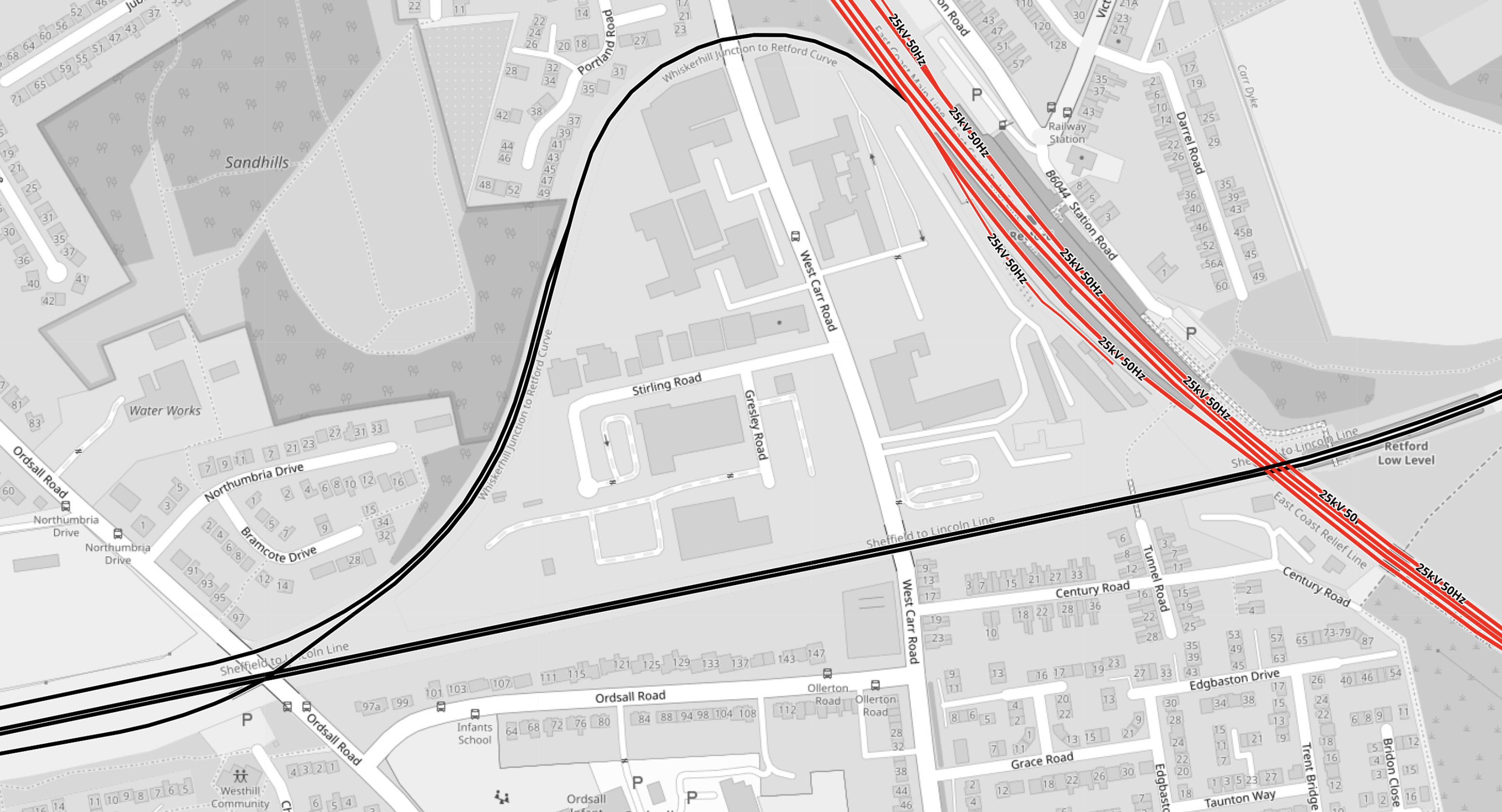
Note.
- The red tracks are electrified and are the East Coast Main Line.
- The black ones aren’t electrified.
- Doncaster is to the North.
- The black line to the East goes to Lincoln
- The black line to the West goes to Sheffield
- The red line going South-East goes to Peterborough and London.
The unusual loop allows trains to connect from one direction to another.
This second OpenRailwayMap shows the tracks in more detail.
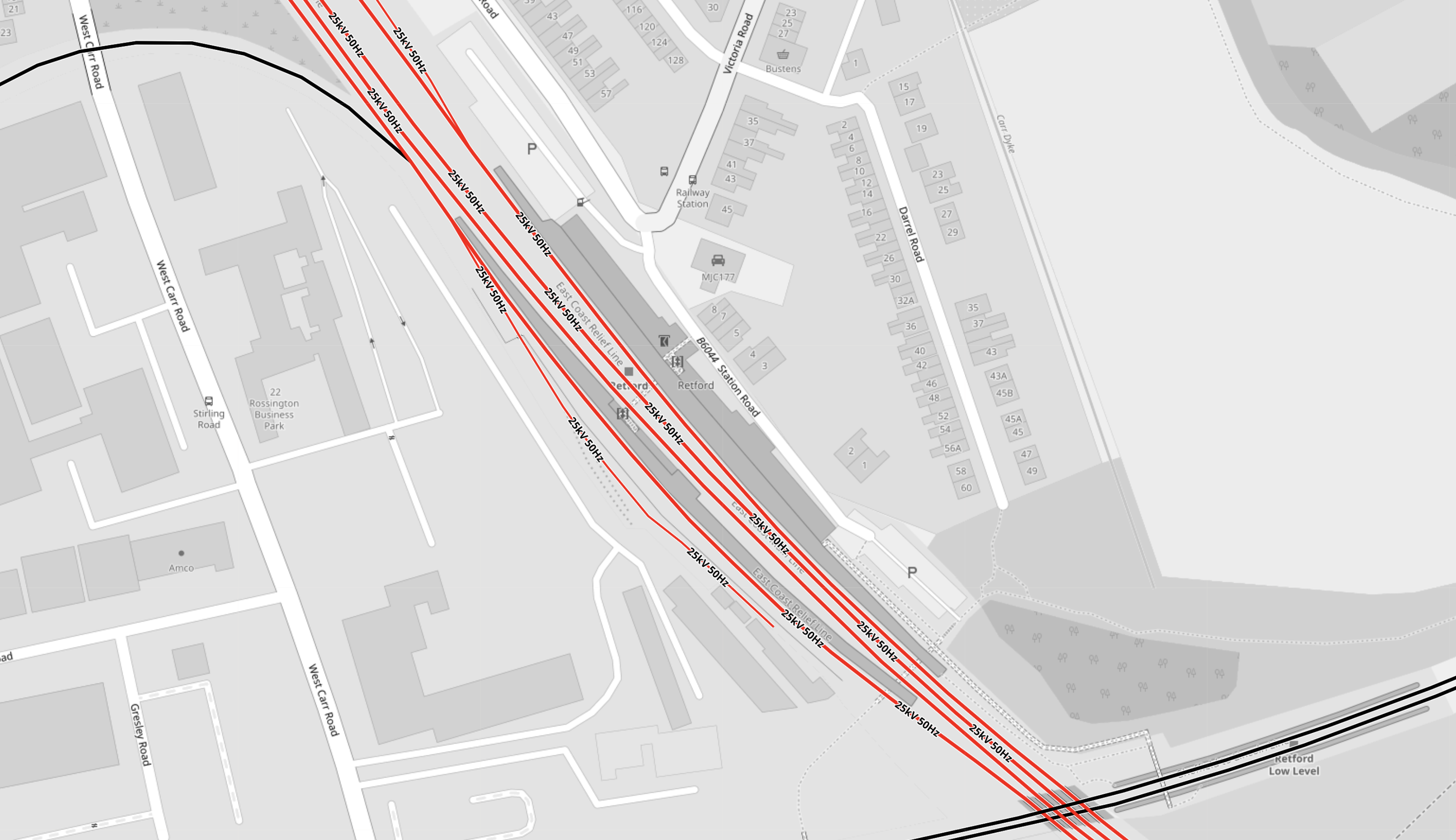
Note.
- As before red lines are electrified and black ones aren’t
- Platforms 1 and 2 are on the East Coast Main Line.
- Platforms 3 and 4 are on the Sheffield and Lincoln Line.
This third OpenRailwayMap shows the platforms in more detail.

Note.
- The yellow tracks are the 125 mph fast lines of the East Coast Main Line.
- The light blue tracks are the 40 mph relief lines of the East Coast Main Line.
- Northbound tracks are to the left of each pair of lines.
- The dark blue track is the 10 mph chord that connects the Northbound relief line of the East Coast Main Line to the Sheffield and Lincoln Line.
- Platform 1 is on the Southbound relief line.
- Platform 2 is on the Northbound relief line.
- Unusually, both platforms are on the same side of the line.
- In The Lengths Of Hitachi Class 800/801/802 Trains, I state that the full length of an InterCity 225 train is 245.2 metres.
- I suspect that both platforms can accommodate a full length InterCity 225, as the trains have been calling at Retford since the 1980s.
I doubt Retford station has any problem accommodating a pair of Class 802 trains, which it does regularly.
How Do Northbound Trains Go To Sheffield From Retford Station?
This OpenRailwayMap shows the tracks to the South of Retford station in detail.
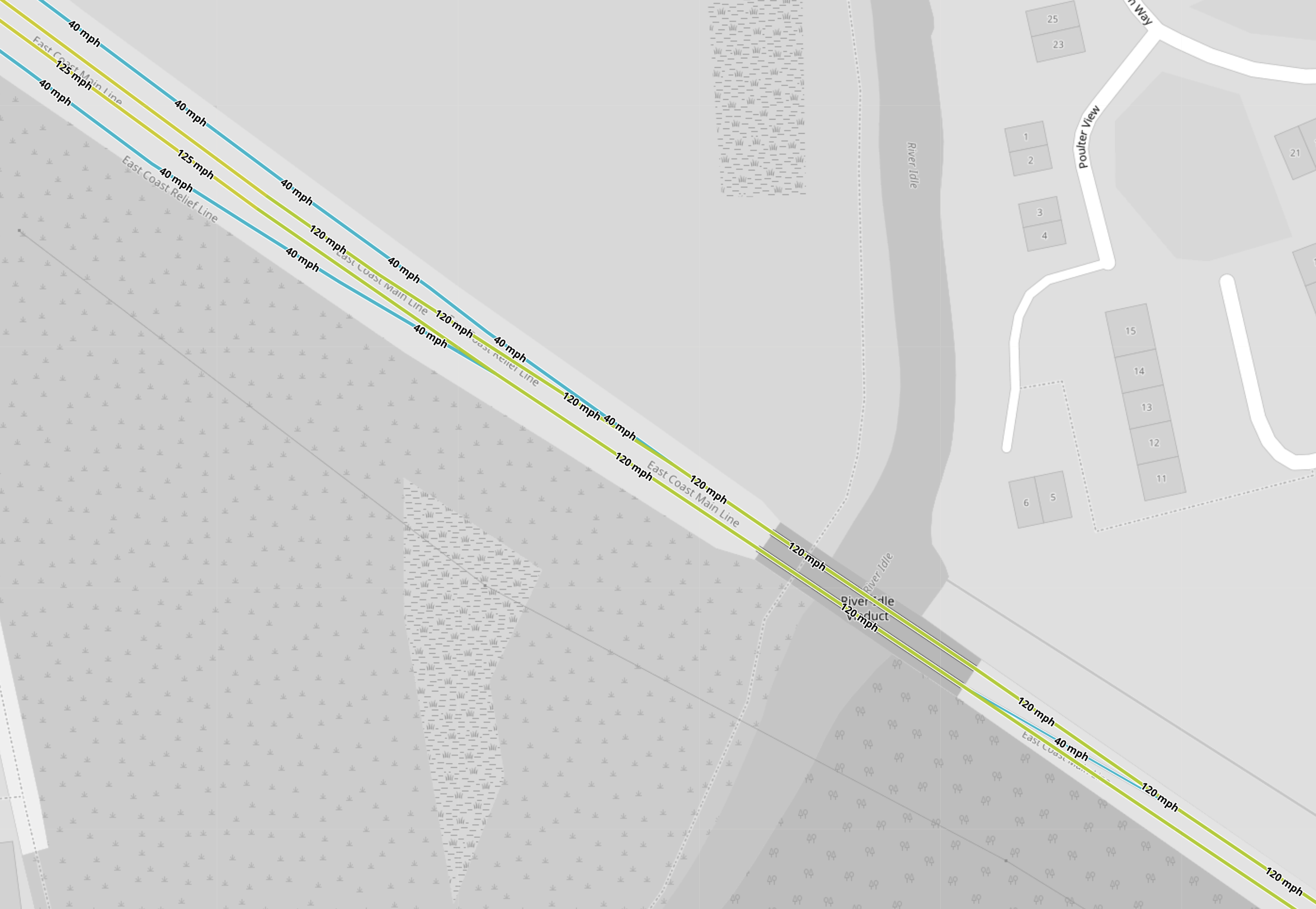
Note.
- The yellow tracks are the 125 mph fast lines of the East Coast Main Line.
- The light blue tracks are the 40 mph relief lines of the East Coast Main Line.
- Northbound tracks are to the left of each pair of lines.
Trains needing to stop in Retford station will need to cross to the Northbound relief line to enter Platform 2 at Retford station.
This OpenRailwayMap shows the curve that connects Platform 2 at Retford station to the Sheffield and Lincoln Line to Sheffield.

Note.
- The green tracks are the 60 mph Sheffield and Lincoln Line.
- Sheffield is to the West.
- The blue tracks are the curve that connects Platform 2 in Retford station to the Sheffield and Lincoln Line.
- There appears to be a grade-separated junction, where the two lines join to the West of Retford station.
A Northbound train to Sheffield will take curve and then join the line to Sheffield.
How Do Southbound Trains Go From Sheffield Through Retford Station?
I suspect trains do the opposite from a train going to Sheffield.
The train takes the curve and then stops in Platform 2 facing South.
This OpenRailwayMap shows the tracks to the South of Retford station in detail.
When the train is cleared by the signals to go South, it will leave Retford station going South on the Northbound relief line.
Note that on the map there are two crossovers, which the train will take to get on the Southbound fast line for Newark and London.
As a Control Engineer, I suspect this is the sort of manoeuvre, that modern digital signalling will make slicker and safer.
How Do Northbound Trains Go To Hull From Retford Station?
On leaving the station, the train will continue along the relief line until it merges with the Northbound fast line for Doncaster.
This is exactly as any Northbound train stopping at Retford does now.
How Do Southbound Trains Go From Hull Through Retford Station?
Currently, trains from Hull stop in Platform 1 on their way to London.
- Trains needing to stop in Retford station will need to cross to the Southbound relief line to enter Platform 1 at Retford station.
- When the train is cleared by the signals to go South, it will leave Retford station going South on the Southbound relief line.
- The Southbound relief line joins the Southbound fast line to the South of the station.
This is exactly as any Southbound train stopping at Retford does now.
Could A Hull And A Sheffield Service Run As A Pair And Split And Join At Retford Station?
Consider.
- Class 802 trains, as used by Hull Trains are designed to be run as a pair of trains, with easy coupling and uncoupling between the two trains.
- Hull Trains regularly run services as a pair of Class 802 trains.
- A pair of trains could leave King’s Cross. They would then split at a convenient station, after which the two trains go to different destinations.
- There are advantages with respect to infrastructure charges.
I feel that Hull Trains two services to Sheffield and Hull/Beverley could work as a pair.
- A pair of trains could leave King’s Cross.
- At Retford station they would split, with one train going to Hull and the other to Sheffield.
Coming South they would join at Retford.
How Would Splitting Of A Hull And Sheffield Service Be Performed At Retford Station?
The procedure would be something like this.
- As the pair of train is stopping in Retford station, it would use the relief line to enter Platform 2.
- It would stop in Platform 2.
- The trains would be uncoupled.
- The front train would go to its destination.
- The rear train would go to its destination.
Note.
- As the track to Doncaster and Hull is faster, the front train should probably be for Hull.
- Platform 2 is electrified, so the Sheffield train could top up its batteries .
- The Sheffield train could lower its pantograph.
Uncoupling takes about two minutes.
How Would Joining Of A Hull And Sheffield Service Be Performed At Retford Station?
Consider.
- Joining would have to be performed in Platform 2, as there is no route for a train from Sheffield to access Platform 1.
- North of Retford station there are two convenient crossovers, to allow a train to cross to the Northbound relief line. There are also a couple of loops, where trains could wait.
- As this is coal-mining country, perhaps, they were part of a freight route between Sheffield and Doncaster?
But this infrastructure would allow, a train from Hull to access Platform 2 at Retford station.
As the Sheffield train can easily access Platform 2, the two trains could meet in Platform 2 and then be joined together for a run to London.
Is There A Problem With Splitting And Joining Of the Hull And Sheffield Services?
Earlier, I said these were the stops of the two services.
- Going North from London King’s Cross to Hull, trains call at Stevenage (limited), Grantham, Retford, Doncaster, Selby, Howden and Brough.
- Going North from London King’s Cross to Sheffield, trains call at Retford, Worksop and Woodhouse.
Surely, if the trains were travelling as a pair, they would need to stop at the same stations to the South of Retford.
But modern digital signalling will allow trains to run closer together, so perhaps this would be the procedure going North.
- The two trains start in the same platform at King’s Cross, with the Sheffield train in front of the Hull train.
- The two trains leave King’s Cross a safe number of minutes apart.
- At its Stevenage and Grantham stops, the Hull train will tend to increase the distance between the two trains.
- The Sheffield train would stop in Platform 2 at Retford station, so that space is left for the Hull train.
- The Hull train will stop behind the Sheffield train in Platform 2 at Retford station.
- The Sheffield train will leave when ready.
- The Hull train will leave when ready.
And this would be the procedure going South.
- The train from Sheffield would line up in Platform 2 at Retford station.
- The train from Hull would line up in Platform 1 at Retford station.
- The train from Sheffield would leave when everything is ready and the train is cleared by the signalling system.
- The train from Hull would leave a safe number of minutes behind the train from Sheffield.
- At its Grantham and Stevenage stops, the Hull train will tend to increase the distance between the two trains.
- The trains could share a platform at King’s Cross.
The digital signalling and the driver’s Mark 1 eyeballs will keep the Hull train, a safe distance behind the faster Sheffield train.
The Capacity Of The Lincoln And Sheffield Line
Looking at the Sheffield and Lincoln Line, it has only an hourly train, that calls at Darnall, Woodhouse, Kiverton Park, Kiverton Bridge, Shireoaks and Worksop between Retford and Sheffield.
- I would suspect that there is enough spare capacity for Hull Trains to run a one train per two hours (tp2h) service between London King’s Cross and Sheffield.
- If LNER feel that a 1 tp2h frequency is viable for Harrogate, Lincoln and other places, surely Hull and East Sheffield could support a similar service from King’s Cross.
If the services could be run by battery-electric trains, capable of running at 140 mph on the East Coast Main Line and giving times of ninety minutes to Sheffield, this could be a success.
Could Woodhouse Station Become A Transport Hub?
This Google Map shows Woodhouse station.
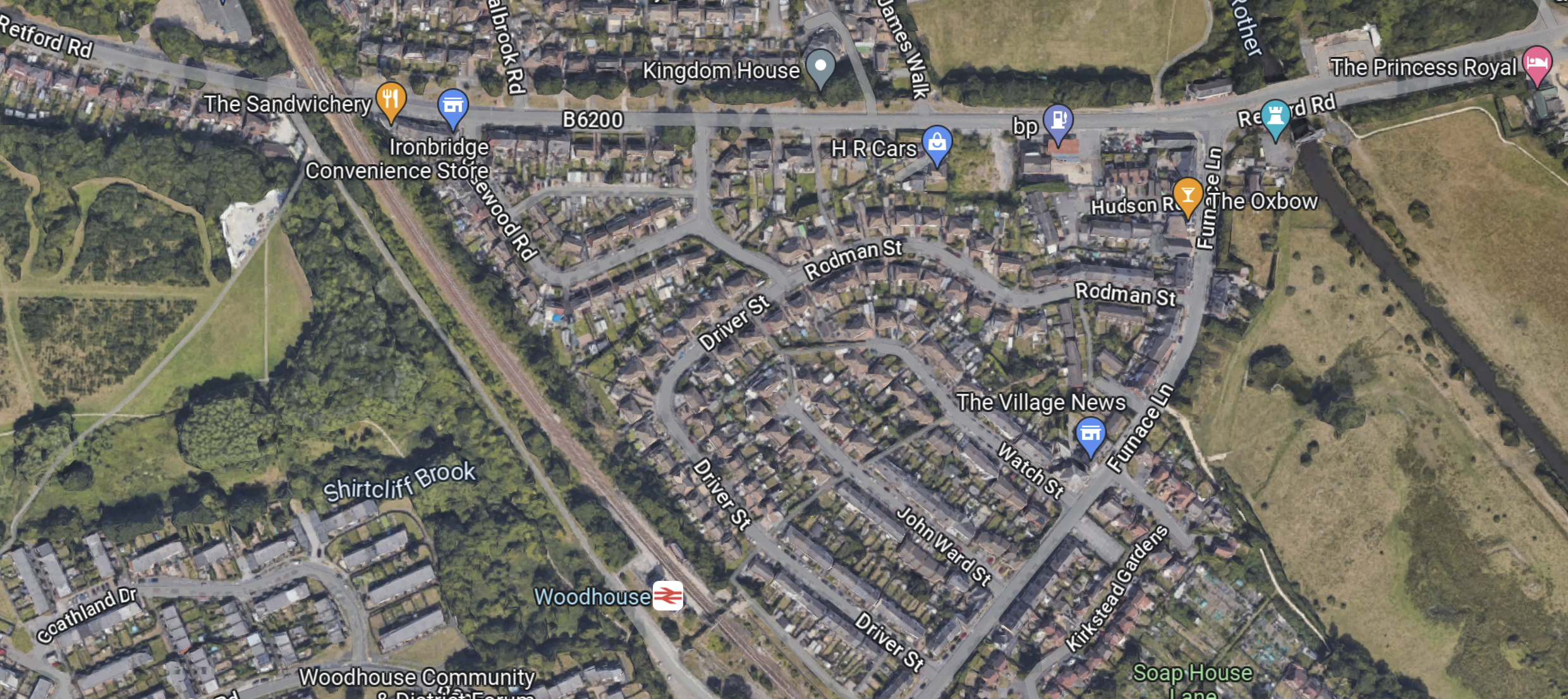
Note.
- It is certainly surrounded by a lot of houses.
- Could it be provided with car-parking?
Although, as this picture shows it is not blessed with lots of facilities.
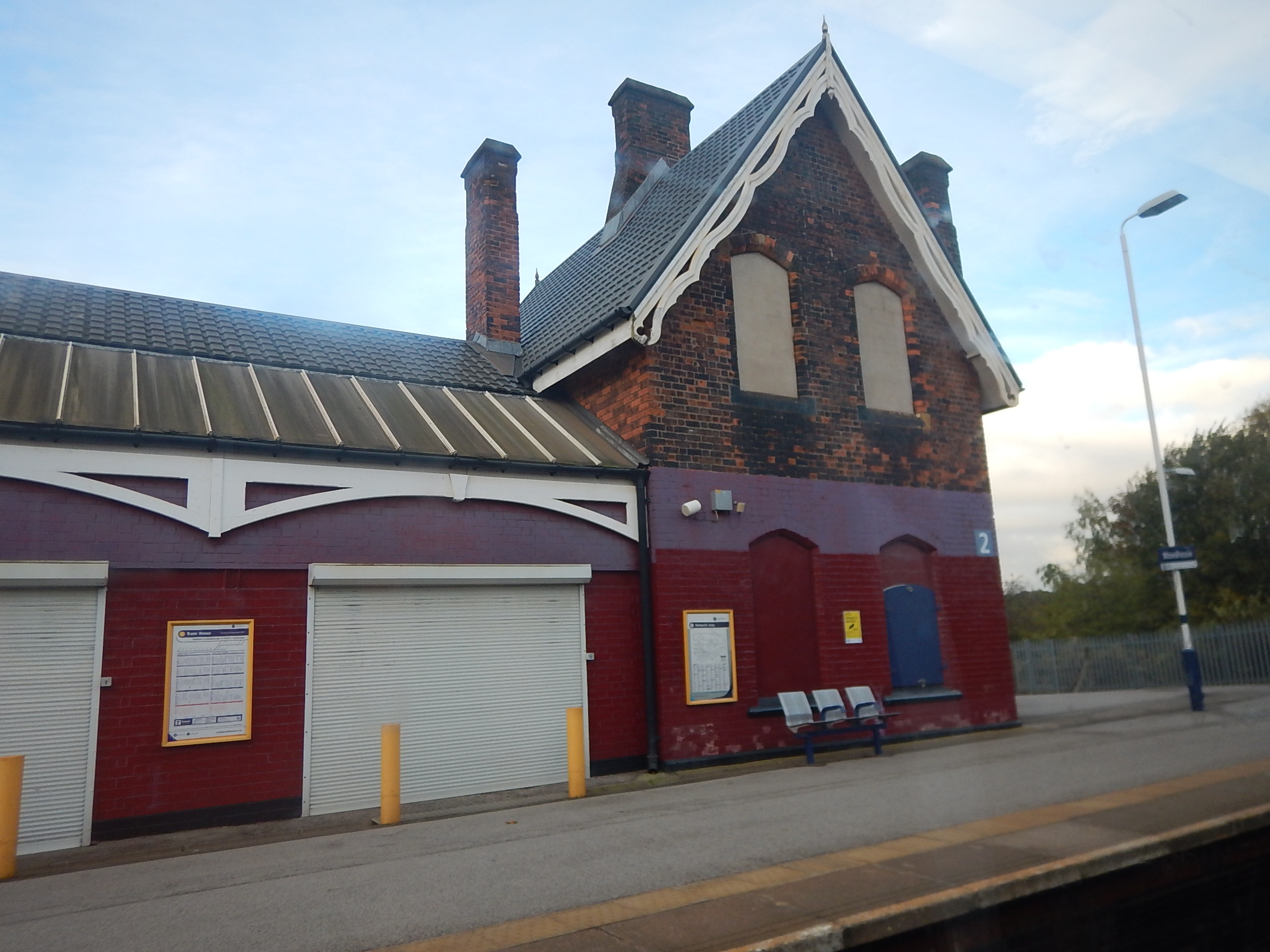
But.
- The station is in an area, which Sheffield want to develop.
- The Advanced Manufacturing Centre is nearby.
- There are aspirations to run a tram-train between Sheffield and Chesterfield via Darnall, Woodhouse and Barrow Hill stations.
- The station could be on the tram-train route to Stocksbridge, that I wrote about in Reopening The Don Valley Section Of The Former Woodhead Line Between Stocksbridge and Sheffield Victoria To Passenger Services.
Woodhouse station could be an interchange or it could become something bigger like a hub station.
How Many Sheffield Services Per Day Could Be Run?
If the Hull and Sheffield trains run as a flight under control of the digital signalling, this will mean that every Hull train can be paired with a Sheffield train.
- There are five trains per day (tpd) to and from Hull and two to and from Beverley.
- It seems a maximum of one tpd in both directions can be a ten-car train.
- Two five-car trains could fit in a platform at King’s Cross.
I suspect that the maximum number of trains per day to and from Sheffield is the same as for Hull. i.e. seven tpd.
But there is no reason, if they have enough trains and paths are available, that Hull Trains couldn’t add extra services to both destinations.
Onward From Sheffield
Several of those, who have commented on the new service have suggested that the service could go further than Sheffield, with Manchester and Leeds being given specific mentions.
This OpenRailwayMap shows the platforms at the Northern end of Sheffield station.
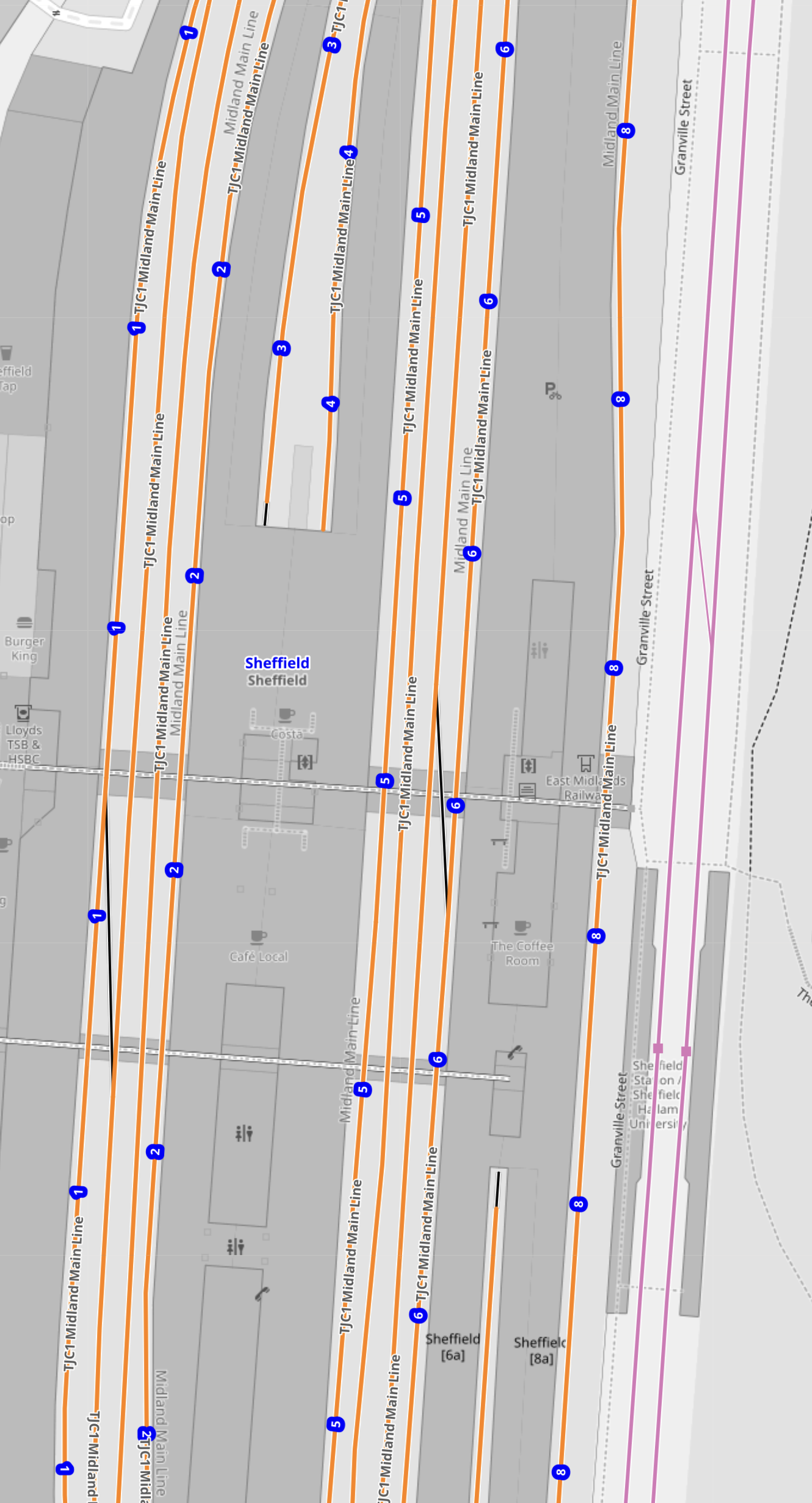
Note.
- The pink tracks at the East are the Sheffield Supertram.
- Trains to and from Barnsley, Huddersfield, Hull, Leeds, Lincoln and Retford access the station from the Northern end.
- Trains to and from Chesterfield, Derby, London, Manchester and Stockport access the station from the Southern end.
- The tracks in Sheffield station are numbered 1 to 8 from the West.
- There are five through platforms. 1, 2, 5, 6 and 8 and two bay platforms at either end.
- An extension of the service to Manchester via the Hope Valley Line, could go straight through the station.
- An extension of the service to Barnsley, Huddersfield or Leeds, would mean the train reversing at Sheffield.
It looks like an extension to Manchester Piccadilly over the recently upgraded Hope Valley Line would be the easiest extension. But would Avanti West Coast, who have FirstGroup as a shareholder want the competition?
Recently, it has been announced that the Penistone Line to Barnsley and Huddersfield will be upgraded to accept two trains per hour (tph) and allow faster running.
Because Sheffield could be around eighty minutes from London, there could be some smart times to and from the capital.
- Meadowhall in 90 minutes
- Barnsley in 112 minutes.
- Huddersfield in 140 minutes.
Huddersfield could be almost twenty minutes faster than the route via Leeds.
Comments From The Times
These are some readers comments from The Times.
- Hope the prices are competitive with LNER. I rarely go to London from Chesterfield with EMR as they’re so expensive. LNER from Newark is much cheaper but a service from Worksop for me would be perfect.
- Excellent News in so many ways. I hope it really takes off which could help ease the congestion on the M1 and also thin out overcrowding on busy LNER services. It really does deserve to succeed.
- This is excellent news. The Lumo service has been a game changer for me and those living in the north east.
The public seem in favour.
Conclusion
I really like this proposal from FirstGroup.
- It has the possibility to provide Sheffield with a fast train link to London.
- It could run about six trains per day.
- It will be faster than High Speed Two was proposed.
It could be the first service of High Speed Yorkshire.
Northumberland Council To Campaign For Better Rural Train Services
The title of this post is the same as that of this article on Rail Advent.
These are the first three paragraphs.
In response to the reduction in the number of trains serving Morpeth and Berwick in the new East Coast Main Line timetable, Northumberland County Council has pledged to continue campaigning hard for improved rail services for communities along the line and beyond.
Councillor Glen Sanderson said the new timetable “Sacrifices the North east’s rail connectivity in order to improve it for the rest of the country.”
The new timetable was due to be introduced last May 2023, but was deferred after the North East Joint Transport Committee said that it was wholly unacceptable. However, the new timetable shows very little improvement from the original. Although more frequent trains will operate between London and Edinburgh, not all of them will stop at Morpeth or Berwick, which are the services the council has been fighting hard for as they are key population centres.
The problems are that between Newcastle and Edinburgh are.
- The railway is only double-track all of the way, with a passing loop South of Berwick.
- The maximum speed is 125 mph for about 40 % of the track, 100/110 mph for another 30 %, with the rest slower.
- Berwick, Morpeth and the new stations at East Linton and Reston are only two platform stations.
The capacity needs to be increased, so that more trains can use the line.
These are my thoughts.
Install Digital Signalling
It has been claimed that digital signalling will add another train per hour (tph) between Stevenage and Doncaster.
So if it was able to do the same between Newcastle and Edinburgh, it might be the first solution to try.
All Passenger Trains Capable Of Running At 125 mph
In Call For ETCS On King’s Lynn Route, I outlined the problem with fast services to Cambridge, Ely and Kings Lynn, where the rains will need 125 mph capability to keep out of the way of LNER’s Azumas on the East Coast Main Line.
There will be a similar problem between Newcastle and Edinburgh.
Improve The Tracks
This would improve more sections of 125 mph running and perhaps better turnbacks at Morpeth and Berwick.
Conclusion
Quite a bit of work will need to be done to get the timetable to the standard the customers require.
 The Anonymous Widower