Last Of The Many
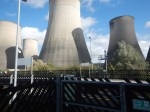
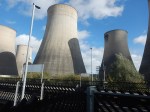
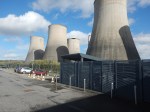
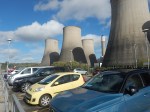
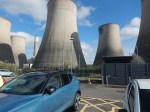
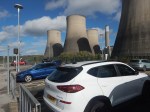
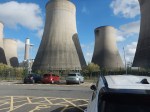
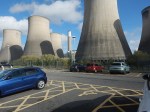
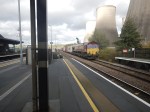
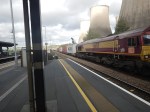
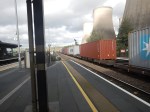
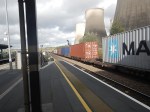
I took a train to East Midlands Parkway station, this morning and took these pictures of the cooling towers of the last coal-fired power station to generate electricity in the UK.
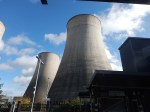
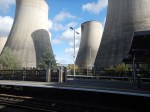
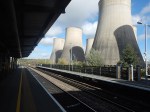
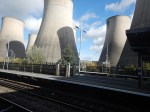
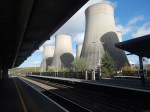
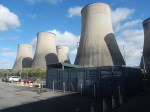
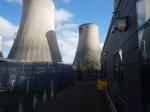
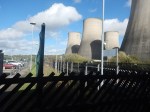
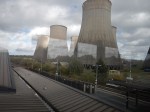
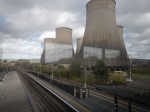
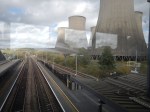
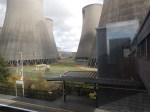
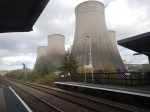
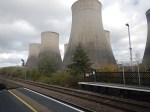
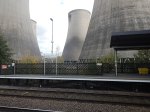
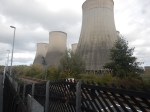
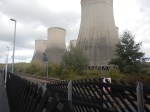
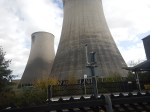
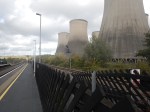
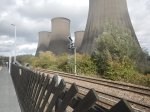
Note.
- The power station was commissioned in 1968.
- It has a nameplate capacity of 2.116 GW.
- Dogger Bank wind farm is intended to have a capacity of 3 GW
- There are eight cooling towers.The diesel locomotive hauling a freight train past the site is a Class 66 locomotive.
- These locomotives are likely to be scrapped in the next few years, to improve air quality in areas, where they run. Some will be replaced by electric or even hydrogen locomotives.
This Google Map shows a map view of the power station in 2024.
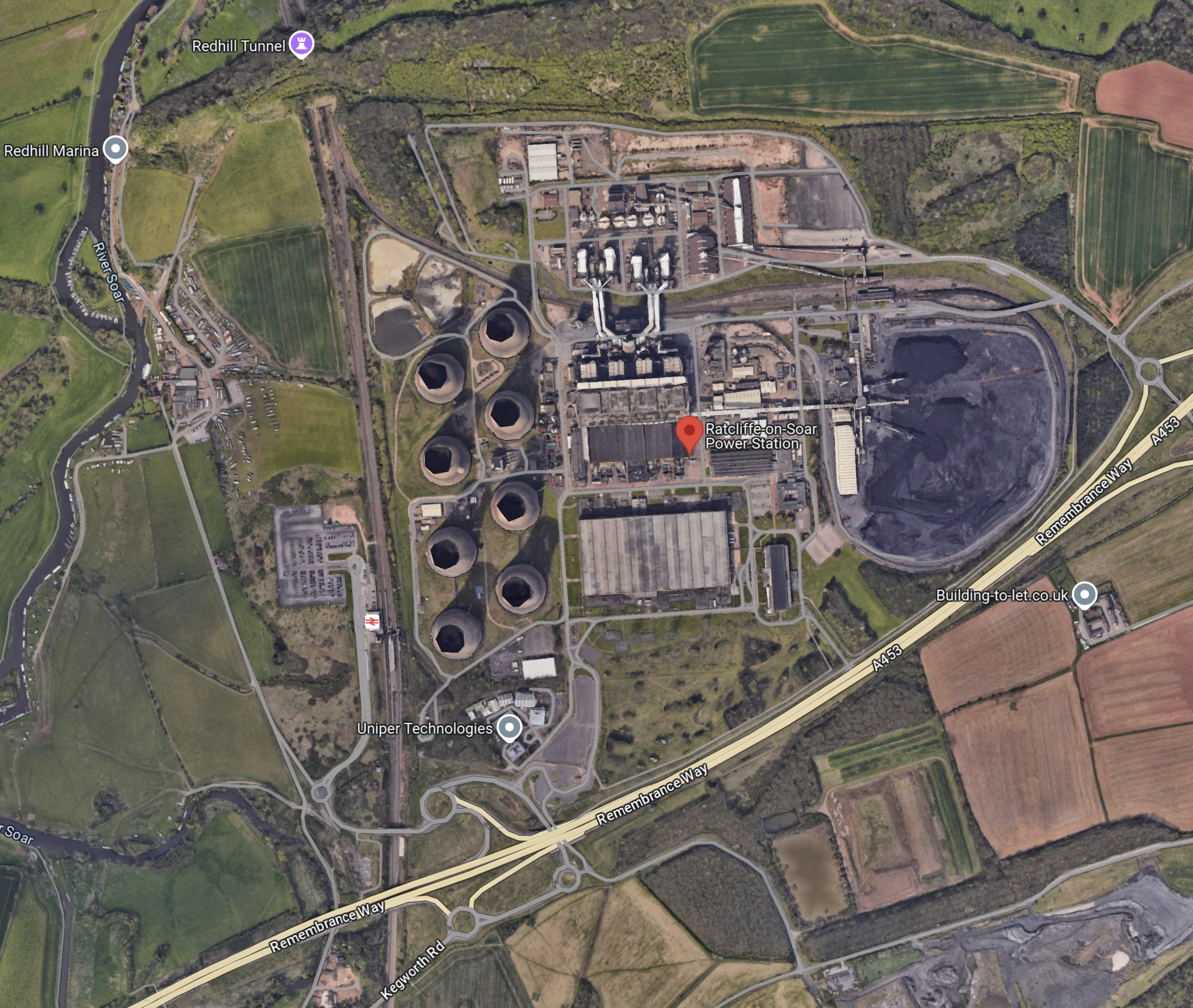
As the famous estate agent Roy Brooks would have said in the 1960s, it is a site with enormous potential.
Ensuring A Sustainable Future For A Coal-Fired Power Station Site Approaching Closure
The title of this section is that of an ARUP report on the future of the Radcliffe-on-Soar site.
This is the introductory paragraph.
Operating for more than 50 years, the Ratcliffe-on-Soar power station closed in September 2024. Its buildings, cooling towers and other structures will be decommissioned and demolished, making the site and surrounding land suitable to be redeveloped as a zero-carbon technology and energy hub for the East Midlands. Arup, working with Uniper, the site owner, supported Rushcliffe Borough Council to establish a Local Development Order (LDO) to make the most out of the potential development opportunities of the site.
ARUP’s report is a good start for one of the most important sites in the Midlands.
Energy In – Hydrogen And Carbon Dioxide Out
This article was inspired by this article in the Sunday Times, which is entitled ‘It’s A Slog’: Life Inside Britain’s Last Coal Power Station.
The article is about Ratcliffe-on-Soar power station, which is next to East Midlands Parkway station.
This is the first paragraph of the station’s Wikipedia entry.
Ratcliffe-on-Soar Power Station is a coal-fired power station owned and operated by Uniper at Ratcliffe-on-Soar in Nottinghamshire, England. Commissioned in 1968 by the Central Electricity Generating Board, the station has a capacity of 2,000 MW. It is the last remaining operational coal-fired power station in the UK, and is scheduled to close in September 2024.
I took these pictures of the power station in 2019.
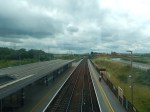
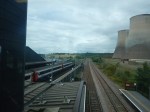
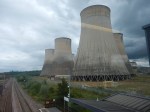
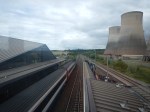
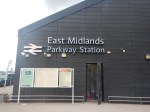
Ratcliffe-on-Soar is the last of a number of large coal-fired power stations, that were built in the area, mainly along the River Trent.
- Rugeley – 600 MW – 1961
- Drakelow – 1630 MW – 1964
- Willington – 800 MW – 1962
- Castle Donington – 600 MW – 1958
- Ratcliffe-on-Soar – 2000 MW – 1968
- High Marnham – 1000 MW – 1959
- Cottam – 2000 MW – 1968
- West Burton – 2000 MW – 1968
Note.
- The date is the commissioning date.
- That is 10,630 MW of electricity.
- There are also a few large gas-fired power stations along the river, that are still operating.
- Both coal and gas-fired stations use the water from the River Trent for cooling.
At the mouth of the river, there is the Keadby cluster of gas-fired power stations.
- Keadby 1 – 734 MW – 1996
- Keadby 2 – 849 MW – 2023
- Keadby 3 – 910 MW – 2027
- Keadby Hydrogen – 900 MW – 2030
Note.
- The date is the commissioning date.
- That is 3,393 MW of electricity.
- Keadby 2 is the most efficient CCGT in the world.
- Keadby 3 will be fitted with carbon capture.
- Keadby 2 has been designed to be retrofitted with carbon capture.
- Keadby Hydrogen will be fuelled by zero-carbon hydrogen.
As the years progress, I can see the Keadby cluster of power stations becoming a large zero-carbon power station to back-up wind farms in the North Sea.
- Hydrogen power stations will emit no carbon dioxide.
- Carbon dioxide from all gas-fired stations will be captured.
- Some carbon dioxide will be sold on, to companies who can use it, in industries like construction, agriculture and chemical manufacture.
- The remaining carbon dioxide will be stored in depleted gas fields.
As technology improves, more carbon dioxide will be used rather than stored.
Other Power Sources In The Humberside Area
In the next few sub-sections, I will list the other major power sources in the Humberside area.
Drax Power Station
Drax power station is a shadow of its former self, when it was one of the power stations fed by the newly discovered Selby coalfield.
These days it is a 2,595 MW biomass-fired power station.
Eastern Green Link 2
Eastern Green Link 2 will be a 2 GW interconnector between Peterhead in Scotland and Drax.
It is shown in this map.

Note.
- Most of the route is underwater.
- It is funded by National Grid.
- Contracts have been signed, as I talk about in Contracts Signed For Eastern Green Link 2 Cable And Converter Stations.
- It is scheduled to be completed by 2029.
This interconnector will bring up to 2 GW of Scottish wind-generated electricity to Drax and Humberside.
Drax has the substations and other electrical gubbins to distribute the electricity efficiently to where it is needed.
2 GW could also reduce the amount of biomass used at Drax.
In the long term, if the concept of the four Eastern Green Links is successful, I could see another Eastern Green Link to Drax to replace imported biomass at Drax.
I also, don’t see why a smaller Drax can’t be run on locally-sourced biomass.
Solar Farms And Batteries Along The River Trent
As the coal-fired power stations along the River Trent are demolished, solar farm developers have moved in to develop large solar farms.
Salt End Power Station And Chemical Works
These two paragraphs from the Wikipedia entry for Salt End describes the hamlet and its power station and chemical works.
Salt End or Saltend is a hamlet in the East Riding of Yorkshire, England, in an area known as Holderness. It is situated on the north bank of the Humber Estuary just outside the Hull eastern boundary on the A1033 road. It forms part of the civil parish of Preston.
Salt End is dominated by a chemical park owned by PX group, and a gas-fired power station owned by Triton Power. Chemicals produced at Salt End include acetic acid, acetic anhydride, ammonia, bio-butanol, bio-ethanol, ethyl acetate (ETAC) and ethylene-vinyl alcohol copolymer (EVOH) with animal feed also being produced on site.
I wonder, if running the complex on hydrogen would give cost and marketing advantages.
Aldbrough Hydrogen Storage Facility
This page on the SSE Thermal web site is entitled Plans For World-Leading Hydrogen Storage Facility At Aldbrough.
This is the most significant paragraph of the page, that is definitely a must-read.
With an initial expected capacity of at least 320GWh, Aldbrough Hydrogen Storage would be significantly larger than any hydrogen storage facility in operation in the world today. The Aldbrough site is ideally located to store the low-carbon hydrogen set to be produced and used in the Humber region.
This is a hydrogen storage facility for a much wider area than Humberside.
Rough Gas Storage Facility
This is the first paragraph of the Wikipedia entry for the Rough Gas Storage Facility.
Rough is a natural gas storage facility under the North Sea off the east coast of England. It is capable of storing 100 billion cubic feet of gas, nearly double the storage capacities in operation in Great Britain in 2021.
In Wood To Optimise Hydrogen Storage For Centrica’s Rough Field, I describe Centrica’s plans to convert the Rough gas storage into a massive hydrogen storage.
The Location Of Aldbrough Gas Storage, Rough Gas Storage, Salt End And Easington Gas Terminal
This Google Map shows between Salt End and the coast.
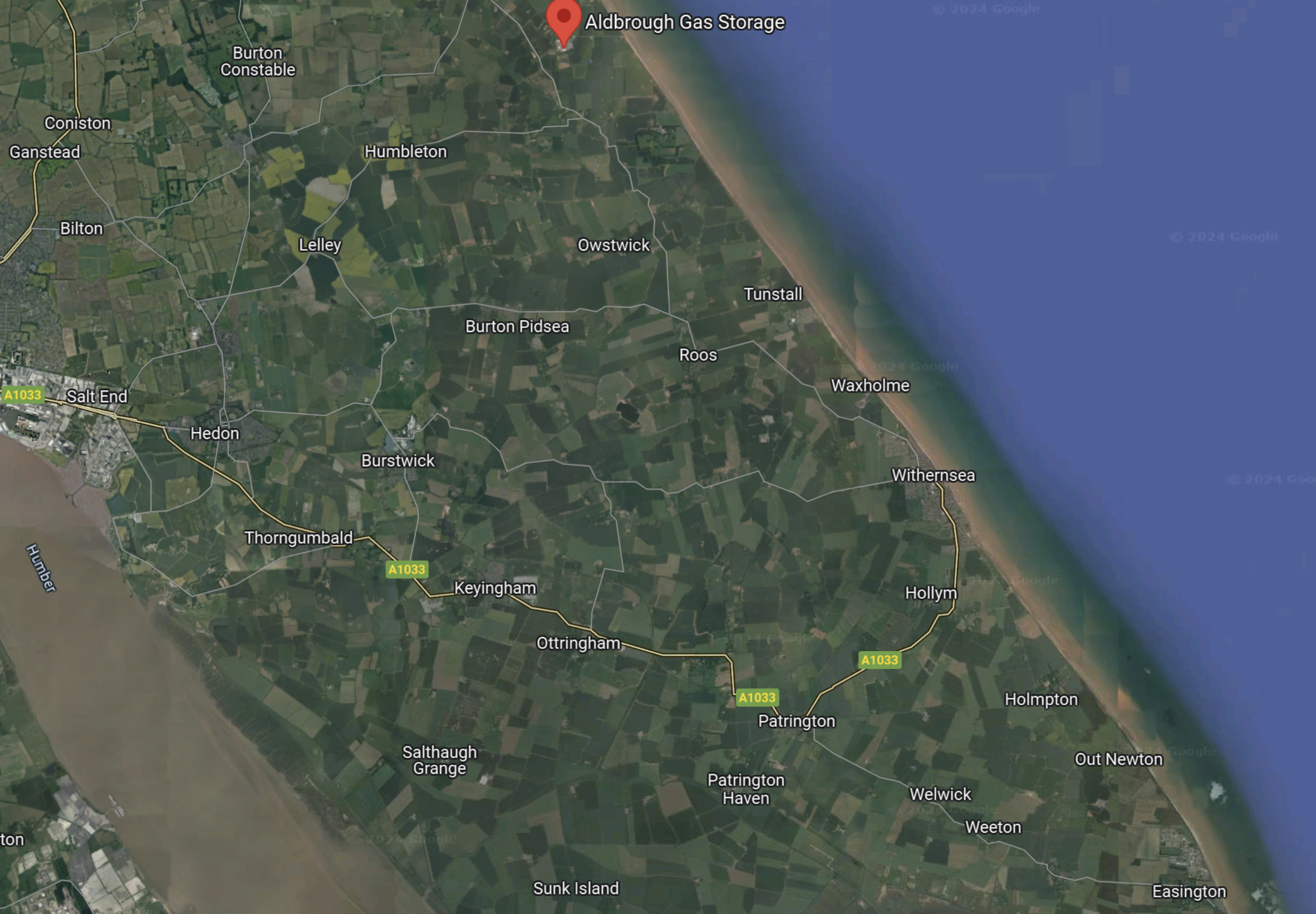
Note.
- The river crossing the South-West corner of the map is the Humber.
- Salt End with its power station and chemical works is on the North Bank of the Humber, where the river leaves the map.
- Aldbrough Gas Storage is marked by the red arrow at the top of the map.
- Easington Gas Terminal is in the South-East corner of the map.
- According to Wikipedia, gas flows into and out of the Rough Gas Storage are managed from Easington.
Looking at the map, I feel that the following should be possible.
- The two gas storage sites could be run together.
- Salt End power station and the related chemical works could run on hydrogen.
- Salt End will always have a reliable source of hydrogen.
- This hydrogen could be green if required.
All the chemical works at Salt End, could be run on a zero-carbon basis. Would this mean premium product prices? Just like organic does?
Enter The Germans
The Germans have a huge decarbonisation problem, with all their coal-fired power stations and other industry.
Three massive projects will convert much of the country and industry to hydrogen.
- H2ercules, which is a project of OGE and RWE, will create a hydrogen network to bring hydrogen, to where it is needed.
- In Uniper To Make Wilhelmshaven German Hub For Green Hydrogen; Green Ammonia Import Terminal, I describe how Uniper are going to build a hydrogen import terminal at Wilhelmshaven.
- AquaVentus is an RWE project that will use 10.3 GW of offshore wind power in German territorial waters to create a million tonnes per year of green hydrogen.
These would appear to be three of Europe’s largest hydrogen projects, that few have ever heard of.
AquaVentus And The UK
This video shows the structure of AquaVentus.
I clipped this map from the video.

Note.
- The thick white line running North-West/South-East is the spine of AquaVentus, that delivers hydrogen to Germany.
- There is a link to Denmark.
- There appears to be an undeveloped link to Norway.
- There appears to be an undeveloped link to Peterhead in Scotland.
- There appears to be a link to just North of the Humber in England.
- Just North of the Humber are the two massive gas storage sites of Aldbrough owned by SSE and Brough owned by Centrica.
- There appear to be small ships sailing up and down the East Coast of the UK. Are these small coastal tankers, that are distributing the hydrogen to where it is needed?
In the last century, the oil industry, built a substantial oil and gas network in the North Sea.
It appears now the Germans are leading the building of a substantial hydrogen network in the North Sea.
These are my thoughts about development of the AquaVentus network.
Hydrogen Production And AquaVentus
This RWE graphic shows the layout of the wind farms feeding AquaVentus.
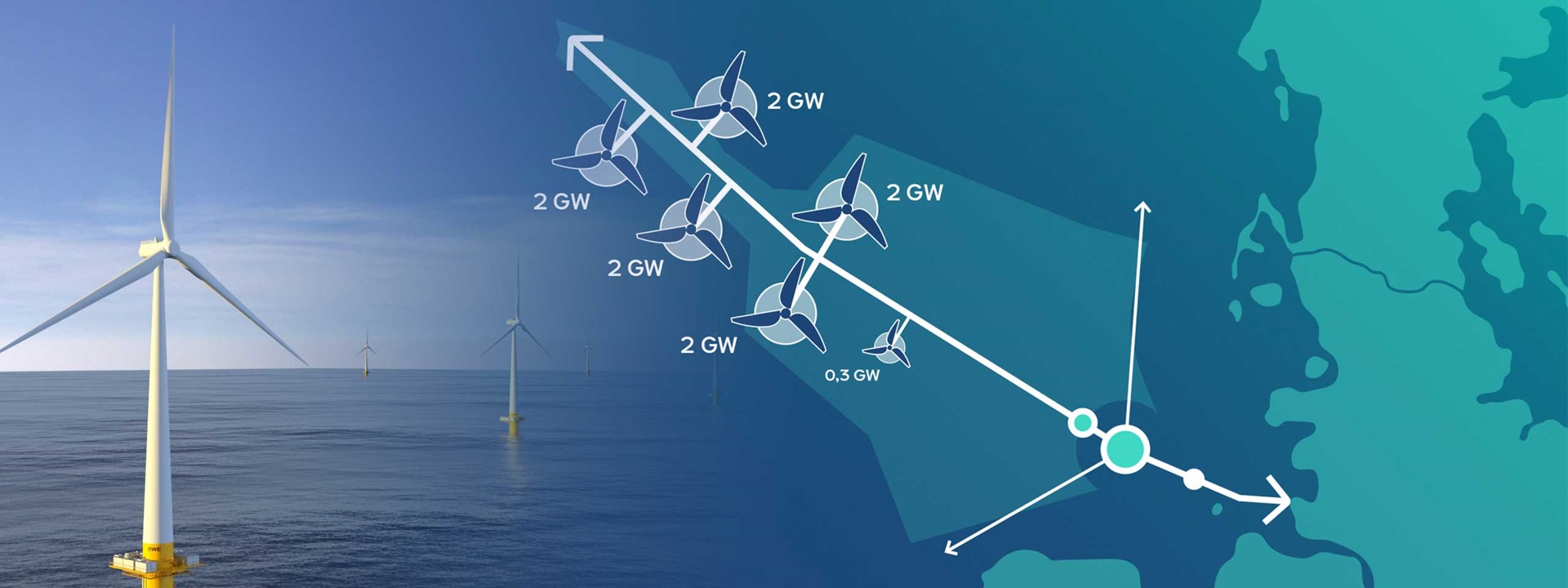
Note.
- There is a total of 10.3 GW.
- Is one of the 2 GW web sites on the UK-side of AquaVentus, the 3 GW Dogger Bank South wind farm, which is being developed by RWE?
- Is the 0.3 GW wind farm, RWE’s Norfolk wind farm cluster, which is also being developed by RWE?
Connecting wind farms using hydrogen pipelines to Europe, must surely mitigate the pylon opposition problem from Nimbys in the East of England.
As the AquaVentus spine pipeline could eventually connect to Peterhead, there will be other opportunities to add more hydrogen to AquaVentus.
Hydrogen Storage And AquaVentus
For AquaVentus to work efficiently and supply a large continuous flow of hydrogen to all users, there would need to be storage built into the system.
As AquaVentus is around 200 kilometres in length and natural gas pipelines can be up to 150 centimetres in diameter, don’t underestimate how much hydrogen can be stored in the pipeline system itself.
This page on the Uniper web site is entitled Green Wilhelmshaven: To New Horizons.
This is a sentence on the page.
Access to local hydrogen underground storage at the Etzel salt cavern site.
An Internet search gives the information, that Etzel gas storage could be developed to hold 1 TWh of hydrogen.
That would be enough hydrogen to supply 10 GW for a hundred hours.
Note that the UK branch of AquaVentus reaches the UK, just to the South of the massive hydrogen storage facilities at Aldbrough and Rough.
It would appear that both Germany and the UK are connected to AquaVentus through substantial storage.
I am certain, that all country connections to AquaVentus will have substantial storage at the country’s hydrogen terminal.
AquaDuctus
This would appear to be the first part of the AquaVentus network and has its own web site.
The web site is entitled Nucleus Of A Offshore Hydrogen Backbone.
These are the first two paragraphs.
The project partners are focusing on a scalable, demand-driven infrastructure: By 2030, AquaDuctus will connect the first large hydrogen wind farm site, SEN-1, with a generation capacity of approximately one gigawatt. SEN-1 is located in the German EEZ in the northwest of Helgoland. The pipeline will transport at a length of approx. 200 km green hydrogen produced from offshore wind to the German mainland and from there to European consumers via the onshore hydrogen infrastructure.
In the next project stage, AquaDuctus will be extended to the remote areas of the German exclusive economic zone towards the tip of the so-called duck’s bill. By that, additional future hydrogen wind farm sites will be connected. Along its way AquaDuctus will provide interconnection points with the opportunity for linking of adjacent national offshore hydrogen infrastructures originating from Denmark, Norway, the Netherlands, Belgium and United Kingdom which opens the door for Europe-wide offshore hydrogen transport by pipeline.
There is also an interactive map, that gives more details.
This paragraph explains, why the Germans have chosen to bring the energy ashore using hydrogen, rather than traditional cables.
Recent studies show that offshore hydrogen production and transport via pipelines is faster, cheaper, and more environmentally friendly than onshore electrolysis with a corresponding connection of offshore wind turbines via power cables. The German federal government has also recognized this advantage and has clearly expressed its intention to promote offshore hydrogen production in the North Sea.
I suspect, that some UK offshore wind farms will use the same techniques.
Hydrogen Production For The UK
Electrolysers will probably be built along the East Coast between Peterhead and Humberside and these will feed hydrogen into the network.
- Some electrolysers will be offshore and others onshore.
- Turning off windfarms will become a thing of the past, as all surplus electricity will be used to make hydrogen for the UK or export to Europe.
- Until needed the hydrogen will be stored in Albrough and Rough.
Backup for wind farms, will be provided using hydrogen-fired power stations like Keadby Hydrogen power station.
Financial Implications
I reported on Rishi Sunak’s Manifesto Speech, which he made on June 11th. This is an extract
This document on the Policy Mogul web site is entitled Rishi Sunak – Conservative Party Manifesto Speech – Jun 11.
These are three paragraphs from the speech.
We don’t just need military and border security. As Putin’s invasion of Ukraine has shown, we need energy security too. It is only by having reliable, home-grown sources of energy that we can deny dictators the ability to send our bills soaring. So, in our approach to energy policy we will put security and your family finances ahead of unaffordable eco zealotry.
Unlike Labour we don’t believe that we will achieve that energy security via a state-controlled energy company that doesn’t in fact produce any energy. That will only increase costs, and as Penny said on Friday there’s only one thing that GB in Starmer and Miliband’s GB Energy stands for, and that’s giant bills.
Our clear plan is to achieve energy security through new gas-powered stations, trebling our offshore wind capacity and by having new fleets of small modular reactors. These will make the UK a net exporter of electricity, giving us greater energy independence and security from the aggressive actions of dictators . Now let me just reiterate that, with our plan, we will produce enough electricity to both meet our domestic needs and export to our neighbours. Look at that. A clear, Conservative plan not only generating security, but also prosperity for our country.
I can’t remember any reports about an energy security policy, which he outlined in the last paragraph of my extract from his speech.
He also said we would have sufficient electricity to export to our neighbours. As I said earlier some of this energy will be in the form of hydrogen, which has been created by offshore electrolysers.
If we are exporting electricity and hydrogen to Europe, this is likely to have three effects.
- An improvement in Europe’s energy security.
- H2ercules will improve and decarbonise German industry, using UK hydrogen.
- The finances of UK plc will improve.
It looks like there would be winners all round.
Rishi Sunak had the cards and he played them very badly.
It is now up to Keir Starmer, Great British Energy and Jürgen Maier to play those cards to link the energy systems of the UK and Germany to ensure security and prosperity for Europe.
Is A High Capacity Freight Route Being Created On The Midland Main Line?
In the January 2022 Edition of Modern Railways, there is a section, which is entitled Mixed Fortunes For Freight In IRP, where IRP is short for Integrated Rail Plan For The North And Midlands.
In the section, this is said about freight on the Midland Main Line.
Whilst HS2 does relieve the MML, electrification of the route north from Kettering via Derby to Sheffield is of relatively limited use to freight, which is generally routed via Corby and Toton to Chesterfield and Rotherham. That said, assuming electrification of the passenger route includes the slow lines from Leicester to Trent and through Chesterfield, it does provide a base on which freight electrification can be built.
This would involve wiring Corby to Syston Junction (north of Leicester), Trent Junction to Clay Cross (south of Chesterfield) and Tapton Junction (north of Chesterfield) to Rotherham Masborough and Doncaster.
As with the ECML, this ‘freight’ electrification would provide a diversionary route and thus greater resilience for East Midlands Railway services.
In addition, gauge clearance throughout from Corby as part of this package would also be highly beneficial in creating a direct route from the ‘Golden Triangle of Logistics’ in the East Midlands to the North East and Scotland for consumer goods supply chains, boosting modal shift to rail and decarbonisation.
It does seem to be a cunning plan worthy of Baldrick at his best.
So is it feasible?
Which Routes Do Freight Trains Use Now?
Christmas in a pandemic, is not a particularly good time to look at the routes freight trains take.
But by looking at Real Time Trains, I can say this.
- Many trains take the route via Corby and Syston Junction, rather than the direct route via Market Harborough and Leicester.
- Leicester is quite busy with freight as trains between Felixstowe and places on the West Coast Main Line, go through the station.
- Very few freight trains seem to take the route via Derby and the Derwent Valley Mills.
- Most freight trains between East Midlands Parkway and Chesterfield seem to take the Erewash Valley Line via Toton and Ilkeston.
I don’t think the pattern will change much, if I look at the trains around the end of January.
What Do I Mean By European-Size Freight Trains?
The Wikipedia entry for loading gauge says this about about the route through the Channel Tunnel and up the Midland Main Line.
UIC GC: Channel Tunnel and Channel Tunnel Rail Link to London; with proposals to enable GB+ northwards from London via an upgraded Midland Main Line.
Note.
- . GC is 3.15 metres wide by 4.65 metres high.
- GB+ is 3.15 metres wide by 4.32 metres high.
- GB+ is intended to be a pan-European standard, that allows piggy-back services.
- British gauging is so complicated, it isn’t specified in standard units. It must be a nightmare for rolling stock designers.
I’ll take an easy way out and assume that by European-Size Freight Trains, I mean that the route must be cleared for GB+ gauge.
Could Kettering and Syston Junction Via Corby Be Cleared For European-Size Freight Trains?
According to a Network Rail Map from February 2010, the current clearance is as follows.
- Kettering and Oakham – W7
- Oakham and Syston Junction – W8
Note.
- Oakham and Peterborough is also W8
- The main problem seems to be that between Corby and Oakham, there are five tunnels; Corby, Glaston, Manton, Seaton and Wing.
- There are also a few overbridges and several level crossings, but they don’t look too challenging.
- Between Corby and Oakham, there is the magnificent Welland viaduct, which has eighty-two arches and is Grade II Listed.
- Ideally, freight operators would like to run European gauge piggy-back services, with road trailers travelling on flat wagons, as they do in CargoBeamer services.
It would be a tough call to satisfy my last point, but if it can be done it would allow all Midland Main Line freight trains to take the Corby diversion and this would remove the problems of running European gauge trains through Leicester station.
This Google Map shows a section of the Welland viaduct.
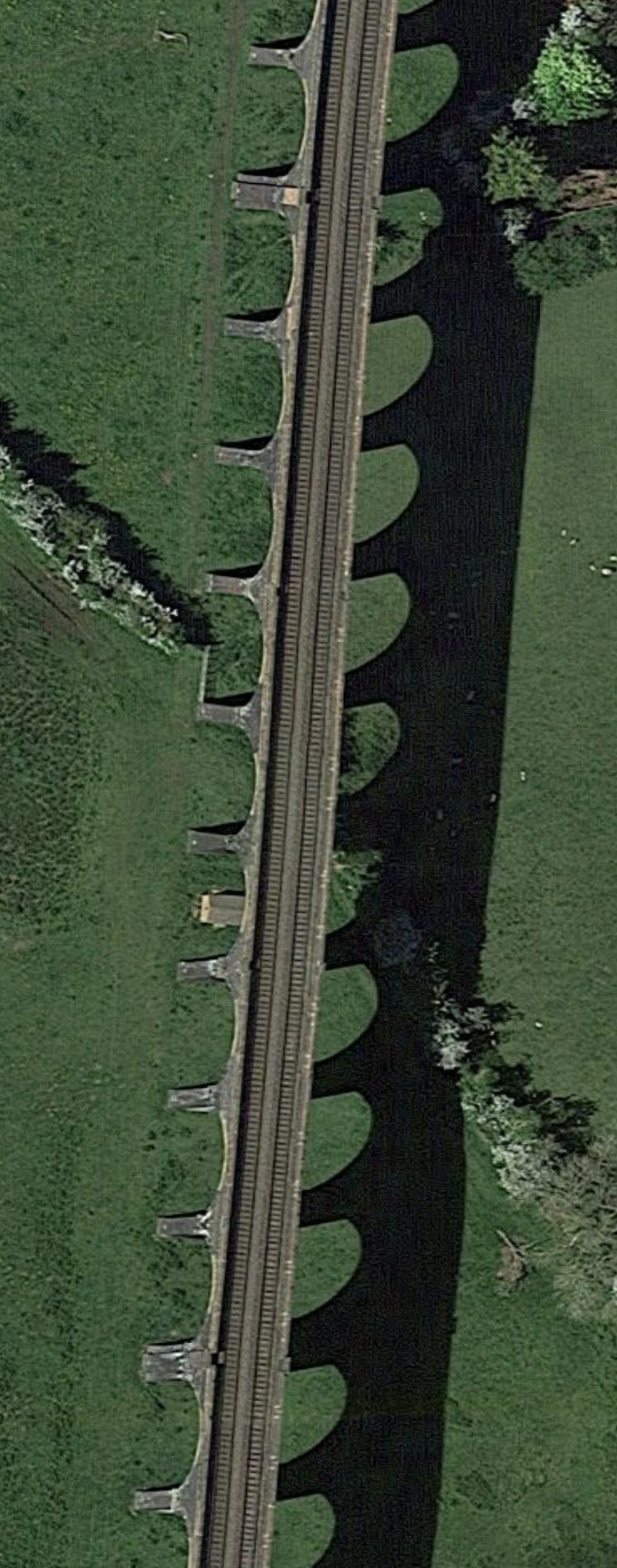
It could be key, as it is fully double-track.
But could it support two heavy freight trains at the same time?
But it would be some sight to see, long European-sized freight trains running over the viaduct.
Could The Midland Main Line Between Syston And Trent Junctions Be Cleared For European-Size Freight Trains?
The route is cleared to W7 or W8 between the two junctions and on inspection with my virtual helicopter, I suspect it wouldn’t be that challenging to upgrade.
It would also be sensible to clear the Castle Donnington Line for European-size freight trains, so that they could reach the East Midlands Gateway freight terminal.
This Google Map shows the location of the East Midlands Gateway.
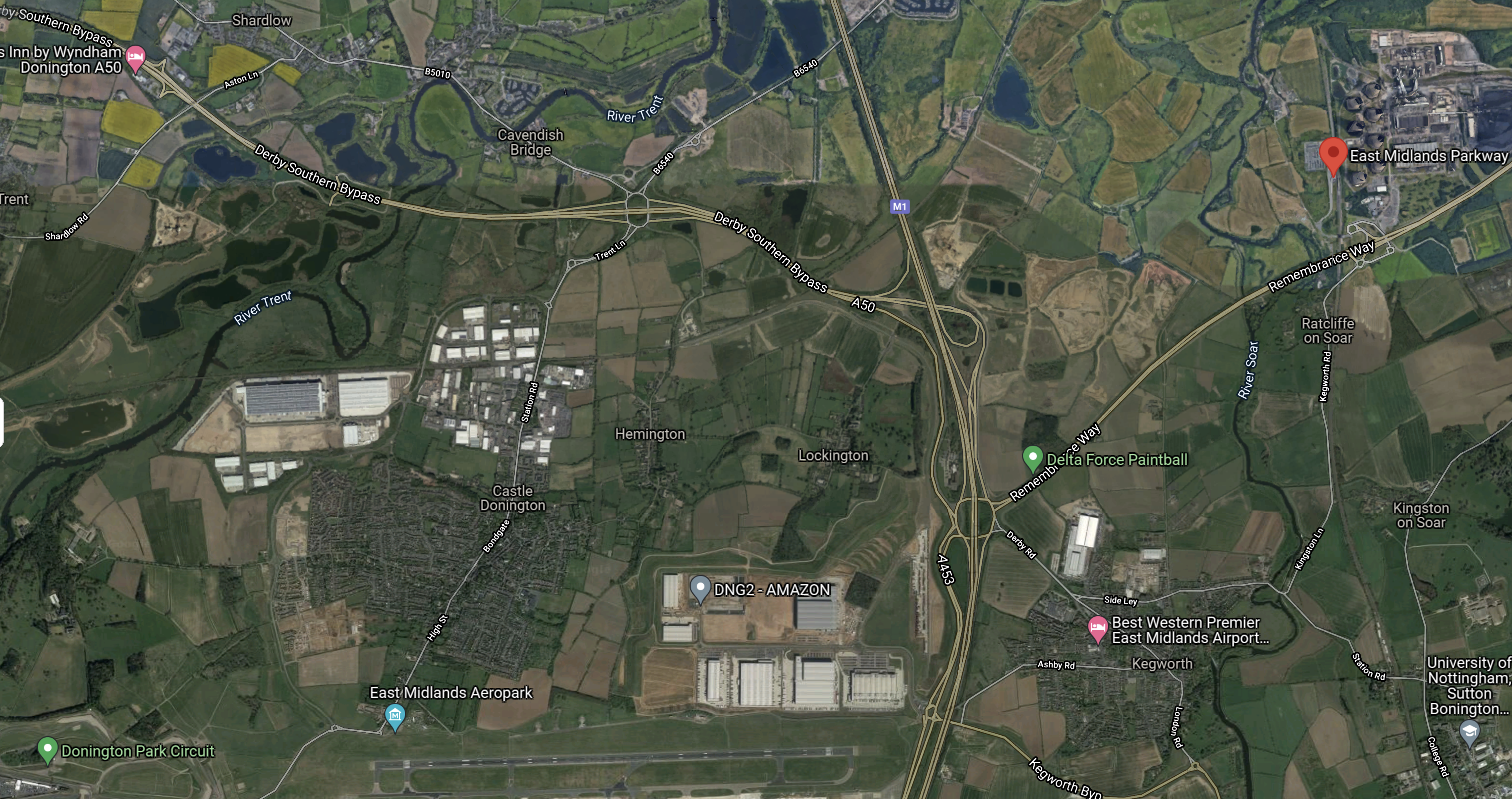
Note.
- East Midlands Parkway station is marked by the red arrow in the North-East corner of the map.
- Castle Donnington circuit is in the South West corner of the map.
- The long East-West runway of East Midlands Airport is clearly visible.
- East Midlands Gateway is to the North of the airport.
This second Google Map shows East Midlands Gateway in more detail.
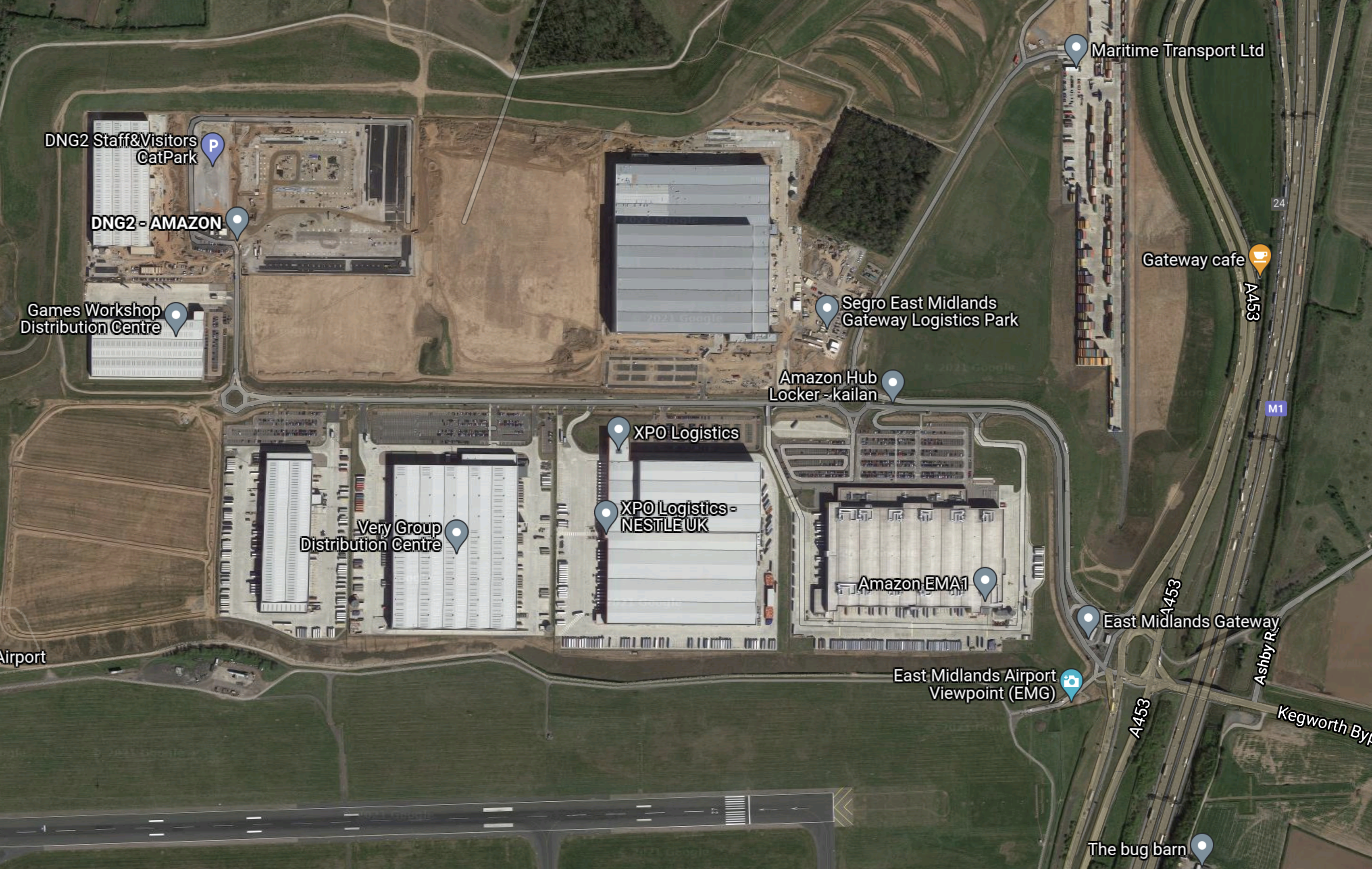
Note.
- In the North-East corner is Maritime Transport’s rail freight terminal.
- The M1 runs North-South at the Eastern edge of the map.
- East Midlands Gateway Logistics Park with two Amazon sheds is in the middle.
- The runway at East Midlands Airport is clearly visible.
The Integrated Rail Plan for the North And Midlands has already announced that High Speed Two will join the Midland Main Line to the South of East Midlands Parkway station to serve Derby, Nottingham and Sheffield.
- This new line will have to go past the airport, either to the North of the Logistics Park or South of the Airport.
- Could there be a station here, both for passengers and the workers at a very busy freight airport and Logistics Park?
- Currently, trains between the rail terminal and London, London Gateway and the Port of Felixstowe have to reverse North of the rail terminal to access the terminal.
- All the rail links between the Midland Main Line and East Midlands Gateway would need to be built to accept European-size freight trains, to ensure maximum flexibility.
It strikes me, that there are a lot of extra features that could be added to the rail network between the Midland Main Line and East Midlands Gateway.
Could The Erewash Valley Line Via Ilkeston Be Cleared For European-Size Freight Trains?
Consider.
- According to a Network Rail Map from February 2010, the Erewash Valley Line is cleared to W8.
- According to Wikipedia, it is the second busiest freight route in the East Midlands.
- Network Rail have spent £250 million on the line in recent years to improve junctions and improve signalling.
- The route doesn’t have a large number of passenger services.
These pictures show Ilkeston station on the Erewash Valley Line.
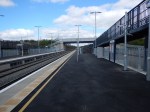

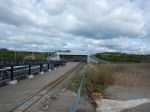
Note.
- The recently rebuilt bridge and the separate avoiding line.
- The Class 158 train under the bridge is 3.81 metres high.
As the European gauge; GB+ is 4.32 metres high, I would feel that Ilkeston station can handle European-size freight trains.
I have flown my virtual helicopter all the way over the Erewash Valley Line from Toton to Clay Cross North junction.
- It looks as if most of the not many bridges are either recent or could be updated to handle the large European-sized freight trains.
- It should also be noted that in many places there is a third track or space for them.
- There are three stations and the Alfreton tunnel.
After this quick look, I feel that the Erewash Valley Line will be able to handle European-size freight trains.
Could Tapton Junction to Rotherham Masborough and Doncaster Be Cleared For European-Size Freight Trains?
This route has very few bridges and I doubt updating wouldn’t cause too many problems.
CargoBeamer
Would it be possible for one of CargoBeamer’s piggy-back trains carrying trailers to run between the Channel Tunnel and the rail terminal at East Midlands Gateway Logistics Park or perhaps another terminal further up the Midland Main Line?
If they could use the Gospel Oak and Barking Line to access the Midland Main Line, I don’t see why not!
Conclusion
It appears that it should be possible to allow European-size freight trains to run between the North of England and the Channel Tunnel.
New ‘HS3’ Link To Yorkshire Proposed By Thinktank After Region’s HS2 Axe
The title of this post, is the same as this article in the Yorkshire Post.
This is the introductory paragraph.
A new “HS3” high-speed rail line between Yorkshire and the Nottinghamshire town of Newark could help make up for the loss of the HS2 eastern leg from Yorkshire, a report by transport think-tank; Greengauge 21 has suggested.
There is also this map from Greengauge 21.
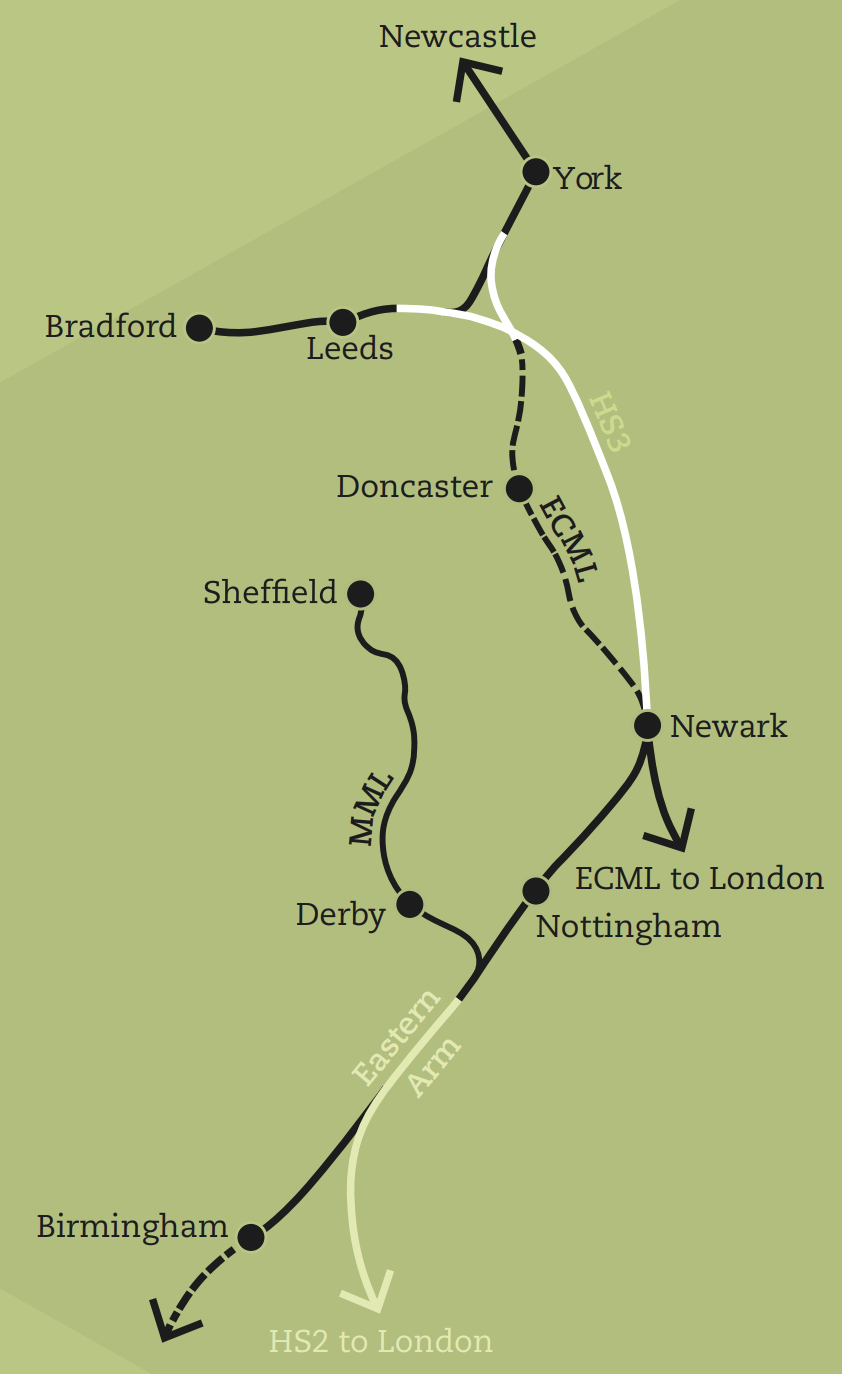
I clipped my copy of the map from this report on Greengauge 21, which is entitled East, West, North And South.
Note.
- As in the Integrated Plan For The North And Midlands, Derby, Nottingham and Sheffield have direct connections to London via High Speed Two.
- The Derby leg is extended to Sheffield via the existing Midland Main Line.
- The Nottingham leg is extended to Newark, where it joins the East Coast Main Line.
- A new High Speed Line, which is shown in white and labelled HS3 links Newark to the East Coast Main Line and the line between Leeds and York at a new triangular junction South of Colton Junction.
- Part of the current route between Doncaster and Colton Junction is the Selby Diversion, which according to Wikipedia was built for speeds upward of 140 mph.
- The route splits in the region of Colton Junction with the Western leg going to Leeds and Bradford and he Northern leg going to York and Newcastle.
I feel this is a better plan than the previous one from High Speed Two.
- It adds Bradford, Derby and Nottingham to the High Speed Two network.
- There is a connection to Birmingham and possibly the South West and Wales.
- The East Coast Main Line is effectively four-tracked between Newark North Gate and York.
I have a few thoughts.
Colton Junction
This junction will feature a lot in this post, so I had better explain where it is.
The Selby Diversion was built in the 1980s to create a new route, which avoided the newly-discovered Selby coalfield.
Colton Junction is about six miles South of York and is at the Northern end of the Selby Diversion.
This Google Map shows the junction.
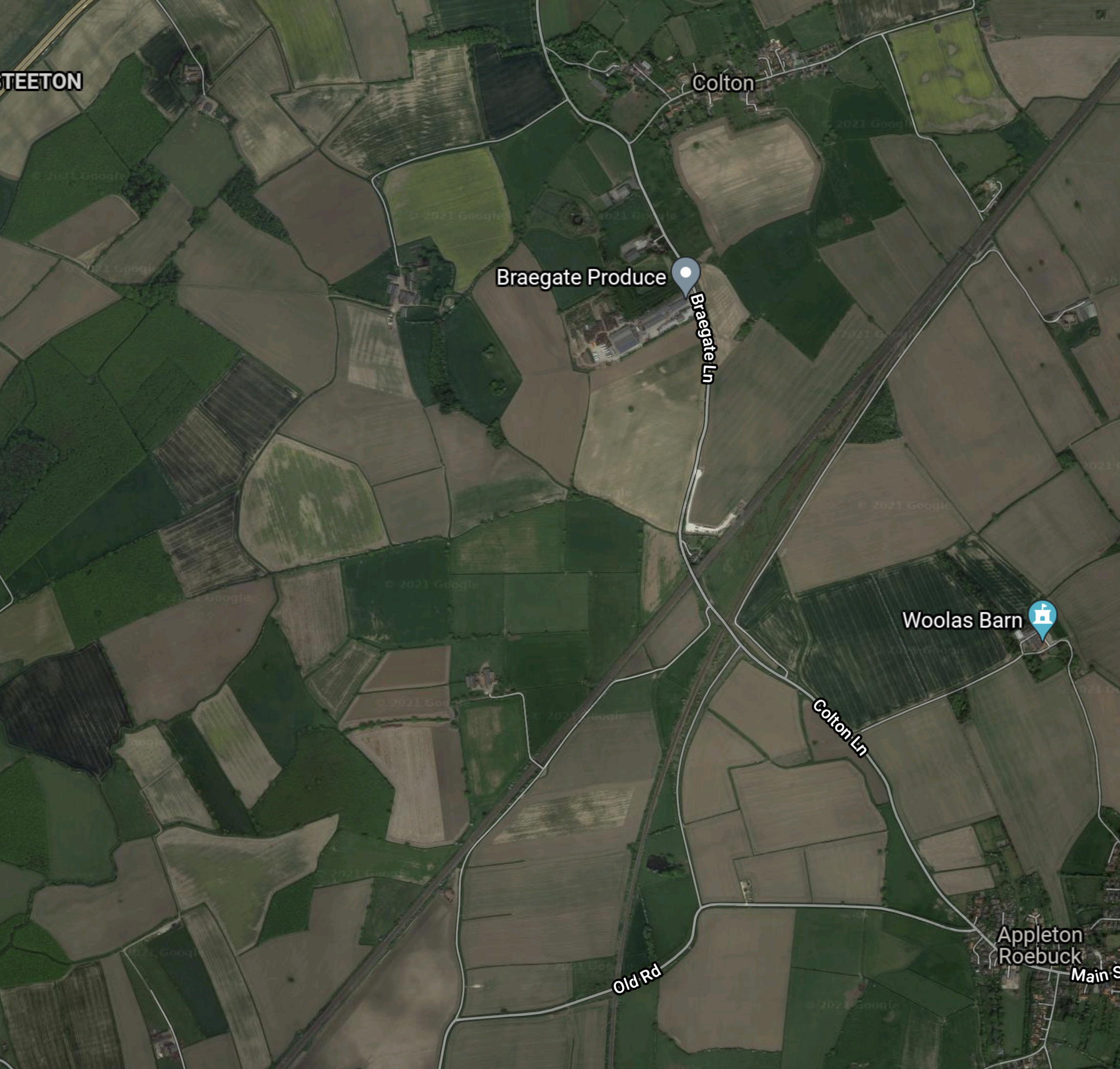
Note.
- The East Coast Main Line going between South-West and North-East across the map.
- The railway going North-East leads to York.
- The village of Colton is at the top of the map.
- Colton Junction is South of the village, where the East Coast Main Line splits.
- The line going South-West is the route without electrification to Leeds, used by TransPennine Express and others.
The line going South is the Selby Diversion, used by all trains on the East Coast Main Line.
East Midlands Hub Or East Midlands Parkway
Some reports indicate that a new Birmingham and Nottingham High Speed Line will go via East Midland Parkway station.
- East Midland Parkway is a fully-functioning four-platform station.
- It is already operating.
- There will soon be a large brownfield site next door, when the coal-fired Radcliffe-on-Soar power-station is demolished.
- It has connections to Nottingham and Sheffield via Derby and Chesterfield.
- Platforms are probably long enough to handle splitting and joining.
- An advanced passenger shuttle could be built to East Midlands Airport.
This map from High Speed Two shows the route of the Eastern leg of High Speed Two, where it passes East Midland Parkway station and Radcliffe-on-Soar power-station.
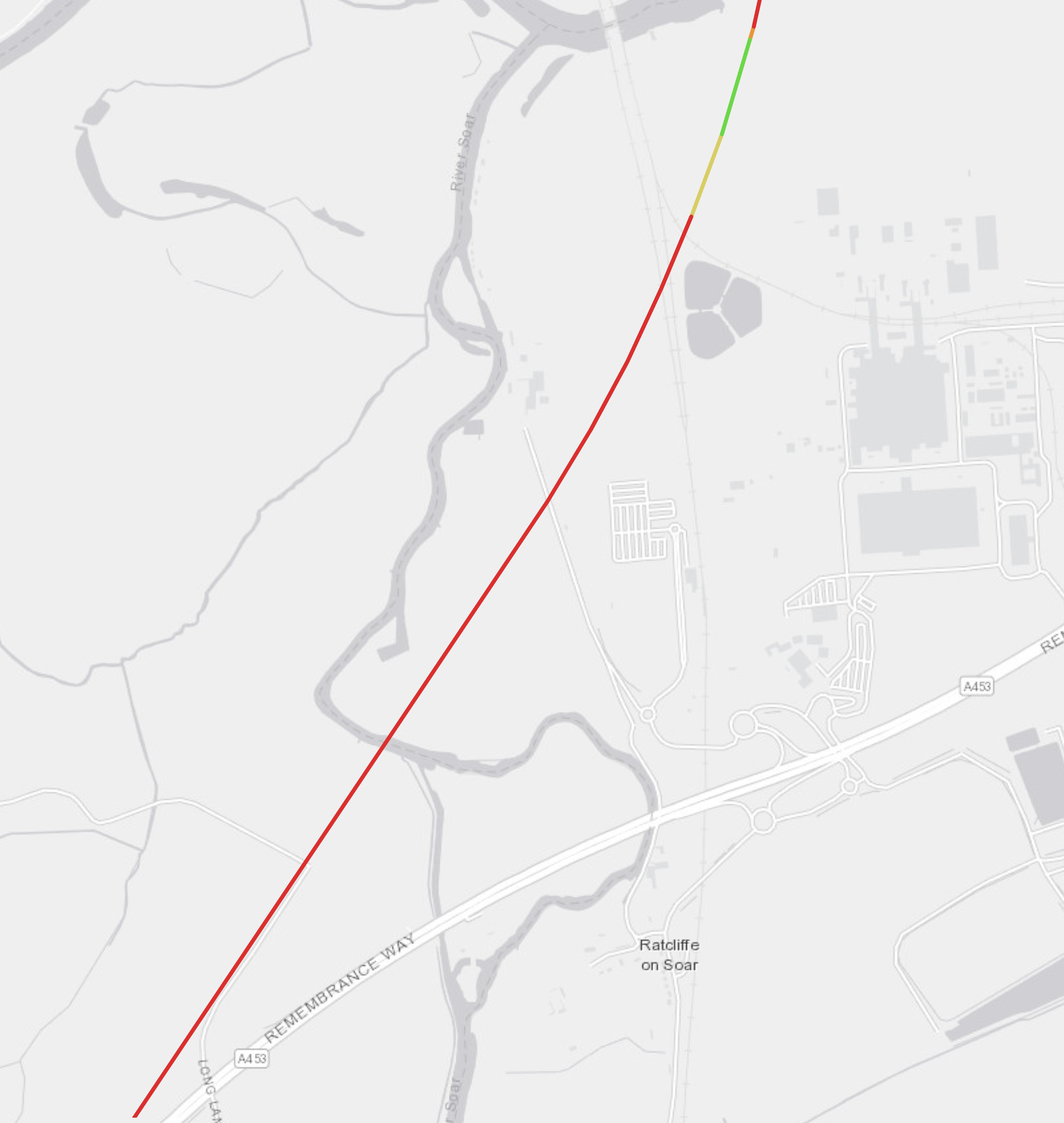
Note.
- The coloured line is the route of High Speed Two.
- Red indicates viaduct
- Yellow indicates cutting.
- Green indicates green tunnel.
- There is a curious clover-leaf shape to the East of High Speed Two.
This Google Map shows the same area.
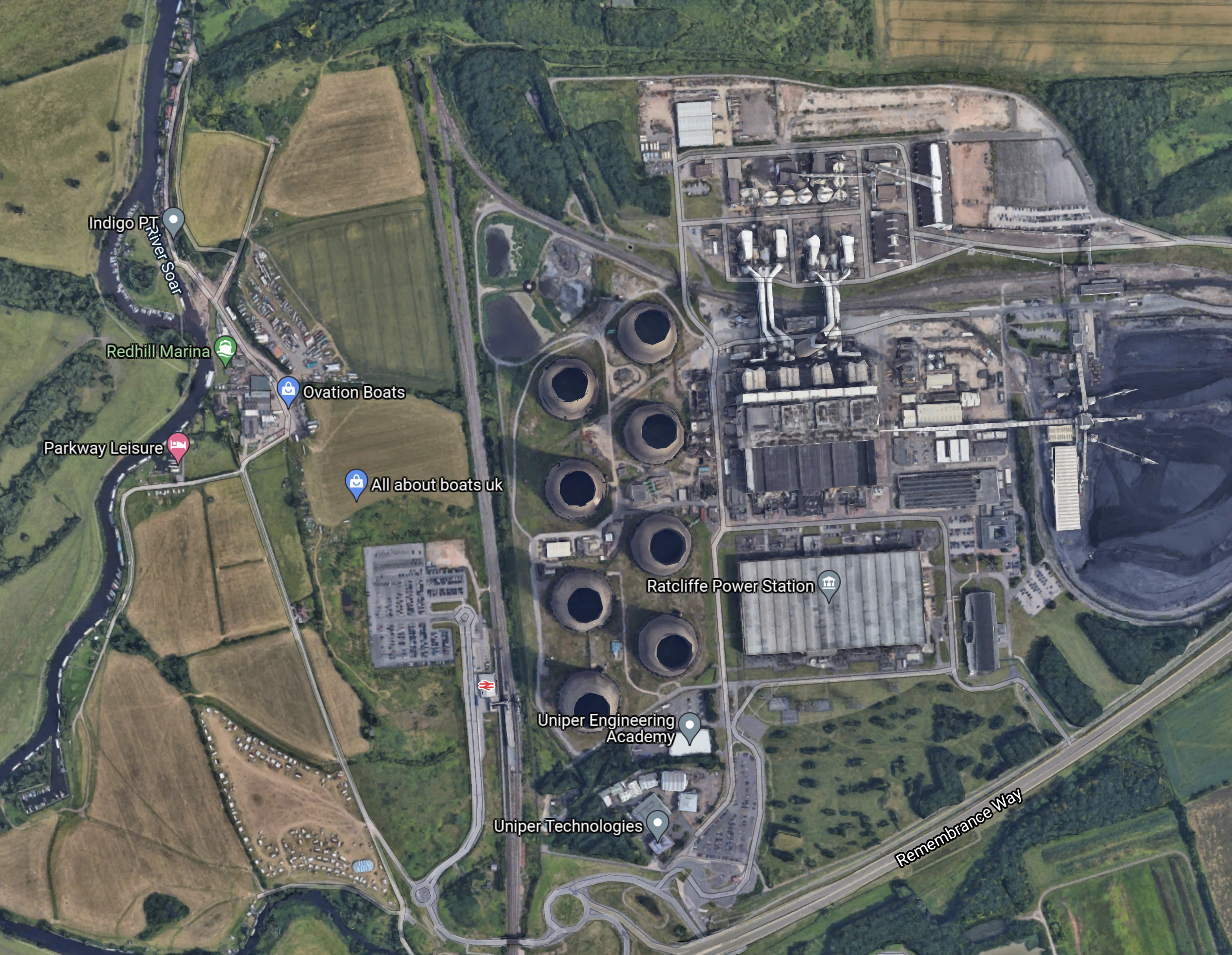
Note
- The River Soar and Remembrance Way can be picked out on both maps.
- The Midland Main Line runs North-South in the Google Map and passes through East Midlands Parkway station.
- It is possible to pick out the curious clover leaf shape to the North of the railway station, where the rail line goes into the power station.
- Returning to the High Speed Two map it is possible to pick out the railway and power stations.
This map from High Speed Two shows the route of the Eastern leg of High Speed Two, to the South-West of East Midlands Parkway station.
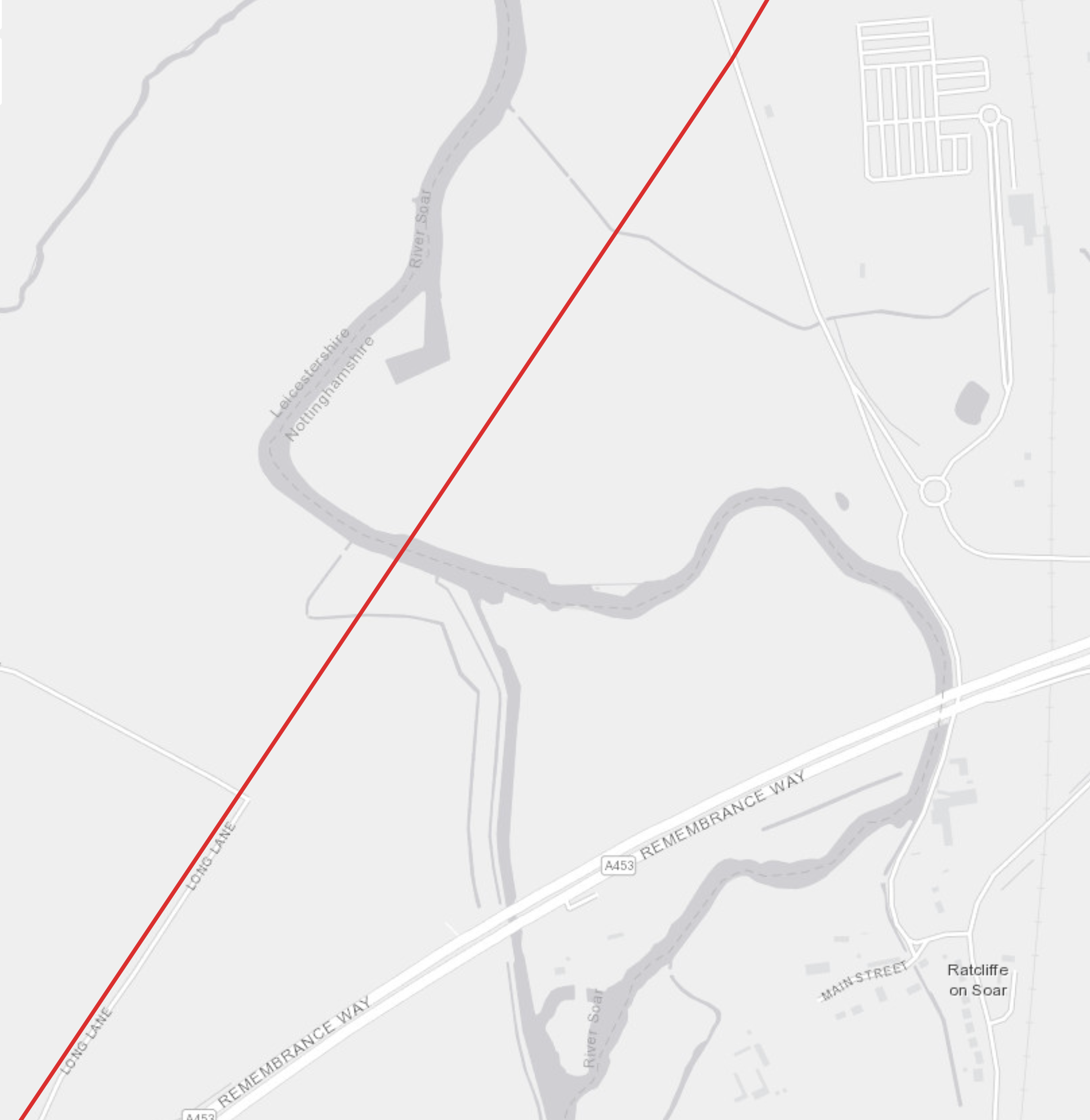
Note.
- The coloured line is the route of High Speed Two.
- Red indicates viaduct.
- East Midlands Parkway station is in the North-East corner of the map.
- The Midland Main Line runs North-South down the Eastern side of the map.
Could the route of High Speed Two be adjusted so that it runs through East Midlands Parkway station?
This Google Map shows a similar area as the second High Speed Two map.
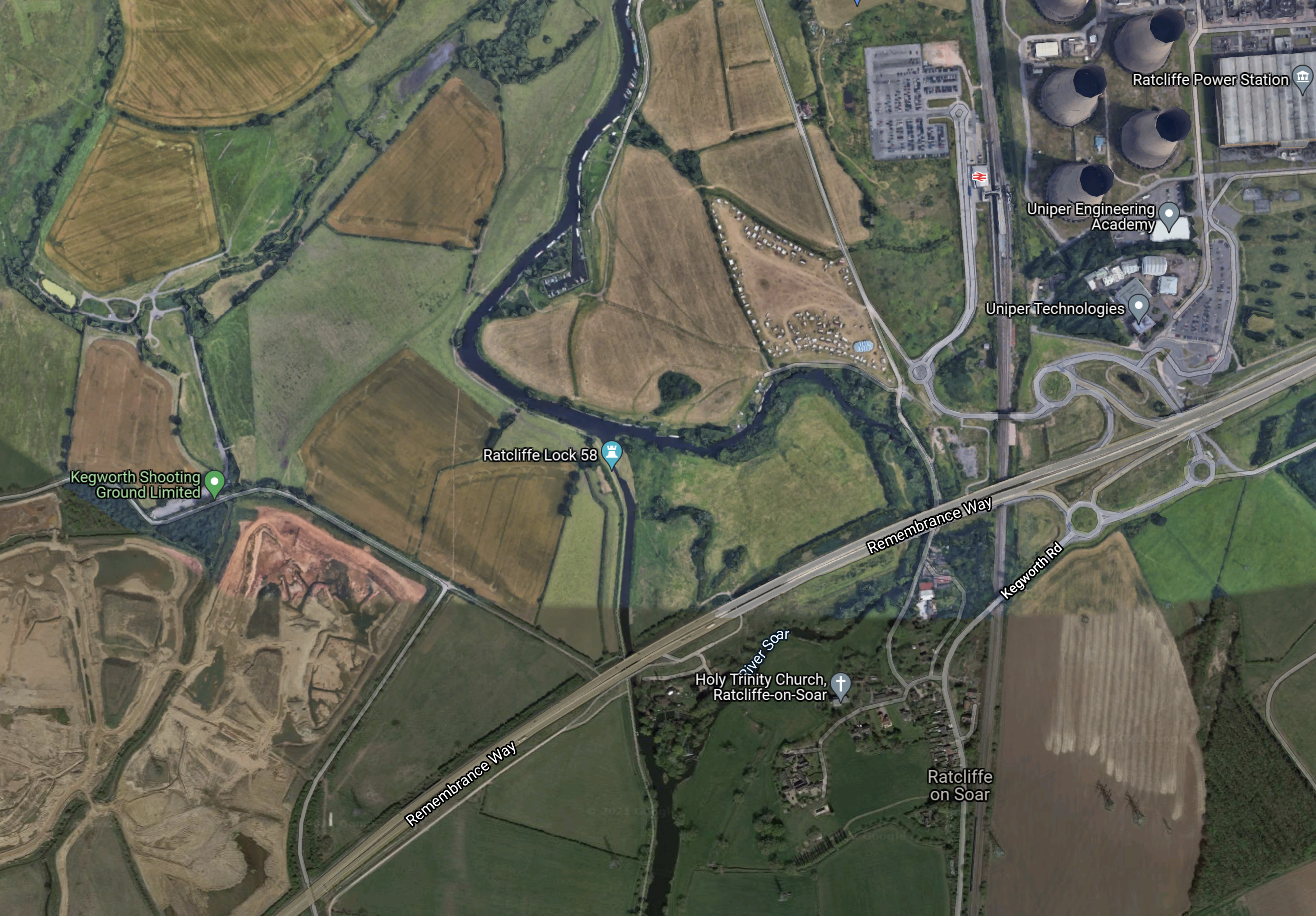
With the exception of the village of Radcliffe-on-Soar, there aren’t many, who would get in the way of the development of a connection between High Speed Two and the Midland Main Line to the South of East Midlands Parkway station.
- High Speed Two crosses Remembrance Way in the South West corner of the map, where there is a junction with the M1 and runs diagonally across the map.
- High Speed Two could probably sneak up the North side of Remembrance Way.
- The station might need to be moved to the North a bit to give space.
- The map also shows the space to the East, that will be created with the demolishing of the power station.
Developing East Midlands Parkway instead of East Midlands Hub could be the more affordable option.
High Speed Two’s Eastern Leg Services
This graphic shows High Speed Two’s services before the Eastern Leg was deleted.
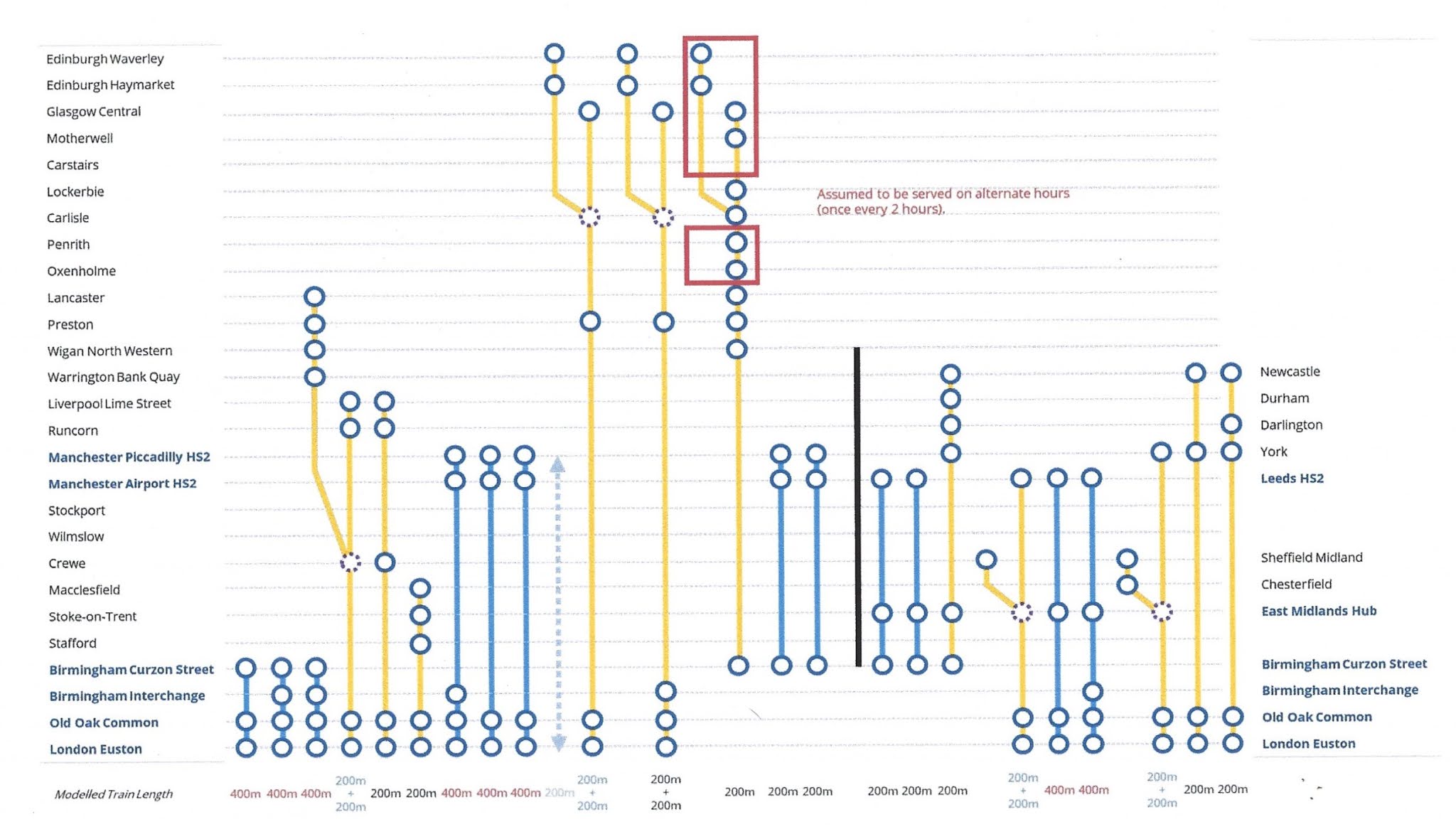
Note.
- Western Leg services are to the left of the vertical black line.
- Eastern Leg services are to the right of the vertical black line.
- Blue indicates a full-size service.
- Yellow indicates a Classic-Compatible service.
Destinations on the former Eastern Leg get the following services.
- Chesterfield – 1 tph
- Darlington – 2 tph
- Durham – 1 tph
- East Midlands Hub – 7 tph
- Leeds – 5 tph
- Newcastle – 3 tph
- Sheffield – 2 tph
- York – 6 tph
Note.
- Two trains will split and join at East Midlands Hub or East Midlands Parkway. But given what I said earlier, the split will take place at East Midlands Parkway.
- Derby, Chesterfield and Sheffield could get two tph.
- If the pattern of the currently proposed High Speed Two service is followed, that would mean that 5tph to Leeds and four tph to York and further North would go through Nottingham.
I suspect that there could be a reduction in either High Speed Services on the Eastern Leg or on the East Coast Main Line.
Splitting And Joining At East Midlands Parkway
Consider.
- All Northbound services on High Speed Two and the Midland Main Line pass through East Midlands Parkway station in the same direction.
- All Southbound services on High Speed Two and the Midland Main Line pass through East Midlands Parkway station in the same direction.
- The four platforms at East Midlands Parkway station will give a lot of flexibility.
If trains split and joined at East Midlands Parkway, there would be no need to reverse to serve Derby, Chesterfield and Sheffield. I can’t see how this could be performed at East Midlands Hub without the Sheffield train reversing. This probably explains why in the original plans for High Speed Two, Sheffield and Chesterfield had their own spur and Derby was not served directly by High Speed Two.
The redesign in the Integrated Rail Plan For The North And Midlands, which abandons the Sheffield spur, probably reduces the costs significantly.
Nottingham
Nottingham will be an extremely busy station with these services running through.
- High Speed Two – 2 tph – Birmingham Curzon Street and Leeds HS2 via Nottingham – Full-Size – 200 metres
- High Speed Two – 1 tph – Birmingham Curzon Street and Newcastle via Nottingham, York, Darlington and Durham – Classic-Compatible – 200 metres
- High Speed Two – 1 tph – London and Leeds HS2 via Nottingham – Classic-Compatible – 200 metres
- High Speed Two – 1 tph – London and Leeds HS2 via Nottingham – Full-Size – 400 metres
- High Speed Two – 1 tph – London and Leeds HS2 via Birmingham Interchange and Nottingham – Full-Size – 400 metres
- High Speed Two – 1 tph – London and York via Nottingham – Classic-Compatible – 200 metres
- High Speed Two – 1 tph – London and Newcastle via Nottingham and York – Classic-Compatible – 200 metres
- High Speed Two – 1 tph – London and Newcastle via Nottingham, York and Darlington – Classic-Compatible – 200 metres
- East Midlands Railway – 1 tph – London St. Pancras and Nottingham via Kettering, Market Harborough and Leicester – Class 810
- East Midlands Railway – 1 tph – London St. Pancras and Nottingham via Kettering, Market Harborough, Leicester, Loughborough, East Midlands Parkway and Beeston – Class 810
- East Midlands Railway – 1 tph – Liverpool Lime Street and Norwich via Chesterfield, Alfreton, Nottingham, Grantham, Peterborough and several other stations – Class 158/170
- East Midlands Railway – 1 tph – Crewe and Newark Castle via Nottingham and several other stations – Class 158/170
- East Midlands Railway – 1 tph – Leicester and Lincoln via East Midlands Parkway, Attenborough, Beeston, Nottingham, Carlton and several other stations – Class 158/170
- CrossCountry – 1 tph – Cardiff Central and Nottingham via Derby, Spondon, Long Eaton, Beeston and several other stations – Class 170
- CrossCountry – 1 tph – Birmingham New Street and Nottingham via Derby – Class 170
- Midlands Connect – 1 tph – Leeds and Bedford via Nottingham and Leicester – Classic-Compatible – 200 metres
Note.
- With High Speed Two services London means London Euston and Old Oak Common.
- Two High Speed Two services do not stop in Nottingham
- With several of these routes I have only put in a few intermediate stations to show the routing of the train at Nottingham.
These services total up to twelve tph going through Nottingham and four tph terminating at Nottingham from London St. Pancras and Birmingham New Street.
Nottingham station would need to be able to handle the following with respect to through trains.
- A train every five minutes.
- Some trains would be 400 metres long.
But there is plenty of space in Nottingham station and High Speed Two’s digital signalling will be able to handle 18 tph.
Nottingham And Newark
The Nottingham and Lincoln Line between Nottingham and Newark appears from my helicopter to be fairly straight.
- The line is double track.
- There are eight stations between Nottingham and the East Coast Main Line.
- The maximum speed of the line is 70 mph.
- It is 18.1 miles between Nottingham and the East Coast Main Line.
- I suspect that it could be upgraded to a 100 mph between Nottingham and the East Coast Main Line.
Typical services in tph will be the same as at Nottingham, which is 12 tph. But there are also occasional freight trains and Peak services to and from London St. Pancras.
With digital signalling on this relatively-simple section, if it were to be fitted with High Speed Two digital signalling, that will have to be able to handle 18 tph, what would you do with the other six tph?
- Some paths would be used to handle the occasional freight trains and Peak services to and from London St. Pancras.
- Some of the capacity could also be used by the stopping trains.
The amount of traffic would probably be less than on the Great Eastern Main Line, which is capable of 100 mph running.
Newark
Newark has the notorious flat crossing, where the Nottingham and Lincoln Line crosses the East Coast Main Line.
This Google Map shows the track layout at Newark.
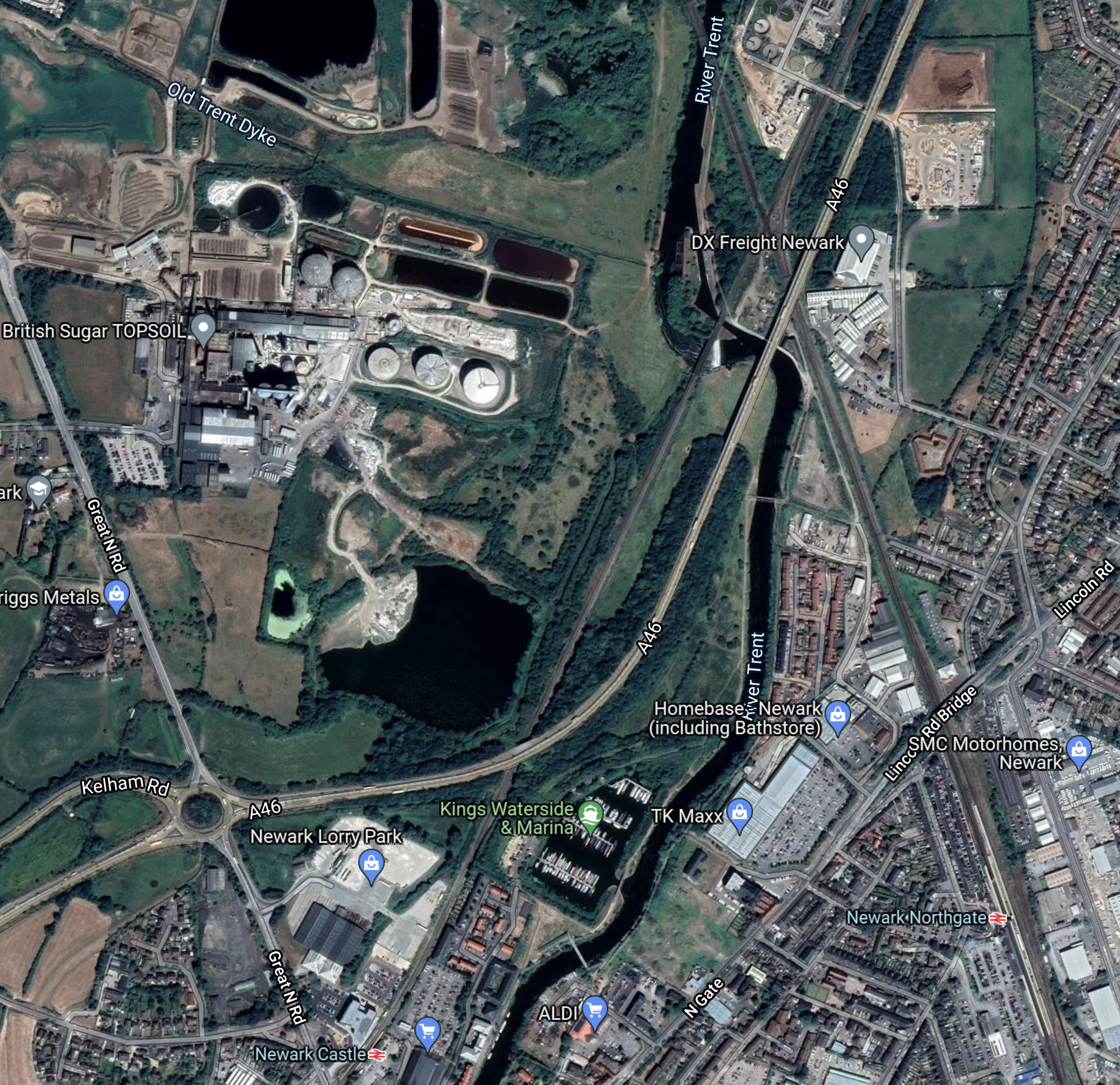
Note.
- Newark Castle station is on the Nottingham and Lincoln Line and is in the South-West corner of the map.
- Newark North Gate station is on the East Coast Main Line and is in the South-East corner of the map.
- The two rail lines run diagonally across the map and cross near the top of the map towards the right.
- Nottingham lies in a South-Westerly direction from this map.
- Lincoln lies in a North-Easterly direction from this map.
- Doncaster, Leeds and York lie in a North-Westerly direction from this map.
- Grantham, Peterborough and London lie in a South-Easterly direction from this map.
Under the Greengauge 21 plan, trains will need to run in the following directions.
- In both directions on the East Coast Main Line.
- In both directions on the Nottingham and Lincoln Line.
- Coming South on the East Coast Main Line, trains will need to be able to go towards Nottingham on the Notting and Lincoln Line.
- Coming from Nottingham on the Nottingham and Lincoln Line, trains will need to be able to go Leeds and York on the East Coast Main Line.
It would be a complicated set of junctions and flyovers for a railway, but not impossible to design and build.
Newark North Gate And Colton Junction
I’ll repeat the map I showed earlier, that shows the routes between Newark North Gate and Colton Junction.
Note.
- The current East Coast Main Line via Doncaster is shown dotted in black.
- The proposed new route, which is called HS3 is shown in white.
- Colton Junction is at the Northern end of the new track.
I suspect that the new route would be built to the same operating standards as High Speed Two.
- Operating speed of 205 mph.
- High specification electrification.
- Signalling capable of handling 18 tph.
- All classic and Classic-Compatible high speed trains would be able to take both routes, but would be limited to 125 mph or 140 mph with in-cab digital signalling on the East Coast Main Line.
- Trains needing to call at Doncaster and freight trains, would use the East Coast Main Line.
- Full-Size High Speed Two trains would generally use the new high speed line.
It looks to be a good way to increase capacity between Newark and Leeds and York.
Timings Between Newark North Gate And Colton Junction
Consider.
- Newark North Gate and Colton Junction are 63 miles apart.
- Trains take 39 minutes.
- There is a stop at Doncaster.
This is an average speed of 97 mph.
If trains went non-stop on the new ‘HS3’ route, there would be these timings at different average speeds.
- 100 mph – 37.8 minutes
- 125 mph – 30.2 minutes
- 140 mph – 27 minutes
- 160 mph – 23.6 minutes
- 180 mph – 22.2 minutes
- 200 mph – 18.9 minutes
Note.
- I have assumed the distance is the same as via the East Coast Main Line.
- I have made no allowance for longer acceleration and deceleration times to and from higher line speeds.
- High Speed Two Classic Compatible Trains could handle up to 205 mph if the track could support it.
It does appear that savings of upwards of fifteen minutes could be possible on all services that could use the new route.
Both East Coast Main Line and High Speed Two services would get time savings.
Colton Junction And York
As I saw and wrote about in London To Edinburgh On Lumo, the route between Leeds and York is being fully electrified.
The East Coast Main Line is already fully electrified, so I doubt the connection between ‘HS3’ and York will be difficult.
Trains will just exchange a 205 mph track for the East Coast Main Line’s 125 mph or 140 mph with in-cab digital signalling.
Colton Junction And Leeds
This High Speed Two Map shows the original planned track layout for High Speed Two to the East of Leeds.
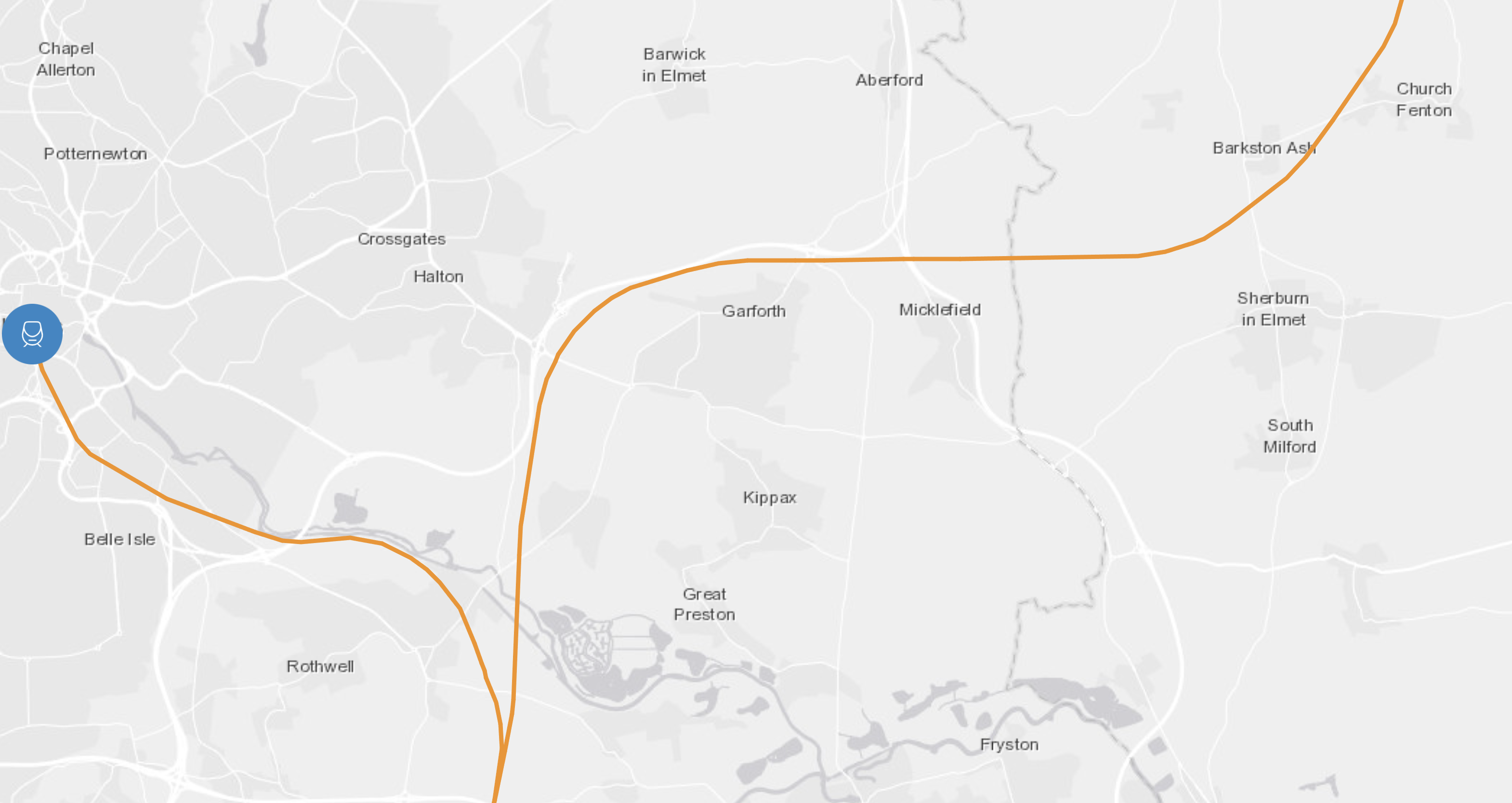
Note.
- The large blue dot indicates Leeds HS2 station.
- The orange lines indicate the new high speed tracks for High Speed Two.
- The track going North-East is High Speed Two’s connection to the East Coast Main Line in the area of Colton Junction.
- The track going South is the Eastern Leg of High Speed Two to East Midlands Hub station, which has now been deleted.
Would it be possible to modify the route of High Speed Two to create a link between the Norther end of Newark and Colton Junction High Speed Line, which Greengauge 21 called HS3 and the proposed Leeds HS2 station?
This map from High Speed Two shows the area, where the High Speed Two Lines were originally proposed to run.

Note.
- The village of Swillington to the East of the proposed route of the Eastern Leg of High Speed Two.
- Junction 45 of the M1 in the North-West corner of the map.
- The River Aire and the Aire and Calder Navigation Canal on the route of High Speed Two to Leeds HS2 station.
This Google Map shows the same area.
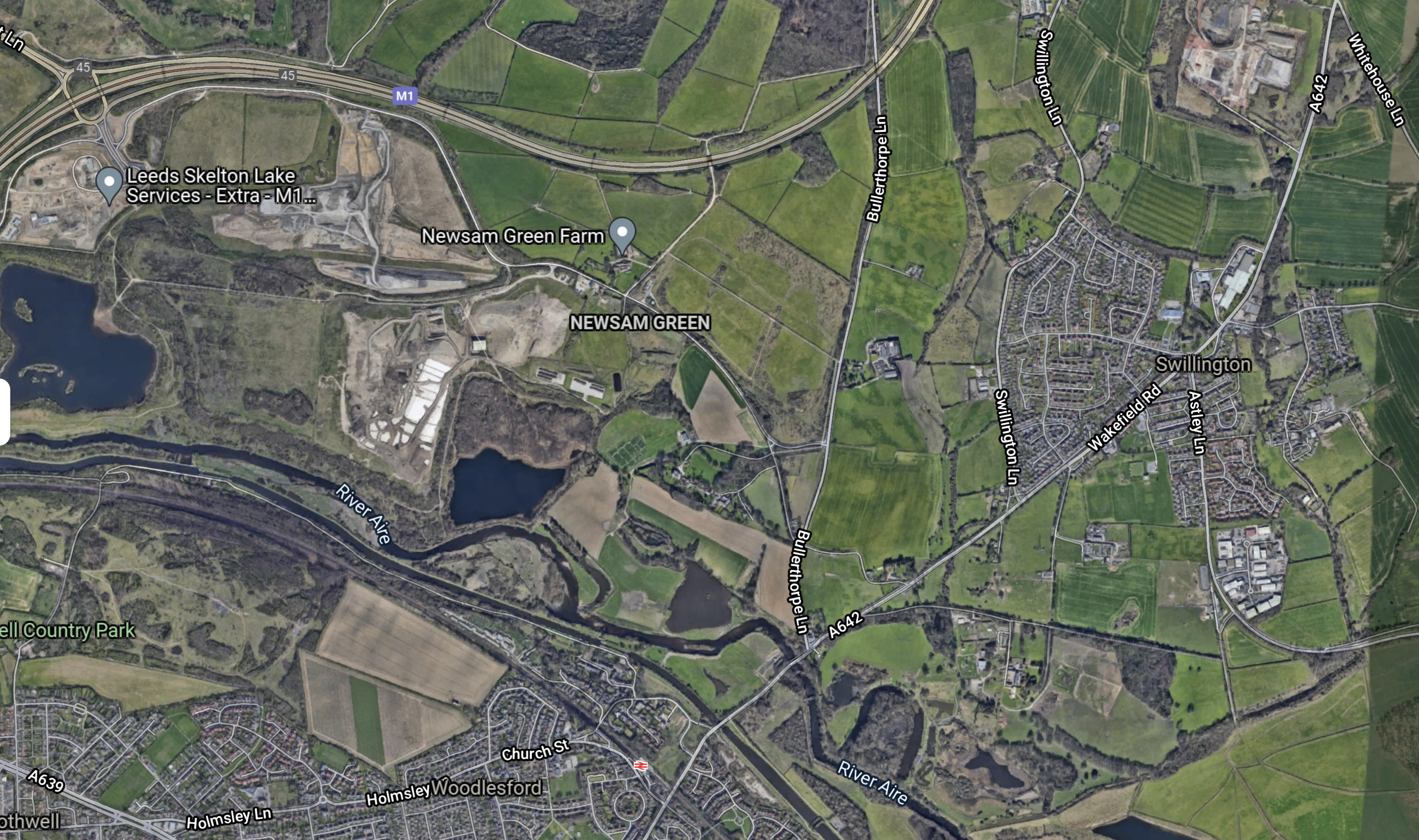
I’m no expert, but I do believe that it would be possible to create a chord to allow trains to access Leeds HS2 station from the York direction.
I would suspect that High Speed Two looked seriously at this chord, as it would enable the proposed Leeds HS2 station to have services to York, Newcastle and Edinburgh using the East Coast Main Line.
But there is one problem with this route – It doesn’t allow and easy solution to serve Bradford.
This map from High Speed Two, shows the Leeds HS2 station and the last bit of the approach from the East.
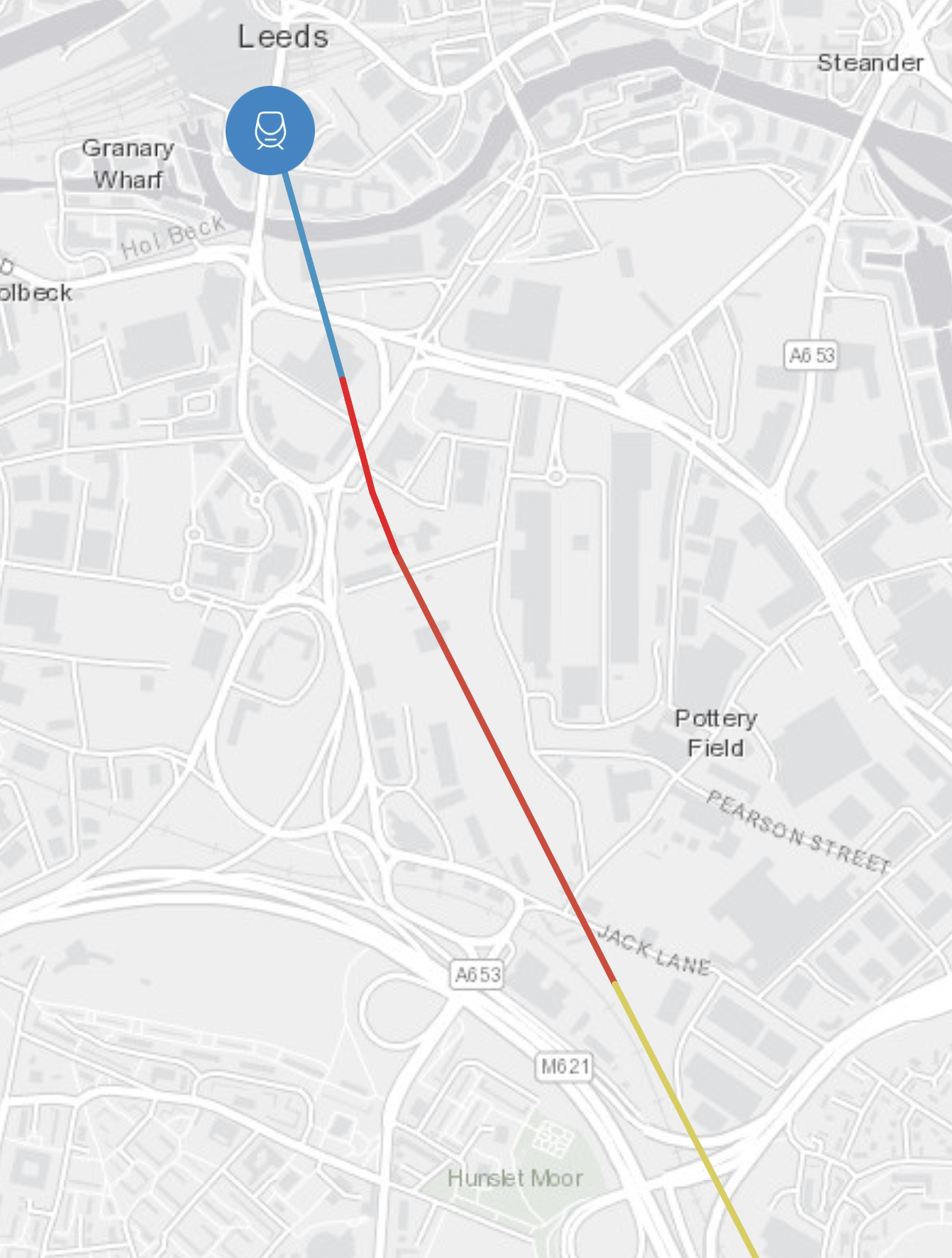
This article on the Architects Journal is entitled Foster + Partners behind designs for Leeds HS2 Station. The article shows.
- Leeds HS2 station is being designed as a terminal station.
- It shares a common concourse with the current Leeds station.
It appears from the pictures in the Architects Journal article, that passengers would have to change trains to get to Bradford.
The alternative would be for trains into Leeds to take the route used by Northern’s service between York and Blackpool North, which goes via Church Fenton, Micklefield, East Garforth, Garforth, Leeds, Bramley, New Pudsey and Bradford Interchange.
But judging by the times of other services, Colton Junction and Leeds would take over twenty minutes and it would be a further twenty minutes to Bradford Interchange.
I can’t think that this is a viable alternative.
Conclusion
I am led to the conclusion, that to get a decent service into Leeds from the East using Greengaige 21’s ‘HS3’ between Newark and Colton junction, would necessitate the building of a new Leeds HS2 station and a new route between the new station and Colton junction.
Red Wall Commuters To Get Rail Revolution
The title of this post, is the same as that of this article on The Sunday Times.
This is the first paragraph.
Nearly £100 billion will be spent on England’s railways outside London, including the construction of three new high-speed lines that will cut journey times in half.
The paper is also predicting that the Birmingham and Leeds leg of High Speed Two will be scrapped.
The three new high speed lines are.
- Birmingham and East Midlands Parkway
- Leeds and Sheffield
- Manchester and Crewe.
I have felt for some time, that timings between London and Yorkshire can be upgraded almost to High Speed Two levels by upgrading the Midland Main and the East Coast Main Lines.
I shall be doing some calculations, when the schemes are announced on Thursday.
East Midlands Parkway Station – 11th July 2019
I took these pictures at East Midlands Parkway station.
These are some of my thoughts.
Ratcliffe-on-Soar Power Station
The station is dominated by the coal-fired Ratcliffe-on-Spar power station, with its eight massive cooling towers.
When I was leaving Liverpool University in the late-1960s, I don’t think any of my fellow students thought coal had a future.
Several of my group of Electrical Engineers went into nuclear engineering, but many like me went into computing, electronics and instrumentation.
But still the Government ploughed on with mining coal and burning the filthy stuff to produce electricity.
Now the current government has decided, that they’ll all be gone by 2025!
And good riddance to them!
It has amazed me, they have survived this long.
I can remember reading in the Guardian in the 1980s of proposals by enlightened thinkers to retrain miners as insulation teams to insulate our terrible pre-war housing stock, which wastes vast amounts of energy.
But politicians of the left, including some who are still around today, glory in the honest toil of working in a coal mine.
I’m afraid, that I’ve met so many children of miners, whose major advice from their father, was to never go down a mine except as a tourist.
Burning coal, has been one of the worst cul-de-sacs of the human race.
An Inadequate Train Service
I have scarcely been to a station with such an inadequate train service.
Logic suggests, that it would have a service something like two or four trains per hour (tph) to major cities within half-an-hour.
But read what is said under Services in the Wikipedia entry for the station.
Here’s the first two paragraphs.
Fears were raised by various bodies, notably East Midlands Airport, about the service pattern proposed for the new station.
Donington Park motor racing circuit is nearby, and its owners have expressed their desire for spectators to use the station or coach services when travelling to the circuit. The owners are also in support of any future light rail transport to East Midlands Airport itself.
On my visit, I took a train from Leicester and then had to wait nearly an hour to get one back to where I started.
Abellio certainly have scope to improve the service.
In Leicester Station – 11th July 2019, I wrote that I felt that if Abellio apply similar logic to that which they are applying in East Anglia, that there could be a significant improvement in services on the Midland Main Line, to the North of Leicester.
- Three tph – Fast trains between Leicester and Sheffield via Derby and Chesterfield
- One tph – Stopping train between Leicester and Sheffield via Derby and Chesterfield
- Three tph – Fast trains between Leicester and Nottingham
- One tph – Stopping train between Leicester and Nottingham
- One tph – Stopping train between Leicester and Lincoln
As the new trains will have a better performance, more could stop at East Midlands Parkway to even out the terrible stopping pattern.
Station Usage
Wikipedia gives the station usage as just over 300,000 passengers per year.
This compares with Louthborough station, which is the next station to the South having a usage of 1,300,000 passengers per year.
Even the new Ilkeston station further North with only two platforms and of a much simpler design, had a usage of 250,000 passengers in its first year.
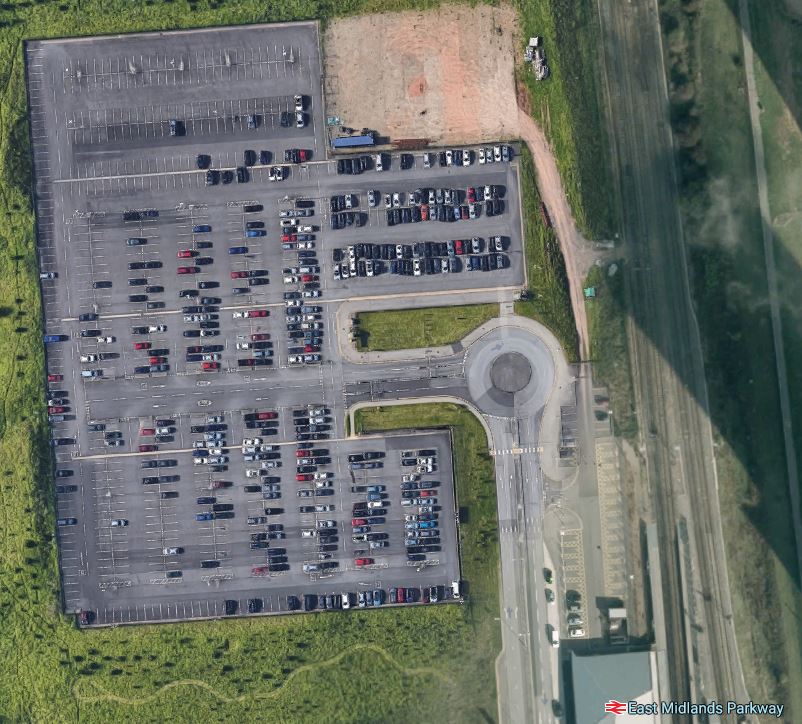
As this Google Map shows, the car parking has attracted a few takers.
I do question though, if the station should ever have been built!
I hope Abellio have a plan to breathe some life into the station.
Megabus
Note the Stagecoach Megabus in the pictures.
This provides services all over Yprkshire and is decribed under Multi-Modal in the Wikipedia entry for the station.
This is the first paragraph.
From 30 March 2009, the station has been used as an interchange station for combined multi-modal journeys using Megabus-branded services run by Stagecoach (the operators of both East Midlands Trains and of Megabus). The MegabusPlus services transport passengers from cities in the north of England to East Midlands Parkway, where passengers transfer to rail for the service to London.
At a first glance, it looks like a crazy idea.
But Stagecoach wouldn’t run it, if it wasn’t needed or profitable.
Charging Battery Electric Trains
In The Mathematics Of Fast-Charging Battery Trains Using Third-Rail Electrification, I showed how a third-rail-based fast charging sstem, like that proposed by Vivarail could transfer several hundred kWh to the batteries of a train stopped in the station, for a few minutes.
East Midlands Parkway station with pairs of tracks between generously-spaced platforms with a gap between the tracks, would be an ideal location for such a charging system.
- The two third-rail would be laid together between the two tracks.
- The third-rails could be shielded, but as they would only be live with a train on the top, would it be necessary?
- The driver would only need to stop the train in the correct position, but they do that anyway.
- An adequate electricity supply shouldn’t be too much of a problem!
In a three minute contact between the train and the third-rail, I believe it would be possible to transfer up to 200 kWh to the batteries of the train.
Conclusion
This station has problems.
I’ll be interested to see how Abellio attract more passengers and use the station to passengers and their own benefit.
 The Anonymous Widower