Two Thirds Of Sofia Wind Turbines Installed
The title of this post, is the same as that of this article on offshoreWIND.biz.
This is the sub-heading.
Seventy wind turbines have been installed at RWE’s Sofia offshore wind farm in the UK, according to a Notice to Mariners recently issued by the project team.
These two paragraphs give more details of the installation process.
The first of the project’s 100 Siemens Gamesa SG 14-222 DD wind turbines was installed in March 2025, and the work reached the halfway mark in September last year. The vessel deployed for the work is Cadeler’s Wind Peak, which is carrying components for six turbines per trip, operating from the port of Hull.
IWS service operation vessel (SOV) IWS Seawalker is supporting the wind turbine installation work.
Note.
- Sofia is being installed by German Company ; RWE.
- Sofa will use 14 MW Siemens Gamesa wind turbines, some of which have recyclable blades.
- The installation process is being carried out nearly 200 kilometers out to sea on the Dogger Bank.
The power will be connected to the grid at Lackenby substation, which is near the Wilton chemical works, which can certainly you the electricity.
Does Wilton Chemical Works Have A Power Station?
I asked GoogleAI, the question in the title of this section and received this reply.
Yes, the Wilton International industrial site (formerly associated with ICI chemical works) has multiple power stations and significant on-site energy generation, operated primarily by Sembcorp Utilities UK. The site features a biomass power station (Wilton 10), a further biomass unit (Wilton 11), and an energy-from-waste plant, supplying electricity and steam to chemical and industrial businesses on-site.
Note.
- Wilton 10 opened as a biomass power station in 2002.
- Wilton 11 opened as a biomass power station in 2016.
I seem to remember, that one of these power stations was there on my visits to Wilton for ICI in the 1970s.
Key details regarding power generation at Wilton:
Biomass & Waste-to-Energy:
The site transitioned from coal-fired units to renewable biomass and waste-to-energy, utilizing wood and other byproducts for power and heat generation.
Sembcorp Utilities:
Sembcorp operates the site’s energy infrastructure, which includes five different generation assets and a private wire network.
Capacity: The site hosts significant generation capacity, including a 52MW biomass unit and a 35MW unit.
Future Projects: The site is involved in developments for net-zero emissions, including the Whitetail Clean Energy project, which is planned as the UK’s first Net Zero emissions power plant with Carbon Capture and Storage (CCS).
The site serves as a “plug and play” industrial location offering on-site, cost-effective energy.
Conclusion
This would appear to be a sensible small power system providing 1400 GW of wind power, backed up if needed be by the two biomass units, which total 87 MW.
Note, that ICI were storing gases under the site for many years, so I suspect, that Carbon Capture and Storage, might work well at this location.
I can see other places, where a wind farm, is combined with energy from waste for backup.
Are Wind Farms Being Backed Up By Energy From Waste Units In The UK?
I asked GoogleAI, the question in the title of this section and received this reply.
Yes, but only in a limited, complementary capacity, rather than as a direct, large-scale substitute for wind power.
Energy from Waste (EfW) units—commonly known as incinerators—are increasing in the UK, but their role in the grid is different from how we “back up” wind.
Here is a breakdown of how it works:
1. The Role of EfW (Baseload, not Backup)
Baseload Generation: EfW plants run 24/7 to burn waste. They provide a steady, consistent, predictable “baseload” of electricity (about 2–3% of UK supply).
Intermittency: Because they run constantly, they cannot ramp up and down quickly when the wind stops blowing. Therefore, they are not a “flexible” backup in the same way gas power plants are.
Partial Renewable: Around 50% of the energy produced by EfW is considered renewable (organic waste), helping the UK hit green targets.
2. What Actually Backs Up Wind?
When wind farms stop producing power during low-wind periods (often called “dunkelflaute”), the UK relies on other sources:
Natural Gas Plants: These are the primary, flexible backup that can ramp up instantly to fill gaps in renewable production.
Interconnectors: Imported electricity from other countries (e.g., Norway, France).
Battery Storage: Growing, but still small-scale compared to total demand.
3. How EfW Helps the Grid
EfW does assist the grid by providing system inertia and consistent, low-carbon, on-demand energy, reducing the need for more fossil fuels to be burnt at certain times. They are particularly useful for providing power when the grid is congested, but they do not specifically act as a “spare tire” for wind farms.
4. Future Trends
The government is looking to attach Carbon Capture and Storage (CCS) to EfW units, which would make them a low-carbon, dependable, and sustainable part of the energy mix by the 2030s.
In summary: EfW plays a part in supporting a greener grid, but it is not a direct substitute for the flexibility required to back up intermittent wind power.
5. Hydrogen Power
This is a section, that artificial intelligence has unsurprisingly left out, as no country has yet built the hydrogen storage and the power stations to generate the electricity, when it is needed.
But Note.
- SSE are building a big hydrogen store in Yorkshire at Aldbrough.
- Centrica are converting the Rough gas storage to a hydrogen store.
- SSE are building a 910 MW hydrogen-powered power station at Keadby.
- SSE are building a 1200 MW hydrogen-powered power station at Ferrybridge.
I suspect if you were building a chemical plant and Wilton fitted your budget, you would take a look.
HiiROC And Agile Energy Unite To Advance Hydrogen Production In Scotland
The title of this post, is the same as that of this article on Offshore Energy.
This is sub-heading.
HiiROC, a UK hydrogen production company, and Agile Energy Recovery Limited, a compatriot developer of low-carbon energy parks, have partnered to evaluate the deployment of HiiROC’s proprietary process to produce low-carbon hydrogen at Agile’s Thainstone Energy Park in Inverurie, Scotland.
These three paragraphs add more detail.
It is understood that Agile is building a Swedish-style Integrated Resource Facility (IRF), which is expected to process up to 200,000 tonnes of municipal and industrial residual waste per year and produce power and heat for the surrounding area.
As for HiiROC, its Thermal Plasma Electrolysis (TPE) process reportedly requires less electricity than conventional water electrolysis and does not generate CO2 emissions, aligning with the UK’s Low Carbon Hydrogen Standard (LCHS). By leveraging the existing gas network and locating hydrogen production at the point of use, the company said it can avoid costly new infrastructure or waiting for new hydrogen pipelines or CCS clusters to come online. HiiROC’s first commercial units are planned for 2026.
The partners noted they will aim to maximize integration of their two plants, with the option to combine CO2 emissions from the IRF with HiiROC’s hydrogen to produce low-carbon e-methanol, an emerging alternative to diesel in maritime applications.
This plant would appear too be built around some impressive chemistry to process 200,000 tonnes of municipal and industrial waste per year.
Out of curiosity, I asked Google AI how much waste the London Borough of Hackney, where I live, collects per year and received this answer.
The London Borough of Hackney processed approximately 113,554 tonnes of total local authority collected waste in the 2021/22 financial year.
More recent, unaudited data for the 2023/24 financial year indicates that the total amount of household waste collected was around 313.6 kg per person. With an estimated population of nearly 280,000 people, this suggests roughly 87,800 tonnes of household waste were collected in 2023/24.
It looks to me, that a lot of councils could explore the HiiROC route to dispose of their waste.
Slough Multifuel Energy-From-Waste Facility Begins Operations
The title of this post, is the same as that of this news item from SSE Thermal.
This is the sub-heading.
SSE Thermal and Copenhagen Infrastructure Partners (CIP), partners of a new energy-from-waste facility in Slough, have entered commercial operations ahead of schedule.
This section from the news item describes the operation of the plant.
Slough Multifuel will produce electricity and heat through burning waste-derived fuels made from various sources of:
- municipal solid waste
- commercial and industrial waste
- waste wood
The 55 MW facility will divert thousands of tonnes of waste away from landfill. It will convert it into a valuable source of energy. The facility is expected to process around 480,000 tonnes of residual waste each year. The station will support the UK Government’s strategy to reduce landfill waste and the export of waste.
Effectively, it is a sophisticated state-of-the-art incinerator, that has been built by Hitachi Zosen Inova.
In an ideal world, everything would be recycled and there would be no landfill or incineration.
But that would only be possible in a green fascist state.
enfinium Announces Proposal For £200m Investment In Carbon Capture Project In North Wales
The title of this post is the same as that of this press release from enfinium.
This is the sub-heading.
The project could be capable of capturing up to 235,000 tonnes of CO2 every year, accelerating efforts to achieve net zero.
The first two paragraphs outline the project.
Today, enfinium, a leading UK energy from waste operator, announces it is progressing plans to invest around £200 million in carbon capture and storage (CCS) technology at the Parc Adfer energy from waste facility in Deeside, North Wales, providing vital carbon removals and boosting the green economy.
The project could capture up to 235,000 tonnes of carbon dioxide (CO2) every year. As over half of the waste processed at the facility is organic, installing CCS would enable the plant to take more CO2 out of the atmosphere than it produces. The Welsh Government’s Carbon Budget makes clear that Wales needs carbon removal solutions to mitigate other polluting parts of the economy to achieve a Net Zero economy.
The press release also says this about Paec Adfer.
Opened in 2019 in partnership with the five local authorities that make up the North Wales Residual Waste Treatment Partnership (NWRWTP), Parc Adfer currently diverts up to 232,000 tonnes of unrecyclable waste from climate damaging landfill. As recognised by the National Infrastructure Commission, emissions from energy from waste plants are lower per tonne of waste compared to landfill.
With CCS installed, Parc Adfer will support the Welsh Government’s ambition to have 100% zero carbon power by 2035 and support over 1,000 jobs in the green economy during the construction phase.
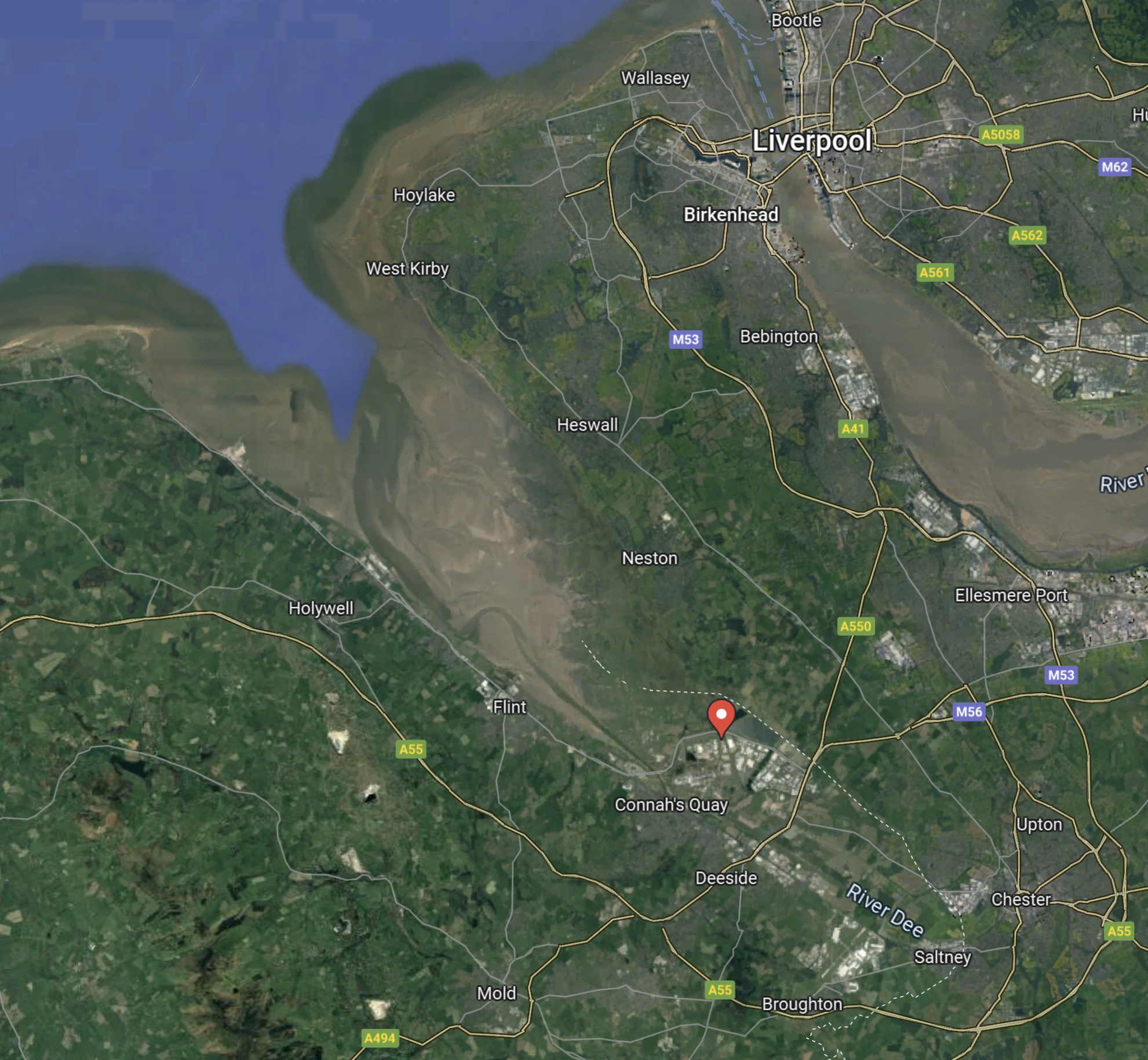
This Google Map shows the location of Parc Adfer, with respect to Liverpool and the River Dee.
Note.
- Liverpool is in the North-East corner of the map.
- Chester is in the South-East corner of the map.
- The Dee Estuary is in the North-West corner of the map.
- The red arrow indicates the location of Parc Adfer.
This second Google Map shows the location of Parc Adfer in Deeside Industrial Park, which is just over the England-Wales border.
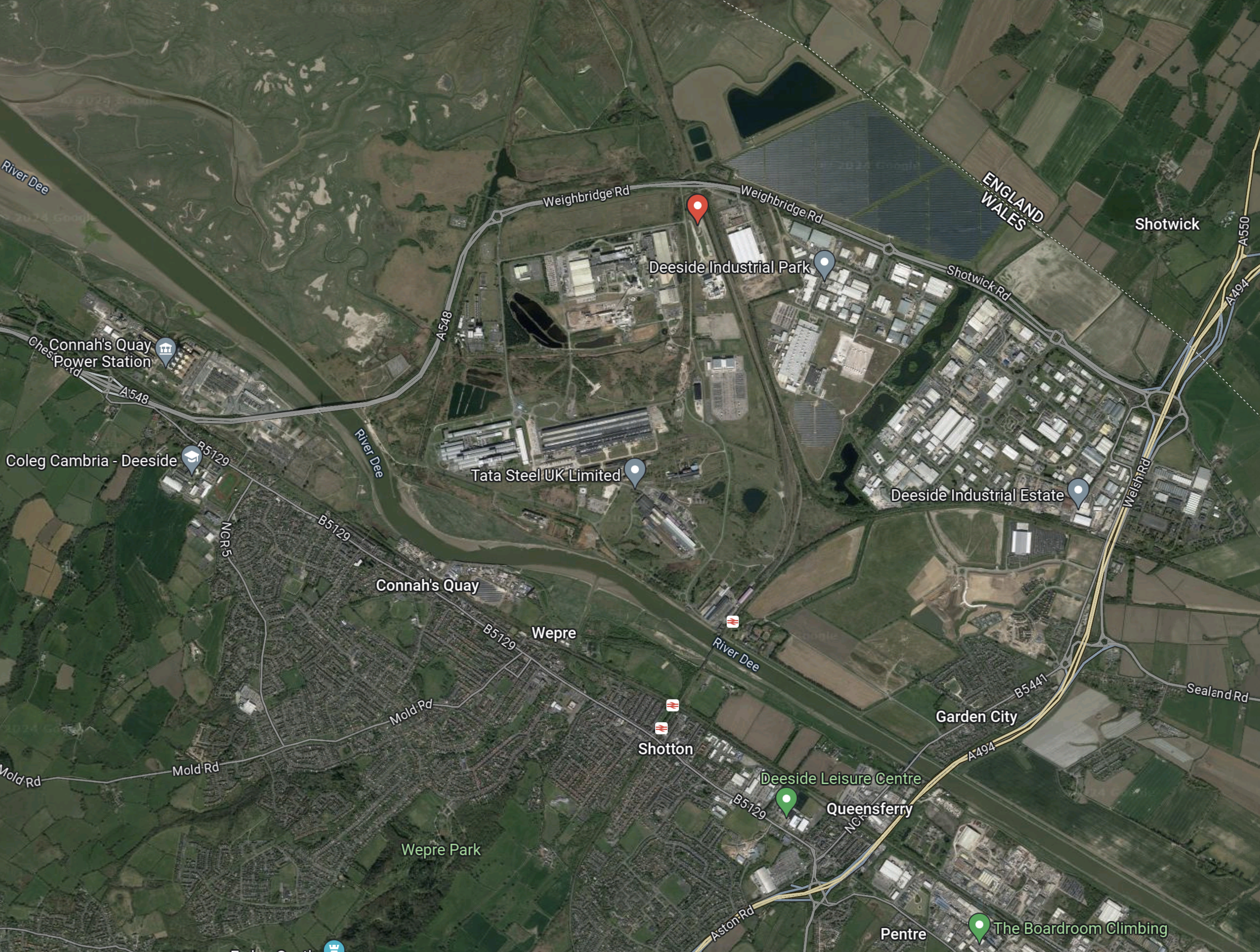
As before, the red arrow indicates the location of Parc Adfer.
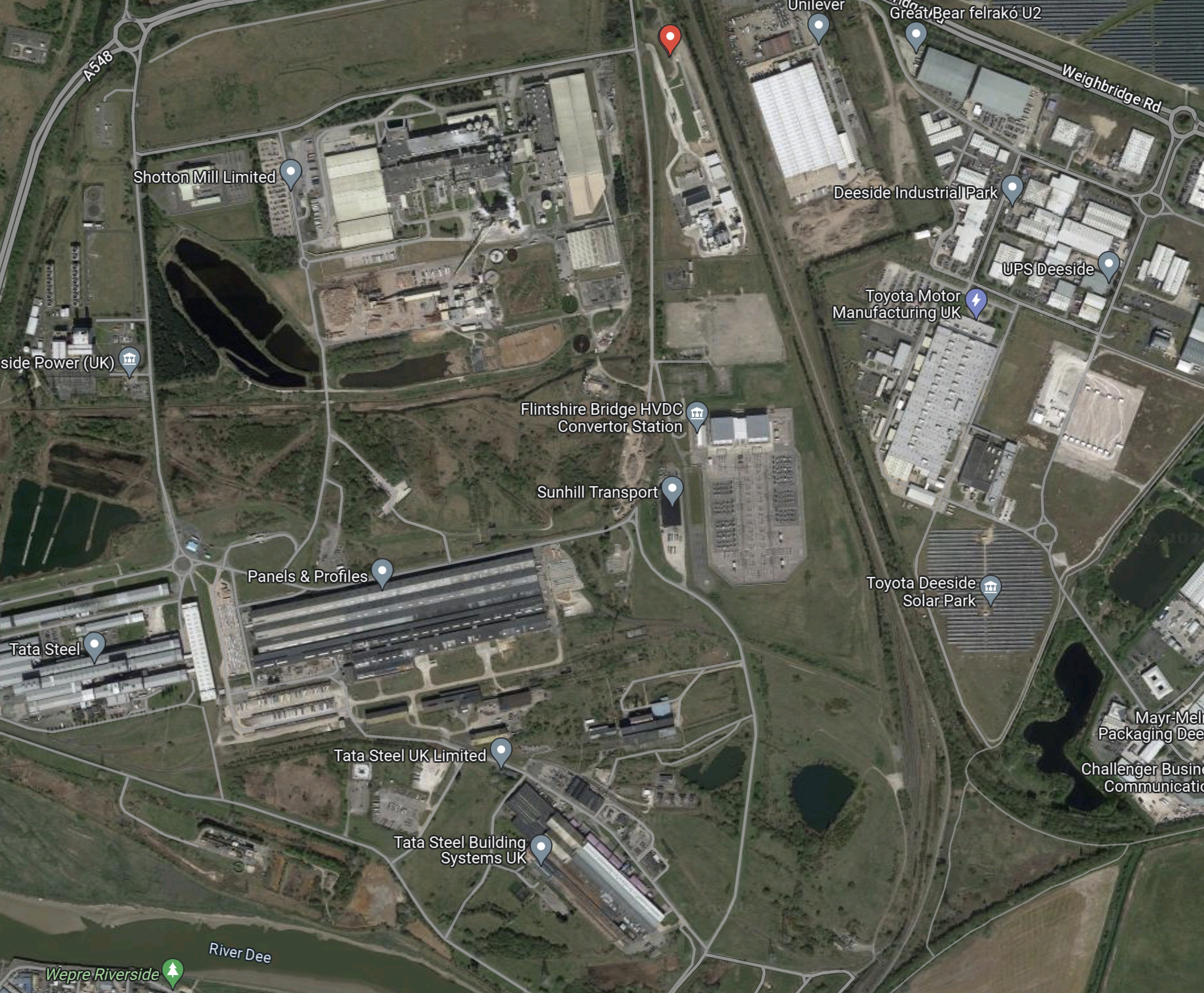
This third Google Map shows the detailed area of Parc Adfer.
Note.
- The red arrow indicates the location of Parc Adfer.
- The Borderlands Line between Liverpool and Wrexham runs alongside the site.
- Around Parc Adfer are assorted steel works and the Flintshire Bridge HVDC Convertor Station for the Western HVDC Link to Hunterston in Scotland.
- On the other side of the tracks are Amazon, Great Bear Distribution, Toyota, Unilever and the Toyota Deeside Solar Park.
These are my thoughts.
Parc Adfer Has Excellent Electrical Connections
In addition to the 2.25 GW Western HVDC Link to Hunterston, there are following power sources in the area.
- The wind farms of Liverpool Bay.
- The 1.4 GW Connah’s Quay power station.
- The 498 MW Deeside power station.
From the enfinium web site, it looks like Parc Adfer will generate 21 MW of zero-carbon energy from waste.
Will Parc Adfer Have A Rail Connection?
According to the enfinium web site, Parc Adfer will process waste from Flintshire County Council, Denbighshire County Council, Conwy County Borough Council, Gwynedd Council and the Isle of Anglesey County Council.
I have arranged these councils in order from East to West and all are served by the North Wales Coast Line.
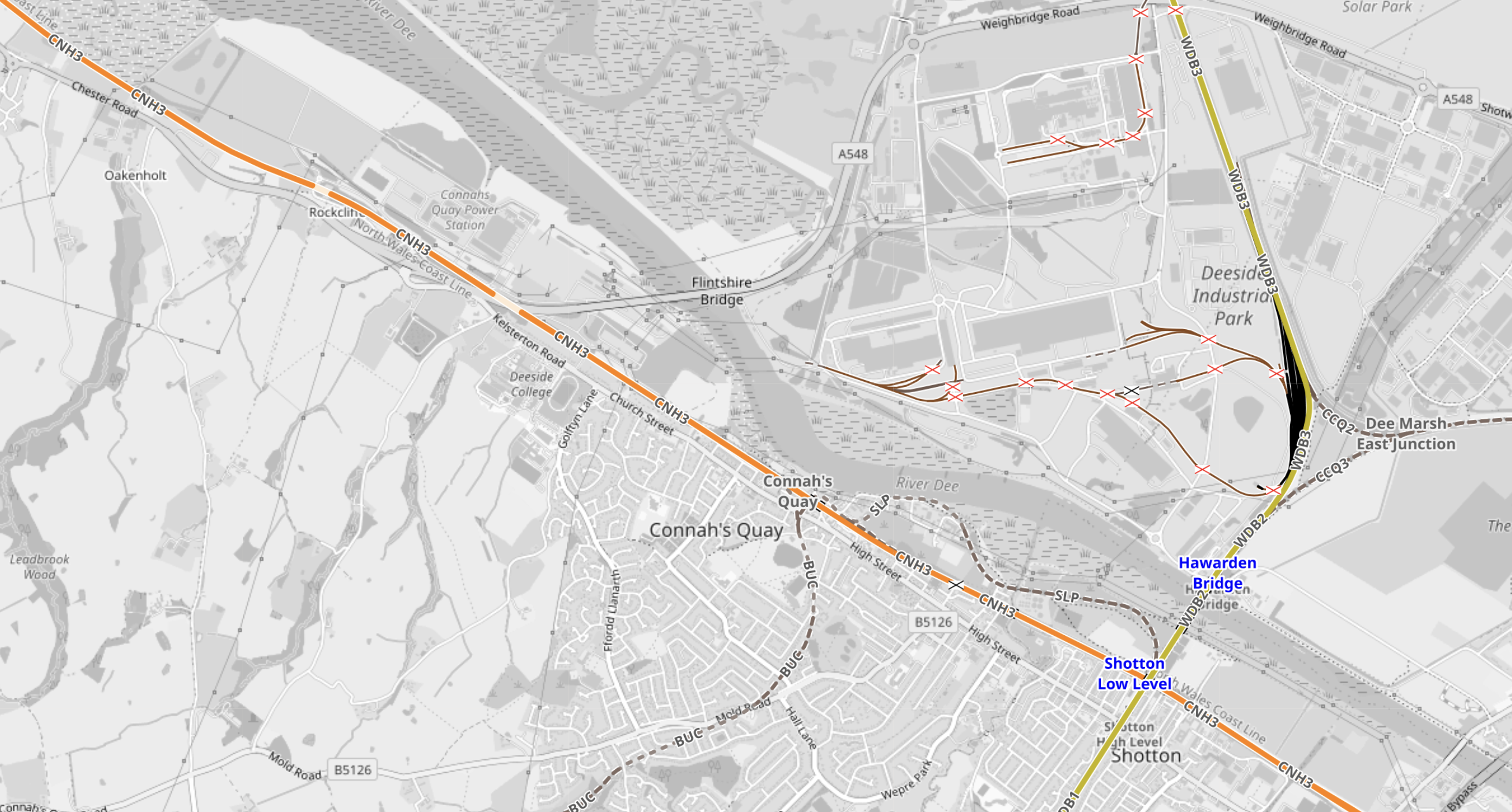
This OpenRailMap shows the rail connection between Parc Adfer and the North Wales Coast Line.
Note.
- The Borderlands Line is shown in yellow and runs between Liverpool and Wrexham.
- The Borderlands Line runs past Parc Adfer just off the North of the map.
- The North Wales Coast Line is shown in orange and runs between North Wales and Chester.
- There are two stations at Shotton; High and Low Levels, which allow a passenger connection.
Unfortunately, there is no rail connection for trains which would allow freight services between Parc Adfer and North Wales.
A section called Future, in the Wikipedia entry for Shotton station, says this about upgrading the station.
In March 2015 Network Rail published the draft version of their Welsh Route Study. It contained a proposal to build a new interchange station that would replace the existing High and Low Level stations, allowing for greater connectivity between the North Wales Coast Main Line and the Borderlands Line. The document recommended a transport planning study to establish the cost, feasibility and benefits of the proposed scheme.
It appears to be likely, that no rail route will be created to allow freight services between Parc Adfer and North Wales.
Deeside Parkway Railway Station
It does appear that a parkway station at Deeside Parkway is a possibility.
This is the opening paragraph of the Wikipedia entry for Deeside Parkway station.
Deeside Parkway is a proposed railway station situated between Neston and Hawarden Bridge on the Borderlands Line. The station is intended to serve the Deeside area of Flintshire, North Wales, particularly the Deeside Industrial Park.
The station is proposed to be park of the North Wales Metro, which is described in this Wikipedia entry.
Shine On – Centrica Opens Its First UK Solar Farm
The title of this post is the same as that of this press release from Centrica.
These are the bullet points.
- 18MW Codford Solar Farm in Wiltshire is Centrica’s first major solar asset
- Part of plans to build a material portfolio of low carbon assets
- Vodafone supports development with long term Power Purchase Agreement for 50% of the output over 10 years
- Additional renewable power supports the UK government’s ‘green grid’ ambitions
I have some thoughts.
Centrica’s First Major Solar Asset
These two paragraphs from the press release outline the project and indicate where it fits in Centrica’s overall philosophy.
Construction began at the site in Wiltshire in April 2022, after the consent was acquired by Centrica Business Solutions in 2021. Made up of 33,000 panels, the project has a total capacity of 18MW and should produce 19GWh of green electricity every year, enough to power some 4,850 homes.
The deal not only brings additional renewable power provision to the UK grid but supports the UK government’s ambition to focus on home-grown renewable energy to boost long-term energy independence and security.
My only reservation is at 18 MW it isn’t that large and the sun doesn’t always shine in the UK.
Centrica’s Portfolio Of Low Carbon Assets
This paragraph from the press release talks about the portfolio.
In late 2021, Centrica announced ambitions to deliver 900MW of low carbon assets by 2026. The company is currently building battery storage projects at former gas peaking plants at Brigg, Lincolnshire, Knapton, North Yorkshire, and Ostend in Belgium, and has developed a multi GW pipeline of projects.
Note that former gas power plants, usually have a very handy connection to the electricity grid.
900 MW would also rate at around the output of two typical gas-fired power stations.
Vodafone’s Power Purchase Agreement
Big companies like Vodafone seem to be increasingly signing Power Purchase Agreements for their renewable electricity. These must give advantages all round.
- The developer can take the purchaser’s deal to a bank and use it to raise capital for the project.
- The purchaser, in this case Vodafone can say that they use at least some zero-carbon electricity, which must help marketing.
- The bank knows that so long as the sun shines, there will be money flowing to the developer.
- The developer doesn’t have to deal with thousands of customers.
These three paragraphs from the press release outline Vodafone’s deal.
Vodafone will purchase half of the electricity output from the solar farm, helping to support its development and bringing additional renewable power provision to the UK Grid. Combined with agreements already in place, around 47% of the company’s annual energy requirement will come from UK-based renewable power sources by 2025.
The long-term Power Purchase Agreement (PPA) will see approximately 9GWh of green electricity dedicated to Vodafone UK. The remainder will be sold into the national grid through Centrica’s Energy Marketing & Trading business.
The deal is the third PPA signed by Vodafone and Centrica Energy Marketing & Trading over the last year. In May 2022, Vodafone and Centrica announced a long-term PPA with MYTILINEOS S.A for the output from three solar farms in the UK. And, in February 2023, Vodafone committed to take a significant proportion of the output from a further five solar farms in one of the largest corporate solar PPAs to date.
It looks like, when Vodafone’s other solar farms are connected, they will be able to advertise as a zero-carbon company running on renewable electricity.
That sort of green advertising hasn’t hurt Lumo’s trains between London and Edinburgh.
Connecting Codford Solar Farm To The National Grid
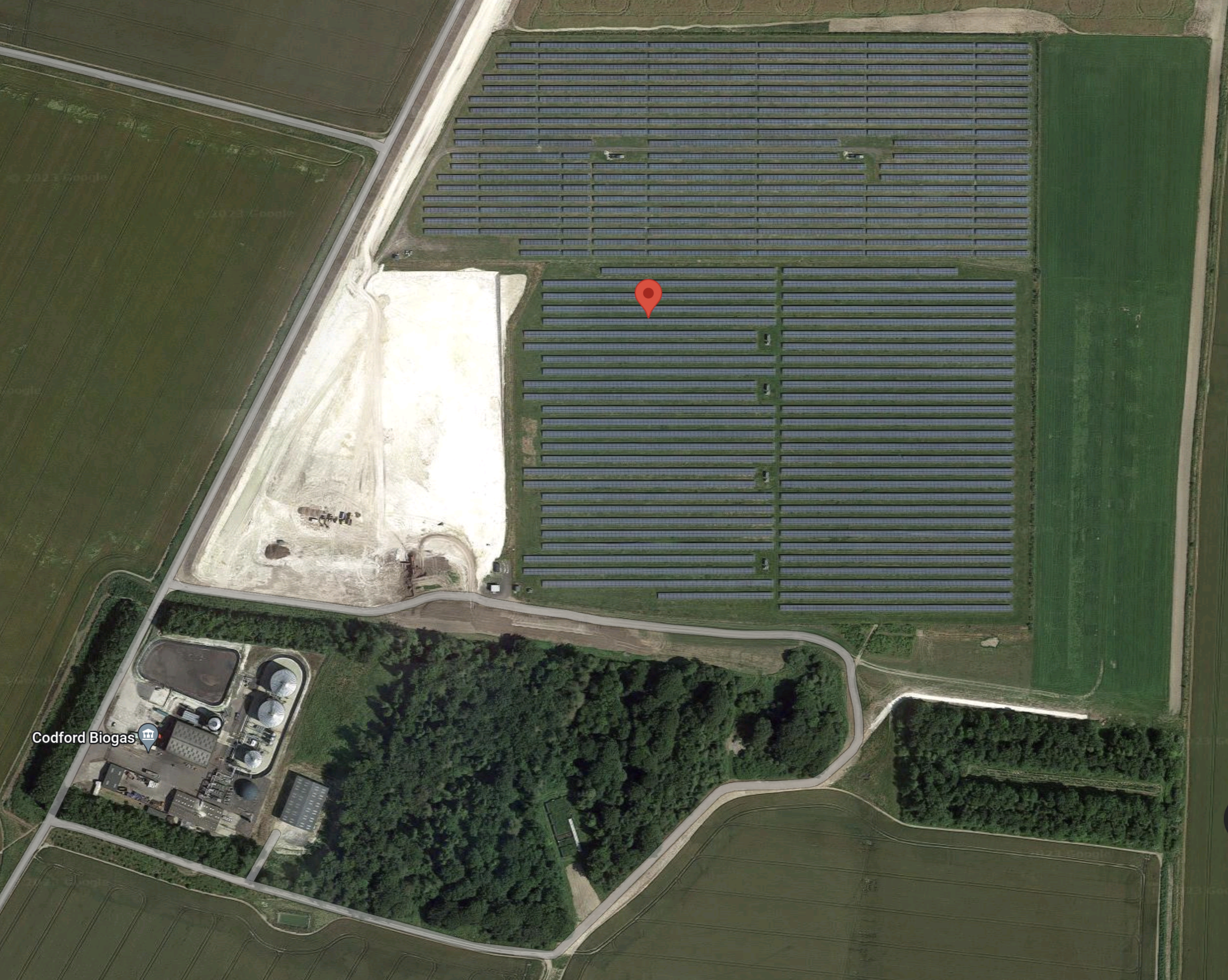
This Google Map shows the location of the Codford Solar Farm.
Note.
- The solar panels marked with the red arrow.
- Codford Biogas in the South-West corner of the map.
- The site is surrounded with the fields of a large arable farm, that grows wheat, barley and oilseed rape.
- The site is also shielded by trees.
This second Google Map shows Codford Biogas.
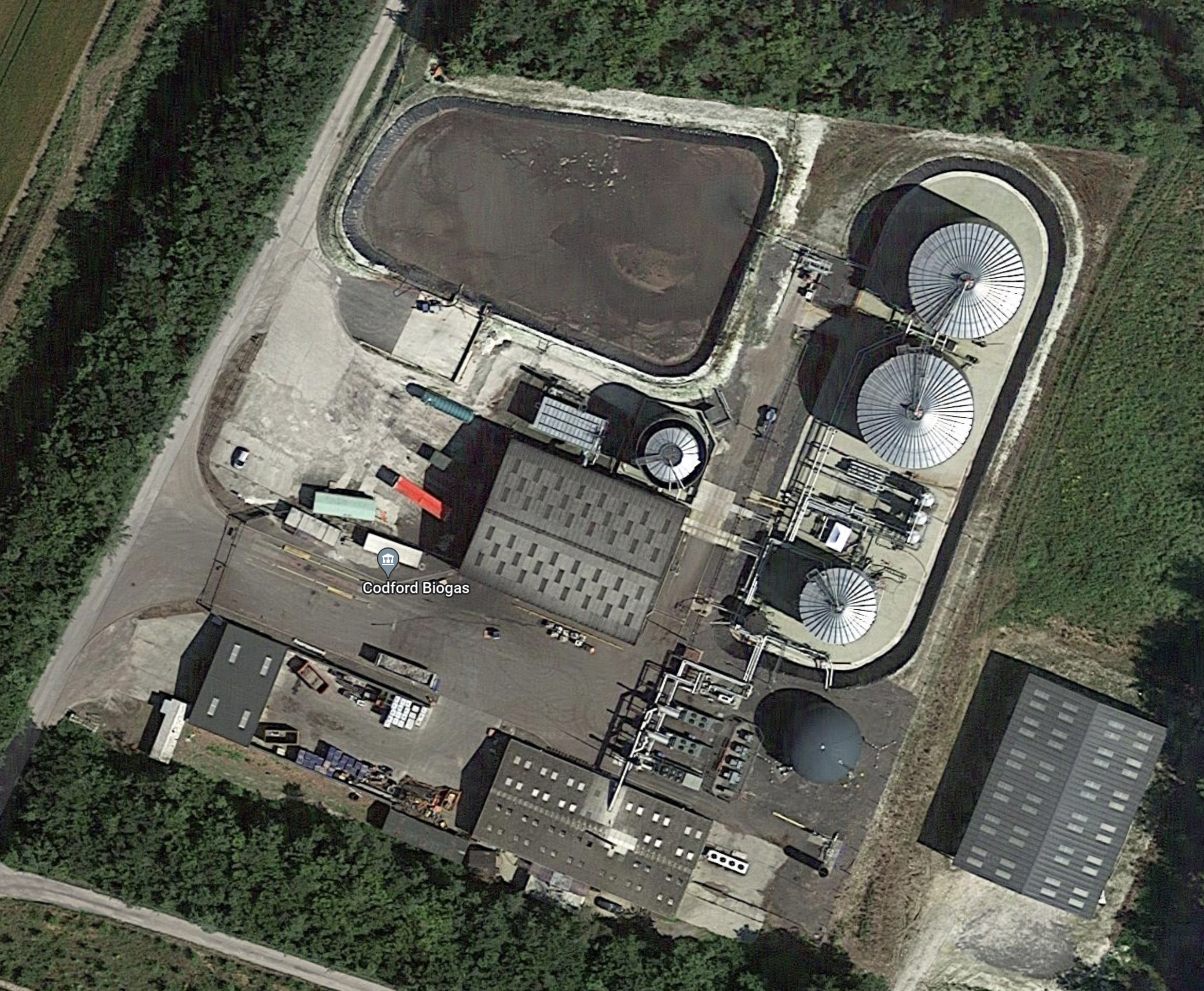
According to their web site, Codford Biogas accept the widest range of food waste in southern England.
The home page describes waste collection, secure disposal and carbon reduction.
Their method of disposal uses anaerobic digestion, which is a complex biological process involving the breakdown of organic matter in the absence of air in large, sealed and insulated vessels with controlled heating and mixing.
The Wikipedia entry for anaerobic digestion describes the process in detail.
On their web site, there is a page, which is entitled What Is AD?, which has an interactive graphic describing the process at Codford.
Main products from the site include.
- 3.6 MW of electricity, which can be fed to the grid.
- Fertiliser, which can be spread directly on the surrounding arable land.
- Waste heat, which will be developed for businesses that need it.
Obviously, the electricity export will need a grid connection, which I suspect will also be used by the new solar farm.
Conclusion
It looks like Centrica have piggy-backed their solar farm on to an existing grid connection.
But it does look like connecting your solar farm to the grid through a power station that can operate continuously, helps to give a more continuous output.
I think we’ll see more of this!
Raven SR And Chart Industries To Work Together On Hydrogen And CO2 Capture
The title of this post, is the same as that of this article on the Carbon Herald.
These are the first two paragraphs.
Renewable fuels company Raven SR and Chart Industries announced they have signed a Memorandum of Understanding to work together on the liquefaction, storage, and transportation of hydrogen as well as pure CO2 produced from Raven SR’s non-combustion Steam/CO2 Reformation process that converts waste to renewable fuel.
Raven SR uses local waste as feedstock to produce transportation-grade H2 and synthetic fuels, including sustainable aviation fuel (SAF). The carbon dioxide, which is a byproduct of the process, when liquefied is used for food and beverage production, fertilizer production, and other consumer needs and as a feedstock for concrete or alternative fuels.
Note.
- It appears like I do, that the companies feel it is better to use carbon dioxide, rather than store it.
- It also looks like they have improved the steam reforming process for making hydrogen.
- An advantage of the process is that it doesn’t need pure water.
There is a video in the article, which I suggest you watch.
It may be one of those processes that dies a premature and messy death, but my knowledge of catalysts and strange ways to produce gases like hydrogen and acetylene from working at ICI in the early 1970s, tells me that someone will develop a viable route to create hydrogen, that is better than the methods used today,
Welsh Firm Wins £300K BEIS Grant To Advance Hydrogen Fuel Tech
The title of this post, is the same as that of this article on Wales247.
This is the first two paragraphs.
A gasification pioneer aims to seal the UK’s low-carbon future after winning a Government grant worth nearly £300,000 to develop waste-to-hydrogen production technology, innovation funding specialist Catax can reveal.
Compact Syngas Solutions (CSS), based in Deeside, Wales, has secured £299,886 from the Department for Business, Energy and Industrial Strategy (BEIS) with the help of Catax. The funding comes from the Low Carbon Hydrogen Supply 2 Programme, which is part of the Net Zero Innovation Portfolio.
Note.
- The objective is produce syngas or green hydrogen from waste that would normally be sent to landfill.
- Syngas, or synthesis gas, is a fuel gas mixture consisting primarily of hydrogen, carbon monoxide, and very often some carbon dioxide.
- Syngas can be used as a fuel in internal combustion engines.
The name of the company; Compact Syngas Solutions could indicate that the company aim to have a compact system to produce syngas or green hydrogen.
I have come across other companies looking at waste diverted from landfill to create aviation fuel, diesel or hydrogen.
I have invested in one; Velocys, through the Stock Market, as I feel this area of technology will be big in the future.
Compact Syngas Solutions seem to have a different take. However like many other, I suspect catalysts are involved.
Conclusion
I think, this will be a company to watch.
Velocys’s Waste-To-Fuel Project Moves Forward
The title of this post, is the same as that of this article on Let’s Recycle.
This is the first paragraph.
Velocys says it has completed works at its Altalto plant in Immingham, North East Lincolnshire, in preparation for a future connection to the East Coast Carbon Capture and Storage (CCS) cluster.
In partnership with British Airways, Velocys is developing a facility that could convert up to 500,000 tonnes of municipal solid waste into fuel for planes and cars each year.
At last, this very interesting and important project is underway.
I believe that plants like this could be the way we keep flying until hydrogen-powered planes are developed.
With Southwest Airlines Deal, Velocys Presells 100% Of The Output From Its US Biobased Jet Fuel Project
The title of this post, is the same as that of this article on the American Chemical Society.
This is the first paragraph.
The biofuel maker Velocys has signed jet fuel purchase agreements with Southwest Airlines and International Airlines Group. Velocys says it now has agreements for the entire output of the facility it plans to open in Mississippi in 2026. The plant, known as Bayou Fuels, will use gasification and Fischer-Tropsch chemistry to make the fuel from wood waste. It will be fitted with carbon-capture equipment from Oxy Low Carbon Ventures, making its fuel net-negative in CO2 emissions. The two airlines have also agreed to buy the resulting greenhouse gas.
Note that the technology is net-negative in carbon dioxide emissions.
This must be a short-term route to decarbonise existing aviation.
Velocys Announces Long-Term Clean Avgas Deals With Airline Behemoths
The title of this post, is the same as that of this article on the Energyst.
This is the first paragraph.
Fuel-from-waste pioneer Velocys has made the world’s biggest sustainable aviation fuel (SAF) plant more investible, as it detailed massive likely long-term supply deals to two big airline groups.
The share price seemed to benefit from the announcement.
I’m not bothered, as I have a small investment.
 The Anonymous Widower