Environmentally-Friendly Dry Cleaning
In the late-1960s, when I worked for ICI, the company was very worried about the effect of dry-cleaning chemicals on the health of workers and was constantly looking for better chemicals.
I suspect as that was fifty years ago, that the dry-cleaning process itself is very much more envionmentally friendly.
But look at these trousers, that I have just brought back from the dry cleaners.
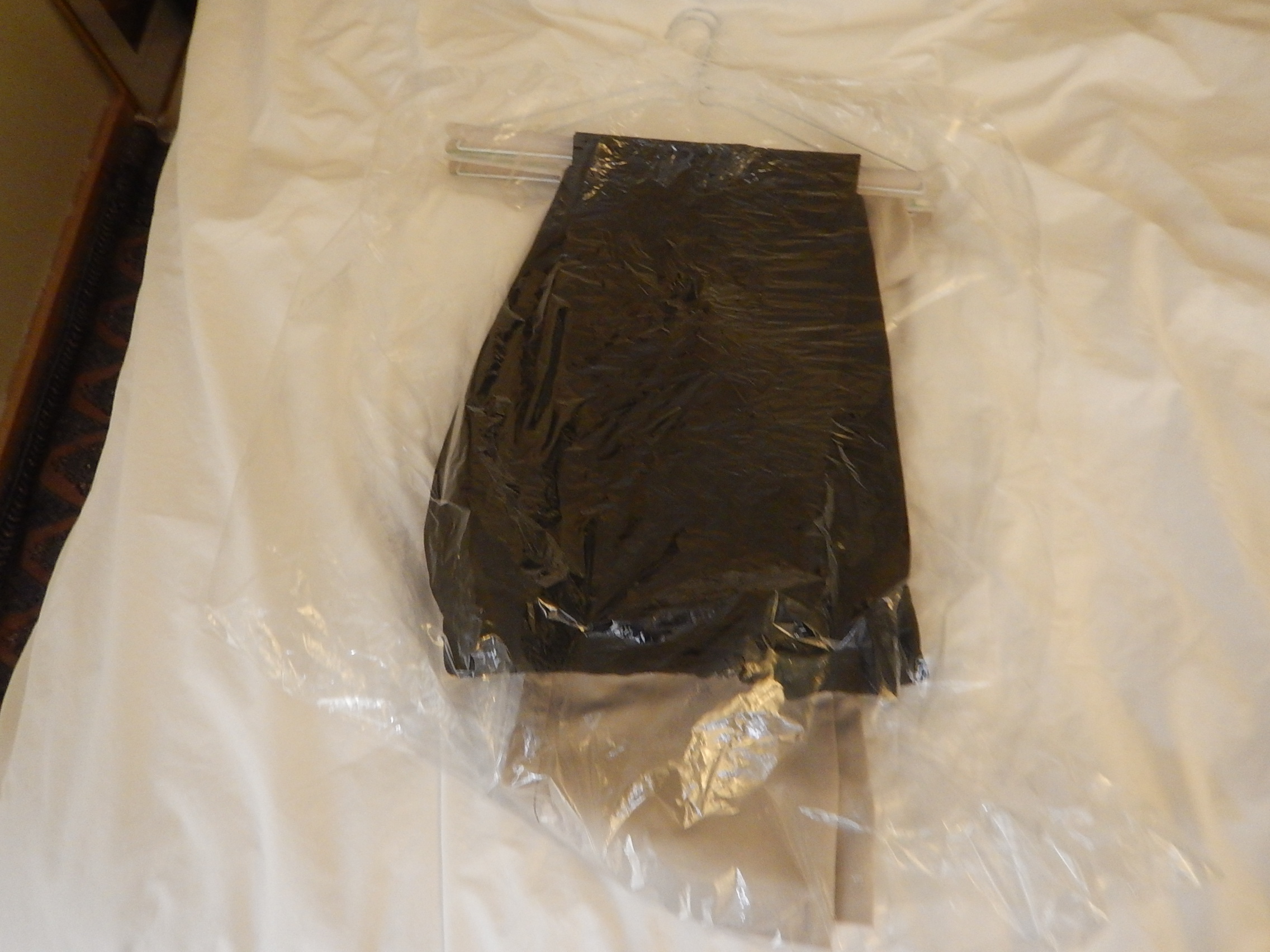
There are two things wrong with the packaging.
The awful wire coat hangers, which are a nuisance to deal with and go straight in the bin.
The plastic wrapping over the top, which I assume is not recyclable.
Years ago in Suffolk, we had a man who collected and returned our bed linen from the laundry, once a week. I can’t remember the company, but I hope they’re still going, as they did an excellent service.
They then started doing dry cleaning and they gave you the choice of having it on hangers or neatly folded in tissue paper.
I remember we chose the latter, as it was so much more convenient.
C would then put things that needed a hanger on proper wooden ones.
With the worries around plastic getting into the oceans, surely we should stop this needless wrapping of dry cleaning with plastic and fold things neatly in tissue paper!
I look forward to seeing a dry-cleaners, that says that we don’t use plastic!
19MW Storage Capacity To Participate In Three UK Flexible Markets
The title of this post is the same as that of this article on Smart Energy.
in Batteries On The Boil As Fund Attracts Investors, I talked about energy storage funds, which are a way of investing in energy storage to add capabilities to electricity grids.
This article talks about how the Gore Street Energy Fund is investing in two energy storage facilities at the Port of Tilbury and Lower Road in Essex
I have also found this article on Solar Power Portal, which is entitled Gore Street Fund Makes New Battery Acquisitions With New 19MW Pair From Origami Energy.
The second article has a picture of a 4 MW/4.8 MWh Tesla battery at Cenin Renewables.
The link to Tesla gives a well-presented page of applications of these batteries.
One example given is Renewable Integration, where this is said.
Smooth and firm the output of a renewable power generation source such as wind or solar.
This will be a large application for these types of large batteries, as although we don’t have masses of sun, we do have a lot of wind.
Big financial institutions like Pension Funds and Insurance Companies need secure long term investment to place their money and these energy storage devices, would appear to offer a sensible return, that enables them to pay their investors, like anybody who has a pension. Traditionally,these financial institutions have invested in property and government bonds for example.
Lately, they have been investing in railway rolling stock, which have a life of up to forty years. These energy storage systems should offer a reasonable life, if well-maintained and updated.
As there will large numbers of energy storage systems installed in the UK in the next decades, I think they could be a big area for investment.
At an individual level, we will also see houses built or refurbished with solar panels and batteries.
We are at the start of an exciting revolution!
Morecambe’s Eden Project North To Feature Giant ‘Mussel’ Pavilions
The title of this post is the same as that of this article on the BBC.
This is the first three paragraphs.
A new Eden Project will feature five giant mussel-shaped domes inspired by local marine life, plans have revealed.
Morecambe’s Eden Project North will include “performance spaces, immersive experiences and observatories”, the charity behind plans for it has said.
The Eden Project, which runs the Cornish attraction of the same name, said the new site would also feature “re-imagined lidos” and gardens.
It appears that the next stage is to obtain the funding.
I must admit, that I was sceptical about the Eden Project in Cornwall, when it was announced in the late 1990s. But it is now a popular visitor attraction, which attracted over a million visitors iin 2017.
Large Hydropower Dams ‘Not Sustainable’ In The Developing World
The title of this post is the same as that of this article on the BBC.
This is the first four paragraphs.
A new study says that many large scale hydropower projects in Europe and the US have been disastrous for the environment.
Dozens of these dams are being removed every year, with many considered dangerous and uneconomic.
But the authors fear that the unsustainable nature of these projects has not been recognised in the developing world.
Thousands of new dams are now being planned for rivers in Africa and Asia.
I think the report has a sound basis and we should think much deeper before we build a large dam.
Storing energy and preventing of floods are probably good reasons, whereas others are not, considering, that solar and wind power are becoming more affordable.
Fish Fingers Surprisingly Sustainable, Say Conservationists
The title of this post is the same as that of this article on the BBC.
When I first saw this headline, I was surprised and cynically felt that this was some put up job paid for by the producers of fish fingers or the Fish Fingers Appreciation Society.
But it appears that the research was done by the Marine Conservation Society.
This is the first paragraph of their Wikipedia entry.
The Marine Conservation Society (MCS) is the UK’s leading marine environment, not-for-profit organisation. It works for the increased protection of the seas around the United Kingdom, via the creation of well managed marine protected areas. It works with fishermen and industry to find more sustainable ways of fishing and with retailers and consumers to buy and choose more sustainable seafood. It involves volunteers to carry out hundreds of beach cleans and surveys annually whilst also working with water companies and local communities to ensure UK bathing waters are of an excellent standard
I think that and other facts in the entry, prove that we can take the BBC report at face value.
Incidentally of their list of the top fifteen fish fingers rated for sustainability, at least two were gluten-free.
Usually, coeliacs and others who are gluten-free are left out of the results.
My last thought, is that why if we can make fish fingers surprisingly sustainable, can’t we do that for other foods?
Charging Battery/Electric Trains En-Route
One big need with a battery/electric hybrid train, is the need to charge the batteries quickly at a station stop.
On my last trip to Sheffield, I timed the stops from brakes on to moving again of the Class 222 train.
Times in minutes:seconds were as follows.
- Leicester 1:30
- Louthborough 1:15
- East Midlands Parkway 1:06
- Long Eaton 1:08
- Derby 1:22
- Chesterfield 1:09
So it looks like there is only a minute to charge the batteries on a typical Inter-City service.
Would it be much longer on say a long rural service like Settle and Carlisle or Inverness to Wick?
I don’t think so!
So how could we top up the train in a station stop of less than a minute.
Plug The Train Into a Power Socket
This may work with electric cars, but if you think it would work with trains and charge them in a minute, then think again!
Using A Pantograph
This may seem to be the obvious way, but to raise the pantograph, get a reasonable charge into the train’s batteries and lower it again, is an awful lot of things to cram into a minute.
There’s also many things that can go wrong.
Vivarail’s Solution
In Issue 864 of Rail Magazine, there is an article entitled Scotland High Among Vivarail’s Targets for Class 230 D-Trains, Vivarail’s solution to charging a battery-powered Class 230 train is disclosed.
A prototype rapid charging facility at its Long Marston base would use short sections of third-rail to quickly recharge a Class 230’s batteries. He said that the third-rail shoegear fitted to the trains in their London Underground service could handle higher currents than simply plugging a cable into the train.
The rapid charging concept consists of a shipping container of batteries that are trickle charged from a mains supply. When a Class 230 sits over the short sections of third-rail, electricity can be quickly transferred to the train’s batteries. When the train is away, the power rails are earthed to ensure they pose no risk The concept provides for charging a Class 230 as it pauses at a terminus before making its return journey.
What surprises me, is the claim, that third-rail is such an effective way of charging the batteries.
But then a Class 92 locomotive has a power of 4,000 kW when running on 750 VDC third rail electrification, so it would appear third-rail systems can handle large amounts of power.
This would be the sequence, as a train performed a station stop.
- The driver would stop the train at the defined place in the platform, as thousands of train drivers do all over the world, millions of times every day.
- Once stopped, the contact shoes on the train would be in contact with the third rail, as they would be permanently down and ready to accept electricity at all times.
- The charging system would detect the stationary train and that the train was connected, and switch on the power supply. to the third-rail.
- Electricity would flow from the track to the batteries, just as if the train was on a standard third-rail electrified track.
- If the train’s battery should become full, the train’s system could stop the charging.
- When passengers had finished leaving and joining the train and it was safe to do so, the driver would start the train and drive it to the next station, after ascertaining, that there was enough power in the batteries.
- When the charging system determined that the train was moving or that the contact shoe was no longer connected to the third-rail, it would immediately cut the power to the rail and connect it to earth.
It is a brilliant system; simple, efficient and fail-safe.
- Regenerative braking will mean that stopping in the station will help to top-up the batteries.
- The battery on the train is being charged, as long as it is stationary in the station.
- Delays in the station have no effect on the charging, except to allow it for longer if the battery can accept more charge.
- The driver concentrates on driving the train and doesn’t have to do anything to start and stop the charging.
- As there is no cable to disconnect or pantograph to lower, disconnection from the charging system is automatic and absolute, when the train leaves.
- The charging system never exposes a live rail to passengers and staff.
As a Control and Electrical Engineer, I believe that developments of this system, could be able to put at least 200 kWh into the train’s batteries at each stop.
The system could also be independent of the driver, whose only actions would be to check on safety, that charging was proceeding as it should and that there was sufficient charge in the batteries before continuing.
Connection And Disconnection To The Third-Rail
These pictures taken at Blackfriars station, show how the ends of the third-rail is tapered, so that the shoe on the train connects and disconnects smoothly.




Note.
- The tapered ends of both rails on opposite side of the gaps.
- For safety, the electrified third-rail is on the other side of the track to the platform.
- One picture shows how yellow-painted wood is used for extra safety.
As a train is always on top of the third-rail, when the power to the rail is switched on in Vivarail’s charging system, I think that, the system should be very safe.
Battery-To-Battery Energy Transfer
Vivarail’s genius is to transfer the energy from trackside batteries to the batteries on the train. As batteries have a low impedance, large amounts of electricity can be passed quickly.
Batteries, Supercapacitors Or Both?
I believe that in a few years time for many applications, supercapacitors will be a viable alternative to batteries.
Energy densities are improving in supercapacitors and they have a similar low impedance, which will enable fast transfer of electricity.
So I wouldn’t be surprised to supercapacitors used on trains or in charging systems.
It may be that a mix of supercapacitors and batteries is the optimal solution.
Installing A Vivarail-Style Charging System
Installation of a Vivarail-style charging system would require.
- A length of third rail to be installed alongside the track or tracks in the station.
- The containerised batteries and control system to be installed in a suitable place.
- Electrical power to be connected to the batteries and control system.
- Appropriate-cabling between the rail and the container.
The great advantage is that to install a charging system in a station would not require any of the complicated and expensive works, often needed to install 25 KVAC overhead electrification.
Supplying Electricity To A Vivarail-Style Charging System
The Rail Magazine article talks of trickle charging the track-side batteries, using mains electricity, but I suspect some of the most cost-effective systems would use solar, wind or water power, backed up by a mains supply.
In a remote station, installing a Vivarail-style charging system powered by a sustainable power might be an opportunity to install modern low-energy lights and other equipment at the station, powered from the charging system.
A Vivarail-Style Charging System Could Be Built With No Visual Intrusion
Another advantage of using Vivarail-style charging systems, is that there is less visual intrusion than traditional continuous 25 KVAC overhead electrification.
Some visual intrusion would be down to the shipping container used to house the batteries.
But if necessary, the batteries could be housed in a classic Victorian outhouse or a modern sympathetically-designed structure.
Would A Vivarail-Style Charging System Need To Be In A Station?
Many, but not all charging systems would be in stations.
However, there are some very convenient places for charging systems, that may not be in stations.
Trains going to Bedwyn station wait for several minutes in a turnback siding to the West of the station, before returning to London. The route is not electrified and bi-mode Class 800 trains will be used on the route, because there is about thirteen miles between Bedwyn and Newbury without electrification.
If a Vivarail-style charging system were to be added to the turnback siding battery/electric trains could work the service to London. I’m sure Hitachi know how to convert a version of a Class 80x train to battery/electric operation.
There will be quite a few places, where for operational reasons, a charging system could or should be placed.
Would All Stations On A Route Need To Be fitted With A Vivarail-Style Charging System?
This would depend on the route and the need to run it reliably.
Detailed computer modelling would show, which stations wouldn’t need to be fitted with charging systems!
If a train was a limited-stop service or not required to stop at a particular station because of operational reasons or the timetable, the train would just pass through the station.
As it didn’t stop, it would not have caused the charging system to switch on power to the third-rail.
But if say due to delays caused by an incident meant a train was low on battery power, there is no reason, why the train can’t make a stop at any charging system to top-up the batteries.
Should The Driver Have Any Control?
Consider.
- It may be extra safety is needed, so the driver could give a signal to the charging system, that it is safe to start the charging process.
- Similarly, the driver should be able to pause or stop the process at any time.
But the driver would mainly be monitoring an automatic process.
Would The Charging System Be Linked To The Signalling?
I think this could be likely, as this could add another level of safety.
Conclusion
I believe it is possible to design a safe charging system using proven third-rail technology and batteries or supercapacitors to transfer at least 200 kWh into a train’s batteries at each stop.
Surely, this method of electrification could be used to allow electric trains to run through environmentally-sensitive areas and World Heritage sites like Bath, the Lake District and the Forth Bridge,
Grimshaw Working On New Eden Project In Morecambe
The title of this post is the same as that of this article in the Architect’s Journal.
The Eden Project in Morecambe does seem to have the look of a serious project.
Thoughts On The Morecambe Bay Eden Project
When the BBC reported this on Friday, they got a generally good reaction from the local residents they interviewed.
Articles in the Guardian and The Times have been positive, with support from local and national politicians and other worthies. The Times too, has extensive positive comments from readers.
For a project like this to be built, let alone be successful, it needs to have this sort of response on the first day.
It is a project that obviously touches a happy nerve, sirs memories or just ticks all the right boxes with lots of people.
So where will the Eden Project be built?
This Google Map shows the town of Morecambe and psart of the coast and bay to the North of the town.
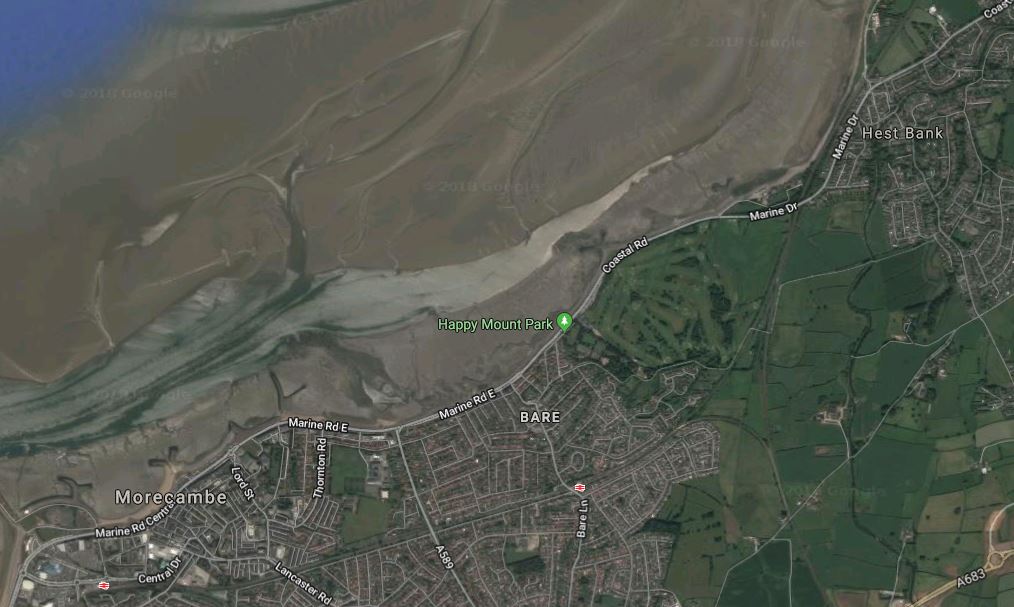
Nothing has been said about the location, but there would appear to be plenty of space.
I’ve only ever been to Morecambe once, when I visited the town on my trek to visit all 92 English football clubs to raise money for pancreatic cancer research at Liverpool University. My brief visit to Morecambe is described in 92 Clubs – Day 21 – Milton Keynes, Morecambe, Newcastle. This was my initial comment on the town.
The town was a bit of a surprise, as I thought it would be like Blackpool only smaller. It is smaller, but it is in much better state than its larger resort down the coast. You wouldn’t see anything as tasteful as this on a roundabout in Blackpool.
My previous visit was very much a quickie, as I had to continue to Newcastle.
The Eden Project By Train
On their web site, the Eden Project, says this about getting to their Cornish attraction by train.
We are just a few miles from St Austell railway station, which is on the main line from London Paddington and is well served by buses to Eden. You could also take the train to Luxulyan, Bugle or Par, for a more scenic journey or to continue your trip on foot or bike.
They also give a discount for visitors that arrive by public transport. As they should!
If I was going, I’d take the Night Riviera to St. Austell and then use a bus to the Eden Project from the bus station at St. Austell station to complete the journey.
The Proposed Morecambe Eden Project By Train
So how would getting to the proposed Eden Project at Morecambe compare?
In Getting To The Proposed Morecambe Eden Project By Train, I laid out how a large zero-carbon rail system could develop around Morecambe.
I also concluded that journeys to and from Birmingham, Edinburgh, Glasgow, Liverpool, London and Manchester, could be made zero-carbon.
How cool is that?
Eden Project Seeks Funds For Morecambe Attraction
The title of this post is the same as that of this article on the BBC.
When I heard about this project on the BBC, my first reaction was – Why Not?
And nothing, I’ve seen or read changes my decision.
If it opens, I shall go, as it’s not far from areas, I visit regularly.
Now That’s What I Call A Growing Green Business!
I took this picture as I walked back from the bus stop to my house, this morning.
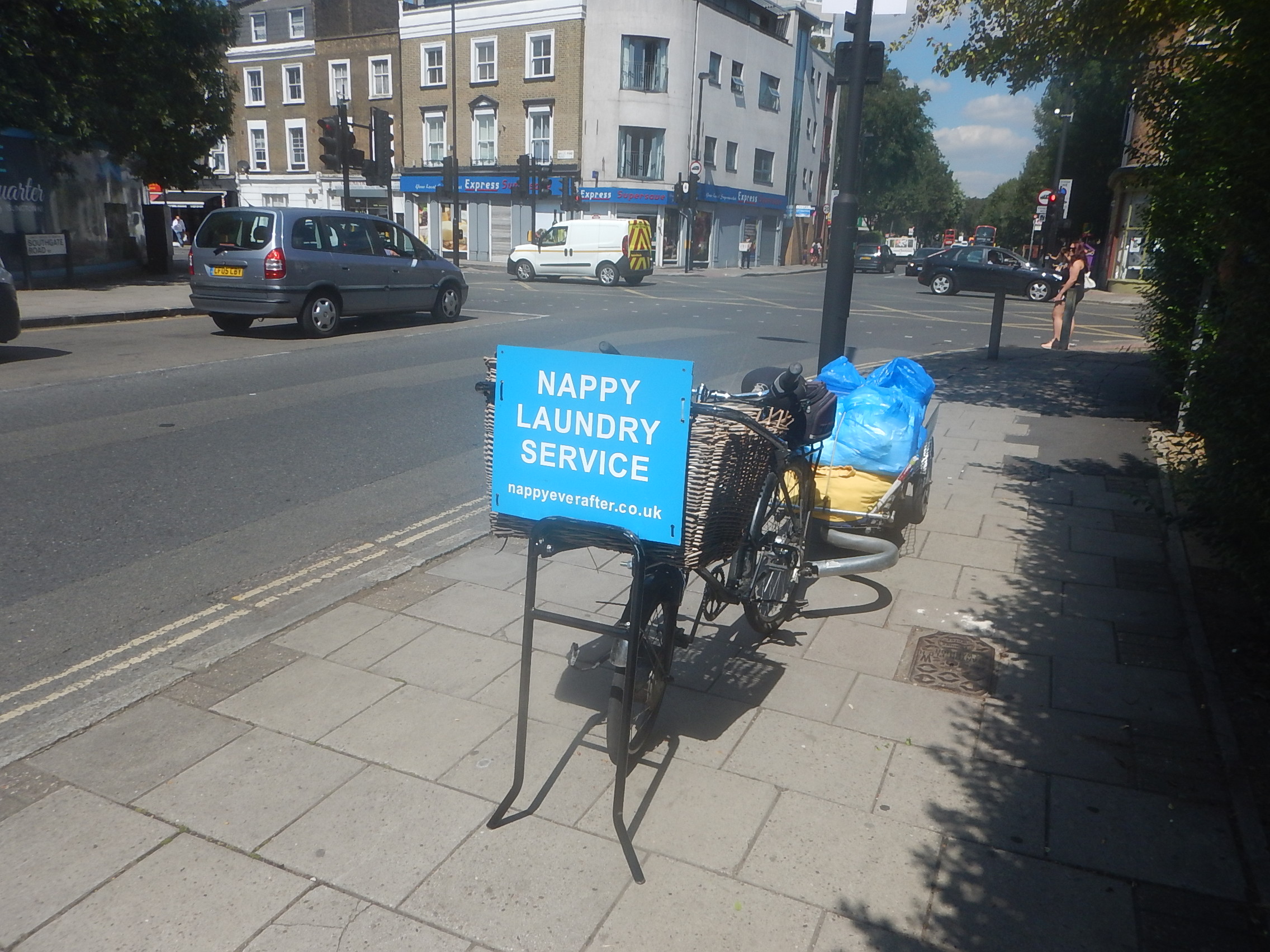
For the third of our three children, we used a nappy service, where every day or so, a guy would collect a bucket of soiled cotton nappies and return a pile of clean ones.
I have images in my mind of C unwrapping them and burying her face in the pile, as it was just one of those experiences she liked. Later in life, I saw her do it with towels in a five-star hotel in Hong Kong.
Our service was provided by a guy with a van, but surely a bicycle takes a nappy service to a new level.
So many of my generation, who used real nappies on their children, swear that the children preferred them.
Certainly, with a nappy service, they were a lot easier.
I have explored the sewers of London, which I wrote about in We’re Really In It Now. The flushers told me, that disposable nappies along with wet wipes and fat from fast food eateries, are the three major problems in the sewers
So disposable nappies might be convenient, but they have to be filtered out and go into landfill.
My best wishes for Nappy Ever After in the future!
 The Anonymous Widower