World’s Largest Offshore Wind Farm Produces Power For The First Time
The title of this post, is the same as that of this press release from SSE.
These bullet points sum up the press release.
- UK Prime Minister Rishi Sunak hails Dogger Bank’s role in bolstering energy security, creating jobs, lowering costs, and achieving Net Zero
- First power achieved at UK’s Dogger Bank as the first of 277 turbines installed 130km from UK coast
- Dogger Bank is now connected via HVDC technology to Britain’s national grid and providing renewable power to homes and businesses
- Each rotation of the first turbine’s 107m long Haliade-X blades can produce enough clean energy to power an average home for two days
- When complete Dogger Bank will deliver clean energy to six million homes annually
I will repeat a highlight of important paragraphs from the press release.
The Size Of The Dogger Bank Wind Farms
When fully complete, Dogger Bank’s world-record-beating 3.6GW capacity will comprise 277 giant offshore turbines capable of producing enough clean energy to power the equivalent of six million homes annually and deliver yearly CO2 savings equivalent to removing 1.5 million cars from the road.
Note.
- The first 1.2 GW section is scheduled for completion in the next few months.
- Two more sections of the Dogger Bank wind farm will eventually raise the capacity to 6 GW.
This cluster of wind farms certainly shows what can be achieved with British offshore wind power.
Innovative HVDC Technology
Dogger Bank also marks the first use of HVDC transmission technology to connect a British wind farm to National Grid’s UK energy network. This includes the installation of the world’s first unmanned offshore HVDC substation platform at the site, as well as first use of Hitachi Energy’s HVDC Light® transmission system which was successfully executed in record time of 38 months with the highest safety and quality standards.
Note.
- HVDC technology appears to be a more efficient way of transmitting energy under the sea and is now generally used for interconnectors.
- This page on the Hitachi Energy web site is entitled Dogger Bank HVDC Connection and gives a good description of the connection and its advantages.
The HVDC Technology and its installation looks like a real achievement, that can be applied to lots of other offshore wind farms.
XLCC seem to be doing the right thing in building an HVDC cable factory in Scotland. Check out their web site.
Biggest Untapped UK Oil Field, Rosebank, Approved By Regulators
The title of this post, is the same as that of this article on the BBC.
This is the BBC’s summary so far.
- The UK’s largest untapped oil field has been approved by regulators
- Rosebank, 80 miles west of Shetland, is estimated to contain 500 million barrels of oil
- The UK government welcomes the decision, saying it will raise billions of pounds and “make us more secure against tyrants like Putin”
- But Scotland’s First Minister Humza Yousaf says he’s “disappointed”, while the Green Party calls the decision “morally obscene”
- Regulators said net zero considerations had been taken into account
This is my summary.
I have been reading Equinor’s web site on Rosebank.
Production will use what is known as a Floating Production Storage and Offloading Vessel or FPSO, which means, when they’ve finished, it can just sail away.
The FPSO will also be electrification-ready, so that all operations on the vessel will probably be powered by green electricity from a nearby wind farm, instead of by a gas turbine engine on the vessel, which burns gas.
This means that the offshore operations will be as carbon-free as is reasonably possible. But importantly, we will pipe the maximum amount of gas from the field for either our own use or selling to the gas-thirsty Germans.
We will need the gas for some time to back up wind and solar with gas-fired power stations.
But what about the emissions from the power stations?
Capturing carbon dioxide from a power station is getting easier, but more importantly, researchers are finding more and more innovative ways of using the carbon dioxide.
H & M and Zara are even selling clothes made from captured carbon dioxide.
Ways are also being developed using plasma electrolysis to strip the carbon out of natural gas to leave useful hydrogen.
Natural gas will be our friend for many decades yet, if we can turn it into a zero-carbon fuel, which I believe we can!
Fourth Phase Could Bring 2 GW More To World’s Already Largest Offshore Wind Farm Under Construction
The title of this post, is the same as that of this article on offshoreWIND.biz.
This is the sub-heading.
Dogger Bank D, the potential fourth phase of the Dogger Bank Wind Farm, whose first three phases totalling 3.6 GW are currently being built, is planned to have a generation capacity of around 2 GW. If built, the fourth phase would bring the total installed capacity of the UK project – already the world’s largest offshore wind farm under construction – to over 5.5 GW.
This is the introductory paragraph.
SSE Renewables and Equinor, which own the Dogger Bank A, B and C offshore wind farms through a consortium that also comprises Vårgrønn, have now launched a public consultation period on the Dogger Bank D proposals that runs until 7 November.
As RWE are developing the 3 GW Dogger Bank South, the Dogger Bank wind farm will be up to 8.5 GW in a few years.
World’s Largest Floating Offshore Wind Farm Officially Opens
The title of this post, is the same as that of this article on offshoreWIND.biz.
This is the sub-heading.
Norwegian energy major Equinor, together with its partners, will inaugurate today the world’s largest floating offshore wind farm, Hywind Tampen
The story is according to Reuters.
This page on the Equinor web site, outlines the project.
Hywind Tampen is the world’s first floating wind farm built specifically to power offshore oil and gas installations, and is now supplying electricity to Equinor’s oil and gas fields Snorre and Gullfaks in the Norwegian North Sea.
With a system capacity of 88 MW it is also the world’s largest floating offshore wind farm and an important step forward in industrialising solutions and reducing costs for future offshore wind power projects.
With Hywind Tampen now operational, Equinor is now operating nearly half (47 percent) of the world’s offshore floating wind capacity.
This floating wind farm powering oil and gas fields will be the first of many.
eDNA Pilot Study Completed At World’s First Floating Offshore Wind Farm
The title of this post, is the same as that of this article on offshoreWIND.biz.
This is the sub-heading.
Equinor and Norwegian Research Centre (NORCE) have completed a pilot study using environmental DNA (eDNA) to monitor the biodiversity and abundance of marine life in waters around the 30 MW Hywind Scotland floating offshore wind farm.
This is the first paragraph.
Equinor and Norwegian Research Centre (NORCE) have completed a pilot study using environmental DNA (eDNA) to monitor the biodiversity and abundance of marine life in waters around the 30 MW Hywind Scotland floating offshore wind farm.
And this paragraph outlines methodology and objectives of the study.
By analysing the eDNA content in water samples, Equinor and NORCE were able to measure the biodiversity of fish species in the water surrounding Hywind Scotland. This pilot study was conducted to learn more about the potential effects that floating offshore wind farms may have on marine habitats.
The research identified 26 fish species and a harbour porpoise in the area.
According to the article, an often used method to analyse fish species is to trawl and analyse.
Surely, just to collect the eDNA from the water, is a method, that has the least effect on the fish, any porpoises and the environment.
Industry Calls For 10 GW Of Offshore Hydrogen In German National H2 Strategy
The title of this post, is the same as that of this article on offshoreWIND.biz.
This is the sub-heading.
Offshore wind and hydrogen developers and organisations in Germany have called on the federal government to set clear targets for offshore hydrogen in the update of the country’s National Hydrogen Strategy, with an additional 10 GW of offshore electrolysis capacity to be added by 2035.
These two paragraphs add detail the story and name those who are behind it.
On 26 May, several companies and industry organisations signed an appeal sent to the German Federal Government that highlights offshore hydrogen’s advantage of adding large-scale capacities and asks that a target of an additional 10 GW of offshore hydrogen by 2035 be added to both the country’s hydrogen strategy and the area development plan.
The parties that signed the appeal include the German offshore wind-to-hydrogen initiative AquaVentus, offshore wind and hydrogen players BP, Siemens Gamesa, Gasunie, Copenhagen Infrastructure Partners (CIP), EnBW, Equinor, and Lhyfe, as well as industry organisations WAB and the Federal Association of Offshore Wind Farm Operators (BWO), among others.
These two paragraphs describe an area to be developed for the first offshore hydrogen production.
As reported in January, in the country’s new area development plan for offshore wind, Germany’s Federal Maritime and Hydrographic Agency (BSH) also outlined the first offshore hydrogen area in the North Sea.
The area, SEN-1, spans over 100 square kilometres in the North Sea and will allow for an electrolysis capacity of up to 1 GW to be tested and connected with a hydrogen pipeline.
Note.
- 1 GW if electricity should create about 435 tonnes of hydrogen per day.
- That amount of hydrogen could be stored as liquid in a sphere with a radius of 11.35 metres.
Norway Has Room For 338 GW Of Offshore Wind, New Analysis Finds
The title of this post, is the same as that of this article on offshoreWIND.biz.
This is the sub-heading.
Norway has the potential to develop up to 338 GW of offshore wind in areas with a low level of conflict, according to a new analysis performed by Multiconsult and commissioned by the industry organisation Norwegian Offshore Wind, Equinor, Source Galileo, Hafslund and Deep Wind Offshore.
These two paragraphs are the main findings of the report.
The report, issued on 14 April, maps 28 areas as suitable for floating wind and 18 areas for fixed-bottom offshore wind, estimating the total potential installed capacity to be 241 GW at 5 MW/km2 and 338 GW at 7 MW/km2.
Of this, floating wind could account for 156 GW and up to 219 GW, while fixed-bottom capacity is between 85 GW and 119 GW.
So how does that figure look for the UK?
Consider.
- The UK has an Exclusive Economic Zone of 773,676 sq. kilometres.
- But if you include overseas territories, the UK’s area is 6,805,586 sq. kilometres and is the fifth largest in the world.
- Norway has an Exclusive Economic Zone of 2,385,178 sq. kilometres.
So taking the 338 GW figure for Norway and ignoring overseas territories, we could generate 109.6 GW.
Dogger Bank Wind Farm Officially Celebrates Its Operations And Maintenance Base Opening
The title of this post is the same as that of this news item on the Dogger Bank wind farm web site.
These bullet points introduce the item.
- 150 guests and employees gathered to celebrate the official opening.
- The state-of-the-art base will be the hub for operations and monitor 5% of UK electricity from its control room.
- Over 400 long-term jobs have been created locally to support Operations and Maintenance from South Tyneside for the 35-year life of the wind farm.
- The world-class facility will be operated in line with the UK Green Building Council’s (UKGBC) Net Zero Carbon Buildings Framework
This Google Map shows the location of the base.
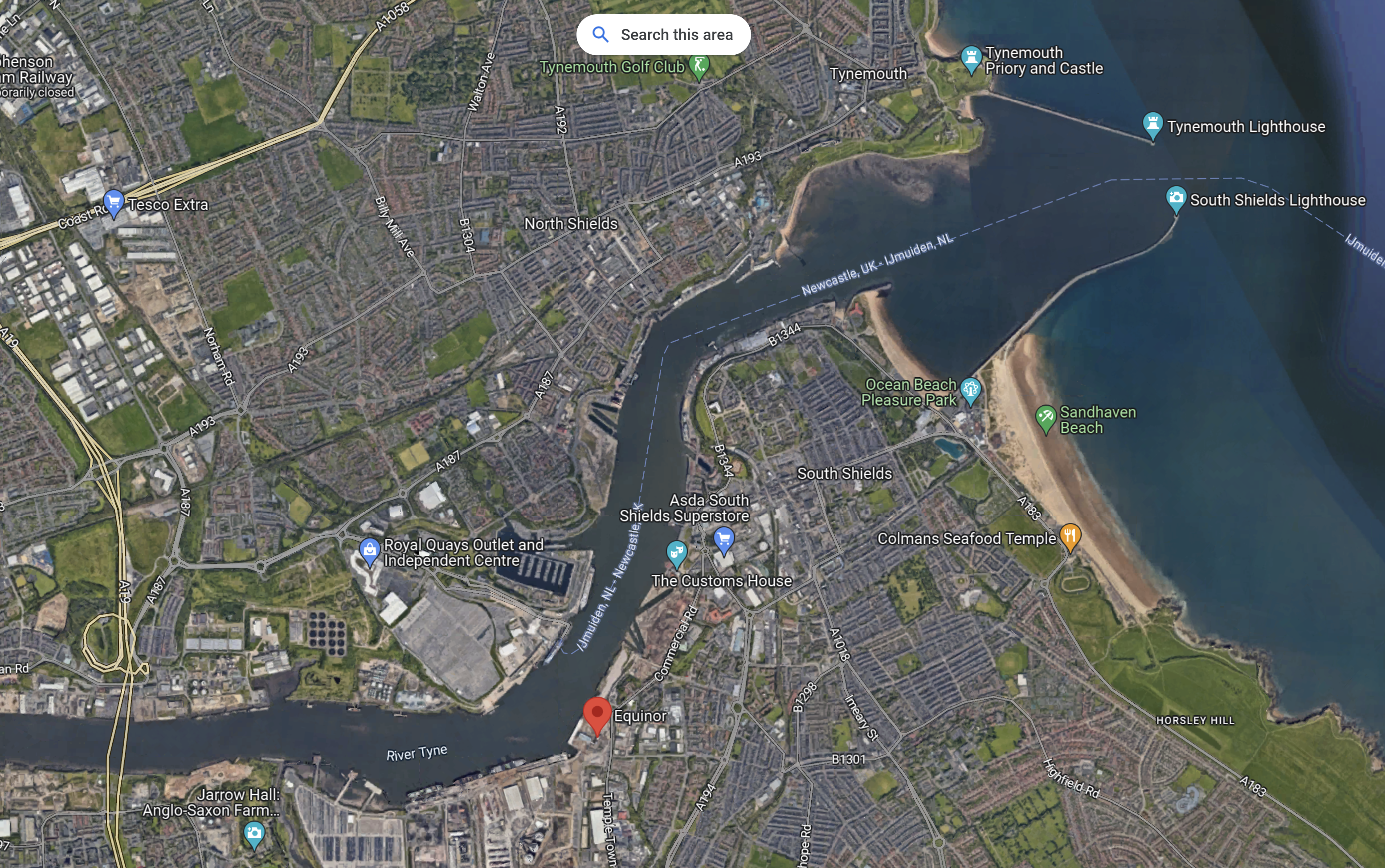
The red arrow indicates the base, which appears to be convenient for the North Sea.
This second Google Map shows a close up if the site.
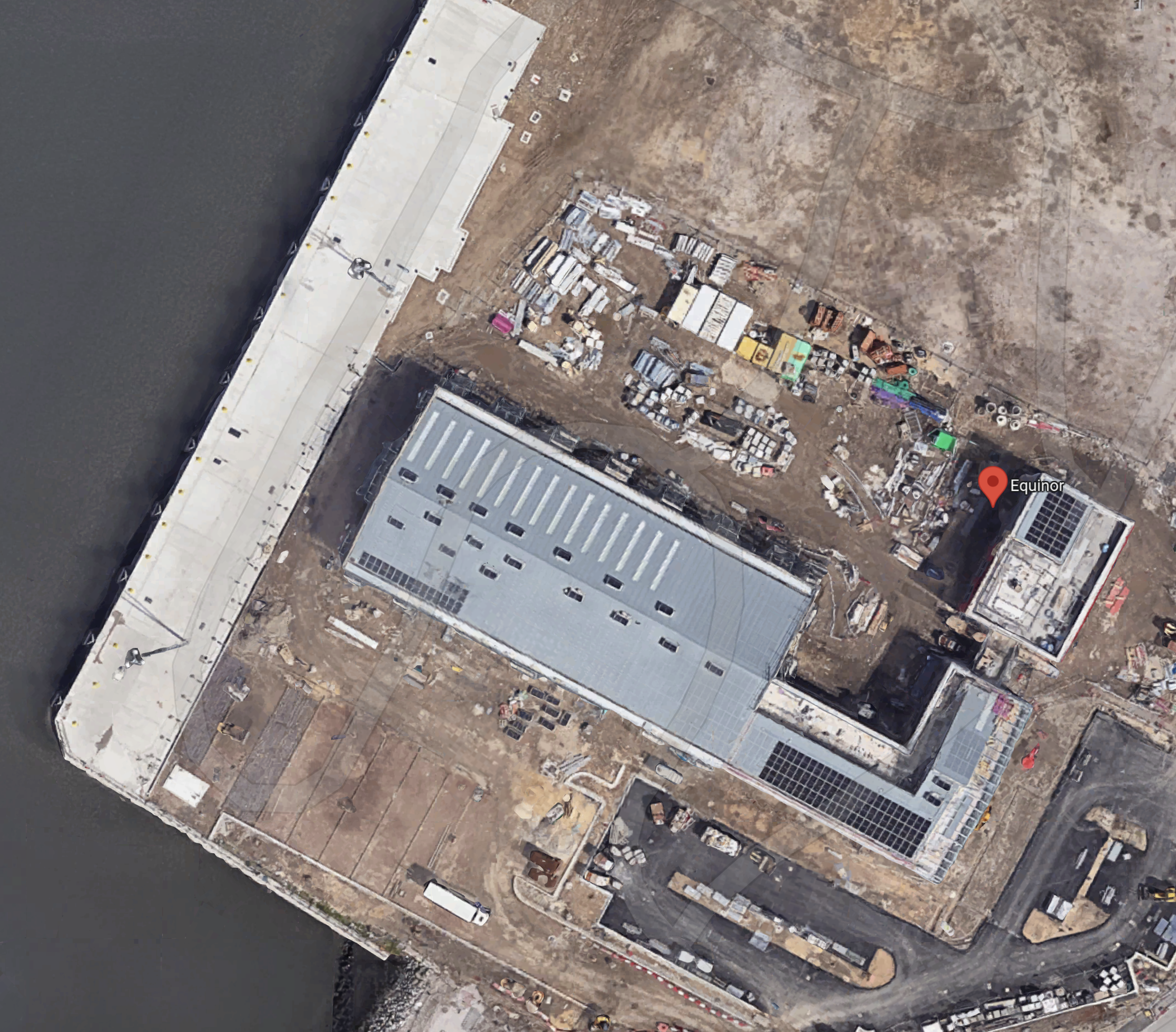
There is a nice long quayside, which in the future could be large enough to assemble floating turbines.
This third image is a Google Map 3D visualisation of the site from across the Tyne.
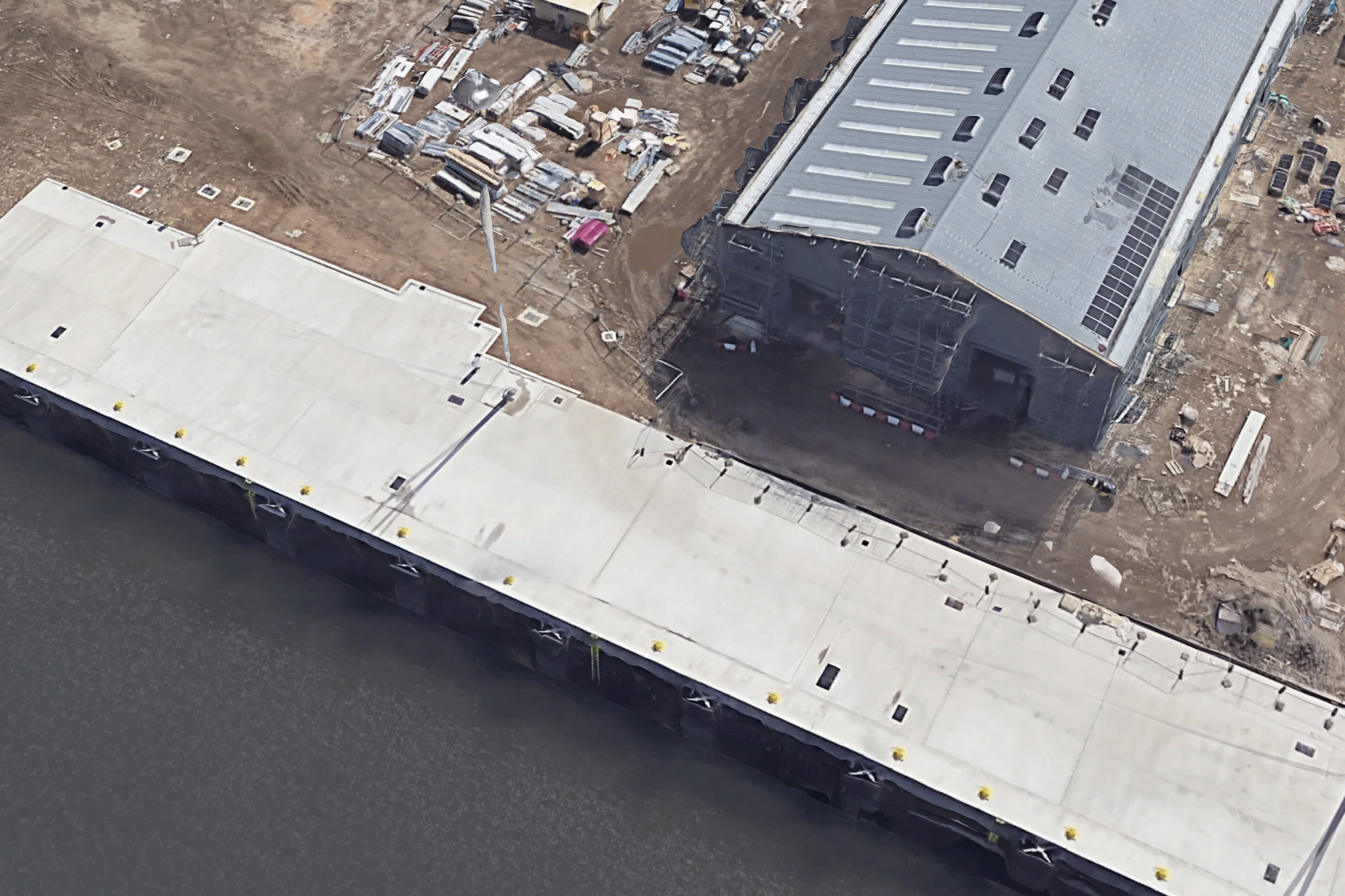
The news item says this about the ownership and operation of the Dogger Bank wind farm.
Dogger Bank Wind Farm is a joint venture between SSE Renewables (40%), Equinor (40%) and Vårgrønn (20%). SSE Renewables is lead operator for the development and construction of Dogger Bank Wind Farm. Equinor will be lead operator of the wind farm on completion for its expected operational life of around 35 years.
Initially, the Port of Tyne base will operate and maintain these wind farms.
- Dogger Bank A – 1235 MW
- Dogger Bank B – 1235 MW
- Dogger Bank C – 1218 MW
This gives a total of 3688 MW.
Note.
- SSE Renewables and Equinor are also developing the 1500 MW Dogger Bank D wind farm.
- This would bring the total up to 5188 MW.
- RWE are also developing the 3000 MW Dogger Bank South wind farm.
Leases were signed for both the Dogger Bank D and Dogger Bank South wind farms in January 2023.
I doubt all of these wind farms will be operated and maintained from the Port of Tyne base, due to the different ownership of Dogger Bank South.
But, I do hope that the facility can be expanded to handle Dogger Bank D.
World’s First Floating Offshore Wind Farm Celebrates Five Years Of Operation
The title of this post, is the same as that of this article on offshoreWIND.biz.
This is the sub-heading.
Hywind Scotland, the first floating offshore wind farm in the world, has passed five years in operation since its commissioning in 2017.
And this is the first paragraph.
According to Equinor, Hywind Scotland is the world’s best-performing offshore wind farm, achieving a capacity factor of 54 per cent over its five years of operations.
Note.
- Hywind Scotland is a 30 MW wind farm with five turbines.
- The capacity faction is much higher than a windfarm with fixed foundations.
- The water depth is between 95 and120 metres.
- The wind farm is 30 km. off Peterhead.
There is at least 15 GW of floating wind farms being planned in UK waters before 2030.
Conclusion
The wind farm has made a good start for the first floating wind farm.
SSE Thermal Charts Path To Green Hydrogen Future With First-Of-A-Kind Project
The title of this post, is the same as that of this press release from SSE Thermal.
This is the sub-heading.
SSE Thermal is developing a first-of-a-kind project in the Humber which would unite hydrogen production, storage and power generation in one location by the middle of this decade.
These paragraphs explain the project.
The Aldbrough Hydrogen Pathfinder project will support the evidence base for wider deployment of flexible hydrogen power in the UK’s net zero journey and is a major enabler of SSE Thermal’s wider Humber ambitions.
Located at SSE Thermal and Equinor’s existing Aldbrough Gas Storage site on the East Yorkshire coast, the project is designed to demonstrate the interactions between hydrogen electrolysis, hydrogen cavern storage and 100% hydrogen dispatchable power.
The concept would see green power sourced from grid through Renewable PPAs, in compliance with the Low Carbon Hydrogen Standard. Hydrogen would then be produced via a 35MW electrolyser before being stored in a converted salt cavern and then used in a 100% hydrogen-fired turbine, exporting flexible green power back to grid at times of system need. In future, hydrogen storage will also benefit offtakers in other sectors, for example in industry, heat or transport.
Note.
- The Aldbrough Gas Storage site currently can store the equivalent of 320 GWh of electricity, It is currently being expanded to be one of the largest hydrogen stores in the world according to this page on the SSE web site.
- SSE Thermal are proposing to build a hydrogen-powered power station at Keadby to the South of the Humber. The press release says this power station could have a peak demand of 1,800MW of hydrogen.
- Aldbrough at its current size could keep the Keadby hydrogen-powered power station going for a week. But Aldbrough will be a lot bigger than the current 320 GWh.
- The Hornsea and Dogger Bank wind farms off the coast of East Yorkshire will have a capacity of at least 13.5 GW.
- A 35 MW electrolyser will produce 15.2 tonnes of hydrogen per day.
SSE and Equinor hope to be storing hydrogen by 2025.
Conclusion
It is an enormous project and it will surely grow with more electrolysers and hydrogen-powered power stations.
 The Anonymous Widower