FirstGroup Adds Leeds-based J&B Travel To Growing Coach Portfolio
The title of this post, is the same as that of this article on Route One.
These two paragraphs add more detail.
J&B Travel of Leeds is the latest coach business to be acquired by FirstGroup.
The operator, which has been established for more than 40 years, has a fleet of 15 vehicles, with work including home-to-school, private hire and FlixBus contracts.
But in some ways, the most significant thing not mentioned is that FirstGroup have now acquired seven coach firms.
- AndersonTravel in London
- EnsignBus in London
- J & B Travel in Leeds
- Matthews Coaches in County Monaghan, Ireland
- Tetley’s Coaches in Leeds
- York Pullman in Harrogate, Hull, Leeds and York
Note.
- MatthewsCoaches are about halfway between Dublin and Belfast.
- Three of the English acquisitions are in Yorkshire and two are in London.
- Leeds isn’t far off being halfway between London and Central Scotland.
This looks like the first part of a master plan.
- Leeds and County Monaghan could be ideal refuelling points for zero-carbon coaches.
- Ferrybridge, just South of Leeds is getting a hydrogen-fired power station.
- Ferrybridge is a big site with a motorway service station on the M1.
- Wrightbus are building an electrolyser at Ballymena, which is 81 miles from Matthews Coaches.
- Wrightbus have said that Dublin and Cork would be an ideal route for a hydrogen coach.
- Wrightbus have said that Heathrow and Gatwick would be an ideal route for a hydrogen coach.
This plan could be built-on with routes to various cities and attractions.
I have some further sorts and questions.
Could The First Obvious Routes Be Run By Hydrogen Coaches?
From what Wrightbus have indicated, I would rate the obvious routes as.
- Dublin and Belfast – 103 miles or 206 miles round trip
- Dublin and Cork – 107 miles or 340 miles round trip
- Leeds and Glasgow – 224 miles or 448 miles round trip
- Leeds and Edinburgh – 222 miles or 444 miles round trip
- Leeds and London – 197 miles or 396 miles round trip
- Heathrow and Gatwick – 40 miles or 80 miles round trip
Note.
The longest route is 714.5 km.
It would appear that, if the hydrogen-powered coach had a range of 1,000 km. all routes would be possible.
How Far Would A Hydrogen Coach Get On A Tankful From London?
A thousand kilometres is 621.4 miles.
These are the distances from Scottish cities to London.
- Aberdeen – 537 miles
- Dundee – 472 miles
- Dunfermline – 430 miles
- Edinburgh – 410 miles
- Glasgow – 404 miles
- Inverness – 561 miles
- John O ‘Groats – 678 miles
- Perth – 451 miles
- Stirling – 418 miles
I’ve added John O’Groats for completeness, but all cities would be reached.
How Far Would A Hydrogen Coach Get On A Tankful Going West From London?
These are the distances from Western towns and cities to London.
- Aberystwyth – 236 miles
- Fishguard – 255 miles
- Holyhead – 289 miles
- Lands End – 310 miles
- Penzance – 307 miles
I’ve added Lands End for completeness, but all towns and cities would be reached.
John O’Groats And Lands End In A Hydrogen Coach
I asked Google AI how far the journey was and received this answer.
The distance from Land’s End to John o’ Groats varies by transport: about 837-874 miles (1347-1407 km) by road, roughly 600 miles (970 km) as the crow flies, and around 1,200 miles (1900 km) for an off-road walking route, with cyclists typically taking 10-14 days and walkers 2-3 months.
So it looks, like there will be a need for a refuel, but that would give 2,000 kilometres, which is more than the 1,347-1,407 kilometres needed.
Ferrybridge Could Be An Ideal Refuelling Point
I suspect, even in fifty years you could name the places in the UK, where you will be certain of refuelling any hydrogen vehicle on the fingers of one hand.
The list would include.
- Ferrybridge in Yorkshire, where SSE are building a hydrogen-fired power station.
- Felixstowe Docks in Suffolk, where there will be a need to fuel hydrogen trucks.
- Keadby in Lincolnshire, where SSE are building a hydrogen-fired power station.
- Kintore in Aberdeenshire, where an electrolyser is being built.
- Runcorn in Cheshire, where there was an electrolyser in 1968, when I worked there.
This web site lists all the UK hydrogen projects.
This Google Map shows the location of the Ferrybridge hydrogen-powered power station site in relation to Barnsley, Doncaster, Leeds and other towns and cities of Yorkshire.

Note.
- The red arrow indicates the former coal-fired power station site.
- Leeds is in the North-West corner of the map.
- Barnsley and Stocksbridge are in the South-West corner of the map.
- The city of Sheffield is to the South-West of Stocksbridge.
- Doncaster is in the South-East corner of the map.
Last September I wrote Visiting The Consultation For Ferrybridge Next Generation Power Station At Knottingley.
In that post, I wrote about supplying both the power station and the motorway services with hydrogen and felt that it could use one of two methods.
- A pipeline from the hydrogen storage in East Yorkshire.
- Some form of train from a hydrogen production site.
Recently, Network Rail have been conducting tests on the movement of hydrogen by train, which I wrote about in Network Rail’s Test Track Take Centre Stage As Hydrogen Is Delivered By Rail For The First Time.
The Ferrybridge Site Has most things needed.
This map shows the site.
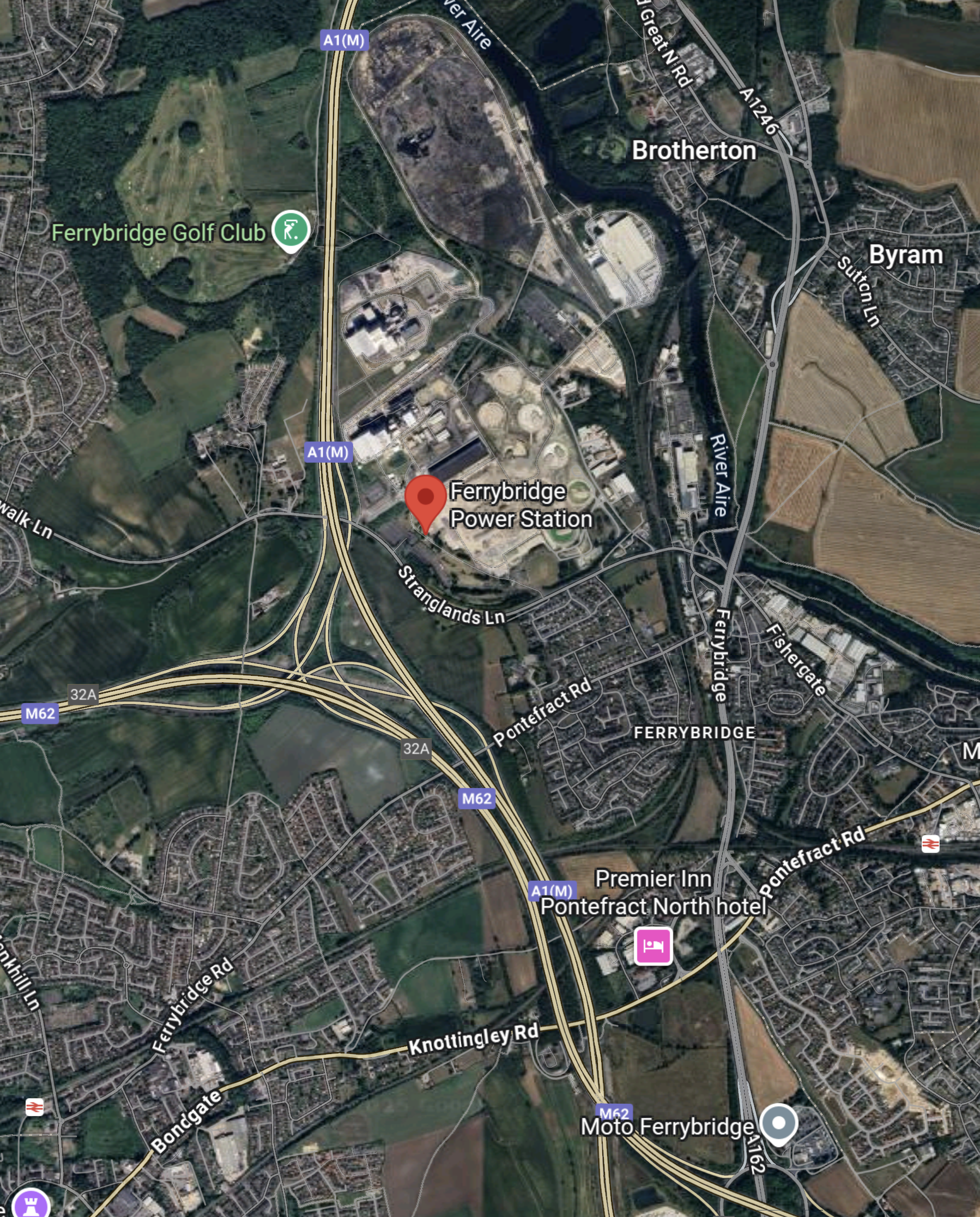
Note.
- The impressive motorway junction, where the North-South M1 crosses the East-West M62.
- Liverpool and Manchester are to the West.
- Leeds, Newcastle and Scotland is to the North.
- Hull is to the East.
- London is to the South.
- There is a Moto Services.
- There is a Premier Inn.
There is even two railway stations on the map.
This reply from Google AI gives the details of the distance between Ferrybridge and the South-West.
The driving distance from Ferrybridge, Yorkshire, to Land’s End is roughly 470 to 500 miles, taking about 8-9 hours, primarily via motorways like the M1, M5, and A30, though exact times and routes vary by real-time traffic and specific starting/ending points.
I am absolutely certain, that if you have a vehicle like a hydrogen coach and you want to go anywhere between A to B on the UK mainland, then if there is hydrogen-refuelling at Ferrybridge, you will be able too do the journey with a refuel at Ferrybridge.
FIRST TO THE FUTURE: Lumo Owner Bids To Turbo-Charge UK Rail With New Routes
The title of this post, is the same as that of this press release from First Group.
These first three paragraphs introduce FirstGroup’s application for the first phase of three separate applications to the Office of Rail and Road (ORR) for new and extended open access rail services.
FirstGroup plc plans to expand its open access rail operations through its successful Lumo business, boosting connectivity, improving UK productivity and passenger choice across the UK.
The expansion aims to replicate the success of Lumo’s Edinburgh to London service in driving material growth on the East Coast Main Line. Lumo operates without government subsidy and contributes more per train mile to infrastructure investment than any other long-distance operator – delivering growth on the railway and connectivity to local communities, at a substantial benefit to the taxpayer.
FirstGroup has submitted the first phase of three separate applications to the Office of Rail and Road (ORR) for new and extended open access rail services, which are described in these bullet points.
- A revised application to run new services between Rochdale and London Euston via Manchester Victoria from December 2028;
- An extension to Lumo’s current Stirling to London Euston track access agreement to operate services beyond 2030;
- A new route between Cardiff and York via Birmingham, Derby, and Sheffield from December 2028; and
- Purchase of new trains meaning continued investment in UK manufacturing of c.£300 million, and long-term jobs.
This paragraph from the press release describes the philosophy of the rolling stock.
Should these applications be successful, FirstGroup will make use of its option to commit further investment in new Hitachi trains built in County Durham. This investment will include five battery electric trains for the Stirling route and three battery electric trains for Rochdale, supporting jobs at Hitachi’s Newton Aycliffe plant. For the services between Cardiff and York, it will deploy refurbished Class 222s.
Note.
- The Class 222 trains will run the Euston and Stirling service until the future Hitachi trains are delivered in 2028.
- The Class 222 trains will run the Cardiff and York service from 2028.
- The Class 222 trains have a maximum speed of 125 mph
- Avanti West Coast’s Class 390 trains have a maximum speed of 125 mph.
- Avanti West Coast’s Class 805 trains have a maximum speed of 125 mph on electrification.
- Avanti West Coast’s Class 807 trains have a maximum speed of 125 mph.
- Grand Central Trains’s future Hitachi trains have a maximum speed of 125 mph.
- Hull Trains’s Class 802 trains have a maximum speed of 125 mph.
- Lumo’s current Class 803 trains have a maximum speed of 125 mph.
- LNER’s current Class 800 and 801 trains have a maximum speed of 125 mph.
- LNER’s current InterCity 225 trains have a maximum speed of 125 mph.
- LNER’s future Class 897 trains have a maximum speed of 125 mph.
- All of the trains, with the exception of the Class 222 trains are electric and have been designed for 140 mph running and can do this if there is appropriate 140 mph signalling.
If the Class 222 trains don’t run on the East and West Coast Main Lines, then these lines could introduce 140 mph running in stages to speed up rail travel between London and the North of England and Scotland.
Rochdale And London
These three paragraphs from the press release describe the proposed Rochdale and London service.
The new Lumo service will operate the first direct service since 2000 between Rochdale and London. Services will call at Manchester Victoria, Eccles, Newton-le-Willows and Warrington Bank Quay. Eccles station connects other parts of the city of Salford, including the fast-growing MediaCity area, via the nearby interchange with Metrolink. Services to Newton-le-Willows will deliver greater rail connectivity for St Helens.
There will be three new return services on weekdays and Sundays, and four return services on Saturdays, which will provide 1.6 million people in the north-west with a convenient and competitively priced direct rail service to London, encouraging people to switch from cars to train as well as providing additional rail capacity. It will also deliver material economic benefits for the communities along the route, including regeneration areas such as Atom Valley and the Liverpool City Region Freeport scheme.
The application has been revised to address the ORR’s concerns about network capacity set out in its letter of July 2025 rejecting FirstGroup’s original application. Supported by extensive modelling, the company has identified sufficient space on the network to accommodate the proposed services. Services will also make use of the Government’s recent investment in power supply for the West Coast Mainline (WCML).
In FirstGroup’s Lumo Seeks To Launch Rochdale – London Open Access Service, I gave my thoughts for Lumo’s application last year.
Differences between the two applications include.
- The service will be run by Lumo’s standard battery-electric Hitachi trains.
- The original application was for six return journeys per day, whereas the new application is for three return services on weekdays and Sundays, and four return services on Saturdays.
Note.
- The battery-electric trains will be able bridge the 10.4 mile gap between Manchester Victoria and Rochdale, and return after charging on the West Coast Main Line.
- The battery-electric trains could be useful during engineering works or other disruptions.
- The trains would be ready for 140 mph running on the West Coast Main Line, when the digital signalling is installed.
- Is the extra return service on a Saturday to cater for football and rugby fans?
I still feel, that with Lumo’s battery-electric trains one or more services could extend across the Pennines to Hebden Bridge, Bradford Interchange or Leeds. Trains would be recharged for return at Leeds.
Stirling And London
This paragraph from the press release describes the proposed Stirling and London service.
Stirling has a wide catchment area, with an estimated three million people living within an hour’s drive. Extending the current track access agreement for the Stirling route from May 2030 will support the shift from car to rail, and investment in the city, as well as in the service’s intermediate stations which include Larbert, Greenfaulds and Whifflet, thanks to greater connectivity to London. The four return services weekdays and Saturdays, and three on Sundays, on the new route are expected to start early in the company’s 2027 financial year.
In Lumo To Expand Scotland’s Rail Network With New London-Stirling Rail Route From Spring 2026, I gave my thoughts for Lumo’s application in June 2025.
Differences between the two applications include.
- The service will only be run initially by Class 222 trains.
- The service will be run by Lumo’s standard battery-electric Hitachi trains after 2028.
- The original application was for five return journeys per day, whereas the new application is for four return services on weekdays and Saturdays, and three return services on Sundays.
- In the original application, Lumo’s new route was to link London Euston directly to Stirling, also calling at Milton Keynes, Nuneaton, Crewe, Preston, Carlisle, Lockerbie, Motherwell, Whifflet (serving Coatbridge), Greenfaulds (serving Cumbernauld) and Larbert.
Note.
- The battery-electric trains could be useful during engineering works or other disruptions.
- The trains would be ready for 140 mph running on the West Coast Main Line, when the digital signalling is installed.
- Is the extra return service on a Saturday to cater for football and rugby fans?
It should be noted that there are always more return services per day going to Stirling, than Rochdale.
Could The Rochdale and Stirling Services Share A Path?
Consider.
- The two services use the West Coast Main Line South of Warrington Bank Quay station.
- Pairs of Class 803 trains can split and join.
- A pair of Class 803 trains are shorter than an 11-car Class 390 train.
- An 11-car Class 390 train can call in Warrington Bank Quay or Crewe stations.
I believe that the Rochdale and Stiring services could share a path.
- One Weekday service per day would be a single train.
- Going South, the trains would join at Warrington Bank Quay or Crewe stations.
- Going North, the trains would split at Warrington Bank Quay or Crewe stations.
- The pair of trains would share a platform at Euston station.
Operating like this would increase the connectivity and attractiveness of the services, and probably increase the ridership and profitability.
Cardiff And York via Birmingham, Derby And Sheffield
These four paragraphs from the press release describe the proposed Cardiff and York service.
Lumo’s new route between Cardiff and York will join up the entire Great British Railway network, connecting all four main lines from the Great Western Main Line to the East Coast Main Line. The plans will also deliver more capacity and drive passenger demand on a previously underserved corridor.
The application proposes six return services each weekday – a significant increase from the current single weekly service.
Bringing Lumo’s popular low-cost model to the corridor will support local communities between Cardiff, Birmingham, Derby, Sheffield, and York. These cities alone have a combined population of more than 2.5 million people. The new services will give local communities access to jobs and services along the route, in support of significant investment that has already been committed by the Government and private sector. This investment includes the Cardiff Capital Regional Investment Zone, the £140million proposed refurbishment at Cardiff Central station, the West Midlands Investment Zone which is expected to create £5.5 billion of growth and 30,000 new jobs, as well as investment plans in Derby, Sheffield and York.
The ORR will now carry out a consultation exercise as well as discuss the applications with Network Rail to secure the required approvals.
Note.
- Only minimal details are given of the route.
- The TransPennine Upgrade will create a new electrified route across the Pennines between York and Huddersfield via Church Fenton, Leeds and Dewsbury.
- The Penistone Line is being upgraded, so that it will handle two trains per hour.
- In the 1980s, the Penistone Line took InterCity 125s to Barnsley.
- The connection with the Penistone Line at Huddersfield has been upgraded.
I am reasonably certain, that FirstGroup intend to route the York and Cardiff service over this partially electrified route.
Sections of the route will be as follows.
- Cardiff and Westerleigh junction – 38 miles – Electrified
- Westerleigh junction and Bromsgrove – 65.2 miles – Not Electrified
- Bromsgrove and Proof House junction – 15 miles – Electrified
- Proof House junction and Derby – 40.6 miles – Not Electrified
- Derby and Sheffield – 36.4 miles – Not Electrified
- Sheffield and Huddersfield – 36.4 miles – Not Electrified
- Huddersfield and York – 41.9 miles – Electrified
There are only two sections of track, that is not electrified.
- Westerleigh junction and Bromsgrove – 65.2 miles
- Proof House junction and Huddersfield – 113.4 miles
Out of a total of 273.5 miles, I believe in a few years, with a small amount of extra electrification or more powerful batteries, Hitachi’s battery-electric high-speed trains will have this route cracked and the Class 222 trains can be sent elsewhere to develop another route.
Feel The Power: Solent From First Bus Introduces Converted NewPower Electric Buses
The title of this post, is the same as that as this press release from NewPower.
These first three paragraphs add more detail.
Repowered vehicles from Oxfordshire-based NewPower will be running on the streets of Solent for the first time as First Bus introduces four newly converted electric buses into service in Portsmouth, Fareham and Gosport.
The ‘repowered’ diesel vehicles have been fully refurbished to a near-new standard and converted to electric power at NewPower’s hi-tech Bicester factory, delivering more environmentally friendly travel for passengers.
Repowered buses converted from diesel to battery-electric by NewPower are the most efficient on the market with a class-leading range of more than 230 miles, recent data has shown.
It certainly seems to me, to be a way to put more affordable zero-carbon buses on the roads.
Lumo To Expand Scotland’s Rail Network With New London-Stirling Rail Route From Spring 2026
The title of this post is the same as this news item from Lumo.
These three bullet points act as sub-headings.
- Lumo has secured a new route connecting Stirling with London Euston, launching as early as Spring 2026, offering passengers five daily affordable services.
- The announcement comes as Lumo hosted a special event at Holyrood attended by MSPs and Scotland’s MPs, spotlighting Lumo’s contribution to enhancing rail connectivity for previously underserved communities in Scotland.
- The route will provide first-ever direct services to London for Whifflet, Greenfaulds, and Larbert, further boosting economic opportunities and travel options in Scotland.
This first paragraph adds some more details.
Lumo, the UK’s leading Open Access rail operator, today announced it has secured five Class 222 six-car trains for its forthcoming route between London Euston and Stirling, beginning as early as Spring 2026. This expansion aims to enhance travel choice and connectivity for passengers along the central belt of Scotland both to England and to Stirling, offering five daily services with the operator renowned for affordability and efficiency.
I have some thoughts.
What Is The Complete Route?
This is the complete route.
Lumo’s new route will link London Euston directly to Stirling, also calling at Milton Keynes, Nuneaton, Crewe, Preston, Carlisle, Lockerbie, Motherwell, Whifflet (serving Coatbridge), Greenfaulds (serving Cumbernauld) and Larbert.
It is fully-electrified and can support 125 mph running most, if not all, of the way.
There Are No Six-Car Class 222 Trains
Consider.
- Currently, five-car Class 222 trains seat 192 in Standard Class and 50 in First Class.
- Currently, seven-car Class 222 trains seat 236 in Standard Class and 106 in First Class.
- Lumo’s five-car Class 803 trains set 402 in Standard Class.
- Lumo’s trains have no First Class.
I estimate that a six-car Class 222 train, with all Standard Class seating would accommodate not far off the 402 seats of one of Lumo’s bog-standard Class 803 trains.
Having identical numbers of passengers on the two fleets, must surely bring operational advantages.
- A six-car Class 222 train could replace a five-car Class 803 train or vice-versa, if Lumo were short of trains.
- Class 222 trains are able to take the Great Northern and Great Eastern Joint Line and other diversions during times of engineering works.
- The Class 222 trains would be able to run between Euston and Rochdale.
- The Class 222 trains might be useful for developing services on routes without electrification.
In the future, a six-car Class 222 train could be directly replaced in Lumo’s fleet by a five-car battery-electric Class 803 train.
The Class 222 Trains Are Diesel-Powered
All the noise and vibration could be a problem, but if I am right about the interchangeability of the two fleets, then this gives some advantages too.
- Earlier delivery of Class 222 trains, than new Class 803 trains, may enable Lumo to start services between Euston and Stirling at an earlier date.
- Earlier delivery of Class 222 trains, may allow selective withdrawal of Class 803 trains for updating.
- A mixed fleet of diesel and electric trains may be able to run more services during engineering works, by using diversion routes without electrification.
- Short route extensions to Dundee or Perth could be tried to assess demand.
There could be some good reasons to get the Class 222 trains into service sooner rather than later.
Will The Diesel Class 222 Trains Be Replaced By Battery-Electric Class 803 Trains?
Although London And Edinburgh By Lumo Using the Joint Line Diversion, was also about Lumo’s proposed Euston and Rochdale service, it was mainly about using battery power to use the Great Northern and Great Eastern Joint Line to avoid engineering works or wiring problems.
Both train types have the following abilities.
- Ability to go between Stirling and Euston via the West Coast Main Line.
- Ability to go between Rochdale and Euston via the West Coast Main Line.
- Ability to go between Stirling and King’s Cross via the East Coast Main Line.
- Ability to go between Edinburgh and King’s Cross via the East Coast Main Line.
- Ability to handle the Great Northern and Great Eastern Joint Line on their own power.
- Ability to handle diversions of up to around a hundred miles on their own power.
As Lumo’s new battery-electric Class 803 trains are delivered, Lumo’s two Anglo-Scottish routes and the one to Rochdale can go all-electric.
Can Lumo Trains Run As Pairs?
I’ve not seen or heard if Lumo have done this, but as I wrote in Ten-Car Hull Trains, I’ve seen Lumo’s sister company Hull Trains run ten-car trains.
As Wikipedia says that both Class 222 and Class 803 trains can run in multiple formations with other trains from the same class, I have to assume it is possible, providing the Fat Controller agrees to the practice.
Has Heidi Alexander Really Said Yes?
After the launch at Holyrood, in front of MSPs and Scottish MPs, it would now be difficult to say No!
But then there’s a by-election to the Scottish Parliament in Hamilton, Larkhall and Stonehouse on Thursday.
Is Lumo’s new route an easy drive from the constituency? A Scot, who has worked in the area said Yes!
Conclusion
I like FirstGroup’s plan to create a diesel fleet to introduce new services and back up their current ones, until the new battery-electric Class 803 trains are delivered.
FirstGroup Makes Last-Minute Open Access Plea
The title of this post, is the same as that of this article on Railnews.
The article is definitely worth a full read.
A little bit of competition never hurt anybody, unless they weren’t very good.
I have already decided to give Great Socialist Railways a miss, unless I have a desperate need.
New Cut-Price Sheffield to London King’s Cross Train Service A Step Closer After Breakthrough
The title of this post, is the same as that of a story on The Star.
This is the sub-heading.
A new cut-price Sheffield to London train service has moved a step closer after a significant breakthrough.
These two paragraphs add detail to the story.
Hull Trains, which is part of FirstGroup, wants to launch a twice-daily return service between Sheffield and London King’s Cross, via Woodhouse, Worksop and Retford.
It says fares would be up to 30 per cent cheaper and the new route would provide more choice for passengers, especially for students and other people on a tighter budget.
I would assume the breakthrough is that the new East Coast Main Line timetable has been agreed.
The article confirms this.
The new East Coast Mainline timetable coming into operation later this year has been confirmed by Network Rail, making it easier to see how the new Sheffield-London trains would fit in around existing services.
Ever since I saw this proposed service, I wondered if by judicious splitting and joining at Retford, the Hull Trains services would effectively be only one ten car train on the East Coast Main Line.
Fourteen New Trains To Drive First Rail Open Access Growth
The title of this post, is the same as that of this press release from First Group.
These four bullet points are sub-headings.
- The Group has signed an agreement with Angel Trains and Hitachi to lease 14 new five-car class 80X Hitachi electric, battery electric or bi-mode trains (70 cars in total) at a cost of c.£500m including maintenance, over a ten year lease period
- The trains will be manufactured by Hitachi in County Durham, securing the skills base and jobs in the local area
- The new trains will enable FirstGroup to significantly expand its open access portfolio and will be used on the newly announced London-Carmarthen route and to increase the number of cars on the existing Lumo and Hull Trains services
- The agreement also contains an option for FirstGroup to lease up to an additional 13 trains on the same terms if the Group’s open access applications are granted by the Office of Rail and Road (‘ORR’)
These first three paragraphs add a bit more detail.
Prime Minister Sir Keir Starmer is visiting Newton Aycliffe, County Durham, today to celebrate a significant agreement for the Hitachi factory which has secured an order to manufacture 70 new rail cars for FirstGroup’s growing open access business, creating certainty for the manufacturing skills base, and the factory’s future.
The Lease Agreement will deliver 14 new trains, which will not only give the Group a homogenous fleet across its open access operations, ensuring flexibility and reliability for customers, but also facilitates the Group’s strategic objective of materially increasing its open access capacity. Delivery of the new trains is expected to commence in late 2027. The lease will be financed by Angel Trains, adding to their portfolio of Hitachi assets. The trains will be maintained by Hitachi at their facilities around the country.
The trains will be used on the Group’s open access rail services, including the Carmarthen-London route announced on 5 December, and the existing Hull Trains and Lumo services on the East Coast Mainline.
Note.
- Does the presence of Keir Starmer indicate any approval for open access?
- Trains could be electric, battery electric or bi-mode.
- Bi-mode trains should only be purchased these days, if they are convertible to battery-electric trains. Hitachi’s can.
- Delivery is expected to commence in late 2027.
- The first fourteen trains will be deployed on the London to Carmarthen, Edinburgh and Hull routes.
This table shows the trains needed initially for each route.
- Carmarthen – Class 802 trains – 5 tpd – 5 trains – 75.3 miles unelectrified
- Edinburgh – Class 803 trains – 5 tpd – 5 trains – electrified
- Hull – Class 802 trains – 5 tpd – 5 trains – 44.3 miles unelectrified
Note.
- tpd is trains per day.
- I’m assuming that as unelectrified distances to Carmarthen and Hull are not that far apart, the number of trains needed is the same.
- Class 802 trains are bi-mode.
- Class 803 trains are electric.
After the fourteen new trains are delivered, there will be a combined fleet of 29 trains.
Consider.
- Hull Trains have started running some services as pairs of trains. I wrote about this in Ten-Car Hull Trains.
- Lumo has been a success and perhaps needs more capacity.
The Wikipedia entry for Grand Union says this.
Grand Union proposed to operate with ex-LNER Class 91s and Rail Operations Group Class 93s hauling nine-car Mark 4s and a Driving Van Trailer.
So perhaps the Carmarthen service needs ten-car trains.
That would mean that the number of routes needed for the three routes would be as follows.
- Carmarthen – Class 802 trains – 5 tpd -10 trains
- Edinburgh – Class 803 trains – 5 tpd -10 trains
- Hull – Class 802 trains – 7 tpd – 10 trains
It would appear that we’re a train short with 29 in the combined fleet against a need of 30 trains.
But then it would also appear that Hull Trains can provide the required five/ten car service with only four trains.
I would assume that the extra train, goes to make up the numbers for Lumo’s Carmarthen service.
Where Will Lumo Strike Next?
Yesterday, First Group reported that they had added more possible services to their network of open-access services.
I gave my view in FirstGroup Acquires London – South Wales Open Access Business And Plans Lumo To Devon.
Their list of possible services and destinations include.
- Hull Trains – London King’s Cross and Beverley via Stevenage, Grantham, Retford, Doncaster, Selby, Howden, Brough, Hull Paragon and Cottingham
- Hull Trains – London King’s Cross and Hull Paragon via Stevenage, Grantham, Retford, Doncaster, Selby, Howden and Brough
- Hull Trains – London King’s Cross and Sheffield via Worksop and Woodhouse
- Lumo – London Euston and Rochdale via Warrington Bank Quay, Newton-le-Willows, Eccles and Manchester Victoria
- Lumo – London King’s Cross and Edinburgh/Glasgow via Stevenage, Newcastle and Morpeth
- Lumo – London Paddington and Carmarthen via Bristol Parkway, Newport, Severn Tunnel Junction, Cardiff Central, Gowerton and Llanell
- Lumo – London Paddington and Paignton via Bath Spa, Bristol Temple Meads, Taunton, Exeter St David’s and Torquay
I believe that all services could be run by identical versions of Hitachi’s high speed Intercity Battery Electric Train, which are described in this page on the Hitachi web site.
The London Paddington and Paignton service would require the longest running without electrification at 210 km. and I don’t believe First Group would have put in a bid, unless they were certain zero-carbon trains with sufficient performance would be available.
Other possible open access services could be.
Hull And Blackpool Airport
Note.
- This could be the first half of a Green Route between the North of England and the island of Ireland, if zero-carbon aircraft can fly from Blackpool Airport.
- Trains would call at Selby, Leeds, Bradford, Huddersfield, Manchester Victoria, Blackburn and Preston.
- Blackpool Airport has good access from Squires Gate station and tram stop, which could be improved.
- Blackpool Airport could be well supplied with green electricity and hydrogen from wind power.
These are distances to possible airports.
- Belfast City – 111 nm.
- Belfast International – 114 nm.
- Cardiff – 143 nm.
- Cork – 229 nm.
- Donegal – 200 nm.
- Derry/Londonderry – 163 nm.
- Dublin – 116 nm.
- Inverness – 228 nm
- Ireland West Knock – 204 nm.
- Kerry – 253 nm.
- Ronaldsway, IOM – 59 nm.
- Shannon – 220 nm.
Note.
- The Wikipedia entry for the all-electric Eviation Alice, gives the range with reserves as 250 nm.
- The Belfast and Dublin airports could be within range of a round trip from Blackpool without refuelling.
- ,Cork, Kerry and Shannon airports may need to go by another airport, where a small battery charge is performed.
- The Isle of Man is surprisingly close.
Blackpool has reasonably good coverage for the island of Ireland.
London Euston And Holyhead
This could be the first half of a Green Route to Dublin, if the trains met a high speed hydrogen-powered catamaran to speed passengers across to Dun Laoghaire.
London King’s Cross And Aberdeen Or Inverness
Why not? But these routes would probably be best left to LNER.
London King’s Cross And Grimsby Or Cleethorpes
In Azuma Test Train Takes To The Tracks As LNER Trials Possible New Route, I talked about how LNER had run a test train to Grimsby and Cleethorpes.
The Government might prefer that an open access operator took the risk and got all the blame if the route wasn’t worth running.
Humberside is very much involved in the energy industry, with several gas-fried power-stations at Keadby.
It might be more efficient in terms of trains and infrastructure, if this service was an extension of the Lincoln service.
London King’s Cross And Scarborough Via Beverley
This would probably be one for Hull Trains, but it would also serve Bridlington and Butlin’s at Filey.
The BBC was running a story today about how holiday camps are making a comeback. Surely, one on a direct train from London wouldn’t be a bad thing. for operators, train companies or holidaymakers.
London King’s Cross And Middlesbrough, Redcar Or Saltburn
As with the Grimsby and Cleethorpes service, the government might think, that this might be a better service for an open access operator.
Teesside is heavily involved in the offshore wind industry and may add involvement in the nuclear industry.
London Paddington And Fishguard, Haverfordwest, Milford Haven Or Pembroke Dock
Note.
- This could be the first half of a Green Route to Southern Ireland, if the trains met a high speed hydrogen-powered catamaran to speed passengers across to Rosslare or an electric or hydrogen-powered aircraft from Haverfordwest Airport.
- These three ports and one airport will feature heavily in the development of offshore wind power in the Celtic Sea.
- RWE are already planning a hydrogen electrolyser in Pembrokeshire, as I wrote about in RWE Underlines Commitment To Floating Offshore Wind In The Celtic Sea Through New ‘Vision’ Document.
- According to the Wikipedia entry for Fishguard Harbour station, it was built as a station to handle ship passengers and is now owned by Stena Line, who run the ferries to Rosslare in Ireland.
- I can see a tie-up between FirstGroup and Stena Line to efficiently transfer passengers between Lumo’s planned service to Carmarthen and Stena Line’s ships to Ireland.
All four secondary destinations would be a short extension from Carmarthen.
Summing Up
Note how energy, a Green Route to Ireland and other themes keep appearing.
I do wonder if running a budget train service to an area, is an easy way of levelling up, by attracting people, commuters and industry.
Have the budget airlines improved the areas they serve?
They’ve certainly created employment in the transport, construction and hospitality industries.
Zero-Carbon Ferries And Short-Haul Aircraft
These will be essential for Anglo-Irish routes and many other routes around the world.
I will deal with the ferries first, as to create a zero-carbon ferry, only needs an appropriate power unit to be installed in a ship design that works.
But with aircraft, you have to lift the craft off the ground, which needs a lot of energy.
This article on Transport and Environment is entitled World’s First ‘Carbon Neutral’ ship Will Rely On Dead-End Fuel, with this sentence as a sub-heading.
The Danish shipping giant Maersk announced it will operate the world’s first carbon-neutral cargo vessel by 2023. The company had promised a carbon-neutral container ship by 2030 but now says it will introduce the ship seven years ahead of schedule following pressure from its customers. While welcoming Maersk’s ambition, T&E says the company is betting on the wrong horse by using methanol which may not be sustainable and available in sufficient amounts.
Note.
- I’d not heard of this ship.
- Pressure from customers brought the date forward by seven years.
- As always, it appears that the availability of enough green hydrogen and methanol is blamed.
Perhaps, Governments of the world should put more teeth in green legislation to ensure that companies and governments do what they say they are gong to do?
But worthwhile developments in the field of shipping are underway.
For instance, I estimate that this Artemis Technologies hydrofoil ferry could take passengers across the 54 nautical miles between Dun Laoghaire and Holyhead in around 90 minutes.
This ferry is being designed and built in Northern Ireland and I can’t believe, it is the only development of its type.
A Fast Green Route To Ireland
I have talked about this before in High-Speed Low-Carbon Transport Between Great Britain And Ireland and I am certain that it will happen.
- Air and sea routes between the UK and the island of Ireland carry a lot of traffic.
- Some travellers don’t like flying. Especially in Boeings, which are Ryanair’s standard issue.
- It is the sort of trip, that will appeal to a lot of travellers and most probably a lot with Irish connections.
- An electric or hydrogen-powered aircraft or a fast surface craft will be able to cross the Irish Sea in a quick time.
- High speed trains and then High Speed Two will consistently reduce the travel times on the UK side of the water.
Cross-water travel routes, be they by aircraft, ferries, bridges or tunnels are generally popular and successful.
Conclusion
Given the opportunity at Fishguard, I can see that FirstGroup next move would be to extend the Carmarthen service to Fishguard Harbour.
FirstGroup Acquires London – South Wales Open Access Business And Plans Lumo To Devon
The title of this post, is the same as that of this article on Railway Gazette.
This is the sub-heading.
‘Growing our open access rail portfolio is a key priority’, FirstGroup CEO Graham Sutherland said on December 5 when the company announced that it had acquired Grand Union Trains GWML Holdings Ltd. GUT holds track access rights to launch an open access passenger service between London and Carmarthen. FirstGroup has also applied for paths to launch a London to Paignton service.
FirstGroup seem to have acted quickly to replace the business that they have lost to the Government.
This is said about the London Paddington and Carmarthen route.
The London Paddington to Carmarthen service is now expected to launch in December 2027, with GUT having secured track access rights to the end of 2037.
There will be five services each way per day, calling at stations including Bristol Parkway, Newport, Severn Tunnel Junction, Cardiff Central, Gowerton and Llanelli. FirstGroup said it would provide low fares, ‘more customer choice and much-needed additional capacity’.
It is still considering rolling stock options, and ’updates will be provided in due course’. The trains would have one class, free wi-fi and onboard catering.
After the successful trial of battery-powered high speed trains that I wrote about in ‘UK-First’ Intercity Battery Trial Exceeds Expectations, I would suspect that the train would run between London Paddington and Carmarthen like this.
- Run between London Paddington and Cardiff Central using the 25 KVAC overhead electrification.
- Whilst running between Paddington and Cardiff Central, the train’s batteries will be fully charged using the overhead electrification.
- Run between Cardiff Central and Carmarthen using the onboard battery power.
- Charge the train as required at Carmarthen.
Note.
- London Paddington and Cardiff Central is 145.2 miles or 233.7 km.
- Cardiff Central and Carmarthen via Gowerton is 75.3 miles or 121.2 km.
- In case of disruption, trains could wait at Cardiff Central, until the batteries had enough charge.
A battery capability of 121.2 km will be needed.
This is said about the London Paddington and Paignton route.
An application has been submitted to the Office of Rail & Road for the service to incorporate five return trips per day between London Paddington and Paignton via stations including Bath Spa, Bristol Temple Meads, Taunton, Exeter St David’s and Torquay from May 2028, as well as a sixth path between Highbridge & Burnham and London.
I suspect that the Paignton route will use a similar profile to the Carmarthen route.
- Run between London Paddington and Chippenham using the 25 KVAC overhead electrification.
- Whilst running between Paddington and Chippenham, the train’s batteries will be fully charged using the overhead electrification.
- Run between Chippenham and Paignton using the onboard battery power.
- Charge the train as required at Paignton .
Note.
- London Paddington and Chippenham is 93.5 miles or 233.7 km.
- Chippenham and Paignton is 128.6 miles or 207 km.
- In case of disruption, trains could wait at Chippenham , until the batteries had enough charge.
A battery capability of 207 km will be needed.
This page on the Hitachi Rail web site is entitled Intercity Battery Trains, where this is a paragraph.
Replacing one diesel engine with just one battery reduces emissions by more than 20% and offers cost savings of 20-30%. Our intercity battery powered trains can cover 70km on non-electrified routes, operating at intercity speeds at the same or increased performance.
I am a Graduate Control and Electrical Engineer and I believe that, if you have a train with two batteries, then by sequencing and managing the power, a range of 140 km. should be possible. As a typical Class 802 train, as used by Hull Trains has three diesel engines, would the train have a range of 210 km., if all three were swapped for batteries?
One fact, that has been disclosed by Hitachi, is that diesel engines and battery packs are identical in weight and power, so train performance and handling is unaffected, by the number of batteries.
If we look at the routes of First Group present and future subsidiaries and how much is on unelectrified track, we can create the following table.
- Beverley – Hull Trains – 71.3 km.
- Carmarthen – Lumo – 121.2 km.
- Hull – Hull Trains – 58,1 km.
- Paignton – Lumo – 207 km.
- Rochdale – Lumo – 16.7 km.
- Sheffield – Hull Trains – 37.5 km.
- Worksop – Hull Trains – 12.2 km.
Note,
- One two or three batteries could be fitted.
- Some destinations could be served without any charging at the destination.
- Hitachi have proposed short lengths of 25 KVAC overhead line to charge trains.
- For some destinations, it may be a more affordable to add another battery than add a charger.
It’s all very modular.
3rd October 2024 – A Day In Liverpool
A Three-Leg Journey North
This is the second time, I’ve bought one of there journeys North and they are a pain, unless you want to guarantee seats.
I suppose, I should buy my tickets earlier, but if I can buy my rickets on the day on other train companies, I would prefer to do it on Avanti West Coast.
Avanti West Coast’s problem is that they haven’t got their new Class 807 trains into service yet, which will double the services to Liverpool.
T arrived at Warrington Bank Quay on time and the transfer to Newton-le-Willows went smoothly, but then, I waited thirty minutes for my train to Liverpool Lime Street.
This OpenRailwayMap shows the route I took.
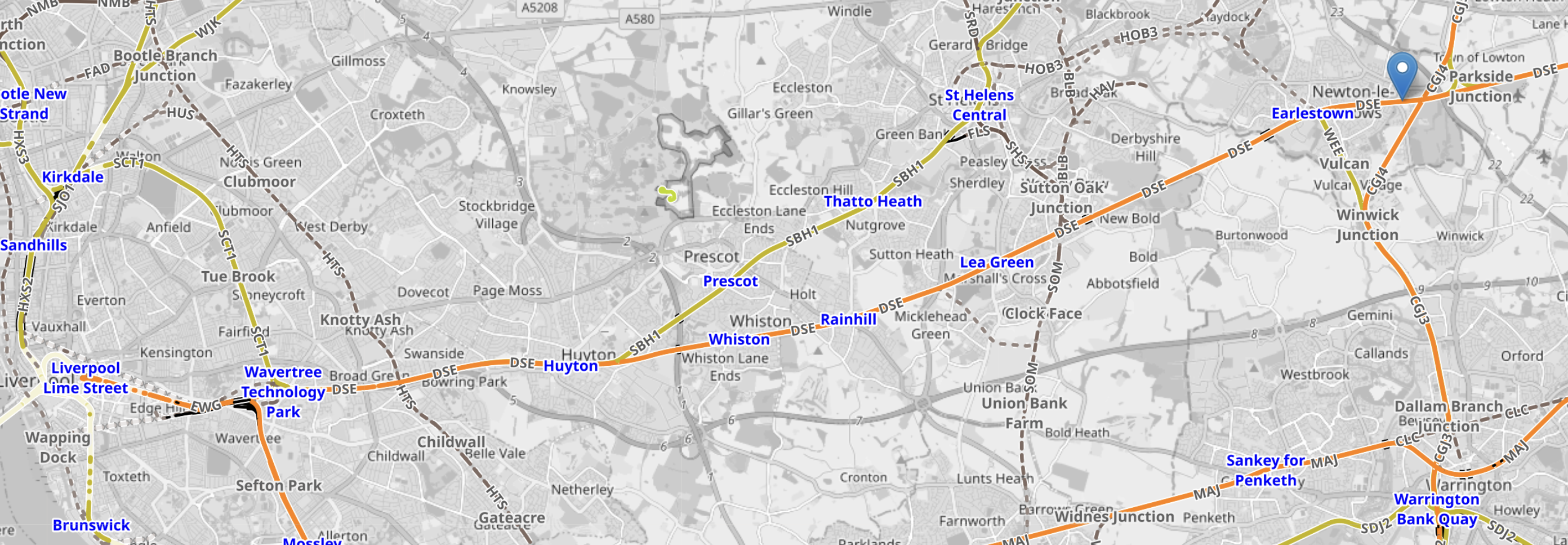
Note.
- Liverpool Lime Street station is at the Western side of the map.
- Newton-le-Willows station is marked by the blue arrow in the top right corner of the map.
- Warrington Bank Quay station is in the bottom right corner of the map.
It does seem a round about route, But I got there. Although, I was late.
Hopefully, in a couple of years, you’ll be able to take a local train between Liverpool Lime Street and Newton-le-Willows stations to link up with FirstGroup’s low-cost Lumo Open Access service between Euston and Rochdale.
A Single Journey Home
I was booked home on the 18:43 train from Lime Street, but as you can often do, I asked and was allowed to board the 17:43.
A Crowded And Crazy Euston
I arrived back at Euston at 20:00, but it was crowded, as the station is very much a building site for High Speed Two.
I felt I would treat myself to a taxi, but I couldn’t find any.
So I took a 205 bus along Euston Road to King’s Cross, where I jumped on the the Circle Line for Moorgate.
From there I took my usual 141 bus home.
A friendly station guy at Moorgate, indicated, there might not be any taxis at Euston.
I’d also found earlier, that there were no escalators to the Underground.
Perhaps more than ever, care should be taken at Euston, when getting to and from the station.
It Looks To Me That High Speed Two Has Got Their Planning Wrong At Euston
The big problem at Euston is getting to and from the National Rail station from East or West,
Compare Euston in this respect with Liverpool Street, King’s Cross, St. Pancras or Paddington.
In The New Step-Free Entrance At Euston Square Station, I show the plans for step-free access to the sub-surface lines.
This new entrance to Euston station, should be built first.
All the dithering about High Speed Two seems to have delayed it!
 The Anonymous Widower