IberBlue Wind Launches In Spain And Portugal With The Objective Of Promoting Iberian Leadership In Floating Offshore Wind
The title of this post is the same as that of this press release from the Simply Blue Group.
These three paragraphs introduce the project.
Simply Blue Group, Proes Consultores and FF New Energy Ventures have formed a joint venture that brings together expertise in all phases of floating offshore wind farm development.
The joint venture will focus its operations in Spain on Andalusia and Galicia, while in Portugal it will focus on the central and northern parts of the country.
IberBlue Wind aims to develop around 2GW of floating offshore wind farms.
This paragraph describes the plans of the Irish company; Simply Blue Group.
Simply Blue Group is a global developer of floating offshore wind farms with projects in Ireland, UK, US, Poland, and Sweden. Simply Blue Group currently has a pipeline of 10GW of projects under development. As part of its growth strategy, the company is now expanding into the Spanish and Portuguese markets.
It appears to be a very ambitious company.
Every GW of renewable energy helps.
Biden-Harris Administration Announces New Actions To Expand U.S. Offshore Wind Energy
The title of this post is the same as that of this fact sheet from the White House briefing room.
This is the sub-title.
Departments of Energy, Interior, Commerce, and Transportation Launch Initiatives on Floating Offshore Wind to Deploy 15 GW, Power 5 Million Homes, and Lower Costs 70% by 2035.
Some points from the fact sheet.
- The President set a bold goal of deploying 30 gigawatts (GW) of offshore wind by 2030, enough to power 10 million homes with clean energy, support 77,000 jobs, and spur private investment up and down the supply chain.
- Conventional offshore wind turbines can be secured directly to the sea floor in shallow waters near the East Coast and the Gulf of Mexico.
- However, deep-water areas that require floating platforms are home to two-thirds of America’s offshore wind energy potential, including along the West Coast and in the Gulf of Maine.
- Globally, only 0.1 GW of floating offshore wind has been deployed to date, compared with over 50 GW of fixed-bottom offshore wind.
- The Floating Offshore Wind Shot will aim to reduce the costs of floating technologies by more than 70% by 2035, to $45 per megawatt-hour.
- The Administration will advance lease areas in deep waters in order to deploy 15 GW of floating offshore wind capacity by 2035.
This all seems to be ambitious!
But!
- In ScotWind Offshore Wind Leasing Delivers Major Boost To Scotland’s Net Zero Aspirations, I looked at Scotland’s latest round of offshore wind leases.
- If the lessors carry out their proposals Scotland will add 9.7 GW of fixed-foundation offshore wind farms and 14.6 GW of floating offshore wind farms, which I estimate will be built by 2035.
- In Three Shetland ScotWind Projects Announced, I looked at three floating wind farms to the East of Shetland, which are a secondary deal after ScotWind, which could generate 2.8 GW by 2035.
- In Is This The World’s Most Ambitious Green Energy Solution?, I describe an ambitious plan called Northern Horizons, proposed by Norwegian company; Aker to build a 10 GW floating wind farm, which will be 120 km to the North-East of the Shetlands.
It could be possible that little Scotland installs more floating wind farms before 2035, than the United States.
And what about England, Wales and Northern Ireland?
- England hasn’t announced any floating wind farm projects, but has around 17 GW of fixed-foundation offshore wind farms under development in the shallower waters along the East and South coasts.
- In Two Celtic Sea Floating Wind Projects Could Be Delivered By 2028, I looked at prospects for the Celtic Sea between Wales, Ireland and Devon/Cornwall. It is possible that a GW of floating wind could be developed by 2028, out of an ultimate potential of around 50 GW.
- Northern Ireland is a few years behind England and Scotland and might eventually make a substantial contribution.
But Biden’s aims of a strong supply chain could be helped by Scotland, as several of the floating wind farms in Scotland are proposing to use WindFloat technology from Principle Power, who are a US company. The Principle Power website has an explanatory video on the home page.
North Seas Countries Commit To 260 GW Of Offshore Wind By 2050
The title of this post, is the same as that of this article on Renewables Now.
This is the first two paragraphs.
The nine member countries of the North Seas Energy Cooperation (NSEC) on Monday committed to at least 260 GW of offshore wind energy by 2050.
The NSEC aims to advance offshore renewables in the North Seas, including the Irish and Celtic Seas, and groups Belgium, Denmark, France, Germany, Ireland, Luxembourg, the Netherlands, Norway, Sweden and the European Commission.
Note.
Intermediate targets are 76 GW by 2030 and 193 GW by 2040.
The UK has a target of 50 GW by 2030, of which 5 GW will be floating offshore wind.
The UK is not mentioned, but has joint projects with the Danes, Germans, Irish, Norwegians, Spanish and Swedes.
There is nothing about energy storage or hydrogen!
On the figures given, I think we’re holding our own. But then we’ve got more sea than anybody else.
Stromar, Broadshore And Bellrock
The ScotWind wind farms, that I described in ScotWind Offshore Wind Leasing Delivers Major Boost To Scotland’s Net Zero Aspirations, are starting to be more than numbers in documents.
This map shows the various ScotWind leases.

Note, that the numbers are Scotwind’s lease number in their documents.
- 3 is now Bellrock and 1,200 MW
- 8 is now Broadshore and 900 MW
- 10 is now Stromar and 1,000 MW
Falck Renewables, who have now been renamed Renantis, and BlueFloat Energy are involved in all three projects, with Ørsted also involved in Stromar.
This article on Renewable Energy Magazine is entitled Companies Partner on Floating Offshore Wind In Scotland, where this is said.
Together the three areas could accommodate a total of approximately 3.0 GW of offshore wind capacity, with the projects scheduled to be operational by the end of the decade, subject to securing consent, commercial arrangements and grid connections.
Dates for ScotWind seem to be emerging and 2030 seems to cover several.
Three Shetland ScotWind Projects Announced
The title of this post, is the same as that of this press release on Crown Estate Scotland.
These three paragraphs outline how the leases were allocated.
Three projects will be offered seabed agreements for offshore wind projects following Crown Estate Scotland’s ScotWind clearing process.
The announcement comes as an offshore wind supply chain summit is held in Aberdeen today (22 August) with Sir Ian Wood, chaired by Michael Matheson MSP, Cabinet Secretary for Energy, and including a keynote address by First Minister Nicola Sturgeon MSP.
Clearing saw the ‘NE1’ area east of Shetland made available for ScotWind applicants who met the required standards but who did not secure their chosen location earlier in the leasing process.
I think it was good idea to offer these leases to those bidders that failed to get a lease, the first time around, despite meeting the standards.
- Would it encourage bidders, if they knew that after the expense of setting up a bid, that if they failed, they could have another chance?
- It must also save the Scottish Government time and money checking out bidders.
- How many times have you interviewed several applicants for a job and then found jobs for some of those, that you didn’t choose for the original job?
Let’s hope the philosophy has generated some good extra contracts.
This map from Cross Estate Scotland shows all the contracts.

Note the three new leases numbered 18, 19 and 20 to the East of Shetland, in the North-East corner of the map.
Their details are as follows.
- 18 – Ocean Winds – 500 MW
- 19 – Mainstream Renewable Power – 1800 MW
- 20 – ESB Asset Development – 500 MW
Note.
All are floating wind farms.
- Ocean Winds is a Spanish renewable energy company that is developing the Moray West and Moray East wind farms.
- Mainstream Renewable Power appear to be a well-financed and ambitious company, 75 % owned by Aker.
- ESB Energy appear to be an experienced energy company owned by the Irish state, who operate several wind farms and Carrington gas-fired power station in the UK.
2.8 GW would appear to be a generous second helping.
Ocean Winds and Mainstream Renewable Power
This web page on the Ocean Winds web site, is entitled Ocean Winds Designated Preferred Bidder For Seabed Leases For 2.3 GW Of Floating Projects East Of Shetland, Scotland, contains several snippets of useful information.
- Crown Estate Scotland announced the result of ScotWind Leasing round clearing process, awarding Ocean Winds with two seabed leases for floating offshore wind projects: a 1.8 GW capacity site with partner Mainstream Renewable Power, and another 500 MW capacity site, east of the Shetland Islands.
- Ocean Winds’ international portfolio of projects now reaches 14.5 GW of gross capacity, including 6.1 GW in Scotland.
- Floating wind turbines for the two adjacent sites are confirmed, because of the water depth.
- The partners are committed to developing floating offshore wind on an industrial scale in Scotland, generating local jobs and opportunities in Scotland and the Shetland Islands.
- From the picture on the web page, it looks like WindFloat technology will be used.
- Ocean Winds developed the WindFloat Atlantic project.
Ocean Winds appear to want to go places.
The Shetland HVDC Connection
The Shetland HVDC Connection will connect Shetland to Scotland.
- It will be 160 miles long.
- It will have a capacity of 600 MW.
- It is estimated that it will cost more than £600 million.
- It will allow the 66MW Lerwick power station to close.
- It will be completed in 2024.
I have a feeling that all these numbers don’t add up to a sensible answer.
Consider.
- The three offshore wind farms can generate up to 2800 MW of green electricity.
- With a capacity factor of 50 %, an average of 1400 MW of electricity will be generated.
- The Viking onshore wind farm on Shetland could generate up to 450 MW.
- More wind farms are likely in and around Shetland.
- Lerwick power station can probably power most of the Shetland’s needs.
- Lerwick power station is likely to be closed soon.
- Sullum Voe Terminal has its own 100 MW gas-turbine power station.
- Load is balanced on Shetland by 3MWh of advanced lead-acid batteries.
- Lerwick has a district heating scheme.
If we assume that Shetland’s energy needs are of the order of a few hundred MW, it looks like at times the wind farms will be generating more electricity, than Shetland and the Shetland HVDC Connection can handle.
Various plans have suggested building electrolysers on Shetland to create hydrogen.
Conversion of excess electricity to hydrogen, would have the following advantages.
- The hydrogen could be used for local heavy transport and to replace diesel.
- Hydrogen could be used to fuel a gas turbine back-up power station, when needed.
- Hydrogen could be used for rocket fuel, if use of Shetland as a Spaceport for launching satellites takes off.
Any excess hydrogen could be exported to the rest of the UK or Europe.
Bombora Wraps Tank Trials Of Its Floating Hybrid Energy Platform
The title of this post, is the same as that of this article on offshoreWIND.biz.
This is the introductory paragraph.
Bombora Wave Power has completed tank testing of its floating foundation system suitable for the InSPIRE solution, which combines the mWave wave energy technology with a wind turbine onto a single floating offshore platform.
This second paragraph gives details of the power output of the hybrid energy platform.
The tank testing program at FloWave follows the pre-FEED phase of the InSPIRE project completed earlier in 2022, based on the integration of a 4MW mWave solution with a 10MW wind turbine on a single semi-submersible floating foundation system.
4 MW seems a worthwhile increase in power, that can probably be handled by the existing cables and substations.
Equinor Is Counting On Tax Breaks With Plans For North Sea Oilfield
The title of this post, is the same as that, of this article in The Times.
These paragraphs outline the project.
Norway’s state-owned oil company is pushing ahead with plans to develop Britain’s biggest untapped oilfield after confirming that it stands to benefit from “helpful” tax breaks introduced alongside the windfall levy.
Equinor could lower its windfall tax bill by as much as £800 million in the years to come thanks to investment relief if it develops the Rosebank field, according to Uplift, a campaign group.
Rosebank, to the west of Shetland, could cost £4.1 billion to develop and may account for about 8 per cent of British oil output in the second half of this decade, producing 300 million barrels of oil by 2050.
Equinor said yesterday that it hoped to take a final investment decision on the field by next year and to start production by 2026. It has applied for environmental approval from the government.
Needless to say Greenpeace are not amused.
We Have Both Long Term And Short Term Energy Problems
In the UK, energy is generally used as electricity or gas and to power industry and transport.
Electricity
In the long term, we need to decarbonise our electricity production, so that all our electricity is produced from zero-carbon sources like nuclear, solar, tidal, wave and wind.
- As I write this, our electricity production is around 26.8 GW of which 62 % is coming from renewable sources.
- Surprisingly around 45 % of the renewables is coming from solar. Who’d have ever thought that in an predominantly-grey UK?
- As we have committed to around 50 GW of wind power by 2030 and the 3.26 GW Hinckley Point C will be on stream by the end of the decade, the long term future of electricity production looks to be fairly secure.
- It would be even more secure, if we added around 600 GWh of storage, as proposed in Highview Power’s Plan To Add Energy Storage To The UK Power Network, which would be used as backup when the sun doesn’t shine and the wind doesn’t blow.
It looks to me, that our long term electricity problem is capable of being solved.
For the next few years, we will need to rely on our existing gas-fired power stations until the renewables come on stream.
Gas
Gas could be more of a problem.
- I wouldn’t be surprised to see a lot of resistance to the replacement of natural gas for heating, cooking and industrial processes.
- Natural gas is becoming increasingly difficult to source.
- As I said in the previous section, we will still need some gas for electricity generation, until the massive wind farms are completed.
On the other hand, there is HyDeploy.
I like the HyDeploy concept, where up to 20 % of hydrogen is blended with natural gas.
- Using a blend of hydrogen and natural gas doesn’t require any changes to boilers, appliances or industrial processes.
- The hydrogen blend would make the most of our existing world class gas network.
- Customers do not require disruptive and expensive changes in their homes.
- Enormous environmental benefits can be realised through blending low carbon hydrogen with fossil gas.
- The hydrogen blending could happen, where the natural gas enters the network at terminals which receive gas from the UK continental shelf or where liquified natural gas is imported.
- Alternatively, it may be possible to surround a gas production platform with an offshore wind farm. This could enable hydrogen production and blending to be performed offshore.
The amount of gas we need would drop by twenty percent.
In The Mathematics Of Blending Twenty Percent Of Hydrogen Into The UK Gas Grid, I calculated that 148.2 tonnes per hour of hydrogen would be needed, to blend twenty per cent of hydrogen into UK natural gas supplies.
I also said this about the electricity needed.
To create 148.2 tonnes per hour of hydrogen would need 8,180.64 MW of electricity or just under 8.2 GW.
I also calculated the effect of the hydrogen on carbon dioxide emissions.
As twenty percent will be replaced by hydrogen, carbon dioxide emission savings will be 24,120,569.99 tonnes.
I believe that generating the 8.2 GW of electricity and delivering the 148.2 tonnes per hour of hydrogen is feasible.
I also believe that HyDeploy could be a valuable way to reduce our demand for natural gas by twenty per cent.
Transport
Not every vehicle, ship, aircraft and train can be powered by electricity, although batteries will help.
Hydrogen will help, but we must also develop our capability for sustainable fuels made from rubbish diverted from landfill and biologically-derived ingredients like used cooking oil.
Summing Up Our Long Term And Short Term Energy Problems
We obviously have got the problem of creating enough renewable energy for the future, but there is also the problem of how we keep everything going in the interim.
We will need gas, diesel, petrol and other fossil fuel derived products for the next few years.
Is Rosebank Our Short Term Solution?
This page on the Equinor web site is entitled Rosebank Oil And Gas Field.
This introductory paragraph described the field.
Rosebank is an oil and gas field 130 kilometres off the coast of the Shetland Islands. Equinor acquired the operatorship in 2019 and has since then been working to optimise and mature a development solution for the field together with our partners.
Could the field with its resources of oil and gas, be just the sort of field to tide us over in the next few difficult years.
But given the position, it will surely not be an easy field to develop.
These two paragraphs set out Equinor’s strategy in developing the field.
Equinor believes the field can be developed as part of the UK Government North Sea Transition deal, bringing much needed energy security and investment in the UK while supporting the UKs net zero target. According to a socioeconomic study (see link below) based on data and analysis by Wood Mackenzie and Voar Energy, if sanctioned Rosebank is estimated to create GBP 8.1 billion of direct investment, of which GBP 6.3 billion is likely to be invested in UK-based businesses. Over the lifetime of the project, Rosebank will generate a total of GBP 24.1 billion of gross value add (GVA), comprised of direct, indirect and induced economic impacts.
Equinor together with our partners are working with the supply chain to ensure that a substantial part of investment comes to Scotland and the UK. A supplier day was held in Aberdeen in partnership with EIC in order to increase the number of local suppliers to tender.
Note.
- The sums that could accrue to the UK economy are worthwhile.
- The Government North Sea Transition Deal is worth a read.
- A lot of the deal is about converting oil and gas skills to those of a renewable energy economy.
Planned properly, we should get all the oil and gas we need to get through difficult years.
I particularly like these two paragraphs, which are towards the end of the Government North Sea Transition Deal.
Through the Deal, the UK’s oil and gas sector and the government will work together to deliver
the skills, innovation and new infrastructure required to decarbonise North Sea oil and gas
production as well as other carbon intensive industries. Not only will it transform the sector in
preparation for a net zero future, but it will also catalyse growth throughout the UK economy.
Delivering large-scale decarbonisation solutions will strengthen the position of the existing UK
energy sector supply chain in a net zero world, securing new high-value jobs in the UK,
supporting the development of regional economies and competing in clean energy export
markets.
By creating the North Sea Transition Deal, the government and the UK’s oil and gas sector are
ambitiously seeking to tackle the challenges of reaching net zero, while repositioning the UK’s
capabilities to serve the global energy industry. The Deal will take the UKCS through to
maturity and help the sector pivot towards new opportunities to keep the UK at the forefront of
the changing 21st century energy landscape.
I believe that developing Rosebank could enable the following.
- The oil and gas we need in the next few years would be obtained.
- The economic situation of the UK would be improved.
- The skills and techniques we need to decarbonise the UK would be delivered.
- Net-zero would be reached in the required time.
- Jobs will be created.
- The export of surplus oil and gas.
I strongly believe that developing the Rosebank field would be worthwhile to the UK.
I have some other thoughts.
Electrification Of Platforms
This page on the Equinor web site is entitled Electrification Of Platforms.
This paragraph explains what that means.
Electrification means replacing a fossil-based power supply with renewable energy, enabling a reduction in greenhouse gas emissions. Equinor is fully committed to reducing emissions from our offshore oil & gas production.
Note.
- Typically, platforms use gas turbine engines running on natural gas to provide the electricity needed on the platform.
- Platforms in the future will get their electricity from renewable sources like wind and will have an electricity cable to the shore.
- Rosebank will be powered in this way.
This document on the Equinor web site is entitled Rosebank: Investing In Energy Security And Powering A Just Transition, which has a section called How Is Rosebank Different?, where this is said.
The key difference of Rosebank compared to other oil fields is that it
aims to draw on new technology applications to help reduce carbon
emissions from its production, through FPSO electrification.Building offshore installations that can be powered by electricity reduces
reliance on gas powered generators which are the biggest source
of production emissions. The electrification of UKCS assets is vital to
meeting the North Sea Transition Deal’s target of reducing production
emissions by 50% by 2030, with a view to being net zero by 2050.Electrification of Rosebank is a long-term investment that will drastically
cut the carbon emissions caused by using the FPSO’s gas turbines for
power. Using electricity as a power source on Rosebank results in a
reduction in emissions equivalent to taking over 650,000 cars off the
road for a year compared with importing 300 million barrels of oil from
international sources.
Note.
- An FPSO is a Floating Production Storage And Offloading Unit, which is the method of production, that Equinor have chosen for the Rosebank field.
- If we are going to extract fossil fuels then we must extract them in a manner, that doesn’t add to the problem by emitting extra carbon dioxide.
- We will probably extract fossil fuels for some years yet, as they are the easiest route to some important chemicals.
- I also believe that we will increasingly find uses for any carbon dioxide captured in combustion and chemical processes.
I already know of a farmer, who heats greenhouses using a gas-powered combined heat and power unit, who pipes the carbon dioxide to the tomatoes in the greenhouses.
Despite what Greenpeace and others say, carbon dioxide is not all bad.
Energy Security
The last page of this document on the Equinor web site is entitled Rosebank: Investing In Energy Security And Powering A Just Transition, is entitled Energy Security.
Look at the numbers.
- £8.1 billion – Total field investment with 78% of this being spent in the UK
- 1600 – Estimated peak number of direct FTE jobs
- £24.1 billion – Estimated gross value add
- 8 % – Of UK oil production from Rosebank to 2030
- 39 million cubic feet per day – Average daily gas production over the first 10 years of field life, equivalent to almost twice Aberdeen’s daily gas consumption
- 250kt CO2 – Carbon avoided by reusing existing FPSO
And if you have time read it fully.
Could The Rosebank FPSO Be Powered By Floating Offshore Wind?
Floating wind turbines are now being installed around the world.
- They can use the largest turbines.
- Some designs perform in the roughest of seas.
- They have a high capacity factor.
- They are generally brought into a suitable port for servicing and updating.
- Floating wind farms can be connected to floating substations
There is at least 20 GW of floating wind turbines planned for UK waters.
So could an appropriately-sized floating wind farm be placed near the Rosebank FPSO to provide it with electricity?
I don’t see why not, if there were some energy storage in the system, for when the wind wasn’t blowing.
Floating Offshore Wind Close To The Rosebank FPSO Would Be Challenging
Rosebank is an oil and gas field 130 kilometres off the West coast of the Shetland Islands.
That would be a challenging location for floating wind turbines.
But solving the installation problems would set precedents for floating wind farms all over the world.
Could The Rosebank FPSO Handle Hydrogen From Floating Offshore Wind?
It would surely be possible to put an electrolyser in the system somewhere, so that hydrogen was also stored in the tanks of the FPSO.
I also don’t think it unfeasible, that twenty percent of hydrogen could be blended into the natural gas to create the low-carbon natural gas, that has been proposed by the HyDeploy project.
Boris Baldrick’s Cunning Plan
This written statement to Parliament on the UK Government web site, is entitled Transport Update: Transpennine Route Upgrade.
It has been published by Grant Shapps and this is the sub-title.
Additional funding has been made available for the Transpennine route upgrade.
This is the complete statement.
Today 19 July 2022, the government has made available £959 million of additional funding to continue to progress the delivery of the ambitious Transpennine route upgrade.
This funding is a significant milestone and another step towards upgrading the key east-west rail artery across the north of England, to further this government’s levelling up and decarbonisation objectives.
In addition to progressing the design of aspects of the upgrade, this funding will enable further on-the-ground delivery of electrification and journey time improvement works, mostly west of Leeds.
One of the first tangible benefits will be enabling electric trains to run between Manchester and Stalybridge by the middle of the decade. We are also developing scope that will enable the Transpennine route upgrade to become the first phase of Northern Powerhouse Rail, including plans to unlock freight flows and take thousands of lorries off our roads.
We are also more than trebling the investment in the Transpennine route upgrade from £2.9 billion to between £9.0 billion and £11.5 billion.
This additional investment will enable the roll out of digital signalling technology, electrification of the full route and the provision of additional tracks for commercial and freight services, giving rail users more reliable, more punctual, more comfortable and greener rail journeys.
I have some thoughts.
It’s Not A Wish List, But A Reality
The last paragraph reads like a wish list.
This additional investment will enable the roll out of digital signalling technology, electrification of the full route and the provision of additional tracks for commercial and freight services, giving rail users more reliable, more punctual, more comfortable and greener rail journeys.
But it’s not a wish list, it’s what is to be done.
Where Will The Government Get Between Nine and Eleven-And-A-Half Billion Pounds?
It’s not the sort of small change that you have in a sock draw.
This document on the UK government web site, is entitled PM Opening Remarks At Press Conference With German Chancellor Olaf Scholz: 8 April 2022, where this is these three paragraphs.
We will also agree on the importance of weaning ourselves off dependence on Russian gas and oil, and ensuring that our energy security cannot be threatened by a rogue state.
This is not easy for any of us, and I applaud the seismic decisions taken by Olaf’s government to move Germany away from Russian hydrocarbons.
Today we have agreed to maximise the potential of the North Sea and collaborate on energy security and on renewables, where Germany and the UK lead the way in new technology.
So did Boris and Olaf sign the world’s first Green Alliance based on zero-carbon energy?
- They may not have signed an Alliance, but they have agreed on common actions.
- Over the last year or so, German money and technology has started to be more visible in our offshore wind farms.
- BP have been backed by German utility; enBW in some of their huge wind farms.
- Siemens Gamesa are providing a lot of wind turbines.
- Will German shipyards build the floats for floating wind farms?
- An interconnector between the Isle of Grain and Wilhelmshaven is planned.
- Rolls-Royce and its German subsidiary MTU are charging into battle against climate change.
- The Germans have taken a liking to ITM Power’s electrolysers to produce hydrogen.
I can see the North Sea or the German Ocean becoming Europe’s power station, with by 2030, a large amount of the energy not needed by the UK, being exported to the Continent, either as electricity or hydrogen.
The Germans could become our magische Geldbäume.
But unlike gas and oil, wind power in the North Sea won’t run out, as it’s renewable.
In How Britannia With Help From Her Friends Can Rule The Waves And The Wind, this was my conclusion.
Boris’s vision of the UK becoming a Saudi Arabia of wind is no fantasy of a man with massive dreams.
Standard floating wind turbines, with the possibility of also harvesting wave power could be assembled in ports along the coasts, towed into position and then connected up.
Several GW of wind-power capacity could probably be added each year to what would become the largest zero-carbon power station in the world.
By harvesting the power of the winds and waves in the seas around the British Isles it is an engineering and mathematical possibility, that could have been developed by any of those great visionary Victorian engineers like Armstrong, Bazalgette, Brunel and Reynolds, if they had had access to our modern technology.
Up Yours! Putin!
This energy and the money it provides will finance our infrastructure and our tax cuts.
Hexicon Wins UK’s First Ever CfD Auction For Floating Offshore Wind
The title of this post, is the same as that of this press release from Hexicon.
This is the first paragraph.
Today (7th of July) the UK Government confirmed that Hexicon AB’s TwinHub project in the Celtic Sea was successful in the latest Contracts for Difference (CfD) Allocation Round (AR4). It has been awarded a CfD for its 32MW floating wind project at a strike price of £87.30/MWh (2012 real prices) taking the project a significant step closer to completion.
This image shows one of their TwinHub turbine installations being towed into place.
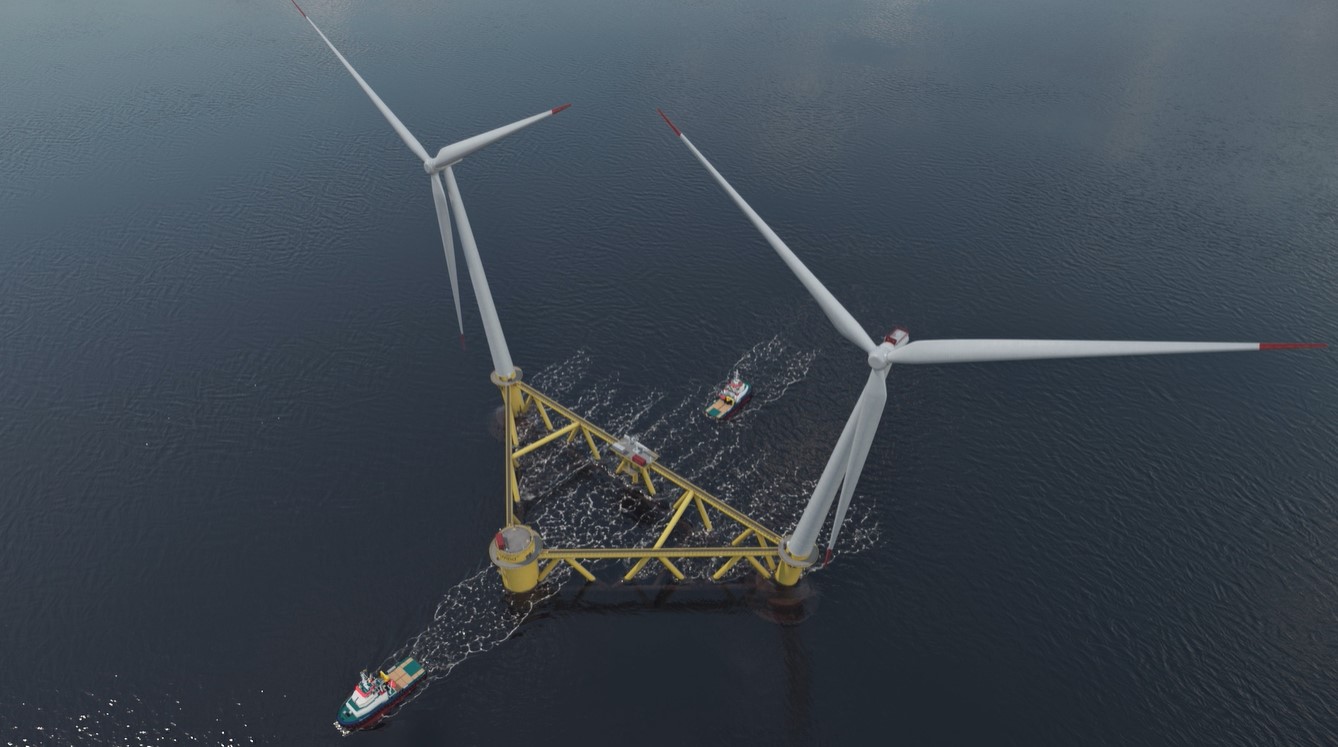
The TwinHub home page has a title of The First Floating Offshore Wind Project in The Celtic Sea.
This is the description on the page.
The TwinHub offshore wind demonstration project intends to prove how Hexicon’s innovative design with two turbines on one floating foundation can further reduce the Levelized Cost of Energy (also referred to as LCoE) before large scale commercialisation. The TwinHub project is a stepping stone to help kick-start floating wind in the Celtic Sea, an area identified as a hotspot for floating wind by the UK Government. It will pave the path for larger and larger projects to help support The Crown Estates’ ambitious target of 4GW of floating wind in the Celtic Sea.
Scroll the page down and there is a short video of a pair of wind turbines in operation.
- It appears that when there is no wind, it automatically goes into a safe parked mode.
- As the wind rises, one turbine starts up.
- The second turbine starts up and the float turns so they face the wind.
It appears to be a classic example of disruptive innovation.
I did the calculations for floating and reusable oil and gas platforms in the 1970s, that were designed by two Cambridge University professors, which would have been launched horizontally and upturned when in position. This experience leads me to believe that the Swedish designers of this type of platform have been able to verify that this is a workable design.
This document from the Department of Business, Industry and Industrial Strategy indicates that the demonstration is for 32 MW.
Does that indicate, that this installation is twin 16 MW wind turbines?
16 MW seems to be the size of the largest wind turbines in the world.
There is a lot to like about this Swedish design.
- As the video shows, it appears to balance itself with the wind.
- I suspect from the calculations I did in Cambridge, that the twin design with its higher weight is more stable than a floating single turbine design.
- The float and its two turbines can be assembled alongside a dock with a large stable onshore dockside crane.
- Servicing would also be done in a dock.
- Working onshore is much safer and easier, than working offshore.
- The twin design allows more power to be generated in a given area of sea.
This is a brilliant concept and it will give Putin, the Sheikhs and the other oil dictators, the most terrible of nightmares.
The initial site chosen for this design in the UK, will be in the sea at Hayle in Cornwall.
This map shows the location.
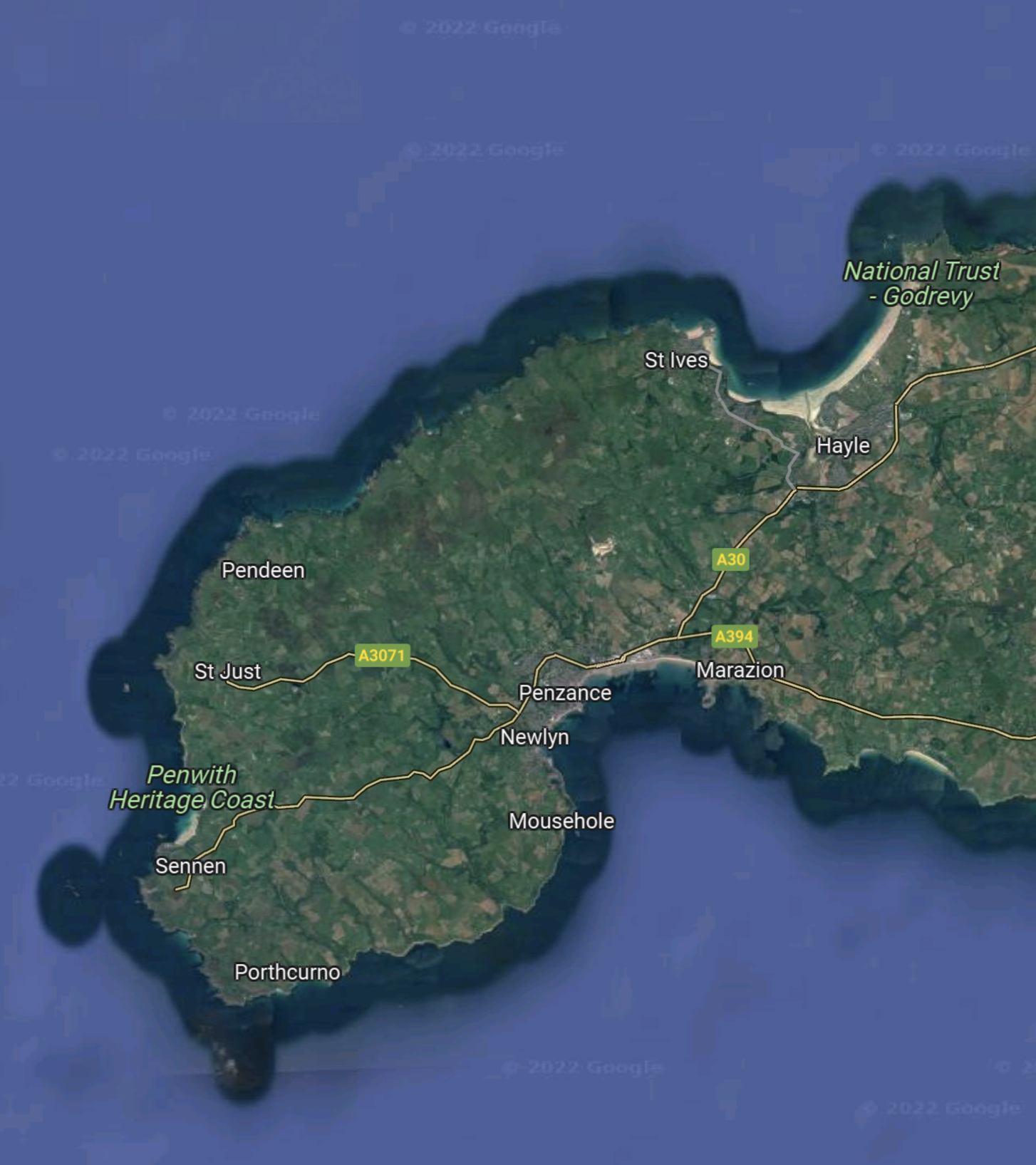
Hayle is in the North-East corner of the map, by the sandy beach.
A 32 MW turbine could probably provide enough electricity for 15,000 houses.
The Crown Estate Announces Areas Of Search To Support Growth Of Floating Wind In The Celtic Sea
The title of this post, is the same as that of this press release from the Crown Estate.
This is the first paragraph.
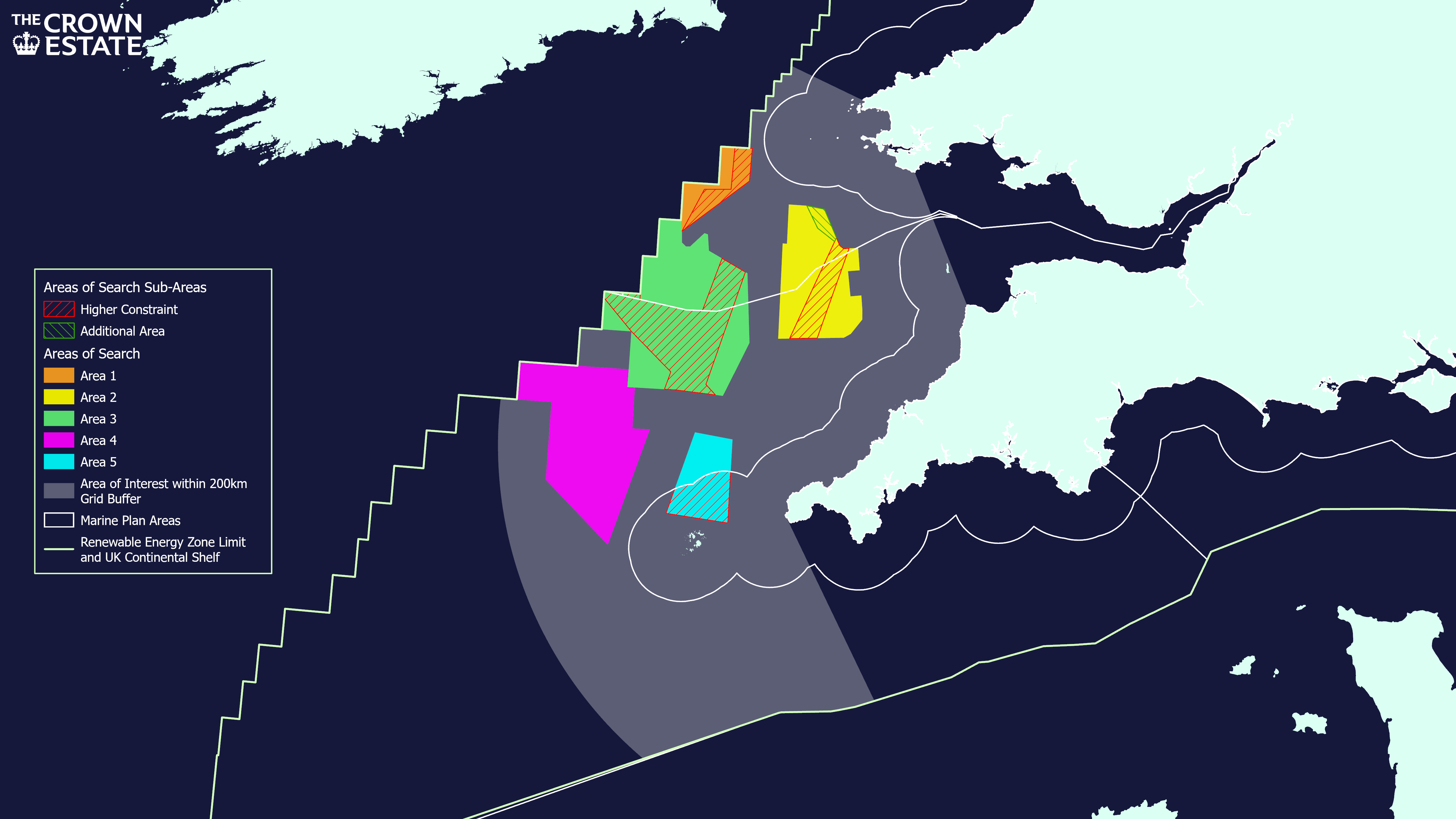
In a major step forward in supporting the UK’s net zero ambitions, The Crown Estate has today identified five broad ‘Areas of Search’ for the development of floating offshore wind in the Celtic Sea – a region rich in natural resources, including world-class wind resource that can be developed with floating turbines. This marks a significant milestone and provides the foundation on which to build greater capacity in the future, helping the UK to achieve its renewable energy targets and drive economic development.
Points in the press release include.
- Five areas with good wind power potential have been chosen.
- A competitive tender, is to be launched in mid-2023.
- It is intended that these areas will deliver 4GW of floating offshore wind power by 2035.
This map shows the areas.
I have a few thoughts.
What About The Other Wind Farms Already Announced In the Celtic Sea?
In DP Energy And Offshore Wind Farms In Ireland, I said this.
They are also developing the Gwynt Glas offshore wind farm in the UK sector of the Celtic Sea.
- In January 2022, EDF Renewables and DP Energy announced a Joint Venture partnership to combine their knowledge and
expertise, in order to participate in the leasing round to secure seabed rights to develop up to 1GW of FLOW in the Celtic Sea. - The wind farm is located between Pembroke and Cornwall.
The addition of Gwynt Glas will increase the total of floating offshore wind in the UK section of the Celtic Sea.
- Blue Gem Wind – Erebus – 100 MW Demonstration project – 27 miles offshore
- Blue Gem Wind – Valorus – 300 MW Early-Commercial project – 31 miles offshore
- Falck Renewables and BlueFloat Energy – Petroc – 300 MW project – 37 miles offshore
- Falck Renewables and BlueFloat Energy – Llywelyn – 300 MW project – 40 miles offshore
- Llŷr Wind – 100 MW Project – 25 miles offshore
- Llŷr Wind – 100 MW Project – 25 miles offshore
- Gwynt Glas – 1000 MW Project – 50 miles offshore
This makes a total of 2.2 GW, with investors from several countries.
It does seem that the Celtic Sea is becoming the next area of offshore wind around the British Isles to be developed.
So what about these seven wind farms?
Erebus and Valorus
Is Blue Gem’s philosophy to develop and prove the technology and put in big bid for around a GW?
Gwynt Glas
The Gwynt Glas web site says this.
The Crown Estate announced in March 2021 that it intends to run a competitive leasing round to award seabed rights to developers for floating offshore wind (FLOW) projects in the Celtic Sea, targeting an overall regional capacity of 4GW.
In January 2022, EDF Renewables and DP Energy announced a Joint Venture partnership to combine their knowledge and expertise, in order to participate in the leasing round to secure seabed rights to develop up to 1GW of FLOW in the Celtic Sea.
The partnership project is called Gwynt Glas, Welsh for Blue Wind, in recognition of its Celtic roots.
Our proposed floating offshore wind project could provide power for approximately 920,000 homes.
It looks like they’re throwing their hat into the ring for 1 GW.
Llŷr Wind
The Llŷr Wind web site says this.
Combined, the two 100MW projects will generate enough renewable electricity to power around 250,000 homes. If successful, we will be able to offer highly cost-effective, floating offshore wind farms to the rest of the world by 2030.
By unlocking new, higher energy capacities from deeper waters, further offshore, the Llŷr projects have huge implications for UK energy consumers. Not only will they help the UK meet its target for net zero emissions, but they will create new opportunities for regional manufacturing and supply chains in Wales and Southwest England as global demand for floating, offshore, wind rises.
It looks to me that this project hasn’t been fully defined yet. Perhaps, this will happen after a successful bid.
Llywelyn
The Llywelyn web site says this.
Llywelyn wind farm is located in Welsh waters in the Celtic Sea, 40 miles off the coast of Pembrokeshire.
Llywelyn’s location has been selected following an extensive feasibility study and rigorous site assessment process. Our assessment has included reviews of protected areas, environmental impacts, cable routing, existing infrastructure, marine traffic, and fishing activity.We have signed an agreement with National Grid, securing a 300MW grid connection in Pembrokeshire. The system operator is exploring upgrades to the existing site to facilitate the connection. These developments will enable the Llywelyn offshore wind project to quickly enter the planning system.
Have they already said go?
Petroc
The Petroc web site says this.
Petroc’s location has been selected following an extensive feasibility study and rigorous site assessment process. Our assessment has included reviews of protected areas, environmental impacts, cable routing, existing infrastructure, marine traffic, and fishing activity.
We have signed an agreement with National Grid, securing a 300MW grid connection in North Devon. The system operator is exploring upgrades to the existing site to facilitate the connection. These developments will enable the Petroc offshore wind project to quickly enter the planning system.
Have they already said go?
These companies are certainly setting themselves up for bidding or have already got a smaller deal.
How Much Wind Power Can Be Developed In The Celtic Sea?
This article on the Engineer is entitled Unlocking The Renewables Potential Of The Celtic Sea.
The article starts with these two paragraphs.
Over the last decade, the UK has become a global leader in renewable marine energy, tapping into the vast resources its coastal geography offers. Offshore wind, in particular, has flourished, with gigawatt-scale projects being deployed off the east coast of England and Scotland, at Hornsea, Dogger Bank and Moray.
However, looking at a map of existing and proposed wind farms, what’s perhaps most striking is the complete absence of projects in the southwest of Britain, off the rugged shores of Wales, Devon and Cornwall, shaped by the fierce North Atlantic. The Celtic Sea – which extends south off Wales and Ireland down past Cornwall and Brittany to the edge of the continental shelf – is estimated to have around 50GW of wind generating capacity alone. What’s more, it also delivers some of the highest tidal ranges in the world, alongside some of the best waters in Europe for generating wave energy. In a country blessed with renewable resources, the Celtic Sea may well be its biggest prize.
I’ll go along with what this article says and accept that 50 GW of wind capacity could be installed in the Celtic Sea.
As I write this article at around nine o’clock, the UK is generating almost exactly 30 GW of electricity, which gives an idea of how large electricity production in the Celtic Sea could be.
Conclusion
It will be interesting to see how this first round of leasing in the Celtic Sea develops.

