Porterbrook Acquires ‘379s’ For Lease To GTR
The title of this post, is the same as that of a small article in the April 2024 Edition of Modern Railways.
This is the first paragraph.
Porterbrook has successfully bid to acquire the fleet of 30 Class 379 Electrostar EMUs from Akiem and will lease them to Govia Thameslink railway, which will use them on Great Northern services.
Note.
- Will the Class 379 trains replace all or some of the 39 Class 387 trains currently used by Great Northern?
- The Class 379 trains are 25 KVAC overhead only trains, whereas the Class 387 trains are dual-voltage.
- If the Class 379 trains are not modified to run on 750 VDC third rail, they will be restricted to Great Northern routes.
- It may be a problem, that the Class 379 trains are only 100 mph trains, whereas the Class 387 trains are capable of 110 mph, but I suspect that the Class 379 trains can be upgraded to 110 mph.
It looks to me that it is likely that Govia Thameslink Railway will end up with thirty spare Class 387 trains.
The Wikipedia entry for the Class 387 train, says this about the differences between the two classes of Electrostar.
The Class 387 is a variation of the Class 379 with dual-voltage capability which allows units to run on 750 V DC third rail, as well as use 25 kV AC OLE.
This surely has three main ramifications for Govia Thameslink Railway.
- Third rail equipment can probably be fitted to the Class 379 train, if required.
- The Class 379 train can probably be uprated to the 110 mph of the Class 387 train.
- Retraining the drivers to use the new Class 379 trains, will not be a major exercise.
Govia Thameslink Railway will have the luxury of configuring the trains to run, the services their passengers need and want.
But Govia Thameslink Railway may have a collateral benefit.
In 2015, a Class 379 train was modified to do a trial as a battery-electric multiple unit.
This section in the Wikipedia entry for the Class 379 train, describes the trial.
During 2013, the national infrastructure owning company Network Rail announced that unit 379013 would be used as a testbed for a future Battery-Electric Multiple Unit. Following several months of conversion work and non-service testing, the unit was used to carry passengers for the first time on a Manningtree–Harwich Town service on 12 January 2015. Throughout its five-week trial period, data was gathered to assess its performance; it could reportedly operate for up to an hour on battery power alone, while charging via the pantograph took two hours.
Note.
- I feel it would be reasonable to assume, that a Class 387 train could be easily converted to battery electric operation.
- I’ve met commuters, who used the prototype every day between Harwich and Manningtree and it gave a good service.
- In an hour with stops, a typical Southern commuter service does just 35 miles.
Southern have two routes, where Class 171 diesel trains are still used.
- Ashford International and Ore – 25.4 miles
- Hurst Green Junction and Uckfield – 24.7 miles.
A battery-electric train with a range of 30 miles would surely decarbonise these routes.
- Batteries would be charged, where 750 VDC third-rail electrification is installed.
- As the Class 387 trains are dual-voltage, a short length of 25 KVAC overhead electrification, could be used to charge the train at Uckfield, if that was to be needed.
- Alternatively, the Vivarail Fast Charge system could be fitted.
A rough estimate is that ten battery-electric Class 387 trains would be needed to make Govia Thameslink Railway an all-electric railway.
- The now redundant Class 171 trains could be cascaded to someone, who needs them.
- The remaining twenty Class 387 trains could be used to replace twenty Class 377 trains, or converted to battery-electric operation and be cascaded to another operator.
Hopefully though, after all of the musical trains, there will be a reliable procedure to convert late model Electrostars into battery-electric trains.
The Definitive Battery-Electric Electrostar
It could have this specification.
- Based on a Class 377, Class 379 or Class 387 train.
- Three, four or five cars.
- I suspect the batteries would be spread around the cars.
- Dual-voltage or 25 KVAC overhead electrification only.
- Charging by 25 KVAC overhead electrification or Vivarail/GWR Fast Charge system.
Note.
- Battery range appropriate for the route.
- In GTR And Porterbrook Unveil £55 million Fleet Modernisation, I talk about an internal refurbishment of GTR’s trains.
It looks to me, that, whatever route Govia Thameslink Railway takes, there could be another twenty refurbished Class 377 or Class 387 trains, that could be available for conversion to four-car battery-electric trains.
Great Western Routes That Could Be Run By Battery-Electric Electrostars
Great Western Railway have 30 Class 387 trains, which are used on Thames Valley services around the London end of the Great Western Main Line.
Routes that could be suitable for Battery-Electric Electrostars include.
- London Paddington and Didcot Parkway – two trains per hour (tph) – 10 trains
- London Paddington and Oxford – one tph – 5 trains – 10.5 miles x 2
- London Paddington and Newbury – one tph – 5 trains
- Reading and Newbury – one tph – 2 trains
- Newbury and Bedwyn – one tph – 1 train – 13.3 miles x 2
- Reading and Basingstoke – two tph – 2 trains – 13.6 miles x 2
- Reading and Gatwick – two tph – 7 trains – 18.6 miles
Note.
- The number of trains is my rough estimate of the number, that would be needed to run each route.
- The miles is how much running would be needed on batteries.
My estimated total is 32, but there might be savings from more efficient routes. It looks like a range of around thirty miles would be sufficient.
Conclusion
It looks like after decarbonising Govia Thameslink Railway and the Thames Valley Services of Great Western Railway, there will be twenty high quality Electrostars available to decarbonise other routes.
Bedford Depot’s Massive Solar Roof Helps Thameslink On Way To Net Zero
The title of this post, is the same as that of this article on RailUK.
These four paragraphs give full details of the project.
Work has begun installing one of Bedford’s biggest solar arrays – on the roof of Govia Thameslink Railway’s (GTR’s) train depot, in Cauldwell Walk.
Almost 1,000 photovoltaic panels (932) will generate 322 MWh of electricity a year – enough to power 120 homes every year, saving more than 66 tonnes of CO2e. They form part of GTR’s commitment to become carbon ‘net zero’ for all its energy needs by 2050.
The solar roof – one of four at different depots across GTR’s vast 11 county network – is being installed by not-for-profit community climate action group Energy Garden.
When it comes online in the New Year, Energy Garden will sell half the solar electricity to GTR to power the depots and plough profits from selling what’s left over into community development projects – Energy Garden already works with more than 50 community groups.
This Google Map shows the location of Bedford Cauldwell Park TMD with respect to Bedford station.

Note.
Bedford station is at the top of the map.
Bedford Cauldwell Park TMD is marked by the red arrow.
This second map shows the depot to an enlarged scale.

Note.
- The map appears to show several roofs, that could be candidates for solar panels.
- At least one shed sells cars. Do they sell electric ones?
As the rail depot appears to be the largest building of its type in the centre of Bedford, in the future will it be serving as a advert for Energy Garden?
This project sounds like a good idea.
And I like the way it’s financed.
First Digitally Signalled Passenger Train Comes To Northern City Line
The title of this post, is the same as that of this article on Rail Advent.
These two paragraphs introduce the article.
The Northern City Line experienced its first taste of digital signalling, as a passenger train controlled by the in-cab technology ran between Finsbury Park and Moorgate on Monday the 27th of November.
The introduction of this type of signalling – known as the European Train Control System, or ETCS – is a first step towards wider adoption across the rail network and represents an important milestone in the government-backed £1.4bn East Coast Digital Programme (ECDP). The programme is designed to improve journeys between London and north of Peterborough, with reliability and environmental outcomes at the forefront of the project’s deliverables.
I hope that one of the benefits will be more trains between Moorgate and Hertford North, Stevenage and Welwyn Garden City.
Overground To London Bridge Under Consideration
The title of this post, is the same as that of a short article in the December 2023 Edition of Modern Railways.
This is the text of the article.
Transport for London is considering introducing London Overground services between Crystal Palace and London Bridge to help relieve overcrowding on the Sydenham corridor during the morning peak.
The move is one of two options outlined in a response to Lewisham’s Public Transport Liason Committee meeting on 4 October. The other is operating additional services on the existing route via the East London Line to Dalston Junction/Highbury & Islington. TfL acknowledges the London Bridge service would ‘represent a new routing for London Overground services that would necessitate significant changes to operational arrangements and driver testing’ and therefore further work is required ‘to establish the feasibility and business case for this change.’ There are no timescales for the implementation of either option.
The overcrowding follows the reduction by Govia Thameslink Railway of its Southern service to two trains per hour last September, when it replaced its East Croydon to London Bridge via Forest Hill stopping service with a Victoria to London Bridge via Forest Hill stopping service. In its response to the committee, GTR says the context to these changes is ‘the continued need to respond to the gap between our costs and revenues’, which it says is in the region of £15 million a year, with both demand and revenue having stabilised at around 80 % of pre-pandemic levels. It says its aim is to make ‘the most efficient use of the resources available to us,’ with the Victoria to London Bridge service designed to provide capacity for journeys to both stations’.
GTR says the current service has sufficient capacity and is lightly loaded outside peak times, and that while it will continue to keep passenger and feedback under review an increase from two to four trains per hour would require an increase in funding.
These are my thoughts.
Transport for London’s Long Term Plans
Plans exist to increase the frequency on various London Overground services and this graphic sums up what was planned a few years ago.
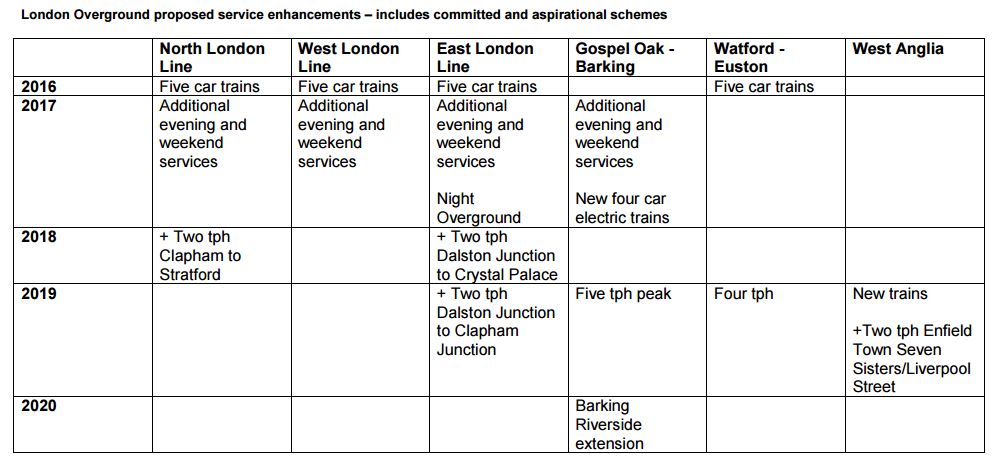
Note the extra two trains per hour (tph) between the following stations.
- Clapham Junction and Stratford
- Dalston Junction and Crystal Palace
- Dalston Junction and Clapham Junction
- Enfield Town and Liverpool St. via Seven Sisters
I think only Route 1 services have been increased.
I know signalling updates are holding up the extra trains on the East London Line, but are more trains needed to fully implement the extra services?
- Routes 2 and 3 services will need Class 378 trains because of the tunnel and these would be transferred from the North London Line.
- Route 4 would need Class 710 trains, as the service already uses them.
So there may be a need for more Class 710 trains.
This plan sees another two trains per hour (tph) running between Dalston Junction and Crystal Palace, which would help to reduce Lewisham’s overcrowding.
Would A London Bridge And Crystal Palace Service Be Easier To Implement?
It looks like the extra Dalston Junction and Crystal Palace services have been held up by two possible reasons.
- The required signalling update on the East London Line, that is needed to increase Crystal Palace and Clapham Junction services has not been performed.
- There are not a sufficient number of Class 378 trains to run the service through the Thames Tunnel. These will be released by running more Class 710 trains on the North London Line.
If two tph were to be run between London Bridge and Crystal Palace, this service would have these advantages.
- The train paths are available.
- The service would not be going through the Thames Tunnel, so the signalling upgrade would not be needed and the trains would not need to be able to evacuate passengers in the tunnel.
- The service could be run by any suitable third-rail trains.
- The service could be run by any length of train, that would fit all the platforms.
I believe the service could be run by eight-car trains to really get a hold on the current overcrowding.
How Many Trains Would Be Needed?
Looking at other services between London Bridge and Crystal Palace, I believe that the journey time would be about 24 minutes.
If the service were run efficiently, I suspect two trains would be needed to provide the required service of two tph.
An eight-car service would required four x four-car trains.
What Trains Could Be Used?
If the numbers are available, then third-rail versions of both London Overground’s Class 378 and Class 710 trains would be suitable.
But this would probably mean a number of Class 710 trains to be manufactured by Alstom. This would not be a short-term solution.
In Liverpool last week, I rode in a Class 319 train and these could be an interesting stop-gap.
- Several will soon be available as West Midlands Trains renews its fleet.
- They are already fitted with third-rail gear.
- They are 100 mph trains.
- Drivers seem to like them.
I believe they could fill in until more Class 710 trains were available.
Crystal Palace Station
This Open RailwayMap shows the platform layout at Crystal Palace station.
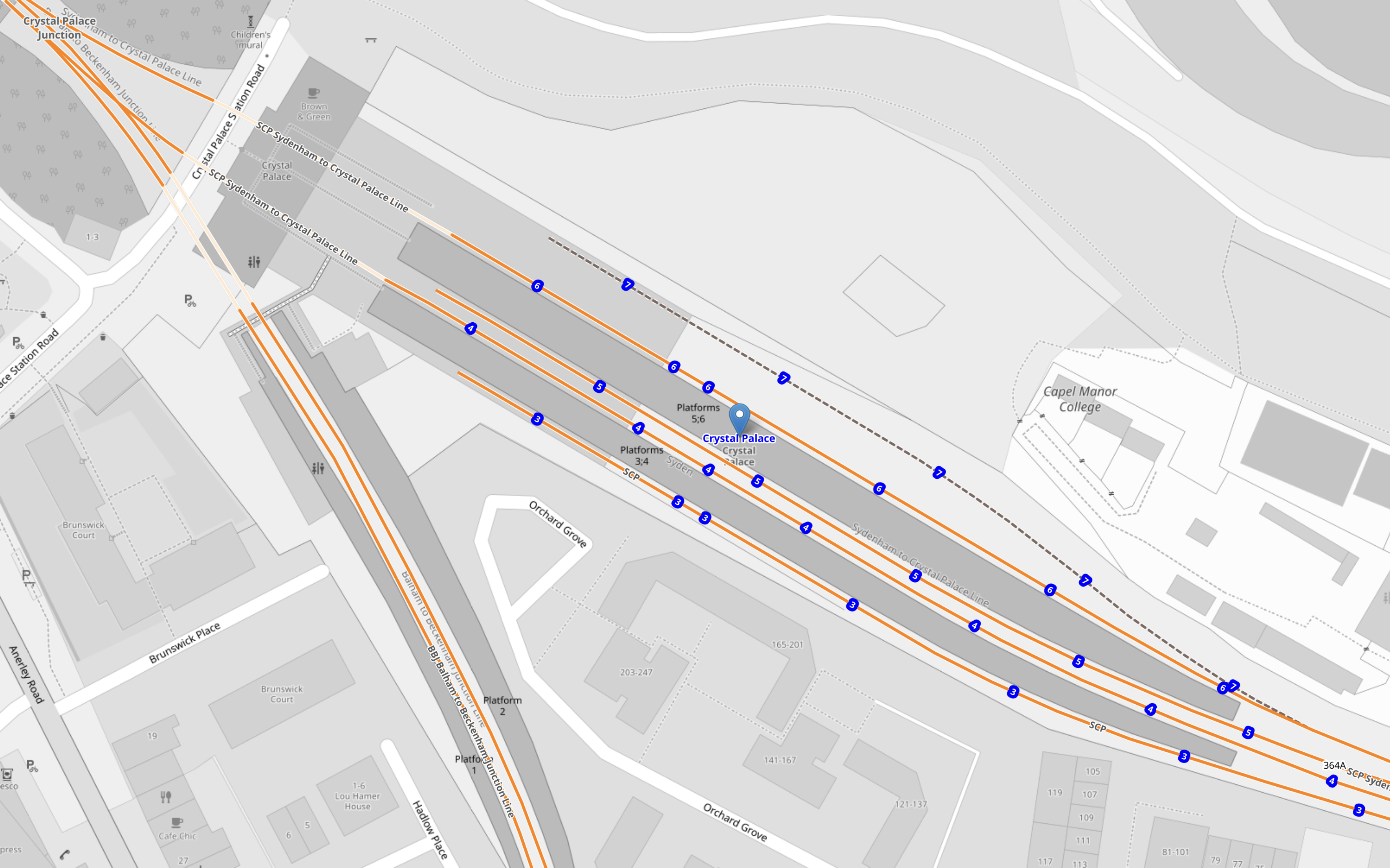
Note.
- Platforms 1 and 2 cross the South-West corner of the map and handle services like London Bridge and Beckenham Junction, London Bridge and London Victoria, and West Croydon services.
- Platform 3 is a little used bay platform, that can terminate trains from the East London Line or London Bridge.
- Platform 4 handles services between London Bridge and London Victoria.
- Platform 5 is a bay platform, that can terminate trains from the East London Line.
- Platform 6 handles services between London Victoria and London Bridge.
- Platform 7 is a disused bay platform.
These pictures show Crystal Palace station.
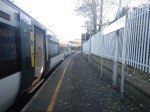
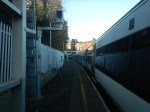
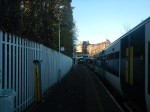
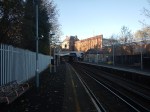
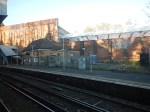
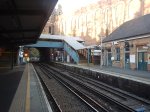
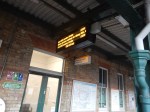
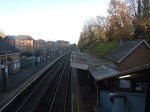
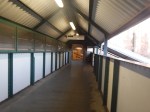
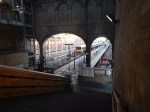
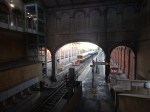
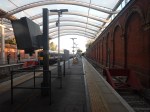
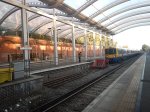
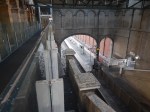
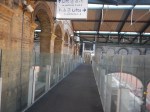
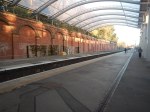
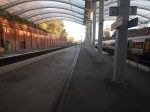
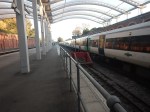

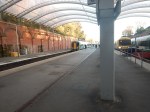
Crystal Palace station has an adequate number of platforms.
Conclusion
A service between London Bridge and Crystal Palace looks to be a sound plan.
Government Agrees To Fund £200m Cambridge South Station
The title of this post, is the same as that of this article on the BBC.
This is the sub-heading.
The government has agreed to fully fund a new £200m railway station.
These are a few points.
- Work has already started.
- The station is next to the city’s Biomedical Campus and Addenbrooke’s Hospital.
- Cambridge South station will be on the East West Railway.
It is expected to be open within two years.
I have a few thoughts.
Services At Cambridge South Station
In a typical hour, it seems the following trains go through the proposed site of Cambridge South station.
- 2 tph – Greater Anglia – Liverpool Street and Cambridge North via Tottenham Hale, Cheshunt, Broxbourne, Roydon (1tph), Harlow Town, Harlow Mill (1tph), Sawbridgeworth (1tph), Bishop’s Stortford, Stansted Mountfitchet (1tph), Elsenham (1tph), Newport (1tph), Audley End, Great Chesterford (1tph), Whittlesford Parkway, Shelford (1tph) and Cambridge.
- 1 tph – Greater Anglia -Norwich and Stansted Airport via Wymondham, Spooner Row (1tpd), Attleborough, Eccles Road (1tpd), Harling Road (1tpd), Thetford, Brandon, Shippea Hill (1tpd), Ely, Cambridge North, Cambridge, Whittlesford Parkway and Audley End
- 1 tph – Great Northern – King’s Cross and Ely via Cambridge, Cambridge North and Waterbeach.
- 1 tph – Great Northern – King’s Cross and King’s Lynn via Cambridge, Cambridge North, Waterbeach, Ely, Littleport, Downham Market and Watlington.
- 1 tph – Great Northern – King’s Cross and Cambridge via Finsbury Park, Alexandra Palace, Potters Bar, Hatfield, Welwyn Garden City, Welwyn North, Knebworth, Stevenage, Hitchin, Letchworth Garden City, Baldock, Royston, Meldreth, Shepreth and Foxton.
- 2 tph – Thameslink – Cambridge and Brighton via Royston, Ashwell & Morden, Baldock, Letchworth Garden City, Hitchin, Stevenage, Finsbury Park, St Pancras International, Farringdon, City Thameslink, London Blackfriars, London Bridge, East Croydon, Gatwick Airport, Three Bridges, Haywards Heath and Burgess Hill
- 1 tp2h – CrossCountry – Birmingham New Street and Stansted Airport via Coleshill Parkway, Nuneaton, Leicester, Melton Mowbray, Oakham, Stamford, Peterborough, March, Ely and Cambridge.
Note.
- tph is trains per hour.
- tp2h is trains per two hours.
This gives a base frequency through Cambridge South, Cambridge and Cambridge North of 8.5 tph.
Could some services be extended to Cambridge South or Stansted Airport?
- 1 tph – Greater Anglia – Ipswich and Cambridge via Needham Market, Stowmarket, Elmswell, Thurston, Bury St Edmunds, Kennett (1tp2h), Newmarket and Dullingham (1tp2h).
- 1 tp2h – CrossCountry – Birmingham New Street and Cambridge via Coleshill Parkway, Nuneaton, Leicester, Melton Mowbray, Oakham, Stamford, Peterborough, March and Ely.
These two trains would gives frequencies of.
- Cambridge South – 10 tph
- Cambridge – 10 tph
- Cambridge North – 9 tph
I have assumed these services would terminate at Cambridge South.
There could also be some new services.
1 tph – Greater Anglia – Wisbech and Cambridge via March, Ely and Waterbeach, Cambridge North and Cambridge.
1 tph – East West Railway – Oxford and Great Yarmouth via Oxford Parkway, Bicester Village, Winsford, Bletchley, Bedford, Tempsford, Cambourne, Cambridge, Cambridge North, Ely, Brandon, Thetford, Attleborough, Wymondham and Norwich.
1 tph – East West Railway – Oxford and Manningtree via Oxford Parkway, Bicester Village, Winsford, Bletchley, Bedford, Tempsford, Cambourne, Cambridge, Newmarket, Bury St. Edmunds, Stowmarket, Needham Market and Ipswich.
These three trains would gives frequencies of.
- Cambridge South – 13 tph
- Cambridge – 13 tph
- Cambridge North – 11 tph
I have assumed these services would terminate at Cambridge South.
The A14 Parkway Station
The A14 Parkway station is a proposal from the East West Railway.
- It would be just to the East of Chippenham junction and would be served by both Greater Anglia’s services between Ipswich and Cambridge and Ipswich and Peterborough.
- It would also be close to the major road junction, where the A11 and the A14 meet.
- It would be a Park-and-Ride station.
I believe it could be a major factor in cutting road mileage in East Anglia, as drivers going to Cambridge from Ipswich, Norwich, a large area of North-East East Anglia and North Essex could find that using the A14 Parkway station an easier and faster route. But the A14 Parkway would need a frequent service to the soon-to-be-three main Cambridge stations.
A Soham and Cambridge service could reverse at the A14 Parkway station or by careful timetabling, passengers would be able to change trains in a minute or two.
A Soham and Cambridge service, that terminated at Cambridge South, would give an extra train between Cambridge South and Newmarket and these frequencies at the three Cambridge stations.
- Cambridge South – 13 tph
- Cambridge – 14 tph
- Cambridge North – 12 tph
There would be a minimum interval of no more than five minutes between trains, if you wanted to hop between any of the three Cambridge stations.
Frequencies between Cambridge station and other main stations in the area would be as follows.
- A14 Parkway – 2 tph
- Attleborough – 2 tph
- Bishop’s Stortford – 2 tph
- Bletchley – 2 tph
- Bury St. Edmunds – 2 tph
- Ely – 6 tph
- Great Yarmouth – 1 tph
- Harlow Town – 2 tph
- Hitchin – 3 tph
- Ipswich – 2 tph
- King’s Lynn – 1 tph
- Letchworth Garden City – 3 tph
- Manningtree – 1 tph
- March – 1 tph
- Needham Market – 2 tph
- Newmarket – 2 tph
- Norwich – 2 tph
- Peterborough – 1 tph
- Royston – 3 tph
- Soham – 1 tph
- Stansted Airport – 2 tph
- Stevenage – 3 tph
- Stowmarket – 2 tph
- Thetford – 2 tph
- Wisbech – 1 tph
- Wymondham – 2 tph
Looking at this list, I think that the timetable needs reinforcing, to perhaps Colchester, Haverhill, March, Peterborough, Soham and Sudbury.
But these services will help.
- 1 tph – Greater Anglia – Ipswich and Peterborough via Stowmarket, Bury St Edmunds, Soham, Ely, Manea, March and Whittlesea.
- 1 tph – East Midlands Railway – Liverpool and Norwich via Liverpool South Parkway, Widnes, Warrington Central, Manchester Oxford Road, Manchester Piccadilly, Stockport, Sheffield, Chesterfield, Alfreton, Nottingham, Grantham, Peterborough, Ely and Thetford
But I can’t help feeling that the Stour Valley Railway needs to be reopened.
Govia Thameslink Railway Issues a Prior Information Notice For New Trains
This article on Railway Gazette is entitled UK Railway News Round-Up and contains this section.
Govia Thameslink Railway has issued a prior information notice seeking the provision of between 21 and 30 four-car 25 kV 50 Hz 160 km/h through-gangwayed EMUs with air-conditioning and toilets for use on existing and/or additional Great Northern services from May 2024. Maintenance would be undertaken in-house at Hornsey depot, supported by a Technical Support & Spares Supply Agreement.
I find this all a bit puzzling.
- The trains that need replacing are surely the eighteen Class 313 trains, that run on the West Coastway Line, as they are some of the oldest trains on the UK network.
- If Govia Thameslink Railway were serious about decarbonisation, they would also replace the Class 171 diesel trains, that work the Marshlink Line and the Uckfield branch, with electric trains with a range of thirty miles on batteries.
How many trains would be needed to replace the Class 313 and Class 171 trains?
- The eighteen three-car Class 313 trains could be replaced with an equal number of new four-car trains and this might result in a rise in passenger numbers.
- I would assume the eighteen trains includes allowances for trains in maintenance and spare trains for when a train fails.
- It may be possible to replace the six four-car Class 171 trains used on the Marshfield Line with three new four-car trains, which have a range of thirty miles on batteries.
- The eleven two-car Class 171 trains used on the Uckfield branch could be replaced with three new four-car trains, which have a range of thirty miles on batteries and would run as four-car trains.
- If eight-car trains were needed on the Uckfield branch, there would be a need for six new four-car trains.
- If twelve-car trains were needed on the Uckfield branch, there would be a need for nine new four-car trains.
Note.
- If four-car trains are needed on the Uckfield branch, this means a total of 18+3+3 or 24 trains.
- If eight-car trains are needed on the Uckfield branch, this means a total of 18+3+6 or 27 trains.
- If twelve-car trains are needed on the Uckfield branch, this means a total of 18+3+9 or 30 trains.
Trains on these Southern routes wouldn’t be stabled at Hornsey depot, but could be moved to Hornsey for maintenance using Thameslink.
But the puzzling bit is that the prior information notice says that the trains will be.
Four-car 25 kV 50 Hz 160 km/h through-gangwayed EMUs with air-conditioning and toilets for use on existing and/or additional Great Northern services from May 2024.
Note.
- There is no mention of the trains being able to run on 750 VDC third-rail infrastructure.
- The trains will run on Great Northern services and the Class 313 and Class 171 trains run on Southern routes.
- The only Great Northern services, that have not been moved to Thameslink are Kings Cross and Cambridge, Ely and King’s Lynn and services to Moorgate.
- The Moorgate services have their own dual-voltage Class 717 trains.
- Govia Thameslink Railway have ambitions to double the frequency of trains to King’s Lynn.
- Two eight-car trains per hour (tph) between King’s Cross and King’s Lynn would need sixteen operational four-car trains.
- Two twelve-car trains per hour (tph) between King’s Cross and King’s Lynn would need twenty-four operational four-car trains.
If Govia Thameslink Railway are thinking of thirty new trains, they must have other destinations in mind.
Could we be seeing a double swap?
- An appropriate number of new trains are procured to run Great Northern services between Kings Cross and Cambridge, Ely and King’s Lynn.
- The Class 387 trains released will be moved to the South to replace the Class 313 and Class 171 trains.
- Some or all of the transferred Class 387 trains will be fitted with batteries to give a range of thirty miles without electrification.
Note.
- Could the new trains be Siemens Desiro City trains like the Class 700 and Class 717 trains, which are already maintained at Hornsey depot? It would surely be more efficient and save money.
- Class 387 trains are dual voltage and would need little or no modification to replace the Class 313 trains.
- Uckfield and Hurst Green junction is 24.7 miles.
- Ashford International and Ore is 25.4 miles
- Adding a battery to a Class 387 train has not been done, but Bombardier converted a near-identical Class 379 train to battery-electric operation over eight years ago.
- Converting a Class 387 train gives a dual-voltage battery-electric train.
- I suspect a charger would be needed at Uckfield. Could it be a short length of 25 KVAC overhead electrification?
Could all the Class 387 trains, that will replace the Class 313 and Class 171 trains be identical to ease the problems, when a train develops a fault?
Conclusion
It looks a good plan.
It also opens up the following possibilities.
- Deployment of 750 VDC battery-electric trains on other routes.
- Deployment of 25 KVAC overhead battery-electric trains on other routes.
- Deployment of tri-mode battery-electric trains on other routes.
- Charging of battery-electric trains using a short length of 25 KVAC overhead electrification.
- Fitting of batteries to Class 379 trains to create a 25 KVAC overhead battery-electric train.
It might be possible to convert other Electrostars to battery-electric operation.
Ignoring Class 387 trains on dedicated services like Heathrow and Gatwick Express, these trains are available for conversion.
- Class 379 trains – Stored – 30 trains
- Class 387 trains – Govia Thameslink Railway – 40 trains
- Class 387 trains – Great Western Railway – 33 trains
Note.
- This gives 103 trains.
- They all have good interiors.
- They are all 100/110 mph trains.
- All trains could be updated to 110 mph.
- All trains can use 25 KVAC overhead electrification.
- The Class 387 trains can also use 750 VDC third-rail electrification.
- The Class 379 trains were built in 2010-2011.
- The Class 387 trains were built from 2014.
I believe both classes will make excellent battery-electric trains.
Where will they be deployed?
These are a selection of routes starting in the South-East of England.
- Ashford International and Eastbourne.
- Gravesend and Hoo.
- London Bridge and Uckfield.
- London Paddington and Bedwyn.
- London Paddington and Oxford.
- Reading and Basingstoke.
- Reading and Gatwick.
- Reading and Redhill.
- Slough and Windsor & Eton Central.
- Twyford and Henley-on-Thames
I’ve only added routes which are less than thirty miles.
Optimal Prediction of Sand For Adhesion
This project was one of the winners in the First Of A Kind 2022 competition run by Innovate UK.
In this document, this is said about the project.
Project No: 10039258
Project title: Optimal Prediction of Sand For Adhesion
Lead organisation: GOVIA THAMESLINK RAILWAY LIMITED
Project grant: £153,228
Public description: Train services are affected by seasonal variables particularly leaf fall between September and
December. They can also be compromised by wet weather, icy and snowy conditions at a regional
or very localised level on a particular route. Maintaining wheel-rail contact to ensure adequate and
safe braking requires the use of sand in low adhesion conditions. Sand is dispensed to trains in
response to a combination of train service plans and of weather forecast. However, not all trains
are currently able to be replenished during overnight stabling and servicing with attendant risks of
delays and damage to trains and infrastructure. Also, there is a high level of safety risk when sand
replenishment on trains is carried out on a third-rail yard.
“Optimal Prediction of Sand for Adhesion” (OPSA) lead by Govia Thameslink Railway, the major
Train Operating Company on third rail in the UK, will deliver a more efficient and cost-effective
means of predicting the dispensing of sand to trains to ensure services are not compromised by
adhesion losses and train sets are not required to be removed from planned operating diagrams
because of inadequate on board sand supplies. The algorithm developed as a results of this project
will base the estimates on an integrated framework that includes the forecast adhesion, track
maintenance and the expected speed profile in order to capture the change in weather and the seasonal factors.
The algorithm developed represents a cost effective solution to predict the use of sand and
schedule the maintenance of trains enhancing in turn safety and reducing the impact of delays on
the timetable. The algorithm will be developed including direct measure of sand dispersion, braking,
wheel slip and line speed diagram also accounting for human behaviour effects such as driving
style.
Govia Thameslink Railway has engaged with Cranfield University to deliver the disruptive
innovation proposed in this project. The algorithm will enable a more efficient train scheduling
improving public performance measure (PPM) addressing train delay targeting in particular the
25% of delay up to 15 minutes cause by several concurrent issues including train rescheduling and
the National Rail Passenger Survey satisfaction.
My Thoughts And Conclusions
Would A Lumo-Style Service Work Between King’s Cross And Norfolk?
This is a bit of a fantasy and you’ll never know the real reason why I have written it!
With the upgrade of the East Coast Main Line to full digital signalling, there will be a problem South of Hitchin with 140 mph Azumas and Hitachi Class 802 trains and similar from Grand Central , Hull Trains and Lumo hogging the fast lines to and from King’s Cross. I first wrote about it in Call For ETCS On King’s Lynn Route.
One solution would be to replace the current Class 387 trains with a 140 mph train , such as a Hitachi Class 802 variant. This would enable these fast King’s Lynn and Cambridge trains to join the 140 mph trains on a fast run to and from King’s Cross.
The Future Of Cambridge
Cambridge is one of the UK’s four world cities, with its heritage and lately its high position in any technology league table.
The Current Rail Service Between London And Cambridge
Currently, it has a good service into King’s Cross, Liverpool Street and St. Pancras.
- Great Northern – two tph to King’s Cross – A stopping train using Class 700 or Class 387 trains.
- Great Northern – one tph between Ely and King’s Cross – A fast train using Class 387 trains.
- Great Northern – one tph between King’s Lynn and King’s Cross – A fast train using Class 387 trains.
- Thameslink – two tph to Brighton – A semi-fast train using Class 700 trains.
- Greater Anglia – two tph to Liverpool Street – A semi-fast train using Class 720 or Class 379 trains.
Note.
- tph means trains per hour.
- The similar Class 387 and Class 379 trains are both late-model Bombardier Electrostars with sensible seats and a large number of tables. Both train types can or could be modified to run at 110 mph.
- The Class 700 trains are unsuitable for the route, as they have ironing-board seats and no tables. These are only 100 mph trains.
- The Queen’s bottom doesn’t like the Class 700 trains.
A large proportion of the passengers and commuters between to and from Cambridge work in high-tech or information-rich businesses and I believe if the trains were more geared to this market they would attract passengers away from the roads.
The Cambridge Employment Problem
Fast-growing Cambridge is taking over the region and it is always looking for towns and villages to develop as places for dormitories and to build premises for the hundreds of high-tech businesses.
This is one of the reasons why Greater Anglia acquired new Stadler Class 755 trains to run services from Cambridge to Bury St. Edmunds, Ipswich, Norwich, Peterborough and Stansted Airport.
If you’re going to lure Cambridge’s well-paid high-tech commuters out of their cars, you must give them an equivalent seat to their car. The Class 379, 387 and 755 trains do this.
Living In Norfolk And Suffolk And Working In Cambridge
This has always been the choice of many who work in Cambridge, but using rail into Cambridge didn’t really take-off seriously until modern three-car Class 170 trains replaced the single-car Class 153 trains.
Greater Anglia have followed the upward trend in passenger numbers, by running hourly four-car Class 755 trains from Cambridge to both Ipswich and Norwich.
Before the pandemic, it was starting to look like Norwich and Cambridge would soon need a second service, especially with the planned opening of the new Cambridge South station in 2025.
Addenbrooke’s Hospital And The Cambridge Biomedical Campus
Cambridge South station is being built to serve Addenbrooke’s Hospital and Cambridge Biomedical Campus, which intend to be create the foremost medical research cluster in the world.
Staycations And Holiday Homes In East Anglia
Life is changing because of the covids and more people are taking staycations or buying holiday homes.
And many are following the example of the Queen and going to Norfolk for their relaxation.
The Undoubted Need To Improve Rail Services Between London King’s Cross And Norfolk Via Cambridge
These factors convince me that there is a need for a new or repurposed rail service between London King’s Cross and Norfolk via Cambridge.
- The need to provide a high-class commuter service between London and Cambridge.
- The need to bring workers into Cambridge from Norfolk.
- The need to provide a fast high-class rail link to Cambridge South station with all its medical research.
- The need to provide a comprehensive working environment on the trains.
- The need to cater for all those people relaxing in Norfolk after a hard week in London.
It is my view, that a radical design of train is needed for this route.
- It would need to have a high-class interior.
- It would need at least a 125 mph capability, so that it can use the fast lines between Hitchin and King’s Cross.
- The train may need the ability to split and join.
- It would need an independent power capability for running on the Breckland Line between Ely and Norwich.
- Because of Cambridge and because East Anglia is easy country for cycling, it would need a sensible capacity for cycles.
I also believe that because of the need to decarbonise, the train should be zero-carbon.
These are my thoughts.
Operating Speed
Because of running on the fast lines between Hitchin and King’s Cross with the 140 mph trains from the North, I suspect that an operating speed of at least 125 mph is needed. But if the Hitachi trains of LNER, Hull Trains, Lumo and in the future possibly other operators like Grand Central, will be capable of 140 mph, this speed could be desirable.
Speed limits once the trains have left the East Coast Main Line at Hitchin North junction are as follows.
- Hitchin and Cambridge – 90 mph
- Cambridge and King’s Lynn – 90 mph
- Ely and Norwich – 75-90 mph
I can see Network Rail using their expertise to raise the speed limit on sections of these lines.
Flighting Of Trains On The East Coast Main Line
To increase capacity on the East Coast Main Line, I believe that at some point in the not too distant future that trains will be flighted. This will involve two or more trains leaving King’s Cross in a sequence and proceeding with all trains at a safe distance from each other.
I can envisage a flight like this from King’s Cross.
- An Edinburgh train with York as the first stop – Leaves at XX.00
- A Leeds train with Doncaster as the first stop – Leaves at XX.03
- A Lincoln train with Peterborough as the first stop – Leaves at XX.06
- A Cambridge train with Stevenage as the first stop – Leaves at XX.09
Note.
- The Edinburgh train would set the speed.
- Trains would maintain their time behind the lead train.
- Everything could be controlled by the digital signalling.
- Gaps between the trains would be sufficient for a safe stop.
- No train in the flight would make a station stop unless it was the last train in the flight.
- The last train in the flight would drop off and go to their destination.
As there are at least two tph to Edinburgh, Leeds and Cambridge, there would be two main flights per hour leaving King’s Cross, with the second flight perhaps incorporating a service to Hull.
Digital signalling and precise driving would enable the flights to be built in the opposite direction into King’s Cross.
The big advantage would be that instead of needing eight paths per hour on the East Coast Main Line, only two would be needed.
All trains would need to have similar performance, so this is another reason why the Cambridge trains need to be at least 125 mph trains.
Train Interiors
Lumo has broken new ground in train interiors.
- It is one class.
- Everybody gets a decent seat.
- Everybody gets good legroom.
- Everybody gets some form of table.
- There are decent-sized overhead racks for hand-baggage and coats.
- There is space for bicycles and heavy luggage appropriate to the route.
This can be built on to provide a good working and playing environment suited to the passengers who would use a fast King’s Cross and Norfolk service via Cambridge.
- Lots of tables for four, as in the high-class Electrostars.
- Better bicycle storage.
- Better alignment of seats with windows.
Hitachi could obviously produce a train to this specification.
But what about other manufacturers.
Stadler’s Class 755 trains are surely a possibility.
- A senior driver from Greater Anglia told me that the design speed for a Class 755 train is 200 kph or 125 mph.
- They have good seats.
- They have flat floors.
- They have large windows.
- They have step-free access between train and platform.
- Like the Hitachi trains, they are in service.
I believe the closely-related Class 745 trains are probably the best commuter trains in the UK and are the only alternative to the Hitachi trains on a125 mph fully-electrified route.
Bridging The Electrification Gap Between Ely And Norwich
Between Norwich and Ely stations is 53.8 miles and this section is not electrified, although both stations have full electrification.
The line is not heavily used with typically only two passenger trains and the occasional freight trains in each direction in an hour.
This Hitachi infographic describes the Hitachi Regional Battery Train.

A 90 km. range could be sufficient to cover the gap between Norwich and Ely.
Could Hitachi build a Class 802 train or similar with a battery range of 90 km or 56 miles?
Certainly, a speed of 100 mph would probably be sufficient to bridge the gap in a decent time.
Improving The Breckland Line
The Breckland Line is the route between Cambridge and Norwich.
- Cambridge and Norwich is 68.5 miles
- Only the sixteen miles between Cambridge and Ely North junction is electrified.
- There are thirteen stops between the two cities.
- A typical time is 79 minutes
- This is an average speed of just 52 mph.
- The operating speed is 75-90 mph.
I am sure that Network Rail can squeeze a few minutes here and there to get the operating speed up to the 100 mph of the Great Eastern Main Line.
But the big problem at Norwich is the Trowse swing bridge.
It is only single track and it is likely that this bridge will be replaced soon.
This Google Map shows Trowse junction, a short distance South of the swing bridge.
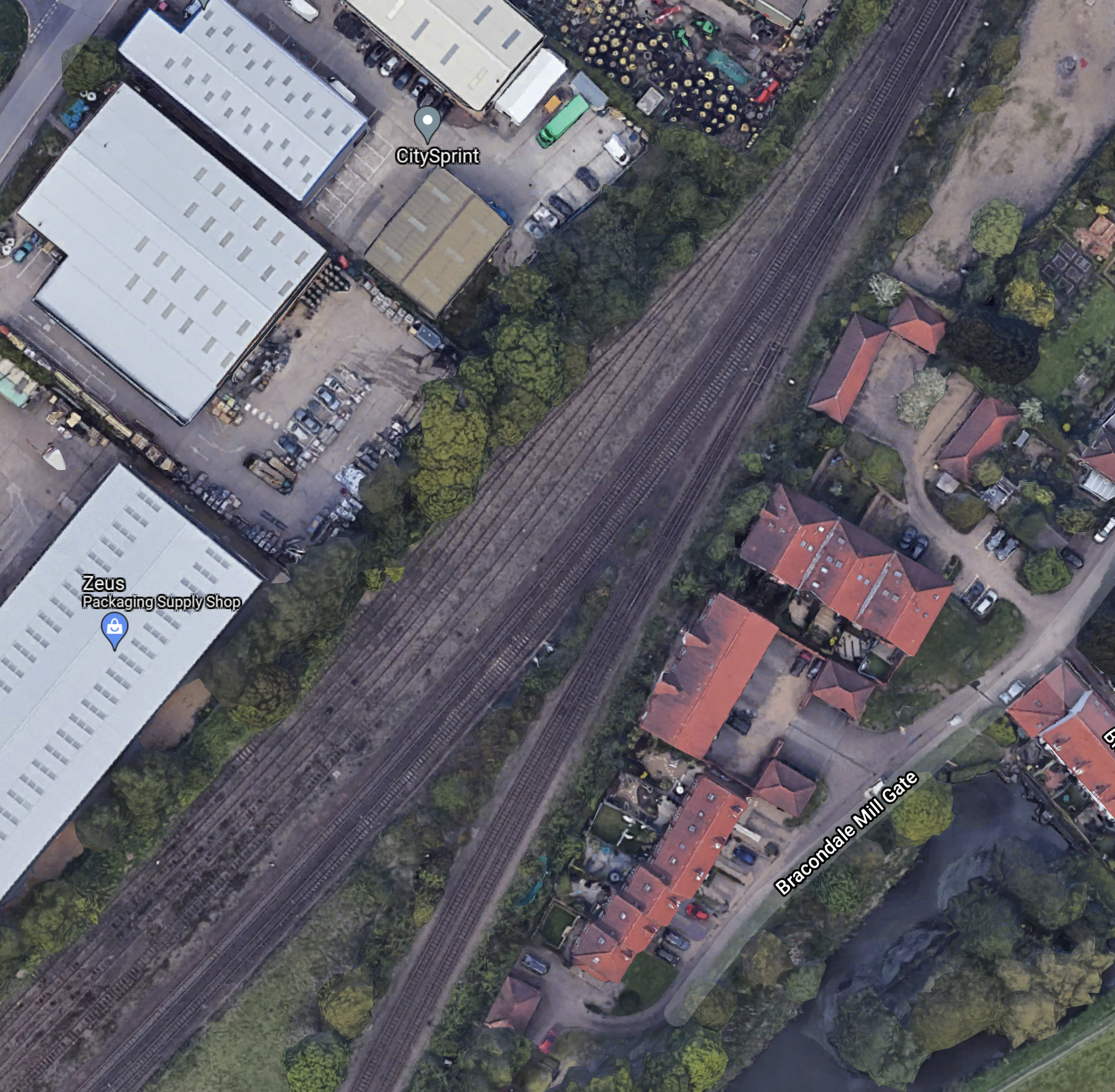
Note.
- The electrified double-track of the Great Eastern Main Line goes across the map from North East to South West.
- The double-track railway to the East of the main line is the unelectrified Breckland Line to Cambridge, which turns West and goes under the main line.
- On the West of the main lines are the Victoria sidings that I wrote about in Greater Anglia Completes Directly-Managed Norwich Victoria Sidings Project.
As the replacement of the swing bridge will require some work to be done to the electrification, I wonder if at the same time Network Rail would electrify the Norwich end of the Breckland Line.
There must be a balance point adding electrification or batteries to the trains.
As the Breckland Line has few freight trains, electrification is not needed for freight.
Ticketing
A high-speed high-capacity service as I’m proposing must be easy to use.
It is a classic route, where nothing short of London-style contactless ticketing will do, as I’m certain this encourages people to use the trains.
As East Anglia is self-contained and has few services that don’t terminate in the area or in London, I am certain that this could be achieved.
If you remove First Class as Greater Anglia has done on many services, you actually simplify the ticketing, so a Lumo-style mid-class is ideal.
High Speed Train Services
Currently Great Northern run two tph from King’s Cross to Ely via Cambridge.
- One service is extended to King’s Lynn.
- I could see the second service extended to Norwich.
Both services would need to be run by 125 mph trains because of the speed of other trains on the East Coast Main Line.
Conclusion
I think duch a system would be possible.
Defibrillators Installed At Every Southern And Thameslink Train Station
The title of this post, is the same as that of this article on The Argus.
The title says it all!
It is obviously a good development.
I also think, that there should be instructions by the defibrillator, as to the quickest way to call medical help.
Using Hitachi ABB Power Grids Technology At Uckfield Station
This post describes how the ABB Power Grids technology could be used to allow battery-electric trains to run between London Bridge and Uckfield stations.
The London Bridge And Uckfield Route
The London Bridge And Uckfield route has these characteristics.
- It is forty-six miles long
- The Southern section between Heald Green junction and Uckfield station is 24.7 miles and is not electrified.
- A service takes approximately eighty minutes.
- Trains run at a frequency of one train per hour (tph)
- The route has been upgraded to be able to handle twelve car trains.
- The route is currently run by Class 171 diesel trains.
- Govia Thameslink Railway is the operator.
It looks to me if you assume a ten minute turnround, then that gives a three-hour round trip.
This would mean the following.
- Trains would have ten minutes charging time at Uckfield.
- If twelve car trains were running on the branch then nine four-car trains would be required for an hourly service.
- Two tph would require twice as many trains.
It looks to me, that Network Rail have arranged the route and the timetables for a fleet of battery-electric trains.
The Battery-Electric Trains
There have been several hints in the rail media, that battery-electric Bombardier Electrostars will be used for the London Bridge and Uckfield route.
I wrote Battery Electrostars And The Uckfield Branch in September 2019.
- In the related post I suggested Class 377, Class 379 or Class 387 trains.
- All are four-car Bombardier Electrostars.
- All are 100 or 110 mph trains.
- The Class 387 trains are already dual voltage, but I suspect all trains could be converted to third-rail or dual-voltage.
- My choice would be Class 379 trains, as they are being made redundant by Greater Anglia and thirty quality trains are looking for a new home.
But all three types would be acceptable and Govia Thameslink Railway has both of the other types in its extensive fleet.
Charging The Battery-Electric Trains
This picture shows the single twelve-car platform at Uckfield station.

There would appear to be plenty of space on the side away from the platform.
There would appear to be two main methods of charging the trains.
A Length Of 750 VDC Third-Rail Electrification On The Side Away From The Platform
- The electrification would be long enough to charge a twelve-car train.
- It could even be made very safe, if an interlock were to be provided, that ensured that the third-rail were only to be live, when a train was in the station that needed charging.
This would be possible, but I suspect the Anti-Third-Rail Electrification Mafia will get this simple method stopped.
A Length Of 25 KVAC Overhead Electrification Powered By One Of Hitachi ABB Power Grids Containised Power Systems
The electrification would be long enough to charge a twelve-car train.
The driver or an automated system would raise the pantographs after the train stopped in the station.
Interlocks could be provided to increase safety.
The overhead electrification would be powered by one or more of Hitachi ABB Power Grids’s containerised power systems
Lightweight catenary could be used to reduce visual intrusion.
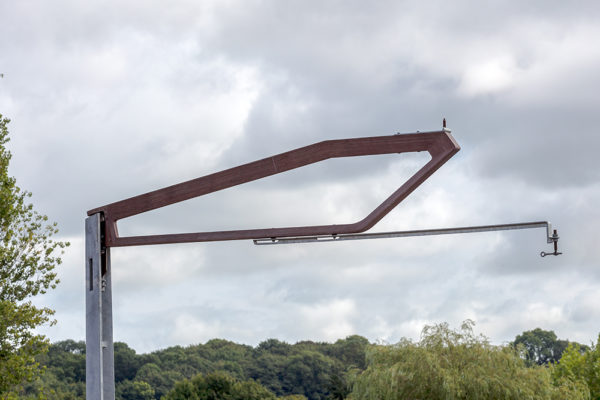
The curved beam at the top of this overhead electrification gantry is laminated wood.
Because of the higher voltage used, I suspect that the Hitachi ABB Power Grids could charge a twelve-car train in under ten minutes.
 The Anonymous Widower