Hydrogen Trains Herald New Steam Age
The title of this post is the same as that of an article on nearly half of Page 4 of today’s Sunday Times.
When I saw the article with its large graphic showing the working of a hydrogen train, the train seemed rather familiar.
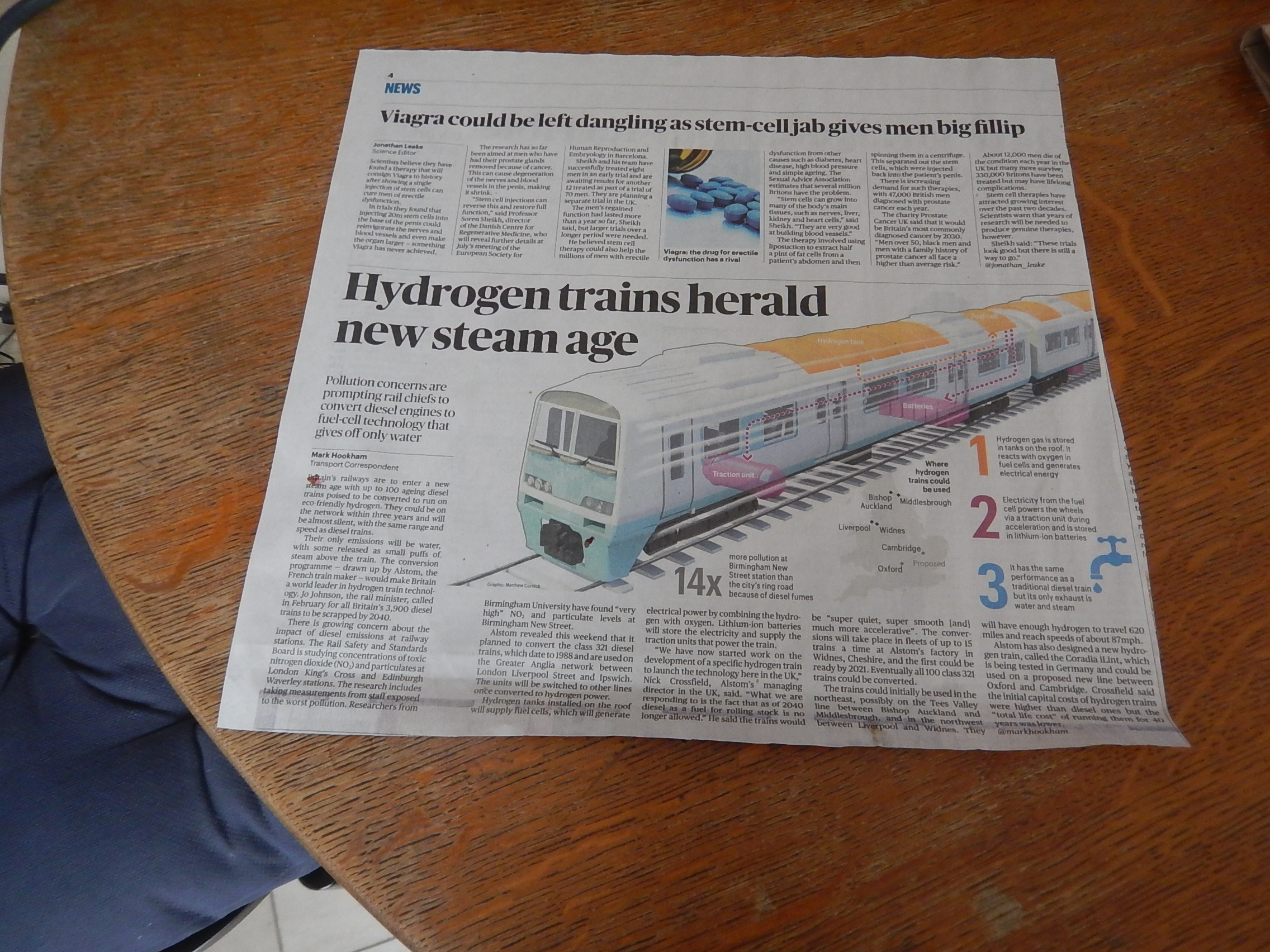
The leaning back front of the train with its two windows and the corrugated roof looked like a Class 321 train.
The large orange area on the roof is the hydrogen tank and the smaller one is the hydrogen fuel cell.
This is a paragraph from the article.
Alstom revealed this weekend that it planned to convert the Class 321 diesel trains, which date to 1988 and are used on the Greater Anglia network between London Liverpool Street and Ipswich. The units will be switched to other lines once converted to hydrogen power.
I suspect Mark Hookham, who wrote the article, has already been told by ninety percent of the train enthusiasts in this country, that Class 321 trains are electric multiple units.
This picture shows the first car of a Class 321 train in the sidings at Ipswich.
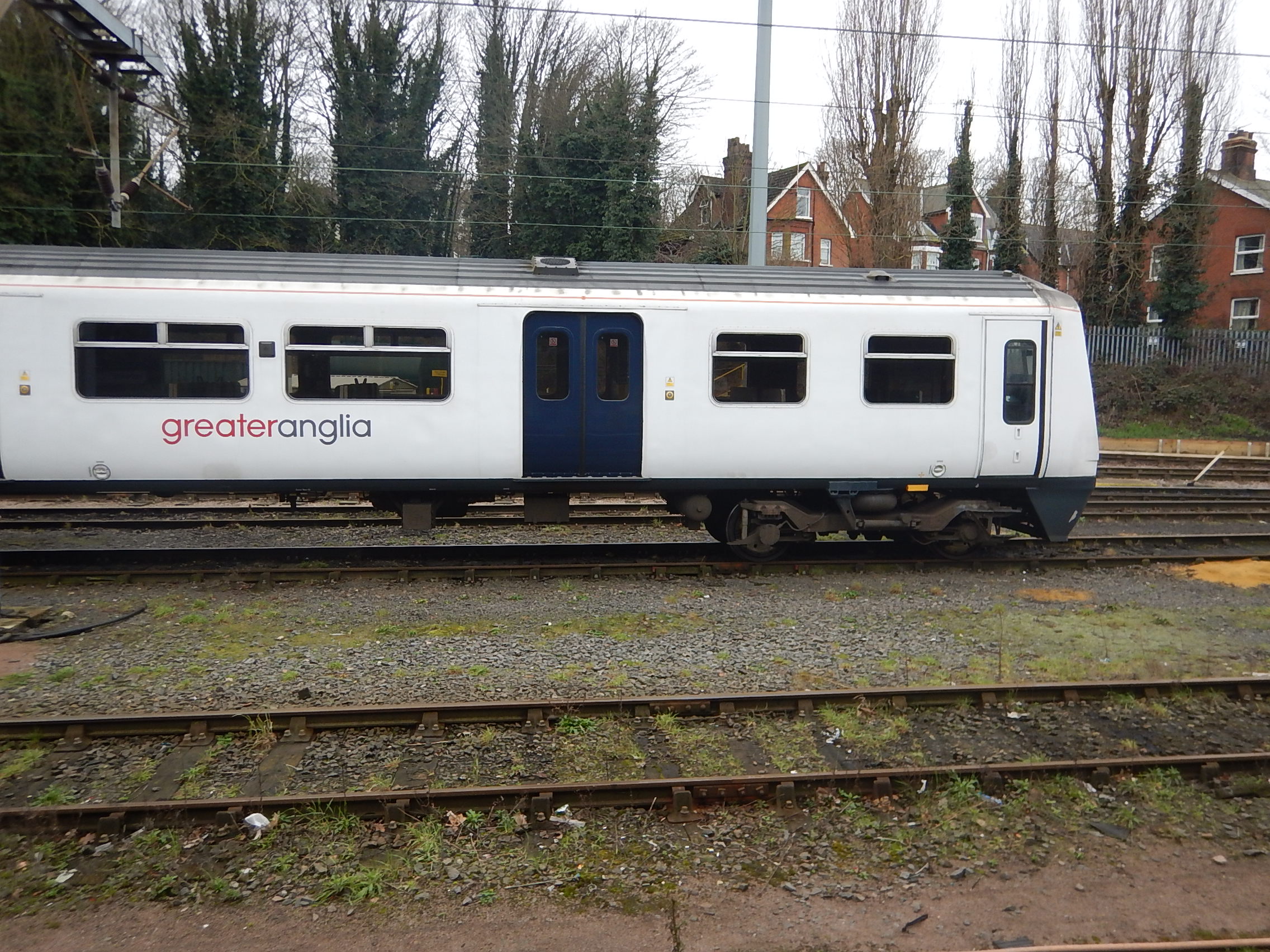
Note all the space, under the train, which would be an ideal place for the batteries and traction control, that are shown in that position, in pink, in the Sunday Times graphic.
But there are other reasons, why Class 321 trains may be ideal to convert to hydrogen power.
- Although they are thirty years old, they are a modern train, which meet all the latest regulations.
- They have a 100 mph operating speed on electricity.
- They operate on 25 KVAC overhead electrification.
- There are a hundred and seventeen four-car trains.
- Greater Anglia will be replacing over a hundred Class 321 trains, with new Class 720 trains in the next two years.
- A number of Greater Anglia’s trains have been upgraded to Class 321 Renatus. These trains are a substantial upgrade over the standard train..
- Greater Anglia’s trains appear to be in good condition.
- Designs have been tested to upgrade the traction motors and drive systems of the trains.
But most importantly, the trains are based on the Mark 3 coach, which gives the following advantages.
- An excellent ride and superb brakes.
- Bodies with a legendary strength and toughness.
- There is a vast amount of knowledge in the UK rail industry, that enables the trains to be kept at peak performance.
I doubt, that you could find a better fleet of a hundred trains to convert to hydrogen power anywhere in the world.
The article says or indicates the following.
- Hydrogen tanks will be mounted on the roof.
- An Alstom spokesman is quoted as saying. “We have now started work on the development of a specific hydrogen train to launch the technology here in the UK.”
- He also said that the trains would be super quiet, super smooth and much more accelerative. I assume that is compared to diesel.
- Conversion will take place in fleets of up to 15 trains a time at Alstom’s factory in Widnes.
- The first train could be ready by 2021.
- Eventually, all Class 321 trains could be converted.
- Initial routes could be on the Tees Valley Line and between Liverpool and Widnes.
- Range on a tank of hydrogen will be 620 miles.
- Top speed would be about 87 mph.
The article finishes with a quote from Alstom’s spokesman. “The initial capital costs of hydrogen trains were higher than diesel ones, but the “total life cost” of running them for 40 years was lower.”
I have my thoughts on various things said and not said in the article.
Alstom’s Widnes Factory
Alstom’s Widnes factory has just upgraded, Virgin Trains, fleet of Class 390 trains, so it does seem capable of handling heavy work on a number of trains at one time.
Train Certification
All trains have to be certified, as to being safe and compatible to run on the UK rail network.
Converting an existing train, must make this process a lot easier, especially as many of the hydrogen components and batteries have been used on trains in the EU.
The Proposed Routes
The routes named in the article are in the North East and North West of England, where hydrogen could be readily available from the petrochemical works, so fuelling the trains may not be a problem.
Power Supply
Class 321 trains were only built to work on lines with 25 KVAC overhead wires, but I suspect the parts exist to enable them to run on 750 VDC third-rail lines, if needed.
INEOS
INEOS is a very large multi-national petrochemical company, with a multi-billion pound turnover, which is sixty percent owned by Jim Ratcliffe, who has just been named the UK’s richest man.
So why would a company like that be involved in hydrogen-powered trains?
This news item from Reuters, is entitled AFC In Hydrogen Power Generation Deal With INEOS.
This is the first two paragraphs.
British budget fuel cell maker AFC Energy has signed a deal with British petrochemicals company INEOS to produce electricity using the hydrogen given off in chlorine manufacturing.
AFC said the project with INEOS ChlorVinyls would use surplus hydrogen from the chemical firm’s Runcorn facility in north-west England to supplement the plant’s energy needs.
I used to know the Runcorn plant well, when I worked there for ICI in the 1960s.
The hydrogen was produced when brine was electrolysed to produce chlorine.
So does Jim Ratcliffe, who is a qualified Chemical Engineer, see an opportunity to sell the by-product as train fuel to his neighbour; Alstom, on the other side of the Mersey?
Obviously, I don’t know what Jim Ratcliffe and INEOS are thinking.
But consider.
- The Sunday Times article says that the North West and the North East of England are two promising areas for hydrogen-powered trains.
- INEOS has large petrochemical plants on the Mersey and Teeside.
- I wonder how many plants owned by INEOS around the world have a surplus of hydrogen.
- Alstom would probably like to sell hydrogen-powered trains everywhere.
- A well-respected chemical engineer, once told me, that the only things that should go out of an integrated petrochemical plant is product that someone pays for, air and water.
As the other place in the UK, where INEOS have a large petrochemical plant is Grangemouth in Central Scotland, I wonder, if we’ll see hydrogen-powered trains North of the Border.
Availability of Hydrogen
This article on Process Engineering, which is entitled INEOS project reduces energy bill by £3m, starts with these three paragraphs.
INEOS Chlor is one of the major chlor-alkali and chlorine derivative producers in Europe. Its Runcorn site in north west England has two large chlorine plants: the original J Unit that uses a mercury cell electrolysis process route, and the more recently opened Genesis Membrane Chlorine Plant (MCP).
Continuous improvement of the manufacturing processes has taken the Runcorn site to a ’best in class’ cost base and environmental performance, and as part of this improvement programme the company wanted to minimise vented hydrogen and maximise the value of this resource at both plants.
Without a significant change in market demand for hydrogen, it was not possible to increase sales to existing customers. The only alternative was to increase the amount used as fuel to power on-site boilers, thereby reducing costs for purchased natural gas.
Burning the hydrogen in on-site boilers.obviously helps to reduce the energy bill, but surely, if the hydrogen could be sold to a local customer, that could be more profitable.
You certainly want to minimise the vented hydrogen!
A few days ago I wrote The Liverpool Manchester Hydrogen Clusters Project, which is a project to create a hydrogen network in the Liverpool Manchester area.
Surplus hydrogen from Runcorn and other placed would be piped around the area to augment the natural gas supply.
This network could supply Alstom’s new hydrogen-powered trains and INEOS have a new market for their surplus hydrogen.
I don’t know the petrochemical industry in the North East, but there are a lot of petrochemical plants and some are owned by INEOS.
Is there a surplus of hydrogen, that could profitably sold as fuel for Alstom’s hydrogen-powered trains. I don’t know!
And then there’s Grangemouth in Scotland! My Scottish agent in the Borderlands, used to work at the INEOS plant in Grangemouth and that had a hydrogen surplus.
Even, if we can’t pipe hydrogen to the various depots for the trains around the country, surely it can be transported by rail!
I think that we may be short of some things in this country, but hydrogen might not be one of them.
Given that Alstom have moved so quickly to start planning conversion of the Class 321 trains, they have probably identified sources of enough hydrogen to power the fleet, even if all are converted, as they hinted at in the Sunday Times article.
Eversholt Rail Group’s Involvement
All the trains are leased from the Eversholt Rail Group, who would probably like to see their assets continue to earn the best return possible.
A few days ago, I wrote Eversholt Joins Very Light Rail Consortium.
These two projects may be at both ends of the rail industry, but I believe, they show the willingness of Eversholt to invest in innovation, rather than allow an asset to drift towards the scrapyard.
The Class 321 Renatus
This page on their web site describes the Class 321 Renatus, which was an upgrade developed by Eversholt in conjunction with Greater Anglia, to improve the trains, whilst waiting for Greater Anglia’s new fleet to be delivered.
These are the listed improvements.
- New air-conditioning and heating systems.
- New, safer seating throughout
- Larger vestibules for improved boarding and alighting
- Wi-Fi enabled for passengers and operator
- Improved space allocation for buggies, bicycles and luggage
- Passenger power sockets throughout
- New, energy efficient lighting
- One PRM compliant toilet and a second controlled emission toilet on each unit
- Complete renewal and remodelling of all interior surfaces.
It would be a better interior than most British Rail-era trains.
Comparison With The Class 769 Train
The proposed hydrogen-powered Class 321 train, will inevitably be compared with Porterbrook‘s Class 769 train, which is a bi-mode upgrade of the Class 319 train.
Looking at operating speed on electricity and alternative fuel we find.
- Both trains can operate at 100 mph on lines with 25 KVAC overhead electrification.
- The Class 769 train can also operate at 100 mph on lines with 750 VDC third-rail electrification.
- According to the Sunday Times article, the Class 321 Hydrogen train can operate at about 87 mph on hydrogen.
- According to this article in Rail Magazine, the Class 769 train can operate at 91-92 mph on diesel.
So in terms of operating speed, the trains are more of less comparable, but emissions will be better with the hydrogen-powered train.
When it comes to interiors, as both trains are Mark 3-based, designed around the same time, train operating companies will have what their budget allows.
In the end the choice will come down to cost, which will surely be higher for the Class 321 Hydrogen, as this will require more expensive modifications and additional infrastructure for refuelling the train.
Could Any Other Trains Be Converted?
There are various other classes of electric multiple unit based on the Mark 3 coach.
I think there could be good reasons to only convert trains with the following characteristics.
- Four-cars or more.
- 100 mph capability
- Perhaps fifty or more trains to convert.
These rules would leave us with only the seventy-two Class 317 trains, many of which have been refurbished and are in very good condition.
Conclusion
I’m drawn to the conclusion, that Alstom and Eversholt are serious about producing hydrogen-powered trains for the UK.
I also think, they’ve identified enough hydrogen to power the whole fleet, if it’s converted.
Greater Anglia’s Class 755 Trains Seem To Have Bags Of Grunt
This article on Rail Magazine, is entitled IN PICTURES: Greater Anglia Unveils First New Stadler Bi-Mode Train In Switzerland.
The text with the excellent and numerous pictures is informative, with other details of the Class 755 trains.
Dynamic Testing
This starts in July and involves.
- Sixteen trains.
- Eight teams.
- Seven locations across Europe including the Czech Republic, Germany, Poland, Romania and Switzerland.
No-one can say that Stadler are not being thorough.
Entry Into Service
The bi-modes will enter service in Summer 2019, when Greater Anglia hope to have twenty trains in service.
The first Class 755 train will be delivered to Norwich Crown Point depot in October.
Articulated Trains
The trains are articulated and the article has a good image of two carriages showing the join.
Power Car And Car Lengths
The article says that the engines will be located in a power car. There is also an image looking through the power car.
I’m still unsure, whether the length of the train, includes the power car!
There are two versions.
- Three-car Class 755/3 trains.
- Four-car Class 755/4 trains.
This clipped image from Wikipedia shows the train formats.
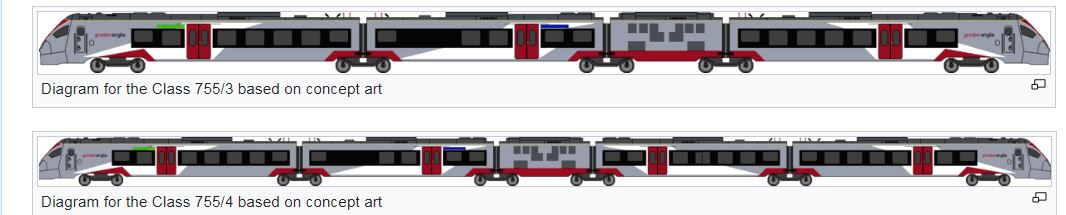
It looks like the four-car Class 755/4 trains, a three-car train with an extra passenger car.
The Class 755/4 train would appear to consist of the following
- Two full-length drive cars, with passenger accommodation.
- A half-length power car.
- Two full-length passenger car.
The three-car Class 755/3 car train would not have the extra full-length passenger car.
So in terms of full-length passenger cars, train lengths could be as follows
- Class 755/3 trains – 3 cars
- Class 755/4 trains – 4 cars
Wikipedia says that each train has the following number of seats
- Class 755/3 trains – 166 seats
- Class 755/4 trains – 224 seats
Calculating the seats per car, gives the following.
- Class 755/3 trains – 55.3 seats/car.
- Class 755/4 trains – 56 seats/car.
This suggests to me, that the interior of a passenger car is very similar to that of a driver car, which must mean manufacturing cost savings.
Diesel Engines
Both trains are fitted with 16 litre V8 engines supplied by Deutz which produce 478 kW.
The power cars have the following numbers of engines
- Class 755/3 trains – 2 engines – 956 kW – 319 kW per car
- Class 755/4 trains – 4 engines – 1912 kW – 478 kW per car.
I suspect that a fifth car could be added to a Class 755 train. This would have 1912 kW and 382 kW per car.
Add a sixth car and this would have 1912 kW and 319 kW per car.
Comparison With A Class 170 Train
Compare these figures with a diesel Class 170 train, which has 315 kW per car.
Both trains are 100 mph trains, built from aluminium, so I suspect that the performance of three-car Class 755/3 and Class 170 trains are roughly the same.
But the four-car Class 755/4 trains have fifty percent more power per car, than the Class 170 train, so these will be no sedate rural trundlers.
Looking at the power figures for five-car and six-car units, they would still have at least as much power per car as a Class 170 train.
Other Possible Routes For Class 755 Trains
Could Class 755 trains be a replacement for routes like the following?
- Aberystwyth to Shrewsbury
- Basingstoke to Exeter – Stadler are doing third-rail in Liverpool
- Birmingham to Stansted Airport
- Cardiff to Holyhead
- Cardiff to Shrewsbury
- Holyhead to Liverpool via Halton Curve
- Holyhead to Manchester Piccadilly
- Liverpool to Norwich
- Milford Haven to Manchester Piccadilly
- Swansea to Shrewsbury
Trains could be any suitable length from three to six cars.
Note that electric FLIRTs can attain 125 mph, so could we see a train with the following characteristics?
- 125 mph on electrified lines, where operating speeds allow.
- 100 mph on lines with no electrification.
This performance is not far off Hitachi’s Class 802 train.
The other major competition could be Bombardier’s proposed 125 mph bi-mode Aventra, that I wrote about in Bombardier Bi-Mode Aventra To Feature Battery Power.
The winners will be the train operating companies and their passengers.
A Video
Greater Anglia have put a video on YouTube.
Conclusion
The Class 755 trains certainly seem to have bags of grunt!
No ‘Ironing Board seats’ For Greater Anglia’s New Trains
The title of this post is the same as the title of this article on Rail Magazine.
The proof will be in the sitting, but the article encourages me, that comfort will be better than some recent new trains.
Direct Trains Between Liverpool Lime Street And Norwich
In my wanderings around the UK, I very often come across this service and use it for short trips between two major towns or cities many miles from both Liverpool and Norwich.
The Current Service
Currently, the service is run by East Midlands Trains and is usually a two-car Class 158 train. Although, I have seen the service worked by a pair of these trains.
The route is very comprehensive with calls at Liverpool South Parkway, Widnes, Warrington Central, Manchester Oxford Road, Manchester Piccadilly, Stockport, Sheffield, Chesterfield, Alfreton, Ilkeston, Nottingham, Grantham, Peterborough, Ely and Thetford.
The service always seems to be full and I suspect that in addition to offering useful routes like Manchester-Sheffield, Liverpool-Nottingham and Nottingham-East Anglia, it is often a convenient route for some long distance business and family travellers.
The major problem for a train operator is that it needs a lot of rolling stock to provide a service.
Liverpool to Norwich takes five and a half hours, so to provide the hourly service probably needs as many as a dozen trains.
This extract comes from the East Midlands Trains section in Wikipedia entry for the Class 158 train.
The hourly Norwich to Liverpool service has been criticised for overcrowding, especially between Liverpool and Nottingham. This resulted from the Department for Transport specifying two-coach units in the EMT franchise starting in November 2007. In the light of persistent and excessive overcrowding, with some passengers being left behind on occasions, the DfT eventually admitted that it had made a mistake. Various cascades of other units enabled more Class 158 stock to be released for this route, and from the December 2011 timetable change the busiest services have been lengthened to four-coach trains between Liverpool and Nottingham, with units splitting and joining at Nottingham as necessary, two-coach trains being regarded as adequate between Nottingham and Norwich. Further services on this route were strengthened from December 2012.
Running a pair of Class 158 trains on the route between Liverpool and Nottingham, does seem to ease problems there, but I’ve encountered bad over-crowding at the Eastern end too.
Improvements On The Route
Several improvements or changes of rolling stock have or are taking place in the next few years.
Increased Capacity At Liverpool Lime Street
This is detailed in the 2017-2018 Station Remodelling section of the Wikipedia entry for Liverpool Lime Street station.
- Two new platforms are being added.
- Platforms are being lengthened.
In addition there are improvements on the approaches to the station.
Ordsall Chord And Related Improvements In Manchester
The Liverpool-Norwich service calls at both Manchester Oxford Road and Manchester Piccadilly stations, although it doesn’t use the new Ordsall Chord.
But I can’t believe that the Liverpool-Norwich service won’t be affected by all the works in Manchester.
Hope Valley Line Improvements
This article on Rail Technology Magazine is entitled Long-Awaited Hope Valley Line Plans Given The Green Light.
Improvements to the Hope Valley Line between Manchester and Sheffield include.
- A loop to allow passenger trains to overtake slow freight trains.
- Removal of a foot crossing.
- Improvements around Dore and Totley station.
This is said on this document on the Transport for the North web site, which announces the Hope Valley improvements.
The new passing loops will mean three fast trains can run per hour between Sheffield and Manchester, one every 20 minutes, freight and stopping trains every hour, and a fast Manchester-Nottingham and East of England service every hour.
If nothing else, the extra capacity between Manchester and Sheffield, will reduce reliance on the Liverpool-Norwich service.
Improvements To The Midland Main Line
The Midland Main Line is not being electrified between Nottingham and Sheffield, but other improvements have taken place over the last few years.
- In particular, the Erewash Valley Line has been improved and a new station at Ilkeston has been added.
- The Liverpool-Norwich service calls at stations on this by-pass.
- The line has been resignalled.
Would a train with a 125 mph capability, as opposed to the 90 mph operating speed of the Class 158 train, allow a faster service?
East Coast Main Line Running
The 90 mph Class 158 trains must present pathing problems on the East Coast Main Line, whereas a 125 mph train could mix it easier with the high speed trains.
Greater Anglia’s Plans
Greater Anglia have ordered a fleet of Class 755 trains.
- The trains are bi-mode.
- The trains have a 100 mph operating speed.
- Greater Anglia have ordered fourteen three-car and twenty-four four-car trains.
Greater Anglia will be replacing 27 diesel trains, that consists of 58 carriages, with 38 bi-mode trains, that consist of 138 carriages.
- There are forty percent more trains.
- There are a hundred and thirty-eight percent more carriages.
- Average train length of the diesels is 2.1 carriages, wheres that of the bi-modes is 3.6.
There are two possible reasons for these large number of trains.
- Abellio have decided to buy a few bi-modes for their other franchises.
- There is going to be a massive expansion of train services in East Anglia.
Two of the new bi-mode services interact with the Liverpool-Norwich service.
- Colchester to Peterborough via Ipswich, Bury St. Edmunds and Ely
- Norwich to Stansted Airport via Ely and Cambridge.
Both services are thought to be hourly.
Consider the Colchester to Peterborough service.
- I estimate that trains will take around two hours.
- The round trip could be under five hours, even with a generous turn-round at both ends and perhaps a wait at Ipswich.
- The waits would allow connecting passengers to join the train.
- A five hour round trip would need five Class 755 trains.
- I would choose four-car trains, as the route can get crowded.
Could the Colchester to Peterborough service be considered as an extension of the Liverpool-Norwich service, that serves Bury St. Edmunds, Ipswich and Colchester?
I think it could if the trains were timed appropriately.
- Passengers from Liverpool to Ipswich, would change at Peterborough or Ely to the Peterborough to Colchester train, which would arrive a few minutes after the Liverpool to Norwich train.
- Passengers from Ipswich to Liverpool, would change at Ely or Peterborough to the Liverpool train, which would arrive a few minutes after Colchester to Peterborough train.
Hopefully, the change would not require a platform change.
Consider the Norwich to Stansted Airport service.
- I estimate trains will take about one hour and fifty minutes.
- The round trip would be four hours and would need four Class 755 trains.
- I would choose four-car trains, as the route can get crowded.
Could the Norwich to Stansted Airport service be equally spaced with the Liverpool-Norwich service between Ely and Norwich to give a clock-face two trains per hour (tph)?
These services call at Ely
- CrossCountry -Birmingham to Stansted Airport
- East Midlands Trains – Liverpool to Norwich
- Greater Anglia – Peterborough to Colchester
- Greater Anglia – Norwich to Stansted Airport
- Great Northern – Kings Lynn to Kings Cross
Totalling them up gives the following frequencies to various stations.
- Bury St. Edmunds/Ipswich/Colchester – 1 tph
- Cambridge North/Cambridge – 3 tph
- Kings Lynn – 1 tph
- Norwich – 2 tph
- Peterborough – 3 tph
- Stansted Airport – 2 tph
I suspect that the services will be arranged so there are convenient interchanges. No-one wants to spend an hour on a draughty Ely station waiting for the next train.
I also suspect that Greater Anglia will use some of their extra trains to improve connectivity at Ely.
Speed Limits On The Route
Speed limits on the route are rather variable.
- Liverpool to Manchester via Warrington is limited to 85 mph
- The Hope Valley Line between Manchester and Sheffield is 90 mph
- The proportion of the Midland Main Line, where 125 mph running is possible, is being increased.
- Grantham to Peterborough on the East Coast Main Line allows 125 mph running.
- The Peterborough to Ely Line is limited to 75 mph.
- The Breckland Line between Ely and Norwich is limited to 75- 90 mph.
I feel that increasing speed limits on some parts of the line would help the Liverpool to Norwich service.
But surely, a train with a 125 mph-capability would help with journey times and train timetabling between Sheffield and Peterborough.
But on the rest of the route, trains with this speed capability, wouldn’t be needed.
Rolling Stock Choices For Liverpool Lime Street And Norwich
Various choices include.
Class 158 Trains
Everything could carry on as now using Class 158 trains
- Two two-car trains working ass a pair would go from Liverpool Lime Street to Nottingham.
- The trains would divide at Nottingham.
- One train would go on its way to Norwich, and the other would wait at Nottingham to join with the train returning from Norwich.
With all the new diesel multiple units arriving in the next few years, I think it is likely that more Class 158 trains could be made available to strengthen the service.
The trouble with the Class 158 trains, is that with only a 90 mph operating speed, they can’t take advantage of the sections of the route where 125 mph running is possible.
Class 170 Trains
These trains were built as successors to the Class 158 trains.
- They are more modern.
- They are 10 mph faster.
- Most are three cars.
But they are still not fast enough for the 125 mph sections of the route.
A Second Service Between Liverpool And Nottingham
Improvements on the Hope Valley Line and in Liverpool and Manchester, might make it possible to run a much-needed second service between Liverpool and Nottingham via Manchester, Stockport and Sheffield..
This extra service could use the same trains as the full service.
Currently, the direct service between Liverpool Lime Street and Nottingham takes two hours thirty five minutes. In some ways, this is a problem, as if the timing was say two hours twenty minutes, a five hour round trip would be possible.
This would mean that the second service would need just five trains.
I doubt that Class 158 trains could meet this schedule, so more would be needed.
Class 800 Trains
Class 800 trains are 125 mph bi-mode trains, but are they fast enough on diesel to make real differences to the timetable by running fast on the Midland Main Line?
I think not!
So more trains would be needed to run the service.
Bombardier’s Proposed 125 mph Bi-Mode
A genuine 125-mph bi-mode, with that performance on both electricity and diesel, would be a totally different matter.
- Timings between Liverpool and Nottingham would drop to perhaps two hours twenty, thus allowing a five hour round trip.
- Timings between Liverpool and Norwich would drop to perhaps four hours fifty, thus allowing a ten hour round trip.
Even so a full service would require fifteen trains.
Bombardier have proposed a train of this type and I wrote about it in Bombardier Bi-Mode Aventra To Feature Battery Power.
In my view, this small exercise shows why some routes in the UK need a 125 mph bi-mode.
If the train can’t do 125 mph, where it is possible on the Midland and East Coast Main Line, the time savings on the route won’t be possible and more trains will be needed to run the service.
One great advantage is that the trains working this route could be the same as those working the main routes of the East Midlands franchise to and from London.
Short Formation InterCity 125 Trains
The forty-year-old InterCity 125 trains have the power and the speed to match the 125 mph bi-mode trains.
Short formation with four or five passenger cars between the two Class 43 locomotives are being used by Scotrail and Great Western Railway, but to use them on Liverpool to Norwich would require another fifteen trains to be updated, which is probably not as cost effective as new 125 mph bi-modes.
Conclusion
If service between the Liverpool Lime Street and Norwich is to continue in its present form, it needs 125 mph bi-more trains.
Charting An Electric Freight Future
The title of this post, is the same as the title of an informative article in the April 2018 Edition of Modern Railways, which was written by Julian Worth, who has many years experience of the rail freight industry.
This is a very comprehensive article looking at the future of motive power for freight trains.
These are points from the article, with some added comments of my own.
2040 And A Diesel-Free Rail System
Government ministers have said that by 2040, the UK will have a diesel-free railway, which will reduce emissions and especially particulates.
This page on the Government web site is entitled Let’s Raise Our Ambitions For A Cleaner, Greener Railway, which gives the text of a speech by the Rail Minister; Jo Johnson.
This is part of what he said.
And that’s why I am today announcing a new ambition.
I would like to see us take all diesel-only trains off the track by 2040.
If that seems like an ambitious goal – it should be and I make no apology for that.
After all, we’re committed to ending sales of petrol and diesel cars by 2040.
If we can achieve that, then why can’t the railway aspire to a similar objective?
Rail may be less carbon intensive than road transport.
That’s why modal shift’s so important.
As an engineer. I feel it is a challenge that is acceptable.
The Diesel Locomotives Are Getting Old!
The ubiquitous Class 66 locomotives, don’t meet the latest emission standards, but in addition, by the late 2020s, they will be getting to thirty years old.
Other locomotives like Class 59 locomotives will be even older.
Replacement locomotives will be needed, as maintenance costs will be getting too high.
The Last-Mile Electric Locomotive
Electric locomotives with a last-mile capability away from electrification like the Class 88 locomotive could be favoured.
- They could be used for terminal work and short-distance movements.
- They would have a 25 KVAC capability.
- They could possibly have a 750 VDC capability, to work on the third-rail network.
- They would meet all the emission standards, when running on diesel.
Julian Worth suggests that the last-mile capability could be provided by a battery.
Although, this would be environmentally-friendly and better in urban areas, I think that any onboard power, should be able to take a train into and out of the Port of Felixstowe, London Gateway and the other major ports.
I met a manager of the Port of Felixstowe a few years ago and they don’t like 25 KVAC wires in a dock, as containers do occasionally get dropped.
Most lines into ports and inland terminals, don’t appear to be too challenging and I’m sure that an uprated Class 88 locomotive could be built, that would handle entry and exit to all the ports and terminals in the UK.
Do We Need A Freight Electrification Strategy?
Julian Worth suggests we need one for the next couple of decades.
He makes some good points.
- Electric traction current is cheaper than diesel fuel.
- Availability of modern electric locomotives should be better than a diesel.
- Diesels may be restricted in urban areas. It could be a vote winner in Mayoral elections in the large Metropolitan areas.
He finishes this with this statement.
Crucially, switching to electric locos from around 2030 would not entail premature replacement of the current fleet and would represent necessary asset renewal in modern equivalent form.
Just imagine the outcry from the Green Movement, if these ageing diesels were to be replaced with modern diesel locomotives..
Undoubtedly, we need a well-thought out freight strategy.
GB Railfreight
This article in Rail Magazine is entitled GB Railfreight In ‘Locomotive Acquisition’ Talks.
So at least one freight company is looking for new motive power. GB Railfreight has a fleet of seventy-eight Class 66 locomotives with other locomotives in the ageing category. Some of their work like hauling the Caledonian Sleeper needs well-presented reliable locomotives, so perhaps they need to update their image.
It will be interesting to see what type and class of locomotive they buy.
Rail Freight Has Changed
Coal to power stations used to be the dominant freight on UK railways.
But n0t any more! Thank goodness!
The major freight on UK railways is intermodal or trains of containers from port to inland terminal and vice versa.
There is also a large growth in construction materials, miuch of it going from quarries in the West Country and the Peak District to the South East of England. To send this any other way than by train, would surely be madness.
There also seems to be an increasing number of trains carrying new vehicles to and from the Continent. More will surely start to use the Channel Tunnel.
Julian Worth says this, after summarising the freight flows.
This suggests modest extensions of electrification might permit much of the construction and intermodal businesses, together with most automotive traffic, to be electrically hauled throughout.
He then goes on to say that the big gap is Felixstowe to Peterborough, Nuneaton and Birmingham.
The Port of Felixstowe
I partly grew up in the town and never thought the port would grow to the size, it is today.
I also remember in the 1980s, when only the odd intermodal train was to be seen on the Felixstowe Branch Line.
- Now, a dozen trains in each direction on every day take the route between Felixstowe and the Midlands.
- The Felixstowe Branch Line is being upgraded to raise the number of trains from the port from 33 to 48.
- The Great Eastern Main Line and the routes through North London are close to capacity.
- The direct route via Peterborough is a lot shorter than the London route.
Julian Worth states, that the number of trains between Felixstowe and the Midlands could rise to as high as fifty every day.
Routes That Should Be Electrified For Freight
Julian Worth suggests that the following routes should be electrified.
Route 1 – London Gateway to Thames Haven Junction
If you electrify Felixstowe to the Midlands, this will remove some diesel freight trains from London.
It would be stupid to replace them with diesel freight trains from London Gateway. So it would be fairly logical to electrify the connecting route to London Gateway.
This Google Map shows London Gateway and the rail connection to the electrified London, Tilbury and Southend Railway.
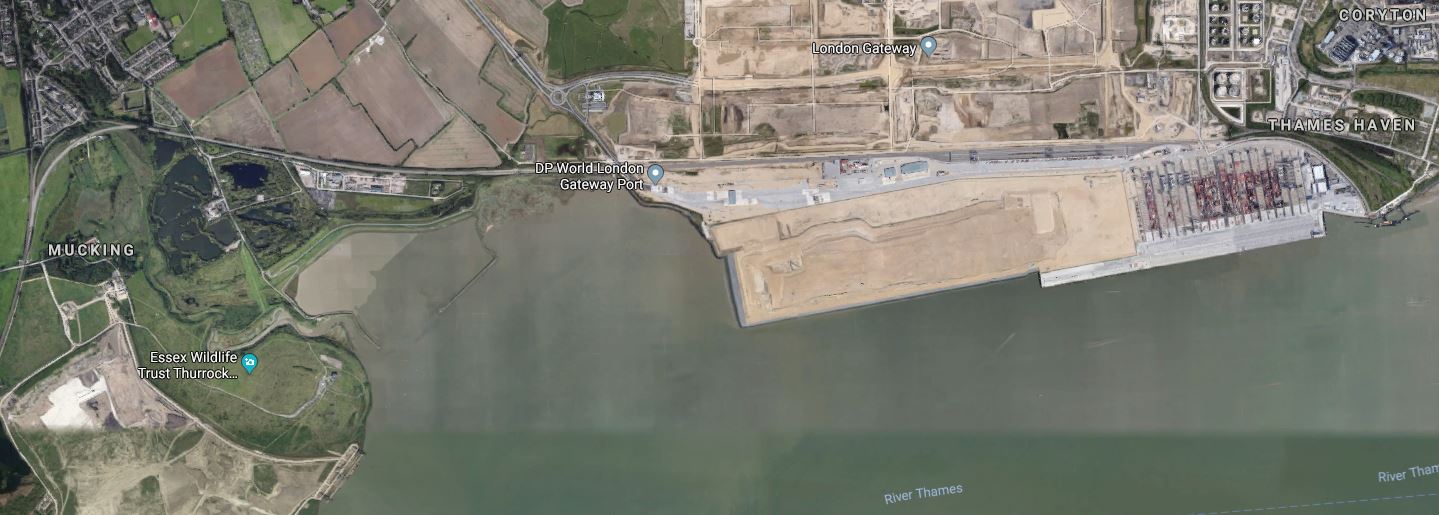
Note.
- The electrified London, Tilbury and Southend Railway, runs North-South at the extreme left of the map.
- The connecting spur curves East on what appears to be a new chord before accessing sidings on the North side of London Gateway.
- There would appear to be a lot of space to expand the port.
- The rail spur to the port is double track.
- It looks like their are sat least five sidings for handling freight trains.
- The sidings are double-ended, so last-mile capable electric locomotives could run round trains, without the need for electrification.
It would have appeared to have been designed for electrification.
Full details on London Gateway’s plans for rail access are given here in the Wikipedia entry for London Gateway, under Rail Terminal.
This is a quick summary.
- Freight trains will use the newly-electrified Gospel Oak to Barking Line to access the West Coast Main Line.
- Freight trains have a route to the Channel Tunnel.
- London Gateway has planning permission for a second rail terminal.
In other places Wikipedia says the port is highly-automated.
I am led to the conclusion, that the Gospel Oak to Barking Line will see a high number of electric freight trains in the future.
I’m not surprised that Julian Worth says the spur currently handles sixteen trains per day and is set to grow significantly.
I certainly wouldn’t buy a house on the Gospel Oak to Barking Line.
Route 2 – Nuneaton To Birmingham Lawley Street
If Felixstowe to Nuneaton is electrified, then this extends the electrification to the massive Lawley Street Freightliner Terminal, which is in central Birmingham.
This diagram from Wikipedia shows the route.
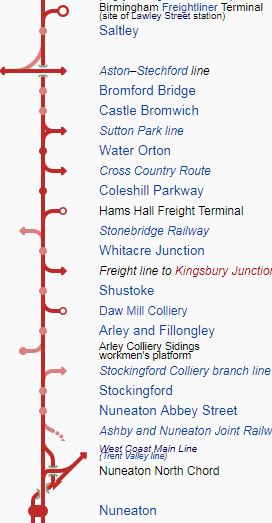
Note.
- Lawley Street Freightliner Terminal, is on the short spur at the top of the diagram.
- iThis electrification would also complete a fully-electrified route between Birmingham New Street station and Sansted Airport, so CrossCountry could use electric trains on that route, instead of the current Class 170 train, which is often overcrowded.
- Would the electrification open up opportunities for more electrified local services in Birmingham?
Julian Worth says that this twenty miles carries thirty-two trains per day.
Would electrifying this route also have environmental benefits in terms of pollution?
Route 3 – Basingstoke To Southcote Junction and Oxford to Denbigh Hall Junction
This route, which connects the Port of Southampton with the West Coast Main Line, would require forty-two miles of electrification.
Consider.
- It would create a fully-electrified route from Southampton to the West Coast Main Line.
- Julian Worth says it carries forty-eight trains per day.
- I also think, he is assuming that the Great Western Electrification extends to Oxford, which surely it will do in the next few years.
- Dual voltage locomotives would be needed.
- It would require electrification of part of the East West Railway.
The East West Railway is to be built as a privatised railway and I’m sure if the sums were right, they would electrify the route from Oxford to Denbigh Hall Junction.
If the Western end of the East West Railway were to be electrified, this must increase the options and operating speed for passenger trains on the route.
Route 4 – Merehead/Whatley to Newbury
Consider.
- Merehead and Whatley are both Quarries of the Mendip Hills.
- The line is double-track and seventy-two miles long.
- Julian Worth says that this route carries twenty-eight stone trains per day.
- Many trains are double-size.
- In a four hour period, using Real Time Trains I found,three stone trains that weighed 4,800 tonnes and had a maximum speed of 45 mph and four stone trains that weighed 2,000 tonnes and had a maximum speed of 60 mph, using the route from the Mendips to London.
With all that heavy traffic, it strikes me that their are only two ways to power these trains on the route.
- Very powerful diesel locomotives, possibly working in pairs.
- Very powerful 25 KVAC electric locomotives, which would need electrification, able to supply lots of amps.
Mendip Rail currently run these services using Class 59 locomotives, which have the following characteristics.
- Built in North America between 1985 and 1995.
- They were the first privately-owned locomotives on the UK main line.
- They have the ability to creep to shift heavy loads on gradients.
- They have a maximim speed of 60-75 mph.
- They are towered by a 2.5 MW diesel engine.
This extract from Wikipedia illustrates their power.
On 26 May 1991 Kenneth J Painter (59005) (with assistance from Yeoman Endeavour) set the European haulage record, with a stone train weighing 11,982 tonnes and 5,415 feet (1,650 m) long. However the so-called ‘mega train’ experiment was not very successful, as a coupling in the centre of the train broke.
It would appear, there was nothing wrong with the locomotives.
By the late 2020s, these locomotives will be over forty years old and although they could probably soldier on for another ten or even twenty years, the cost of maintenance will increase and reliability could decrease. You don’t want a 4,800 tonne stone train blocking the Reading to Taumton Line.
I suspect too, that it is unlikely that this important stone traffic will decrease. This is said in the Wikipedia entry for Mendip Rail.
Mendip Rail’s class 59s work services between various destinations which have changed over time according to demand and specific contracts. They have worked regularly over southern railway tracks, for example to the former Foster Yeoman terminals at Eastleigh and Botley, as well as delivery aggregates for construction work on the Thames Barrier, Second Severn Crossing, Channel Tunnel and most recently Heathrow Terminal 5, which required 3 million tonnes of stone.
Mendip Rail hauls about 4.5 million tonnes of stone from Torr Works each year, and about 2.5 million tonnes from Whatley Quarry.
I suspect that these stone flows will continue and there will come a time in the not-to-distant future, where new locomotives will be required.
- The Class 59 locomotives were built for these stone trains and have a maximum tractive effort of 507 kN at just 7 mph.
- A large electric Class 92 locomotive has a maximum tractive effort of only 400 kN.
But I suspect that engineers can design an electric locomotive, that can handle these trains either by themselves or working in a pair.
So there will be a choice between a very powerful diesel locomotive or a very powerful electric one.
- Will those that live by the railway and environmentalists accept new diesel locomotives?
- Electric locomotives would require the line to be electrified.
- Electrification would allow Great Western Railway to run their Class 800 trains more efficiently using the wires.
- Would those who live by the railway, accept the electrification of the line?
It’s a difficult choice.
Route 5 – Felixstowe to Ipswich. Haughley Junction to Peterborough and Helpston to Nuneaton
Consider
- This would be a big project, as it would require 146 miles of new electrification.
- But the return could be worthwhile, as currently the route handles twenty trains per day and once the Felixstowe Branch Line has more double track, this figure could rise to fifty-six trains per day.
- At Ipswich, Peterborough and Nuneaton, the route connects to fully-electrified lines.
My project management knowledge tends to electrifying this line from East to West as almost three separate projects.
- Felixstowe to Ipswich
- Haughley Junction to Peterborough
- Helpston to Nuneaton
It could even be five, if Helpston to Nuneaton was split into two at either Leicester or the Midland Main Line.
I have three general questions.
- When the gauge clearance was undertaken a few years ago, were bridges raised to accommodate wires as well?
- Will the natives object to fifty trains per day?
- Will the line be resignalled to handle the greater number of trains?
Once the full route is electrified, the number of trains to and from Felixstowe , that used the Great Eastern Main Line and the routes through London would drop. Obviously, some trains like those between Felixstowe and Wales and the West Country would still need to use the London routes.
But overall, this would allow a mixture of the following.
- Higher passenger train frequencies on the North London Line
- Higher passenger train frequencies on the Gospel Oak To Barking Line
- More freight trains to and from London Gateway could use the cross-London routes.
The last point would mean, that electric locomotives would need to have access to London Gateway.
I will detail my thoughts on Felixstowe to the Midlands electrification in the next three sub-sections.
Route 5A – Felixstowe to Ipswich
Electrifying between Felixstowe and Ipswich shouldn’t be the most challenging of projects.
- The route is fairly flat.
- The route is double track, except for part of the Felixstowe Branch Line.
- The line was cleared for the largest containers a few years ago.
- Doubling of the Felixstowe Branch Line around Trimley and the removal of some level crossings should start this year.
- There should be an adequate 25 KVAC power supply at Ipswich.
I have two extra questions.
- Will the partial doubling of the Felixstowe Branch, prepare the line for electrification?
- Has a scheme been designed to take electrification to the port?
But there will be benefits.
- Some freight trains that use the Great Eastern Main Line and the electrified routes through London, could be hauled all the way. by electric locomotives.
- If Felixstowe station was to be electrified, Greater Anglia could run five-car Class 720 electric trains instead of Class 755 bi-mode trains on the branch, if required.
- Class 755 bi-mode trains on the Ipswich to Lowestoft service, would be able to use the electrification between Westerfield and Ipswich stations.
- Noise and vibration could be reduced.
It is just over a dozen miles of elwctrification, so isn’t the largest of projects.
Route 5B – Haughley Junction to Peterborough
Like the first section between Felixstowe and Ipswich, this section is also not very challenging.
- The route is fairly flat.
- The route is double track.
- The line was cleared for the largest containers a few years ago.
- Ely is being remodelled to remove a bottleneck.
- Ely to Soham improvements seem to have been dropped, but will surely happen.
- Haughley Junction needs to be remodelled.
- Network Rail are already removing level crossings.
- There should be an adequate 25 KVAC power supply at Haughley and Peterborough.
I have an extra question.
- Will the route between Cambridge and Chippenham Junction be electrified?
But there will be benefits.
- Electric freight between Felixstowe And The East Coast Main Line as far as Scotland.
- Greater Anglia could run their service between Colchester and Peterborough with a Class 720 electric train.
- Greater Anglia’s service between Ipswich and Cambridge would do more running under wires.
The electrification might even enable some useful electrified diversion routes.
Route 5C -Helpston to Nuneaton
I don’t know this section of the route, as well as I know the two other sections.
- The route is double track.
- There is a busy level crossing in the middle of Oakham.
- There should be an adequate 25 KVAC power supply at both ends of the route.
It would appear that the route goes through Leicester station on the Midland Main Line.
As the electrification of the Midland Main Line has been postponed, how will this section of the route be handled?
But there will be benefits.
- Electric freight between Felixstowe And The Midlands
- Fewer freight trains would need to go via London
- Some passenger services, like Birmingham-Stansted Airport, could be run using electric trains.
Completing all three sections will open up new possibilities for both freight and passenger services.
Route 6 – Hare Park Junction to Leeds Stourton
This is a freight route , which can be followed this way.
- It leaves the electrified Wakefield Line at Hare Park Junction, which is South of Sandal and Agbrigg station.
- It passes Wakefield Kirkgate and Normanton stations and there appears to be a connection to Wakefield Europort.
- It then joins the Hallam Line and goes to the Stourton Freightliner Terminal.
Electrification of this eighteen mile route, would allow freight trains with electric traction to reach the Stourton terminal.
The electrification could also be extended to Leeds station, so that passenger services on the Hallam Line, run by bi-mode trains would have an electrified route into Leeds.
Route 7 – Mountsorrel to Syston Junction and Manton Junction to Corby
Mountsorrel Quarry is one of the biggest granite quarries in Europe. It is not on the railway anymore, but is connected to the Midland Main Line at
Barton upon Soar, by a mineral conveyor.
These two short lengths of electrification connect Mountsorrel to the electrified portion of the Midland Main Line to London and by using the Felixstowe to Nuneaton route, there is access to the East and West Coast Main Lines.
Julian Worth says that thirty trains per day use the route.
Looking on Real Time Trains, they are not the mega-trains of the Mendips, but they seem to go all over England.
Route 8 – Whitacre Junction to Birch Coppice
Birch Coppice is a freight terminal and it is connected to the Birmingham Lawley Street to Nuneaton Line at Whitacre Junction, by a six mile rail link.
As in Julian Worth’s plan, the Birmingham Lawley Street to Nuneaton Line will have been electrified, it will be an logical section of wires to install.
Summarising The Routes
Summarising the routes, you get the following, once all the proposals are added to the UK’s electrified network.
- There is a major East-West route from Felixstowe to Birmingham, that connects to the two major North-South routes; East and West Coast Main Lines and East Anglia’s Great Eastern Main Line.
- The Reading to Taunton Line now provides an route to the South-West for electric trains.
- The massive quarries in the Mendips and at Mountsorrel are connected to the main electrified network.
- The ports of Felixstowe, London Gateway and Southampton are connected to the main electrified network.
- The inland depots of Birch Coppice, Birmingham Lawley Street and Leeds Stourton are connected to the main electrified network.
Others may well be added.
For instance, an electrified connection to Liverpool2 along the Canada Dock Branch, which runs in places through densely-packing housing and has been looked at for a passenger service by Merseyrail.
Installing The Electrification
Traditionally, electrification schemes have been done using money directly from the Treasury.
To say, performance in recent years has been mixed would be an understatement!
With my experience of project management, I have my theories about the poor performance, but as I have no serious data to back them up, I will not put most of them in this post.
I will say however, that my observations of the electrification of the Gospel Oak to Barking Line have led me to the conclusion, that there are not enough competent engineers, surveyors and technicians to install the current low-level of new electrification.
However, recent statements and documents from Chris Grayling about how the Southern rail access to Heathrow is to be financed, might suggest a model for electrification.
This Press Release on the Department of Transport web site, starts with these two paragraphs.
Private companies have been asked to come forward with ideas to deliver a new southern rail link to Heathrow Airport.
The link will be one of the first projects under government plans to invite third parties – such as local authorities and private sector companies – to invest in the rail network, over and above the £47 billion the government is already planning for the next 5 years.
The idea is that a private consortium would do the following.
- Design, build and finance a new line, station or other piece of railway infrastructure.
- Maintain it for a number of years.
- Charge train operators a charge for using the infrastructure, in much the same way as Network Rail charge every train for track access.
If the sums add up, I suspect it is model that will work for electrification.
I will take the Felixstowe Branch Line, that I know well as an example.
The benefits of electrification on this line could be as follows.
- Freight trains from the Port of Felixstowe using electrified lines from Ipswich, could be able to use electric haulage, which might be more affordable.
- Greater Anglia could run Ipswich to Felixstowe services using trains running solely on electricity.
- There would be less pollution and possibly less noise and vibration.
- Electrification might allow faster operating speeds on the branch, which in turn would allow more freight and passenger trains.
- The hourly passenger service between Ipswich and Felixstowe might be able to be doubled in frequency.
Currently, after the dualling at Trimley has been finished, the branch is planned to handle an hourly passenger train and around fifty freight trains per day.
It strikes me that if the contracts and charges have the right balance, that a deal could be struck with a competent consortium.
It would have the following parts.
- The consortium would design, finance and install the electrification.
- Installing the electrification would be done, without disturbing the passenger and freight traffic.
- The consortium would maintain the electrification for an agreed number of years.
- Electrification access charges would be modelled on track access charges and agreed with a regulator, such as the Office of Road and Rail.
- Failure to provide a working electrified railway, would incur penalty charges to operators.
I feel the model could work.
- The consortium would use best practice from around the world.
- The consortium might encourage innovative design and working.
- The consortium would make sure it had the best engineers, technicians and equipment to keep the electrification in tip-top condition, as that is the best way to maximise return on capital, against a fixed income.
- The Office of Road and Rail would ensure safety, quality and reliability.
I also feel, that one of the ways to get the electrification installed in a professional manner and then operational at an agreed date, is to get the project management right.
Too much of what I’ve seen on electrification in the UK, reminds me of the phrase – It’ll be alright on the night!
A consortium, which has to raise and justify the money it needs, can’t rely on this mantra and must be sure that if a scheme is going to cost £100 million, then.
- The initial budget must be correct.
- The electrification can be installed for that sum.
- Sufficient contingency is included.
Get the first project, seriously wrong and they won’t get another of the many electrification projects in the pipeline.
Extend Crossrail To Southend Airport
The title of this post, is the same as that of this article in the Southend Echo.
This is the first two paragraphs.
Southend Airport’s boss has suggested that high-speed Crossrail trains should be extended to the airport to provide a faster service for travellers to and from London.
Glyn Jones, chief executive of Stobart Aviation, suggested to transport secretary Chris Grayling that the £16billion rail project from Heathrow Airport should be extended to Southend.
I like this idea and I wrote about it in Crossrail Tests Its Trains In Southend, where I finished the post like this.
I have come to these conclusions about services between Liverpool Street and Southend Victoria stations..
- A Fast Greater Anglia express service could probably achieve a sub-fifty minute time.
- A Slow Crossrail service, could probably do the trip in an hour.
- Better interchange with Crouch Valley Line and Great Easstern Main Line services would be achieved.
- Four Fast and four Slow services in each hour is possible.
My choice for the Liverpool Street to Southend Victoria service would be as follows.
-
Four trains per hour – Crossrail Class 345 trains – Stopping at all stations.
-
Four trains per hour – Greater Anglia Class 745 trains – Stopping at Southend Airport, Billericay, Shenfield and Stratford.
Or the simple option of just running the four Crossrail trains.
Legal & General To Invest £350m in UK Rail Infrastructure
The title of this post, is the same as this article on Railway Technology.
Wikipedia says this about Legal & General.
The company offers a wide range of products for individuals and corporate businesses. Its investment management is the UK’s largest investment manager of UK pension fund assets and has a growing US business, based in Chicago, Illinois.
So in a few years time, your pension might own a couple of nuts and bolts on a train.
What Will Happen To The Class 379 Trains?
Greater Anglia’s fleet of thirty Class 379 trains are being replaced by by a brand new fleet of Class 745 Stadler FLIRT EMUs which will be fixed 12-car trains on Stansted Express services and Class 720 Bombardier Aventra EMUs on Cambridge services.
These trains have a high specification.
- Four-car trainsets.
- Ability to work as four, eight and twelve-car trains.
- 2+2 seating in Standard Class.
- 2+1 seating in First Class.
- Plenty of luggage space.
- Wi-fi and power sockets.
- Full compliance with all Persons of Reduced Mobility rules.
- 100 mph capability.
- Regenerative braking.
I also suspect the following is true about the trains.
- The ability to run on 750 VDC third rail electrification could be added reasonably easily.
- Lithium-ion batteries to give a limited range, can be fitted.
- The top speed could be upgraded to the 110 mph of the closely-related Class 387 trains.
- The trains have end gangways and could be certified to run through the core route of Thameslink, like the Class 387 trains.
So they would appear to be a very useful train.
So what will happen to the trains?
This is my speculative list of possible uses.
Continued Use By Greater Anglia
In some ways it’s strange that these reasonably new trains are being replaced on Stansted and Cambridge services.
They are being replaced by Stadler Class 745 trains, which like the Class 379 trains are 100 mph trains.
In the next decade or so, the West Anglia Main Line is to be upgraded.
- There will be four tracks at least between Tottenham Hale and Broxbourne stations.
- Cambridge South station and the East West Rail Link will have been completed.
- Line speed will have been improved to at least 100 mph along its full length.
- The High Meads Loop will be developed to allow more trains from the West Anglia Main Line to use Stratford instead of the overcrowded Liverpool Street as a London terminal.
I suspect the number of fast services between London and Cambridge along the West Anglia Main Line will be increased.
So are performance upgrades available for the Class 745 trains, which will deliver these improved services?
If Stadler are late with their delivery of the Class 745 trains, the Class 379 trains will continue to be used on Stansted and Cambridge services.
This is discussed in this article in Rail Magazine, which is entitled Contingency Plans In Place For Greater Anglia’s Main Line Fleet.
But surely, this would only delay their cascade to other operators.
According to Wikipedia, all of the replacement Class 745 trains, are scheduled to enter service in 2019, which should mean that the Class 379 trains should be available for cascade to other operators, sometime in 2020.
St. Pancras to Corby
Under Future in the Wikipedia entry for Corby station, this is said.
It is planned that a half-hourly London St Pancras to Corby service will operate from December 2019 using new Class 387 trains, once the Midland Main Line has been electrified beyond Bedford as part of the Electric Spine project. Network Rail has also announced that it plans to re-double the currently singled Glendon Junction to Corby section as part of this scheme.
In the December 2017 Edition of Modern Railways there is an article, which is entitled Wires To Corby Now in 2020.
This is the first paragraph.
Carillion is to deliver electrification of the Midland Main Line to Corby, but electric services will not start until December 2020, a year later than previously envisaged.
The article also states the following.
- A fourth track is to be installed between Bedford and Kettering.
- Track and wires are to be updated so that new 125 mph bi-mode trains can run between St. Pancras and Derby, Nottingham and Sheffield.
- Improvements to the current electrification South of Bedford.
Everything should be completed, so that the new bi-mode trains could enter service from 2022.
It should be noted that Wikipedia says this about the Future of the East Midlands Trains franchise.
The franchise is due to end in August 2019. The Invitation to Tender is due to be issued in April 2018, which will detail what improvements bidders for the franchise must make. The contract will then be awarded in April 2019.
This could give the following project schedule on the Midland Main Line.
- April 2019 – Award of new East Midlands franchise.
- August 2019 – New East Midlands franchise starts.
- December 2020 – Electric services to Corby start.
- December 2022 – Bi-mode services to Derby, Nottingham and Sheffield start.
These dates would fit well with the retirement of the Class 379 trains by Greater Anglia in 2020.
Current timings between Corby and London are 71 minutes with four stops. I don’t think it would be unreasonable to assume that the improved track and new trains would be designed so that the timings between Corby and London would be reduced to under an hour, with a round trip of two hours.
If this can be achieved, then just four trains of an appropriate length will be needed to meet the required two tph timetable.
- Four-car services would need four trains.
- Eight-car services would need eight trains.
- Twelve-car services would need twelve trains.
It might not be possible to run eight and twelve car services due to platform length restrictions.
If the two hour round trip could be achieved by an existing Class 387 or an uprated Class 379 trains, then either of these trains would be a shoe-in for the route.
Otherwise we’ll be seeing something faster like a Class 801 train.
But if services are to start in 2020, there would be a problem to manufacture the trains in the available time, as the contract will only have been awarded in April 2019.
I think that St. Pancras to Corby is a possibility for Class 379 trains, which may need to be uprated to 110 mph. On the other hand, Class 387 trains wouldn’t need to be uprated.
West Midlands Trains, who have a similar need for their Euston to West Midlands services, have ordered 110 mph Aventras.
- So perhaps the new East Midlands franchise will do the same.
- This would be more likely, if Bombardier come up with the rumoured 125 mph bi-mode Aventra.
- Or they could buy a mixture of Class 800 and 801 trains.
I don’t think the Class 379 trains will work St. Pancras to Corby.
Battery Services
A Class 379 train was used for the BEMU trial, where a battery was fitted to the train and it ran for a couple of months between Manningtree and Harwich, using overhead power one way and battery power to return.
Was this class of train chosen, as it was one of the easiest to fit with a battery? After all it was one of the later Electrostars.
This article on the Railway Gazette from July 2007 is entitled Hybrid Technology Enters The Real World. It describes the experimental conversion of a Class 43 power-car from a High Speed Train into a battery-assisted diesel-electric power-car.
A second article in the Railway Gazette from October 2010 is entitled First New Stansted Express Train Rolls Out. It describes the Class 379 train in detail. This is an extract.
Although part of the Electrostar family, the Class 379 incorporates a number of technical changes from the original design developed in the late 1990s, making use of technologies which would be used on the Aventra next-generation Electrostar which Bombardier is proposing for the major Thameslink fleet renewal contract.
The body structure has been revised to meet European crashworthiness requirements. The window spacing has changed, with the glass bolted rather than glued in place to enable faster repairs. The couplers are from Dellner, and the gangways from Hübner. Top speed is 160 km/h, and the 25 kV 50 Hz trains will use regenerative braking at all times.
The last statement about regenerative braking is the most interesting.
To my knowledge electric trains that use regenerative braking had never run on the West Anglia Main Line before and that to handle the return currents with 25 KVAC needs special and more expensive transformers. The obvious way to handle regenerative braking at all times without using the electrification is to put an appropriately sized battery on the train.
If Bombardier have done this on the Class 379 train, then it might be a lot easier to fit a large battery to power the train. This would explain why the trains were chosen for the trial rather than a train from a more numerous variant.
The result was a trial of which few, if any,negative reports can be found.

The result was a trial of which few, if any,negative reports can be found.
Class 379 Train Performance On Batteries
Little has been said about the performance of the train.
However, in this document on the Network Rail web site, which is entitled Kent Area Route Study, this is said.
In 2015, industry partners worked together to investigate
battery-electric traction and this culminated with a
practical demonstration of the Independently Powered
Electric Multiple Unit IPEMU concept on the Harwich
Branch line in Anglia Route. At the industry launch event,
the train manufacturers explained that battery
technology is being developed to enable trains to run
further, at line speeds, on battery power, indeed, some
tram lines use this technology in the city centres and many
London buses are completely electric powered.The IPEMU project looked at the feasibility of battery power
on the Marshlink service and found that battery was
sufficient for the train to run from Brighton to Ashford
International and back but there was insufficient charge to
return to Ashford International on a second round trip. A
solution to this could be that the unit arrives from Ashford
International at Brighton and forms a service to Seaford and
back before returning to Ashford International with a
charged battery.The IPEMU demonstration train was a Class 379, a similar
type to the Class 377 units currently operated by Southern, it
was found that the best use of the battery power was to
restrict the acceleration rate to that of a modern diesel
multiple unit, such as a Class 171 (the current unit type
operating the line) when in battery mode and normal
acceleration on electrified lines.
|Ashford to Brighton is 62 miles, so a round trip would be 124 miles.
The document doesn’t say anything about how many stops were made in the tests, but I’m sure that Bombardier, Greater Anglia and Network Rail have all the data to convert a Class 379 into a viable IPEMU or Independently Powered Electric Multiple Unit.
As to how long it takes to charge the battery, there is an interesting insight in this article from Rail Magazine, which is entitled Battery-Powered Electrostar Enters Traffic. This is said.
It is fitted with six battery rafts, and uses Lithium Ion Magnesium Phosphate battery technology. The IPEMU can hold a charge for 60 miles and requires two hours of charging for every hour running. The batteries charge from the overhead wires when the pantograph is raised, and from regenerative braking.
The two-one ratio between charging and running could be an interesting factor in choice of routes.
What About The Aventra?
I quoted from this article in the Railway Gazette from October 2010 earlier. This is said.
Although part of the Electrostar family, the Class 379 incorporates a number of technical changes from the original design developed in the late 1990s, making use of technologies which would be used on the Aventra next-generation Electrostar.
So would it be a reasonable assumption to assume, that if batteries can be fitted to a Class 379 train, then they could also be fitted to an Aventra?
This article in Global Rail News from 2011, which is entitled Bombardier’s AVENTRA – A new era in train performance, gives some details of the Aventra’s electrical systems. This is said.
AVENTRA can run on both 25kV AC and 750V DC power – the high-efficiency transformers being another area where a heavier component was chosen because, in the long term, it’s cheaper to run. Pairs of cars will run off a common power bus with a converter on one car powering both. The other car can be fitted with power storage devices such as super-capacitors or Lithium-ion batteries if required.
This was published in 2011, so I suspect Bombardier have refined the concept.
But it does look that both battery variants of both Class 379 trains and Aventras are possible.
Routes For Battery Trains
What important lines could be run by either a Class 379 train or an Aventra with an appropriate battery capability?
I will refer to these trains as IPEMUs in the remainder of this post.
I feel that one condition should apply to all routes run by IPEMUs.
The 2:1 charging time to running time on battery ratio must be satisfied.
East Coastway And Marshlink Lines
As Network Rail are prepared to write the three paragraphs in the Kent Area Route Study, that I quoted earlier, then the East Coastway and Marshlink Lines, which connect Brighton and Ashford International stations, must be high on the list to be run by IPEMUs.
Consider.
- All the route, except for about twenty-four miles of the Marshlink Line is electrified.
- Brighton and Ashford International stations are electrified.
- Some sections have an operating speed of up to 90 mph.
- Brighton to Hastings takes 66 minutes
- Ashford International to Hastings takes 40 minutes
- There is a roughly fifteen minute turnround at the two end stations.
The last three points, when added together, show that in each round trip, the train has access to third-rail power for 162 minutes and runs on batteries for 80 minutes.
Does that mean the 2:1 charging to running ratio is satisfied?
I would also feel that if third-rail were to be installed at Rye station, then in perhaps a two minute stop, some extra charge could be taken on board. The third-rail would only need to be switched on, when a train was connected.
It looks to me, that even the 2015 test train could have run this route, with just shoe gear to use the third-rail electrification. Perhaps it did do a few test runs! Or at least simulated ones!
After all, with a pantograph ready to be raised to rescue a train with a flat battery, they could have run it up and down the test route of the Mayflower Line at a quiet time and see how far the train went with a full battery!
Currently, many of the train services along the South Coast are run by a fleet of Class 313 trains, with the following characteristics.
- There are a total of nineteen trains.
- They were built in the late 1970s.
- They are only three cars, which is inadequate at times.
- They are 75 mph trains.
- They don’t have toilets.
- The trains are used on both the East Coastway and West Coastway Lines.
Replacing the trains with an appropriate number of Class 379 trains or Aventras would most certainly be welcomed by passengers, staff and the train companies.
- Diesel passenger trains could be removed from the route.
- There could be direct services between Ashford International and Southampton via Brighton.
- One type of train would be providing most services along the South Coast.
- There would be a 33% increase in train capacity.
- Services would be a few minutes quicker.
- For Brighton’s home matches, it might be possible to provide eight-car trains.
- The forty-year-old Class 313 trains would be scrapped.
The service could even be extended on the fully-electrified line to Bournemouth to create a South Coast Seaside Special.
London Bridge To Uckfield
I looked at Chris Gibb’s recommendation for this line in Will Innovative Electrification Be Used On The Uckfield Line?
These actions were recommended.
- Electrification of the branch using 25 KVAC overhead.
- Electrification of tunnels with overhead conductor rail.
- Dual-voltage trains.
- Stabling sidings at Crowborough.
How would this be affected if IPEMUs were to be used?
The simplest way to run IPEMUs would be to install third-rail at Uckfield to charge the train.
Current timings on the route are as follows.
- London Bridge to Hurst Green – electrified – 32 minutes
- Hurst Green to Uckfield – non-electrified – 41 minutes
- Turnaround at London Bridge – 16 minutes
- Turnaround at Uckfield – 11 minutes
Hurst Green station is the limit of the current electrification.
Adding these times together, show that in each round trip, the train has access to third-rail power for 91 minutes and needs to on batteries for 82 minutes.
It looks like the 2:1 charging to running ratio is not met.
To meet that, as the round trip is three hours, that means that there probably needs to be two hours on electrification and an hour on batteries.
So this means that at least eleven minutes of the journey between Hurst Green and Uckfield station needs to be electrified, to obtain the 2:1 ratio.
It takes about this time to go between Crowborough and Uckfield stations.
- Crowborough will have the new sidings, which will have to be electrified.
- The spare land for the sidings would appear to be to the South of Crowborough station in an area of builders yards and industrial premises.
- Crowborough Tunnel is on the route and is nearly a kilometre long.
- The route is double-track from Crowborough station through Crowborough Tunnel and perhaps for another kilometre to a viaduct over a valley.
- The viaduct and the remainder of the line to Uckfield is single track.
- The single track section appears to have space to put the gantries for overhead electrification on the bed of the original second track.
If you apply Chris Gibb’s original recommendation of 25 KVAC, then electrification between Crowborough and Uckfield station, might just be enough to allow IPEMUs to work the line.
- The sidings at Crowborough would be electrified.
- About half of the electrification will be single-track.
- Crowborough Tunnel would use overhead rails.
- Power could probably be fed from Crowborough.
- The regenerative braking would be handled by the batteries on the trains.
- Changeover between overhead power and batteries would be in Crowborough station.
- Buxted and Uckfield stations wouldn’t be complicated to electrify, as they are single-platform stations.
I very much feel that running IPEMUs between London Bridge and Uckfield is possible.
Preston to Windermere
The Windermere Branch Line is not electrified and Northern are proposing to use Class 769 bi-mode trains on services to Windermere station.
Current timings on the line are as follows.
- Windermere to Oxenholme Lake District – non-electrified – 20 minutes
- Oxenholme Lake District to Preston – electrified – 40 minutes
If you add in perhaps ten minutes charging during a turnaround at Preston, the timings are just within the 2:1 charging ratio.
So services from Windermere to at least Preston would appear to be possible using an IPEMU.
These trains might be ideal for the Windermere to Manchester Airport service. However, the Class 379 trains are only 100 mph units, which might be too slow for the West Coast Main Line.
The IPEMU’s green credentials would be welcome in the Lakes!
The Harrogate Line
This is said under Services in the Wikipedia entry for Harrogate station, which is served by the Harrogate Line from Leeds.
The Monday to Saturday daytime service is generally a half-hourly to Leeds (southbound) calling at all stations and to Knaresborough (eastbound) on the Harrogate Line with an hourly service onwards to York also calling at all stations en route.
Services double in frequency at peak time to Leeds, resulting in 4 trains per hour (tph) with 1tph running fast to Horsforth. There are 4 tph in the opposite direction between 16:29 and 18:00 from Leeds with one running fast from Horsforth to Harrogate.
Evenings and Sundays an hourly service operates from Leeds through Harrogate towards Knaresborough and York (some early morning trains to Leeds start from here and terminate here from Leeds in the late evening).
Proposals have been made to create a station between Harrogate and Starbeck at Bilton, whilst the new Northern franchise operator Arriva Rail North plans to improve service frequencies towards Leeds to 4 tph from 7am to 7pm once the new franchise agreement starts in April 2016.
I believe that the easiest way to achieve this level of service would be to electrify between Leeds and Harrogate.
- IPEMUs might be able to go between Harrogate and York on battery power.
- Leeds and York are both fully electrified stations.
- If a link was built to Leeds-Bradford Airport, it could be worked on battery power and the link could be built without electrification.
- The electrification could be fed with power from Leeds.
- There is also the two-mile long Bramhope Tunnel.
Full electrification between Leeds and Harrogate would allow Virgin’s Class 801 trains to reach Harrogate.
I’m fairly certain that there’s a scheme in there that with minimal electrification would enable IPEMUsy to reach both a new station at Leeds-Bradford Airport and York.
Conclusion
These routes show that it is possible to use IPEMUs to run services on partially-electrified routes.
As I said earlier, the 2:1 ratio of charging to running time could be important.
Airport Services
Class 379 trains were built to provide fast, comfortable and suitable services between London Liverpool Street and Stansted Airport.
Because of this, the Class 379 trains have a First Class section and lots of space for large bags.
Surely, these trains could be found a use to provide high-class services to an Airport or a station on a high-speed International line.
But there are only a limited number of UK airports served by an electrified railway.
- Ashford International for Eurostar.
- Birmingham
- Gatwick
- Heathrow
- Luton
- Manchester
- Southampton
- Southend
- Stansted
Most of these airports already have well-developed networks of airport services, but Class 379 trains could provide an upgrade in standard.
In addition, the following airports, may be served by an electrified heavy rail railway.
All except Doncaster Sheffield would need new electrification. For that airport, a proposal to divert the East Coast Main Line exists.
Possibilities for airport services using IPEMUs, based on Class 379 trains with a battery capability would include.
Ashford International
The completion of the Ashford Spurs project at Ashford International station will surely create more travellers between Southampton, Portsmouth and Brighton to Ashford, as not every Continental traveller will prefer to go via London.
Class 379 IPEMUs,with a battery capability to handle the Marshlink Line would be ideal for a service along the South Coast, possibly going as far West as Bournemouth.
Birmingham
Birmingham Airport is well connected by rail.
I think that as train companies serving the Airport, have new trains on order, I doubt we’ll see many Class 379 trains serving the Airport.
Bristol
Various routes have been proposed for the Bristol Airport Rail Link.
In my view, the routes, which are short could be served by light rail, tram-train or heavy rail.
As the proposed city terminus at Bristol Temple Meads station would be electrified and the route is not a long one, I’m pretty sure that a Class 379 IPEMU could work the route.
But light rail or tram-train may be a better option.
Gatwick
Gatwick Airport station is well served by trains on the Brighton Main Line, running to and from Brighton, Clapham Junction, East Croydon, London Bridge, St. Pancras and Victoria, to name just a few.
Gatwick also has an hourly service to Reading via the North Downs Line, which is only partly electrified.
In my view, the North Downs route would be a classic one for running using Class 379 IPEMUs.
- The Class 379 trains were built for an Airport service.
- Four cars would be an adequate capacity.
- No infrastructure work would be needed. But operating speed increases would probably be welcomed.
- Third-rail shoes could be easily added.
- Several sections of the route are electrified.
- Gatwick Airport and Reading stations are electrified.
Currently, trains take just over an hour between Reading and Gatwick Airport.
Would the faster Class 379 IPEMUs bring the round trip comfortably under two hours?
If this were possible, it would mean two trains would be needed for the hourly service and four trains for a half-hourly service.
There may be other possibilities for the use of Class 379 trains to and from Gatwick Airport.
- Luton Airport keep agitating for a better service. So would a direct link to Gatwick using Class 379 trains be worthwhile?
- Class 379 IPEMUs could provide a Gatwick to Heathrow service using Thameslink and the Dudding Hill Line.
- Class 379 IPEMUs could provide a Gatwick to Ashford International service for connection to Eurostar.
I also feel that, as the trains are closely-related to the Class 387/2 trains used on Gatwick Express, using the Class 379 trains on Gatwick services would be a good operational move.
Also, if Class 379 IPEMUs were to be used to create a South Coast Express, as I indicated earlier, two sub-fleets would be close together.
Leeds-Bradford
Earlier I said that the Harrogate Line could be a route for IPEMUs, where services could run to York, if the Leeds to Harrogate section was electrified.
A spur without electrification could be built to Leeds-Bradford Airport.
Based on current timings, I estimate that a Bradford Interchange to Leeds-Bradford Airport service via Leeds station would enable a two-hour round trip.
An hourly service would need two trains, with a half-hourly service needing four trains.
Manchester
Manchester Airport is well connected by rail and although the Class 379 trains would be a quality upgrade on the current trains, I think that as Northern and TransPennine have new trains on order, I doubt we’ll see many Class 379 trains serving the Airport.
Conclusion
Looking at these notes, it seems to me that the trains will find a use.
Some things stand out.
- As the trains are only capable of 100 mph, they may not be suitable for doing longer distances on electrified main lines, unless they are uprated to the 110 mph operating speed of the Class 387 trains.
- The main line where they would be most useful would probably be the East and West Coastway Lines along the South Coast.
- Converting some into IPEMUs would probably be useful along the Marshlink and Uckfield Lines, in providing services to Gatwick and in a few other places.
I also feel, that Aventras and other trains could probably be designed specifically for a lot of the routes, where Class 379 trains, with or without batteries, could be used.
My Football Routine
I usually arrange my Saturday football around a schedule something like this.
- 09:00 Go to Islington Marks and Spencer, Boots and Chapel Market, as my grandmother would have done over a hundred years ago, to do my weekend shopping.
- 11:00 Listen to Fighting Talk on Radio 5.
- 12:45 Leave home and catch a bus to Liverpool Street.
- 13:30 Catch the train for Ipswich.
- 14:43 Arrive in Ipswich and walk to Portman Road
- 15:00 Watch the match.
- 17:09 Catch the train back from Ipswich.
- 18:30 Arrive back in London
- 19:00 Arrive back home.
Sometimes I vary the routine, by having lunch in Spitalfields before I get the train.
I should say that as I’m a coeliac, I find getting acceptable gluten-free food in Ipswich difficult, so I never eat anything in the town.
You might think what is wrong with my schedule.
It’s the dreaded Rail Replacement Buses, that seem to interrupt many weekends, when there is football at Ipswich.
The time taken by the buses means, I have to allow an extra ninety minutes over the normal rail journey.
I know there is a lot of work to do on the line, but why can’t it be done on days when there is no football. As a widower, who lives alone, I find it tiresome.
I’ve even talked to some Norwich supporters about this and they’re as angry as I am.
Why GA Uses Locomotive-Hauled Trains And Why The Class 755 Trains Are Coming
The first part of the title of this post is the same as that of an article in Rail Magazine, which is well worth a read.
Some interesting points.
- Norwich-Sheringham had 200,000 passengers per year in 1996; it is 600,000 now.
- Competition between Yarmouth and Norwich is the X1 bus with wi-fi and charging sockets and a fifteen minute frequency.
- Level crossing accidents are a problem.
- Locomotive-hauled stock is not a cheap option.
- When Norwich City are at home, extra capacity is needed.
I suspect that Greater Anglia would like to not have to use locomotive haulage.
Class 755 Trains
The article certainly shows why they chose the fleet of Class 755 trains with 24 x four-car and 14 x three-car units.
- A three-car or four-car train can be rostered accordingly.
- The trains are bi-mode, being able to work electrified and non-electrified routes.
- The trains are 100 mph trains and probably have a much shorter station dwell time, which must reduce some journey times.
- The trains will probably have charging sockets, 4G and wi-fi.
- There appear to be enough trains for increased frequencies on all services.
- I suspect that, as the trains will probably carry a high-proportion of leisure passengers, there will be adequate space for buggies, bicycles, large cases and wheel-chairs.
I’ll look at the routes where Class 755 trains will be used.
Some general points apply.
- Several proposed routes like Norwich to Stansted Airport are partially-electrified.
- Most timetables away from the electrified lines are written for a 75 mph Class 150 train.
- Some routes need more capacity and more frequent services.
Norwich To Yarmouth
Currently, this is a one train per hour (tph) service, which takes 33-37 minutes with four or five stops. Two trains are probably needed to run the service, although Greater Anglia do combine it with the Lowestoft services.
Note the following.
- Norwich to Yarmouth is not an easy drive in a car.
- |The X1 buses have a frequency of four tph.
- There are generous turnround times at Norwich and Yarmouth.
- The Wherry Lines are being resignalled, according to this article in Rail Engineer, which is entitled Atkins Awarded £29m Resignalling Contract In Anglia.
I would not be surprised to see the Norwich to Yarmouth service speeded up such that a Class 755 train could do a complete round trip in an hour.
- This would mean the current hourly service would need just one train.
- This would allow a four tph service to be run by just four trains.
- The trains could alternate between the two possible routes to give all stations at least a two tph service to both Norwich and Yarmouth
- Four tph would be a true Turn-Up-And-Go service.
To summarise, the current hourly service would need one train, but a much more customer-friendly four tph would need four trains.
How would a four tph service rejuvenate Yarmouth?
Norwich To Cromer And Sheringham
Currently, this is an hourly service, that takes just under an hour with seven stops. This service needs two trains.
Note the following.
- The Bittern Line is double-track from Norwich to Hoveton and Wroxham station.
- From there it is single-track, with passing opportunities at North Walsham and Cromer stations.
- A new station could be built at Rackheath for an eco-town development of 5,000 houses.
- The line has recently been resignalled.
I am fairly certain that the extra performance of the Class 755 trains, will allow a two tph service between Norwich and Sheringham.
This two tph service would need four trains.
To summarise, the current hourly service would need two trains, but a much more customer-friendly two tph would need four trains.
Norwich To Lowestoft
Currently, this is an hourly service, that takes 35-47 minutes with either one or six stops.
The current service would need two trains.
Note the following.
- The line is double-track.
- As with Norwich to Yarmouth, the current timings are such, that they can be achieved by a 75 mph Class 150 train.
- All the Wherry Lines will be resignalled.
I suspect that two tph may be possible with Class 755 trains, by means of some innovative timetabling.
It might be possible that if a train went fast one way with just one stop and slow the other with six stops, that it could do a round trip to Norwich in an hour.
A two tph service run like this could need just two trains, with the fast trip in probably something under twenty-five minutes.
To summarise, the current hourly service would need two trains, but a much more customer-friendly two tph could also need two trains.
Lowestoft To Yarmouth
There must be lots of good reasons concerning commerce, tourism, leisure and families to connect the two biggest towns in the very East of England by rail. Great Yarmouth is slightly larger with a population of 70,000 to Lowestoft’s 60,000.
Because no connection exists, I’d always thought that to provide one was difficult, as it would perhaps envisage building a large bridge across the water in the area. But I have just read a section entitled Direct Yarmouth Services in the Wikipedia entry for Lowestoft station. This is said.
In January 2015, a Network Rail study proposed the reintroduction of direct services between Lowestoft and Yarmouth by reinstating a spur at Reedham. Services could once again travel between two East Coast towns, with an estimated journey time of 33 minutes, via a reconstructed 34-chain (680 m) north-to-south arm of the former triangular junction at Reedham, which had been removed in c. 1880.The plans also involve relocating Reedham station nearer the junction, an idea which attracted criticism.
Surely if Network Rail has suggested this link in this study on their web site, it must be fairly easy to reinstate, as they don’t want to start any more fiascos.
There are several possible reasons.
- Has the Todmorden Curve shown that these links generate traffic and revenue for Network Rail? Perhaps, they’ve even got the maps out and looked for similar curves to Todmorden.
- Does this link give an extra route between Norwich and Ipswich, that makes it easier for passengers to do certain journeys without changing trains?
- There is a significant number of journeys betwen Lowestoft and Yarmouth by rail and road.
- Does it make it easier for trains to serve Lowestoft and Yarmouth?
- Perhaps reorganising the rail lines and station at Reedham realises a sizable piece of land for development.
- Do Network Rail want to create a record for reopening the oldest closed railway line? 135 years has probably not been beaten.
This map shows the area of the proposed junction.
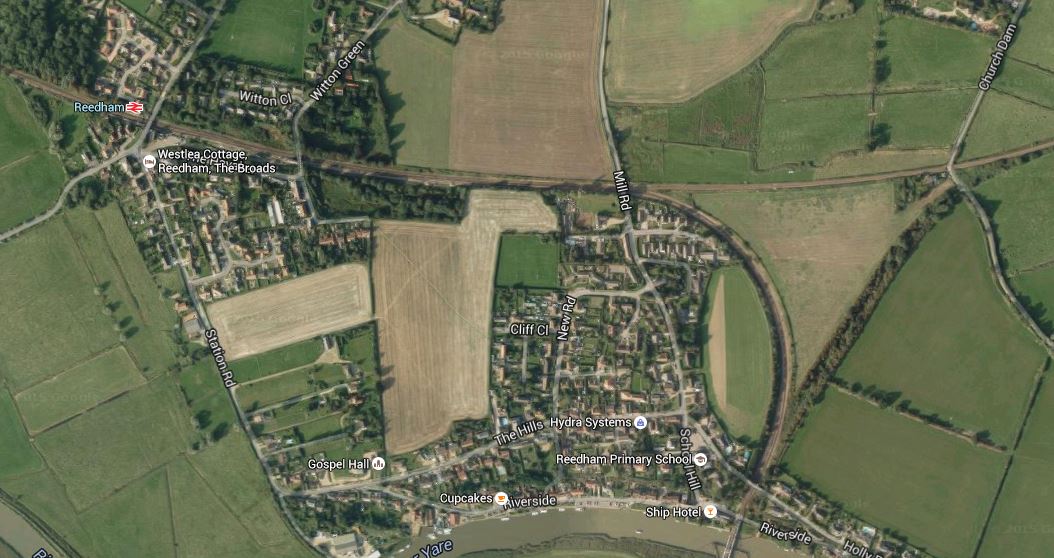 Norwich is to the West, Yarmouth to the North East and Lowestoft is to the South.
Despite being removed in 1880, the line of the third side of the junction is still visible.
But there is opposition as this article in the Great Yarmouth Mercury details. Perhaps, the locals don’t want any more housing?
The article mentions a cost of a billion pounds, which would make it a no-no! However the Todmorden scheme cost less than ten million pounds for a similarly-sized curve.
Currently, the fastest Lowestoft to Yarmouth journey takes about eighty minutes with a change at Norwich.
But these timings are also possible.
- Reedham to Yarmouth – 16 minutes
- Reedham to Lowestoft – 26 minutes
I suspect canny locals know that some trains connect well, so do the trip in under an hour.
It would appear though that if the Reedham chord was relaid, that Yarmouth to Lowestoft could be achieved in about fifty minutes.
I suspect that even if the Reedham Chord is not relaid, Greater Anglia may have plans to incorporate this service into the pattern of trains on the Wherry Lines.
They’ve certainly even got enough trains to run a shuttle using a three-car Class 755 train between Lowestoft and Yarmouth with a reverse at Reedham station.
An hourly service would need only one train.
Norwich To Stansted Airport
Greater Anglia have said that this new hourly service will replace the current service from Norwich to Cambridge on the Breckland Line.
Consider.
- Norwich to Cambridge takes 70 minutes, which is probably timed for 75 mph trains.
- Cambridge to Stansted Airport takes 30 minutes
- Trowse bridge at Norwich, is a major bottleneck on all trains connecting Norwich to the South and it may be improved or replaced. I wrote about Trowse Bridge in Is This The Worst Bottleneck On The UK Rail Network?
- Some sections of the line are electrified.
Would a round trip be possible in three hours?
This would need three trains for an hourly service and six trains for a two tph service.
When this hourly service is combined with services from other operators, there will be two tph from Norwich to Stansted Airport.
So I suspect only one tph will be needed on this route.
To summarise, the current hourly service would need three trains.
Ipswich To Lowestoft
Currently, this is an hourly service, that takes a few minutes under an hour and a half with nine stops.
Looking at the timetable for the 11:17 from Ipswich, the various sections of the journey take.
- Ipswich to Lowestoft – 86 minutes
- Turnround at Lowestoft – 24 minutes
- Lowestoft to Ipswich – 89 minutes
- Turnround at Ipswich – 41 minutes
Which gives a round trip time of four hours.
This is from the Wikipedia entry for the East Suffolk Line and describes the infrastructure.
The line is double-track from Ipswich to Woodbridge and from Saxmundham to Halesworth with the rest of the route being single track, apart from a short passing loop at Beccles. The line is not electrified, has a loading gauge of W10 between Ipswich and Westerfield and W6 for all other sections, and a line speed of between 40-55 mph.
Also note the following.
- The current four hour round trip means that four trains are needed for the service.
- Up and down trains pass at XX:25 at Beccles station and at XX:54-57 at Saxmundham station.
- The turnround times at Ipswich and Lowestoft are long, so that the timetable works and the trains can pass at Beccles and Saxmundham.
Given some track improvements, removal of a couple of level crossings and some clever timetabling, I suspect that the Class 755 trains could probably travel between Ipswich and Lowestoft in around an hour. Greater Anglian would like that for marketing reasons.
Turning these trains in thirty minutes would give a three hour round trip and reduce the number of trains required to three.
The real benefit comes if the line could be upgraded such that the Class 755 trains could do the round trip in two hours, which would reduce the number of trains required to two.
I suspect that there is extensive work being done to find a method to get a time of under an hour between Ipswich and Lowestoft.
When they’ve cracked that problem, they’ll probably move on to increasing the services on the line to two tph.
If they can crack both problems, two tph between Ipswich and Lowestoft running in around an hour, would need just four trains.
To summarise, the current hourly service would need three trains, but a much more customer-friendly fwo tph would need four trains.
When the Lowestoft to London service is introduced, this will probably be a single morning train to London and an evening train back. This would need an additional train.
Ipswich To Felixstowe
Currently, the service is hourly and a single train does a round trip in an hour.
The track is being improved and I’m fairly sure that two tph are possible, which would need two trains.
To summarise, the current hourly service would need a single train, but a much more customer-friendly two tph would need two trains.
Ipswich to Cambridge
Currently, the service is hourly and a single train does a round trip in three hours.
Note the following.
- Three trains are needed to run the hourly service.
- The current three-car trains can get very crowded.
- Some sections of the line are electrified.
- Haughley Junction is going to be improved.
I feel that the Ipswich to Cambridge time can be reduced to under an hour by the new trains.
This would have the following effects.
- Reduce the number of trains required for an hourly service to two trains.
- It might be possible to run a two tph service with four trains.
I suspect that two tph all the way from Cambridge to Ipswich may not be needed, as Greater Anglia’s proposed timetable includes two tph between Ipswich and Bury St. Edmunds and the proposal was developed before Cambridge North station threw a new big and important station into the mix.
Consequently, we could see something very different at the Cambridge end of the route.
Perhaps an hourly service between Cambridge, Cambridge North, Ely and Bury St. Edmunds, needing perhaps two trains.
To summarise, the current hourly service would need two trains, but a much more customer-friendly Western end would need perhaps two extra trains.
Improvements At Ipswich Station
Ipswich station will need extra platform capacity to handle extra services to Cambridge, Felixstowe and Lowestoft.
Colchester Town To Sudbury
Greater Anglia have said that this new route will replace the current service on the Gainsborough Line.
Current timings on this route are.
- Colchester Town to Marks Tey – 14 minutes
- Marks Tey to Sudbury – 20 minutes
- Turnround at Sudbury – 5 minutes
- Audbury to Marks Tey -19 minutes
- Marks Tey to Colchester Town – 16 minutes.
- Turnround at Colchester Town – 5 minutes
This gives a round trip of 79 minutes, with a Marks Tey to Marks Tey time of 44 minutes.
Note the following.
- One train would be needed to run an hourly service, if the round trip could be reduced between an hour.
- Some sections of the line are electrified.
- The Gainsborough Line has an operating speed of 50 mph.
- A new platform will be needed at Colchester Town station.
I think is is highly likely that the Class 755 train will be able to do the round trip in under an hour.
If the time spent on the branch could be reduced to under thirty minutes, then two tph on the route are possible, which would need two trains.
To summarise, the current hourly service would need one train, but a much more customer-friendly two tph would need two trains.
Colchester To Peterborough
Greater Anglia have said that this new hourly service will replace the current service from Ipswich to Peterborough.
Current timings on this route are.
- Colchester to Ipswich – 20 minutes
- Ipswich to Peterborough – 99 minutes
A round trip should be possible in four hours.
Note the following.
- Four trains would be needed to run an hourly service, if the round trip could be under four hours.
- Some sections of the line are electrified.
If this service could be run at two tph, this would need eight trains.
I doubt two tph would be needed, as other trains and operators shadow the route.
To summarise, the proposed hourly service would need four trains.
Summary Of Class 755 Train Services
This is a summary of the current and proposed routes, with their frequencies and the trains needed
- Norwich to Yarmouth – Hourly needs one train.
- Norwich to Sheringham – Hourly needs two trains.
- Norwich to Lowestoft – Hourly needs two trains.
- Lowestoft to Yarmouth – Hourly needs one train.
- Norwich to Stansted Airport – Hourly needs three trains.
- Ipswich to Lowestoft – Hourly needs three trains.
- Lowestoft to London – One train per day would need one train.
- Ipswich to Felixstowe – Hourly needs one train.
- Ipswich to Cambridge – Hourly needs two trains.
- Colchester Town to Sudbury – Hourly needs one train.
- Colchester to Peterborough – Hourly needs four trains.
This is a total of twenty-one trains, which is less than the current number of trains running the service.
The reduction in trains needed is because of the following.
- Class 755 trains are 100 mph trains and the timetable is written for 75 mph trains.
- Class 755 trains will be able to stop at a station quicker than current trains.
- Class 755 trains can take advantage of electrification where it exists.
Three- or four-car trains can be scheduled according to traffic needs.
In my analysis, I added what I thought would be more customer-friendly services.
- Norwich to Yarmouth – Four tph needs four trains.
- Norwich to Sheringham – Two tph needs four trains.
- Norwich to Lowestoft – Two tph needs two trains.
- Lowestoft to Yarmouth – Hourly needs one train.
- Norwich to Stansted Airport – Hourly needs three trains.
- Ipswich to Lowestoft – Two tph needs four trains.
- Lowestoft to London – One train per day would need one train.
- Ipswich to Felixstowe – Two tph needs two trains.
- Ipswich to Cambridge – Hourly needs two trains. Plus two trains to shuttle around Cambridge, Ely and Bury St. Edmunds.
- Colchester Town to Sudbury – Two tph needs two trains.
- Colchester to Peterborough – Hourly needs four trains.
This is a total of thirty-one trains, which is still below the total number of thirty-eight trains.
Greater Anglia probably won’t expand services in the way I have suggested, but consider the following.
- They have a flexible fleet with both three- and four-car Class 755 trains.
- They are the dominant passenger operator.
- Norwich and Cambridge stations have good platform capacity and Ipswich can be improved.
- Most of the signalling and track is in excellent condition.
This would enable train services to be increased as required.
There would also be trains available for new services such as.
- Cambridge to Wisbech.
- Ipswich to Aldeburgh
I could even envisage a Bury St. Edmunds to London service, that splits and joins with the Lowestoft to London service at Ipswich station.
Greater Anglia have planned well.
Infrastructure Required
The infrastructure required to run all these trains includes
- The Wherry Lines are being resignalled, This may not be needed, but it will certainly make things easier.
- Some platforms may need to be lengthened.
- Ideally, all the station platforms will be adjusted so that their height fits the Class 755 trains.
- The Reedham Chord may be reinstated to allow direct Lowestoft to Yarmouth services.
- Track improvements might night be needed on the Esst Suffolk Line.
- Ipswich station will need extra platform capacity to handle extra services to Cambridge, Felixstowe and Lowestoft.
- Colchester Town will need a second platform for the service to Sudbury.
No electrification is required, although to perhaps extend the wires for a few hundred metres in a few places might ease operation.
- From Norwich to where the Bittern and Wherry Lines divide.
- From Ipswich to where the East Suffolk and Felixstowe Lines divide.
- At Marks Tey along the Gainsborough Line.
This will allow the Class 755 trains to run on electricity for longer.
Conclusion
I’m probably very wide of mark, but iI do feel there is scope with the large number of Class 755 trains ordered by Greater Anglia to improve trains in East Anglia by a large amount.
 The Anonymous Widower