What Will Be The Fastest Times Possible Between London King’s Cross And Leeds?
According to media reports, it is likely that the Eastern Leg of High Speed Two will be scrapped on kicked into the long grass.
So out of curiosity, what times can be achieved between London King’s Cross and Leeds.
Wikipedia says this about digital signalling on the line.
Increasing maximum speeds on the fast lines between Woolmer Green and Dalton-on-Tees up to 140 mph (225 km/h) in conjunction with the introduction of the Intercity Express Programme, level crossing closures, ETRMS fitments, OLE rewiring and the OLE PSU – est. to cost £1.3 billion (2014). This project is referred to as “L2E4” or London to Edinburgh (in) 4 Hours. L2E4 examined the operation of the IEP at 140 mph on the ECML and the sections of track which can be upgraded to permit this, together with the engineering and operational costs.
Note.
- Woolmer Green is 23.8 miles North of King’s Cross and a short distance to the North of the Digswell Viaduct.
- Dalton-on-Tees is North of Doncaster, where the line to Leeds leaves the East Coast Main Line.
The 186 mile journey to Leeds can be broken down into these sections.
- King’s Cross and Woolmer Green – 23.8 miles – 16 minutes – 89.3 mph
- Woolmer Green and Doncaster – 132.2 miles – 85 minutes – 93.3 mph
- Doncaster and Leeds – 29.9 miles – 32 minutes – 56 mph
In Will Avanti West Coast’s New Trains Be Able To Achieve London Euston and Liverpool Lime Street In Two Hours?, I estimated that each stop in an electric Hitachi Class 802 train takes eight minutes, which includes six minutes accelerating and decelerating and a two minute dwell time in the station.
- Services between London Euston and Leeds typically stop three times, so this means there are four acceleration/deceleration cycles, if you add in the one split between London Kings Cross and Leeds.
- There are also three dwell times of perhaps two minutes in the intermediate stations.
- This would mean that a total of thirty minutes must be added to calculate the journey time.
If the train averaged these speeds over 186 miles, the following times would be achieved.
- 125 mph – 89 minutes
- 130 mph – 86 minutes
- 140 mph – 80 minutes
- 150 mph – 74 minutes
- 160 mph – 70 minutes
Adding in the thirty minutes for stops gives some reasonable timings for between London King’s Cross and Leeds.
There are ways that times could be reduced.
Removal Of Level Crossings
This course of action always brings results, but is hated by the local users.
This article in The Times is entitled HS2 Eastern Leg To Leeds Axed, where there is said.
The government’s long-awaited Integrated Rail Plan also commits to full electrification of the Midland Main Line from London St Pancras to Sheffield, as well as upgrades to the East Coast Main Line. The Times understands this includes removing level crossings, which will help reduce journey times.
Every little helps!
More Running At Higher Speeds
From my figures, it appears that roughly a ten mph increase in average speed reduces journey time by up to six minutes.
So the more running at 140 mph or even faster the better.
It should be noted that the Selby Diversion on the East Coast Main Line was designed by British Rail for 160 mph The Wikipedia entry says this.
The line was the first purpose-built section of high-speed railway in the UK having a design speed of 125 mph; however, research by British Rail in the 1990s indicated that the route geometry would permit up to 160 mph operation, subject to the necessary overhead line equipment and signalling upgrades.
Upgrading the line for higher speeds would be a way of reducing the journey time.
- Curves could be better profiled.
- Full digital signalling with perhaps even some degree of automatic control could be introduced.
- More robust overhead line equipment could be installed.
- Some sections of slab track could be laid.
- Level crossing removal.
I wouldn’t be surprised if one of the new Hitachi trains within a few years could be able to average 140 mph between London King’s Cross and Leeds, with a possible 160 mph average speed in the future.
Faster Acceleration And Deceleration
If the three-minute acceleration and deceleration times can be reduced to two minutes this will save eight minutes on the journey.
Quicker Dwell Times
Why not?
Automatic Train Control Through The Newark Crossing
I proposed this in Could ERTMS And ETCS Solve The Newark Crossing Problem? and I believe it would allow trains on the East Coast Main Line at full speed if they didn’t stop at Newark station.
Automatic Train Control Over The Digswell Viaduct And Through The Welwyn North Station
As at the Newark Crossing, I believe ERTMS and ETCS could increase speeds over the Digswell Viaduct and through Welwyn North station.
High-Speed Two Classic Compatible Trains
These faster trains could bring the time down further, if they were to run the service.
Sample Times
I wouldn’t be surprised to see with full digital signalling and a 125 mph average between London King’s Cross and Leeds.
- 125 mph Base Time – 89 minutes.
- Four Acceleration/Deceleration section at 6 minutes each – 24 minutes.
- Three Dwell Times at 2 minutes each – 6 minutes
This would mean a total time of one hour and 59 minutes.
Uprate that to 140 mph and faster acceleration and deceleration.
- 140 mph Base Time – 80 minutes.
- Four Acceleration/Deceleration section at 4 minutes each – 16 minutes.
- Three Dwell Times at 2 minutes each – 6 minutes
This would mean a total time of one hour and 42 minutes.
Uprate that to 160 mph and faster acceleration and deceleration.
- 160 mph Base Time – 70 minutes.
- Four Acceleration/Deceleration section at 4 minutes each – 16 minutes.
- Three Dwell Times at 2 minutes each – 6 minutes
This would mean a total time of one hour and 32 minutes.
A Non-Stop Service
This would speed up the service.
With a 125 mph average between London King’s Cross and Leeds.
- 125 mph Base Time – 89 minutes.
- One Acceleration/Deceleration section at 6 minutes each – 6 minutes.
This would mean a total time of 95 minutes.
Uprate that to 140 mph and faster acceleration and deceleration.
- 140 mph Base Time – 80 minutes.
- One Acceleration/Deceleration section at 4 minutes each – 4 minutes.
This would mean a total time of 84 minutes.
Uprate that to 160 mph and faster acceleration and deceleration.
- 160 mph Base Time – 70 minutes.
- One Acceleration/Deceleration section at 4 minutes each – 4 minutes.
This would mean a total time of 74 minutes.
These compare with a proposed time of one hour and 21 minutes on the original plan to High Speed Two.
Conclusion
It looks like a non-stop service between London and Leeds running at 140 mph, with perhaps some sections at perhaps a bit faster, could be able to match the High Speed Two times.
How Feasible Is A High Speed Line Between Birmingham And Nottingham?
In Red Wall Commuters To Get Rail Revolution, I indicated that the Department of Transport is considering creating three new high speed lines in the Midlands and the North of England.
One is proposed between Birmingham and East Midlands Parkway, which is described in the original article in The Sunday Times like this.
A 42-mile line from Birmingham to East Midlands Parkway, just south of Nottingham. This is expected to cut journey times between the two cities from 72 minutes to 27 minutes.
There is a currently, a CrossCountry service between Nottingham and Birmingham New Street stations.
- The frequency is two trains per hour (tph)
- Trains are generally three- or four-car formations of Class 170 diesel trains.
- All trains stop at Tamworth, Burton-on-Trent and Derby.
- Some trains stop at Wilnecote, Willington, Spondon, Long Eaton and Beeston
- The services take upwards of seventy-one minutes.
Note.
- The frequency between Birmingham New Street and Derby is four tph.
- Trains reverse at Derby which takes seven minutes.
- Three tph stop at Burton-on-Trent.
I feel that the current service is very much a compromise, which is trying to handle three services.
- A fast train between Birmingham and Nottingham.
- A fast train between Birmingham and Derby.
- A local service between Nottingham and Derby.
High Speed Two will be providing a non-stop service between Birmingham Curzon Street and East Midlands Hub stations.
- The frequency will be three tph.
- There will also be an hourly train between Birmingham Interchange and East Midlands Hub station.
- The services will take twenty minutes or slightly less from Interchange.
The services will only get you to East Midlands Hub station.
In addition after High Speed Two opens Midlands Connect are planning to run a direct service between Nottingham and Birmingham Curzon Street stations.
- The frequency will be one tph.
- The service will use High Speed Two Classic Compatible trains.
- The only stop will be East Midlands Hub station.
- The service will take thirty-three minutes.
So how does a new high speed line connect Birmingham and Nottingham in twenty-seven minutes?
Consider.
- The route between Birmingham New Street and North Stafford Junction is 35.9 miles
- At North Stafford junction a double-track freight line leads to the East.
- The freight line passes to the North of East Midlands Airport and South of Long Eaton station before joining the Midland Main Line at Trent junction to the North of East Midlands Parkway station.
- Trains can pass straight into Nottingham via Beeston.
- Nottingham is just 6.7 miles to the East of Trent junction and East Midlands Parkway is just a mile South of Trent junction.
- South Stafford junction to Trent junction is probably about seven miles.
I believe that this is the route that will be upgraded to create a high speed line between Birmingham and Nottingham.
- Part of the route between Tamworth and Burton-on-Trent was upgraded to 125 mph running by British Rail.
- Between Birmingham New Street and North Stafford Junction is used by CrossCountry services between Birmingham and Derby and Nottingham.
- I believe that the route can be fully electrified and upgraded, so that most of the route could be suitable for 125 mph running.
- The Midland Main Line is already capable of handling trains at 125 mph.
This should make it possible for services to run between Birmingham New Street and Nottingham in the required twenty-seven minutes.
I will answer a few questions.
Could The Trains Serve Birmingham Curzon Street In Birmingham?
In Birmingham Airport Connectivity, I said this
But look at this map clipped from the High Speed Two web site.
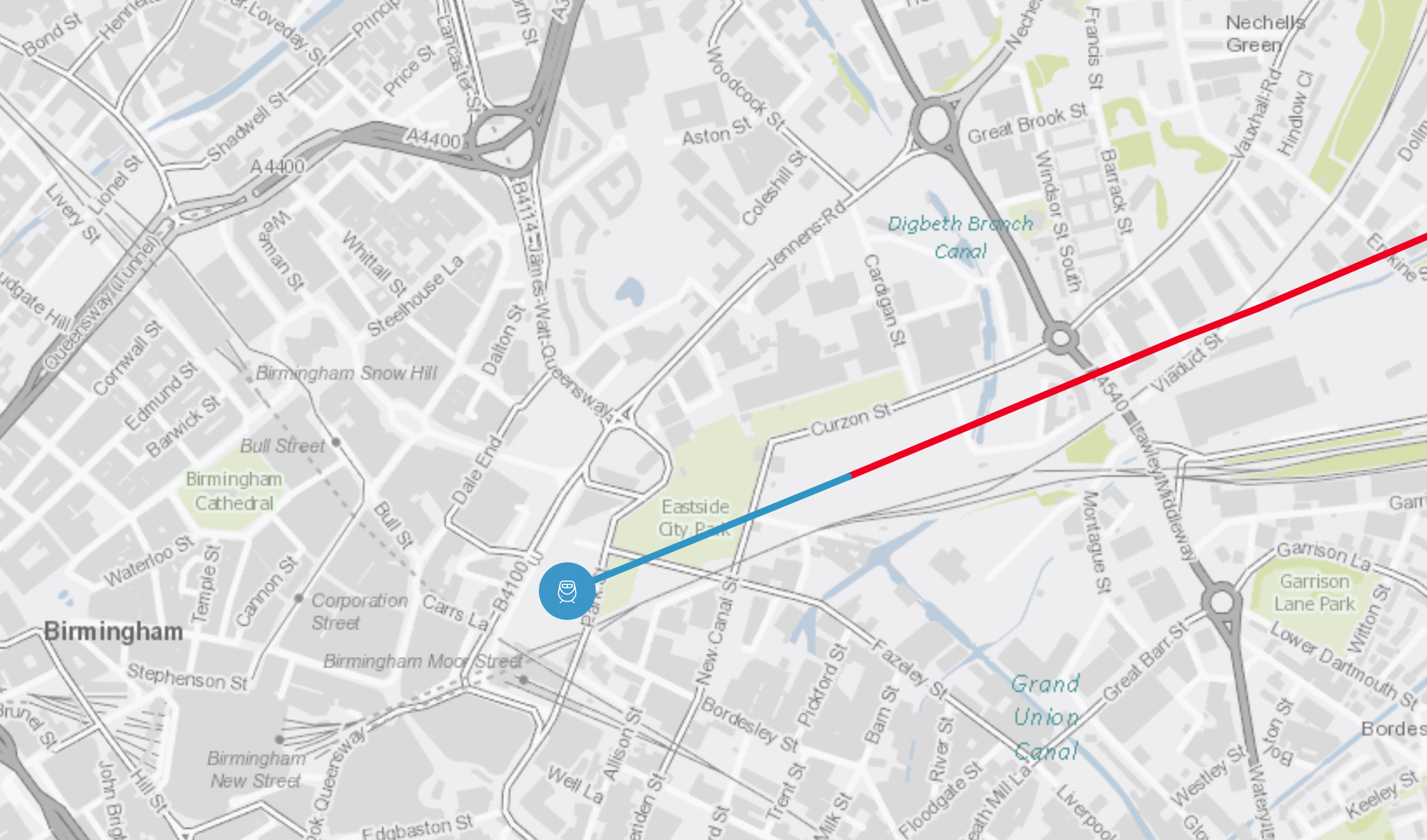
Note.
- The blue dot shows the location of Curzon Street station.
The West Coast Main Line running into New Street station, is just to the South of Curzon Street station.
New Street station can be picked out to the West of Curzon Street station.
This Google Map shows a close-up of the current Curzon Street station site.
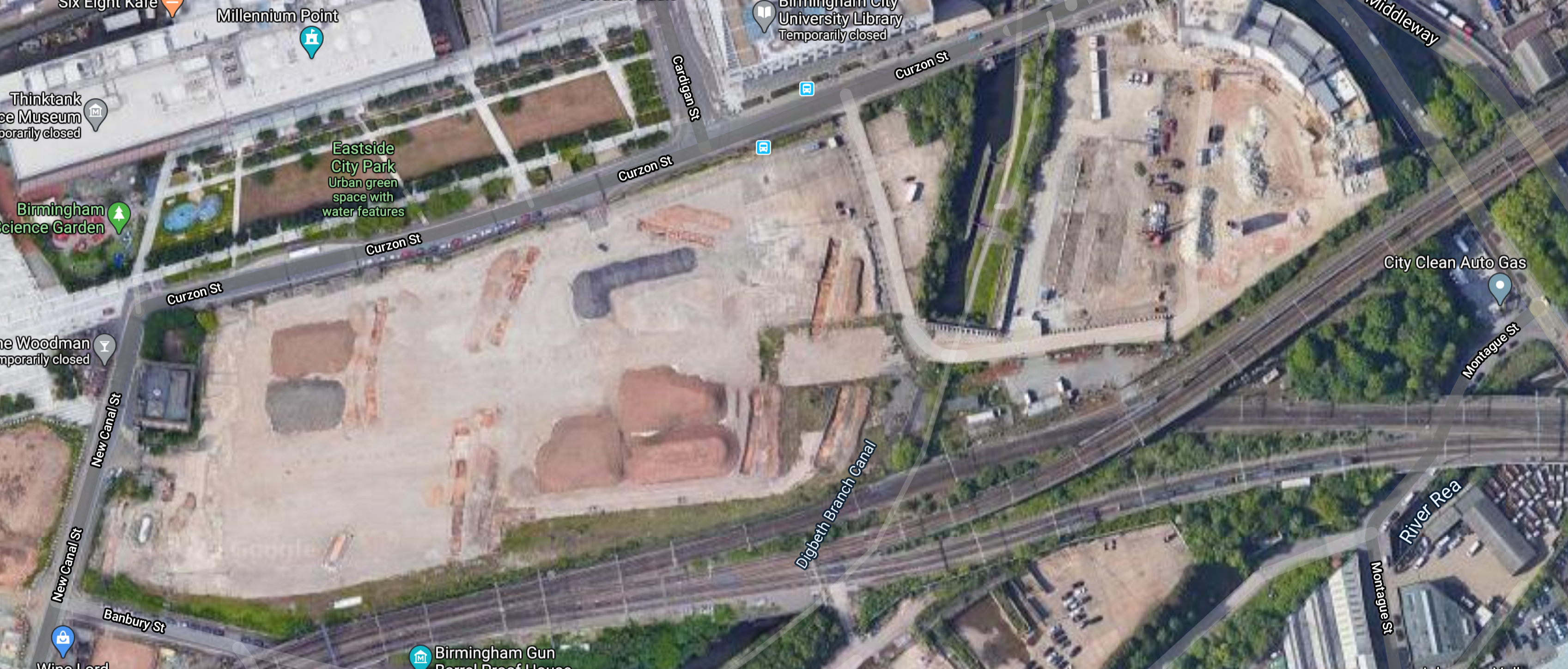
The same pattern of rail lines going past the Curzon Street site into New Street station can be picked out.
Surely, a connection could be made to allow trains from a couple of platforms in Curzon Street station to terminate trains from the West Coast Main Line.
Possible services could include.
- London Euston and Birmingham Curzon Street via Watford Junction, Milton Keynes, Rugby and Coventry
- Cardiff and Birmingham Curzon Street via Bristol Parkway, Swindon, Oxford and Milton Keynes.
- Cambridge and Birmingham Curzon Street via Bristol Parkway, Bedford and Milton Keynes.
There are a lot of possibilities to give High Speed Two much bigger coverage.
I also suspect that the proposed Nottingham and Birmingham service could terminate in Birmingham Curzon Street.
Could High Speed Two Classic Compatible Trains Run Between Birmingham And Nottingham?
As High Speed Two Classic Compatible Trains would have the same loading gauge as current trains, I don’t see why not.
Could A London Euston And Nottingham Service Be Run With A Reverse At Birmingham Curzon Street?
These are prospective times for High Speed Two.
- London Euston and Birmingham Curzon Street – 45 minutes
- London Euston and East Midlands Hub – 52 minutes
Note that East Midlands Hub and Nottingham could take at least twenty minutes.
And this is a current timing.
- London St. Pancras And Nottingham – 95 minutes
It is possible calculate the time for London Euston to Nottingham with a reverse at Birmingham.
- London Euston and Birmingham Curzon Street – 45 minutes
- Reverse at Birmingham Curzon Street – 3 minutes
- Birmingham Curzon Street and Nottingham – 27 minutes
This would give a time of 75 minutes between London Euston and Nottingham.
It does look to me, that the fastest route between London and Nottingham, will be to to go via Birmingham and the proposed new high speed route.
So the answer to the question in the title of this section is a Yes!
Could A London Euston And Sheffield Service Be Run With A Reverse At Birmingham Curzon Street?
These are prospective times for High Speed Two.
- London Euston and Birmingham Curzon Street – 45 minutes
- London Euston and East Midlands Hub – 52 minutes
- London Euston and Sheffield – 87 minutes
And these are current timings.
- London St. Pancras And Derby- 85 minutes
- London St. Pancras And Sheffield- 118 minutes
- Birmingham New Street And Derby- 33 minutes
- Birmingham New Street And Sheffield- 75 minutes
It is possible calculate the time for London Euston to Sheffield with a reverse at Birmingham.
- London Euston and Birmingham Curzon Street – 45 minutes
- Reverse at Birmingham Curzon Street – 3 minutes
- Birmingham Curzon Street and Sheffield – 75 minutes
This would give a time of 123 minutes between London Euston and Sheffield.
I wonder what time could be achieved between London Euston and Sheffield could be achieved with improvements to the following lines.
- The CrossCountry Route between North Stafford junction and Derby station.
- The Midland Main Line between Derby and Sheffield.
I would expect that the improvement to these routes would include.
- At least almost full electrification.
- Removal of level crossings.
- Full digital signalling.
- Upgrading to 140 mph running.
I could see the following service improvements.
- A substantial reduction of the times between Birmingham and Sheffield.
- Derby and Burton-on-Trent would get a fast service to London Euston via High Speed Two.
- Derby and Burton-on-Trent would get a fast service to Birmingham probably with a frequency of 4 tph.
- CrossCountry services between Birmingham and Sheffield would be faster.
Derby and Burton-on-Trent would get a much better train service.
Could Burton-on-Trent, Derby, Nottingham And Sheffield Be served By Trains Splitting And Reversing At Birmingham Curzon Street?
These are prospective frequencies for High Speed Two.
- Burton-on-Trent – No trains
- Chesterfield 1 tph
- Derby – No trains
- East Midland Hub – 7 tph
- Nottingham – 0 tph
- Sheffield – 2 tph
Suppose there were two tph between London and Birmingham Curzon Street, that split into two trains in Birmingham.
- One train could go to Nottingham and call at Tamworth and Burton-on-Trent.
- The other train could go to Sheffield and call at Tamworth, Burton-on-Trent, Derby and Chesterfield.
This would give the following frequencies from London on High Speed Two.
- Burton-on-Trent – 2 tph
- Chesterfield – 2 tph
- Derby – 2 tph
- Nottingham – 2 tph
- Sheffield – 2 tph
Note that I am ignoring the Eastern Leg of High Speed Two in this analysis.
Could We Go For The Full Burton?
In the previous sections, I suggested serving Nottingham and Sheffield from Euston using High Speed Two with a reverse at Birmingham Curzon Street, where the train would split into two trains, with one train going to Sheffield and the other going to Nottingham.
But could the split be at a rebuilt Burton station?
Consider.
- Burton station could become an Eastern terminus of Birmingham’s Cross-City Line.
- Burton station could become the Western terminus of the Ivanhoe Line to Leicester.
- If the Cross Country Route is upgraded, Burton station would have fast connections to Birmingham, Derby, Chesterfield, Sheffield and Leeds,
- If the new Birmingham and Nottingham route is created, this would mean fast connections to Nottingham and possibly Lincoln.
Burton-on-Trent could become the passenger rail hub for the Mid Midlands.
I
Red Wall Commuters To Get Rail Revolution
The title of this post, is the same as that of this article on The Sunday Times.
This is the first paragraph.
Nearly £100 billion will be spent on England’s railways outside London, including the construction of three new high-speed lines that will cut journey times in half.
The paper is also predicting that the Birmingham and Leeds leg of High Speed Two will be scrapped.
The three new high speed lines are.
- Birmingham and East Midlands Parkway
- Leeds and Sheffield
- Manchester and Crewe.
I have felt for some time, that timings between London and Yorkshire can be upgraded almost to High Speed Two levels by upgrading the Midland Main and the East Coast Main Lines.
I shall be doing some calculations, when the schemes are announced on Thursday.
HS2 Downsizes Euston Station To Save Costs
The title of this post, is the same as that of this article on Construction Enquirer.
The High Speed Two station at Euston will now have only ten platforms and it will be built in a single construction phase.
These are my thoughts.
Oversite Development
When completed, there will be a lot of development over the top of the new Euston station.
One way or another, this could be a nice little earner for High Speed Two,
- It will be one of the most convenient addresses in London.
- The development could be housing, offices or some innovative commercial property.
- There might even be a large indoor sports or concert arena like the O2.
But whatever gets developed on top of the station, the developer would surely prefer to be handed as large a site as possible in 2026 all in one go.
And the earlier it is handed over, the earlier High Speed Two gets paid.
I do wonder, if a large international property and entertainment group of the highest quality has made the government an offer that is far too good to refuse to build a world class venue on top of the station.
- It would be a very well-connected by public transport and most visitors could come by public transport.
- Surely, if a massive attraction was on top of the station, High Speed Two and all the railways would benefit from the rail ticket revenue.
- The Manchester Arena is over the top of Manchester Victoria station. So why not a Euston Arena?
Euston station, is a site where High Speed Two and developers must be ultra-bold to maximise the return for everyone, including those sceptics, who believe High Speed Two is a waste of money.
The View From Ian
There is an excellent post on Ian Visits which is entitled HS2 to Cut London Euston Station To Ten Platforms.
Some of the following thoughts have been suggested by reading Ian’s post.
Euston Station Must Be Able To Handle Eighteen Trains Per Hour
The main tracks of High Speed Two are being designed to handle eighteen trains per hour (tph) or a train every three minutes and twenty seconds.
The current plan is that when Phase 2 is complete, the High Speed platforms at Euston station will handle seventeen tph, which will leave one path spare for sorting out problems.
With ten High Speed platforms, that would mean that in a busy hour, each platform would handle two tph or a train every thirty minutes.
With the improvements in signalling and track and train design, I would expect that turning trains in Euston at that frequency is possible.
I suspect that High Speed Two and Network Rail have done extensive Monte-Carlo simulations to prove that ten High Speed platforms can handle the required eighteen tph.
Greater Integration Between High Speed Two And Network Rail
In Ian’s post he says this.
In the meantime, HS2 and Network Rail are working on how they can have a greater integration between HS2 and the associated upgrades of the Network Rail side of the station.
Consider.
- The Network Rail station should be able to handle a single 200 metre long Classic-Compatible train at the present time.
- Under current plans four services into the High Speed platforms at Euston station will be single 200 metre long Classic-Compatible trains.
- I wonder if it would be possible to add a crossover to allow High Speed Two trains from the North to enter the Network Rail platforms alongside the High Speed Two platforms.
- If the track layout were possible, this could effectively give High Speed Two ten High Speed platforms and one or even two emergency ones, if required in the Network Rail station.
This Google Map shows Euston station.
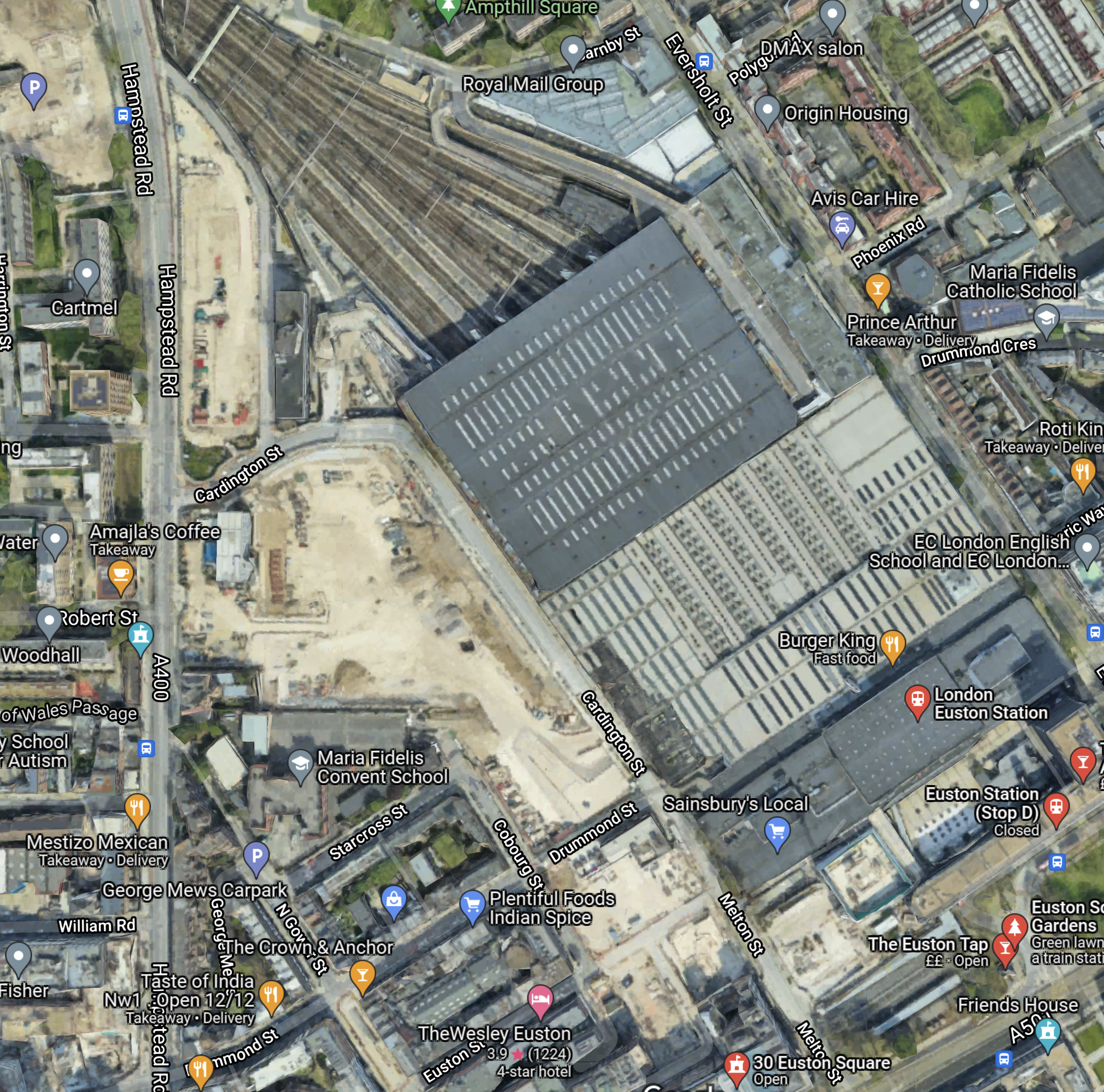
Note.
- The large square building is the current Euston station.
- The building site on the Western side of the station is the High Speed extension, where there will be ten platforms.
- Euston station can take 265 metre long Class 390 trains.
- Platform 1 on the East side of Euston station can take the 355 metre long Caledonian Sleeper.
There certainly would appear to be possibilities to link the two sides of the station to improve operational flexibility.
I wonder if something could be done in Birmingham to improve connectivity.
In Birmingham Airport Connectivity, I said this
But look at this map clipped from the High Speed Two web site.
Note.
- The blue dot shows the location of Curzon Street station.
The West Coast Main Line running into New Street station, is just to the South of Curzon Street station.
New Street station can be picked out to the West of Curzon Street station.
This Google Map shows a close-up of the current Curzon Street station site.
The same pattern of rail lines going past the Curzon Street site into New Street station can be picked out.
Surely, a connection could be made to allow trains from a couple of platforms in Curzon Street station to terminate trains from the West Coast Main Line.
Possible services could include.
- London Euston and Birmingham Curzon Street via Watford Junction, Milton Keynes, Rugby and Coventry
- Cardiff and Birmingham Curzon Street via Bristol Parkway, Swindon, Oxford and Milton Keynes.
- Cambridge and Birmingham Curzon Street via Bristol Parkway, Bedford and Milton Keynes.
There are a lot of possibilities to give High Speed Two much bigger coverage.
Anglesey Hydrogen Can Bridge UK’s Energy Gap Says Economics Expert
The title of this post, is the same as that of this article on the University of Bangor web site.
This is the sub title.
Anglesey can become a UK leader in hydrogen energy technology, cleaning up the transport sector and creating high quality jobs across North Wales, according to a leading Welsh economic expert.
The University of Bangor is a respected university, that goes back to the nineteenth century.
But for Liverpool giving me an unconditional offer, as Bangor was one of the universities on my UCCA form, I could have studied in the North-West corner of Wales.
After a resume of where we are with hydrogen in the world, Dr. Edward Jones of Bangor University outlines how North West Wales can be turned into a hydrogen hub, to join similar hubs at Deeside in Flintshire and at Milford Haven in Pembrokeshire.
This is a paragraph of the article.
Dr Jones believes hydrogen could also hold the key to powering transport in future through a Welsh invention from the 19th century (the hydrogen fuel cell was developed in Swansea by William Grove in 1842).
William Grove was an interesting lawyer and scientist.
Dr. Jones would appear to be very much in favour of using hydrogen to take Wales forward to being zero-carbon in 2050.
I have written a few posts about the transformation of Anglesey and North West Wales, as Wales moves towards this goal. I also have some other thoughts of my own.
Holyhead Hydrogen Hub
This is happening and I wrote about it in Holyhead Hydrogen Hub Planned For Wales.
High Speed Two To Holyhead
I believe this could be a way to create a zero-carbon route between London and Dublin in under five hours and I wrote about it in Could High Speed Two Serve Holyhead?.
- London and Holyhead in a battery-equipped High Speed Two Classic-Compatible train should be under three hours.
- A single High Speed Two Classic-Compatible train would run between London and Holyhead, with a passenger capacity of around five hundred. It would probably split and join with another service at Crewe.
- Discontinuous electrification would be provided along the North Wales Coast Line.
- The trains could call at Old Oak Common, Birmingham Interchange, Chester, Crewe, Llandudno Junction and Bangor.
A High Speed catamaran would speed passengers between Holyhead and Dublin in under two hours.
Hydrogen-Powered Catamarans From Holyhead
The dynamics of a diesel-powered high speed catamaran are well-proven, with some large craft transporting passengers and vehicles on sea crossings all over the world.
Type “hydrogen-powered high speed catamaran” into Google and you get several hits to research and development projects, but no-one appears to have taken a large high speed craft and converted it to hydrogen.
But I do believe that someone somewhere is developing a hydrogen-powered catamaran with something like the following specification.
- 200 passengers
- 100-mile range
- 60 knot operating speed.
The HSC Francisco is a high speed craft that plies between Buenos Aires and Montevideo carrying over a thousand passengers and a hundred cars at 58 knots. It is powered by gas-turbine engines running on liquified natural gas.
I believe I’m not asking for the impossible.
Anglesey Airport As A Zero-Carbon Airport
Anglesey Airport uses part of RAF Valley and has hosted services to Cardiff.
This Google Map shows the runways of RAF Valley.
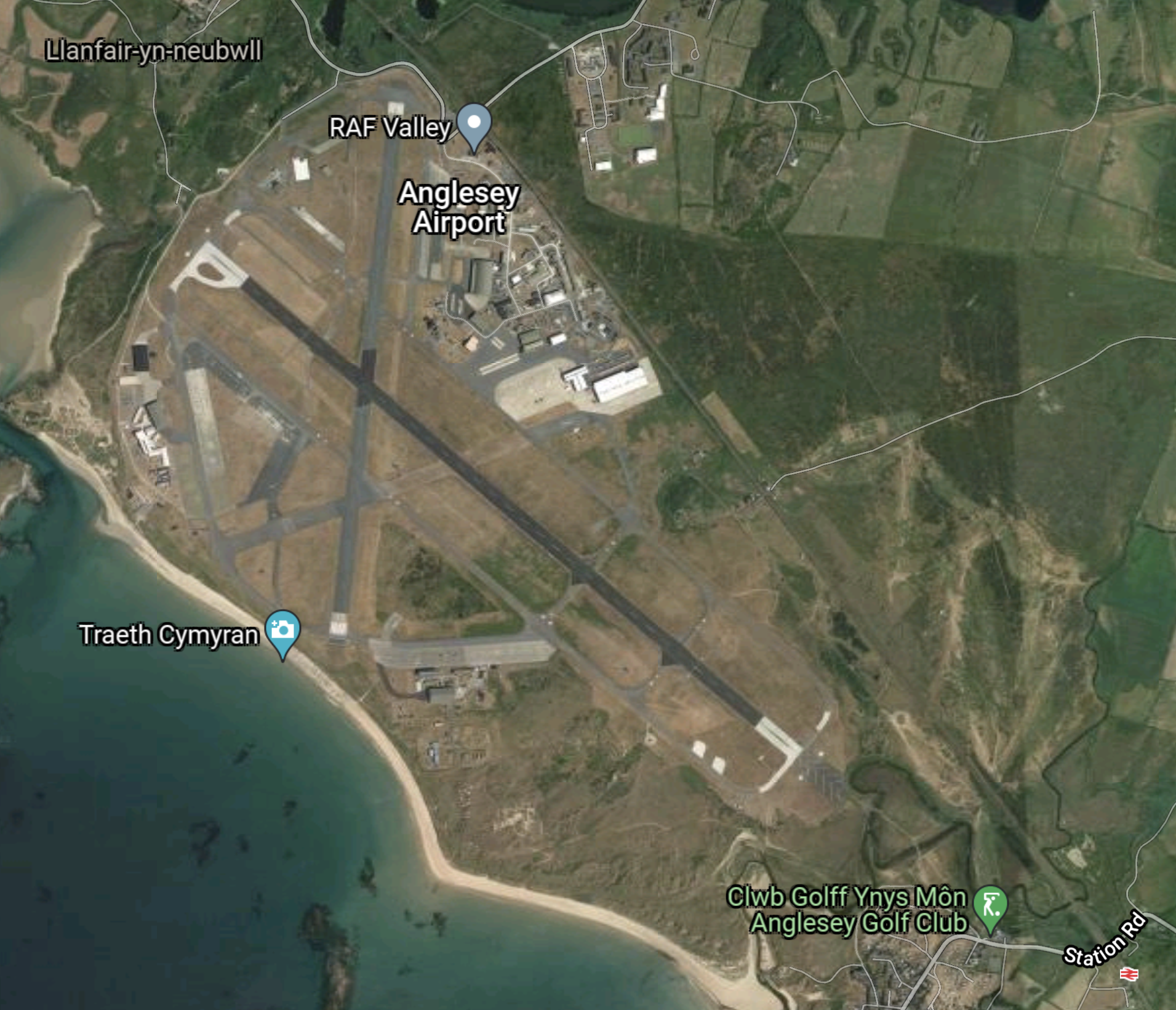
Note.
- The longest runway 14/32 is over two thousand metres long.
- Rhosneigr station in the South East corner of the map.
- The facilities of Anglesey Airport to the North-East of the runways.
The railway forms the border of the airport, as this second Google map shows.
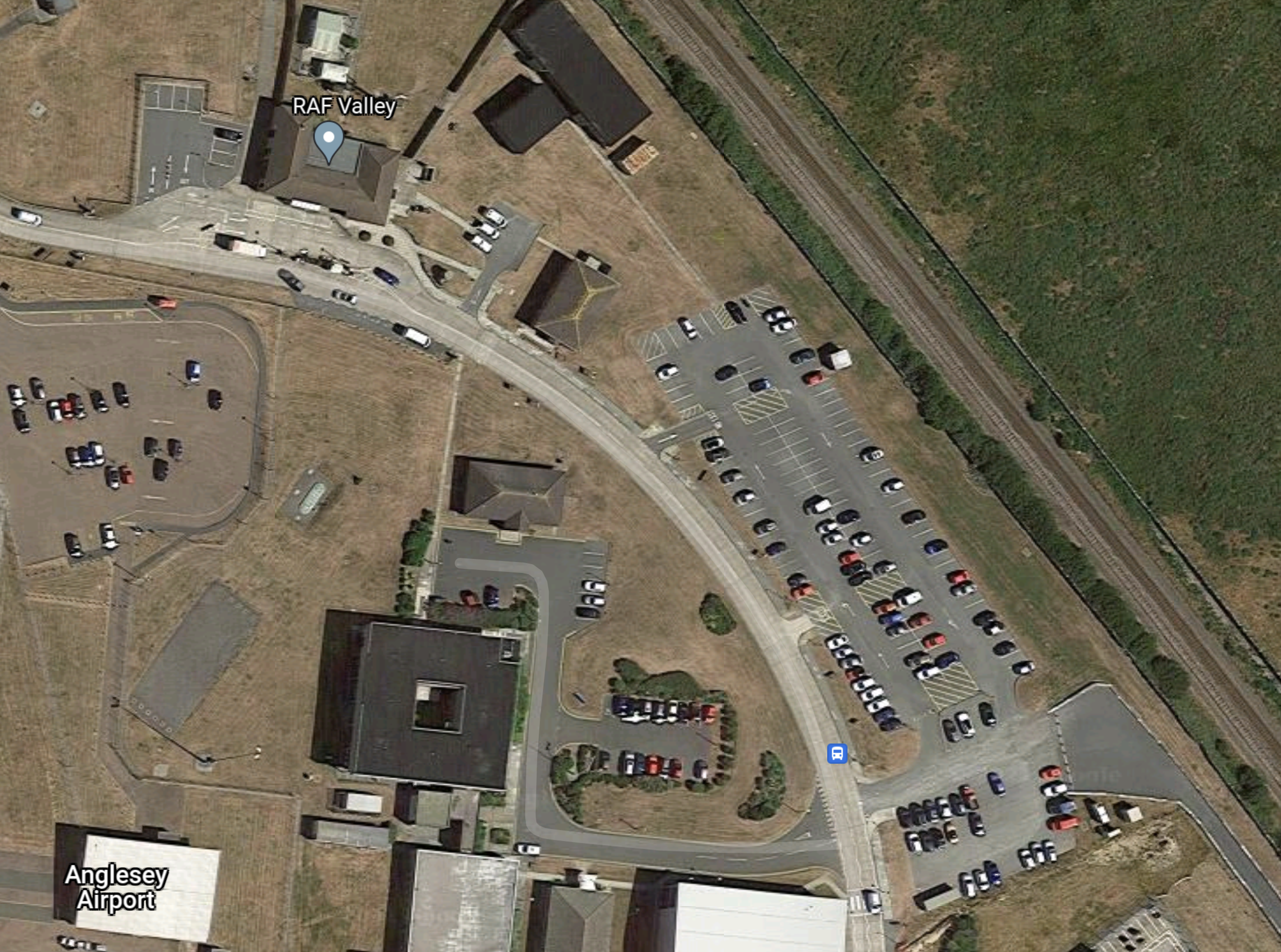
The railway is straight as it passes the Airport and there would be space for a two-hundred metre bi-directional step-free platform for passengers for the Airport.
Airbus are proposing a hydrogen-powered ZEROe Turbofan.

If you think it looks familiar, I believe that Airbus are proposing to develop the aircraft out of the current Airbus A320neo.
- The capacity will be up to 200 passengers.
- The range will be up to 2000 miles.
- Dublin and Anglesey Airports are just 71.5 miles apart.
- The cruising speed of Mach 0.78 would be irrelevant on this route, as it would probably fly a route to minimise noise.
The plane would probably be able to do several trips between Anglesey and Dublin without refuelling.
As the Port of Holyhead is developing a hydrogen infrastructure, I suspect that to provide hydrogen refuelling at Anglesey Airport would be possible.
I believe that by combining hydrogen-powered aircraft with battery-electric trains, some difficult sea crossings can be made carbon-free.
I believe that Anglesey Airport could be key to a zero-carbon London and Ireland service.
- Airbus are also proposing a 100-seat ZEROe Turboprop.
- Belfast, Cork, Derry and Shannon would also be in range.
Flights could also continue to and from Cardiff.
Reopening The Anglesey Central Railway
This has been proposed as a Beeching Reversal project.
I wrote about it in Reopening The Anglesey Central Railway.
It could be reopened as a zero-carbon railway.
Conclusion
There is a lot of scope to use hydrogen in North West Wales and Anglesey.
First Phase Of ‘Transformational’ Darlington Rail Station Upgrade Approved
The title of this post is the same as that of this article on the North East Times.
This upgrade is on the Eastern side of the current station and will include a new entrance, station building, concourse and three new platforms.
This design should allow the following.
- LNER, High Speed Two and other expresses not stopping at the Darlington station to pass through at speeds of up to 125 mph or more.
- Expresses stopping in the station will slow and accelerate in less time than they do now.
- It will probably allow more local trains to Bishops Auckland, Middlesbrough and Saltburn
A seventy-five percent increase in platforms probably offers other advantages.
Results For HS2’s Trial For Alternative Fuels Set To Cut Carbon Released
The title of this post, is the same as that of this article on Rail Technology Magazine.
This paragraph sums up the results.
Although the results demonstrated partial air quality benefits, when compared to red diesel, the trial showed possible carbon reduction opportunities via the sustainable sourcing of alternative fuels.
It looks like, there will be benefits from swapping from red diesel.
Thoughts On Splitting The Northern Line
In Battersea Power Station Station Opens, I talked about the scale of the new Battersea Power Station station.
- It looks like it could have three entrances.
- It’s got four escalators and two lifts to go to down to platform level.
- It has two terminal platforms.
I feel it has been designed to handle as many passengers and trains as Morden station.
- Morden station has five platforms.
- The station is step-free.
- The station handles ten million passengers per year.
The signalling can handle up to thirty trains per hour (tph) to Morden.
It looks to me that Battersea Power Station station has been designed to be big enough to take half the trains from North London with ease.
The Bank Station Upgrade
In the Bank Station Upgrade, nearly a mile of new train tunnel and several shorter pedestrian tunnels were built.
They were dug not with a tunnel boring machine, but by traditional methods, that would have been understood by Brunel and the ancient Egyptians; pick and shovel, but probably assisted by the best modern electrical diggers and trucks.
I would expect that any tunnelling needed to split the Northern Line will not use an expensive tunnel boring machine.
The Northern Line will be going back to the future.
The Proposed Split
There has been talk of splitting the Northern Line into two separate lines for some years.
- The Western Line (Charing Cross Line) would run between Edgware and Battersea Power Station via Camden Town, Euston, Charing Cross and Kennington.
- The Eastern Line (Bank Line) would run between High Barnet and Morden via Camden Town, Euston, Bank and Kennington.
Note.
- I will call the two lines the Bank and Charing Cross Lines.
- Both lines could have Victoria Line frequencies of at least thirty tph.
- It is generally felt that the split would need a rebuild at Camden Town station to handle the extra passengers.
- Camden Town station also needs better access between the trains and the street.
- There would need to be better connections at Kennington and Euston stations.
Surely, the main advantages of the split would be as follows.
- Trains on both lines would go end-to-end without crossing a junction, where signals and points were constantly switching trains. This is why the Victoria Line can handle more than thirty-three tph.
- Trains will run at Victoria Line frequencies on both lines.
- All trains at Camden Town and Kennington stations would use a route without points to go as fast as possible through the station.
- Eliminating the points, would make both lines more reliable.
- Euston station will have upwards at least sixty tph connecting it to Crossrail.
Effectively, the new Bank and Charing Cross Lines would be able to perform just like Dear Old Vicky.
I will now look at where work needs to or could be done to successfully split the two lines.
Kennington Station
In Could Access Between Platform And Train Be Improved At Kennington Station?, I outlined how passengers might use Kennington station to change between the Bank and Charing Cross Lines.
I developed this rule.
The rule would appear to be if you’re on one line and are going to a station on the other, you change at Kennington station.
Staff would need to be on the platform to help those, who were changing direction.
But I do think changing can be made to work well with step-free access between train and platform on all four platforms at Kennington station.
It will be interesting to see, what proportion of train changes at Kennington are simple cross-platform changes, where there is no use of the steep stairs. I think it could be quite high.
I believe Kennington station will grow into a very smooth interchange between the Bank and Charing Cross Lines.
Although, there’ll be a problem for some time, if you’re in a wheelchair and want to go between Morden and Battersea Power station.
This could be solved by lifts between each pair of platforms and the intermediate level passage, which connects to the lifts to the surface.
The Camden Town Problem
This map from cartometro.com shows the lines around and through Camden Town station.

Note.
- Camden Town station has four platforms.
- The Eastern pair are under Kentish Town Road and connect to High Barnet in the North.
- The Western pair are under Camden High Street and connect to Edgware in the North.
- In each pair of tracks the Northbound track is above the Southbound track.
- There is a level passage between the two Northbound tracks, so it is an easy interchange, if you’re on the wrong train going North.
- The passage between the two Southbound tracks has stairs at either end, if you want to change Southbound trains at the station.
But the real problem lies South of the station; the horrendously complicated Camden Town Junction.
The junction must be able to handle trains going between the following stations.
- Bank and Edgware
- Bank and High Barnet
- Charing Cross and Edgware
- Charing Cross and High Barnet
Note in the map, that the High Barnet tracks dive under the Edgware tracks so they can form two separate pairs of tracks to Euston, only one of which goes via Mornington Crescent.
If there was a similar junction on the motorways of the UK or the Interstate Highways of the US, it would have years ago been simplified.
The split will mean the following.
- The Eastern pair of platforms will still be connected to High Barnet as now, but will also be directly connected to the tracks that go directly to Euston and on to Bank.
- The Western pair of platforms will still be connected to Edgware as now, but will also be directly connected to the tracks that go to Euston via Mornington Crescent and on to Charing Cross.
- Camden Town Junction could be seriously simplified, with perhaps the ability to swap between routes only available for depot and engineering movements.
I do suspect, it would also mean all trains from High Barnet will go via Bank and all trains via Edgware will go via Charing Cross.
- A proportion of passengers would have to change at Camden Town.
- Both routes would connect to High Speed Two at Euston.
- Both routes connect to the Central, Jubilee, Piccadilly and Victoria Lines.
- Improvements promised for Euston will give better access to the Sub-Surface Lines.
I think it will be a case of winning some good routes and losing others. Disgusted from Finchley might complain.
But then there will be Crossrail, which as it connects to both lines at Tottenham Court Road and Moorgate could give serious advantages.
The split isn’t without passengers who will object to losing their preferred route.
Camden Town Station
This document on TfL’s web site gives more details of the proposed capacity upgrade at Camden Town station. This schematic of the tunnels, platforms and walkways shows how the station could look in a few years time.
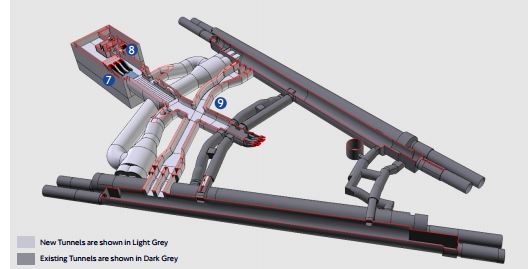
Note.
- New tunnels are shown in light grey.
- Existing tunnels are shown in dark grey.
- The Northbound platforms are above the Southbound ones.
- The tunnels in the foreground are those of the Charing Cross Line.
- The far tunnels are those of the Bank Line.
- The new Buck Street entrance is labelled 8.
- There is a new pedestrian tunnel between the two Northbound Lines.
- Below it is a new tunnel between the two Southbound Lines.
- There is an existing passage linking the four lines.
The full upgrade is very much on the back burner, but could Camden Town station be upgraded with the proposed extra cross passages.
- These would enable passengers to change lines easily on the level.
- Passengers changing between the Bank and Charing Cross Lines could be kept away from the existing escalators and the space at their bottom.
- The tunnels would increase the circulation area.
- The tunnels would be part of the new Buck Street entrance if it were to be built.
I feel with improved cross-platform interchange, Camden Town could function as an interchange station between the Bank and Charing Cross Lines.
A similar rule as I used for Kennington station would apply for passengers.
The rule would appear to be if you’re on one line and are going to a station on the other, you change at Camden Town station.
Staff would need to be on the platform to help those, who were changing direction.
But it would be a more comprehensive and easier interchange than Kennington, as all changes would be without steep stairs.
Once Camden Town station is working well with the new cross passages, I would then get a developer to put a large development on the proposed site of the Buck Street entrance, with a new entrance with lifts and escalators underneath, that reached down to the new cross tunnels.
After what the contractors did at Whitechapel, I suspect this could be achieved, whilst keeping the trains running and leaving the existing Camden Town station intact.
This Google Map shows the area between Camden Road and Camden Town stations.
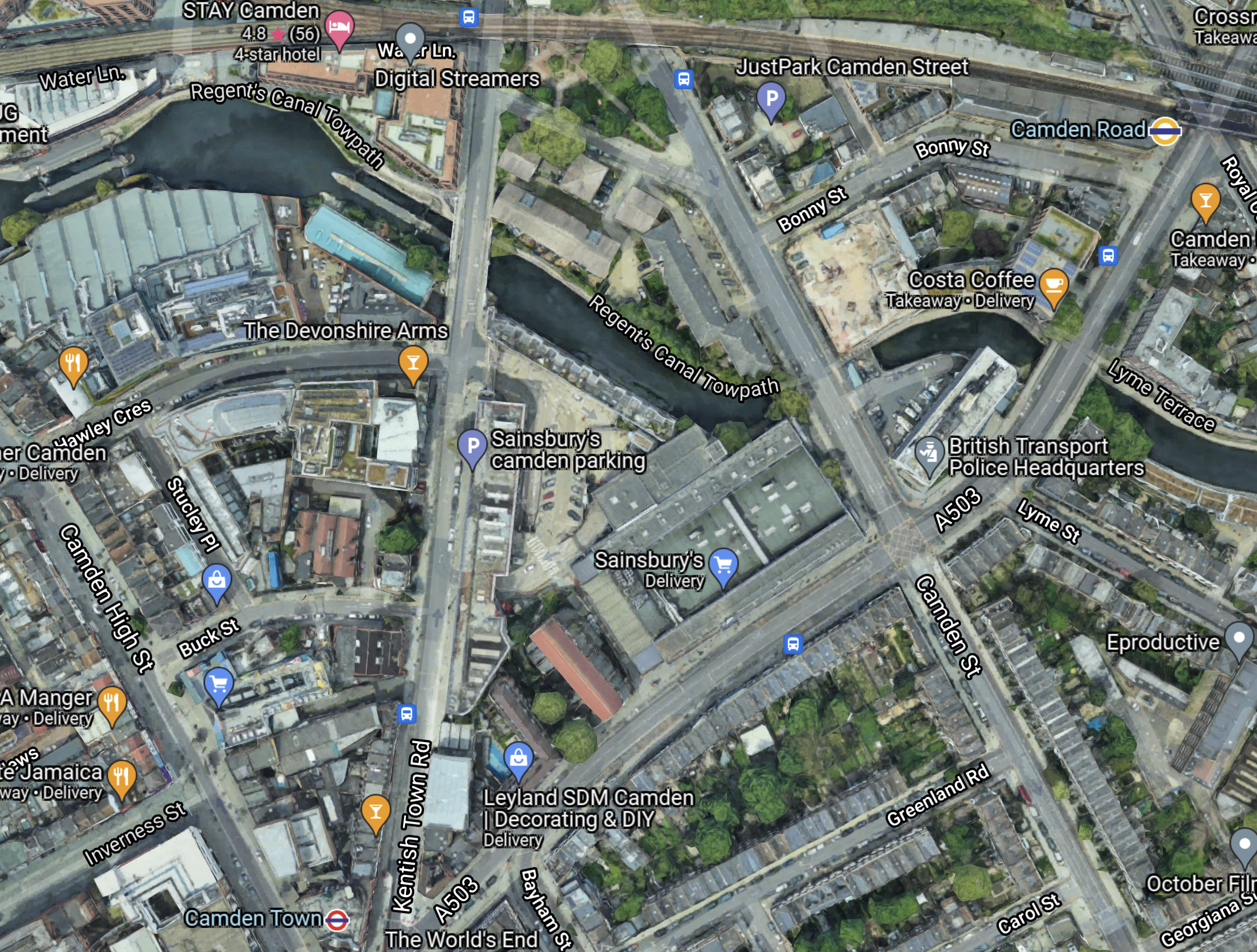
Note.
- Camden Road station on the North London Line is in the North-East corner of the map.
- Camden Town station is at the bottom of the map towards the West.
- The Charing Cross Line to Edgware is under Camden High Street.
- The Bank Line to High Barnet is under Kentish Town Road.
- Buck Street is to the North of Camden Town station connecting Camden High Street and Kentish Town Road.
- The red-roofed building in Buck Street is the former Hawley School, which is now owned by Transport for London and is earmarked for the new station entrance.
- The Regent’s Canal, which has a convenient towpath, runs East-West across the map.
- A lot of development is happening on the North bank of the canal.
The map doesn’t show how difficult it is to walk between the two stations along the busy Camden Road.
In Between Camden Road And Camden Town Stations Along The Canal, I walked between the two stations along the canal and then up Kentish Town Road. It took me fourteen minutes in total with seven minutes between the canal and Camden Town station.
I believe the following will happen.
- People living and working in the new developments will need access to Camden Town station.
- The Regent’s Canal towpath will be updated into a safer walking route between Camden Lock and Camden Road station, that serves a lot of the developments.
- More tourists will need to get to Camden Lock and the markets.
These will increase the need for extra capacity at Camden Town station.
The only way it will get built is by a private developer, who puts a lot of housing on the Buck Street site and sells it as quality housing in an iconic location.
A lot of politicians won’t like it, but solving the problems at Camden Town station, which is an overcrowding accident waiting to happen, is more important than their egos.
These pictures show some of the features of Camden Town station.

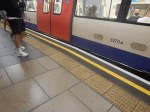
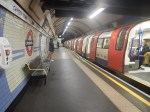
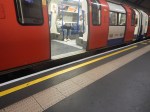



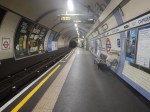
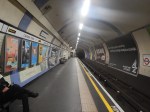


I believe Camden Town station could grow quickly into a very smooth interchange between the Bank and Charing Cross Lines.
In a few years time, when the Buck Street entrance is built, the capacity problems will be on their way to solution.
Finally, once the Buck Street entrance is complete, the original station can be refurbished.
Euston Station, Crossrail, Crossrail 2 and the Northern Line
Consider.
- Euston station is a very busy station and it will be even busier, when High Speed Two opens.
- Crossrail 2 will not be built before High Speed 2 opens.
- The Victoria Line doesn’t connect to Crossrail.
- The only connection between Euston station and Crossrail are the two branches of the Northern Line.
Splitting the Northern Line into the Bank and Charing Cross Lines will increase the number of Northern Line trains through Euston to at least sixty tph, if both lines can handle Victoria Line frequencies.
It looks to me, that making the Northern Line step-free at Euston is the best short-term alternative to building Crossrail 2.
Euston Station
Euston station is the third station, where the Bank and Charing Cross Lines connect.
This map from cartmetro.com shows the Northern Line through Euston station.
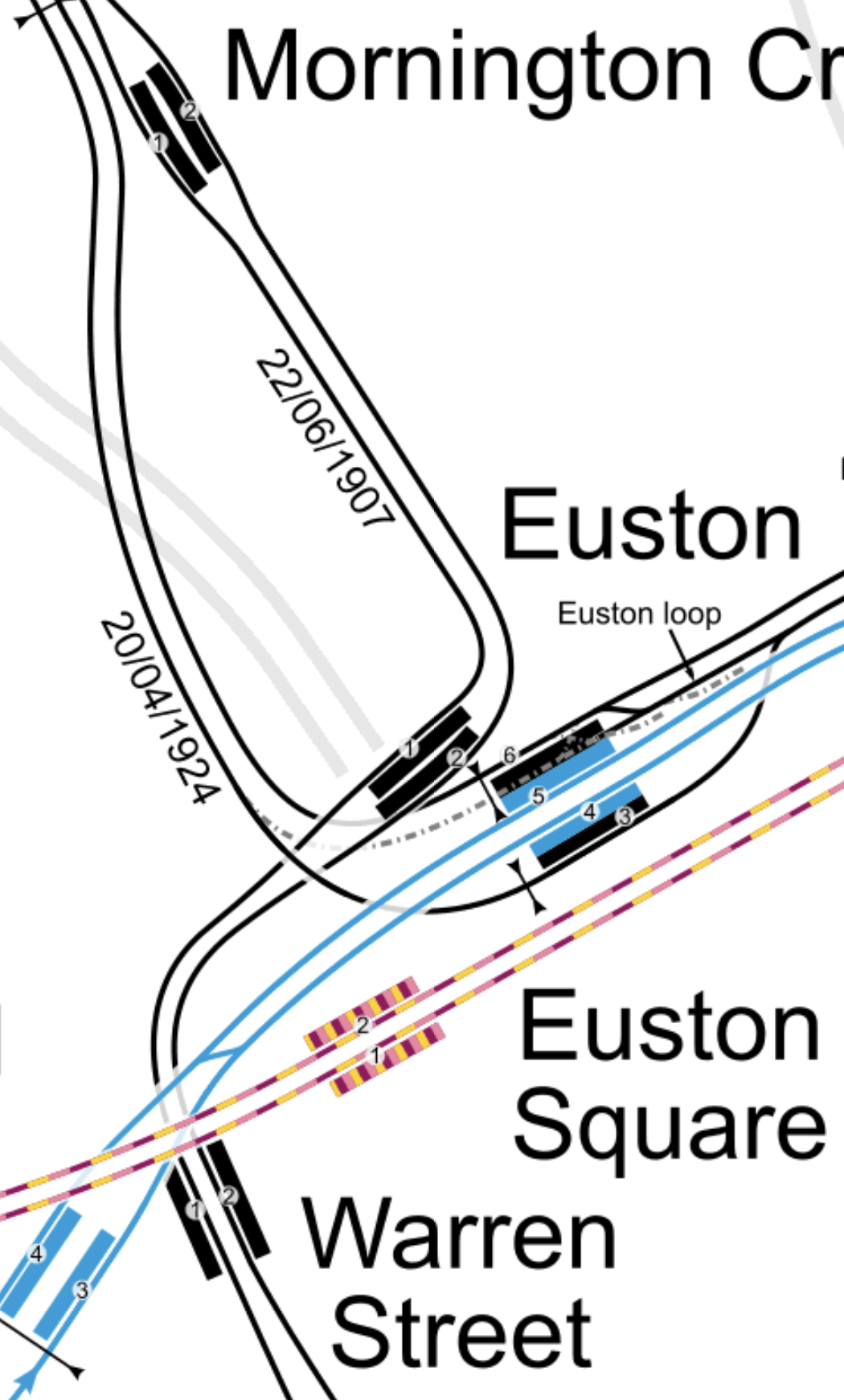
Note.
- The Northern Line is shown in black.
- The Victoria Line is shown in blue
- The Sub-Surface Lines are shown in purple and yellow.
In the map, the platforms are as follows going from top to bottom.
- Platform 1 – Northbound – Northern – Charing Cross to Camden Town
- Platform 2 – Southbound – Northern – Camden Town to Charing Cross
- Platform 6 – Southbound – Northern – Camden Town to Bank
- Platform 5 – Northbound – Victoria – Victoria to Walthamstow
- Platform 4 – Southbound – Victoria -Walthamstow to Victoria
- Platform 3 – Northbound – Northern – Bank to Camden Town
It is a bit unusual as the cross-platform interchange between Bank and Victoria Lines involves a change of direction.
With the development of Euston station for High Speed Two, I am sure interchange between the two branches of the Northern Line and the other lines at Euston will be made step-free.
Plans have already been published that will connect Euston Square station and Euston station. I wrote about it in The New Step-Free Entrance At Euston Square Station.
These pictures are of Euston station.
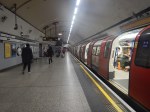
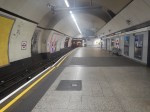
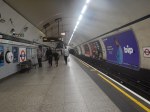
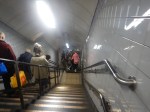
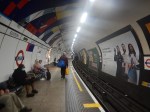
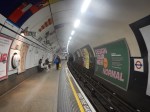
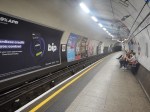
I feel the wide Platform 6 could give scope for innovation.
Level Access Between Train And Platform
I believe that many platforms on the Northern Line can be modified to give level access between train and platform.
In Could Access Between Platform And Train Be Improved At Kennington Station?. I outlined how it could be achieved at Kennington station.
At Kennington station, all platforms are straight and this is a prerequisite to making the access level.
I also feel that any straight platform with a Harrington Hump could effectively be given a full length hump.
I suspect that a lot of stations could be converted to level access between train and platform
Conclusion
I believe that splitting the Northern Line would be very worthwhile.
High Speed Two Services
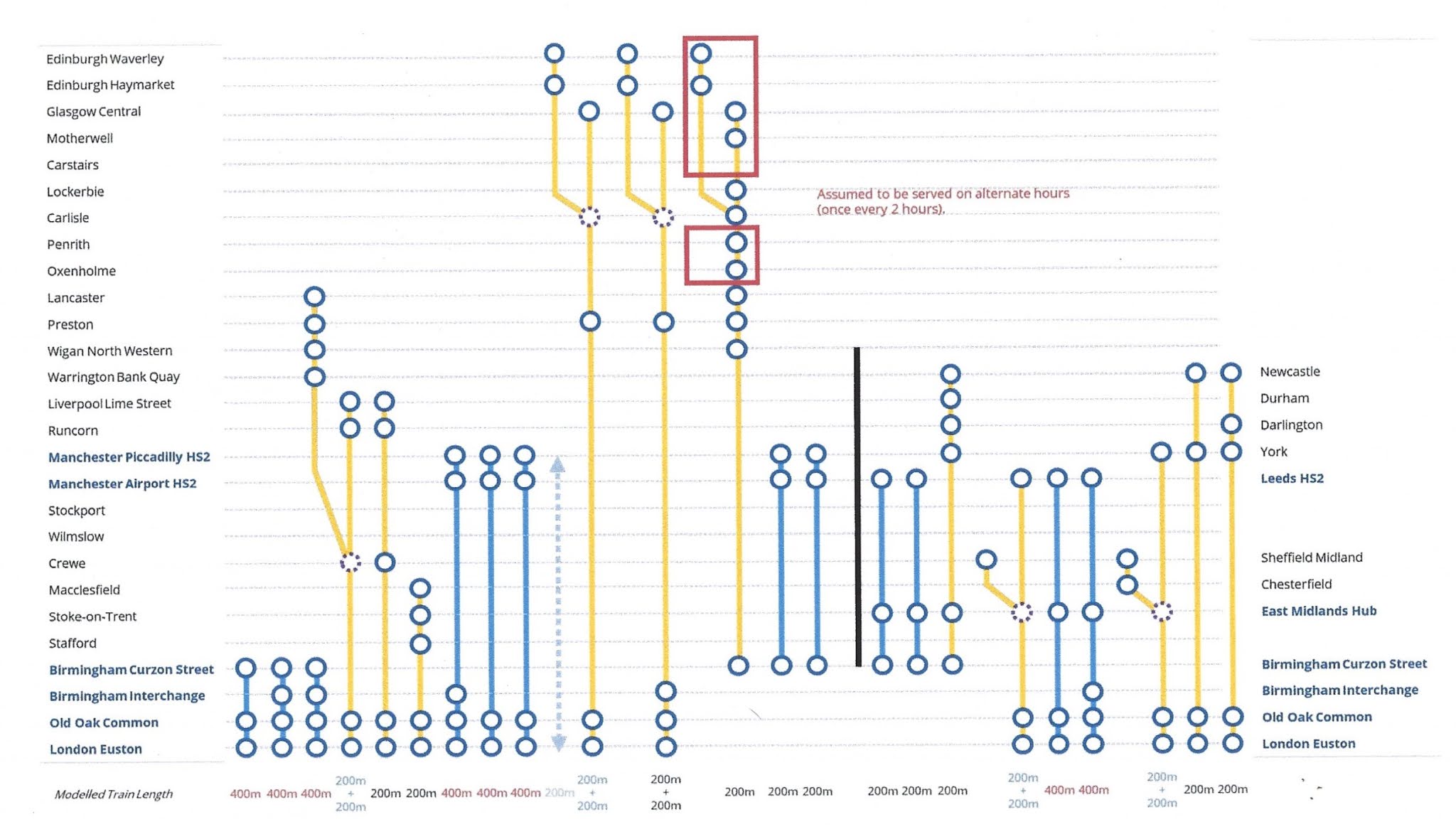
This diagram shows High Speed Two services.
Note.
- Trains to the left of the vertical black line are Phase 1 and those to the right are Phase 2.
- Full-Size trains are shown in blue.
- Classic-Compatible trains are shown in yellow.
- The dotted circles are where trains split and join.
- In the red boxes routes alternate every hour.
Click on the diagram to enlarge it.
Could Avanti West Coast Run A Lumo-Style Service Between London And Liverpool?
Avanti West Cost’s Class 807 Trains
Avanti West Coast will be introducing their new Class 807 trains by 2023.
One of the routes, on which they will run, will be between London Euston and Liverpool Lime Street stations.
These trains are members of Hitachi’s AT300 family, with these characteristics.
- Seven cars.
- 453 seats
- 125 mph operating speed, with 140 mph possible under in-cab signalling, where the track allows.
They have been designed to be able to achieve or better times from the Class 390 trains, which have the advantage of tilt.
The Seats In The New Trains
Seats are important to passengers and there has been criticism, that some of the seats in Hitachi trains are like ironing boards.
But, so far nothing has been said about the seats on the new Class 807 trains.
453 seats in seven cars of a Class 807 train is 64.7 seats per car.
These are comparison figures for other trains.
- On a nine-car Class 801 train, there are 611 seats or 67.8 seats per car.
- On a five-car Class 801 train, there are 302 seats or 60.4 seats per car.
- On a five-car Class 810 train, there are 301 seats or 60.2 seats per car.
- On a five-car Class 803 train, there are 406 seats or 81.2 seats per car.
- On a nine-car Class 390 train, there are 469 seats or 52.1 seats per car.
- On an eleven-car Class 390 train, there are 589 seats or 53.5 seats per car.
Note.
- The Class 390 trains or Pendolinos have less seats per car, than the Hitachi trains. Is this because of all the space taken up by the tilting mechanism?
- As the seats per car for a Class 807 is between the five- and nine-car Class 801 trains, it would appear that the seat density is not much different to the trains on LNER and Great Western Railway.
- Lumo’s Class 803 trains on their low-cost service would appear to have a higher seating density. But Lumo says that they have redesigned the seats for more comfort.
- In The Seat Of Aurora, I looked at a report from Modern Railways on the seats in the Class 810 trains, which the writer found were much more comfortable.
It would appear that the two latest fleets of Hitachi trains have seats that are designed for more comfort.
Consider.
- First Group own seventy percent of Avanti West Coast.
- First Group own hundred percent of two train operating companies; Great Western and TransPennine Express, who run versions of Hitachi AT300 trains, so they probably have a lot of bottom-level feedback.
- In the current Class 390 train upgrade, Avanti West Coast are replacing all the Standard Class seats, the company must care about seat quality.
- First Group own hundred percent of Lumo, who have acquired new trains with comfortable seats.
I would be very surprised if the seats in the new Class 807 trains for Avanti West Coast were not custom-designed for their routes.
The Unusual Length Of The Class 807 Train
These are the length of the Class 390 and Class 807 trains.
- Class 390/0 – nine-car – 217.5 metres
- Class 390/1 – eleven-car – 265.3 metres
- Class 807 – seven-car – 182 metres
Note.
- A ten-car Class 807 train would be 260 metres.This could be convenient, if more eleven-car Pendolinos were needed.
- The Class 807 train is thirty-five metres shorter, than the nine-car Pendolino.
As eleven-car Class 390 trains commonly run London Euston and Liverpool Lime Street, why would they need the Class 807 train to be shorter?
I think there is a clue in this picture.

It shows a Class 390 train in Liverpool South Parkway station.
- At the time, Liverpool Lime Street station was closed for track remodelling.
- Liverpool South Parkway was acting as Liverpool’s main terminus.
- To accommodate the Pendolinos a temporary platform extension was built in the station.
Could it be that shorter trains were ordered to avoid the expense of lengthening the platforms at Liverpool South Parkway and perhaps other stations, that Avanti West Coast might serve?
The Current Service Between London Euston And Liverpool
The current London Euston and Liverpool Lime Street service is as follows.
- There is one train per hour (tph)
- The service calls at Milton Keynes Central, Stafford, Crewe and Runcorn.
- All of the stations can accommodate an eleven-car Pendolino.
- Trains take around an average of two hours and twelve minutes.
- The first Northbound train leaves at 07:07 and the last at 21:07.
- The first Southbound train leaves at 07:00 and the last at 20:48.
Services are generally run by eleven-car Class 390 trains, which gives a capacity of 589 passengers per hour.
I always think, there a need for a later train back to London, but then that could be said of many places.
A Possible Service From December 2022
Wikipedia says this.
- There will be two tph.
- The second service will call at Liverpool South Parkway station.
If two tph were to be run by Class 807 trains, this would give the following.
- A capacity of 906 seats per hour.
- This is a 54 % increase in capacity.
But if only the Liverpool South Parkway service was run by a Class 807 train and the other service was still run by an eleven-car Class 390 train, this would give the following.
- A capacity of 1042 seats per hour.
- This is a 77 % increase in capacity.
And all without expensive and disruptive platform extensions at Liverpool South Parkway station.
According to Wikipedia, the plans will need to be approved by the Office of Road and Rail.
How Fast Will A Class 807 Train Travel Between London Euston And Liverpool?
The Class 807 trains will have these features.
- The trains will have no diesel engines or batteries. This must save weight and that means better acceleration.
- The trains will have no tilt mechanism.. This must save weight and that means better acceleration.
- The trains will have a new nose. Is it more aerodynamic, which would cause less drag and increase operating speed?
Would these features mean the Class 807 trains can match the performance of the Class 390 train, despite not having tilt?
There are also improvements on the West Coast Main Line, that have not been fully reflected in the timetable.
I did a full analysis about how a two-hour journey time might be achieved in Will Avanti West Coast’s New Trains Be Able To Achieve London Euston and Liverpool Lime Street In Two Hours? This analysis led me to these conclusions.
- I am convinced that the new trains are designed for a two hour journey between London Euston and Liverpool Lime Street stations.
- Refurbished Class 390 trains should also be able to do the same time.
- I also calculated that nine trains would be needed for the two tph service, if they can arrange a fifteen minute turnround at both ends of the route. So would, the Class 807 trains be used on the Liverpool service to release newly-refurbished Class 390 trains to boost Blackpool and Birmingham services?
Alternatively, if the two services are run using eleven-car Class 390 trains for the current service and seven-car Class 807 trains for the one via Liverpool South Parkway, Avanti West Coast would need five of each train.
- They could fit in thirty minute turnrounds at both ends of the route.
- The mixed pair of trains would give a 77 % increase in capacity.
- The Class 807 service would be a two-hour trip.
- If the Class 390 service couldn’t match the time it could use current timings.
Whatever is done, it would be a flagship service between London and Liverpool.
The new trains will pay for themselves many times over, if this is the case, as a two-hour journey will surely attract passengers.
Organising The Service
If you really wanted to make the service simple and passenger-friendly, you would have dedicated platforms for the trains at both ends of the route.
- In Liverpool Lime Street station trains seem to have used one platform for many years. Currently, they seem to be using Platform 9.
- Surely, a similar arrangement could be setup at London Euston.
The service could also be setup with contactless ticketing, if that was felt the way things should be done.
Going The Whole Way
Suppose, that the London Euston and Liverpool Lime Street service is very successful for any number of reasons.
- The two hour journey time.
- The all-electric service.
- The doubling of the frequency.
- The availability of more seats.
- The expansion of Merseyrail into England’s first battery-electric Metro, which I wrote about in Chancellor To Fund £710m Merseyrail Expansion.
- The cost of driving, due to a mileage charge on all journeys.
Will this lead to a need to expand the service?
If it does, the obvious way would be to lengthen Liverpool South Parkway station and run longer trains.
An Eleven-car Class 390 train would carry 589 passengers.
Adding three-cars to a seven-car and the train would still be shorter than an eleven-car Class 390 train, but it would carry around 650 passengers.
This would add an extra ten percent capacity to the route.
This would surely provide the capacity until High Speed Two arrives towards the end of the decade.
I do wonder if Avanti West Coast are using the London Euston and Liverpool Lime Street service to experiment with how they might run High Speed Two services.
Conclusion
As a two tph service run by Class 807 trains in two hours would be over 4,500,000 seats in each direction, I feel that this will be a very popular and intensive service.
I feel that Avanti West Coast will need to apply lessons learned on sister company’s Lumo’s service between London Kings Cross and Edinburgh.
 The Anonymous Widower