Polanski And Farage Don’t Agree. But They Have More In Common Than You Might Think
The title of this post, is the same as that of this article on the BBC, by Laura Kuenssberg.
It is very much a must read article comparing two of the most controversial party leaders in the UK.
This is the sub-heading.
One is a former stockbroker from the south who, by his own proud admission, loves smoking, drinking and women. The other’s a proud vegan, gay, northern former actor, who told me he’d never drunk a drop.
These first three paragraphs add detail to the story.
But the jubilant Zack Polanski and Nigel Farage have rather a lot in common.
Before you scream, burst out laughing, or think I have lost my marbles, of course, there are very big differences between them.
The Greens talk about a climate emergency. Reform UK calls the government green plans, “net stupid zero”.
This is Laura’s summing up of the Terrible Twins.
Their views on the cause of Britain’s pain vary wildly.
The Greens might point the finger at the super-rich, the “donor billionaires” they often cite. Reform often blames immigration, which they controversially characterise as an “invasion” of people arriving in the UK without permission.
But both parties feed off and stir up sentiment that’s felt by lots of the public: that Britain doesn’t work any more.
Whether it’s the new Green MP saying “working hard used to get you something” in her victory speech, or Nigel Farage repeatedly telling us “Britain is broken”, the same argument flows from both: that the country is in such a dreadful state that only new political saviours can fix it.
And both Reform and the Greens are willing to push the conventions of what traditional UK politicians would find acceptable – or what they believe would make them electable.
That’s not just about their image or the unstuffy ways they court publicity – Nigel Farage willingly going into the I’m A Celebrity jungle, or Zack Polanski being seen on a dance floor in campaign videos – but how they choose to focus on sensitive issues, where others might not choose to tread.
I would disagree that Britain is broken, but that it needs someone with sensible policies that everybody can get behind.
The Greens policies on the super-rich would drive anybody with ambition and money from this country and already countries like Canada are advertising for migrants.
With two immigrant lines, Farage is everything my father thought was bad about Oswald Mosley and his fascists in the 1930s. If a Reform UK Government started rounding up illegal immigrants on the streets, the violence would probable be enormous.
How Much Renewable Energy Will The UK Be Generating By 2030?
I have to admit, that whether you like the Tories or not, they have developed an energy generation policy and an energy relationship with Germany, that appears to be working and is allowing the current Government to do a bit of spending on defence and other needs.
I asked Google AI, the question in the title of this section and received this reply.
The UK government has set an ambitious target to reach 95% low-carbon electricity generation by 2030, aiming for a system driven by 43-50 GW of offshore wind, 27-29 GW of onshore wind, and 45-47 GW of solar power. This plan aims to dramatically reduce fossil fuel reliance, supported by 23-27 GW of battery capacity.
Key 2030 Renewable Energy Projections & Targets:
Total Clean Power Goal: The goal is 95% of electricity from low-carbon sources (renewables and nuclear) by 2030, up from roughly 74% in 2024.
Offshore Wind: Target of 43-50 GW, deemed crucial to powering the grid.
Onshore Wind: Target of 27-29 GW, with recent policy changes lifting bans to accelerate development.
Solar Power: Target of 45-47 GW, aiming to triple current capacity.
Flexibility: 23-27 GW of battery capacity and 4-6 GW of long-duration storage are needed to manage intermittency.
Challenges and Forecasts:
Shortfall Risks: While the government target is high, some projections suggest wind and solar may only account for 44% of generation by 2030, requiring significant acceleration to reach the 95% clean goal.
Investment Needs: Achieving these goals requires an estimated £48 billion in additional investment, on top of planned projects.
Progress: In 2024, renewable sources already hit a record of over 50% in certain quarters, with low-carbon sources overall (including nuclear) providing nearly 70% of generation.
My Thoughts
I will add some of my thoughts.
Electricity Demand: As I write, according to National Grid: Live it is 33.3 GW, which is met by with Production of 27.1 GW and Transfers of 6.2 GW.
Electricity Production: In 2030, I believe that if the UK has long-term battery capacity of something like 4 GW/40 GWh, that total UK electricity production could be upwards of 125 GW.
Hinckley Point C Power Station: This should add 1.6 GW in 2030 and 2031 to further boost UK electricity production.
Pumped Storage Hydro: In How Much Pumped Storage Hydro Will Be Operational In The UK By 2030?, I estimate that the Bank of England standard of energy storage, will add 5 GW of electricity production.
Highview Power: Highview Power are developing long duration liquid-air energy storage and have identified locations for sixteen 300 MW/3.2 GWh monsters.
Excess Electricity Production: This will be exported, either as electricity or after conversion to hydrogen. It will be a Magic Money Forest for the victor of the General Election in 2029.
If Hinckley Point C, the pumped storage hydro and Highview Power’s batteries work as their engineers hope, then the result of the next General Election will be predictable.
It is certainly, Kier Starmer’s to win, by getting the energy right!
Highview Power And The 2029 General Election
Every extra GWh added to energy storage has the following affect.
It will mean that more wind farms will not have to be switched in times of high wind and over production, as the electricity can be stored.
At the present time, there are four ways of storing energy.
- Turn it into hydrogen. But the Hindenberg did a good PR job for not using hydrogen.
- Store it in a pumped storage hydro system, but these have problems with their large land use.
- Store it in a large lithium battery, but these have problems with fire risks and need a large amount of expensive lithium.
- Store it in one of Highview Power’s liquid air batteries.
I believe that Highview Power’s liquid-air long duration batteries, have several advantages.
- They are built from readily available components.
- They can be scaled to the need at the location, where they are installed.
- A small one is 50 MW/300 MWh and a large one is 300 MW/3.2 GWh.
- The batteries come with grid stabilisation and other features.
- The batteries have a lifespan of greater than 50 years
- The energy storage fluid, is captured from the air.
- They are a product, that would be easy to finance in quantity.
- Goldman Sachs is an investor.
- A village with a power problem could fund a Highview Power battery and have a nice little earner, with perhaps a wind turbine on a nearby hill.
- Centrica is an investor.
If a politician were to understand it, it could wind them the next General Election.
Canal Water To Heat Some Of Liverpool’s Most Famous Buildings In Hi-Tech Carbon-Cutting Scheme
The title of this post is the same as that of this press release from Liverpool City Region.
These five bullet-points act as subheadings.
- Energy generated from Leeds and Liverpool canal by one of the UK’s largest water source heat pumps
- Announcement comes as Mersey Heat Energy Centre officially opens
- Scheme to connect Georges Dock, Cunard and the Museum of Liverpool buildings to Mersey Heat Network
- Joint project between Combined Authority, Liverpool City Council and National Museums Liverpool
- Key part of Combined Authority plan to reach net zero by 2035
These introductory paragraphs add more detail.
Three major public buildings on Liverpool’s waterfront are to slash carbon emissions by joining a heat network driven by energy from canal water.
Under the plan, an extended pipeline will connect Georges Dock building, the Cunard building, and the Museum of Liverpool, part of National Museums Liverpool (NML), to the Mersey Heat network.
The newly opened Mersey Heat Energy Centre is already supplying the Liverpool Waters site, the Titanic Hotel and the Tobacco Warehouse apartments.
It uses one of the UK’s largest water source heat pumps to extract energy from the Leeds and Liverpool Canal to power a network of heating pipes.
The project is the latest in the Liverpool City Region’s five-year carbon action plan and journey to reach net zero. The Combined Authority has recently secured an additional £35m to decarbonise dozens of other public buildings from the Department of Energy Security and Net Zero.
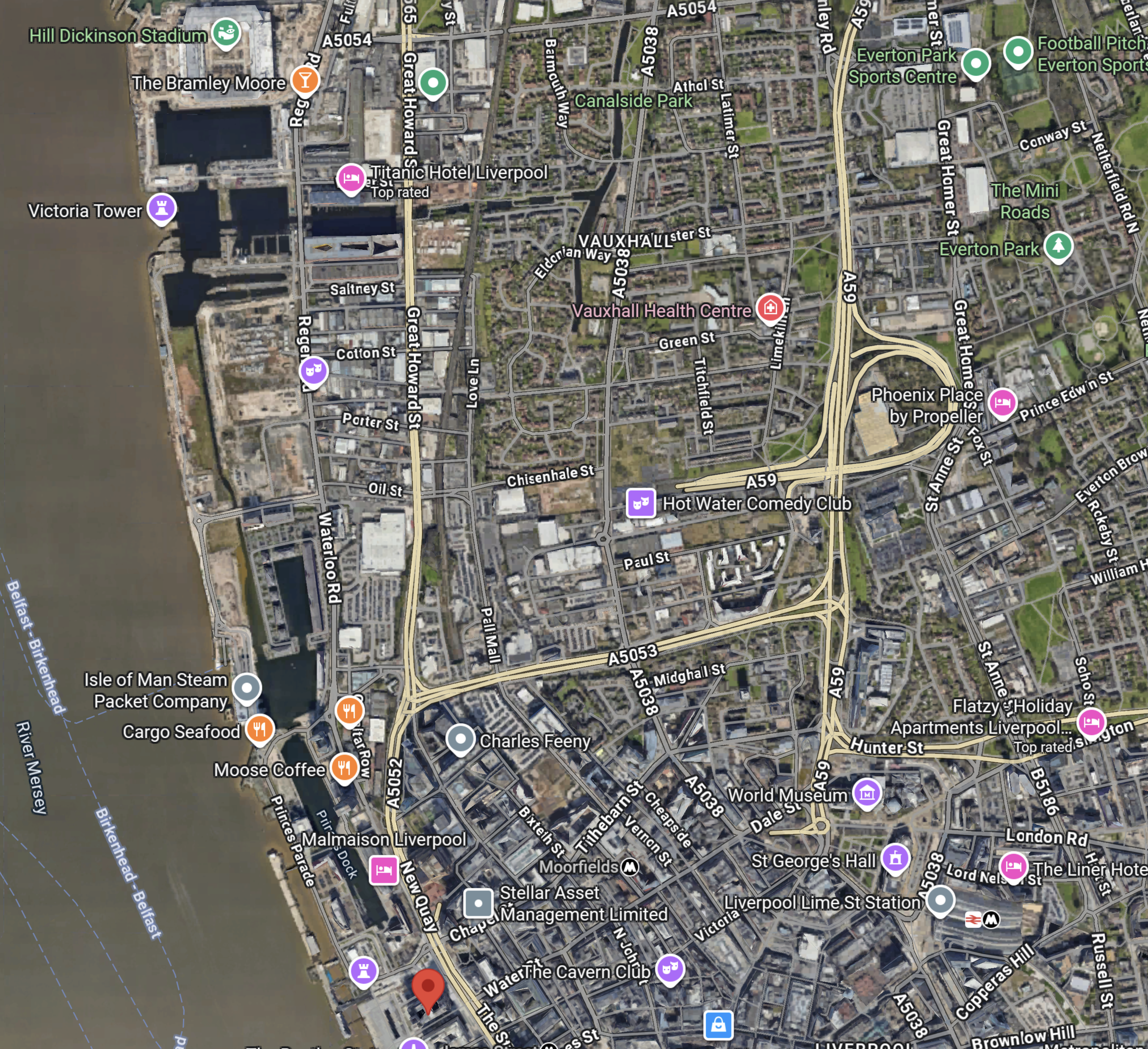
This map of the Liverpool Waterfront shows the canal and some of the buildings mentioned.
Note.
- In the top-left corner is Everton’s new Hill-Dickenson Stadium, which at the time of this map was under construction.
- The pink arrow to its right indicates the Titantic Hotel.
- The Leeds and Liverpool canal passes on the South side of the hotel.
- On the other bank of the canal is the Tobacco Warehouse.
- The canal goes East and then turns North before going all the way to Leeds. The Wikipedia entry gives full details of the canal.
- From the Titanic Hotel, the Leeds and Liverpool Canal also turns South and boats can go along Liverpool’s famous Waterfront to Canning Dock, in front of the Tate Liverpool.
- The red arrow marks the Liver Building.
- Georges Dock building, the Cunard building, and the Museum of Liverpool are just to the South the Liver Building.
- To the East of the Liver building, there is Liverpool City Centre, with beyond it Liverpool Lime Street station, with another collection of important buildings including St. George’s Hall, the Picton Library, World Museum and the Walker Art Gallery.
The Combined Authority will not have a shortage of buildings to decarbonise with the £35m from the Department of Energy Security and Net Zero.
These are my thoughts.
What Is A Water Source Heat Pump?
I asked Google AI this question and received this answer.
A water source heat pump (WSHP) is a highly efficient, low-carbon renewable energy system that extracts heat from a nearby water source like a lake, river, or canal to provide heating and hot water for a building, and can also be used for cooling. It works by using electricity to transfer this thermal energy into the building’s heating system, offering a more efficient alternative to traditional boilers and reducing energy bills. There are two main types: closed-loop systems, which circulate a fluid through pipes submerged in the water, and open-loop systems, which directly pump and then discharge the water.
Is Mersey Heat Energy Centre A Closed Or Open-Loop Water Source Heat Pump?
I asked Google AI this question and received this answer.
The Mersey Energy Heat Centre uses an open-loop water source heat pump system. It abstracts water from the Leeds and Liverpool Canal, extracts heat from it, and then returns the water back to the dock system.
As the Leeds and Liverpool Canal is 127 miles long, and there appears from the map to be a lot of water in the docks at the Liverpool end, I would expect that Liverpool will have more than enough water to extract heat from.
Where Exactly Is The Mersey Heat Energy Centre?
In this article on Place North West, which is entitled Work Begins On Peel’s Mersey Heat Energy Centre, has this image, which is labelled as the Mersey Heat Energy Centre.
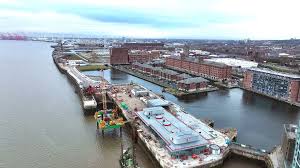
Note the large building in the foreground with the circular objects on the roof. Could these be fans or vents?
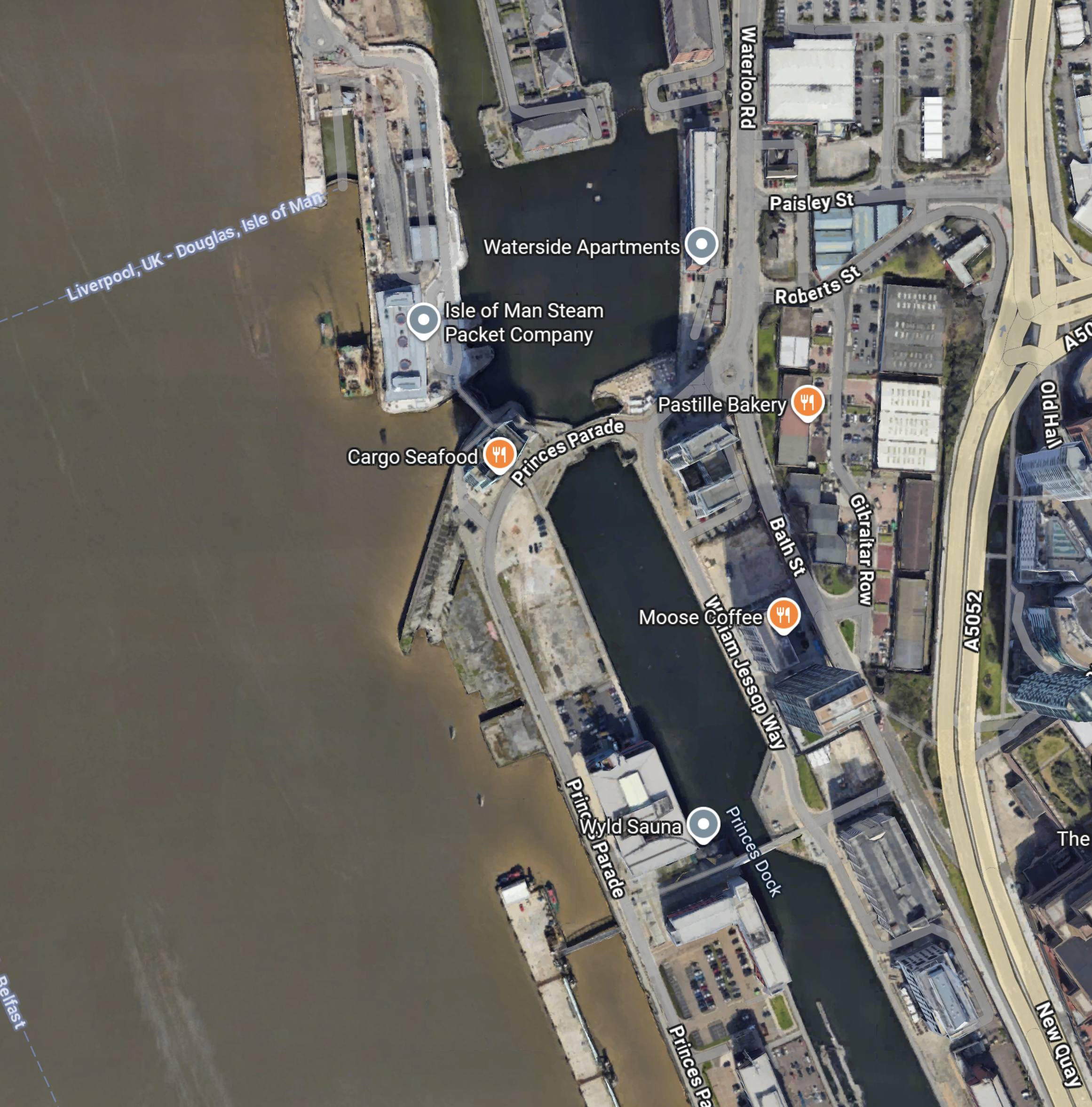
This Google Map shows the area.
Note.
- The two docks at the top of the map can be picked out in the image.
- The main breakwater on the left, which is marked Isle of Man Steam Packet Company, looks very similar to the one shown in the image.
- The bridge between the two docks on the left appears to be the same in both map and image.
I am fairly sure, that the large building on the breakwater with the three circles on the roof, is the Mersey Heat Energy Centre.
It certainly looks to be a building, that could provide a substantial amount of heat and power .
What Is The Output Of The Mersey Heat And Energy Centre?
I asked Google AI this question and received this answer.
The Mersey Heat and Energy Centre produces low-carbon heat for up to 6,700 homes and 1.3 million square feet of commercial space, aiming to deliver around 20GWh of heat per year. The project is also planned to expand to supply around 45GWh annually. This heat is delivered to buildings for their heating and hot water needs through the Mersey Heat network.
This article on Place North West, also has this similar answer.
Led by district heat network specialist Ener-Vate, the Mersey Heat Energy Centre will feature two 3MW water source heat pumps that would work on an ‘open loop’ system to take heat from water from the Leeds-Liverpool canal. This heat would be used to warm surrounding homes and businesses within six kilometres.
Plans form the first phase of Peel NRE’s Mersey Heat network. The initial project could supply 20GWh of heat every year, with planning permission secured to expand to supply around 45GWh – the equivalent of supplying heating and hot water to 17,000 homes.
It looks like we’re getting similar answers from different sources.
Does the Merseyside Area Have Enough Green Electricity To Power A Large Water Source Heat Pump?
In Could Liverpool Develop A Massive Zero-Carbon Data Centre?, I calculated the operational and planned offshore wind power in Liverpool Bay and got these results.
- 2509 MW has been commissioned.
- 3980 MW is being planned.
That is a total of 6489 MW or about twice the output of Hinckley Point C nuclear power station.
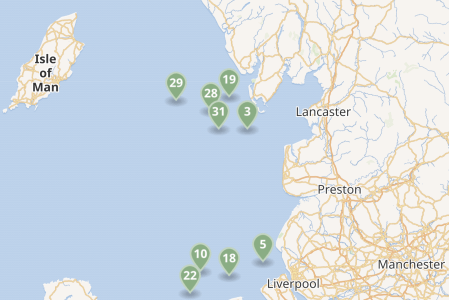
This map shows the existing wind farms in the sea between Liverpool, Lancashire and the Isle of Man.
Note.
- Each green arrow is a wind farm.
- There is the 2452 MW Heysham nuclear power complex near Lancaster.
- The Western HVDC Link is a 2250 MW connection between Hunterston in Western Scotland near Glasgow and Connah’s Quay on the Wirral.
- I also suspect more space in Liverpool Bay could be developed with wind farms.
Spinal Tap turned the power up to 11, Liverpool, being Liverpool, they have enough power to go to at least sixteen.
Will Merseyside Have Lots Of Data Centres?
Consider.
- It has the power.
- It has the water.
- The locals speak a form of English.
- Merseyside will be two hours from London by train.
- There are two Premier League football teams.
- The golf courses are good.
- It is a city that is famous all over the world.
I am sure the number of data centres will grow.
Yarmouth Harbour To Be ‘Completed’ In £60m Project
The title of this post, is the same as that of this article on the BBC.
This is the sub-heading.
A major port is set to expand to prepare for construction work linked to several national infrastructure projects.
These first two paragraphs, which give more details.
Peel Ports said it would invest between £50m and £60m in Great Yarmouth’s Outer Harbour by developing the southern terminal, creating a roll-on roll-off (RORO) lift ramp and a large storage area.
Port director Richard Goffin said the construction work, which is set to begin in 2026, would “complete” the port as laid out in a business case in the early 2000s.
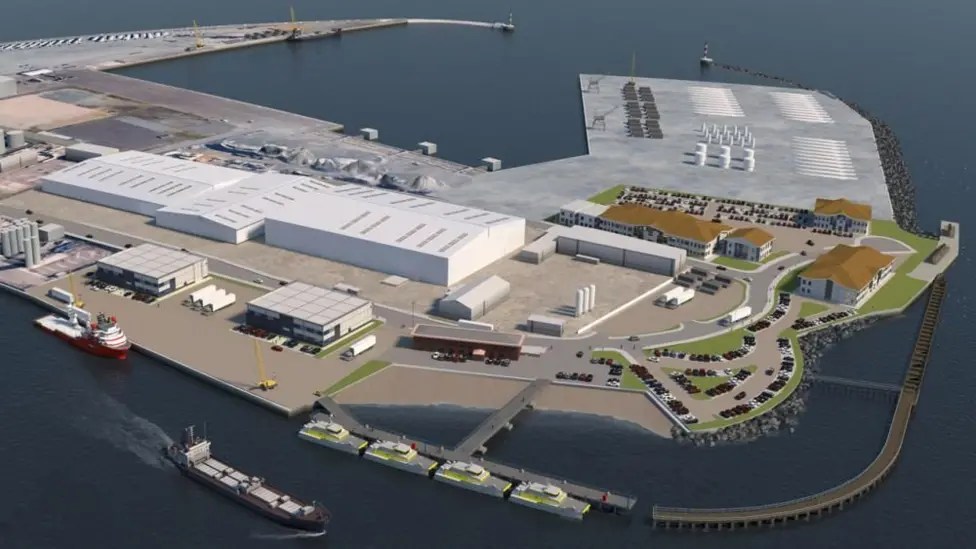
This image from Peel Ports Group shows how the Port of Great Yarmouth will look after the the proposed development.
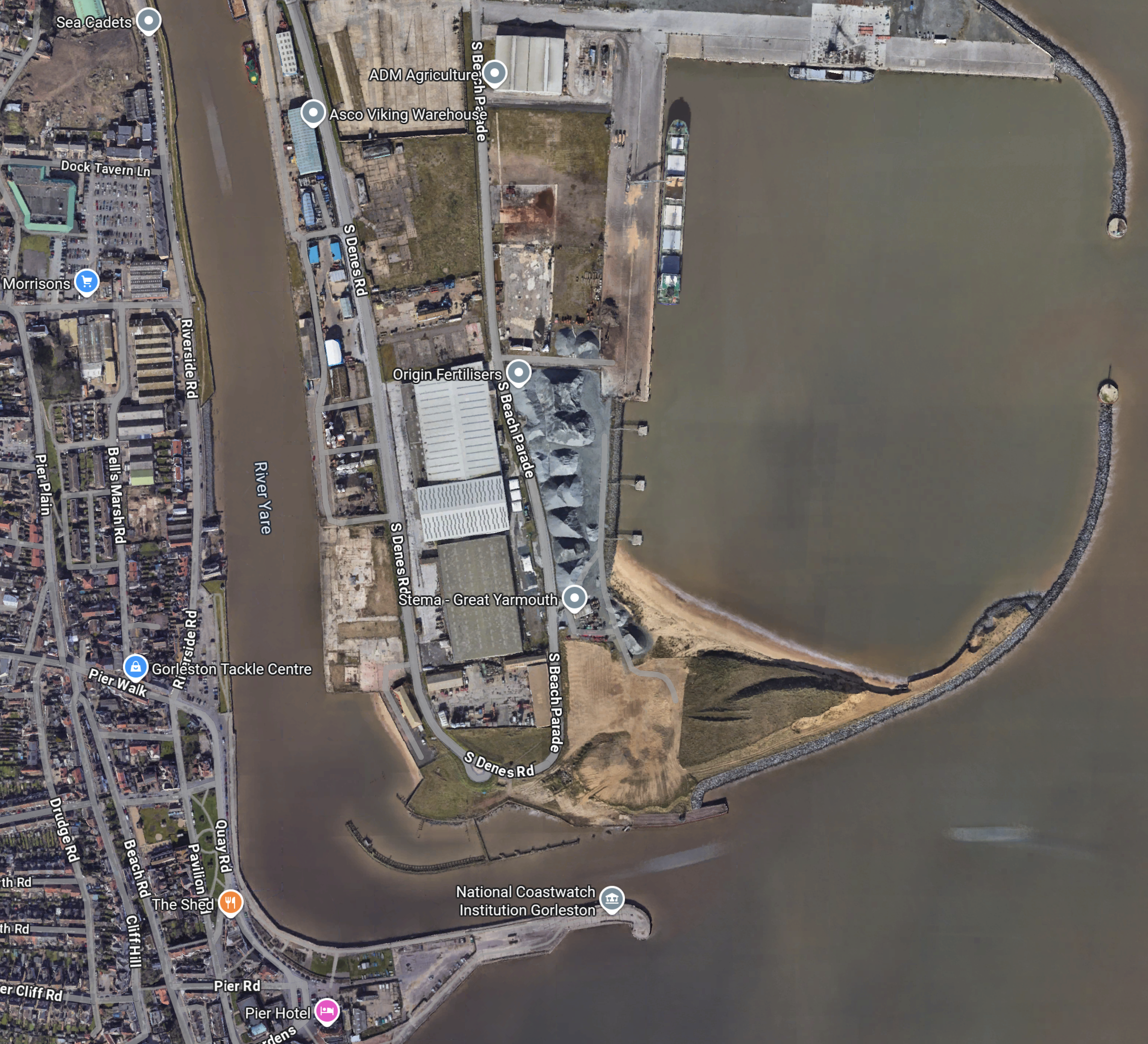
And this Google Map shows the port as it is today.
Note.
- The large triple shed, with the cross-wise middle section can be picked out in both the image and the map.
- The label by the shed says Origin Fertilisers, so I suspect the three objects on the quayside, which are visible in both the image and the map could be conveyors for loading and unloading ships with fertiliser.
- The two breakwaters are visible in both the image and the map.
It looks like the development would mainly involve filling in the Southern part of the current harbour.
With only a quick look and scant details, it looks to me, that it is a development that could be easily realised.
I have some thoughts.
Rail Access To The Port
There is no rail access to the port and I couldn’t see how it could be provided, without demolishing half of the town.
But there are carriage sidings at Great Yarmouth station, which are described in this Wikipedia entry like this.
New sidings were provided at the western end of the station to cope with the additional services operating into the station, following the closure of the M&GN system. It is a crescent-shaped site between the A47 road and Wherryman’s Way at the northernmost point of the River Yare, about 1⁄4 mi (400 m) north-west of the station. It had fallen out of use in the 1980s when Norwich Crown Point depot was built.
In 2010, the unused sidings were purchased by Great Yarmouth Borough Council; they were intended for use as a freight terminal, despite the lack of rail connection to the town’s port. It was hoped that 10,000 tonnes of sugar cane per week would be carried from Yarmouth to Cantley. The need to use a lorry shuttle between the docks and the rail yard, along with a £3.2 million quote for replacing the sidings at Cantley, saw the plan dropped.[19]
In May 2020, Eastern Rail Services commenced a lease with Norfolk County Council and Network Rail for Yarmouth Vauxhall sidings. Managing director James Steward said the siding “matched ERS’s requirement for an East Anglian site to base its rolling stock.” Following extensive de-vegetation works, Direct Rail Services 37402 became the first locomotive in 19 years to run into the sidings on 26 May 2020, followed the next day by it delivering five former Greater Anglia Mark 3 coaches for storage. On 6 July 2020, ERS was authorised a licence exemption permitting them to operate trains within the site
The Port of Great Yarmouth appears to be keen to do its part in the construction of Sizewell C. Could components for the power station, be brought into the port through the new roll-on/roll-off berth and then transferred to rail in the former carriage sidings?
This 3D Google Map shows the carriage sidings.

Most of the rolling stock appears to be retired Mark 2 and M3 coaches.
Road Access To The Port
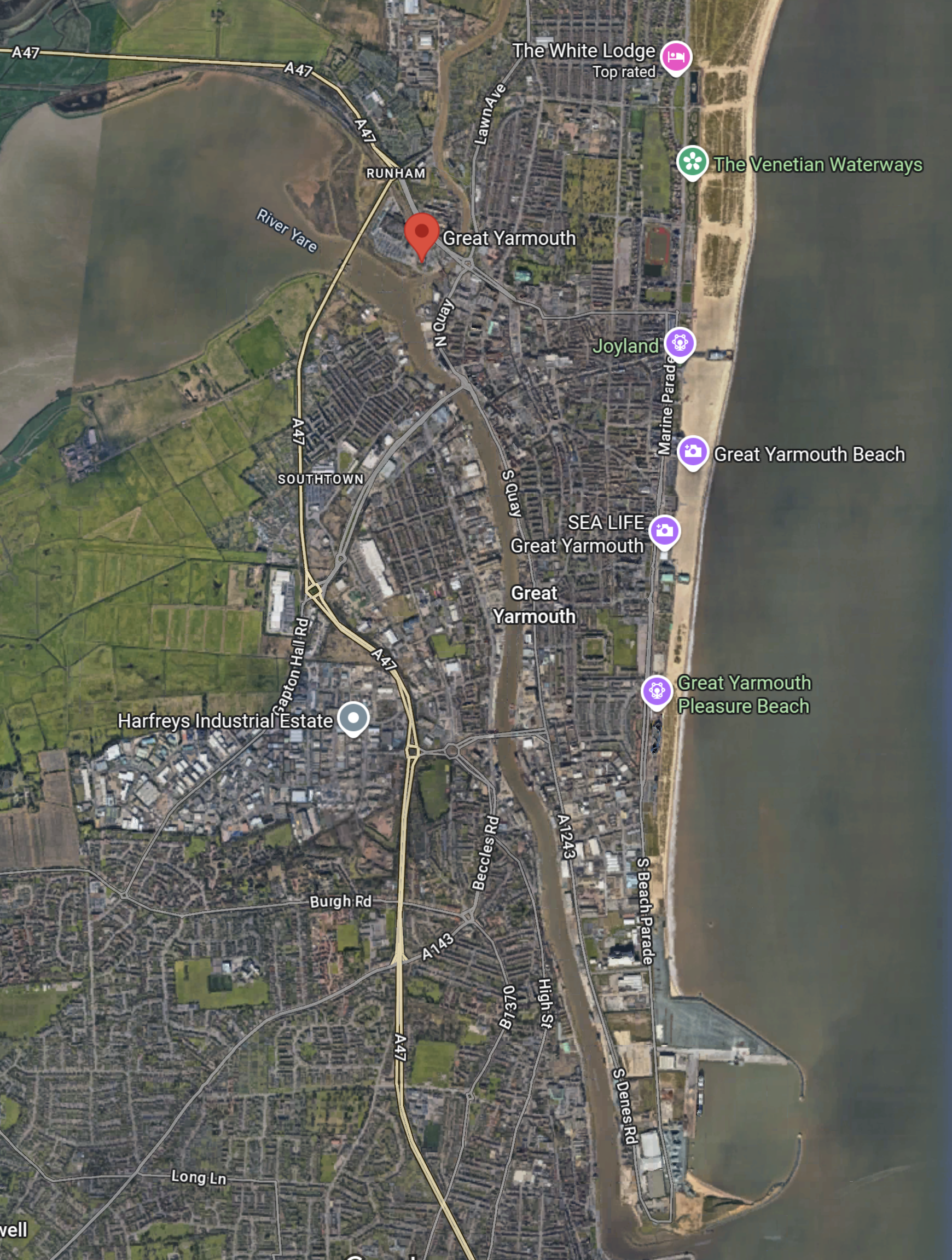
This Google Map shows Great Yarmouth and the Port and roads in the area.
Note.
- The red arrow indicates Great Yarmouth station.
- The Port of Great Yarmouth is in the South-East corner of the map.
- The A 47 runs down the West side of the town.
- The River Yare runs from the railway station to the sea, just below the port.
There is a road on the East bank of the River Yare, that connects to the A 47 and could easily connect to a rail cargo terminal to the North-West of the station in the derelict carriage sidings.
I can certainly see Nimbies not liking the new roll-on/roll-off ferry creating traffic in the town.
The Construction Of Sizewell C
Sizewell C is very similar to Hinckley Point C and this extract from the Wikipedia entry for Hinckley Point C describes some of that power station’s construction.
In March 2017, EDF, after the Office for Nuclear Regulation (ONR) gave approval to start building, the building of the first parts of the plant proper began with a network of tunnels to carry cabling and piping. Work was also under way on a jetty to land building materials, a seawall, and accommodation blocks.
In January 2018, EDF said that they were on track to start generating electricity by 2025 and that they planned to start constructing above-ground structures for the power station by June 2019.
The approximate 2,000 cubic metres (71,000 cu ft) concrete pour for the first reactor started on 11 December 2018. It was completed over a 30-hour period, creating the first part of the unit one 4,500 tonne base, a platform 3.2 metres (10 ft 6 in) thick. The reactor building will be built on the (to be completed) platform. This construction start marks the first new reactor build in the UK after a 30-year break, and the second PWR in the UK, after Sizewell B.
Completion of the base for the first reactor, the final 8,954 cubic metres (316,200 cu ft) of concrete, was achieved in June 2019. Completion of the base for the second reactor, 8,991 cubic metres (317,500 cu ft) of concrete, was achieved in June 2020.
Construction utilises the world’s largest crane, the Sarens SGC-250 double ring crane, which is responsible for lifting Hinkley Point C’s heaviest components. More than 600 heavy fabrications, including the five major parts of each unit’s steel containment liner and dome, are positioned by the SGC-250. The crane, named Big Carl, was delivered in modular form, consisting of over 400 deliveries.
In February 2023, the first nuclear reactor pressure vessel was delivered to site via the Bristol Channel Hinkley-dedicated wharf at Combwich. The pressure vessel was built in France in 2022 by Framatome.
In May 2024, the first of the 520 tonne steam generators was delivered to site in the same manner as the reactor pressure vessel.
Note.
- A good proportion of the power station and the materials to build it were brought in by sea.
- The size of everything is huge.
- Big Carl seems to make appearances in all big projects.
- According to the BBC, Peel Ports are spending £60million on a new roll-on/roll-off terminal, 350 metres of quay and ten hectares of high quality storage space.
I wouldn’t be surprised, if they have the contract for Sizewell C’s logistics, that Peel Ports will be laughing all the way to the bank.
If nothing else, after Sizewell C is completed, they will have a high-class port facility at the end of the A 47 from Birmingham, Leicester, Peterborough and Norwich, which could open up possible ferry routes to Europe.
Between Great Yarmouth And Sizewell
If the components come in to Great Yarmouth on trailers on the RORO ferries from France, they could be taken to Sizewell on the A 12 road.
Smaller components may be taken by road, but I wouldn’t rule out a transfer to rail in the carriage sidings at Great Yarmough, as I indicated earlier.
Nigel Farage Speech: Persistent Offenders Would Face Life Sentences
The title of this post, is the same as that of this article in The Times.
This is the sub-heading.
The Reform UK leader pledged more prison spaces, deportation of criminals and zero-tolerance policing as part of a six-week Lawless Britain campaign drive.
These three paragraphs give more detail about what criminals can expect and how much it will cost.
Every shoplifter would be prosecuted and stop and search powers used to “saturation point” under Nigel Farage’s pledge to make Reform UK the “toughest party on law and order this country has ever seen”.
He said that a Reform government would crack down on prolific offending by imposing life sentences on those who commit three or more offences.
The Reform leader set out plans to spend £17.4 billion to cut crime by half in the first five years if the party wins the next general election — an annual cost of £3.5 billion.
At least hanging and flogging aren’t mentioned. But he does suggest sending one of our worst child murderers to El Salvador and that Britain would leave the European Convention on Human Rights.
This paragraph says how he will pay for this law and order policy.
Farage said Reform would pay for the £17.4 billion law and order crackdown by ditching HS2 and net zero policies — money which has also been pledged for other policies.
I have just done a little calculation about how much offshore wind power should be commissioned by January 2029, which will likely be before the expected 2029 General Election.
- In October 2023, there was 15,581 MW of operational offshore wind.
- Currently there are 10,842 MW under construction, that should be commissioned by January 2029.
- There is also 2,860 MW of smaller wind farms, which have yet to be started that should be commissioned by January 2029.
- That all totals up to 29, 285 MW or 29.3 GW.
- Another 12 GW of offshore wind is scheduled to be commissioned in 2029 and 2030.
Currently, as I write this we are generating 29.3 GW from all sources.
I asked Google AI how much solar energy we will have in January 2029 and got this answer.
In January 2029, the UK is projected to have a significant amount of solar energy capacity, with the government aiming for 45-47 GW of total solar power by 2030.
Let’s assume the sun only shine half the time and say 20 GW on average.
We’ll also have 4.4 GW from Hinckley Point C and Sizewell B, as all other nuclear will have been switched off.
I asked Google AI how much energy storage we’ll have by January 2029 and got this answer.
In January 2029, the UK is projected to have around 120 GWh of battery energy storage capacity, according to a European report. This is part of a broader goal to reach 400 GWh by 2029 for the EU-27, with the UK contributing significantly to this total.
If there’s say another Great Storm, the dozens of interconnectors between the UK and Europe should keep us all going.
It looks to me that by January 2029, we’ll be substantially on the way to being powered by renewables.
Most of the net zero money will have been spent and we’ll be almost at net zero.
Phase One of High Speed Two has a target date of 2030, and I suspect that the engineers working on the project will get trains running between Old Oak Common and Birmingham Curzon Street stations before the General Election, just because if NF’s going to cancel the project, they might as well do their best to get him to lose the election.
So at best he might get a year’s savings from stopping High Speed Two, but an unfinished High Speed Two, will be a joke on NF and make him look a complete laughing stock!
Ambitious £3bn Pumped Hydro Project At Loch Ness Moves Forward
The title of this post is the same as that of this article on Sustainable Times.
These are the two introductory paragraphs.
A £3 billion pumped storage hydro (PSH) project near Scotland’s iconic Loch Ness is one step closer to becoming a reality. Glen Earrach Energy (GEE) confirmed on April 25th that it has officially submitted the planning application for its ambitious 2gw scheme.
If greenlit, this project would represent nearly three-quarters of the total PSH capacity planned for Loch Ness, contributing 34 GWh of the region’s 46 GWh storage goal. But it’s not just the storage that stands out. This development would also account for two-thirds of the generating capacity, all while using just half of the water previously considered. To put it into perspective, the project’s capacity would be on par with the combined output of around 800 onshore wind turbines scattered throughout the Highland Council area.
Note.
- The generating and pumping capacity for this ambitious scheme is given as 2 GW. Only three in China and one in the United States are larger.
- The storage capacity of 34 GWh will make it the largest in the UK, possibly the second largest in Europe to Ulla-Førre in Norway and one of the ten largest in the world.
- A projected 10% reduction in the UK grid’s carbon footprint is claimed.
- The cost of three billion is high, but compare that with the tens of billions quoted for the 3.26 GW Hinckley Point C.
The Glen Earrach scheme is not short on superlatives and the article in Sustainable Times is worth a thorough read.
Fifth Hydro Project Proposed At Loch Ness, is based on a BBC article of the same name.
These were my thoughts in the related post.
The Existing Hydro Schemes On Loch Ness
According to the BBC article, there are two existing hydro schemes on Loch Ness.
- Foyers is described on this web site and is a reasonably modern 305 MW/6.3 GWh pumped storage hydroelectric power station, that was built by SSE Renewables in the last fifty years.
- Glendoe is described on this web site and is a modern 106.5 MW conventional hydroelectric power station, that was built by SSE Renewables in the last twenty years.
Foyers and Glendoe may not be the biggest hydroelectric power stations, but they’re up there in size with most solar and onshore wind farms. Perhaps we should look for sites to develop 100 MW hydroelectric power stations?
The Proposed Hydro Schemes On Loch Ness
According to the BBC article, there are four proposed hydro schemes on Loch Ness.
- Coire Glas is described on this web site and will be a 1.5GW/30 GWh pumped storage hydroelectric power station, that is being developed by SSE Renewables.
- Fearna is described on this web site and will be a 1.8GW/37 GWh pumped storage hydroelectric power station, that is being developed by Gilkes Energy.
- Loch Kemp is described on this web site and will be a 600MW/9 GWh pumped storage hydroelectric power station, that is being developed by Statera.
- Loch Na Cathrach is described on this web site and will be a 450MW/2.8 GWh pumped storage hydroelectric power station, that is being developed by Statktaft.
In addition there is, there is the recently announced Glen Earrach.
- Glen Earrach is described on this web site and will be a 2GW/34 GWh pumped storage hydroelectric power station, that is being developed by Glen Earrach Energy.
Note.
- The total power of the seven pumped storage hydroelectric power stations is 4.76 GW.
- The total storage capacity is 89.1 GWh.
- The storage capacity is enough to run all turbines flat out for nearly nineteen hours.
I estimate that if 2 GW/34 GWh of pumped storage will cost £3 billion, then 4.76 GW/89.1 GWh of pumped storage will cost around £7-8 billion.
AI Forecast To Fuel Doubling In Data Centre Electricity Demand By 2030
The title of this post, is the same as that as this article in The Times.
This is the sub-heading.
International Energy Agency predicts that artificial intelligence could help reduce total greenhouse gas emissions
These are the first two paragraphs.
Data centres will use more than twice as much electricity by 2030 than they do today as artificial intelligence drives demand, the International Energy Agency predicts.
The agency forecast that all data centres globally will use about 945 terawatt-hours of electricity each year by 2030, roughly three times as much as the UK’s total annual demand of 317 terawatt-hours in 2023.
I am very much an optimist, that here in the UK, we will be able to satisfy demand for the generation and distribution of electricity.
- Our seas can accommodate enough wind turbines to provide the baseload of electricity we will need.
- Roofs and fields will be covered in solar panels.
- SSE seem to be getting their act together with pumped storage hydro in Scotland.
- I am confident, that new energy storage technologies like Highview Power with the packing of companies like Centrica, Goldman Sachs, Rio Tinto and others will come good, in providing power, when the wind doesn’t blow and the sun doesn’t shine.
- Hopefully, Hinckley Point C and Sizewell C will be online and soon to be joined by the first of the new small modular nuclear reactors.
- Hopefully, Mersey Tidal Power will be operating.
- There will be innovative ideas like heata from Centrica’s research. The economical water heater even made BBC’s One Show last week.
The only problem will be the Nimbies.
SSE And Gilkes Energy Submit Plans For Pumped Hydro Storage Project
The title of this post, is the same of this article in Solar Power Portal.
This is the sub-heading.
SSE Renewables and Gilkes energy have submitted a planning consent application to Scottish Ministers for a proposed Pumped Storage Hydro (PSH) project.
These two paragraphs add more detail.
The Fearna PSH project is proposed as a 50:50 joint venture project between SSE and Gilkes Energy, with Gilkes Energy leading the development under a developer services agreement with SSE Renewables. The scheme will have an installed capacity of 1.8GW and a stored capacity of up to 36GWh, providing 20 hours of storage. If approved, the project would be the largest pumped hydro scheme in the UK.
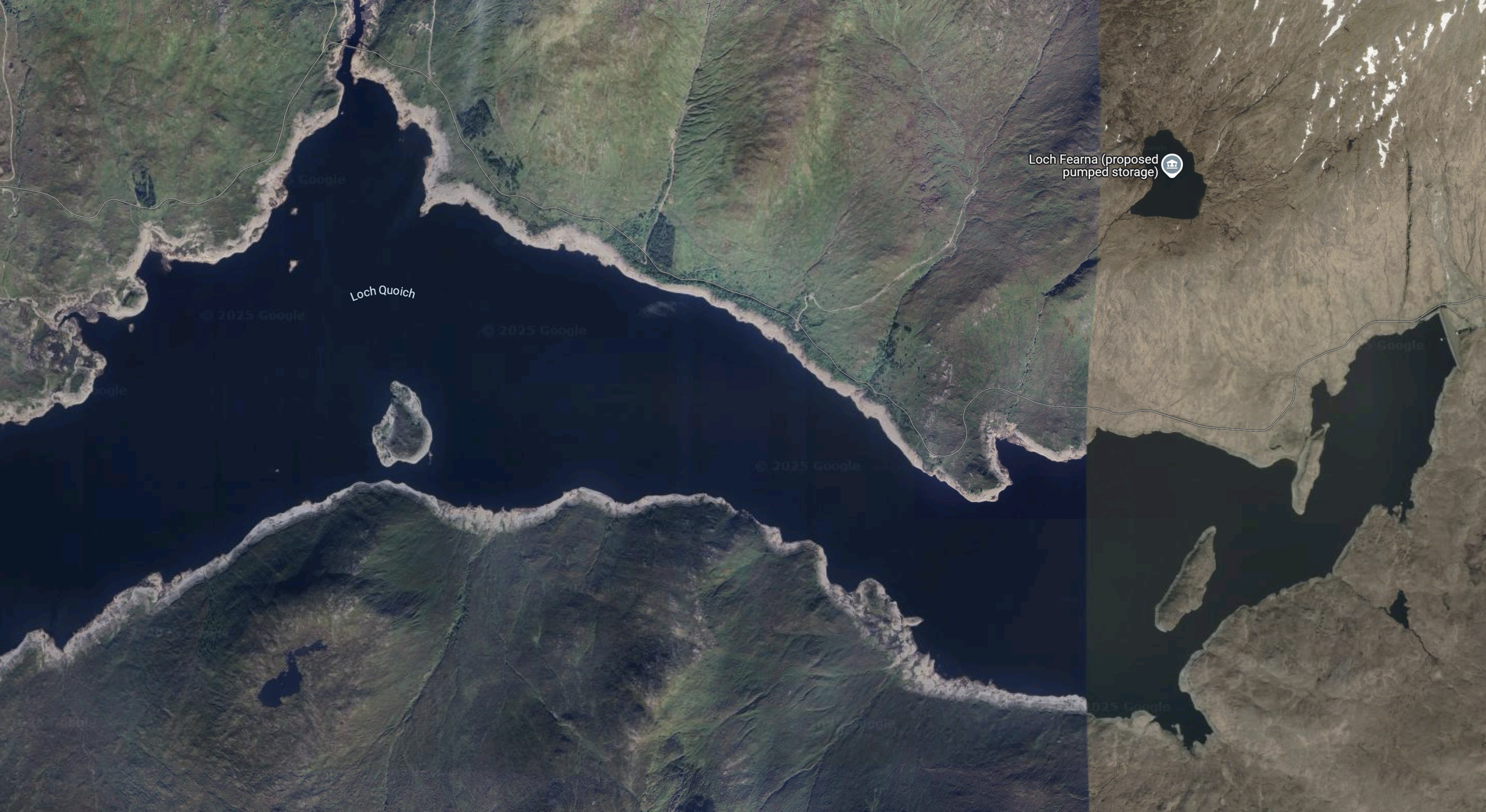
The proposed site is located around 25km from Invergarry in the Scottish Highlands and adjoins SSE Renewables’ existing Loch Quoich reservoir, which forms part of the Great Glen hydro scheme. The development will include the construction of tunnels and a new power station that will connect the existing Loch Quoich reservoir to an upper reservoir at Loch Fearna.
This Google Map shows the location of Invergarry and Loch Quoich.

Note.
Loch Quoich is the dolphin-shaped loch at the West of the image.
Invergarry is indicated by the red dot at the East of the image.
This second Google Map shows the location of Loch Fearna to the North-East of Loch Quoich.
These are my thoughts.
It Will Be A Large Scheme
With an installed capacity of 1.8GW and a stored capacity of up to 36GWh, providing 20 hours of storage, this is not a small scheme.
Wikipedia’s Description Of Loch Quoich
This is the first two paragraphs of the Wikipedia entry for Loch Quoich.
Loch Quoich (Scottish Gaelic: Loch Chuaich) is a loch and reservoir situated west of Loch Garry approximately 40 km northwest of Fort William, Lochaber, Scotland. The name means “loch of the quaich”. In 1896, it was listed as six miles long and three-quarters of a mile in width, belonging to Mrs. Ellice of Glenquoich, within the parish of Kilmonivaig.
Both lochs form part of the Glen Garry hydroelectricity project commissioned by the North of Scotland Hydro-Electric Board in the 1950s.
So is the Loch Fearna scheme, a massive repurposing of the existing Glen Garry hydroelectricity project?
I wrote about this before in Repurposing The Great Glen Hydro-Electric Scheme?
This map from the SSE Renewables web site shows the layout of the dams and power stations between Loch Quoich and Invergarry..
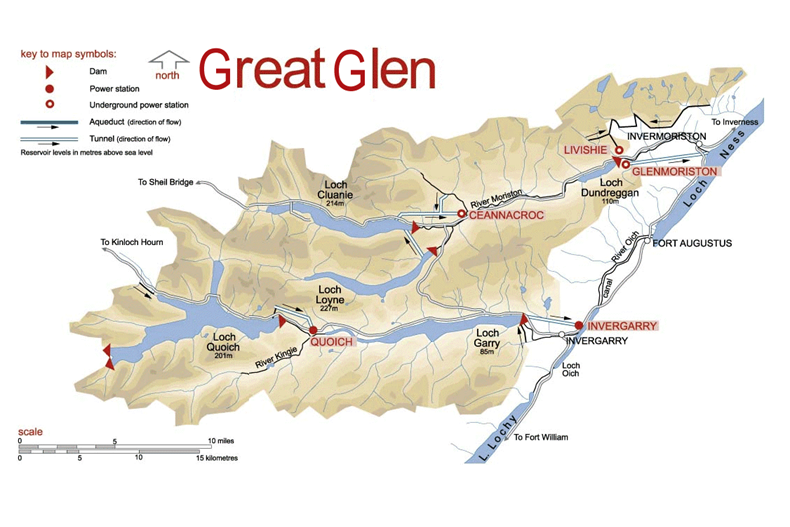
The sizes of the power stations in the scheme are as follows.
- Ceannacroc – 20 MW
- Livishie – 15 MW
- Glenmoriston- 37 MW
- Quoich – 18 MW
- Invergarry – 20 MW
- Mucomir – 1.7 MW
This gives a total power of 112.7 MW.
112.7 MW to 1.8 GW (1800 MW) is a colossal increase in power.
It should be noted that 1.8 GW is half the power of Hinckley Point C nuclear power station.
New Bid To Connect Heritage Railway To Mainline
The title of this post, is the same as that of this article on the BBC.
The is the sub-heading.
A bid to connect one of the longest heritage railways in Britain with mainline services has taken a step forward.
These are the first two paragraphs.
West Somerset Railway (WSR) and Somerset Council have now submitted a business plan to the government to restore the mainline from Taunton to the final WSR stop at Bishop’s Lydeard.
The proposal suggests Bishop’s Lydeard could become a commuter and tourist hub.
There has been several attempts to connect the branch to Taunton station.
These are my thoughts.
Minehead, Bishop’s Lydeard And Hinckley Point C
This Google Map shows the area.
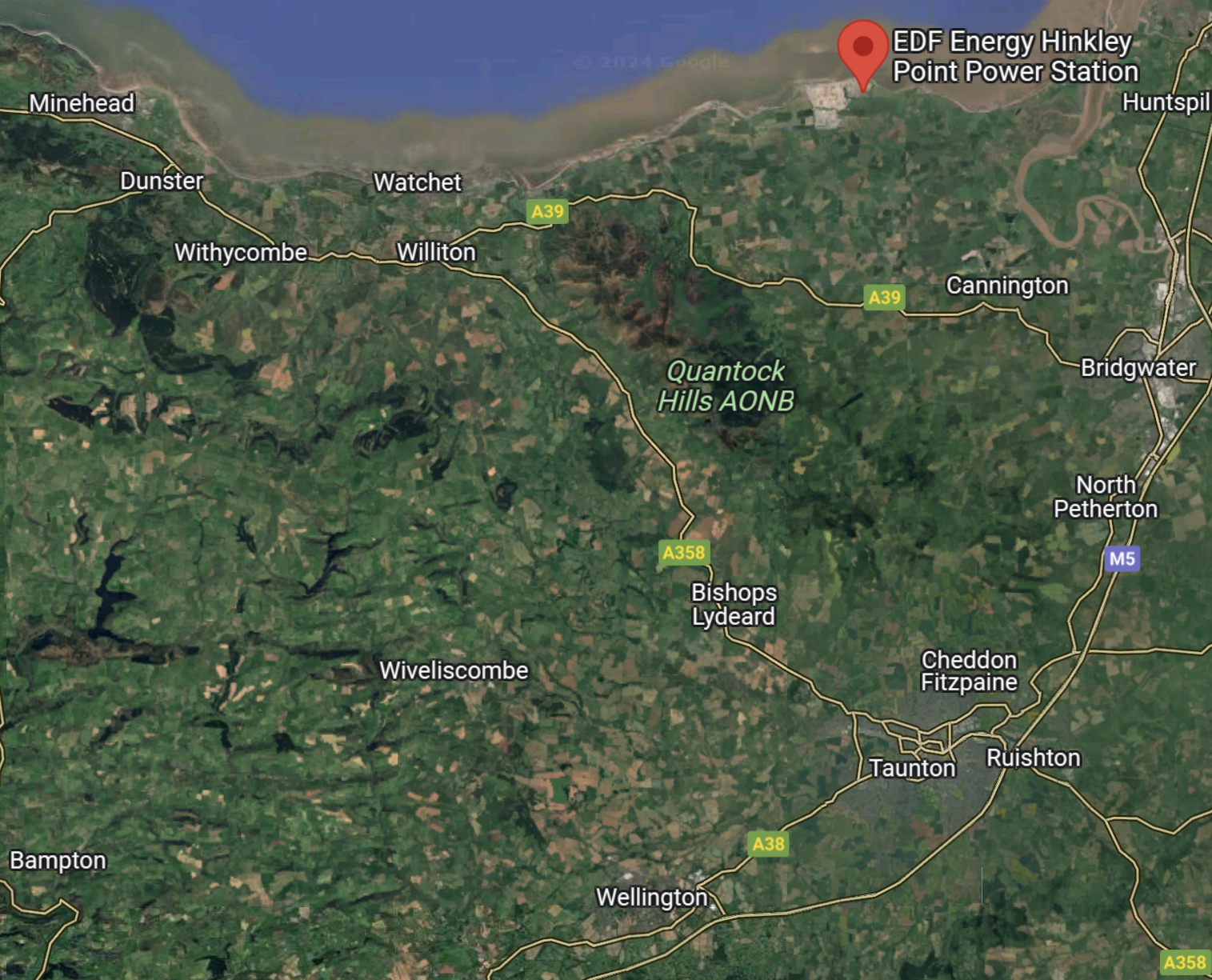
Note.
- Minehead is in the North-West corner of the map.
- Hinckley Point power station is indicated by the red arrow.
- Bishop’s Lydeard is in the middle of the map.
- The M5 motorway curves diagonally between the North-East and South-West corners of the map.
- There are motorway services at Taunton Deane, which is to the South of Taunton and Cullompton, which is a few miles South-West of Wellington.
- The large town of Taunton is the junction of the London and Exeter and the Bristol and Exeter railway lines.
- The town of Wellington will be getting a new railway station.
It is a very busy area and it will only get busier, as the availability of power will only attract industry, like the battery factory pencilled in for Bridgewater.
The Major Effect Of Hinckley Point C
Hinckley Point C will generate 3.26 GW of electricity and to operate the power station will need around nine hundred workers.
I can also expect that the Hinckley Point site will get involved in other energy handling and use.
- The site would be an ideal place for a large electrolyser to produce hydrogen.
- Wind turbines in the Bristol Channel could use Hinckley’s grid connection.
- Energy could be stored on the site. It could be an ideal location for one of Highview Power’s 200 MW/3.25 GWh liquid air batteries.
- Hydrogen could be exported using coastal tankers.
- Interconnectors could take electricity to Cornwall, Devon, Wales and Ireland.
All of these activities would create needs for workers at all levels.
- A rail connection to Taunton and Bristol, will probably be needed to bring workers into Hinckley Point.
- A rail connection would be ideal for bringing construction materials, steel and other heavy goods into and out of the Hinckley Point site.
- Hydrogen could also be taken out in rail tankers.
- Nuclear waste could be taken out by train.
I think it is highly likely, that Hinckley Point will need a rail connection for efficient operation.
Sizewell C And Hydrogen
Hydrogen is so important to the philosophy of the design and construction of Sizewell C, that hydrogen has its own section on the Sizewell C web site.
Hydrogen produced by nuclear power stations like Hinckley Point C, is called pink hydrogen, but like green hydrogen it is zero-carbon and pollution-free.
Hinckley Point C And Hydrogen
I can envisage Hinckley Point C will create a lot of hydrogen both for use locally and distribution to remote users.
- Hydrogen could be delivered locally by truck, just as propane is today around the world.
- Coastal tankers could distribute the hydrogen from a jetty.
- Pipelines could connect the two nearby motorway service stations to the power station site.
Just as is happening at Sizewell, a local hydrogen network could be built.
Hydrogen Refuelling On The M5
Consider.
- In MAN Expands Its Zero-Emission Portfolio, I talked about MAN’s new hydrogen-powered hTGX truck, which has been designed with a 600 km. or 373 mile range.
- As Cullompton, which is the Southernmost of the two services on the M5 that are close to Hinckley Point C, is only 124.9 miles from Penzance, it should be possible for a truck, with a range similar to that of the MAN hTGX to do a round trip from the Southern end of the M5 to Penzance, without refuelling.
- As the total length of the M5 is only 163 miles, a hydrogen-powered truck with the range of the MAN hTGX would be able to do a delivery anywhere along the motorway and return to the hydrogen from Hinckley Point C, without refuelling.
- MAN are saying that the hTGX truck can be refuelled in less than fifteen minutes.
It looks to me, that a hydrogen electrolyser at Hinckley Point C would be ideally located to provide pink hydrogen for a zero-carbon hydrogen-powered route to and from the far South-West.
I believe that if there were a best-in-class hydrogen-refuelling facility close to Hinckley Point C, it would encourage those who regularly drove to Devon and Cornwall to look seriously at hydrogen-powered vehicles.
The Nature Of The Hinckley Point C Rail Link
Sizewell C are using a simple practical approach to connect the Sizewell C site to the nearby East Suffolk Line.
- The existing freight sidings are being expanded.
- Two Park-and-Ride sites are being created at stations in the East Suffolk Line.
- A link road will be built between the railway and the Sizewell C site.
- A fleet of hydrogen-powered double-deck buses has been ordered to take workers between the railway and the power station.
- The signalling on the East Suffolk Line is being improved.
This map from OpenRailwayMap shows the Northern end of the West Somerset Railway and its relationship to Hinckley Point C power station.
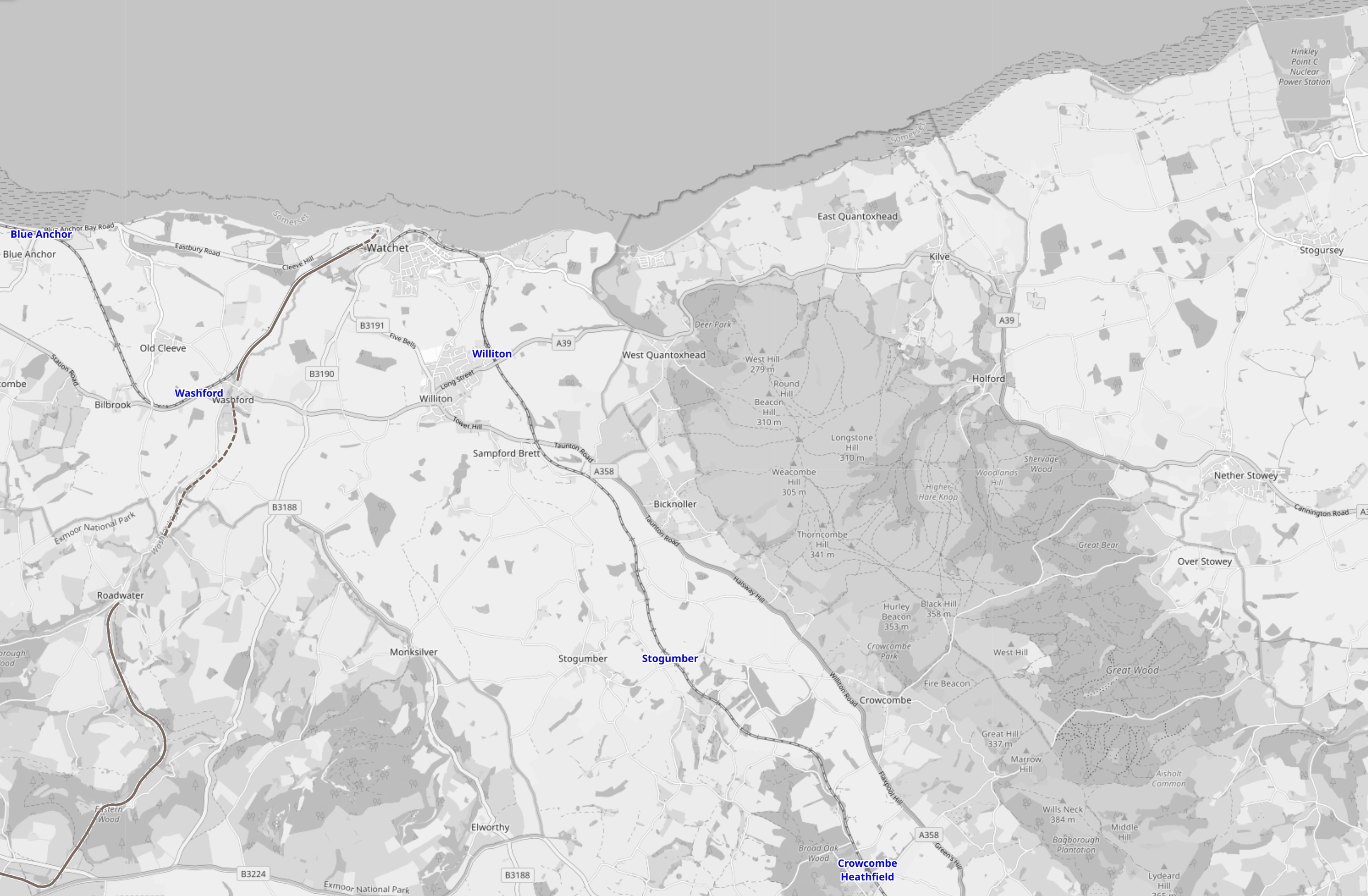
Note.
- Hinckley Point C power station is in the North-East corner of the map.
- Crowcombe & Heathfield, Stogumber, Sampford Brett, Doniford Halt, Williton, Watchet, Washford and Blue Anchor are existing or former stations on the West Somerset Railway.
- Existing stations are shown in blue.
- West of Blue Anchor are the two existing stations of Dunster and Minehead.
This Google Map shows Williton station, which is the nearest station to Hinckley Point C.
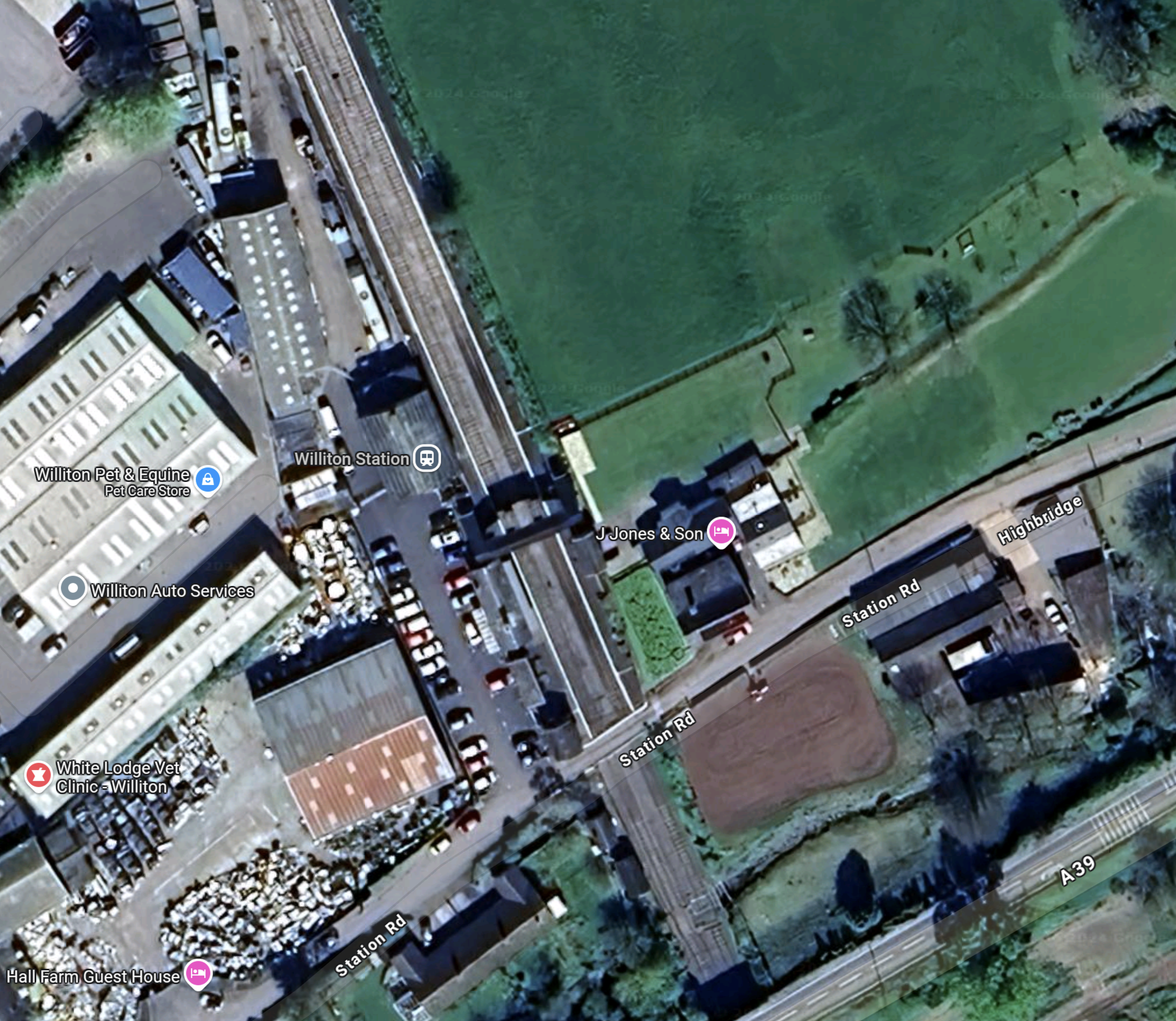
Note.
- The station has a footbridge, which was erected in 2011, so is probably in good condition.
- There are several Listed buildings on the site.
- Going East on the A39 should lead to Hinckley Point C.
I suspect a quality bus company could build a small fleet of buses to shuttle workers, visitors and others to Hinckley Point C.
As I’m sure, hydrogen will be in plentiful supply, I’m certain hydrogen-powered buses could be used.
This Google Map shows a longer section of the West Somerset Line through Williton station.
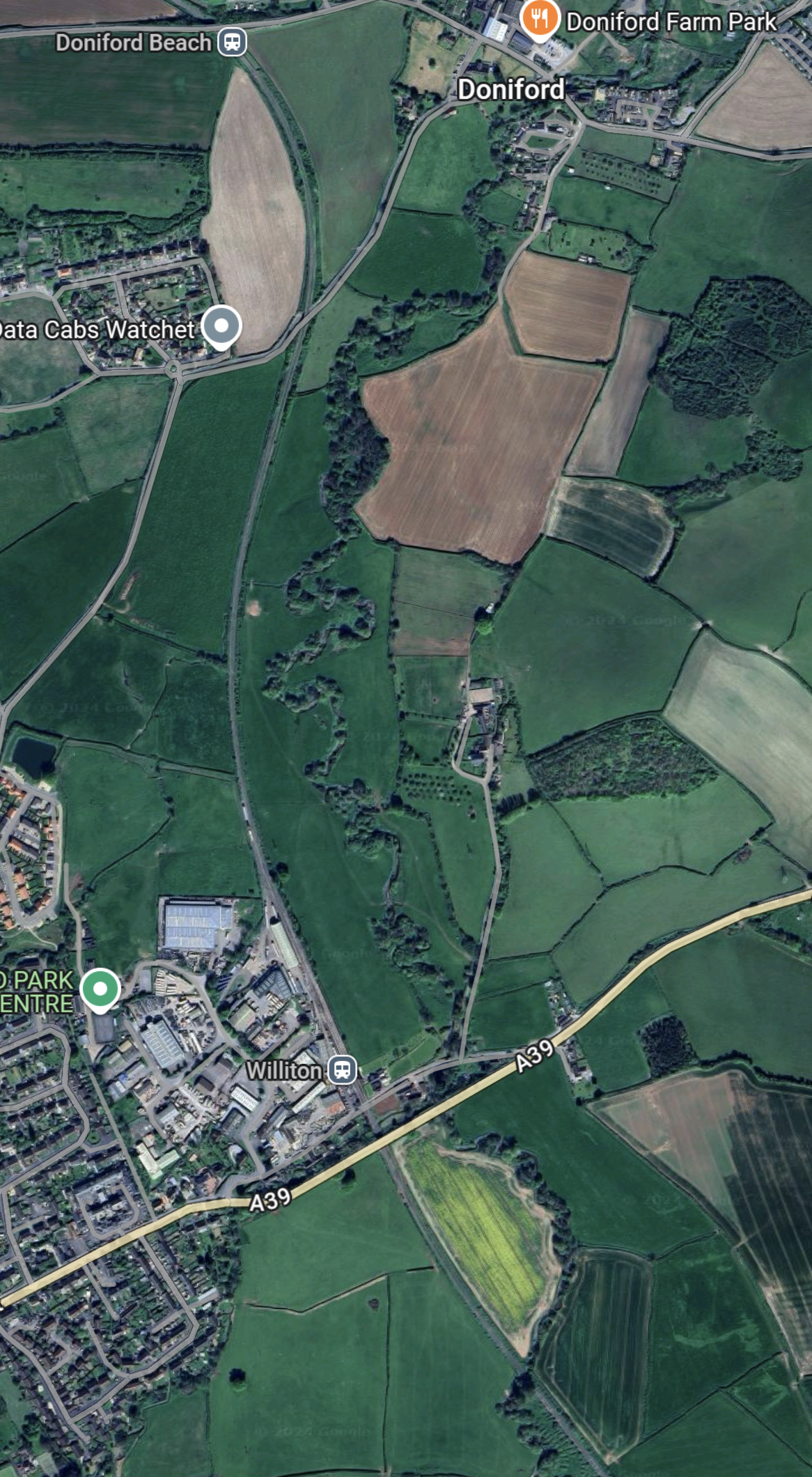
Note.
- The West Somerset Line runs North-South down the map.
- Doniford Halt station is at the top of the map, where the coast road crosses the railway on a bridge.
- Williton station is in the middle of the map, where the A39 crosses the railway.
Looking at the railway, which runs mainly between fields, I wouldn’t be surprised that if Hinckley Point wanted a freight siding, they could fit one in.
Go-op
Go-op are an open access railway company, that wants to run services in Somerset.
I wrote about their successful application in Regulator Approves New Go-op Train Service Between Swindon, Taunton and Weston-super-Mare.
This is the first paragraph of their Wikipedia entry.
Go-op Cooperative Ltd.,[ branded as Go-op, is an open access train operating company, proposing to operate a service in south-west England between Taunton and Swindon, via Westbury. It aims to become the first cooperatively owned train operating company in the United Kingdom, to improve access to the public transport infrastructure through open access rail services linking main lines to smaller market towns, and by co-ordinating services with light rail, bus links and car pools.
If you read their Wikipedia entry and their web site, they seem to have ambition and be different.
According to Wikipedia, they have made no less than five different proposals, but it is the fourth that I find interesting.
In 2021, Go-op began discussions with Network Rail for services between Swindon and Bishops Lydeard (just beyond Taunton), which it hoped to begin in mid-2022. At first there could only be three services per day, due to congestion between Swindon and Westbury; a further three could be provided to Frome or Westbury, connecting with existing services to Swindon. These plans would also improve local services on the TransWilts Line, calling at Trowbridge and Melksham.
The plans for Bishops Lydeard would restore the link broken in 1971 between the national network and the preserved West Somerset Railway, which runs leisure services to Minehead.
This sounds very much like an extended and simplified version of the West Somerset Line proposal.
But it does look like two groups have looked at the infrastructure and what is needed and come to similar conclusions.
Perhaps, they have other things in common like train procurement and servicing.
Stadler Presents A World First In Berlin
The title of this section, is the same as that of this press release from Stadler.
These are the first two paragraphs.
With the RS ZERO, the rail vehicle manufacturer is presenting the successor to the successful Regio-Shuttle RS1 model. There is a choice of two modern and environmentally friendly drive technologies: Hydrogen and battery. Both will enable CO2 emission-free operation of secondary lines in the future.
Stadler today unveiled the prototype of the new RS ZERO, the innovative successor to the successful RS1 Regio-Shuttle. The Regio-Shuttle has been one of the most popular vehicles in German regional rail transport for 28 years, with around 500 RS1 vehicles currently in operation in Germany and the Czech Republic. Stadler is building on this proven technology and integrating state-of-the-art, environmentally friendly drive systems. The RS ZERO is optionally available with a hydrogen and/or battery drive and thus not only sets new standards for environmentally friendly rail transport, but also presents a world first.
These pictures from Chemnitz Trams And The Chemnitz Model, show the Regio-Shuttle RS1.




Note.
- The Regio-Shuttles can run as up to seven car trains.
- These Regio-Shuttles are electro-diesel.
- The distinctive diagonal windows.
- They can carry 170 passengers at 75 mph.
- They can run as train-trams using the Chemnitz model on compatible tram networks.
The Regio-Shuttle Wikipedia entry gives more details.
This image from the press release shows the prototype RS ZERO.
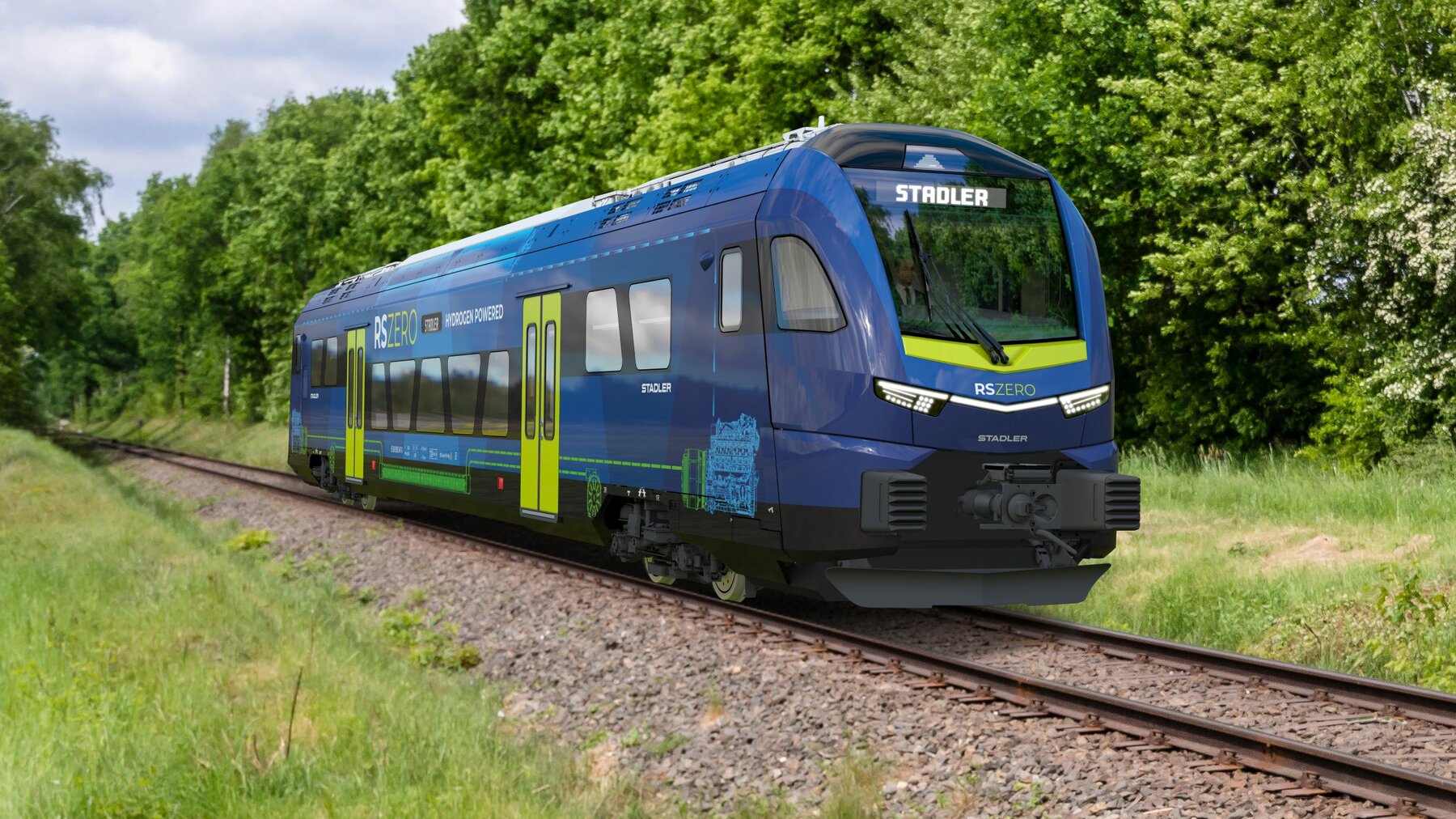
It looks very similar to my pictures from Chemnitz.
I have a few thoughts.
Comparison To A Class 150 Train
A Class 150 train can carry up to 149 seated passengers at 75 mph, which is similar to the RS ZERO.
As Stadler have built trains for Greater Anglia, Merseyrail and the Glasgow Subway, I believe that Stadler could build an RS ZERO, that would fit the UK loading gauge.
In What Train Is This?, I show the standard of interior, that can be achieved by refurbishing a Class 150 train, but unlike the RS ZERO, the train won’t be zero-carbon.
Does The RS ZERO Have A Toilet?
This is a paragraph from the press release.
The prototype of the RS ZERO presented today in Berlin is a one-car vehicle with hydrogen drive. Stadler is demonstrating the numerous design options with a multi-purpose area equipped for carrying bicycles, pushchairs and bulky luggage, lounge and comfort zones, standard and privacy seats, a wheelchair space, WC and a train office.
The train appears to be able to have what an operator might need.
What Will Be The Range Of An RS ZERO On Hydrogen?
I suspect, Stadler will provide a train, that will handle the route.
Would Stadler Be Able To Produce An RS ZERO That Could Satisfy The West Somerset/Go-op Requirement?
I obviously, can’t answer that.
But.
- The train is zero-carbon.
- It’s the right size.
- I suspect that the hydrogen fuel will be available from Hinckley Point C.
- The design has a proven track record.
- The train is not by any means vapourware!
- Stadler need a launch order.
- An experienced ROSCO would probably finance the trains.
One perk is that those involved in buying the train, could probably wangle a trip to Chemnitz to see several Regio-Shuttle RS1 trains at work.
Note that Chemnitz used to be Karl-Marx Stadt, so some of our Government will feel nostalgic.
But I do believe, this could be a very handy train to decarbonise branch and secondary lines in the UK.
Large Scale Hydrogen Storage Sites Could Reduce Customer Energy Costs By £1bn Per Year
The title of this post, is the same as this press release from Centrica.
These four paragraphs summarise the report.
Centrica and FTI report finds that hydrogen storage would help balance the UK’s energy system and reduce bills.
A net zero scenario including large scale hydrogen storage – specifically, a redeveloped Rough gas storage facility – would reduce energy costs by an additional £1bn per year by 2050.
Report also finds that a UK energy system focused on renewable generation risks high levels of intermittency without an established hydrogen market. By 2050, electricity generation from renewables could exceed total demand around 15% of the time.
Electricity generation from renewables could also rise or fall by as much as 100GW over the course of a single day. More than twice current levels of peak demand on winter evenings and the equivalent energy output from over 30 Hinkley Point C nuclear power stations.
Note.
- Hydrogen Central entitles their article about the Centrica press release Centrica Says Hydrogen Can Reduce Household Bills by £35 a Year. That’s almost a bottle of my favourite Adnams beer a week!
- I talked about the redevelopment of the Rough facility into hydrogen storage in Aberdeen’s Exceed Secures Centrica Rough Contract.
- Generating hydrogen from excess electricity and storing it until it is needed, must be an efficient way of storing electricity or powering industrial processes that need a lot of energy, if storing hydrogen makes £1bn per year!
- It should be noted that Centrica have a large interest in HiiROC, who are developing an efficient way to generate hydrogen from any hydrocarbon gas from chemical plant off-gas through biomethane to natural gas. In a perfect world a HiiROC system in a sewage works could capture the biomethane and split it into hydrogen and carbon black. The hydrogen could be used to refuel vehicles and the carbon black would be taken away to someone, who has need of it.
In some ways, it is surely sensible to have enough energy in a store, if the renewables fail. As Rough is already there and functioning, it is surely one of the easiest routes to redevelop Rough, so that it is in top-quality condition.
It should also be noted, that Rough is not far from the Aldbrough Gas Storage, which SSE are converting to a second massive hydrogen store.
So Humberside will have two of the largest hydrogen stores in the world, which Centrica and SSE will use to maxise energy security in the wider Humberside and East Yorkshire area, and I suspect to maximise their profits as well.
This video shows the structure of AquaVentus, which is a pipeline system, that the Germans are building to bring much-needed hydrogen to German industry from electrolysers in the North Sea and other countries like Denmark, Norway, the Netherlands and the UK.
I clipped this map from the video.

Note how a branch of AquaVentus makes landfall around the Humber estuary at a UK label.
Will Centrica and SSE be trading hydrogen from Rough and Aldbrough with the Germans through AquaVentus? You bet they will, as the Germans are short of both hydrogen and hydrogen storage.
All T-Pylons Fully Wired Up In Major Milestone For Hinkley Connection Project
The title of this post is the same as that of this press release from National Grid.
These three bullet points are sub-headings.
- Hinkley Connection Project’s 116 T-pylons now ‘strung’ with overhead conductors
- Final conductors fixed into place on a row of T-pylons near Yatton, North Somerset
- 460km and 1,288 tonnes of power line have been installed between project’s T-pylons
Seven paragraphs of the press release go into great detail about how the cables were attached.
But I find this image from the press release, is the most interesting part.
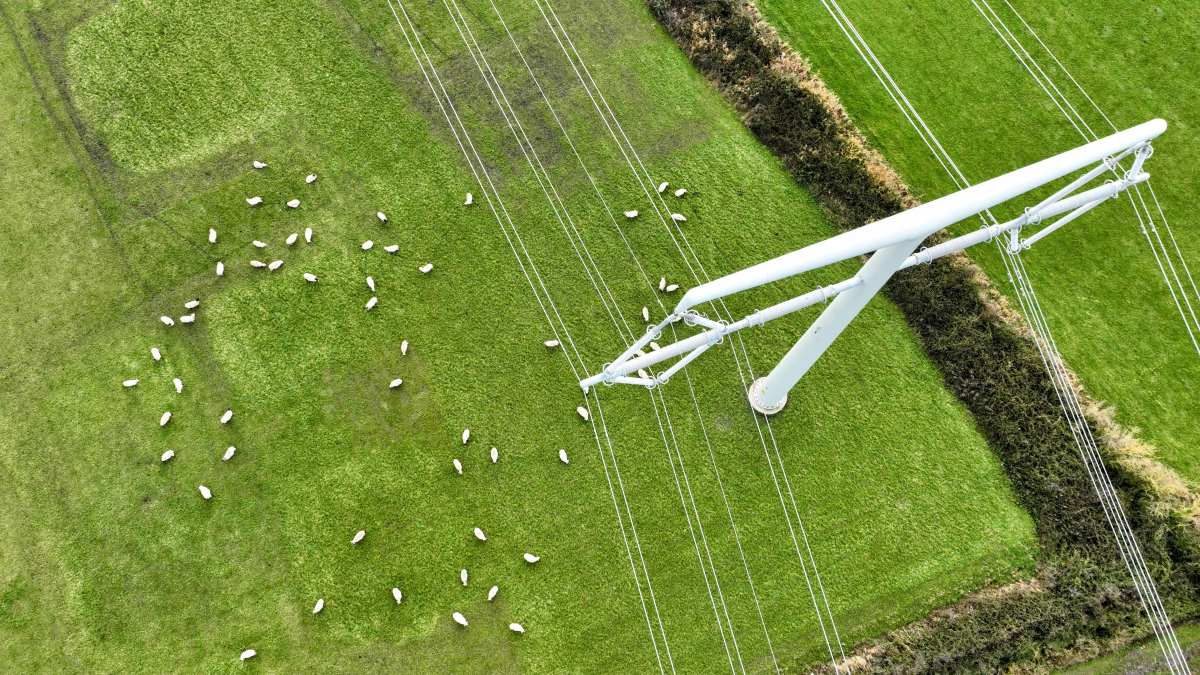
Note.
- There are six cables on each diamond earring-shaped insulator.
- There appears to be a second cross-bar between the insulators.
- The pylon has a small footprint on the ground.
- The white dots on the ground look like sheep.
- The base of the pylon, will make a good scratching post for animals, like sheep, cattle and horses.
This second picture is a profile, that I took at Yatton from a passing train.
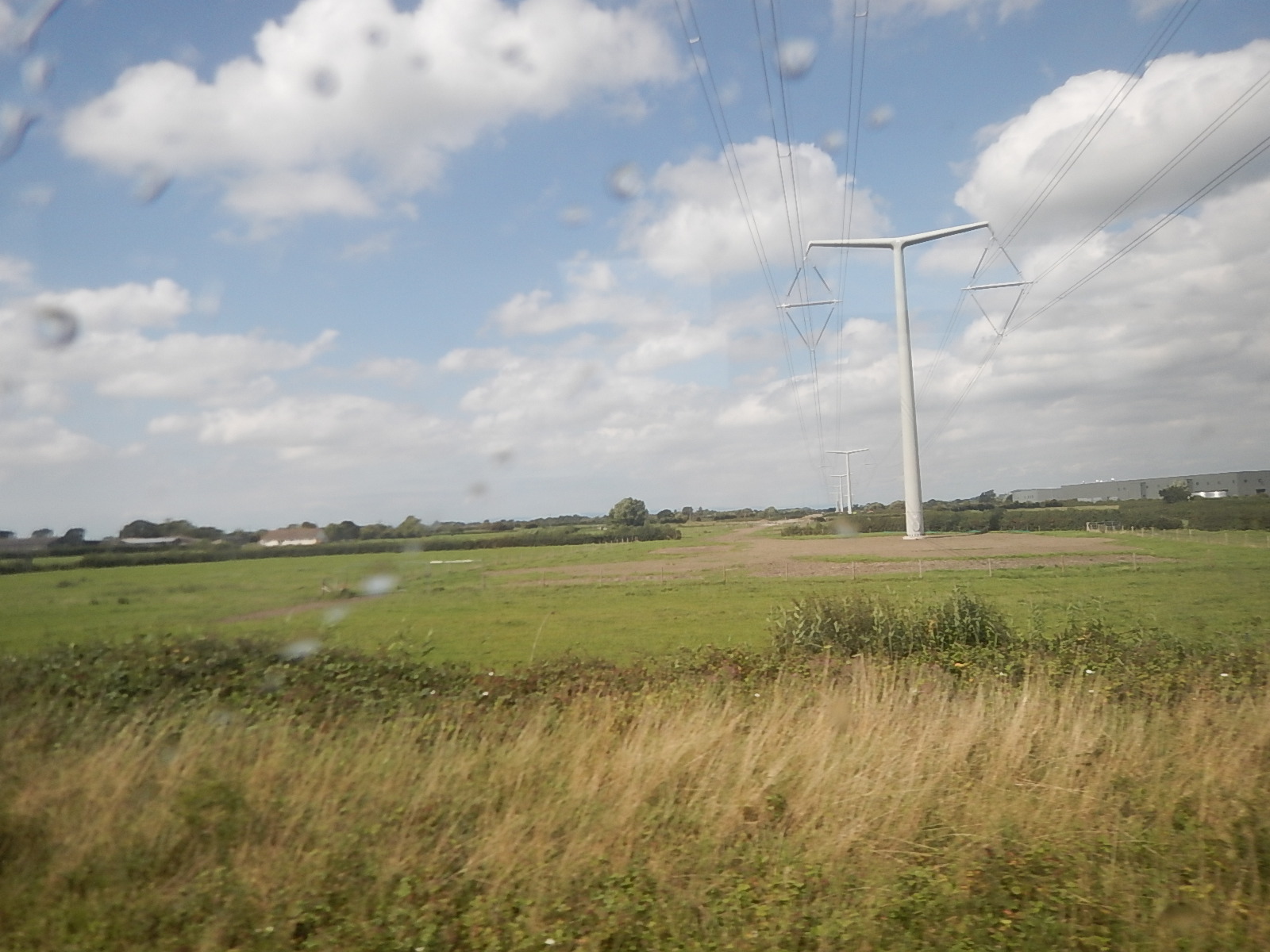
Note that the second cross-bar is not there. Is it to steady the insulators during the installation of the cables?
This picture shows some of the traditional pylons used to connect the Sizewell site to the National Grid.
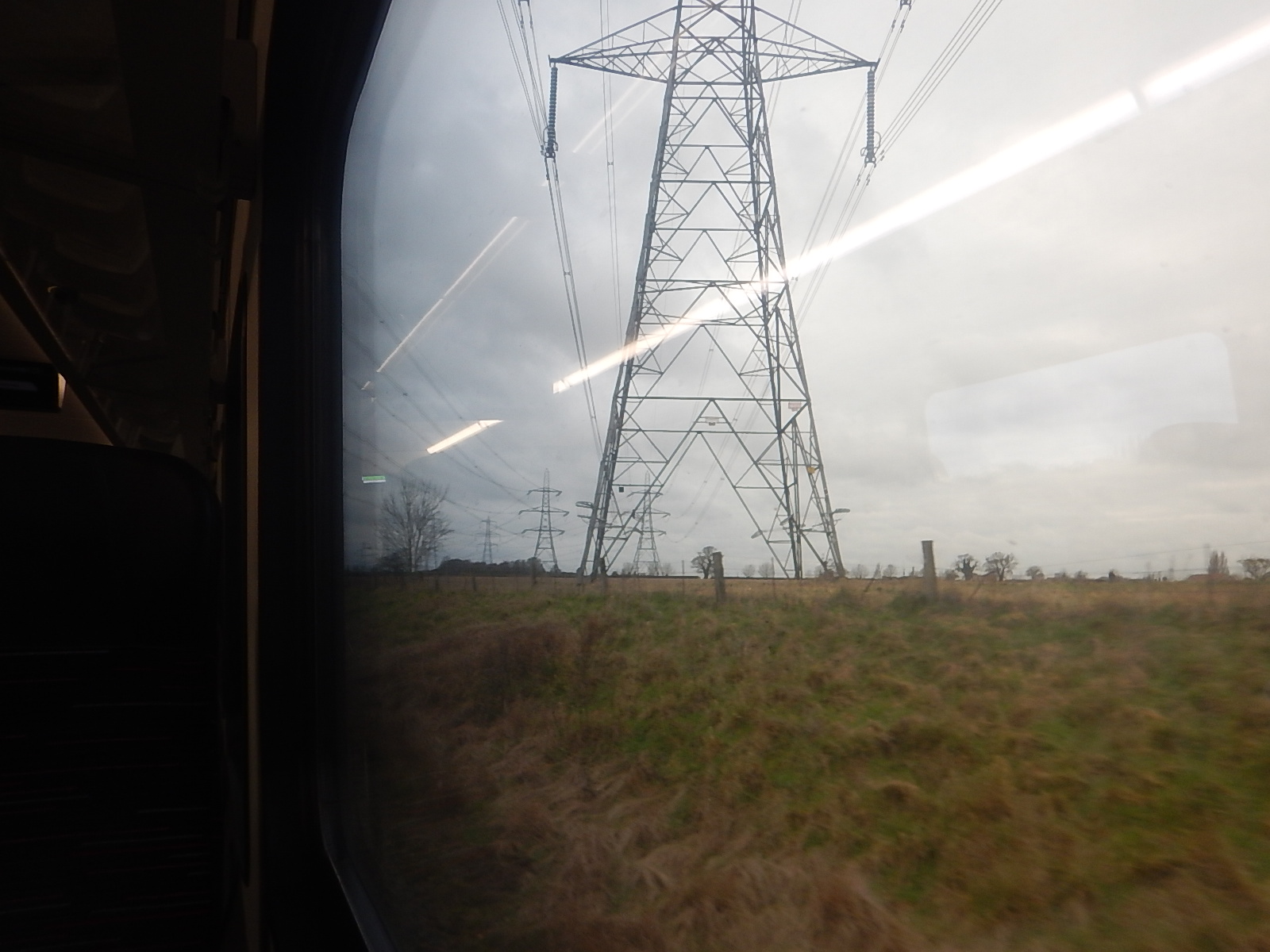
I know which ones I prefer.
 The Anonymous Widower