Holyhead Hydrogen Hub Planned For Wales
The title of this post is the same as that of this article on H2 View.
This is the introductory paragraph.
Plans for a new hydrogen production plant, refuelling and distribution hub have been unveiled for Holyhead, North Wales.
Some other points from the article.
- Unsurprisingly, it will be called the Holyhead Hydrogen Hub.
- Holyhead is the second largest roll-on, roll-off port in the UK.
- There is plenty of potential for renewable energy in the area.
- It will support the port and large scale movements of HGVs.
- There is plenty of potential for renewable energy in the area.
- The hydrogen in future could support trains, ships, public transport and other uses.
In the last year, I’ve read about hydrogen hubs in ports, including Portsmouth and Antwerp, so Holyhead is just following a trend.
Will High Speed Two’s Classic-Compatible Trains Have Battery Operation?
I believe it is very likely, that High Speed Two’s new classic-compatible trains will have battery capabilities.
- Batteries would handle energy generated by regenerative braking.
- Batteries would give a train recovery capability in case of overhead catenary failure.
- Batteries would be used for depot movements.
- Batteries would probably improve the energy efficiency of the trains.
Effectively, the batteries would power the train and would be topped-up by the electrification and the regenerative braking.
But would they be able to give the trains a route extension capability on lines without electrification?
Consider.
- Battery technology is getting better with energy capacity per kilogram increasing.
- Batteries will be full, when the train leaves the electrification.
- These trains will be as light as possible.
- Trains will not be running at speeds in excess of perhaps 100 mph without electrification.
- Fast charging can be provided at station stops.
I think, that trains could be able to do at least 40 to 50 miles on a full charge.
Fast Charging Technology
The most promising fast-charging technology is Vivarail’s system of using a length of conventional third-rail connected to a bank of batteries. When the train connects with the third-rail, electricity flows to the batteries on the train.
There are also others working on systems that use short lengths of overhead electrification.
Both systems can be totally automatic and safe.
Example Routes
These are three possible example routes.
Aberdeen And Edinburgh
These are the distances between stops on the route between Aberdeen and Edinburgh.
- Aberdeen and Stonehaven – 12 miles
- Stonehaven and Montrose – 24 miles
- Montrose and Arbroath – 14 miles
- Arbroath and Dundee – 17 miles
- Dundee and Leuchars – 8 miles
- Leuchars and Kirkaldy – 25 miles
- Kirkcaldy and Inverkeithing – 13 miles
- Inverkeithing and Edinburgh – 13 miles
It is a total of 130 miles without electrification.
The route is also generally flat and mainly along the coast.
Inverness And Edinburgh
These are the distances between stops on the route between Inverness and Strirling.
- Inverness and Aciemore- 35 miles
- Aviemore and Kingussie – 12 miles
- Kingussie and Pitlochry – 43 miles
- Pitlochry and Perth – 30 miles
- Perth and Gleneagles – 15 miles
- Gleneagles and Stirling – 17 miles
It is a total of 152 miles without electrification.
As there are some steep gradients, there may be a need for some electrification in certain sections of the route.
Holyhead And Crewe
These are the distances between stops on the route between Holyhead and Crewe
- Holyhead and Bangor – 25 miles.
- Bangor and Llandudno Junction – 16 miles
- Llandudno Junction and Colwyn Bay – 4 miles
- Colwyn Bay and Rhyl – 10 miles
- Rhyl and Prestatyn – 4 miles
- Prestatyn and Flint – 14 miles
- Flint and Chester – 13 miles
- Chester and Crewe – 21 miles
It is a total of 105 miles without electrification.
The route is also generally flat and mainly along the coast.
A Stepping-Stone Approach
I believe there is a design of fast charger, that in say a three minute stop can charge the battery sufficient to get to the next station. The electrification might continue for perhaps a couple of hundred metres from the station on the tracks where the trains are accelerating.
A train making a stop at a station would do the following.
- As it approaches the stop, the train’s kinetic energy is turned into electricity by the regenerative braking.
- This energy is stored in the batteries.
- In the station, the batteries are charged from the fast charger or electrification.
- Whilst stopped, the batteries provide the power for the train’s systems.
- Accelerating away would use the batteries or electrification if it is installed.
The train’s computer would monitor the batteries and control the various power systems and sources to run the train in the most efficient manner.
This sequence would be repeated at each stop as the train progressed to its destination.
Extra Electrification
In the section on the challenging Edinburgh and Inverness route, I said that some gradients would probably need to be electrified to maintain progress.
But there are other sections, where electrification has been suggested.
- Stirling and Perth
- Crewe and Chester
So could we be seeing a mixture of electrification and charging stations on routes to allow electric trains to serve routes, where full electrification is impossible for practical, scenic, heritage or cost reasons?
The South Wales Metro is to use discontinuous electrification to save the cost of rebuilding innumerable bridges.
Conclusion
I believe that engineers can design high speed trains, that will be able to run on existing lines using battery power to serve the remoter parts of Great Britain.
Could High Speed Two Trains Serve Chester And North Wales?
This may seem a slightly outrageous proposal to run High Speed Two trains to Chester.
- The city is a major tourist destination.
- Despite its closeness to Crewe it is a major rail hub, with services across Wales to Cardiff, Holyhead and Llandudno and along the border between England and Wales to Shrewsbury and Newport.
- Merseyrail serves the city and the station can be considered to be part of Liverpool’s extensive commuting area. This service is likely to be more reliable and faster with the delivery of new Class 777 trains.
- For parts of Merseyside, travelling to London or Manchester Airport, is easier via Chester than Liverpool Lime Street or Liverpool South Parkway.
If the promoters of High Speed Two are serious about creating a railway for the whole country, then I feel that running trains direct to and from Chester could be very beneficial for the towns and cities, that can be served by the current network at Chester.
Current And Possible Timings
Currently, trains take two minutes over two hours between Euston and Chester.
When Avanti West Coast introduces the new Hitachi AT-300 trains on the route, the following times will be possible.
- Euston and Crewe via West Coast Main Line – 90 minutes – Fastest Pendelino
- Crewe and Chester – 24 minutes – Current timing
This would give a time of one hour and 54 minutes, which is a saving of 8 minutes. But a lot of carbon would not be emitted between Euston and Crewe.
I estimate, that with High Speed Two Phase 2a completed, the following timings will be possible.
- Euston to Crewe via HS2 – 55 minutes – HS2 website
- Crewe and Chester – 24 minutes – Current timing
This would give a time of one hour and 19 minutes, which is a saving of 43 minutes.
Infrastructure Needed
There will need to be some infrastructure changes.
Platform Lengthening At Chester Station
The station would probably be served by two-hundred metre long High Speed Two Classic-Compatible trains, which might need some platform lengthening.
This Google Map shows the station.
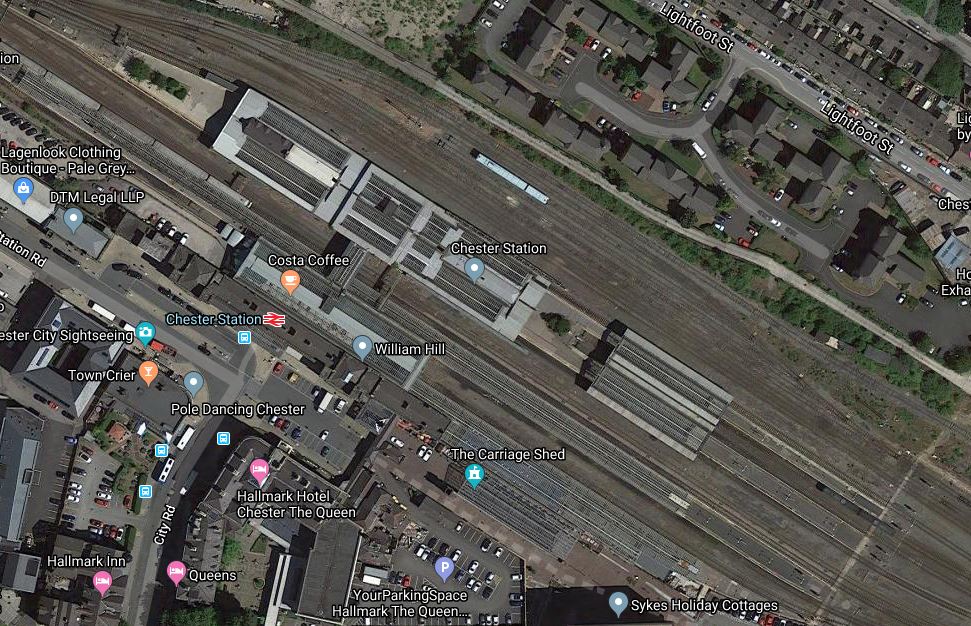
It looks to me, that there is plenty of space.
Will Chester And Crewe Be Electrified?
We know little about the capabilities of the trains proposed by the various manufacturers.
But, I wouldn’t be surprised that one or more of the proposals use batteries for one of the following purposes.
- Regenerate braking.
- Emergency power.
- Range extension for up to perhaps sixty miles.
As Chester and Crewe stations are only twenty-one miles apart with no intermediate stations, which will be run at an average speed of only 52 mph I don’t think it will be impossible to extend the service to Chester on battery power.
If electrification is required I wrote about it in Hitachi Trains For Avanti.
As it is only just over twenty miles, I don’t think it will be the most challenging of projects, although there does seem to be a lot of bridges.
Electrification would also allow Avanti West Coast’s Hitachi trains to run on electricity to Chester.
What About Holyhead?
Holyhead could become a more important destination in the next few years.
It is probably the best alternative to avoid flying and driving between Great Britain and the Island of Ireland.
And who can accurately predict, what effect Brexit and thinking about global warming will have?
I have a feeling that after electrification to Chester, using on-board energy storage could be used West of Chester.
It is very difficult to predict battery ranges in the future, but I can see a two hundred metre long High Speed Two Classic-Compatible train being able to reach Holyhead on battery power, with or without some limited extra electrification.
Alternatively, the UK and Welsh governments, might bite the bullet and just electrify the whole route between Crewe and Holyhead.
I have found a train on Real Time Trains, that covered the 105.5 miles between Holyhead and Crewe in two hours and 11 minutes at an average speed of 48 mph. The train took then a total of three hours and forty-five minutes to get to Euston
I estimate that with electrification and some track improvements, that it will be possible to travel between Euston and Holyhead in under three hours before High Speed Two.
Conclusion
It looks to me, that when High Speed Two, think about adding extra destinations, Chester and Holyhead could be on the list.
I also suspect that even without electrification and High Speed Two services, but with the new Class 805 trains, the route could be a valuable one for Avanti West Coast.
 The Anonymous Widower