Rumours Grow Over Future Of HS2
The title of this post is the same as that of this article on Railnews.
This is the first paragraph.
The future of HS2 appears to be increasingly in doubt, as reports suggest that the forthcoming Oakervee Review will axe Phase 2b between the West Midlands and Yorkshire and possibly cancel the project entirely.
The article also says this about the first phase of the project.
Another possibility is that Phase 1 between London and Birmingham could be built more cheaply by lowering the maximum speed from the presently-planned 250km/h. Such a reduction would reduce the new line’s capacity and lengthen journey times but still ease the pressure on the West Coast Main Line, where paths are in short supply.
There are three suggestions in these two paragraphs and before I discuss them, I’ll detail the various phases of the project as they are current proposed.
The Phases Of High Speed Two
High Speed Two will be two phases with the second phase split into two.
- Phase 1 – London and the West Midlands
- Phase 2a – West Midlands and Crewe
- Phase 2b – Crewe and Manchester and West Midlands and Leeds
The plan improves links between London and several major cities in the Midlands and North.
Northern Powerhouse Rail
I am a great believer in holistic design and in the economies of doing several similar projects together or in a well-defined sequence, that delivers benefits in a stream.
For that reason, I believe that the equally-important Northern Powerhouse Rail should be designed in conjunction with High Speed Two, to achieve the following objectives.
- A better railway, that connects more towns and cities.
- A phased delivery of benefits.
- Possible cost savings.
This report on the Transport for the North web site which is entitled At A Glance – Northern Powerhouse Rail, advocates a much better approach.
- High Speed Two would go from Crewe to Hull via Warrington, Manchester Airport, Manchester Piccadilly, Huddersfield, Bradford and Leeds.
- Northern Powerhouse Rail would go from Liverpool to Hull via Warrington, Manchester Airport, Manchester Piccadilly, Huddersfield, Bradford and Leeds.
- There would be a double junction at High Legh between Liverpool and Manchester, that connects the two routes.
- London and Liverpool services would use the Western end of Northern Powerhouse Rail from High Legh.
- There would be improvements East of Leeds to connect to Sheffield and the East Coast Main Line.
This map shows the high speed railways between Crewe, Liverpool, Manchester and Warrington.

I discussed, what has been proposed by Transport of the North in Changes Signalled For HS2 Route In North.
Cutting High Speed Two To An Affordable Budget
I’ll take the three suggestions in the Rail News article.
Suggestion One – Cancel The Project
This is actually the second suggestion, but I think the article kills it in the second paragraph, that I quoted, when it says that High Speed Two is needed to ease pressure on the West Coast Main Line.
Cancellation would probably be a vote loser and a big stick with which to beat Boris, if he brought forward any environmental proposals.
I doubt cancellation will happen, unless we get someone like Nigel Farage as Prime Minister.
Suggestion Two – Cancel Phase 2b Between The West Midlands And Yorkshire
This clip of a map from the Transport for the North report shows a schematic of the rail links to the East of Manchester.
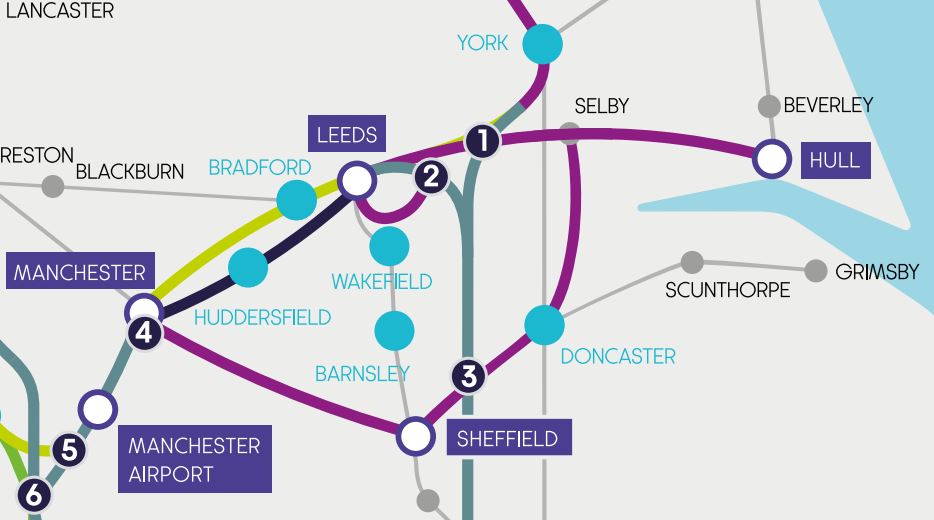
Northern Powerhouse Rail would offer a lot of improvements, which are shown in purple.
There are also these projects that will improve trains to and from Yorkshire.
- Northern Powerhouse Rail between Liverpool and Hull via Manchester Airport, Manchester Piccadilly, Huddersfield, Bradford and Leeds.
- A possible connection between Northern Powerhouse Rail and High Speed Two at High Legh.
- Midland Main Line upgrade with 125 mph bi-mode trains between London and Sheffield.
- 140 mph running on the East Coast Main Line between London and Doncaster and onward to Bradford, Hull, Leeds and York.
I’ll add a few more flesh to the points.
High Speed Two To Hull
If High Speed Two connects to Northern Powerhouse Rail at High Legh it will join everything together.
- High Speed Two trains would run between London and Hull via Birmingham, Crewe, Manchester Airport, Manchester Piccadilly, Huddersfield, Bradford and Leeds.
- Very expensive infrastructure would be shared between High Speed Two and Northern Powerhouse Rail.
- Leeds and Manchester would be just twenty minutes apart, with trains from both lines on the same tracks.
- Hull station has the space to handle the trains.
Combining the two routes should save billions.
Midland Main Line To Sheffield, Rotherham, Barnsley, Wakefield And Leeds
This is already ptoposed for the Midland Main Line.
- New stations will be built at Rotherham and Barnsley.
- Four fast trains per hour between Sheffield and Leeds can be delivered.
- 125 mph bi-mode trains to Yorkshire via the East Midlands.
But what about the following?
- Could the Erewash Valley Line be used instead of a new High Speed Two line between the East Midlands and Sheffield?
- Could the Midland Main Line be electrified and upgraded to 140 mph running like the East Coast Main Line?
Similar connectivity to that of High Speed Two can be created at a lower cost.
Cancellation of the Eastern Leg of Phase 2b would mean there would be no improved link between the West and East Midlands.
Perhaps, the Eastern leg of High Speed Two, would run only to the proposed East Midlands Hub station at Toton.
Increasing Capacity On The East Coast Main Line
In Thoughts On A 140 mph East Coast Main Line Between London And Doncaster, I did a crude calculation to see how many extra trains could be run between London and Doncaster on a digitally signalled 140 mph East Coast Main Line.
This was my conclusion.
If something similar to what I have proposed is possible, it looks like as many as an extra seven tph can be accommodated between Kings Cross and the North.
That is certainly worth having.
Extra trains could be run between Kings Cross and Bradford, Hull, Leeds, Nottingham and Sheffield.
Estimated timings would be eighty minutes to Doncaster and under two hours to Leeds.
Suggestion Three – Reduce Speed In Phase 1
There is always a tendency for project promoters to make sure their project is the biggest and the best.
There will be an optimum speed for a London and Birmingham high speed line, which balances benefits, costs, noise and disturbance. One politician’s optimum will also be very different to another’s.
Such parameters like operating speed and capacity must be chosen with care.
Conclusion
I believe, that we need the capacity of both High Speed Two and Northern Powerhouse Rail to move passengers and freight.
So we should design them together and with other improvements like the Midland Main Line and the East Coast Main Line.
Will HS2 And Northern Powerhouse Rail Go For The Big Bore?
Different Versions Of This Post
The original post was published on the 25th August 2019.
It has been updated on the 21st November 2020 to reflect changes made to High Speed Two (HS2).
It has been updated on the 13th January 2023 for piggy-back freight trains.
The Merging Of High Speed Two And Northern Powerhouse Rail
It looks to me that there will be increasing links and merging between High Speed Two (HS2) and Northern Powerhouse Rail (NPR).
This report on the Transport for the North web site, is entitled At A Glance – Northern Powerhouse Rail.
Proposals and possibilities include.
- NPR will have a Western terminal at a new station in Liverpool City Centre.
- HS2 trains would access Liverpool and Manchester via a junction between HS2 and NPR at High Legh.
- There will be six trains per hour (tph) between Liverpool and Manchester via Manchester Airport.
- The route between Manchester and Manchester Airport is planned to be in tunnel.
- There will be six tph between Manchester and Leeds.
In addition, Boris has made positive noises about a high speed line between Manchester and Leeds being of a high priority.
So will the planners go for the logical solution of a High Speed tunnel between Manchester Airport and Leeds?
- There could be a theoretical capacity of perhaps 18 tph, which is the design capacity of High Speed Two.
- Speeds of up to 125 mph or more could be possible. The Gottard Base Tunnel has an operating speed for passenger trains of 125 mph.
- Stations could be at Manchester Airport, Manchester Piccadilly/Piccadilly Gardens/Victoria, Huddersfield, Bradford and Leeds.
- West of Manchester Airport, the route appears easier and the tunnel would emerge close to the airport. High Speed Two is planning that the tunnel emerges just to the North of the Airport and that the station is below ground level.
- East of Leeds the tunnel would join up with existing routes to Doncaster, Hull, Newcastle and York.
- Freight trains would be allowed at speed of up to 100 mph.
I believe such a tunnel could be built without disrupting existing rail services and passengers. Remember building Crossrail’s tunnels in London was an almost invisible process.
It would result in two rail systems across Northern England.
- Upgraded Classic Rail Routes
- The Big Bore
My thoughts on the two systems follow.
Upgraded Classic Rail Routes
This could include improvements such as these,
- Extra passing loops.
- Selective electrification
- Improved stations
- Comprehensive in-cab digital signalling
- More paths for passenger and freight trains.
Which could be applied to routes, such as these.
- The Huddersfield Line
- The Chat Moss Line
- The Calder Valley Line
- The Hope Valley Line
- The Dearne Valley Line
- The Selby Line
- The Midland Main Line North Of Clay Cross
In addition, there could be the reopening of some closed or freight routes to passenger trains.
This article on Rail Technology Magazine is entitled Network Rail Reveals Detailed £2.9bn Upgrade Plans For TransPennine Route.
It is a comprehensive upgrade that includes.
- Improvement between Huddersfield and Westtown, which is near Dewsbury
- Grade separation or a tunnel at Ravensthorpe
- Rebuilding and electrification of eight miles of track.
- Possible doubling the number of tracks from two to four.
- Improved stations at Huddersfield, Deighton, Mirfield and Ravensthorpe.
This project would be a major improvement to the Huddersfield Line.
In Sheffield Region Transport Plan 2019 – Hope Valley Line Improvements, I talked about planned improvements to the Hope Valley Line, which should begin in the next couple of years.
These improvements are given in detail under Plans in the Wikipedia entry for the Hope Valley Line.
The Hope Valley Improvements will cost in the region of tens of millions of pounds and Wikipedia sums up the benefits like this.
These changes to allow three fast trains, a stopping train and freight trains each hour were also supported in a Transport for the North investment report in 2019, together with “further interventions” for the Northern Powerhouse Rail programme.
It seems like good value to me!
So could we see other multi-million and billion pound projects created to improve the classic routes across the Pennines?
Projects would be fully planned and the costs and benefits would then be assessed and calculated.
Then it would be up to the Project Managers to devise the optimal structure and order in which to carry out all the projects.
I wouldn’t be surprised to see the following techniques used.
- Discontinuous electrification to avoid bridge reconstruction.
- Intelligent, hybrid diesel/electric/battery trains from Bombardier, CAF, Hitachi or Stadler, capable of 125 mph running and changing mode at speed.
- Modular digital signalling
- Factory built stations and step-free bridges.
- Removal of all level crossings.
- All stations updated for step-free access between train and platform.
The objectives would be as follows.
- More train paths, where needed.
- Faster line speed.
- Less running on diesel.
- Fast station stops.
Hopefully, the upgrading could be done without too much disruption.
Remember though, that disruption to existing users during a project, is most likely down to bad project management.
The Big Bore
The Central Core tunnel of Crossrail between Royal Oak and East London, was virtually a separate project before Crossrail’s stations and much of other infrastructure was built.
I believe that digging the tunnel first gave a big advantage, in that it could be constructed as an independent project, provided that the logistics of delivering the components and removing the junk was done efficiently.
But it did mean that travellers wouldn’t see any benefits until the project was almost complete.
HS2 and NPR are different in that they also envisage upgrading these routes.
- The Huddersfield Line
- The Chat Moss Line
- The Calder Valley Line
- The Hope Valley Line
- The Dearne Valley Line
- The Selby Line
- The Midland Main Line North Of Clay Cross
Only the Huddersfield Line is directly affected by the Big Bore.
Effectively, the Big Bore will provide a by-pass route for passenger trains between Leeds and West of Manchester Airport, to take the fast trains of HS2 and NPR underneath the congested classic lines.
In Changes Signalled For HS2 Route In North I said this about a tunnel between Leeds and Manchester.
To get a twenty-five minute time between Leeds and Manchester with a ten minute frequency, which I believe is the minimum service the two cities deserve, would be like passing a whole herd of camels through the eye of a single needle.
The Swiss, who lets face it have higher hills, than we have in Northern England would create a new route mainly in tunnel between the two cities, with perhaps an underground station beneath the current Grade I Listed; Huddersfield station.
The transport for the North report suggests Bradford Low Moor station, as an intermediate station, so why not Bradford Low Moor and Huddersfield stations?
Note that the Gotthard Base Tunnel, which opened a couple of years ago, deep under the Alps, is about the same length as a Leeds and Manchester tunnel, and cost around eight billion pounds.
It would be expensive, but like Crossrail in London, the tunnel would have big advantages.
- It could be built without disrupting current rail and road networks.
- It would have a capacity of up to thirty tph in both directions.
- Unlike Crossrail, it could handle freight trains.
- It would unlock and join the railway systems to the East and West.
I believe, it would be a massive leap forward for transport in the North of England.
It would be a very big project and probably one of the longest rail tunnels in the world.
Comparison With The Gotthard Base Tunnel
But surely, if a small and rich nation like Switzerland can build the Gotthard Base Tunnel, then we have the resources to build the Big Bore between Manchester Airport and Leeds.
Consider these facts about the Gotthard Base Tunnel.
- It is two single track bores.
- Each bore has a track length of around 57 kilometres or 35 miles.
- The tunnel may be deep, but it is direct and level.
- The maximum speed is 250 kph or 160 mph.
- The operational speed for passenger trains is 200 kph or 125 mph.
- The operational speed for freight is 100 kph or 62 mph.
- It can take the largest freight trains.
To make numbers even more impressive it is joined to the shorter Ceneri Base Tunnel, to provide an even longer route.
Manchester Airport And Leeds Direct
Now consider Manchester Airport and Leeds.
- The current rail distance is 56 miles.
- There are stops at Manchester Piccadilly, Manchester Oxford Road, Manchester Victoria and Huddersfield stations.
- Journey time is eighty minutes.
But the direct distance is only 68 kilometres or forty-three miles.
Surely if the Swiss can blast and dig two 57 km. single-track rail tunnels through solid rock, we can go eleven kilometres further with all the recent experience of tunnelling around the world.
The lengths of the various legs would be as follows.
- Manchester Airport and Manchester – 14 km.
- Manchester and Huddersfield – 35 km.
- Huddersfield and Bradford – 17 km.
- Bradford and Leeds – 13 km
Trains running on the various legs at 200 kph, which is the cruising speed of a 1970s-built InterCity 125, could take the following times for the various legs.
- Manchester Airport and Manchester – 4.2 minutes
- Manchester and Huddersfield – 10.5 minutes
- Huddersfield and Bradford – 5.1 minutes
- Bradford and Leeds – 13 km – 3.9 minutes
Leeds and Manchester Airport would be under thirty minutes apart, even allowing two minutes each for the three stops.
Looking at NPR between Liverpool and Hull, times could be as follows.
- Liverpool and Manchester – 26 minutes
- Manchester and Leeds – 20 minutes
- Leeds and Hull – 38 minutes
Or a Coast-to-Coast time of under ninety minutes.
Train Frequencies
HS2 is being designed to handle eighteen tph, although slower intensive railways in the UK can handle up to twenty-four tph.
At the current time or certainly in a few years time, the theoretical maximum frequency through the Big Bore should be between these two figures. I will assume at least eighteen tph in this post.
The At A Glance – Northern Powerhouse Rail report talks about the following frequencies.
- Liverpool and Manchester via Manchester Airport – Six tph.
- Manchester and Leeds – Six tph
- Leeds and Hull – Two tph
This is all so lacking in ambition. It is like building a new high capacity road and only allowing those with status to use the road.
If Leeds and Manchester Airport can handle eighteen tph, why not use some of it to create an Express Metro under the Pennines?
To me, if the Big Bore is built, nothing short of twelve tph or a train every five minutes is acceptable, at Liverpool, Manchester Airport, Manchester, Huddersfield, Bradford and Leeds stations.
The extension to Hull could be reduced to perhaps six tph, but with the upgrading of the Hull and Leeds Line to perhaps 140 mph, I’d be bold and create a true TransPennine Express;
Hull and Liverpool every five minutes would be the ultimate Marketing Man’s dream.
The Underground Stations
Manchester Airport, Manchester, Huddersfield, Bradford and Leeds would all be through stations deep underground.
- They would be connected to the surface by lifts and escalators.
- Some entrances to the stations would connect to existing stations and others might emerge in City squares like Manchester’s P:iccadilly Gardens.
- Most stations would be just two platforms, as all trains would pass through on either side of a large underground concourse.
- Bay platforms could be added as required.
- All stations would have platform edge doors.
- Passengers would be able to reverse direction by just walking across the concourse.
Stations would build on the lessons learned from Crossrail. But then NPR is closer to Crossrail than a Classic High Speed Line.
Weston Williamson’s Vision For Manchester Piccadilly Station
I wrote about this in The Rival Plans For Piccadilly Station, That Architects Say Will ‘Save Millions’.
I believe that this is the way to create an underground station.
The Terminal Stations
The two main terminal stations for NPR and trains running through the Big Bore would be the proposed High Speed station at Liverpool and the existing Hull station.
But one other terminal station is being created; Edinburgh.
I have been going to Edinburgh station to and from England for perhaps thirty years and the capacity of the station has constantly increased.
Recent developments have been an extended Platforms 5 and 6, that can take the longest LNER trains.
I wouldn’t be surprised to find out that with the application of digital signalling, that there is capacity for at least eight tph between Edinburgh and Newcastle.
There would certainly be capacity for at least two tph between Liverpool and Edinburgh via Manchester Airport, Manchester, Huddersfield, Bradford, Leeds, York and Newcastle.
In the East the other possibilities for terminals are Doncaster, Newcastle and York.
- I would discount Newcastle, as it lacks capacity and its location would make it difficult to add more.
- Doncaster has good connectivity and space, but do Leeds and Hull offer similar connectivity?
So that leaves Hull, Edinburgh and York, as the only Eastern terminals.
In the West, there is probably a need to connect to the Northern section of the West Coast Main Line (WCML).
- Glasgow Central is probably the obvious terminal, but it would need an extra connection at the junction of HS2, NPR and WCML at High Legh.
- If necessary Preston could be used, as it has space and lots of connectivity.
- Why not use Blackpool North, as it sits on a large site and is fully electrified. It could certainly take four tph?
- A lot of the things I said for Blackpool, also apply to Chester, which would give a gateway to Mid and North Wales!
The trains through the Big Bore could fan out at both the East and West.
Tunnel Size
As Manchester will be served by High Speed Two’s Full-Size trains from Birmingham and London, both Manchester stations will need to be built to accept these trains.
I feel that the whole tunnel between Manchester Airport and Leeds, should be built to the High Speed Two size, so that it can accept the largest possible passenger and freight trains, in the future.
That would obviously include the ability to handle piggy-back freight trains.
Integration Of HS2 and NPR
The At A Glance – Northern Powerhouse Rail report is proposing this and it looks that the following HS2 services could be possible between Euston and Manchester.
- Two tph – Euston and Hull via Old Oak Common, Manchester Airport, Manchester, Huddersfield, Bradford and Leeds
- Two tph – Euston and Edinburgh via Old Oak Common, Manchester Airport, Manchester, Huddersfield, Bradford, Leeds, York and Newcastle.
Note.
- Manchester Airport, Manchester, Huddersfield, Bradford and Leeds would all have four tph to and from London, by the Western arm of HS2’s Y.
- If in addition there were two tph between Liverpool and Hull and Liverpool and Edinburgh, this would mean four tph from the Big Bore of NPR to both Hull and Edinburgh.
- None of these core services need to terminate in the Big Bore.
I very much feel that integrating HS2 and NPR is the way to go.
Could We See A High Speed Northern Metro?
If we assume that the Big Bore could handle the HS2 frequency of at least eighteen tph, then it would be possible to create a high speed service across the Pennines with the following Metro-like frequencies.
- Liverpool and Hull – 4 tph
- Liverpool and Edinburgh – 2 tph
- Glasgow and Hull – 2 tph
- London Euston and Hull – 2 tph
- London Euston and Edinburgh – 2 tph
- London Euston and Glasgow – 2 tph
This would result in the following frequencies
- Liverpool – 6 tph
- Glasgow – 4 tph
- London Euston – 4 tph
- Manchester Airport – 12 tph
- Manchester – 12 tph
- Huddersfield – 12 tph
- Bradford – 12 tph
- Leeds – 12 tph
- Hull – 8 tph
- York – 4 tph
- Newcastle – 4 tph
- Edinburgh – 4 tph
What would these frequencies do for train travel in the North of England?
Freight
The Gotthard Base Tunnel has been designed so that both freight and passenger trains can use the route.
There is a need for extra freight capacity across the country and I wonder if freight trains could use the Big Bore.
I estimate that the Big Bore would be 68 kilometres if bored straight and level between West of Manchester Airport and Leeds.
Lets assume it is seventy kilometres or 43.5 miles.
So times, through the tunnel at various average speeds would be.
- 125 mph – 21 minutes
- 110 mph – 23.7 minutes
- 100 mph – 26.1 minutes
- 90 mph – 29 minutes
- 80 mph – 32.6 minutes
- 62 mph (Gotthard Base Tunnel speed for freight) – 42 minutes.
Could it be mandated that freight trains can use the tunnel, if they could maintain a particular speed?
Consider.
- A 125 mph train with stops at Manchester Airport, Manchester, Huddersfield, Bradford and Leeds would probably take thirty minutes to transit the tunnel.
- A freight train running at 90 mph would take more or less the same time.
- Fifteen tph would mean a train every four minutes.
- Automatic control of all trains in the tunnel would be a possibility. It appears to work on the much more complicated Thameslink.
I think with the following conditions, one or even two freight trains per hour, in addition to the passenger trains, can pass through the Big Bore in each direction.
- The locomotives have the performance of at least the Class 93 locomotive, which is currently being built.
- Freight trains can be hauled through at a minimum speed, which could be between 90 and 110 mph.
- The passenger trains and train and platform staff work together to produce very short station dwell times.
- All passenger trains are identical.
- Station platforms are designed so that passengers can leave and enter the trains rapidly.
It will be a Big Bore with a capacity to match!
What About Sheffield?
I haven’t forgotten Sheffield, but I think it could be linked across the Pennines by another route.
Under the upgrades for Northern Powerhouse Rail, it is proposed that services between Sheffield and Leeds become 4 tph in 25 minutes along the Dearne Valley Line.
Does Boris Know More Than He Lets On?
The headline on the front cover of Issue 885 of Rail Magazine is Boris Backs New Pennine Railway.
There is also a sub-heading of PM commits to Leeds-Manchester line.
Boris didn’t apply any substance to the speech, except to say that it will be funded.
Conclusion
I believe that my naïve analysis in this post shows that a TransPennine tunnel is possible.
But I believe that the right tunnel could have one big advantage.
Suppose it was built to handle the following.
- A capacity of eighteen tph, which is the same as High Speed Two.
- An operating speed of 140 mph or more. The Gotthard Base Tunnel has a maximum operating speed of 160 mph.
- High Speed Two’s Full-Size trains.
- The largest freight trains.
It would be future proofed for longer than anybody could envisage.
There are also other smaller advantages.
- It would by-pass a lot of difficult areas.
- It would cause very little aural and visual disruption.
- If it were designed with care, it would not affect the flora and fauna.
- As with the Swiss tunnel, it could be dug level, which would save energy and allow trains to run faster.
- It could be running twelve tph between Leeds and Manchester Airport via Bradford, Huddersfield and Manchester Piccadilly.
- Existing surface railways at the Eastern end could serve Cleethorpes, Darlington, Doncaster, Edinburgh, Hull, Middlesbrough, Newcastle, Scarborough, Sheffield and York
- Existing surface railways at the Western end could serve Barrow, Blackpool, Carlisle, Chester, Glasgow, Liverpool. North Wales, Preston and Wigan.
It would be more like Thameslink for the North turned on its side, rather than Crossrail for the North.
The Future Of TransPennine Express
TransPennine Express operates services across the Pennines.
In Changes Signalled For HS2 Route In North, I explored the possibilities of merging the infrastructure of High Seed Two and Northern Powerhouse Rail, as proposed by this report on the Transport for the North web site, which is entitled At A Glance – Northern Powerhouse Rail.
In my post, I proposed this service pattern across the Pennines, after sketching it on one of the 5 x 3 inch cards, that I use for notes.
- High Speed Two – Two tph between London and Hull via Manchester Airport, Manchester Piccadilly and Leeds
- High Speed Two – One tph between London and Edinburgh via Manchester Airport, Manchester Piccadilly, Leeds, York and Newcastle.
- Northern Powerhouse Rail – One tph between Liverpool and Edinburgh via Manchester Airport, Manchester Piccadilly, Leeds, York and Newcastle.
- Northern Powerhouse Rail – Two tph between Liverpool and Sheffield via Manchester Airport and Manchester Piccadilly
- Northern Powerhouse Rail – Two tph between Liverpool and Hull via Manchester Airport, Manchester Piccadilly and Leeds
- Northern Powerhouse Rail – One tph between Liverpool and Sunderland via Manchester Airport, Manchester Piccadilly, Leeds, York and Middlesbrough.
But how do proposed services across the Pennines like these, fit with the current TransPennine Express services?
Manchester Airport And Middlesbrough
The Liverpool and Sunderland service covers the same route. at the same frequency of one tph.
Manchester Airport And Newcastle
The London and Edinburgh and Liverpool and Edinburgh services cover the same route, at a doubled frequency of two tph.
Liverpool And Newcastle
The Liverpool and Edinburgh service covers the same route, at the same frequency of one tph.
Liverpool And Scarborough
I didn’t put this in thew original proposed schedule, so it would need to be added at one tph.
Manchester Piccadilly And Hull
The London and Hull and Liverpool and Hull services cover the same route, at an increased frequency of four tph.
Manchester Piccadilly And Huddersfield And Huddersfield And Leeds
These two services, either side of Huddersfield, are effectively local services and could either stay with TransPennine Express or be moved to Northern.
Manchester Airport And Cleethorpes
The Liverpool and Sheffield service covers the same route, at a doubled frequency of two tph, as far as Sheffield.
One tph could be extended to |Cleethorpes.
Manchester Airport And Glasgow Central
If there is a connection between the Northbound West Coast Main Line and Westbound Northern Powerhouse Rail then this service will be possible at the current frequency of one tph.
There would need to be a West-facing terminating platform at Manchester Airport.
Alternatively, this could remain a Classic service.
Manchester Airport and Edinburgh
The London and Edinburgh and Liverpool and Edinburgh services cover the same route, at a doubled frequency of two tph.
Liverpool And Glasgow Central
If there is a connection between the Northbound West Coast Main Line and Eastbound Northern Powerhouse Rail then this service will be possible at the soon-to-be-introduced frequency of one tph.
It could use Liverpool’s High Speed station.
Alternatively, this could remain a Classic service.
New Services
I could also throw in a few other services.
Liverpool And Nottingham
Could a service between Liverpool’s new High Speed station and Nottingham be introduced with a frequency of one tph?
The route would be via Manchester Airport, Manchester Piccadilly and Sheffield on Northern Powerhouse Rail before reversing at Sheffield and travelling to Nottingham via Chesterfield and Alfreton.
Scarborough And Llandudno
Why not?
If the demand is there various services might be viable.
Extra Stations
I think we will also see more station calls, by both High Speed and TransPennine Express trains.
Conclusion
TransPennine Express will be a very different franchise in the future.
Puzzled By New Fleets For TransPennine Express
TransPennine Express (TPE) are replacing all their trains, but their choice of three different new fleets puzzles me.
The new fleets and their routes are as follows.
Nova1
This is a fleet of nineteen five-car bi-mode Class 802 trains.
According to Wikipedia, they will work the following routes, with probably a frequency of one tph
Liverpool Lime Street and Edinburgh via Newcastle, which I estimate will take 4:15 hours
Manchester Airport and Newcastle, which takes around 2:45 hours
These two services would probably need nine for the Edinburgh service and six for the Manchester Airport service.
This means that there are four extra trains.
If there is a spare or one in maintenance, that means that two trains are available to boost capacity on busy services if needed, by running a ten-car train.
I doubt that ten-car services to Manchester Airport could be run through the Castlefield Corridor due to the inadequate stations, but Liverpool and Edinburgh might be a route for longer trains.
I have some observations on Nova1.
- The trains are 125 mph trains, that can be upgraded to 140 mph with in-cab signalling.
- The trains will share the East Coast Main Line with LNER’s Azumas, which are other members of te same family of Hitachi trains.
The trains have been authorised to start running services.
Nova2
This is a fleet of twelve electric Class 397 trains.
According to Wikipedia, they will work the following routes,
- Manchester Airport and Glasgow Central, which takes around 3:30 hours.
- Manchester Airport and Edinburgh, which takes around 3:15 hours.
- New route – Liverpool Lime Street and Glasgow Central, which could take around 3:30 hours.
Currently, the two existing routes run at a frequency of one train per two hours, which would probably need at least seven trains.
This probably means that there will be four trains left for the service between Liverpool and Glasgow, if it assumed there is one train spare or in maintenance.
As a round trip between the two cities, would probably take eight hours, it looks like the frequency will be one train per two hours.
This would give the following services, all with a frequency of one train per two hours.
- Manchester Airport and Glasgow Central via Manchester Piccadilly
- Manchester Airport and Edinburgh via Manchester Piccadilly
- Liverpool Lime Street and Glasgow Central
Passengers wanting to go between Liverpool Lime Street and Edinburgh should keep reading.
I have some observations on Nova2.
- They are 125 mph trains that are replacing the 110 mph Class 350 trains.
- In the next few years, these 125 mph trains will be sharing the West Coast Main Line with faster trains like Class 390 trains and the trains of High Speed Two, both of which should be capable of 140 mph, when running using in-cab signalling.
- I would assume that the trains can be similarly upgraded, otherwise they will have to be replaced.
- There was an option for more trains, but I suspect the success of Class 802 trains on the Great Western Railway led to it not being taken up.,
The trains should come into service later this year.
Nova3
This is a fleet of five-car rakes of Mark 5A coaches, hauled by a Class 68 diesel locomotive.
There are fourteen locomotives and driving van trailers, with enough coaches for thirteen rakes.
I would suspect that TPE are aiming to have twelve trains available for service.
According to Wikipedia, they will work the following routes, which both have a frequency of one train per hour (tph)
- Liverpool Lime Street and Scarborough via Manchester Victoria, which takes around 2:45 hours.
- Manchester Airport and Middlesbrough, which takes around 2:45 hours.
So with turnround at both ends, I suspect that a six hour round trip is possible. So to provide the two hourly services across the Pennines, TPE will need six trains for each route.
This explains a fleet size of twelve operational trains.
I have two observations on Nova3.
- They are diesel-powered and will be running at times on electrified lines. But I suspect the diesel Class 68 locomotive could be replaced in the future with an electro-diesel Class 88 locomotive.
- Questions have been raised about the speed of exit and entry from the coaches through single end doors of the coaches.
- They have an operating speed of only 100 mph, but opportunities for higher speeds on the routes are limited to perhaps thirty to forty miles on the East Coast Main Line.
At least they should be in service within a couple of months.
Why Didn’t TPE Order A Unified Fleet?
To summarise TPE have ordered the following trains.
- Nova1 – Nineteen Class 802 trains
- Nova2 – Twelve Class 397 trains.
- Nova3 – Thirteen trains consisting of four coaches topped and tailed by a a Class 68 locomotive and driving van trailer.
All forty-four trains are five cars.
Surely, it would have been easier for TPE to have a fleet, where all the trains were the same.
I suspect that all routes can be run using Class 802 trains, so it as not as if there are any special requirements for the trains.
So why didn’t TPE order a fleet of Class 802 trains?
I can only think of these reasons.
- Hitachi couldn’t supply the required number of trains in the appropriate time-scale.
- ,CAF made an offer that TPE couldn’t refuse.
It should also be born in mind that Great Western Railway and Hull Trains, which like TPE are First Group companies, went down the Class 802 route.
The Future
There are various issues, that will arise in the future.
Nova2 And West Coast Main Line Operating Speed
The new Nova trains are running on TPE’s Northern and Scottish routes and as I indicated earlier, the Nova2 trains might not be fast enough in a few years time for the West Coast Main Line, which will have Class 390 trains running at 140 mph using in-cab signalling.
High Speed Two will surely make this incompatibility worse, unless CAF can upgrade the Nova2 trains for 140 mph running.
Replacing the Nova2 trains with Class 802 trains, which are being built for 140 mph running, would solve the problem.
Nova3 And Class 68 Locomotives
There are powerful reasons to replace diesel locomotives on the UK’s railways, with noise, pollution and carbon emissions at the top of the list.
As Northern Powerhouse Rail is created, there will be more electrification between Manchester and York, adding to the pressure to change the traction.
- There could be a change of locomotives to Class 88 or Class 93 locomotives, which would run using the overhead electrification, where it exists.
- The trains could be changed to Class 802 trains.
The Class 68 locomotive is increasingly looking like an interim solution. At least, it’s a less polluting locomotive, than the dreaded and ubiquitous Class 66 locomotive.
Class 185 Replacement
TPE will still have a fleet of diesel three-car Class 185 trains.
- They are running on routes between Manchester and Hull and Cleethorpes via Huddersfield, Leeds and Sheffield.
- These are best described as just-about-adequate trains and are one of The Treasury’s boob-buys.
- As Northern Powerhouse Rail is created, they will be increasingly running under wires.
- Could it be likely that more capacity will be needed on routes run by these trains?
- The capacity of a Class 185 train is 169 seats, as opposed to the 342 seats of a five-car Class 802 train.
I think it could be very likely that instead of running pairs of Class 185 trains, TPE will replace them with five-car Class 802 trains.
Conclusion
I very much feel, that over the next few years, TPE’s fleet will change further in the direction of a one-unified fleet!
Changes Signalled For HS2 Route In North
The title of this post is the same as that as this article on Rail News.
This is the first two paragraphs.
The government is reconsidering the route of HS2 between Crewe and Manchester and also between Birmingham and Leeds, which are jointly known as Phase 2b.
A consultation has been launched on proposals to use HS2 as a regional route, by providing two new junctions so that Northern Powerhouse Rail services could use HS2 to reach Manchester.
The Times also has a news item entitled HS2 To Link With Northern Powerhouse Line, that adds some other details to the story.
This is the start of the news item.
HS2 trains will be able to run across Northern England under plans for a fully-integrated high-speed network.
The government said yesterday that HS2 would connect into a proposed east-west route across the Pennines, enabling trains to run directly between more cities.
Four years ago, I wrote Whither HS2 And HS3?, which argued for greater integration of the two routes and more tunnelled stations under major cities to build High Speed Two and Northern Powerhouse Rail with less disruption.
Part of that post was deliberately over the top, but it seems that others have been thinking in a similar way.
The Times also says the following.
- Two junctions near High Legh will connect High Speed Two and the East-West line.
- High Speed Two will be realigned between Nottingham and Derby to avoid a year-long part-closure of the M1.
- The government has insisted that both High Speed lines are necessary.
- Northern Powerhouse trains would be able to use High Speed Two.
- High Speed Two trains may be able to run at speed direct to Liverpool, Bradford and Hull.
- The CBI are quoted as liking the proposal.
The Times also has a map that shows the proposed routes of the High Speed railways.
At A Glance – Northern Powerhouse Rail
This is the name of this report on the Transport for the North web site.
I will use information from this report , when it is relevant and the best available.
My Thoughts
These are my thoughts on the project taking information from the two articles and the Transport for the North report.
Preamble – Line Speeds On High Speed Two, The West Coast Main And The East Coast Main Line
High Speed Two is being designed for running at a speed of 225 mph with a capacity of eighteen trains per hour (tph)
The West And East Coast Main Lines are designed for 125 mph running for most of their lengths.
In the future, with the addition of in-cab digital signalling, it is intended that these two lines will be upgraded to allow running at 140 mph.
A Liverpool and Manchester High Speed Line
Looking at the map and the position of High Legh, it appears that a new High Speed line could be built Vaguely along the route of the M56 between Liverpool and Manchester.
- It appears to cross the Mersey to the West of Warrington.
- It appears to go South of Warrington, where there could be a station.
- It would call at Manchester Airport.
From this article in the Knutsford Guardian, which is entitled Government Releases New HS2 Plans For High Legh And Ashley, I suspect there will be a lot of opposition from local politicians and residents.
I seem to remember, a lot of opposition to the building of the M56.
This could be a difficult route to persuade the local people to accept.
This Google Map shows Manchester Airport.

Note how the M56 motorway passes across the North-West of the Airport.
Could the Liverpool and Manchester High Speed Line be alongside the motorway or even in a tunnel underneath?
This second Google Map shows the area around High Legh.
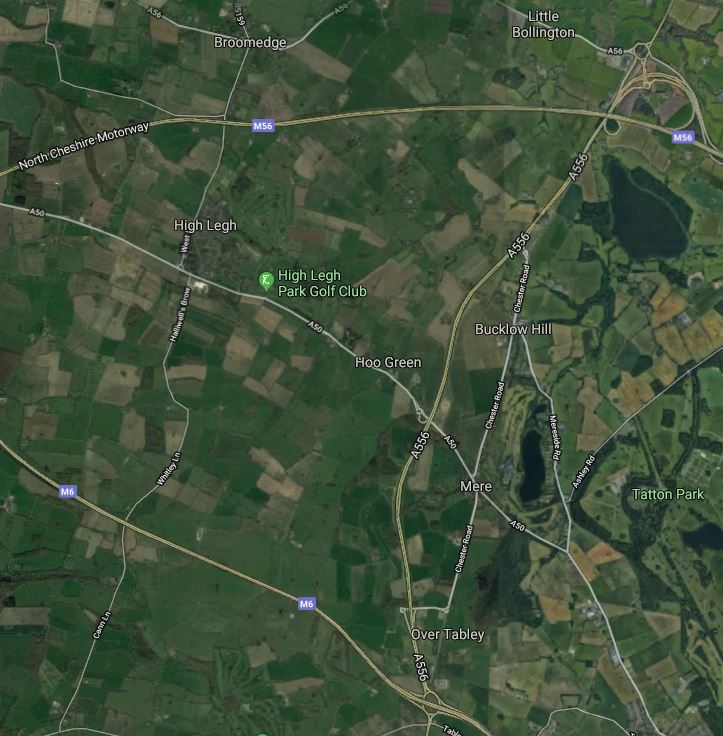
Note.
- The M56 going across the top of the map.
- The spaghetti in the North-East corner of the map is Junction 8 on the M56, where it joins the A556.
- The new A556 by-pass route to the West of the original route.
- The M6 running diagonally across the map.
- High Legh village is just to the North-West of the middle of the map.
This clip of a map from the Transport for the North report shows a schematic of the current and possible rail links in the area.
High Speed Two would appear to come North and split into two routes.
- One continues North to join the existing West Coast Main Line just South of Wigan.
- Another goes through Crewe station.
North of Crewe, the two routes join and then split into three at the Junction labelled 6.
- To Warrington and Liverpool
- To Wigan, Preston and Scotland
- To Manchester Airport and Manchester.
A second Junction labelled 5, allows Northern Powerhouse Rail trains to run Liverpool-Warrington-Manchester Airport-Manchester.
This is a new layout and has the following advantages.
- I estimate that trains could save 7-8 minutes on services running between Crewe and Wigan because of the longer running at High Speed Two operating speeds at 225 mph.
- ,If they don’t stop at Crewe and Runcorn, further minutes could be saved.
- Trains between London and Preston and London and Glasgow could skip the stop at Warrington to save further minutes.
- There could be an advantageous reorganisation of stopping patterns.
- London and Liverpool services and Liverpool and Manchester services could stop at Warrington, which would give Warrington very good connections.
- The Liverpool-Manchester and Liverpool-Crewe Lines could be built to High Speed Two standards, which could allow 225 mph running.
I also think the track layout can be run alongside or underneath the various motorways in the area for a lot of the route between Liverpool, Crewe, Warrington and Manchester Airport.
It would appear to be a very good solution to a complex problem and overall, I suspect it gives better connectivity, at a more affordable cost, whilst creating a railway that can be built with less disruption and will ultimately produce less noise.
The Transport for the North report, also says the following.
- There could be a new Warrington South Parkway station.
- Six tph between Liverpool and Manchester via Warrington are planned.
- Journey times will be 26 minutes.
The Twenty-first Century will finally get a modern and fast Liverpool and Manchester Railway.
Liverpool And Manchester Timings To And From London
The High Speed Two entry on Wikipedia gives the following timings after Phase Two is completed.
- London and Liverpool – One hour and thirty-six minutes
- London and Manchester – One hour and eight minutes
The Liverpool timing is slower, as for these timings, it runs on 125 mph lines between Crewe and Liverpool with a possible stop at Runcorn.
I feel that the proposed route to a new station in Liverpool city centre will reduce the Liverpool timing.
- There will be more running at 225 mph.
- There will be no slow local traffic.
- There will only be a stop at Warrington in a new purpose-built station.
I would not be surprised to see very similar sub-seventy minute times for both services.
It would dampen any rivalry between the two cities and if London and Wigan could be achieved in a similar time, it would surely ease train scheduling for the future operator of High Speed Two.
The Liverpool Lime Street Capacity Problem
This article on the Liverpool Echo is entitled New High-Speed Rail Station For Liverpool City Centre Takes Step Forward.
This is an extract.
A plan to build a completely new high-speed rail station in the CENTRE of Liverpool is taking a major step forward today – and Everton’s chief executive will be leading it.
Transport leaders want to build a new high-speed line into Liverpool to connect with HS2 to London and the planned Northern Powerhouse rail line across the north.
That means an entirely new “architecturally stunning” station in Liverpool city centre as Lime Street is too small to cope with the extra traffic.
So why is Lime Street station still too small, as it has been increased in capacity in the last couple of years?
I will look at the direct Virgin services between Euston and Liverpool Lime Street.
- Northbound trains leave at XX:07 and take two hours and 12-14 minutes for the journey.
- Trains wait for 26-28 minutes in the platform at Liverpool Lime Street station.
- Sorthbound trains leave at XX:47 and take two hours and 12-16 minutes for the journey.
- Trains wait for 4-8 minutes in the platform at Euston station.
It looks to me, that Virgin are using the platform at Lime Street station to balance the service. It does mean that trains probably keep more reliably to the timetable, but it hogs the platform at Liverpool Lime Street
Virgin want to increase the frequency to two tph and the London and Liverpool timing of around two hours and 12-16 minutes, means that a second platform is needed at Liverpool Lime Street station.
The station has now been remodelled and at least one extra platform has been added.
The problem could also be solved if the classic Virgin services took say one hour and 52 minutes between Euston and Liverpool.
This would enable the following.
- Trains would leave Euston and Liverpool Lime Street at the same time.
- Trains would have eight minutes to turn round at each end of the journey.
- There would be a very passenger-friendly journey time of under two hours.
I think this will happen at some time in the future.
- Digital signalling and track improvements will allow a high proportion of 140 mph running.
- New trains will have faster dwell times at stations.
, Competing against High Speed Two will drive faster services on the classic route.
High Speed Two is currently saying that London and Liverpool services will take one hour and thirty-six minutes and run at a two tph frequency.
This will probably mean that a clock-face timetable will be difficult without trains waiting in platforms at each end of the journey for a long time.
It will certainly mean that High Speed Two between London and Liverpool will need two platforms at the Northern end.
Even if the proposed one hour and thirty-six minutes was reduced to my estimate of seventy minutes to the new station, there would still be a need for two platforms. Liverpool is just a little bit too far away from London.
In addition Northern Powerhouse rail is saying that it will be running six tph between Liverpool and Manchester.
It would be difficult to fit all the platforms needed into Lime Street station.
A New Liverpool City Centre High Speed Station
This Google Map shows Liverpool Lime Street station and the surrounding area.
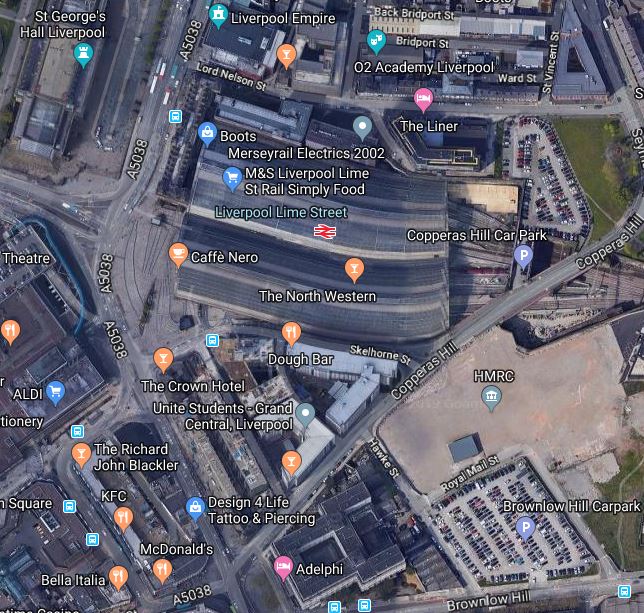
Consider.
- Lime Street station has a well-developed network of local rail lines going North, East, South and West under the Mersey, which are being updated with new trains and extra destinations.
- Liverpool Lime Street station is a Grade II Listed building.
- It is surrounded to the North and West with a cluster of historically and culturally important buildings including the Grade I Listed St. George’s Hall.
- Close to and alongside the North and South sides of the station are buildings that few would mourn if they were demolished.
- Between the station and the University of Liverpool to the East, there is a lot of land, that is mainly surface car parking and more low-grade buildings.
I think designing a High Speed station close to the current Lime Street station could be the sort of challenge many world-class architects will relish.
How Many Platforms And What Capacity Would Be Needed For A New Liverpool City Centre High Speed Station?
We already know that the following High Speed services are planned.
- Two tph between Liverpool and London.
- Six tph between Liverpool and Manchester and beyond.
- Would extra services to Glasgow and Birmingham be needed?
- There could also be long turnround times, which need extra platforms, as I indicated earlier.
It should also be noted that according to Wikipedia, Birmingham’s City Centre High Speed station; Birmingham Curzon Street station is being designed with seven platforms.
I could see an eighteen tph High Speed station with at least eight platforms.
- Two platforms would be for London services
- Three or four platforms would be for Manchester and beyond services
- Two or three platforms would be for other and future services and service recovery.
- All platforms would be able to accept maximum length High Speed Two trains.
The capacity of the station must be large enough for all future eventualities
I could envisage the following Northern Powerhouse Rail services, sometime in the future.
- Four tph -Liverpool and Hull via Manchester Airport, Manchester and Leeds
- Two tph -Liverpool and Edinburgh via Manchester Airport, Manchester, Leeds, York and Newcastle
- Two tph -Liverpool and Sunderland via Manchester Airport, Manchester, Leeds, York and Middlesbrough
- Two tph – Liverpool and Sheffield via Manchester Airport and Manchester
There could also be two tph to each of Birmingham, Glasgow and London.
The absolute limit between Liverpool and High Legh Junction would probably be eighteen tph, which is the design capacity of High Speed Two.
I am assuming that the High Speed sections of Northern Powerhouse Rail will be built as near as possible to High Speed Two standards, as regards train capacity, track, electrification, signalling and stations.
How Would Trains Access The New Liverpool City Centre High Speed Station?
To the East of Lime Street station is the campus of Liverpool University. There are a large number of buildings and to make things more difficult there is a cathedral, a brand-new hospital (Hopefully!) and several Listed buildings.
There is also no obvious route for a new High Speed Railway into a new station close to the current Lime Street.
I feel that the only solution is to bore a tunnel to bring the High Speed Railway to the city-centre. from perhaps six miles to the East of the city.
- The tunnels would be only for High Speed services.
- I suspect the preferred route would include tunnelling under some existing rail lines or motorways.
- This would mean that High Speed services would be unhindered by local traffic, when approaching or leaving Liverpool.
- Speed would be at least 140 mph.
This is only following a similar philosophy to that used to bring High Speed One into St. Pancras under East London, where the tunnels are under the North London Line.
Would The New Liverpool City Centre High Speed Station Be On The Surface Or Underground?
Recently, two semi-underground stations linked to deep tunnels have been built in the UK; Stratford International and the Paddington station for Crossrail. Crossrail and London’s Northern Line Extension have also shown how stations, that are deep underground, can have large developments on top.
I know the area around the Lime Street station well and I have a strong three-dimensional sense and feel that there is a solution that could be developed.
The final solution would be one for architects, council planners, engineers , politicians and accountants.
Between Manchester Airport And Manchester Piccadilly
Most current trains between Manchester Piccadilly and Manchester Airport stations take between 15-18 minutes.
I don’t believe that these times are compatible with a 26 minute time between Liverpool and Manchester Piccadilly.
So I am fairly certain that to achieve the planned time in the Transport for the North report, that an almost direct tunnel between Manchester Airport and Manchester Piccadilly stations is necessary.
Could the tunnel pass through underground platforms at Manchester Piccadilly station, which run across the station and then surface to connect with the chosen route to Leeds?
In an earlier plan, referenced under Manchester City Centre (Phase 2b) in the Wikipedia entry for High Speed Two,, this is said.
The route will continue from the airport into Manchester city centre via a 7.5-mile (12.1 km) twin bore branch tunnel under the dense urban districts of south Manchester before surfacing at Ardwick.
Under the earlier plan, trains would have gone into a rebuilt Manchester Piccadilly station.
This Google Map shows the tracks between Manchester Piccadilly station and Ardwick, where Siemens have a train care facility.
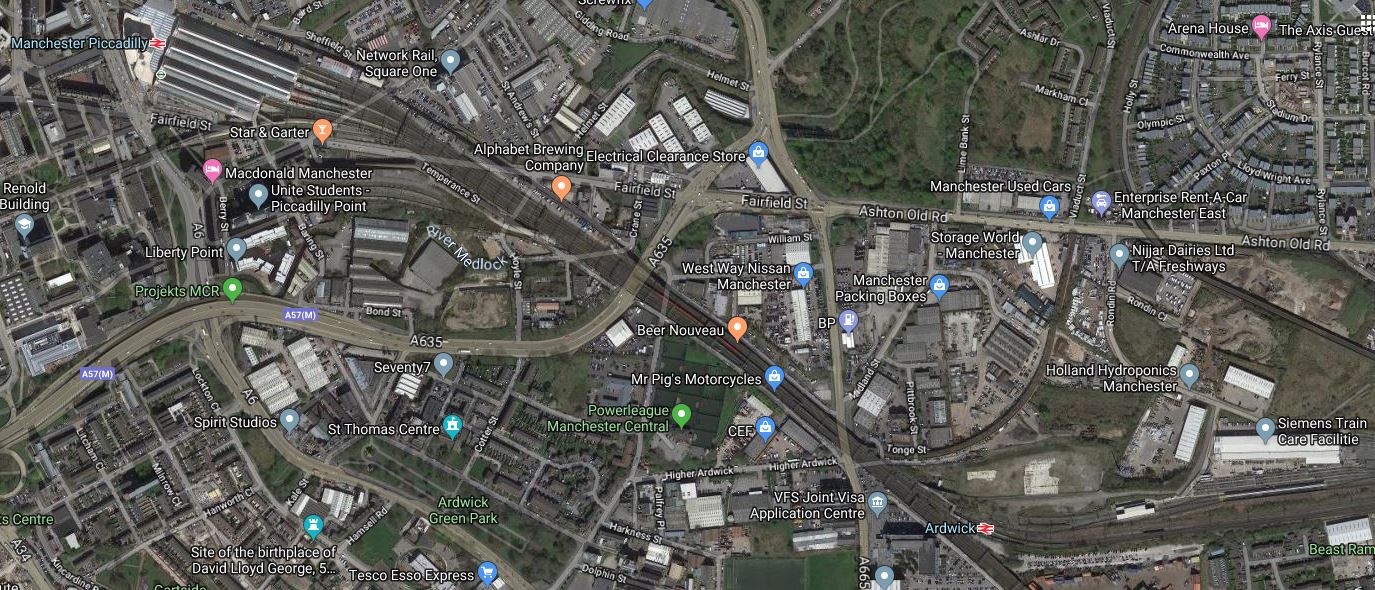
Note.
- If the tunnels emerged at Ardwick after passing under Manchester Piccadilly station, they would be pointing in more of less the right direction to emerge at Ardwick and continue on the way to Leeds, via the Huddersfield Line
- Under the earlier plan, I suspect the tunnels would go in a wide loop around South Manchester.
This tunnelled approach to new underground platforms at Manchester Piccadilly has the following advantages.
- High Speed services between Manchester Piccadilly and Manchester Airport stations would have their own dedicated High Speed line.
- Much of the tunnelling to the East of Manchester Piccadilly station could be under existing railway infrastructure.
- Through and terminal platforms as needed would be provided under the current Manchester Piccadilly station.
- Escalators and lifts would connect the underground platforms to local services and the Manchester Metrolink.
- By choosing the right orientation for the tunnel and position for the underground platforms, it may be possible to have a second entrance to the underground station from Piccadilly Gardens.
- The current Manchester Piccadilly station would only need refurbishing, rather than a total rebuild.
Manchester would have the fastest conventional airport link in the world. Who needs Hyperloop or Maglev?
Would Any High Speed Services To And From London Terminate At Manchester?
If London and Manchester trains have a sub-seventy minute journey time, trains would need to wait for some minutes in a terminal platform. It is the Liverpool problem all over again.
- These would need to be long enough for a full-length train.
- They would be expensive to build, as they would be underground.
So I suspect that providing services to cities beyond Manchester would actually reduce the complication and cost of the underground station.
Services at the underground station at Manchester Piccadilly would be as follows.
- Northern Powerhouse Rail – Six tph between Liverpool and Manchester Piccadilly
- High Speed Two – Three tph between Manchester Piccadilly and London
- Northern Powerhouse Rail – Six tph between Manchester Piccadilly and Leeds.
Surely, this means that three tph must terminate in the underground platforms!
If trains emerge at Ardwick, they could also continue on the Hope Valley Line to Sheffield.
If two tph could go to Sheffield, this means that the service pattern through the underground platforms could be.
- High Speed Two – Two tph between London and Hull via Manchester Airport, Manchester Piccadilly nd Leeds
- High Speed Two – One tph between London and Edinburgh via Manchester Airport, Manchester Piccadilly, Leeds, York and Newcastle.
- Northern Powerhouse Rail – One tph between Liverpool and Edinburgh via Manchester Airport, Manchester Piccadilly, Leeds, York and Newcastle.
- Northern Powerhouse Rail – Two tph between Liverpool and Sheffield via Manchester Airport and Manchester Piccadilly
- Northern Powerhouse Rail – Two tph between Liverpool and Hull via Manchester Airport, Manchester Piccadillyand Leeds
- Northern Powerhouse Rail – One tph between Liverpool and Sunderland via Manchester Airport, Manchester Piccadilly, Leeds, York and Middlesbrough.
I have shown that it is possible to design a schedule, where no High Speed services need to terminate in Manchester Piccadilly station.
So all the underground station would need is two through platforms.
A turnback could be provided at Ardwick for service recovery.
Overall services from the underground stations would be as follows.
- Two tph – Edinburgh
- Four tph – Hull
- Nine tph – Leeds
- Six tph – Liverpool
- Three tph – London
- Nine tph – Manchester Airport
- One tph – Middlesbrough
- Two tph – Newcastle
- Two tph – Sheffield
- One tph – Sunderland
- Five tph – York
This was only after a few minutes juggling. I’m sure a professional could be better.
The only reason to add bay platforms to the underground station would be, if high speed regional services like those at St. Pancras were to be run terminate in Manchester.
The through station concept also means that if demand was such, that Manchester needed four or more tph to or from London, Manchester is future-proofed.
Could Island Platforms Be Built At Manchester Piccadilly And Manchester Airport High Speed Stations?
Some of London’s Jubilee Line stations, with the highest capacity like Canada Water, Canary Wharf, London Bridge, Waterloo and Westminster, have their Jubilee Line platforms designed to the following rules.
- Tracks perhaps twenty or thirty metres apart.
- A wide concourse between the two platforms, so travellers and staff can freely circulate.
- Escalators and lifts in the concourse..
- Platform-edge doors for safety.
It is a very good starting point, but it could be taken further.
- Step-free access between platform and train, through wide doors..
- Large numbers of information displays.
- Tickets would indicate the door number to use.
- Toilets and kiosks
- Lots of visible staff, rather than the North’s usually few invisible versions.
Everything would be geared to a quick and easy boarding and leaving the trains.
Liverpool And Manchester Timings To And From London
The High Speed Two entry on Wikipedia gives the following timings after Phase Two is completed.
- London and Liverpool – One hour and thirty-six minutes
- London and Manchester – One hour and eight minutes
The Liverpool timing is slower, as for these timings, it runs on 125 mph lines between Crewe and Liverpool with a possible stop at Runcorn.
I feel that the proposed route to a new station in Liverpool city centre will reduce the Liverpool timing.
- There will be more running at 225 mph.
- There will be no slow local traffic.
- There will only be a stop at Warrington in a new purpose-built station.
I would not be surprised to see very similar sub-seventy minute times for both services.
It would dampen any rivalry between the two cities and if London and Wigan could be achieved in a similar time, it would surely ease train scheduling for the future operator of High Speed Two.
Liverpool And Manchester Journeys
I also suspect that nearly all Liverpool and Manchester passengers would use the High Speed services running between the city centres and Manchester Airport every ten minutes, which would take twenty-six minutes.
One estimate on the Internet says it takes fifty minutes to drive!
As both cities have extensive and interconnecting local rail, tram and bus networks, would this mean simplification of the other services between the two cities?
The Castlefield Corridor
Hopefully something will be done to sort out this route between Manchester Piccadilly and Manchester Victoria stations.
- I am very surprised that freight trains for Trafford Park Freight Terminal still use the Castlefield Corridor.
- Will there still be a need to provide as many services to Manchester Airport, as surely passengers will use the High Speed route, which will be running every ten minutes and will probably be a escalator or lift away?
- Would there be any need for long distance services to run through the route?
- Manchester Airport to Edinburgh, Hull, Leeds, Newcastle and York would go via Northern Powerhouse Rail under Manchester Piccadilly and the City Centre.
- Manchester Airport to Liverpool and Warrington would leave the Airport to the West and go direct.
- Manchester Airport to Blackpool, Glasgow, and Preston would leave the airport to the West and would take the West Coast Main Line at High Legh.
- Manchester Airport to Birmingham, and London would leave the airport to the West and would take High Speed Two at High Legh.
I think the Castlefield Corridor end up as a series of train or tram-train routes across Manchester.
Consider.
- Merseyrail’s Northern Line is a series of routes across Liverpool.
- The Cross-City Line is a series of routes across Birmingham.
- The Tyne and Wear Metro is a series of routes across Newcastle.
- Thameslink is a series of routes across London.
- The East London Line is a series of routes across East London.
Note that the last two routes, have been planned to handle in excess of 20 tph.
Why should the Castlefield Corridor routes be any different?
It’s just another cross-city line!
If there was a direct escalator and lift connection from Platforms 13 and 14 at Manchester Piccadilly station, the routes through the Castlefield Corridor would be a superb system connecting passengers to High Speed Two and Northern Powerhouse Rail.
The Future Of The West Coast Main Line
Consider.
- It appears Crewe and Warrington will be by-passed by new High Speed tracks.
- A new Warrington station with calls from High Speed Two services, will have good rail links to Chester, East Liverpool, North Wales and West Manchester.
- Wigan station is well-connected with commuter lines to Kirkby, Liverpool, Manchester and Southport, which would bring passengers to High Speed Two services stopping in the station.
- Preston station will connect passengers from Blackpool and North West Lancashire to High Speed Two services.
I wouldn’t be surprised to see the West Coast Main Line between Crewe and Preston converted into quadruple track all the way.
- Two High Speed tracks with at least 140 mph running and only one stop at Wigan.
- Two slow tracks for freight and local services, with stops as necessary.
Separation of High Speed services on 140 mph tracks with perhaps a capacity of at least fifteen tph, raises the possibility of using 140 mph electric multiple units running High Speed regional services.
- Northern terminals could be Blackburn, Blackpool and Burnley.
- Southern terminals could be Crewe, Liverpool, Manchester and Stoke.
- Liverpool services would terminate in the new High Speed platforms.
- Manchester services would call at Manchester Airport.
- Manchester services would terminate in bay platforms in the underground High Speed station underneath Manchester Piccadilly, with quick and easy access to the High Speed services.
- All High Speed local services would call at Preston and Wigan.
Trains would have the following characteristics.
- Capable of 140 mph running.
- High capacity, quality interiors.
- Step-free access between train and platform.
- Able to use platform-edge door used by the High Speed trains.
Think of a modernised Class 195 train, used for high speed commuter services between St. Pancras and Kent.
If a battery-electric capability could be added, the towns and cities served could increase dramatically.
- Northern terminals could be Barrow, Hebden Bridge and Windermere.
- Southern terminals could be Chester.
- Carlisle could be served using the Cumbria Coast Line via Barrow, Sellafield, Workington and Whitehaven.
I can see a large High Speed regional network developing around a 140 mph West Coast Main Line between Crewe and Preston.
North of Preston, the West Coast Main Line will become a double-track line with the passenger trains travelling at 140 mph.
A Manchester And Leeds High Speed Line
In Lord Adonis On Crossrail Of The North, I compared the current route between Leeds and Manchester with the Ipswich and Norwich route, that I know well.
- Both routes are roughly the same length.
- Ipswich and Norwich has a 100 mph line speed, with usually just two stops.
- Manchester and Leeds has a much slower line speed, with umpteen stops.
- The fastest trains between Manchester Victoria and Leeds take forty-nine minutes, with a stop at Huddersfield, and are just 1 train per hour (tph).
- Norwich and Ipswich in a couple of years, will take 30 minutes at a frequency of 3 tph.
This clip of a map from the Transport for the North report shows a schematic of the rail links to the East of Manchester.
Two alternative routes are proposed.
- The black route would be created by upgrading the Huddersfield Line.
- The yellow route would be a new route via Bradford.
The Transport for the North report says this about the Leeds-Manchester service.
- There will be six tph.
- The journey will take 25 minutes.
The next two sections give my thoughts on these options.
Upgrading The Huddersfield Line
It will be a tough ask to upgrade this line so that a twenty-five minute time can be achieved.
I suspect though, it wouldn’t have been suggested unless it were possible.
Manchester And Leeds Via Bradford Low Moor
The Transport for the North report indicates that this could be via Bradford Low Moor station.
To get a twenty-five minute time between Leeds and Manchester with a ten minute frequency, which I believe is the minimum service the two cities deserve, would be like passing a whole herd of camels through the eye of a single needle.
The Swiss, who lets face it have higher hills, than we have in Northern England would create a new route mainly in tunnel between the two cities, with perhaps an underground station beneath the current Grade I Listed; Huddersfield station.
The transport for the North report suggests Bradford Low Moor station, as an intermediate station, so why not Bradford Low Moor and Huddersfield stations?
Note that the Gotthard Base Tunnel, which opened a couple of years ago, deep under the Alps, is about the same length as a Leeds and Manchester tunnel, and cost around eight billion pounds.
It would be expensive, but like Crossrail in London, the tunnel would have big advantages.
- It could be built without disrupting current rail and road networks.
- It would have a capacity of up to thirty tph in both directions.
- Unlike Crossrail, it could handle freight trains.
- It would unlock and join the railway systems to the East and West.
I believe, it would be a massive leap forward for transport in the North of England.
Upgrade Or Tunnel Between Manchester And Leeds?
Obviously, the tunnel would take several years to bore.
So to get Northern Powerhouse Rail up and running, the Huddersfield Line would be upgraded first.
At a future time, the tunnel would be constructed.
Hopefully, it could be built, when the finance became available, without disrupting existing train services.
After the tunnel was built, there could be a division of services.
- High Speed Two and Northern Powerhouse Rail services would use the tunnel.
- Stopping services would use the Classic route on the Huddersfield Line.
All passengers would get the service they need.
Freight would have an extra route, if it could use the High Speed tunnel.
High Speed Lines East Of Leeds
I’ll repeat the map I included earlier, which shows the route of High Speed Two and the two Northern Powerhouse Rail routes to the East of Leeds.
The three Junctions labelled on the map are.
- Junction on High Speed Two mainline for Leeds – North East services.
- Junction on High Speed Two Leeds spur to facilitate through services via existing Leeds station.
- Junction on High Speed Two mainline for Sheffield – Leeds services.
The two main Northern Powerhouse Rail routes East of Leeds are.
- A connection to the East Coast Main Line for York, Newcastle and Edinburgh.
- An extension Eastwards to Hull.
Having ridden around these lines in the last few weeks, I believe that these routes could be upgraded to a High Speed standard.
- The East Coast Main Line is mainly four-track and could be capable of 140 mph running, with in-cab digital signalling.
- An electrified link between Leeds and the East Coast Main Line has been promised for years.
- Replace the Selby swing bridge and the line between Leeds and Hull could probably be upgraded to an electrified 125 mph line with 140 mph available with in-cab signalling.
The Northern Powerhouse Rail report gives these proposed details of services East of Leeds.
- Leeds and Newcastle -four tph in 58 minutes.
- Leeds and Hull – two tph in 38 minutes
If all the lines East of Leeds were electrified, local services could be run by 140 mph electrical multiple units, likethose I proposed for Liverpool and Manchester High Speed regional services. These would not delay the High Speed services.
Liverpool and Hull Timings
The Northern Powerhouse Rail report doesn’t give a timing for this route across Northern England, but it does give the intermediate timings
- Liverpool and Manchester – 26 minutes
- Manchester and Leeds – 25 minutes
- Leeds and Hull – 38 minutes
This gives a time of 90 minutes between Liverpool and Hull, which compares with the current fastest time of 2:32 hours.
In addition, the frequency of the service would certainly be at least two tph and possibly as high as four tph.
Hull Station As A High Speed Terminal
Hull station has been earmarked for some time as an Eastern terminal for Northern Powerhouse Rail.
This Google Map shows the station.
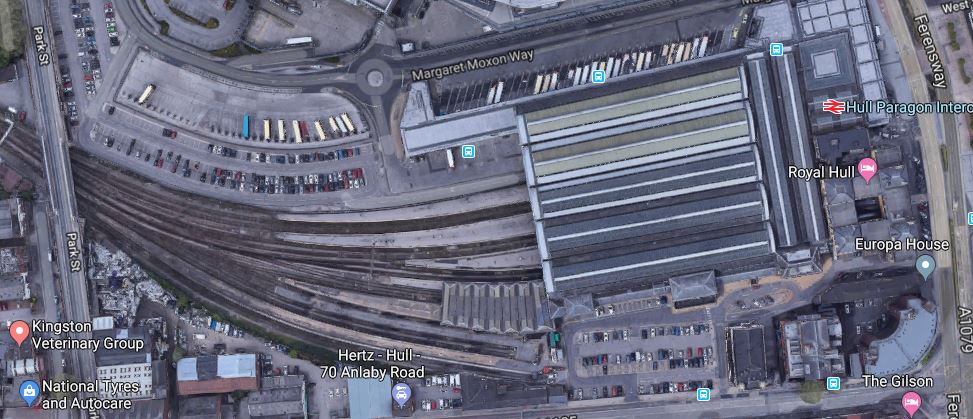
The station is large, with six platforms, and would have no problem accommodating long High Speed Two trains.
Could using Hull station as a terminal for a London-Birmingham-Manchester Airport-Manchester-Leeds-Hull service be a sensible response to saving costs and reducing disruption in the building of High Speed Two to Leeds?
- Northern Powerhouse Rail will need a High Speed link across or under the Pennines, but Leeds station is congested.
- The new Junction 2 on the Northern Powerhouse Rail map, has been designed to allow services through Leeds station.
- Leeds station probably would not be able to turn round a High Speed servicefrom London, without the previously planned substantial rebuilding.
- Could the passengers at Leeds cope with all the disruption?
- One extra High Speed service in both directions between Manchester and Hull every hour, could probably be accommodated using modern digital signalling.
- The train might even split and join at Leeds to serve both Newcastle and Hull.
Using Hull as a terminal probably has other advantages.
- There is probably space to add a stabling facility close to the station.
- Upgrading the route between Hull and Selby, would speed-up London to Kings Cross services via the East Coast Main Line.
- Electrification between Hull and Leeds would allow substantial improvement in local services around Hull.
If you look at the whole High Speed Two route between London and Hull via Manchester and Leeds, the route would be as follows.
- High Speed Two between London and Crewe.
- New High Speed railway between Crewe and Manchester via High Legh and Manchester Airport
- New High Speed route across or under the Pennines to Leeds.
- Upgraded line between Leeds and Hull.
I believe that it would be possible to run between London and Manchester at 225 mph and up to 140 mph on all the rest of the route.
Manchester Airport Connectivity
If High Speed Two and Northern Powerhouse Rail are developed as laid out in the Transport for the North report, the following cities will be connected to Manchester Airport.
- Birmingham – High Speed Two
- Blackpool – Northern Powerhouse Rail/West Coast Main Line
- Bradford – High Speed Two/Northern Powerhouse Rail
- Carlisle – Northern Powerhouse Rail/West Coast Main Line
- Edinburgh – Northern Powerhouse Rail/East Coast Main Line
- Glasgow – Northern Powerhouse Rail/West Coast Main Line
- Hull – High Speed Two/Northern Powerhouse Rail
- Leeds – High Speed Two/Northern Powerhouse Rail
- London – High Speed Two
- Newcastle -High Speed Two/Northern Powerhouse Rail
- Preston – Northern Powerhouse Rail/West Coast Main Line
- Sheffield – Northern Powerhouse Rail
- Sunderland – Northern Powerhouse Rail
- York – High Speed Two/Northern Powerhouse Rail
Manchester Airport will probably become the most important station in the North with High Speed connections to a large part of England and Scotland.
The Big Advantage Of Route Sharing
Suppose you have arrived in Manchester Airport and need to get home in Hull.
Because both High Speed Two and Northern Powerhouse Rail will run between the Airport and Hull, the frequency will be increased.
There could be the following services.
- High Speed Two – 2 tph between London and Hull
- Northern Powerhouse Rail – 2 tph between Liverpool and Hull
Giving a train every fifteen minutes.
High Speed East Coast Between London and Yorkshire, the North East Of England and Edinburgh
The East Coast Main Line is not mentioned in either of the articles, I have quoted in this post.
This line will see big changes in the next few years.
- All services from East Coast Trains, Hull Trains and LNER and some services from TransPennine Express will be run by 140 mph-capable Class 800/801/802 trains.
- ERTMS will be installed between London and Doncaster.
- Extra tracks will be added in places.
- Werrington Junction will be improved.
Large sections of the line will be capable of 140 mph running.
Currently, the fastest non-stop trains between London and Doncaster take a few minutes over ninety minutes. With 140 mph trains, I think the following times are easily possible.
- London and Doncaster – 80 minutes
- London and Hull – A few minutes over two hours, running via Selby.
- London and Leeds – A few minutes less than two hours, running on the Classic route.
For comparison High Speed Two is quoting 88 minutes for London Euston and Leeds, via Birmingham and East Midlands Hub.
I think we may have the making of a railway race between London and Leeds
- London Kings Cross via Peterborough, Wakefield and Doncaster
- London Euston via Birmingham and East Midlands Hub
- London Euston via Birmingham, Manchester Airport, Manchester and Bradford.
In addition, if the Leeds and Hull Line via Selby were to be upgraded to a High Speed route capable of running at up to 140 mph, I believe that by 2024 or 2025 could see London and Hull covered in under two hours.
The East Coast Main Line will be a High Speed Line in all but name.
The improvements and the 140 mph operating speed will create more capacity and I believe services from Kings Cross could be something like.
- London and Bradford – Two tph
- London and Edinburgh – Three or four tph – One or two tph via Leeds
- London and Hull – Two tph
- London and Leeds – Three or four tph
- London and Lincoln – Two tph
- London and Middlesbrough – Two tph
- London and Newcastle – Four tph
- London and Scarborough – One tph
- London and Sunderland – Two tph
- Leeds and Edinburgh – Two or three tph
Selective joining and splitting could be used to make better use of paths South of Doncaster.
I haven’t proven it, but my gut feeling for the numbers, is that LNER with their fleet of Azumas, will be capable of running a Turn-Up-And-Go service of four tph between London Kings Cross and Leeds, Newcastle and Edinburgh.
I suspect, that hey’ll have to buy a few more trains.
With the open access operators providing extra services, I suspect that there will be at least two tph between London Kings Cross and Bradford, Harrogate, Hull, Middlesbrough, Scarborough and Sunderland.
It would be the ultimate High Speed service based on a route that was designed by Victorians.
To make the most of the East Coast Main Line improvements, the following Northern Powerhouse Rail improvements should be done.
- Leeds to Hull
- Leeds to the Northbound East Coast Main Line
I’ve already discussed the first, but the second would do the following.
- Speed up services between Leeds and Newcastle and Scotland.
- Allow LNER to run electric trains between London and Scotland via Leeds.
- Create an electrified route between Neville Hill Depot and York.
- Create an electrified diversion through Leeds for the East Coast Main Line
High Speed East Coast is on the way.
High Speed Services To Sheffield
This clip of a map from the Transport for the North report shows a schematic of the rail links in East Yorkshire.
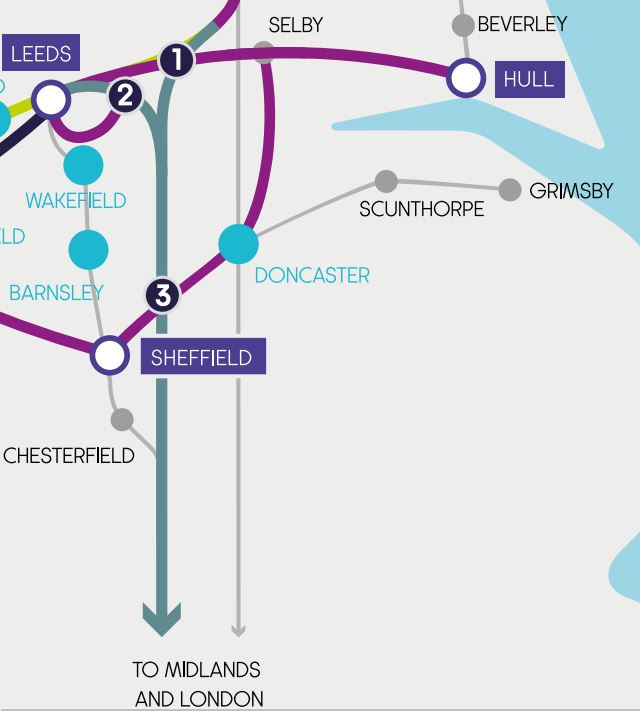
I can remember, when the Master Cutler used to run to Sheffield via the East Coast Main Line in the 1960s.
Even if a train took thirty minutes to go between Sheffield and Doncaster, it will still be a journey time of under two hours between London Kings Cross and Sheffield.
But note that on the map the route between Sheffield and Doncaster is shown as to be improved for Northern Powerhouse Rail.
If the route were to be electrified, it could give Sheffield and Rotherham a High Speed route to London Kings Cross.
The Classic route to Sheffield via the Midland Main Line is being upgraded.
- It will be electrified as far North as Market Harborough.
- Much of the route will have a 125 mph operating speed and perhaps 140 mph with in-cab signalling.
- It will share the 15.5 mile Northern section of the spur between High Speed Two and Sheffield, meaning it will be electrified between Clay Cross North Junction and Sheffield.
So when the new 125 mph bi-mode trains start running between St. Pancras and Sheffield, I would suspect that timings on this route could be below the two-hour mark.
Sheffield will get a much improved train service to and from the South.
Sheffield And Hull
The map in the Northern Powerhouse Rail report, shows a route between Sheffield and Hull via Doncaster as improved Northern Powerhouse Rail.
- It includes Sheffield and Doncaster, which could be improved to a High Speed electrified line.
- Part of the route between Doncaster and Selby is the East Coast Main Line, which should be able to sustain 140 mph running in a few years.
- Selby and Hull, is another route to be improved by Northern Powerhouse Rail.
Northern Powerhouse Rail are planning two tph in fifty minutes between Sheffield and Hull.
They could be 125 mph electric multiple units, which are a bit better than the current Pacers.
Some local services use a second route via Doncaster, Thorne, Goole, Gilberdyke and Brough.
Between Doncaster and Gilberdyke is not planned for improvement in the Northern Powerhouse Rail report, but at only twenty-five miles, it could easily be run by using 125 mph battery-electric trains, which would charge their batteries whilst running at both ends of the route.
- I wonder if it would be best to electrify the Thorne/Goole first, to give diversion for trains between Doncaster and Hull, whilst the Selby Swing Bridge is electrified.
- I have just read on this page of the Historic England web site, that the Selby Swing Bridge was Listed as Grade II ion the 23rd April 2015. So is this the reason why the electrification between Leeds and Hull has stalled?
- An electrified Thorne/Google route, might be used for local trains, whilst expresses used the Selby route.
- Selby has a couple of useful West-facing bay platforms.
There certainly seems to be some innovative Project Management at work
After all, train operators wouldn’t probably want to cut off one of their markets, whilst upgrading and electrification are underway.
Sheffield and Grimsby Via Doncaster and Scunthorpe
This route is shown on the Northern Powerhouse Rail map.
- There is an hourly TransPennine Express service between Cleethorpes station and Manchester Airport via Scunthorpe, Doncaster and Sheffield.
- There are a few sundry local services.
- The route serves the important Port of Immingham.
- A large renewable energy industry is developing in North Lincolnshire.
- British Steel has just folded at Scunthorpe.
The route doesn’t really fit the Northern Powerhouse ideal and it has a totally inadequate passenger service.
Could this route be improved to provide better rail services to the area, that sometimes, the rest of the UK forgets?
- Electrification might be needed to handle the heavy freight from Scunthorpe and Immingham.
- Would an LNER service between London Kings Cross and Cleethorpes be welcomed?
- Cleethorpes and Manchester Airport needs to at least be doubled in frequency.
With all the energy projects going on in North Lincolnshire, this area could become the Lincolnshire Powerhouse.
Sheffield And Leeds
Long-terms plans for traffic between these two cities will probably be by Junctions 2 and 3 on the map in the Northern Powerhouse Rail report.
The Northern Powerhouse Rail report, suggests that the trains will use High Speed Two and some infrastructure improvements and will run at a frequency of four tph and take 28 minutes.
This is a good service and compares well with what is planned between Ipswich and Norwich.
In the meantime, the main route is the Hallam Line, where trains take eighty minutes for the forty-five miles
Let’s hope Northern’s more powerful new Class 195 trains, bring the journey time under the hour.
Barnsley and Rotherham mustn’t be left out of the benefits of Northern Powerhouse Rail.
- In Sheffield Region Transport Plan 2019 – A New Station At Barnsley Dearne Valley, I discuss Sheffield’s plans for Barnsley Dearne Valley station on the Dearne Valley Line.
- There are also plans for a new station on the Dearne Valley Line at Rotherham.
- These two stations will be served by an extended East Midlands Railway London and Sheffield service to Leeds.
- One tph between London and Leeds via Rotherham, Barnsley and Wakefield would surely be welcomed.
Is this the beginning of Yorkshire Powerhouse Rail?
Sheffield And Manchester
The Northern Powerhouse Rail map has this route marked as Northern Powerhouse Rail.
As a lot of freight traffic is generated along the Hope Valley Line, which is the only route between the two cities, will this route be upgraded for a faster speed and greater capacity.
Will the Hope Valley Line be electrified?
- At the Western end, it is electrified as far as far as Hazel Grove station.
- At the Eastern end, High Speed Two will mean there will be electrification at Dore Junction.
- The distance between Dore Junction and Hazel Grove station is about thirty miles.
- My helicopter didn’t show that many bridges or level crossings.
- There are three long tunnels on the route, which are a total of eight miles long. Depending on their condition, these could be easy or difficult to electrify.
- Much of the electrification at the Western end looks in need of replacement.
This is one for the project engineers and accountants, but I wouldn’t be surprised to see this route electrified.
High Speed Two Routes
From the map it appears that in addition to the current proposed routes for High Speed Two trains.
- London-Birmingham-Liverpool (96 mins from 128)
- London-Birmingham-Manchester (68 mins from 128)
- London-Birmingham-Wigan and then on the West Coast Main Line to Glasgow. (218 mins from 248)
- London-Birmingham-East Midlands Hub-Sheffield-Leeds (82 mins from 132) and then on the East Coast Main Line to Newcastle 138 mins from 172)
Two new routes would be added via the new High Legh junctions.
- London-Birmingham–Manchester Airport-Manchester-Leeds-Hull
- London-Birmingham-Manchester Airport-Manchester-Leeds-Newcastle
In addition Liverpool would be served via the High Legh junctions.
This page on The Guardian is a useful guide to current and HS2 tomings, which I have used here.
My best estimates for the new layout are as follows.
London-Birmingham-Liverpool via High Legh – 66 mins
London-Birmingham-Manchester Airport-Manchester via High Legh – 66 mins
London-Birmingham-Manchester Airport-Manchester-Leeds via High Legh – 92 mins
London-Birmingham-Manchester Airport-Manchester-Leeds-Hull via High Legh – 130 mins
Note.
- To avoid problems, Liverpool and Manchester will probably end up with the same scheduled times.
- I suspect that the High Legh route may save more time, than I have estimated.
- Any savings South of High Legh will benefit all routes.
As under the new proposals London and High Legh will be continuous High Speed line, with High Speed spurs to Liverpool, Manchester Airport and Manchester, it would appear that the proposals offer faster journey times to the area.
Building High Speed Two And Northern Powerhouse Rail
There is an old Project Management phrase about
Getting All Your Ducks In A Row!
I think, that someone has been thinking hard as it appears the building of the second phase of High Speed Two and Northern Powerhouse Rail together can offer a lot of benefits.
These are my thoughts on the project order.
Devise An Intelligent Electrification Philosophy
Transport for Wales and their contractors are devising an intelligent discontinuous electrification philosophy for the South Wales Metro.
The Hallam, Hope Valley and Huddersfield Lines will be tricky to improve and electrify.
- They run through picturesque countryside.
- There are a large number of overbridges and some level crossings..
- There could be objections.
- There are some long tunnels.
- Access could be difficult.
- Speed limits will need to be increased.
Every trick will need to be employed.
- Instead of rebuilding overbridges, electrification could be discontinuous as in South Wales.
- Trains would have enough energy storage to bridge gaps in electrification.
- Tunnels will be electrified using rails on the roof or as third-rail.
- Intelligent fast-charging for trains with batteries will be deployed.
Less obtrusive electrification could also be used, as I described in Prototype Overhead Line Structure Revealed.
It does seem to be a good attempt to reduce the clutter of girders, gantries and wires!
Leeds And Sheffield Improvements
Leeds and Manchester is a difficult rail journey, but so is Leeds and Sheffield.
This route can be improved, by doing what I indicated earlier.
- Complete the electrification.
- Improve the track and signalling where necessary.
- Build new stations at Barnsley Dearne Valley and Rotherham.
- From 2022, East Midlands Railway should run at least one tph between St. Pancras and Leeds via Sheffield, Meadowhall, Rotherham, Barnsley Dearne Valley and Wakefield Westgate.
- Add extra trains between Sheffield and Leeds to give Northern Powerhouse Rail’s promised four tph in twenty-eight minutes
This would introduce competition and options for travel to and from Leeds.
Conclusion – This upgrade would bring large benefits to the area and should have the highest priority.
Lines East Of Leeds
These are the lines East of Leeds.
- A connection to the East Coast Main Line for York, Newcastle and Edinburgh.
- An extension Eastwards to Hull.
These would not be the most expensive sub-project, but they would give the following benefits, when they are upgraded.
- Electric trains between Hull and Leeds.
- Electric trains between Hull and London.
- Electric access to Neville Hill Depot from York and the North.
- An electric diversion route for the East Coast Main Line between York and Doncaster.
- The ability to run electric trains between London and Newcastle/Edinburgh via Leeds.
Hull and Humberside will be big beneficiaries.
The trains that the train operators have ordered can run all the services.
Once ERTMS is installed on the East Coast Main Line, train travel between London and Hull could be under two hours.
Conclusion – These lines should be improved sooner rather than later.
Midland Main Line Between Clay Cross Junction And Sheffield
This section of track will be shared between High Speed Two and the Midland Main Line.
- It is 15.5 miles long.
- It will be electrified.
- The only intermediate station is Chesterfield, which will need to be substantially rebuilt.
- It will have a high line speed, perhaps even in excess of 140 mph.
- Currently, the line carries about ten tph in both directions.
Completing this sub-project early would give benefits.
- The bi-mode trains due to be introduced on the Midland Main Line in 2022, would benefit from the improved electrified line.
- Timings on services between London and Sheffield would be reduced to under two hours.
An electrical supply for the electrification would have to be provided in Sheffield, which would be useful, if other electrification projects were to be started in the area.
Conclusion – This line should be improved and electrified, sooner rather than later.
Electrification Of The Hope Valley Line
Work is already planned to upgrade capacity on the Hope Valley Line.
Having looked at several electrification projects in the last few years, it is my belief that delays can occur because of bad surveys and preparation work done too late and in great haste.
So why not do as much of this work, whilst the capacity is upgraded?
Electrification of what would be a well-surveyed and prepared railway, with an immaculate track, must be a lot easier to plan, install and deliver on time.
Conclusion – This line should be improved and electrified, sooner rather than later, especially as it could be a test project for other lines through the hills.
Improvement And Possible Electrification Of The Huddersfield Line
Improvement of this line could probably give a large benefit to services between Leeds and Manchester via Huddersfield.
- Current services on the line would be speeded up.
- More services could be possible.
On the down side, it is a busy route and improvement will be very difficult.
Conclusion – This important route should be improved as soon as possible.
Building The Liverpool And Manchester High Speed Line
This will be a large and complex project.
It will involve building the following.
- Around thirty miles of new railway.
- New platforms and/or stations in Liverpool, Warrington, Manchester Airport and Manchester.
- A Tunnel between Manchester Airport and Manchester.
- Diversion of the West Coast Main Line through or around Crewe and Warrington.
- Building of the two junctions at High Legh.
- Connection to High Speed Two towards Birmingham and London.
It is my opinion, that the diversion of the West Coast Main Line should be opened at the same time as High Speed Two reaches Crewe, in 2027.
Conclusion -The diversion of the West Coast Main Line should be given priority, but the Liverpool and Manchester High Speed line can be done later.
Good Project Management Is Needed
I am sure, that Northern Powerhouse Rail and High Speed Two can work together to produce a schedule that delivers benefits in a steady stream.
They must be bold and not allow the politicians to derail the project or move it in an unsustainable direction, based on pressure from their constituents.
Conclusion
Linking the building of Phase Two of High Speed Two and Northern Powerhouse Rail would appear to be a sensible solution to expanding the economy of Northern England.
An Alternative View On HS3
This article on CityMetric is entitled Is Crossrail For The North The Biggest Priority For The North?
The article presents a lot of information and finishes with this paragraph.
None of which is to say that HS3 (I’m sticking with that name) is a bad idea: the existing trans-pennine links are shocking, and it’s pretty gross that transport secretary Chris Grayling scrapped plans to invest in rail in the north in literally the same week he called for another £30bn railway line for London. But if money is scarce, there may be better things we can do with it.
In Lord Adonis On Crossrail Of The North, I came to this conclusion.
Improvements are much-needed in the North, which could include.
- A short/medium term plan to deliver the best possible service with the new trains ordered by Northern and TransPennine Express.
- A long term plan to deliver a genuine 140 mph service across the North of England.
- A plan to improve the Calder Valley and Hope Valley Lines across the Pennines.
- A plan to improve some of the poor connections across the North.
- A strategy to make the best use of the two connections with HS2 at Manchester and Leeds .
A detailed plan is needed that lays down what should be done in the next ten to twenty years.
The plan is also needed as soon as possible.
Perhaps, a high speed route or routes across the North of England could be paired with improved local rail, tram and bus services in all urban areas.
Lord Adonis On Crossrail Of The North
There has been a lot of talk recently about HS3, Northern Powerhouse Rail or Crossrail Of The North.
On Radio 5 Live, this morning, Lord Adonis said a lot of sensible things about the high speed line from Liverpool to Hull via Manchester and Leeds.
His plea was for a plan for a start and he suggested that an objective would be to halve the journey time from Manchester to Leeds and have a train every few minutes.
He suggested it could be probably built using a mixture of new track alignments and existing railways.
I agree with what he said, but the problem is that every Tom, Dick and Harriet has their own ideas of what they want.
How Would I Design Crossrail Of The North?
I can at least look at this without favouring any one of the North’s great urban area.
Urban Areas Of The North
I will list those with populations of over 200,000,, from this list in Wikipedia.
- Manchester – 2,553,379
- West Yorkshire – 1,777,934
- Liverpool – 864,122
- Tyneside – 774,891
- Nottingham – 729,977
- Sheffield – 685,368
- Teeside – 376,633
- Stoke-on-Trent – 372,775
- Sunderland – 335,415
- Birkenhead – 325,264
- Hull – 314,018
- Preston – 313,322
- Blackpool – 239,409
- Barnsley – 223,281
Urban areas with populations between 100,000 and 200,000 include Wigan, Mansfield, Warrington, Doncaster, York, Burnley, Blackburn, Grimsby, Accrington, Burton, Lincoln and Chesterfield.
Some of the connections between pairs of these areas are truly dreadful despite being only fifty or so files apart.
Northern Connect
I would think it reasonable that all these centres of population have good, preferably direct, connections between them.
Northern obviously think this way as they are creating a concept called Northern Connect, using new Class 195 trains to connect many of these areas with a quality service.
The North TransPennine Routes
TransPennine operate these North Pennine routes.
- 1 train per hour (tph) – Liverpool Lime Street to Newcastle
- 1 tph – Manchester Airport to Middlesbrough
- 1 tph – Manchester Airport to York
- 1 tph – Liverpool Lime Street – Scarborough
- 1 tph – Manchester Piccadilly to Hull
Note that the opening of the Ordsal Chord iin a few months, might change the routing of some of these services.
All of these services use the Huddersfield Line between Manchester and Leeds, stopping at both Huddersfield and Leeds stations.
Manchester Victoria To Leeds
As Lord Adonis said, the important section is between Manchester Victoria and Leeds stations.
I’ll start with a comparison of a series of rail journeys, all of which are about the same length.
- The fastest trains between Manchester Victoria and Leeds take forty-nine minutes, with a stop at Huddersfield, and are just 1 tph
- Norwich to Ipswich in a couple of years, will take 30 minutes at a frequency of 3 tph.
- Glasgow to Edinburgh currently takes about fifty minutes, at a frequency of 4 tph.
- Cardiff to Swansea currently takes 52-54 minutes, at a frequency of 2 tph.
It does seem that the North has a point if two of East Anglia’s larger cities get a better service than Leeds and Manchester.
The Huddersfield Line And The Great Eastern Main Line Compared
It is also enlightening to compare the Manchester to Leeds Line via Huddersfield to Ipswich To Norwich section of the Great Eastern Main Line.
It should be noted that I’m comparing these two lines, as both have lived on scraps from Central Government for decades. I also know the Great Eastern Main Line well!
- Both lines are double-track.
- Norwich-Ipswich is flat.
- The Huddersfield Line is rather hilly
- Norwich-Ipswich has only two stations and only the occasional slower service.
- The Huddersfield Line has numerous stations and local services.
- Norwich-Ipswich is electrified to a robust standard.
- On the Huddersfield Line, only Manchester to Stalybridge is scheduled for electrification.
- Norwich-Ipswich has a 100 mph speed limit, that could possibly be raised in places.
- I can’t find the speed limit on the Huddersfield Line, but suspect it could be less than 100 mph.
It is truthful to say that the Huddersfield Line is a much more challenging route than the Norwich to Ipswich.
The Effect Of Electrification On The Great Eastern Main Line
It might appear that the electrification of the Great Eastern Main Line makes for the difference in times.
But it should also be remembered that Ipswich to Norwich wasn’t electrified until the mid 1980s and if I remember correctly before that date, the fastest expresses were timed at two hours from Norwich to London with just two stops. The fastest services now are ten minutes under two hours with four stops.
With the introduction of the new Class 745 trains, timings of ninety minutes have been promised to the Department for Transport.
Timings did not drop significantly with the electrification in the mid-1980s, Services just became more reliable with more stops, as electric trains can accelerate better.
The decrease in timings over the next few years will be down to the following.
- Removal of bottlenecks like Trowse Bridge.
- Increase in speed limits.
- Trains with a shorter dwell time at stations.
- Trains with better acceleration and braking.
- Improved track and signalling.
- All passenger trains on the line will have the same performance.
I will be very interested to see what timings, the Class 745 trains eventually achieve!
Electrifying Between Leeds And Manchester Victoria Stations
It looks like the electrification between Manchester Victoria and Stalybridge stations will be complete by the end of this year.
The central section of the route is problematical with the Grade 1 Listed Huddersfield station and large numbers of bridges.
In TransPennine Electrification And Piccadilly Upgrade Now Also In Doubt, I came to these conclusions about electrifying the route.
-
Electrification would not go anywhere near Huddersfield, as the heritage lobby and their lawyers would have a field day.
-
Standedge and Morley tunnels are over 2,000 metres long, double track and Standedge is level. If they needed refurbishment in the future, perhaps they could be electrified with an overhead rail, so that bi-modes could have a couple of miles of electricity.
-
Electrification might be extended at the Manchester and Leeds ends of the line, so that the two cities could improve their local suburban electric networks.
-
An alternative would be that the Leeds and Manchester suburban electric networks were provided with a few Class 769 trains or even some brand new four-car bi-modes.
-
Services between Leeds and Manchester would be run by fast bi-modes.
Is there a more difficult stretch of possible electrification in the UK?
The Ultimate Bi-Mode Train
Currently four bi-mode trains are planned for introduction into the UK.
- Hitachi Class 800 trains and Class 802 trains.
- Stadler Class 755 trains
- Porterbrook Class 769 trains
Note.
- Two hundred and eleven bi-mode trains have been ordered.
- Nineteen Class 802 trains have been ordered for TransPennine routes.
In Do Class 800/801/802 Trains Use Batteries For Regenerative Braking?, I look at the prospect of using energy storage in Hitachi’s bi-mode trains.
The Class 802 train is probably something like the ultimate bi-mode train.
- 125 mph using electrification.
- 100 mph under diesel power
- Regenerative braking at all times using energy storage.
- Automatic pantograph raising and lowering.
- Sophisticated in-cab signalling.
Obviously, interior fitment would be up to the operator.
Class 195 Trains
Northern is acquiring 25 x two-car and 30 x three-car Class 195 trains.
These are 100 mph trains, so it must be a good idea to make sure all Northern services that use the same routes as TransPennine services are run by these faster trains.
Short/Medium Term – A Classic Manchester Victoria To Leeds Route
TransPennine Express are already planning to run Class 802 trains between Liverpool and Newcastle via Manchester and Leeds. It looks to me, that whoever plans their train policy, saw the electrification crisis coming.
I wonder what times they can achieve between Leeds and Manchester Victoria, if the following were to be done.
- Stalybridge to Manchester Victoria electrification is complete.
- Track and signalling is the best it can be.
- The route has a 100 mph operating speed.
- All trains on the route are 100 mph capable.
- Northern replaces their scrapyard specials with Class 195 trains.
The reason for the same operating speed of 100 mph, enables trains to follow each other in a stream. It could be 90 mph, if that was easier for the route.
Station dwell times can also be reduced.
Due to overcrowding, the TransPennine dwell times, must currently be some of the worst in the UK.
This is typical at Huddersfield.
Not even the Japanese with their pushers could get this to work.
But a modern train like the Class 802 train with wide lobbies and adequate capacity should cope.
So what time could be possible, if everything goes as planned?
If Norwich to Ipswich which is about the same distance as Leeds to Manchester, can be achieved in thirty minutes, I believe it is possible that the Northern route could be achieved in the same time or perhaps thirty-five minutes.
Thirty-five minutes should be adequate for a few years, if say there was a train every ten minutes!
Long Term – A Genuine High Speed Manchester Victoria To Leeds Route
I’ve flown my virtual helicopter between Manchester and Leeds and it is not flat agricultural land like seventy percent of the route of HS2.
I believe that creating a genuine high speed route, with say a 140 mph top speed across the Pennines will be a major engineering challenge that will make Crossrail in London look easy.
It may even be more economic to develop 140 mph hydrogen-powered tilting trains, that can run on the classic route at 125 mph.
Only one thing matters to passengers; a fast reliable and very comfortable and affordable train service across the country.
Manchester Victoria To Manchester Airport
When the Ordsall Chord opens any Leeds to Manchester Victoria service can continue to Deansgate, Oxford Road, Manchester Piccadilly and Manchester Airport stations.
Manchester Victoria To Liverpool
Currently, services between Liverpool Lime Street and Manchester Victoria stations take a few minutes over half-an-hour.
I would suspect that thirty minutes is achievable, if the following is done.
- The four-tracking at Huyton is completed.
- Track and signalling is the best it can be.
- The route has a 100 mph operating speed.
- All trains on the route are 100 mph capable.
- Northern replaces their scrapyard specials with Class 195 trains.
I suspect all of this is in progress.
Note, this is very similar work, to that needed between Manchester and Leeds.
Leeds To Hull
Currently, services between Leeds and Hull stations take a few minutes under an hour.
A few thoughts on the route.
- The Selby Line from Leeds to Hull is double-track and not electrified.
- From my virtual helicopter, it appears to be straight in very flat country, so it is no wonder Hull Trains offered to electrify the line.
- If the Selby swing bridge were to be sorted, it could become a 100 mph line with trains to match.
- Northern replaces their scrapyard specials with Class 195 trains.
- Modern in-cab signalling.
I suspect quite a few minutes could be taken off this route which is about fifty miles.
I suspect this line will eventually be electrified, as it could give sound time savings and it looks relatively easy.
York To Scarborough
Currently, services between York and Scarborough stations take forty-nine minutes, with one tph.
- Similar improvements to the double-track unelectrified line as for the Leeds to Hull route, could be made.
- But if the line has a problem , it is that it has 89 level crossings, although Network Rail intends to close them all before 2025.
I wonder, if the time can be reduced between York and Scarborough, such that two tph can be timetabled.
I doubt York to Scarborough will be electrified.
Northallerton To Middlesbrough
This short line is quite heavily used and is a valuable diversion route, so I suspect nothing urgent needs to be done.
Like Leeds to Hull, I suspect this line will eventually be electrified.
Conclusions
I have come to the following conclusions.
- Manchester Victoria to Leeds is achievable in half-an-hour with the new trains on order and no major infrastructure, other than that already planned.
- Any line where TransPennine Express services run needs to have the highest possible operating speed and no slow trains.
- Northern need to get their Class 195 trains into service as soon as possible.
Improvements are much-needed in the North, which could include.
- A short/medium term plan to deliver the best possible service with the new trains ordered by Northern and TransPennine Express.
- A long term plan to deliver a genuine 140 mph service across the North of England.
- A plan to improve the Calder Valley and Hope Valley Lines across the Pennines.
- A plan to improve some of the poor connections across the North.
- A strategy to make the best use of connections with HS2.
A detailed plan is needed that lays down what should be done in the next ten to twenty years.
The plan is also needed as soon as possible.
HS2 Potential To Northern Connectivity Not To Be Underestimated, Says Percy
This is the title of an article in Rail Technology Magazine.
Rail and road connectivity is not a simple matter.
Although there is a need for East-West routes across the North, there is also the need for better High Speed Rail connections between pairs of cities like.
- Newcastle and Leeds
- Leeds and Nottingham
- Sheffield and Nottingham
- Birmingham and Manchester
- Leeds and Sheffield
- Birmingham and Leeds.
- Birmingham and Preston
All these connections will be provided by HS2.
Of the other major links that are needed.
- Manchester and Sheffield
- Manchester and Leeds
- Blackpool and Leeds
- Leeds and Hull
- Liverpool and Manchester
The first three are very difficult because of the terrain.
Because Leeds has good High Speed Rail connectivity to the cities East of the Pennines via HS2, the Leeds-Manchester route is probably the most important.
As High Speed Rail is a long term project, it will tend to grow, where the returns and needs are greatest.
Expanding Manchester Piccadilly Station
This announcement on the Government web site is entitled Put HS3 at the heart of a High Speed North – Adonis.
This is an extract.
Recommendation six: Proposals for the redevelopment of Manchester Piccadilly station should be prepared jointly by TfN, Transport for Greater Manchester, Manchester City Council, Network Rail, DfT and HS2 Ltd.
These organisations should work to together to deliver:
a) Detailed plans for the new east-west platforms 15/16 to facilitate delivery early in Control Period 6 and unlock the development potential of the Mayfield site;
b) A masterplan for the longer-term development of Manchester Piccadilly station as a whole, incorporating capacity for HS2 services and options for the delivery and timing of platform capacity for HS3; and
c) Proposals for funding and financing the station redevelopment, including for private sector and local contributions.
I know Manchester Piccadilly station well and it has multiple space problems. These pictures illustrate some of the problems on the North side of the station.



You have lots of short trains and long platforms, which means the following.
- Passengers have to walk long distances.
- There is confusion of which train to take with more than one in the platform.
- It must be a nightmare for train operators and their staff.
Surely some reorganisation could improve this mess, that was probably designed by Topsy.
On the South side of the station, there are two of the most crowded platforms in the UK. Platforms 13/14 need a serious sorting out.
Currently, services from Platform 13 seem to go to the following.
- Huddersfield
- Leeds
- Manchester Airport
- Norwich
- Scarborough
- Sheffield
- York
And from Platform 14 to the following.
- Blackpool
- Edinburgh
- Liverpool
- Southport
Most of the services seem to be provided by TransPennine Express and I think it is true to say, that when and if the Ordsall Chord is opened, there will be a sorting out of services on these two platforms.
But I do feel that the solution is Network Rail’s preferred one of adding platforms 15/16. They can’t be built soon enough, to ease the overcrowding.
This Google Map shows the layout of Manchester Piccadilly station.

Manchester Piccadilly Station
The current Platforms 13/14 are along the bottom of the station, connected to the main station by the two small bridges. I would assume that the two new platforms will go on the south side of 13/14.
Wikipedia gives more details of developments related to the Northern Hub and HS2.
It is going to be a tight fit to get all the lines and platforms into the area.
The more I look at the station, the more I tend to think that the Picc-Vic Tunnel might have been a good solution.
It makes me wonder if it would be more efficient for HS2 and HS3 to share a route through Manchester from the Airport to Victoria and on to Huddersfield and Leeds. It would need to be mainly in tunnel and could go right under the city with underground stations. I wrote about it in Rethinking HS2 And HS3.
Surely, if two high speed lines are to go through Manchester, they should share a route?
I have also received this image from a reader; Ben.
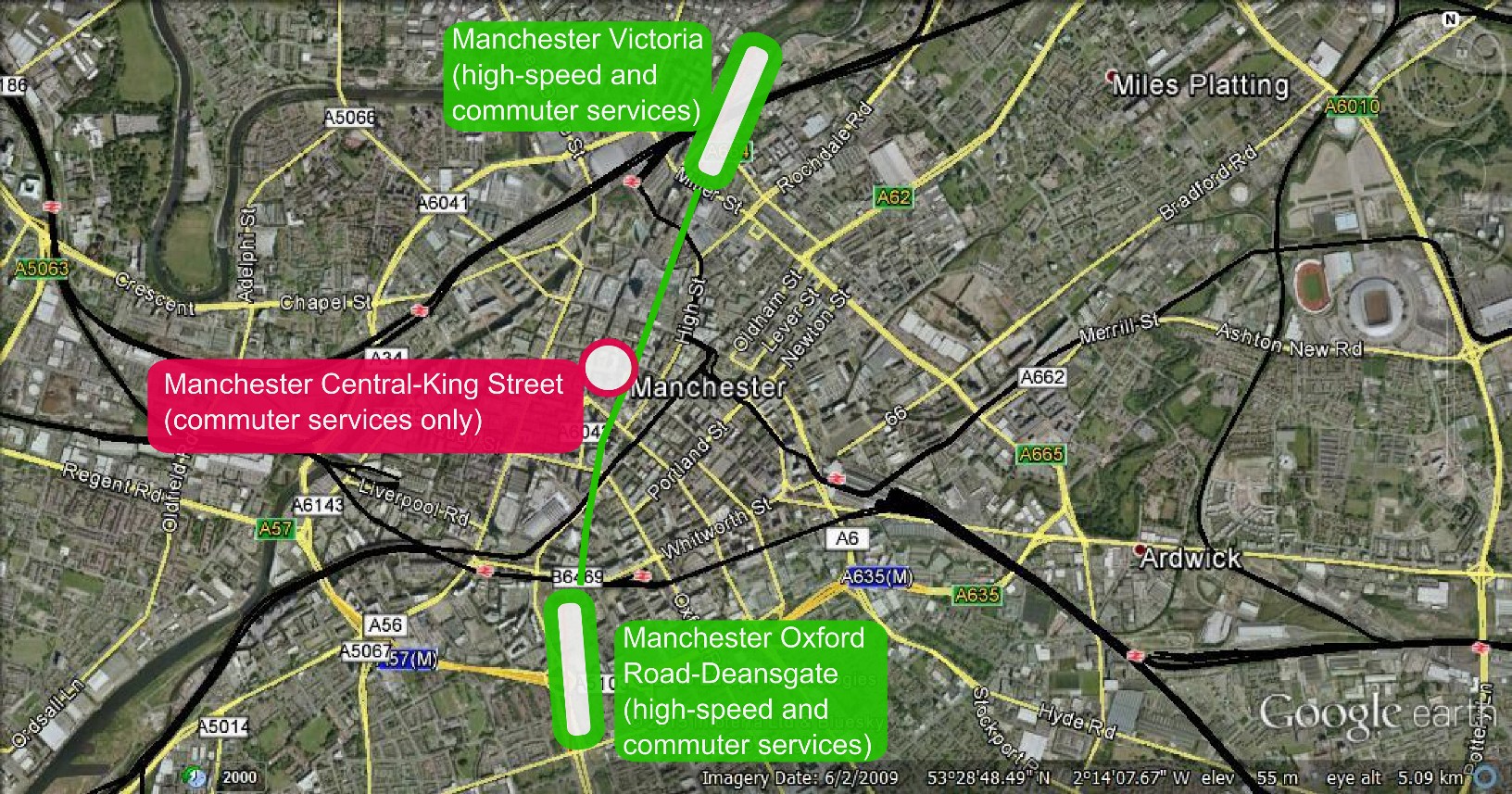
An Alternative Cross-Manchester Tunnel
Ben’s plan illustrates some advantages of a cross-city tunnel, which probably include.
- Less demolition at stations served by HS2.
- HS2 and HS3 could probably share platforms.
- Release of platforms at Piccadilly.
- A station in the centre of the city.
- Better links to the trams and local train services
- Ability to continue in tunnel towards Huddersfield and Leeds.
Remember that we’ve improved our tunnelling capability by a large amount in recent years.
Crossrail in London has also developed station designs and layouts, that could be used in Manchester.
- Massive double-ended stations to effectively serve two separate locations.
- Lines and station layouts to ease and encourage same platform interchange.
- Moving walkways and inclined lifts, where necessary to ease passenger movement.
- Island platforms to ease interchange between directions and branches, as at Whitechapel.
So could the most passenger friendly station, just called Manchester, be built under the city?
I don’t think that the current plans for Piccadilly, which are just so much conservative dross will be realised, as someone will come up with something much better. But then recommendation six encourages that!
Rethinking HS2 And HS3
There is an article on the Rail News web site entitled Sheffield-Leeds HS2 route ‘to be shared with HS3’.
The article bases their article on a document called Rolling Stock Perspective, published by the Department of Transport and comes to the conclusion, that HS2 and HS3 may share tracks between Leeds and Sheffield.
In a post, which I called Whither HS2 and HS3?, I suggested HS2 and HS3 shared tracks between Manchester Interchange (Airport), Manchester and Leeds, and also said that both HS2 and HS3 should serve Leeds and Sheffield. So I might have got it right!
The one thing, I did get right in that post was the last statement.
The one thing we mustn’t do is build HS2 as it is currently designed, as we can do much better than is proposed.
Certainly, it appears that there is a lot of serious thinking going on in the design of HS2 and HS3. Today it was about linking HS2 and HS3, whereas yesterday it was about linking HS1 and HS2.
Who knows what idea will turn up next?
 The Anonymous Widower